This is the Accepted Version of a paper published in the journal The
International Journal of Science, Mathematics and Technology Learning:
Sorin, Reesa, Stannard, Carol, and Gordon, Iain (2015)
Postcards across borders.
International Journal of Science, Mathematics and Technology Learning, 22 (2). pp.
11-34.
Journal Title
Volume #, Publication Year, <community URL>, ISSN # © Common Ground, Author (s) Name(s), All Rights Reserved Permissions: [email protected]
Postcards Across Borders
Carol Ann Stannard, University of Aberdeen, Scotland Reesa Sorin, James Cook University, Australia
Iain Gordon, James Hutton Institute, Scotland
Abstract: This research builds upon earlier studies by Sorin & Gordon (2010, 2013) and Sorin (2012, 2014) on how arts-based learning - the exchange of postcards - can enhance understanding of students’ perceptions of local and global environments, as well as sustainability. Study groups from these earlier projects were early primary (5 – 8 years old) and kindergarten age (4 – 5 years old). This research sought to ascertain how applying the same art-based technique could engage and encourage older students to reconnect with environment and sustainability issues.
Students aged 8-9 years old from two different countries (Australia and Scotland) were paired together to exchange postcards comprising drawings and stories about their environment. Data were gathered from the students’ postcards, both the drawings and the text; and pre and post project interviews conducted with the students and their teachers. This paper examines data from the pre and post project interview and overviews some of the postcard image analysis. Initial data analysis of pre- and post-project interviews revealed observable shifts in students’ understanding, concerns and knowledge of the environment. Post-project interviews reflected an appreciation of the environmental issues of their immediate environment and the other environment, and indicated that students were intrinsically directing their attention to the natural environment and authentic issues; rather than just being led by explicit teaching.
Keywords: Science, Environment, Arts-based Research
Introduction
or the purposes of this research, we begin by defining ‘environment’ and ‘environmental sustainability.’ When using the word, ‘environment’, one generally refers to the natural, rather than the human-made environment. According to Mondal (n.d), environment is the surroundings in which organisms, including humans, live. “It is comprised of the interacting systems of physical, biological and cultural elements which are interlinked both individually and collectively.” These interactions influence the growth and development of all life forms. Environmental sustainability is defined as “a state in which the demands placed on the environment can be met without reducing its capacity to allow all people to live well, now and in the future” (Financial Times, n.d.). An environmental issue that is widespread is that “we are exceeding and eroding the earth's carrying capacity, that there are limits to growth on a finite planet” (Ibid). For many, it is the children of today who will be the guardians of the environment in the future. Sorin and Gordon (2013) note, “young children’s perceptions of and attitudes to their environment carry with them into adulthood…it is essential that these future adults have an informed knowledge of the role, value and function of the…environment” (p. 96). Yet children often suffer from a disconnect with the natural world (Louv, 2005). From its inception, this research has looked at how we as educators can reconnect children with the environment and help them to become responsible guardians of it. This project used the postcards approach developed in previous studies to connect classes of middle school children in Scotland and in Australia in their exploration of the environment and environmental sustainability.
Biodiversity of Scotland and Australia
In Scotland, the dominant habitat is mountains, moorlands and heath (44% of land coverage) (UK National Ecosystem Assessment [UKNEA], 2011). Its organic rich soils and peatlands are immensely important for UK’s soil carbon storage, and it is estimated the peatlands stores ~1,620 mega tonnes of carbon (UKNEA, 2011). It is home to 24,800 species of invertebrates, 242 species of bird and 63 different mammals, some of which are seen as part of Scotland’s identity: deer, grouse, eagles, red squirrel and capercaille (Scottish Executive, 2004). 197 species and 39 habitats in Scotland are seen as priorities and designated as of national and international importance under the Biodiversity Action Plan (UKNEA, 2011). Scotland’s diverse and dramatic landscape and coastal margins generate an estimated nature tourism income of £1.4 billion (UKNEA, 2011). It is important, not just for the wellbeing of future generations, but also for Scottish economy, to conserve and enhance its biodiversity.
Similar to Scotland, Australia’s natural environment is a major source of revenue for the country and it is estimated, excluding income derived from visitors to the Great Barrier Reef, the other World Heritage areas of Australia generate $7.25 billion annually in tourism income (www.abs.gov.au, 2014).
Australia is home to ~70% of the world’s flora and fauna and ~570,000 different species (www.abs.gov.au, 2014). Australia’s ecosystems include deserts, tropical rainforests, alpine regions as well as coral reefs (Great Barrier Reef and Ningaloo Reef), giant kelp forests and mangrove forests (www.abs.gov.au, 2014). The continent’s relatively isolated location for the last ~55 million years has meant its biota has been able to evolve unperturbed by external influences (Stannard, 2013). However, Australia has the unfortunate honor of having one of the highest species decline rates compared to other countries (www.abs.gov.au, 2014) and Australia’s Biodiversity Strategy advises that 1,700 species and ecological communities within Australia are known to be threatened and at risk of extinction (Natural Resource Management Ministerial Council, 2010). In the Year Book Australia 2012, produced by the Australian Bureau of Statistics, data for 2011 revealed the extent of extinction and endangerment to native flora and fauna with 42 flora species extinct, 118 critically endangered and 530 species endangered. Data for the fauna indicates that 55 species are extinct, 40 critically endangered and 143 endangered (Australian Bureau of Statistics, 2012).
It is the threat of continued loss and degradation of the natural environment and the realisation that we need to protect and sustainably manage our ecosystems for future generations, that has prompted Governments to look at the education of the future caretakers of this planet. In their strategy for the conservation and enhancement of biodiversity in Scotland, 2004, the Scottish Executive stated their aim was “to conserve biodiversity for the health, enjoyment and wellbeing of the people of Scotland now and in the future”. Among the objectives and actions listed to achieve the overall aim was the action “review and where necessary enhance the place of biodiversity in formal education” (Scottish Executive, 2004). This type of action is echoed in Australia’s Biodiversity Conservation Strategy 2010-2030, whose actions included “expand biodiversity coverage in school curricula”.
Without developing an appreciation of the world around them and the need to protect and manage natural resources sustainably, children will not become the caretakers we need in the future to ensure our planet can deliver adequate ecosystem services to support human health and wellbeing. For educators, the challenge has been how to engage and stimulate learning about the natural environment and its welfare in the classroom.
Arts-based Learning
involved a broad age range of children (3 – 11 years old) and although the range of animals and habitat depicted in the rainforest drawings was greater for the age-class range of 8-11 years old, drawings from the youngest age group (3 – 5 years old) still displayed a complex imagery of the rainforest environment (Snaddon et al, 2008). Einarsdotti et al (2009) observed “an invitation to children to draw can encourage them to address issues that are relevant to them, in a way that was also meaningful to them” (page 229).
Posing the research question ‘what are children’s relationships with nature?’ Kalvaitis and Monhardt (2012) used two research tools for data collection: drawings and narratives. Their research participants were aged between 6 and 11 years of age, and were invited to complete two tasks: draw a picture of themselves in nature; write about their picture and their relationship with nature. Their research found a positive relationship with nature from the participants, but distinctions in the image content depending upon the age of the individual (Kalvaitis and Monhardt, 2012).
The addition of narratives with drawings enhances researchers understanding of the drawing (Sorin & Gordon, 2010). Focusing their research of participants from urban and rural settings in North Queensland, Sorin & Gordon (2010), adopted a ‘postcard style’ method (drawing and narrative) to assess children’s perceptions of the tropical landscape. They found that children generally had a positive view of the natural environment and used this postcard style method to produce ‘road maps for visitors to explore the local environment’. The addition of text enabled them to understand the children’s ideas being expressed in the drawings (Sorin & Gordon, 2010). It is acknowledged that connecting art and science provides a valuable tool in ascertaining children’s perceptions of the environment and sustainability (Sorin & Gordon, 2010; Sorin & Gordon, 2013).
Earlier projects by Sorin & Gordon (2010, 2013) and Sorin (2012, 2014) studied how arts-based learning, specifically the exchange of postcards, could be used with very young children to ascertain their perception of local and global environments and sustainability. This research project was developed from their findings and sought to ascertain how applying the same art-based technique could engage and encourage older students to reconnect with the environment and sustainability issues.
Methodology
Venue/ Participants
The research took place in primary classrooms in Scotland (Aberdeen) and Australia (Cairns), from August to December, 2013. The Aberdeen based school involved is a public school, located in a leafy, middle class suburb. The class was a Year 4/5 class, with 23 students aged 9 – 10, whose school year began at the end of August, as the research commenced.
Prior Learning
Aberdeen Primary School
Scottish schools are involved in an international initiative known as ‘Eco-Schools’. This initiative is aimed at encouraging school wide participation in sustainable development education (keepscotlandbeautiful, 2014). The programme has three award levels: Bronze, Silver and Green Flag, and schools are required to work within seven elements (Eco Committee, Environmental Review, Action Plan, Monitoring and Evaluation, Linking to the Curriculum, Involving the Whole School and Wider Community, Eco Code) and develop and undertake actions in any three topics, of which ‘litter’ is a mandatory topic (Litter, Energy, Health & Wellbeing, Transport, Waste minimisation, Biodiversity, School grounds, Water, Sustaining our World, Food and the environment) (keepscotlandbeautiful, 2014). The level of their actions within both the elements and topics, determines the award given to the school. At present 89 schools in the Aberdeen area are registered on the Eco-Schools programme and since 2005, the Aberdeen primary school involved in the ‘postcards across borders’ project has held the highest Eco-School programme award; Green Flag (keepscotlandbeautiful, 2014). Schools are required to renew their award status every two years and must provide evidence of further activities and actions within the sphere of the programme since their last assessment period to retain their status (keepscotlandbeautiful, 2014).
Prior to the commencement of the school’s involvement with the project, the students had been involved in a litter project connected to their Green Flag award.
“All the school have worked towards the school’s ECO Green Flag and have taken part in activities such as recycling, planting and re-using materials”. Aberdeen Primary Teacher pre project interview response.
Cairns Primary School
The classroom teacher of the children from Cairns Primary School in Australia was proactive in teaching them about the environment. Prior to their involvement in the project it was confirmed the children had a basic understanding about caring for the environment, plants and animals:
“They know basic things like how we look after our environment by- putting rubbish in the bin, how we look after plants, how we look after our pets (fish and hermit crabs), remembering not to pull leaves off plants, not blocking water pipes (with sand or rubbish) as it goes out to sea and fish can die”. Cairns Primary Teacher pre project interview response.
Data Collection
permission from the teachers for the project researchers to be present in the classroom during the project to observe the children. As the researchers were required to engage with children under the age of 18, each researcher obtained a disclosure certificate, prior to commencing the project, to verify they had passed police authority checks.
Data were collected in the form of pre and post project interviews with students and their teachers, written observations made by the researchers, and postcards created by the children. The pre and post project interviews are the topic of this paper. At the beginning of the project, semi-structured interviews were conducted with student and teacher participants. Students were asked:
1. What does the word ‘environment’ mean?
2. Tell me about where you live?
3. What are the best things about your environment?
4. Is there anything that worries or concerns you about your environment?
5. Do you prefer inside or outside environments? Why?
6. What do you know about other environments?
7. What would you like to know about other environments?
Verbal and visual prompts were prepared for use with Question 1. The verbal prompt was that the definition for ‘Environment’ was a place where people, animals and/or plants live. The visual prompt contained three images and accompanying explanatory text. The first image was of people in a snowy place. It explained that people live in different environments, some have snow, some don’t. The second was a picture of a frog in a pond. It said that animals live in different environments e.g. frogs live in ponds. The third was an image of sunflowers in a field. It said that plants live in different environments e.g. these sunflowers live in a sunny
environment.Teachers were asked:
1. How do you define ‘environment’ and ‘environmental sustainability’?
2. What do students in your class know about their environment?
3. What do they know about other environments?
4. What do they know about environmental sustainability?
5. What do they need to know about environmental sustainability?
6. What curricula or actions are being taken to teach children about the environment
and environmental sustainability?
Following the preliminary interviews, the Postcards across Borders project was introduced. In Australia, this involved a discussion about Scotland and an invitation to create a postcard about where they live to send to a student in Aberdeen. Photographs of the students, where parental permission was given, were taken and attached to their postcards.
In Scotland, the students were shown a picture book of Cairns, Australia and the researcher discussed Australia with the students. They were asked if they would like to create a postcard about where they live for students in Cairns. These postcards were illustrated and a brief description of the illustration and Aberdeen was written, but students were asked to leave part of the text section blank. The Aberdeen students were then shown photographs of each Australian student and asked to identify which student they would like to correspond with. The appropriate postcard from the student in Australia was then given to them to read and respond. The responses included an introduction about themselves; answers to questions posed by the Australian student; and any questions they wished to pose.
learning based around postcard content, for example the Aberdeen based students learnt about geographical location of UK and Australia and its influence on climate.
At the end of the project, students and teachers were re-interviewed. Students were again asked the six questions from the preliminary interview as well as ‘what they liked/ would change about the Postcards project’. Teachers were also asked again some of the questions from the initial interview, but were asked additionally to provide comment on what their class had learned about other environments, particularly the one with which they shared postcards, what worked in the Postcards across Borders project and what could be changed, and how they would follow-up learning in the class.
Data Analysis
For preliminary and post project interviews, data were analysed using open or emergent coding, where concepts were identified, applied to further text, and refined to produce emergent themes. According to Kumar (2005), this process involves reading through interview responses to gain understanding of their meaning and, “from these responses you develop broad themes that reflect these meanings…these themes become the basis for analysing the text” (pp. 240 - 241). As the researchers recognise the subjectivity that arises from this method, and to ensure that analysis of the data was not affected by the relationships each researcher had established with their primary school students, the Scotland interviews were analysed by the Australian researcher and the Australia interviews by the Scottish researcher. These were later cross-checked and any discrepancies discussed and re-examined. The postcards themselves, though not the main focus of this paper, were analysed using content and interpretive analysis. Content analysis meant identifying and counting items within the image, and interpretive analysis meant researchers reflecting on the overall mood of the drawing, emerging themes, unusual features and intuitive responses to the drawing (see Tables 2 – 11).
Results
In this section we present findings from a selection of key questions asked in the pre project interviews with the students and teachers, present a selection of the postcards exchanged with their interpretive results, as well as comparative tables of the content analysis of the postcards. The responses from a few key questions asked in the post project interviews with the students and teachers are also presented.
Student pre-project interviews
Definition of Environment
Many students, both in Aberdeen and Cairns, struggled with a response for question 1 “what does the word ‘environment’ mean” in the pre-project interviews. In Aberdeen, the verbal and visual prompts was used for 9 students, 4 of which could still not provide a definition, while the other students provided a response which was directly related to an image from the visual prompt; example response “plants and trees, flowers and air”.
In Cairns, four students required a verbal and visual prompt to expand upon their answer and again, three provided answers which related directly to the prompt, such as, “a place where animals live and they get protected”.
“Care for the world so we don’t leave bins and rubbish lying around”
“Try not to drop litter”
“Cats can get stuck in cans. People sometimes drop things on the ground”
Three responses from students in Cairns referred to environmental issues when asked for their definition:
“Nature, to look after it”
“About nature and about treating nature good, not chopping down trees”
“To keep our environment clean like the trees, the animals in it, the flowers and stuff like that”
Describe your environment
Responses to question 2 in the pre-interviews were quite variable from both participating groups. In their responses students mentioned features of their outdoor and indoor environments and activities undertaken in both settings, however students in Australia tended to focus more on details relating to their home and the area where they lived compared to the Aberdeen responses. From the various outdoor features mentioned by both participating groups, a few were aligned (Table 1).
Table 1. Features used to describe the outdoor environment identified in both participating groups’ answers in preliminary interviews.
Feature Scotland Australia
Trees 52% 41%
Grass 9% 23%
Plants 13% 32%
Flowers 26% 9%
Park 17% 9%
Garden/backyard 26% 32%
Other features mentioned were specific to the natural environment of the student’s home country, for example in the Scottish responses 4% mentioned squirrels, 4% mentioned field/wheat and hay bales. Students in Scotland also made a distinction in their answers between trees and woodland; 17% mentioned forest/woods, as opposed to trees. Features mentioned specific to the Australian nature environment include: sunbirds (5%), beach (5%).
One student provided gave a description account of the beach environment near their home in Australia:
“You walk out of the house. There is grass, you go down and there is a really beautiful beach. There are nice shells and blue water”.
Half of students from both participating groups indicated they had no worries or concerns about the environment (43% Aberdeen, 50% Cairns) in response to question 4 of the pre-project interview. 22% of the Aberdeen based students cited concerns about litter, either on the ground or causing harm to animals. For example: “Once I saw a baby fox who got its head stuck in a can. My mum phoned Animal Rescue”. 9% of the Cairns based students also mentioned concerns about litter and its impact on the wildlife, for example:
“The rubbish could get swept to the beach, turtles and animals could eat it and die”. “How people leave rubbish around and its makes the animals die”.
Other concerns expressed related to siblings, neighbourhoods and animals, but this was more in relation to how the animal may harm them, for example: stung by bees. One student from Cairns expressed an environmental concern “people chopping down trees and its wrecking the environment”, while another Cairns student related their concern to a weather event typical to Australia, “When there is cyclones, because lighting can strike down trees and our house is made of wood”.
What is known about other environments?
Initial responses to question 6 in the pre-project interviews produced a plethora of countries and cities as the majority of the students from Aberdeen and Cairns simply provided a list. The responses from the Cairns students were more specifically related to Australia e.g. states, cities or towns and 45% of the responses fell within this category.
A small number of students from both participating groups were able to provide a more descriptive answer about another country either due to it being their original homeland or that of their parents. For example:
“I know my home country Ghana, Africa. Water there isn’t quite clean, so we have to have some pouches. Dry land, we plant seeds, so when the rainy season comes we get crops and can make bread”.
What would you like to know about other environments
Question 7 of the pre-project interview caused some issues for the students and many either gave a negative reply (23% of the Cairns students) or did not provide a response at all (17% of the Aberdeen students). From the responses received, 32% of the Cairns students wanted to know about the animals and plants, with 14% wanting to know about the climate of other environments.
In Aberdeen, 22 % of the students wanted to know about the animals, plants, flowers, trees and schools of other environments, while 13% of the students wanted to know if other environments were clean or dirty, dangerous or had rubbish.
Teacher pre-project interviews
Level of the students knowledge of their environment
The Cairns students also had knowledge of the impact on sea life if sand or rubbish blocked water pipes and was washed out to sea.
Students’ knowledge of environmental sustainability
Responses from both the teachers to question 4 of the pre-project interview stated that the students knew about recycle, re-use and refuse. In the Cairns school the teacher replied that the school had specific bins for recycle, re-use and refuse. The Aberdeen teacher’s response referred to the school’s efforts to attain the ECO Green Flag award.
What students need to know about the environment/environmental sustainability
The Cairns teacher’s response to question 5 of the pre-project interview was very specific:
“To have a good understanding about what it means and to take ownership/responsibility for their actions”
For the Aberdeen students, the teacher felt the students should know about “biodiversity”, “local landscape and land use”.
Postcard Exchanges
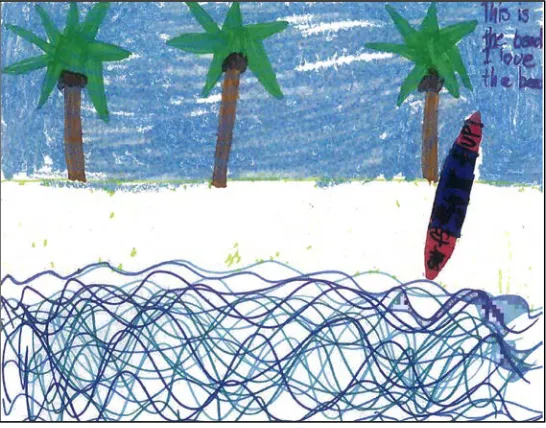
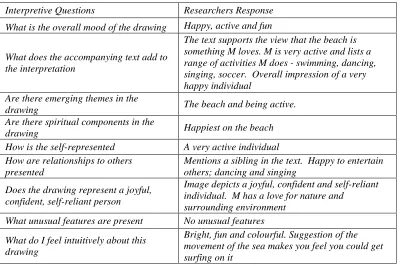
[image:10.504.130.403.395.609.2]In the first exchange when the children were essentially introducing themselves to their overseas penpal, many of the children chose to draw an outdoor scene (Figures 1-3). From the children in Cairns these scenes related to the beach environment (Figure 1), while the children from Aberdeen drew more varied outdoor environments (Figures 2 and 3). The interpretative results for the beach postcard are given in Table 2 and the woodland postcard in Table 3.
Figure 1. From first postcard exchange, this postcard was drawn by
Figure 2. From first postcard exchange, this postcard was drawn by
[image:11.504.42.443.352.618.2]a child based in Aberdeen and depicts woodlands.
Table 2. Interpretive analysis results for beach scene postcard from Cairns pupil
Interpretive Questions Researchers Response What is the overall mood of the drawing Happy, active and fun
What does the accompanying text add to the interpretation
The text supports the view that the beach is something M loves. M is very active and lists a range of activities M does - swimming, dancing, singing, soccer. Overall impression of a very happy individual
Are there emerging themes in the
drawing The beach and being active. Are there spiritual components in the
drawing Happiest on the beach How is the self-represented A very active individual How are relationships to others
presented
Mentions a sibling in the text. Happy to entertain others; dancing and singing
Does the drawing represent a joyful, confident, self-reliant person
Image depicts a joyful, confident and self-reliant individual. M has a love for nature and
surrounding environment What unusual features are present No unusual features
What do I feel intuitively about this drawing
Bright, fun and colourful. Suggestion of the movement of the sea makes you feel you could get surfing on it
Interpretive Questions Researchers Response
What is the overall mood of the drawing Positive with mostly bright colours used, the sun shining and the lone person smiling
What does the accompanying text add to the interpretation
Text explains the drawing of the woods. Explains J lives near the woods, that it has lots of trees and that birds nest there
Are there emerging themes in the drawing Woods. Very nature orientated drawing How is the self-represented Lone person represented. Smiling so a positive
representation
How are relationships to others presented A bird is nesting in the trees. The child has a positive relationship with this type of animal What unusual features are present No
The interpretive results for both postcards indicate the children enjoy the outdoor environment. This is expressed also in Table 4, the interpretative results for Figure 3 which is a picture of a park which the student visits near their home. In their narrative the Aberdeen based student points out to the Cairns student other features of the park that they could not fit into their picture:
[image:12.504.69.472.63.215.2]“I couldn’t fit the climbing frame in the photo. There is a pole and tree but I couldn’t fit them in either”.
Figure 3. Park scene drawn by a pupil from the Aberdeen school.
Table 4. Interpretive analysis results of the Park scene postcard.
Interpretive Questions Researchers Response What is the overall mood of the
drawing
Mood of the drawing is very positive with a bright, sunny day depicted
What does the accompanying text add to the interpretation
The story explains the child's drawing well. A explains the items present in the park. Are there emerging themes in the
[image:12.504.132.400.307.484.2]How is the self represented No self or other is represented in the drawing What unusual features are present No unusual features
One of the Aberdeen student’s drawing depicted objects which are symbolic of Scotland e.g. thistle (national flower), deer and rain (Figure 4). The narrative accompanying the image explained these to the child in Cairns:
[image:13.504.112.365.201.394.2]“In Scotland we get deer. The national flower is a thistle”
Figure 4. From first postcard exchange, this postcard was drawn by
a child based in Aberdeen. The content displays objects which are
symbolic of Scotland – deer, the national flower (Thistle) and rain.
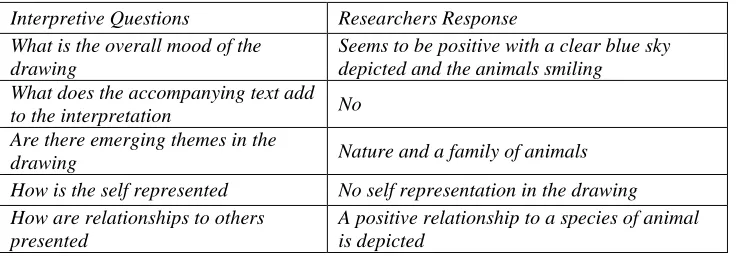
Table 5. Interpretive analysis results of deer postcard produced by Aberdeen based student
Interpretive Questions Researchers Response What is the overall mood of the
drawing
Seems to be positive with a clear blue sky depicted and the animals smiling
What does the accompanying text add to the interpretation No Are there emerging themes in the
drawing Nature and a family of animals How is the self represented No self representation in the drawing How are relationships to others
presented
[image:13.504.42.410.525.654.2]What unusual features are present No unusual features
[image:14.504.72.318.209.356.2]Comparative results of the content of the first postcards produced by the students show that 25% of the Aberdeen children drew outdoor scenes (woods, parks, garden and football pitch) compared to 33% of the outdoor images from Cairns students, the majority of which were beach scenes. More Aberdeen students (38%) drew images of their home, some including the garden in the picture for their first postcard, compared to 24% of the Cairns students. Table 6 gives a breakdown on the comparative content of the two sets of postcards produced.
Table 6. Comparative analysis of the postcard content from the first exchange
Content Aberdeen Cairns
Houses 38% 21%
Outdoor Scene 25% 33% Map of Country 0 8% House/Street Plan 17% 4%
Family 4% 17%
Animals 8% 0%
Man-made objects only 13% 4% Natural objects only 13% 29%
Figure 5. Postcard produced by an Aberdeen based student for the second exchange. The image shows someone enjoying a swim on a sunny day.
Table 7. Interpretive analysis results of the swimming picture produced by Aberdeen pupil for second batch of postcards for exchange
Interpretive Questions Researchers Response
What is the overall mood of the drawing
Seems to be positive with the lone person smiling. The day is sunny and even the animal on the towel is smiling
What does the accompanying text add
to the interpretation Swimming is a hobby. Are there emerging themes in the
drawing Beach
How is the self-represented Self is depicted positively How are relationships to others
presented Positive relationship with animals What unusual features are present No unusual features
Table 8. Interpretive analysis results for the football postcard drawn by an Aberdeen pupil.
Interpretive Questions Researchers Response What is the overall mood of the
drawing
Positive with all people smiling and green (a bright colour) dominating.
What does the accompanying text add
to the interpretation Enjoyment of playing soccer. Loves soccer. Are there emerging themes in the
drawing Playing soccer, Friends How is the self-represented Positive
How are relationships to others
[image:16.504.143.390.256.423.2]presented Positive relationship with others What unusual features are present No unusual features
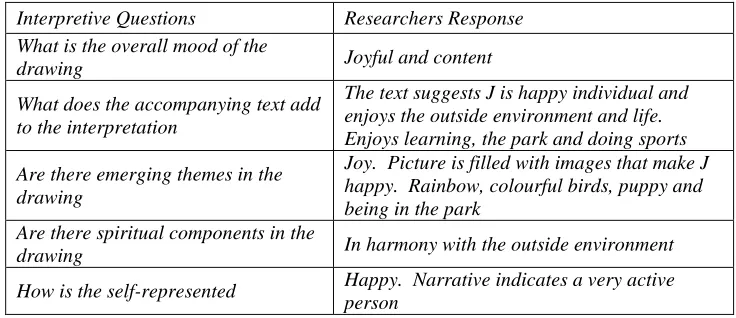
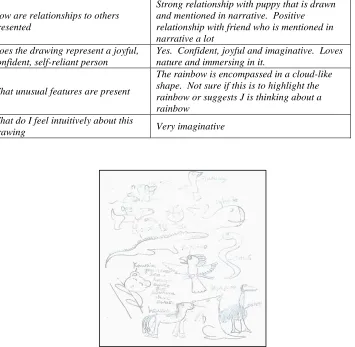
[image:16.504.67.435.492.651.2]Figure 7. Postcard from a Cairns student depicting an outdoor scene in a park. The image contains colourful birds and a rainbow.
Table 9. Interpretive results for park scene drawn by Cairns student
Interpretive Questions Researchers Response What is the overall mood of the
drawing Joyful and content What does the accompanying text add
to the interpretation
The text suggests J is happy individual and enjoys the outside environment and life. Enjoys learning, the park and doing sports Are there emerging themes in the
drawing
Joy. Picture is filled with images that make J happy. Rainbow, colourful birds, puppy and being in the park
Are there spiritual components in the
drawing In harmony with the outside environment How is the self-represented Happy. Narrative indicates a very active
How are relationships to others presented
Strong relationship with puppy that is drawn and mentioned in narrative. Positive relationship with friend who is mentioned in narrative a lot
Does the drawing represent a joyful, confident, self-reliant person
Yes. Confident, joyful and imaginative. Loves nature and immersing in it.
What unusual features are present
The rainbow is encompassed in a cloud-like shape. Not sure if this is to highlight the rainbow or suggests J is thinking about a rainbow
What do I feel intuitively about this
[image:17.504.55.410.65.412.2]drawing Very imaginative
Table 10. Interpretive results for analysis of animal postcard produced by Cairns pupil.
Interpretive Questions Researchers Response What is the overall mood of the
drawing
Happy. Most of the animals are drawn with smiles on their faces
What does the accompanying text add to the interpretation
Text suggests L is happy with living environment
Are there emerging themes in the
drawing Animals
How is the self-represented No self represented, but care taken to draw animals suggests L loves animals
How are relationships to others presented
Narrative about family suggests happy with living environment. Positive relationship with family and pets and animals
Does the drawing represent a joyful, confident, self-reliant person
Confident, happy individual. Loves nature, particularly animals.
What unusual features are present No
What do I feel intuitively about this drawing
Menagerie of animals, most are specific to Australia and care has been taken to ensure the images are identifiable, even without the labelling
Comparative results of the imagery content of the second batch of postcards indicates the number of children from Cairns drawing outdoor scenes only on their postcard remained unchanged (33%), while the outdoor imagery from the Aberdeen children significantly declined to just 8%. 38% of the postcards from the Aberdeen depicted outdoor activities, compared to 17% activity based postcards from the Cairns students. A few postcards from both schools in the second exchange contained images of computer games (13% Aberdeen, 4 % Cairns).
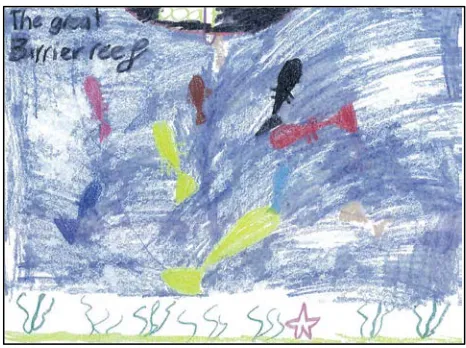
In the final postcard exchange the outdoor theme continued in the postcards produced by the Cairns students, with four postcards reflecting the beach environment and including marine life e.g. the colourful fish found in the Great Barrier Reef (Figure 9). The Cairns student explained to the Aberdeen penpal about how many people visit the reef:
“At Cairns there is a very popular reef it’s called the Great Barrier Reef and about 20,000 people come to swim in and if you were over here you’d love it”
Figure 9. From last postcard exchange, this postcard was drawn by
a child based in Cairns. The drawing is of the Great Barrier Reef, an
[image:19.504.40.410.389.581.2]important ecosystem in Australia and a major tourist attraction.
Table 11. Interpretive results of the Great Barrier Reef postcard
Interpretive Questions Researchers Response What is the overall mood of the
drawing Bright and cheerful What does the accompanying text add
to the interpretation
Text suggests A is happy and enjoys the natural environment. Talks about the Great Barrier Reef
Are there emerging themes in the
drawing Great Barrier Reef and sea life How is the self-represented Represented as someone who loves the
outdoor environment. Appreciates nature How are relationships to others
presented
Narrative suggests socialable individual. Positive relationship with friends and classmates
Does the drawing represent a joyful, confident, self-reliant person
Happy, content and confident. Love nature and appreciates natural environment of Australia
Figure 10. From last postcard exchange, this postcard was from
a child based in Aberdeen and is a photograph taken to show the
Autumn season in Scotland with the different coloured leaves and
leaves falling off the trees.
Given the photographic nature of the last batch of postcards from Aberdeen and the repetitive nature of the images (e.g. leaves), the interpretive analysis could not be carried out. Content analysis of the last postcards produced by the Cairns students reveal 41% of the postcards depicted outdoor scenes. One postcard was a plan view of a local natural pool where the child had found a skull. The narrative to the Aberdeen penpal explains the picture well and the adventure of the find. Another child drew a picture of the Cairns’ school vegetable garden and their narrative described what plants the children grew there.
Friends featured prominently in the last postcards produced by the Cairns students (27%) and in many cases the student had identified the friends to their Aberdeen penpal by writing the child’s name about the image.
Student post project interviews
Definition of Environment
In the post-interviews, neither participating group of students required the use of the verbal and visual prompts. The responses received were more closely aligned with regards to items mentioned in their definition of the word ‘environment’ (Table 12).
Table 12. Items used in responses to define the word ‘environment’ in post-interviews.
Item Scotland Australia
Trees 43% 35%
The world around us 39% 39%
Plants 30% 26%
[image:20.504.63.468.557.648.2]Flowers 9% 13% Sustainability issues 9% 13%
Sustainability issues in the responses received from the students from Scotland and Cairns related to caring for the world and protecting the trees and plants.
Describe your environment
In the post interview responses to question 2, 69% of the Australian students were more focused on the nature around them with 39% referring to trees, 26% to plants and 17% to flowers. Three responses were descriptive of nearby creeks:
“There is a creek there and when it rains for a few days you can swim in it and catch fish and red claws”.
“There’s a few frogs around (jump on his window for aircon)”.
“There’s lots of snakes down at the creek”.
30% of responses from the Australian students included descriptors for the outdoor environment, which included: lots of space, windy/sunny, clean and beautiful.
From the Aberdeen based students, the responses were more related to descriptions about the weather with 26% of the children mentioning the cold weather and lack of leaves on the trees. A few students made comparisons between the climate in Aberdeen and Cairns, for example: “Not like Australia. Cold and in summer not warmer than 12oC. No pools in gardens as there is not enough hot air. It’s coming up to Christmas and snow is coming”.
None of the responses in the post-interviews to question 2 included any reference to the indoor environment; either features or activities.
Concerns about the environment
After the postcards had been exchanged, this question solicited a slightly lower percentage of students responding with no concerns or worries (39% Aberdeen, 43% Cairns). There was an increase in the number of students responding with concerns which related to the environment and our impact on it. Most answers related to litter and rubbish and how this can lead to the death of animals and plants/trees. One response from a Cairns student was:
“We might lose some things like animals and other living things”.
One Aberdeen based student mentioned the impact of animals and people on nature:
“Pets and animals destroying some of nature and people littering”.
The percentage of students in Aberdeen who had environmental concerns remained the same (21%), however 9% mentioned vehicle pollution was a cause for concern, while one student mentioned the impact of non-native species in Scotland:
Two Cairns students spoke about their concerns about their neighbourhood, with both students specifically referring to being robbed.
What do you know about other environments?
Post-interview responses from the Aberdeen based students found that 96% of the students were able to describe aspects of Australia, with 52% mentioning its climate, 43% its animals and 22% mentioned the Great Barrier Reef. Comments which relate to these three areas include:
“Great barrier reef has stopped people chucking litter in it, so animals and reef won’t be damaged”
“Learnt that Australia is kind of a dangerous place to be in the wild, cos there are crocodiles. It’s a good place to swim in through the reef. Lots of kangaroos and koala bears”
“Quite tropical”
“It’s hotter cos it’s nearer the equator”
Several students made reference to the time difference between Scotland and Australia and the variation in seasons, for example:
“Their winter is our summer”
“The warmest months are at the start and end of the year and ours are in the middle”
“When we sleep, they wake up”
Two students from Aberdeen commented on the geographical locations of Scotland and Australia, with one commenting “Australia is nearest the equator and Scotland is nearest the top of the world”.
Other comments made in response to question 6 of the post project interview were differences between the two countries which included: pools in the gardens, different plants, vegetables and flowers and size of the two countries.
The responses from the Aberdeen based children were more prolific than those given by the Cairns students. Only 65% of the students from Cairns indicated they had learnt something about either Aberdeen or Scotland, with the majority of these commenting on the weather in Scotland/Aberdeen. A few students made reference to the climate in Scotland and activities that might be limited or different due to the weather conditions, for example:
“I’ve learnt that in Scotland it’s much more cold and its snows more often. It’s harder to go outside and do stuff”.
“That Scotland is very different because they have snow and we don’t. They do different things to us (skiing and ice-skating)”.
One student in reference to Scotland having snow made the comment “I think it would be cold, wet and fun. I’ve never seen snow”.
Other comments made about specific things learnt about Scotland/Aberdeen were:
Different houses/speech/culture/just different 35%
Loch Ness monster belief 5%
Some ponds to feed ducks 4%
Big fields to play in 4%
Call football soccer 4%
Do different things (skiing/ice skating) 4%
What activities were enjoyed and what can be done differently
The overall response to question 7 of the post project interview was very positive, with students in Aberdeen and Cairns stating that they enjoyed the project. 74% of the Aberdeen based students indicated that the best thing about the project was writing a postcard to someone in another country. Specific responses within this context were:
“get letters from people in a different country”
“talking to our friends on our postcards”
“get to see what they like, their pets and what their family are called”
“I never thought I would get a postcard from Australia”
“I have been getting to speak to my friend and see what they do. I got to see
what their environment is like”
When referring specifically to the task of writing a postcard, one Aberdeen student replied “better than normal writing, and I will be sad to stop writing to them”.
This type of response was similar to that received from the Cairns students:
“We got to draw pictures, write things about us and make friends”
“We got to write to our friends in Scotland and we’re much different to them”
“We got to draw and share information about us and that they responded to us”
“I got to meet a new friend and learn more about what they do, not people I already know”
“We could talk to people somewhere else in the world”
“We write and draw pictures and send them. Then we get others back. We get to talk with our friends about it and in class”.
From the responses received from the Aberdeen based students, 26% referred to a teacher-initiated activity which related to learning more about Australia. A few students also mentioned ‘pointillism’ a drawing activity which was led by their teacher
“Write to somewhere different next time”
“Maybe have someone from even further around the world”
Other suggestions from the Cairns students were more related to the engagement with their postcard penpal:
“Seeing each other”
“To say more information to the person”
“I could tell about what’s been happening. Talk more about Cairns”
Many of the responses from the Aberdeen students with regards to what to do differently involved a trip to Australia and their Australian friends visiting Scotland. One student suggested “We could go on a trip and see how different their environment is”. One student spoke of a letter the class had written to their Head teacher asking for permission to visit Australia:
“We wrote a letter to Mrs T. to visit Australia and stay with Reesa or our friends.
We would work on the plane”.
Other changes suggested for the project were:
“Photographing and sharing photos of each environment”
“Doing more class activities about Australia”
Teacher post project interviews
Focussing specifically on the questions asked in the post project interviews, which related to the project, the teachers’ responses are given in Table 13.
Table 13. Responses from the Teachers Post Project Interviews to three specific project related questions.
What have they learned about other environments,
particularly the one with which they shared postcards?
Which activities worked? What could we do differently next time?
How will you follow-up this learning in class?
Cairns Teacher 1
That is very different
I really liked the collection of objects that were relevant to the child, in which they used to generate their ideas and feelings about different things
Cairns Teacher 2
They have learnt about the hemispheres and how it is colder as you get further from the equator. The different styles of houses are because of the different climates.
Skyping would be great but we need more notice for this activity.
It is very close to the end of the year but we are learning about Christmas around the world at the moment and Scotland will feature as one of the countries we learn about.
Aberdeen Teacher
We have compared the climate of Cairns to Aberdeen. We have learned about native animals in Australia. We have learned about what grows in the school garden in Cairns.
Children loved writing the postcards to their 'friends'. Maybe some guidance on topics/headings that could be covered.
Continue work on biodiversity issues in Scotland
Discussion
The project only ran for four months, however there was still a noticeable shift in the children’s understanding of the environment and sustainability observed. First notable change was with the responses received between the pre and post project interviews to the first question, “What is the environment?” which was asked of the children. The verbal and visual prompt was only required for one child in the post project interviews, compared to 12 in the preliminary interviews. For the definitions received for the word ‘environment’, 39% of the responses from both schools mentioned ‘around you (either living things, surroundings, earth) or ‘world around us’. This was a significant increase in the usage of this definition particularly for the Cairns students; 18% usage in pre interviews, 39% usage in post interviews and even for the Aberdeen students, the usage of this definition had increased by 10%. Usage of the words: plants, grass, trees, flowers, etc., remained similar in both the pre and post interview responses. It was encouraging to note after the project, that responses from Cairns students also included references to specific Australian environments e.g. outback, rainforest. One child stated “The rainforest is a healthy environment” and more references were made to looking after/protecting the environment, which indicated children were thinking more about their local environment and its sustainability.
This change in the children’s ability to reflect more on their own environments and issues was also noted by the school staff. Both participating classes (Aberdeen and Cairns) had some prior learning about the environment, prior to being involved in the project. Their knowledge related to looking after the environment, particularly with regards to recycling and not littering and this was reflected in the majority of the answers given to the initial interview questions. After four months of being part of the project and with the additional support learning in the classroom, all the children were able to express more individualistic responses to the interview questions and talk about specific environmental issues reflecting advancement in their appreciation and understanding of the natural world. This was supported by statements from the Deputy Principal the Scotland Primary School:
“The children were clear about the environment and were able to explain quite a bit about it and are more aware of Biodiversity and what it means for the future”.
and the classroom teachers of the participating schools:
“They have learnt about the hemispheres and how it is colder as you get further from the equator. The different styles of houses are because of the different climates”. Post interview response from Cairns Primary School Teacher.
“We have compared the climate of Cairns to Aberdeen. We have learned about native animals in Australia. We have learned about what grows in the school garden in Cairns”. Post interview response from Aberdeen Primary School Teacher.
Comparisons between the responses received when asked to describe your environment, also showed a shift in the children perceptions, with nearly all the children from both schools giving responses in the post project interviews which related to the outdoor environment and making reference to the nature around. This change was more noticeable in the responses received from the Cairns students, who in the pre-project interviews provided very few descriptors for the outdoor environment, preferring instead to refer to an outdoor item or feature e.g. pools, sheds, trampolines.
There was a slight drop in the number of children from both schools who expressed no concerns/worries about the environment in their post project responses; and the concerns expressed were more varied and less focused on littering for the Aberdeen children. It would have been nice to see issues highlighted in their responses which related to the environment of their penpal, particularly as some of the Aberdeen children had taken note of about issues relating to the Great Barrier Reef. These were expressed in their responses to the question “What do you know about other environments” which included comments such as “has environmental protection”. It may be that the wording of Question 4, “worries or concerns about the environment,” did not enable children to make the connection between what they had learnt about a particular environment and environmental issues.
It was disappointing that in the post interviews, 26% of the Cairns students gave a negative response to the question “What do you know about other environments?” A review of the postcards exchanged between the Cairns students who provided this reply and their Aberdeen penpals revealed that there were some references made to the environment in Scotland by the Aberdeen penpal. Further, the final batch of postcards from the Aberdeen students presented photos of autumn scenes in Scotland; which one would have expected to have a more dramatic impact on the Cairns students, who don’t experience such an autumn in tropical Australia. It is unfortunate that the project ended before postcards could be produced by the Cairns students in response to the autumn scenes, as these may have demonstrated their learning about the environment in Scotland. Another set of postcards from Cairns may have also reinforced to the students what they had learned about the other environment; and may have impacted on their answer in the post program interview.
Conclusion
Findings from this research demonstrated shifts in students’ understanding, concerns and knowledge about the environment, both locally and globally. This was evidenced by the pictorial images produced and the extended answers from most students in the post project interviews. Students at both schools expressed enjoyment in participating in the project, and having a penpal in another country with whom they could communicate. From previous iterations of this research, it seems that this is a common theme: rather than writing to the class as a whole, having a particular person with who to share postcard information was engaging and enhanced the learning experience. Further, using the postcard format; that is visuals as well as words; allowed students to express their understandings in multiple ways.
While teachers sometimes describe current curricular demands as ‘overcrowded’ and ‘unmanageable’, this project presented them with a creative and engaging way to teach. In a cross-disciplinary way, it included topics of science and environment, but also art, creative writing, research, communication and technology, thus covering a number of curriculum areas within a single project.
Limitations to this research were in the time it was conducted; over a four-month period. This was due to limitations in the research grant itself, but also because the school years differ between the northern and southern hemispheres. In the northern hemisphere, schools commence for the year in August/September and finish in June. In the southern hemisphere they commence at the end of January and finish mid-December. This makes it difficult for groups from each region to communicate for more than four or five months, as school years end and students move on to other grades and usually do not stay together as a group. Had there been a way of keeping students in contact with each other, a change that would be made to the project would be to extend the postcard exchange period. The first postcards were essentially about the children introducing themselves to their penpal. In the subsequent postcards there were more images of outdoor scenes and activities and, from the Aberdeen children, photographs of the changing season in Scotland. Further postcard exchanges could have included photographs of the Cairns environment and extended topics and areas of the environment discussed and supported by teacher-facilitated activities.
Overall, learning about the environment and environmental sustainability through postcards sent to penpals in another country was very successful in engaging learners and helping them to learn. Combining science, sustainability, language and the arts not only gave students multiple opportunities to learn and to demonstrate their learning, but also encouraged teachers to creatively engage their students in the learning process. It is hoped that in the future the researchers will be able to implement this program to students in many age groups and in many different countries.
REFERENCES
Einarsdottir J., Dockett S., Perry B., (2009), Making meaning: children’s perspectives expressed through drawings. Early Child Development and Care, Vol 179, No 2, p 217-232. Financial Times. (n.d.). Definition of Environmental Sustainability. Accessed 3 March 2015 at
http://lexicon.ft.com/Term?term=environmental-sustainability .
Kumar, Ranjit. (2005). Research Methodology – a step by step guide for beginners. 2nd edition.
Frenchs Forest, NSW: Pearson.
Louv, Richard. (2005). Last Child in the Woods – Saving our Children from Nature Deficit
Disorder. North Carolina, USA: Algonquin Books.
Mondal, Puja. (n.d.). Meaning, definitions and components of environment. Accessed online 3
March 2015 at http://www.yourarticlelibrary.com/environment/meaning-definition-and-components-of-environment/6157/.
Natural Resource Management Ministerial Council 2010, Australia’s Biodiversity Conservation Strategy 2010-2030, Australian Government, Department of Sustainability, Environment, Water, Population and Communities,
Canberra.
Sorin, Reesa. (2014). Sharing Postcards about Where We Live: Early Childhood Environmental
Understanding. The International Journal of Early Childhood Learning. Vol. 20, 35 –
49.
Sorin, R and Gordon, I. J. “Frogs in the Drain — Children’s Perceptions of the Tropical
Landscape.” Refereed Proceedings of the Inaugural Tropics of the Imagination
Conference, 2-3 November 2009. etropic: electronic journal of studies in the tropics, Vol 9 (2010), < http://www.jcu.edu.au/etropic>
Sorin R., Gordon I.J., (2013). Developing a Methodology to Assess Children’s Perceptions of the Tropical Environment. International Education Studies, Vol 6, No 2, p 96 – 108. UK National Ecosystem Assessment (2011). The UK National Ecosystem Assessment: Synthesis
of the Key Findings. UNEP-WCMC, Cambridge.
http://www.keepscotlandbeautiful.org/sustainable-development-education/eco-schools (2014)
http://www.abs.gov.au/AUSSTATS/[email protected]/Lookup/1301.0Feature+Article12009%E2%80%9 310
ABOUT THE AUTHORS
Dr Carol Ann Stannard is Assistant College Registrar at The University of Aberdeen, Kings College, Scotland. She is a scientist with a particular interest in land and human environmental systems.
Associate Professor Reesa Sorin lectures in Early Childhood Education and Arts Education at James Cook University, Cairns, Australia. Her research interests include arts-based methods for teaching environmental sustainability and the impact of dogs in the classroom.