Scaling-
Up Process
-
Oriented Guided Inquiry Learning
Techniques for Teaching Large Information Systems
Courses
Jarrod Trevathan,
Griffith University, AUSTRALIA [email protected]
Trina Myers
James Cook University, AUSTRALIA
Heather Gray
Griffith University, AUSTRALIA [email protected]
Abstract
Promoting engagement during lectures becomes significantly more challenging as class sizes increase. Therefore, lecturers need to experiment with new teaching methodologies to embolden deep learning outcomes and to develop interpersonal skills amongst students. Process Oriented Guided Inquiry Learning (POGIL) is a teaching approach that uses highly structured group work during lessons so that students construct content. Each group member takes on a role for which the other group members rely on, and then the group reports back to the class. This paper describes how POGIL was adapted for use in a large first year Information Systems course. Quantitative and qualitative results suggest that students are receptive to POGIL, as the approach creates a relaxed, friendly and trusting community that is typically not present in classes that use a didactic teaching style. We provide a discussion of lessons learned with regard to using POGIL in a large lecture theatre and give recommendations for how to improve interactivity amongst the class.
Keywords
POGIL, active learning, student interaction.
Introduction
The didactic approach to lecturing where there is one-way communication from the lecturer to the students is clearly ineffective (i.e., the “sage on the stage”) (Moog & Spencer (2008). Research conducted into this teaching style suggests a disconnection with the way the human brain is wired
to interpret new information and learn (Bransford, 2000).Therefore, the traditional approach to
lecturing needs to evolve with the advent of new technologies and teaching methodologies that are better suited to the way humans learn. The scope of the problem magnifies when class sizes become large (e.g., 200 + students).
that are critical for their careers as they transition from study into the work force. POGIL has traditionally been used for teaching Chemistry to large classes to promote engagement and the fostering of soft skills (Farrell, et al (1999), Hanson & Wolfskill (2000)). Recently, POGIL was
adapted for use in Information Technology (IT) classes – where there is a significant need for
nurturing soft or interpersonal skills (Myers, et al (2012); Trevathan and Myers, (2013)). The Myers, et al. (2012) study involved two subjects (networking and databases) taught over a two-year period. The study found that students’ problem solving abilities, interpersonal skills and learning outcomes improved significantly. Over 85% of the students surveyed stated that they found POGIL beneficial to their studies. However, the IT class sizes in the Myers, et al. (2012) study were relatively small (i.e., up to 70 students).
This paper investigates how well POGIL scales up to a class size of approximately 350 students
undertaking an Information Systems (IS) subject consisting predominantly of business,
management, commerce, and accounting students. We describe the course structure and strategies employed to promote engagement using POGIL. Quantitative and qualitative results suggest that POGIL creates a relaxed, friendly and trusting community that is typically not present in classes that use a didactic teaching approach. We also provide a discussion of lessons learned with regard to using POGIL in a large lecture theatre and give recommendations for how to improve
interactivity amongst the class.
This paper is organised as follows: Section 2 provides background on POGIL and how this teaching methodology operates in lectures and workshops. Section 3 describes the methodology for how POGIL was adapted for use in a large IS course and the way data was gathered to provide feedback on POGIL’s effectiveness. Section 4 presents quantitative and qualitative results from the teaching surveys conducted, and provides a discussion on the lessons learned regarding the use of POGIL in a large lecture theatre. Section 5 gives a few concluding remarks and avenues for future work.
Background and Problem Motivation
How POGIL Works
POGIL is a method that uses highly structured group sessions where students work on process-oriented tasks to derive answers as a collective. The students work together in groups of three or
four and are assigned one of the following roles: Manager, Recorder, Presenter or Reflector
(optional). The use of roles enforces accountability within the groups so the outcomes are peer-driven as opposed to instructor-peer-driven where the motivation of completing tasks is to satisfy the instructor. Each role is dependent on the other roles, so students are accountable to their peers for the function they play (D. Hanson & Wolfskill, 2000; D. M. Hanson, 2006; POGIL, 2012).
The Manager ensures that team members are fulfilling their roles, accomplishing the assigned tasks on time, and all group members are participating in the activities and understanding the concepts. The Recorder scribes the group’s discussions and important aspects of the group’s observations, insights and the significant concepts learnt. The Presenter delivers concise oral reports to the class. The Reflector observes group dynamics, behaviour and performance and may report to the group (or the class) about how well the group operates.
The POGIL activities focus on core concepts and encourage a deep understanding of the course material through an exploration to construct understanding while developing higher-order thinking skills. The tasks include directed, convergent or divergent questions. Directed questions can be answered directly from the information provided, convergent questions require groups to reach a consensus of the solution and divergent questions can have a range of possible correct responses.
To initiate POGIL in a subject, the class must first undergo a “building the POGIL culture” stage.
information and collaborative learning. The students also learn the rules and roles of the “highly structured” group sessions, and the expectations for each session.
Once the POGIL culture has been established, students come to class prepared for POGIL group work. While there are numerous formats for how POGIL lessons can be structured, a common
approach is to have a ten-minute “mini-lecture”, then a “breakaway POGIL session” for five
minutes. During the POGIL session, the students will work on an exercise related directly to the lecture content. The instructor mingles amongst the groups to gauge how the students are
performing. At the end of the session, two or more groups are called on to report back to the class
(during a “consolidation session”). The instructor then typically recaps and/or adds to the
students’ answers.
Problem Motivation – “The Tumbleweed Moment”
POGIL was originally used for teaching Chemistry students in a laboratory setting over the course of a full day. The Myers, et al. (2012) study was the first time POGIL had been applied in a discipline outside of Chemistry, and in a traditional lecture theatre setting. However, the study involved smaller lecture sizes of up to 150 students. The main problem addressed in this paper is how to scale up POGIL to large classes of potentially 400 students. This paper aims to extend upon the Myers, et al. (2012) study by describing what additional teaching “infrastructure” in the form of techniques, resources, or approaches are required to make POGIL effective in a large class setting.
The biggest challenge with a large class is promoting engagement. Using POGIL does not guarantee that engagement will occur. We have dubbed the situation where engagement does not
occur as the “tumbleweed moment”. In American western cowboy movies, tumbleweed is a dead
circular plant that is perpetually blowing around a desolate landscape. The tumbleweed is a symbol of deafening silence and hopelessness. We metaphorically apply this to the moment in either a POGIL breakaway or consolidation session, whereby the students do not respond to any prompts or engage in any manner. From the lecturer’s perspective, it almost seems as if tumbleweed is blowing across the lecture theatre. This is accompanied by a feeling of failure and despair. The challenge is how to avoid the “tumbleweed moment” in POGIL. This paper seeks to provide strategies and approaches in the form of lessons learned that increase the chances of engagement.
Methodology
The trial course was an IS subject with a cohort of approximately 350 students. IS differs to IT in that, in addition to technology, it focusses on the people and procedures that employ the
technology for a business-driven goal. As such, this study has a slightly different student demographic than Myers, et al. (2012) with business, commerce, accounting and management students (as compared to primarily IT students). The remainder of this section describes the how POGIL was adapted for use in the subject, and the quantitative/qualitative approach that was used to gauge how effective POGIL was throughout the course.
The Course POGIL Structure
At the start of the second lecture, the entire process was repeated with a new set of instructions for an image (refer to the bottom section of Table 1). However, students were placed under pressure by having a slightly more challenging image and less time to come up with a solution. After this exercise, the actual course content begins, and there is a content-related POGIL exercise undertaken later on in the lecture. The point of the second lecture was to reinforce the idea of group work and also to introduce students that may have missed the first lecture on what was expected for POGIL group work.
Table 1
“Building the POGIL Culture” Exercises (Myers et al., 2012).
In the middle of the paper draw a parallelogram
• 13 cm wide x 6 cm high
• Skewed 45 degrees to the right
Under this shape
• To the right draw a biohazard sign
o (4cm diameter)
• To the left draw Pacman
o (4cm diameter)
• Between these draw an Ankh
o (4cm high)
Above the parallelogram draw a sine wave where:
• The top line of the parallelogram represents
zero and its width represents 1 second
• The sine wave starts in the positive phase
• The sine wave has a frequency of 3Hz and
• The amplitude peaks at 1cm high
In the centre of the page starting at the bottom draw a cylinder (3D)
• 6cm high
In the bottom left corner draw the symbol for a Universal Quantifier
• 4cm high
In the bottom right corner draw an atom
• 4cm high
In the middle of the top of the cylinder draw a Zombie facing forward with his head lolling to the left side
AND
Holding a Papua New Guinea flag in his right hand.
The flag is:
• 3cm wide x 2cm deep
• Dropping downward at an angle of 45
[image:5.595.92.504.100.586.2]degrees
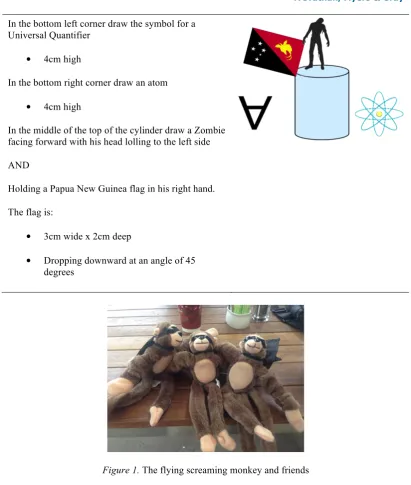
Figure 1. The flying screaming monkey and friends
To add an element of “quirkiness” to the POGIL sessions, we employed the use of three flying
screaming monkeys1 (see Figure 1). The flying screaming monkey is a sling shot that propels the monkey through the air. An accelerometer within the monkey senses the vibration and causes the monkey to shriek. The monkey’s purpose was to signal the end of a POGIL breakaway session. The monkey acted as a universal (and fun) sign that the students had to quickly focus their attention on the teaching facilitator again. The idea was that this would be a better way to regain control over the class rather than through issuing verbal commands. There was also the added
“engagement bonus” that students could be hit by the monkey during the lecture. (Note that students would not be physically harmed by the monkey as it is a plush toy.)
After the “building the POGIL culture” phase, POGIL exercises were introduced in every lecture. Lectures were limited to 50 minutes. After allowances for 5 minutes at the start and finish of the lecture for “housekeeping” (e.g., announcements, admin, etc.), there was only 40 minutes remaining for actual teaching. This made lesson timing critical. Throughout the semester we experimented with two types of POGIL lecturing format:
• 2 x (10 minute mini-lecture, 5 minute POGIL breakaway session, 5 minute POGIL
consolidation session); or
• 1 x (20 minute mini-lecture, 10 minute POGIL breakaway session, 10 minute POGIL
consolidation session).
The POGIL exercises were of three types: Convergent, divergent, and directed. An example of a
convergent question is a debate over competing government policies on high-speed broadband. A divergent question may be to analyse the fast food industry using Porter’s five forces model. Alternately, a directed question could be “Explain how social networks facilitate viral marketing”. During each exercise, a modest prize was on offer for the group that gave the best answer.
The Griffith University PRO-Teaching Project
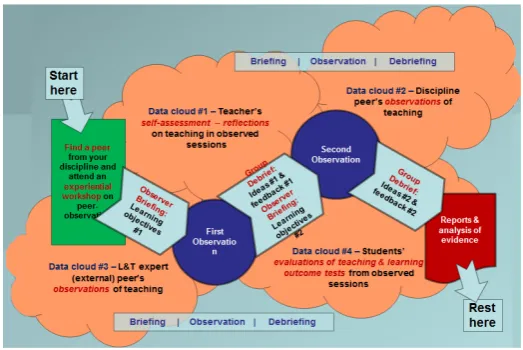
PRO-Teaching2 uses a developmental form of peer observation (review) of teaching that creates a
[image:6.595.167.429.439.614.2]collaborative and supportive atmosphere for staff to discuss and share ideas around teaching practice. Using a structured approach, data is collected from a range of sources to build evidence of teaching quality.
Figure 2. The Processes in the PRO-Teaching Project.
The PRO-Teaching project consists of two rounds of peer-feedback and student evaluation (see Figure 2). Two peers are chosen (one with discipline knowledge and the other from a teaching and learning background). The peers reflect on the lecture in terms of a broad range of criteria as outlined by the PRO-Teaching project including: 1) aims and objectives; 2) content knowledge; 3)
teaching techniques; 4) personal characteristics; 5) formative assessment; 6) deep learning outcomes; 7) curriculum structure; 8) learning environment; 9) teaching aids and materials; and scholarly approach. After each evaluation, the peers discuss “things that worked well”, “points for consideration” and “agreed development ideas” with the lecturer. During the lectures being evaluated by the peers, students are also issued with an optional survey asking them to gauge the teacher’s effectiveness from their perspective across a range of criteria.
POGIL Survey
The PRO-Teaching program is largely geared towards professional development in teaching. The surveys are designed to provide the lecturer with feedback about his/her teaching approach and aptitude. The surveys do not specifically target extended aspects related to POGIL that this study was intending to capture. Therefore, a second survey was conducted with POGIL specific
questions at the end of the course. This was administered online3 and remained open for two
weeks.
Results
PRO-Teaching Results
Table 2 presents the questions from the PRO-Teaching student survey. Students were asked to rate each question from 1 to 5, where “1 = strongly disagree” and “5 = strongly agree”.
Table 2. PRO-Teaching Student Survey Questions
How effective is this teacher in:
Q1 Making clear the objectives of the lesson?
Q2 Using approaches to help you learn?
Q3 Motivating and inspiring you to learn?
Q4 Highlighting the relevance of what you were to learn?
Q5 Assessing your prior knowledge before explaining new material?
Q6 Ensuring that you received feedback which helped you to learn?
Q7 Explaining the requirements and standards of work for excellence?
Q8 Helping you to extend your knowledge understanding and skills (i.e., challenged you)?
Q9 Teaching in an organised and coherent manner?
Q10 Using feedback to improve his/her teaching?
[image:8.595.96.498.79.530.2] [image:8.595.97.503.321.526.2]Q11 In helping you to learn overall?
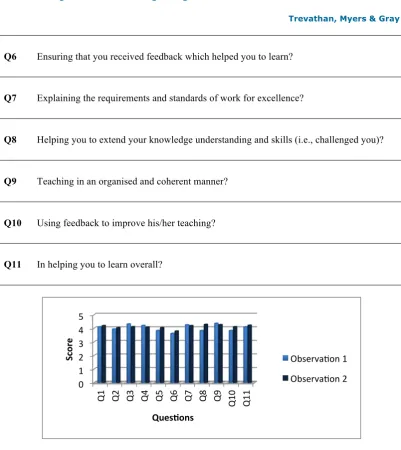
Figure 3. PRO-Teaching Student Survey Results for Both Observations
Figure 3 presents the survey results from the two student observations of the lectures. The number of respondents was 19 and 41 for observations 1 and 2 respectively. The use of paper planes was suggested by Kahn & Walsh (2006) as a fun way of encouraging feedback from students. As such, the students were asked to make paper planes out of their survey forms for the second observation. The paper plane approach doubled the response rate for the second observation.
In general, the second observation scored marginally better than the first observation. This suggests some improvement in the lecturer’s personal style. The significant result is that the lectures were rated as being approximately 4/5. This indicates that the students were positively responding to the POGIL approach – particularly with regard to question 4 (“Highlighting the relevance of what you were to learn”) and question 11 (“In helping you to learn overall”).
Questions 3, 7 and 9 rated the most highly. These questions were “motivating and inspiring you to learn”, “Explaining the requirements and standards of work for excellence”, and “teaching in an organised and coherent manner”. These questions are consistent with POGIL’s philosophy as to
0 1 2 3 4 5
Q1 Q2 Q3 Q4 Q5 Q6 Q7 Q8 Q9 Q10 Q11
Sc
or
e
Ques*ons
Observa4on 1
what POGIL is trying to achieve. Question 6, “ensuring you received feedback which helped you to learn” rated the lowest of all questions. This may have something to do with improving the lecturer’s techniques for closure on the consolidation sessions to ensure that all students do sufficiently understand the content (explained further in Section 4.3).
A shortcoming of the survey results is the low response rate in terms of the percentage of overall students in the class (5% - 11%). Future work would involve further surveys across multiple offerings of the course and other measures to increase the response rate.
POGIL Survey
Table 3 shows the questions for the POGIL survey. Students were asked to rate each question from 1 to 5, where “1 = strongly disagree” and “5 = strongly agree”.
Table 3
POGIL Survey Questions
Q1 What are three things about POGIL group work that were valuable to your learning?
Q2 Is there anything about the POGIL group work that you think could be improved?
Q3 As a result of the POGIL group work, I feel more confident in my ability to work with
my fellow students. Why do you feel this way? Could you share an example?
Q4 As a result of the POGIL group work, I felt more engaged during lectures. Why do
you feel this way? Could you share an example?
Q5 POGIL group work helped me:
A. remember concepts and processes learned in this subject
B. be able to explain and compare concepts and processes learned in this subject
C. understand how to apply the concepts learned in this subject
D. analyse processes and problems in the subject area
E. evaluate (check and critique) solutions in the subject area
Q6 During POGIL group work, the lecturer responded to the level of understanding in the class, and adapted their teaching accordingly.
Why do you feel this way? Could you share an example?
Q7 Overall, I feel that the POGIL group work in lectures has been a positive learning
experience.
Q8 Thinking about the way your other classes at university have been taught, do you
[image:10.595.123.485.315.461.2]think POGIL group work could benefit other subjects? Do you have any comments about the ways that POGIL group work was an advantage or disadvantage compared to the teaching in other subjects?
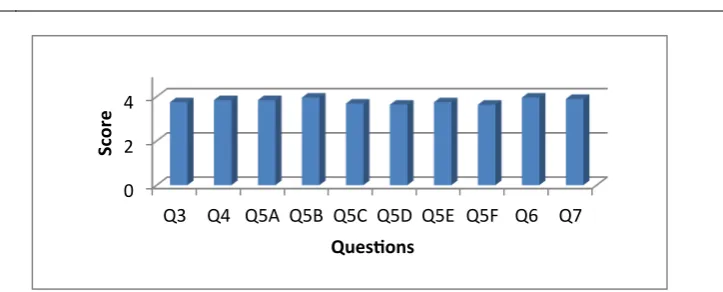
Figure 4. POGIL Survey Results
There were 19 respondents for the POGIL survey. Figure 4 shows the survey results. Table 4 provides samples of student feedback when asked to comment on why they scored certain
questions the way in which they did. The survey results largely support those of the PRO-Teaching survey and suggest that students were receptive to the POGIL approach. Most respondents felt that they developed a deeper understanding of the content, enjoyed peer engagement/feedback, and liked the interactive nature of the lectures. The most prominent suggestion for improvement was stricter enforcement of POGIL groups. Overall, most students thought that POGIL would be beneficial to their learning if used in other subjects. There was only one respondent that strongly disagreed with his/her experiences with regard to POGIL.
0 2 4
Q3 Q4 Q5A Q5B Q5C Q5D Q5E Q5F Q6 Q7
Sc
or
e
Table 4
Student Comments to Elaborate on Survey Questions
Trends Students’ Comments
The use of POGIL in lectures
“I think POGIL and the combination of a Facebook group worked well and has the potential to work even better in the future. I thought the prizes were also a good idea, people who want to present their answers should get rewarded, and people who present great work should get a bigger reward.”
“Helped me understand the topic better.”
“The ability to discuss and voice my opinions about the subject/topic and hear others’ opinions.”
“Interacting with peers.”
“Made the teaching more personable. Was good!”
What can be improved about POGIL
“Instead of getting into the same groups try and get into a slightly different group every time.”
“POGIL group work is good. I think it doesn't need any improvement.” “It was hard to keep the same teams for all of the lectures. I think because it didn't count towards the grades. Maybe make it mandatory for the POGIL groups to stay together for all the lectures.”
“Maybe smaller groups of two would work better.”
“Sticking to the same group members from the start. This is due to the fact that the students turn up for that week that the POGIL groups are formed and then they fail to turn up for the rest of the semester.”
Attitude towards working with other students
“Not only did it make clear what people in my group were thinking, but the reports given by each group after the POGIL group work allowed people to share their thoughts with the whole theatre. Knowing these things made me more comfortable and confident when working with others.”
“You are basically forced to work with other students which in time will only build your confidence in your ability to work with other students.”
“I was able to interact with other students doing the same course and also overcoming my shyness.”
“Knowing that everyone has a different opinion and have a right to be heard even if you don't agree with it.”
“It was a good way to get to know people.”
“It helps you learn how to make friends in a course. For example, today, I made a new friend during the SEEK POGIL activity. It was fun.”
Engagement in lectures
“I particularly enjoyed the weeks where we were asked to draw specific things on a sheet of paper and present our attempts to the rest of the class.”
“I looked forward to coming to this lecture over any others.”
“Working and sharing answers during the lecture gives you the feeling that the lecture is made for your benefits and study.”
“It easier to understand the content when you are talking about it to each other.”
“We had to physically move around to be with other group members, made you feel involved.”
“Instead of sitting there and listening the lecturer talk, we had to listen and then apply the information that we learnt.”
Could POGIL be used on other courses?
“For the non-maths based subjects, it would be very beneficial as it helps you understand what you understand well and what you don't.”
“I think POGIL group work could be used in other lectures, especially longer lectures as they give you time to process the information for yourself and have a break from the lecturer speaking.”
“I liked the different approach that this subject had and would like to see it in other course.”
“Yes, definitely! Other intricate subjects such as accounting.”
“I think that POGIL group work could benefit other subjects so that the lectures are more engaged and people who are kinaesthetic learners (like me) can learn more during lectures.”
Lessons Learned for Facilitating Engagement through POGIL in Large Classes
The following are a few key points discovered through experimentation and reflection throughout the course with initiating the POGIL sessions. The points came about by casual discussions amongst the teaching staff.
The lecturer must mingle with the students. During the POGIL breakaway sessions, the lecturer absolutely must try to circle through at least part of the class. Remaining stationary at the front does not promote engagement, nor does it allow the lecturer to get a feel for whether the students are understanding the content. Mingling with the students also allows the lecturer to identify which groups have a strong answer so that they can be singled out to report to the class if the lecturer is having difficulty with getting groups to volunteer during the consolidation session. Time
constrained activities may not always allow the lecturer to get very far around the class. Therefore, different parts of the class can be ventured to during different breakaway sessions in order to cover as much of the class as possible.
Ideally, the lecturer should stand in front of the lectern. The lectern can often create a mental and physical barrier between the lecturer and the students. Where possible, the lecturer needs to be in the space half way between the lectern and the front row of students. For a large lecture theatre, a wireless microphone and remote mouse (to advance through lecture slides) are required.
covered in a lecture. We found two-three concepts to be the maximum. The time allowances need to be strictly adhered to for the breakaway and consolidation sessions.
Recap, summarise, or crystallise answers at the end of the consolidation session. After the groups have reported, the lecturer needs to bring all the answers together to close the consolidation session. The lecturer cannot just have the students respond and then quickly move on with the
lecture. This leads to a situation we have termed “the void”. “The void” is a moment where all the
energy has been sucked out of the POGIL exercise. POGIL has not failed, but it definitely has not succeeded. The danger with not correctly closing the exercise is that some students might not have heard the other groups’ answers, or the answers given are incorrect or incomplete. This creates “the void” where the students do not understand the content and the POGIL exercise has largely been meaningless.
Closure for the consolidation session can occur in various ways depending on the nature of the
exercise. A class debate may not need much effort to close if the lecturer has facilitated the debate
well. A convergent exercise might require the lecturer to record selected groups’ answers as they are being reported (e.g., by typing the main points in a word processing document visible to students via a projector), or by having selected groups show their answers via a document camera (or other means), and then have the lecturer show the recommended answer. Bear in mind that the method of closure must be suitable for the type of exercise and must adhere to time constraints.
Visually show the POGIL exercise and specific instructions during the entire breakaway session.
The instructions can be shown via a projector and/or through the use of printed hand-outs. This allows the students to refer back to what is being asked of them to ensure that they do not deviate from the task or misinterpret what the lecturer has said. We found that verbal-only instructions for a POGIL session were less effective than verbal instructions backed up with visual instructions.
Make strategic use of prizes to encourage interaction. Awards and incentives can prompt groups to volunteer to report to the class. However, prizes must be awarded conservatively and are not always effective. Only recognise high quality answers, otherwise the value of the prize is diminished. Students will feel that they will get a prize regardless of whether they try or not. Furthermore, the prize needs to be highly publicised. That is, students need to be aware that the prize is on offer, and when it is awarded it should be done with the class’s whole attention. Having the students applaud when the prize is awarded makes the recipient feel good about him/herself. In many ways peer recognition is worth more than the prize itself.
A potential situation that may develop throughout the course is that several dominant personalities may end up with the majority of the prizes. The way we avoided this was to target differing groups to report based on information gathered by the staff during the breakaway session.
Use support staff. As the lecture is large, it was found that two additional staff were beneficial for running the lesson. The following are some reflections on the use of support staff:
Strategically place staff around the room. The reality is that a lecturer will have difficulty controlling all elements of the class. Support staff strategically positioned at the rear of the room can help control background chatter and reduce interference from late arriving students.
Staff must support the authority of the lecturer. They must not talk to students (or amongst each other) while the lecturer is speaking (during the mini-lecture and the consolidation session). Staff
need to quickly identify groups to report and/or usher students to the front of the class when called
Have staff actively engage the students during POGIL sessions. This is for the same reasons that the lecturer must mingle amongst the students. Support staff can be dispatched to areas where the lecturer is unable to venture to during a breakaway session.
Staff must know the exercise thoroughly prior to commencing the POGIL session. This is to ensure that the POGIL exercise is effective. It requires a staff briefing prior to the lecture.
Staff must be fully versed in the expectations of POGIL. POGIL is a high-energy activity and the students need to pick up on that energy at a conscious and subconscious level from all staff. Staff need to actively approach students, ask them how they are going, and offer guidance. Staff must not wait until a student or group asks for assistance.
Students cannot cluster at the back of the lecture theatre. There is a tendency for students to congregate in the rows that are the most distant from the lecturer. In a large lecture theatre, this can create a significant physical divide between the lecturer and the students. This situation makes it more difficult to engage students as the divide facilitates the ability for students to “hide”. Lectures with lower attendance exacerbate the problem as the divide is even greater, and there are fewer potential students to provide interaction with.
Some solutions to this problem are: 1) Instruct all students to move to the front of the theatre prior to commencing the lecture; 2) Taping off the back rows so that they are not accessible to the students when they arrive; and/or 3) Have support staff act as ushers to instruct students to sit up close as they arrive – this is especially useful for late arriving students.
Force students to engage with a group. Some students try to work individually during the breakaway sessions (i.e., they are not part of a POGIL group). Students need to know that the group work is compulsory. The teaching staff can single out individuals during the breakaway session and gently ask them whether they are part of a group, and if not, suggest that they should compare notes with a nearby group (or other individuals that are also not part of a group).
Maintain consistency of lecturer. Not all of the lectures throughout the course were given by the same lecturer (i.e., there were guest lecturers from industry). There was a notable drop-off in engagement in these lectures as the guest lecturer was unfamiliar to the students. This led us to conclude that consistency of the lecturer (i.e., the same lecturer (or lecturers) who built the POGIL culture and has run all the POGIL sessions) is a key factor in maintaining engagement throughout the course.
Engagement with the flying screaming monkey. In general, students reacted positively to the use of the monkey. Many students laughed or smiled when the monkey landed near them. There were numerous occasions when the monkey was fired back at the lecturer during the lectures. This created a moment of spontaneity, which served to maintain attention.
Conclusions
This paper described how POGIL was adapted for use in a large IS course. Preliminary results suggest that students enjoyed the engagement, could understand the content better, and liked hearing what other group members’ thoughts were. POGIL creates a relaxed community
environment that is typically not present in classes that use a didactic teaching approach. The main contribution provided here is a series of lessons learned. We intend to use these lessons to develop an instructional framework that other teachers can use if they choose to adopt POGIL for their courses.
Future work will explore what is necessary for the process of “building the POGIL culture for
therefore, further experimentation and evaluation is required in future offerings of the course. We will endeavour to undertake studies across different courses and colleges, and will look into the
effect that different genders and ethnicities may have on engagement/willingness to participate.
References
Bauersfeld, H. (1995). The structuring of the structures: Development and functioning of
mathematics as a social practice. In L. P. Steffe & J. Gale (Eds.), Constructivism in education
(pp. 137-144). Hillsdale, NJ: Lawrence Erlbaum Associates Publishers.
Ben-Ari, M. (1998). Constructivism in computer science education. SIGCSE Bulletin, 30(1),
257-261.
Bransford, J. (2000). How people learn: Brain, mind, experience, and school. Washington, DC:
National Academies Press.
Davidson, R. (2012). Wiki use that increases communication and collaboration motivation.
Journal of Learning Design, 5(2), 38-49.
Douglas, E. P., & Chiu, C. (2012). Process-oriented Guided Inquiry Learning in Engineering.
Procedia - Social and Behavioral Sciences, 56(0), 253-257.
Farrell, J. J., Moog, R. S., & Spencer, J. N. (1999). A guided-inquiry general chemistry course.
Journal of Chemical Education, 76(4), 570.
Hanson, D., & Wolfskill, T. (2000). Process workshops - A new model for instruction. Journal of
Chemical Education, 77(1), 120.
Hanson, D. M. (2006). Instructor's guide to Process-Oriented Guided-Inquiry Learning. Lisle, IL:
Pacific Crest.
Kahn, P., & Walsh, L. (2006). Developing your teaching, ideas, insight and action. London:
Routledge.
Kearsley, G., & Shneiderman, B. (1998). Engagement theory: A framework for technology-based
teaching and learning. Educational Technology, 38(5), 20-23.
Moog, R. S., & Spencer, J. N. (2008). Process Oriented Guided Inquiry Learning (POGIL). USA: American Chemical Society, Oxford University Press.
Myers, T., Monypenny, R., & Trevathan, J. (2012). Overcoming the glassy-eyed nod: An
application of process-oriented guided inquiry learning techniques in Information Technology.
Journal of Learning Design, 5(1), 12-22.
POGIL. (2012). Process-Oriented Guided Inquiry Learning. Retrieved from http://pogil.org
Trevathan, J., & Myers, T. (2013). Towards online delivery of Process Oriented Guided Inquiry
Acknowledgments
The authors would like to acknowledge Maurice Keightley, Sharon Morrow, Trevor Andersen, Felicity Coffey, Diana Pasco and Romy Lawson. This work is supported by the Australian Council of Deans ICT (ACDICT) Learning and Teaching Academy (ALTA) grant in collaboration with Griffith University and James Cook University.