0022-538X/11/$12.00 doi:10.1128/JVI.00547-11
Copyright © 2011, American Society for Microbiology. All Rights Reserved.
Inhibition of Human BK Polyomavirus Replication by
Small Noncoding RNAs
䌤
Irina Tikhanovich,
1Bo Liang,
2Cathal Seoighe,
3William R. Folk,
2and Heinz Peter Nasheuer
1*
Centre for Chromosome Biology, School of Natural Sciences, National University of Ireland, Galway, Galway, Ireland1;Department of Biochemistry, University of Missouri—Columbia, Columbia, Missouri2; and School of
Mathematics, National University of Ireland, Galway, Galway, Ireland3
Received 17 March 2011/Accepted 27 April 2011
Small noncoding RNAs regulate a variety of cellular processes, including genomic imprinting, chromatin remodeling, replication, transcription, and translation. Here, we report small replication-regulating RNAs (srRNAs) that specifically inhibit DNA replication of the human BK polyomavirus (BKV)in vitroandin vivo. srRNAs from FM3A murine mammary tumor cells were enriched by DNA replication assay-guided fraction-ation and hybridizfraction-ation to the BKV noncoding control region (NCCR) and synthesized as cDNAs. Selective mutagenesis of the cDNA sequences and their putative targets suggests that the inhibition of BKV DNA replication is mediated by srRNAs binding to the viral NCCR, hindering early steps in the initiation of DNA replication. Ectopic expression of srRNAs in human cells inhibited BKV DNA replicationin vivo. Additional srRNAs were designed and synthesized that specifically inhibit simian virus 40 (SV40) DNA replicationin vitro. These observations point to novel mechanisms for regulating DNA replication and suggest the design of synthetic agents for inhibiting replication of polyomaviruses and possibly other viruses.
Small noncoding RNAs (ncRNAs) have important roles in eukaryotic gene expression determining developmental pro-cesses and growth and differentiation (reviewed in references 1, 8, 20, 27, 30, and 49). In addition, certain ncRNAs (e.g., Y-RNAs) are required for chromosomal DNA replication and proliferation of mammalian cells (5, 23); however, the mech-anisms by which these act are not yet understood. Roles for ncRNAs in regulating viral infections of mammalian cells were uncovered with the discovery of virus- and host-encoded RNAs controlling viral gene expression (reviewed in references 10 and 41) and with the recognition that recruitment of the cel-lular origin recognition complex (ORC) to the viral origin of replication (OriP) by Epstein-Barr virus (EBV) nuclear anti-gen 1 (EBNA1) and initiation of EBV DNA replication are RNA dependent (38).
BK virus (BKV) infects nearly the entire human population but generally is innocuous unless viral replication is activated following kidney transplantation and immune suppression, when it may cause polyomavirus-associated nephropathy (PVAN) and allograft loss (14, 19). Polyomavirus DNA replicationin vitro
and in vivo requires one viral protein, the large T antigen (TAg), with other factors supplied by the host cell (25, 28). Polyomavirus DNA replication initiates with TAg binding at the viral origin of replication (39, 44) and recruitment of host factors such as replication protein A (RPA), DNA polymerase
␣-primase (Pol-primase), and topoisomerase I (2, 45), fol-lowed by Pol-primase catalyzedde novo synthesis of nascent primers for DNA replication. Early initiation products, the nascent DNA primers, are then extended by DNA polymerase
␦and proliferating cell nuclear antigen (PCNA) and the load-ing factor replication factor C on the leadload-ing and laggload-ing strands (37, 54). Although the DNA replication machineries are conserved between primates and rodents, BKV does not replicate in mouse cells as a result of species-specific interac-tions between TAg and cellular Pol-primase, analogous to what has been observed with simian virus 40 (SV40) (26, 28, 31, 32, 42, 48, 52). In contrast to what was observed with SV40, however, a dominant negative factor(s) present in mouse cell extracts acts at the BKV origin of replication to inhibit DNA replication, even in an otherwise supportive environment (28, 52). The studies reported here identify small ncRNAs as being responsible for the observed inhibition of BKV DNA replica-tion by mouse cell extracts. Notably, these small replicareplica-tion- replication-regulating RNAs (srRNAs) can dramatically inhibit BKV DNA replication when they are ectopically expressed in human cells.
MATERIALS AND METHODS
DNAs. pUC18-based plasmid DNAs with complete viral origins included pOriBKV (containing sequences of the archetype BKV Dik strain) (28), pOriSV40 (SV-S strain [42]), and BKV-mPyV (containing chimeric BKV and murine polyomavirus origins [28]). All DNAs for replication assays were purified with Midiprep kits (Qiagen, Germany). pU6 was constructed by insertion of a U6 promoter DNA fragment cut out with BglII and EcoRI from a modified pSirenRetreQ vector into the BamHI- and EcoRI-digested pUC18 vector. pU6-B-5-1 and pU6-mY1 were constructed by insertion of annealed synthetic oligo-nucleotides of DNA encoding srRNA B-5-1 and mY1 RNA sequences into pU6 vectors using BamHI and EcoRI sites. Sequences of the oligonucleotides were as
follows: for B-5-1, 5⬘-GATCACCGGTCTCACGACGACATTCCAGACGTGG
CCTCGTGGGTGCTTCCACGTTGCGAACACCCCGATTTCCCGGTCCCT
TTTTTGGAA-3⬘and 5⬘-AATTTTCCAAAAAAGGGACCGGGAAATCGGG
GTGTTCGCAACGTGGAAGCACCCACGAGGCCACGTCTGGAATGTC
GTCGTGAGACCGGT-3⬘; for mY1, 5⬘-GATCGGCTGGTCCGAAGGTAGT
GAGTTATCTCAATTGATTGTTCACAGTCAGTTACAGATTGAACTCCT GTTCTACACTTTCCCCCCTTCTCACTACTGCACTTGACTAGTCTTTTT
TGGAA-3⬘and 5⬘-AATTTTCCAAAAAAGACTAGTCAAGTGCAGTAGTG
* Corresponding author. Mailing address: Centre for Chromosome Biology, School of Natural Sciences, National University of Ireland, Galway, Galway, Ireland. Phone: 353 91 49 2430. Fax: 353 91 49 5504. E-mail: [email protected].
䌤Published ahead of print on 4 May 2011.
6930
on November 7, 2019 by guest
http://jvi.asm.org/
AGAAGGGGGGAAAGTGTAGAACAGGAGTTCAATCTGTAACTGACT
GTGAACAATCAATTGAGATAACTCACTACCTTCGGACCAGCC-3⬘.
Purification of proteins and the inhibitory activities (IAs).Human recombi-nant topoisomerase I (47), Pol-primase (43), RPA (35, 40), BKV TAg, and SV40 TAg (4, 28, 36) were expressed and purified, and their concentrations and activities were determined as previously described (21).
To purify IAs of BKV DNA replication, extracts from FM3A cells (56) were prepared as previously described (28). FM3A cell extracts (5 mg) were initially passed over Affigel blue resin (0.5 ml; Bio-Rad) under gravity flow and then over a phosphocellulose P11 resin (Whatman). The final flowthrough was collected and applied to 1 ml of single-stranded DNA (ssDNA)-cellulose equilibrated with 20 mM HEPES-KOH, pH 7.5, 100 mM NaCl, and 0.03 mg/ml bovine serum albumin (BSA) and incubated for 1 h at 4°C. Resin was washed with 20 column volumes of the same buffer, and IAs were eluted with a step gradient using increasing salt concentrations of 250 mM NaCl, 500 mM NaCl, 750 mM NaCl, and 1 M NaCl. Fractions eluted with a 500 to 750 mM salt concentration containing IAs were collected, dialyzed to remove excess salt or alternatively diluted with salt-free buffer, and used for anion-exchange chromatography. The pooled IA fractions were loaded on a Q Sepharose column (bed volume, 1 ml) equilibrated with 20 mM HEPES-KOH, pH 7.5, and 100 mM NaCl and washed sequentially with 5 column volumes of buffer containing 250 mM NaCl. Bound material was eluted in 750 mM NaCl–20 mM HEPES-KOH (pH 7.5), diluted
with salt-free buffer, and loaded onto a Mono Q HR 5/5 column using the A¨ KTA
Explorer fast-performance liquid chromatography (FPLC) system (buffer A con-sisted of 20 mM HEPES-KOH, pH 7.5, 50 mM NaCl, and 1 mM EDTA; buffer B consisted of 20 mM HEPES-KOH, pH 7.5, 1 M NaCl, and 1 mM EDTA). IAs were eluted with a salt gradient. Peak fractions were dialyzed and tested for BKV DNA replication inhibition or alternatively extracted with phenol-chloroform (1:1) and precipitated with 2-propanol.
In vitroDNA replication assays.Replication of DNAsin vitrowas assayed as previously described (28, 52) with slight modifications. Briefly, the reaction
mixture (40l) contained the following: 20 mM HEPES-KOH, pH 7.8; 7 mM
magnesium acetate (MgAc); 1 mM dithiothreitol (DTT); 4 mM ATP; 200M
each CTP, UTP, and GTP; 50M dCTP; 100M each dATP, dTTP, and dGTP;
40 mM creatine phosphate (pH 7.8); 40g/ml creatine kinase; 5 Ci of
[␣-32P]dCTP (3,000 Ci/mmol, Perkin-Elmer); 0.25g of origin-containing
plas-mid DNA; and human HeLa cell extract (100g of total protein). The small
RNAs were added to the assay mixture as indicated in the figure legends. The
reaction was started by the addition of 0.2g of purified BKV TAg. After
incubation for 60 min at 37°C, reaction products were precipitated with cold 10% (wt/vol) trichloroacetic acid (TCA) containing 2.5% (wt/vol) sodium pyrophos-phate and spotted on glass fiber filters (GF/C; Whatman), washed with 1 M HCl, and analyzed by scintillation counting.
In vivoDNA replication assays.Human kidney proximal tubular epithelial cells (HK-2 cells) were grown in RPMI 1640 medium with 10% fetal bovine serum
(FBS), seeded in 12-well plates (1⫻105
cells/well), and incubated overnight at 37°C. Cells were transfected with expression vector for TAg, pCMV-BKTAg (10 ng; CMV is cytomegalovirus), template plasmid pOriBKV (10 ng), srRNA ex-pression vector pU6-mY1/pU6-B-5-1 or empty control vector pUC (200 ng), and pBC plasmid vector (500 ng) as carrier DNA using Fugene HD (Roche) trans-fection reagent. Replicated template DNA was extracted and analyzed by South-ern blotting as previously described (28). Independent assays were performed in triplicate and yielded equivalent results.
Monopolymerase DNA replication assay. The BKV and SV40
monopoly-merase replication assay mixture contained 0.25g of pOriBKV DNA (28) and
0.25g of pOriSV40 (42), respectively. The assay was supplemented with 50 ng
of topoisomerase I, 100 ng of Pol-primase, and 1g of RPA in 30 mM
HEPES-KOH, pH 7.8, 7 mM (MgAc), 0.1 mM EGTA, 0.5 mM DTT, 200M each UTP,
GTP, and CTP, 4 mM ATP, 100M each dATP, dGTP, and dTTP, 10M
dCTP, 40 mM creatine phosphate, 1g of creatine kinase, 0.1 mg/ml
heat-treated BSA, and 5Ci of [␣32
P]dCTP (3000 Ci/mmol, Perkin-Elmer) in 40l.
The small RNAs were added to the assay as indicated in the figure legends.
Purified BKV or SV40 TAg (0.2g) was added to start the reaction as indicated
on the figures, and after incubation for 60 min at 37°C, the reaction products were precipitated with cold 10% (wt/vol) TCA containing 2.5% (wt/vol) sodium pyrophosphate, spotted on GF/C, washed with 1 M HCl, and analyzed by scin-tillation counting.
Initiation of replication of BKV DNA.Initiation reactions were performed according to previously published methods (46, 52). In detail, the initiation
reaction mixtures contained 0.25g of origin-containing DNA, 1.6g of BKV
TAg, 1g of RPA, 30 mM HEPES-KOH, pH 7.8, 7 mM magnesium acetate, 1
mM EGTA, 1 mM dithiothreitol, 0.2 mM UTP, 0.2 mM GTP, 0.01 mM CTP, 4
mM ATP, 40 mM creatine phosphate, 1g of creatine kinase, 0.3g of
topo-isomerase I, 0.2 mg/ml of bovine serum albumin, and 10Ci of [␣-32
P]CTP (3,000 Ci/mmol; Perkin-Elmer). The reaction was started by the addition of 100 ng of recombinant human Pol-primase. The small RNAs were added to the assay mixture as indicated in the figure legends. The reaction mixture was spotted on DE81 paper (Whatman), and then unincorporated nucleoside triphosphates
(NTPs) were removed by washing six times with 0.5 M Na2HPO4and twice
each with water and ethanol. The incorporation of nucleoside monophos-phates (NMPs) was analyzed by scintillation counting.
Unwinding assay.The unwinding of origin-containing plasmid DNA was car-ried out as previously described (55) with slight modifications. The SV40 and
BKV unwinding assay contained 0.5g of pOriBKV DNA or 0.5g of pUC-HS
DNA (or pOriSV40) (42), 50 ng of topoisomerase I, and 1g of RPA in 30 mM
HEPES-KOH, pH 7.8, 7 mM MgAc, 0.1 mM EGTA, 0.5 mM DTT, 4 mM ATP,
40 mM creatine phosphate, 1g of creatine kinase, and 0.1 mg/ml BSA in 40l.
Purified BKV or SV40 TAg (0.2g) was added to start the reaction, and after
incubation for 60 min at 37°C, the reaction mixture was supplemented with 4l
of proteinase K-EDTA solution (10 mg/ml proteinase K, 0.1 M EDTA) and 3l
of 1% SDS and incubated for 30 min at 37°C. After that, 2l of 3 M NaAc and
70l of 2-propanol were added to precipitate DNA. The mixture was incubated
for 1 h at⫺70°C. DNA precipitate was collected by centrifugation (22,000⫻gfor
15 min at 4°C), washed with 70% ethanol, briefly air dried, resuspended in 5l
of 1⫻agarose loading buffer, and separated in 1.5% agarose (low-melting point
quality) gels at 9 V per cm. Gels were stained with 0.05 mg/ml of ethidium bromide and photographed under UV irradiation. For quantification the stained gels were scanned using an FLA5100 imager and the ImageGauge software (both Fuji). The unwinding activity is defined as the amount of unwound DNA relative to the total DNA (supercoiled plus unwound) determined in the reaction.
Per-centage of inhibition is calculated as follows: 100⫺100⫻ai/a0,whereaiis the
activity in the presence of inhibitory RNA anda0is the activity without RNA.
Cloning of small RNA.Synthesis of cDNA clones from purified RNA prepa-rations was performed according to Lau et al. (24) with modifications. Total
RNA (108cells) was separated on a Mono Q column. RNA fractions
con-taining RNAs that inhibit BKV DNA replication were combined. In the initial step, RNA was ligated to an activated microRNA (miRNA) cloning linker containing a BanI restriction site (AppCTGTAGGCACCATCAddA; restriction site is underlined) (IDT Inc.) in buffer without ATP. RNA greater than 40 nucleotides (nt) was purified from the gel. Alternatively, RNA was
separated from unligated 3⬘adaptor by using a G-50 spin column. Purified RNA
was used for 5⬘ adaptor ligation (ATCGTaggcaccugaaa, RNA/DNA version;
lowercase letters represent RNA, and the BanI restriction site is underlined). An RNA mixture greater than 40 nt was purified as described above. Purified RNA was used for reverse transcription-PCR (RT-PCR) (RT primer, ATTGATGGT GCCTAC; PCR primers, ATTGATGGTGCCTACAG and ATCGTAGGCAC CTGAAA; BanI restriction sites are underlined). Following 25 cycles of PCR, products were subsequently cloned into pGemT-Easy vector (Promega).
In vitroRNA synthesis.Forin vitroRNA synthesis, PCR was performed using primers containing T7 or Sp6 promoter sequences. Alternatively, predigested plasmid DNA or synthetic oligonucleotide (template single-stranded oligonucle-otide with annealed promoter sequence containing primer) was used as a tem-plate. Template DNA was transcribed using T7 or Sp6 RNA polymerase (Roche). RNA was purified by isopropanol precipitation (1 volume) following acid phenol, phenol-chloroform, and chloroform extraction.
Enrichment of RNA binding to origin DNA.An RNA pool was produced byin vitrotranscription of PCR products of cloned small RNAs and then was used for
selection of origin-binding species. Denatured RNA (0.5 g) and 50 ng of
denatured BKV ori (Dik strain nt 5031 to 282) were hybridized at 48°C in SELEX (systematic evolution of ligands by exponential enrichment) buffer. Re-sulting mixtures were separated in 2% agarose gel, and RNA/DNA hybrids were purified from the gel using a gel extraction kit (Sigma) and then subjected to
RT-PCR amplification, followed byin vitrotranscription. The enriched RNA
pool was used for the next round of selection. The procedure was repeated up to 12 times. PCR products after enrichment steps 5, 8, and 12 (yielding srRNAs B-5, B-8, and B-12, respectively), were cloned into pGemT-Easy vector and selected, and inserts were sequenced.
RESULTS
Inhibitory activities for BKV replication in mouse cell ex-tracts are small ncRNAs specific for the BKV noncoding con-trol region (NCCR). In vitro BKV DNA replication assays using the monopolymerase assay (28) were used to guide
on November 7, 2019 by guest
http://jvi.asm.org/
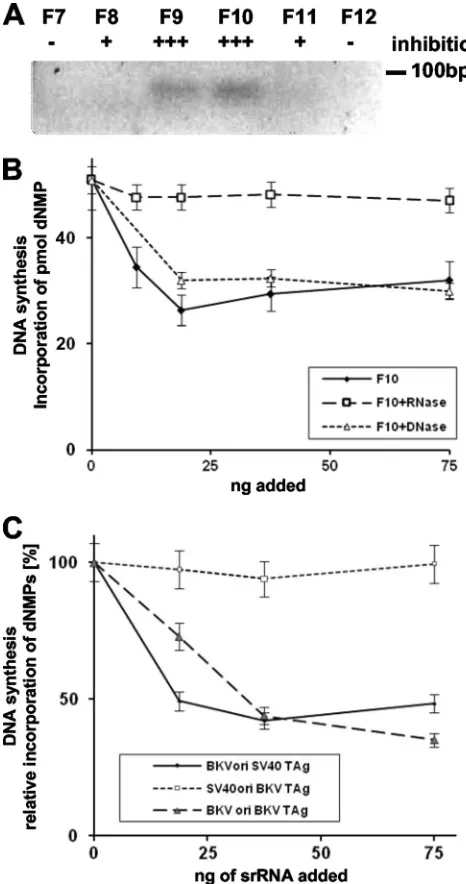
chemical fractionation to purify inhibitory activities (IAs) (28, 52) from mouse FM3A cell extracts. Fractions of all purifica-tions were analyzed by SDS-PAGE, and after Mono Q chro-matography, no specific protein bands (stained with silver) correlated with IAs (data not shown). The Mono Q-purified fractions of IA occurred as one single peak whoseA254/A280
was approximately 2, suggesting that IAs are predominantly comprised of nucleic acids. These fractions were analyzed by agarose gel electrophoresis followed by ethidium bromide staining and were found to contain nucleic acids whose migra-tion on a gel suggests a size of less than 100 nt (Fig. 1A). RNase treatment but not DNase treatment of the fractions with maximal inhibitory activity abolished inhibition of BKV DNA replication in vitro (Fig. 1B), indicating that the IA is composed of small RNAs, here called srRNAs. While these findings do not rule out the presence of accessory proteins (such as RNPs), no evidence has been obtained suggesting the requirement for such.
To assess the specificity of the fractionated srRNAs, the highly purified Mono Q fractions were added to monopoly-merase replication assays with either BKV or SV40 TAg and DNA containing their cognate NCCRs. These analyses re-vealed that the inhibition of BKV replication by srRNAs is specific for the BKV NCCR and is independent of the source of TAg (the SV40 TAg can act at the BKV origin [28]) (Fig. 1C and data not shown). Notably, the full replication activity of the monopolymerase assay with the SV40 template indicates that these srRNAs inhibit enzymatic activities of neither cel-lular replication factors nor TAg. RNAs of other mouse cells and human cells were analyzed for inhibitory activities; cellular RNAs of NIH 3T3 cells, prior to and after purification by Mono Q chromatography, significantly inhibited BKV DNA replication in the monopolymerase assay, whereas no inhibi-tion (and even some stimulainhibi-tion) was detected with unfrac-tionated human HeLa-S3 and HEK293S cell RNAs and RNAs purified by Mono Q chromatography (Fig. 2B to E; also data not shown). Fractions A2 and A3 from NIH 3T3 cells (Fig. 2C) were the most inhibitory, and the profile of IAs differed among the cell lines, suggesting that the expression and composition of the srRNAs are cell line specific.
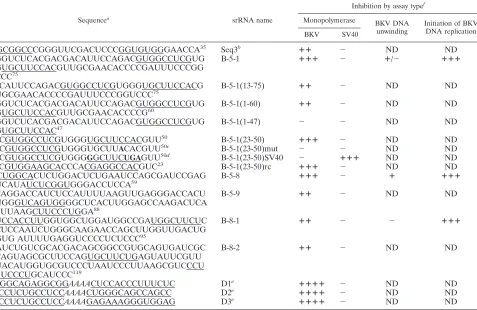
Enrichment, cloning, and sequence analysis of murine srRNAs.The Mono Q-purified small RNAs described in Fig. 1A were cloned according to Lau et al. (24), and the recovered plasmids were sequenced. In total, 71 cDNA sequences were obtained having an average length of 47⫾13 nt and an aver-age GC content of 57%⫾10%. These cDNAs were ligated to a T7 promoter and transcribed, and the transcripts were tested in various replication assays. One srRNA (Seq3) significantly inhibited BKV replication in the monopolymerase assay, and expressing Seq3 in human cells inhibited BKV DNA replica-tionin vivoby about 50%, whereas Seq3 did not inhibit SV40 replication in the monopolymerase assay (summarized in Ta-ble 1; also data not shown). Structure predictions using the RNA fold program (http://www.tbi.univie.ac.at/RNA/man /RNAfold.html) suggested that Seq3 contained a hairpin with a⌬Gof⫺10.9 kcal/mol, and bioinformatic analyses of Seq3 showed small similarities to origin sequence but did not iden-tify a sequence annotation in published databases (data not shown).
[image:3.585.299.532.85.527.2]To obtain additional replication-inhibitory RNA sequences
FIG. 1. Determination of nature of inhibitory activity. (A) Frac-tions F7 to F12 corresponding to the Mono Q elution peak analyzed by electrophoresis in 2% agarose gel followed by staining with ethidium bromide. The inhibitory activity (IA) toward BKV DNA replication and the 100-bp marker are indicated on the top and the right of the panel, respectively. (B) Mono Q chromatography-purified IA from mouse FM3A cells was treated with RNase or DNase and then tested in BKV monopolymerase replication assays. (C) srRNA fractions pu-rified from FM3A extracts were added to the monopolymerase repli-cation assay using DNA containing the BKV origin of replirepli-cation with SV40 TAg or DNA containing the SV40 origin of replication with BKV TAg (75 ng of RNA with an estimated length of 50 nt [length estimation of RNA is derived from the cloning results without SELEX] yields a 50% inhibition with a 36-fold molar excess of RNA over origin DNA). Reactions with BKV TAg and DNA containing the BKV origin of replication served as controls. The incorporation of deoxynucleoside monophosphates (dNMPs) into the BKV origin DNA was detected by acid precipitation and scintillation counting. DNA synthesis was de-termined in duplicates and repeated three times. The average of in-corporation of dNMPs and the standard deviations are presented.
on November 7, 2019 by guest
http://jvi.asm.org/
at a higher frequency than by direct cloning, we developed an alternative strategy involving an adaptation of SELEX (sys-tematic evolution of ligands by exponential enrichment) (12, 17). Previous observations that templates containing BKV core origins with heterologous murine polyomavirus (mPyV) origin flanking sequences can be replicated by FM3A mouse cell extracts supplemented with human Pol-primase complex (52) suggested that the inhibitory activity of FM3A extracts (and thus the srRNAs) acts through the viral NCCR. Accordingly, cDNAs derived from purified srRNA fractions were ligated to a T7 promoter and transcribedin vitro, and RNAs capable of binding to the denatured BKV NCCR were amplified by RT-PCR repetitively. The inhibitory activity of the amplified RNA pool significantly increased with the number of SELEX cycles (data not shown): after 5 (B-5), 8 (B-8), and 12 selection cycles (B-12), cDNA sequences from the SELEX-generated srRNAs were cloned and sequenced (Table 1 and data not shown).
BLAST searches of mouse and human genomes and tran-scriptomes were performed with the SELEX-selected cDNA sequences as queries, but no significant similarities were found. However, transcripts from repetitive sequences and modified noncoding RNAs are difficult to determine by BLAST searches
(11), so the RepeatMasker program (release, open-3.2.9; A. F. A. Smit, R. Hubley, and P. Green, Institute for Systems Biology [http://www.repeatmasker.org]) was employed to search mouse and human genome databases (genome plus transcripts), and similarities were identified with RNAs from diverse genomic repeats, snRNAs, and tRNAs (data not shown). It is notewor-thy that some of these RNAs, of approximately the same size as the srRNAs, are derived from heterochromatic satellite sequences at pericentromeric regions of chromosomes, and these RNAs are enriched in human and murine cancer cells, especially by DNA stressors and inducers of apoptosis (3, 22, 53).
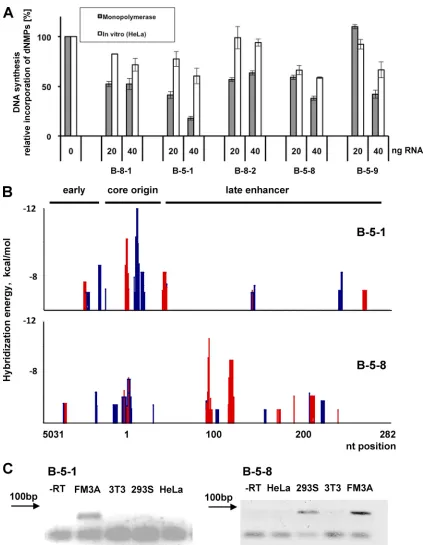
[image:4.585.111.477.72.414.2]B-5-1 and B-5-8 srRNAs are BKV specific and are expressed in mouse cellsin vivo. The SELEX-selected B-5-1 and B-5-8 srRNAs inhibitedin vitroBKV DNA replication to a greater extent than other RNAs (Fig. 3A; summarized in Table 1). Bioinformatic analyses using calculations of hybridization en-ergy with data sets for RNA-DNA hybrids of Sugimoto et al. (50, 51) revealed that srRNAs contain at least two sequence elements complementary to independent regions located on opposite strands of the BKV NCCR. The calculated hybrid-ization energies relative to the nucleotide location of the BKV
FIG. 2. Purification of inhibitory srRNAs. (A) Mono Q fractions of total RNAs from FM3A cells were analyzed by electrophoresis in a 1.5% agarose gel. In parallel, fractions A1, A2, A3, A4, and A8 of FM3A (B), NIH 3T3 (C), HeLa (D), and HEK293 (E) cells, corresponding to 0.6 M, 0.62 M, 0.64 M, 0.66 M, and 0.73 M NaCl, were analyzed. The incorporation of dNMPs into the BKV origin DNA was detected by acid precipitation and scintillation counting. DNA synthesis was determined in duplicates and repeated three times. The average of incorporation of dNMPs and the standard deviations are presented.
on November 7, 2019 by guest
http://jvi.asm.org/
NCCR for the two RNAs B-5-1 and B-5-8 are shown as exam-ples in Fig. 3B; both RNAs contain two such sequences de-scribed above, highlighted in the figure by different colors. Expression of these srRNAs in mouse FM3A cells was con-firmed by RT-PCR (Fig. 3C). The amplified PCR products from FM3A cells were cloned and sequenced and found to have identical sequence to B-5-1 or B-5-8 RNA. However, similar amplification products were not detected with cellular RNAs from NIH 3T3 cells or human HeLa cells. A weak cDNA product band was detected with cellular RNAs from human 293S cells, using the B-5-8 specific primers (Fig. 3C), and verified by sequencing the cDNAs. These B-5-8 RNAs of 293S cells were reproducibly detected but in much lower concentrations than those of FM3A cells, and their presence may explain why the total RNA of 293S cells did not stim-ulate BKV DNA replication and even slightly inhibited rep-lication, whereas HeLa cells, which lack this RNA, stimu-lated BKV DNA replication (compare Fig. 2E and D).
Inhibitory srRNAs block BKV DNA replication at an initi-ation step.To determine whether the unwinding or the initia-tion reacinitia-tion is the target for inhibiinitia-tion, these initiainitia-tion steps
were biochemically analyzed. Addition of inhibitory srRNA partially reduced the level of unwound origin DNA (Fig. 4A; summarized in Table 1). A slight decrease in unwinding of origin-containing DNA was determined with total FM3A RNA, which was in the range of that observed with B-5-8, but no significant reduction of unwound DNA was determined with B-5-1 and B-8-1 RNAs (although both significantly inhib-ited BKV DNA replication) (Fig. 3A and Table 1). Even though multiple RNAs including total FM3A RNA reduced unwinding of BKV DNA, the extent of this inhibition (always lower than 15%) cannot solely account for the observed inhi-bition of viral replication. In contrast to the slight effect on unwinding of BKV origin-containing DNA, the initiation of BKV DNA replication was reproducibly and efficiently inhib-ited by srRNAs B-5-1 and B-8-1 (Fig. 4B and Table 1). In summary, these data reveal that srRNAs can inhibit multiple stages of DNA replication but that the initiation reaction is the main target of the inhibition.
Interactions of srRNAs with BKV NCCR DNA. Previous
[image:5.585.62.539.83.393.2]investigations revealing that sequences flanking the BKV core origin are required for function of the inhibitory activity in
TABLE 1. RNA sequences
Sequencea
srRNA name
Inhibition by assay typef
Monopolymerase BKV DNA
unwinding
Initiation of BKV DNA replication
BKV SV40
1AGGCGGCCCGGGUUCGACUCCCGGUGUGGGAACCA35 Seq3b ⴙⴙ ⫺ ND ND
1CCGGUCUCACGACGACAUUCCAGACGUGGCCUCGUG GGUGCUUCCACGUUGCGAACACCCCGAUUUCCCGG UCCC75
B-5-1 ⴙⴙⴙ ⫺ ⴙ/⫺ ⴙⴙⴙ
13GACAUUCCAGACGUGGCCUCGUGGGUGCUUCCACG UUGCGAACACCCCGAUUUCCCGGUCCC75
B-5-1(13-75) ⴙⴙ ⫺ ND ND
1CCGGUCUCACGACGACAUUCCAGACGUGGCCUCGUG GGUGCUUCCACGUUGCGAACACCCCG60
B-5-1(1-60) ⴙⴙ ⫺ ND ND
1CCGGUCUCACGACGACAUUCCAGACGUGGCCUCGUG GGUGCUUCCAC47
B-5-1(1-47) ⫺ ⫺ ND ND
23GACGUGGCCUCGUGGGUGCUUCCACGUU50 B-5-1(23-50) ⴙⴙⴙ ⫺ ND ND
23GACGUGGCCUCGUGGGUGCUU
ACACGUU50c B-5-1(23-50)mut ⫺ ⫺ ND ND
23GACGUGGCCUCGUGGGGGCUUCUGAGUU50d B-5-1(23-50)SV40 ⫺ ⴙⴙⴙ ND ND
50AACGUGGAAGCACCCACGAGGCCACGUC23 B-5-1(23-50)rc ⴙⴙⴙ ⫺ ND ND
1GGCUGGCACUCUGGACUCUGAAUCCAGCGAUCCGAG UUCAUAUCUCGGUGGGACCUCCA59
B-5-8 ⴙⴙⴙ ⫺ ⴙ ⴙⴙⴙ
1CCCAGGACCAUCUCCAUUUUAAGUUGAGGGACCACU GUGGGUCAGUGGGGCUCACUUGGAGCCAAGACUCA CAUUAAGCUUCCCUGGA88
B-5-9 ⴙⴙ ⫺ ND ND
1CCUCCACCUUGGUGGCUGGAUGGCCGAUGGCUUCUC UCUCCAAUCUGGGCAAGAACCAGCUUGGUUGACUG UGUG AUUUUGAGGUCCCCUCUCCC95
B-8-1 ⴙⴙ ⫺ ⫺ ⴙⴙⴙ
1CGAUCUGUCGCACGACAGCGGCCGUGCAGUGAUCGC GCAGUAGCGCUUCCAGUGCUUCUGAGUAUUCGUU GUACAUGGUGCGUCCCUAAUCCCUUAAGCGUCCCU CGUCCCUGCAUCCC119
B-8-2 ⴙⴙ ⫺ ND ND
GGAGGCAGAGGCGGAAAACUCCACCCUUUCUC D1e ⴙⴙⴙⴙ ⫺ ND ND
CCGCCUCUGCCUCCAAAACUGGGCAGCCAGCC D2e ⴙⴙⴙⴙ ⫺ ND ND
CCGCCUCUGCCUCCAAAAGAGAAAGGGUGGAG D3e ⴙⴙⴙⴙ ⫺ ND ND
aNucleotides predicted to hybridize to the NCCR are underlined. Italics indicate a spacer between hybridization sites in the designed srRNAs. All sequences but
those of B-5-1(23-50)mut and B-5-1(23-50)SV40 contain two complementary sites to the NCCR of BKV Dik strain between nt 5031 and 5141 plus nt 1 to 281.
bSeq3 was obtained in the original screen for srRNAs without SELEX.
cChanging the residue in boldface in one of the two hybridization sites of the B-5-1(23-50) mutant abolished its inhibitory activity.
dWhen the 4 nt in boldface in B-5-1(23-50)SV40 were introduced, they destroyed complementarity to BKV origin/NCCR but created complementarity to SV40
origin/NCCR.
esrRNAs that were designed as described in the text and are not derived from natural RNA sequences. Underlined sequences are complementary, from left to right,
to nt 5129 to 5139 plus 5132 to 5119 (D1), nt 1 to 5129 plus 101 to 114 (D2), and nt 5139 to 5129 plus 5119 to 5132 (D3) of the NCCR.
fScoring is as follows:⫺, no inhibition;⫹, weak inhibition;⫹⫹, intermediate inhibition;⫹⫹⫹, strong inhibition;⫹⫹⫹⫹, very strong inhibition; ND, not determined.
on November 7, 2019 by guest
http://jvi.asm.org/
FIG. 3. Replication of polyomavirus DNA in the presence of srRNAs. (A) srRNAs were transcribedin vitrousing oligonucleotides with an SP6 promoter; the sequences coding for the indicated RNAs as templates were assayed for inhibition of BKV DNA replication either in HeLa extract or in the monopolymerase replication assay. DNA synthesis was determined in duplicates and repeated three times. The average of incorporation of dNMPs and the standard deviations are presented. (B) Calculation of hybridization energies of B-5-1 and B-5-8 and their interaction with the BKV NCCR. The energy was calculated using the nearest-neighbor method with data sets for RNA-DNA hybrids of Sugimoto et al. (50, 51). Each determination of hybridization energy lower than⫺6 kcal/mol and⫺4 kcal/mol (upper and lower panels, respectively) was plotted versus the position on the origin of replication. Blue and red mark the binding of RNA to the upper and the lower DNA strands, respectively. (C) Twenty-five nanograms of total RNA from FM3A, NIH 3T3, HEK293S, and HeLa cells was reverse transcribed using random decamers as primer at 42°C. Reverse transcription products were PCR amplified using specific primers for B-5-1 and B-5-8 sequences. For B-5-1 a specific product of 47 nt of nested PCR is presented. FM3A reverse transcription product without reverse transcriptase (⫺RT) served as a negative control.
on November 7, 2019 by guest
http://jvi.asm.org/
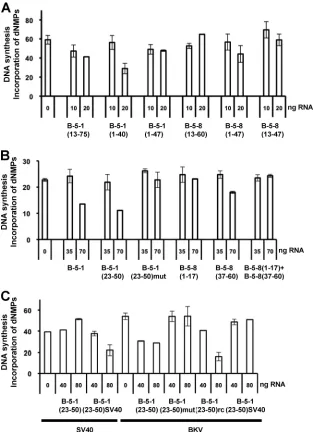
FM3A extracts (52) and the observation of interactions of srRNAs with origin DNA (Fig. 3B) led to the design of exper-iments exploring the regions in srRNAs B-5-1 and B-5-8 that are responsible for inhibition. Deletion or modification of se-quences at the 3⬘ or 5⬘end of B-5-8 RNA, predicted to hy-bridize to the BKV NCCR, abolished the ability of RNAs to inhibit the BKV monopolymerase assay (Fig. 5). Furthermore, RNAs that should bind to the BKV NCCR [e.g., nt 1 to 17 of B-5-8 [B-5-8(1–17)] and B-5-8(37–60)] but that lack a con-necting sequence did not inhibit DNA replication (data not shown). Deletions of B-5-1 RNA at the 3⬘or 5⬘termini did not affect its inhibitory activity, supporting the suggestion that binding sites are situated within the central region of nt 23 to 50 of B-5-1 RNA (Table 1). This sequence was synthesizedin vitro, and B-5-1(23–50) transcripts were found to exhibit an inhibitory activity equal to that of the parent molecule B-5-1 (Fig. 5B). Closer analysis of the B-5-1(23–50) sequence re-vealed that two sites [underlined nucleotides of B-5-1 and B-5-1(23–50) in Table 1] should hybridize to the BKV core origin on opposite strands. Introduction of a point mutation into the most 3⬘site of the two hybridization sequences abol-ished the inhibition [Fig. 5C and Table 1, B-5-1(23–50)mut]. In contrast, RNA with reverse complementary sequence to B-5-1(23–50) [B-5-B-5-1(23–50)rc], which should hybridize to the re-verse complementary sites of the origin DNA (i.e., sites oppo-site to the original hybridization oppo-sites), exhibited inhibitory activity similar to that of B-5-1 (Fig. 5C). This suggests that inhibition of replication initiation is mediated by simultaneous binding of one srRNA molecule to opposite strands of the NCCR.
Development of an srRNA that inhibits SV40 DNA replica-tionin vitro.B-5-1(23–50) RNA is predicted to have equivalent hybridization sites to the SV40 NCCR due to the high homol-ogy between BKV and SV40. However, the putative SV40 hybridization sites overlap in the RNA sequence, so one RNA molecule would not hybridize to both strands of the SV40 origin at the same time. To examine whether srRNAs inhibi-tory to SV40 can be developed from this molecule, mutant RNA B-5-1(23–50)SV40 was designed by introducing four nu-cleotides in the 3⬘ part of the RNA, to create an additional hybridization site for the SV40 core origin (and concomitantly, destroy the hybridization site to the BKV core origin) (Fig. 5C; summarized in Table 1). In full agreement with the prediction and in contrast to B-5-1(23–50), RNA B-5-1(23–50)SV40 ef-fectively inhibited SV40 but not BKV DNA replication (Fig. 5C and Table 1).
De novodesign of srRNAs that inhibit BKV DNA replication
in vitro. These results indicate that RNAs hybridizing to the upper and lower strands of the BKV or SV40 NCCR, within or close to the core origin, will inhibit DNA replication. To test this further, we designed RNAsde novo having both hybrid-ization sites within the BKV core origin or having one site within the core origin and a second site complementary to a sequence 100 nt distant, within the late enhancer sequence. RNAs D1 and D2, respectively (Fig. 6A and Table 1), were synthesized and tested for inhibitory activity. Alternatively, the complementary sequences were synthesized in a reverse com-plementary fashion (Fig. 6A, RNA D3, and Table 1). All three RNAs also contain a quadruple-A stretch to connect the two binding sites. As predicted, these three RNAs significantly inhibited BKV DNA replication in the monopolymerase assay (Fig. 6B; summarized in Table 1), indicating that RNAs with two complementary sites to the viral NCCR are sufficient to inhibit the viral DNA replicationin vitro.
srRNA inhibits BKV DNA replicationin vivo.To ascertain if srRNAs function in vivo, the B-5-1 srRNA sequence was placed downstream of the U6 promoter (pU6-B-5-1) and transiently expressed in human kidney tubular epithelial cells (HK-2 cells), together with template DNAs and a DNA expressing BKV TAg. In multiple independent assays, BKV DNA replication was consistently inhibited by up to 70% com-pared to transfections with the vector DNA (pUC) or the vector expressing an unspecific mouse Y-RNA (pU6-mY1) (Fig. 7), indicating that srRNAs that inhibit the BKV replica-tionin vitroalso inhibit BKV DNA replicationin vivo.
DISCUSSION
That ncRNAs can control both cellular and viral DNA rep-lication is a significant recent development in our understand-ing (5, 23, 38). In prior studies of BKV replication, we dis-cerned the presence of diffusible inhibitors in mouse FM3A cell extracts that had not been detected in similar studies of the replication of other polyomaviruses (28, 52). Further charac-terization reveals these inhibitors to be small RNAs, termed srRNAs, that are origin specific and can function bothin vitro
[image:7.585.42.284.68.234.2]and in vivo. During our purification process, we could not detect any specific proteins associated with these srRNAs. Fur-thermore, inhibition of BKV DNA replication by srRNA was observed in the monopolymerase assay, indicating that other
FIG. 4. Unwinding of BKV DNA and initiation of BKV DNA replication in the presence of srRNAs. (A) Unwinding of BKV and SV40 origin-containing DNAs (as indicated) with BKV large TAg in the absence of RNA (0 ng) and in the presence of 10 or 20 ng of B-5-1, B-5-8, B-8-1, or total FM3A RNA. The B-5-8 srRNA does not inhibit SV40 origin-dependent unwinding, suggesting that the helicase func-tion of BKV large TAg is not inhibited by this RNA. Percentage of inhibition in the presence of RNAs relative to samples without RNA is given in the diagram. (B) Increasing amounts of B-5-1 RNA, B-5-8 RNA, B-8-1 RNA, total RNA from NIH 3T3 cells, or origin-based SELEX step 12 RNA, B-12, were added to the initiation assay with DNA containing the BKV origin of replication. Incorporation of la-beled nucleotide in the absence of large TAg served as a background control and was subtracted.
on November 7, 2019 by guest
http://jvi.asm.org/
accessory proteins are not absolutely required for the inhibi-tion (28, 52).
It is important to contrast previous studies of RNA aptamers that inhibit the viral helicase (17) with our observations that srRNAs do not inhibit helicase activity of viral TAg. Moreover, the primase activity of Pol-primase itself is not blocked directly by srRNAs since the same enzyme complex initiates SV40 DNA replication but not BKV DNA replication in the pres-ence of these srRNAs. This is consistent with our previous findings that the inhibitory activities are specific for BKV DNA
replication and do not interfere with SV40 DNA replication (28, 52). However, the de novo synthesis of RNA primers during the initiation of BKV DNA replication by Pol-primase may be inhibited by sequence-specific hybridization of the srRNAs.
Bioinformatic analyses of the inhibitory srRNAs suggest that inhibition of BKV DNA replication requires a single molecule of RNA to anneal to both strands of the viral noncoding control region. This leads to the hypothesis that inhibition of replication is mediated by hybridization of srRNAs to
se-FIG. 5. Modulation of BKV and SV40 DNA replication in the presence of mutant srRNAs. (A and B) Wild type and deletion mutants of B-5-1 and B-5-8 RNA were added to the monopolymerase BKV DNA replication assay in the indicated amounts (the numbers in parentheses describe the mutants and refer to the nucleotide regions of B-5-1 and B-5-8 which are transcribedin vitrousing T7 RNA polymerase). (C) Small RNAs added to the monopolymerase DNA replication assay with SV40 or BKV origin of replication and the respective TAg. The mutants derived from B-5-1 RNA B-5-1(23–50), B-5-1(23–50)mut, B-5-1(23–50)rc [reverse complement of B-5-1(23–50)], and B-5-1(23–50)SV40 [mutant of B-5-1(23– 50) having two binding sites of SV40 NCCR] putatively involved in hybridization to the SV40 or BKV origin of replication in the monopolymerase DNA replication assay containing SV40 or BKV origin of replication in the presence of the purified recombinant SV40 or BKV TAg, respectively. The incorporation of dNMPs into the BKV origin DNA was detected by acid precipitation and scintillation counting. DNA synthesis was determined in duplicates and repeated three times. The average of incorporation of dNMPs and the standard deviations are presented. The data are summarized in Table 1.
on November 7, 2019 by guest
http://jvi.asm.org/
[image:8.585.134.447.69.501.2]quences on opposite strands close to or within the BKV core origin so as to form a replication-inactive initiation complex (Fig. 8). Interestingly many srRNAs have the feature that just one region of the RNA hybridizes to both strands of the SV40 origin at neighboring sites. Since the SV40 core origin penta-mer elements form a more perfect palindrome than the BKV core origin elements, the srRNAs inhibitory for BKV replica-tion do not inhibit SV40 DNA replicareplica-tion. The isolareplica-tion of identical sequences for both RNAs B-5-1 and B-5-8 suggests that they do not belong to a family of highly repeated genomic sequences, but the identification of genomic sequences encod-ing these RNAs will require sequencencod-ing the FM3A tumor cell genome or deep sequencing of its ncRNAs. The binding of srRNAs to the viral origin DNA is reminiscent of the interac-tion of antigene RNAs to promoters but is likely to involve different biochemical mechanisms and pathways since the Argonaute protein is most likely involved in the
promoter-dependent inhibition of transcription but not in the action of srRNAs (6, 7, 18, 57).
The mechanism of inhibition of BKV DNA replication by srRNAs was examined in various ways; deleting predicted binding sites of the srRNAs or exchanging nucleotides within these sites abolished the inhibition of DNA replication by the srRNAs. In addition, an artificial RNA was designed that spe-cifically inhibited SV40 but not BKV DNA replication, and the
[image:9.585.325.492.66.386.2]de novodesign of RNA sequences inhibited BKV DNA repli-cation. That srRNAs are expressed in tumor cells and also that the small-DNAPolyomaviridaehave very successfully served as model systems to study viral and cellular functions, including the molecular mechanisms and regulation of host DNA repli-cation and transcription (9, 15), lead us to speculate about a role of srRNAs in cellular control pathways. The negative regulatory srRNAs reported here, together with the recently described positive regulatory RNAs (5, 23, 38), provide novel
FIG. 6. Inhibition of BKV DNA replication in the presence of newly designed inhibitor RNAs. (A) Following the hypothesis that RNA must contain two sites complementary to the opposite strands of the BKV NCCR to inhibit BKV DNA replication, the RNA sequences D1, D2, and D3 were designed, with D3 containing the binding sites of D1 in opposite orientations. The energy was calculated using the near-est-neighbor method with data sets for RNA-DNA hybrids of Sug-imoto et al. (50, 51). Each determination of hybridization energy lower than⫺7 kcal/mol was plotted versus the position at the BKV origin of replication. Blue and red mark the binding to the upper and the lower DNA strands, respectively. (B) RNA sequences D1, D2, and D3 were added to the monopolymerase BKV DNA replication assay as indi-cated. The incorporation of dNMPs into the BKV origin DNA was detected by acid precipitation and scintillation counting. DNA synthe-sis was determined in duplicates and repeated three times. The average of incorporation of dNMPs and the standard deviations are presented.
FIG. 7.In vivoBKV DNA replication in the presence of srRNA. BKV DNA replicationin vivowas measured by transfecting HK-2 cells with BKV origin-containing plasmids and BKV TAg expression vector together with an empty vector (pUC) or a control vector expressing mouse Y1-RNA (pU6-mY1; mouse Y1-RNA also does not inhibit BKV DNA replicationin vitro[I. Tikhanovich and H. P. Nasheuer, unpublished data]) or B-5-1 expression vector (pU6-B-5-1). Cells were harvested at 48 h posttransfection, and replicated BKV DNA was analyzed by EcoRI and DpnI digestion, agarose gel electrophoresis, and Southern blotting as previously reported (28). The average quan-tification of band density of threein vivoDNA replication experiments and the standard deviation are presented in panel B. The amount of DpnI-resistant replication products in the transfection of pUC empty vector was arbitrarily set to 100%.
on November 7, 2019 by guest
http://jvi.asm.org/
[image:9.585.41.282.68.363.2]and additional levels of control to eukaryotic DNA replication and may lead to the development of new strategies to inhibit replication of viruses or other infections agents. Thus, as for ncRNAs in gene expression (3, 13, 16, 20), srRNAs may contribute to regulation of DNA replication in addition to the well-known factors such as posttranslational modifica-tions, protein-protein interacmodifica-tions, and protein stability (8, 27, 29, 33, 34).
ACKNOWLEDGMENTS
We thank T. Krude, A. Samali, S. Gupta, and C. Morrison for reagents, advice on small RNA cloning, and critical reading of the manuscript.
This work was supported by grants of the Science Foundation Ire-land (H.P.N.), an NUIG student fellowship, a Thomas Crawfort Hayes fellowship (both, I.T.), and funds from the University of Missouri— Columbia (W.R.F.). C.S. is a Science Foundation Ireland Stokes Pro-fessor of Bioinformatics.
REFERENCES
1.Bernstein, E., and C. D. Allis.2005. RNA meets chromatin. Genes Dev.
19:1635–1655.
2.Borowiec, J. A., F. B. Dean, P. A. Bullock, and J. Hurwitz.1990. Binding and unwinding—how T antigen engages the SV40 origin of DNA replication.
Cell60:181–184.
3.Bouzinba-Segard, H., A. Guais, and C. Francastel.2006. Accumulation of small murine minor satellite transcripts leads to impaired centromeric
ar-chitecture and function. Proc. Natl. Acad. Sci. U. S. A.103:8709–8714.
4.Bru¨ckner, A., et al.1995. The mouse DNA polymerase␣-primase subunit p48 mediates species-specific replication of polyomavirus DNA in vitro. Mol.
Cell. Biol.15:1716–1724.
5.Christov, C. P., E. Trivier, and T. Krude.2008. Noncoding human Y RNAs are overexpressed in tumours and required for cell proliferation. Br. J.
Cancer98:981–988.
6.Chu, Y., X. Yue, S. T. Younger, B. A. Janowski, and D. R. Corey.2010. Involvement of Argonaute proteins in gene silencing and activation by RNAs complementary to a non-coding transcript at the progesterone receptor
promoter. Nucleic Acids Res.38:7736–7748.
7.Corey, D. R.2005. Regulating mammalian transcription with RNA. Trends
Biochem. Sci.30:655–658.
8.Fabian, M. R., N. Sonenberg, and W. Filipowicz.2010. Regulation of mRNA
translation and stability by microRNAs. Annu. Rev. Biochem.79:351–379.
9.Fanning, E., and K. Zhao.2009. SV40 DNA replication: from the A gene to
a nanomachine. Virology384:352–359.
10.Fanning, E., X. Zhao, and X. Jiang.2009. Polyomavirus life cycle, p. 1–24.In
B. Damania and J. M. Pipas (ed.), DNA tumor viruses. Springer Science and Business Media, New York, NY.
11.Gardner, P. P.2009. The use of covariance models to annotate RNAs in
whole genomes. Brief Funct. Genomic. Proteomic.8:444–450.
12.Gold, L., B. Polisky, O. Uhlenbeck, and M. Yarus.1995. Diversity of
oligo-nucleotide functions. Annu. Rev. Biochem.64:763–797.
13.Guenther, M. G., and R. A. Young.2010. Transcription. Repressive
tran-scription. Science329:150–151.
14.Hirsch, H. H., et al.2005. Polyomavirus-associated nephropathy in renal transplantation: interdisciplinary analyses and recommendations.
Transplan-tation79:1277–1286.
15.Howley, P. M., and D. M. Livingston.2009. Small DNA tumor viruses: large
contributors to biomedical sciences. Virology384:256–259.
16.Jacquier, A.2009. The complex eukaryotic transcriptome: unexpected
per-vasive transcription and novel small RNAs. Nat. Rev. Genet.10:833–844.
17.Jang, K. J., N. R. Lee, W. S. Yeo, Y. J. Jeong, and D. E. Kim.2008. Isolation of inhibitory RNA aptamers against severe acute respiratory syndrome (SARS) coronavirus NTPase/helicase. Biochem. Biophys. Res. Commun.
366:738–744.
18.Janowski, B. A., et al.2005. Inhibiting gene expression at transcription start
sites in chromosomal DNA with antigene RNAs. Nat. Chem. Biol.1:216–
222.
19.Jiang, M., J. R. Abend, S. F. Johnson, and M. J. Imperiale.2009. The role
of polyomaviruses in human disease. Virology384:266–273.
20.Kanhere, A., et al.2010. Short RNAs are transcribed from repressed poly-comb target genes and interact with polypoly-comb repressive complex-2. Mol.
Cell38:675–688.
21.Kolpashchikov, D. M., et al.1999. Interaction of the p70 subunit of RPA
with a DNA template directs p32 to the 3⬘-end of nascent DNA. FEBS Lett.
450:131–134.
22.Komissarov, A. S., I. S. Kuznetsova, and O. I. Podgornaia.2010. Mouse
centromeric tandem repeats in silico and in situ. Genetika46:1217–1221. (In
Russian.)
23.Krude, T., C. P. Christov, O. Hyrien, and K. Marheineke.2009. Y RNA functions at the initiation step of mammalian chromosomal DNA
replica-tion. J. Cell Sci.122:2836–2845.
24.Lau, N. C., L. P. Lim, E. G. Weinstein, and D. P. Bartel.2001. An abundant
class of tiny RNAs with probable regulatory roles inCaenorhabditis elegans.
Science294:858–862.
25.Li, J. J., and T. J. Kelly.1984. Simian virus 40 DNA replication in vitro. Proc.
Natl. Acad. Sci. U. S. A.81:6973–6977.
26.Li, J. J., and T. J. Kelly.1985. Simian virus 40 DNA replicationin vitro: specificity of initiation and evidence for bidirectional replication. Mol. Cell.
Biol.5:1238–1246.
27.Liu, Q., and Z. Paroo.2010. Biochemical principles of small RNA pathways.
Annu. Rev. Biochem.79:295–319.
28.Mahon, C., et al.2009. Restriction of human polyomavirus BK virus DNA
replication in murine cells and extracts. J. Virol.83:5708–5717.
29.Masai, H., S. Matsumoto, Z. You, N. Yoshizawa-Sugata, and M. Oda.2010. Eukaryotic chromosome DNA replication: where, when, and how? Annu.
Rev. Biochem.79:89–130.
30.Michel, U.2002. Non-coding ribonucleic acids—a class of their own? Int.
Rev. Cytol.218:143–219.
31.Murakami, Y., T. Eki, M. Yamada, C. Prives, and J. Hurwitz.1986.
Species-specificin vitrosynthesis of DNA containing the polyoma virus origin of
replication. Proc. Natl. Acad. Sci. U. S. A.83:6347–6351.
32.Murakami, Y., C. R. Wobbe, L. Weissbach, F. B. Dean, and J. Hurwitz.1986. Role of DNA polymerase alpha and DNA primase in simian virus 40 DNA
replicationin vitro. Proc. Natl. Acad. Sci. U. S. A.83:2869–2873.
33.Nasheuer, H. P., H. Pospiech, and J. Syva¨oja.2007. Progress towards the
anatomy of the eukaryotic DNA replication fork, p. 27–68.In D. H.
Lankenau (ed.), Genome integrity: facets and perspectives. Springer, Berlin, Germany.
34.Nasheuer, H. P., R. Smith, C. Bauerschmidt, F. Grosse, and K. Weisshart.
2002. Initiation of eukaryotic DNA replication: regulation and mechanisms.
Prog. Nucleic Acid Res. Mol. Biol.72:41–94.
35.Nasheuer, H. P., et al.1992. Purification and functional characterization of bovine RP-A in an in vitro SV40 DNA replication system. Chromosoma
102:S52–S59.
36.Nesper, J., et al.1997. A cell-free replication system for human polyomavirus
JC DNA. J. Virol.71:7421–7428.
37.Nethanel, T., and G. Kaufmann. 1990. Two DNA polymerases may be required for synthesis of the lagging DNA strand of simian virus 40. J. Virol.
64:5912–5918.
38.Norseen, J., et al.2008. RNA-dependent recruitment of the origin
recogni-tion complex. EMBO J.27:3024–3035.
39.Oehlmann, M., C. Mahon, and H. P. Nasheuer.2007. Comparison of DNA
replication inXenopus laevisand simian virus 40. Adv. Exp. Med. Biol.
604:3–16.
40.Pestryakov, P. E., et al.2003. Human replication protein A. The C-terminal RPA70 and the central RPA32 domains are involved in the interactions with
the 3⬘-end of a primer-template DNA. J. Biol. Chem.278:17515–17524.
41.Scaria, V., M. Hariharan, B. Pillai, S. Maiti, and S. K. Brahmachari.2007. Host-virus genome interactions: macro roles for microRNAs. Cell Microbiol.
9:2784–2794.
[image:10.585.43.283.67.212.2]42.Schneider, C., K. Weisshart, L. A. Guarino, I. Dornreiter, and E. Fanning. FIG. 8. Model of inhibition of BKV DNA replication by srRNAs.
An srRNA molecule anneals to opposite strands of the BKV origin of replication and interferes with primer synthesis by Pol-primase by changing the structure of the initiation complex. Leading and lagging strands of DNA are brought together by interaction with srRNA, and primer synthesis is blocked while unwinding is undisturbed.
on November 7, 2019 by guest
http://jvi.asm.org/
1994. Species-specific functional interactions of DNA polymerase alpha-primase with simian virus 40 (SV40) T antigen require SV40 origin DNA.
Mol. Cell. Biol.14:3176–3185.
43.Schub, O., et al.2001. Multiple phosphorylation sites of DNA polymerase
␣-primase cooperate to regulate the initiation of DNA replication in vitro.
J. Biol. Chem.276:38076–38083.
44.Simmons, D. T.2000. SV40 large T antigen functions in DNA replication
and transformation. Adv. Virus Res.55:75–134.
45.Simmons, D. T., R. Roy, L. Chen, D. Gai, and P. W. Trowbridge.1998. The activity of topoisomerase I is modulated by large T antigen during unwinding
of the SV40 origin. J. Biol. Chem.273:20390–20396.
46.Smith, R. W., C. Steffen, F. Grosse, and H. P. Nasheuer.2002. Species specificity of simian virus 40 DNA replication in vitro requires multiple functions of human
DNA polymerase alpha. J. Biol. Chem.277:20541–20548.
47.Soe, K., et al.2001. A human topoisomerase I cleavage complex is recog-nized by an additional human topoisomerase I molecule in vitro. Nucleic
Acids Res.29:3195–3203.
48.Stadlbauer, F., C. Voitenleitner, A. Bruckner, E. Fanning, and H. P. Nasheuer.1996. Species-specific replication of simian virus 40 DNA in vitro requires the p180 subunit of human DNA polymerase alpha-primase. Mol.
Cell. Biol.16:94–104.
49.Storz, G., S. Altuvia, and K. M. Wassarman.2005. An abundance of RNA
regulators. Annu. Rev. Biochem.74:199–217.
50.Sugimoto, N., et al.1995. Thermodynamic parameters to predict stability of
RNA/DNA hybrid duplexes. Biochemistry34:11211–11216.
51.Sugimoto, N., S. Nakano, M. Yoneyama, and K. Honda.1996. Improved thermodynamic parameters and helix initiation factor to predict stability of
DNA duplexes. Nucleic Acids Res.24:4501–4505.
52.Tikhanovich, I., and H. P. Nasheuer.2010. Host-specific replication of BK virus DNA in mouse cell extracts is independently controlled by DNA
polymerase␣-primase and inhibitory activities. J. Virol.84:6636–6644.
53.Ting, D. T., et al.2011. Aberrant overexpression of satellite repeats in
pancreatic and other epithelial cancers. Science331:593–596.
54.Waga, S., G. Bauer, and B. Stillman.1994. Reconstitution of complete SV40
DNA replication with purified replication factors. J. Biol. Chem.269:10923–
10934.
55.Weisshart, K., et al.2000. Protein-protein interactions of the primase subunits p58 and p48 with simian virus 40 T antigen are required for
efficient primer synthesis in a cell-free system. J. Biol. Chem.275:17328–
17337.
56.Yamane, I., and N. Nakano.1966. Long-term culture of the ascites form of
a mouse mammary tumor in serum-free media. Tohoku J. Exp. Med.88:
203–214.
57.Younger, S. T., and D. R. Corey.2009. The puzzle of RNAs that target gene
promoters. Chembiochem10:1135–1139.