This is the
Accepted Version
of a paper published in the journal The
International Journal of Arts Theory and History:
Sorin, Reesa, and Brooks, Tamara (2013)
Exploring place through the visual arts:
from the real to the ideal.
International Journal of Arts Theory and History, 7 (1). pp.
43-61.
http://ijath.cgpublisher.com/product/pub.231/prod.12
Exploring Place through the Visual Arts: from the Real to the Ideal
Abstract
It is said that children today are becoming increasingly disconnected from their environment. However, determining the extent of this disconnect by exploring young children’s environmental perceptions, experiences and conceptualisations can be challenging, with children not always having the words to describe what they see, think or feel. To address this issue, methodologies have been developed that enable children to communicate through various art forms. Problems associated with arts-based research methods include that literate cultures place little value on visual representations, with the assumption being that language is the most appropriate representational medium to express what one thinks, feels or senses. Even now, as the amount of published visual research increases, there remain remarkably few guides on how to do visual research methods and more importantly, how to interpret the visual.
This paper describes a series of studies in which young children depicted "places", through drawing, painting and collage, supplemented by stories and interviews. Their creations of "place" varied from the real (what they actually saw in their environment), to holiday spots, and hypothetical or imagined places. While children generally
represented their places positively, they demonstrated a greater affinity for human made rather than natural objects within their environment.
Introduction
It is the long held belief of authorities that childhood is the most opportune time for bonds and positive attitudes towards the natural environment to be developed (White, 2004). If pro-environmental values aren’t established during childhood researchers argue that they may never develop (Ibid), thus the importance of encouraging child-nature interactions cannot be stressed enough.
In 2004, the United Nations (UN) declared the years 2005-2014 the ‘Decade of Education for Sustainable Development’ (United Nations Educational, Scientific and Cultural Organisation [UNESCO], 2009) in response to a number of emerging studies, highlighting children’s disconnect from their natural surroundings. A key player in the child-nature disconnect debate was Richard Louv (2005, 2008) who, through
interviewing over 3000 children and their parents, discovered widespread
this phenomena ‘nature deficit disorder’, defining it as “the human costs of alienation from nature, among them: diminished uses of the senses, attention difficulties, and higher rates of physical and emotional illnesses” (Louv, 2005, p.36). The authors of this paper were interested in investigating whether this disconnect was also apparent in Far North Queensland, Australia, home to beautiful ecosystems such as marine, coral reefs and tropical rainforests (Westoby, 1993).
The challenge in exploring young children’s environmental conceptualisations, experiences and perceptions is that they do not always have the words to describe what they see, think or feel (Sorin, 2004). Thankfully, other methods of
representation have been used to enable children to communicate their
understandings, including drawings, photography, song, story and drama (Benson, 2009). These methodologies are known as arts-based research, valuable because “the arts can embody and communicate emotions, beliefs, ideas and values; they can convey meaning through aesthetic forms and symbols and evoke emotive
responses to life with or without words” (Russell-Bowie, 2006, p.3). Unfortunately, the general assumption remains that language (written and spoken) is the most
adequate medium for communicating what we think, feel and sense (Kendrick & McKay, 2004). Although arts-based research is on the rise, there still remain
remarkably few guides on how to do visual research methods and, more importantly, how to interpret the visual (Rose, 2007).
This paper explores our journeys to unveil children’s perceptions of and attachments to the environment, or ‘place’ using an arts-based methodology. For the purpose of this paper ‘place’ is defined as “a territory of meanings. These meanings are created both by what one receives from and by what one gives to a particular environmental context” (Relph, 1993, cited in Ellis, 2005, p.58). The paper will describe a series of studies in which young children depicted ‘places’, through drawings and collage, supplemented by stories and interviews.
Methodology
The methodology is presented in two sections: the first, the Drawing Method and the second, the Collage Method.
The Drawing Method
children’s artwork about the environment; and ultimately, through refining methods, to determine children’s perceptions of the environment. The method took the form of Action Research. This involves researching a practical issue using a cyclical process, with the implications of this approach being that the research process is ongoing and changes to methods occur to improve results, thus improving its applicability to real-world situations (Denscombe, 2007). As McTaggart (1992, in MacNaughton and Hughes, 2009) notes, “action research increases our understanding of what we do and why we do it” (p. 10). It is usually practice-oriented and, both reflection and action at each stage, leads to improved practices and new knowledge.
There were five distinct cycles to this research, in which approaches, materials, sample sizes and ages were trialed and evaluated, leading to changes as the methodology evolved. It included over one hundred children, aged from 5 – 12 in urban, rural and remote private and state schools in north Queensland and initially in the Philippines. The research questions were: “What are young children’s perceptions of their environment?” and “How can arts-based methods be used to glean children’s understandings of their environment?”
Data included children’s drawings, their verbal accounts of the drawings, and teacher and researcher observations. To collect data, children were asked to construct drawings of their environment. Throughout the cycles, this took different forms, such as “Draw what you see from your window”, and “Draw what you see on your way to school.” In its final cycle, the research asked children to draw where they lived, to send to children in another country (as an authentic task). Children’s final drawings were in the form of a large postcard with a story on the back, as they were to be mailed to another country. Through the cycles, it was found that adding drama and authentic tasks made the process more relevant and engaging to young children during data collection, and asking children to tell a story about their artwork helped researchers to understand and interpret the drawing during data analysis. Children’s stories were either written by the child or dictated to the researchers or teacher.
counting items, a ‘holistic view’ of interpretation is encouraged, including elements of design, choice of colour and the child’s own voice (Di Leo, 1983). The research confirmed that there is a value in the juxtaposition of the arts and science in exploring understanding (and in the future, teaching children) about environmental sustainability.
The Collage Method:
Brooks’ (2010) research aimed to use collage, supplemented by stories, to reveal children’s place attachments. This research again used a qualitative, arts-based methodology. Alvesson & Skoldberg (2009) explain that qualitative researchers attempt to interpret and make sense of phenomena in terms of the meanings people bring to them. The research question was, “What evidence of place attachments do young children represent using the arts (collage/stories)? Children were asked to construct a collage of their ‘special place’, so that the researcher could ascertain the characteristics, social influences and physical features that make ‘places’ appealing to children.
Data were collected from a class of children in a private school setting. Collages were constructed representing children’s special places, accompanied by a short story explaining why the place was special. Blizard & Schuster (2007) explain that by sharing stories about their environments children give order, significance and meaning to the chaos of their experiences. Following an initial examination of the collages and stories, six children were purposively selected as information-rich cases, to partake in semi-structured interviews. Collages, stories, interview transcripts and the researcher’s observation notes contributed to the data collected.
Content analysis was the technique applied to children’s collages; while an interpretive process known as ‘open-coding’ was applied to children’s stories and interviews. Overall, collage-making proved to be useful “as a reflective process, as a form of elicitation, and as a way of conceptualizing ideas” (Butler-Kisber & Poldma, 2009, p.2); and storytelling and interviews enhanced the children’s expression and researchers’ understanding of their ideas (Sorin & Gordon, 2009).
Findings
the same range, in that they varied from the ‘real’ to the ‘ideal’ and from the ‘natural’ to the ‘human-made’. Findings presented below discuss and give examples of these ranges, followed by a discussion of using the arts to move towards a more
sustainable society.
The Real to the Ideal
In drawings and collages, a number of children depicted real places, from their immediate environment to holiday spots that were local, national and international. But some children created images of hypothetical places and features, that they had either imagined or become familiar with through the media. Yet, previous studies indicate that children depict their place attachments to be local: homes, gardens and nearby streets; places where direct and repeated experiences occur (Jack, 2010).
The Real
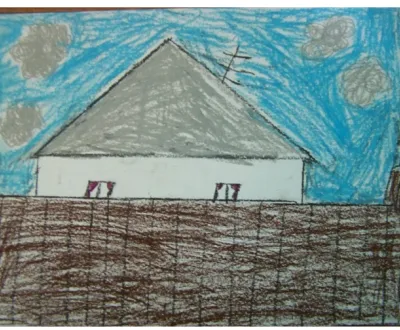
In initial cycles of the Drawing Method research, researchers shared the book, “Window” by Jeannie Baker with the children. This is a wordless picture book, with each double page showing views from a window, as the landscape becomes more and more industrialised. Children were asked to draw what they saw from their windows, and some took this quite literally, carefully sketching in a window frame and putting their drawings within it. In Figure 1 (below) the child’s drawing consists of a high fence and the roof and upper portion of a house. Her explanation was that when she looked out her window, all she could see was the fence and the top of the
[image:6.595.206.406.577.742.2]neighbours’ house. She added, I can imagine the neighbour’s dog running around happily in the grass. They don’t have trees or plants, but we do. But I didn’t draw it because this is down the side and there are just rocks there.
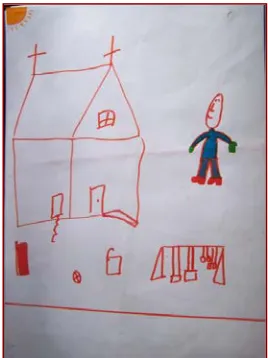
Other children represented literally what they could see from their classroom window. For example, in Figure 2, a child whose school was located on the same grounds as the church, drew a picture containing the church and the school’s play area. His story was, This is the church and play area and the fountain where we drink and a ball and me.
Figure 2. The school environment.
By the fourth cycle of the Drawing Method research, we had replaced the Windows
book with a role play, where the researchers visited a class as tourists from another country, wanting to know more about the children’s local environment. Some children did very literal drawings, such as Figure 3 below, which depicts frogs that children find in the school drains.
Figure 3. Frogs in the Drain
[image:7.595.222.402.534.690.2]was particularly engaging for the children, and one that had the greatest percentage of realistic drawings. For example, in Figure 4 below, there is a drawing by one of the children who lives on a farm. It contains several trees. His story was based on the work undertaken on the farm. He wrote: “I’m planting 2000 more Honeygold Mangoes. I have lots of trees…I live on a farm.”
Figure 4. The farm environment picture for children in Canada.
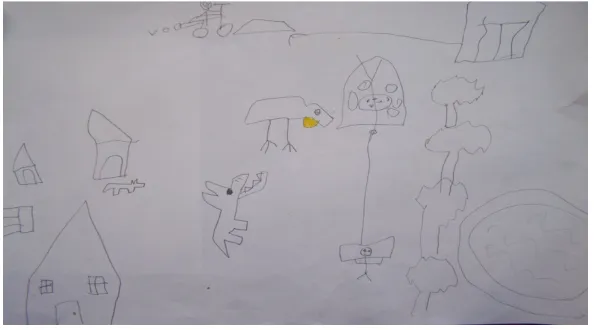
[image:8.595.166.463.530.695.2]Another did a pencil drawing with a splash of colour on the bush turkey (Figure 5 below). This drawing and story are quite detailed and descriptive of what he actually does in his environment, including culling wild bush turkeys. The child’s story was: “This is my house and this is the turkey trap that I made. That is me pulling the string. Inside the trap we put fruit. The turkey has a nest and it is full of leaves and insects and pooh. My brother is riding his motorbike and that’s my house and the dogs. That’s my swimming pool and the trees too.”
Figure 5. Turkey trapping
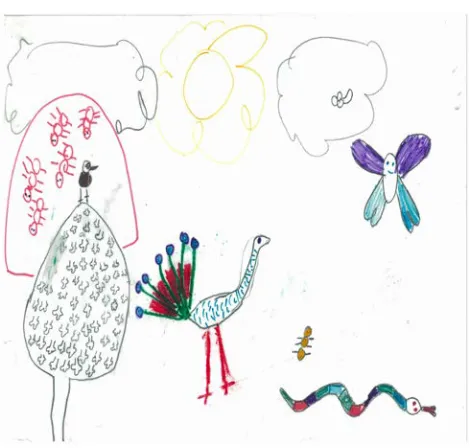
peacocks on the school grounds), ant hill, tree, kookaburra, sun, clouds, butterfly and fly.”
Figure 6. The rural environment
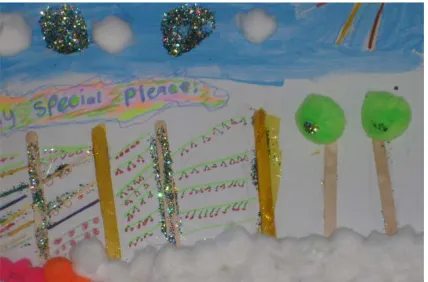
In the Collage Method research, children’s collages were also quite literally ‘real’, with depictions of their special places including very specific details pertaining to the environment. In Figure 7 below, a child represented ‘Gecko’s, a local indoor
playground, as it appears in reality. His description states: This is Geckos. It is special to me because it is an indoor playground and it has a really, really big slide and bouncy castle.
[image:9.595.141.455.565.707.2]Another child created a collage of the family lounge room, drawing the minute details featured on the carpet design, a high-definition television (which was transformed into a car) and other room displays (Figure 8 below).
Figure 8. Child’s Lounge Room
Holiday Spots
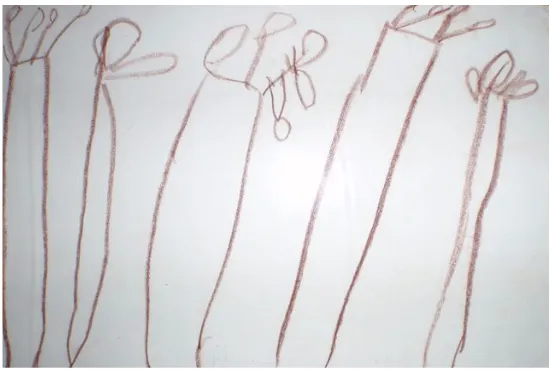
A recurring theme in the Collage Method research was holiday destinations. But holidays and family outings were depicted in the drawings as well, often explained through the stories children provided. This was unexpected, as children in the drawing research were asked to represent their environment, implying their home environment. For example, a child completed the drawing of trees and bats in Figure 9 below, and told a story that elaborates the drawing, describing a family picnic: “These are the bats hanging in the trees. When we went there we had some lunch and we saw some bush turkeys. When we left they hopped on the tables and ate all of the scraps that we left behind.”
Another child drew a picture of the sea and sea creatures (Figure 10 below) and told us, “When I go to the beach sometimes I go diving. I look for creatures – moray eels, sharks, jellyfish and crocodiles.”
Figure 10. Going to the beach.
Depiction of family holidays at local spots demonstrates reciprocal relationships between natural places and famiial interactions. Research indicates that interactions with family and friends were a key reason for why places held special meanings (Steadman, 2003).
environment, in the Collage Method children were asked to represent their ‘special place.’ Explanation of ‘special place’ was left to the children’s imaginations, so some may have defined it as ‘a place out of the ordinary’.
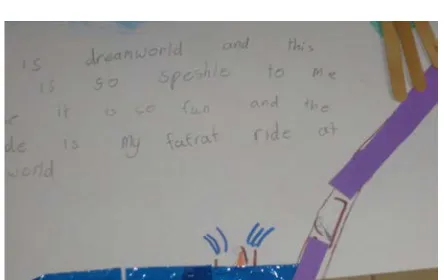
National holiday destinations included theme parks such as Dreamworld and interactive science museum, Sci-tech in Australia. The child representing
[image:12.595.187.409.263.403.2]Dreamworld wrote the following story: This is Dreamworld and this place is so special to me because it is so, so fun and the ride is my favourite ride at Dreamworld (Figure 11 below).
Figure 11: Dreamworld
The child who depicted Sci-tech (Figure 12 below) wrote: Sci-tech is special because it has science and other fun stuff. Additional information this child included in his interview, when questioned about what it was he liked at Sci-Tech was: I’ve got lots of favourite things but mostly my favourite things, um I think there’s also a movie there…anyways my favourite thing is a sand thing and you can roll it and it does really weird things with the sand. It appeared that this child enjoyed the option of a variety of activities and a variety of choices.
[image:12.595.91.448.591.767.2]National holiday destinations, such as Sci Tech and Dreamworld, with their plethora of activities, seemed to hold more appeal to children than more sedentary
[image:13.595.192.406.291.432.2]destinations, such as camping grounds or farms. According to the theory of affordances (Gibson, 1979 in Benson, 2009), children view a landscape for its inherent functions while adults primarily view landscapes for their form. However, a number of children did choose to depict natural destinations. Figure 13 below presents a child’s collage of a family trip to a cherry farm in another state. Her accompanying story reads: My special place is Orange because I like cherry farms.
Figure 13. Trip to Cherry Farm
Snow, which is non-existent in the tropical climate where the studies were
undertaken, was the reason for a child representing a national destination, as Figure 14 (below) shows. The story read: At Canberra we have to wear 12 layers of clothes.
Figure 14: Snow in Canberra
[image:13.595.184.410.545.713.2]made a collage of Bali in Indonesia, a favourite beach vacation spot for Australian tourists. The accompanying story read, My favourite place is Bali because it is fun and I went there last year (Figure 15 below).
Figure 15: Child’s collage of Bali
Others chose to draw holiday cities, such as Hong Kong, with its skyscrapers (Figure 16 below).
Figure 16: Hong Kong
Children’s choices of international places over local ones may reflect what
Gruenewald (in Gruenewald and Smith, 2008) defines as ‘placelessness’, a concept expressing people’s loss of locality because, rather than inhabiting places they are merely residing in them. Holiday destinations are places where we reside, but then return to everyday living.
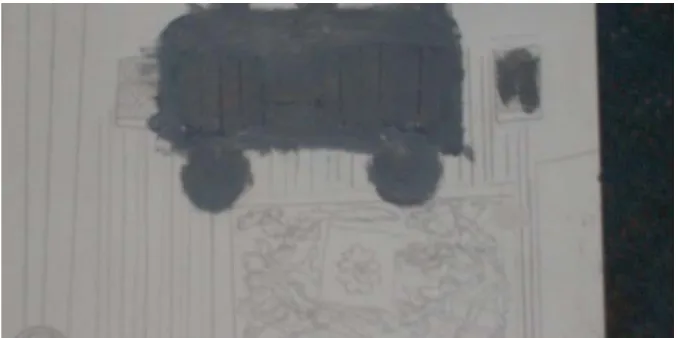
[image:14.595.181.413.421.615.2]In each research study, a number of children chose to depict hypothetical, or imagined places. For example, when asked to draw their environment, one child created a picture (Figure 17 below) of Thomas the Tank Engine, on what appears to be a railway track. This was probably something the child had viewed on television, and imagined as her environment. Anning & Ring (2004) note that children develop strong personal preferences for what they want to draw and how they want to draw it from their immersion in popular culture. Also, according to Pyle (2002, in Blizard & Schuster, 2007), children are living increasingly secluded lives with discretionary time often spent in front of the television or computer.
Figure 17. Thomas the Tank Engine
Another child represented Paris as her special place (Figure 18 below), in the collage study. However, surprisingly she had not been there; it was simply her ideal holiday location. Her story read, “I like France because it is a nice place and I can speak French.”
Figure 18. Paris
[image:15.595.153.443.540.718.2]national or international significance. But interestingly, not all places were real. Some children chose to depict hypothetical or imagined places as their special places or environments.
Natural vs Human-made Objects
While children generally represented their places positively, in many cases they demonstrated a greater affinity with the indoor, electronic environment than with the outdoor, natural environment. Research has shown that young children’s play has become confined to basements, playrooms and bedrooms because of parental fears for the child’s safety (Thompson, Aspinall & Montarzino, 2008) and this might be reflected in the abundance of indoor drawings.
The drawings and paintings showed a slight difference in representation of natural and human-made objects, in that trees (natural objects) were represented far more than any other objects, with 53% of pictures containing trees. However, the next most represented objects were houses (human-made objects), with 41% of pictures including houses, followed by wild animals (natural objects), such as frogs, echidnas, butterflies and kangaroos =present in 39% of the pictures. Household equipment (human-made objects) such as barbecues and lawnmowers were present in 35% of the pictures and buildings (human-made) in 34%. Sun, vegetation and grass were next most represented, with 33%, 28% and 28% respectively, followed by people (25%), roads (23%), water (22%, but often in swimming pools) and vehicles (20%). Even when the natural environment was the focus of the drawing or painting, references to the human-made environments appeared. For example, in Figure 4 above, which depicts Honeygold Mango trees and a farm, the child’s story went on to describe human-made objects, including electronic devices:
“I’m planting 2000 more Honeygold Mangoes. I have lots of tree. We’ve got a
Playstation. I live on a farm. There’s lots of tractors on our farm. We’re making bigger sheds.”
Children’s collages and stories also demonstrated a strong affinity with human-made elements over natural ones. 14 of the 15 collages contained human-made elements in comparison with 12 of the 15 featuring natural elements.
percentages only relate to the content analysis findings; it is important to note that children’s stories and interview made reference to human-made elements at a rate equal to 45% of the research sample.
[image:17.595.150.448.319.467.2]In collages, natural made elements and their percentages include: sun (50%), clouds, animals and trees (40%), weather elements (30%), water (13%), mountains and fruit (5%). It is important to note that even the most naturally-based collages made reference to technological entertainment. In Figure 19 (below), a child depicted their special place to be a camping spot. She collaged a wonderful natural environment, yet when asked whether she preferred being in her ‘special place’ alone or with others, she replied: With others coz if my DS goes down I don’t know what to do.
Figure 19. Family camping spot.
Additionally, in Figure 8 above, when writing his story explaining the importance of his loungeroom he wrote: It has powerpoints for my DS. This example is very familiar to one that Louv (2005, 2008, p.10) had in his own study where one child explained “I like to play in the indoors better because that’s where all the electrical outlets are”.
For this child and several other children within this study, indeed around the world, technological gadgets contribute to the meanings they afford to their various places. Findings like this would suggest that children are becoming “so estranged from their natural origins, that soon they may not recognize our species’ basic dependence on nature as a condition of growth and development” (Kellert, 2002, cited in White, 2004, p.3)
Conclusion
children, who do not always have the words to express what they think and feel. However, we found that to best understand the visuals created by children, we needed stories accompanying their work and, between the visuals and the stories, we were better able to understand children’s perceptions.
Children’s depictions of place covered a range of perceptions, from the literal and real to holiday spots within the local environment, in other locations in Australia, and at international locations. Some children even represented hypothetical or imagined places, such as on the Thomas the Tank Engine train or in Paris, a place not yet visited, but imagined by the child.
Both natural and human-made objects featured in children’s visual representations, but there seemed to be a preference for human made objects. Even in cases where the natural environment was depicted in the art work, the accompanying story explained that when the child’s electronic game stopped working, she was bored in the place. This seems to confirm the disconnect with nature, or, as Louv names it, “Nature Deficit Disorder”.
Movement towards a sustainable society can only be achieved through education. To build good teaching and learning models, researchers need to determine what
children already know about environmental sustainability, and what feelings and attitudes they hold towards caring for the natural environment (Martin, 2007). The Arts (including storytelling) provided much insight into children’s perceptions of place. The importance of being aware of children’s environmental understandings for
References
Alvesson, M., & Skoldberg, K. (2009). Reflexive Methodology: New Vistas for Qualitative Research (2nd ed.). London, California, New Delhi, Singapore: Sage
Publications.
Anning, A., and Ring, K. (2004). Making Sense of Children’s Drawings. Berkshire, England: Open University Press.
Benson, C. (2009). Changing Places: Children’s Experiences of Place during Middle Childhood. Unpublished doctoral dissertation, Humboldt State University.
Blizard, C. R., & Schuster, R. M. (2007). Fostering Children’s Connections to Natural Places through Cultural and Natural History Storytelling. Children, Youth and
Environments, 17 (4), 171-206.
Butler-Kisber, L., & Poldma, T. (2009). The power of visual approaches in qualitative inquiry: The use of collage making and concept mapping in experiential research. Proceedings of the EKSIG Conference: Experiential knowledge, method and methodology. London (June).
Denscombe, M. (2007). The Good Research Guide for small scale research projects – 3rd edition. Berkshire, England: Open University Press.
Di Leo, J. H. (1983). Interpreting Children’s Drawings. New York: Brunner Maze. Hurwitz, A. and Day, M. (2001) Children and Their Art: Methods for the Elementary School. (7th ed.).Belmont, USA: Thomson.
Gruenewald, D. and Smith, G. (eds). (2008). Place-based Education in the Global Age: Local Diversity. New York: Taylor and Francis.
Jack, G. (2010). Place Matters: The significance of place attachments for children’s wellbeing. British Journal of Social Work, 40.755 – 771.
Kendrick, M., & McKay, R. (2004). Drawings as an Alternative way of Understanding Young Children’s Constructions of Literacy. Journal of Early Childhood Literacy, 4,
109-128.
Louv, R. (2005). Last Child in the Woods: Saving Our Children from Nature Deficit Disorder. Chapel Hill, NC: Algonquin Books.
MacNaughton, G. and Hughes, P. (2009). Doing Action Research in Early Childhood Studies – a step by step guide. Berkshire, England: Open University Press.
Martin, P. (2007). Caring for the Environment: Challenges from Notions of caring. Australian Journal of Environmental Education, 23, 57-64.
Rose, G. (2007). Visual Methodologies: An Introduction to the Interpretation of Visual Materials (2nd ed.).Los Angeles, London, New Delhi, Singapore & Washington DC:
Sage Publications.
Russell-Bowie, D. (2006). MMAD about the arts! An Introduction to Primary Arts Education. Frenchs Forest, NSW: Pearson Education.
Sorin, R. (2004). Understanding children’s feelings – Emotional literacy in early childhood. Research in Practice Series. Canberra: Early Childhood Australia. ISBN: 0975193546.
Sorin, R. and Gordon, I. (2009). Frogs in the Drain – Children’s Perceptions of the Tropical Landscape. eTropic - electronic journal of studies in the tropics.
Steadman, R. (2003). Is it really just a social construction?: The contribution of the physical environment to sense of place. Society and Natural Resources. 6(8), 671 – 685.
Thompson, C. W., Aspinall, P., and Montarzimo, A. (2008). The childhood factor: Adult visits to green places and the significance of childhood experience. The Journal of Environment and Behaviour. 40 (1), pp. 111 – 143.
United Nations Educational, Scientific and Cultural Organisation (2009). UNESCO Review of Contexts and Structures for Education for Sustainable Development 2009. Paris, France: Arjen Wals.
Westoby, M. (1993). Biodiversity in Australia compared to other continents in R.E. Ricklefs and D. Schluter (eds). Historical and Geographic Determinants of
Community Diversity. Chicago: University of Chicago Press.