(2008)
www.electrochemsci.org
An enhanced Glucose Biosensor Modified by
Pt/sulfonated-MWCNTs with Layer by Layer Technique
Hongjuan Wang, Chunmei Zhou, Jiahua Liang, Hao Yu, Feng Peng*
School of Chemistry and Chemical Engineering, South China University of Technology, Guangzhou, China
*E-mail: [email protected]
Received: 4 July 2008 / Accepted: 12 August 2008 / Published: 8 September 2008
In this work, a glucose biosensor, which was denoted as (GOD/Pt/S-MWCNTs)x/GC biosensor, was constructed successfully by fixing sulfonated MWCNTs immobilized with Pt nanoparticles (Pt/S-MWCNTs) and glucose oxidase (GOD) on the surface of glassy carbon electrode (GCE) with LBL technique. The biosensor constructed by this method was characterized by cyclic voltammogram (CV) and electrochemical impedance spectroscopy (EIS). The detecting performance of the biosensor with different layers was investigated and optimized. The results show that the detection performance of the glucose biosensor reaches the optimum with three layers of GOD/Pt/S-MWCNTs. The detecting performance of the (GOD/Pt/S-MWCNTs)3/GC biosensor to glucose is excellent with the detecting sensitivity of 1.36 A/mM, linear range of 2.5mM and the correlation coefficient of 0.972.
Keywords: glucose biosensor; Pt/sulfonated-MWCNTs; cyclic voltommogram; chrnonocamperometry
1. INTRODUCTION
Because of simplicity and quickness, amperometric glucose biosensor is the most common used for glucose detection. But there still exist some problems, such as narrow linear range, low sensitivity and stability, which can’t satisfy the detection requirement. In order to improve the performance of the glucose biosensor, significant research has been devoted to this field by many methods such as the addition of redox mediators [1, 2], conducting polymer [3-6], carbon nanotubes [7,8] and nanoparticles [9-14], etc.
In this work, a glucose biosensor, which was denoted as (GOD/Pt/S-MWCNTs)x/GC biosensor, was constructed successfully by fixing sulfonated MWCNTs immobilized with Pt nanoparticles (Pt/S-MWCNTs) and glucose oxidase (GOD) on the surface of glassy carbon electrode (GCE) with LBL technique. The biosensor constructed by this method was characterized by cyclic voltammogram (CV) and electrochemical impedance spectroscopy (EIS). The detecting performance of the biosensor with different layers was investigated by chronoamperometry (CA) and was optimized. The detection performance of the optimum glucose biosensor was evaluated.
2. EXPERIMENTAL PART
2.1. Reagents and solutions
Glucose oxide (GOD, 133,600 units/g, type X-S, from Aspergillus niger), -D (+)-glucose (97%) and Nafion (5 wt% in ethanol) were purchased from Sigma. Multi-walled carbon nanotubes (MWCNTs, 10-20 nm outer diameters) were kindly provided by Chengdu Organic Chemicals Co. Ltd. All the other reagents used are analytic grade. 0.1 M phosphate buffer solution (PBS) as electrolyte solution was prepared from sodium dihydrogenphosphate and disodium hydrogenphosphate. All the reagents and material were used as received without further purification. All solutions were prepared with deionized water of a resistivity not less than 18 MΩ·cm (Milli-Q, USA). Experiments were performed at room temperature ( 25±1 oC).
2.2. Apparatus
The cyclic voltammogram and chronoamperometric experiments were carried out using a computer-controlled Autolab PGSTAT30 potentiostat/galvanostat with GPE and FRA softwares (Eco Chemie, Netherlands). A conventional three electrode electrochemical cell was used in this work with a bare or modified glassy carbon electrode as working electrode (2 mm diameter), a platinum electrode as counter electrode and an Ag/AgCl electrode with saturated KCl as reference electrode, respectively. During the chronoamperometry experiment, a stirrer (DF-101B, Shanghai magnetic apparatus company) was used to keep the solution uniform.
2.3. Preparation of modified GC biosensor
and dry at a desiccator to obtain the Pt/S-MWCNTs modified GC (Pt/S-MWCNTs/GC) electrode. (b) Then 5 L of GOD (1mg/mL) was casted on the modified GC electrode and dried at room temperature to obtain GOD/Pt/S-MWCNTs/GC glucose biosensor. Repeating the step (a) and (b) several times to obtain the resultant (GOD/Pt/S-MWCNTs)x/GC glucose biosensor. The glucose biosensor was stored in 0.1 M PBS (pH 7) at 4 oC in refrigerator when not in use.
3. RESULTS AND DISCUSSION
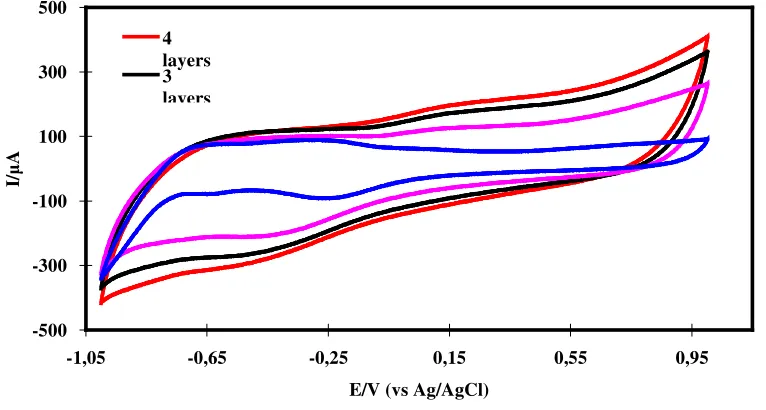
Fig. 1 is the cyclic voltommogram of the (GOD/Pt/S-MWCNTs)x/GC glucose biosensor with different layers. It can be seen that the responding current increase with the increase of the layer and almost steady with three layers, which indicates that the electric property of the glucose biosensor arrives the optimum with the layers of 3. With the more layers, the usage factor of the Pt/S-MWCNTs will decrease.
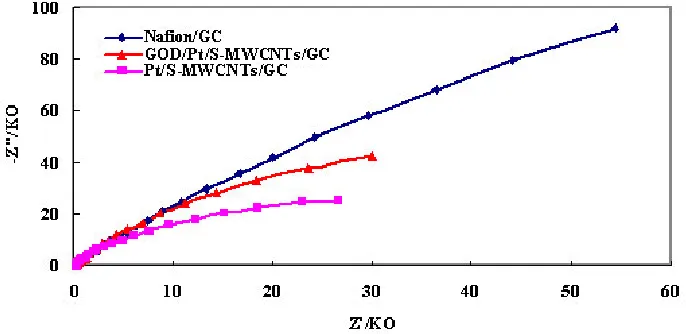
The electron-transfer resistance on the electrode can be obtained by measuring the diameter in Nyquist plot of EIS. The larger the diameter is, the larger the electron-transfer resistance is. Fig. 2 is the EIS of the GC electrode with Nafion, Pt/S-MWCNTs and GOD/Pt/S-MWCNTs. From it, it can be seen that the electron-transfer resistance of the Nafion/GC electrode is the largest, which is due to the non-conductivity of the Nafion. After modified by the Pt/S-MWCNTs, the electron-transfer resistance of the Pt/S-MWCNTs/GC electrode becomes very little with the smallest diameter. This is due to the perfect conductivity of Pt/S-MWCNTs. Because of the non-conductivity of GOD, the electron-transfer resistance of the GOD/Pt/S-MWCNTs/GC electrode becomes larger again.
-500 -300 -100 100 300 500
-1,05 -0,65 -0,25 0,15 0,55 0,95
E/V (vs Ag/AgCl)
I/
A
[image:3.612.117.500.453.658.2]4 layers 3 layers
Figure 2. EIS of GC Electrode with modification of Nafion, GOD/MWCNTs and Pt/S-MWCNTs
Fig. 3 is the EIS of (GOD/Pt/S-MWCNTs)x/GC biosensor with different layers. With the layer increases, the diameter decreases, that is to say, the electron-transfer resistance decreases. Although the GOD, Nafion (which is used to dispersing Pt/S-MWCNTs) and Pt/S-MWCNTs all increase with the layer increase and the GOD and Nafion are all non-conductivity, the electron-transfer resistances decrease with the layer increase, which further indicates the good conductivity of Pt/S-MWCNTs.
Figure 3. EIS of the (GOD/Pt/S-MWCNTs)x/GC biosensor with different layers
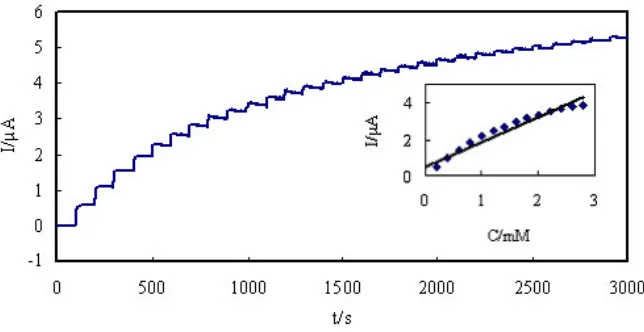
[image:4.612.129.491.418.598.2]The detecting performance of the (GOD/Pt/S-MWCNTs)3/GC biosensor to glucose was shown in Fig.5. The working potential of 0.25V was applied in the measurement, which is much lower than the conventional value of usually 0.7V. The lower working potential can avoid the oxidation of coexisting interfere in practical application. The insert figure is the calibration curve with responding current to glucose concentration. It can be obtained that the detecting linear range is 2.5 mM and the detecting sensitivity is 1.36 A/mM with the correlation coefficient of 0.972.
Figure 4. Chronoamperometric response of the (GOD/Pt/S-MWCNTs)x/GC biosensor with different layers to 0.2mM glucose
Figure 5. Detecting performance of the (GOD/Pt/S-MWCNTs)3/GC biosensor to glucose with the working potential of 0.25V
4. CONCLUSIONS
[image:5.612.138.487.177.334.2] [image:5.612.146.468.403.569.2]and the correlation coefficient of 0.972. This study has developed a promising method for preparation of glucose biosensor with excellent performance.
ACKNOWLEDGEMENT
The authors thank the Key Laboratory of Green Chemical Technology of Guangdong Province for financial support.
References
1. J. Z. Xu, J. J. Zhu, Q. Wu, Z. Hu and H. Y. Chen. Electroanal. 15 (2003) 219 2. L. Y. Jiang, H. M. Liu, J. Liu, Q. D. Yang and X. X. Cai. Talanta 619-620 (2008) 11 3. M. Gao, L. M. Dai and G. G. Wallace. Electroanal. 15 (2003) 1089
4. E. S. Forzani, H. Q. Zhang, L. A. Nagahara, I. Amlani, R. Tsui and N. J. Tao. Nano Lett. 4 (2004) 1785
5. M. A. Rahman, N. H. Kwon, M. S. Won, E. S. Choe and Y. B. Shim. Anal. Chem. 77 (2005) 4854 6. H. Mugurauma, Y. Shibayama and Y. Matsui. Biosens. Bioelectron. 23 (2008) 827
7. H. J. Wang, C. M. Zhou, F. Peng and H. Yu. Int. J. Electrochem. Sci. 2 (2007) 508 8. M. E. G. Lyons and G. P. Keeley. Int. J. Electrochem. Sci. 3 (2008) 819
9. M. S. Topcu, O. Gokdogan, A. Gulce and H. Gulce. Biosens. Bioelectron. 21 (2006) 1719 10. C. P. Remirez and D. J. Caruana. Electrochem. Commun. 8 (2006) 450
11. E. Y. Cai, X. N. Zhao, J. J. Zhu and H. Y. Chen. Chem. Mater. 18 (2006) 279 12. Y. J. Zou, C. L. Xiang, L. X. Sun and F. Xu. Biosens. Bioelectron. 23 (2008) 1010 13. J. J. Yu, D. L. Yu, T. Zhao and B. Z. Zeng. Talanta 74 (2008) 1586
14. X. H. Kang, Z. B. Mai, X. Y. Zou, P. X. Cai and J. Y. Mo. Talanta 74 (2008) 879
15. S. A. Miscoria, J. Desbrieres, G. D. Barrera, P. Labbe and G. A. Rivas. Anal. Chim. Acta. 578 (2006) 137
16. F. L. Qu, M. H. Yang, J. H. Jiang, G. L. Shen and R. Q. Yu. Anal. Biochem. 344 (2005) 108 17. W. W. Yang, J. X. Wang, S. Zhao, Y. Y. Sun and C. Q. Sun. Electrochem. Commun. 8 (2006) 665 18. Y. J. Zou, C. L. Xiang, L. X. Sun and F. Xu. Electrochimica Acta 53 (2008) 4089
19. F. Peng, L. Zhang, H. J. Wang, P. Lv and H. Yu. Carbon 43 (2005) 2405 20. H. J. Wang, H. Yu, F. Peng and P. Lv. Electrochem. Commun. 8 (2006) 499