Monograph:
Konrad, Wilifred, Espluga, Josep, Bergmans, Anne et al. (6 more authors) (2018)
Comparative cross-country analysis on preliminary identification of key factors underlying
public perception and societal engagement with nuclear developments in different national
contexts. Research Report. European Commission
[email protected] https://eprints.whiterose.ac.uk/
Reuse
This article is distributed under the terms of the Creative Commons Attribution-NoDerivs (CC BY-ND) licence. This licence allows for redistribution, commercial and non-commercial, as long as it is passed along
unchanged and in whole, with credit to the original authors. More information and the full terms of the licence here: https://creativecommons.org/licenses/
Takedown
If you consider content in White Rose Research Online to be in breach of UK law, please notify us by
underlying public perception and societal
engagement with nuclear developments
in different national contexts
Month 13 – September 2016
(
Update March 2018)
Authors: Wilfried Konrad (DIALOGIK), Josep Espluga (UAB)
Co-Authors:
Anne Bergmans (UANTWERPEN)
Ioan Charnley-Parry (UCLan)
Matthew Cotton (UY)
Ann Enander (FHS)
Jan-Henrik Meyer (UCPH)
Gene Rowe (GRE)
CAVEAT
Following the HoNESt research approach, the empirical basis for this deliverable consists of the
so-called ‘short country reports’ produced by HoNESt historians who are experts of the history of
nuclear energy of ‘their’ specific countries. The aim of social science research in HoNESt Work
Package 4 is to analyse these reports in terms of perception and engagement. In the process of
this analysis we are only occasionally able to refer to original primary sources and to reference
them since these are often not accessible e.g. for language reasons. In line with received
scholarly practice of such ‘secondary analysis’, we will reference to the relevant short country
reports, where the full reference to the primary sources can be found. In addition, it is all the more
important to mention that these ‘short country reports’ are still in a draft status and not yet
PREFACE
This document Deliverable 4.2 ‘Comparative cross-country analysis on preliminary identification
of key factors underlying public perception and societal engagement with nuclear developments
in different national contexts’ is an update – in response to the HoNESt midterm review – of the
previous version of D4.2 which was submitted in September 2016. The revision consists of four
elements:
1. Update of country studies: The first issue of D4.2 had to be based on preliminary versions
of HoNESt historians short country reports. In the meantime, the final drafts of these
reports are available, which offered the opportunity to amend D4.2 social science country
studies in the light of the latest versions of the short country reports.
2. USA country study: Following the emphasize put on US nuclear developments by the
midterm review, D4.2 has been enhanced by an additional country study analysing the
US case.
3. Update of comparison section: Revising the existing country studies, and adding one
more country, required updating the cross-country comparisons.
4. Conclusions section: A conclusions section has been added aiming at summarizing
EXECUTIVE SUMMARY
This report deals with the history of nuclear-society interactions from a social science perspective.
Since the beginning of project HoNESt in September 2015, historians have elaborated 20
so-called ‘short country reports’ covering most European and major non-European countries (e.g.
USA). On the basis of this comprehensive collection of individual studies – each encompassing
about 60 years of history – we have selected seven countries to be analysed in terms of public
perception of, and public engagement with, nuclear energy: Austria, Bulgaria, the Federal
Republic of Germany (FRG), the Netherlands, Spain, the United Kingdom (UK), and the United
States of America (USA). Our findings reveal that each country follows its own nuclear
development path with corresponding preference profiles and engagement traditions. However,
there are similarities among countries allowing researchers to classify them analytically as either
neutral to supportive (e.g. UK) or refusing (e.g. FRG) with regard to deploying nuclear power for
electricity production. The varying preference profiles of each country hints at the fact that people
refer to a broad scope of heterogeneous evaluation criteria when assessing nuclear technologies.
Arguments such as security of energy supply, (dis)trust in decision-makers, climate change, or
national prestige play an important role in the debate. Citizens argue from different points of view.
Their perceptions and arguments reflect the complexity of the debate comprising environmental,
economic, social, and political considerations. Except for the UK and Bulgaria, where protests
only occasionally occurred, all countries have faced active civil society opposition against nuclear
issues, i.e. public forced communication activities. Pro-nuclear communication processes
commissioned by regulators and industry promoters of nuclear power are part of the history of
nuclear-society interactions in each country. However, there is only a handful of examples of
CONTENTS
1. Introduction ... 8
2. Public perception ... 9
3. Public engagement ... 11
4. Social science country studies ... 13
4.1. Austria ... 14
4.1.1. Public perception in Austria ... 14
4.1.2. Public engagement in Austria ... 16
4.2. Bulgaria ... 18
4.2.1. Public perception in Bulgaria ... 18
4.2.2. Public engagement in Bulgaria ... 20
4.3. Federal Republic of Germany ... 22
4.3.1. Public perception in the FRG ... 22
4.3.2. Public engagement in the FRG ... 25
4.4. The Netherlands ... 27
4.4.1. Public perception in the Netherlands ... 27
4.4.2. Public engagement in the Netherlands ... 31
4.5. Spain ... 35
4.5.1. Public perception in Spain ... 35
4.5.2. Public engagement in Spain ... 39
4.6. United Kingdom ... 41
4.6.1. Public perception in the UK ... 41
4.7. United States of America ... 49
4.7.1. Public perception in the USA ... 49
4.7.2. Public engagement in the USA ... 54
5. Public perception and public engagement in a cross-country perspective ... 55
5.1. Public perception ... 56
5.2. Public engagement ... 59
6. Conclusions ... 60
7. List of short country reports ... 63
TABLES
Table 1: Basic facts on nuclear power in Austria ... 14
Table 2: Acceptance profile Austria ... 15
Table 3: Basic facts on nuclear power in Bulgaria ... 18
Table 4: Acceptance profile Bulgaria ... 20
Table 5: Basic facts on nuclear power in the FRG ... 22
Table 6: Acceptance profile FRG ... 25
Table 7: Basic facts on nuclear power in the Netherlands ... 27
Table 8: Acceptance profile Netherlands ... 31
Table 9: Basic facts on nuclear power in Spain ... 35
Table 10: Acceptance profile Spain ... 39
Table 11: Basic facts on nuclear power in the UK ... 41
Table 12: Acceptance profile UK ... 45
Table 13: Basic facts on nuclear power in the USA ... 49
Table 14: Acceptance profile USA ... 53
Table 15: Evaluation categories according to countries ... 56
1. Introduction
This document is part of the research undertaken in the context of HoNESt Work Package 4. It
provides a report on key factors underlying societal perception and engagement with nuclear
developments in selected European countries and the United States. It relies on a systematic
approach of scrutinizing a range of country reports using an overall evaluation framework in
analysing historical narratives of nuclear developments and outstanding events related to the use
of nuclear energy.
Against this background, we aim at testing the validity and feasibility of our concepts of public
perception and public engagement in different national nuclear environments, focusing on nuclear
power and research reactors and referring only occasionally to waste issues and nuclear weapons
– namely where these are prominent in the debate about nuclear power. In order to be able to
make useful cross-country comparisons, we decided to assess seven countries – Austria,
Bulgaria, FRG, Netherlands, Spain, UK, and USA – based upon on the following selection criteria:
• Country size
o Large: FRG, Spain, UK, USA
o Small: Austria, Bulgaria, Netherlands
• Political system
o Democratic: Austria, FRG, Netherlands, UK, USA
o Transition from authoritarian regime to democracy: Bulgaria, Spain
• Status of the use of nuclear energy
o Reactors in operation: Bulgaria, FRG, Netherlands, Spain, UK, USA
o Governmental decision to stop future use: FRG
o Governmental decisions regarding future use to be taken: Bulgaria, Spain
o New reactors under construction or research: UK, USA, Netherlands
The data bases for this deliverable are the following HoNESt draft short country reports provided
by historians in the context of the project’s Work Package 2::
• Berkers, E., 2017. The Netherlands Short Country Report, February 2017. HoNESt
Project Report.
• Butler, S., Bud, R., 2017. United Kingdom Short Country Report, February 2017. HoNESt
Project Report.
• Forstner, C., 2017. Austria Short Country Report, February 2017. HoNESt Project Report.
• Josephson, P.R., 2017. United States Short Country Report, February 2017. HoNESt
Project Report.
• Kirchhof, A.M., Trischler, H., 2017. Federal Republic of Germany Short Country Report,
February 2017. HoNESt Project Report.
• Rubio-Varras, M.d.M., De la Torre, J., Espluga, J., Presas i Puig, A., 2017. Spain Short
Country Report, February 2017. HoNESt Project Report.
• Tchalakov, I., Hristov, I., 2017. Bulgaria Short Country Report, February 2017. HoNESt
Project Report.
The structure of the report is as follows. Section 2 gives a brief overview of the concept of ‘public
perception’, explains the method deployed for identifying nuclear energy evaluation categories,
and delivers a list of those categories elicited by analysing country reports. Section 3 deals with
engagement and the type of actors involved in engagement processes. Section 4 provides our
results of analysing historians’ country studies in terms of public perception and public
engagement. Section 5 discusses the results focussing on cross-country comparisons. Finally
section 6 summarizes the findings and points to the limits and approach of this report.
2. Public perception
As the transformation of the energy system has become a key policy issue in many countries,
public perception and acceptance of both the transition process and single energy technologies
has become a major topic in energy research and policy advice literature (Bickerstaff et al. 2008;
Demski et al. 2015; Devine-Wright 2008; Ellis et al. 2007; Hauff et al. 2011; Kim et al. 2013;
system to be objective and one that can be readily identified and improved, HoNESt social
scientists understand reality as the creative construction of human beings. This assumption is
underlying our concept of ‘perception’; a definition that seeks to understand reality as the
construction of people’s interpretation of their experiences, in this case nuclear energy and its
interaction with civil society.
Quantitative and qualitative evidence of public acceptance of nuclear technologies reveals an
interplay between numerous complex factors influencing and shaping perceptions and values.
These include factors such as institutional trust, procedural fairness, risk tolerability, availability
of scientific information, and nuclear power’s role in mitigating anthropogenic climate change
(Besley 2012; Parkhill et al. 2010; Pidgeon et al. 2008; Poortinga et al. 2006; Visschers/Siegrist
2012). Such complex factors go beyond simple direct interactions with government and the
nuclear industry and reflect a spectrum of interactions within local communities and within wider
society (Whitton et al. 2016).
Against this background, this deliverable presents preliminary results of public attitudes and
preferences towards nuclear energy within the seven countries listed above. By means of
qualitative analysis of HoNESt reports on countries’ nuclear history, data were synthesized into a
set of country-specific acceptance profiles. In doing so, content analysis has been conducted
using an inductive category development procedure referring to Mayring (2004). Each nuclear
history report of the seven countries investigated for this deliverable was examined in-depth in
order to create categories representing the evaluation basis for preference making towards using
nuclear power stations for electricity production. In a second step, the text passages assigned to
these categories were further investigated in order to deduce sub-categories specifying the main
category. This process has been performed by the two lead authors of this deliverable in a way
that each country report was analysed by a single researcher. In particular, Konrad is responsible
for the evaluation of Austria, Bulgaria, FRG, Netherlands, UK, and USA, Espluga for Spain.
Overall, we identified the following eight categories for evaluating nuclear energy.
• Trust: This issue captures whether (dis)trust in politics, institutions, and business plays a
• National economics: This evaluation category gathers arguments related to a collective,
i.e. national economic perspective, encompassing topics such as security of supply,
wealth and industrial progress, or resource requirements.
• Consumer economics: The issue of consumer economics considers microeconomic
considerations on individual and household level, e.g. concerns about energy prices.
• Local impact: This aspect refers to effects raised by citizens living close to planned or
realized nuclear sites. Perceptions influenced by proximity can be both supportive (e.g.
stressing benefits of job creation) or refusing (e.g. locally unwanted land uses). Moreover,
this factor gathers reasoning patterns hinting at a gap between individual and collective
technology acceptance (e.g. a nuclear reactor is not rejected per se but when living close
to it).
• Environmental impact: This issue consists of positive or negative assessments as to the
environmental impacts of nuclear energy. This applies e.g. for statements about climate
change or radioactive contamination.
• Social & ethical impact: This category serves to collect arguments related to values of
national or local identity, fairness and justice from both an inter- and intra-generational
perspective, and non-proliferation of nuclear blueprints, technologies, and materials.
• Health impact: This factor captures fears of being exposed to health risks originating from nuclear power plants.
• Risk of catastrophic accident: This issue compiles arguments centred on the high or low
damage potential of nuclear power.
3. Public engagement
Understanding public perceptions is an important prerequisite when it comes to engaging with
citizens about nuclear energy. Since the limitations of a one-way information process from
institutions to society has become clear, public participation seems to be the means of choice to
make (energy) policy decisions socially acceptable (Whitton et al. 2016). For Rowe and Frewer
(2005), public participation is the “practice of involving members of the public in the
agenda-setting, decision-making, and policy-forming activities of organizations/institutions responsible for
participants and promoters, i.e. those who have commissioned the engagement initiative, the
authors differentiate between three engagement types (Rowe/Frewer 2005:254ff.).
• Public communication refers to a process where information is transferred from the
sponsor of an initiative to the public. There is no involvement of the public per se, i.e.
public feedback is not required or sought.
• Public consultation refers to a process of conveying information from members of the
public to the sponsors of the initiative, following a process initiated by the sponsor. In this
process, there is no formal dialogue between individual members of the public and the
sponsors.
• Public participation means the existence of information exchange between members of
the public and the sponsors. The most significant feature of a participatory engagement
is that there is some degree of dialogue in the process. The flow of information is
two-way, with the exchange of information opening up the possibility of perception change in
both the sponsors and the public.
These three categories have proven to be effective in capturing and classifying nuclear-related
engagement activities initiated by state authorities or industrial organisations. However, it turned
out that beyond such ‘official engagement’ in the history of nuclear-society interactions the public
or its representatives often created and conducted their own participation activities. We suggest
designating engagement actions directed from the public to regulators or nuclear companies as
‘public forced communication’.
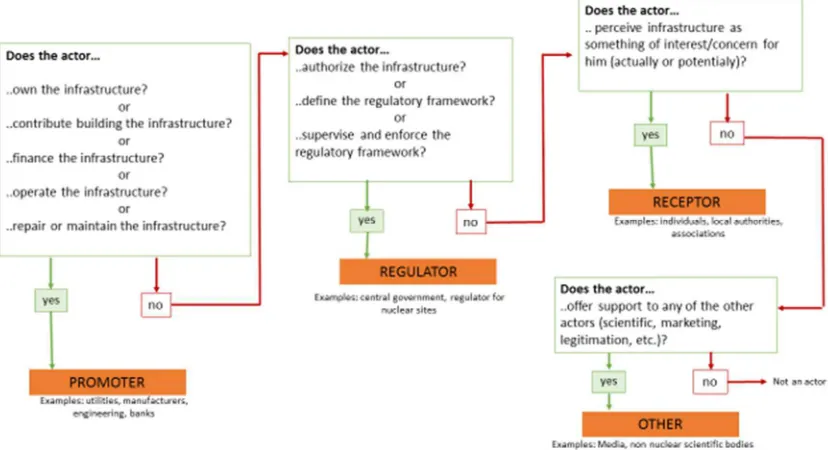
In order to enable clear distinctions between different originators and receptors of engagement
processes, HoNESt researchers have developed the following scheme consisting of four actor
types.
• Promoters (or private sponsors): Companies, scientific bodies (supporting promoters
arguments/interests), interest organizations, political parties.
• Regulators (and other public institutions): Regulators at local, regional, national,
• Receptors (or affected people): Civil society (organized people such as environmental
groups, associations, neighbourhood groups, NGOs, labour unions), interest groups,
political parties, public in general, scientific bodies (supporting affected people).
• Other: Media (opinion pieces supporting promoters’, regulators’, or affected peoples’
[image:15.595.92.506.300.525.2]arguments/interests), non-nuclear scientific bodies.
Figure 1 demonstrates how to differentiate between these actor types.
Figure 1: Actor’s taxonomy
Source: Rubio-Varas et al. (2016)
4. Social science country studies
The purpose of this section is to present the results of the social science investigations of the
historians’ country reports. Each country portrait starts with a table providing latest and historical
facts on the country’s nuclear programme, followed by significant techno-economic as well as
perception and engagement highlights. Subsequently, light is shed on nuclear-society interactions
history. This scheme has been employed for the analysis of seven countries that in this section
are presented in alphabetical order.
4.1. Austria
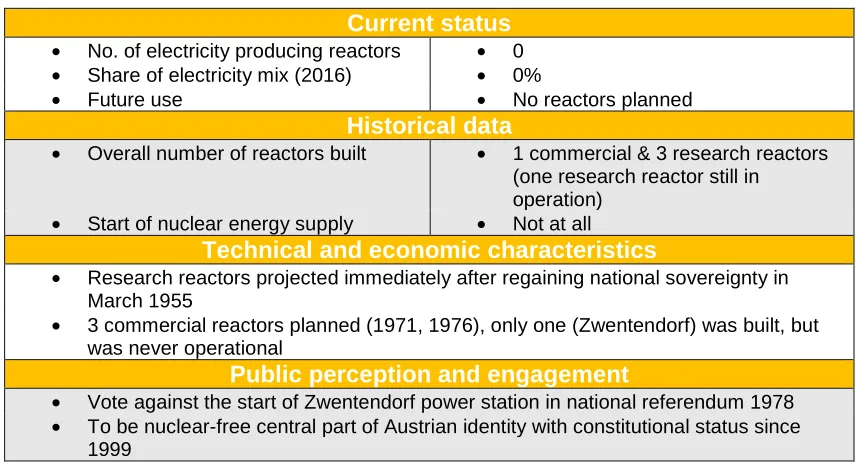
The purpose of the following table is to provide a brief overview of basic facts on nuclear power
[image:16.595.83.511.301.532.2]in Austria.
Table 1: Basic facts on nuclear power in Austria
Current status
• No. of electricity producing reactors • 0• Share of electricity mix (2016) • 0%
• Future use • No reactors planned
Historical data
• Overall number of reactors built • 1 commercial & 3 research reactors (one research reactor still in
operation)
• Start of nuclear energy supply • Not at all
Technical and economic characteristics
• Research reactors projected immediately after regaining national sovereignty in March 1955
• 3 commercial reactors planned (1971, 1976), only one (Zwentendorf) was built, but was never operational
Public perception and engagement
• Vote against the start of Zwentendorf power station in national referendum 1978
• To be nuclear-free central part of Austrian identity with constitutional status since 1999
Source: own depiction
4.1.1. Public perception in Austria
In the history of nuclear energy in Austria, the anti-nuclear movement managed to convince the
country’s population to narrowly vote against the introduction of commercial nuclear power in a
referendum in 1978, so that the already completed nuclear power plant at Zwentendorf never
went critical. At first, mainly taking place at the local level in the light of a public opinion at least
partly in favour of technical progress, civil society opposition against nuclear power grew to
nation-wide protests that finally caused policy-makers to incorporate a ban on the use of nuclear energy
in the Austrian constitution. As the short country report data show, public criticism of nuclear
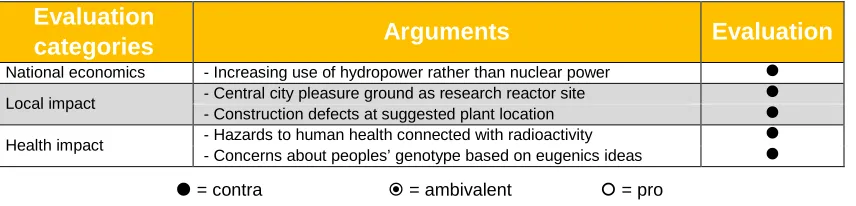
National economics
The first stirrings of protest against the Zwentendorf power plant had become visible with a
memorandum of the Lower Austrian Chamber of Physicians from 1969. Among other arguments,
the authors questioned the viability of this project and argued in favour of increasingly deploying
Austrian’s hydropower capabilities (Forstner 2017:25).
Local impact
At the end of the 1950s, the first siting decision for the research reactor of the Austrian universities
(TRIGA MARK II) was criticised by residents due to plans of locating it at a World War II
above-ground flak tower in the Augarten, a central Vienna pleasure above-ground (Forstner 2017:18). Another
argument raised against using this facility was the bad condition of the building.
Health impact
A key argument both in the debate about the location of research reactors and the use of nuclear
energy at all was concern about the hazards to human health coming from nuclear radiation.
These fears not only had a medical background, but also rested on eugenics ideas of radiation
[image:17.595.88.516.527.630.2]having harmful impacts on the genotype of the Austrian people (Forstner 2017:25).
Table 2: Acceptance profile Austria
Evaluation
categories
Arguments
Evaluation
National economics - Increasing use of hydropower rather than nuclear power Local impact - Central city pleasure ground as research reactor site
- Construction defects at suggested plant location Health impact - Hazards to human health connected with radioactivity
- Concerns about peoples’ genotype based on eugenics ideas
= contra = ambivalent = pro
4.1.2. Public engagement in Austria
In the course of Austria’s nuclear history we can observe the implementation of communication
and consultation processes as well as examples of public forced communication.
Public communication
Faced with a growing, in its beginning in 1969 widely ignored campaign against nuclear power
plants, the Austrian government in April 1976 commenced a public information campaign
consisting of expert discussions (’hearings’) in ten Austrian cities (Forstner 2017:25ff.) Both
supporters and opponents of nuclear energy were represented among those experts. Far from
yielding the desired success in terms of creating a pro-nuclear morale among the public, the
government’s communication exercise on the contrary helped local protest groups in May 1976
to form an umbrella organization (Initiative of Austrian Nuclear Power Opponents) aiming at
preventing Zwentendorf from being commissioned (Forstner 2017:28).
Public forced communication & Public consultation
Austria’s civil society played an active role in campaigning against nuclear power plants, strongly
arguing with negative impacts of radiation on the human body using examples from Hiroshima
and Nagasaki as evidence. At the end of the 1950s, protests of residents led to moving the site
of the planned Austrian universities’ research reactor from a Vienna’s central pleasure ground to
a peripheral area (Forstner 2017:18). Between 1972 and 1975, up to 20,000 inhabitants of the
state of Vorarlberg protested against the projected Swiss nuclear power station Rüthi. As this
plant should be built near the Austrian border, the so-called Anti-Rühti Marches crossed the
border to Switzerland (Forstner 2017:40). Initially local criticism and protests against the planned
nuclear power stations Zwentendorf and Stein/St. Pantaleon emerged into a nation-wide
anti-nuclear movement consisting of a wide range of social and political groups, e.g. mothers,
teachers, natural scientists, pupils, Catholics, artists, trade unionists, socialists, communists, and
even right-wing communities arguing on the basis of ideas of eugenics. One anti-nuclear key
event was a panel discussion with about 3,500 participants in Linz in April 1975. This discussion
was broadcasted all over Austria, both Chancellor Kreisky and the Minister of Trade were among
on nuclear power had supposedly cost the Swedish Social Democrats crucial votes (Kolb 2007),
and domestically under pressure of the protest movement, the social democratic Austrian
Chancellor Bruno Kreisky enacted both a construction freeze of the Stein/St. Pantaleon plant and
decided to hold a public national referendum on whether the Zwentendorf plant should go into
operation or not. In November 1978, a narrow majority of 50.47% voted against the start up, and
only a month after the plebiscite the parliament adopted a new law that forbade the use of nuclear
fission in Austria for energy production. However, this was not the end of the Austrian anti-nuclear
movement. Following the TMI and Chernobyl accidents, the anti-nuclear movement gained even
more importance and significantly influenced the government in declaring Austria in 1999 – by
constitutional law – to be a non-nuclear country (Forstner 2017:20f., 27ff., 38f.). The
‘Bundesverfassungsgesetz für ein atomfreies Österreich’ (Federal Constitutional Act for a
Non-Nuclear Austria) determines that:
• “Nuclear weapons cannot be produced, tested, stored or transported,
• Nuclear power plants cannot be constructed anymore and those that are already built
cannot start operation,
• Transport and storage of compounds for nuclear fission are forbidden, except those for
peaceful uses although not those for energy production,
• The Republic of Austria is liable for any injuries due to accidents with radioactive
compounds or has to enforce the claims from foreign causers,
• The Federal Government is responsible for the implementation of the law” (Forstner
4.2. Bulgaria
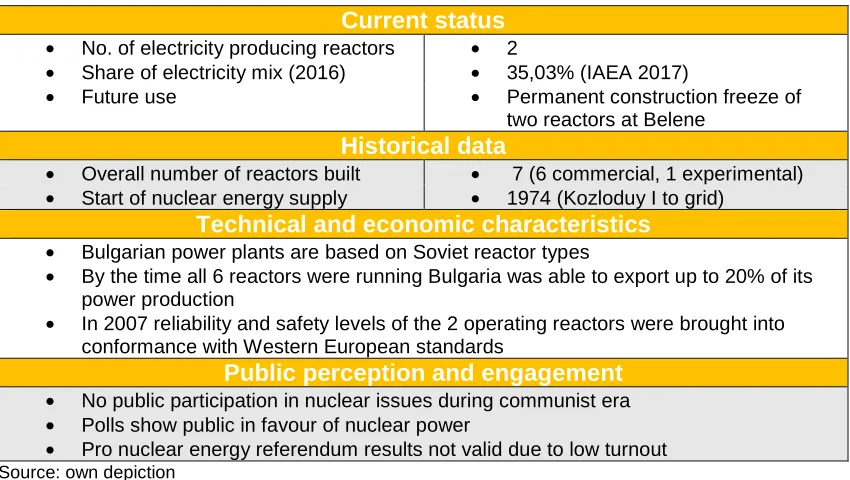
The purpose of the following table is to provide a brief overview of basic facts on nuclear power
[image:20.595.86.511.253.493.2]in Bulgaria.
Table 3: Basic facts on nuclear power in Bulgaria
Current status
• No. of electricity producing reactors • 2• Share of electricity mix (2016) • 35,03% (IAEA 2017)
• Future use • Permanent construction freeze of two reactors at Belene
Historical data
• Overall number of reactors built • 7 (6 commercial, 1 experimental)
• Start of nuclear energy supply • 1974 (Kozloduy I to grid)
Technical and economic characteristics
• Bulgarian power plants are based on Soviet reactor types
• By the time all 6 reactors were running Bulgaria was able to export up to 20% of its power production
• In 2007 reliability and safety levels of the 2 operating reactors were brought into conformance with Western European standards
Public perception and engagement
• No public participation in nuclear issues during communist era• Polls show public in favour of nuclear power
• Pro nuclear energy referendum results not valid due to low turnout
Source: own depiction
4.2.1. Public perception in Bulgaria
Until the beginning of the 1990s, when the country’s political system changed from a communist
regime into a parliamentary democracy, what Bulgarian citizens’ thought about utilizing nuclear
technologies for electricity production did not enter a public space and remained politically largely
irrelevant. Nevertheless, before 1990, as everywhere in Eastern Europe the Communist
authorities had promoted nuclear power as part of Soviet style development and modernity. Since
then, nuclear energy has become a subject of discussion within both the political and public arena.
Although the civil society debate on nuclear power started in 1989 with the foundation of the
nuclear-critical Ecoglasnost environmental organisation, a slight majority of the Bulgarian
population seems to accept nuclear power plants, according to an opinion survey conducted after
Fukushima in March 2011. In that poll, 50.9% said that Bulgaria should still build new nuclear
at Belene, 44% agreed with constructing one plant and another 24% agreed with constructing two
plants, while 32% indicated that they would build no reactors at all (Tchalakov/Hristov 2017:49f.).
This predominantly positive attitude, as the country report shows, is, however, interwoven with
concerns and compromises resulting from the evaluation of government decisions in terms of
trust, national economics, and health impact.
Trust
The government’s policy of not informing the Bulgarian population about the real consequences
of the Chernobyl accident led to the creation of an overall feeling of distrust in nuclear
technologies (Tchalakov/Hristov 2017:17.). This policy was implemented under the influence of
the Soviet Union and its probably misleading suggestions towards handling the Chernobyl case.
National economics
One of the preconditions Bulgaria had to accomplish to be allowed to become a member of the
EU was to shut down four of the six reactors of the Kozloduy power plant for safety reasons.
Critics of this decision argued Bulgaria would lose a crucial part of its industrial capability when
fulfilling the European Commission’s request.1 Economic considerations were also put on the
agenda in the debate on the question of whether construction of the Belene power plant should
be completed or not. Those who supported completion said the plant would prevent Bulgaria from
importing electricity from Romania and Turkey; those against argued that this would increase
energy dependency from Russia since a Russian company would build the Belene plant.
(Tchalakov/Hristov 2017:43).
Health impact
In the years following the Chernobyl accident a share of the Bulgarian population has developed
fears about radiation pollution – according to the Bulgarian country report, in “1993 more than
1
38% of Bulgarian population considers radiation pollution as the most dangerous threat”
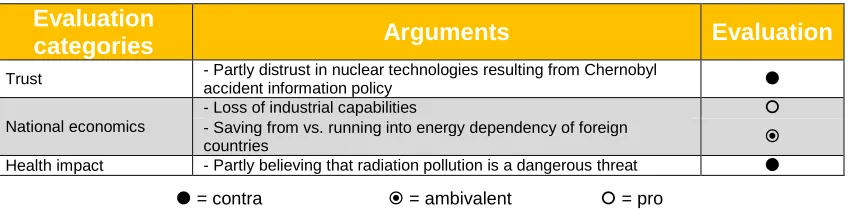
[image:22.595.88.514.217.329.2](Tchalakov/Hristov 2017:18.).
Table 4: Acceptance profile Bulgaria
Evaluation
categories
Arguments
Evaluation
Trust - Partly distrust in nuclear technologies resulting from Chernobyl accident information policy
National economics
- Loss of industrial capabilities
- Saving from vs. running into energy dependency of foreign countries
Health impact - Partly believing that radiation pollution is a dangerous threat
= contra = ambivalent = pro
Source: own depiction
4.2.2. Public engagement in Bulgaria
Public engagement in the Bulgarian nuclear history centred on communication and consultation
processes; in addition activities of public forced communication can be observed.
Public communication
During the communist era, the public had no voice in nuclear power decision-making. Debates
about the Bulgarian energy policy and the role of nuclear reactors in the country’s energy portfolio
took place within the political, economic and scientific nomenklatura. Citizens had no other choice
than to notice and accept what government had decided. Hence, public communication about
nuclear issues was processed within a top-down framework without any feedback opportunity for
the receivers of the state’s messages. The government relied on this one-way approach when
only insufficiently informing the public about the Chernobyl accident, since – as the Bulgarian
country report says – “Bulgarian communists were just too loyal to the Russians”
(Tchalakov/Hristov 2017:37).
Public forced communication & Public consultation
One of the first activities of the Ekoglasnost environmental organisation founded in 1989 in the
course of the Bulgarian regime change was urging the provision of reliable information about
Chernobyl and the accident’s impacts. But this has only been the starting point for the rise of
other factors (e.g. lack of funds), contributed to the construction freeze of the Belene plant in 1990
(Tchalakov/Hristov 2017:25.). Another key event of public engagement has been the referendum
of January 2013. The referendum was concerned with voting on whether Bulgaria should develop
nuclear energy through construction of a new nuclear power plant. (However, it was widely
presumed that it actually was on restarting the frozen Belene project.) The ballot yielded two
results. First, a clear majority of participants voted in favour of nuclear energy with 61.49% ‘Yes’
votes and 38.51% ‘No’ votes. Second, with a turnout of just20.22%, this result was politically
non-binding since the referendum significantly missed the required 60% quorum of registered voters.
Therefore, the referendum did not change the state of the Belene project since the government
“refused to restart the project pointing to the non-binding rate of participation” (Tchalakov/Hristov
4.3. Federal Republic of Germany
The purpose of the following table is to provide a brief overview of basic facts on nuclear power
[image:24.595.88.514.254.558.2]in the Federal Republic of Germany (FRG).
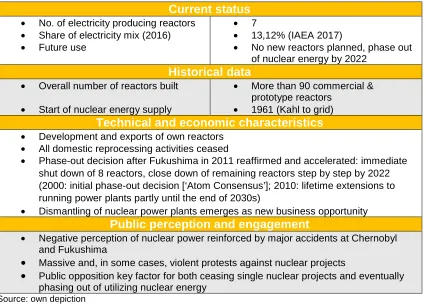
Table 5: Basic facts on nuclear power in the FRG
Current status
• No. of electricity producing reactors • 7• Share of electricity mix (2016) • 13,12% (IAEA 2017)
• Future use • No new reactors planned, phase out of nuclear energy by 2022
Historical data
• Overall number of reactors built • More than 90 commercial & prototype reactors
• Start of nuclear energy supply • 1961 (Kahl to grid)
Technical and economic characteristics
• Development and exports of own reactors• All domestic reprocessing activities ceased
• Phase-out decision after Fukushima in 2011 reaffirmed and accelerated: immediate shut down of 8 reactors, close down of remaining reactors step by step by 2022 (2000: initial phase-out decision [‘Atom Consensus’]; 2010: lifetime extensions to running power plants partly until the end of 2030s)
• Dismantling of nuclear power plants emerges as new business opportunity
Public perception and engagement
• Negative perception of nuclear power reinforced by major accidents at Chernobyl and Fukushima
•
Massive and, in some cases, violent protests against nuclear projects•
Public opposition key factor for both ceasing single nuclear projects and eventually phasing out of utilizing nuclear energySource: own depiction
4.3.1. Public perception in the FRG
Since the 1960s, nuclear energy has been a controversial societal issue in West Germany. The
conflict, however, was not dominated by the discourse of specialized groups of advocates and
opponents, but was strongly influenced by a broad involvement of often local civil society actors,
often around reactor sites throughout the country in the 1970s and 1980s. Citizen action groups
carried their protest into the political realm by founding the German Green party in the late 1970s.
The relatively strong green party has given the nuclear issue a prominent presence in German
politics, contributing – along with other factors – to the phase-out decision of the Merkel
An early example of public opposition took place in Karlsruhe. Local women’s associations were
critical of the nuclear research center operating since 1962 “because of the danger posed to
citizens in a city with a high population density” (Kirchhof/Trischler 2017:8). However, the main
starting point of the German anti-nuclear movement is connected with the protests against the
proposed Wyhl power plant in the mid-1970s (Radkau 2012). As opposed to the United States
(cf. below), civilian energy production and military use of nuclear technologies had been perceived
as being independent issues until the 1980s. Electricity and weapons production were considered
as being two sides of the same coin only in the context of the opposition against the proposed
Wackersdorf reprocessing plant. The anti-nuclear movement suspected that this plant would
serve weapon-technical purposes and should be built as part of the NATO double-track decision
of December 1979 (Radkau 2012:119). Investigating the FRG short country report
(Kirchhof/Trischler 2017, the factors determining public perception of nuclear energy in the FRG
can be assigned to the evaluation categories trust, national economics, environmental impact,
social & ethical impacts, health impact, and risk of catastrophic accident.
Trust
In the course of the nuclear debate, time after time it has become obvious that lack of trust is a
popular point of criticism among those against nuclear energy. Mistrust was raised against both
political and economic actors. Critics suspected that regulators, the state, and the nuclear industry
colluded and were not trustworthy. The political handling of big industry projects were perceived
as non-transparent and authoritarian, with opponents blaming policy-makers for not seriously
considering alternative energy technologies (Kirchhof/Trischler 2017:6, 13). Left-wing critics
perceived this collusion between the state, the regulators and industry in terms of left-wing ideas
current in the 1970s, such as the leftist tenet ’state-monopoly-capitalism’, with the state being the
saviour of industry in late capitalism. Ideas of the high-security ’nuclear state’ – drawing on
National economics
From an economic point of view, critics addressed the high cost of nuclear energy as a major
disadvantage. In the opinion of many citizens, “the costs of the facilities far exceeded the benefits”
(Kirchhof/Trischler 2017:14).
Environmental impact
Negative environmental impacts have been assumed for both the construction and running of
nuclear power stations. For instance, farmers and wine growers feared negative environmental
impacts resulting from the cooling towers of the projected Breisach power plant (Kirchhof/Trischler
2017:25).
Social and ethical impacts
Nuclear opponents claimed an ethical duty to act against nuclear energy for the sake of a
nuclear-free future of the coming generations. However, arguing for inter-generational justice did not
follow only altruistic ambitions, rather a major driving factor was the fear of being accused by
succeeding generations of failing to act against the nuclear industry. Here, arguments drawing on
the example of earlier generations having failed in the face of the ethical challenge posed by the
Nazi dictatorship played an important role (Kirchhof/Trischler 2017:13f., Schüring 2012).
Health impact
Worries about the risks of low-level radiation have been discussed with respect to both public
health in general and children’s health in particular (the latter issue mostly raised by women), and
locally in certain regions, such as the vicinity of the power plant Krümmel (East of Hamburg)
(Kirchhof/Trischler 2017:27).
Risk of catastrophic accident
The public felt troubled by both the dangers of nuclear waste disposal and the risks imposed to
the population in case a disaster would happen at a power plant. The latter argument became
specifically relevant in debates in the aftermath of the Chernobyl accident and about the fast
breeder project in Kalkar (which was never put into service). In a trial in 1984 against Kalkar
type as more difficult to control than a conventional plant, thus in their view it would involve
significantly higher risks of serious accidents: “On the one hand a Bethe-Tait accident could not
be ruled out; on the other hand liquid sodium was used for cooling, which was chemically
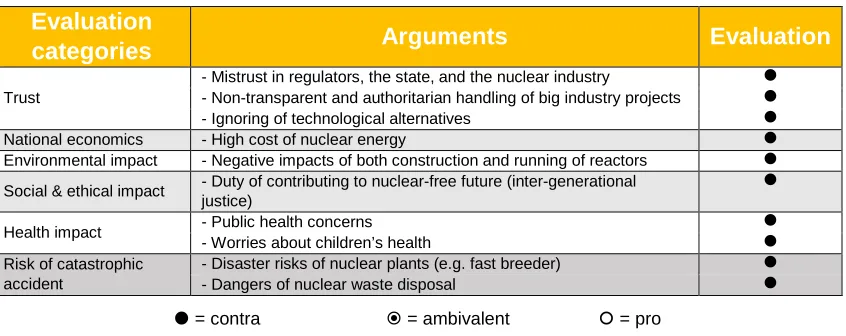
[image:27.595.89.512.257.425.2]especially aggressive” (Kirchhof/Trischler 2017:20).
Table 6: Acceptance profile FRG
Evaluation
categories
Arguments
Evaluation
Trust
- Mistrust in regulators, the state, and the nuclear industry
- Non-transparent and authoritarian handling of big industry projects - Ignoring of technological alternatives
National economics - High cost of nuclear energy
Environmental impact - Negative impacts of both construction and running of reactors Social & ethical impact - Duty of contributing to nuclear-free future (inter-generational
justice)
Health impact - Public health concerns - Worries about children’s health Risk of catastrophic
accident
- Disaster risks of nuclear plants (e.g. fast breeder) - Dangers of nuclear waste disposal
= contra = ambivalent = pro
Source: own depiction
4.3.2. Public engagement in the FRG
Although German decision-makers over decades have been constantly engaged in public
communication activities – striving to provide citizens with information about the advantages of
nuclear power – the key feature of (West)Germany’s history of nuclear-society interactions is an
increasingly critical civil society participating in numerous anti-nuclear public forced
communication initiatives. The toponyms Wyhl, Brokdorf, Gorleben, Kalkar, and Wackersdorf
signify key locations of civil society resistance against nuclear power plants, radioactive waste
disposals, and reprocessing facilities taking place throughout the 1970s and 1980s
(Kirchhof/Trischler 2017:9ff.). Except for the Brokdorf power plant, none of these nuclear projects
went into operation. One – but not the sole – reason2 for the projects’ failures had been massive
protest demonstrations at all of these sites of up to 100.000 people, which were sometimes
2 Besides public resistance, for each project eventually not realized there are specific political or economic
accompanied by the occupation of building sites. Repeatedly these protests turned into violent
clashes with the police, causing observers in the Brokdorf case to speak of “civil-war-like
confrontations between police forces and opponents of the project” (Glaser 2012:12). A reason
for the strength and partly violent nature of the German anti-nuclear movement stems from the
deeply rooted mistrust in state and industry, culminating in activists’ perceptions of citizens being
victims of the machinations of the nuclear complex. Left-wing activists inspired by ideas of a
high-security ’nuclear state’ (cf. above) “saw a connection between the extension of atomic energy and
democratic deficits and argued that the atomic lobby lacked transparency as well as honesty”
(Kirchhof/Trischler 2017:13). Underpinned by such a rationale that argues against nuclear energy
from a political and not a technical point of view, brutal police responses led militant anti-nuclear
actions to gain even more support. Another explanation of the high level of violence committed
by parts of the anti-nuclear movement is that German activists perceived and practiced civil
disobedience in different terms than US activists, for whom it implied strictly non-violent conduct,
4.4. The Netherlands
The purpose of the following table is to provide a brief overview of basic facts on nuclear power
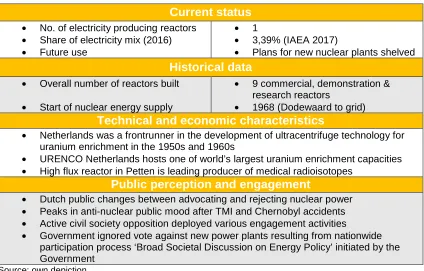
[image:29.595.87.511.252.523.2]in the Netherlands.
Table 7: Basic facts on nuclear power in the Netherlands
Current status
• No. of electricity producing reactors • 1• Share of electricity mix (2016) • 3,39% (IAEA 2017)
• Future use • Plans for new nuclear plants shelved
Historical data
• Overall number of reactors built • 9 commercial, demonstration & research reactors
• Start of nuclear energy supply • 1968 (Dodewaard to grid)
Technical and economic characteristics
• Netherlands was a frontrunner in the development of ultracentrifuge technology for uranium enrichment in the 1950s and 1960s
• URENCO Netherlands hosts one of world’s largest uranium enrichment capacities
• High flux reactor in Petten is leading producer of medical radioisotopes
Public perception and engagement
• Dutch public changes between advocating and rejecting nuclear power
• Peaks in anti-nuclear public mood after TMI and Chernobyl accidents
• Active civil society opposition deployed various engagement activities
• Government ignored vote against new power plants resulting from nationwide participation process ‘Broad Societal Discussion on Energy Policy’ initiated by the Government
Source: own depiction
4.4.1. Public perception in the Netherlands
The timespan from the late 1960s to the early 1970s marks both the years when the Netherlands
became a nuclear nation and when anti-nuclear activists and citizen groups performed activities
against nuclear projects. The 1960s had seen optimism about the modernization potential of
nuclear technologies as well as a massive decrease in public attention to this topic. The
commissioning of two nuclear power plants, the building of a uranium enrichment plant, and the
decision to participate in the fast breeder project in Kalkar (Germany) between 1968 and 1973,
renewed public interest in nuclear issues, this time focussing on in the opinion of opponents
critical issues related to trust, economic, or environmental factors (cf. below). Opinion polls portray
accident of Chernobyl, Eurobarometer data of 1987 and 1989 reports 54% and 58% negative
votes (Berkers 2017:67). When after signing the Kyoto protocol nuclear technologies were
discussed as an option of greening the energy system with a view to lower CO2 emissions, Dutch
public opinion shifted to a more positive attitude. Pro-nuclear answers prevailed in polls conducted
in 2005, 2008 and 2010, and in 2005 a two-third majority of the participants supported plans of
extending the lifetime of the Borssele plant (Berkers 2017:19, 67). However, public preferences
changed again in the light of the Fukushima accident. In a poll of the market research company
Synovate commissioned by Greenpeace 51% of the interviewed citizens were against building
new power plants in the Netherlands (Synovate 2011). A recent paper by the European Atomic
Forum on public acceptance of nuclear energy reports that “after a dip just after the accident,
public acceptance of nuclear has recovered” (FORATOM 2017:157).
The analysis of the Netherlands’ short country report (Berkers 2017) has revealed the following
evaluation criteria as being decisive for Dutch citizens’ nuclear perceptions: trust, national
economics, consumer economics, environmental impact, social & ethical impact, and risk of
catastrophic accident.
Trust
In the 1970s, environmental groups, so-called ‘critical scientists’ or left-wing political activists
viewed nuclear energy from the perspective of a general attitude of mistrust in institutions,
representatives, and actions of modern democratic states: “Progress itself was questioned as was
the scientific and political establishment and the data they provided as arguments for their cause
were distrusted” (Berkers 2017:15). A lack of trust, for instance, was even virulent in the context
of the government’s initiative for a ‘Broad Societal Discussion on Energy Policy’ (in Dutch: BMD;
cf. below for more details), which took place from 1980 to 1984. Anti-nuclear groups questioned
the fairness of the process and suspected it of aiming to weaken the anti-nuclear movement and
obscure a decision already taken in favour of nuclear energy. Actually, the BMD had two
conclusions regarding the future of nuclear energy in the Netherlands. First, a majority of
participants did not want new nuclear reactors. Second, an immediate shut down of the two
the BMD majority’s plea against new nuclear plants, the feeling of mistrust was confirmed,
reinforcing the gap between politics and society (Berkers 2017:50ff.).
National economics
In the beginning of the process of entering the nuclear domain, arguments linked to the
modernization of industry and society and to prospects of growing economic wealth helped to
create a nuclear-friendly public opinion. When nuclear technologies became a societally
contested issue, their assumed economic benefits were questioned by alleging economic reasons
against expanding both the Netherlands power plant and uranium enrichment capacities. In a
petition to the parliament (1976) of the Think Tank ‘Bezinningsgroep Energie’ signed by 1200
scholars these plans had been criticised as unnecessary because the existing facilities already
met the electricity demand, furthermore the planned developments were unlikely to stimulate
Dutch industry, would prove to be too costly in the light of the expectation of increasing uranium
prices (which peaked in the mid-1970s; cf. Pool 2013),3 and would not lead to new jobs in the
region of the uranium enrichment factory (Berkers 2016:79). Moreover, anti-nuclear actors
regarded nuclear investments as misallocation of scarce resources that could be better used for
the development of alternative energy sources (Berkers 2017:43f.).
Consumer economics
In order to finance its part of the fast breeder project in Kalkar (Germany), the State government
created the so-called ‘Kalkar levy’, a surcharge of 3% to the electricity bill of Dutch households.
Overall, the public reacted with outrage, and many of those who did not agree with the fee refused
to pay for it (Berkers 2017:47). Nowadays, the Kalkar levy is judged to be the biggest mistake the
pro-nuclear actors could have made since it accelerated the formation of the anti-nuclear
movement which by the time was still relatively small (Berkers 2017:49).
3 Since the share of fuel prices on nuclear energy costs are much lower than in the cases of coal or gas, one
Environmental impact
When by the early 1970s anti-nuclear groups set out to put nuclear energy on the agenda of the
public debate, the environmental movement, which had until then focused on chemical pollutants
and landscape transgression, made ecological concerns surrounding nuclear energy its main
target. In recent years, the challenge of climate change endowed nuclear energy with a new
reputation as a promising low-carbon electricity technology (Berkers 2017:19).
Social & ethical impact
In the beginning of the Dutch post-war nuclear energy history, when nuclear electricity was
decoupled from nuclear weapons and positively connected to technical progress, the
Netherland’s ability to construct and run a nuclear reactor was perceived as a reason for national
pride. These capabilities had been demonstrated at an exhibition called ‘The Atom’ in 1957, where
visitors could experience a working reactor that was manufactured by Dutch engineering and
electro-technical companies. Ethical concerns about the circumstances of uranium mining
especially in African countries, and about the unwanted spreading of knowledge, blueprints and
technologies required for the construction of nuclear weapons, in the late 1970s, played a crucial
role in the anti-nuclear movement’s arguments against an expansion of the Netherland’s uranium
enrichment capacities at Almelo. Regarding proliferation, protesters argued about an espionage
case related to the Pakistani nuclear weapons programme, a contract between Germany (one of
the three partners of the Almelo plant) and Brazil to deliver enriched uranium, and the danger of
Germany becoming a nuclear power (Berkers 2017:43f.).
Risk of catastrophic accident
Public discussion addressed nuclear safety on several occasions, namely on the security of the
Dodewaard reactor (triggered by a little leakage in a connection to the reactor’s pressure vessel),
the safety of transporting nuclear material in general, and after the TMI accident (Berkers
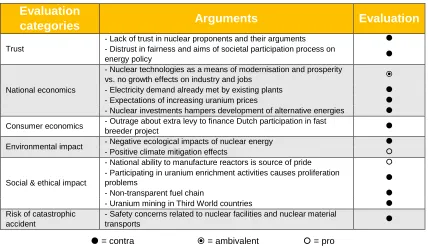
Table 8: Acceptance profile Netherlands
Evaluation
categories
Arguments
Evaluation
Trust
- Lack of trust in nuclear proponents and their arguments - Distrust in fairness and aims of societal participation process on energy policy
National economics
- Nuclear technologies as a means of modernisation and prosperity vs. no growth effects on industry and jobs
- Electricity demand already met by existing plants - Expectations of increasing uranium prices
- Nuclear investments hampers development of alternative energies Consumer economics - Outrage about extra levy to finance Dutch participation in fast
breeder project
Environmental impact - Negative ecological impacts of nuclear energy - Positive climate mitigation effects
Social & ethical impact
- National ability to manufacture reactors is source of pride - Participating in uranium enrichment activities causes proliferation problems
- Non-transparent fuel chain
- Uranium mining in Third World countries Risk of catastrophic
accident
- Safety concerns related to nuclear facilities and nuclear material transports
= contra = ambivalent = pro
Source: own depiction
4.4.2. Public engagement in the Netherlands
The massive increase in public awareness of nuclear technologies in the Netherlands at the end
of the 1960s came along with a shift in strategies and actors of nuclear engagement processes.
Until the late 1960s business and political actors had been organizing communication campaigns
in order to create a nuclear-friendly atmosphere, and subsequently in the 1970s and 1980s
nuclear issues were debated and contested in the course of public participation activities pushed
on by both the government and civil society organizations.
Public communication
Official and unofficial communication campaigns conducted by political and industrial actors in
the formative phase of the Netherlands’ nuclear endeavours had the primary objective of
convincing society of the manifold civil applications of nuclear power by stressing its wealth and
progress potentials. Nuclear power was cast in terms of economic and social welfare and
disassociated from the nuclear bomb (Verhees 2012). Two communication actions had
Atom’ and ‘Benefits of the Atom’, which were made available by the US Information Service, and
which strived to stage nuclear power as one of the most important inventions in the history of
mankind (Berkers 2017:8f.). The second and most influential action in arousing pro-nuclear
enthusiasm, however, was ‘The Atom’ exhibition that took place in 1957 in a hangar at Amsterdam
Schiphol Airport. The show-stopper of this event was a working 10 kW nuclear reactor which
fascinated the public. Altogether, the exhibition attracted about 750,000 visitors, i.e. it reached
almost 5% of the Dutch population directly and many others indirectly via different media (Berkers
2017:32ff.).
Public forced communication
From the early 1970s onwards, nuclear power discussions overcame the boundaries of expert
circles of industry, science or politics and civil society started to develop its own independent
ideas about nuclear technology issues. The growing anti-nuclear movement did not focus on only
one or two components of the Netherlands nuclear ambitions. Rather, with varying intensity, it
challenged the whole programme by conducting various engagement activities ranging from
protest marches and civil disobedience to petitions and memoranda. As depicted above,
imagining nuclear power as a dangerous technology here was just one factor among concerns
based on economic or ethical perceptions. The following list provides examples of anti-nuclear
actions (Berkers 2017:14ff.):
• In opposition to the ultracentrifuge project in Almelo, a group of young scientists in 1970
published the report ‘The ultracentrifuge: godsend or a threat to peace?’.
• When in the summer of 1973 the second Dutch nuclear energy reactor at Borssele got
its licence, petitions against it were written.
• The building of a suspension reactor in Arnhem was in 1973 challenged by a group called
‘Purple September’.
• In September 1974 about 10.000 Dutch citizens protested at the Kalkar site, just across
the Dutch-German border, against the building of the fast breeder reactor. Some weeks
later the Dutch Parliament was offered a petition pleading for the end of the project. It
was signed by 155.000 citizens. Dutch and German activists also engaged in
• In January and February 1976 several hundred people gathered for anti-nuclear
demonstrations in Dodewaard and Borssele, the sites of the two Dutch nuclear reactors.
• About 10.000 citizens demonstrated in April 1977 at the Almelo uranium enrichment
facility.
• In September 1977 about 60.000 people protested in Kalkar against the fast breeder
reactor.
• A number of anti-nuclear organizations jointly published an ‘Almelo information bulletin’
in October 1977.
• In May 1980, a two-day discussion camp joined by up to 5.000 participants was held
about the strategy to get the nuclear energy reactor at Dodewaard closed. The camp
participants decided to announce the blocking of the plant’s entrance gates. This was
realized with about 15.000 people who blocked the site for one day in October 1980.
Public participation: the ‘Broad Societal Discussion on Energy Policy’
From the mid-1970s to the end of this decade, a societal debate about nuclear energy emerged
that resulted in the decision of the national government to organize a ‘Broad Societal Discussion
on Energy Policy’ (in Dutch: BMD; Berkers 2017:50ff.). The starting point of this engagement
process was the intention of the Dutch government to build three further nuclear energy plants.
The plans to do so had been announced in 1974, containing the participatory element that people
were granted the right to be heard regarding impacts on the location. However, soon it became
clear that civil society participants would not be satisfied with discussing siting issues, instead
they urged for the opportunity to debate about nuclear energy as such. Reflecting these demands,
it was decided to carry out the BMD engagement process. This initiative consisted of the following
two phases.
a) Information phase: Beyond stakeholder consultations, a key element of the information phase
(September 1981 to October 1982) consisted of publication of a full-page ‘bulletin’ in all
nationwide newspapers, asking the general public about opinions concerning energy policy. On
the basis of the input obtained this way, the topics ‘costs of nuclear energy’, ‘structure of the
electricity provision’, ‘risk analysis and perception’ and ‘processing and storing of radioactive
energy and environmental policies. Throughout the Netherlands 13 hearings about these topics
were organized, resulting in scenarios that would serve as input for the second BMD part.
b) Discussion phase: During the discussion phase (January 1983 to December 1984), the four
scenarios were discussed nationwide in hundreds of moderated discussions, namely local
discussions organized by municipalities (1811 meetings), organizational discussions organized
by non-governmental organizations (1120 meetings), and school debates.
When the final report was published in early 1984, the main conclusion was that a majority of the
Dutch people did not want new nuclear reactors. The government, however, did not feel
committed to follow this vote and decided in January 1985 to reject the conclusions of the BMD.
For the anti-nuclear movement this was like a punch in the face that delegitimized the seriousness
of the government’s participation process. From the beginning activists encountered the BMD
with a rather sceptical view, being suspicious about the way the government would deal with the
outcomes. The government’s ignoring of the BMD results confirmed the “anti-nuclear movement
in its opinion that the Government together with nuclear industry already had decided in favour of
4.5. Spain
The purpose of the following table is to provide a brief overview of basic facts on nuclear power
[image:37.595.85.514.254.582.2]in Spain.
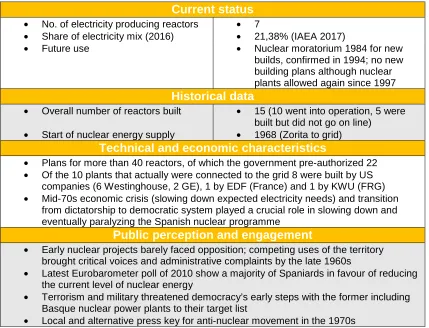
Table 9: Basic facts on nuclear power in Spain
Current status
• No. of electricity producing reactors • 7• Share of electricity mix (2016) • 21,38% (IAEA 2017)
• Future use • Nuclear moratorium 1984 for new builds, confirmed in 1994; no new building plans although nuclear plants allowed again since 1997
Historical data
• Overall number of reactors built • 15 (10 went into operation, 5 were built but did not go on line)
• Start of nuclear energy supply • 1968 (Zorita to grid)
Technical and economic characteristics
• Plans for more than 40 reactors, of which the government pre-authorized 22
• Of the 10 plants that actually were connected to the grid 8 were built by US companies (6 Westinghouse, 2 GE), 1 by EDF (France) and 1 by KWU (FRG)
• Mid-70s economic crisis (slowing down expected electricity needs) and transition from dictatorship to democratic system played a crucial role in slowing down and eventually paralyzing the Spanish nuclear programme
Public perception and engagement
• Early nuclear projects barely faced opposition; competing uses of the territory brought critical voices and administrative complaints by the late 1960s
• Latest Eurobarometer poll of 2010 show a majority of Spaniards in favour of reducing the current level of nuclear energy
• Terrorism and military threatened democracy’s early steps with the former including Basque nuclear power plants to their target list
• Local and alternative press key for anti-nuclear movement in the 1970s
Source: own depiction
4.5.1. Public perception in Spain
Following the draft Spanish short country report (Rubio-Varas et al. 2017), government’s and
industry’s perception of nuclear energy is characterized by a positive perspective focusing on
emphasizing factors of reliability, efficiency, and safety of nuclear power plants. This was
underpinned by pointing at beneficial indirect environmental impacts resulting from heat
emissions on local agriculture (Rubio-Varas et al. 2017:25). A risk-benefit approach was the
considered substantially greater, and protests of environmentalists were considered to be not
consistent with the reality of nuclear power plants. The public regulatory bodies tended to highlight
the economic dimension of nuclear energy, emphasizing particularly that employment would be
created in rural and economically depressed areas. Following a period characterized by the
emergence of quite a few isolated critical voices, since 1974 local and, in the Basque Country
and Catalonia, regional groups occurred acting against nuclear power.4 After the nuclear
moratorium of 1984, anti-nuclear action groups developed more organized structures and
contributed to a nationwide latent public opposition to nuclear power (Rubio-Varas et al. 2017:6).
The latest Eurobarometer poll shows a majority of Spaniards in favour of reducing the current
level of nuclear energy: when answering the question ‘should the current level of nuclear energy
as a proportion of all energy sources be reduced, maintained the same or be increase’, in 2010
49% said reduced, 33% maintained, 9% increased, and 9% don’t know (Eurobarometer 2010). A
poll of June 2015 said that 28% are in favour of nuclear energy and 60% against (FORATOM
2017:159). In this context, the factors shaping public perception of nuclear energy in Spain can
be assigned to the following evaluation categories:
Trust
Distrust in risk management of both electricity utilities and governmental actors on national,
regional, and local level. On the one hand, as for other Western countries one can assume for
the Spanish case that a general distrust in modern institutions has merged with anti-nuclear
sentiments. A strong hint to this issue is the rhetoric of the anti-nuclear movements that “include
aspects identifying nuclear power with technological colonialism and imperialism” (Rubio-Varas
et al. 2017:15). Another reason for developing distrust in utilities and administrative authorities
was that in the opinion of anti-nuclear activists electricity companies would act with an “abusive
attitude” by “ignoring the law in their dealings” and “imposing their will on the locals” (Rubio-Varas
et al. 2017:15, 26 with reference to interviews with anti-nuclear people and books and pamphlets
of the anti-nuclear movement).
4 Large-scale protests already happend before the TMI accident, for instance in June 1978 100,000 people