This is a repository copy of The craft of evaluative practice: Negotiating legitimate methodologies within complex interventions.
White Rose Research Online URL for this paper: http://eprints.whiterose.ac.uk/132188/
Version: Accepted Version
Article:
Connelly, S. orcid.org/0000-0003-1758-0366 and Vanderhoven, D. (2018) The craft of evaluative practice: Negotiating legitimate methodologies within complex interventions. Evaluation. ISSN 1356-3890
https://doi.org/10.1177/1356389018794519
© The Author(s) 2018. This is an author produced version of a paper subsequently
published in Evaluation. Uploaded in accordance with the publisher's self-archiving policy.
[email protected] https://eprints.whiterose.ac.uk/ Reuse
Items deposited in White Rose Research Online are protected by copyright, with all rights reserved unless indicated otherwise. They may be downloaded and/or printed for private study, or other acts as permitted by national copyright laws. The publisher or other rights holders may allow further reproduction and re-use of the full text version. This is indicated by the licence information on the White Rose Research Online record for the item.
Takedown
If you consider content in White Rose Research Online to be in breach of UK law, please notify us by
1
The craft of evaluative practice: negotiating legitimate methodologies within
complex interventions
Steve Connelly
University of Sheffield, UK Dave Vanderhoven
Independent researcher, Sheffield, UK
Corresponding author:
Steve Connelly, Department of Urban Studies & Planning, University of Sheffield, Winter St., Sheffield S10 2TN, UK.
Email: [email protected]
Abstract
Evaluations of complex interventions are likely to encounter tensions between different methodological principles, and between the inherent causal rationality of evaluation and the messy complexity of real institutional contexts. Conceptualising evaluation as producing
s a useful concept for
unpacking evaluation design in practice. A case study of service integration shows how different approaches may have unpredictable levels of legitimacy, based in contrasting assessments of their methodological acceptability and actual utility. Through showing how practitioners resolved the tensions, we suggest that crafting a patchwork of different methodologies may be legitimate and effective, and can be seen as underpinned by its own pragmatic rationality. However, we also conclude that the explanatory power of theory-driven evaluation can be embedded in such an approach, both in elements of the patchwork and as an overarching guiding principle for the crafting process.
Keywords
2
The craft of evaluative practice: negotiating legitimate methodologies within
complex
interventions
W I
Lyndon project sponsor
Introduction
Evaluation design rests on a plethora of issues:
resources available and so on. These sit alongside often deep-seated beliefs in the value of different methodologies, each with their perceived strengths and weaknesses, protagonists and critics. In the context of evaluating complex social policy interventions (Sanderson 2000; Ling 2012), methodological choices are likely to be complicated and contested. In this paper our aim is to enhance understanding of how such choices are made, through what we conceptualise as dynamic meaning-making and learning processes, driven by multiple rationalities and with uncertain outcomes (Weiss 1979). C
between the technical aspects of evaluation design and the institutional and political nature
“
Within a broadly neo-institutionalist approach (Sanderson 2000) we propose an innovative analysis which focuses on legitimacy: that is, whether an evaluation methodology can be
taken as authoritative (Schmitter 2001). D
social processes (Zelditch 2001), the legitimacy of evaluation and evaluation-derived evidence is curiously absent as an explicit concern in the literature. Here we operationalise
B
legitimation of political power (Beetham 1991). This takes us beyond simply recognising complexity, to provide analytical tools for dissecting negotiations over rival methodologies as processes of legitimation and de-legitimation, in which technocratic and political
arguments are equally present.
Our approach is motivated and informed by close observation of an adult social care
integration programme and the
out how best to evaluate it. In common with many projects in this and other policy fields, the Lyndon Project1 involved multiple interventions in complex processes, driven by the
assumptions that organisational change leads to better outcomes and (in the UK at least) reduced costs. Given the importance of these goals, developing appropriate evaluation methodologies has attracted much attention, especially as the evidence supporting these assumptions is very weak (Wistow and Dickinson 2012; Baxter et al. 2017).
In the narrative presented below, we demonstrate how those involved successfully negotiated tensions over the legitimacy of different evaluation methodologies. We show that there were surprising and important differences between how people believed they
3
ought to evaluate and what they believed was most effective, and in particular between rhetorical commitments to quantitative outcomes measures and actual practices of
qualitative process understanding. G
with theory-driven evaluation (TDE) (Sullivan and Stewart 2006: 195) we were particularly interested in whether we could use our advisory role in the programme to base the evaluation in a coherent theory of change (ToC). We
more-or-final evaluation report was a patchwork of different kinds of evidence, which nevertheless commanded legitimacy.
We conclude that understanding the constructed and contested legitimacy of evaluation methodologies in practice is useful, not only for explaining outcomes but also in identifying possible approaches to effecting change. Evaluations should be seen as complex
interventions in themselves, and therefore one cannot expect single methodologies to be taken up unproblematically: in practice, different rationalities may be combined. This suggests an appreciation of evaluation as a craft (Sanderson 2000), with its own pragmatic rationality which privileges situated judgements about legitimacy and utility over
methodological principle. However, we argue that this still allows a significant role for the causal rationality of theory-driven approaches.
Before presenting the story of the case, we consider further how issues of complexity and
B
approach to analysing legitimacy.
Rationalities of evaluation
Evaluation practice has long been dominated by the quantitative assessment of outcomes, with the attribution of impact assessed as far as possible through designs inspired by the natural (and particularly biomedical) sciences - randomised controlled trials are the
(Lehmann 2015). These methodologies are rooted in a positivist
“ links: an understanding of policy making and
bureaucracies as inherently rational (Adelman 1996); assumptions of linearity both in the processes being evaluated (Wagenaar and Cook 2003) and in the translation of evaluation
N et al. 2007); and a view of causality as (only) observable as the
P T 1997). However, such approaches have
struggled to provide useful accounts of the effectiveness of policy interventions in tackling complex social problems, producing poor explanations which neglect the complexity of the institutional context both of interventions and of evaluations (Sanderson 2000). Moreover,
the problem is self- (Wagenaar and
Cook 2003) sustains the predilection for modernist evaluation, despite its manifest failings.
For many years (going back at least to Weiss and Rein in 1970) a section of the evaluation community has responded with methodologies which start from the principle that
evaluation should go beyond assessing outcomes to provide causal accounts of the
4
institutionalist approaches, which treat the rules and norms of organisational contexts as central to explaining the general failure of mainstream evaluation to create useful
knowledge (Sullivan 2011; Saunders 2012; Højlund 2014). So, for instance, Saunders emphasises how the actual use (or not) of an evaluation is intimately connected with its
usability
(Saunders 2012: 422) in a particular setting. These two strands converge in support of - TDE (Chen 1990; Coryn et al. 2011), with the
TDE
support improved policies and programmes though organisational learning and increased accountability (Berriet-Solliec et al. 2014).
There may, however, be a fundamental conceptual problem which undermines the utility of evaluation, common to modernist outcomes evaluation and TDE. Evaluation is essentially rationalist: the concept assumes that a goal-oriented intervention of some kind can be identified, and that there is a causal connection between intervention and observable change (Maxwell 2012). These assumptions may fail in the messy real world of policy and practice: in complex, dynamic, open systems causally relevant beginnings and effects of interventions may not be identifiable (Sanderson 2000; Ling 2012). Moreover, in a context of multiple, potentially competing interpretations it may not be possible to create a singular theory of change (ToC), a potentially fatal problem for any theory-based solution to the attribution problem (Sullivan and Stewart 2006). The strongest response is to abandon the possibility of defining and explaining outcomes altogether (Sullivan 2011) clearly
problematic in a policy world which demands such knowledge. But this seems unnecessary,
“ terra firma
certainty in modernist-
(2000: 445), though to a rather different destination.
W -
policy making and bureaucracies as rational processes and organisations (Adelman 1996) and the more fundamental issue of evaluation being inherently causal. Regarding the first, we need to recognise the differences within the broad family of TDE, which encompasses everything from positivist, quantitative causal modelling (Solmeyer and Constance 2015) through to interpretive approaches which see meaning-making as central to policy making (Pouliot 2014). The former are clearly vulnerable to the anti-modernist argument, but the latter perhaps are not, if their understanding of causality (needed to sustain evaluation as a concept) is compatible with their interpretivist epistemology.
Here evaluation based philosophically in critical realism (CR) (Pawson and Tilley 1997) offers a way forward. CR conceptualises causality as based in inherent powers of agents and of the ideational and material structures which constitute the world. This intrinsically qualitative
5
to be treated as causal factors in their own right, rather than as conflicting positions which must be (but perhaps cannot be) reconciled in order to create a singular theoretical
understanding of what is going on. We need, though, to be humble in our claims to have theorised a process (Sanderson 2000; Patton 2012), and strive not for full understanding but
“
modest prediction, and always open to revision2.
However, causal theory-based approaches face more mundane challenges. TDE seems particularly resource-demanding, with extended engagement required for the intimate organisational knowledge and stakeholder involvement necessary to develop causal
theories (Ling 2012; Ivaldi et al. 2015). It may thus not be practically feasible, particularly in the context of financial austerity (Sullivan and Stewart 2006; Montague and Porteous 2013).
Further, w L
(Ling 2012: 82) real world policy makers need usable, generalisable knowledge about the relationship between interventions and outcomes (Sullivan 2011).
“ terra firma is to treat evaluation as a craft,
range of methods appropriate (2000: 450, emphasis
added). Similarly Patton uses the analogy of judicial process to encourage an evaluator to
. The
suggestion appears to be that successful practice might involve pragmatic selection of methods without necessarily having any underlying single rationality beyond judgements of
. What is not clear, however, is the basis for such selection: what guides
(Sanderson 2000: 449)?
Legitimacy
To address this we need a way of examining how and why different rationalities are
manifested in practice. Here we turn to the concept of legitimacy, which is fundamentally an issue of whether or not a social practice fits into a system of norms: that is, a socially shared framework defining what is right and appropriate (Zelditch 2001)3. In the context of the
legitimacy of power, Beetham (1991) argues that such judgements involve more than simply consent based on a belief in legitimacy (as Weber (1968 [1922] influentially claimed).
2 Sanderson (2009) suggestively links policy making in general (rather than evaluation) to American pragmatist philosophy. In terms of implications for method, the overlaps between critical realism practical adequacy
D . Whether other
underlying ontological and epistemological commitments are compatible seems doubtful, but is an unfinished debate beyond the scope of this paper.
6
Instead, he argues that the legitimacy of regimes rests on the exercise of power in
dinate to the regime in question (Beetham 1991: 19). His approach has the advantages that it allows for
explanatory accounts of contestation and change in the legitimacy of relations of power, and provides an analytical framework (the triads of rules, justifying beliefs and consent)
researchable.
W B
relation to the legitimation of regimes (O'Kane 1993), as a constructivist and institutionalist approach it seems very open to being developed for the analysis of multiple and competing legitimacy claims in complex contexts. Thus Connelly (2011) and Lau (2013) have shown
B
issues of how different actors and policy processes are accepted and become influential.
H
concern with the legitimacy of actors and their exercise of power. By moving away from the Weberian idea that legitimacy is essentially and only about consent, Beetham introduces justification for rules on principled or abstract grounds (O'Kane 1993). This opens the way to use the framework to analyse other contexts in which judgements of the acceptability of power are made which draw on general principles, including those about the status of different forms of knowledge and the methodologies used to generate them. This would seem eminently suitable for an examination of evaluation practices, as these are - overtly at least a way of creating authoritative knowledge about a process in order to guide further action.
O
instrumental use (Saunders 2012; Højlund 2014). Weiss (1979)
unspoken, uses of evidence in the policy process such as neutralising opponents and deflecting criticism. In some cases evaluating, and being seen to evaluate, may be the most important, symbolic purpose (Saunders 2012), rather than the production of knowledge. However, the instrumental use is part of the core meaning of the concept of evaluation, in a way these other functions are not.
A B
legitimate it will need to: follow accepted rules, which are justifiable according to sufficiently widely shared beliefs, and command sufficient consent by those who are
involved in the process. J
encompassing both process and outcomes. Legitimacy will rest on a mixture o
(often taken-for-granted) beliefs about what kinds of processes generate valid knowledge, and the kinds of data they think they need to achieve their goals for the evaluation. So while we might expect, for instance, randomised trials to command
7
evaluator in the same setting might attempt to follow the rules for producing a ToC, justified by the belief that causal models are essential for generating useful knowledge.
But legitimacy is not just a matter of the in-principle justifiability of design: it is also a pragmatic matter of whether a methodology is acceptable (i.e. consented to by those involved) because it produces practically usable knowledge (cf. Saunders 2012). Further, the
-
legitimacy (Johnson et al. 2006): judgements about usability are likely to depend on whether an evaluator thinks their audience will accept a proposed methodology.
B
rules, justifiability and consent, but that where alternative rules or justifying principles exist it is always open to contest. While his concern is principally with challenges to a regime, here we are interested in how competing methodologies fare. The previous section suggested that while modernist rationality may be dominant, there is no single evaluation methodology which commands universal consent, particularly given the many functions which evaluation can fulfil and the likelihood that different stakeholders will have different
goals “ . In the context of evaluating complex
interventions the possibility for disagreement over design and implementation is therefore likely to be high.
We seek to explain why an evaluation is carried out in a particular way why one methodology is chosen rather than another - through examining the triads of governing rules, justifying beliefs and levels of consent which different approaches command. None of this can be predicted a priori. Such examination means paying attention to actual practices (Sullivan 2011), and an open mind about what constitutes a legitimating rule or belief. We thus avoid normative assumptions about what is legitimate (Hurrelmann et al. 2007): in particular, we do not assume that legitimacy derives from intrinsic qualities of certain methodologies or the force of better argument. A convincing case for the production of
necessarily give a methodology legitimacy and lead to its adoption.
The case study: integration of services for vulnerable adults in Lyndon
We turn now to the case study. As a single case linked to conceptual development, this is
(Siggelkow 2007: 23) through
B . Our claim here
is for new middle-range theory (Merton 1967; Ling 2012), as we demonstrate the
significance of legitimacy judgements in the practice of evaluating a complex intervention, and so in explaining the way an evaluation evolves as methodological choices are made. While the specifics are, of course, unique to the context, we are suggesting that similar processes may well be found elsewhere, particularly as the case exemplifies many
8
Between 2011 and 2013 the Lyndon Project aimed to integrate adult care services on a housing estate of some twelve thousand inhabitants, located on the periphery of an English
T -based resources and
services and focusing on building resilience, would improve service quality and so impact on the health, wellbeing and independence of older and vulnerable people (Project Mandate, July 2011)4. I L
commissioning team, it brought together council departments and organisations from the health and community sectors. The project comprised six workstreams5,organised through
P B local authority and National Health Service (NHS) executives and mid-level managers of concurrent integration projects, chaired by a senior
.
From the outset the project had multiple functions. Alongside delivering substantive
L
services and developing a business case for taking the approach forward elsewhere in the city. It was watched particularly closely by the managers of a much larger service integration project: Getting It Right was a partnership of the local authority and NHS which aimed to save £60 million annually through reducing unscheduled admissions of older people to hospital. Evaluation for both accountability and learning was thus at its core, but without dedicated resources apart from limited staff time. Neither was a methodology established at the outset: like other activities evaluation was experimental and emerged over time, and turned out to be complex and contested. This may well also be typical of myriad initiatives undertaken by local authorities and even at central government level, away from the well-resourced evaluation of flagship policies. It provided an environment in which policy
ation methodologies became very visible, in the absence of an imposed evaluation framework and professional evaluators6.
Our ability to observe arose from our position within the project. Formally this was based on
L
Project] through P B Local Integrated Services
Project Agreement, August 2011). This gave both of us positions on the management group, and Connelly membership of the Project Board. Although we had no formal status as
4 To preserve anonymity, statements such as this one are not attributed to traceable sources. The titles are genuine to indicate the nature of the source.
5T Engagement & Communication, Market Development, Integrated Health & Social Care, Multi-agency Approach & Community Interventions, Intergenerational Intervention, and Evidence Base & Evaluation.
9
academic understanding of evaluation methodologies was increasingly drawn on. We had no authority to impose, but we advised, supported and informed as the practitioners developed their approach.
As researchers this allowed us to build up relationships of trust and friendship which gave us close access to the project (cf. Bjørkeng et al. 2009), spanning the two and a half years from
B
activities. For this paper we have drawn on digital recordings of: a set of eight interviews early in the project with the workstream leads, project lead, sponsor and manager; two sets of interviews with Board members (six from mid-project and thirteen towards the end); nine ad hoc meetings with the sponsor, project lead and Evaluation workstream lead; and almost all the steering group and management team meetings (thirty meetings altogether). We also have detailed notes from informal meetings and conversations with the lead and sponsor, along with field notes taken in and after meetings organised by associated projects within
the authority and local NHS. T
project management group and Board meetings, and a number of project documents (referenced in the text e.g. the Project Mandate cited above.) Analysis of this material was
B
inductively within these (Braun and Clarke 2006). We were looking for enactment and discussion of rules, justifications of those rules, and for consent and dissent, including not
attitudes towards those of others.
Given the nature and purpose of this paper, a number of methodological points need to be acknowledged. Firstly, while this is not an evaluation of the project, there are clear parallels with a theory-driven evaluation in our analysis, in that we are presenting a theoretical explanation of a complex intervention. This reflects our own critical realist perspective, and
. Secondly, given our concern with how
evaluation is presented, as well how it is carried out, we note our choice to present a narrative. Given the diversity of positions we uncovered, which points to the robustness of the methodology (Maxwell 2012), narrative is useful as it provides coherency based on causal links between events (Dodge et al. 2005; Abell 2009) and at the same time uses
its context are interwoven (Costantino and Greene 2003). We suggest that the validity of the analysis arises not just from the use of a diversity of sources, systematic coding and so on, but also in particular from our close engagement with the project. Our grasp of the situation was continuously checked and challenged by the practitioners, and its accuracy was evidenced by our engagement being sustained as the project was extended and by the way our views and advice were taken increasingly seriously.
10
distance was challenged: we came to respect and like the practitioners, and appreciate the herculean nature of their task and the progress they made. Given that our task here is not to evaluate their work, but rather to examine the processes by which evaluation was shaped, this lack of distance is, we believe, relatively unimportant, and outweighed by the benefits of unusually good access to the field (cf. Patton 2015).
We present our account as a narrative in three chronological stages, through which we trace
-driven
approaches to evaluation. These stages follow the structure of the evaluation activities within the project:
A. an initial phase of working out how the project could and should be evaluated;
B. W P
activities; and,
C. the second-year extension of a slimmed-down project, ending with the final evaluation report.
At each stage we present a tabular summary of the legitimacy of contending methodologies
B ying beliefs and consent.
The early months: how should the project be evaluated?
Early project team meetings exposed serious concerns about which evaluation
methodologies would be acceptable within the team, and to other stakeholders, as ways of generating authoritative knowledge. This puzzling over legitimacy can usefully be
summarised in terms of five questions:
Why was the project to be evaluated? The team were unanimous that the key goal was to inform better service provision, but demonstrating cost neutrality or savings was also essential.
What was to be evaluated? The whole project and its overall outcomes, the outcomes of specific component interventions, or the process?
Who would evaluate, given that the allocated resource for evaluation was a single team member?
When was it to be evaluated? Was there a need for a plan from the outset, or could the evaluation evolve with the project?
Finally, how was it to be evaluated? Were numbers needed, and if so would these measure financial or other resource savings, or the health and wellbeing of
residents? If not numbers, then what?
Underlying these was a deeper concern. In the context of funding cuts, the team feared that service integration might simply be used to reduce costs, rather than maintain or improve service quality. They were committed to achieving the latter, and so wanted an evaluation of quality as well as cost - yet achieving this appeared to them to be beset by a fundamental
T
outcomes quantitatively, justifiable both as the usual, taken-for-granted correct process and
11
terms what The System needs to know is if the investment in the community-support
7. Yet the team also believed that showing relevant, significant changes in spending and attributing these conclusively to project activities was unlikely.
Conversely, from the outset they agreed that showing quick, positive results from specific interventions for individual service users would not be difficult, yet that despite the
of the people who would be making decisions about resources. As the first Evidence Base & Evaluation workstream lead said to a project meeting,
B I
[stories] as being enough, because how can you measure the cost-benefit of that,
B . The
problem for the project team was that although within the group they shared a belief in stories as evidence, they also believed that qualitative evaluation was not legitimate for other key stakeholders. Such beliefs were surprisingly widespread: some of those attributed (by others) with a need for numbers, including economists and statisticians, also expressed a belief in the value of qualitative evaluation. I
ers and, ultimately, the UK Treasury.
Although at this early stage we suggested that a causal approach might be useful, this was
. In
an early meeting the project man
C
carried little weight.
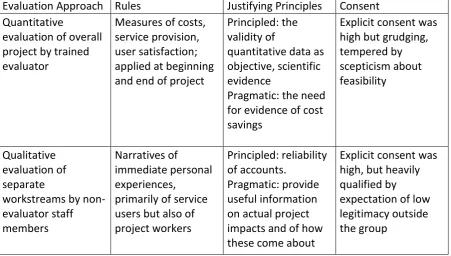
At the outset two basic positions thus emerged as candidate legitimate answers to the what? and how? questions: quantitative evaluation of overall outcomes, and qualitative
T
there any clear leadership to bring about a resolution everyone seemed genuinely undecided, and committed to puzzling out the best evaluation methodology.
T B both positions
have claims to legitimacy and serious weaknesses, with neither able to establish dominance.
12
Evaluation Approach Rules Justifying Principles Consent Quantitative
evaluation of overall project by trained evaluator
Measures of costs, service provision, user satisfaction; applied at beginning and end of project
Principled: the validity of
quantitative data as objective, scientific evidence
Pragmatic: the need for evidence of cost savings
Explicit consent was high but grudging, tempered by scepticism about feasibility Qualitative evaluation of separate
workstreams by non-evaluator staff members
Narratives of
immediate personal experiences,
primarily of service users but also of project workers
Principled: reliability of accounts.
Pragmatic: provide useful information on actual project impacts and of how these come about
[image:13.595.74.526.75.331.2]Explicit consent was high, but heavily qualified by expectation of low legitimacy outside the group
Table 1. Early stages: competing methodologies
The why? question was addressed by making the evaluation explicitly multifunctional, using
A
outcomes alongside benefits to clients, operational change, and organisational learning. This
NH“
of use within the NHS, and its authorship by a recognised academic evaluation expert (see Moullin 2009). The scorecard could thus be adopted as defining a set of rules which both
could also be expected to have external legitimacy. More or less simultaneously an
organisational solution was devised which made it possible to avoid confronting directly the who?what? and how? problems. (When? was resolved by default, as the project started before evaluation was sorted out.) The solution was to split evaluation into two strands, carried out in different ways by different groups. T
Overarching Evaluation Framework (April 2012):
The Balanced Scorecard approach will be used to assess the overall impact of the numerous interventions in Lyndon. Each of the individual interventions will undertake their own evaluations independently.
While the Framework defined the Scorecard and its indicators, it did not specify how the separate intervention evaluations were to be done, nor what indicators they should use.
The overall evaluation was assigned to the Evidence Base & Evaluation workstream, with a trained statistician as its new lead, and was thus separated from the five implementation workstreams. The task was technically challenging. In the absence of suitable
13
L
attribute this to the collective impact of the project interventions. This might tell decision makers that the Project as a whole was worth replicating elsewhere, though it was
Overview of Balanced Scorecard and Planned Work, April 2012).
The middle stage: conviction without proof?
Designing the overall evaluation took many months. Meanwhile, the evaluation of the separate interventions developed in two parallel ways. While the puzzling continued over
audiences, the team engaged in an extremely effective evaluative process. Never named as
development.
The explicit evaluation. T s hypothesis (Page XX above) and re-presented this as a matrix (Appendix 2) of 17 outcomes allocated to 15 activities, in order to generate a collective understanding of how the parts of the project related to the hypothesis. The matrix also provided a basis for monitoring progress, and so for evaluating it. In contrast, we (the authors) tried to use the hypothesis as the basis for explicit
T C I B
although we had yet to work out rules for carrying out an evaluation based on this, the
for TDE that causal reasoning would show how process and outcomes were connected, and link individual interventions with the overall outcomes (Berriet-Solliec et al. 2014). Moreover, this approach was legitimised for us by its academic standing something only we were aware of.
In a rare explicit discussion of competing methodologies, these two proposals were put to a team meeting. The matrix was introduced as a management and evaluation tool, legitimised by its transparency and simplicity, its grounding in the hypothesis, and by being proposed by the project managers. The Balanced Scorecard was defended by the Evaluation workstream lead on the grounds that it had been approved by the Project Board, and that overall outcomes could not be abandoned in favour of process measures. It was agreed that the two were complementary. Our theory-based approach was hardly discussed, and withdrawn on the grounds that adding another table was unhelpful. Its obvious (to us) superiority in evaluative power was insufficient to command the consent of the others: the rules were unfamiliar and comparatively complex, and academic standing insufficient on its own to legitimise our proposal. The enduring result was to embed a patchwork approach to evaluation, using a wide range of methods and a mix of qualitative and quantitative evidence, and eschewing causal attribution. Board meeting minutes, a few months later, note that
14
interventions at once to improve outcomes. All projects in the programme are being evaluated to ensure that there is evidence of their effectiveness. Very direct
attribution is not always possible though.
Yet, despite our private frustration, this approach was ultimately successful.
It was exemplified by the internal evaluation of the proje W
P
would cope in the event of a heavy snowfall. T
reflections, along with responses to structured interviews with clients. It was largely
qualitative, with a single quantitative section on the impact on clients and their satisfaction.
T
separate section presented individual case stories. These were not illustrative of a
quantitative evaluative core: they were the core, with a rhetorical force exemplified by the
M K K
die during these dark, cold winter months means everything.
Tacit evaluation practices. These stories emerged from the most effective, but least visible, evaluation practices. The project concern with learning and improvement meant that every report by the support workers, and the discussions from every meeting, fed into a continuous, unstructured reflective examination and use of evidence. Some of this not only guided further action, but was also repeatedly reproduced to support the case for the project. This evidence was almost entirely stories about individuals in the community of how they had responded to interventions by the project, or conversely of how the state had failed to intervene effectively in their lives (Box 1 paraphrases a typical, much-used example.)
These stories were re-told at every level from support worker supervisions through to city-scale design workshops for Getting It Right. They were emotionally powerful (Hoch 2006):funny, dismaying,
reassuring, capable of moving senior professional audiences to public tears. The team were well aware of this power: as the project manager told the Board,
story, a case, no matter how uninspired
W
were often shocking, the stories gained credibility through confirming the
possible. The stories worked as practical evaluations: they convinced everyone involved that effective and cheap service integration could be achieved fairly straightforwardly, through
Box 1: A typical, much repeated story.
The local authority had removed a roadside bench in Lyndon. Unknowingly this
effectively trapped a frail elderly couple in
15
community support workers linked to cross-sectoral teams, built up organically as needs were uncovered and trust was built between workers.
“ L
went beyond the Project. Their repetition effectively shaped action within the much larger Getting It Right project, convincing both its chief executive and some general practitioners. The latter started taking on community support workers to start Lyndon-like programmes without any quantitative evidence: senior NHS managers were described to the Board as
GP I
the local authority staff, who stereotyp H
problematic need for quantitative data. However, echoing Gawande (2010), Getting it
Right
evaluation in the NHS was counterbalanced by a professional disposition amongst clinicians towards the evidential value of individual case histories. More bluntly the project lead
GP .
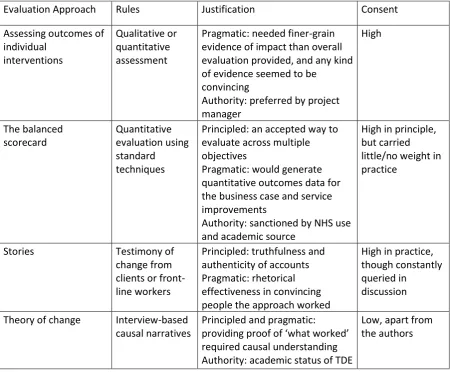
At the end of the first year we can summarise the evaluation processes as shown in Table 2, with three methodologies sufficiently legitimate to be running in parallel, and TDE excluded.
Evaluation Approach Rules Justification Consent
Assessing outcomes of individual
interventions
Qualitative or quantitative assessment
Pragmatic: needed finer-grain evidence of impact than overall evaluation provided, and any kind of evidence seemed to be
convincing
Authority: preferred by project manager High The balanced scorecard Quantitative evaluation using standard techniques
Principled: an accepted way to evaluate across multiple objectives
Pragmatic: would generate quantitative outcomes data for the business case and service improvements
Authority: sanctioned by NHS use and academic source
High in principle, but carried little/no weight in practice
Stories Testimony of change from clients or front-line workers
Principled: truthfulness and authenticity of accounts Pragmatic: rhetorical effectiveness in convincing people the approach worked
High in practice, though constantly queried in
discussion
Theory of change Interview-based causal narratives
Principled and pragmatic:
required causal understanding Authority: academic status of TDE
[image:16.595.73.524.347.719.2]Low, apart from the authors
16
The mature stage: a simple, effective project
During the middle stage little progress was made in several of the workstreams, and activity narrowed to developing L . Senior managers decided to continue the project for a second year, focusing on this approach and its evaluation. The enduring legitimacy tension is clear. Continuation was based on the conviction of the Board and those they reported to that they had sufficient evidence that the approach was working. Yet they also believed that the evidence was insufficient to support a final decision about either
long-term continuation or scaling up. F
Getting It Right were to adopt the approach formally. The evaluation was developed within the project team and through informal meetings between ourselves and the managers, reflecting the trust that was developing and our increasing status as usefully critical friends. The resulting plan was for a multi-strand evaluation, comprising:
quantitative measures of health and social care outcomes
the collection of as many case stories as was practicable and analysing these for causal patterns
an interview-based investigation of causal processes from the perspective of the steering group and project managers, conducted by ourselves.
Compared to the Winter Planning evaluation, there was significantly more emphasis on producing quantitative data, albeit rather grudgingly. As a senior officer put it, I
I
TDE . The intention to collect and analyse significant numbers of case stories, rather than just to use the most striking ones, was intended to develop robust and fine-grained causal accounts of how the project worked (Dodge et al. 2005). The project managers had clearly shifted their position on the value of such analyses, even if they would not commit to framing the evaluation around a
comprehensive ToC.
At this point the quantitative, outcome indicators re-emerged in ways which challenged earlier negative assumptions about their feasibility and value. The Evaluation workstream produced figures showing that, since the project had started, Lyndon had bucked city trends for unscheduled hospital admissions. In response, concerned that this quantitative evidence was dominated by health outcomes (and despite her aversion to quantification) the project lead produced data showing the neighbourhood also bucking trends on the average age at which care packages were taken up. The latter was particularly valuable, as credible attribution (Mayne 2012) was easy, with a very short causal chain from we did this for an individual to The financial implications were startling, as the high cost of each package implied huge savings, sufficient to pay for the community support workers many times over.
The proje
17
. The systematic analysis of multiple stories was excluded. Time and resources ran out, and in any case she believed it was unnecessary to push the boundaries of
locally-acceptable evaluation methods in this way. As the report put it,
the evaluation approach has been to collect a range of evidence to build up a picture of the change and impact of the work. No single piece of evidence is conclusive but the combined picture provides a body of evidence for commissioners to use to inform future decision making (Lyndon Way of Working, Evaluation, September 2013)
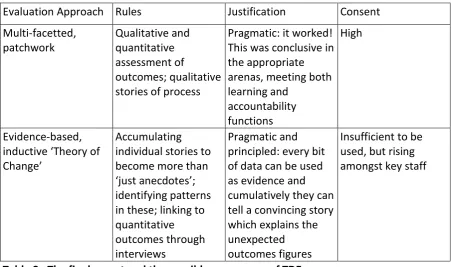
The overall product was thus a legitimate patchwork, with different rules for different parts of the evaluation, justifiable by a corresponding range of principles. There was no single underlying rationality: or rather, the rationality was that of evaluation as craft. The project lead and her team had successfully constructed an intelligible picture (Sanderson 2000: 449) (summarised in Table 3), using data of the right kinds, reported in an appropriate way, to do the required task of convincing an already sympathetic audience that the Lyndon way of working was a success.
Evaluation Approach Rules Justification Consent
Multi-facetted, patchwork
Qualitative and quantitative assessment of
outcomes; qualitative stories of process
Pragmatic: it worked! This was conclusive in the appropriate arenas, meeting both learning and
accountability functions
High
Evidence-based,
T C
Accumulating individual stories to become more than
identifying patterns in these; linking to quantitative outcomes through interviews
Pragmatic and principled: every bit of data can be used as evidence and cumulatively they can tell a convincing story which explains the unexpected outcomes figures
[image:18.595.72.524.329.596.2]Insufficient to be used, but rising amongst key staff
Table 3. The final report and the possible emergence of TDE
Conclusions
18
approach which commanded suffic L
larger Getting It Right programme. Reaching this point was supported by continuous, tacit, qualitative evaluation practices which enabled learning and development within the project while generating rhetorically powerful, convincing narratives for external audiences. Hearts and minds were being won over by informal practices at the same time as people struggled to formulate a publicly legitimate evaluation approach.
This struggle was one of engaged and reflexive practice, and significant shifts in what constituted accepted rules and justifying principles (Beetham 1991) took place over the
-month life. Central to the struggle was the tension between the legitimacy of designs based on familiar, accepted methodologies and legitimacy based on utility, with the former tending to reduce usability (Saunders 2012). Three aspects are of particular interest.
Firstly, quantitative evaluation had little traction until late in the project, when its utility was
T L . They were sceptical
about outcomes measures, and were well aware of the attribution problem created by complexity and of the problem of showing quantitative results in a city-scale comparison.
T
narrative. However, they simultaneously subscribed to the view that everyday positivism is dominant, and so displaced the need for numbers onto Others. It thus remained crucial in creating legitimacy (Johnson et al. 2006).
Secondly, in practice the most powerful methodology was that which was believed to be weakest in public. Telling and retelling an individual story (provided it followed tacit rules of relevance and truthfulness) had de facto legitimacy as a way of evaluating the success of the project, with sufficient authority to be the basis for significant decisions - the antithesis of stereotypical evidence-based policy making.
T
theorise it explicitly, and theory-based approaches had little legitimacy at first, echoing
“ “ T C
(2006: 192). However, over time the Lyndon managers developed an explicit interest in causal theory, although this remained inessential to their craft: the patchwork approach was successful without recourse to theoretical underpinning.
19
I seems a fruitful new way (Siggelkow 2007) to understand in
. Following Beetham (1991) in separating out the rules, their justifying principles and the consent they command, we can show how issues of use and usability are intimately and complexly connected (Saunders 2012). Legitimacy in evaluation is more than simply people believing in the utility of a particular methodology. It may rest on all of: the in-principle acceptability of an evaluation on methodological grounds (particularly if this is reinforced by authoritative external endorsement); whether it is done well and follows the relevant rules correctly; and on whether it is acceptable to the relevant audience(s) on the grounds that it provides useful, usable knowledge in that context. The approach also allows the different kinds of uses noted by Weiss (1979) to be analysed alongside each other. While an evaluation may be useful because it creates usable knowledge (Saunders 2012), other uses may be as or more important in justifying evaluation design in any given context for instance the need to
achieve wider le
This has practical implications for evaluators, who should pay attention to legitimacy, and be open minded on how it is conferred. Encouragingly, we suggest that the force of everyday positivism should not be overestimated, and that even where it is publically professed it may not be dominant in practice. Moreover, because legitimacy rests on all three
dimensions of rules, justifiability and consent, it is not inherently stable. Change is probably (almost) always possible, and in particular we highlight the possibility for learning during the course of an evaluation. It may well be fruitful to promote such learning, through providing opportunities for experimentation and reflection.
Finally, we turn to the issue of whether an evaluation needs to be, or can be, underpinned by a single rationality, and what the role of CR-based TDE might be. The Lyndon case shows that such coherence is not a necessary condition for success, and suggests that a pragmatic patchwork of different methods is a feasible approach in this kind of context, being both effective and legitimate. Achieving a successful patchwork requires flexibility the ability and willingness to respond to emerging knowledge, changing demands for knowledge and
. Of course, this
approach in itself must establish its legitimacy: while it worked in Lyndon it might well face legitimacy problems in other contexts. Thus it will need to be argued for, have its usefulness demonstrated, and itself be evaluated.
It was very evident in Lyndon, and presumably elsewhere, that evaluations are themselves interventions in complex and dynamic settings, and so subject to the same complexity: multiple goals, poorly defined boundaries, changing understandings and so on. Given this,
TDE in particular establishing a ToC at the outset (Ling 2012) reveal an
assumption that evaluators can organise an evaluation based in a single rationality.
20
bedrock of effective evaluation. On the one hand it is clear that causal theorising can be a legitimate component of a patchwork - where, for instance, short, unambiguous causal chains are present (cf.Sullivan and Stewart 2006, who note that practitioners often see the value of causal explanation.) On the other, more speculatively, we suggest that critical realist, theory-driven evaluation can act as a guide to the craft of developing successful patchworks an underlying rationality which can incorporate different kinds of process and outcome data (Morton 2003; Connelly and Anderson 2007), and into which more explicit
causal elements can be introduced if/when these
audience(s). In such an approach, full Theories of Change act as regulatory ideals not in themselves possible, but informing feasible, practically-adequate theorising. Our pragmatic goal should perhaps be to achieve evaluations which are more and increasingly theory-driven, rather than 100% theory-driven.
Funding
21
Appendix 1: Lyndon Overarching Evaluation Framework
The Balanced Scorecard approach will be used to assess the overall impact of the numerous interventions in Lyndon. Each of the individual interventions will undertake their own evaluations independently.
Learning perspective
What learning is required to sustain the project & innovate development?
Client perspective
What do clients / stakeholders want from the project?
Financial perspective
How well does the project manage costs and resources?
Operational perspective
What ‘business processes’are needed to achieve the aim of the project?
Strategic Aim
By having integrated services and place-based resources, assets and budgets combined with robust individual and community resilience, the health, wellbeing and
22
Appendix 2 Lyndon planning matrix: the middle phase
MULTI AGENCY, COMMUNITY INTERVENTIONS AND MARKET
DEVELOPMENT
COMMUNICATIONS AND INFORMATION
INTERGENERATIONAL INTERVENTIONS
LBJ FORUM – COMMUNITY
ENGAGEMENT
Project work Res
ilien c e pl a nn ing Comm un ity mo ne y Mi c ro e nte rpris e Deme nti a s tr ate gy Inf orm ati on c ap ture a nd de c is io n m ak in g Lo c al J S NA Lo c al di rec tory Int erge ne rat io na l Int erv en tion s wor k s ho ps Rev iew of pa thw ay s wi th v iew to j o int s c ree ni ng S up po rt o f s ma ller v ol un tary group s V ol un tee ring Inc lud in g s ma ll s c al e c om mu n ity c om mi s s ion ing B rok erin g/l ink ing c om mu ni ty gr ou ps Chan ne lling info rma tion S us ta ina bl e bu s in es s mo d el P rev en tion P ilots
Issues/ other work
Access to information X X X X X X
Getting around safely X X
Improved home care services
X X X
Safety X
Reliable trades people, cleaners and volunteers
X X X X X
Support with day to day X X X X X
Lack of contact with neighbours
X X X X
Key worker X X X X X X X X X X X X
Integrated services X X X X X X X
Resilience - community X X X X X X X X X
Self care X X X X
Risk stratification X X X X
Whole household approach
X X X X X
Theatre work X
Open spaces Neighbourhood appraisal/plan
X X X
Learning and doing X X X X X X X X X X X X X X X
FOR EACH PIECE OF WORK – NEED TO AGREE WHAT THE EVIDENCE BASE IS AND THE EVALUATION PROCESS. ALSO NEED TO ENSURE
23
References
Abell, P. (2009) 'A Case for Cases' Sociological Methods & Research 38(1): 38-70.
Adelman, C. (1996) 'Anything Goes: Evaluation and Relativism' Evaluation 2(3): 291-305.
Barnes, B. (2001) 'Practice as collective action' in T. R. Schatzki, K. Knorr Cetina and E. von Savigny, The Practice Turn in Contemporary Theory Abingdon, Oxon: Routledge, pp. 17-28.
Baxter, S., D. Chambers, M. Johnson, A. Sutton, E. Goyder and A. Booth (2017) 'Understanding new models of integrated care: a systematic review examining outcomes, pathways of change and applicability of evidence', at Health Services Research Network Symposium, Nottingham, 6-7 July 2017.
Beetham, D. (1991) The Legitimation of Power, Basingstoke: Macmillan.
Berriet-Solliec, M., P. Labarthe and C. Laurent (2014) 'Goals of evaluation and types of evidence' Evaluation 20(2): 195-213.
Bjørkeng, K., S. Clegg and T. Pitsis (2009) 'Becoming (a) practice' Management Learning 40(2): 145-159.
Braun, V. and V. Clarke (2006) 'Using thematic analysis in psychology' Qualitative Research in Psychology 3(2): 77-101.
Chen, H. T. (1990) Theory-driven Evaluations, Thousand Oaks, CA: Sage.
Connelly, S. (2011) 'Constructing legitimacy in the new community governance' Urban Studies 48(5): 929-946.
Connelly, S. and C. W. Anderson (2007) 'Studying water - reflections on the problems and possibilities for interdisciplinary working' Interdisciplinary Studies Review 32(3): 213-220.
Coryn, C. L. S., L. A. Noakes, C. D. Westine and D. C. Schröter (2011) 'A Systematic Review of Theory-Driven Evaluation Practice From 1990 to 2009' American Journal of Evaluation 32(2): 199-226.
Costantino, T. E. and J. C. Greene (2003) 'Reflections on the Use of Narrative in Evaluation' American Journal of Evaluation 24(1): 35-49.
Dodge, J., S. M. Ospina and E. G. Foldy (2005) 'Integrating Rigor and Relevance in Public Administration Scholarship: The Contribution of Narrative Inquiry' Public
Administration Review 65(3): 286-300.
Gawande, A. (2010) Complications: A surgeon's notes on an imperfect science, London: Profile Books.
Hoch, C. (2006) 'Emotions and planning' Planning Theory & Practice 7(4): 367 - 382.
24
Hurrelmann, A., S. Schneider and J. Steffek (2007) 'Introduction: Legitimacy in an Age of Global Politics' in A. Hurrelmann, S. Schneider and J. Steffek, Legitimacy in an Age of Global Politics, Basingstoke: Palgrave Macmillan, pp. 1-16.
Ivaldi, S., G. Scaratti and G. Nuti (2015) 'The practice of evaluation as an evaluation of practices' Evaluation 21(4): 497-512.
Johnson, C., T. J. Dowd and C. L. Ridgeway (2006) 'Legitimacy as a social process' Annual Review of Sociology 32: 53-78.
Lau, M. (2013) 'Flexibility with a Purpose: Constructing the Legitimacy of Spatial Governance Partnerships' Urban Studies.
L E ‘ W W W Evaluation 21(2): 167-172. Ling, T. (2012) 'Evaluating complex and unfolding interventions in real time' Evaluation
18(1): 79-91.
Maxwell, J. A. (2012) A Realist Approach for Qualitative Research, Thousand Oaks, CA and London: SAGE Publications.
Mayne, J. (2012) 'Contribution analysis: Coming of age?' Evaluation 18(3): 270-280.
Merton, R. K. (1967) On Theoretical Sociology, New York: Free Press.
Montague, S. and N. L. Porteous (2013) 'The case for including reach as a key element of program theory' Evaluation and Program Planning 36(1): 177-183.
Morton, A. (2003) 'The theory of knowledge: saving epistemology from the epistemologists' in P. Clark and K. Hawley, Philosophy of Science Today, Oxford: Oxford University Press, pp. 39-58.
Moullin, M. (2009) 'Using the Public Sector Scorecard to measure and improve healthcare services ' Nursing Management 16(5): 26-31.
Nutley, S. M., I. Walter and H. Davies (2007) Using evidence: How research can inform public services, Bristol: Policy Press.
O'Kane, R. H. T. (1993) 'Against Legitimacy' Political Studies 41(3): 471-487.
Patton, M. Q. (2012) 'A utilization-focused approach to contribution analysis' Evaluation 18(3): 364-377.
Patton, M. Q. (2015) 'Evaluation in the field: The need for site visit standards' American Journal of Evaluation 36(4): 444-460.
Pawson, R. and N. Tilley (1997) Realistic Evaluation, London: SAGE.
Pouliot, V. (2014) 'Practice tracing' in A. Bennett and J. T. Checkel, Process Tracing: From Metaphor to Analytic Tool, Cambridge: Cambridge University Press, pp. 237-259.
25
Sanderson, I. (2009) 'Intelligent policy making for a complex world: pragmatism, evidence and learning' Political Studies 57(4): 699-719.
Saunders, M. (2012) 'The use and usability of evaluation outputs: A social practice approach' Evaluation 18(4): 421-436.
Sayer, A. (1992) Method in Social Science: a Realist Approach (2nd edition), London: Routledge.
Schatzki, T. R. (2001) 'Practice theory ' in T. R. Schatzki, K. Knorr Cetina and E. von Savigny, The Practice Turn in Contemporary Theory Abingdon, Oxon: Routledge, pp. 1-14.
“ P C W E U
this be accomplished?' in, Symposium: Mountain or Molehill? A critical appraisal of the Commission White Paper on Governance, Jean Monnet Working Paper No. 6/01, New York: NY University School of Law, pp.
Siggelkow, N. (2007) 'Persuasion with case studies' Academy of Management Journal 50(1): 20-24.
Solmeyer, A. R N C U
policies: Introduction' American Journal of Evaluation 36(4): 470-474.
Sullivan, H. (2011) '"Truth" junkies: using evaluation in UK public policy' Policy & Politics 39(4): 499-512.
Sullivan, H. and M. Stewart (2006) 'Who owns the theory of change?' Evaluation 12(2): 179-199.
Wagenaar, H. and S. D. N. Cook (2003) 'Understanding policy practices: action, dialectic and deliberation in policy analysis' in M. Hajer and H. Wagenaar, Deliberative Policy Analysis: understanding governance in the network society, Cambridge: Cambridge University Press, pp. 139-171.
Weber, M. (1968 [1922]) Economy and Society, New York: Bedminster Press.
Weiss, C. H. (1979) 'The many meanings of research utilization' Public Administration Review 39(5): 426-431.
Weiss, R. S. and M. Rein (1970) 'The evaluation of broad-aim programs: Experimental design, its difficulties, and an alternative' Administrative Science Quarterly: 97-109.
Wistow, G. and H. Dickinson (2012) 'Integration: work still in progress' Journal of Health Organization and Management 26(6): 676-684.