Closing the gap: test
and learn
Technical annex A: statistical analysis
2
1
Statistical analysis of trial data
5
1.1
Preliminary assumption testing and the inferential tests used
5
1.2
Adjustment for design effect caused by cluster randomisation
6
2
Trial analysis results
8
2.1
1stClass@Number year 1 trial (all pupils) – ANCOVA and gain score analysis 9
2.2
1stClass@Number year 2 trial (all pupils) – ANCOVA and gain score analysis 11
2.3
1stClass@Number year 1 trial (FSM pupils) – ANCOVA and gain score analysis13
2.4
1stClass@Number year 2 trial (FSM) – ANCOVA and gain score analysis
15
2.5
Growth Mindsets year 1 trial (all pupils) – ANCOVA and gain score analysis
17
2.6
Growth Mindsets year 2 trial (all new group reading test (NGRT)) – ANCOVA and
gain score analysis
19
2.7
Growth Mindsets year 2 trial (all progress in maths (PiM)) – ANCOVA and gain
score analysis
21
2.8
Growth Mindsets year 1 trial (FSM pupils) – ANCOVA and gain score analysis 23
2.9
Growth Mindsets year 2 trial (FSM NGRT) – ANCOVA and gain score analysis 25
2.10
Growth Mindsets year 2 trial (FSM PiM) – ANCOVA and gain score analysis 27
2.11
Inference Training year 1 trial (all pupils) – ANCOVA and gain score analysis29
2.12
Inference Training year 1 trial (FSM pupils) – ANCOVA and gain score analysis
31
2.13
Numicon Intervention Programme year 1 trial (all pupils) – ANCOVA and gain
score analysis
33
2.14
Numicon Intervention Programme year 2 trial (all pupils) – ANCOVA and gain
score analysis
35
2.15
Numicon Intervention Programme year 1 trial (FSM pupils) – ANCOVA and gain
score analysis
37
2.16
Numicon Intervention Programme year 2 trial (FSM pupils) – ANCOVA and gain
2.17
Research Lesson Study year 2 trial (all pupils) – ANCOVA and gain score
analysis
41
2.18
Research Lesson Study year 2 trial (FSM pupils) – ANCOVA and gain score
analysis
43
2.19
Response to Intervention (breakthroughs in literacy) (RTI) year 1 trial (all pupils)
– ANCOVA and gain score analysis
45
2.20
RTI (breakthroughs in literacy) year 2 trial All – ANCOVA and Gain Score
analysis
47
2.21
RTI (breakthroughs in literacy) year 1 trial (FSM pupils) – ANCOVA and Gain
Score analysis
49
2.22
RTI (breakthroughs in literacy) year 1 trial (FSM) – ANCOVA and gain score
analysis
51
2.23
RTI (breakthroughs in literacy) year 2 trial (writing, all) – ANCOVA and gain
score analysis
53
2.24
RTI (breakthroughs in literacy) year 2 trial All pupils (two clusters removed) –
ANCOVA and gain score analysis
55
2.25
RTI (breakthroughs in literacy) year 2 trial All pupils (multiple clusters removed)
– ANCOVA and gain score analysis
57
2.26
RTI (breakthroughs in literacy) year 2 trial FSM pupils (two clusters removed) –
ANCOVA and gain score analysis
59
2.27
RTI (breakthroughs in literacy) year 2 trial FSM pupils (multiple clusters
removed) – ANCOVA and gain score analysis
61
2.28
Achievement for All trial year 1 (all pupils) – ANCOVA and gain score analysis63
2.29
Achievement for All year 2 trial (all pupils) – ANCOVA and gain score analysis65
2.30
Achievement for All year 1 trial (FSM) – ANCOVA and gain score analysis 67
2.31
Achievement for All year 2 trial (FSM pupils) – ANCOVA and gain score analysis
69
1 Statistical analysis of trial data
1.1 Preliminary assumption testing and the inferential tests
used
Prior to analysis, the principle was adopted that it is not acceptable to drop an outlier, just
because it is an outlier – in order to use a parametric test. There was no evidence to
suggest that any outliers were caused by data error, deliberate or accidental misreporting,
sampling error or the non-maintenance of the research protocol.
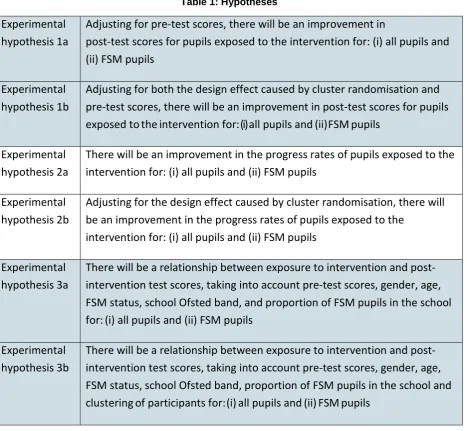
[image:5.595.68.536.261.692.2]Table 1 shows the hypotheses tested in each trial.
Table 1: Hypotheses
Experimental
hypothesis 1a
Adjusting for pre-test scores, there will be an improvement in
post-test scores for pupils exposed to the intervention for: (i) all pupils and
(ii) FSM pupils
Experimental
hypothesis 1b
Adjusting for both the design effect caused by cluster randomisation and
pre-test scores, there will be an improvement in post-test scores for pupils
exposed to the intervention for: (i) all pupils and (ii) FSM pupils
Experimental
hypothesis 2a
There will be an improvement in the progress rates of pupils exposed to the
intervention for: (i) all pupils and (ii) FSM pupils
Experimental
hypothesis 2b
Adjusting for the design effect caused by cluster randomisation, there will
be an improvement in the progress rates of pupils exposed to the
intervention for: (i) all pupils and (ii) FSM pupils
Experimental
hypothesis 3a
There will be a relationship between exposure to intervention and
post-intervention test scores, taking into account pre-test scores, gender, age,
FSM status, school Ofsted band, and proportion of FSM pupils in the school
for: (i) all pupils and (ii) FSM pupils
Experimental
hypothesis 3b
6
similar distribution of co-variants, a non-parametric form of ANCOVA (Quade’s F)
1was
able to be applied.
To test hypotheses 2a (i–ii) and 2b (i–ii), gain scores were first calculated from pre- and
post-test scores; the gains for control and intervention were then assessed to see if they
met the assumptions necessary for the use of one-way ANOVA (analysis of variance).
Similarly, none of the data met all of the assumptions and therefore a non-parametric
alternative (Kruskal-Wallis one-way ANOVA) was applied. The assumptions tested were:
normality, the presence of outliers, homogeneity of variance, and equity of sample size.
Finally, in relation to hypotheses 3a (i–ii) and 3b (i–ii), the data was evaluated according to
the requirements for conducting regression modelling with standard multiple regression.
The majority of the results were satisfactory; however, two of the analyses had sample
sizes that were too small for effective regression modelling to take place.
Using this variety of tests meant that the first two assessments were able to consider the
effectiveness of the interventions with regard to the assessment of attainment, the second
two relative progress, and the final pair of assessments were able to provide a validation of
the other findings with regard to the effect of a range of individual differences at cluster
and pupil level.
1.2 Adjustment for design effect caused by cluster
randomisation
Adjustment for the design effect resulting from clustering in the testing of hypotheses 1b
(i–ii) and 2b (i–ii) was carried out using the approach recommended and discussed by
Campbell and colleagues.
2This approach has been applied to primary healthcare where
randomisation has had to take place at general practitioner surgery level. It involves using
a formula to calculate the effective sample size taking into account the number of clusters
and intracluster dependence. The p-value for the result is then adjusted accordingly.
Hypotheses 1a (i–ii) and 2a (i–ii) form an assessment of the effect of interventions without
taking into account this design effect whilst hypotheses 1b (i–ii) and 2b (i–ii) represent
adjustments to the results found in the preceding hypotheses. Interpretation of these two
1
Quade, D. ‘Rank analysis of covariance’, Journal of the American Statistical Association 62(1967): 1187– 1200
2
Campbell, M.K., Mollison, J., Steen, N., Grimshaw, J.M. and Eccles, M. ‘Analysis of cluster randomized trials in primary care: a
8
2.1 1stClass@Number year 1 trial (all pupils) – ANCOVA and
gain score analysis
Standard Age Scores (SAS) Control Intervention
Pre-test Post-test Pre-test Post-test
n = 1139 565 565 574 574 Mean 89.75 90.93 91.93 93.69 Median 89.00 89.00 92.00 92.00 Standard deviation 13.37 14.18 13.56 13.73 Range 60.00 71.00 61.00 71.00 Standard error of the mean 0.56 0.60 0.57 0.57 Skewness 0.47 0.39 0.31 0.28 Kurtosis -0.27 -0.43 -0.37 -0.47 95 per cent confidence interval (upper bound) 90.85 92.10 93.04 94.82 95 per cent confidence interval (lower bound) 88.65 89.76 90.82 92.57 Median gain in the control group < 0.001 Median gain in the intervention group < 0.001 Difference in gain < 0.001
Design effect 2.08
Intracluster correlation coefficient 0.06 Effective sample size 558
Quade’s non-parametric ANCOVA F p-value np 2
d*
Adjusted to compensate for the effect of cluster
10
Adjusted to compensate for the effect of cluster
randomisation 0.44 0.507 0.028 0.057 Non-adjusted 0.92 0.338 0.028 0.057
*Converted from F **Converted from chi-squared
Regression modelling p-value
Taking into account pre-test scores, gender, age, free school meals (FSM) status, school
Ofsted band, and proportion of FSM pupils in the school 0.010 Taking into account pre-test scores, gender, age, FSM status, school Ofsted band,
2.2 1stClass@Number year 2 trial (all pupils) – ANCOVA and
gain score analysis
SAS Control Intervention
Pre-test Post-test Pre-test Post-test
n = 513 250 250 263 263 Mean 83.59 85.17 85.29 87.21 Median 82.00 85.00 85.00 87.00 Standard deviation 10.42 11.62 11.36 12.47 Range 47.00 61.00 54.00 69.00 Standard error of the mean 0.66 0.74 0.70 0.77 Skewness 0.76 0.64 0.80 0.80 Kurtosis 0.32 0.35 0.70 0.76 95 per cent confidence interval (upper bound) 84.88 86.61 86.66 88.72 95 per cent confidence interval (lower bound) 82.30 83.73 83.92 85.70 Median gain in the control group 3.00 Median gain in the intervention group 2.00
Difference in gain -1.00
Design effect 1.42
Intracluster correlation coefficient 0.05 Effective sample size 369
Quade’s non-parametric ANCOVA F p-value np2 d*
Adjusted to compensate for the effect of cluster
12
Adjusted to compensate for the effect of cluster
randomisation 0.28 0.598 0.028 0.055 Non-adjusted 0.39 0.530 0.028 0.055
*Converted from F **Converted from chi-squared
Regression modelling p-value
Taking into account pre-test scores, gender, age, FSM status, school Ofsted band, and
proportion of FSM pupils in the school 0.147 Taking into account pre-test scores, gender, age, FSM status, school Ofsted band,
2.3 1stClass@Number year 1 trial (FSM pupils) – ANCOVA and
gain score analysis
SAS Control Intervention
Pre-test Post-test Pre-test Post-test
n = 257 143 143 114 114 Mean 83.06 84.84 87.98 89.47 Median 81.00 83.00 87.00 87.00 Standard deviation 12.32 12.88 12.15 13.18 Range 57.00 47.00 52.00 49.00 Standard error of the mean 1.03 1.08 1.14 1.23 Skewness 1.04 0.73 0.58 0.39 Kurtosis 0.99 -0.18 0.32 -0.72 95 per cent confidence interval (upper bound) 85.07 86.95 90.21 91.89 95 per cent confidence interval (lower bound) 81.04 82.73 85.75 87.05 Median gain in the control group 2.00 Median gain in the intervention group <0.001
Difference in gain -2.00
Design effect 1.09
Intracluster correlation coefficient 0.02 Effective sample size 240
Quade’s non-parametric ANCOVA F p-value np2 d*
Adjusted to compensate for the effect of cluster
14
Adjusted to compensate for the effect of cluster
randomisation 0.03 0.871 0.011 0.021 Non-adjusted 0.03 0.866 0.011 0.021
*Converted from F **Converted from chi-squared
Regression modelling p-value
Taking into account pre-test scores, gender, age, FSM status, school Ofsted band, and
proportion of FSM pupils in the school 0.372 Taking into account pre-test scores, gender, age, FSM status, school Ofsted band,
2.4 1stClass@Number year 2 trial (FSM) – ANCOVA and gain
score analysis
SAS Control Intervention
Pre-test Post-test Pre-test Post-test
n = 132 62 62 70 70
Mean 84.27 86.52 83.83 85.99 Median 83.50 86.00 83.00 86.00 Standard deviation 11.14 12.87 11.09 12.00 Range 47.00 61.00 48.00 46.00 Standard error of the mean 1.41 1.63 1.33 1.43 Skewness 0.73 0.88 1.19 0.66 Kurtosis 0.13 1.13 1.84 -0.07 95 per cent confidence interval (upper bound) 87.05 89.72 86.43 88.80 95 per cent confidence interval (lower bound) 81.50 83.31 81.23 83.18 Median gain in the control group 2.50 Median gain in the intervention group 3.00
Difference in gain 0.50
Design effect 1.04
Intracluster correlation coefficient 0.02 Effective sample size 130
Quade’s non-parametric ANCOVA F p-value np2 d*
Adjusted to compensate for the effect of cluster
16
Adjusted to compensate for the effect of cluster
randomisation 0.16 0.691 0.035 0.071 Non-adjusted 0.16 0.685 0.035 0.071
*Converted from F **Converted from chi-squared
Regression modelling p-value
Taking into account pre-test scores, gender, age, FSM status, school Ofsted band, and
proportion of FSM pupils in the school 0.548 Taking into account pre-test scores, gender, age, FSM status, school Ofsted band,
2.5 Growth Mindsets year 1 trial (all pupils) – ANCOVA and
gain score analysis
SAS Control Intervention
Pre-test Post-test Pre-test Post-test
n = 1772 850 850 922 922 Mean 100.74 102.53 99.58 100.06 Median 101.00 103.00 100.00 101.00 Standard deviation 16.29 17.55 14.82 16.68 Range 68.00 72.00 72.00 72.00 Standard error of the mean 0.56 0.60 0.49 0.55 Skewness -0.15 -0.18 -0.08 -0.00001 Kurtosis -0.72 -0.81 -0.62 -0.71 95 per cent confidence interval (upper bound) 101.84 103.71 100.54 101.14 95 per cent confidence interval (lower bound) 99.65 101.35 98.63 98.98 Median gain in the control group 2.00 Median gain in the intervention group 1.00
Difference in gain -1.00
Design effect 2.61
Intracluster correlation coefficient 0.05 Effective sample size 678
Quade’s non-parametric ANCOVA F p-value np2 d*
Adjusted to compensate for the effect of cluster
18
Adjusted to compensate for the effect of cluster
randomisation 2.62 0.105 - 0.062 - 0.125 Non-adjusted 6.86 0.009 - 0.062 - 0.125
*Converted from F **Converted from chi-squared
Regression modelling p-value
Taking into account pre-test scores, gender, age, FSM status, school Ofsted band, and
proportion of FSM pupils in the school 0.000 Taking into account pre-test scores, gender, age, FSM status, school Ofsted band,
2.6 Growth Mindsets year 2 trial (all new group reading test
(NGRT)) – ANCOVA and gain score analysis
SAS Control Intervention
Pre-test Post-test Pre-test Post-test
n = 1195 618 618 577 577 Mean 94.00 95.25 93.90 95.87 Median 95.00 96.00 94.00 96.00 Standard deviation 14.64 15.48 15.29 16.20 Range 70.00 70.00 70.00 72.00 Standard error of the mean 0.59 0.62 0.64 0.67 Skewness -0.08 0.01 0.16 0.17 Kurtosis -0.70 -0.70 -0.56 -0.48 95 per cent confidence interval (upper bound) 95.16 96.47 95.15 97.19 95 per cent confidence interval (lower bound) 92.85 94.03 92.65 94.54 Median gain in the control group 1.00 Median gain in the intervention group 2.00
Difference in gain 1.00
Design effect 3.80
Intracluster correlation coefficient 0.22 Effective sample size 498
Quade’s non-parametric ANCOVA F p-value np2 d*
Adjusted to compensate for the effect of cluster
20
Adjusted to compensate for the effect of cluster
randomisation 0.50 0.481 0.040 0.080 Non-adjusted 1.89 0.170 0.040 0.080
*Converted from F **Converted from chi-squared
Regression modelling p-value
Taking into account pre-test scores, gender, age, FSM status, school Ofsted band, and
proportion of FSM pupils in the school 0.473 Taking into account pre-test scores, gender, age, FSM status, school Ofsted band,
2.7 Growth Mindsets year 2 trial (all progress in maths (PiM)) –
ANCOVA and gain score analysis
SAS Control Intervention
Pre-test Post-test Pre-test Post-test
n = 998 518 518 480 480 Mean 90.24 91.74 89.74 91.49 Median 91.00 92.00 89.00 91.00 Standard deviation 13.45 12.02 13.74 12.65 Range 70.00 64.00 66.00 72.00 Standard error of the mean 0.59 0.53 0.63 0.58 Skewness 0.35 0.13 0.52 0.49 Kurtosis -0.20 -0.14 0.04 0.63 95 per cent confidence interval (upper bound) 91.39 92.77 90.96 92.62 95 per cent confidence interval (lower bound) 89.08 90.70 88.51 90.36 Median gain in the control group 1.00 Median gain in the intervention group 2.00
Difference in gain 1.00
Design effect 2.67
Intracluster correlation coefficient 0.13 Effective sample size 379
Quade’s non-parametric ANCOVA F p-value np2 d*
Adjusted to compensate for the effect of cluster
22
Adjusted to compensate for the effect of cluster
randomisation 0.002 0.962 0.002 0.005 Non-adjusted 0.006 0.938 0.002 0.005
*Converted from F **Converted from chi-squared
Regression modelling p-value
Taking into account pre-test scores, gender, age, FSM status, school Ofsted band, and
proportion of FSM pupils in the school 0.647 Taking into account pre-test scores, gender, age, FSM status, school Ofsted band,
2.8 Growth Mindsets year 1 trial (FSM pupils) – ANCOVA and
gain score analysis
SAS Control Intervention
Pre-test Post-test Pre-test Post-test
n = 441 203 203 238 238 Mean 92.77 94.14 92.62 94.18 Median 92.00 92.00 92.50 94.00 Standard deviation 15.30 14.90 14.89 15.90 Range 66.00 67.00 66.00 72.00 Standard error of the mean 1.07 1.05 0.97 1.03 Skewness 0.33 0.28 0.29 0.42 Kurtosis -0.29 -0.44 -0.37 -0.32 95 per cent confidence interval (upper bound) 94.88 96.19 94.51 96.20 95 per cent confidence interval (lower bound) 90.67 92.09 90.73 92.16 Median gain in the control group < 0.001 Median gain in the intervention group 1.50
Difference in gain 1.50
Design effect 1.25
Intracluster correlation coefficient 0.04 Effective sample size 360
Quade’s non-parametric ANCOVA F p-value np2 d*
Adjusted to compensate for the effect of cluster
24
Adjusted to compensate for the effect of cluster
randomisation 0.20 0.655 0.024 0.047 Non-adjusted 0.25 0.618 0.024 0.047
*Converted from F **Converted from chi-squared
Regression modelling p-value
Taking into account pre-test scores, gender, age, FSM status, school Ofsted band, and
proportion of FSM pupils in the school 0.951 Taking into account pre-test scores, gender, age, FSM status, school Ofsted band,
2.9 Growth Mindsets year 2 trial (FSM NGRT) – ANCOVA and
gain score analysis
SAS scores Control Intervention
Pre-test Post-test Pre-test Post-test
n = 453 247 247 206 206 Mean 90.71 90.88 92.31 93.88 Median 91.00 90.00 93.00 93.00 Standard deviation 14.24 14.66 14.93 15.83 Range 58.00 70.00 70.00 72.00 Standard error of the mean 0.91 0.93 1.04 1.10 Skewness 0.14 0.26 0.34 0.34 Kurtosis -0.82 -0.55 -0.28 -0.23 95 per cent confidence interval (upper bound) 92.48 92.71 94.35 96.04 95 per cent confidence interval (lower bound) 88.93 89.05 90.27 91.72 Median gain in the control group -1.00 Median gain in the intervention group <0.001
Difference in gain 1.00
Design effect 1.45
Intracluster correlation coefficient 0.10 Effective sample size 458
Quade’s non-parametric ANCOVA F p-value np2 d*
Adjusted to compensate for the effect of cluster
26
Adjusted to compensate for the effect of cluster
randomisation 1.79 0.181 0.076 0.152 Non-adjusted 2.59 0.108 0.076 0.152
*Converted from F **Converted from chi-squared
Regression modelling p-value
Taking into account pre-test scores, gender, age, FSM status, school Ofsted band, and
proportion of FSM pupils in the school 0.328 Taking into account pre-test scores, gender, age, FSM status, school Ofsted band,
2.10 Growth Mindsets year 2 trial (FSM PiM) – ANCOVA and
gain score analysis
SAS Control Intervention
Pre-test Post-test Pre-test Post-test
n = 373 204 204 169 169 Mean 87.29 88.94 87.55 88.52 Median 87.00 90.00 87.00 88.00 Standard deviation 13.07 11.29 12.77 12.22 Range 61.00 50.00 52.00 60.00 Standard error of the mean 0.92 0.79 0.98 0.94 Skewness 0.50 -0.01 0.35 0.22 Kurtosis -0.19 -0.40 -0.41 -0.43 95 per cent confidence interval (upper bound) 89.09 90.49 89.48 90.36 95 per cent confidence interval (lower bound) 85.50 87.39 85.63 86.68 Median gain in the control group 3.00 Median gain in the intervention group 1.00
Difference in gain -2.00
Design effect 1.59
Intracluster correlation coefficient 0.12 Effective sample size 238
Quade’s non-parametric ANCOVA F p-value np2 d*
Adjusted to compensate for the effect of cluster
28
Adjusted to compensate for the effect of cluster
randomisation 0.90 0.343 0.062 0.124 Non-adjusted 1.43 0.231 0.062 0.124
*Converted from F **Converted from chi-squared
Regression modelling p-value
Taking into account pre-test scores, gender, age, FSM status, school Ofsted band, and
proportion of FSM pupils in the school 0.797 Taking into account pre-test scores, gender, age, FSM status, school Ofsted band,
2.11 Inference Training year 1 trial (all pupils) – ANCOVA and
gain score analysis
SAS Control Intervention
Pre-test Post-test Pre-test Post-test
n = 1477 875 875 602 602 Mean 95.16 97.53 96.23 98.55 Median 95.00 97.00 96.00 98.00 Standard deviation 14.17 14.44 15.86 16.47 Range 65.00 70.00 67.00 71.00 Standard error of the mean 0.48 0.49 0.65 0.67 Skewness 0.05 -0.01 0.11 0.03 Kurtosis -0.71 -0.72 -0.79 -0.87 95 per cent confidence interval (upper bound) 96.10 98.49 97.50 99.87 95 per cent confidence interval (lower bound) 94.22 96.58 94.97 97.24
Median gain in the control group 2.00 Median gain in the intervention group 2.00
Difference in gain 0.00
Design effect 2.88
Intracluster correlation coefficient 0.08 Effective sample size 521
Quade’s non-parametric ANCOVA F p-value np2 d*
Adjusted to compensate for the effect of cluster
30
Adjusted to compensate for the effect of cluster
randomisation 0.08 0.778 -0.012 -0.025 Non-adjusted 0.23 0.632 -0.012 -0.025
*Converted from F **Converted from chi-squared
Regression modelling p-value
Taking into account pre-test scores, gender, age, FSM status, school Ofsted band, and
proportion of FSM pupils in the school 0.511 Taking into account pre-test scores, gender, age, FSM status, school Ofsted band,
2.12 Inference Training year 1 trial (FSM pupils) – ANCOVA and
gain score analysis
SAS Control Intervention
Pre-test Post-test Pre-test Post-test
n = 375 225 225 150 150 Mean 88.70 91.53 92.19 93.31 Median 88.00 92.00 90.50 92.00 Standard deviation 13.26 13.47 13.69 14.24 Range 55.00 60.00 58.00 57.00 Standard error of the mean 0.88 0.90 1.12 1.16 Skewness 0.22 0.17 0.30 0.21 Kurtosis -0.90 -0.55 -0.63 -0.69 95 per cent confidence interval (upper bound) 90.43 93.29 94.38 95.59 95 per cent confidence interval (lower bound) 86.97 89.77 90.00 91.03
Median gain in the control group 4.00 Median gain in the intervention group 1.50
Difference in gain 0.00
Design effect 1.18
Intracluster correlation coefficient 0.03 Effective sample size 323
Quade’s non-parametric ANCOVA F p-value np2 d*
Adjusted to compensate for the effect of cluster
32
Adjusted to compensate for the effect of cluster
randomisation 2.97 0.085 -0.097 -0.194 Non-adjusted 3.51 0.061 -0.097 -0.194
*Converted from F **Converted from chi-squared
Regression modelling p-value
Taking into account pre-test scores, gender, age, FSM status, school Ofsted band, and
proportion of FSM pupils in the school 0.474 Taking into account pre-test scores, gender, age, FSM status, school Ofsted band,
2.13 Numicon Intervention Programme year 1 trial (all pupils) –
ANCOVA and gain score analysis
SAS scores Control Intervention
Pre-test Post-test Pre-test Post-test
n = 875 371 371 504 504 Mean 92.10 93.34 88.13 90.72 Median 90.00 92.00 87.00 89.00 Standard deviation 13.13 14.18 13.75 14.39 Range 72.00 72.00 72.00 71.00 Standard error of the mean 0.68 0.74 0.61 0.64 Skewness 0.68 0.41 0.76 0.49 Kurtosis 0.64 0.15 0.41 -0.30 95 per cent confidence interval (upper bound) 93.43 94.78 89.33 91.98 95 per cent confidence interval (lower bound) 90.76 91.90 86.93 89.46
Median gain in the control group 2.00 Median gain in the intervention group 2.00 Difference in gain < 0.001
Design effect 1.97
Intracluster correlation coefficient 0.05 Effective sample size 455
Quade’s non-parametric ANCOVA F p-value np2 d*
Adjusted to compensate for the effect of cluster
34
Adjusted to compensate for the effect of cluster
randomisation 2.89 0.089 0.081 0.162 Non-adjusted 5.70 0.017 0.081 0.162
*Converted from F **Converted from chi-squared
Regression modelling p-value
Taking into account pre-test scores, gender, age, FSM status, school Ofsted band, and
proportion of FSM pupils in the school 0.111 Taking into account pre-test scores, gender, age, FSM status, school Ofsted band,
2.14 Numicon Intervention Programme year 2 trial (all pupils) –
ANCOVA and gain score analysis
SAS Control Intervention
Pre-test Post-test Pre-test Post-test
n = 529 278 278 251 251 Mean 88.69 90.77 86.91 96.22 Median 87.50 91.00 86.00 97.00 Standard deviation 14.24 13.75 13.94 14.22 Range 59.00 58.00 58.00 70.00 Standard error of the mean 0.85 0.82 0.88 0.90 Skewness 0.53 0.17 0.66 0.15 Kurtosis -0.33 -0.85 -0.13 -0.29 95 per cent confidence interval (upper bound) 90.37 92.38 88.64 97.97 95 per cent confidence interval (lower bound) 87.02 89.15 85.19 94.46
Median gain in the control group 3.50 Median gain in the intervention group 11.00
Difference in gain 7.50
Design effect 1.43
Intracluster correlation coefficient 0.04 Effective sample size 378
Quade’s non-parametric ANCOVA F p-value np2 d*
Adjusted to compensate for the effect of cluster
36
Adjusted to compensate for the effect of cluster
randomisation 13.32 < 0.001 0.190 0.386 Non-adjusted 19.04 < 0.001 0.190 0.386
*Converted from F **Converted from chi-squared
Regression modelling p-value
Taking into account pre-test scores, gender, age, FSM status, school Ofsted band, and
proportion of FSM pupils in the school 0.000 Taking into account pre-test scores, gender, age, FSM status, school Ofsted band,
2.15 Numicon Intervention Programme year 1 trial (FSM pupils)
– ANCOVA and gain score analysis
SAS Control Intervention
Pre-test Post-test Pre-test Post-test
n = 212 86 86 126 126 Mean 85.80 86.22 82.28 84.40 Median 85.00 85.50 81.00 84.00 Standard deviation 10.70 12.07 10.47 11.64 Range 45.00 46.00 48.00 59.00 Standard error of the mean 1.15 1.30 0.93 1.04 Skewness 0.38 0.29 0.84 0.91 Kurtosis -0.06 -0.82 0.81 1.08 95 per cent confidence interval (upper bound) 88.06 88.77 84.11 86.44 95 per cent confidence interval (lower bound) 83.54 83.67 80.45 82.37
Median gain in the control group 0.50 Median gain in the intervention group 3.00
Difference in gain 2.50
Design effect 1.12
Intracluster correlation coefficient 0.03 Effective sample size 195
Quade’s non-parametric ANCOVA F p-value np2 d*
Adjusted to compensate for the effect of cluster
38
Adjusted to compensate for the effect of cluster
randomisation 2.14 0.144 0.106 0.213 Non-adjusted 2.38 0.123 0.106 0.213
*Converted from F **Converted from chi-squared
Regression modelling p-value
Taking into account pre-test scores, gender, age, FSM status, school Ofsted band, and
proportion of FSM pupils in the school 0.139 Taking into account pre-test scores, gender, age, FSM status, school Ofsted band,
2.16 Numicon Intervention Programme year 2 trial (FSM pupils)
– ANCOVA and gain score analysis
SAS Control Intervention
Pre-test Post-test Pre-test Post-test
n = 101 62 62 39 39
Mean 84.79 91.85 82.51 96.87 Median 82.50 91.00 82.00 97.00 Standard deviation 11.85 14.12 9.71 11.03 Range 43.00 50.00 31.00 50.00 Standard error of the mean 1.51 1.79 1.56 1.77 Skewness 0.66 0.23 0.23 0.16 Kurtosis -0.40 -0.93 -1.10 0.19 95 per cent confidence interval (upper bound) 87.74 95.37 85.56 100.33 95 per cent confidence interval (lower bound) 81.84 88.34 79.46 93.41 Median gain in the control group 8.50 Median gain in the intervention group 15.00
Difference in gain 6.50
Design effect 1.03
Intracluster correlation coefficient 0.01 Effective sample size 102
Quade’s non-parametric ANCOVA F p-value np2 d*
Adjusted to compensate for the effect of cluster
40
Adjusted to compensate for the effect of cluster
randomisation 6.04 0.014 0.248 0.513 Non-adjusted 6.22 0.013 0.248 0.513
*Converted from F **Converted from chi-squared
Regression modelling p-value
Taking into account pre-test scores, gender, age, FSM status, school Ofsted band, and
proportion of FSM pupils in the school 0.216 Taking into account pre-test scores, gender, age, FSM status, school Ofsted band,
2.17 Research Lesson Study year 2 trial (all pupils) – ANCOVA
and gain score analysis
SAS Control Intervention
Pre-test Post-test Pre-test Post-test
n = 920 431 431 489 489 Mean 95.34 97.49 94.02 95.83 Median 95.00 97.00 94.00 96.00 Standard deviation 12.74 14.07 13.47 13.56 Range 60.00 68.00 64.00 71.00 Standard error of the mean 0.61 0.68 0.61 0.61 Skewness -0.08 0.05 0.14 0.13 Kurtosis -0.47 -0.38 -0.46 -0.47 95 per cent confidence interval (upper bound) 96.55 98.82 95.21 97.03 95 per cent confidence interval (lower bound) 94.14 96.16 92.82 94.63 Median gain in the control group 2.00 Median gain in the intervention group 2.00
Difference in gain 0.00
Design effect 1.96
Intracluster correlation coefficient 0.04 Effective sample size 483
Quade’s non-parametric ANCOVA F p-value np2 d*
Adjusted to compensate for the effect of cluster
42
Adjusted to compensate for the effect of cluster
randomisation 0.37 0.544 0.028 0.056 Non-adjusted 0.72 0.396 0.028 0.056
*Converted from F **Converted from chi-squared
Regression modelling p-value
Taking into account pre-test scores, gender, age, FSM status, school Ofsted band, and
proportion of FSM pupils in the school 0.793 Taking into account pre-test scores, gender, age, FSM status, school Ofsted band,
2.18 Research Lesson Study year 2 trial (FSM pupils) –
ANCOVA and gain score analysis
SAS Control Intervention
Pre-test Post-test Pre-test Post-test
n = 163 75 75 88 88
Mean 91.68 93.96 91.11 93.56 Median 91.00 92.00 91.00 93.00 Standard deviation 11.94 13.87 13.80 14.35 Range 58.00 55.00 61.00 59.00 Standard error of the mean 1.38 1.60 1.47 1.53 Skewness 0.35 0.26 0.27 0.06 Kurtosis -0.07 -0.74 -0.30 -0.61 95 per cent confidence interval (upper bound) 94.38 97.10 94.00 96.56 95 per cent confidence interval (lower bound) 88.98 90.82 88.23 90.56 Median gain in the control group 1.00 Median gain in the intervention group 2.00
Difference in gain 1.00
Design effect 1.06
Intracluster correlation coefficient 0.01 Effective sample size 159
Quade’s non-parametric ANCOVA F p-value np2 d*
Adjusted to compensate for the effect of cluster
44
Adjusted to compensate for the effect of cluster
randomisation 0.04 0.841 0.016 0.032 Non-adjusted 0.04 0.836 0.016 0.032
*Converted from F **Converted from chi-squared
Regression modelling p-value
Taking into account pre-test scores, gender, age, FSM status, school Ofsted band, and
proportion of FSM pupils in the school 0.559 Taking into account pre-test scores, gender, age, FSM status, school Ofsted band,
2.19 Response to Intervention (breakthroughs in literacy) (RTI)
year 1 trial (all pupils) – ANCOVA and gain score analysis
SAS Control Intervention
Pre-test Post-test Pre-test Post-test
n = 1536 714 714 822 822 Mean 97.07 99.74 98.39 100.90 Median 98.00 100.00 99.00 102.00 Standard deviation 14.73 15.39 15.26 15.38 Range 69.00 72.00 70.00 72.00 Standard error of the mean 0.55 0.58 0.53 0.54 Skewness 0.07 -0.03 -0.05 -0.07 Kurtosis -0.52 -0.65 -0.71 -0.74 95 per cent confidence interval (upper bound) 98.15 100.87 99.43 101.95 95 per cent confidence interval (lower bound) 95.99 98.61 97.34 99.85 Median gain in the control group 2.00 Median gain in the intervention group 3.00
Difference in gain 1.00
Design effect 2.81
Intracluster correlation coefficient 0.07 Effective sample size 556
Quade’s non-parametric ANCOVA F p-value np2 d*
Adjusted to compensate for the effect of cluster
46
Adjusted to compensate for the effect of cluster
randomisation 0.18 0.668 0.018 0.037 Non-adjusted 0.52 0.472 0.018 0.037
*Converted from F **Converted from chi-squared
Regression modelling p-value
Taking into account pre-test scores, gender, age, FSM status, school Ofsted band, and
proportion of FSM pupils in the school 0.553 Taking into account pre-test scores, gender, age, FSM status, school Ofsted band,
2.20 RTI (breakthroughs in literacy) year 2 trial All – ANCOVA
and Gain Score analysis
SAS Control Intervention
Pre-test Post-test Pre-test Post-test
n = 317 157 157 160 160 Mean 86.80 90.36 86.45 88.70 Median 86.00 89.00 85.00 87.00 Standard deviation 12.05 12.66 11.77 13.60 Range 44.00 60.00 54.00 62.00 Standard error of the mean 0.96 1.01 0.93 1.08 Skewness 0.18 0.26 0.41 0.51 Kurtosis -1.05 -0.62 -0.26 -0.35 95 per cent confidence interval (upper bound) 88.68 92.34 88.27 90.81 95 per cent confidence interval (lower bound) 84.91 88.38 84.63 86.59 Median gain in the control group 3.00 Median gain in the intervention group 2.00
Difference in gain -1.00
Design effect 1.55
Intracluster correlation coefficient 0.05 Effective sample size 213
Quade’s non-parametric ANCOVA F p-value np2 d*
Adjusted to compensate for the effect of cluster
48
Adjusted to compensate for the effect of cluster
randomisation 0.08 0.784 -0.019 -0.038 Non-adjusted 0.12 0.733 -0.019 -0.038
*Converted from F **Converted from chi-squared
Regression modelling p-value
Taking into account pre-test scores, gender, age, FSM status, school Ofsted band, and
proportion of FSM pupils in the school 0.326 Taking into account pre-test scores, gender, age, FSM status, school Ofsted band,
2.21 RTI (breakthroughs in literacy) year 1 trial (FSM pupils) –
ANCOVA and Gain Score analysis
SAS Control Intervention
Pre-test Post-test Pre-test Post-test
n = 460 248 248 212 212 Mean 93.18 96.10 91.38 93.15 Median 93.00 97.00 92.00 93.00 Standard deviation 13.86 14.48 14.12 15.23 Range 60.00 57.00 57.00 63.00 Standard error of the mean 0.88 0.92 0.97 1.05 Skewness 0.18 -0.03 0.10 0.19 Kurtosis -0.65 -0.88 -0.85 -0.68 95 per cent confidence interval (upper bound) 94.90 97.90 93.28 95.20 95 per cent confidence interval (lower bound) 91.45 94.30 89.48 91.10 Median gain in the control group 4.00 Median gain in the intervention group 1.00
Difference in gain -3.00
Design effect 1.23
Intracluster correlation coefficient 0.03 Effective sample size 380
Quade’s non-parametric ANCOVA F p-value np2 d*
Adjusted to compensate for the effect of cluster
50
Adjusted to compensate for the effect of cluster
randomisation 2.33 0.127 - 0.079 - 0.159 Non-adjusted 2.88 0.090 - 0.079 - 0.159
*Converted from F **Converted from chi-squared
Regression modelling p-value
Taking into account pre-test scores, gender, age, FSM status, school Ofsted band, and
proportion of FSM pupils in the school 0.988 Taking into account pre-test scores, gender, age, FSM status, school Ofsted band,
2.22 RTI (breakthroughs in literacy) year 1 trial (FSM) –
ANCOVA and gain score analysis
SAS Control Intervention
Pre-test Post-test Pre-test Post-test
n = 116 57 57 59 59
Mean 84.26 89.00 83.83 85.02 Median 83.00 87.00 84.00 83.00 Standard deviation 11.39 12.47 10.03 12.28 Range 41.00 46.00 36.00 47.00 Standard error of the mean 1.51 1.65 1.31 1.60 Skewness 0.44 0.33 0.26 0.74 Kurtosis -0.83 -0.66 -0.76 -0.01 95 per cent confidence interval (upper bound) 87.22 92.24 86.39 88.15 95 per cent confidence interval (lower bound) 81.31 85.76 81.27 81.88 Median gain in the control group 4.00 Median gain in the intervention group -1.00
Difference in gain -5.00
Design effect 1.05
Intracluster correlation coefficient 0.01 Effective sample size 115
Quade’s non-parametric ANCOVA F p-value np2 d*
Adjusted to compensate for the effect of cluster
52
Adjusted to compensate for the effect of cluster
randomisation 1.68 0.196 -0.123 -0.248 Non-adjusted 1.75 0.185 -0.123 -0.248
*Converted from F **Converted from chi-squared
Regression modelling p-value
Taking into account pre-test scores, gender, age, FSM status, school Ofsted band, and
proportion of FSM pupils in the school 0.060 Taking into account pre-test scores, gender, age, FSM status, school Ofsted band,
2.23 RTI (breakthroughs in literacy) year 2 trial (writing, all) –
ANCOVA and gain score analysis
SAS Control Intervention
Pre-test Post-test Pre-test Post-test
n = 117 52 52 65 65
Median 54.00 62.50 60.00 56.00 Range 110.00 106.00 116.00 116.00 Median gain in the control group 8.50 Median gain in the intervention group -4.00
Difference in gain -12.50
Design effect 1.08
Intracluster correlation coefficient 0.01 Effective sample size 117
Quade’s non-parametric ANCOVA F p-value np 2
d*
Adjusted to compensate for the effect of
cluster randomisation 0.003 0.959 < 0.001 0.010 Non-adjusted 0.003 0.958 < 0.001 0.010
One-way Kruskal-Wallis ANOVA on
gain scores X2 p-value r** d**
Adjusted to compensate for the effect of
54
proportion of FSM pupils in the school N/A Taking into account pre-test scores, gender, age, FSM status, school Ofsted band,
2.24 RTI (breakthroughs in literacy) year 2 trial All pupils (two
clusters removed) – ANCOVA and gain score analysis
SAS Control Intervention
Pre-test Post-test Pre-test Post-test
n = 307 147 147 160 160 Mean 86.27 89.61 86.45 88.70 Median 86.00 89.00 85.00 87.00 Standard deviation 11.92 12.31 11.77 13.60 Range 44.00 46.00 54.00 62.00 Standard error of the mean 0.98 1.02 0.93 1.08 Skewness 0.23 0.22 0.41 0.51 Kurtosis -0.98 -0.91 -0.26 -0.35 95 per cent confidence interval (upper bound) 88.19 91.60 88.27 90.81 95 per cent confidence interval (lower bound) 84.34 87.61 84.63 86.59
Median gain in the control group 3.00 Median gain in the intervention group 2.00
Difference in gain -1.00
Design effect 1.58
Intracluster correlation coefficient 0.05 Effective sample size 202
Quade’s non-parametric ANCOVA F p-value np2 d*
Adjusted to compensate for the effect of cluster
56
Adjusted to compensate for the effect of
cluster randomisation 0.08 0.777 - 0.020 - 0.041 Non-adjusted 0.13 0.722 - 0.020 - 0.041
2.25 RTI (breakthroughs in literacy) year 2 trial All pupils
(multiple clusters removed) – ANCOVA and gain score
analysis
SAS Control Intervention
Pre-test Post-test Pre-test Post-test
n = 237 114 114 123 123 Mean 86.19 88.06 86.02 88.89 Median 85.00 87.00 86.00 87.00 Standard deviation 11.67 13.33 12.04 12.16 Range 54.00 62.00 44.00 46.00 Standard error of the mean 1.09 1.25 1.09 1.10 Skewness 0.50 0.54 0.29 0.31 Kurtosis -0.04 -0.16 -0.91 -0.86 95 per cent confidence interval (upper bound) 88.34 90.51 88.14 91.04 95 per cent confidence interval (lower bound) 84.05 85.61 83.89 86.75
Median gain in the control group -2.00 Median gain in the intervention group -1.00
Difference in gain -1.00
Design effect 1.25
Intracluster correlation coefficient 0.03 Effective sample size 198
Quade’s non-parametric ANCOVA F p-value np 2
d*
Adjusted to compensate for the effect of cluster
58
Adjusted to compensate for the effect of cluster
randomisation 0.00 0.974 0.002 -0.005 Non-adjusted 0.00 0.971 0.002 -0.005
2.26 RTI (breakthroughs in literacy) year 2 trial FSM pupils (two
clusters removed) – ANCOVA and gain score analysis
SAS Control Intervention
Pre-test Post-test Pre-test Post-test
n = 114 57 57 57 57
Mean 84.26 89.00 83.44 84.30 Median 83.00 87.00 83.00 82.00 Standard deviation 11.39 12.47 9.96 11.85 Range 41.00 46.00 36.00 47.00 Standard error of the mean 1.51 1.65 1.32 1.57 Skewness 0.44 0.33 0.33 0.84 Kurtosis -0.83 -0.66 -0.65 0.42 95 per cent confidence interval (upper bound) 87.22 92.24 86.03 87.37 95 per cent confidence interval (lower bound) 81.31 85.76 80.85 81.22
Median gain in the control group 4.00 Median gain in the intervention group -1.00
Difference in gain -5.00
Design effect 1.06
Intracluster correlation coefficient 0.02 Effective sample size 113
Quade’s non-parametric ANCOVA F p-value np2 d*
Adjusted to compensate for the effect of cluster
60
Adjusted to compensate for the effect of cluster
randomisation 2.12 0.146 - 0.140 - 0.283 Non-adjusted 2.23 0.135 - 0.140 - 0.283
2.27 RTI (breakthroughs in literacy) year 2 trial FSM pupils
(multiple clusters removed) – ANCOVA and gain score
analysis
SAS Control Intervention
Pre-test Post-test Pre-test Post-test
n = 84 47 47 37 37
Mean 84.23 87.94 82.14 83.24 Median 82.00 86.00 82.00 81.00 Standard deviation 11.96 12.92 9.71 11.79 Range 41.00 46.00 35.00 46.00 Standard error of the mean 1.74 1.88 1.60 1.94 Skewness 0.44 0.41 0.29 0.89 Kurtosis -0.92 -0.82 -0.85 0.59 95 per cent confidence interval (upper bound) 87.65 91.63 85.26 87.04 95 per cent confidence interval (lower bound) 80.82 84.24 79.01 79.44
Median gain in the control group 4.00 Median gain in the intervention group -1.00
Difference in gain -5.00
Design effect 1.02
Intracluster correlation coefficient 0.01 Effective sample size 86
Quade’s non-parametric ANCOVA F p-value np 2
d*
Adjusted to compensate for the effect of cluster
62
Non-adjusted 0.15 0.701 - 0.042 - 0.084
2.28 Achievement for All trial year 1 (all pupils) – ANCOVA and
gain score analysis
SAS Control Intervention
Pre-test Post-test Pre-test Post-test
n = 823 356 356 467 467 Mean 95.33 97.18 98.77 99.21 Median 95.00 96.00 100.00 101.00 Standard deviation 14.95 15.98 16.48 18.05 Range 67.00 69.00 72.00 72.00 Standard error of the mean 0.79 0.85 0.76 0.84 Skewness 0.10 0.15 -0.09 -0.04 Kurtosis -0.59 -0.63 -0.73 -0.88 95 per cent confidence interval (upper bound) 96.88 98.84 100.27 100.85 95 per cent confidence interval (lower bound) 93.78 95.52 97.28 97.58 Median gain in the control group 1.00 Median gain in the intervention group 1.00
Difference in gain 0.00
Design effect 1.79
Intracluster correlation coefficient 0.03 Effective sample size 476
Quade’s non-parametric ANCOVA F p-value np2 d*
Adjusted to compensate for the effect of cluster
64
Adjusted to compensate for the effect of cluster
randomisation 2.89 0.089 -0.079 -0.159 Non-adjusted 5.18 0.023 -0.079 -0.159
*Converted from F **Converted from chi-squared
Regression modelling p-value
Taking into account pre-test scores, gender, age, FSM status, school Ofsted band, and
proportion of FSM pupils in the school 0.261 Taking into account pre-test scores, gender, age, FSM status, school Ofsted band,
2.29 Achievement for All year 2 trial (all pupils) – ANCOVA and
gain score analysis
SAS Control Intervention
Pre-test Post-test Pre-test Post-test
n = 335 135 135 200 200 Mean 96.10 99.56 99.71 100.35 Median 95.00 97.00 102.50 103.00 Standard deviation 14.25 15.13 18.00 17.64 Range 58.00 70.00 69.00 69.00 Standard error of the mean 1.23 1.30 1.27 1.25 Skewness 0.27 0.28 -0.17 -0.20 Kurtosis -0.57 -0.60 -1.03 -0.91 95 per cent confidence interval (upper bound) 98.51 102.12 102.20 102.79 95 per cent confidence interval (lower bound) 93.70 97.01 97.22 97.90 Median gain in the control group 2.00 Median gain in the intervention group 0.50
Difference in gain -1.50
Design effect 1.27
Intracluster correlation coefficient 0.01 Effective sample size 280
Quade’s non-parametric ANCOVA F p-value np2 d*
Adjusted to compensate for the effect of cluster
66
Adjusted to compensate for the effect of cluster
randomisation 6.71 0.010 -0.160 -0.323 Non-adjusted 8.53 0.004 -0.160 -0.323
*Converted from F **Converted from chi-squared
Regression modelling p-value
Taking into account pre-test scores, gender, age, FSM status, school Ofsted band, and
proportion of FSM pupils in the school N/A Taking into account pre-test scores, gender, age, FSM status, school Ofsted band,
2.30 Achievement for All year 1 trial (FSM) – ANCOVA and gain
score analysis
SAS Control Intervention
Pre-test Post-test Pre-test Post-test
n = 255 129 129 126 126 Mean 90.71 93.50 93.16 91.75 Median 92.00 93.00 93.00 89.00 Standard deviation 12.94 14.27 15.38 17.49 Range 55.00 55.00 53.00 62.00 Standard error of the mean 1.14 1.26 1.37 1.56 Skewness 0.16 0.10 -0.03 0.17 Kurtosis -0.46 -0.57 -1.15 -1.30 95 per cent confidence interval (upper bound) 92.95 95.96 95.84 94.81 95 per cent confidence interval (lower bound) 88.48 91.03 90.47 88.70 Median gain in the control group 1.00 Median gain in the intervention group -4.00
Difference in gain -5.00
Design effect 1.16
Intracluster correlation coefficient 0.02 Effective sample size 228
Quade’s non-parametric ANCOVA F p-value np2 d*
Adjusted to compensate for the effect of cluster
68
Adjusted to compensate for the effect of cluster
randomisation 12.98 < 0.001 -0.243 -0.501 Non-adjusted 15.08 < 0.001 -0.243 -0.501
*Converted from F **Converted from chi-squared
Regression modelling p-value
Taking into account pre-test scores, gender, age, FSM status, school Ofsted band, and
proportion of FSM pupils in the school 0.037 Taking into account pre-test scores, gender, age, FSM status, school Ofsted band,
2.31 Achievement for All year 2 trial (FSM pupils) – ANCOVA
and gain score analysis
SAS Control Intervention
Pre-test Post-test Pre-test Post-test
n = 100 41 41 59 59
Mean 94.56 95.80 94.64 95.68 Median 94.00 95.00 100.00 98.00 Standard deviation 12.89 14.32 19.13 17.99 Range 53.00 60.00 62.00 58.00 Standard error of the mean 2.01 2.24 2.49 2.34 Skewness 0.29 0.37 -0.08 -0.16 Kurtosis -0.11 0.13 -1.41 -1.27 95 per cent confidence interval (upper bound) 98.51 100.19 99.52 100.27 95 per cent confidence interval (lower bound) 90.62 91.42 89.76 91.09 Median gain in the control group 1.00 Median gain in the intervention group -2.00
Difference in gain -3.00
Design effect 1.04
Intracluster correlation coefficient 0.01 Effective sample size 103
Quade’s non-parametric ANCOVA F p-value np2 d*
Adjusted to compensate for the effect of cluster
70
Adjusted to compensate for the effect of cluster
randomisation 0.08 0.780 -0.028 -0.057 Non-adjusted 0.08 0.776 -0.028 -0.057
*Converted from F **Converted from chi-squared
Regression modelling p-value
Taking into account pre-test scores, gender, age, FSM status, school Ofsted band, and
proportion of FSM pupils in the school N/A Taking into account pre-test scores, gender, age, FSM status, school Ofsted band,
3 Pupil year groups involved in year 1 and year 2 trials
Intervention
Year 1
Year 2
1stClass@Number
3
3
Growth Mindsets
1, 3, 5, 7, 9
3, 5, 7, 9
Inference Training
3, 5, 7, 9
N/A
Numicon Intervention Programme
1, 3, 5
2
Response to Intervention (breakthroughs in
literacy)
5, 7
5, 7
Research Lesson Study
1, 3, 5, 7, 9,
12
1, 3, 5, 7, 9,
12
Achievement for All
1, 3, 5, 7, 9,
72
Trials with randomisation at whole school
level
Pre-test
Missing
post-test
% of
attrition
1stClass@Number
1910
613
32
Achievement for All (year 1)
1376
494
36
Achievement for All (year 2)
882
426
48
Growth Mindsets
3648
847
23
Inference Training
3006
1349
45
Numicon Intervention Programme
1368
324
24
RTI (Breakthroughs in Literacy)
3033
974
32
Totals
15223
5027
33
Year 2 replications with randomisation
within each school
Pre-test
Missing
post-test
% of
attrition
1stClass@Number
898
247
28
Growth Mindsets (NGRT)
2183
405
19
Growth Mindsets (PiM)
1586
302
19
Numicon Intervention Programme
752
125
17
RTI (Breakthroughs in Literacy)
589
180
31
RTI (Breakthroughs in Literacy) (writing test)
476
314
66
Research Lesson Study
1108
188
17
© Crown copyright 2016
Reference: DFE-RR500c
ISBN:
978-1-78105-558-8
You may re-use this document/publication (not including logos) free of charge in any
format or medium, under the terms of the Open Government Licence v3.0. To view this
licence, visit
www.nationalarchives.gov.uk/doc/open-government-licence/version/3
or
email:
.
Where we have identified any third party copyright information you will need to obtain
permission from the copyright holders concerned.