0022-538X/92/116533-08$02.00/0
Copyright©1992, American Societyfor Microbiology
Mutations within the 5'
Nontranslated
Region of
Hepatitis A
Virus
RNA
Which
Enhance
Replication
in BS-C-1 Cells
STEPHENP. DAY,tPAULAMURPHY, EDWIN A. BROWN, AND STANLEY M. LEMON* Department of Medicine, The University of North Carolina at Chapel Hill,
Chapel Hill, North Carolina27599-7030
Received 7 July 1992/Accepted 7 August 1992
Passage of human hepatitis A virus (HAV) in cell culture results in attenuation of the virus as well as progressive increases in the efficiency of virus replication in cell culture. Because the presence of identical mutations within the5' nontranslated regions (5'NTRs) of several
independently
isolated cell culture-adapted HAV variants suggests that the 5'NTR may play a role in determining this change in virus host range, we constructed chimeric infectious cDNA clones in which portions of the 5'NTR of cell culture-adapted HM175/p35 virus were replaced with cDNA from either wild-type virus (HM175/wt) or a secondindependently
isolated,butclosely
related cell culture-adapted virus (HM175/pl6). Substitution of the complete 5'NTR of HM175/p35 with the 5'NTR of HM175/wt resulted in virus with very small replication foci in continuous African green monkey kidney (BS-C-1) cells, indicating that 5'NTR mutations in HM175/p35 virus are required for optimal growthinthese cells. A chimera with the 5'NTR sequence of HM175/p16 retained the large foci ofHM175/p35 virus, while the growth properties of other viruses having chimeric 5'NTR sequences indicated that mutations at bases152 and/or 203 to 207 enhance replication in BS-C-1cells. These findings were confirmed in one-stepgrowth experiments, which also indicated that radioimmunofocus size is a valid measure of virusreplication competence in cell culture. An additional mutation at base 687 ofHM175/pl6 hadonly
a minor role inenhancing growth. In contrast to their effectin BS-C-1 cells, these5'NTR mutations did not enhancereplication in continuous fetal rhesus monkey kidney (FRhK4) cells. Thus, mutations at bases 152 and/or 203 to 207enhancethereplication of HAVin ahighly
hostcell-specific fashion.HepatitisAvirus(HAV), nowclassified within the genus Hepatovirusof thefamilyPicornaviridae, is ahepatotropic virus which commonly causes acute viral hepatitis in hu-mans(13). Considerable efforts have been expendedonthe developmentof HAV vaccines since the first demonstration that the virus may bepropagatedin cultures ofprimate cells. Good progress has been made in thedevelopment of forma-lin-inactivated whole-virusvaccines,but progress has been much slower with attenuated-vaccine candidates, which offer substantial theoretical advantages over inactivated products in terms of cost, ease of administration, and perhapsduration ofimmunity (21). It has been shown that the adaptation ofwild-type HAV to growth in cell culture and subsequent successive passaging of virus result in a marked reduction in the abilityof the virus to cause acute hepatocellular disease inexperimentallychallenged primates (18). However, this attenuation of the hepatovirulence of HAV is accompanied by an apparent reduction in the replicationcompetence of the virus invivo,with the result thatinfection with cellculture-adapted, attenuatedvariants leadsto only low-levelantibodyresponses (17).
Because new approaches maybe required for the devel-opment of better attenuated-vaccine candidates, we have been interested in the molecular mechanismsunderlyingthe phenotypic changes which accompany the adaptation and passage of HAV in cell culture. In a previous study, we found that the particle/infectivity ratio of a cell culture-adaptedHAVvariant(HM175/pl6virus)wasapproximately 4,000-foldlower than thatof itswild-typeparent(HM175/wt
*Correspondingauthor.
tPresentaddress: StateLaboratoryofHygiene andDepartment
of Preventive Medicine, University of Wisconsin, Madison, WI 53706.
virus), when the abilities of both viruses to form visible replication foci were studied over a period of 14 days in continuous cultures ofAfrican green monkey kidney (BS-C-1)cells (12). HM175/pl6virus containsonly19mutations fromthe HM175/wt sequencethroughout its 7.5-kb genome. Seven of these mutations are either identicalwith orvery similar to mutations present in another independently iso-lated cell culture-adapted variant of the HM175 strain of HAV (HM175/p35 virus), suggesting that these mutations might beparticularlyimportantinadaptation (12).An anal-ysis of chimeric infectious cDNAs with contributions from HM175/p35 virus and its wild-type parent (HM175/wt) has indicated that mutationswithinthe P2regionof the genome (putatively proteins 2B and 2C) are required for efficient replication ofHM175/p35 in cell culture (9). However, the occurrenceof identical mutations within the 5'nontranslated regions(5'NTRs)of theHM175/pl6andHM175/p35 viruses,
aswellasinathird cell culture isolate of HM175 virus(19), suggeststhat the 5'NTR may alsoplayan importantrole in determining the growthcharacteristics of HAV in cell cul-ture(12). Thishypothesiswasrecentlyconfirmed in studies examining the growth of HAV variants with chimeric ge-nomesin cultured African greenmonkeykidneycells
(6, 9).
Tobetter define 5'NTRmutationswhichpositively
influ-enceHAVreplicationin cellculture,weconstructedaseries of 5'NTR chimeras within thebackground
genome of the infectiousHM175/p35clone. Thesechimeras contain cDNA representing segments of the 5'NTRs from HM175/wt andHM175/pl6
viruses. Analysis of the growth properties of virusesrescued from these chimeras indicates that mutations atbases152and/or203to207 of the 5'NTRstrongly
enhance replication competence in continuous cultures of African greenmonkeykidneycells.6533
on November 9, 2019 by guest
http://jvi.asm.org/
MATERIALSANDMETHODS
Cell culture propagation of HAV. HM175 virus variants were grownin continuous cultures of African greenmonkey kidney (BS-C-1) or fetal rhesus monkey kidney (FRhK-4) cells maintained in Eagle's minimal essential medium with Earle'ssalts, 100 mMglutamine,andpenicillinand strepto-mycin (MEM) supplemented with 2% fetal bovine serum.
BS-C-1cellswereobtainedfrom L. Binn of the Walter Reed ArmyInstitute ofResearch,
Washington,
D.C.,
andusedatpassages 70 to 101. FRhK-4 cells were obtained from M. Sobsey, The University of North Carolina at
Chapel
Hill,
andwere utilized atpassage 92.
HM175/p16 virus is a plaque-purified virus which was
isolated from the liver ofanexperimentallyinfected marmo-set (passage 6 of the wild-type humanvirus in marmosets and which has been passaged 16 times in low-passage or
continuous cultures of African green monkey
kidney
cells (12). This virus has recentlybeen showntobe substantially attenuated in primates (15).HM175/p35
viruswas indepen-dentlyisolated from human feces andsubsequentlypassaged
35times in low-passageAfrican greenmonkey
kidney cells;
this virus has been clonally isolated bylimiting
dilution passage,and it isattenuatedinprimates
(4).
TheHM175/p35
virus employed in these studies was rescued from the infectious molecular clone, pG3HAV/7 (see below). Al-though independently adapted to cell culture,HM175/p16
andHM175/p35
viruses containanumberof identical muta-tions from thepresumptive wild-typevirus sequence, includ-ing mutationsat bases 152 and 203to207within the 5'NTR(Table
1) (12).
HAV cDNA clones. Plasmid stocks were
purified
from Escherichia coli TG1 transformed with cDNA constructs. The infectiousgenome-lengthcDNAofpHAV/7 (represent-ing the genome ofHM175/p35 virus) (5) wasremoved from the plasmid by partial HindIII and XbaI digestion and inserted into the multiple cloning site of transcriptionalvectorpGEM3 (Promega) downstream of the SP6 promoter to createpG3HAV/7. Chimericgenome-lengthcDNA clones were constructed from pG3HAV/7 by replacing restriction fragments representing segments of the 5'NTR ofHM175/ p35 viruswith cDNA segmentsderivedfrom
HM175/wt
(23)
or HM175/p16 virus (12) (Fig. 1). cDNA representing the 5'NTR sequence of
HM175/p16
viruswasderived from the pS'pl6 plasmid. Thisplasmidwasconstructedby amplifica-tion of an 895-bp fragment from thepHAVCHll9
plasmid (12) by polymerase chain reaction using primers A+xO (5'-tcactcaagcTTTCAAGAAGGGTCTCCGG-3'), which correspondstothe 5' 19 bases ofHM175/p16
viruspreceded by an upstream HindIII site, and A-870(5'-ATTGATCCA
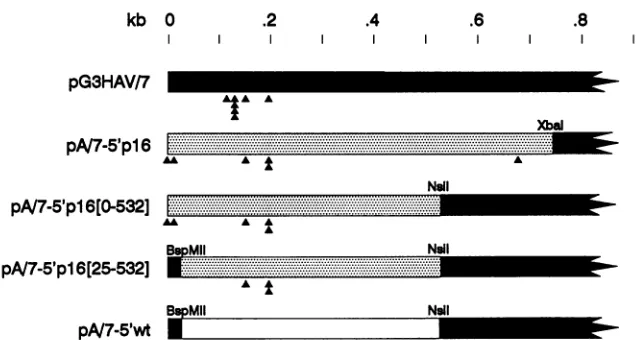
CAGAACT), complementarytobases 870to885. Thepoly-merase chain reaction productwas restricted withHindIII and XbaI and inserted into the multiple cloning site of pGEM3 downstream of the SP6RNApolymerase promoter to create pS'pl6. Chimeric genome-length cDNAs were constructed by ligation ofappropriate restriction digestion fragments from pG3HAV/7 and p5'pl6 as depicted in Fig. 1. An additional chimerawasconstructed in which the 5'NTR of HM175/p35 virus was replaced with cDNA from
pHAVLB1l3,
whichwasderived fromHM175/wt
virus(23).
The5'NTR chimeras thus containedHM175/p16
cDNA from basepositions 0to744(pA/7-5'p16),
0to532 (pA/7-5'pl6[0-532]), and 25to532(pA/7-5'p16[25-532]) orcontained wild-typeHM175 cDNA from bases 25to532(pA/7-5'wt) (Fig. 1). (Base0inHM175/p16
virus isanadditional U residueatthe 5' terminus of the genome [12].)Eachconstructretained theHAV
polyprotein-coding region
and 3' nontranslatedregion
ofpG3HAV/7(HM175/p35
virus), including
those mutations within the P2regionwhich Emersonetal.(9)
haveshowntobe important for
growth
in cell culture. To confirm the correctnessof theconstructions,
thechimeric cDNAsweresequenced
through
ligation
sitesby
thedideoxynucleotide
sequencingmethod ofSanger
etal.(20),
modified for double-stranded DNA.In vitrotranscription.Plasmid DNA
(5 ,ug)
waslinearized with HaeII and the 3'overhang
was filledinwith Klenow fragment(5).
The cDNAwasextracted with phenol-chloro-form,precipitated
inethanol,
resuspended
in nuclease-free water,andtranscribedwith SP6 RNApolymerase
(Promega)
according
to the manufacturer's instructions. The cDNA template was removedby
digestion
of thetranscription
reaction mixture with RNase-free DNase(Promega),
fol-lowedbyphenol-chloroformextraction and ethanol precip-itation. The RNApellet
wasresuspended
in 60RI
ofnu-clease-free water, and the
quality
of thetranscription
products was determinedby
electrophoresis
in formalde-hyde-agarosegels.Transfection assays. Transfectionswere
performed
in 60-mm-diameter cell culture dishescontaining
BS-C-1 cell monolayersthatwereapproximately
85% confluent. Mono-layers werewashed three times with OPTI-MEM(GIBCO
BRL)and then 3ml of OPTI-MEMwasadded. A total of 50 ,ulofLipofectin (GIBCO
BRL)
wasaddedto 50 ,u of RNA(approximately
5jig
ofRNA),
and this mixturewasslowly
addedtothemedium
covering
thecellmonolayers.The cells wereincubatedovernight
at35.5°Cina5%CO2atmosphere.
The following day, 3 ml of MEMsupplemented
with 20% fetal bovineserum wasaddedtoeachdish and the cellswereincubated for an additional 24 h. The medium was then removed and
replaced
with MEMcontaining
2%fetalbovine serum.The cultureswereincubated for 2 weeksat35.5°Cin a5%CO2 atmosphere,atwhich timesupernatantfluidswere removed and stored at -70°C forsubsequent
studies. To assessvirusgrowth,
the cells werefixedwith acetone and stained with radiolabelled anti-HAVimmunoglobulin
G(IgG)
as describedpreviously (14).
Analysis
ofvirusreplication efficiency.Theefficiency
with which rescuedvirusesreplicated
inBS-C-1orFRhK-4 cells wasassessed in radioimmunofocus assays(14).
Both the size ofreplication
foci and theintensity
ofstaining
of individual radioimmunofoci with125I-labelled
anti-HAV antibodieswere evaluated as measures of virus
replication.
Briefly,
rescued viruses wereinoculated onto nearly confluent BS-C-1 cellmonolayers
in 60-mm-diameter cell culture dishes. Aftervirus adsorption for 1 h, cell cultures were overlaid with agarose and incubated for 2weeks,
asdescribedprevi-ously
(14).
Foci of virusreplication
were visualizedby
autoradiography
after acetone fixation andstaining
of the cell sheets with radioiodinated anti-HAVIgG.The diameters of 30representative replicationfociweremeasured for each virus studied, and themean areas weredetermined. Plastic discsrepresenting
the same fociwere cut from the culture dish bottomswithacorkborer,
and thequantity
of radiola-belled anti-HAVIgG boundby each viralreplication
focus wasdeterminedby countinginagammacounter.Asnoneof the viruses studied werecytopathic,
therelationship
be-tween focus size
(specifically,
area, whichisproportionate
to the number of cells within a
focus)
and the individual focuscountsperminuteprovided
anestimate of the averageamount of viral
antigen
produced by individual cells within thereplication
focus. As an alternative measure of replica-tionefficiency,
thequantity
of125I labelled HAVon November 9, 2019 by guest
http://jvi.asm.org/
kb 0 .2 .4 .6 .8
pG3HAV/7
A- A
Xba
pA/7-5'p16
hA Aj A
Nll
pN/7-5'pl
6[0-532] LIiA 'A A
B8pMIl NWl
pA/7-5'pl 6[25-532]
_ _,* i
B8pMIl Null
pA/7-5'wt
FIG. 1. 5'NTRs of plasmids containing infectious genome-length HAV cDNAs utilized for transfection of BS-C-1 cells. The NTR comprises the first 735 nucleotides of the genome. Black genome segments represent sequence derived from pG3HAV/7(HM175/p35 virus), whilestippled segments are derived fromp5'/pl6 (HM175/p16virus) and the white segment is derived frompHAVLB113(HM175/wtvirus). Arrowheads indicate mutations from the sequence ofHM175/wt.Restriction sites used for construction of these plasmids are indicated.
bodiesboundby entire cell culture disheswasdeterminedby
directcounting and relatedtotheinput viral titer measured inradioimmunofocus-formingunits(14).
One-step HAV growthcurves.Thereplicationefficiency of selected viruseswas assessed under approximate one-step
growth conditions. BS-C-1 cells were grown until nearly
confluentin24-wellplates and inoculated with 0.1 ml of virus representingamultiplicity of infection of approximately 2.0.
Following a 1-h period of adsorption, cells were washed
twice and2.0 ml of maintenance mediumwasaddedtoeach well. The cells from individual wells were harvested and
assayed for intracellularvirusat8, 24,48, 72, and 144h as
follows. The mediumwasaspirated from each well, and the
cell sheets were washed twice with Hanks' balanced salt
solution. Cellswere lysed by the addition of 1 ml of MEM
containing 0.1% sodium dodecyl sulfate, and viruspresentin the lysate was quantified by radioimmunofocus assay (14
days of virus growthinBS-C-1cells)(14). RESULTS
Viruses with different5'NTRsequencesgenerate radioimmu-nofoci with different sizes in BS-C-1 cell cultures. Four chi-meric genome-length cDNAconstructswerecreated by
re-placing regions of the 5'NTR of HM175/p35 virus with cDNA derivedfrom eitherHM175/wtorHM175/p16virus,asshown
inFig. 1. In each case, the remainder of thegenome
down-stream of the 5'NTR was derived from HM175/p35 virus
(pG3HAV/7). pA/7-5'pl6 contained the entire 5'NTR
se-quence of HM175/pl6, while pA/7-5'p16[0-532] and
pA/7-5'pl6[25-532]containedHM175/p16sequencebetweenbases 0 to 532 and 25 to 532, respectively. Within the 5'NTR, HM175/p35 virus contains mutations from thewild-type se-quenceonlywithinthesequenceflankedbybases 123 and 208 (Table 1). Thus, pA/7-5'wt, createdby splicing cDNAfrom
pHAVB113
and pG3HAV/7 atBspMII (base 24) and NsiI (base 532) sites contained the entire 5'NTR sequence of HM175/wt. ThepA/7-5'pl6[25-532J,
pA/7-5'pl6[0-532],
pA/7-5'pl6, and pG3HAV/7 constructs contained 3, 5, 6, and 7 single base changes from thewild-type 5'NTR sequence ofpA/7-5'wt,in eachcaseincludingcommonmutationsatbase 152(A-to-Gsubstitution)andatleastoneU deletion withina
shortoligo(U)tract atbases203 to207(Table 1).
Runoff RNAstranscribedunder directionofSP6 polymer-ase fromplasmids linearizedwith HaeII werepredominantly genome length
(approximately
7.5 kb) (data not shown). However, we also observed two minorsubgenomicspecies ofapproximately4.6 and1.6kb,confirming previous obser-vations (5). Virus was rescued by transfection of BS-C-1 cellswith the RNA transcripts, using a liposome-mediated transfection procedure. The replication foci generated by theseviruses in BS-C-1 cellsranged from large (similarto thatobtained withHM175/pl6virus[12])tovery small (Fig. 2).Replacementof the5'NTRsequenceofHM175/p35 virus (pG3HAV/7)with thecorresponding
sequence ofwild-type HM175 (pA/7-5'wt) resulted in virus with very small foci (diameter of c1mm) resembling radioimmunofoci obtained after2 weeks ofgrowthofHM175/wtin BS-C-1 cells(12). Similarreplication fociwere obtainedwith viruses rescued frommultiple identicalcDNAconstructs,arguing againstthe chance acquisition of a mutation that was detrimental to replication elsewhere in the genome. This result indicates that mutations within the 5'NTR of HM175/p35 virus are necessary foroptimalgrowth in BS-C-1cells.Substitution of the complete 5'NTR ofHM175/p35 with the 5'NTR ofHM175/pl6
(pA/7-5'pl6 construct)
resulted in virus with a focus size comparable to that ofHM175/p35 (diameter, >3 mm) (Fig. 2) or HM175/p16 virus(data
not shown). The fact that the 5'NTRs of HM175/p35 and HM175/p16 could substitute for each other withoutsignifi-TABLE 1. Phenotypesand 5'NTR mutations ofHM175 virus variants
Ceul Hepatitisin NTRmutationatbase(s):
Virus culture .
^ate
growtha pimates 8 124 131-134 152 203-207 687
HM175/wt + ++++ G U UUUG A IU U
HM175/p16 +++ + U A U UUUG G ddC G
HM175/p35 +++ + G C dddd G dU U
a+,veryslowgrowth and lowyields;+ ++,moderatelyrapid growthand
yields.
I+,inconsistent,low-levelserumenzymeelevations; ++++,consistent,
markedserumenzymeelevations.
cd, deletion.
on November 9, 2019 by guest
http://jvi.asm.org/
[image:3.612.161.479.73.243.2]At l t
HM7Ii5,j)35 ..s-U
*
.4 9
A:75,p16E ,)-532j
-
14-A 7-5pl6
0o *
[image:4.612.320.551.74.250.2] [image:4.612.90.273.77.226.2]A,'7-5'p16
[25-532]
A:7-5wt
FIG. 2. Autoradiograms of radioimmunofocus assays (BS-C-1 cells)of viruses rescued fromplasmids depictedinFig. 1.The assay wascompleted2 weeks after inoculation of thecellsand represents cellculturepassage2 of the rescued virus.
cant reduction in the growth characteristics of the virus suggested that the mutations which these viruses share in common within this region (at bases 152 and 203 to 207 [Table 1]) may be particularly important to the ability of HAVtoreplicateefficientlyin BS-C-1 cells. Thishypothesis was tested by the construction of additional plasmids in whichHM175/p16 mutationsatbase687(pA/7-5'pl6[0-532])
or bases 0, 8, and 687 (pA/7-5'pl6[25-532]) were excluded (Fig. 1). In multiple radioimmunofocus assays in BS-C-1 cells,viruses rescued from theseconstructs generated sub-stantially larger replication foci than virus withthe 5'NTR sequenceofHM175/wt virus (Fig. 2).These results confirm thatit is the 5'NTR mutationsatbases 152and/or203to207 that are necessary for efficient replication. Although we notedvariability indifferent radioimmunofocus assays, the replication foci producedby these viruses were often smaller (diameter of 1to3mm)than thoseproducedbyHM175/p35
or A/7-5'pl6 virus (Fig. 2). These results suggest that the mutation at687 has aminor role in furtherenhancingvirus replication inBS-C-1 cells (6).
Expression of HAVantigeninvivoby viruses with different 5'NTR sequences. Considerable attention has been focused recentlyonthe role of the5'NTR incontrolling translationof theproteins ofpicornaviruses, includingHAV(1, 10).In an attempt to examine the influence of 5'NTR mutations on viral translation invivo, we measured the quantity of radio-labelled anti-HAV IgG bound to individual replication foci produced in BS-C-1 cells by viruses rescued from the constructs shown in Fig. 1. This measure provides an estimate of the amount of HAV antigen produced within each individual focus, while the size (area) of the focus is proportionate to the number of cells infected within the focus. As shown in Fig. 3, when we analyzed 30 repre-sentative radioimmunofoci produced by each virus, we found aroughly linear correlation between themeanareaof replication foci and the meanquantity of
125I-labelled
anti-HAVantibodies boundby each focus. Thus, theamountof viralantigen produced within individual cells was not mea-surably different with any of the viruses studied, while the viruseswith greater replicationefficiency spread to alarger number of cells within individual replication foci over the 2-week period of incubation. However, it is important to point outthatwedo notknow thelinearity of the relation-shipbetweencountsperminute boundinradioimmunofocus6 12-0
10
-E
a
8-c
a)
PI,c
6-
4-I
2-1 2 3 4 5 6 7 8 9 10 11 12
Radioimmunofocus Area (mm2)
FIG. 3. Viral antigen content versus size (area) of individual radioimmunofoci produced by 5'NTR chimeric viruses in BS-C-1 cells. Symbols: A,HM175/p35; 0, A/7-5'pl6; *,A/7-5'pl6[0-532];
M,A/7-5'pl6[25-532]; A,A/7-5'wt. Eachpointrepresentsthemean
valuesof 30representative replicationfoci, whilelines with
arrow-heads in both dimensions indicate standarddeviations.
assaysand the intracellular viral antigencontent. It may be
that
1"I-labelled
anti-HAV antibody staining saturates atrelatively low intracellular antigen concentrations.
One-step growth
analysis
of 5'NTR mutant viruses. Be-cause the radioimmunofocus assaymeasuresthe spreadof HAV antigen from an infectious focus within a cell sheet, determination of focus size in this assay should be agoodmeasureof theadaptationofvirustogrowthincell culture. Tovalidate this hypothesis, we assessed thereplication of three of the rescued viruses in BS-C-1 cells under one-step growth conditions(Fig. 4). To generate sufficientvirus for these assays, itwasnecessarytopasseach virusoncein cell culture after its rescue from cDNA. Thus, these one-step growth experimentsrepresented passage 3 of these viruses in cell culture after rescue, while the radioimmunofocus assays for quantitation of the one-step growth harvests representedpassage 4 in cellculture aftervirusrescue.
These one-step growth experimentsconfirmed the earlier results and also demonstrated that radioimmunofocussizeis avalidmeasureof cell cultureadaptation.Thereplicationof A/7-5'wtvirus(Fig. 4B)wassignificantly slowerthan that of A/7-5'pl6[25-532] virus (Fig. 4A). Although the infectious titers ofA/7-5'pl6[25-532]andA/7-5'wtwerenearlyidentical at8h,theA/7-5'wt yieldsweresignificantlylowerat24and 48 h and approximately 10-fold less at 72 h. Intracellular A/7-5'pl6[25-532] virus plateauedat72h,sothatthe titers of these viruses wereapproximatelythe same at144h. While the infectious titers ofHM175/p35 virus(Fig. 4C)wereless at 8and 24h,thereplication kinetics of this virus indicated somewhat morerapid growththan for the
A/7-5'pl6[25-532]
virus. The differences in thereplicationratesof theseviruses thus reflect the differentradioimmunofocus sizesgenerated by these viruses(Fig. 2).The results of the one-stepgrowth analysis, therefore, confirm that the mutations atbases152 and/or 203 to 207 enhance the growthof HAV in BS-C-1 cells.Replication competence of5'NTR chimerasin FRhK-4cells. To determine whether the differences in the replication competence ofviruses whichwe observed in BS-C-1 cells were also present in a different cell type, we compared
14
on November 9, 2019 by guest
http://jvi.asm.org/
A
7
6
LL5
0)
v-4
3
21
0 20 40 60 80 100120140
Hours
Postinoculation
FIG. 4. Intracellularvirus accumulation measured under approximateone-step growth conditions in BS-C-1 cells infectedwith virus
rescued frompA/7-5'pl6[25-532] (A), pA/7-5'wt (B), and pG3HAV/7 (C). RFU, radioimmunofocus-forming units.
radioimmunofocus size and viral antigenproductionin BS-C-1 cells and continuous cultures of fetal rhesus monkey kidney(FRhK-4)cells.AlthoughbothHM175strainvariants westudiedwereadaptedtogrowthinAfricangreenmonkey
kidney cells, FRhK-4 cells have been used widely for propagation ofHAV incell cultureand inaprevious study of mutationsresponsiblefor the cell cultureadaptation pheno-type ofHM175 virus (9). Parallel cultures of FRhK-4 and BS-C-1 cells were inoculated with increasing quantities of virusesrescued from theconstructsshown inFig. 1,aswell
as HM175/pl6 virus. Cellswere maintainedunder agarose
overlays for 2weeks, thenfixed, and stained with radiola-belled anti-HAV antibodies. We found less than a3.3-fold difference in the infectious titers of each of the rescued viruses when thesewere determined byindependent
radio-immunofocusassayscarriedoutinBS-C-1andFRhK-4 cells (datanotshown). However,thereweredramaticdifferences in the size of replication foci in these cell lines (Fig. 5). Differencesinthesizesofreplication foci of the HM175/p35, A/7-5'pl6, andA/7-5'wtviruseswereagainnoted inBS-C-1 cells. Thereplicationfociobtainedwith eachof therescued viruseswere smaller in FRhK-4 cells than inBS-C-1 cells. Moreover, therewere noapparentdifferences in the sizeof replication foci obtained with viruses having wild-type or mutant5'NTRsequencesinFRhK-4cells(Fig. 5), indicating that the 5'NTR mutations present in HM175/p35 and HM175/pl6viruses donotenhancegrowth inthis cell line. InbothBS-C-1 and FRhK-4cells, individualreplicationfoci
wereoccasionallysignificantly largerthanothers,suggesting
the possibility that new mutationswere accumulatingwith continued passage ofrescued viruses in cell cultures. This experiment representedpassage3 ofthe rescued viruses in cell culture. A similar phenomenon was noted in the one-stepgrowth experimentsdescribed above(datanotshown). We also measured viral antigen accumulation in the in-fected BS-C-1 and FRhK-4 cell cultures maintained under
agarose overlays (Fig. 6). These results, which were not obtained under one-step growth conditions, indicated an
approximately10-fold reduction in theexpressionofantigen
by BS-C-1 cell cultures infected with virus containing the wild-type 5'NTR sequence compared with cell cultures
infectedwith an equivalent quantityof viruscontainingthe
5'NTR sequenceofeither HM175/p35 or HM175/pl6 virus (Fig. 6A). In contrast, the antigen content of infected FRhK-4 cells was much less than that of BS-C-1 cells infected in parallel with the same inocula, and little differ-ence was evident in antigen expression by FRhK-4 cells
infected with viruseshavingdifferent5'NTRsequences(Fig. 6B).
DISCUSSION
Previousstudieshave indicated thatmutationsresponsible for the adaptation of HAV to growth in cell culture are
located within the regionofthegenome encoding the
puta-a
HM175/p35 v 4
Vo*
A/'7-5pl6
A7-5wt
:t4J
Ar
b
*a
t
I
-1
[image:5.612.133.495.79.302.2]..
FIG. 5. Radioimmunofoci generated by virus rescued from
pG3HAV/7(HM175/p35),pA/7-5'pl6, andpA/7-5'wtincontinuous
cultures of African green monkey (BS-C-1) (a) and fetal rhesus
monkey kidney(FRhK-4) (b)cells.
[image:5.612.373.515.525.683.2]B
C
... ... ...
on November 9, 2019 by guest
http://jvi.asm.org/
A
6
0 0
E
0.
0) cm
.2
C
B
250
200
150
100
50
0
1 2 3 4 5 1 2 3 4
Inoculum
(Log10 RFU)Inoculum (Log10
RFU)5
FIG. 6. Accumulation of HAV antigen in BS-C-1(A) and FRhK-4 (B) cells infected with viruses rescued from cDNAconstructsdepicted inFig. 1. Symbols are asdescribed in thelegendto Fig. 3, 0 = HM175/pl6virus, which differs from the other viruses with respectto mutations outside of the 5'NTR (11). Cells were maintained beneath agarose overlays for 14 days after infection, thenfixed, and stained with
"MI-labelled anti-HAV antibodies. The counts per minute (cpm) bound by each culture dish is shown as a function of inoculum size (radioimmunofocus-forming units[RFU]measuredinBS-C-1cells). Background binding of "MI-labelledanti-HAV antibodiesranged from 1,939 to 3,376 cpm.
tive 2B and 2Cproteins(8, 9). Inthis report, however, we present data which demonstrate that mutations within a
smallregion of the5'NTRof theHAV genomealso substan-tially enhancethereplicationof HM175 variantsin
continu-ouscultures ofAfrican greenmonkey kidney
(BS-C-1)
cells. Mutations which enhance viral replication in BS-C-1 cells include anA-to-G substitution atbase 152and/or the dele-tionofoneor twoUresidues withinashortoligo(U)tract at bases 203 to 207. Both mutations are present in the cell culture-adapted HM175/p16andHM175/p35 viruses. In ad-dition, there is also a U deletion at bases 203 to 207 in HM175/p59 virus, a third HM175variant which was inde-pendently adaptedtogrowthandserially passagedin African green monkey kidney cells(19). Thus,itmaybethis muta-tion which is the most important in enhancing growth in BS-C-1 cells.Athirdmutation,aU-to-G substitutionatbase 687, plays a definite but less important role in enhancing replicationin BS-C-1cells (6)and is found in bothHM175/p16
andHM175/p59
viruses.All of theinfectiousconstructs whichwe examinedcontained the 2B and 2C mutations of HM175/p35 which have been shown to be important for replication incellculture.Compared with earlier studies examining the effects of mutations on growth of HAV in cell cultures (8, 9), our findingsareenhancedbyouruseofmore-quantitative mea-suresof virusreplication.Wecompared thereplication rates ofviruseshaving different mutations under one-step growth conditions(Fig.4). Suchanapproach is difficult to apply to large numbers of viruses, however, because of the slow and generallynoncytolytic growth of HAV. However, quantita-tive measurements of radioimmunofocus size and antigen content (Fig. 3) correlate with differences in replication kinetics under one-step conditions andprovide a simple and directmeasure ofreplication competence.
The exact mechanism by which these 5'NTR mutations affect viralreplicationin certain cell cultures and hence the
host range of the virus is not understood. However, the 5'NTRsofotherpicornaviruses havebeen showntoinitiate viraltranslationbyanunusual processof internalribosomal entry, an event occurring many hundreds ofbases down-streamof theuncapped 5' terminus ofthe RNA(10).Recent work has confirmed the existence of a similar internal ribosomalentry site
(IRES)
within the 5'NTR ofHAV(2).
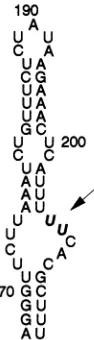
Comparison of a model of the secondary structure of the HAV 5'NTR with thestructureproposedfor the5'NTRof encephalomyocarditis virus and analysisof in vitro transla-tionexperiments using 5' truncatedHAV RNAshave sug-gested that the 5' terminus of the HAV IRES is located upstreamof base 355(1).This has beenconfirmed ina more recent study examining translation in rabbit reticulocyte lysatesprogrammedwithbicistronicconstructsin which the HAV5'NTR controlstranslationof the downstream reporter gene (2). Thus, available data suggest that the locations of the 5'NTR mutations which we have shown to positively influence thereplication of HAVinBS-C-1 cells lie within the HAV IRES elementorveryclosetoits5'limit.Modeling studiessuggest thatnucleotides 203to 207arelocatednear the base of a conserved stem-loop structure and that U deletionsatbases 203to207 reduce the size ofasmall bubble within thisstructure(1) (Fig. 7).Base152 is locatednearthe 3' terminus of a putatively single-strandedpyrimidine-rich
tract. Deletion of sequence downstream of base 151
signifi-cantlyimpairsHAVIRES-directed translation in vitro(2).
While a primary effect on RNA replication cannot be excluded, thelocations of these mutations thus suggest the possibilitythattheyact toenhancereplication by
positively
influencingtranslation of the HAVpolyprotein.Wefoundno measurable increase in thebindingofradiolabelledantibodyto cellsinfected with chimeric viruses containing wild-type
or cell culture-adapted 5'NTR sequences (Fig.
3),
but the abilityofthisinvivo assayto distinguishdifferent levelsof intracellular antigen accumulation remains unproven. Inon November 9, 2019 by guest
http://jvi.asm.org/
[image:6.612.146.461.75.283.2]190
A
U U
C A
UA CG UA UA UA G C U U200
C C
UA
AU
AU U
AU
C A
U C
UG
[image:7.612.165.212.79.249.2]170G C G U G U AU
FIG. 7. Proposed secondarystructureofpartof domain III of the HM175/wt5'NTR (1). Thearrowindicates the location of mutations (U deletions) at base positions 203 to 207 which are present in HM175/p16 virus.
addition, itmaybe that thespread of virus toadjacentcells
occurs onlyafter acertain level of viral replication
(intrac-ellular antigen accumulation) is reached. In fact, data from the one-step growth experiments suggest that viruses with and without these mutations eventually reach the same
intracellular titers (compare Fig. 4A and B) but that virus lackingthemutations takes longertodoso. Examination of the translational efficiencies of RNAs transcribed from the chimeric5'NTRconstructsinrabbit reticulocyte lysates has failed torevealanyenhancement thatcould be attributedto
specificmutations(2).However, these datadonotexcludea role for these mutations in enhancing translation of HAV RNA in vivo. We found the positive influence of these mutationsonvirusreplicationtobepresentin BS-C-1cells, which arederived from African greenmonkeys, butnot in FRhK-4 cells which are derived from the kidneys of fetal
rhesusmonkeys. The5'NTR mutations thus actinahighly host cell-specific fashion, as suggested by Emerson and coworkers (9), and an effect on translation would not be expected inreticulocyte lysates.
AsbothHM175/p16 and HM175/p35 viruswereadaptedto
growthinculturesofAfricangreenmonkey kidneycells, it is
not surprising that avery host cell-specific effect might be seen only in closely related cells. The 5'NTRs of the
picornaviruses bind several host cell proteins which are
likely to play roles in virus translation and/or viral RNA replication (7, 11, 16). Recent evidence fromourlaboratory suggests that the 5'NTR of HAV similarly binds several BS-C-1 cell proteins (3). The 5'NTR mutations which we have shown to positively influence the replication of the virus in these cellsmay thus actby enhancingorreducing the affinity of the 5'NTR for these cellular RNA-binding proteins. Furtherinvestigation ofthishypothesisislikelyto
provideadditional informationonthemechanismsbywhich these mutations enhancereplicationof HAV incell culture and in alarger sense mayprovide insights intothe mecha-nismsofattenuation mediatedby5'NTR mutations in other picomaviruses suchaspoliovirus (22).
ACKNOWLEDGMENTS
WethankJ.Ticehurst,S. M.Feinstone,and R. H.Purcell for the
pHAVLB113andpHAV/7 plasmids,andwethank S. Hildebrants for
preparationof themanuscript.
This work was supported in part by a grant from the U.S. Army Medical Research and Development Command (DAMD 17-89-Z-9022) and a Technical Services Agreement with the Programme for
Vacci,qe
Development of the World Health Organization.REFERENCES
1. Brown, E. A., S. P. Day, R. W. Jansen, and S. M. Lemon. 1991. The 5' nontranslated region of hepatitis A virus: secondary structure andelements required for translation in vitro. J. Virol. 65:5828-5838.
2. Brown, E. A., A. Zajac, and S. M. Lemon. Unpublished data. 3. Chang, K.-H., E. A. Brown, R. W. Jansen, and S. M.Lemon.
Unpublisheddata.
4. Cohen, J. I., B.Rosenblum, J. R.Ticehurst,R. J.Daemer, S. M. Feinstone, and R. H. Purcell. 1987. Complete nucleotide se-quence of an attenuated hepatitis A virus: comparison with wild-type virus. Proc. Natl. Acad.Sci. USA84:2497-2501. 5. Cohen, J. I., J. R.Ticehurst, S. M. Feinstone, B.Rosenblum, and
R. H. Purcell. 1987. Hepatitis A virus cDNA and its RNA transcriptsareinfectious incellculture. J. Virol. 61:3035-3039. 6. Day, S. P., and S. M.Lemon.1990. A single base mutation in the 5' noncoding region of HAV enhances replication of virus in vitro, p. 175-178. In F. Brown, R. M. Chanock, H. S. Ginsberg, and R. A.Lerner(ed.), Vaccines 90:modernapproaches to new vaccines including prevention of AIDS. Cold Spring Harbor Laboratory Press, Cold Spring Harbor, N.Y.
7. DelAngel, R. M., A. G. Papavassilion, C. Fernandez-Thomas, S. J.Silverstein, and V. R.Racaniello.1989. Cell proteinsbind to multiple sites within the 5' untranslated region of poliovirus RNA. Proc. Natl. Acad. Sci. USA86:8299-8303.
8. Emerson, S. U., Y. K. Huang, C.McRill,M.Lewis, and R. H. Purcell. 1992. Mutations in both the 2B and 2C genes of hepatitis A virus areinvolved inadaptation to growth in cell culture. J. Virol. 66:650-654.
9. Emerson, S. U., C. McRill, B. Rosenblum, S. Feinstone, and R. H. Purcell. 1991. Mutations responsible for adaptation of hepatitis A virus to efficient growth in cell culture. J. Virol. 65:4882-4886.
10. Jang,S. K., T.Pestova, C. U. T. Hellen, G. W.Witherell,and E. Wimmer. 1991. Cap-independent translation of picornaviral RNAs: structure and function of the internal ribosomal entry site. In R. E. Thach (ed.), Translationally regulated genes in higher eukaryotes. Karger, Basel.
11. Jang, S. K., and E. Wimmer. 1990.Cap-independent translation ofencephalomyocarditisvirus RNA: structural elements of the
internal ribosomal entry site and involvement of a cellular 57-kDa RNA-binding protein. Genes Dev.4:1560-1572. 12. Jansen, R. W., J. E. Newbold, and S. M. Lemon. 1988. Complete
nucleotidesequenceof acell culture-adapted variant of hepatitis Avirus: comparison with wild-type virus with restricted capac-ity for in vitro replication. Virology 163:299-307.
13. Lemon,S. M. 1985. Type Aviral hepatitis: newdevelopments in anolddisease. N. Engl. J. Med. 313:1059-1067.
14. Lemon, S. M., L. N. Binn, and R. H. Marchwicki. 1983. Radioimmunofocus assay for quantitation of hepatitis A virus in cellcultures. J. Clin. Microbiol.17:834-839.
15. Lemon,S. M., P.Murphy, J. Ticehurst, L. Binn, and J. LeDuc. Unpublisheddata.
16. Meerovitch, K., J. Pelletier, and N. Sonenberg. 1989. Acellular protein that binds to the5'-noncodingregion of poliovirus RNA: implications for internal translation initiation. Genes Dev. 3:1026-1034.
17. Midthun, K., E.Ellerbeck, K. Gershman, G. Calandra, D. Krah, M. McCaughtry, D. Nalin, and P. Provost. 1991. Safety and immunogenicityof alive attenuatedhepatitis A virus vaccine in seronegativevolunteers. J. Infect. Dis.163:735-739.
18. Provost, P. J., F. S. Banker, P. A. Giesa, W.J. McAleer, E.B.
Buynak, and M. R. Hilleman. 1982. Progress toward a live, attenuated humanhepatitis Avaccine. Proc. Soc. Exp. Biol. Med. 170:8-14.
19. Ross, B. C., R. N. Anderson, P.C. Edwards, andI. D. Gust. 1989. Nucleotide sequence of high-passage hepatitis A virus
on November 9, 2019 by guest
http://jvi.asm.org/
strain HM175: comparison with wild-type and cell culture-adapted strains. J. Gen. Virol. 70:2805-2810.
20. Sanger, F., S. Nicklen, and A. R.Coulson. 1977. DNA
sequenc-ing with chain-terminating inhibitors. Proc. Natl. Acad. Sci. USA 74:5463-5467.
21. Siegi, G., and S. M. Lemon. 1990. Recent advances in hepatitis Avaccine development. Virus Res. 17:75-92.
22. Svitldn, Y. V., S. V. Maslova, and V. I. Agol.1985. Thegenomes
of attenuated and virulentpoliovirus strains differ in their in vitro translation efficiencies. Virology 147:243-252.
23. Ticehurst, J. R., V. R. Racaniello, B. M.Baroudy, D. Baltimore, R. H.Purcell, and S. M. Feinstone. 1983. Molecular cloning and characterization ofhepatitis A virus cDNA.Proc. Natl. Acad. Sci. USA 80:5885-5889.
![FIG. 3.valuesradioimmunofocicells.headsM, Viral antigen content versus size (area) of individual produced by 5'NTR chimeric viruses in BS-C-1 Symbols: A, HM175/p35; 0, A/7-5'pl6; *, A/7-5'pl6[0-532]; A/7-5'pl6[25-532]; A, A/7-5'wt](https://thumb-us.123doks.com/thumbv2/123dok_us/1305177.83720/4.612.90.273.77.226/valuesradioimmunofocicells-antigen-content-individual-produced-chimeric-viruses-symbols.webp)
![FIG. 4.rescued Intracellular virus accumulation measured under approximate one-step growth conditions in BS-C-1 cells infected with virus from pA/7-5'pl6[25-532] (A), pA/7-5'wt (B), and pG3HAV/7 (C)](https://thumb-us.123doks.com/thumbv2/123dok_us/1305177.83720/5.612.373.515.525.683/rescued-intracellular-accumulation-measured-approximate-growth-conditions-infected.webp)