0022-538X/92/106099-08$02.00/0
CopyrightC1992, AmericanSociety for Microbiology
Localization of cis-Acting Sequences in the Latency-Related
Promoter
of Bovine Herpesvirus 1
Which Are Regulated by
Neuronal Cell Type Factors and Immediate-Early Genes
A. C. BRATANICH AND C. J. JONES*Centerfor Biotechnology, Departmentof Veterinary Science, University of Nebraska,
Lincoln,
FairStreetatEastCampus Loop,
Lincoln,
Nebraska 68583-0905Received8June 1992/Accepted16 July 1992
Bovine herpesvirus 1 (BHV-1) establishes a latent infection in sensory ganglionic neurons of cattle. During alatentinfection, a single latency-related (LR) transcript is expressed. This observation suggested that DNA sequencesin the LR promoter are
positively
regulated by neuralcell type factors. The regulation of the LR gene wasexamined in neuralcellsaswellas nonneural cells intransient assays. A 258-bpXbaI-SphI fragment from the LR promoter cis activated the herpes simplex virus type 1thymidine kinase promoter in rat pheochromo-cytoma(PC-12) cells and differentiated human (HCNIA) neurons. In contrast, cis activation was not observed withrat(Rat-2) fibroblasts, undifferentiated HCNLA cells, or bovine turbinate cells. Treatment of PC-12 cells with nerve growth factor increased transcriptional activity of the XbaI-SphI fragment. Exonuclease HI footprintingexperimentssuggested that nuclearfactors bind to theXbaI-SphIfragment. Theimmediate-earlygenes of BHV-1 trans activated the LRpromoter, and DNA sequences 5' to the XbaI-SphI fragment were necessary for maximal stimulation. These results imply that neural-cell-type-specific factors and BHV-1 immediate-early genes
positively
regulate LR gene expression.Bovineherpesvirus 1(BHV-1)isasignificant viral patho-genof cattle andcancauserespiratory disease,abortions, or
occasionally encephalitis (for a review, see reference 31).
Likeall membersof thealphaherpesvirussubfamily, BHV-1 establishesalatentorpersistent infection in sensory
gangli-onicneurons of the infected host (1, 10, 21,22). Thevirus can persist ina latent state for the lifetime of the infected host or can periodically reactivate and cause extensive damage tothe host. In contrast to the 70to80viral genes expressedduringalyticinfection ofbovinecells, viral gene expression is severely impaired during a latent infection. One smallregionof the genomeistranscriptionallyactive in
latently infected neurons, and this region is designatedthe
latency-related (LR) gene (14, 19-21). Transcripts originat-ing from the LR gene accumulate in the nuclei ofsensory neurons which are latently infected (14, 19-21). The LR
transcript is also detected in lytically infected cells and accumulates late afterinfection(14).
The transcriptional promoterwhich regulates expression
of the LR gene is contained within a 980-bpPstI fragment (12). Inprimaryculturesof rabbit neurons, the LR promoter is 10-fold more active than the simian virus 40 early pro-moterand enhancer. Viral infection alsopositivelyregulates LR promoter activity. Consequently, it was hypothesized that cis-acting sequences within the LR promoter are re-sponsibleforneuronalcelltypeexpressionandtrans activa-tionbyviralorvirus-induced factors.
Inthisstudy, tworegions within theLR promoterwhich were necessary for efficient trans activation by BHV-1
immediate-early (IE)geneswereidentified.A258-bp
XbaI-SphI fragmentcis activated theherpes simplexvirus type 1
(HSV-1) thymidinekinase(TK)promoterincells of neuronal
originbutnotother cell types.However,thisfragmentdoes nothave promoteractivity andwas notnecessaryfortrans
* Correspondingauthor.
activation byBHV-1 IE genes. Ifneuronal cellsweretreated withnervegrowth factor(NGF),transcriptional activitywas stimulated slightly. IftheXbaI-SphI fragmentwas digested withAIuI,cisactivation of theTKpromoterwasobserved in neuronal cells only after treatment with NGF. When the
XbaI-SphI fragment was incubated with nuclear extracts from rat cells, protection from exonuclease III (ExoIII) digestionwasobserved,suggestingthat nuclear factorsbind sequences in the XbaI-SphI fragment. These results indi-cated that distinctregionsof the LR promoterarenecessary for neuronal cell typeexpressionandtransactivationbyIE genes.
MATERIALSANDMETHODS
Cells. Bovine turbinate and Rat-2 cellsweremaintainedas described previously (11, 12). PC-12 cells(rat
pheochromo-cytoma[9])wereobtained from the American
Type
CultureCollection and maintained in RPMI media
supplemented
with 8% horse serum and 4% fetal bovine serum. HCN1A cells (human cortical neurons [23]) were maintained in Earle'smodifiedEaglemediumsupplementedwith15%fetal bovine serum. Todifferentiate HCN1Acells,cultureswere treated with 0.5 mM 3-isobutylmethylxanthine
(IBMX),
0.5 mMdibutyrylcyclicAMP(cAMP),and 25 ng of NGF per ml for 6days(23). During differentiation, cellswerefedevery3days. Rat-2, BT,and PC-12 cellsweretreatedwith 25 ng of NGF per ml for the indicated times.
Cell transfection. Transfection of BT, Rat-2, and PC-12 cellswascarriedoutbycalcium phosphate
precipitation
as describedpreviously (11,12).HCN1A cellsweretransfectedbythe Polybrenemethod(18).
CAT assays. Forty hours
posttransfection,
cells were washed in phosphate-buffered saline and a cell-free lysate waspreparedby three freeze-thawcyclesin 0.25MTris(pH
7.8). Chloramphenicol
acetyltransferase
(CAT)
enzymatic
activitywasmeasuredasdescribed
previously
(11,
12).
After6099
on November 9, 2019 by guest
http://jvi.asm.org/
6100 BRATANICH AND JONES
thin-layer chromatography (TLC),
theamountof[14C]chlo-ramphenicol (CM), acetylated
orunacetylated,
was mea-sured withanAmbisradioanalytical
device.Preparation
of nuclear extracts. Nuclear extracts wereprepared
from mammalian cellsby
theprocedure
ofDignametal.
(7).
Proteinconcentrations of the variousextractswere measured(4),
and theextractsweresubsequently
frozenat -1200C.Plasmid constructs. Plasmids
pO.9Scat/l, pO.95cat/6,
pAXhoI, and pO.SXba/47 were described previously (12). Plasmids
pSV2cat,
pAlOcat2,
andpSVOcat
were obtained from BruceHoward. ToconstructpAXP/1,
theunique
XhoI site inpAXhoI
was convertedto aBglII
siteby
addition ofsynthetic BglII
linkers and the531-bp XhoI-HindIII
frag-ment
(nucleotides [nt]
451to981)
wasreleasedby digestion
with
BglII-HindIII
andsubsequently
inserted into apAlOcat2
vectordigested
withBglII
andHindIII. Prior tocloning,
thepAlOcat2
vector waspurified
in apolyacryl-amide
gel
to eliminate simian virus 40early
promoter se-quences.Theplasmid pAXS/1
wasconstructedby digesting
pAXP/1
withSphI
andHindIII,
filling
in the ends with Klenowfragment,
andsubsequently ligating
with T4ligase.Forasummaryofthese constructs, see
Fig.
1.For constructionof enhancer
plasmids,
aCATconstructcontaining
the HSV-1 TK promoter was used(pBLcat/4
[26]).
PlasmidpO.95cat/1
wasdigested
withXbaI,
which releasednt523to981asanXbaI
fragment.
Thiswaspossible
since the SmaI-PstI sequences of thepUC-19 polylinker,
including
an XbaIsite,
areadjacent
to nt 981 of the LR promoter.nt523to981 of the LR promoterwerecloned intopBLcat/4
attheXbaIsite,
andaclone withnt981adjacent
to theTKpromoterwasselectedby
restrictionmapping.
This constructwasdigested
withSphI,
whichreleased theXbaI-SphI
site of the LR promoter(523
to781)
by
virtue ofanSphI
site in thepolylinker
ofpBLcat/4.
Theresulting
linear-izedplasmid
was recircularized with T4ligase
anddesig-nated
pBL/Sph-.
ThereleasedSphI
fragment (XbaI-SphI)
wascloned into the
SphI
site ofpBLcat/4,
and theresulting
constructwas
designated pBL/Sph+.
Theorientationof thefragment
was determinedby digestion
withXbaI. TheHin-dIII-XbaI
fragment
of the LR promoter(1
to523)
wasclonedinto the HindIII-XbaI sites of
pBLcat/4
anddesignated
pBL/H-Xba.
Forasummaryof these constructs, seeFig.
3. All DNAfragments
werepurified
in5%polyacrylamide
gelsand electroeluted. Plasmids were
purified
from bacteriabyalkaline
lysis
followedby
two CsCldensity centrifugations
(25).
Plasmids
containing
the BHV-1 IEtulregion (c601)
and E2.6wereobtained from M.Schwyzer (28, 29).
To preparea construct that
expressed
only IE4.2,
c601 wasdigested
with
SalI
plus HindIII,
the ends were made blunt withKlenow
fragment,
thelarge fragment
waspurified by
agarosegel electrophoresis,
and thefragment
wasligated
with T4 DNAligase.
Forasummaryofthese constructs,seeFig.
2.Binding
assays for ExoIlHdigestion.
TheXbaI-SphI
frag-mentwaslabeledatits 5'
phosphate
endsby incubating
withpolynucleotide
kinase and[-y-32P]ATP.
Thefragment
wassubsequently digested
withAluI,
and the individualfrag-ments were
purified
inpolyacrylamide
gels as described above.Binding
volumes forExoIlI digestion
were50 ,ul. The reaction mixtures contained thefollowing components: 0.5 to 1 ngofend-labeled DNA(10,000
to 20,000 cpm), 45mMKCl,
25 mM HEPES(N-2-hydroxyethylpiperazine-N'-2-ethanesulfonic
acid) (pH 7.8),
0.1 mM EDTA, 0.5 mMdithiothreitol,
3 ,ug ofpoly(dI-dC),
and 15 p,g of nuclear extract.After the reactionwasincubated for 20 minat30°C,MgCl2wasaddedto afinalconcentration of5 mM and 375 U ofExolII wasalso added. This is theamountofExoIII that yielded little or no background when the fragments were incubated withjust bovineserumalbumin (datanot
shown).
Reaction mixtures were incubated foranadditional 20 minat 30°C, and reactions weresubsequently terminatedby addi-tion ofphenol-CHCI3-isoamyl alcohol (50:49:1). After etha-nol precipitation, the products were separated on a 6%denaturing polyacrylamidegel.
For competition footprinting assays with the
respective
oligonucleotides, 20or200ng of the double-stranded
oligo-nucleotide was incubated with the nuclear extract mixture for 20minat 37°C. The labeledfragmentwas
subsequently
added, and the reaction mixturewasincubatedasdescribed above.
PC-12, Rat-2, or HCN1A cells were transfectedwith the designatedplasmids (10 ,ug). Twenty-four hours posttrans-fection, some cultures of Rat-2 cells or PC-12 cells were treated with 25 ng of NGF per ml since thisconcentration wasshowntoinduce differentiation of PC-12 cells as well as induce early-response genes(5, 9,24). For differentiation of HCN1A cells, cultures were treated with NGF (25 ng/ml),
IBMX (0.5 mM), and forskolin (0.5 mM) for 6 days prior to transfection (23). At 40 hposttransfection,totalcelllysates wereprepared and CAT enzymatic activity was measuredin the presence of
[14C]CM
(40 p.g of protein, 1 h, 37°C). For HCN1Acells, extractsderived from an equivalent number of cells (2 x 10⁴) were used to measure CATactivity (4h,37°C). The various forms of CM were separated by TLCand
quantified.
The 21-bp oligonucleotide which contains three AP-1 or tetradecanoyl phorbol acetate-responsive elements (TRE)
is 5'-TGAGTCATGAGTCATGAGTCA-3' (2). The 39-bp
oligonucleotidewhichcontains three cAMP-responsive ele-ments (CRE)is5'-GATCTGACGTCATGACTGACGTCAT GACTGACGTCATCA-3' (17). The 36-bp oligonucleotide whichcontains three octamer (Oct)-binding sites is 5'-GAT CATGCAAATGATCATGCAAATGATCATGCAAAT-3' (8).
RESULTS
Localization of the minimal LR promoter. To localize
regions of the LR promoter necessary for transcriptional
activity, restriction fragments from the LR promoter were insertedatthe 5' terminus ofaplasmid carrying a promoter but not CAT and transcriptional activity was measured in bovineturbinate(BT) cells,ratpheochromocytoma (PC-12)
cells, or tat (Rat-2) fibroblasts. Previous results indicated that the LR promoterwas an efficient promoter in sensory neuronsbutnotother cell types(12).However, these studies did not localize elements inthe LR promoter which were necessary for efficienttranscription in neural cells. As
pre-viously
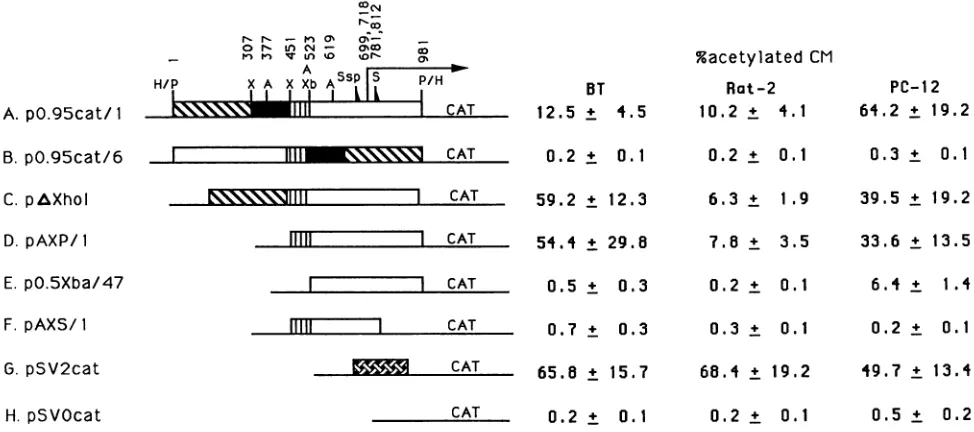
demonstrated, LR promoteractivity had strict ori-entationpreferences in allcell lines tested since pO.9Scat/1 wasanefficientpromoterbut pO.9Scat/6 was not (Fig. 1). In BTand Rat-2cells, the simianvirus 40 early promoter and enhancer(pSV2cat)wasfivetosixtimes more efficient as a promoter thanwas pO.95cat/1. In contrast, pO.9Scat/1 hadhigherpromoteractivityin rat neuroblastoma (PC-12) cells. A construct containing the XhoI-PstI fragment (nt 451 to
981; pAXP/1)had promoteractivity similartothat in pAXhol inBT, PC12,and Rat-2cells. If theXhoI-XbaI fragment was removed (nt451to523;pO.SXba/47),promoteractivity was abolished. When sequences between SphI-PstI (nt 812 to
981)
weredeleted,promoteractivity was eliminated. These J. VIROL.on November 9, 2019 by guest
http://jvi.asm.org/
A. pO.95cat/ 1
r-r-l- - In a'4%:
Or- N - at0 Co
_t) vX'uo'0 r- 0%
A Ssp
H/P X A X Xb AP
11
I IIk k
I C_!v&&&&x_I1I1I I CAT
BT 12.5 ± 4.5
%acetylated CM Rat-2 10.2 + 4.1
PC-12 64.2 + 19.2
B. pO.95cat/6 I 11I1X'NNN CAT 0.2 + 0.1
C. p&Xhol D. pAXP/ 1 E. pO.5Xba/47 F. pAXS/1
CAT
11111 I CAT
CAT
11111 I CAT
59.2 + 12.3 54.4 29.8 0.5 + 0.3 0.7 + 0.3
6.3 + 1.9
7.8 + 3.5 0.2 + 0.1 0.3 ± 0.1
39.5 + 19.2
33.6 + 13.5
6.4 + 1.4
0.2 + 0.1
uRnN
CAT 65.8 15.7 68.4 + 19.2 49.7 + 13.4H. pSVOcat CAT 0.2 ± 0.1 0.2 + 0.1 0.5 + 0.2
FIG. 1. Localization of LRpromoteractivity. Cellsweretransfected with various plasmids (10 p.g).At40hposttransfection, total cell
lysateswereprepared and CATactivitywasmeasured in thepresenceof[14C]CM(40 ,ug of protein, 1 h, 37°C). The various forms ofCMwere
separated by TLC andquantified. Restrictionenzymesitesare:PstI (P), XhoI(X), AluI (A), XbaI (Xb), SspI (Ssp), SphI(S), and HindIll (H). The arrow indicates the direction of LR transcription and the approximatestart site. Nucleotide numbering is from the published
sequence(14). Resultsaretheaveragesfromthreeindependentexperiments.
results indicated that inbovine cells andratcells (neuralor
nonneural), the minimal LR promoterwas localized to the XhoI-PstIfragment (nt 451 to981).
trans Activation of LR promoter by BHV-1 IE genes. To analyze the ability of BHV-1 IE genes to regulate LR promoter activity, cotransfection experiments were
per-formed with BT cells. Previous experiments demonstrated that LR promoter activity and steady-state levels of LR RNAaccumulateatlatetimesafterinfection, suggesting that viral genes or virus-induced factors were responsible for
activation (12, 14). BT cells were cotransfected with the
respectiveLRpromoter constructsandaplasmidcontaining one ormore oftheBHV-1 IEgenes (for a summaryof the
BHV-1 IEgenesused inthis study, see Fig. 2). Aplasmid
containing IEtul(c601)orjust IEtul/4.2positively regulated
the intact LR promoter (pO.95cat/1) sixfold. If the XhoI fragment(nt 307to452;pAXhoI)orPstI-XhoIfragment (nt
1-452; pAXP/1) was deleted, trans activation by c601 and IEtul/4.2 was reduced almost threefold. In contrast, E2.6
trans activatedpAXhoI as efficiently asthe intact LR
pro-moter. However, transactivation ofpAXP/l by E/2.6 was
reducedmorethantwofold.These resultsdemonstratedthat
theXhoI fragment of the LR promoter was necessary for
trans activationby IEtul/4.2 and thatsequenceswithin the PstI-XbaI region were necessary for trans activation by E/2.6.
cis Activation of the TK promoterby LR promoter frag-ments. To determine whether regions of the LR promoter have transcriptional enhancer activity, DNA fragments whichspannedthe LRpromoterwereinsertedadjacenttoan
HSV-1 TK promoter construct (pBLcat/4) and transcrip-tional activity was measured in PC-12, BT, or Rat-2 cells.
The PC-12 (rat pheochromocytoma) cell line has features whicharesimilarto thoseofneurons, canbedifferentiated
into neuronlike cells by numerous agents, and has widely beenusedtostudyneural-cell-type-specificevents(5, 9, 24).
Rat-2 cells are a fibroblast cell line (11) and served as a
nonneural cell type to test for cell-type-specific cis-acting
sequences. InPC-12 cells,theXbaI-SphI fragment oftheLR
promoter (pBL,/Sph+) enhanced TK promoter activity 15-fold (Fig. 3). Constructs containing either the SphI-PstI fragment (nt 812 to 981; pBL/Sph-) or the HindIII-XbaI fragment (nt 1 to 523; pBL/H-Xba) had promoter activity thatwas at least threefold higher than that ofpBLcat/4 in PC-12cells. In Rat-2cells, however, promoteractivitiesof pBLVSph+ andpBVSph-werelowerthan that ofpBLcat/4.
In BT cells, promoter activity of pBVL_Sph+ was slightly
higher than that of pBLcat/4. These results demonstrated thatanXbaI-SphIfragment cis activated the TKpromoterin rat pheochromocytoma (PC-12) cells but not in nonneural (Rat-2orBT)cells.
Effect ofNGF on LR enhancer activity. To examine the effect NGF has on LR enhancer activity, cellswere trans-fected with the various enhancer constructs, in thepresence of NGF, and promoter activity was measured. In PC-12 cells, promoter activity of pBLVSph+ was slightly higher
after cells were treated with NGF (Table 1). Promoter
activityof the other enhancerconstructswasnotaltered in Rat-2 or PC-12 cells by NGF treatment. These results demonstrated that NGF stimulated enhanceractivityof the XbaI-SphI fragmentinPC-12 cells butnot Rat-2 cells.
To further explore the effects ofNGF on LR enhancer activity, the humancorticalneuron cellline, HCN1A,was
transfected with the variousconstructs and promoter activ-itywas measured inundifferentiated ordifferentiated cells.
HCN1A cellswereobtained froman individual with
unilat-eral megalencephaly (23). These cells express neuron-spe-cific but notglia-specific markers and canbe differentiated with dibutyryl cAMP, IBMX, and NGF. After differentia-tion, cells displaya mature neuronal morphologywith nu-merous long, extensively branched processes with spines and varicosities(lla, 23). InundifferentiatedHCN1Acells,
0.2 + 0.1
G. pSV2cat
0.3 + 0.1
on November 9, 2019 by guest
http://jvi.asm.org/
[image:3.612.62.549.78.294.2]6102 BRATANICH AND JONES
A.
0
-3
0
la
la
0s
* IEtul o IEtul/4.2
El E2.6
pO.95cat/1 pAXhol pAXP/1
Map Units
C
Transript
*Positions
D. Plasmid
*Desigwnationc601 IEtul/4.2
| <
L
0-|
S-
-|
g0 0.2 0.4 0.6 0.8 1.0
- E2.6 - e2 IE4.2 el ORI e1 e2 e3
2 _ I E2.9
-LR
7U)u C ) cn. cxuZ=
E z n f) (f -zz z(f
1000 bp
[image:4.612.137.472.81.484.2]E/2.6
FIG. 2. transActivationofthe LR promoterby BHV-1genes.(A)BTcellsweretransfected with 10pLgof therespectivepromoter-CAT plasmids and 8 ,ugofaplasmid containingBHV-1 IE genes. At48hposttransfection,CATenzymatic activitywasmeasured. Valuesare
percentsacetylated CM insamplescotransfected withLRpromoterconstructs andthedesignatedIEplasmidsdividedbycontrolvalues (withoutanyIEconstruct).Valuesareaveragesforfiveindependentexperiments. (B) Diagramof BHV-1genome.(C)Positions of IEgenes. IE4.2 isthe4.2-kbRNAtranscript derivedfromlEtul. IE2.9 is the 2.9-kbtranscript. Solid linesin thetranscript positionmaprepresentexons (elore2).Dashed lines indicate thepositionsof intronsandarrowsindicatethe direction oftranscription. (D)IEcontainingplasmidsused inthis study. RestrictionmapofthelEtulregion is derivedfromreference 29. E/2.6 isanearly2.6-kbtranscriptwhich encodesaprotein identicaltoIE/2.9(28).
pBLcat/4 had higher activity compared with those of LR enhancer constructs (Table 1). In differentiated HCN1A
cells, pBL/Sph+ had10-fold-higher promoter activity than
pBLcat/4. Thus, in differentiated human neurons, the TK promoter was cisactivatedby theXbaI-SphIfragment.
Localization ofelements intheXbaI-SphI fragmentwhich are necessaryfor enhancer
activity.
Tobegin tounderstand whichregions of theXbaI-SphI fragmentwerenecessary to cis activate the TK promoter in PC-12 cells, the fragment wasdigestedwithAluIandindividualfragments were testedfor enhancer activity. The results indicated that the
AluI-SphI fragment
(pBLSph2A)
stimulated TK promoteractiv-ity approximately twofold in PC-12 cells as well as Rat-2 cellscomparedwithpBLcat/4 (Fig.4). TheXbaI-AluI
frag-ment
(pBL/XballC)
hadlittle,if any,effectonTK promoteractivity in PC-12 or Rat-2 cells. When PC-12 cells were treated with NGF, promoter activities of pBL/Sph2A and
pBL/XbalC
werestimulatedatleasttwofoldcomparedwith thosefor normal cells. If Rat-2 cellsweretreatedwithNGF,promoteractivityof
pBL/SphlA
andpBLcat/4wasreducedapproximately twofold compared with those for normal cells. Individual AluI
fragments
werenotefficientenhancer elements inPC-12cellscompared with theintactXbaI-SphI fragment, suggesting that sequences neartheAluI site are necessary for transcriptional enhancer activity in PC-12 cells.Binding of cellular factors to the LRenhancer fragment.
ExoIlI
footprinting assays were conducted to determineJ. VIROL.
on November 9, 2019 by guest
http://jvi.asm.org/
A
Plasnid 1 2 3 4
7 '
;j40 sige
6
_1
Ac-CMl(%) "2 "
B
1. plilcal/42.
pflB,JSph-3. pli11 1-XAba
S.
[image:5.612.60.295.70.326.2]4. plIf/Sph+
FIG. 3. Localization of DN transcriptional enhancer activ
variousplasmids (10 tg). At4
wereprepared and CATactiv
[14C]CM (40 ,ugofprotein,1h, separatedby TLC, percents
thesevalues aregiven. The n
plasmids presentedinpanelB thisstudy. Restriction sitesa
BamHI(B), and XhoI(X).
whether cellular factors b( ExoIII is a 3' to 5' exc
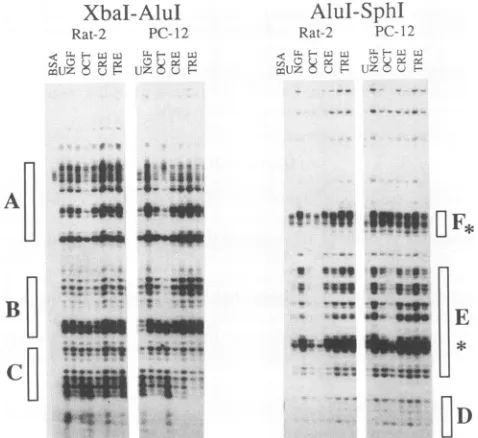
beledXbaI-AluI fragment. Addition of theCRE oligonucle-otidehadnoeffectontheExoIII protectionpatternin Rat-2
PC-12 .5T-2 or PC-12 cells. The Oct oligonucleotide inhibited binding
X1 23 4 1 2 3 4 slightly to regions A and B in PC-12 and Rat-2 cells. The
TREoligonucleotide also reduced binding slightlytoregion CinnuclearextractspreparedfromPC-12cells butnotRat-2 cells.An examinationofthesequence(Fig. 6) didnotreveal
aTREinregion Cor an Oct-binding site in region AorB,
suggesting that the inhibition observed was nonspecific or
thatfactors that bindtosequencesintheXbaI-AluIfragment
*o ** ,* also haveanaffinity foraTREconsensusorOctconsensus. WhentheAluI-SphI fragmentwasincubated with nuclear
extractsprepared fromPC-12orRat-2cells, protectionfrom
:hX-Exoll digestion could be observed in three separate
do-mains (Fig. 5 and 6). NGF-inducible binding to the entire
IIsxI) _7- fragmentwasobserved forPC-12and Rat-2cells.However,
s'.Z.s2-7.E1 CAT qualitative differences inExoIIIprotectionpatterns andthe
protectionpatternsobtained withnuclear extractsprepared
S I'llNb from untreated cellswerenotobvious. WhentheAluI-SphI
.i.,
CA7 fragmentwasincubated with nuclearextractspreparedfrom x xXhPC-12
cells, subtle differences inExoIII
protection profiles liS,TKwereobservedinregionsEand Fcomparedwith results for_ ; CAT Rat-2cells (Fig. 5;denotedby asterisks). Even after treat-Xb s ment with NGF, the novel protection patternwas detectedin
K
t-ii-:}i5- regionF.WithinregionE,twoOct-likeelementsareflanked
by putativeTATA boxes(region F)andaCCAATbox(Fig. [Asequencesin theLRpromoterwith 6). When an oligonucleotide containing a consensus Oct-rity. (A) Cellswere transfected with binding sitewasusedasacompetitor in footprinting
exper-0 h posttransfection,total celllysates iments,binding toregion Ewasdiminished comparedwith ritywasmeasuredinthepresenceof ExoIllI protectionpatterns in control samples. In Rat-2cells,
a37C)yThe variousCformseofiCM
were the Octoligonucleotide
inhibitedbinding
to two Oct-likeaumbers
above the lanes referto the elements in region E as wellas surrounding sequences. In (B)Diagram of the plasmids usedinPC-12
cells, inhibition of binding to region E by the Oct reHindiII
(H),SphI (S), XbaI(X!),) oligonucleotidewas confined to the twooverlappingOct-likeelements. Oligonucleotides containinga consensusTRE or
CREdidnotalter the ExoIIIprotectionpattern inregionD, E, orF intheAluI-SphI fragment. In summary,binding of nuclear factorstotheXbaI-SphI fragmentwascomplex,and
)und to the XbaI-SphI fragment. subtle differences in
ExoIII
protection profiles wereob-nuclease which has been used servedforPC-12cells Rat-2cells.
successauiiy
LoanaIlyze
iteractuons
uetweenreguiatory
ele-ments and DNAbinding proteins in crude nuclear extracts (30). When nuclearextracts fromPC-12orRat-2cellswere
incubated with the XbaI-AluIfragment,atleastthree distinct regionswereprotected(Fig. 5;forasummaryofbinding,see
Fig. 6). If the XbaI-AluI fragment was incubated with nuclear extracts treated with NGF, enhanced binding was
observedin PC-12cellsbutnotinRat-2 cells. Oligonucleo-tidescontainingconsensussites forOct,CRE, orTREwere
incubated with nuclearextracts (20min) priortoaddition of the radiolabeled XbaI-AluI fragment to determine whether these respective transcription factors interact with the
la-DISCUSSION
In this study,we identified a258-bpXbaI-SphI fragment
from the LR promoter which cis activated the HSV-1 TK promoter in cells of neuronalorigin. NGF stimulated tran-scription in neuronal cells but not other cell types. The XbaI-SphI fragment did not have promoter activityin any
cell type tested, suggesting that other regions of the LR promoterwere requiredfor promoteractivity. ExoIII foot-printing experiments indicated that nuclear factors
inter-TABLE 1. Effect of NGF on LR enhanceractivity'
Mean(SD)forcell type:
Plasmid PC-12 PC-12treated Rat-2 treated HCN1A
with NGF Rat-2 with NGF Undifferentiated Differentiated
pBLcat/4 1.0 ± 0.3 1.0+ 0.4 1.0+ 0.2 1.0 ± 0.3 1.0± 0.3 1.0± 0.5
pBLVSph- 3.2+ 1.8 2.6 ± 1.3 0.2 ± 0.1 0.3 + 0.2 0.2+ 0.1 1.2± 0.8
pBL/Sph+ 17.2 ± 4.8 23.1 ± 3.1 0.6+0.4 0.2+ 0.3 0.5 ± 0.2 10.5± 2.9
pBL/H-XbaI 2.6 ± 0.8 2.2 ± 0.9 0.4± 0.1 0.5 ± 0.2 0.9± 0.3 1.2 + 0.4
aValuesgivenare a
comparison
ofpromoteractivityintherespectiveenhancerconstructs tothat inpBLcat/4.Each valuerepresentsthe averagefromatleastthreeindependentexperiments.Fordetails,seeMaterialsand Methods.
on November 9, 2019 by guest
http://jvi.asm.org/
[image:5.612.54.554.619.704.2]6104 BRATANICH AND JONES
pBLcat/4
HSXbB- TK
CAT 1.0±0.3
Rat-2
1.0+0.4 1.0 + 0.3
Rat-2
NGF 1.0 + 0.3
:b S
ITK
P.;y.;.Y;m; CAT 17.2 + 2.8
A S
I I
eTK.i.
CAT2.6 + 0.6
Xb A
I I TK
[image:6.612.82.547.84.236.2]CAT 1.4 + 0.5
FIG. 4. Enhanceractivity ofAluI subclones derivedfromXbaI-SphI fragment.Therespectivecellsweretransfected with variousplasmids (10 iLg).In somesamples,NGF(25ng/ml)wasaddedat16 hposttransfection.At 40 hposttransfection,total celllysateswerepreparedand CATactivitywasmeasured in thepresenceof[14C]CM (40Fgofprotein,1h, 37°C).The various forms of CMwereseparated byTLC and quantified.
acted with theXbaI-SphI fragment, and subtle differences were observed for PC-12 cellsversus Rat-2 cells. LR pro-moter sequences5'totheXbaI-SphI fragmentwererequired for trans activation by BHV-1 IE genes. These data sug-gestedthat atranscriptionalenhancer in the LRpromoteris active in neuronal cells and that other sequencesnearthe 5' terminusof the promoterwere transactivatedbyBHV-1IE genes.
XbaI-AluI
Rat-2 PC-12
<L_JLJ -W-L
C.,_ xt
B + .. 0 ..
*v-B
..
TT * ,.
..I
c .l 'r
U
**t41.
Alul-SphI
Rat-2 PC-12
*.'. ... liE
t**!fW[1F*
4 ,.. m.
: ;t*
Xp_ _l
3r
e
*:
tA*N
o lp D
FIG. 5. Analysis of nuclear proteins which interact with XbaI-SphI fragment by ExoIll digestion. TherespectiveAluI fragments
wereincubated with 151Lg of bovineserumalbumin (BSA), nuclear
extractfrom Rat-2orPC-12 cells (U), ornuclearextractprepared
from cellstreated with NGF(25 ng/ml, 24 h[NGF]). For
competi-tion experiments, synthetic oligonucleotides (20 or 200 ng)were
incubated for 20 min with nuclear extracts prepared from cells treated withNGF and the radioactive fragmentwassubsequently
added.ExoIII footprintingwasconductedasdescribed inMaterials
andMethods.
LR promoter activity and steady-statelevels of LR-spe-cific mRNA increaseduringalyticinfection,
suggesting
that aviral geneor avirus-induced factormediatesthis process(12, 14). This study indicated that IEtul stimulated LR promoteractivity(Fig. 2). Sequenceswithin theXhoI-XhoI
fragmentwere necessary fortrans activation by
IEtul/4.2.
TheXhoI-XhoIfragment isanegative regulatoryelement in bovine cells, suggesting that other factors, in addition to IEtul/4.2, mediate LR transcription by interacting with
DNA sequencesin thefragment.ThePstI-XbaIfragment
(nt
1 to 307) was necessary for trans activation by E/2.6,
implying thattransactivationbyIE geneswasmediatedby at least two independent DNA sequences. These results suggested thatIEtul products coordinate LR gene expres-sion duringalyticinfectioncycleand that neuronal factors directhighlevels ofexpression duringalatentinfection.
Attempts to localize aLR promoterfragmentwhichwas active in PC-12 cells but not BT or Rat-2 cells were not successful, suggestingthatrequirementsfor basal promoter
activitywere similar for all cell types. In PC-12 cells and differentiated human
(HCN1A)
neurons,theXbaI-SphI
frag-mentincreased TK promoteractivitymorethan10-fold. TheSphI-PstI fragment(nt812to981;
pBL/SphI-)
andHindIIl-XbaIfragment(nt1to523;pBLIH-Xba)also increased TK promoter activitythree-to fourfold in PC-12 cells (Fig. 3).
However, these fragments did not cis activate the TK promoter in BT cells, Rat-2 cells, or undifferentiated HCN1A cells. The finding that treatment of HCN1A and
PC-12 cells with NGF led to higher promoter activity of
pBL/Sph+
butnotpBLcat/4 strengthensthehypothesisthatcell-type-dependent interactions were crucial for cis-acting
functions of the
XbaI-SphI
fragmentsinceNGFis critical for neurondifferentiation andmaintenanceofneuronphenotype (forareview, seereference15).Insummary,theXbaI-SphI fragment in the LR promoter was a strong transcriptionalenhancer in cells of neuronaloriginwhen linkedto theTK promoter.Thefindingthat otherregionsof the LR promoter have weak enhancer activity in PC-12 cells implied that
expression of the LR gene in neural cells is not entirely dependenton onecis-actingsequence.
Several discrete regions within the XbaI-SphI fragment wereboundby nuclear factorsasjudged by
ExolII
footprint-xipBL/Sph+ t
pBL/Sph2A
pBL/Xba1C
0.6 + 0.4
1.9 + 0.5
1.2 + 0.5
23.1 + 0.2
6.5 + 0.9
4.1 + 0.6
0.5 + 0. 1
0.9 + 0.2
0.9 + 0.3
A
F; - -S -} -s a | [;;@;.;.;1
J. VIROL.
on November 9, 2019 by guest
http://jvi.asm.org/
[image:6.612.63.302.407.626.2]A G
I" V." r
LR
transcript
SaII
A B
Xbal
TGTCTRORCO GGGCTTTGTG TTTTTCCCRC CCCTOCCCTT GCCCCTGGCC GCCTGGCCGG 580
C NGF-IC LAT AP-2
_ ~~~~~~~~~~~~Alul
CCGGCTRRRG TATRGGCCRG RCCRRRCCCC CCGCRGCRGC TCTGCTCGCT GGCGRGRCCC 610
D NGF-IC E
CRRRGCGCCR RTTGTGGCRT RTTTCCGGGT CTGRCCGCGC CTGCRCTGC CTTTGGCRTT 700
F ICAAT I OCT OCT
RRTRTTTCRG flGTTTRRTRTT6CRGRCRGR CRRRRRGCCR GRTRRTTRCR RRGTRTTTGT 760
TATA TATA
TTTTRTTGRT TGCGCRTGCG
Sphu
FIG. 6. Summary ofExoIII protection experiments from LR enhancer region. (A) Restriction map of the LR promoter region and approximatestartsiteofLRtranscription. Regions oftheLR promoter which were necessary for trans activation by E/2.6 and IE/4.2 are indicated. Restriction enzymesites within the LR promoterare PstI(P), HindIII (H),XhoI(X),XbaI(Xb), AluI (A), SspI (Ssp), and SphI (S). (B)DNA sequenceofthe LR promoterfrom the coding strand of the LR transcript was derived from the published sequence (14). The lettersA to Fabove thesequencecorrespond to regions protected from ExoIII digestion after incubation with nuclear extractsprepared from PC-12 cells treatedwithNGF. Shownis theposition oftheNGF 1Cbinding site (NGF-1C;GCGGGGGCG [5]). Both NGF-1C sites contain sevenof ninematches andarepresent onthe complementary DNA strand. The AP-2 site matches the consensus (GCCNNNGGC[27]). Positions of the Oct-like elements haveanarrowin thedirectionof the consensus, are located on the complementary DNA strand, andcontain
twomismatches fromanOct-1consensus(ATGCAAAT; forareview,seereference8).Aregionof theHSV-1latency-associated transcript promoterwhich is within theneuron-specific enhancer (LAT [3])has 9of11basesmatchingbutis 3'to5'with respect totheHSV-1 sequence. Positions of the TATA-like elementsandthe CAAT boxaredenotedby the boxes. Regions ofthe LR promoterwhichareregulatedby BHV-1 IE genes arealsodepicted.
ingexperiments (Fig. 5). However, onlyminordifferencesin ExoIII protection patterns were observed when the XbaI-SphI fragment was incubated with nuclear extracts from PC-12cellsversusRat-2cells. InPC-12 cells, NGFinduces a family ofgenes which are designated the early-response
genes(5).Amember of thisfamily,NGF-1C, isa
transcrip-tional activator that specifically binds the sequence
GCGGGGGCG (5). Within the XbaI-SphI fragment, two regions are present with seven of nine bases matching
NGF-1C(Fig. 6).AregionwhichcontainsaconsensusAP-2 bindingsitewasprotectedfromExoIII digestionafter incu-bation with nuclearextracts (Fig. 5). AP-2plays an
impor-tantrole in neural crest development and as such may be important with respect to transcriptional activity of the XbaI-SphI fragmentinneuronal cells(16). Thepresenceof
anOct-like element in theXbaI-SphI fragmentisinteresting
since neuron-specific Oct proteins that bind HSV-1 IE promotersandinhibittranscriptionhave beenidentified(13). These neuronal Oct-2 factors also differ in their binding specificity and function (6), suggesting thatthis elementor
other similar factorscan influence the activityof the
XbaI-SphI fragment. The HSV-1 latency-associated transcript promoter has a single motif which is a strong enhancer in neuronal cells (3). An 11-base sequence in the XbaI-SphI fragment(CAGGGGCAagG;nt567to557)is theonly region inthe LR promoter which resembles the HSV-1 sequence. SincetheXbaI-AluI fragmentdid not havestrongenhancer activity, this sequence alone doesnot appear tobecrucial for transcriptional enhancer activity. Considering the
dra-maticdifference in enhanceractivityin thetwocelllines,the dataimpliedthat factors inPC-12cells bind sequences in the
XbaI-SphI fragment and activatetranscription. In contrast, nuclear factors in Rat-2 cells bind similar DNA sequences butwereunabletoactivatetranscription.Current studiesare aimed at identifying which factors interact with the XbaI-SphI fragment and how these interactions affect
transcrip-tionalactivity.
ACKNOWLEDGMENTS
We thank D.HamernikandF.Osorio forhelpful discussions and forcriticallyreading the manuscript.
This work was supported by Public Health Service grant R29CA47872 andby USDAgrant92-34103-7168.
REFERENCES
1. Ackerman, M., E. Peterhans, and R. Wyler. 1982. DNA of bovineherpesvirus type 1 in the trigeminalgangliaoflatently infected calves.Am.J. Vet. Res. 43:36-40.
2. Angel, P., M. Imigawa, R.Chiu,B. Stein, R.J.Imbra, H.J. Rhamsdoerf, C. Jonat,P.Herrlich,andM. Karin.1987. Phorbol
esterinducible genescontainacommoncis elementrecognized byaTPAmodulatedtrans-acting factor.Cell49:729-739. 3. Batchelor,A.H.,andP.O'Hare. 1992.Localizationofcis-acting
sequence requirements in the promoter of the latency-associ-ated transcript of herpes simplex virus type 1 required for cell-type-specific activity.J.Virol. 66:3573-3582.
4. Bradford, M. M. 1976. A rapid andsensitive method for the quantitation of microgram quantities of protein utilizing the principle ofprotein-dye binding.Anal. Biochem.72:248-254.
on November 9, 2019 by guest
http://jvi.asm.org/
[image:7.612.109.502.69.296.2]6106 BRATANICH AND JONES
5. Crosby, S. D., J. J. Puetz, K. S.Simburger, T. J. Fahrner, and J. Milbrandt. 1991.The early response geneNGFI-C encodes a zinc finger transcriptional activator and is a member of the GCGGGGGCG (GSG) element-binding protein family. Mol. Cell Biol. 11:3835-3841.
6. Dent, C. L., K. A. Lillycrop, J. K. Estridge, N. S. B. Thomas, and D.S.Latchman.1991. The B-cell andneuronal forms of the octamer-bindingprotein Oct-2 differinDNA-bindingspecificity and functional activity. Mol. Cell.Biol. 11:3925-3930. 7. Dignam, J. D., R. M. Lebovitz, and R. G. Roeder. 1983.
Accurate transcription initiation by RNApolymerase II in a solubleextractfromisolated mammalian nuclei. Nucleic Acids Res. 11:1475-1489.
8. Falkner, F. G., R. Moickat, and H.G.Zachau.1986. Sequences closely related to an immunoglobulin promoter/enhancer ele-ment occur upstreamof other eukaryotic and of prokaryotic genes.Nucleic AcidsRes.13:7847-7863.
9. Greene, L. A., and A. S. Tischler. 1976. Establishment of a
nonadrenergic clonal line of rat adrenal pheochromocytoma cells whichrespondto nervegrowthfactor. Proc. Natl. Acad. Sci.USA73:2424-2468.
10. Homan, E. J., and B. C. Easterday. 1983. Experimental latent and recrudescentbovineherpesvirus1infectionsincalves.Am. J. Vet. Res. 44:309-313.
11. Jones, C. 1989. The minimaltransforming fragment of HSV-2 is acomplex transcriptionalpromoterelement. Virology 169:346-353.
11a.Jones,C.Unpublished data.
12. Jones, C., G. Delhon, A. Bratanich, G. Kutish,and D. Rock. 1990. Analysis of the transcriptionalpromoterwhich regulates the latency-related transcriptof bovineherpesvirus 1. J. Virol. 64:1164-1170.
13. Kemp, L. M., C. L. Dent, and D. S. Latchman.1990. Transcrip-tionalrepression of herpes simplex virus immediate earlygenes andofoctamercontaining cellularpromotersin neuronal cells is mediatedbythe octamer DNAelement. Neuron4:215-222. 14. Kutish, G., T.Mainprize,and D.Rock. 1990. Characterization
of the latency-related transcriptionally active region of the bovineherpesvirus1 genome. J. Virol. 64:5730-5737.
15. Lo, D. C.1992. NGF takesshape.Curr. Biol. 2:67-69. 16. Mitchell, P. J., P. M. Timmons, J. M. Hebert, P. W. J. Rigby,
and R.Tjian. 1991.Transcription factorAP-2 is expressedin neuralcrest celllineages duringmouse embryogenesis. Genes Dev.5:105-119.
17. Montminy, M. R., K. A. Sevarino, J. A. Wagner, G. Mandel, and R. H.Goodman.1986.Identificationof a cAMPresponsive element within theratsomatostatingene.Proc.Natl.Acad.Sci. USA 83:6682-6686.
18. Rhim,J. S.,J.Fujita,P. Arnstein, and S. A. Aaronson. 1986.
Neoplastic conversion of humankeratinocytes by adenovirus 12-SV40 virus and chemical carcinogens. Science 232:385-388. 19. Rock, D., J. Lokensgard, T. Lewis, and G. Kutish. 1992. Characterization of dexamethasone-induced reactivation of la-tentbovineherpesvirus1. J.Virol. 66:2484-2490.
20. Rock, D. L., S.L. Beam, and J. E. Mayfield. 1987. Mapping bovine herpesvirus type 1 latency-related RNA in trigeminal ganglia of latently infectedrabbits. J. Virol. 61:3827-3831. 21. Rock, D. L., W. Hagemoser, F.Osorio,and D. E.Reed. 1986.
Detection of bovine herpesvirus type 1 RNA in trigeminal ganglia oflatently infected rabbits by in situ hybridization. J. Gen. Virol. 67:2515-2520.
22. Rock, D. L., and D. E. Reed. 1982. Persistent infection with bovineherpesvirus1:rabbitmodel. Infect. Immun. 35:371-373. 23. Ronnett,G. V., L. D. Hester,J. S. Nye, K.Connors,andS. H. Snyder.1990. Humancortical neuronal cell line: establishment fromapatient with unilateral megalencephaly. Science 248:603-605.
24. Salton, S. R. J., D. J. Fischberg, and K.-W. Dong. 1991. Structureof thegeneencoding VGF,anervoussystem-specific mRNAthat israpidly andselectively induced bynervegrowth factor in PC12cells. Mol. Cell. Biol. 11:2335-2349.
25. Sambrook, J., E. F. Fritsch, and T.Maniatis.1989. Molecular cloning:alaboratory manual,p.1:21-1:50.ColdSpring Harbor Laboratory,Cold Spring Harbor,N.Y.
26. Stein, B., H. J. Rahmsdorf, A. Steffen, M. Litfin, and P. Herrlich. 1989. UV-induced damage isanintermediate stepin UV-inducedexpressionof humanimmunodeficiencyvirustype 1, collagenase, c-fos, and metallothionein. Mol. Cell. Biol. 9:5169-5181.
27. Williams,T., and R.Tjian.1991.Analysis of theDNAbinding and activation properties of the human transcription factor AP-2.GenesDev.5:670-682.
28. Wirth, U. V.,C. Fraefel,B.Vogt,t.Vlcek, V. Paces, and M. Schwyzer. 1992.Immediate-earlyRNA 2.9andearlyRNA2.6 of bovine herpesvirus 1 are 3' coterminal and encode aputative zincfinger transactivator protein.J.Virol. 66:2763-2772. 29. Wirth, U. V., B. Vogt, and M. Schwyzer.1991.The three major
immediate-early transcripts of bovine herpesvirus1arisefrom
twodivergent and spliced transcription units. J.Virol. 65:195-205.
30. Wu, C. 1985. An exonuclease protection assay reveals heat shock element andTATAboxbinding proteinsincrude nuclear
extracts.Nature(London)317:84-87.
31. Wyler, R., M. Engels, and M.Schwyzer. 1989.Infectious bovine rhinotracheitis/vulvovaginitis (BHV-1),p.1-72.InG.Wittman andY. Becker(ed.), Herpesvirus diseases of cattle, horses, and pigs. Developments in veterinaryvirology ser. Kluwer Aca-demicPublishers,Boston.
J. VIROL.