City, University of London Institutional Repository
Citation
:
Miceli, G., Scopelliti, I. & Raimondo, M. A. (2018). Preferences for Insight and Effort Differ across Domains and Audiences. Advances in Consumer Research,This is the accepted version of the paper.
This version of the publication may differ from the final published
version.
Permanent repository link:
http://openaccess.city.ac.uk/20219/Link to published version
:
Copyright and reuse:
City Research Online aims to make research
outputs of City, University of London available to a wider audience.
Copyright and Moral Rights remain with the author(s) and/or copyright
holders. URLs from City Research Online may be freely distributed and
linked to.
City Research Online: http://openaccess.city.ac.uk/ [email protected]
Preferences for Insight and Effort Differ across Domains and Audiences
Gaetano “Nino” Miceli, University of Calabria, Italy Irene Scopelliti, City University of London, UK Maria Antonietta Raimondo, University of Calabria, Italy
EXTENDED ABSTRACT
A creative process is “the sequence of thoughts and actions that lead to a novel, adaptive production” (Lubart 2001, 295). Narratives of the creative process can enhance the perceived quality of a product and stimulate inferences on the creator’s ability to produce additional high-quality ideas and outputs (Baas et al. 2015; Mourgues et al. 2016), improve empathy between creators and their audiences (Davis 1983; Friestad and Wright 1994), and increase process transparency (Buell and Norton 2011; Buell, Kim and Tsay 2017). These narratives can emphasize either the experience of insight (Schooler, Fallshore, and Fiore 1995) – the sudden, dream-like, spontaneous and illuminating experience facilitating the emergence of new ideas–or the application of effort (Lucas and Nordgren 2015) – the methodical, planned, and rational stage in which ideas are organized and transformed into a new product.
People hold beliefs on how creative products are generated (e.g., Sternberg 1985; Runco and Bahleda 1986; O’Connor, Nemeth and Akutsu 2013), and these beliefs can influence product evaluations due to reliance on stereotypical knowledge and heuristics (Sternberg 1985; Levy, Stroessner, and Dweck 1998). We maintain that an insight-based narrative of the creative process (Rothenberg 1970; Kasof 1995) has greater fit with artistic domains, whereas an effort-based narrative of the creative process has greater fit with scientific domains (Lucas and Nordgren 2015). Because lay beliefs influence evaluations of creative products (Baas et al. 2015; Sternberg 1985), we expect artistic products to receive better evaluations when their creative process is described through insight-based narratives rather than effort-based narratives and that the opposite pattern holds for scientific products.
We also expect experts to be more analytical in processing information and less sensitive to heuristics, to own to a higher extent the meta-cognitive skills necessary to evaluate others’ level of ability (Kruger and Dunning 1999), and to be more receptive towards effort-based narratives of the creative process (Ericsson, Krampe, and Tesch-Romer 1993; Ericsson, Prietula, and Cokely 2007), thus to respond relatively more favorably to information on central and concrete – rather than ephemeral and transient – factors
characterizing the creative process. Six studies support the proposed conceptual framework and the existence of optimal narratives for the promotion of artistic and scientific products to different audiences.
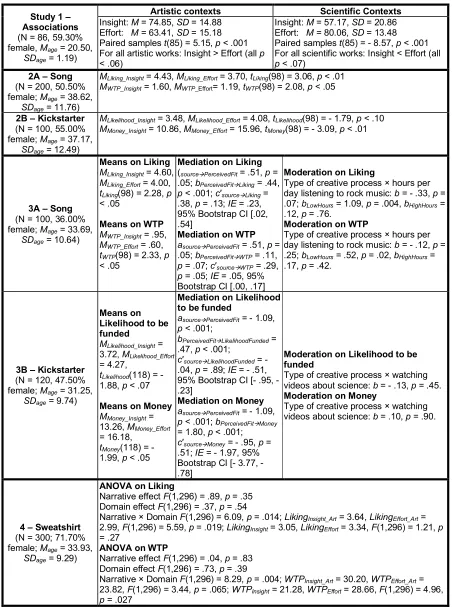
Study 1 verified the existence of associations between an insight-based creative process and artistic domains, and between an effort-based creative process and scientific domains. Participants read the descriptions of twelve new successful artistic works and scientific works and rated the extents to which they were the outcome of insight and effort. Each art work received higher insight ratings than effort ratings, and each science work received higher effort ratings than insight ratings. Furthermore, all art works received higher insight ratings than all science works, and all scientific works received higher effort ratings than all art works.
Studies 2A and 2B investigated whether describing a creative process using insight- vs.
process leading to their last song either as insight-based or effort-based. Afterwards, they listened to a 45-second excerpt of the song. Participants evaluated the song more favorably and were willing to pay more, when it was presented through insight-based (vs. effort-based) narratives. In study 2B we measured intentions to fund a Kickstarter project based on scientific research that was presented through insight- vs. effort-based narratives of the creative process. When it was presented through effort-based narrative, the project was considered (marginally) more likely to reach the fund-raising goal and participants allocated more funds to it than when it was presented through an insight-based narrative.
Studies 3A and 3B replicated studies 2A and 2B but also tested the proposed fit
mechanism, as well as the role of expertise, in the artistic and scientific domain, respectively. Participants in Study 3A evaluated the song from Study 2A more favorably and were willing to pay more for it when they read it was the outcome of insight than effort. The perceived fit between the creative process narrative and the image of the creator mediated both effects. In addition, an insight-based creative process produced more favorable evaluations of an artistic product, but this effect was attenuated as recipients’ expertise increased. Participants in Study 3B evaluated the project from Study 2B as (marginally) more likely to reach the fund-raising goal and assigned more funds to it when it was described as effort-based than as insight-based. Also in this case, the perceived fit between the type of creative process and the work mediated both effects. In line with our prediction, expertise did not interact with the type of narrative of the creative process, as both experts and non-experts prefer effort-based
narratives. However, the perceived fit between the nature of the creative process and the image of the creator only mediated the effect when participants’ expertise was low to average.
In Study 4, participants read descriptions of a new product presented as either artistic or scientific, and as the outcome of either an insight- or an effort-based creative process. When the product was described as artistic, participants evaluated it more favorably and were willing to pay more for it, if they read it was the outcome of insight rather than of effort. When the product was presented as scientific product, the opposite pattern was observed.
REFERENCES
Baas, Matthijs, Severine Koch, Bernard A. Nijstad Nijstad, and Carsten K. W. De Dreu, (2015). “Conceiving Creativity: The Nature and Consequences of Laypeople’s Beliefs about the Realization of Creativity,” Psychology of Aesthetics, Creativity, and the Arts, 9(3), 340–354.
Buell, Ryan W., and Michael I. Norton (2011). “The labor illusion: How operational transparency increases perceived value,” Management Science, 57(9), 1564–1579.
____________, Tami Kim, and Chia-Jung Tsay (2017). “Creating reciprocal value through operational transparency,” Management Science, 63(6), 1673–1695.
Davis, Mark H. (1983). “Measuring individual differences in empathy: Evidence for a multidimensional approach,” Journal of Personality and Social Psychology, 44, 113– 126.
Ericsson, K. Anders, Ralf T. Krampe, and Clemens Tesch-Römer (1993). “The role of deliberate practice in the acquisition of expert performance,” Psychological Review, 100(3), 363–406.
____________, Michael J. Prietula, and Edward T. Cokely (2007). “The making of an expert,” Harvard Business Review, 85(7/8), 114–121.
Friestad, Marian, and Peter Wright (1994). “The persuasion knowledge model: How people cope with persuasion attempts,” Journal of Consumer Research 21(1), 1–31.
Kasof, Joseph (1995). “Explaining creativity: The attributional perspective,” Creativity Research Journal, 8(4), 311–366.
Kruger, Justin, and David Dunning (1999). “Unskilled and unaware of it: how difficulties in recognizing one's own incompetence lead to inflated self-assessments,” Journal of Personality and Social Psychology, 77(6), 1121–1134.
Levy, Sheri R., Steven J. Stroessner, and Carol S. Dweck (1998). “Stereotype formation and endorsement: The role of implicit theories,” Journal of Personality and Social
Psychology, 74(6), 1421–1436.
Lubart, Todd I. (2001). “Models of the Creative Process: Past, Present and Future,”
Creativity Research Journal, 13(3–4), 295–308.
Lucas, Brian J., and Loran F. Nordgren (2015). “People underestimate the value of
persistence for creative performance,” Journal of Personality and Social Psychology, 109(2), 232–243.
Mourgues, Catalina, Mei Tan, Sascha Hein, Julian G. Elliott, and Elena L. Grigorenko (2016). “Using creativity to predict future academic performance: An application of Aurora's five subtests for creativity,” Learning and Individual Differences, 51, 378– 386.
O'Connor, Alexander J., Charlan J. Nemeth, and Satoshi Akutsu (2013). “Consequences of beliefs about the malleability of creativity,” Creativity Research Journal, 25(2), 155– 162.
Rothenberg, Albert (1970). Inspiration, insight and the creative process in poetry. College English, 32(2), 172–183.
Runco, Mark A. and Michael D. Bahleda (1986). “Implicit Theories of Artistic, Scientific, and Everyday Creativity,” The Journal of Creative Behavior, 20(2), 93–98.
Schooler, Jonathan W., Marte Fallshore, and Stephen M. Fiore (1995). “Epilogue: Putting insight into perspective,” In R.J. Sternberg and J. E. Davidson (ed.), The nature of insight. Cambridge, MA: The MIT Press. 559–587.
Sternberg, Robert J. (1985). “Implicit theories of Intelligence, Creativity, and Wisdom,”
TABLE 1 SUMMARY OF EMPIRICAL RESULTS
Study 1 – Associations
(N = 86, 59.30% female, Mage = 20.50,
SDage = 1.19)
Artistic contexts Scientific Contexts
Insight: M = 74.85, SD = 14.88 Effort: M = 63.41, SD = 15.18 Paired samples t(85) = 5.15, p < .001 For all artistic works: Insight > Effort (all p
< .06)
Insight: M = 57.17, SD = 20.86 Effort: M = 80.06, SD = 13.48 Paired samples t(85) = - 8.57, p < .001 For all scientific works: Insight < Effort (all
p < .07)
2A – Song
(N = 200, 50.50% female; Mage = 38.62,
SDage = 11.76)
MLiking_Insight = 4.43, MLiking_Effort = 3.70, tLiking(98) = 3.06, p < .01 MWTP_Insight = 1.60, MWTP_Effort= 1.19, tWTP(98) = 2.08, p < .05
2B – Kickstarter
(N = 100, 55.00% female; Mage = 37.17,
SDage = 12.49)
MLikelihood_Insight = 3.48, MLikelihood_Effort = 4.08, tLikelihood(98) = - 1.79, p < .10 MMoney_Insight = 10.86, MMoney_Effort = 15.96, tMoney(98) = - 3.09, p < .01
3A – Song
(N = 100, 36.00% female; Mage = 33.69,
SDage = 10.64)
Means on Liking
MLiking_Insight = 4.60, MLiking_Effort = 4.00, tLiking(98) = 2.28, p
< .05
Means on WTP
MWTP_Insight = .95, MWTP_Effort = .60, tWTP(98) = 2.33, p
< .05
Mediation on Liking
(sourceàPerceivedFit = .51, p =
.05; bPerceivedFitàLiking = .44, p < .001; c′sourceàLiking =
.38, p = .13; IE = .23, 95% Bootstrap CI [.02, .54]
Mediation on WTP
asourceàPerceivedFit = .51, p =
.05; bPerceivedFitàWTP = .11, p = .07; c′sourceàWTP = .29, p = .05; IE = .05, 95% Bootstrap CI [.00, .17]
Moderation on Liking
Type of creative process × hours per day listening to rock music: b = - .33, p = .07; bLowHours = 1.09, p = .004, bHighHours =
.12, p = .76.
Moderation on WTP
Type of creative process × hours per day listening to rock music: b = - .12, p = .25; bLowHours = .52, p = .02, bHighHours =
.17, p = .42.
3B – Kickstarter
(N = 120, 47.50% female; Mage = 31.25,
SDage = 9.74)
Means on Likelihood to be funded
MLikelihood_Insight =
3.72, MLikelihood_Effort
= 4.27,
tLikelihood(118) = -
1.88, p < .07
Means on Money
MMoney_Insight =
13.26, MMoney_Effort
= 16.18,
tMoney(118) = -
1.99, p < .05
Mediation on Likelihood to be funded
asourceàPerceivedFit = - 1.09, p < .001;
bPerceivedFitàLikelihoodFunded =
.47, p < .001;
c′sourceàLikelihoodFunded = -
.04, p = .89; IE = - .51, 95% Bootstrap CI [- .95, - .23]
Mediation on Money
asourceàPerceivedFit = - 1.09, p < .001; bPerceivedFitàMoney
= 1.80, p < .001;
c′sourceàMoney = - .95, p =
.51; IE = - 1.97, 95% Bootstrap CI [- 3.77, - .78]
Moderation on Likelihood to be funded
Type of creative process × watching videos about science: b = - .13, p = .45.
Moderation on Money
Type of creative process × watching videos about science: b = .10, p = .90.
4 – Sweatshirt
(N = 300; 71.70% female; Mage = 33.93,
SDage = 9.29)
ANOVA on Liking
Narrative effect F(1,296) = .89, p = .35 Domain effect F(1,296) = .37, p = .54
Narrative × Domain F(1,296) = 6.09, p = .014; LikingInsight_Art = 3.64, LikingEffort_Art =
2.99, F(1,296) = 5.59, p = .019; LikingInsight = 3.05, LikingEffort = 3.34, F(1,296) = 1.21, p
= .27
ANOVA on WTP
Narrative effect F(1,296) = .04, p = .83 Domain effect F(1,296) = .73, p = .39
Narrative × Domain F(1,296) = 8.29, p = .004; WTPInsight_Art = 30.20, WTPEffort_Art =