City, University of London Institutional Repository
Citation
:
Kharlamov, E., Hovland, D., Skjaeveland, M. G., Bilidas, D., Jimenez-Ruiz, E.
ORCID: 0000-0002-9083-4599, Xiao, G., Soylu, A., Lanti, D., Rezk, M., Zheleznyakov, D.,
Giese, M., Lie, H., Ioannidis, Y., Kotidis, Y., Koubarakis, M. and Waaler, A. (2017). Ontology
Based Data Access in Statoil. Journal of Web Semantics, 44, pp. 3-36. doi:
10.1016/j.websem.2017.05.005
This is the accepted version of the paper.
This version of the publication may differ from the final published
version.
Permanent repository link:
http://openaccess.city.ac.uk/id/eprint/22959/
Link to published version
:
http://dx.doi.org/10.1016/j.websem.2017.05.005
Copyright and reuse:
City Research Online aims to make research
outputs of City, University of London available to a wider audience.
Copyright and Moral Rights remain with the author(s) and/or copyright
holders. URLs from City Research Online may be freely distributed and
linked to.
City Research Online:
http://openaccess.city.ac.uk/
[email protected]
Ontology Based Data Access in Statoil
Evgeny Kharlamova, Dag Hovlandc, Martin G. Skjævelandc, Dimitris Bilidasb, Ernesto Jim´enez-Ruizc, Guohui Xiaod,
Ahmet Soyluf, Davide Lantid, Martin Rezkd, Dmitriy Zheleznyakova, Martin Giesec, Hallstein Liee,
Yannis Ioannidisb, Yannis Kotidisg, Manolis Koubarakisb, Arild Waalerc
aUniversity of Oxford, Department of Computer Science, Wolfson Building, Parks Road, OX1 3QD, Oxford, UK. bNational and Kapodistrian University of Athens, Panepistimiopolis, Ilissia, 15784, Athens, Greece.
cDepartment of Informatics, University of Oslo, Blindern, 0316, Oslo, Norway. dKRDB Center, Free-University of Bozen-Bolzano, P.zza Domenicani 3, 39100, Bolzano, Italy.
eStatoil ASA, Stavanger, Norway.
fNTNU – Norwegian University of Science and Technology, Teknologiveien 22, 2815, Gjøvik, Norway. gAthens University of Economics and Business, 76 Patission Street, 10434, Athens, Greece.
Abstract
Ontology Based Data Access (OBDA) is a prominent approach to query databases which uses an ontology to expose data in a conceptually clear manner by abstracting away from the technical schema-level details of the underlying data. The ontology is ‘connected’ to the data via mappings that allow to automatically translate queries posed over the ontology into data-level queries that can be executed by the underlying database management system. Despite a lot of attention from the research community, there are still few instances of real world industrial use of OBDA systems. In this work we present data access challenges in the data-intensive petroleum company Statoil and our experience in addressing these challenges with OBDA technology. In particular, we have developed a deployment module to create ontologies and mappings from relational databases in a semi-automatic fashion; a query processing module to perform and optimise the process of translating ontological queries into data queries and their execution over either a single DB of federated DBs; and a query formulation module to support query construction for engineers with a limited IT background. Our modules have been integrated in one OBDA system, deployed at Statoil, integrated with Statoil’s infrastructure, and evaluated with Statoil’s engineers and data.
Keywords: Ontology Based Data Access, Statoil, Optique Platform, System Deployment, Evaluation, Bootstrapping,
Optimisations.
1. Introduction
The competitiveness of modern enterprises heavily de-pends on their ability to make theright business decisions by relying on efficient and timely analyses of theright busi-ness critical data. For example, one of the factors deter-mining the competitiveness of Statoil1,2 is the ability of
Email addresses: [email protected](Evgeny Kharlamov),[email protected](Dag Hovland),
[email protected](Martin G. Skjæveland),
[email protected](Dimitris Bilidas),[email protected]
(Ernesto Jim´enez-Ruiz),[email protected](Guohui Xiao),
Ahmet Soylu),[email protected](Davide Lanti),
[email protected](Martin Rezk),
[email protected](Dmitriy Zheleznyakov),
[email protected](Martin Giese),[email protected](Hallstein Lie),[email protected](
Yannis Ioannidis),[email protected](Yannis Kotidis),
[email protected](Manolis Koubarakis),[email protected]
(Arild Waaler)
1Statoil ASA, is a Norwegian multinational oil and gas
com-pany headquartered in Stavanger, Norway. It is a fully integrated petroleum company with operations in thirty-six countries.
2https://www.statoil.com/
its exploration geologists to find in a timely manner new exploitable accumulations of oil or gas in given areas by analysing data about these areas. Gathering such data is not a trivial task in Statoil and in general in data inten-sive enterprises due to the growing size and complexity of corporate information sources. Such data sources are often scattered across heterogeneous and autonomously evolving systems or has been adapted over the years to the needs of the applications they serve. This often leads to the situa-tion where naming convensitua-tions for schema elements, con-straints, and the structure of database schemata are very complex and documentation may be limited or nonexis-tent making it difficult to extract data. As a result, the data gathering task is often the most time-consuming part of the decision making process.
���������� ��������� ��������� ��������� ��������� ��������� ��������� ��������� ��������� ��������� ��������� ��������� ��������� ���������� ��������� ��������� ��������� ��������� ��������� ��������� ��������� ��������� ���������� ��������� ��������� ��������� ��������� ������ �������� ��������� �������� �������� �������� ��������� ����� ������ ���� ������� ��������� ��������� ��������� ��������� ���������� ���������� ��������� ��������� ��������� ��������� ��������� ��������� ��������� ��������� ��������� ��������� ��������� ��������� ���������� ��������� ��������� ��������� ��������� ���������� ��������� ��������� ��������� ��������� ���������� ���������� ��������� ��������� ��������� ��������� ��������� ��������� ��������� ��������� ��������� ��������� ��������� ��������� ���������� ��������� ��������� ��������� ��������� ��������� ��������� ��������� ��������� ���������� ��������� ��������� ��������� ��������� ��������� ��������� ��������� ��������� ���������� ���� ����� ������ ������������ ����� ����� ���������
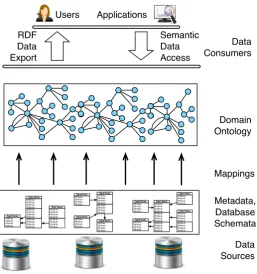
Figure 1: General diagram of OBDA.
DBs has been created long time ago, e.g., EPDS was cre-ated about 15 years ago, and can hardly be accessed, i.e., queried, by geologists without a help from IT personnel due to the complexity of their schemata, e.g., EPDS cur-rently has about 3,000 tables with about 37,000 columns, and a common information need of a Statoil geologist cor-responds to an SQL query with hundreds to thousands of terms and 50–200 joins. Construction of such queries is not possible for Statoil geologists and thus they have to pass their information needs to IT specialists who then turn the needs into SQL queries. This drastically affects the efficiency of finding the right data that should back decision making (see Section 2 for further details).
Ontology Based Data Access (OBDA) [1] is a prominent
approach to data access in which anontologyis used to me-diate between data consumers and data sources (see a gen-eral diagram of OBDA in Figure 1). The ontology provides ‘a single point of semantic data access’ for data consumers, and allows either to export data in a semantic format or to pose queries over the integrated data sources in terms of a user-oriented conceptual model that abstracts away com-plex implementation-level details typically encountered in database schemata. Domain experts are thus able to ex-press information needs in their own terms without any prior knowledge about the way the data is organised at the source, and to receive answers in the same intelligible form. The ontology is connected to the data via a set of
mappings: declarative specifications that relate
ontologi-cal terms with queries over the underlying data. OBDA systems automatically translate ontological queries, i.e., SPARQL, into database queries, i.e., SQL, and delegate
execution of SQL queries to the database systems hosting the data. OBDA is a naturalfit to address the Statoil data access challenges described above: if complex databases are presented to users via an ontology, then they can for-mulate queries in terms of classes and properties in an object-centric fashion, e.g., asking for all wellbores
pene-trating a rock layer of a specificgeological age. Moreover,
OBDA is a so-called virtual approach, providing an ac-cess layer on top of databases while leaving the data in its original stores. Thus, OBDA has the potential to im-prove data access with a minimal change to existing data management infrastructure.
OBDA has recently attracted a lot of attention and a number of systems have been developed, e.g., [2, 3, 4, 5, 6]. However, to the best of our knowledge, the following three problems have attracted only limited attention and in isolation:
(i) How tocreate ontologies and mappings for a deploy-ment of an OBDA system?
(ii) How to ensure that OBDA query processing iseffi
-cient in practice?
(iii) How to ensure that the target users are actually able
to efficientlyexpress their information needs against an OBDA system?
comes with a high modelling cost due to the complexity of the domain and of the database schemata. Moreover, unoptimised OBDA query processing may become imprac-tical when the ontology and/or database are large [7]. Fi-nally, expressing information needs over an OBDA system as a query written in a query language, e.g., SPARQL, is error prone and requires substantial training which sig-nificantly limits the usability of an ODBA system in a company.
In this work we addressed these limitations and devel-oped (i) novel semi-automatic techniques to bootstrap new ontologies and mappings from relational databases and to integrate existing ones, and (ii) novel optimisa-tion techniques to improve query processing by producing compact and efficient SQL queries, and then by carefully planning their query execution strategy over one or several federated DBs. (iii)a novel OBDA oriented visual query formulation interface.
We then implemented these techniques and developed an OBDA deployment, query optimisation, and query for-mulation systems which were integrated in an end-to-end OBDA system Optique [8, 9].
We applied Optique in Statoil in order to improve the data gathering routine of Statoil geologists. To this end we deployed our OBDA system over seven prominent, com-plex, and large data sources: EPDS, Recall, CoreDB, GeoChemDB, OpenWorks, Compass, and NPD FactPages (see Section 2 for details about these DBs). These DBs are mostly Statoil’s corporate data stores for exploration and production data and Statoil’s interpretations of this data, and they are heavily used by Statoil geologists.
Our OBDA solution Optique has been successfully de-ployed and evaluated at Statoil over the aforementioned seven DBs. We used three metrics to show this success:
• quality of the system’s deployment,
• efficiency of the system’s query processing, and
• effectiveness andefficiency of the system’s query
for-mulation support.
In order to objectify the measure of success and facilitate all three metrics, we gathered a catalogue of queries col-lected from Statoil geologists. These queries cover a wide range of typical information needs, and they are hard to formulate over Statoil databases.
In order to show the quality of our semi-automatic de-ployment, we showed that the system enables formulation of the queries in the catalog, i.e., it provides enough onto-logical terms to do so, it covers a wide range of commonly used ontological terms from the geological domain, and the ontology and mappings in combination reflect expec-tations of geologists, that is, the answers to queries from the catalog correspond to expectations of geologists.
In order to show the efficiency of the Optique’s query processing, we conducted a number of experiments. The
first set of experiments aimed at showing how our query
optimisations lead to significant reduction of query pro-cessing time over one DB. To this end we focused on the most complex Statoil DB available for our experiments, EPDS, and showed how our optimisations affect query ex-ecution time for queries from the Statoil catalog. Since EPDS is not a public DB, we conducted the same exper-iments over NPD FactPages, a public Statoil DB. Since NPD FactPages is small, about 105 MB, we developed and applied a procedure to scale this data in such a way that the resulting DB respects the important structural charac-teristics of the original DB. Finally, we conducted exper-iments over federated databases in order to show practi-cal benefits of our distributed query planning component. Most of our experiments showed that Optique can han-dle queries from the Statoil’s catalog reasonably well, that is, in time comparable to the time reported by existing Statoil’s systems.
In order to show the effectiveness of Optique’s query formulation we showed that the semantic queries that ge-ologists have to formulate are much simpler than the data queries over the Statoil databases behind our OBDA de-ployment. We also conducted a series of user studies to show that the queries from the Statoil’s query catalog can be formulated by Statoil’s target personnel in a reasonably short time.
Finally, we integrated Optique in Statoil’s infrastructure in order to facilitate the update of the system by Statoil’s business units. In particular, we integrated Optique with ArcGIS3 in order to show query results computed by
Op-tique on geological maps.
The paper is organised as follows: in Section 2 we present Statoil’s data access challenges. In Section 3 we give an overview of OBDA and then in Section 4 and dis-cuss what are the advantages of OBDA for Statoil and limitations of existing ODBA solutions. in Section 5 we give technical background of our deployment, query pro-cessing, and query formulation solutions. In Sections 6–8 we present evaluation of our OBDA deployment at Statoil. Note that in these three sections we introduce several sys-tem requirements that we consolidated by interviewing ge-ologists and IT-specialists of Statoil. These requirements were important for us to guide the work and for Statoil colleagues to measure the success of this work. Moreover, gathering and consolidating requirements was compulsory for us to proceed with the system deployment in Statoil. In Section 9 we give details on how we integrated Optique platform in Statoil’s infrastructure. In Sections 10 and 11 we summarise the lessons we learned and conclude. Fi-nally, in Appendix A we give an end-to-end real example from our statoil deployment: we present information need of a Statoil geologist, show how it can be formulated over an ontology as a semantic query both in a formal query language and in our visual query system, present mappings relevant to the semantic terms in the semantic query, the
SQL query generated from the semantic query with the help of the ontology and mappings, and the distributed query execution plan generated by our query planning sys-tem.
Delta from Previous Publications. This submission mainly
extends our ISWC’15 paper [10] in several important di-rections. Some material form Sections 5-7 also appeared in [11, 12, 13, 14, 15]. In short, we now presented deploy-ment in Statoil over a federated scenario of six databases (EPDS, GeoChemDB, Recall, CoreDB, OW, Compass), while previously the deployment was over a single database EPDS (that essentially included NPD FP). Thus, deploy-ment, query optimisation techniques, and evaluation for the federated scenario are new. Also, we present here a new evaluation of the query formulation system with Sta-toil engineers, a very detailed use-case description, and we
first time explain how Optique is integrated in the Statoil’s infrastructure. We now give details of what is new in this paper comparing to [10].
• Data Access in Statoil (Section 2): The use-case de-scription of Section 2 significantly extends what we previously reported [10]. Indeed, now we introduce six instead of one database, give Table 1 and give a much more detailed description of the data access routine in Statoil.
• Ontology Based Data Access (Section 3): In order to be self-contained, we added to the current submission an extended section that introduces OBDA and for this purpose we developed a detailed example.
• Technical Background of the Optique Platform (Sec-tion 5): Everything in the sub-sec(Sec-tion on Federated Query Execution (Section 5.3) is new. Sections 5.2 and 5.3 give much more details than the correspond-ing sections in [10].
• Deployment (Section 6): most of Section 6 is new. The system is now running over seven DBs, while in the previous publications it was only over EPDS. Therefore, most of Section 6.2 is new including Tables 2 and 3 with detailed statistics of bootstrapped on-tologies and evaluation of their OWL 2 profiles. Sec-tion 6.3 that contains comparison with other systems including ontop, MIRROR, and D2RQ and shows that we are better in most of the cases is new. Finally, we conducted a novel assessment: we checked whether bootstrapped ontology and mappings lead to expected query results.
• Query Answering over OBDA Deployment in Statoil (Section 7): We have significantly extended the eval-uation scope. We evaluated the efficiency of Optique for the Statoil’s query catalog over federated DBs and this is all new. Moreover, we evaluated Optique over EPDS and scaled NPD FactPages the effect of opti-misations based on OBDA constraints techniques and
this was only partially presented in our previous pub-lications: results for scaled NPD FactPages are all new, while for EPDS the new aspect is the insight on the evaluation in Table 7.
• Visual Query Formulation at Statoil (Section 8): The evaluation of our query formulation system with Sta-toil engineers is new.
• Integration in Statoil’s Infrastructure (Section 9): The whole section is new. We have integrated our platform with the ArcGIS system and in general the implementation of our system has become much more mature. All this (including Figures 21 and 22) is new.
2. Data Access in Statoil
In this section we describe the data access practices of geologists in Statoil and present challenges they confront.
2.1. Exploration Geology as Data Management
The main task of exploration geologists in oil companies like Statoil, is tofind exploitable deposits of oil or gas in given areas and to analyse existing deposits. This is typ-ically done by investigating how parts of the earth crust are composed in the area of interest. In Figure 2 shows an area of investigation around two platforms located off -shore; the earth’s crust under the platforms has several rock layers. The earth’s crust can be analysed indirectly with seismic investigations and more directly by collecting rock samples and so-called log curves from drilled well-bores. In the former case the analyses are conducted by recording the time of echoes of small explosive charges that are fired repeatedly over the area of interest, and using this information to estimate the geological composition of the ground below. In the latter case the analyses is done over rock samples that are taken both during and after drilling and through measurements collected from sensors installed along the wellbore. By combining information from wellbores, seismic investigations, and general geolog-ical knowledge, geologists can, for example, assess what types of rock are in the reservoir and intersected along the wellbore. The geologist does this typically in two steps:
(i) find relevant wellbore, seismic, and other data in Sta-toil databases,
Table 1: Database metrics: Showing number of schema constructs for each database schema. Zero-values are removed from the table for readability.
EPDS GeoChemDB Recall CoreDB OW Compass
Overview
Tables 1595 90 22 15 78 895
Mat. views 27 4
Views 1703 41 12 1026 1004
Columns 8378 3396 430 63 16668 30638
Tables by no. rows
0 rows 1130 3 2 15 512
1 row 1152 9 2 4 34
1 <rows≤10 135 9 1 4 15 117
10<rows≤100 83 20 3 2 17 80
100 <rows≤1 000 58 30 3 4 12 87
1 000<rows≤10 000 63 10 5 1 11 42
10 000 <rows≤100 000 57 4 2 1 2 19
100 000<rows≤1000 000 35 3 4 2 4
1 000 000 <rows 12 3 2 1
Tables by no. columns
1 col 4 5 6
1 <cols ≤10 586 68 7 11 47 527
10<cols ≤100 1032 23 13 4 26 353
100 <cols ≤1 000 3 2 9
1 000<cols
Mat. views by no. columns
1 col
1 <cols ≤10 23 1
10<cols ≤100 4 3
100 <cols
Views by no. columns
1 col 3 2 3 2
1 <cols ≤10 526 12 555 509
10<cols ≤100 1174 14 9 461 471
100 <cols ≤1 000 13 3 7 22
Wellbores Platforms
[image:7.595.43.281.81.244.2]Rock layers
Figure 2: Platforms, wellbores, and rock layers; an illustration of the complex nature of petroleum reservoirs.
2.2. Geological Data at Statoil
Statoil has a number of databases of different formats and sizes that have different content and provided by dif-ferent vendors and that geologists have access to. In our study we focussed on the following seven databases. In-formation about the structural size of the Statoil internal databases is found in Table 1.
(1) Exploration and Production Data Store (EPDS)is the
Statoil’s central repository of geological data of the type described above, i.e., for exploration, produc-tion data, and its interpretaproduc-tions. EPDS is stored in an Oracle database. It was created about 15 years ago and it currently has about 3,000 tables and views that have about 37,000 columns all together. As is of-ten the case in large enterprises, naming conventions for schema elements, constraints, and the structure of EPDS’s schema are complex and considerable parts of it have limited or no documentation. As a result, the major challenge with accessing EPDS is the schema complexity: writing queries over EPDS requires fa-miliarity with all the variety of its underlying schema components. In terms of size, EPDS is about 700 GB.
(2) Core DB Information about samples taken from the
wellbore, and measurements done on them
(3) Openworks Project databases, that is, work in
progress. Mostly geological interpretations, but also some measurements. Information should be moved to other databases, like EPDS, when the information is stable.
(4) Recall Wellbore logs, that is, measurements made
down along the wellbore, both during drilling, and on later occasions.
(5) GeoChemMeasurements from the wellbore in thefield
of geochemstry. Mostly spectrometry, but also some other measurements.
(6) compass Geometric and geographic infomation about
wellbores. E.g. 3d wellbore paths.
(7) Norwegian Petroleum Directorate FactPages (NPD FP)Unlike the others, this is not an internal database at Statoil, but an external data source governed by the NPD, which reports to the Norwegian Ministry of Petroleum and Energy. The directorate performs a wide range of tasks on regulating and monitoring oil and gas activities on the Norwegian Continental Shelf. NPD FP [17] is a dataset that is published online by the NPD and it contains data about oil and gas com-panies, i.e., their producingfields, ongoing exploratory drilling wellbores, and seismic surveys. NPD FP is frequently used by Statoil domain specialists and we verified with them that it contains a wide range of relevant terms. NPD contains mainly geological and legal information pertaining to wellbores and licenses.
We next describe the approaches currently used in Sta-toil to access the above and other databases.
2.3. Data Access in Statoil
Following common practices of large enterprises, geolo-gists at Statoil analyse data in two steps: (i) they first access and gather relevant data from available databases, and then(ii)apply analytical reporting tools on top of the gathered data.
Example 1. An example and typical Statoil task that would require the two above steps is the following:
Show all the core samples overlapping with the geological unit X, where X is a given lithostrati-graphic unit of interest, e.g., the Brent group or the Tarbert formation.
It has been estimated that in the oil and gas indus-try [16], and this is confirmed by our Statoil-internal in-formation, 30–70% of the time that geologists spend on analytical tasks is invested in the first step of finding the
right data for analyses. The focus of this work is to
im-prove Statoil’s data access with Semantic Technologies and thus we now give details on whyfinding the right data is hard.
Access Points. The data access step is typically done via a
variety of query interfaces and data extraction tools, such as geographical information system (GIS) tools and spe-cialised data manipulation tools, that we shall collectively refer to asaccess points. Theflexibility of the access points is limited and in general users can control them only by inserting values for certain query parameters. When in-formation needs cannot be satisfied with any of the avail-able access points, geologists, possibly with the help of IT staff, try to combine answers obtained from several access points. In some cases, geologists have to contact IT staff
Figure 3: FME: a commercial tool for defining ETL processes. Each box in the diagram describes a data manipulation task. The contents of the boxes are blurred for privacy reasons.
Creating Access Points. Access points are typically based
on materialised special purpose database views. To make a new view or to modify an existing one, IT stafftypically use external tools, such as Feature Manipulation Engine (FME).4 The process of making such view consists of the
three ETL steps: (i) extracting, (ii) transforming, and
(iii) loading data. For Step (i) Statoil IT stafflocate
rel-evant data in EPDS, other data sources or existing access points, and produce SQL code for its extraction. This is done using specialised data extraction tools, since di-rectly accessing complex database schemata like EPDS’ is prone to error, time consuming, and not always feasi-ble due to its complexity and limited documentation. An SQL query for data extraction generated by the extraction tools are typically large and, e.g., over EPDS they may contain thousands of words and have 50–200 joins. Dur-ing Step (ii), usDur-ing specialised tools, IT staffdefine how to preprocess the data extracted at Step (i). This adds an-other layer of data processing, this time over the relevant data, to perform projections, filtering, joins, schema re-namings and complex computations such as geographical coordinate conversions. In Step (iii), IT staffpopulate the access point’s view with the data: both data extraction and manipulation code is executed which materialises the view. In sum, building an ETL process that establishes an access point for a complex information need consists of a myriad of data access and processing steps, many of which require deep knowledge of the data that is being processed and how it is represented. Figure 3 shows an excerpt of an FME process that establishes an access point for gathering
4http://www.safe.com/
the information for the information need about overlap-ping core samples as in Example 1.
Data Access Bottleneck. It is common that Statoil
geolo-gist have to involve IT stafffor data access especially when geologists need to ‘explore’ the data, e.g., in the case when the concrete information need is not clear and depends on the available data or when a new access point has to be created. Thus, IT staff become the de facto mediators between geologists and databases and this is the case not only for Statoil but for large and data intensive compa-nies in general [16]. In practice, it is often the case that the availability of IT personnel that both understand the information need of the geologist and the inner workings of the data sources and tools necessary to answer the in-formation need is scarce, and such people are often over-loaded. Moreover, development of a new access points is a very time consuming process and may take up to sev-eral weeks; e.g., in Statoil it commonly takes up to sevsev-eral days to produce an access point that completely answers the required information need. The concrete time of course depends on the complexity of the query task and the de-gree of the involvement of the IT staff. As the result, the IT staffinvolvement became the (time) bottleneck of the data access.
2.4. Improving Access to Statoil’s Data
time from several days to several hours would potentially bring a significant saving by improving the effectiveness of Statoil’s exploration department, which is key to their overall competitiveness and profitability. One way to re-duce the data access time is to provide Statoil geologists with a way to express their information needs to the sys-tem directly, without an intervention of the IT staff. In the next section we describe an Ontology Based Data Access approach that has the potential to satisfy Statoil’s needs.
3. Ontology Based Data Access
Ontology Based Data Access (OBDA) is a prominent approach for end-user oriented access to databases. OBDA relies on Semantic Web technologies, and its application to relational databases has been heavily studied by the Semantic Web community. Using an example from the oil industry domain, we now describe the main concepts of Ontology Based Data Access to relational databases.
3.1. General Idea
The main idea behind OBDA is to provide the user with access to the data store via the use of a domain specific vocabulary of classes, i.e., unary predicates, and properties, i.e., binary predicates, that the user is familiar with. This vocabulary is related to the database schema via view definitions, called mappings; thus, technical details of the database schema are hidden from end-users. For example, in the case of Statoil, the majority of EPDS table names are not meant to be read by end-users, e.g., EXTOBJIND BKUP, RCA GRDENS, and SSRF RCK SEG, while the semantics of others are clearer, e.g., DOCUMENT,
WELLBORE, andCORE. The user formulates queries in terms of the classes and properties in an object-centric fashion, e.g., they can ask for allwellbores penetrating arock layer
of a specificage. Queries over the domain vocabulary are then unfolded into queries over the database schemas and executed over the data by DBMS. An important feature of the OBDA approach is that the domain vocabulary is enhanced with a set of formal axioms that constitute
an ontology, e.g., the ontology may say that each layer
of chalk rock has a specific age. In contrast to database constraints, ontological axioms can be exploited to enrich query answers with implicit information. That is, in the OBDA scenario the data is treated under the so-called Open World Assumption and can be incomplete w.r.t. to the ontology axioms. E.g., the data may state that the rock layers in the area surrounding the Ekofisk field are chalk, but not their age, and thus this data would be incomplete w.r.t. the axiom stating that all chalk layers are from Cretaceous era. Enrichment of answers is done via logical reasoning: a user query Q over the domain vocabulary can be rewritten into a new query over this vocabulary that is logically equivalent to Q w.r.t. the ontology and ‘absorbs’ a fragment of the ontology relevant for answeringQ. For example, if the user asks for wellbores
that penetrate rock from the Cretaceous era, then this query will not return the wellbores of Ekofisk, while the rewritten query will also ask for wellbores that penetrate chalk, and thus return the Ekofisk’s wellbores. To sum up, an OBDA system provides the user with object-centric domain vocabulary enhanced with an ontology that allows queries to be formulated in intuitive terms that the user is familiar with. OBDA systems are able to enrich user queries with ontological knowledge and unfold them into queries over databases. Based on our Statoil inspired example, we now give more details of OBDA components.
3.2. Relational Databases
In the relational data model, a database consists of a schema and instance, where the schema is a set of ta-ble names with corresponding attribute names and con-straints, e.g., primary and foreign keys. The instance ‘pop-ulates’ tables of the schema with tuples by assigning values to the tables’ attributes. We illustrate this on our running example.
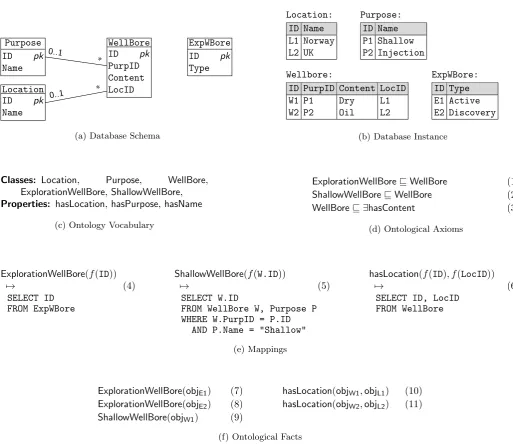
Example 2. Consider the sample database schema in-spired by our experience with Statoil in Figure 4(a). The
schema consists of four tables. Tables Purpose and
Locationare for storing wellbore purposes and locations,
respectively. The table WellBore is for storing
informa-tion about wellbores and it has four attributes including
IDas the primary key, and PurpID andLocID as foreign
keys related to the tables Purpose and Location,
respec-tively. Finally, the tableExpWBoreis for storing
informa-tion about explorainforma-tion wellbores. In Figure 4(b) we present a sample database instance over the sample schema.
3.3. Ontologies
An ontology is usually referred to as a ‘conceptual model’ of (some aspect of) the world. It introduces the vocabulary of classes and properties that describe vari-ous aspects of the modelled domain. It also provides an explicit specification of the intended meaning of the vo-cabulary by describing the relationships between different vocabulary terms. These relationships are specified with special first-order formulae, also called axioms, over the vocabulary. An ontology can be thought of simply as a set of such axioms—i.e., a logical theory. Besides axioms, an ontology can contain ontological facts, which can be specified as first-order atoms with constants but not vari-ables. These constants are interpreted as (representations of) objects of the domain. Viewing an ontology as a logi-cal theory opens up the possibility of using automated rea-soning for different tasks, including checking an ontology’s internal consistency (checking whether the ontology does not entail ‘false’, i.e., if it is logically consistent), query answering, and other (non-)entailments.
Example 3. Figure 4(c) lists a vocabulary for
describ-ing wellbores with classes such as Purpose, Location and
Purpose ID pk
Name
Location ID pk
Name
WellBore ID pk
PurpID Content LocID
ExpWBore ID pk
Type
0..1
∗
0..1 ∗
(a) Database Schema
Location: ID Name L1 Norway L2 UK
Purpose: ID Name P1 Shallow P2 Injection
Wellbore:
ID PurpID Content LocID W1 P1 Dry L1 W2 P2 Oil L2
ExpWBore: ID Type E1 Active E2 Discovery
(b) Database Instance
Classes: Location, Purpose, WellBore,
ExplorationWellBore,ShallowWellBore, Properties: hasLocation,hasPurpose,hasName
(c) Ontology Vocabulary
ExplorationWellBore�WellBore (1)
ShallowWellBore�WellBore (2)
WellBore� ∃hasContent (3)
(d) Ontological Axioms
ExplorationWellBore(f(ID))
�→ (4)
SELECT ID FROM ExpWBore
ShallowWellBore(f(W.ID))
�→ (5)
SELECT W.ID
FROM WellBore W, Purpose P WHERE W.PurpID = P.ID
AND P.Name = "Shallow"
hasLocation(f(ID), f(LocID))
�→ (6)
SELECT ID, LocID FROM WellBore
(e) Mappings
ExplorationWellBore(objE1) (7)
ExplorationWellBore(objE2) (8)
ShallowWellBore(objW1) (9)
hasLocation(objW1,objL1) (10)
hasLocation(objW2,objL2) (11)
[image:10.595.37.551.72.520.2](f) Ontological Facts
Figure 4: Sample Ontology Based Data Access Scenario
hasLocation, hasContent and hasName. Figure 4(d)
con-tains axioms using the vocabulary. Axioms (1) and (2)
state that exploration wellbores and shallow wellbores are
wellbores. Axiom (3) states that every wellbore has some
content. In Figure 4(f ) there are ontological facts stating
thatobjE1,objE2 are exploration wellbores, objW1is a
shal-low wellbore, and objW1 and objW2 have respectively the
locations objL1 andobjL2.
In the last decade, a number of tools for ontological rea-soning have been developed. The existence of such tools was an important factor in the design of the OWL ontology language [18] and its basis in description logics [19]. OWL was initially developed to be used in the Semantic Web. The availability of description logic based reasoning tools has, however, contributed to the increasingly widespread use of OWL, not only in the Semantic Web, but as a
pop-ular language for ontology development infields as diverse as biology [20], medicine [21], geography [22], geology [23], astronomy [24], agriculture [25] and defence [26]. Recently ontologies has been recognised as a prominent mechanism for data integration and end-user oriented data access.
3.4. Mappings
Via mappings one can declaratively define how ontolog-ical terms are related to terms occurring in the relational schema. Mappings are essentially (read-only) view defi -nitions of the following form that declare how to popu-late classes with objects—in OWL objects are represented with Uniform Resource Identifiers (URIs)—and to popu-late properties with object-object and object-value pairs:
Class(fo(x))�→SQL(x),Property(fo(x), fo(y))�→SQL(x, y),
where SQL(x) and SQL(x, y) are SQL queries with respec-tively one and two output variables, and fo, fv are func-tions that ‘cast’ values returned by SQL into respectively objects, i.e, URIs, and values.5 Classes are populated
with URIsfo(x) computed from the valuesxreturned by
SQL(x). Properties can relate two objects, e.g., by stating that a wellbore has a particular location, or assign a value to an object, e.g., stating that a location has a particular name (a string), and they are respectively populated with pairs of objects fo(x), fo(y) or pairs of an object fo(x) and value fv(y) computed from the values x and y re-turned by the SQL query. A mapping isdirect if it relates a table to a class or an attribute to a property. We will rely on direct mappings in automatic mapping generation (see Section 5.2 for details). Given a database and a set of mappings over it, one can execute SQL queries in the mapping definitions and populate the classes and prop-erties of the mappings, thus creating a set of ontological facts. This process is usually referred to asmaterialisation
of the ontological facts defined by the mappings.
Example 4. Figure 4(e) contains three mappings. The
first one defines how to populate the class of exploration
wellbores with objects computed from IDs of ExpWBore
table. This mapping is direct. Materialisation of facts
defined by this mapping over the sample database instance
in Figure 4(c), gives Facts (7) and (8) in Figure 4(f ).
Note that objW1 = fo(W1) is the URI computed from the
first tuple in the table ExpWBore. Mapping (5) defines
which objects can be in ShallowWellBore wellbores via a
selection on the purpose name. This mapping is not direct
and Fact (9) is the materialisation of this mapping over
the sample database instance. Finally, Mapping (6) is
direct for the propertyhasLocation, and Facts(9)and(11)
are the materialisation for this property over the sample database instance.
In contrast to common existing approaches, like e.g. the ETL processes behind access points shown in Figure 3, OBDA mappings are declarative, and their semantics is captured by the ontology. The mappings must still be con-structed and maintained, but the potential for automation and tool support is high because of the precise definition of each mapping and their relative low complexity. Indeed, mappings are atomic in the sense that each of them relates to DBs one class or property. Therefore, the SQL query of each mapping much smaller than the typical SQL code of ETL processes behind access points or in collections of SQL views. This makes the SQL code of individual map-pings more readable and more maintainable that the one behind access points. Another advantage of OBDA map-pings is that they can be reused by many data acces tasks: they ‘connect’ ontologies to DBs and then can be used for any query over the ontology, while each ETL processes
5These functions should ensure coherent generation of URIs that
respects primary and foreign keys.
like in Figure 3 is for a concrete data access task and can hardly be reused for other tasks.
3.5. Query Answering Over Ontologies and in OBDA
As we discussed above, ontological axioms and facts are a logical theory, and query answering over them is logical reasoning rather than operations on a data instance as in the case of relational databases. To see the difference be-tween relational and ontological query answering, consider the following example.
Example 5. The following query (in SPARQL notation) selects all objects that have content:
SELECT ?x WHERE { ?x :hasContent ?y. }
Considering the ontological facts in Figure 4(f ) as a database instance with two unary and one binary tables, it is easy to check that answering the query over this instance yields no answers since the data has no information about
hasContent. At the same time, the facts in Figure 4(f ) to-gether with the axioms in Figure 4(d) logically entail three
answers to this query: objE1,objE2, andobjW1. These
an-swers are not explicit, but rather implicit, e.g., objW1 is
a shallow wellbore, thus, due to Axiom (2) it is also a
wellbore, and therefore, due to Axiom (3), it should have
content.
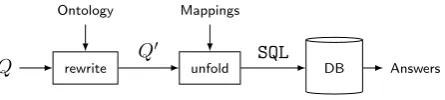
So, since query answering in OBDA involves logical rea-soning, it allows one to retrieve both explicit and implicit query answers. It can be seen as reasoning over the ontol-ogy and (virtual) ontological facts that one would have if materialising them from the database over which the map-pings are defined. In the case of OBDA, this reasoning is simulated via a two step process of query rewriting and
unfolding as presented in Figure 5. A query Q over the
ontological vocabulary isfirst rewritten w.r.t. the ontology O into a unionQ� of queries s.t. each query ofQ� is
sub-sumed byQ. This rewriting is in essence a compilation of relevant ontological information intoQand similar to the resolution procedure in Prolog. We refer the reader to [27] for details on rewriting, and illustrate it with an example below. Then, the queryQ� is unfolded into an SQL query
SQL using mappings. Finally, SQL is evaluated over the database instance using a database management system which gives the set of answers. It was shown in [27] that the answers computed via rewriting and unfolding, after they are turned into objects or values with the appropriate foorfv, coincide with the answers that are computed over the virtual ontological facts.
Example 6. Rewriting the query from Example 5 over the sample ontological axioms in Figure 4(d) gives the union
SELECT ?x WHERE { ?x hasContent ?y. } UNION { ?x a WellBore. }
Q
Ontology
rewrite
Mappings
unfold DB Answers
[image:12.595.52.275.82.132.2]Q� SQL
Figure 5: Query processing in OBDA
The next step is unfolding the rewritten query with the sample mappings in Figure 4(e) into the following SQL query:
SELECT f(ID) AS x FROM ExpWBore UNION
SELECT f(W.ID) AS x FROM WellBore W, Purpose P WHERE W.PurpID = P.ID AND P.Name = "Shallow".
The unfolding is built from Mappings (4)and(5). As there
are no mappings for hasContentandWellbore, these parts
of the query are simply ignored. Evaluation of this SQL
query over the data instance in Figure 4(b) returnsE1,E2,
and W1. Translation of these values into objects gives the
same answers as in Example 5, where we computed the answers over the virtual ontological facts.
In the next section we discuss advantages and disadvan-tages of OBDA for Statoil and present technical require-ments for OBDA to fulfil Statoil’s needs.
4. OBDA: Advantages for Statoil and Limitations
4.1. OBDA: Advantages for Statoil
The main advantage of OBDA systems is that they offer an end-user oriented vocabulary that can be used to com-posequeries. Predefined query templates that are typically available for end-users are not satisfactory (i.e., have lim-ited applicability) in scenarios such as the one of Statoil, where there is a frequent need for queries that do not fol-low the templates. OBDA, in contrast, offers a vocabulary that can be seen as ‘building blocks’ that are not specifi -cally tailored to any query but can be used to compose a variety of queries. Thus, OBDA naturally supports data exploration tasks needed in Statoil and allows the users to write new queries themselves without requesting IT sup-port.
Another advantage of an OBDA system is that it can be layered on top of databases without any required customi-sation. View-based query answering and data warehouses follow a similar approach, but they typically require to move data from the original database to the views, or the data warehouse. OBDA, in contrast, is a so-called virtual
approach, that is, it does not require to pre-materialise any data at all. Thus, OBDA systems avoid the problem of up-dating materialised data. The OBDA approach is OLTP rather than OLAP oriented. As we observed in Statoil, ge-ologists typically need OLTP queries, up-to-date answers, and the ability to compose queries themselves. Thus, we see OBDA as more suitable for our use-case than other technologies, e.g., data warehousing.
4.2. OBDA: Limitations for Statoil
The advantages of OBDA come with challenges. Thefirst challenge is to obtain the required components to install an OBDA system, i.e., ontologies and mappings. To overcome this we developed a bootstrapper that is able to extract ontologies and direct mappings from relational schemata. To address the industrial domain at Statoil, we developed an ontology, calledSubsurface Exploration (SE)
ontology, that is heavily relies on information extracted from the seven databases presented in Section 2 and that widely covers the domain of the petroleum subsurface exploration. Details on our semi-automatic ontology construction techniques can be found in Section 5.2 and our experience with deployment in Statoil in Section 6.
The second challenge is to guarantee that our OBDA system is able to process semantic queries over massive amounts of data, as in Statoil. Since query processing in OBDA requires rewriting, unfolding, and query execution with an RDBMS, this is not a trivial task. In Sections 5.3 and 5.4 we present our query optimisation techniques and in Section 7 results of our experiments.
The third challenge comes with the assumption that the users can formulate queries over the ontological vocabu-lary. SPARQL [28] is the standard query language over ontologies; however, it is not end-user oriented. To over-come this challenge, we developed an interface—see Sec-tion 5.5 for details of our techniques–tailored for users that are not familiar with formal query languages. Our inter-face is expressive enough to cover most of typical queries we acquired from Statoil geologists and in Section 8 we present results of our user study.
5. Optique Platform: System Overview and Tech-nical Background
We start with an overview of our OBDA platform Op-tique and then into technical details of four of its com-ponents that are the most critical for the deployment in Statoil.
5.1. System Overview
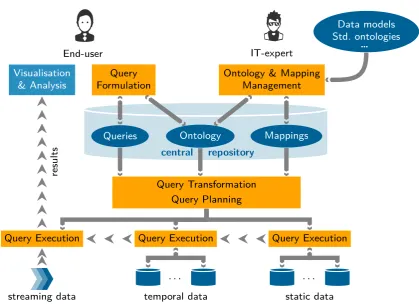
The general Optique platform architecture, shown in Figure 6, has two user roles: the end-user, in our case typically a geoscientist that wants some specific access to data, and the IT-expert, whose job it is in part to provide such end-users with access to data. The Optique platform consists of various components that are integrated in a common framework, provided by the Information Work-bench [29]. Ontologies, mappings, queries and other spec-ifications, like SPARQL repository settings, are stored in a central repository that all components can access.
End-user IT-expert
Data models Std. ontologies
…
Visualisation
& Analysis FormulationQuery Ontology & MappingManagement
Ontology Mappings Queries
Query Transformation Query Planning
Query Execution Query Execution Query Execution
· · · ·
results
streaming data temporal data static data
[image:13.595.94.514.96.403.2]central repository
Figure 6: Optique Architecture Overview
side interface of the query formulation tool is driven by information in the ontology, and this information is fed to the client by a server side part that can also exploit rank-ing usrank-ing query logs to better the user’s efficiency and user experience.
The queries constructed by the formulation tool is pro-cessed by our query transformation module (see Sec-tion 5.3 for details), which considers the informaSec-tion in the ontology, mappings, data source schemas, and additional optimisation settings, to transform the SPARQL query into an optimised federated SQL query over all the sources connected to the platform. This SQL query is passed on to our query planning and execution module (see Sections 5.3 and 5.4 for details), that deconstructs the SQL query and orchestrates the evaluation of the query parts to the cor-rect underlying data sources. The data sources evaluates the query parts as any other SQL query and return the results back to query execution module, which assembles the query answering results of the sources to form the fi -nal result of the end-user query.6 This result is given back
to the query transformation module which delivers the
re-6In the setup of the Optique platform at Statoil we only access
static data sources, i.e., regular relational databases. In a different installation of the platform, we also access temporal and streaming sources [30].
sult to the end-user following the SPARQL protocol [31]. Depending on how the end-user query was issued, the re-sults can be visualised differently: as a regular table, in a wiki front-end provided by the Information Workbench, or displayed directly in Statoil end-user expert tools, via a transformation of the SPARQL query result set, see Sec-tion 9.
The IT-expert is equipped with interfaces to setup and maintain the platform and its artefacts, in particular the deployment module (see Section 5.2 for details) that can construct ontologies and mappings over the data sources using the data schemas as input. There are also interfaces that allow the IT-expert to add new artefacts to the plat-form, and examine and edit those stored in the central repository, e.g., queries, ontologies and mappings. The platform relies on existing tools for ontology development like Prot´eg´e,7 but features custom-built modules for
map-ping construction [32].
We now proceed with more technical background on four Optique modules: deployment module for creating ontolo-gies and mappings, query optimisation and query process-ing module, federated query execution module, and end-user oriented query construction module.
5.2. Deployment
An OBDA specification is typically defined in the lit-erature as a 4-tuple composed by an ontology vocabulary V, an ontology O, a set of mappings M and a database schema S. A OBDA instance is an OBDA specification where the database schemaSis replaced byD, a database instance forS.
We support the following tasks for bootstrapping on-tologies and mappings, or assets, from RDBs in order to create an OBDA instance.
(i) Bootstrapping: Given a relational databaseD,
gen-erate an instance (D,V,O,M). This task can be naturally divided into two sub-tasks.
- Vocabulary and Ontology generation: GivenD,
cre-ate a vocabularyV and an ontology OoverV.
- Mapping generation: Given D,V, andO create a
set of mappingsMrelatingDwithV.
(ii) Importing: Given an instance (D,V,O1,M) and an
ontologyO2, return an instance (D,V,O,M), where
Ois the alignment of O1 andO2.
Task (ii) is important in applications where ontologies (partially) describing the domain of interest have been al-ready created and users want to incorporate them into their semantic data access system.
The bootstrapping of the ontologies and the mappings enables a (preliminary) deployment of semantic data ac-cess system. These mappings and ontologies, however, require further inspection by ontology engineers and do-main experts to detect the most promising classes, prop-erties, axioms, and mappings, and to verify their quality. Neverthelesss, the bootstrapped assets should meet some minimal requirements so that they can be usable in prac-tice. We have identified the following metrics to measure and guarantee a minimum quality of the generated assets:
(1) Ontology language: compliance with standard ontology
languages with well-defined semantics like OWL 2 and its profiles to enable the use of a wide-range of Semantic Web technologies. Note that the choice of the ontology lan-guage (e.g., one of OWL 2 profiles) also affects suitability of the different query answering engines. For example, if the bootstrapped ontology is to be used in a OBDA sce-nario, as in Optique, OWL 2 QL profile is required by the query rewriting engine. (2) Mapping language: compli-ance with standard directives like the W3C direct mapping specification8 and standard W3C mapping languages like
R2RML.9 (3) Query coverage: suitability of the ontology
vocabulary to formulate the queries that the user is inter-ested in. (4) Query results: accuracy of the query results obtained with the bootstrapped instance in the sense that the query answer should satisfy the user’s expectations.
8Direct mappings: http://www.w3.org/TR/
rdb-direct-mapping/
9R2RML language: http://www.w3.org/TR/r2rml/
To the best of our knowledge existing bootstrapping systems provide limited or no support for the bootstrap-ping tasks and quality requirements described above, see, e.g., [33, 34] for an overview of such systems. Most of the state of the art bootstrappers fail to conform with the ontology and mapping language standards, or they do not provide profiling capabilities for the outpout ontology. Furthermore, BootOX outperforms existing systems in bootstrapping that were available for benchmarking (see Section 6.3 for details).
Bootstrapping. The goal of bootstrapping is to find
pat-terns in D, i.e., SQL queries SQL(x) and SQL(x, y) that correspond to meaningful classes and properties. We boot-strap three types of mappings depending on what rela-tional algebra operators can appear in their SQL-parts:
(i) projection, (ii) selection, and (iii) full mappings that
allow any relational algebra operators.
A special kind of projection mappings, that are recom-mended by W3C as the standard way to export relational data in RDF, are direct mappings. They mirror RDB schemata by essentially translating (i)each (non-binary) table into an OWL class;(ii) each attribute not involved in a foreign key into an OWL datatype property;(iii)each foreign key into an OWL object property.
Generation of axioms, however, is usually a more in-volved process. Ontological vocabulary extracted by di-rect mappings can be enriched with axioms by propagat-ing RDB constraints, e.g., a foreign key relatpropagat-ing two tables could be propagated into a subclass axiom between the two corresponding classes. BootOX[14] relies on a series of patterns to transform database features into OWL 2 ax-ioms and puts special attention to the OWL 2 profile of the generated ontology (see Appendix B for a complete list of patterns). Database features can be encoded us-ing different axioms which may lead to different OWL 2 profiles. For example, primary keys and unique constraints can be modelled with the OWL 2 constructHasKey, which is supported in OWL 2 RL and OWL 2 EL, but must be avoided if the target ontology language is OWL 2 QL as in our OBDA scenario.
BootOX can also discover implicit constraints in databases, e.g., minimal primary keys in tables, candidate foreign keys by checking containment between (samples from) projections of tables. While working with EPDS we found that the discovery of implicit constraints was prac-tically important since prominent tables are materialised views without specified primary or foreign keys, and ax-ioms constructed from such constraints are exploited in query optimisation. Note that the bootstrapped ontology can be quite close to the source schema and we see this as a natural outcome: bootstrapping is the first step in OBDA system deployment, and the resulting assets are by no means perfect, but provide a starting point for post-processing and extension.
bootstrapped with direct mappings and verified by users, and in the corresponding tables we learn attributes whose values give good clustering of tuples; then, for each cluster we create a subclass of C. For example in one of the databases the table WellBore contains different types (i.e. clusters) of wellbore according to their purpose and one could bootstrap axioms like
‘WellBore has purpose Appraisal SubClassOf: WellBore’.
In order to bootstrap full mappings, we discover chains of tables that are ‘well joinable’, that is, connected via for-eign keys or with good overlap on some sets of attributes, and convert them into candidate classes and properties. For instance, for each chain we detect the ‘leading’ table T and relate the chain to a class by projecting it on T’s primary key; then, we combine names of the tables in the chain and attributes on which they were joined to suggest a name for this class.
In addition, BootOX automatically extends direct mappings with metainformation about provenance. The provenance metainformation is modelled in the mapping assertion, adding, for instance, the source database from which the information is extracted, and more granular in-formation, like table and column identifiers.
URI creation. BootOXfollows the good practices of the
W3C direct mapping specification to create the URI (tem-plates) for classes, properties and individuals in order to minimise the so-called impedance mismatch problem [1], which is caused due to the fact that databases store data values (e.g strings, integers, etc.) while the ontology in-cludes objects uniquely identified by URIs. We address the problem on the level of object generating functions dis-cussed in Section 3.4. Our functions respect primary and foreign keys and ensures that all the generated objects are unique and the same object is generated when required. Note thatBootOXhas also been used to assist the man-ually creation of mappings in order to use common URI templates for the referenced ontology classes, properties and individuals.
The R2RML language provides mechanisms (i.e. tem-plates) to implement the object generating functions. For example, the basic rule to generate the URIs for the sub-jects in a mapping is the following:
http://basens/table/{pk1}/.../{pkn}
If the table does not contain any primary key the tem-plate URI is created using all columns in the table:
http://basens/table/{col1}/.../{coln}
When dealing with foreign keys, the URI of the object mapping associated to the referencing table should be gen-erated according to the URIs of the subjects for the refer-enced table. e.g.:
http://basens/reftable/{fkcol1}/.../{fkcoln}
Exceptions apply when dealing with inheritance. In these cases URI template generation is a bit more elabo-rated and requires the use of internal indexes to keep track of the URI template required for the referenced tables.
Alignment. A way to extend a bootstrapped ontology is
to align it with an existing high quality domain ontol-ogy. Ontology alignments (also called correspondences) between entities of two ontologiesO1,O2 are represented
as a 3-tuple{e, e�, r}whereeande� are entities ofO 1and
O2, respectively;r∈{�,�,≡}is a semantic relation [35].
If correspondences are automatically created a confidence valuec, usually, a real number within the interval (0. . .1] is typically added to the mapping tuple. Confidence intu-itively reflects how reliable a correspondence is (i.e., 1 = very reliable, 0 = not reliable). Although there are sev-eral possible representations for alignments, in this work we represent them through standard OWL 2 axioms.
We have extended the ontology alignment system LogMap [36] that aligns two ontologies O1 and O2 by
deriving OWL 2 equivalence and sub-class(property) ax-ioms between the terms fromO1’s andO2’s vocabularies
using the lexical characteristics of the terms and the structure of the ontologies. Our extension [37, 38] is a highly scalable solution that, in the resulting ontologyO after O1 and O2 are aligned, minimises the violations of
theconservativity principle i.e.,Odoes not entail (many)
sub-class(property) axioms overO1’s andO2’s vocabulary
which are not already entailed by O1 or O2. When
experimenting with the Statoil databases, we noticed that this logical guarantee is often a necessity since an alignment O of a bootstrapped O1 with an imported
domain ontologyO2that does not preserve conservativity
gives the following side-effects: query answering over O produces answers that are unexpected by domain experts, and that would not be obtained if one queries O1 alone,
or O entails axioms over O2’s terms that are unexpected
and counter-intuitive for domain experts.
5.3. Query Processing Optimisation
Our query processing system relies on the two stage pro-cess with rewriting and unfolding as described above. It was observed [7] that a naive implementation of this ap-proach performs poorly in practice; thus, we developed and implemented a number of techniques to optimise both stages of query processing, which we present in detail be-low. We empirically tested the efficiency of our optimi-sation techniques over EPDS and will present results on query execution in Section 7. We also evaluated our tech-niques in a controlled environment and our tests show that thanks to these optimisation techniques our query process-ing solution can dramatically outperform existprocess-ing OBDA solutions [39].
Optimisation of Rewriting. We address two challenges:
(i) redundancy in RQ: fragments of RQ may be
sub-sumed by other fragments, and thus evaluation of
UQover RDBs requires redundant computation;
(ii) inefficiency of rewriting: computation of RQ is in
the worst case exponential in the size of Q and O, and thus its online computation is often slow for largeQ,MandO.
The main source of redundancy in RQ is that classes (properties) can participate in multiple mappings either directly, or indirectly via their multiple sub-classes (sub-properties).10 To avoid this, we minimise both the
map-pings and the UCQRQusing query containment. To ad-dress the inefficiency, we proposed two novel techniques. Both techniques can be applied in isolation or combined. Ourfirst technique is to improve computation of class hier-archies entailed by the ontology, which the rewriting heav-ily relies on, by applying graph reachability techniques to a DAG-encoding of dependencies among classes. The sec-ond one is to move part of online reasoning offline: for all atomic queries we perform expensive rewriting up front and compile the results of this computation into the exist-ing mappexist-ings, and use these enriched mappexist-ings when user queries Qare unfolded, see [40] for details.
Optimisation of Unfolding. We address three challenges
with query unfolding:
(i) redundant unions due to redundancies in the
boot-strapped ontology or mappings;
(ii) redundant joins, that come from the fact that on the
ontological level the data is modelled as a graph, i.e., as a ternary relation, while on the data level in RDBs it is modelled with n-ary relations, and thus an un-folding ofRQinto SQL over an n-ary table naturally introduces n-1 self-JOIN operations;
(iii) inefficient joins come from the so-called impedance
mismatch, i.e., on the ontological level objects are
represented with object ids URIs while in RDBs with tuples; thus, joins inRQare unfolded into SQL joins over string concatenation that prevents RDBs from the use of existing indices.
To address these issues, we developed structural and
semantic optimisation techniques. For structural
opti-misations we push joins inside the unions and special functions (such as URI construction) as high as possible in the query tree; we also detect and remove inefficient joins between sub-queries. Semantic optimisations remove redundant unions, joins, detect unsatisfiable or trivially satisfiable conditions, etc.
OBDA Constraints. The optimizations discussed in the
previous paragraphs are based on the additional informa-tion coming from the DB schema such asprimary and
for-eign keys. Unfortunately, these optimization techniques
cannot exploit constraints that go beyond what can be
10This issue is partially tackled at the bootstrapping stage [14].
explicitly declared in the schema. For instance, the data stored at Statoil has certain properties that derive from domain constraints or storage policies that are not mod-eled using DB constraints. For example, the view in the database containing information about wellbores, in fact, satisfies the following implicit constraints: (1) it must contain all the wellbores in the ontology; (2) every tu-ple in the view must contain the information about name, date, and well (no nulls); (3) for each wellbore in the view, there is exactly one date/well that is tagged as ‘actual’.
In [12] we show how to use this information to further optimize UQ (please note that details of these technique are beyond the scope of this paper and we refer the reader to [12] for examples and further explanations). We do so by introducing two novel classes of constraints that go beyond database constraints. Thefirst type of constraint,
exact predicate, intuitively describes classes and properties
whose elements can be retrieved without the help of the ontology. The second type of constraint,virtual functional
dependency, intuitively describes a functional dependency
over the virtual RDF graph exposed by the ontology, the mappings, and the database. These notions are used to enrich the OBDA specification so as to allow the OBDA system to identify and prune redundancies from the trans-lated queries. We show in [12] that thanks to these opti-mizations we can improve the overall performance of query executions by orders of magnitude.
Optimisation of distinct answers. Removing duplicates
from query answers raises an interesting problem for OBDA systems. On the one hand, OBDA theory assumes set semantics for computation of query answers, that is, each answer occurs only once in the answer set. On the other hand answering queries over relational databases is typically implemented under bag semantics, that is, any answer can occur multiple times in the answer set. In par-ticular, evaluation of SQL queries produced by our query processing system returns answers with duplicates. From our experience with the OBDA deployment at Statoil, these duplicates bring a number of challenges: duplicate answers appear as noise to most end-users, visualisation systems are significantly slowed down when flooded with repeated answers, and the large number of such answers negatively affects network capacity and database connec-tivity. Using the DISTINCT modifier in SPARQL queries to remove redundant answers is unfolded into the SQL
DISTINCT, which, in our experiments, was extremely detri-mental to performance and led to a number of queries to time out. In order to overcome this problem, we propose to defer the removal of duplicate tuples to the OBDA system rather than the underlying database engine. In particu-lar, wefilter out redundant answers using predefined Java hash functions. This simple solution outperforms SQL
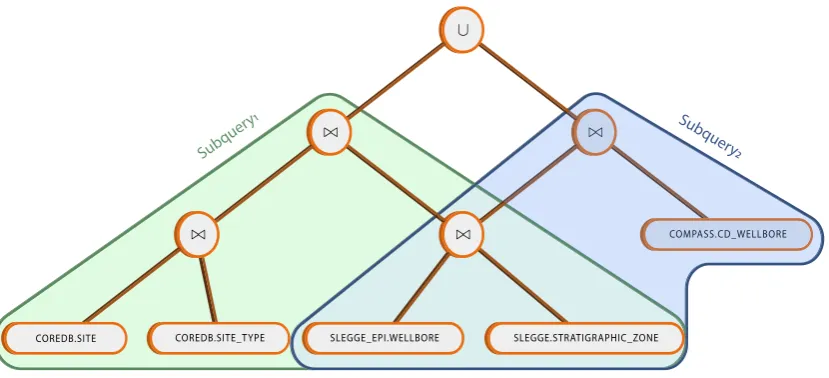
Figure 7: Query Plan.
5.4. Federated Query Execution
The unfolded query produced by the process described in the previous section is a SQL query, that is sent for exe-cution by the underlying RDBMS. As described in Section 2, end users often need to access information that resides in different databases. In the discussed scenario there is need for an underlying system that is capable of importing and processing data from different endpoints. In certain cases it may be preferable to take advantage of the processing capabilities of each endpoint, in order to ship fragments of the query for execution there and only import back an in-termediate result, instead of the detailed data. Of course, such a decision should be cost-based. For instance a sim-ple policy of sending the largest possible fragment to each end-point is often sub-optimal. Systems that put through these tasks are known as mediators, whereas the underly-ing database systems are known as endpoints.
Extending Exareme With Data Integration Capabilities.
Exaremeis anelasticexecution environment for complex data workflows on the cloud. These data workflows in-corporate user computations in the form of User-Defined
Functions (UDFs). Several extensions have been
imple-mented in order for the system to be able to cope with the demanding requirements of the OBDA installation in Statoil, whereas at the same time preserving its massively parallel processing capabilities:
(i) its optimizer has been re-designed in order to take into consideration common subexpressions coming from different parts of a complex query;
(ii) special data transfer operators have been imple-mented in order to be able to import data from end-points;
(iii) a federated analyzer module has been implemented,
which based on the OBDA mappings, gathers statis-tics about the external data;
(iv) pushing data processing to endpoints as a
post-optimization step is considered;
(v) caching and reuse of intermediate results can be en-abled to exedite query processing.
In what follows we describe some of these extensions in more detail.
Federated Analyzer. Since theExaremeoptimizer is
cost-based, thefirst step in order to be able to make cost esti-mations for different federated query plans, is to analyze the columns of base tables residing in different endpoints. This is an offline process taking place before query answer-ing. Initially, the OBDA mappings are parsed and a list of all base tables referenced there is obtained. This way
Exaremeavoids gathering statistics for tables that cannot show up in an unfolded SQL query. This number can be very large for the databases considered in the Statoil envi-ronment and this simple optimization saves a lot of compu-tation. For each column of the obtained tablesExareme
sends to the corresponding endpoint queries that ask for the different values, the minimum and maximum value and the column size. This way we can obtain basic statistical measures without having to resort to the often unfeasible task of importing all the data.
Common Subexpression Identification. Common