M-Estimator and D-Optimality Model Construction
Using Orthogonal Forward Regression
Xia Hong
, Senior Member, IEEE
and
Sheng Chen
, Senior Member, IEEE
Abstract—This correspondence introduces a new orthogonal forward regression (OFR) model identification algorithm using D-optimality for model structure selection and is based on an M-estimators of parameter estimates. M-estimator is a classical robust parameter estimation tech-nique to tackle bad data conditions such as outliers. Computationally, The M-estimator can be derived using an iterative reweighted least squares (IRLS) algorithm. D-optimality is a model structure robustness criterion in experimental design to tackle ill-conditioning in model structure. The orthogonal forward regression (OFR), often based on the modified Gram–Schmidt procedure, is an efficient method incorporating structure selection and parameter estimation simultaneously. The basic idea of the proposed approach is to incorporate an IRLS inner loop into the modified Gram–Schmidt procedure. In this manner, the OFR algorithm for parsimonious model structure determination is extended to bad data conditions with improved performance via the derivation of parameter M-estimators with inherent robustness to outliers. Numerical examples are included to demonstrate the effectiveness of the proposed algorithm.
Index Terms—Forward regression, Gram–Schmidt, identification, M-es-timator, model structure selection.
I. INTRODUCTION
Various neural networks such as radial basis function (RBF)
net-works can be expressed as a linear-in-the-parameters model structure
where the system output is a linear combination of nonlinear basis
functions. Provided that there is a separate mechanism for determining
centers/widths of these basis functions, the basis weights/parameters
can be trained using linear optimization techniques. The architecture
or topology of the class of linear-in-the-parameters modeling networks
enables them to be readily assessed in terms of their modeling
capa-bility, structure, learning, construction, and numeric stacapa-bility, since the
results of quadratic optimization and linear algebra are directly
appli-cable. Moreover, by applying linear regression statistical techniques to
the identification of this type of neural networks, it is possible to model
the observational data in a statically optimal sense to achieve improved
performance for a wide range of applications/tasks in the field of signal
processing, dynamical system modeling, and control.
The general method of M–estimation [1] is well established in
order to tackle outliers in observational data. As a generalization of
maximum-likelihood estimation method for data with outliers, the
M-estimator uses some cost functions which increase less rapidly than
that of least squares estimators as the residual departs from zero, so
the parameters estimator is more robust to outliers. Computationally,
M-estimator can be derived using an iterative reweighted least squares
(IRLS) algorithm. M-estimation has been applied successfully to
time series prediction, image processing and pattern recognition
[2]–[4]. Two major aspects of system identification are model
struc-ture determination and parameter estimation. While M-estimator is
Manuscript received March 11, 2004; revised June 14, 2004. This work was supported by the EPSRC UK. This paper was recommended by Associate Editor P. De Wilde..
X. Hong is with the Department of Cybernetics, University of Reading, RG6 6AY Reading, U.K.
S. Chen is with the School of Electronics, University of Southampton, SO17 1BJ Southhampton, U.K.
Digital Object Identifier 10.1109/TSMCB.2004.839910
concerned with parameter robustness, conventional optimum
exper-imental designs are concerned with model structure robustness [5].
In optimum experimental design, model adequacy is evaluated by
statistical measures of goodness via experimental design criteria, e.g.
A- and D-optimality. By quantitatively measuring the model adequacy
as function of the eigenvalues of the design matrix, design efficiency
and experimental effort of designs can be optimized.
The orthogonal forward regression (OFR) is an efficient algorithm
to determine a parsimonious model structure [6]. Driven by
require-ments for improved model generalization, a few variants of OFR have
been introduced in order to tackle ill-conditioning problem that may be
associated with least squares parameter estimates [7]–[11]. Recently,
variants of the forward OFR algorithms have been introduced by
mod-ifying the selective criteria to include A- and D-optimality in forward
regression [12], [13] to form hybrid approaches applicable to neural
networks modeling. Although these methods do not generally need the
assumption of a normal error distribution, the parameter estimator may
not be statistically optimal if the data exhibit bad conditions such as
outliers.
Alternatively there exists a vast amount of work on sparse modeling
including the well-known support vector machine (SVM) [14], which
is often used in classification tasks [15] and can also be used in sparse
regression modeling [16]. SVM is regarded as a robust modeling
ap-proach and based on a structural risk minimization (SRM) principle,
that is to minimize an estimate of the upper bound of model
general-ization. The model sparsity and robustness of SVM can be achieved
by incorporating an
"
-insensitive function in the loss function, as
pro-posed by Vapnik [14]. The
"
-insensitive function and Huber loss
func-tion used in M-estimator shares a similarity of using
l
1norm (see
Sec-tion II-A). Because the implementaSec-tion of SVM sparse modeling with
the
"
-insensitive function is solved via constrained quadratic
program-ming (QP), it is computationally expensive. It has been shown that OFR
algorithm can be combined with SVM to improve model sparseness
[16].
This paper presents a new model identification algorithm that
com-bines the M-estimator with forward regression. Based on the modified
Gram–Schmidt procedure for OFR, the proposed algorithm
incorpo-rates an IRLS inner loop into the modified Gram–Schmidt procedure
to derive the M-estimator of model parameters. In combination with
D-optimality for model structure selection, the proposed algorithm
si-multaneously derive robust model structure and parameter estimates
for bad data conditions.
The paper is organized as follows. Section II initially introduces
methodologies relevant to the proposed algorithm, including general
nonlinear regression modeling based on OFR algorithm with
D-opti-mality and the concept of the M-estimator. Section III introduces the
model identification algorithm using forward regression with
M-esti-mation. Numerical examples are used to demonstrate the efficacy of
the algorithm in Section IV and conclusions are given in Section V.
II. PRELIMINARIES
A linear regression model (RBF neural network, B-spline
neuro-fuzzy network) can be formulated as [17], [18]
y(t) =
Mk=1
p
k(x(t))
k+ (t)
(1)
where
t = 1; 2; 1 1 1 ; N
, and
N
is the size of the estimation data set.
y(t)
is system output variable,
x(t) = [x
1(t); 1 1 1 ; x
n(t)]
Tis system
input vector with an assumed known dimension of
n
.
p
k()
is a known
nonlinear basis function, such as RBF, or B-spline fuzzy membership
functions.
(t)
is an uncorrelated model residual sequence with zero
mean and variance of
2.
kis model parameter, and
M
is the number
of regressors.
Equation (1) can be written in the matrix form as
y = P2
2 + 4
2
(2)
where
y = [y(1); 1 1 1 ; y(N)]
Tis the output vector.
2
2
2 =
[
1; 1 1 1 ;
M]
Tis parameter vector,
4 = [(1); 1 1 1 ; (N)]
Tis
the residual vector, and
P
is the regression matrix
P =
p
1(1)
p
2(1)
1 1 1 p
k(1) 1 1 1
p
M(1)
p
1(2)
p
2(2)
1 1 1 p
k(2) 1 1 1
p
M(2)
p
1(N) p
2(N) 1 1 1 p
k(N) 1 1 1 p
M(N)
with
p
k(t) = p
k(x(t))
. Denote the column vectors in
P
as
p
k=
[p
k(1); 1 1 1 ; p
k(N)]
T,
k = 1; 1 1 1 ; M
. An orthogonal decomposition
of
P
is
P = WA
(3)
where
A = f
ijg
is an
M 2 M
unit upper triangular matrix and
W
is an
N 2 M
matrix with orthogonal columns that satisfy
W
TW =
diag
f
1
; 1 1 1 ;
Mg
(4)
with
k= w
kTw
k; k = 1; 1 1 1 ; M
(5)
so that (2) can be expressed as
y = (PA
01)(A2) + 4 = W0 + 4
(6)
where
0 = [
1; 1 1 1 ;
M]
Tis an auxiliary vector. The above
orthog-onal decomposition can be realized by the modified Gram–Schmidt
algorithm [6], in which least squares parameter estimates are usually
used. Based on the modified Gram–Schmidt algorithm, a few variants
of forward OLS algorithms have been introduced to improve model
generalization capability based on the concepts from Bayesian
regular-ization/basis pursuit [9], experimental design and leave-one-out (LOO)
score, respectively, [10], [11]. Although these methods do not generally
need normality error distribution assumption, the parameter estimator
may not be statistically optimal if the data exhibit bad conditions such
as outliers, or are heavy tailed. The general method of tackling this
problem is well established as M-estimation [1], which is a
generaliza-tion of maximum-likelihood estimageneraliza-tion method for data with outliers.
The M-estimator [1] is described in the following section.
A. M-Estimators
The M-estimators have been well studied [1]. Considering the linear
regression model given by (1), the M-estimator minimizes the cost
function
V
M=
Nt=1
((t))
(7)
where the function
((t))
is some predetermined non-negative
func-tionals for different types of estimators, e.g., for least squares
((t)) =
L((t)) =
2(t)
. Typically,
((t))
is an even function and
nonde-creasing with respect to the absolute value of
(t)
. The problem of least
squares estimator is that
V
Mwill be influenced by any outlier typified
by a large absolute value
(t)
. The general M-estimator can tolerate
undetected outliers by assigning a smaller weight to observations with
residuals with large absolute values, so the parameter estimates are less
vulnerable to unusual data. The most common types of M-estimators
are the
Huber
estimator given by [1]
H() =
12
2;
for
jj
jj 0
12
2;
for
jj >
(8)
or the Turkey
bisquare
estimator, given by
B() =
6
1 0 1 0
2 3
;
for
jj
16
2for
jj >
(9)
where the parameter
is called a tuning constant, e.g. it is common to
choose
= 1:345
for the
Huber
estimator and
= 4:685
for the
Turkey
bisquare
estimator.
1The M-estimator can be derived by setting
@V
M@2
2= ^2= 0
(10)
to yield
@V
M@2
= P
T= 0
(11)
where
0
is zero vector.
= @V
M@(1)
; . . . ; @V
@(N)
M T= [ ((1)) ; . . . ; ((N))]
T(12)
where
()
is the derivative of
()
with respect to
. Define the weight
function
!(t) = ((t))
(t)
;
for
t = 1; . . . ; N:
(13)
Equation (11) can be written as
P
T4 = 0
(14)
where
=
diag
f!(1); !(2); . . . !(N)g
, whose solution is given as
the weighted least squares
^
2
M= fP
TPg
01P
Ty:
(15)
Because
!(t)
s are primarily unknown, an iteratively reweighted least
square (IRLS) is required. The M-estimator IRLS procedure is as
fol-lows:
Denote
m
as the iteration step. Initially set
m = 1
,
(1)= I
(i.e.
least squares) to derive an initial model residuals
(1)(t)
, then for
m =
2; . . . ; m
w!
(m)(t) =
(m01)
(t)
(m01)(t)
;
for
t = 1; . . . ; N:
(16)
From (8) and (9), the weight functions of
Huber
and the Turkey
bisquare
estimator can be explicitly given by
!
(m) H(t) =
1;
for
(m01)(t)
j
(t)j ;
for
(m01)(t) >
(17)
1The theoretic foundation of choosing these values is due to [1] in that these
and
!
(m) B(t) =
1 0
(t) 2 2;
for
(m01)(t)
0;
for
(m01)(t) >
(18)
respectively. Let
(m)=
diag
f!
(m)(1); !
(m)(2); . . . !
(m)(N)g
;
then
^
2
(m)M= P
T(m)
P
01P
T(m)
y
(19)
4
(m)= y 0 P ^
2
(m)M
(20)
where
4
(m)= [
(m)(1); 1 1 1 ;
(m)(N)]
Tare ready for next iteration
step. The above procedure iterates until the parameter estimator
2
^
Mconverges at
m = m
w.
^
2
M= P
T(m )P
01P
T(m )
y:
(21)
The asymptotic covariance matrix of
2
^
Mis given by [1]
var
[ ^
2
M] = E(
2)
E
2 d d(P
TP)
01:
(22)
From (22), it is seen that the efficiency of the M–estimator depends
on the full rank of the
(P
TP)
01. However this usually may not be
true for an oversized
P
, unless there is some robustness measure in
place to select a parsimonious model structure. Robust model structure
selection can be achieved via experimental design criteria that selects
P
Tk
P
k, where
P
kis a subset of
P
, if
P
TP
is ill-conditioned. The
basic OFR model structure detection algorithm using D-optimality [13]
is initially given below, which will be incorporated in the proposed
algorithm of Section III.
B. Model Structure Selection by D-Optimality
A significant advantage due to orthogonalization is that the
contribution of model regressors to the model can be
evalu-ated. The OFR estimator involves selecting a set of
n
variables
p
k= [p
k(1); 1 1 1 ; p
k(N)]
T,
k = 1; 1 1 1 ; n
, from
M
regressors
to form a set of orthogonal basis
w
k,
k = 1; 1 1 1 ; n
, in a forward
regression manner. As the orthogonality property
w
Tiw
j= 0
for
i 6= j
holds, if (6) is multiplied by itself and then the time average is
taken, the following equation is easily derived
1
N
y
Ty = 1
N
Mk=1
2k
w
Tkw
k+ 1
N
4
T4:
(23)
The most relevant
n
regressors can be forward selected
ac-cording to the value of an error reduction ratio
[
ERR
]
k(defined
as
k2w
Tkw
k=y
Ty
, see [6]). At the
k
th selection, a candidate regressor
is selected as the
k
th basis of the subset if it produces the largest value
of
[
ERR
]
kfrom the remaining
(M 0 k + 1)
candidates. This
proce-dure can automatically select a subset of
n
regressors to construct a
parsimonious model. Equivalently, this procedure can be expressed as
J
(k)= J
(k01)0 1
N
k2k(24)
where
J
(0)= y
Ty
. At the
k
th forward regression stage, a candidate
regressor is selected as the
k
th regressor if it produces the smallest
J
(k).
Equation (24) can be modified to form an alternative model selective
criterion to enhance model robustness. The D-optimality criterion [5]
maximizes the determinant of the design matrix defined as
W
TkW
kmax J
D= det W
TkW
k=
nk=1
k(25)
where
W
k2 <
N2ndenotes the resultant regression matrix,
con-sisting of
n
regressors selected from
M
regressors in
W
. It can be
easily verified that the selection of a subset of
W
kfrom
W
is
equiv-alent to the selection of the a subset of
n
regressors from
P
[13].
In order to include D-optimality as a model selective criterion for
im-proved model robustness, construct an augmented cost function as
J = 1
N
4
T4 + log
1
J
D= 1
N
y
Ty 0
n k=1 2k
k+
nk=1
log 1
k
(26)
where
is a positive small number. Note that this composite cost
func-tion simultaneously minimizes (24) and maximizes (25) [13]. Equafunc-tion
(26) can be directly incorporated into the OFR algorithm to select the
most relevant
k
th regressor at the
k
th forward regression stage, via
J
(k)= J
(k01)0 1
N
k2k+ log 1
k
:
(27)
At the
k
th forward regression stage, a candidate regressor is selected as
the
k
th regressor if it produces the smallest
J
(k)and further reduction
in
J
(k01). Because
log(1=J
D)
is an increasing function if
k< 1
,
which is true for some
k > K
, the selection procedure will terminate
if
J
(k)J
(k01)at the derived model size
n
if an proper
is set.
This is significant because this means that the proposed approach can
detect a parsimonious model size in an automatic manner.
A method of orthgonalization as required in above procedure is the
modified Gram–Schmidt procedure [6]. In [13],
kare derived as least
squares estimates. In the following, we propose a new algorithm as how
to incorporate D-optimality model structure selection with M-estimator
(Section II-A). The basic idea is to extend the modified Gram–Schmidt
algorithm to include, at every forward regression step, an IRLS
proce-dure inner loop that derives the M-estimator for the auxiliary vector
0
.
III. MODEL
IDENTIFICATION
ALGORITHM
USING
FORWARD
REGRESSION
WITH
M-ESTIMATION
Starting from
k = 1
, the columns
p
j,
k + 1 j M
are made
orthogonal to the
k
th column at the
k
th stage. The D-optimality
crite-rion (27) for each of
p
j,
k + 1 j M
columns is evaluated, and
the most relevant column is selected to be interchanged with the
k
th
column. The M-estimator for the
k
th regressor (the selected regressor)
is then derived, as shown below, via the proposed IRLS inner loop. The
operation is repeated for
1 k n
< (M 0 1)
.
Algorithm
1) Initially denote
,
and
,
,
.
2) The
th stage of the forward
re-gression selection procedure with
D-optimality is given below. For
, compute
(k;j)=
p
(k01)j T4
(k01)p
(k01) jT
p
(k01)j
(j)k
= p
(k01)j Tp
(k01)j
(28)
J
(k)j
= J
(k01)0 1
N
(k;j) 2(j)k+ log
1
(j) k(29)
3) Find
J
(k)= J
(k)j
= min J
j(k);
k j M
(30)
The
th column of
is then
in-terchanged with the
th column of
, and the
th column of
up to
the
th row is interchanged with
the
th column of
. For notational
convenience, the resultant
is
still be referred to as
. This
effectively selects the
th
candi-dates as the
th regressor in the
subset model. Then set
,
and derive model residual vector as
4
(1)(k)= 4
(k01)0
(1)kw
k(31)
(
NB
. The objective of (28)–(30) is
to realize the D-optimality selective
criterion of (26).)
4)
w
k= p
(k01)k k= w
Tkw
k kj=
w
T kp
(k01)j k;
k + 1 j M
p
(k)j
= p
(k01)j0
kjw
k;
k + 1 j M
(32)
Denote
.
5) The following IRLS algorithm
inner loop which aims to derive
ei-ther
Huber
or
bisquare
M-estimator
for the
th element of the
auxil-iary vector
, which is initialized
as
.
Iterated Re-weighted Least Squares
(IRLS) Inner Loop
i. Initialize
. Note that
model residual vector is
initial-ized as
from Step 2.
ii. For
Huber
M-estimator, set
, where
denotes standard deviation.
Use (17) to construct
(m)H= diag !
H(m) (k)(m01)(1) ; !
(m)H (m01)(k)(2)
. . . ; !
(m)H
(m01)(k)(N)
:
(33)
or for
bisquare
M-estimator, set
. Then use
(18) to construct
(m)B
= diag !
B(m) (k)(m01)(1) ; !
(m)B (m01)(k)(2)
. . . ; !
(m)B (m01)(k)(N)
(34)
iii. Denote
(m)=
(m)Hfor Huber M-estimator
(m)B
for
bisquare
M-estimator
(35)
and
k(m)=
w
w
TkT(m)4
(k01)k
(m)w
k(36)
4
(m)(k)= 4
(k01)0
k(m)w
k(37)
where
.
(
NB
. The orthogonal forward
regres-sion can be explicitly interpreted
as fitting the previous model
residual vector
using the
selected orthogonal basis
. While
derived in Step 3 is associated
with
as least squares
param-eter estimates, (36), (37) are the
direct application of (19), (20)
to derive Re-weighted least square
parameter estimates for
M-estima-tors.)
iv. If
, where
is
arbitrarily small number, then set
, and goto step ii.
Oth-erwise, set
,
.
Finish the IRLS inner loop.
6) update
J
(k)= J
(k01)0 1
N
2kk+ log 1
k
(38)
7) The procedure is monitored and
terminated at the derived
step,
when
, for a predetermined
. Otherwise, set
, go to
step 2.
8) The original model coefficient
vector
can then be
Note that in OFR-based algorithms it is important to make a clear
dis-tinction between model selective criteria and the parameter estimation
cost function. The model selective criteria is used to decide which term
to be included into the model, and parameter estimation cost function
is used to derive parameters for a given model. It is possible to
incor-porate M-estimator in model selective criterion by using IRLS loop at
step 2, but this will be computationally expensive. The proposed
algo-rithm can still detect ill-conditioning as a model term with deterioration
in model conditioning will not be selected.
A. Relations to SVM Regression
The support vector machine (SVM) regression is an alternative
ro-bust modeling approach [14], [15] based on the following model
struc-ture:
y(t) = (x(t))
T$ + b + (t)
(39)
where
$
,
b
are parameters, and
(x) 2 F 2 <
Ndenotes a
map-ping from data
x
into a feature space
F
. By
Mercers
condition [14], it
is possible that the inner product in
some
feature space
F
can be
effi-ciently represented by some kernel functions, given by
k (x(i); x(j)) = (x(i))
T(x(j)) 2 <
(40)
in which
i
,
j
are data labels. Note that some RBF functions, e.g.
Gaussian, belong to kernel functions family [15].
The
"
-insensitive function is defined as
"() =
0;
jj 0 ";
for
jj "
for
jj > "
(41)
where
"
is a predetermined nonnegative parameter that is effectively
used in controlling model complexity. Based on the SRM principle the
SVM regression modeling usually uses a composite functional
k$k
2+ C
N t=1 "((t))
(42)
as the objective function, where
C
is a predetermined smoothing
pa-rameter. The minimization of (42) based on (39) can be reformulated
as a constrained convex quadratic programming problem to derive a
“global” parameter optimal solution under the condition that both
C
and
"
are appropriately chosen [14], [15]. Increasing
"
will reduce final
model size, but taking
" = 0
, results in model size to be equal to
number of data points
N
. To formulate a constrained convex quadratic
programming problem [14], [15] some slack variables associated with
the bounds of
"are initially introduced, followed by the reformulation
of the functional (42) into a Langrangian form including some
addi-tional Langrangian parameters
i,
3i,
i = 1; . . . ; N
[14]. The derived
SVM regression model is the optimal solution given by
y(t) =
Ni=1
(
i0
3i) k (x(t); x(i)) + b + (t)
(43)
in which
i,
3iare the derived Langrangian parameters. The
simulta-neous parameter and structure identification can be achieved because
some of
(
i0
3i)
0s
are derived as zeros, by controlling the size of
"
. The SVM usually generates excellent model, but the computation
expense is much higher than that of OFR algorithm [16]. By
com-paring (43) with (1), it is seen that the SVM is a
linear-in-the-parame-ters model with the parameter associated with each kernel as
(
i0
3i)
.
However in (1) the basis functions
p
k()
are not restricted to be kernel
functions.
[image:5.594.301.552.64.303.2]Various cost functions described in this paper are shown in Fig. 1.
It is seen from Fig. 1(b) and (c) that the
"
-insensitive function is very
Fig. 1. Cost functions for different estimators. (a) Least squares. (b) Vapnik’s
"-insensitive. (c) Huber and (d) Turkey Bisquare.
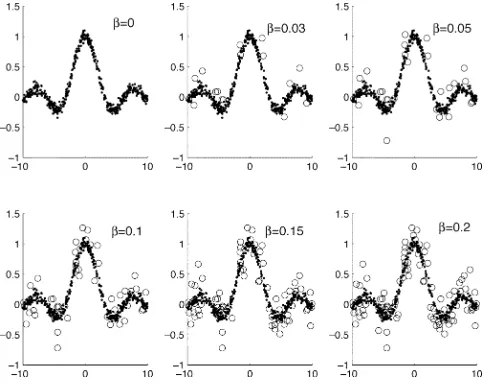
Fig. 2. Data generated by “sinc” function with additive noise of various levels of outliers in Example 1; (dotted-N(0; 0:05 ), (normal), and circle-N(0; 0:2 ) (outliers).
similar to
Huber
’s cost function, because both are based on
l
1norm
of errors for larger errors. Note that the
"
-insensitive function is not a
smooth function, and cannot be fitted into M-estimator family, in which
the derivative information of the loss function is basic information in
evaluating the robustness of M-estimator. It is also not suitable for many
optimization procedures, which require derivative information, to be
applied. Instead of using
"
-insensitive cost function, the Huber cost
function has been used in support vector machine (SVM) regression
that is solved by using a recurrent neural network [19].
IV. NUMERICAL
EXAMPLES
Example 1:
Consider using an RBF network to approximate the
“sinc” function
[image:5.594.306.548.345.538.2]TABLE I
RMS ERRORS ANDMODELSIZE OFDERIVEDMODELSWITHRESPECTIVE TOTRUEFUNCTIONz(EXAMPLE1)
1000 training data
y(x)
were generated from
y(x) = z(x) +
, using
uniformly distributed random
x 2 [010; 10]
. The additive noise
is
a Gaussian mixture that mixes two types of noises, a larger portion of
normal noise with smaller variance and a smaller portion of noise with
higher variance. i.e.
N(0; 0:2
2) + (1 0 )N(0; 0:05
2)
, where
0 < < 0:2
as a small number to denote the contamination ratio, such
that
has the probability
(10 )
of being drawn from
N(0; 0:05
2)
(as
“normal”), and a probability
of
N(0; 0:2
2)
(as “outliers”).
For various levels of contamination ratio
, 1000 noisy observations
were generated and divided into a training data set of 500 data points
and a test data set of 500 data points. The 500 training data points
is shown in Fig. 2 for different
. For each case, the proposed
algo-rithm is applied based on the RBF network. All the training data points
are used as the candidate center set
c
is, with
p
k(x(t))
constructed
using Gaussian function
p
k= (x; c
k) = expf0kx 0 c
kk
2=h
2g
.
The width
h = 1
is fixed for simplicity. Note that by removing the
IRLS inner loop of the algorithm, the procedure simply reduces to OFR
with D-optimality algorithm [13]. For comparison the SVM regression
approach was applied, with the same Gaussian function
k(x; c
k) =
expf0kx0c
kk
2=h
2g
, and
h = 1
, as kernels. The parameters in SVM
regression was set as
" = 0:06
and
C = 1
, as these values give the
best tradeoff between model sparseness and generalization by trial and
error.
With various values of
as different level of bad data conditions,
the proposed algorithm is compared with OFR with D-optimality
al-gorithm using only least squares estimates and SVM regression. With
a predetermined small number
= 0:001
, all of the derived models
based on OFR algorithm have the number of centers in the range of
n
= 21 22
, but the model size of SVM regression range from
n
= 123 176
. The root of mean squares (RMS) errors of a range
of data conditions are listed in Table I. It is seen that the proposed
algorithm is most robust to outliers when the data contains
approxi-mately 10% outliers. To achieve better performance for M-estimators,
it is useful to slightly adjust tuning constants because these are set for
95% efficiency when data is normal. As data distribution is unknown
these values can be adjusted via iterations and cross-validation. For the
training data set as shown in Fig. 2 with
= 0:1
, the model predicted
output by using the proposed algorithm with Turkey bisquare
M-esti-mators is shown in Fig. 3. For the best results in term of sparseness
and efficiency, OFR based algorithms are better than SVM regression.
The SVM regression is very robust even with worst data condition, and
gives consistent results for all data conditions.
Fig. 3. Bisquare M-estimator model predictions with = 0:1and true functions (Example 1).
Fig. 4. Automobile MPG data (circle: original data; and dotted: synthetical outliers).
TABLE II
RMS ERRORS ANDMODELSIZE OFDERIVEDMODELSWITHRESPECTIVE TO MPG DATAOUTPUT(EXAMPLE2)
i.e. each input has a width with a similar scale of its standard
de-viation. For both the original data and modified data, four types
of algorithms were applied and the modeling results were listed
in Table II. In the modeling original data without outliers, a
pre-determined small number
= 0:01
was used for all OFR based
algorithms. In the modeling data with outliers, it was found that
the setting of
= 0:01
would terminate at a model with too small
model size with insufficient approximation accuracy, so
= 0:0001
was used to allow larger models and better approximation
accu-racy. In the SVM regression approach, the same Gaussian function
k(x; c
k) = expf0(x 0 c
k)
Tdiagf50; 500; 5g(x 0 c
k)g
was used,
and the parameters in SVM regression was set as
" = 3
and
C = 10
.
It is shown that the proposed algorithm and SVM are robust to outliers
than least square parameter estimates, in the sense that they are less
vulnerable to the change in data’s deviation from its original data. The
OFR based algorithms produce more sparse models than that of SVM
regression for all cases.
V. CONCLUSIONS
In this correspondence, a new OFR model identification algorithm
is introduced. The OFR, often based on the modified Gram–Schmidt
procedure, is an efficient method incorporating structure selection and
parameter estimation simultaneously. The proposed algorithm includes
M-estimator by using an IRLS algorithm inner loop based on the
mod-ified Gram–Schmidt procedure. D-optimality as a model structure
ro-bustness criterion is used in model selection. In this manner the
pro-posed approach extends the use of the OFR algorithm for
parsimo-nious model structure determination even in bad data conditions via
the derivation of parameter M–estimators with inherent robustness to
outliers. Numerical examples have shown that the proposed algorithm
has improved performance than OFR with least squares parameters as
data condition deteriorates.
ACKNOWLEDGMENT
The authors wish to thank the referees for their suggestions which
greatly improved the quality of this paper.
REFERENCES
[1] P. J. Huber,Robust Statistics. New York: Wiley, 1981.
[2] J. T. Connor and R. D. Martin, “Recurrent neural networks and robust time series prediction,”IEEE Trans. Neural Netw., vol. 5, no. 2, pp. 240–253, Mar. 1994.
[3] J. H. Chen, C. S. Chen, and Y. S. Chen, “Fast algorithm for robust tem-plate matching with m-estimators,”IEEE Trans. Signal Process., vol. 51, no. 1, pp. 230–243, Jan. 2003.
[4] A. B. Hamza, H. Krim, and G. B. Unal, “Unifying probabilistic and variational estimation,”IEEE Signal Process. Mag., vol. 19, pp. 37–47, Sep. 2002.
[5] A. C. Atkinson and A. N. Donev,Optimum Experimental Designs. Ox-ford, UK: Clarendon Press, 1992.
[6] S. Chen, S. A. Billings, and W. Luo, “Orthogonal least squares methods and their applications to nonlinear system identification,”Int. J. Contr., vol. 50, pp. 1873–1896, 1989.
[7] S. Chen, Y. Wu, and B. L. Luk, “Combined genetic algorithm opti-mization and regularized orthogonal least squares learning for radial basis function networks,”IEEE Trans. Neural Netw., vol. 10, no. 6, pp. 1239–1243, Nov. 1999.
[8] M. J. L. Orr, “Regularization in the selection of radial basis function centers,”Neural Computat., vol. 7, no. 3, pp. 954–975, 1995. [9] X. Hong, M. Brown, S. Chen, and C. J. Harris, “Sparse model
identifica-tion using orthogonal forward regression with basis pursuit and [d]-opti-mality,” IEE Proc. Contr. Theory Applicat., vol. 151, no. 4, pp. 491–498, 2004, submitted for publication.
[10] S. Chen, X. Hong, and C. J. Harris, “Sparse kernel regression modeling using combined locally regularised orthogonal least squares and d-opti-mality experimental design,”IEEE Trans. Autom. Contr., vol. 48, no. 6, pp. 1029–1036, Jun. 2003.
[12] X. Hong and C. J. Harris, “Nonlinear model structure detection using op-timum experimental design and orthogonal least squares,”IEEE Trans. Neural Networks, vol. 12, no. 2, pp. 435–439, Mar. 2001.
[13] , “Nonlinear model structure design and construction using orthog-onal least squares and d-optimality design,”IEEE Trans. Neural Netw., vol. 13, no. 5, pp. 1245–1250, Sep. 2001.
[14] V. Vapnik,The Nature of Statistical Learning Theory. New York: Springer-Verlag, 1995.
[15] K. R. Müller, S. Mika, G. Rätsch, K. Tsuda, and B. Schölkopf, “An introduction to kernel-based learning algorithms,”IEEE Trans. Neural Netw., vol. 12, no. 2, pp. 181–201, Mar. 2001.
[16] K. L. Lee and S. A. Billings, “Time series prediction using support vector machines, the orthogonal and the regularized orthogonal least squares algorithms,”Int. J. Syst. Sci., vol. 33, no. 10, pp. 811–821, 2002.
[17] C. J. Harris, X. Hong, and Q. Gan, Adaptive Modeling, Estima-tion and Fusion From Data: A Neurofuzzy Approach. New York: Springer-Verlag, 2002.
[18] M. Brown and C. J. Harris,Neurofuzzy Adaptive Modeling and Con-trol. Englewood Cliffs, NJ: Prentice-Hall, 1994.
[19] Y. Xia and J. Wang, “A one-layer recurrent neural network for support vector machine learning,”IEEE Trans. Syst., Man, Cybern., B, Cybern., vol. 34, no. 2, pp. 1261–1269, Apr. 2004.