Toward Subtle Intimate Interfaces for Mobile Devices
Using an EMG Controller
Enrico Costanza
1,2, Samuel A. Inverso
1, Rebecca Allen
1 1Liminal Devices
Media Lab Europe
Sugar House Lane, Bellevue
Dublin 8, Ireland
{enrico, sam, rebecca}@medialabeurope.org
2
Electronic Publishing
MIT Media Lab
77 Massachusetts Ave.
Cambridge, MA 02139, USA
[email protected]
ABSTRACT
Using a mobile device in a social context should not cause embarrassment and disruption to the immediate environment. Interaction with mobile and wearable devices needs to be subtle, discreet and unobtrusive. Therefore, we promote the idea of “intimate interfaces”: discrete interfaces that allow control of mobile devices through subtle gestures in order to gain social acceptance. To achieve this goal, we present an electromyogram (EMG) based wearable input device which recognizes isometric muscular activity: activity related to very subtle or no movement at all. In the online experiment reported, the EMG device, worn on an armband around the bicep, was able to reliably recognize a motionless gesture without calibration or training across users with different muscle volumes. Hence, EMG-based input devices can provide an effective solution for designing mobile interfaces that are subtle and intimate, and therefore socially acceptable.
Author Keywords
Mobile computing, wearable computing, electromyogram, subtle interaction, intimate interface, social acceptance
ACM Classification Keywords
H5.2. [Information Interfaces and Presentation]: User Interfaces – Input devices and strategies, User-centered design
INTRODUCTION
The computational power of contemporary mobile and wearable devices is advancing rapidly, however their interfaces continue to mimic those of desktop computers. Yet the conditions of use at the desk are very different from those in a mobile context. Consequently, mobile interfaces recently received much attention from the CHI community [1, 22, 25]. Important issues of the mobile context include:
the amount of attention a user can devote to the interface, the type of input that can be performed on the move, the limited size of graphical displays, and the social acceptance of devices and interaction techniques. Furthermore, it has been suggested that wearable input devices should be “as natural and (conceptually) unnoticeable as possible” if they are meant to be adopted in everyday and public situations [27].
Our research extends this concept: we believe that not only the devices should be unnoticeable and natural, but also the interaction with them needs to be subtle, discreet and unobtrusive. Therefore, we promote the idea of “intimate interfaces”: discrete interfaces that allow control of mobile devices through subtle gestures in order to gain social acceptance.
Most of the interaction with mobile devices takes place when surrounded by other people, such as on buses and trains. The design of interaction techniques has to take into account the social context where the interaction will occur. In some situations speech recognition or interfaces based on evident gesturing could be inappropriate, if not even unpractical (e.g. in a crowded underground train). Using a mobile device in a social context should not cause embarrassment and disruption to the immediate environment. The replacement of ring-tones with vibrating alerts in mobile phones constitutes an example of a widespread subtle interface to improve social acceptance. Unfortunately, this idea has not yet been generalized to other parts of the interface.
Current commercial devices such as PDAs and mobile phones provide high computational power and wide bandwidth connectivity – both remotely (e.g. Internet) and locally (personal and body area networks). In fact, this type of device is converging with wearable computers being designed and developed in universities; the latest version of MIThril [5] for example is based on a commercial PDA. Recent technological developments in eyeglass displays [17, 18, 19] make them interesting candidates for the next generation of mobile devices. The display technology is integrated in standard eyeglass frames and lenses and it is barely noticeable to observers. Unlike head mounted displays, eyeglass displays are unobtrusive and do not occupy the wearer’s entire field of view, preserving
Permission to make digital or hard copies of all or part of this work for personal or classroom use is granted without fee provided that copies are not made or distributed for profit or commercial advantage and that copies bear this notice and the full citation on the first page. To copy otherwise, or republish, to post on servers or to redistribute to lists, requires prior specific permission and/or a fee.
awareness of the environment [9]. Eyeglass displays create a virtual semitransparent screen in front of the user, with resolution between 320x240 and 640x480 pixels allowing the display of around 20 lines of text. This virtual screen is “physically decoupled” from the mobile device it is connected to (e.g. the PDA). This characteristic allows the big advantage of the screen size not being constrained by the device dimensions (e.g. big display and very small device/PDA/phone).
However, the decoupling of device and display reduces the effectiveness of interaction techniques that associates the manipulation and display of information. Examples include touch-screen displays often embedded in PDAs, tilt-based interfaces to navigate content in handheld devices [10, 15, 23, 25, 28], and tangible interfaces where interaction with digital content is performed through manipulation of physical icons virtually linked to it [8, 19]. Therefore, eyeglass displays require a new interaction paradigm that is not so strongly relying on physically manipulating the mobile device. An alternative to display-centric interfaces is an interface centred on the user’s body. Gestural interaction has been proposed as an interaction technique for mobile devices, and it appears a suitable way of interaction with systems based on the eyeglass displays. The user performs gestures to issue commands, and the results are displayed on the virtual screen.
In previous research, gestures are typically sensed by accelerometers [23], capacitive techniques [27] or proximity sensors worn on different parts of the body [12]. These techniques require the users to noticeably move their limbs, which can be inconvenient and socially unacceptable. On the contrary, electromyographic (EMG) signals can convey information about isometric muscular activity: activity related to very subtle or no movement at all. Hence it allows the definition of a class of “subtle” or “motionless gestures” that can be used to design discreet, intimate mobile interfaces.
In mobile computing biosignals have been used for context awareness [5] and inference of the user affective state [13]. In contrast, in this paper, we focus on explicit control of the interface. EMG is a biosignal related to muscle contraction [3]. Studies on the use of EMG for gesture recognition have been reported, but none of them takes explicit advantage of its subtlety, the fact that commands can be issued without the generation of observable movements.
This paper describes the design of a novel controller for mobile devices based on EMG. Previous research on the use of EMG for human-computer interfaces is reviewed in the “Related Work” section. In the “Motivation” section we present a rationale for our approach and how it differs from prior art. We discuss our iterative design process, focussing on pilot studies and how those impacted on the system we developed in the “Design Process” section. Subsequently we describe a user study that we performed and we discuss the results.
RELATED WORK
The electromyogram (EMG) is an electrical signal generated by muscle contraction. It can be recorded non-invasively using surface electrodes in differential pairs, each pair constituting a channel. Methods for effective recording and computer aided analysis of EMG signals have been the object of study in the field of biomedical engineering for the last three decades [3]. The typical biomedical analysis for diagnosis applications involves envelope detection, energy measurement (directly related to the force) and frequency characterization [4].
Control applications generally involve signal acquisition from a number of differential electrodes, feature extraction and real-time pattern classification. The first examples of EMG based real-time control systems can be found in the field of prosthesis control and functional neuromuscular stimulation. Hefftner et al. [14], for example, report successful results for a system that can recognise two gestures generated from the shoulder and upper arm. The system must be specifically calibrated for each subject and uses EMG signals from two channels.
A number of studies focused on the use of EMG for computer interfaces targeted at users with physical disabilities. Putnam and Knapp [26] developed a reconfigurable system to control generic graphical user interfaces. The system incorporates a “continuous control” mode where the amplitude of the contraction is mapped to a parameter swing (sliders, scrollbars) and a “gesture recognition” mode that discriminates between two gestures and can be used for discrete selections. The gesture recognition is performed on a dedicated digital signal processing (DSP) board and it is based on neural networks. It requires training for each user of the system. Barreto et al. [2] propose a system to control a mouse-like “point and click” interface using facial muscles. Spectral features of EMG signals are analysed, in addition to the amplitude, to increase performance. The system is not reported to require individual calibration for each user and it is implemented on a DSP board.
RS232 and Ethernet). Their system requires calibration for every user.
Recent studies focus on the use of EMG for the recognition of an alphabet of “discrete” gestures. Fistre and Tanaka [7] propose a system that can recognise six different hand gestures using two EMG channels on the forearm. The device is designed to control consumer electronics and is described as portable. Testing in a mobile context has not been reported. Wheeler and Jorgensen [32] report the development and successful testing of a “neuroelectric joystick” and a “neuroelectric keypad”. Using EMG signals collected from four and eight channels on the forearm they successfully recognise the movement corresponding to the use of a virtual joystick and virtual numeric keypad. Gestures mimicking the use of physical devices are successfully recognised using hidden Markov models. The system is proposed as an interface for mobile and wearable devices, but an embedded implementation is not reported, nor is testing in a mobile context.
In a different fashion, but still in the context of CHI, EMG signals have been used in conjunction with other physiological signals (skin conductivity, blood pressure and respiration) to detect the affective state of the user [13].
MOTIVATION
Social acceptance is a key factor for mobile devices. Rekimoto [27] points out that any mobile technology needs to be as unnoticeable and natural as possible to be considered usable in everyday situations. Lumsden and Brewster [22] question the social acceptance of speech-based and gesture-speech-based interaction. We believe that not only the technology itself should be unnoticeable and natural, but also the user interaction with the mobile device needs to be subtle, discreet and unobtrusive. Speech recognition has been criticised as an interaction technique for mobile devices because verbal communication is the most common form of interpersonal communication, so in many situations it would be awkward and inappropriate to start “talking” to a computer. Hand and body gestures are also important part of human to human communication. Therefore, the same criticism moved to speech applies to interfaces based on evident gestures.
We believe that EMG’s greatest potential for mobile interfaces is its ability to sense muscular activity not related to movement. This characteristic allows the definition of a class of “subtle” or “motionless gestures” that can be used to design discreet, intimate mobile interfaces. Yet previous studies on the use of EMG for human computer interaction (mobile or not) do not explicitly consider subtlety, leading to a different approach. Tanaka and Knapp [30] report as a limitation the fact that in EMG signals muscular activity and movement are not always related. They remedy this by complementing EMG with inertial sensor (gyros) data in a multimodal fashion. Fistre and Tanaka [7] and Wheeler and Jorgensen [32] propose the use of EMG for hand gesture
recognition as an alternative to accelerometers or mechanical sensors for movement, but not for subtle gestures.
The system we propose is a small wireless armband controller, with a form factor in the tradition of Body-media [16], which can be worn under clothes to make it unnoticeable. The armband device is completely self-contained; it senses, amplifies and analyzes the EMG signals from the bicep. If a gesture is recognised the device transmits via Bluetooth an appropriate message containing the device ID and the parameters describing the gesture (if any). When the device senses muscular activity not corresponding to the defined gestures it remains “silent”; i.e. it will not trigger commands while the user performs everyday movement. The Bluetooth message can be received by devices compliant to this standard, such as many commercially available PDAs and mobile phones, and easily mapped to an interface. The armband device is designed to potentially fit any user, it does not require calibration or training to the muscles of individual people. Compared to other EMG based systems [7, 26, 32] the approach we propose is to trade resolution in terms of variety of gestures being recognised for:
• minimizing computational complexity
• robustness against false positives
• use of only one input channel
• avoiding calibration or system training on each user
Minimal computational complexity is essential to implement the processing in a low power embedded device, such as an ARM7 microcontroller.
The EMG controller does not occupy the user’s hands, and does not require them to operate it, hence it is “hands free”. When combined with eyeglass displays, and/or audio output, it forms a closed loop “hands free” system. This can be highly advantageous in a number of everyday situations: for example when the user is carrying objects. It can also be useful in specific fields, such as maintenance, where the user’s hand are needed to perform a principal task, and uses the mobile computing system for assistance. If augmented with tactile actuators, the armband device can form an integrated multimodal i/o system.
DESIGN PROCESS
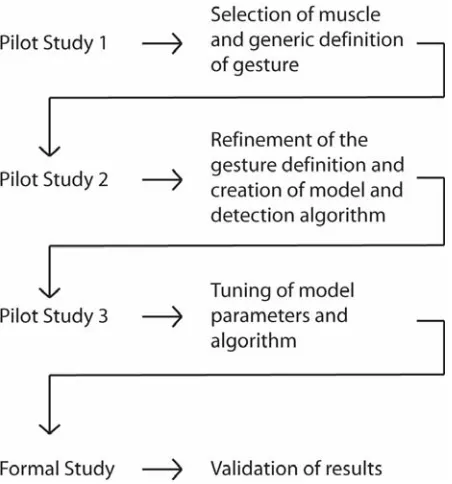
The system design was carried out as an iterative process centred on users. A number of exploratory informal user studies were performed to insure that the system would be natural and easy to use. Figure 1 summarizes the process. From the hardware point of view the system is quite straightforward and not very different from other EMG controllers described in the literature. The device includes an high input impedance amplifier connected to electrodes, an anti-aliasing filter, a microcontroller to sample and process the EMG signal and a Bluetooth communication module to transmit the processing results. All of the processing takes place in the microcontroller: when a gesture is recognised, an appropriate message is transmitted via Bluetooth. For the preliminary experiments, however, the wearable device streamed the amplified sampled signal via Bluetooth, and the processing took place on a standard Windows PC.
The design of the recognition algorithm and the definition of the gesture were carried out in parallel to satisfy two requirements: the gesture should be (1) natural for people to perform, and (2) different enough from “normal” muscle activity to avoid misclassification (“false positives”). The process started with a pilot study to select one muscle and subtle isometric contractions that could serve the definition of “motionless gesture”. The subjects for this pilot were chosen so that a range of different muscle volumes were tested. Initial candidates for the muscle selection were: the temporalis, the bicep, the triceps, the forearm, the abdominals and the calf. Factors considered for the decision included: ease of electrodes placement, quality of the acquired signal and the type of activity that
each muscle contributes during normal movement such as walking. The test revealed the bicep as the best candidate because it lies superficially making the signal fairly immune to activity generated by other muscles, and it is well defined even in non-athletes. The gesture was defined as a brief contraction, such that it could be performed without being noticed, while the arm is unfolded, parallel to the body while the user is standing.
A second informal study was conducted to refine the definition of the subtle gesture and create a model and algorithm for its detection. New subjects participated in the study and were chosen for a variety of muscle volumes. EMG signals were recorded from subjects performing the selected contraction and compared with the signals generated by other types of muscle activity, such as moving in an indoor space, lifting objects of various weights and gesticulating while talking.
The subjects were informed that the purpose of the study was to define a subtle gesture that could be used to control mobile devices. The gesture was described to them in a not detailed way (just as a “brief contraction of the bicep, i.e. the upper arm, that would not be very evident”) so that they had some freedom in the way they performed it. With this procedure we wanted to see whether such a definition of “brief contraction” would be consistent across individuals, and to ensure that the gesture definition would be, to a certain extent, natural to perform, rather than defining a gesture a priori and ask/force the users to learn it.
[image:4.612.63.289.53.295.2]The model resulting from the second study, depicted in Figure 2, is based on the standard deviation of the EMG signal, calculated with a sliding window of duration 0.2s overlapping for 75% of its duration. The standard deviation was chosen to smooth the data and emphasize discontinuities in the energy of the electromyogram. The window size was selected to be the longest possible without filtering out interesting features. A mathematical model and a recognition algorithm for the brief contraction were then created heuristically from the observation of the data. A
[image:4.612.322.558.56.232.2]Figure 1 Design process outline.
brief contraction was observed to correspond to a peak in the standard deviation of the signal. Given the noise-like characteristics of the EMG signal [3], standard peak-detection techniques could not be employed. Such peaks were rather modelled as follows: an interval “beginning” of duration TB of low activity (silence) followed by an interval
“middle” of high activity of duration TM and then again low
activity for an interval “end” of duration TE. High activity
and low activity were defined respectively as the standard deviation of the signal being above a threshold H and below a threshold L. To allow some tolerance in the model, the condition on the history is imposed on the average of its values. The condition on the middle needs to be satisfied by 50% of the samples, and the condition on the end by 70% of the samples.
The model definition is stricter on the duration of the contraction rather than its intensity. This is because the preliminary study showed that the duration was more consistent than the intensity across users, despite the fact that no specific indication was given about either. One disadvantage of this model is that it requires the gesture to be completed before the recognition can take place. The recognition could be made faster by removing the “end condition” for the closure of the gesture; however, this would cause an increase in the number of false positives. The tuning of the five parameters of the model required a third informal study. New and returning users were informally asked to test the system. The testing was conducted to stress the system to produce false positives and false negatives. The iterations recurred until the number of false positives approached zero and the system recognised contractions performed by any user.
Once the recognition worked robustly on one gesture, the possibility of creating a gesture alphabet of two gestures was explored. The gestures were defined as two short subtle contractions of different durations. This corresponded to varying the value of TM in the model
together with its tolerance. The results obtained at this point were then validated with the formal user studies reported in the next section.
FORMAL USABILITY EXPERIMENT
An experiment was conducted to assess the usability of EMG as a subtle interaction technique for mobile devices. The experiment evaluated the system usability in a mobile context. The study was conducted using a setup similar to the one successfully employed by Pirhonen et al. [24], which provided a reasonably realistic environment to test the system while the user was mobile and still maintain enough experimental control to measure performance.
Experimental Design
Participants were 10 adults: 5 women and 5 men, ages 23 to 34, all were colleagues who volunteered for the study. Subject 8 participated in a pilot study; all others were naive. Using the wireless EMG device, the participants
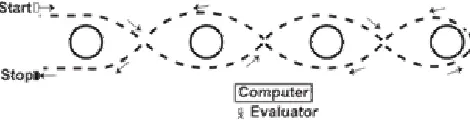
performed five walking tasks, one without contracting (to determine the devices misclassification rate), and four while making contractions of different durations. Each of the four contraction tasks was preceded by a short familiarization session. While walking, participants navigated 24 meter laps around obstacles setup in a regularly trafficked walkway in Media Lab Europe, see Figure 3. This setup was similar to the one reported by Pirhonen et al.[24] who noted this mobile context allows us to “take measurements of the usage of the device whilst the users were mobile but was not as formally controlled as a laboratory study, which would lack realism and ecological validity."
Participants were given written instructions that informed them the study was assessing EMG as a subtle interface for mobile devices and they would control the system using their bicep while walking using a subtle contraction that could be performed with their arm relaxed at their side. Participants were also instructed the contraction recognised has a minimum and maximum duration and a minimum strength requirement. No further instructions were given for the subtleness of the contractions, thus it was subjective to the participant to define subtly.
We refer to the four contraction tasks the participants performed as ‘generic’, ‘short’, ‘long’, and ‘mixed' contractions. During these tasks participants were prompted to contract with an audio stimulus in the form of a MIDI piano tone delivered through wireless headphones. In the generic task participants attempted to consistently make contractions that the system would recognise. In the short task they attempted to consistently make the shortest contraction the system would still recognise. In the long task they attempted to consistently make the longest contraction the system would recognise. In the mixed task they attempted to make both long and short contractions when given corresponding stimuli. Each task was preceded by a short familiarization session.
During the familiarization sessions participants stood and only heard an auditory feedback when the system recognised a contraction. No coaching or further feedback as to the amplitude or duration of the contraction was given to the participants, so they were unaware of why the algorithm was or was not recognizing the contraction. They were only aware if the contraction was recognised. This was also true for the walking tasks.
[image:5.612.321.556.55.115.2]In all contraction tasks the same real-time detection algorithm was used across participants without calibration or modification, and it recognised contractions of duration
between 0.3 and 0.8 seconds. If the system detected a muscle contraction participants were given auditory feedback in the form of a MIDI trumpet tone delivered through wireless headphones. No further feedback was given, thus when performing contractions participants were quantitatively unaware of the contraction's duration. This minimal feedback was given to establish if the users could learn to use the feedback without specific training.
Subjective workload was measured with the NASA TLX [11] scales after each walking contraction task to assess demands imposed by the EMG controller and the different contraction types. Workload is important because in a mobile environment users have less attention to spend on the interface and interaction technique because they are monitoring and navigating their surroundings [24], an additional complexity is introduced when the interaction technique uses the same body parts used while mobile. Therefore, an interface and interaction technique with a lower workload will be more successful in a mobile context [24].
For the system setup, the participant’s skin was first prepared with an abrasive gel to ensure signal quality. In pilot studies, it was found the pre-gelled electrodes did not require skin abrasion unless users used skin creams or lotions earlier in the day. For consistency, all participants were abraded in this formal study.
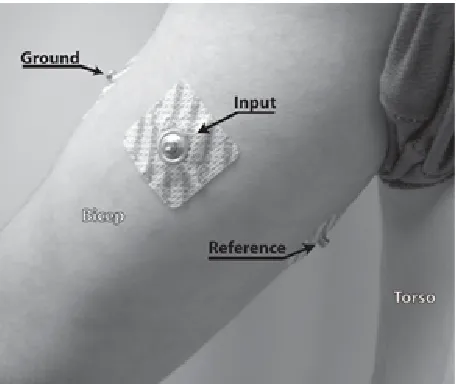
After abrasion, disposable, sold-gel, self adhering, Ag/AgCl 9mm disc surface electromyogram (SEMG) electrodes were applied in three positions around the upper arm of the subject's dominant hand such that the input electrode was centred on the bicep brachii, reference was on the inside middle of the upper arm below the bicep, and ground was placed on the middle outside of the upper arm see Figure 4. The electrodes were placed around the upper arm to test the feasibility of embedding them in an
armband. For participants 1, 2, and 4 the reference and ground positions were swapped because the inner reference pressed against their bodies while walking causing deflection artefact.
After the electrodes were applied, the wireless EMG device was mounted to the upper arm with an elastic band between the electrodes and elbow. The wireless EMG device streamed 10 bit values at 80 Hz over serial Bluetooth to a 2 GHz Pentium 4 PC running Windows XP. The BCI2000 software framework [29], running on the PC, was used for signal processing and stimulus presentation. While the contraction detection algorithm was simple enough to run on the device's micro-controller, it was implemented under BCI2000 to allow real-time monitoring of the EMG signal and classification output for the experiment.
Tasks
All subjects participated in all tasks: within-subjects design. The tasks proceeded in order as follows, however, the short and long contraction tasks were performed in counterbalanced order, such that a participant randomly performed short or long first. The tasks in detail are: 1. Walking, No Contractions
While wearing the wireless EMG device participants were instructed to walk ten laps at their preferred walking speed. 2. Standing, Familiarization, Generic Contractions
Participants were given the wireless headphones, and told to briefly contract their bicep freely in order to familiarize themselves with the system. The familiarization ended when either the participant was confident interacting with the system or a fifteen minute time limit was reached. If participants could not confidently use the system after the time limit they were verbally given feedback as to why their contractions were not controlling the system. This was only necessary for participants 2, 9, and 10; who were only told once to shorten their contractions, and then they were quickly able to control the system.
3. Walking, Stimulus-Response, Generic Contractions Subject's walked the obstacle course and attempted to contract when they heard an audio stimulus through the wireless headphones. Participants were randomly presented 15 (SD=5) stimuli.
4. Standing, Familiarization, Short Contractions
[image:6.612.61.289.53.245.2]Similarly to generic contraction familiarization, participants stood and only heard an auditory feedback when the system recognised the contraction. The system recognised the same contraction duration as in the first two tasks; it was subjectively up to the participant to define the short contraction. Participants were again instructed the system recognised a contraction of certain duration and they should explore the limits of the system. When they were comfortable making the shortest contraction they thought
Figure 4 Electrode positions on upper arm. Input is on the bicep, ground is on the outside of the arm, reference is on
the system would still recognise the experiment continued with the next task.
5. Walking, Stimulus-Response, Short Contractions
Participants walked the obstacle course again and attempted their short contraction when they heard an audio stimulus through wireless headphones. Participants were randomly presented 15 (SD=5) stimuli.
6. Standing, Familiarization, Long Contractions
Participants stood and only heard an auditory feedback when the system recognised the contraction. The system recognised the same contraction as in the previous tasks, it was subjectively up to the participants to define the long contraction. When they were comfortable making the longest contraction they thought the system would still recognise the experiment continued with the next task. 7. Walking, Stimulus-Response, Long Contractions
Participants walked the obstacle course again and attempted their longest contraction when they heard an audio stimulus through the headphones. Participants were randomly presented 14 (SD=3) stimuli.
8. Walking, Stimulus-Response, Mixed Long and Short Contractions
Finally, participants were instructed to walk the obstacle course again and make both short and long contractions when they heard either a high pitched MIDI piano tone (short contraction) or low pitched MIDI piano tone (long contraction) stimulus. Participants were randomly presented 23 (SD=5) total stimuli: 12 (SD=3) short and 11 (SD=3) long.
RESULTS
No false positives were detected while online during the first walking task. In addition, the online recognition rates for the four contraction walking tasks were: generic 96%, short 97%, long 94%, and mixed 87%.
In the first familiarisation task, participants were able to control the system in an average of 3.75 minutes (SD=2.17), excluding the three participants who reached the fifteen minute time limit and required additional feedback. The participants given feedback (2, 9 and 10), all had the same difficulty that their contractions were too long. They were told once to make their contractions shorter and then they were able to control the system in 11.75, 1.78 and 5.48 minutes respectively.
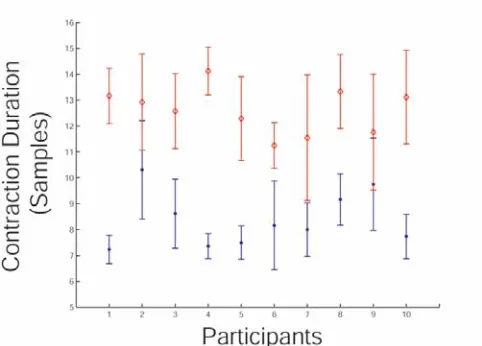
As mentioned in the Design Process, offline analysis was performed on the data from the short and long contraction walking tasks to determine if short and long contractions are separable into two gestures for control. Figure 5 shows the mean and standard deviations for the short and long contraction durations. From the data, a duration boundary of 0.5 seconds was used to create a new recognition algorithm that recognised long and short contractions
separately. As with the original algorithm, only the first recognition was counted, any additional recognition was ignored until the next stimuli. Applying this new short-long detection algorithm to the mixed contraction data resulted in an overall accuracy of 51%, with 55% shorts recognised and 47% longs recognised. The misclassification rate for shorts as longs was 33%, and the misclassification rate for longs as shorts was 11%.
DISCUSSION
Users were able to control the system consistently with only the feedback that a contraction was recognised. The generic contraction’s accuracy of 96% indicates EMG can be used successfully as a controller.
The recognition of short and long contractions offline using the mixed data set was fairly low. This may have occurred because the online algorithm recognised a small range of contraction durations; therefore the longs may not have been sufficiently different from the shorts for the participants to accurately produce them. The range of contraction durations was set from pilot studies which indicated most false positives occur from very long muscle contractions, therefore a trade-off between reproducibility of long and short contractions and increased false positives may occur if the range is widened.
It is important to note the durations of the short and long contractions are subjective because the participants were not given feedback to their actual durations. Therefore the participants trained themselves on what they considered were long and short contractions. If the participants were given feedback for their contraction durations, they may learn to consistently make different long and short contractions.
There were no significant differences in the subjective workload tests between contraction tasks (one-way ANOVA F4,45=0.39,p<0.82). Though not reflected in the
[image:7.612.317.558.56.229.2]workload score, after the experiments some participants
Figure 5 Mean and standard deviation error bars for long and short contraction durations. Closed circles indicate means for
stated they felt longs were more difficult than shorts. In addition, we noticed the three participants that required feedback in the first familiarization task became frustrated when they could not make the system recognise their contractions; however, at the end of the experiment they were comfortable using the system.
CONCLUSION AND FUTURE WORK
This paper has shown that an EMG based wearable input device can be effectively employed in a mobile context for subtle and intimate interaction. The system presented is able to reliably recognize a motionless gesture without calibration or training across users with different muscle volumes.
During the experiment we observed that the participants performed the gesture subtly and inconspicuously, which indicates motionless EMG gestures can be utilized as a socially acceptable alternative for mobile device interaction. As proposed, in combination with eyeglass displays and/or audio output, an EMG controller forms a closed loop “hands free” system that is advantageous in situations where the principal task occupies the hands or environments where obtrusive interaction techniques would be annoying to surrounding people.
Further user studies should test the system in more complex “real world” scenarios, such as lifting objects or interacting socially, and have viewers rate the subtlety from the social perspective. The simplicity of the gesture recognition algorithm illustrates that it is possible to obtain interesting results even without calibration. Further development should include the use of more advanced analysis techniques, such as autoregressive modelling, which has been reported to be successful in some EMG literature [14]. We are working on expanding the EMG gesture alphabet for increased levels of control. While, further work on the signal processing may make it possible to recognize multiple subtle gestures from a single muscle, it appears more practical to define a more extended interface using different controllers on various muscles (e.g. on both arms). In general, this studied showed EMG based input devices can be effectively used to design mobile interfaces that are subtle and intimate.
ACKNOWLEDGMENTS
The authors would like to acknowledge Alberto Perdomo and Juanjo Andres Prado in our group for hardware design and support. Our thanks also go to the MINDGAMES group for extra support with hardware.
Thanks to Ian Oakley, Media Lab Europe, for the invaluable suggestions and Justen Hide at the University of York for the constructive comments.
REFERENCES
1. Ängeslevä, J., O’Modhrain, S., Oakley, I., Hughes, S. Body Mnemonics. Proc. Physical Interaction (PI03) –
Workshop on Real World User Interfaces, a workshop at the Mobile HCI Conference 2003.
2. Barreto, A., Scargle, S., Adjouadi, M. Hands-off human-computer interfaces for individuals with severe motor disabilities. Proc. HCI International 1999, 970-974.
3. De Luca, C.J. Physiology and Mathematics of Myoelectric Signals. IEEE Transactions on Biomedical Engineering, Vol. BME-26, No.6, June 1979.
4. De Luca, C.J. Surface Electromyography: Detection and Recording. Whitepaper, DelSys Inc., 2002. http://www.delsys.com/library/papers/SEMGintro.pdf
5. DeVaul, R., Sung, M., Gips, J., Pentland, A. MIThril 2003: Applications and Architecture. Proc the 7th IEEE International Symposium on Wearable Computers, 2003.
6. Dubost, G., Tanaka, A. A Wireless, Networked-based Biosensor Interface for Music. Proc. International Computer Music Conference, 2002.
7. Fistre, J., Tanaka, A. Real Time EMG Gesture Recognition for Consumer Electronics Device Control.
Presented at Sony CSL Paris Open House 10/2002, http://www.csl.sony.fr/~atau/gesture/.
8. Fitzmaurice. G., Ishii, H., and Buxton, W. A. S. Laying the Foundations for Graspable User Interfaces.
Proceedings of CHI’95, pp 422-449.
9. Geelhoed, E., Falahee, M., Latham, K. Safety and Comfort of Eyeglass Displays. Proc. of the 2nd international symposium on Handheld and Ubiquitous Computing, 2000, p.236-247.
10.Harrison, B.L., Fishkin, K.P., Gujar, A., Mochon, C., and Want, R. Squeeze me, hold me, tilt me! An exploration of manipulative user interfaces. Proc CHI 1998, ACM Press (1998).
11.Hart, S. G., Wickens C. Workload Assesment and Prediction. In Booher, H.R., ed. MANPRINT, an approach to system integration, Van Nostrand Reinhold, New York, 1990, pp 182-188.
12.Headon, R., Coulouris, G. Supporting Gestural Input for Users on the Move. Proc IEE Eurowearable '03, pp 107-112.
13.Healy, J., Picard, R. Digital Processing of Affective Signals. Proc. ICASSP (1998).
14.Hefftner, G., Zucchini, W., Jaros, G.G. The Electromyogram (EMG) as a Control Signal for Functional Neuromuscular Stimulation-Part I: Autoregressive Modeling as a Means of EMG Signature Discrimination. IEEE Trans. Biomed. Eng., vol. 35, pp. 230-236, April 1988.
16.http://www.bodymedia.com/
17.http://www.eyetap.org/
18.http://www.microopticalcorp.com/
19.Ishii, H. and Ullmer, B. Tangible bits: Towards Seamless Interfaces between People, Bits, and Atoms.
Proceedings of CHI’97, pp 234-241.
20.Kasai, I., Tanijiri, Y., Endo, T., Ueda, H. A Forgettable near Eye Display. Proc Fourth International Symposium on Wearable Computers (ISWC'00).
21.Knapp, B., Lusted, H. A Bioelectric Controller for Computer Music Applications. Computer Music Journal, vol. 14, No. 1, Spring 1990.
22.Lumsden, J., Brewster, S. A paradigm shift: alternative interaction techniques for use with mobile & wearable devices. Proc. of the 13th Annual IBM Centers for Advanced Studies Conference CASCON’2003
23.Oakley, I., Angesleva, J., Hughes, S., O'Modhrain, S. Tilt and Feel: Scrolling with Vibrotactile Display. Proc EuroHaptics'04.
24.Pirhonen, A., Brewster, S.A., Holguin, C. Gestural and Audio Metaphors as a Means of Control in Mobile Devices. Proc. CHI 2002, ACM Press 2002.
25.Poupyrev, I., Maruyama, S., Rekimoto, J. Ambient touch: designing tactile interfaces for handheld devices.
Proc UIST 2002, ACM Press (2002), pp 51-60.
26.Putnam, W., Knapp, B. The Use of the Electromyogram in a Man-Machine Interface. Proc. of
the Virtual Reality and Persons With Disabilities Conference, June 1993.
27.Rekimoto, J. GestureWrist and GesturePad: Unobtrusive Wearable Interaction Devices. Proc. 5th IEEE International Symposium on Wearable Computers, 2001.
28.Rekimoto, J. Tilting Operations for Small Screen Interfaces. Proc. UIST'96, 1996.
29.Schalk, G., McFarland, D. J., Hinterberger, T., Birbaumer, N., Wolpaw, J. R. BCI2000: A general-purpose brain-computer interface (bci) system. IEEE Transactions on Biomedical Engineering, 51(6):1034-1043, 2004.
30.Tanaka A., Knapp B. Multimodal Interaction in Music Using the Electromyogram and Relative Position Sensing. Proc NIME’02.
31.Trejo, L.J. Wheeler, K.R. Jorgensen, C.C. Rosipal, R. Clanton, S.T. Matthews, B. Hibbs, A.D. Matthews, R. Krupka, M. Multimodal Neuroelectric Interface Development. IEEE Transactions on Neural Systems and Rehabilitation Engineering, June 2003, Vol. 11, No. 2, pp 199- 203.