Socrates, Trust and the Internet
Kieron O’Hara
Dept of Electronics and Computer Science University of Southampton
Highfield
Southampton SO17 1BJ United Kingdom
Abstract: Socrates, one of the world’s greatest philosophers, never wrote anything, and confined all his philosophy to spoken debate. The important issues for Socrates were trust and control: he felt the radical decontextualisation that resulted from the portability and stasis of written forms would obscure the author’s intentions, and allow the misuse of the written outside of the local context. Trust has once more become a central problem, both politically and epistemologically, but since Socrates’ day, various technologies have undermined his distinction, making the relationship between trustworthiness and linguistic mode more complex. In this paper, I review the state of the art in Internet technologies, showing (a) how developers and authors attempt to establish trust in their websites or e-commerce processes, and (b) how new work in dynamic content creation further blurs the spoken/written and global/local
distinctions.
Introduction
The interrelations between technology, society and psychology are marked and deep. Artefacts play a central role in the development of both social constructs and individual psychology. Accordingly, technological change can be highly disruptive of settled forms of life; even very mundane technologies can be highly transformative. Indeed, it may perhaps be more accurate to say that especially mundane technologies are
transformative. Though the invention of movable type seems, with historians’ hindsight, to be a straightforward and rather dull extension of existing technology, it goes without saying that efficient and cheap printing, mundane as it is, has proved about as
transformative as it gets.
The central importance of the development of technologies for writing – indeed writing as a technology itself – has long been acknowledged, if not fully understood (McLuhan 1962, Ong 1982, Havelock 1963). Plato must be seen as the pioneer, the explorer who began to develop the virgin ground, in a series of brilliant, often contradictory, works, the Republic, the Phaedrus, the Ion, the (possibly fake) Seventh Letter. His instincts, as ever, were correct; Western philosophy is a series of footnotes to Plato precisely
because of his unparalleled ability to locate the permanent fault lines of a controversy. Much of his work involves deep meditation on the likely effects of the shift in Ancient Greece from a primarily oral culture to one which might reasonably be called literate (Havelock 1963).
case of writing, for example, the effect is – in the modern argot – to outsource memory), thereby conserving psychological resources. On the other hand, questions are inevitably raised about whether such developments dehumanise us in some crucial respect, and whether the technological implementation of the faculty is trustworthy, or suitably sensitive to its no doubt highly nuanced social context (O’Hara 2004).
The latest in this stream of linguistic technologies is the Internet (O’Hara 2002a). The Internet may or may not have a big effect on society; clearly in a world where half the population has never made a telephone call, its effects will be limited (though equally there are an estimated 654 million people online). Nevertheless, in the decade or so since the development of the World Wide Web lifted it out of the academic ghetto of computer nerds, the Internet has begun to influence many lives, not only in the developed world, quite dramatically (for good or ill). More information is now stored and disseminated over the Internet than we can really imagine.
With this phenomenal resource, trust is naturally an issue. How much of this information, how many of the computing services that the Internet provides, are
trustworthy? How can we possible investigate over such a giant domain? In this paper, I would like to argue that, happily, many of the latest Internet technologies coming on stream now, many still in prototype form, will help provide some answers to questions of trust. In particular, the capabilities afforded by the Semantic Web, a new extension of the World Wide Web, will allow some rigorous interrogation of documents and various other automated interlocutors. To see how this helps, we will need to review the
technologies underlying the Semantic Web, and show how they can help meet some of the problems that linguistic technologies perennially face.
Accordingly, the paper has the following structure. We begin with a quick review of the relevant technologies that make up the Internet and the World Wide Web, and then move on to describe how they have been extended and improved in the development of the concept of the Semantic Web. The next section shows how trust fits into the original conception of the Semantic Web; the issue of trust was always anticipated as being of central concern here. Having introduced trust in the context of modern technology, we will then rewind several centuries, and review Socrates’ arguments about trust, orality and literacy in Plato’s dialogue the Phaedrus. What is interesting about the Semantic Web in this context is that the technology begins to blur the contrast between the spoken and the written, and therefore in some ways provides an avenue to online trust by
addressing Socrates’ arguments, and we outline this with some examples from the latest computer science research. In the final section, we will discuss how far we can take these conclusions, and also the prospects for Semantic Web technology.
The Internet and the World Wide Web
dynamically, individually for each packet, rather than there being any fixed route; by these means it is extremely hard to disrupt Internet traffic, because if some key line gets cut, dynamic routing will simply work out another route to send the packets. Once all the packets arrive – in the blink of an eye – the target computer reassembles them in the right order, and voila, it has an exact copy of the original data file.
That is all we are going to say about the Internet as a whole, except to remark that it is a very mundane technology, and it has had undeniably giant effects. For the rest of this section, we will focus on the World Wide Web (WWW).
The WWW is part of the Internet, and so functions in the same way. It is the multimedia part of the Internet, and it is arguably the great success of the WWW in the early 1990s that lifted the Internet out of the computer science department, and into public and commercial life. Information is presented on the WWW in webpages, which can show text, pictures, sounds, movies etc together. The ability of the Internet to move large amounts of information around quickly and seamlessly has helped commercial
development; firms can put pictures and text about their goods and services online, and people can send orders through immediately. Customers can find out about a whole range of goods, comparing prices and quality, without leaving their desks, and so save themselves large amounts of shoe leather; this is what economists call cutting
transaction costs.
The WWW is based on a particular computer language, HTML (the Hypertext Markup Language). Webpages are created by commands in HTML – you can see raw HTML if you look at a webpage, and click on the menu command ‘view source’ (this command may be slightly different in different webpage browsers). Because HTML is the
common WWW language, webpages are always more or less alike, and can all be seen by the main browsers, such as Microsoft’s Internet Explorer, or Netscape’s Navigator. HTML tells your computer how to arrange all the information in a webpage on a screen, where the text should go, how it should be formatted, where the pictures fit, how the different panels of text should fit together, and so on; it controls the look of the page.
The key to the usability of the WWW is that users should be able to find the page they want easily; this is not a trivial task, given that there are about 550 billion web
In ye olden days, when the WWW started, you had to type in each web address, and remember them from one time to the next; as web addresses became very long and complex, that was of course very tedious. The web would get nowhere that way. Two essential improvements made it possible to navigate through the giant quantity of information on the web. The first were hyperlinks. HTML allows the writer of the webpage to insert links to other webpages; they generally appear in blue on a webpage. If the user clicks the mouse on a hyperlink, then he will move to the new web address. This allows a set of pages to be linked associatively, so reading becomes non-linear and there are many different routes through material. A writer can also link to other people’s pages, so, for example, an online news report about the Liberal Democratic Party could link to other articles about the party, Mr Koizumi’s personal webpage, pages explaining Japan’s political system, and so on. This allows very interesting methods of
commentary; http://eliotswasteland.tripod.com/, for example, contains the text of Eliot’s
Waste Land with links between not only the various images deployed through the poem, but also out to other relevant pages (e.g. to an online exegetical Bible for the biblical references, to an online version of Dante’s Commedia, etc).
The second innovation was the development, in the mid-90s, of search engines, which could search, more or less accurately, through the information on the web. These engines, which have their own web addresses, and which include Google and Yahoo!, allow you to suggest a key word or phrase, and then will find all the webpages that contain that phrase. Artfully chosen key words cut down the search time for users massively.
The Semantic Web
Anything wrong with that? Currently, not quite. But the WWW is actually reaching the limits of capacity. Google, the market leader, is a brilliant search engine, that actually looks around intelligently for the best pages to refer you to (see O’Hara 2004, Chapter 5 for a discussion of Google’s PageRank system). But the more information that appears on the web, the less use a simple key word system is; it will give you too many
irrelevant hits. The trouble with key words is that they are uninterpreted; if your key word is, say, Bush, a key word system is unable to tell the difference between George Bush, Kate Bush, the African Bush or the metal lining of an axle-hole (known as a bush, believe it or not).
Hence, as the WWW reaches its limits, work is already commencing on its successor, the Semantic Web (SW). The aim of the SW is to give the computer the ability to interpret the key words for you, to search much more intelligently (Berners-Lee et al 2001, O’Hara 2002a, 49-52). In this section, we’ll discuss briefly how this will work, and how it has extended the concepts underlying the WWW. Warning: technophobes should take this section slowly; it will come to resemble alphabet soup very quickly!
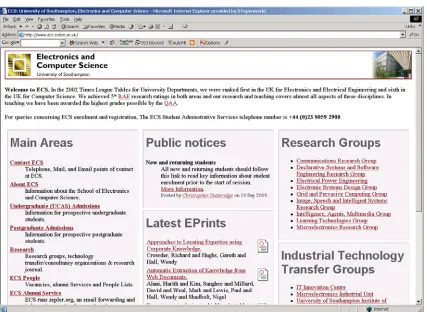
So, for example, if we take a webpage such as the home page of my department, shown in Figure 1, HTML tells the computer to take the text ‘University of Southampton’ and to display it in a certain position in a certain font. XML will allow you to tell the
[image:5.595.86.513.162.474.2]computer not only that, but also that ‘University of Southampton’ refers to a university.
Figure 1: http://www.ecs.soton.ac.uk
However, that is not enough. The computer can do very little more with that information than it could do before. Therefore the SW needs another bit of kit, the
Resource Description Framework (RDF). RDF is a framework that brings together three things, two objects, and a relation between them. So, for example, the two objects might be ‘University of Southampton’, and the picture in the top right of Figure 1 (which will be a file, perhaps called something like ‘soton.jpg’). RDF lets you tell the computer that there is a relationship between the two: the relation might be called ‘picture-of’, and so RDF lets us assert that ‘soton.jpg picture-of “University of Southampton”’ – i.e. that the picture at the top right is a picture of the University of Southampton. This is obvious to the human reader of the page, but it will be news to the computer.
An ontology is a specification of the language and concepts of a restricted domain of discourse, and gives as it were the conceptual background to the words and phrases used in XML and RDF. These words and phrases are therefore defined in terms of each other, which specifies a little web of interrelated concepts. Naturally the technology is too weak to say that the computer understands anything (in other than metaphorical senses), but an ontology will provide the beginning of a little web of terms in the sense of Quine and Ullian (1970). So the computer could be told, for instance, that a
university is a type of educational establishment, that it has students and lecturers, an
address, a website, a telephone number, that the lecturers will include professors, senior lecturers and readers, that the students will include undergraduates and postgraduates, that the postgraduates will have degrees, that these degrees will be in subjects, and will have been awarded by educational establishments, and so on. The ontology links together all the concepts and terms that will help the computer to make holistic sense of the terms like ‘university’ that were being used in the XML specification of the
webpage.
Figure 2: From the WWW to the SW (taken from Koivunen & Miller 2001)
Trust and the Semantic Web
What, then, does this have to do with trust? Actually, the role of trust was built into the standard conception of the SW right from its beginnings. Figure 3 was developed by Tim Berners-Lee in order to articulate the layers of expression, comprehension and inferential power that would be required by his conception of an extension of the WWW that supported intelligence.
[image:7.595.97.510.498.715.2]How do we interpret these layers? At the bottom are Unicode (a standardised system for encoding data) and URIs (Uniform Resource Identifiers – web addresses). These are the nuts and bolts of the SW. But there is no point having these unless you have XML to tell you what they refer to. And there is no point having XML unless you have RDF to tell you how those things relate to each other. Similarly, there is no point having XML and RDF unless you have ontologies to explain the significance of the XML classes and RDF relations. There is no point having ontologies without logic to provide methods of inferring one thing from another. There is no point inferring things without a theory of proof to tell you that the inferences are sound.
And, finally, there is no point having a system of proof unless those who will use it (in the case of the SW, this means the 654m Internet users) have confidence in it. Without trust of the users in the system, the SW will never get off the ground.
Trust and orality in the Phaedrus
So trust is essential to the SW. This brings us back round to the question of what trust is, how it operates, and how it can be fostered (Misztal 1996, Fukuyama 1995, O’Hara 2004). These questions have long been pondered over; in this paper, I would like to focus on some interesting and still-relevant work by Plato. In his early work the
Phaedrus, Plato represents Socrates as arguing as follows.
SOCRATES: You know, Phaedrus, writing shares a strange feature with painting. The offspring of painting
stand there as if they are alive, but if anyone asks them anything, they remain most solemnly silent. The same is true of written words. You’d think they were speaking as if they had some understanding, but if you question anything that has been said because you want to learn more, it continues to signify just that very same thing forever. When it has once been written down, every discourse roams about everywhere, reaching indiscriminately those with understanding no less than those who have no business with it, and it doesn’t know to whom it should speak and to whom it should not. And when it is faulted and attacked unfairly, it always needs its father’s support; alone, it can neither defend itself nor come to its own support. (Plato 1997, 275de, p.552)
Socrates, of course, wrote nothing; what we know of him is filtered through the testimonies of contemporaries, notably Plato and Xenophon. However, my feeling is that this passage, and the whole of the discussion of orality, literacy and trust in the
Phaedrus may well be a representation of Socrates’ authentic voice.
Third, once the written word goes out, it is more or less fixed (this is even more the case since the introduction of printing – Ong 1982), whereas a spoken message, since it has to be repeated anew each time it is reproduced, can alter with time, responding to changes in context. Fourth, with the spoken, the audience can engage in interrogation of the speaker, determining whether the speaker ‘really’ knows what he is talking about, clarifying points and raising objections. With the written, the audience cannot do this. Fifth, the spoken is fixed in time, it is anchored to a context, and can be properly evaluated only in reference to its context. The written is similarly context-bound, but it is trivial to take the written out of context.
This model of trust is very interesting. Of course, in a small society, such as a Greek city-state such as Socrates’ Athens, trust can work easily on this model. But even now, this distinction between spoken and written underlies many models of trust. In a court, for example, evidence has to be given orally, and there must be an opportunity for witnesses to enter into an interrogative conversation with a properly-appointed and trained representative of the defendant in order that the witness’ evidence will be trusted. Written evidence, even in the form of a signed affidavit, is not trusted, and is usually only admitted in the case of trivial or uncontested evidence. Politics is another oral ‘society’; recall the election for the Master of a Cambridge College in C.P. Snow’s novel The Masters, where all the key electioneering is conducted through the medium of the spoken, and the written plays a minor and often obstructive role. And in
education, the oral remains a key mode of evaluation; the oral examination of a PhD thesis is a central part of the assessment of a candidate’s ability to perform written
research!
However, such a model of trust can be quite inhibiting for more complex or distributed societies, as argued for example in (Fukuyama 1995), which claims that the lack of social structures able to support the trust of non-kin is a key explanatory variable for the relatively poor economic performance of countries such as Italy and China, compared to Japan or the USA. The analogy between the spoken and the written, and different types of trust – restricting one’s trust to a local context, or trusting more distributed agents with whom one is personally unacquainted – is suggestive; in fact, pace Socrates, the written word is often trusted, and quite properly, with the help of various institutions, such as peer review, or the publicity and certification of an author’s provenance
(O’Hara 2004). Institutions such as this carry many of the information-processing costs of examining and regulating potential trustees’ bona fides. Trust-bearing institutions have often been seen as essential for the creation of truly modern societies (Fukuyama 1995, Misztal 1996).
The development of the Internet as an anarchic and unregulated space is very central to the value consensus at its heart (Lessig 1999). So the creation of institutions to regulate it will meet resistance (even if it is inevitable). However, what I want to argue here is that the increasing sensitivity to the audience that the SW makes possible will affect the nature of trust online. The distinction between the spoken and the written has blurred since Socrates’ time, in particular with the inventions of recording media (Hughes 1996); technology has always distorted and affected linguistic modes (McLuhan 1962, Ong 1982). The SW is another technology in this tradition. In the next section,
therefore, I will look once more at Socrates’ five marks of the oral, and see whether it will be possible to develop technologies that allow the written to be subject to these conditions.
Socrates’ marks of the oral: trust, expressivity and intelligence
The first mark is that of the control of associations. Hypertext tries to mimic associative memory, the recall phenomenon where someone remembers some very different
experience as a result of present stimuli. The classic literary example of associative memory, of course, is in Proust’s Swann’s Way, where the narrator, upon consumption of a coconut madeleine dipped in tea, suddenly remembers his childhood stays in Combray with his Aunt Leonie, who also used to give him madeleines served that way. Hypertext allows that sort of associative link to be made in a webpage; the reader clicks on any word, highlighted in blue, that interests him, and is taken to a relevant page.
However, hyperlinks in an HTML document don’t exactly model associative memory. They are written by the author of the page; hence continuing the analogy with Proust, the experience would be more like the narrator biting into the madeleine and
remembering some incident from the baker’s past. However interesting this might be, it is hardly an exact model of associative memory.
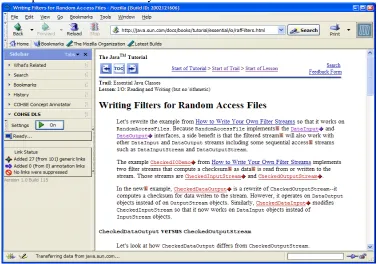
New technology, though, allows the reader to regain control of these associative links. In a piece of software called the Conceptual Open Hypermedia Services Environment (COHSE), the reader is presented with a set of links that are created specifically for him, at the moment that he reads the page (and hence these links might change dynamically over time). Using ontologies to understand the subject matter of the webpage and the interests of the reader, and a collection of interesting links that the software keeps up and maintains, a webpage can be given a set of associative hyperlinks that are tailored to the reader’s interests, not the author’s. Furthermore, the links
created for one reader may well be very different from the links created for another (Carr et al 2001). In this way, the written webpage becomes a little more like a spoken item, as the reader becomes able to control a type of hypertext conversation with the page – the reader, not the author, is able to suggest new topics, as he clicks on the links that interest him (Figure 4).
hypermedia systems, perhaps integrated into a browser, might well be a way to achieve the catholicity of links that Sunstein hopes for, without the weight of regulation that Sunstein expects would be necessary.
Figure 4: The COHSE interface: coloured diamonds denote links generated by the system for the reader
The second mark of the oral is that of the personalisation of content. Again, ontologies and the nimbleness that the SW provides can ameliorate this issue for the written word. Artequakt is a system that creates biographies of artists (Alani et al 2003). The
biographies are created at the moment they are requested, by downloading information from the Internet, matching it against an ontology of art, and reassembling it according to various narrative templates.
Figure 5: The architecture of Artequakt
Figure 6: A dynamically-configured biography of Renoir
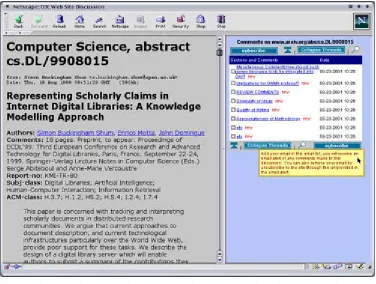
[image:12.595.126.468.390.677.2]comments might well be incorporated into the main text (Ong 1982), but in this case the authorship of the annotations, and the comments or text to which the annotations refer, are made explicit. The author of the document, of course, can also take part in the debate. In this way, the third mark of the oral, the lack of closure of a discourse, can be mirrored in the written as well. Figure 7 shows a D3E discussion of a website; the panel on the right of the window shows the comments laid out for viewing. The comments are as easily readable as the original document, though the original always retains a
[image:13.595.110.486.222.506.2]privileged presentation in its own window, and furthermore the structure of the original is used to structure the presentation of the comments.
Figure 7: D3E
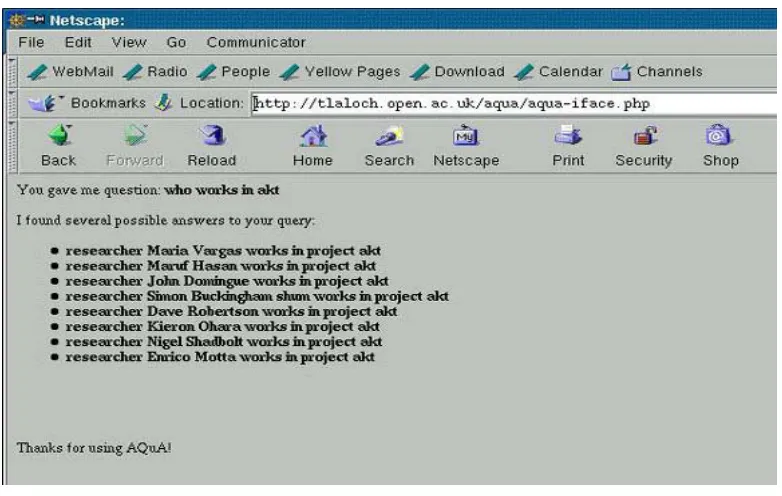
Figure 8: A query to AQUA
Figure 9: Online presence and conversational mapping
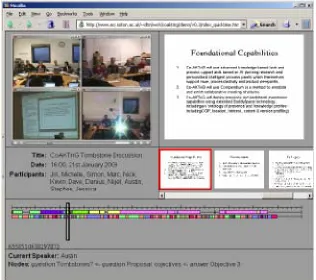
Figure 10: Replay and navigation through a meeting
Conclusion
[image:15.595.141.457.367.647.2]content in real time, allows this primarily written medium to mimic the instantaneity and context-sensitivity of the spoken. The Socratic oral criteria of trust is widely accepted in various sectors of society – as we saw, for example, in education or the law – and so the new expressivity enabled by SW technology is a very important step forward in the creation and fostering of online trust.
Nevertheless, it is still important to ask in what circumstances this adoption of the Socratic marks of the oral will facilitate trust. The answer is that, so far at least, the circumstances will be relatively limited ones. First, we must look for contexts where there is little or no institutional support. Institutions exploit the long-distance
characteristics of the written: memory, regulation, sanction. Institutions spread trust far more efficiently than mechanisms based on speech and personal acquaintance
(Fukuyama 1995). Hence where institutions exist online, with sufficient power over their subjects to enforce trustworthy behaviour, SW technologies are likely to have only a marginal effect on trust.
Second, since the enhancement of interaction is the whole point of the SW innovations, then we must look for contexts where interaction is possible and important. And third, there must be a relative lack of history; where two communities share a history of enmity and mistrust, as for example in Northern Ireland, or in Israel and Palestine, then that mistrust will of course not be removed simply by providing more channels of communication. Substantially more work than that is required for trust to emerge.
There are contexts that meet these characteristics, and in which therefore SW
technology might help provide trust. They are fairly limited, and yet widespread enough for the technology to be of a good deal of social value. They include, for instance, the world of science, the world of academic discussion generally, and business. Political problems will take more time and effort to solve; but in science, academe and business there is a lot of goodwill waiting to be propagated, with tangible and clear benefits for all from greater interaction, knowledge sharing and transfers of resources.
Two final points deserve to be made, to act as a proper dampener on expectations. First, to begin with, much of what I have said in this essay seems to chime in with the theory of technology developed in the 1960s by Marshall McLuhan (McLuhan 1962), who predicted that the development of the new electronic media would, by the instantaneity that they support, herald a return to orality. McLuhan’s coining of the famous term ‘global village’ is more significant here than is often remembered; the village is an acoustic space, where speech will always be more important (because more context-sensitive, more nimble) than writing (McLuhan & Fiore 1967). In a similar vein, Paul Levinson has described how on the WWW the written has been transformed, given speech-like qualities (Levinson 1999).
habits of literacy, the psychology of writing, to become ingrained (Havelock 1963). When the only examples of writing readily available were inscriptions on stone monuments, then that would not be enough to support the internalisation of discourse and the externalisation of memory that, psychologically, were the ultimate effects of writing (Ong 1982). Recall the limited set of contexts in which the SW’s linguistic innovations will be effective; the SW is similarly unpervasive, and its social effects will be correspondingly limited.
And second, we must of course note that potential is not actuality; the SW is a very exciting series of developments, but it could equally go the way of other great
technologies that just didn’t catch on. Its catching on, like the WWW, will depend on the timely creation of brilliant tools that bring in new users – tools such as search engines like Google, or the ability to transfer money around securely in commercial transactions. These tools have yet to be developed, and until they are, the SW will remain a ghetto in the computer science department.
The way we develop, the way we use technology to externalise psychological processes – as first described, memorably, by Socrates in the Phaedrus – is a process that may well be influenced by unpredictable forces, such as market forces, but equally is at least partly under our control. Contra Lyotard, the human/inhuman distinction remains always to be negotiated anew (Lyotard 1991). And, contra the hopes of many
cybertheorists – most prominently Donna Haraway, who seeks to exploit technology as a way of burying identity and breaking down conceptual barriers (Haraway 1991), and Kevin Warwick (Warwick 2002) – the new flexibility that the SW provides will not, for the foreseeable future, bring the Cyborg concept any closer.
The Semantic Web can be radical, and could be transformative. But predicting the course of such transformation is much more difficult than exaggerating it. As computer scientist Charles Jonscher once wrote:
Ihave gleaned two lessons from the history, short as it has been, of electronic technology; they are, inevitably, over-simplifications, but they have been my guide. The first is to regard almost any prediction of the future power of the technology itself as understated. The second is to regard almost any prediction of what it will do to our everyday lives as overstated. (Jonscher 1999, p.248)
References
Alani H., Kim S., Millard D.E., Weal M.J., Hall W., Lewis P.H. & Shadbolt N.R. 2003. ‘Automatic ontology-based knowledge extraction from web documents’ IEEE Intelligent Systems 18(1): 14-21.
Berners-Lee T., Hendler J. & Lassila O. 2001. ‘The Semantic Web’ Scientific American May 2001.
Buckingham Shum S., De Roure D., Eisenstadt M., Shadbolt N. & Tate A. 2002. ‘CoAKTinG: collaborative advanced knowledge technologies in the grid’ 11th IEEE Symposium on High
Performance Distributed Computing, Edinburgh, July 2002.
Buckingham Shum S. & Sumner T. 2001. ‘JIME: an interactive journal for interactive media’
Learned Publishing 14: 273-285.
Carr L., Bechhofer S., Goble C. & Hall W. 2001. ‘Conceptual linking: ontology-based open hypermedia’ 10th World Wide Web Conference, Hong Kong, 2001.
Haraway D. 1991. Simians, Cyborgs and Women. London: Free Association Press. Havelock E.A. 1963. Preface to Plato. Oxford: Basil Blackwell.
Hughes R. 1996. English in Speech and Writing: Investigating Language and Literature. London: Routledge.
Jonscher C. 1999. Wiredlife: Who Are We in the Digital Age? London: Anchor.
Koivunen, M.-R. & Miller E. 2001. ‘W3C Semantic Web activity’ Semantic Web Kick-Off Seminar, Finland 2001.
Lessig L. 1999. Code and Other Laws of Cyberspace. New York: Basic Books. Levinson P. 1999. Digital McLuhan: A Guide to the Information Millennium. London:
Routledge.
Lyotard J.-F. 1991. The Inhuman: Reflections on Time, Bennington G. & Bowlby R. (trans.). Oxford: Blackwell.
McLuhan M. 1962. The Gutenberg Galaxy. Toronto: University of Toronto Press. McLuhan M. & Fiore Q. 1967. The Medium is the Massage: An Inventory of Effects.
Harmondsworth: Penguin.
Misztal B. 1996. Trust in Modern Societies. Cambridge: Polity Press. O’Hara K. 2002a. Plato and the Internet. Cambridge: Icon Books.
O’Hara K. 2002b. ‘The Internet: a tool for democratic pluralism?’ Science as Culture 11(2): 287-298.
O’Hara K. 2004. Trust: From Socrates to Spin. Cambridge: Icon Books.
Ong W.J. 1982. Orality and Literacy: The Technologizing of the Word. London: Methuen & Co. Plato. 1997. ‘Phaedrus’ (A. Nehamas & P. Woodruff, trans.) in J.M. Cooper (ed.) Plato:
Complete Works. Indianapolis: Hackett. 506-556.
Quine W.V. & Ullian J.S. 1970. The Web of Belief. New York: Random House. Sunstein C. 2001. Republic.com. Princeton: Princeton University Press.
Vargas-Vera M., Motta E. & Domingue J. 2003. ‘AQUA: an ontology-driven question answering system’ AAAI Symposium on New Directions of Question Answering, Stanford, March 2003.