Introduction: Falls across Europe
Falling is a common problem of old age1. Approximately
30% of people aged over 65 years fall each year and after the age of 75 the rates are higher1
. Falls are the dominant cause of the injuries among elderly people, and 40-50,000 older people in the 28 countries in EU25 and EEA will die due to a fall every year2. There is a ten-fold difference in mortality
due to falls across the European countries which must be addressed2
. Between 20 and 30% of those who fall suffer injuries that reduce mobility and independence and increase risk of premature death1
. Older people make up a large and increasing percentage of the population of European
coun-tries. As people grow older they are increasingly at risk of falling and suffering injury from falling3
.
Falls are also associated with significant social and psycholog-ical consequences, as people lose confidence and become isolat-ed and restrict their activity4
. A fall may be the first indication of undetected illness3
. Repeated falls often herald a decline in an older person’s functional ability1,3
. Unless action is taken, the number of falls and fall-related injuries is likely to increase over the next 25-30 years1,3. A number of assessment strategies and
interventions targeted at specific groups of individuals in specif-ic settings have been shown to work5,6
. In practice, however, suc-cessful interventions have been put into practice with different population groups and in different settings than the original research suggests they were efficacious. There is an overall need to standardise assessment procedures and tailor interventions to individual situations for effective practice. So far, population-based strategies have not been properly evaluated7
and there is no evidence that successful falls reduction interventions can actually significantly reduce fractures and health care costs1.
This points to the need for monitoring, implementation and fur-ther evaluation of intervention strategies.
ProFaNE (Prevention of Falls Network Europe)8
has been funded by the European Commission (EC) to consolidate and
Prevention of Falls Network Europe:
a thematic network aimed at introducing good practice
in effective falls prevention across Europe. Four years on.
D.A. Skelton and C.J. Todd, on behalf of the ProFaNE group
School of Nursing, Midwifery and Social Work, University of Manchester, Manchester, UK
Abstract
ProFaNE, Prevention of Falls Network Europe, is a four-year thematic network co-ordinated by the University of Manchester, UK, with 25 partners across Europe and funded by the European Community Framework 5. There are also Network Associates from a number of EU and non-EU countries who give their advice and experience at steering meetings, seminars and confer-ences. There are four main themes (taxonomy and co-ordination of trials; clinical assessment and management of falls; assess-ment of balance function; psychological aspects of falling). The work of ProFaNE is practical, in terms of developing the evidence base for implementation of effective interventions, standardising the health processes for people with a history of falls and encouraging best practice across Europe. Over the four years of the Network many key publications by the members have been regularly cited, the web membership has increased to over 2,000 members from 30 countries, there is an active discussion board and there are nearly 1,000 resources available to download. The success of the networking and relationship building in these four years has meant that many countries have adopted new national strategies to prevent falls and injuries.
Keywords:Falls, Fall-related Injuries, Aged, Interdisciplinary Interventions, Assessment
Review Article Hylonome
The authors have no conflict of interest.
Corresponding author: Dawn A. Skelton Ph.D., School of Nursing, Midwifery and Social Work, University of Manchester, Coupland 3, Oxford Road, Manchester, M13 9PL, UK
E-mail: [email protected]
disseminate good practice in taxonomy and clinical trial method-ology as well as detailed clinical assessment and management protocols for those ‘at risk’ of falls. ProFaNE also aims to iden-tify how best to assess balance function and to develop work in psychology across Europe in order to more fully understand consequences of falls, methods to reduce fear of falling and how best to increase adherence to falls prevention interventions.
ProFaNE – Prevention of Falls Network Europe
Membership
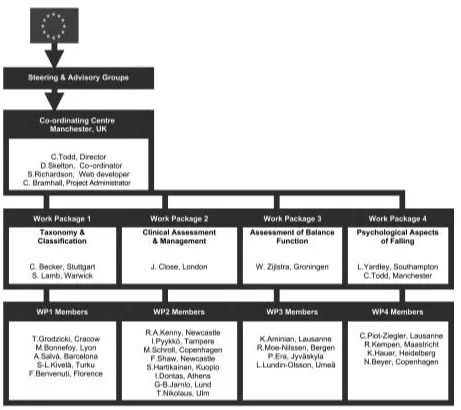
ProFaNE has 24 originators (Figure 1) focusing on the issue of prevention of falls and improvement of postural sta-bility amongst elderly people. It comprises four work pack-ages, which address key areas in the field of trial design, assessments of risk in different settings and fear of falling: (1) taxonomy and co-ordination of trials
(2) clinical assessment and management (3) assessment of balance function (4) psychological aspects of falling.
Working across Europe
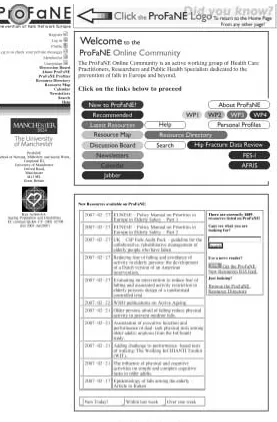
The essence of ProFaNE’s methodology is to engender joint working across disciplines, specialties and sites as well as break-ing down barriers (by speakbreak-ing plain English, standardised ter-minology and exchange programmes) to build a critical mass of scientists and clinicians focusing on falls assessment and effec-tive implementation of interventions. This has been facilitated in two ways; by selected members attending workshops from other work packages and by the use of a state of the art web-based project management system supplied and maintained by the co-ordinating centre in Manchester (Figure 2), which acts both as communication medium within the network and a user-friendly window for the outside world to access the work of ProFaNE. ProFaNE has started to publish papers in non-English language journals to ensure that dissemination is as wide as possible9-11
. Observers from clinical and academic insti-tutions, non-governmental organisations, and policy makers and planners are invited to meetings so as to facilitate the roll out of conclusions, recommendations and protocols into effec-tive practice.
Work to date
The Network has been running for four years, there have been four main Network and combined Work package Meetings (Utrecht, Manchester, Heraklion and Barcelona) and we have convened over 20 workshops, undertaken per-sonnel exchanges, transferred technology and knowledge, set up collaborative studies (funded separately from this Network), sharing data and worked to develop evidence based protocols and other documents which represent state of the art statements on the topic area. ProFaNE’s work has been disseminated at over 30 pan-European and International
con-ferences and a key document for policy makers around Europe, written by ProFaNE members during 2003, was pub-lished by the World Health Organisation1. New funding for
research by members (in their own countries) and collabora-tive pan-European bids have been successful. Some of this success may be due to the backing that the ProFaNE Network can provide to their work. Although aimed at improving prac-tice across Europe, the Network has forged strong links with other groups in Australia, New Zealand and Canada.
Work Package 1 - taxonomy and co-ordination of trials
The Objectives of work package 1 are:
1. To build a network of intervention sites for fall and injury prevention studies.
2. To facilitate technology transfer between researchers. 3. To allow the creation of synergistic effects by common
tax-onomy and outcome measures to enable pooling of data. 4. To facilitate epidemiological studies, intervention trials
and public health policy related to falls prevention in underrepresented European countries.
5. To enable prospective pre-planned meta-analysis and multi-centre trials across Europe.
It is essential that people working in the research and devel-opment of interventions across Europe maximise the poten-tial for reducing falls and related injuries by working together to exchange ideas and technologies. Researchers will be able to address questions that cannot be easily addressed by single centre trials because of the required sample sizes, and also to pool data in prospective meta-analysis. The Network thus aims to facilitate multi-centred studies across Europe. However, any multi-centre trial requires the development of a common language or taxonomy to describe interventions and trial outcomes, a register of ongoing trials and a prospective collaboration of trials and trialists with the intention of under-taking pooled analysis of data from different trials. Experience from the Cochrane Review of Fall Prevention6
has shown that the manner in which interventions are defined and described in primary research has a large effect on the inter-pretation of pooled analyses. ProFaNE have come to consen-sus on a core-set of outcome measures and descriptors would make comparisons much easier12
. This work has been made possible by a series of systematic reviews on falls definitions13
, psychological outcomes14and physical activity measures15.
This work package provides a structured environment to undertake a consensus building exercise to develop a taxon-omy and common data collection system. Full details appear on the ProFaNE website, www.profane.eu.org. The fourth year aims to inform senior organisations, health care providers and policy makers of the current evidence on what works to prevent falls in older people.
Work Package 2 - clinical assessment and management
The Objectives of work package 2 include:
surround-ing falls prevention across Europe.
2. To embrace at national level the different political and health service agendas so that recommendations can be translated into working models of practice in each country. 3. To identify key individuals, societies and organisations
across Europe instrumental in falls prevention.
4. To establish a network of members across Europe to facil-itate dissemination of evidence likely to influence service developments at national and local level.
5. To facilitate the exchange of national and local expertise in falls prevention.
6. To derive consensus for assessment and management of older people at risk of falling using the existing evidence base as well as knowledge of experts in the field.
7. To promote practical and generalisable approaches to the assessment of older people at risk of falling.
This work package focuses on development of consensus
[image:3.609.70.531.64.474.2]in assessment and management of falls in older people across Europe. Fundamental to this process is the development of a clear understanding of how services across Europe are con-figured and the national and international drivers for change. In the first year the work package undertook a series of net-work visits, enabling members to visit other members and also key individuals in European countries to identify the potential opportunities and constraints of developing and delivering falls services in a co-ordinated and comprehensive fashion. It is imperative to identify effective methods of dissemination of the recommendations as methods will differ from country to coun-try. Next, the focus was on development of assessments which can be tailored to a variety of clinical settings, from community-based assessment to highly specialised investigation units. The work package links closely with work packages 3 and 4 to ensure consensus in recommendations. In addition to the recommen-dations for clinical assessment and management, work package
2 provides advice and guidance on evaluation and audit of serv-ices and links closely with work package 1. This year focused on the collation of agreed assessment and evaluation methods, finalising systematic reviews in the areas of assessment and preparation of recommendations for dissemination. In 2007 a fully interactive online assessment and management protocol comes online that can be used as a decision-making tree follow-ing the pathway of a faller through the healthcare process.
Work Package 3 - assessment of balance function
The Objectives of work package 3 are:
1. To identify instruments and procedures that can be used for assessment of balance function in clinical settings. 2. To identify areas where further development is needed.
3. To combine expertise from different disciplines involved in studying balance and transfer knowledge between these disciplines.
4. To co-operate in research.
5. To provide an intellectual environment for interdiscipli-nary projects and dissemination of knowledge into disci-plines working in the clinical field.
The development of effective fall prevention programs requires the understanding of the underlying causes of falls. Measurement tools are needed that predict the risk of falling and give objective assessment of balance function as required in daily life activities16
[image:4.609.175.452.67.489.2]. The ultimate goal of the activities within this work package is to combine the expertise of different disci-plines for the development of balance assessment tools which can be used routinely in clinical settings. To accomplish the
objectives of this work package, existing instruments and pro-cedures for assessment of balance function have been evaluat-ed and so far, a systematic review on the use of force-platforms in balance assessment has been published17
, further reviews of clinical balance measures and dual-task balance assessments are in progress. This work package particularly focuses on the use of lightweight ambulatory equipment that allows for the measurement of human movement under real-life conditions. This novel approach to the analysis of human movement can potentially fill the need for objective field instruments18-20
. However, the approach needs the development of valid, reli-able and easy-to-use procedures that will give an insight into the relationship between objective measures of balance function, the level of activity and the occurrence of falls in older people. Work by members of this work package includes the design of protocols which specifically address different aspects of balance function in older people (e.g., assessment of dual-task perform-ance, sensory dependence, and effects of mechanical manipula-tions), the use of body fixed sensors for an analysis of balance function and physical activity, and the development of appro-priate methods for signal acquisition and analysis. The work also addresses the validity and predictive value of instruments and procedures for balance assessment. In 2007 recommenda-tions for objective clinical balance assessment appear.
Work Package 4 - psychological aspects of falling
The Objectives of work package 4 are:
1. To co-ordinate efforts aimed at determining the psy-chosocial factors which promote or reduce uptake of and adherence to a range of falling-related interventions. 2. To understand attitudes to falls/injury and to falls
preven-tion intervenpreven-tions and behaviour of older people, by the development of measures to assess attitudes towards interventions (e.g., FES-I see below).
3. To agree reliable and valid questionnaire measures, which can be used to assess all aspects of falling-related anxi-eties, and evaluate the effect of interventions on falling-related anxiety.
4. To co-ordinate development of self-test indices used to evaluate a person’s own risk of falling and provide infor-mation on how to reduce their risk.
5. To develop guidelines for the design of falling-related interventions in order to maximise acceptability, uptake and adherence in target populations, and promote posi-tive psychosocial outcomes such as increased activity, independence and quality of life.
To accomplish this, the work package brings together clinicians working with different populations of older people at risk of falling, and social scientists with expertise in the psychology of falling, behavioural change, interview-based research, and ques-tionnaire design. The group’s particular interest is in what moti-vates older people to engage in, or reject, a variety of interventions intended to reduce the risk of falls and injury. Guidelines on remedial action that an older person can do themselves to reduce risk are an ultimate aim, particularly guidelines on presentation of
information that appeals to the older person and that they can relate with. The work package has accumulated qualitative pri-mary and secondary data on attitudes, uptake and adherence to different interventions in different populations in order to identi-fy common relevant motivations and concerns21,22
and a series of recommendations for professionals is available23. This work
pack-age has produced and validated a new questionnaire, based on the well known FES4which comprehensively assesses all aspects of
falling-related anxiety (FES-I, Falls Efficacy Scale-International)24,25
and this is now available in fourteen different languages on the ProFaNE website (English, Brazilian-Portuguese, Danish, Dutch10
, Finnish, French, German11
, Greek, Hindi, Norwegian, Punjabi, Spanish, Swedish, Urdu). There has been a cross-cultural validation of the FES-I in the UK, the Netherlands and Germany26
. The FES-I has 16 questions a short FES-1 of 7 items is available on the website. The work package now also produce guidelines on what attitudes and beliefs predict intention to undertake strength and balance training27and have
designed a questionnaire (Attitudes to Falls-Related Interventions Scale (AFRIS)) which is available on the ProFaNE website. Views on existing self-tests have been sought through the discussion board on the ProFaNE website. A ProFaNE self-test is currently in development. A systematic review of web-based infor-mation for older adults on falls prevention is underway.
The wider impact of ProFaNE
Partners, Members and Network Associates of ProFaNE have been invited to join committees for National, Governmental and non-Governmental Organisations on injury prevention; have contributed to many national guide-lines on falls prevention; have contributed to the revised AGS, BGS Guidelines on falls prevention28
; are connected with other European Networks on Injury Prevention (EuroSafe, APOLLO, EUNESE); have been invited to contribute to Australian and New Zealand Networks on Falls Prevention; have been invited to join programme committees and present at International Conferences in a number of disciplines.
Conclusions
The work of ProFaNE aims to advance science, to improve and standardise health care and research procedures and to introduce best practice widely across Europe. ProFaNE encour-ages interdisciplinary networking across Europe and beyond.
Acknowledgements
References
1. Skelton DA, Todd C. What are the main risk factors for falls amongst older people and what are the most effec-tive interventions to prevent these falls? How should interventions to prevent falls be implemented? World Health Organisation Health Evidence Network, World Health Organisation, Denmark; 2004.
2. European Network on Safety among Elderly (EUNESE). Priorities for Elderly Safety in Europe: Agenda for action. Center for Research and Prevention of Injuries (CE.RE.PR.I.); 2006.
3. Tinetti ME. Clinical practice. Preventing falls in elderly persons. New Engl J Med 2003; 348:42-49.
4. Tinetti M, De Leon C, Doucette J, Baker DI. Fear of falling and fall-related efficacy in relationship to func-tioning among community-living elders. J Gerontol 1994; 49:M140-M147.
5. Chang JT, Morton SC, Rubenstein LZ, Mojica WA, Maglione M, Suttorp MJJ, Roth EA, Shekelle PG. Interventions for the prevention of falls in older adults: systematic review and meta-analysis of randomised clin-ical trials. BMJ 2004; 328:680-687.
6. Gillespie LD, Gillespie WJ, Robertson MC, Lamb SE, Cumming RG, Rowe BH. Interventions for preventing falls in elderly people. The Cochrane Database of Systematic Reviews 2005, Issue 5. Art. No.: CD000340. DOI: 10.1002/14651858.
7. Skelton DA, Todd CJ, on behalf of the ProFaNE Group. Thoughts on effective falls prevention interven-tion on a populainterven-tion basis. Journal of Public Health 2005; 13:196-202.
8. Skelton DA, Becker C, Lamb SE, Close JCT, Zijlstra W, Yardley L, Todd CJ. Prevention of Falls Network Europe: a Thematic Network aimed at introducing good practice in effective falls prevention across Europe. Eur J Aging 2004; 1:89-94.
9. Skelton DA, Salvà A, on behalf of the ProFaNE Group. Evidence-based falls prevention across Europe. Rev Esp De Geriatría Y Gerontología 2005; 40:64-69. 10. Kempen GIJM, Zijlstra GAR, Haastregt JCM van. Het
meten van angst om te vallen met de Falls Efficacy Scale-International. Achtergrond en psychometrische kenmerken (in press, Tijdschr Gerontol Geriatr). 11. Dias N, Kempen GIJM, Todd CJ, Beyer N, Freiberger
E, Piot-Ziegler C, Yardley L, Hauer K. Die Deutsche Version der Falls Efficacy Scale - International Version (FES-I). Z Gerontol Geriatr 2006; 39:297-300.
12. Lamb SE, JØrstad EC, Hauer K, Becker C, on behalf of the ProFaNE group. Development of a common out-come data set for fall injury prevention trials: The Prevention of Falls Network Europe Consensus. J Am Geriatr Soc 2005; 53:1618-1622.
13. Hauer K, Lamb SE, JØrstad EC, Todd C, Becker C, on behalf of the ProFaNE group. Systematic review of
defini-tions and methods of measuring falls in randomised con-trolled fall prevention trials. Age Ageing 2006; 35:5-10. 14. JØrstad EC, Hauer K, Becker C, Lamb SE, on behalf of
the ProFaNE group. Measuring the psychological out-comes of falling: a systematic review. J Am Geriatr Soc 2004; 5:501-510.
15. JØrstad-Stein EC, Hauer K, Becker C, Bonnefoy M, Nakash RA, Skelton DA, Lamb SE. Suitability of phys-ical activity questionnaires for older adults in fall pre-vention interpre-vention trials: a systematic review. J Aging Phys Act 2005; 13:461-481.
16. Mulder T, Zijlstra W, Geurts ACH. Assessment of motor recovery and decline. Gait Posture 2002; 16:198-210. 17. Piirtola M, Era P. Force platform measurements as
pre-dictors of falls among older people - a review. Gerontology 2006; 52:1-16.
18. Aminian K, Najafi B. Capturing human motion using body-fixed sensors: outdoor measurement and clinical applica-tions. Comp Animat Virtual Worlds 2004; 15: 79-94. 19. Helbóstad JL, Moe-Nilssen R. The effect of gait speed
on lateral balance control during walking in healthy elderly. Gait Posture 2003; 18:27-36.
20. Zijlstra W. Assessment of spatio-temporal parameters during unconstrained walking. Eur J Appl Physiol 2004; 92:39-44.
21. Yardley L, Donovan-Hall M, Francis K, Todd C. Older people’s views of advice about falls prevention: a quali-tative study. Health Educ Res 2006; 21:508-517. 22. Yardley L, Bishop FL, Beyer N, Hauer K, Kempen GIJM,
Piot-Ziegler C, Todd C, Cuttelod T, Horne M, Lanta K, Rosell A. Older people’s views of falls prevention interven-tions in six European countries. Gerontologist 2006; 46:650-660.
23. Yardley L, Beyer N, Hauer K, McKee K, Ballinger C, Todd C. Recommendations for promoting the engage-ment of older people in activities to prevent falls. Qual Saf Health Care 2007; 16:230-234.
24. Yardley L, Todd C, Beyer N, Hauer K, Kempen G, Piot-Ziegler C. Development and initial validation of the Falls Efficacy Scale International (FES-I). Age Ageing 2006; 34:614-619.
25. Yardley L, Kempen GI. Measuring expected outcomes of falls. J Am Geriatr Soc 2006; 54:1300-1301.
26. Kempen G, Todd C, Haastregt JCM van, Zijlstra GAR, Beyer N, Freiberger E, Hauer K, Piot-Zeigler C, Yardley L. Cross-cultural validation of the Falls Efficacy Scale (FES-I) in older people. Results from Germany, The Netherlands and the UK were satisfac-tory. Disabil Rehabil 2007; 155-162.
27. Yardley L, Donovan-Hall M, Francis K, Todd C. Attitudes and beliefs that predict older people's inten-tion to undertake strength and balance training. J Gerontol B Psychol Sci Soc Sci 2007; 62:119-125. 28. American Geriatrics Society, British Geriatrics Society