This is a repository copy of Who supports the support workers? : E-learning for support
workers of students with disabilities.
White Rose Research Online URL for this paper:
http://eprints.whiterose.ac.uk/109239/
Version: Published Version
Proceedings Paper:
Power, Christopher Douglas orcid.org/0000-0001-9486-8043, Petrie, Helen
orcid.org/0000-0002-0100-9846, Swallow, David et al. (1 more author) (2009) Who
supports the support workers? : E-learning for support workers of students with disabilities.
In: CTA 2009 Proceedings of the Second International Conference on Information and
Communication Technologies and Accessibility. , pp. 167-178.
[email protected] https://eprints.whiterose.ac.uk/
Reuse
Items deposited in White Rose Research Online are protected by copyright, with all rights reserved unless indicated otherwise. They may be downloaded and/or printed for private study, or other acts as permitted by national copyright laws. The publisher or other rights holders may allow further reproduction and re-use of the full text version. This is indicated by the licence information on the White Rose Research Online record for the item.
Takedown
If you consider content in White Rose Research Online to be in breach of UK law, please notify us by
Who supports the support workers? E-learning for support workers of students with disabilities
Christopher Power, Helen Petrie, David Swallow, Monia Sannia
Department of Computer Science University of York, York, UK YO10 5DD [email protected]
[email protected] [email protected] [email protected]
Keywords: disability issues, students with disabilities, support workers, statistical surveys, qualitative analysis, participatory design
Abstract
This paper discusses the results of an investigation regarding the support of people with disabilities in educational settings. The results indicated a lack of standardization in training and gaps in the knowledge and attitudes of educational professionals regarding how to appropriately support people with disabilities in higher and further education. The paper discusses a pilot project for offering workplace training on skills and techniques for a group of educational professionals, support workers of people with disabilities, through an online course in a virtual learning environment.
1 Introduction
While higher education is normally seen as the domain of the student, it is also a place of work for hundreds of staff members who interact with an increasingly large range student groups. As education has become more inclusive all people, there are practical challenges related to the training of staff such as lecturers, administrative staff, librarians and support workers, in the tools and techniques to support students with disabilities. There is an opportunity to use e-learning resources to help these professionals develop the necessary skills for properly supporting these students.
This paper details the data collection activities of the European Unified Approach for Accessible Lifelong Learning (EU4ALL) that identified several gaps in the knowledge of staff regarding support of students with disabilities in their educational institutions. The results of this investigation has demonstrated that there is no standardized training in place for staff of educational institutions in disability issues, and that many educational professionals rely on day-to-day experiences to fill gaps in their knowledge. While first hand experience is necessary for high quality support, and indeed each student is unique in their requirements, it is unreasonable that professionals are starting from an empty canvas when it comes to delivering the support required of them, especially when there are many well-known solutions to common accessibility problems.
This paper describes an online course that was designed with line managers and support workers in the Higher York partnership of institutions of higher and further education (HE/FE) in Yorkshire1 in the United Kingdom. A participatory design methodology was used to identify the particular training needs of the involved institutions. This innovative training program will allow the involved institutions to share a common learning platform and a set of training materials for their support workers. This will provide the line managers at the institutions increased availability of workers with appropriate skills, and thus ensures that support workers will have more opportunities for employment.
2 Previous Literature
The definitions of workplace training, or online training, or e-learning in the workplace are somewhat ambiguous across the literature. There have been several attempts across the field to construct ontologies and typologies for e-learning, based on time, place (Abram 2003; Servage, 2005) and other factors such as the technology used for delivery (Piccoli, Ahmad and Ives, 2001). For purposes of this paper, the following more general definition of e-learning is used: Òe-learning uses information and communications technologies (ICTs) to deliver content (learning, knowledge and skills) on a one-way
(asynchronous) or two-way (synchronous) basisÓ (The Conference Board of Canada, 2001). This definition is consistent with, and encompasses, several other definitions of practice (ASTD, 2001) and definitions used in research literature (Abram, 2003; Welsh, Wanberg, Brown and Simmering, 2003; Terry, 2000).
Roy and Raymond (2008) provide a case study of 16 SMEs successfully using e-learning for purposes of training new and current employees and for identification of needed skills during the hiring process. There is a case to be made for online workplace training as a viable alternative for keeping staff skills up to date in SME environments. Benefits of using e-learning practices in SMEs include: consistent delivery of training (Rosenberg, 2002), higher retention rates (Servage, 2005) and reduced training time (Pantaziz, 2002).
Within HE/FE there are other examples of e-learning being used to train educational professionals; however, usually these are focussed on training teachers. Cavalli and Lorenzi (2002) reported successful use of e-learning for purposes of training new teachers in technologies used in the classroom at Italian universities. Similarly, Kupetz and Ziegenmeyer (2005) discuss the use of e-learning methodologies to train teachers in different methodologies for teaching English. Indeed, further examples of technical training of teachers through e-learning are available from Hungary (T—th, PentelŽnyi, and T—th, 2004) and the Netherlands (Stefanov, Krassen, Naskinova and Nikolov, 2007). Unifying many of these ideas are the design principles for e-learning for training teachers presented by Lockhorst (2004).
While e-learning is used in education environments and commercial enterprises for training purposes, there are no examples that could be found of e-learning technologies being used in training employees in support for people with disabilities in either of these domains.
3 Problem Identification
In order to properly identify what type of training and what knowledge regarding the support of people with disabilities is available in higher and further education, a large-scale investigation was undertaken in European and international education institutions under the auspices of the European Unified Approach for Accessible Lifelong Learning (EU4ALL).
3.1 Stakeholders
Prior to beginning formal data collection, a review of existing services available to students with disabilities was undertaken. The following stakeholders were identified as being important to the success of students with disabilities in education: disability officers, librarians/library staff, lecturers, tutors, content producers, technical support staff, support workers, personal assistants and administrative personnel. Individuals from each of these groups were engaged as part of the data collection activities.
Regarding the groups of students encountered by educational professionals, they were divided into 4 broad groups: students with visual disabilities (SVD); students with hearing disabilities (SHD); students with physical disabilities (SPD, sub-divided into upper limb and lower limb disabilities); and students with specific learning difficulties, such as dyslexia (SSLD).
3.2 Quantitative Results
The use of an online survey engaged a large number of professionals in questions about disability support in education. This survey was 60 questions long and covered a large range of topics, many of which are beyond the scope of this paper. For the purposes of this paper, the focus is on those questions regarding the staff interaction with students with disabilities, staff knowledge of institutional policies and procedures and the training that professionals have received in these areas. Further topics included: availability of assistive technologies, quality of learning materials and assessment practices. These topics will be analysed and explored in other work.
always account for 100% of the respondents. As the survey was quite long, participants were permitted to exit the survey and return at a later date to the place where they exited. Participants in the online survey had the incentive of being entered into a prize draw for a limited number of €15 (or local
equivalent) gift vouchers from the online store Amazon. At the end of the initial elicitation period 129 English speaking professionals had completed the survey.
Respondents were asked if they had previously worked with students with disabilities. For those professionals who answered this question, 48% of them reported that they currently work with blind or partially sighted students and 34% of respondents have worked with this student group in the past. Further, almost half of the respondents (46%) currently work with deaf or hard of hearing students and 37% of respondents have worked with them in the past and 17% of respondents have not worked with them at all. Curiously, 1% of respondents reported that they did not know whether they work or have worked with deaf or hard of hearing students. Approximately 63% of respondents currently work with physically disabled students, with 29% having worked with them in the past, and only 8% not having worked with them at all. Finally, 69% of respondents currently work with students with specific learning difficulties, 17% have worked with them in the past and only 11% have never worked with these students at all.
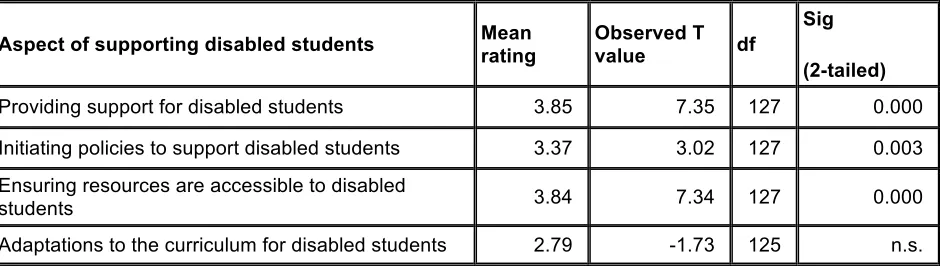
[image:4.612.73.543.372.505.2]Given that the majority of professionals report working with a variety of different students with disabilities, it is important to examine the types support that is provided by them. In Table 1 there a selection of types of support presented with the mean ratings with which professionals responded. On a scale from 1 to 5, with 1 being very little support provided to 5 being a great deal of support provided, there were three means that were significantly above the midpoint, indicating that on average professionals are providing a variety of types of support to their students on a regular basis.
Table 1: Results of tests of whether professionals' rating of their involvement with support for disabled students differ from the neutral midpoint of the rating scale.
Aspect of supporting disabled students Mean
rating
Observed T
value df
Sig
(2-tailed)
Providing support for disabled students 3.85 7.35 127 0.000
Initiating policies to support disabled students 3.37 3.02 127 0.003
Ensuring resources are accessible to disabled
students 3.84 7.34 127 0.000
Adaptations to the curriculum for disabled students 2.79 -1.73 125 n.s.
Table 2: Percentage of respondents who have received training to support students with disabilities.
Country Number of respondents % with training (N)
Australia 16 50.0(8)
Canada 12 66.7(8)
UK 48 85.4(41)
USA 34 85.3(29)
All countries in
survey 110 78.2(86)
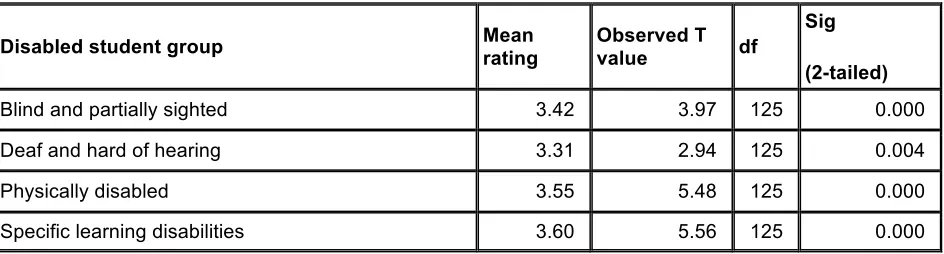
Despite the prevalence of this training, the results of the survey indicate that professionals feel that they are only moderately knowledgeable regarding disability issues. Table 3 shows the general state of knowledge that professionals feel they have regarding issues relating to students in various disability groups. Each professionals report significant mean ratings above the midpoint, on a scale of 1 to 5, with 1 representing no knowledge of disability issues and 5 being very knowledgeable about disability issues.
Table 3: Results of tests of whether professionals' ratings of how well informed they are on disability issues differ from the neutral midpoint of the rating scale.
Disabled student group Mean
rating
Observed T
value df
Sig
(2-tailed)
Blind and partially sighted 3.42 3.97 125 0.000
Deaf and hard of hearing 3.31 2.94 125 0.004
Physically disabled 3.55 5.48 125 0.000
Specific learning disabilities 3.60 5.56 125 0.000
Indeed, in open answer sections related to the above two results, a lack of coverage in the training on important topics, such as assistive technologies or alternative format materials, was regularly reported.
These gaps in training become more apparent when examining the responses from professionals regarding the use of good practice guidelines for supporting students with disabilities at their institutions. Only 48.5% of professionals responded that their institution had good practice guidelines that were used for accessible online materials. A further 37.6% stated that they did not know if their institution had good practice guidelines (out of a total of 101 respondents). Alarmingly, almost 15% of professionals stated that their institution did not use good practice guidelines. Given this information, it is curious that almost 90% of respondents stated that accessible online materials were available at their institution.
3.3 Qualitative Results
[image:5.612.72.544.331.458.2]The interviews and focus groups followed the critical incident technique, a methodology devised by Flanagan (1954), in which participants are asked to identify specific incidents which they have experienced personally, and which have made a significant contribution, either positively or negatively, to an activity or event. An example of a question that would be asked when using this technique would be:
ÒWhen was the last time you wanted to support a student with disabilities but were unable to do so?Ó
This technique is extremely useful for pinpointing specific problems or solutions and identifying uncommon events that might otherwise be overlooked by other methods that only focus on common and everyday occurrences. At the end of the elicitation period 42 interviews and 3 focus groups had been completed in the UK, Canada, Australia and New Zealand from students with disabilities and a variety of educational professionals. Among the professionals interviewed were: disability officers, lecturers, tutors, content producers and support workers.
The quantitative results from the survey were supported by the results from the interviews, with many of the interviewees reporting that they had undergone or were currently undergoing training. However, the focus and purpose of the training was somewhat erratic. Some institutions (2 identified by participants) offered general training in working with people with disabilities, whereas others offer more specific training, such as Sign Language (2), physical dexterity techniques (1) or lip reading (1).
Seven interviewees noted that training was voluntary at their institutions, whereas others stated that it was mandatory and often carried out as part of the initial staff induction training. The latter approach was considered by some to embed good practice and a uniform approach across the whole organization. In some cases, the training was carried out in the disability office, or a specific disability working group; however, in other cases it is carried out human resources or an external organization. When performed by the latter, topics that were covered were general issues including the use of correct terminology, symbol interpretation and how to use pro-active language. Notably, no participants indicated that education-specific skills and techniques were included in their training, such as assessment accommodations or teaching style adjustments.
Seven of interviewees (disjoint from the previously mentioned group) felt that their most significant training had been developed on-the-job through actually working with students with disabilities.
Eight of the interviewees, including 2 disability officers, reported having not received any training in working with students with disabilities.
Finally, nine interviewees reported that they felt that they did not need any training because they already have sufficient awareness of disability issues either through direct or indirect experience. More importantly, some interviewees felt they did not need any training whatsoever despite admitting that they knew very little about how to support students with disabilities. The reasons for this ranged; however, a common theme was that working with people with disabilities should be the domain of specialized personnel only. Another interesting theme that emerged was from interviewees who felt that working with students with disabilities should be ÒnormalÓ and ÒimpartialÓ and therefore did not require special training. The reasoning used to support this was that students are aware of what special needs they have and that it is their responsibility to inform the staff members involved in working with them.
3.4 Discussion
Clearly, the state of knowledge and training for educational professionals in support of people with disabilities is, at best, conflicted. One resounding theme that came through the interviews and open answer questions of the survey is that the majority of educational professionals have a sincere desire to provide better support to students with disabilities and that they require more complete information to accomplish this goal.
As successes have been reported in applying online workplace training in other sectors of education (e.g. teacher training), an e-learning course to supplement the skills and knowledge of all educational professionals in disability issues could provide the increased awareness desired by professionals.
4 The e-Support Worker Guidance Package (eSWGP)
The support worker infrastructure for students with disabilities at HE/FE institutions consists of people filling a variety of roles to assist students in completing tasks related to their education. These individuals are often recruited from the community, either as volunteers or on part-time employment contracts. In some cases, these professionals will have expertise in a particular skill, such as sign-language interpretation. However, in other cases, such as readers or notetakers, no prior skills are required. Consequently, when new support workers are recruited they come with a wide variety of backgrounds and skills, and they may not have any formal training in disability issues. As a result, these professionals were seen to be a good target group with which to work in developing a training course. If it is the case that effective online training can be undertaken with such a diverse group, then the design should be able to be extended into other professional groups with small, iterative adjustments to the curriculum.
Examples of types of support workers in HE/FE institutions include:
¥ Communication support workers: These support workers support deaf and hard-of-hearing students with a variety of communication tasks. These can include sign-language, interpretation, lipspeaking, notetaking and scribing.
¥ Laboratory assistants: Often utilized by people with physical disabilities, these individuals help manipulate equipment in laboratory settings.
¥ Lipspeakers: These individuals listen to spoken dialogue and speak it back silently to deaf and hard-of-hearing students.
¥ Notetakers: This group is the most commonly provided support worker for a wide variety of students. They take notes in lecture or tutorial setting to supplement existing materials or to transcribe when notes are not available previous to teaching sessions.
¥ Readers: These individuals read written material aloud to a student or dictate audio recordings.
¥ Scribes: Scribes record what a student says during examinations, tests or assignments.
¥ Sign language interpreters: These individuals are highly trained professionals who interpret spoken word into a sign language (of which there are many varieties).
¥ Speech-to-text operators: These operators are trained to transcribe material from speech to text that can be presented on visual display units in real time.
¥ Study skills tutors: These tutors can be provided to any student who is struggling with keeping pace with their courses.
¥ Transcribers: Individuals who transcribe, translate or interpret information into various alternative formats such as Braille books, tactile diagrams or captioning of audio/video materials.
The design of a training package for support workers was undertaken with the Higher York HE/FE institutions. As part of the participatory design of the training package, the research team engaged disability officers and support workers from the Higher York institutions in focus groups in order to prepare a training needs analysis. These focus groups explored the different roles that support workers take when working with students and the skills needed in those roles. The focus group also discussed their needs as supervisors of support workers and the constraints that are placed upon them by both the institutions that they work for and governmental legislation. The result of these focus groups was the following objectives for the eSWGP:
¥ Training in support techniques: While some support workers will focus on one highly specialized field (e.g. sign language interpreters, library technicians), others will undertake a variety of tasks such as assessment support, notetaking and reading for students. Each of these roles requires training in a variety of skills regarding how to effectively and efficiently assist the students.
¥ Training in support roles: While each support worker has their own role when working with a student, there is often a myriad of other people performing other roles that may impact on the performance of each other. Providing training in the basic concepts attached to other roles is expected to help improve communication between support workers for a particular student, and possibly have the added benefit of inspiring support workers to take on other roles.
¥ Efficient use of time committed to training: One recurring theme in the interviews and focus groups from the initial investigation was that the money to support students in education is not increasing as quickly as enrolment. As a result, there is a great deal of pressure to efficiently use the physical and person resources currently available. This sentiment was echoed by the design focus group from Higher York. While there is no desire to decrease the amount of support provided, there is an aspiration to use e-learning resources as a supplement to existing practices. As such, there should be no increase in the time spent by staff in using the learning resources, and automation to increase efficient management of support workers is highly desired.
¥ Unified training across institutions: Across Europe there is no standard training for support workers. This project provides an opportunity to create a unified set of training materials that can be used by all institutions in a relatively small area, and theoretically by other institutions around the world. It is important that the material be easily extensible to include links to specialized information for a particular institution. Connected to this is the desire to not encounter the duplication of information that already exists in institutional information systems into the training platform. This is particularly desirable in order to avoid added work in maintaining multiple versions of the information and to avoid the confusion that might result from information falling out of date.
¥ Collaboration between support workers: There was a desire from many participants to have support workers from different institutions share best practices and experiences through an online community.
Many of the above objectives are derived from institutional benefits that may be gained from having well trained support staff. For example, having support workers with proper knowledge of how support money offered by the Disability Student Allowance (DSA) can be used to fund support staff will help offload some questions that arise from student confusions over the financial rules and regulations. Another example is that through a unified training program by which the disability office knows that a minimal level of training has been achieved by support workers at a given institution, it is possible for institutions to share their support workers for exceptional circumstances such as relief work when someone is ill or absent from the job. Finally, by creating a community of support workers in an online collaborative space, it is hoped that common questions that recur often, can be dealt with as they arise within the community, as opposed to encountering the bottleneck of going through the disability office for all queries.
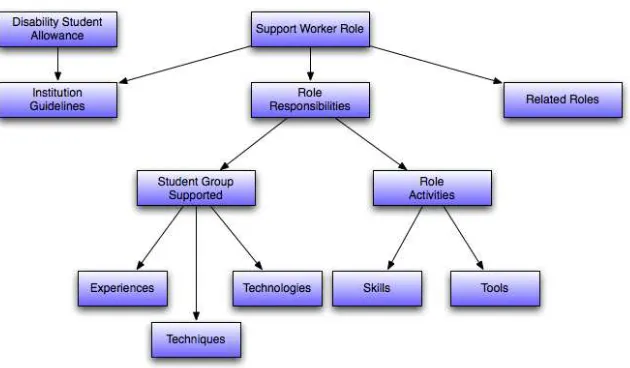
After completing the list of learning objectives for the online training course, materials were collected and organized into main themes that would be used to construct the course contents. In Figure 1, a concept map presents the design of the contents of the training course for support workers.
Figure 1: A concept map of topics to be covered in the online training course for support workers.
For a full course on these items, the following will be available to the support worker:
¥ Educational Biographies: These will be testimonials from a variety of students from across the disability groups who will talk about their experiences in education. These biographies will include demonstrations of specific technologies (e.g. screen readers, Braille displays) and techniques (e.g. sign-language interpretation, scribing) that are used on a daily basis by these students.
¥ Extension/Application Exercises: These will be activities to encourage support workers to apply their knowledge and skills to real and simulated situations. This could include problem-solving activities.
¥ Reflection Exercises: These will be questions and activities that encourage support workers to reflect on their own practice.
¥ Assessments: These could be formative (assessments during a course or module, to check ongoing progress and provide guidance) or summative (at the end of course or module).
¥ Online forum: The expectation is that many support workers will be participating in training at approximately the same time, even though the course is self-directed (e.g. at the start of the academic year). These students will be assigned into support groups within the online environment allowing them to discuss various aspects of the courses. Disability officers, or senior support workers will help answer questions and provide guidance on these forums.
5 Initial Pilot Evaluation
With these initial requirements in place, a trial of the eSWGP is being prepared for deployment. The virtual learning environment (VLE) Moodle was chosen as the platform on which to conduct the initial pilot of the eSWGP. The Higher York Support and Skills website is already available in a prototype form at www.hysupportandskills.org and the evaluation will begin in January, 2009. This pilot of the training course will include approximately 20 support workers from York St. John University and the University of York.
6 Future Work
partners becoming involved. This stage would provide the benefit of examining the scalability of the platform within a geographical area where much of the content, and possibly the end-users, is likely to be very similar and equally applicable. Information pertaining to specific institutions could easily be incorporated and the analysis of the project's extension within a still relatively small area with strong institutional links would allow for prompt feedback and iterative improvements. Once it has been established that the generic nature of the proposed training materials can indeed be appropriated by any number of institutions, and that the technical infrastructure can support such growth, further expansion of the eSWGP could occur both nationally within the UK, throughout Europe and in other international regions (e.g. North America, Africa, Asia).
Although the intended audience would be entirely different in each case, the flexibility of the eSWGP will allow it to be tailored towards other cohorts of professionals. Although the Higher York project has focused initially upon support workers, a similar training program could be devised specifically for teaching staff, for example, or indeed any of the other stakeholders identified as being important to the success of students with disabilities in education.
7 Conclusion
This paper reports on an inquiry into the knowledge and training of professionals in higher and further education institutions regarding issues relating to students with disabilities. In the majority, the professionals reported through an online survey that training was available in their institutions; however, further investigation indicates that they are not confident in their own knowledge of the issues, with only moderate knowledge of disability issues being reported. These results were triangulated with interview data that indicated the training received was inconsistent across institutions, and the topics that were covered were incomplete. Finally, participants in both the surveys and interviews indicated that they desired more information regarding disability issues so that they could better support their students.
During the survey and interview periods many of the professionals involved were eager to engage with the research team in exploring ways supplement their training. This led to the research team proposing an online training course through a virtual learning environment for various professional groups.
This investigation has led to the design of an e-learning course intended to train support workers for people with disabilities in their roles and in the challenges they will encounter when performing their duties. This course was developed in cooperation with a partnership of HE/FE institutions in the York, UK area through a participatory design methodology and will be piloted in early 2009. It is believed that when successful, this course can be extended to other types of educational professionals for enhancing their knowledge and skills relating to students with disabilities.
8 References
Abram, S., (2003). A primer on e-Learning: The framework, the market, the players, KM World, 12(2), p. 10.
ASTD: American Society of Training Directors, (2001). A Vision of E-Learning for America's Workforce : Report of the Commission on Technology and Adult Learning. American Society of Training Directors. Policy and Public Leadership. Alexandria, [online], Available at: www.nga.org/cda/files/ELEARNINGREPORT.pdf (accessed July, 2008).
Cavalli E., Lorenzi A. (2002). Teacher training through eLearning technology, Online Educa Berlin: 8th International Conference on Technology Supported Learning & Training Berlin November 27-29, 2002.
Conference Board of Canada, (2001). E-Learning for the workplace: Creating CanadaÕs life long learners,
[online] Available at:
http://www.hrsdc.gc.ca/en/hip/lld/olt/Skills_Development/OLTResearch/e_learning_workplace.shtml (accessed July, 2008).
Flanagan, J. C., (1954). The Critical Incident Technique. Psychological Bulletin, 51(4), 327-359.
Kupetz, R. and Ziegenmeyer, B., (2005). Blended learning in a teacher training course: Integrated interactive e-learning and contact learning, ReCALL, 17, p.179-196.
Universiteit Utrecht, [online] Available at: http://dspace.ou.nl/handle/1820/973 (accessed July, 2008).
Pantaziz, C., (2002). Maximizing E-Learning to Train the 21st Century Workforce, Public Personnel Management, 31(1), p.21-26.
Piccoli, G., Ahmad, R. and Ives, B., (2001). Web-Based Virtual Learning Environments: A Research Framework and a Preliminary Assessment of Effectiveness in Basic IT Skills Training, MIS Quarterly,
25(4), p.401-426
Rosenberg, M., (2002). E-Learning Trends in the Pharma Industry, Pharmaceutical Executive, 22(10), p.114-115.
Roy, A. and Raymond, L., Meeting the Training Needs of SMEs: is e-Learning a Solution? The Electronic Journal of e- Learning,6(2), p.89 Ð 98, [online] Available at www.ejel.org, (accessed July, 2008).
Servage, L., (2005) Strategizing for workplace e-Learning: Some critical considerations, Journal of Workplace Learning, 17(5/6), p.304-317.
Stefanov, K, Naskinova, I and Nikolov, R. ICT-enhanced Teacher training for Lifelong Competence Development, TENC: Publications and Preprints. [online] Available at: http://dspace.ou.nl/handle/1820/973, (accessed July, 2008).
Terry, L., (2000). Get Smart Online, Upside, 12(5), p.162-164.
T—th, ç., PentelŽnyi, P. and T—th P., (2004). Virtual Electronic Learning in Vocational Initial Teacher Training. Budapest Tech Jubilee Conference. Budapest, September 4, 2004. [online] Available at: http://www.bmf.hu/conferences/jubilee/ (accessed July, 2008).