Rochester Institute of Technology
RIT Scholar Works
Theses Thesis/Dissertation Collections
5-15-2015
Economic Figures
Fiona Eloisa WilsonFollow this and additional works at:http://scholarworks.rit.edu/theses
This Thesis is brought to you for free and open access by the Thesis/Dissertation Collections at RIT Scholar Works. It has been accepted for inclusion in Theses by an authorized administrator of RIT Scholar Works. For more information, please [email protected].
Recommended Citation
R
!
I
!
T
Economic Figures
by
Fiona Eloisa Wilson
A Thesis Submitted in Partial Fulfillment of the Requirements
For the Degree of Master of Fine Arts
in Imaging Arts
School of Photographic Arts and Sciences
College of Imaging Arts and Sciences
Rochester Institute of Technology
Rochester, NY
May 15, 2015
Committee Approval:
Christine Shank Date
MFA Director, Assistant Professor, Committee Chair Date
Angela Kelly Date
Associate Professor, Coordinator Photo Arts1, Committee Member
Date
Jessica Catherine Lieberman Date
Date
Acknowledgements
There are many people who contributed to the completion of this work, but none as
important as my committee members Angela Kelly, Jessica Lieberman, Christine Shank and my
former committee head Patti Ambrogi. These people have impacted my life in a way they may
never truly understand. They were my strength when I had doubts and support when I was
struggling. Their compassion, intelligence and guidance allowed me to achieve what never could
have been achieved without them.
The advice I received from my classmates, Lisa Adamucci, Sarah Hearn, Manuel
Pena, Christin Boggs, Emma Powell, Nick Marshal and Maria Providencia Casanovas, was
invaluable. They helped me to question everything and to discover what I really wanted my work
to be about.
This work is also for my parents and my family, who have always supported me.
They deserve credit for everything that I am. They helped me grow, allowed me to photograph
Contents
Acknowlwgements: iii
Abstract: v
List of Figures: vi
Introduction: 1
Displacing Main Street: 2
‘the store’: 11
Conclusion: 19
Abstract
Economic Figures
The title economic figures refer to both finances and the people (as figures) that are
affected by monetary instability. People in two consumer locations are documented
photographically through two projects that tell the story of the evolving sites of strip mall and
main street shopping. In Displacing Main Street, photographs of people entering strip mall stores
are installed on abandoned main street store sites. ‘the store’ are photographs that show the
intimate story of my parents struggle to keep their main street small business open. The final
exhibition combines these two works in a single gallery to give the viewer the opportunity to
List of Figures
Figure 1: 230 Main Street West, Rochester, NY 14614
Figure 2: Untitled, ‘the store’, 2010
Figure 3: Childhood drawing, c 1990.
Figure 4: Untitled, from 'the store' 2010.
Figure 5: David's Remote, 'the store', 2010
Figure 6: Alma Sewing a Button, 'the store', 2010
Figure 7: Red Demo Room, ‘the store’, 2010
Figure 8: Getting Ready, “the store’, 2010
Figure 9: Mom, Home Office, 2010
Figure 10: Post-Its, ‘the store’ 2010
Figure 11: 1040 Clinton Avenue South, Rochester, NY 14620
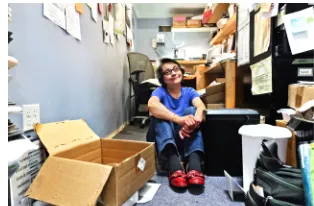
Figure 12: Moms Red Shoes, ‘the store’ 2010
Introduction
Economic Figures, uses photography to address the common cultural and economic
concern of the transition of commerce from local main street locations to the destination shops of
big chain stores located in strip mall sites. This transition became a personal issue when the 2008
recession threatened my family's sole source of income. This jolted me into a state of
hyper-awareness of the dominant business models that permeate consumer culture, the result of which
creates a directly negative affect on the economic stability of small business owners and the
communities they serve. In response to my understanding that as consumers we are all
complicit, I began to make photographs that attempt to question the power and authority of big
chains, by re-asserting the value of local business; and placing responsibility and power of
consumer choice back on individuals. Two photographic explorations, Displacing Main Street
and ‘the store’, are the results of this investigation into contemporary retail economics through
observable phenomena and my personal story.
Displacing Main Street, uses the practices of activist art in subversively placing images
of people entering chain store facades in a public forum; that of empty local store fronts. As Nina
Felshin states, activist art is "...characterized by the innovative use of public space to address
issues of sociopolitical and cultural significance and to encourage community or public
participation as a means of effecting social change."1 Installing images in these sites makes
visible the result of the consumers shopping at chain stores. Instead of making the choice of
shopping based on immediate gratification, it asks the consumer to become informed about
whom their money empowers and about whom is more likely to empower the community in
return.
The photographs of my family's business in, 'the store', point to what is lost in this
cultural transition from local to destination shopping. The quality of a small business in the
community is demonstrated by the way my parents, David and Alma Wilson, take individual
care of each of their customers. Images of my mom sewing, or my father hand cleaning
equipment with his smallest tools aim to show value in the personal connections made through a
retail context. This is the micro scale of the social political issue that my exhibition, Economic
Figures, unpacks for the viewer. It is how I have come to understand that there is a connection
between the consumer and economics in the small-scale retail environment.
Displacing Main Street
"Sell 'em low, stack 'em high, make those downtown merchants cry!"
-Chain Store Employee Chant2
Displacing Main Street interacts with the transition of commerce from local main street
locations to the destination shops of big chain stores located in strip mall sites. This project seeks
to question the status quo of this shifting cultural environment, reasserting the influence of the
choices made by individuals. The photographs function within the boundaries of activist art by
decentering the viewer. As Barthes states "Ultimately, Photography is subversive not when it
2 Mitchell, Stacy. Big-Box Swindle : The True Cost of Mega-Retailers and the Fight for America's
frightens, repels, or even stigmatizes, but when it is pensive, when it thinks."3Displacing Main
Street requests the general public to pause and consider what is lost in their communities. Formal
connections make the idea of replacement apparent asking the viewer to consider what is
affected by their spending power. That if they choose to shop in local stores instead of chains,
local shopping might be strong enough to thrive.
Since the inception of chain retail a system of direct competition was implemented
toward local Main Street business as "Building new stores does not expand the pie; it only
reapportions it."4 Cultural landscapes evolve as older forms become obsolete. This shift was
enforced by post WWII economics and the necessity for the growth of public infrastructure that
could support the popularity of the automobile. Non-urban areas changed from pedestrian
friendly towns to suburbs dominated by the car, since changes in the consumer relationship with
shopping required a new landscape to include the automobile. Lacking in off-street parking and a
plan for the combination of car and pedestrian traffic patterns, Main Street was not prepared.
Chains took advantage of the cheap land and open spaces of “taxpayer strips” to design their
shopping centers with large parking lots, easy access from highways and designated pedestrian
areas in consideration of automobiles.5 The evolutionary result is the contemporary strip mall.
New Big-Box stores are sold to communities as job creators. Though it may take several
years, these stores actually cause job loss. Their goal is to dominate the market and once they
have done this they will then raise their prices to the same as the local store or just pennies less.
This works because the local stores are either severely crippled or out of business completely.
3 Barthes, Roland. Camera Lucida : Reflections on Photography. 1st American ed. (New York: Hill and
Wang 1981), 38.
4 Mitchell, Stacy. Big-Box Swindle : The True Cost of Mega-Retailers and the Fight for America's
Independent Businesses. (Boston: Beacon Press, 2006), 36.
The people who were previously employed by these stores for good wages and good benefits no
longer have jobs. The other local businesses that those stores used for advertising and other retail
costs lose business and they close. The people who worked there lose their jobs. Eventually,
reducing “…a county's retail employment by an average of 180 jobs, or 3.2 percent."6 These
good jobs are replaced with minimum wage employment. Devastating local economy that was
once strong in its diversity and community ties.
One of the benefits of supporting small business is that a significantly higher percentage
of the money spent stays within the local economy. Michael Shuman describes this as supporting
economic development rooted in local ownership and import substitution (LOIS). Many
communities believe that the only way to create new jobs and bring in more wealth is to form an
economic cluster of big business by attracting industry and big stores.7 However a diverse and
healthy group of “Small-Marts” consistently strengthens a community because of the Economic
Multiplier. This is an economic term that refers to the calculation of the relationship between
how much of the money spent in a specific region stays within those geographic parameters. In a
2003 study the economic multiplier of a Borders compared with two local book stores in Austin,
Texas found that “…one hundred dollars spent at the Borders would circulate thirteen dollars in
the Austin economy, while the same one hundred dollars spent at the two local bookstores would
circulate forty-five."8Small-Marts usually spend more money locally at other Small-Mart
businesses; they bank locally, they advertise in local newspapers and offer well paid jobs with
6 Mitchell, Stacy. Big-Box Swindle : The True Cost of Mega-Retailers and the Fight for America's
Independent Businesses. (Boston: Beacon Press, 2006), 37-38.
7 Shuman, Michael. The Small-Mart Revolution : How Local Businesses Are Beating the Global
Competition. 1st ed. (San Francisco: Berrett-Koehler, 2006), 48.
8 Shuman, Michael. The Small-Mart Revolution : How Local Businesses Are Beating the Global
benefits “…that form the backbone of a city's middle class and the core of its tax base."9 Instead
of supporting the local economic structure the chain store conversely extracts money out of a
community. Stuck in this loop the consumer class is losing their wealth and their community.
To explore these ideas I conceptually converge both sites by installing images of people
in the facades of chain stores on the ruins of the closed or abandoned storefronts of main street
sites. The photographs function within the boundaries of activist art by decentering the viewer.
As Barthes states "Ultimately, Photography is subversive not when it frightens, repels, or even
stigmatizes, but when it is pensive, when it thinks."10 A strong white border simulates a picture
frame thus highlighting the photographic image and grabbing the attention of pedestrians and
drivers. Printed on a vinyl these images indefinitely hold their integrity in the exterior weather
conditions of this alternative exhibition space. Inserting photographs on the windows of these
sites invites the passerby to investigate the interior. Instead of covering the entire window, room
is left to view the interiors of these former main street business sites. Remnants such as shelving
or color of paint can be seen. Thus a comparison is made between the new and the old model of
retail sites.
9 Mitchell, Stacy. Big-Box Swindle : The True Cost of Mega-Retailers and the Fight for America's
Independent Businesses. (Boston: Beacon Press, 2006), 39-40.
10 Barthes, Roland. Camera Lucida : Reflections on Photography. 1st American ed. (New York: Hill and
[image:12.612.139.468.488.601.2]Wang, 1981), 38.
Placed in-situ, the photographs that comprise Displacing Main Street appropriates the
strategy of repetitions of architectural design and behavior familiar in corporate owned retail
sites, to foreground a pattern of consumption that reproduces that same pattern. Applying the
techniques of street photography to this simulated main street, I envision it as a stage prepared
for a specific performance. Through the ability to capture the moment where action and scene
combine to make an event worth photographing, the photographer transforms the ordinary action
into a performance. Thus, Displacing Main Street, is a play on the history of street photography
where the relationship between an individual and the vernacular retail environment is addressed.
Street photographer Zoe Strauss makes her images in the community in which she lives
in Philadelphia. Interested in walking the streets and meeting the people in her community
Strauss documents people, signs and landscapes as a reflection of her environment and lifestyle.
These images are then displayed in a non-gallery site, under the I-95 underpass. Here they are
sold for five dollars. Instead of taking these images and selling them in a high art venue, Strauss
makes her artwork available to those in the community that she photographs.
Historically, strip mall sites were designed based on the theatrical stage by one of the
first architects and designers of these retail sites; Victor Gruen. He borrowed from his experience
in theater, using color, shape, repetition, windows and lighting, to set a metaphorical stage for the
drama of the social interaction of shoppers. According to Jeffery Hardwick, "Drawing on his
theater experience, Gruen employed two familiar metaphors for describing the drama of modern
storefronts: the advertisement and the stage."11 Gruen knew that the design of retail architecture
was inseparable to its profit. Using every trick of drama and emotional manipulation he was
successful in directing the flow of human bodies to his buildings. His innovation in retail
11 Hardwick, M. Jeffrey and Victor Gruen. Mall Maker: Victor Gruen, Architect of an American Dream.
architecture and design led to social and financial growth of the site, since “…it will include
features to induce people to drive considerable distances to enjoy its advantages."12 Robert
Venturi describes the forms of architecture used in strip malls as the "Decorated Shed".13 That is architecture that has become a symbol in space instead of a form in space, whose exterior is
highly decorated while its interior is nothing more that a horizontal box. The exterior facades of
this type of build function well in the "autoscape", in a culture where overcoming vast distances
and high speeds is necessary for communication. This is a new from of architecture for a new
scale of landscape derived from the dominance of car culture.
My photographs document the observation of these anonymous figures in the exteriors of
the ubiquitous retail site of the mall. When photographing these sites, I participate in the flow of
authority that is maintained by the constant circulation of power and knowledge inherently
linked to observation. According to Susan Sontag, "To photograph is to appropriate the thing
being photographed. It means putting oneself into a certain relation to the world that feels like
knowledge––and, therefore, like power.”14 To capture moments of consumers in these privately
owned public spaces I become a voyeur and part of the mechanism of surveillance.
Michel Foucault describes the power of surveillance as the ability to hold knowledge
over a subject. This power-knowledge relationship is not only activated by a permanent record
such as a recording, a photograph, or a document, but also a hierarchy of observation is
constantly applied through ones individual visibility to other individuals: "this reign of
'opinion'...represents a mode of operation through which power will be exercised by virtue of the
12 Hardwick, M. Jeffrey and Victor Gruen. Mall Maker: Victor Gruen, Architect of an American Dream.
(Philadelphia: University of Pennsylvania Press, 2004), 1.
13 Venturi, Robert, Steven Izenour and Denise Scott Brown. Learning from Las Vegas : The Forgotten
Symbolism of Architectural Form. (Cambridge, Mass.: MIT Press, 1977), 163.
mere fact of things being known and people seen in a sort of immediate, collective and
anonymous gaze."15 The concept of Foucault's system of power and knowledge as described by
the process of surveillance, observation and report is played with further as the document/report
is in the form of photographs that are then given back to the public to evaluate.
The people in my images are understood abstractly through their behaviors, they are
anonymous, allowing the viewer to envision their own past behaviors. An interest in observable
phenomena leads these images away from a portraiture that is interested in communicating a
deeper identity. I look for ways in which "People have become elements of animation in a
pleasantly planned environment..."16 Following the theories of Foucault I observe how specific
repeated actions, such as the practice of pushing a cart of goods before our bodies, is a form of
performance that allows people to actively participate in their individualization and in their
repression. A set of operations maintained by the social and economic forces that act on
individuals that enter these sites leads to such specific behaviors. The application of disciplinary
forces has become so invisible that ordinary behaviors, absurd and without rationality when
taken out of that psychological context, have become normal.
To make these photographic observations I maintain an anonymous relationship to the
site and subject that I photograph by concealing myself either in my car, or behind other
structures found in these spaces. This is done to for two reasons; in order to avoid being removed
from the site and to prevent my figures from interacting with the camera instead of the site. The
architecture is also intentionally photographed to be anonymous. The image is either composed
or digitally manipulated during post processing to remove all identifying text. This shifts
15 Foucault, Michel and Colin Gordon. Power/Knowledge: Selected Interviews and Other Writings,
1972-1977. 1st American ed. (New York: Pantheon Books, 1980), 154.
16 Jackson, John Brinckerhoff. Discovering the Vernacular Landscape. (New Haven, Yale University
culpability from a specific company and places the critique on the system as a whole. This
removal of a text also reveals the underlying affects of the visual semiotic codes inherent in Mall
Facades, as the identity of each store is now understood by the choice of architectural referents
and color codes found in the facades.
Artists have explored the phenomenon of the suburban landscape since suburbia became
part of the dominant American culture in the mid-twentieth century. Ed Ruscha documented the
ordinary in the series of images in his book Twenty-Six Gasoline Stations. His images of gas
stations approached the issues of car culture and suburban structures by simply documenting
their insertion into the landscape. "The pictures were stripped of any artistic frills and reduced to
an essentially topographic state, conveying substantial amounts of beauty, emotion and
opinion."17
The 1975 exhibit, New Topographics, Photographs of a Man-altered Landscape, brought
together photographers who, partly influenced by Ruscha's work collectively documented the
everyday American landscape through images of mobile homes, tract homes, industrial parks,
coal factories, motels and suburban streets. Baltz's images of industrial parks examined the
construction of new architecture and the convergence of structure and landscape. Interested in
making an objective document, he used a formalist approach to depict the modern architecture
found in his sites.
Brian Ulrich’s project Dark Stores documents the abandoned sites of chain retail
locations. Though he began this project before the 2008 recession the closing of major chain
names, such as Linens’ N Things, added to the interest of these sites. It is common for Big Box
stores to abandon retail sites to build new stores using updated aesthetics, to move to a more
profitable location. The abandoned shells that litter the vernacular landscape are signs of the
temporality of chain stores.
Matt Siber’s Untitled Project demonstrates how advertisements use of color and symbol
are related to their written text. By separating the two forms of language the importance of
reading each is conveyed to the viewer. This related to my project as by removing the text from
each scene I enhance the idea of architecture as a symbol and the stage as advertisement.
Architecture is more than the practical creation of a useful space. The designs of these
structures inform how we interact with other people. In discussing the places of gathering in the
community, such as the market place, Jackson describes the presumed role of the individual: "It
is assumed that those who come there are already aware that they are members of the
community, responsible citizens and that on occasion they will participate in public discussions
and take action on the behalf of the community"18 In a system where a shopping center is no
longer in the center of a community, where the people come from vast distances and assemble
anonymously, this sense of gathering as responsible citizens is unlikely and outdated. This
project leads the viewer to re-evaluate the meaning of the impact of retail architecture has on
their personal lives, on the choices they make as consumers. Asserting a responsibility on
consumers to spend money (as little as it may be) in the ways that provides the best long-term
benefits by first supporting their local community.
18 Jackson, John Brinckerhoff. Discovering the Vernacular Landscape. (New Haven, Yale University
'the store'
My personal story is an entry point into narrative of the lives of American independent
business owners. As the child of two parents who run a small retail business together I have
experienced consumer culture from the seller's perspective. My life experiences differ greatly
from those who only understand retail from a consumer standpoint. I do not attempt to be
objective, as the photographs document my personal story. I make images that both reveal the
universal story of small business owners and the personal struggle of my parents for survival.
With my camera I document their financial struggle. As I photograph the moments that reach
below the surface, for the inevitable. That ‘the store’ will close.
Though Accent on Music (the store’s name) did provide our family's income, the store
was never a thriving business. Over the years, my parents were able to keep a slice of a market
that was quickly changing as digital music began to dominate the Hi-Fi culture. The store
reached a moderate level of success when home theater installation was integrated into the
business. The housing boom of the late 1990's and early 2000's became a source of economic
[image:18.612.193.414.140.284.2]opportunity for my parents. As suburban sprawl grew with new custom homes and businesses so
did their store’s economic stability. When the market for new custom homes crashed this source
of income ended almost immediately. My family has been on the brink of financial ruin since the
beginning of the 2008 recession.
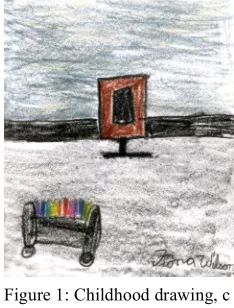
I was 6 years old in 1989, when my parents became
self-employed, opening Accent on Music Inc. As an only child I felt my
own sacrifice as attention shifted away from me and towards ‘the
store’. I became resentful of the time I was forced to spend there, due to
the behavioral rules that prevented me from acting like a kid; don’t
make a mess, be polite to customers, don’t interrupt conversations;
basically be charmingly invisible. Mostly I just read books, drew, or
painted on scraps of paper. As I got older the rules changed to include responsibilities such as
stamping and filing invoices, dusting and washing the windows (my least favorite) and
answering the phone with the following script: “Accent on Music, How may I help you?”
Though I was a child I was always part of their business. Photography provides me an entrance
back to the store by allowing me to reconnect to my parent's situation. It gives me a reason to be
present, to know what is going on day to day. Being there and hearing the stories, just knowing
what is happening allows me to initiate my new role in the family an informed adult.
Photographing my parents during this vulnerable time is not an easy, as these images
make our personal lives public. Initially I was afraid of exploiting them. Full of insecurity, my
parents could not understand why they mattered enough to be photographed. These images tell
the larger cultural economic crisis in a personal story. As Marianne Hirsch states artists who use
family photographs can infuse the personal with cultural critique; "...in disrupting their own
[image:19.612.425.542.165.319.2]documentary authority and their use as evidence––photographs can become powerful weapons of
social and attitudinal change."19 From this perspective my parents are not portrayed as victims,
but as strong individuals persevering in a competitive retail environment.
Accent on Music is not simply a place where my parents go to work; it is where they have
spent the majority of their lives as a married couple. For twenty years their lives surrounded this
business. To build a business from scratch required constant attention. This strained their
relationship as disappointments led to personal arguments over business strategies.
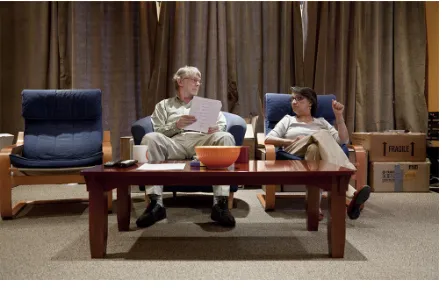
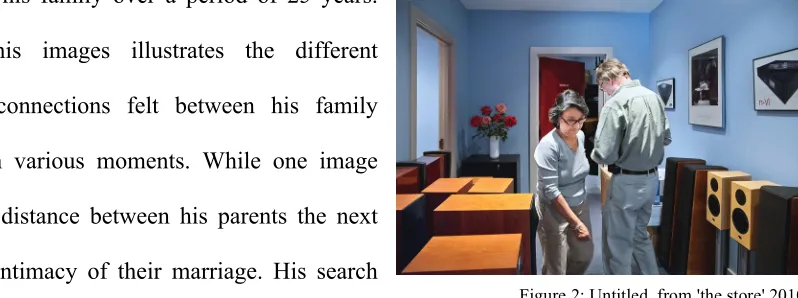
Contemporary photographer Doug Dubois collected moments that revealed the underlying
tensions of his family over a period of 25 years.
Each of his images illustrates the different
emotional connections felt between his family
members in various moments. While one image
depicts the distance between his parents the next
shows the intimacy of their marriage. His search
for the fleeting gestures that convey the underlying emotional truth as a result of family
dynamics is similar to the aspects of images of my parents interacting on a marital level.
However Dubois images show an emotional and physical separation between his parents while in
the image of my parents here the space between them is fleeting and evidence of the type of
routine interactions they have developed. Over the years, the store and their marriage became
intertwined. Their life together centered on the business. Their customers are their only social
outlets. They do not take days off and any trip or family vacation is planned to coincide with
home installations. With no time apart from each other living in highly stressful situation their
marriage suffered. These tensions have left the relationship in a mixed state of dependence and
[image:20.612.130.529.275.424.2]
19 Hirsch, Marianne. Family Frames, (Cambridge, Mass: Harvard University Press, 1997), 8.
love.
Separated by gender roles; responsibilities followed traditional female and masculine
lines. My mother carried the weight of the dual role of business owner and housewife. It was
expected that even after a long day at work that she come home a cook dinner, which she did
every night from scratch. At the store she is the executive assistant, the manager and the cleaning
lady. She is also the person who maintains relationships with the customers by learning and
remembering their individual stories. My father thinks he is the owner and that everyone else just
works for him, including my mother. He is the salesman and with 30 plus years of experience
has earned an international reputation for being one of the most knowledgeable people in the
Hi-Fi industry. His responsibilities are more focused to the selling, installation and maintenance of
the hi-fi equipment; like a matchmaker his job is to find the right system. The one with the right
sound for each specific client:
“The trick is to pick one that does a good job of capturing for you the meaning and emotion of the performance, one that delivers the relationships, the patterns that we call music. The best way to do this is to listen through a piece of music and evaluate your own response; if it’s a good feeling, it’s a good HiFi!”
-From Listening, a manifesto by David Wilson
-From Listening, a manifesto by David Wilson My mother decorated the store as if it were her home, using color palettes to reflect her
[image:21.612.98.266.412.524.2]Puerto Rican heritage. Details such as a hung tapestry or flowers gave the showrooms the
[image:21.612.353.516.414.522.2]warmth. This was a good selling tool, one that allowed clients to envision a music system
expertly integrated into their homes. It is necessary to the success of the business that it look
presentable, to inspire respect and confidence in the customer. Keeping up the appearance of a
successful business took priority over every financial decision in our lives. The store always
came first. Our actual home, a true 'fixer-upper' was never finished. All of the projects started by
my parents before the store opened were left incomplete. There was never enough money or time
leftover to make the house into our home.
When you own a store there is no such thing as a guaranteed paycheck. Growing up, I
was always hyper-aware that money was an issue. Aside from the increasing dilapidated state of
the house there were often clues that we were in a constant state of catching up to debt. Bill
collectors called so often that by the time I was in middle school I already knew the line; 'the
check’s in the mail'. I often came home to find that the phone has been turned off, that we don't
have electricity, or that we have ran out of oil for heat. We
always seemed to be waiting to finish a job so that the
customer would pay their bill. My mom, the person in
charge of the store and house finances, never wanted me to
know when money was low and still attempts to protect me
[image:22.612.351.518.270.387.2]from this truth today.
[image:22.612.126.517.272.393.2] [image:22.612.373.535.549.660.2]Figure 8: Getting Ready, “the store’, 2010 Figure 7: Red Demo Room, ‘the store’, 2010
My parents are fortunate to have strong friendships with their customers. Without these
people, the business would have failed quickly and quietly like most of the Hi Fi stores in their
region. This is a common story during times of economic recession, as Stacy Mitchell describes
in her book, Big-Box Swindle; "Retail profit margins are slim and, while a chain has the
financial resources to ride out losses at some of its superstores indefinitely, only a small decline
in revenue can make the difference for an independent." My parents survived because of the
sacrifices they were willing to make. As my mother say’s “those other stores just don’t know
how to tighten their belts.” This allowed the money collected from previous jobs, the couple
small sales a month and upgrading of the equipment of long-term customers, to keep Accent on
Music and my family alive.
Photographer Larry Sultan documented the retirement of his father with the intention of
describing the impact of Reagan economics on his family. Similar to my approach he would visit
a place from his youth, his family home, to make images that could tell a universal story.
However what he found in his pictures was that the inspiration of sociology only became a side
story to the emotional connections between him and his parents; “What drives me to continue
this work is difficult to name. It has more to do with love than with sociology, with being a
subject in the drama rather than a witness…These are my parents. From that simple fact,
everything follows.” 20 Like Sultan's discovery, I found that my images also attempt to prevent a
loss, that of ‘the store’. Looking at the portraits of my parents working reveals the emotional
connections between us: me as the child and them as the parents. Images of my parents looking
at me, looking at them through the lens of a camera place the viewer in my position in the
family. As Hirsch explains family photographs display the relationship structure between
individuals through looking; "...the ways in which the individual subject is constituted in the
space of the family through looking...how looks position members of the family in relation to
one another, in their predetermined but forever negotiable roles and interactions..." 21 When I
look at this portrait of my mother in Figure 12, I find a moment made permanent through its
photographic capture, moments that my parents would rather protect me from. Though she tries
to appear happy the concerns of the day and her love for me are evident in her eyes. When
looking at this photograph the viewer is given the opportunity to fully experience my mother's
gaze. The sadness in her eyes comes from the disappointment in her inability to continue to take
care of herself, my father and of me. By coming home I have changed my role in the family from
child to adult ready to piece together a family structure of mutual support.
Mitch Epstein documented the closing of the furniture and real estate business that
supported his extended family. Aptly named, Family Business, includes a collection of still lives
and interiors that expand on the portraits. This combination elaborates on the details that evoke
the complexity of emotions found in the portraits. The
inclusion of documents adds to the narrative by giving
details of their work. One can read the partial text,
discerning enough of the sentence's to comprehend the
language of the business, its ordinary tasks and the
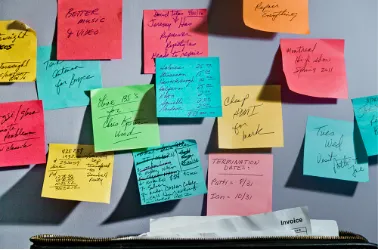
day-to-day stresses of owning a small business. In 'the
store', images of unpaid invoices and post it notes similarly reveal a factual understanding of
how it operates.
[image:24.612.346.535.441.566.2]
21 Hirsch, Marianne. Family Frames, (Cambridge, Mass: Harvard University Press, 1997), 9.
Accent on Music sells Hi-Fidelity audio and video products. These are luxury systems
that provide quality of sound. They cost thousands of dollars because these unique products are
designed to enrich one's life for decades. Hi Fi manufacturers do not used the strategy of planned
obsolescence to compel repeat purchases. Their products do not break. People buy these products
because they are interested in the quality of the experience of listening to music. However we do
not live in a culture that values quality and endurance. The powerful leader of chain stores,
Wal-Mart, has further changed the relationship between the manufacture and the seller. Chain stores
control the quality of the products made by the manufacturer. The manufacturer has no choice
but to comply with a company that has become their biggest or sole purchaser. "Companies that
depend on one or two chains for a large portion of their revenue, as many now do, are
perpetually at risk of being crushed and losing everything."22 Demands include reducing prices,
producing large quantities for specific sale days and even accepting the forced return of unsold
goods at the manufacturers expense. In essence, turning Big-Box stores into consignment
retailers, who then take no financial risk and can continuously provide more products for cheaper
prices. This culture of valuing quantity over quality of product leads to customers asking my
parents for discounts when they are already only making 10% of the sales price. Repeat business
is also a problem, since once you buy a system you will never need to replace it. Long-term
customers buy upgrades and get regular maintenance of their stereos, some decide that they want
a more impressive system 5 or 10 years down the road, but once that first big sale is made a
client is unlikely to make a similar purchase. They do not need to.
The store has not yet closed. This photography project is not about the demise or
nostalgia for a once successful business. This is a complex narrative that attempts to suggest
22 Mitchell, Stacy. Big-Box Swindle : The True Cost of Mega-Retailers and the Fight for America's
multiple ways to understand the relationship between the personal and the public and the nature
of the photography as a personal metaphor for a larger issue. It is about the will to endure over
hard economic times and the work and fear and disappointments that accompany that goal. These
images hold their significance and meaning in tension they expand from personal experience the
universal story of small business owners to open a conversation that is relevant in contemporary
culture. As Martha Rosler writes about the New Documentary photographers; "...a growing body
of documentary works committed to the exposure of specific abuses caused by people's jobs, by
the financier's growing hegemony over the cities, by racism, sexism and class oppression..."23
This is the sort of documentary that my images belong. The story here is strength of character
through perseverance.
Conclusion
Exhibited simultaneously Displacing Main Street and ‘the store’ allows for a dialogue
between the closed store and the struggling store. A visual conversation between these two
projects supports a more complete picture of the contemporary strife of local small businesses.
[image:26.612.378.535.413.516.2]
23 Rosler, Martha, Decoys and Disruptions: selected writings, 1975-2001
[image:26.612.71.347.423.512.2]"There is something like a culture of environmental change, a pattern of day-to-day decisions
worth exploring."24
The movement towards the support of local businesses already has momentum and there
are several ways to become informed about changing one’s lifestyle of become a supported of
local businesses. Stacey Mitchell and Michael Shuman’s blogs, The Institute for Local
Self-Reliance New Rules Project and other websites provide access to articles and resources that
describe how and what changes one can make. New this year is “Small Business Saturday”, a
holiday shopping day for small businesses that joins Black Friday and Cyber Monday shopping
post Thanksgiving. One can now easily find information on their local businesses from the Small
Business Local Resources website. Large Chains are even imitating small business, hiding their
corporate identity, to steal back customers they lost. Indicating that the shift in public attitude for
[image:27.612.71.283.401.501.2]local business has become a threat to chains.
Figure 13: Economic Figures Exhibition
Economic Figures joins this movement using documentary photographs as a form of art
activism, by distributing a message in the public sphere and the art gallery that engages public
participation by changing the conversation. The viewer is placed in between these two sets of
images, essentially completing the work. From the images of my parents devoting their lives to
‘the store’ and their customers the viewer is given an opportunity to re-evaluate what is lost
24
[image:27.612.381.535.405.501.2]Jackson, John Brinckerhoff. Discovering the Vernacular Landscape. (New Haven, Yale University Press, 1984), 68.
within the context of images of the closed local retail sites. This reveals a loss that is multiplied
by each empty local site. Hopefully evoking a moment of self-reflection, one that influences
Selected Bibliography
Barthes, Roland. Camera Lucida : Reflections on Photography. 1st American ed. New York: Hill and Wang, 1981.
Baudrillard, Jean. Simulacra and Simulation, The Body, in Theory. Ann Arbor: University of Michigan Press, 1994.
Blauvelt andrew. Worlds Away New Suburban Landscapes. Minneapolis, Walker Art Center, 2008.
Dubois, Doug. --All the Days and Nights. 1st ed. New York: D.A.P./Distributed Art Publishers [distributor] Aperture, 2009.
Epstein, Mitch. Family Business. 1st ed. Göttingen: Steidl, 2003.
Esperdy, Gabrielle. Modernizing Main Street. Chicago, University of Chicago Press, 2008.
Ewen, Stuart. All Consuming Images : The Politics of Style in Contemporary Culture. New York: Basic Books, 1988.
Felshin, Nina. But is it Art, The Spirit of Art as Activism. Seattle: Bay Press, Inc.1995
Foucault, Michel and Colin Gordon. Power/Knowledge : Selected Interviews and Other
Writings, 1972-1977. 1st American ed. New York: Pantheon Books, 1980.
Hardwick, M. Jeffrey and Victor Gruen. Mall Maker : Victor Gruen, Architect of an American Dream. Philadelphia: University of Pennsylvania Press, 2004.
Jackson, John Brinckerhoff. Discovering the Vernacular Landscape. New Haven, Yale University Press, 1984.
Kunstler, James Howard. The Geography of Nowhere : The Rise and Decline of America's Man-Made Landscape. New York: Simon & Schuster, 1993.
Mitchell, Stacy. Big-Box Swindle : The True Cost of Mega-Retailers and the Fight for America's Independent Businesses. Boston: Beacon Press, 2006.
Rowell, Margit and Whitney Museum of American Art. Ed Ruscha, Photographer. 1st ed. Göttingen New York: Steidl; Whitney Museum of American Art, 2006.
Shore, Stephen, Stephan Schmidt-Wulffen and Lynne Tillman. Uncommon Places : The
Shuman, Michael. The Small-Mart Revolution : How Local Businesses Are Beating the Global Competition. 1st ed. San Francisco: Berrett-Koehler, 2006.
Sontag, Susan. On Photography. 1st Anchor Books ed. New York: Anchor Books, 1990.
Strauss, Zoe. America. Los Angeles, CA: AMMO Books, 2008.
Sultan, Larry. Pictures from Home. New York: Abrams, 1992.
Venturi, Robert, Steven Izenour and Denise Scott Brown. Learning from Las Vegas : The
Forgotten Symbolism of Architectural Form. Cambridge, Mass.: MIT Press, 1977.