INTENSIVE BIG ROOM PROCESS FOR CO-CREATING VALUE IN
LEGACY CONSTRUCTION PROJECTS
O. Alhava, Chief Technology Officer Fira Oy, Vantaa, Finland
[email protected], http://www.fira.fi/en/home/ E. Laine, Project Engineer
Fira Oy, Vantaa, Finland
[email protected], http://www.fira.fi/en/home/ A. Kiviniemi, Professor
University of Liverpool, Liverpool, UK
[email protected], http://www.liv.ac.uk/architecture
SUMMARY: In construction projects the changes and refinements of client requirements are often seen just as a disturbance causing additional costs. However, today clients' business needs evolve constantly and therefore changes in the project requirements are inevitable. Simultaneously, the increasing competition forces companies to minimise unproductive capital costs. Therefore there is an economical pressure to shorten the construction time and the design and construction will be even more concurrent than today. There is clearly potential value to be created for customer by terms of collaborative design process.
Fira is an innovative Finnish company which has developed its interactive and customer centric Verstas process since 2009. Fira is using service logic as a guiding principle in the development of collaborative design processes, such as Intensive Big Room (IBR), which is a combination of Building Information Modelling (BIM) and further development of Integrated Concurrent Engineering (ICE ) and Big Room methodologies.
The traditional project management methods are not efficient in managing late changes in customer’s requirements. This article presents a new method combining collaborative design process, requirements management and IBR in a small sub-process - locking and ironmongery - in legacy construction project models. The sub-process was selected for the development of the method because it is a perfect example of the traditional fragmented process where efficient coordination between different participants and management of requirements are very difficult. However, the same principles can be applied to many other sub-processes too. The method combines service logic, value co-creation and use of IBR concept in a standard contract environment in a unique way which can give significant benefits to the companies able to adopt the presented concept in their business models. Using these methods Fira can now change its business model, differentiate with more attractive value proposal for customer, create more value than its competitors and capture value for securing its competitiveness in future.
KEYWORDS: co-creating, customer value, BIM, Big Room, ICE, Alliance Model, collaborative design
1.
INTRODUCTION
In the UK, already in 1998, the Construction Task Force had deep concerns that the construction industry as a whole is under-achieving, even though the industry in the UK was believed to match any other construction industry in the world. Among others, the task force named two key drivers lacking from the industry, namely 1) focus on customer and 2) integrated processes and teams (Eagan 1998).
this, Fira, an innovative Finnish construction company, started to develop Verstas process to increase co-created value through networks consisting of customer, designers, customer’s business analytics and subcontractors, which later evolved into development of the Intensive Big Room (IBR) concept. Finally, in year 2013 Fira introduced construction project oriented applications for Verstas and IBR, in which Lean tools, like pull scheduling and Last Planner were introduced for production. Some of these tools were adopted from Lean Project Delivery Process (LPDS), which is developed by Lean Construction Institute and is based on Lean-principles (Howell 1999) derived from Toyota Lean Management and Toyota Production System (TPS).
From Fira’s perspective the value for customer is co-created together in Verstas or in IBR, where client’s processes can be examined and business process requirements for design of the building can be defined in interactive co-working process. Both the Verstas and IBR processes are addressing the value creation paradigm shift by taking the client and end-user into the core of construction process. This client centric approach is used to ensure that the focus in the process is in whose business the building is built for, instead of traditional approach in which client is considered as to whom the building is built.
Fira utilises requirements management in the Verstas and IBR processes to highlight the customer’s business requirements throughout the process. Verstas is designed for interaction and consists of pre-planned steps of communication for creating value with the customer in the project development phase. IBR is a efficient process for developing the solutions, which meet the customer’s business requirements. It is used in the design phase, and it focuses to use collaborative design as a tool for delivering better results for customer in lesser time. IBR increases the possibilities to co-create the customer value by placing the customer in the centre of the collaboration process. Simultaneously, the IBR is a Lean process, since it is used to reduce the latency from the design process by using ICE. IBR also increases the possibility for creating innovations in small scale projects (5 – 20 MEUR) also if they use legacy contract models like project management contracts, since IBR replaces traditional design meetings with facilitated collaborative design sessions.
In this study, a new approach to value creation process is proposed by integrating customer value, people, integrated process and ICT into a common framework.
2.
RESEARCH BACKROUND
Both industrial manufacturers and marketing research community have begun to emphasise developing services in addition to traditional product offering. This change has been reasoned by both securing long-term growth and increasing competitiveness (Jacob and Ulaga 2008). As the creation of value is the core purpose of economic exchange, the focus has been traditionally on the supplier’s output and price. Service scientists argue that the value is fundamentally derived and determined in-use instead of exchange (Vargo et al. 2008). Furthermore, service as business logic should be implemented as facilitated processes in which supplier gets directly involved with the customer’s every day practises. This transition from product focused logic to service and customer centric logic has also become a keen area of interest in research (Grönroos 2008).
2.1
Value creation with the customer
In the industrial marketing, there has been a paradigm shift, which took place in early ‘90s and changed product oriented thinking to relationship marketing (Grönroos 1994) and later to service dominant logic (Vargo et al. 2008). Today in the industrial marketing, customers are considered as value creators and companies should urge to get involved with their customers’ value generating processes. By doing this, the supplier can become a co-creator of value with its customers (Grönroos 2008).
2.2
Challenges in value creation in construction projects
Construction industry has not provided examples of service systems (Hietala 2010). Dave et al. (2008) introduce a number of reasons, which prevent construction industry increasing the productivity and furthermore prevent us creating value together with the customer. Especially the heavily fragmented nature of the industry sector and greatly varying organisational competencies reduce the possibilities to introduce service logic in the construction industry. Also, as Dave mentions, construction industry suffers from the lack of trust between stakeholders and even conflict of interest between the client and contractors. Dave proposes a simple framework of people, processes and ICT, and firmly suggests that great significance should be given to integration of these three domains.
The concept of Virtual Design and Construction (VDC) provides also modelling tools, which can be used during all stages of LPDS (Khanzode 2006). However, both VDC and LPDS are not emphasising the co-creation of customer value or prioritisation of customer orientation, but focus mainly on production process and tools, even though customer value is first on the list of initial concept of Lean (Womack & Jones 1996). Prahalad (2008) takes the notion of customer value even further, as he states that value is based on unique, personalised experiences of consumers and it is not anymore a question of ownership of resources by which the value will be created. Instead, it is a question of access to resources. According to Prahalad, the competitive advantage of a firm will depend on its approach to business processes that can seamlessly connect customer and resources and manage simultaneously the needs for efficiency and flexibility. For construction industry, the concepts of customer value co-creation and service logic are relatively new and they provide opportunity to differentiate in the market (Hietala et al. 2010).
2.3
Integrated Project Delivery and Alliance model
Collaborative construction project delivery methods can be seen as a development efforts owing to the frustration felt toward the opportunism, which is caused by the traditional contracting. The Alliance model, which has been used in Finland in growing numbers, and the Integrated Project Delivery (IPD), which is mainly used in USA, address the problem of opportunism by introducing a new commercial model, a relational multiparty contracting (Lahdenperä, 2012), common organisation and new production system, which is based on Lean methods and excessive use of BIM (Liikennevirasto 2013).
Alliance model introduces the concept of value for money for achieving optimal value to be delivered from the project to the project’s funders (Liikennevirasto 2014). Simultaneously, a new business model for participants is introduced as the Alliance model changes the earning logic of the construction industry if compared to the legacy contracting models.
In addition the new integrative pain/gain sharing incentive model, the Alliance model, as implemented in construction projects in Finland, introduces a novel risk-sharing principle as well as risk management process and a lean-based management system for the projects (Liikennevirasto 2013). However, in Finland, all these novelties are applicable only in relatively large projects and they are considered to be heavy from project delivery and implementation perspective. An unsolved key question remains: Is it possible to use the same methodology in small scale projects or gain benefit by adopting the same ontology in a sub-project of a larger construction project, which is implemented by using legacy methods like design and build contracting?
2.4
Big Room and Integrated Concurrent Engineering
Room for both design and construction phases, which provides the benefits of collaboration in terms of shared knowledge, information flow and rapid feedback (Fischer et al., 2014).
In order to make the Big Room more efficient in design phase, Chachere et al. (2009) have been developing a tailor-made application of Integrated Concurrent Engineering (ICE) for construction industry based on collaboration methods of aerospace industry. The developed ICE methodology is similar to the model which is has been used by Team X of NASA’s Jet Propulsion Laboratory (JPL). JPL itself has been developing and using their extreme collaboration method from mid-90s (Mark, 2002) and it has spread widely as the aerospace industry has adopted the concept of extreme collaboration. Currently there are more than 20 dedicated laboratories and centres, in which a specific Concurrent Design Facility (CDF) has been built for extreme collaboration (Xu et al., 2013). Unfortunately, similar development has not taken place in the construction industry even though ICE, collaborative design and Big Room are discussed.
ICE brings the concurrent design approach to the construction industry aiming to speed up the process by increasing task parallelism and reducing response latency and lag, which decelerate legacy multi-disciplinary construction engineering processes (Chachere et al., 2009). However, reports from both Team X and ICE sessions indicate that the method may be intolerably stressful for many (Chachere, 2009), which in turn raises the question whether or not it is suitable for co-creating value with customer. While the early adopters in construction industry have successfully implemented these new integrative project delivery methods and clearly started to create open service systems, the majority of construction industry is still troubled with the fragmented processes and adversarial relationships.
3.
CASE PROCESS, PROJECTS AND RESEARCH METHOD
3.1
Case process
Access management is a vital functionality in operations and maintenance processes of all customers. In many cases, it also has a significant role in customer’s business processes because access management affects directly to the customer’s ability of creating value and avoid waste. In turn, the implementation of access management has substantial effect to the Operational Expenditure (OPEX) of the customer. For example, in the case project, one of the main requirements for the client in selecting the system was flexibility.
According to the interviews which were conducted in the Lahden Sairaalaparkki case project, the locking and ironmongery design and production process, which is part of the access management, suffered from severe problems. These defects in the process caused delays in installation phase and also increased the risk that the end result would be something else than client really needs. In addition, the locking and ironmongery is ideal as a case process for this study, because 1) the end result of the process affects directly the functionality of the building from the users’ and client’s perspectives, and 2) of its complexity as it involves several project participants which makes the coordination of information and sharing knowledge among them difficult.
3.2
Case projects
A Design & Build project executed by Fira, namely Lahden Sairaalaparkki, was selected as the first case project to study the locking and ironmongery process. Lahden Sairaalaparkki was a project containing an office building of 5000 gross-m2 and a car park for 600 cars. The design in was executed by using integrated BIM, which was in daily use on site. However, the BIM use on site was main contractor-oriented and only few subcontractors were willing and capable to use the models. The BIM use was also limited mainly to the site office due to required skilled use of computer.
decided that all key participants must attend to the Intensive Big Room sessions, which were held once a week and lasted in maximum four hours.
3.3
Research method
The research was conducted in two phases. Firstly, the study of the locking and ironmongery process was done by observing and analysing this process in the selected case project Lahden Sairaalaparkki during design and construction phase for six months. The data was collected by using interviews and a Lean problem solving tool A3 method (Liker and Convis 2012). The analyses were conducted during and after interviews by using a Root Cause Analysis (RCA) as a part of the A3 method. As a result from this study, a new Verstas-based process was proposed to be used as a client centric design process as described in Alhava et al. (2014).
Second phase of the empirical research was conducted as a case study of 10 consecutive Intensive Big Room (IBR) sessions during the Rajamäki project. Each IBR session included a Plus/Delta self-reflection to analyse the previously made modifications to the IBR model and to innovate new modifications to next IBR session. The Plus/Delta tool was chosen, because it provides repeatable and easily facilitated method to measure the quality of the meetings and collaboratively collect ideas to improve the implementation of the session and methodology (Kloppenborg et al., 2003). Simultaneously with IBR sessions a literature study was conducted and modifications were made to the IBR model based on the study, Plus/Delta findings and experiences of the facilitator. Finally, all participants were interviewed at the end of the session series. Results and findings from the IBR model development were verified by conducting an IBR survey within the parallel projects in which Big Room was in use. Facilitators and some of the participants were interviewed for the survey. Results and findings were compared with the Rajamäki case for the final conclusions.
Since the results and the findings of the Rajamäki project were promising, the IBR method was decided to be adopted to solve the critical problems of the case process. Therefore in this revised study, the Verstas-process was replaced with IBR as a proposed solution. The locking and ironmongery process and proposed IBR-based solution was depicted by using business process modelling. The proposed solution was developed by combining the case process analysis from Lahden Sairaalaparkki and the IBR process as used in Rajamäki and findings in the literature studies.
3.4
Case process #1 Lahden Sairaalaparkki
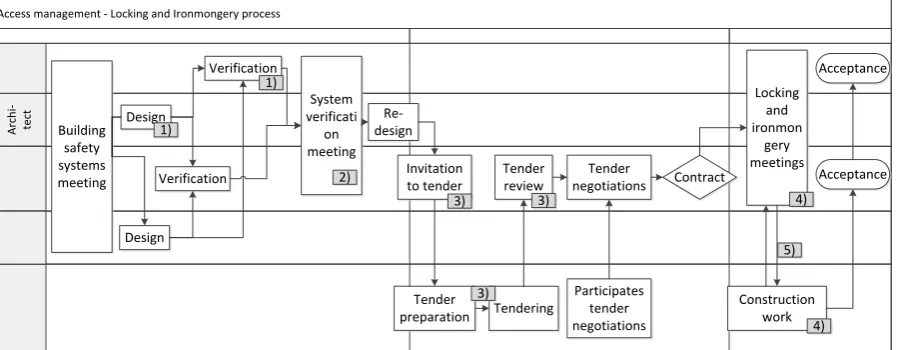
[image:5.595.76.525.503.678.2]In the first case project, Lahden Sairaalaparkki, the locking and ironmongery process was initiated by the architect together with electrical engineer as depicted in Figure 1. The responsibility for initiating the process belongs to the architect due to prevailing public sector’s contracting principles and national practice for project delivery.
FIG. 1: Locking and ironmongery process of the case project Lahden Sairaalaparkki posed number of fallacies and pitfalls. Numbers 1-5 refer to discussion of case process in Chapter 4.4 respectively.
Access management - Locking and Ironmongery process
A rc h i-te ct C lie n t G en er al co n tr ac to r Su b -c o n tr ac to r: lo ck in g an d ir o n m o n ge ri n g El ec tr i-ca l e n g. Production Design Tendering Contract Building safety systems
meeting Invitation to tender
Tender review Tender preparation Tendering Tender negotiations Construction work Acceptance Design Design Verification Verification System verificati on meeting Re-design Locking and ironmon gery meetings Participates tender negotiations Acceptance 1) 1) 2) 3) 3) 3) 4) 4) 5)
The principles of the safety and access systems of the building were defined together with the design group, main contractor and client. BIM was not utilised to facilitate the definition process, instead traditional plans and drawings were used. Based on the principles agreed in the meeting both the electrical engineer and architect prepared their designs. The architect consulted external locking specialist to select the ideal locking solutions and to define the coding for them. Although the designs of different disciplines were mainly completed by using BIM, locking and ironmongery design was completed with traditional methods, as it is still done in most BIM projects. The designs were checked and approved by the client and the main contractor and after that exported to project's database.
Before starting the tendering phase for installation, a separate system verification meeting was held to ensure the compatibility of locking system solution and design. After consultation the architect updated the design accordingly and main contractor collected all relevant documentation and placed the invitations for installation tender for locking and ironmongery contractors.
In the case process, all four tenderers adhered to their own tendering methods and used the source material very differently when compared to each other. As a result of the tendering process main contractor received four tenders, which were non-comparable and therefore the decision to select the subcontractor was made rather by evaluating the quality and quantity of tenders instead of systematically comparing each of them with requirements of the customer and against other tenders.
The selected contractor arranged meetings with client, architect and main contractor to go through the proposed solutions to create the final locking and access plans for the project. The discrepancies between the different designs in architectural, electrical and locking documents as well as in smoke extraction plans were solved on site during the installation phase. Simultaneously, as the installation phase made the access management solution more understandable for the end-users, a number of corrections and changes were made to the initial locking design. Some critical installation information from the end-users was not included to the design and therefore supplementary information was collected during installation phase.
3.5
Case process #2, Rajamäki and Intensive Big Room process
Fira’s IBR is a multidisciplinary facilitated process for structured co-working and co-creation. Fira has adopted the ICE collaboration method for IBR from studies made in Center for Integrated Facility Engineering (CIFE) at the Stanford University. In Rajamäki project, a shared dedicated facility was used for co-working in weekly meetings attended by all participants, and utilising BIM compatible large screens and projectors, whiteboards, and high-speed wlan for VPN-users. Simultaneously a separate room for making private phone calls or conducting tasks in other projects was made available. By this also those specialists, who had only a relatively small design task in the project and were working simultaneously in multiple projects, were also able in participating in the IBR sessions. The IBR was also tested on site, where the conditions were challenging and only a large screen was available.
The project gained real benefits from these arrangements, since designers were able to participate in co-located IBR sessions in regular basis even though the project had relatively small budget compared to projects in which 24/7 Big Rooms have been used. These arrangements were also necessary due to fact that the use of IBR was not included into the design contracts which were made between customer and designer companies before Fira joined to the project.
During the Rajamäki project, there were 10 subsequent IBR sessions and the methodology was developed continuously. The project team used a Lean method, Plus/Delta, for self-assessment and measuring the performance of each session and new tools. Externally, continuous evaluation and literature study were conducted to analyse the improvements as well as to develop new tools and methods to be tested in next IBR sessions.
The findings from Rajamäki project supported the theory in which the ICE represents the most accelerated project method, where the full organisation gathers and executes the most interdependent work together. Even though the individual subtask durations varied a lot in Rajamäki, the IBR was proved to be a platform for solving problems, discussing alternatives and questioning assumptions by using parallel and dynamic team work. Extremely collaborative work, maximised communication and information flow supported by visual representation of the design in BIM format were the tools for value co-creation with the customer.
4.
KEY FINDINGS
4.1
Identified fallacies and pitfalls
According to interviews the following six major flaws were identified from implemented locking and ironmongery process in the Lahden Sairaalaparkki case. Numbering is also used to identify occurrences in process chart in Figure 1:
1) Architect had to use a consultant to define the locking and ironmongery data into the door schedule in design phase. The terms and coding which were used in the schedule were so detailed that project participants were not able to verify the results without the locking specialist. Knowledge of system provider would have helped in defining the requirements for solutions at the early stage of the process.
2) Access management and locking system provider was selected and system verification was made based on locking solutions. Customer's business requirements for the access management were not properly identified and the functionality of the system was not fully defined.
3) Invitations to tender were delivered without functionality description, design contained errors and was partially inadequate. As a result the tenderers could not provide alternative economical solutions.
4) Invitations to tender were provided in a such format that each tenderer needed to interpret the data in order to prepare their tender. As a result tenderers spent varying time and used varying methods to prepare the tenders and thus tenders were not comparable.
5) Subcontractor was not able to detect all the inconsistencies of the design and data, neither during tendering phase nor in the meetings with the project participants. Therefore subcontractor was not able to finalise the installation as planned and the required design information had to be completed during the installations. Also, some of the problems were identified too late, which caused non-optimised use of access solutions due to the fact that corrective reinstallations were not financially feasible compared to the potential benefits they would have brought for the client.
6) Client and end-users completed and partially changed their requirements during installation, which caused redesign and rework.
4.2
Root cause analysis
As discussed above the first case process in Lahden Sairaalaparkki caused a lot of waste. Even more challenging was the potential customer value, which was not created, but destroyed. In order to define counter measures, a RCA was used for each fallacy to study each issue in more detail. Resulting root causes were examined further in a framework of value creation, people, processes and ICT and appropriate countermeasures were defined for each root cause to be used in proposed solution process as follows:
2) Even though BIM was used extensively in the project, the information related to the case process in each phase was presented solely in prevailing formats and documents. A comprehensive understanding of the defined access management and locking functionality was cumbersome, even impossible, to obtain. Thus errors and discrepancies in the defined plans and details were inevitable and some parts even remained unplanned and were recognised only in the installation phase. From the process perspective use of requirements management is essential during the design and construction to make sure that customer's business requirements drive the design. From the perspective of value and people, the customer could involve end-users into the development phase if the process would aim to a user-friendly functionality description for access management, which the customer could use internally for sole value creation.
3) The information in the design documentation was scattered and insufficient for verification, tendering and installation purposes. Traditional representation of the information caused waste as it prevented architect, client and main contractor from understanding and verifying the design efficiently. In addition, the lack of explicit functionality description for access management prevented subcontractors from understanding and implementing all the required functionalities in their locking solution at once. Process could be efficient only if the information would be targeted and filtered for each process task. Process-wise, the information management should offer just the required information in the most useful format for the people in the process. Information management belongs to ICT domain and efficient information delivery should be implemented by using tailor-made standard model views of BIM. However, this requires also thorough analysis of the information needs of all participants in different stages and definition of responsibilities to produce the necessary information.
4) Client’s business processes evolved during the Lahden Sairaalaparkki case project. As discussed in Chapters 2 and 3, required visualisation of access management solution and requirements management were not present in prevailing process and therefore noteworthy requirements of the customer were not identified along in the locking and ironmongery process. As a result of the low ability to recognise and react to changes in customer’s business requirements on time the late changes disturbed the installation process. From the process and value perspective, the co-creation should be carried out through locking and ironmongery process and co-working should be pre-planned and facilitated to ensure efficiency. Also, from the ICT perspective, the use of BIM for visualisation should be mandatory to avoid what happened in the case process, where the client realised designed functionalities only based on observations on site visits. Standardised model views should be used to create more value for customer by enriching the 3D representation and simultaneously for filtering obsolete details from BIM to make it easier for client and end-users to observe and understand the proposed access and locking functionalities during the design and implementation process.
4.3
Lessons learned
Key features in the proposed implementation of early involvement principle and IBR process are:
1) Customer’s business requirements are always individual and project specific.
2) Customer’s abilities to define business requirements and develop them to technical requirements for a construction project are very limited.
3) Customer is not able to understand designed functionalities based on the current standard documentation of construction process without additional visualisation and personalisation of information.
4) The team responsible for designing and implementing the solution must be brought together as early as possible to integrate the team and create a shared understanding for the objectives, requirements, and finally the solution.
5) Integration of the team consisting of different companies cannot be done without changing the prevailing paradigm: the selection of participants cannot be based solely on the lowest cost bid and the commercial model must include incentives to integrate the team instead of fragmenting it by forcing participant to minimise their workload.
5.
PROPOSED SOLUTION
The design of the proposed client centric solution for the case process is based on four design principles, namely customer value, people, process and ICT. Following argumentation is used as guiding principles in designing the proposed solution:
1) Customer business value can be maximised by using co-creation with the client and design team to define functional requirements for access management based on CAPEX/OPEX (Capital/Operational Expenditure) analysis.
2) Selection of system provider is made in the beginning of the process according to early involvement procedure of IPD and it is based on value for money principle instead of traditional choice of goods and services based on the lowest cost bid.
3) The business model of the locking and ironmongery project is changed for supporting value for money thinking. The potential bonus of the participants in the project is based on verifiable added value to the customer. If the team of companies fails to achieve its targets, the participants will return part of their fees to the customer.
4) IBR is used to facilitate the end-to-end co-creation together with customer and end-users to design and implement the optimal solution according to customer's business process requirements. IBR ensures also the required adaptivity to changes in client’s and end-users' business requirements.
5) Key Result Areas (KRAs) for the entire project are based on value for money principle and Key Performance Indicators (KPIs) are defined for each KRA. Incentive model is based on common incentive pool and shared targets, which are defined by KRA/KPIs.
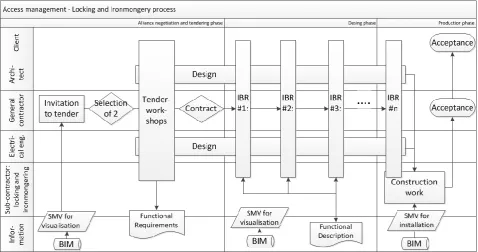
6) Productivity during installation is increased by using only verified installation data and standardised model views (Laine et al. 2014). Proposed solution is depicted in Figure 2.
FIG. 2: Proposed solution for the client centric design management process for locking and ironmongery in which IBR and standardised model views are being used.
5.1
Detailed process description
[image:9.595.71.550.377.629.2]sessions, the customer processes and use-cases are examined as a part of collaborative design. The Standard Model Views are used for visualisation in order to gain shared understanding for the required functionalities of access management.
Due to the early involvement of all required designers and specialists together with the owners of the customer’s business processes, shared understanding is achieved very early in the design phase. Other benefits accrue from bringing the project team together at the very beginning of design. The team develops cohesiveness and commitment to the customer’s goals on each KRA. To achieve the early involvement, the subcontractor and system provider are selected simultaneously in the tendering phase. In tendering, the final selection is made by comparing performance of the two competitors in workshops in which they have to develop the solution together with the design team. The evaluation criteria consists both on the ability to provide value for money during the workshop as well as stating the Turnover Cost (TOC) based on the design made in the workshop. By using 80-20 weighting between the shown capability and end cost, the best provider will be chosen and contracted.
In the design phase the designers are developing their plans individually as in a legacy design process. However, the IBR sessions are used to create shared understanding as early as possible, eliminating the latency from the design process and enabling the fast decision process as Chachere et al. (2009) described and Fira experienced in the Rajamäki Project.
5.1.1 Intensive Big Room session description
The IBR session is a facilitated process with three phases, namely set-up, ICE and wrap-up phases. The IBR session starts with set-up phase, in which briefing and setting the common goals for the session is done. The goals are usually identified problems and design tasks, which must be finalised during the session. The goals are documented as well as their owners, who are responsible for concluding each task during the session. Also, if there are any changes in the rules or tools, these are explained at the session briefing. After that a design schedule review is conducted, emerged problems in the schedule are analysed as well as the schedule for coming three weeks is adjusted. The Last Planner method can be used to facilitate joint planning of the schedule. Finally, in each briefing for a session, the status of design process is reviewed. In visualisation (A0-posters, charts and applications on screen) same colours are used coherently: green indicates progression-track, yellow indicates an identified problem, which can be solved, and red indicates a show-stopper problem, which needs interdisciplinary attention and collaboration in the ICE session.
The second phase of IBR is the ICE session, in which there are always two facilitators, the chairman and the secretary. The chairman is actually the facilitator and activator, who dispatches the tasks for task owners and helps them to form the team. Chairman allocates the tasks for task owners and hands over the ICE procedure chart for each owner. The task and goal are described in the chart and there is a standard three step process, which is conducted to solve the task. First, the customer’s expectations are reviewed and documented, then similarly the systems or machinery in requirements are reviewed and finally the impacts and alternatives of structural and architectural solutions and their constructability are discussed and the decisions are made. Task owners are responsible for documenting the facts to the ICE procedure chart for each task. Each task has an opportunity to get more resources or even interrupt the work of other teams, if it is necessary to use crowd-sourcing in solving the task or make sure that each and every one is aware of a fundamental change or decision. Simultaneously, the secretary documents the common discussion and especially the decisions. The chairman re-allocates tasks and resources, identifies bottlenecks, refocuses the teams and controls that all teams reach their targets towards the end of the ICE session.
The IBR-session is always wrapped up by conducting task completion review and self-reflection by using Plus/Delta. Each task owner presents his conclusions and decisions. Simultaneously, the secretary updates the A0 Visual Progress Chart and, hence, the results are visible for each participant.
6.
DISCUSSION
2006). This paper concentrates on the development of a new method in a small sub-process in relatively small case projects. Locking and ironmongery process represented in the case projects less than one percent of the total budget. It also occurred relatively late in project’s infill phase and the production was done parallel with other finalising works with time constraints. From main contractor’s perspective, locking and ironmongery process was dealt as an inevitable but not crucial subcontracted part of project. However, evidences of loose integration of people, process and information management, which are presented in this study, and their implications in value creation are matching to findings by Dave et al. (2008) in their critical study of construction sector. However, one of the limitations of the study is that the result was not measured from the customer’s OPEX perspective at all.
Another critical finding of Dave et al. was the marginal productivity improvement for isolated ICT investments. This too is in line with the case process, as the main contractor was investing in using BIM in the project and all major design disciplines were utilising BIM as a design tool, but it was not beneficial for customer or subcontractors in the case process.
In the case process, the information, knowledge and participants of the process were heavily fragmented due subcontracted work, broken business models and required expertise. The framework of customer value, people, process and ICT was providing tools to identify the pitfalls and develop collaborative design process. However, there are three obstacles in the implementation of the proposed solution. 1) The use of competence-based bid instead of lowest cost bidding requires a leap of faith. A small scale application of alliance tendering will cause extra costs in the early implementations. 2) There is inevitably an initial development cost for standardised model views, facilitation process and training as well as for a new contracting model. Additionally, the IBR process implementation and the use of early involvement principle will add costs. 3) The currently used contractual agreements maintain the same sub-optimisation and conflict of interest problems that were discussed in Dave et al. (2008). Participants will not change their habits without changing the revenue sharing model.
On the other hand, proposed solution provides clearly more value for the customer, since applying IBR process into locking and ironmongery process changes the logic of whole delivery system and the end-result is more beneficial for customer. It is also expected that the total cost of installation will decrease due to removal of waste from the process, which in the long run will compensate the initial development costs. The main contractor should take these initial costs as an investment for their service development. Process should be seen as a chargeable service, which needs to be developed into a service concept. Additional value can be also used as an incentive for aligning the contractors by using a shared compensation pool similar to the IPD or Alliance model and pain-gain revenue sharing model.
From the service logic perspective, there is a very valuable side effect for the main contractor from using IBR sessions in solving recurring issues of construction management. Main contractor is collecting intangible asset of knowledge in cross-project use of IBR. Business-model-wise, the value creation for customer is the first objective. Each time the locking and ironmongery IBR session is being held, the customer value increases: 1) access management functionality is designed based on customer requirements, 2) implementation and cost are understood and controlled by the customer and for these reasons the customer satisfaction will be higher than in the case process or cases where the prevailing process is implemented.
A crucial question is how well the facilitating organisation is able to capture the created value. In other words, main contractor is able to engage it to the customer's practices and first learn from the customer and later provide new customers more variable processes than competitors. Hence, the subsequent IBR session will provide more value for the project with less effort and the intellectual capital of the main contractor will increase project by project. Proposed use of IBR process is actually a co-creative collaboration process with the ability to save knowledge for further use and therefore it represents method for value creation for the main contractor’s customers and value capturing tool for the main contractor.
7.
CONCLUSIONS
and value for money principle to be used within legacy design-build (D/B) project was developed and proposed. Service logic was used as a guiding principle during the development.
Key innovations in the proposed model include value co-creation by using Intensive Big Room as a tool for interaction. Similarly a value capturing method of IBR for the main contractor was presented, by which the contractor can increase the intangible knowledge in its organisation and secure long term competitiveness. Client centricity is further strengthened by introducing requirements management in the process for documenting, tracking and updating the client requirements as the construction project is proceeding. The utilisation of BIM is expanded from designers to individual workers on site by using standardised model views, which increases the productivity on production phase.
Proposed solution makes it possible to start using the methodology of Integrated Project Delivery (IPD) even though the customer, designers or general contractor are not mature enough to use IPD/Alliance contract for the project but relay on legacy contracts, e.g., D/B contract. Solution provides also an opportunity for the general contractor to increase customer value even in small scale subcontracts by using an integrated business model. The change in business model and ability to capture value provides the company a possibility to differentiate with more attractive value proposal for customers.
8.
REFERENCES
Alhava O., Laine E. and Kiviniemi A. (2014). Interactive client centric design management process for
construction projects, eWork and eBusiness in Architecture, Engineering and Construction ECPPM 2014
(Mahdavi A., Martens B., and Scherer R., editors), Taylor & Francis Group, London, UK, 593-599.
Chachere J. (2009). Observation, Theory, and Simulation of Integrated Concurrent Engineering: Grounded Theoretical Factors and Risk Analysis Using Formal Models, working paper #WP118, Center for Integrated Facility Engineering, Stanford University, Stanford, April.
Chachere J., Kunz J. and Levitt R. (2009). The role of reduced latency in integrated concurrent engineering, working paper #WP116, Center for Integrated Facility Engineering, Stanford University, Stanford, April.
Dave B., Koskela L., Kagioglou M. and Bertelsen S. (2008). A Critical Look at Integrating People, Process and Information Systems within the Construction Sector, Proceedings for the 16th Annual Conference of the International Group for Lean Construction, 795-807. (Available at http://iglc.net/conference-papers/iglc-16-manchester/).
Eagan Construction Task Force. (1998). Rethinking construction, (Available at http://www.architecture.com/files/
RIBAHoldings/PolicyAndInternationalRelations/Policy/PublicAffairs/RethinkingConstruction.pdf, Accessed 27/03/ 2014).
Fundli I. S. and Frode D. (2014). Collaborative Design Management – A Case Study Proceedings of IGLC22 (Kalsaas B. T., Koskela L. and Saurin T. A., editors), Akademika forlag, Trondheim, Norway, 627-638.
Grönroos C. (1994). From marketing mix to relationship marketing: Towards a Paradigm Shift in Marketing, Management Decision, Vol. 32, Issue 2, 4-20.
Grönroos C. (2008). Service logic revisited: who creates value? And who co-creates?, European Business Review, Vol. 20, No. 4, 298-314.
Hietala H., Särkkä M., Rouvinen A. and Aho J. (2010). From a goods-dominant to a service-dominant business model: case service construction, QUIS12 conference, USA, 2-5 June 2011.
Howell G. (1999). What is lean construction, Proceedings IGLC-7, Berkeley, 26-28 July 1999.
Ibbs, C., Kwak, Y., Ng, T., and Odabasi, A. (2003). ”Project Delivery Systems and Project Change: Quantitative Analysis.” Journal of Construction Engineering and Management, Volume 29, Issue 4, pages 382–387.
Khanzode, A., Fischer, M. and Reed, D. (2005) "Case Study of the Implementation of the Lean Project Delivery System (LPDS) Using Virtual Building Technologies on a Large Healthcare Project", Proceedings of 13th International Group for Lean Construction Conference, Sydney, Australia
Khanzode A., Fischer M., Reed D. and Ballard G. (2006). A guide to applying the principles of virtual design & construction (VDC) to the lean project delivery process, CIFE Working Paper #093, Stanford University.
Kloppenborg T. J., Shriberg A. and Venkatraman J. (2003), Project Leadership, Management Concepts Inc., USA.
Knapp S., Long D. and Howell G. (2014) The Role of the Owner’s Representative on IPD, Proceedings of
IGLC22 (Kalsaas B. T., Koskela L. and Saurin T. A., editors), Akademika forlag, Trondheim, Norway 1369-1377.
Lahdenperä P. (2012). Making sense of the multi-party contractual arrangements of project partnering, project alliancing and integrated project delivery, Construction Management and Economics, Vol. 30, Issue 1, 57-79.
Laine E., Alhava O. and Kiviniemi A. (2014). Improving built-in quality by BIM based visual management, Proceedings of IGLC22 (Kalsaas B. T., Koskela L. and Saurin T. A., editors), Akademika forlag, Trondheim, Norway, 945-956.
Lapinski, A., Horman, M., and Riley, D. (2006) ”Lean Processes for Sustainable Project Delivery.” Journal of Construction Engineering and Management, Volume 132, Issue 10, pages 1083–1091.
Liikennevirasto (2013). Rantatunneli alliance project plan, Alliance Executive Team, 26 June, Tampere, Finland.
Liikennevirasto (2014). Rantatunneli alliance value for money report project development phase, Alliance Leadership Team, 3 April, Tampere, Finland.
Liker J. K. and Convis G. (2012). Toyota way to lean leadership, New York, McGraw-Hill.
Liker, J. K. and Morgan, J. M. (2006). The Toyota way in services: the case of Lean product development Academy of Management Perspectives, May 1, 2006 20:5-20.
Mark G. (2002). Extreme Collaboration, Communications of the ACM, Vol. 45, No. 6, pp. 89-93.
Matthews, O. and Howell, G.A. (2005) "Integrated Project Delivery An Example Of Relational Contracting." Lean Construction Journal Volume 2, Issue 1, pages 46-61
Mossman A. (2008). More than materials: managing what's needed to create value in construction, ECCL, 2nd European Conference on Construction Logistics, Dortmund. (Available at
http://www.thechangebusiness.co. uk/TCB/ Integrated_Project_Delivery_files/More-than-materials-Construction-Logistics-ECCL.pdf).
Prahalad C. and Krishnan M. (2008). The new age of innovation, New York, McGraw-Hill.
Seed W.R. (2014). Integrated project delivery requires a new project manager, Proceedings of IGLC22 (Kalsaas B. T., Koskela L. and Saurin T. A., editors), Akademika forlag, Trondheim, Norway, 1447-1459.
Vargo S., Maglio P. and Akaka M. (2008). On value and value co-creation: a service systems and service logic perspective, European Management Journal Volume 26 Issue 3, June 2008, 145-152.
Womack J. and Jones D. (1996). Lean thinking: banish waste and create wealth in your corporation, London, Simon and Schuster.