Rochester Institute of Technology
RIT Scholar Works
Theses Thesis/Dissertation Collections
4-2014
Kinesthetic Empathy
Danielle Haendiges
Follow this and additional works at:http://scholarworks.rit.edu/theses
This Thesis is brought to you for free and open access by the Thesis/Dissertation Collections at RIT Scholar Works. It has been accepted for inclusion in Theses by an authorized administrator of RIT Scholar Works. For more information, please [email protected].
Recommended Citation
Rochester Institute of Technology
A Thesis Submitted to the Faculty of
The College of Imaging Arts and Sciences
School for American Crafts
In Candidacy for the Degree of
Master of Fine Arts
Kinesthetic Empathy
By Danielle Haendiges
2
Thesis Title:
Kinesthetic EmpathyStudent Name:
Danielle HaendigesThesis Committee Final Approvals
Chief Advisor: Michael Rogers
Associate Advisor: David Schnuckel
Associate Advisor: Juan Carlos Caballero-Perez
3
Abstract
Kinesthetic empathy is a term that talks about our ability as humans to feel each other’s
pain. We have an incredible understanding and connectivity with people we hold close in our
lives. The body of work for my MFA Thesis Exhibition explores some aspects of these
phenomena by illustrating emotional relationships in glass sculpture. There are many different
ways that people empathize with one another, therefore, different aspects and rituals of
commiserating are explored to better understand why we can feel another person’s pain without
physically experiencing it.
I have a very specific connection with this type of empathy; my younger sister, Leigh,
has been sick her whole life. While Leigh appears healthy and well, she has a multitude of
autoimmune diseases that have required her to be on chemotherapeutic medication since she was
very young. She feels severe physical pain everyday of her life. Growing up as her older sister,
I felt compelled to protect her. In this lifelong attempt to protect her emotionally and physically,
I have experienced a huge range of emotions related to her pain and health struggles. While
many people feel sympathy for Leigh and her health issues, I think that our strong connection as
siblings has made our relationship unique. While most elder siblings take a defensive stance
with the younger, I have found my feelings to be more akin to survivor’s guilt.
Through the use of portraiture with elements of the grotesque, I show a relatable person
with whom one would feel a connection to, as well as a physical deformity that may be difficult
to look at otherwise. The contrast of combining realistic bodily features assuming impossible
physical distortions will pull the viewer into the work to investigate something seemingly
4
Sources and Research
To explore these feelings, I have researched sympathetic magic such as Vodun figures
from West Africa and the Yoruba people1, as well as different rituals for healing the sick and
restoring balance through nature. I have also done extensive research on different auto immune
diseases, their symptoms and treatments, and the physical deformities caused by them to
approximate the visual. Research on the various medications my sister has taken over the years,
collecting MRI’s, X-RAYs, images of different physical ailments, and discussion with a friend
who lost her younger sister to a disease very similar to my younger sister have all influenced the
work. The images that are used are based on actual medical information and MRI / X-RAY
imagery. However, I have abstracted these deformities into a set of symbols to be used
throughout the body of work.
Sympathetic Magic and Symbols
The Yoruba people had many religious and cultural traditions. The most interesting to me
are the ones using dolls to represent humans and how these dolls are cared for to have an effect
on a specific person.
“When the concept of "doll" is considered in the context of African culture, they are
usually not children's playthings, but rather objects that are laden with ritual and religious
associations within the community. African dolls are used to teach, and entertain, they are
supernatural intermediaries, and they are manipulated for ritual purposes (Dagan 1990)”.
The power held by these artistically crafted figures for the purpose of female fertility or
good health and fortune is very interesting to me. If a woman was having issues with fertility she
would have a small statue of a very voluptuous woman form to keep with her to help encourage
5
emphasized genitals. The use of exaggerating anatomical features was very specific to the nature
of the doll. The magic and symbolic healing through dolls covers many ailments and problems
of the people at the time, not just fertility. Investigating the symbols and imagery used in these
ancient dolls influenced the way that I used certain symbols of my own throughout this body of
work. The symbols I used are different from most of the ones used in these ancient figures;
throughout my thesis work, vertebrae and the spinal cord are displayed outside the skin to show
their medical importance and to imply a metaphorical vulnerability and a need for healing. In
exaggerating the sizes and changing the placement of this anatomy, the urgency and weight of
these failing parts is brought to the forefront for the viewer.
Medical Conditions
My sister has Juvenile Rheumatoid Arthritis (JRA) and Chiari Malformation. Many of
their treatments, through which we have both struggled and bonded, are nearly as terrible as the
disease itself. JRA is an autoimmune disease which is treated similarly to cancer; it is
aggressive, chronic and incurable. Chemotherapy is used along with many other medications.
These medications are prescribed mostly to balance out major negative effects of the chemo: an
attempt to slow the degradation of skeletal joints. JRA comes with more than just knotted
fingers and painful knees; generally those who are born with an auto immune disease like my
sister have multiple auto immune diseases. The tendency of these diseases toward multiples
makes treatment and recovery all the more difficult. The diseases and treatments can have very
different effects on the body, sometimes even conflicting.
Chiari Malformation is a low placement of the occipital lobe of the brain, which can
6
Institute of Neurological Disorders and Stroke 2013). Most people with this malformation have
a very slight form of it and may live their whole lives without ever knowing that they have it.
The other extreme of this malformation causes babies to be born with their spines outside of their
bodies, making life outside the womb impossible. For the level of this disease that my sister has
(about the most severe one can have without any obvious physical deformity), symptoms
generally present in early adulthood. These can be anything as minimal as a headache to
something as alarming as the occasional loss of feeling in the legs; even as dramatic as a total
loss of bodily control when they cough or sneeze. Any type of stressor that would change the
spinal fluid’s pressure can cause the patient to even collapse to the ground. Where a normal
person’s body would compensate for the change by letting more fluid into or out of the head, the
Chiari Malformation is a narrowed channel in the foramen magnum, rendering the ability to
balance this fluid impossible. The only way to fix this is a surgical process called a spinal laminectomy; an attempt to open up the spinal cavity, shave down the top few vertebrae to be shorter and, in turn, relieve the pressure on the spinal cord (National Organization for Rare
Disorders 2014). A Dura matter brain graft is implanted like a gasket in the newly widened
foramen magnum to keep it open for the exchange of fluid and hold the space required for the
spinal cord to be unobstructed. Leigh had undergone this surgery. Luckily, it went well.
The doctors were able to build a gasket out of the lining of a cow’s heart so as to keep
the proper distance between Leigh’s brain and foramen magnum. Aside from a longer recovery
due to her various autoimmune diseases, she has recuperated beautifully. However, the ethical
yet sterile attitude with which the surgeon cut open her head is something I will not soon forget.
These interactions between surgeon and patient/body parts begged the comparison of the body to
7
use of multiples in my thesis work became very important because of this idea of human
mending; the transfer of parts from different life forms to make these repairs possible.
While research on the medical side of these maladies has informed my work visually and
conceptually, I feel that the personal interactions that I have had with medical professionals over
the years alongside Leigh have also informed the work. Chemotherapy and its toxic, sterilizing
effects are a key component to the concepts I am working with. The aftereffects such as
infertility, side effects of chemotherapeutic medication, and other medications, which become
necessary once a patient is on chemotherapy are also a big part of what I explored. While
doctors see the intravenous infusion of this liquid, they often don’t see the days of vomiting,
diarrhea and exhaustion that come as a result of the treatment. I think as science makes the
boundary of inside and outside the body more easily permeable, the medical personnel can often
take for granted the delicacy and fragility of human emotions that can be equally important for a
patient’s recovery. The scientific progress has made the business of preventing death into a
well-oiled machine where emotion is unnecessary and I feel that this recognition of emotional
delicacy should be in balance with the growing knowledge of the durability and restoration of the
body.
Artistic Influences
This body of work has been influenced by many sources, including the contemporary
work of established sculptors whose aesthetic, practice, and conceptual intent proves relevant to
mine. Using abstractions to the human form to facilitate an empathetic narrative is an element
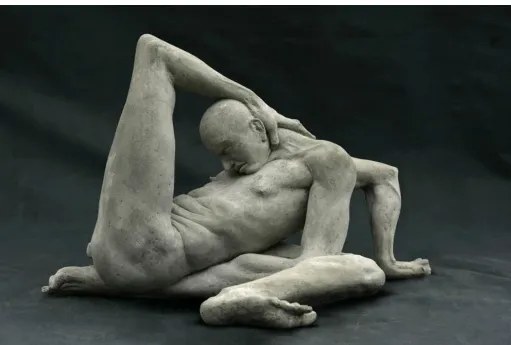
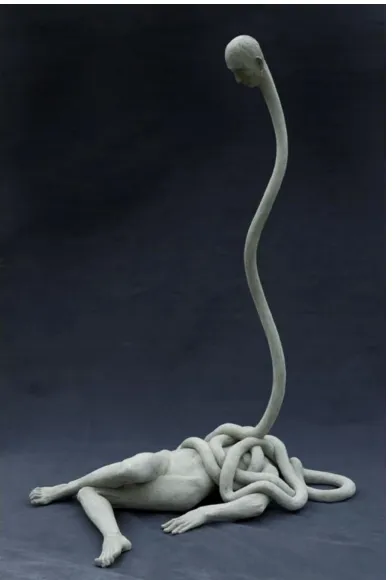
my work shares with the work of artist Emil Alzamora. He exaggerates the anatomical structure
8
makes his distortions to the figure more difficult to view in that you can see a body doing these
impossible things and imagine your own body forming these poses. In Masochist (Fig 1) a contorted man is stretched in an uncomfortable position and upon closer inspection one finds that
the body parts are misplaced, (arms extending from where legs should be). This type of
distortion is visible in my work in both Little Spoon, and Mirroring.Little Spoon uses a real face with distorted neck and exposed spine to push the discomfort of the viewer. Mirroring has elongated and overly arched necks that are realistic enough to be compared one’s own, yet
impossible. The exposed spine continues the illustration of impossible human anatomy.
Alzamoras work Afterlife Afterthought (Fig 2) showcases an immensely elongated and twisted neck to talk about seeing one’s self, as if from above, in the moments soon after death
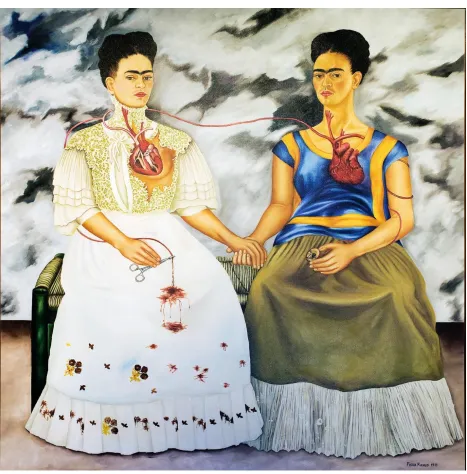
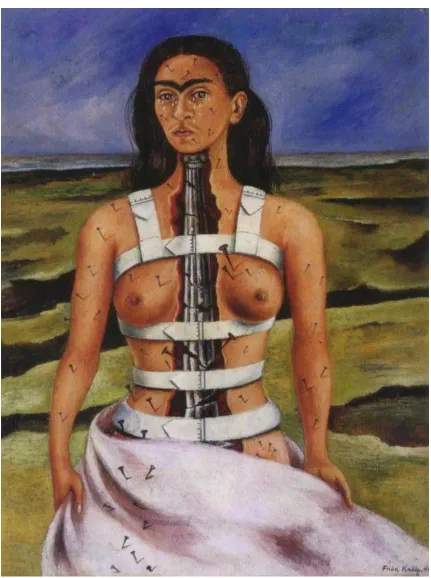
Another artist I found helpful in the process of creating my own set of symbols that speak
about pain and health issues is Frida Kahlo. Her paintings not only document her own many
physical ailments and surgeries, but also express the mental agony that accompanies her bodily
suffering. Kahlo’s paintings are believable enough to relate to and sympathize with, but
abstracted in such a way that pushes the great depth of her emotion. The Two Frida’s (Fig 3) is a great example of Kahlo’s painful imagery in which she is connected to another version of herself
by the heart: both of their hearts are exposed. I used a similar idea in Telepathy by connecting the two heads by crocheted copper as a means to visualizea life force. Kahlo’s painting The Broken Column was also an inspiration to me. Her comparison of her spinal cord to a broken architectural element was a concept that I often considered with my own works; most visible in
9
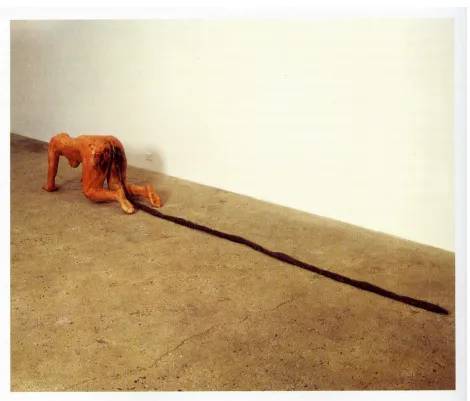
Kiki Smith is another artist who has made figurative sculpture with emotional
undertones. Her series of full body casts of her own form, with some element of the inside of the
body getting out in a grotesque manner, to be a major influence on my work. I found that the
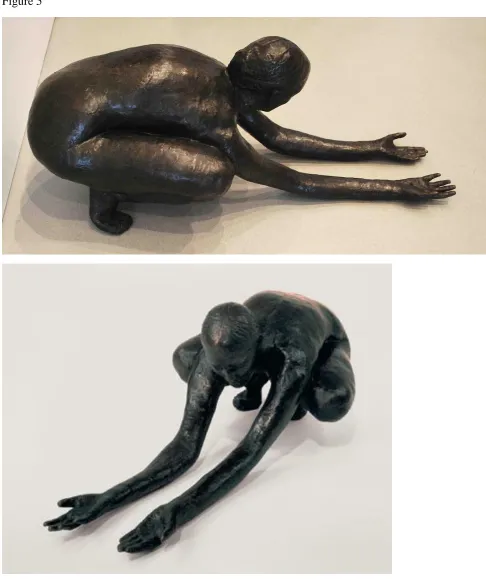
two most influential of her pieces are Untitled (Fig 5), which shows elongated arms on a female form to reinforce the emotional length added to the physical reach. Smith’s bold use of
disgusting looking material in Tale (Fig 6), was symbolic inspiration to be unafraid to use the grotesque with realistic figures shown in my work on Spine Study #1 -#4.
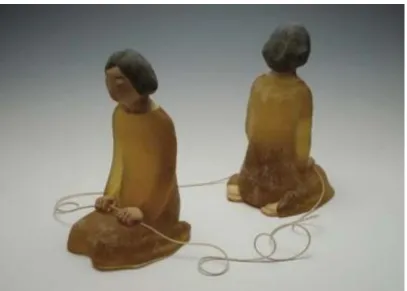
Finally, Masayo Odahashi’s small glass figures convey connectivity and
emotional bond in a very concise way (Fig 7 and 8). Her work is very well edited and uses small
details to express big emotions. I found that the minimalistic nature of her work made me
consider how my pieces could say more visually without becoming cluttered. This clean
aesthetic was helpful to me in that I have a tendency to want to add things on to works, where the
more appropriate solution to get the concept across is editing.
Critical Analysis
The use of invented anatomy gives a sense of discomfort to the viewer and brings them to
a place of bodily awareness and understanding for a problem they may not actually have. This
idea of facilitating kinesthetic empathy and connectivity to the work within my MFA Thesis
Exhibition was the impetus to its making. To make the work very personal I have chosen to use
my own face for the portraits and busts in the show. This was an attempt to invite them to make
connections to real people in their own lives with whom they may feel this type of connection.
10
I’m not sure how I could have persuaded the viewer to draw connections to their own lives more
than I did. In discussing the show with some viewers Life Infusion (fig 9) seemed to be the most relatable piece for people due to how easily they could recognize and relate to the idea of an I.V.
I also have been working through the feelings that I feel towards Leigh, about how her
health relates to me, and, in turn, how the work uses specific materials and imagery that
represent our relationship metaphorically. I have been researching poses and gestures that show
sympathy and express pain. This process began with looking at many images of people with
various physical problems as well as x-ray images of these same deformities to see the structure
from the inside and the outside. There is a common visual thread among these spinal
deformities: stretching and compressing. I have been able to simplify some of these poses and
images to a more concise shape, like the pose in Mirroring (fig 10). These figures have
elongated necks that feel unnatural and yet hold truth in their feeling of awkwardness. In Little Spoon (Fig 11), the larger figure has a more natural body shell while the smaller one is
compressed into just a long, twisted neck with spine exposed. This pose taken by the Little Spoon references some of the more painful looking stances held by people with severe spinal deformities and emphasizes that it is under the protection of the larger figure with the more
normal body shape. While some sculptures are abstracted to a point that is not recognizable as a
specific body part, they still evoke a feeling of discomfort.
As far as the choice of materials, glass translates the many aspects of my concerns with
the body more relevantly than other materials. Glass is fragile but heavy, referencing our own
physical fragility amidst the heft we carry through emotional burden. In By a Thread (fig 12) the noticeably broken and repaired surface of the piece shows the fragility of the glass. However, it
11
Mirroring the smaller figure is made of broken and reconstructed pieces making it seem weak and precarious. Yet, it is still supporting the weight of the larger figure who could not stand on
her own due to the steep angle of her elongated neck. This balance between fragility and
strength, heft and delicateness was best achieved using glass.
Moreover the optics that glass possesses make it possible to see through many of the
pieces. Transparency connects strongly to the medical theme in the work through ideas about
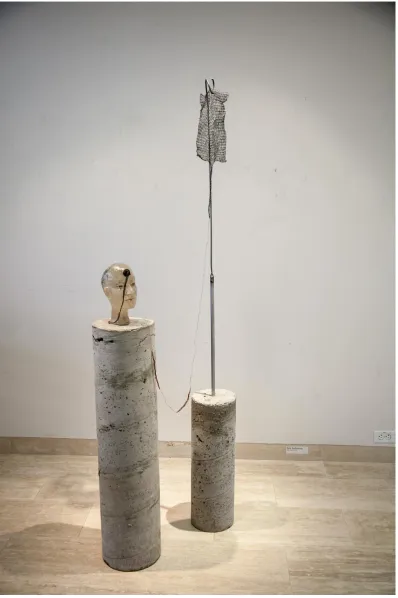
seeing what is under the skin as accessible and even replaceable. Telepathy (fig 13) utilizes the transparency of glass by showing the copper network or nerves inside. The connection of the
pieces by the long copper cord is made more important by showing that the copper originates
deep inside the heads. Transparency allows for layering and showing inside and outside spaces
simultaneously. This can be seen in Life Infusion by the I.V. bag and line continuing from outside the body to inside the head. Mirroring utilizes the clear quality of glass, by showing the space where the spinal cord would go inside the larger figure safely contained inside the neck
and comparing it to the exposed exoskeleton-like spine on the smaller broken figure. The
juxtaposition of the two helps make a healthy to unhealthy, or safe to dangerous comparison
even though both piece seem to have a sense to precariousness.
Copper wire is used a lot throughout this body of work to represent an intangible life
force but also, in some works, the spinal cord. Copper is most useful with casting glass because
of its compatibility for casting, but once incorporated it carried as a symbol and took on different
shapes and meanings. The crocheted copper cord used throughout the exhibition goes in and out
of real space to connect some of the medical objects with an intangible force that is transferred
from person to person. In Infusion the cord starts in the shape of an I.V. bag, but slowly
12
force. This growth pattern comes in again in Telepathy where it is not only used to show the exchange of feelings between my sister and I, but also indicates the connection that is kept
between us even through the distance that we keep. The placement of where the cord enters the
heads and what that represents in Telepathy takes root conceptually in the guilt I feel for being able to push her pain to the back of my mind while she is forced to feel this pain every day.
Leigh has overcome incredible amounts of adversity within her own body. However, she is still
faced with the daily decision of either feeling sorry for herself or choosing to look ahead and live
her life without feeling the constant burden of her illnesses.
To represent deformity and surgery, I use elongated necks and various vertebrae
throughout this body of work. My experience with Leigh’s spinal laminectomy relates
specifically to the piece By a Thread. The head surgeon for this particular procedure was very casual about opening my sister’s head and excitedly announced that her malformation was “the
worst he’d ever seen” in that way that one would talk about an intense football game. This
seemingly casual attitude about a subject so painful for me presented an idea about my
discomfort. To the doctors, Leigh’s head could be opened and repaired as easily as one might
open the hood of a car; the lack of mystery over what is inside makes them infinitely more
comfortable than I. By a Thread is one of the most delicate pieces in the show and it is truly meant to give the viewer the feeling that the work could be untied and the inside accessed very
quickly and simply. However, the visual fragility forbids this painstaking and precise task. The
feeling of ease of access paired with the unnerving idea of breaking something so delicate starts
to describe the conflicted emotions that I feel about her and her debilities.
The idea that through science the human body has become a fixable, mechanical tool is
13
delicacy of their work. In order to function as a brain surgeon, I imagine one must learn to look
at the parts of the human body in a way similar to how we might look at a broken car part that
needs fixing so as to remove the emotional weight associated with saving a life. The burden of
thinking that one is in control of life and death is a difficult thing for the human mind to carry, so
I do understand the mental disconnection of body part to person for these medical professionals.
This only seems to exemplify the idea that we as humans feel such a strong connection to one
another as people. To me, Leigh will never be a statistic. My sister’s struggle has never been
and will never be measurable on a number scale because it is so much deeper than “one to ten”
can describe. I have never felt what she physically feels, but I carry it with me emotionally.
Leigh is not a quantifiable thing that can be plugged into an algorithm and yet is treated with a
sterile, flat rate type of care that cannot understand her complexity.
So far this work has given me clarity about what it means to really feel sympathy and
why we as humans feel a level of empathy for our fellow men and women. I have gained a new
perspective on the different auto-immune diseases that exist, especially those with which my
sister is burdened. I have been exploring this idea of how we feel other peoples’ pain and I think
that the findings will show that we all have the capacity to empathize for others. When one is
very connected emotionally to a person this empathy has the potential to grow very strong. I
intended that the work within my MFA Thesis Exhibition would provoke a sense of empathy
from the viewers, whether they know me, my sister, or anything about these types of ailments.
At some point everyone has to deal with a person they hold dear feeling ill or in pain, so this
14
Conclusion
This body of work was a general success. I feel that most of the emotional response I
aimed to illicit from the viewer was achieved. In displaying my work, I was reminded that no
one emotional response can ever be felt by everyone who views a certain thing. While I never
imagined that I could reach everyone with the same objects and receive the desired response
from all of them, I was pleased to find how many people were able to walk into the gallery
without knowing anything of my personal and family references and walk out with a sense of
understanding for the work and empathy for the idea. The concrete pedestals became a part of
the works they were holding, which was unexpected. While I felt that concrete as a material
would be more appropriate for these works than the standard painted wooden ones, I did not
expect them to influence the pieces as much as they did. The visual weight offered by the
concrete, along with the rocky, broken surface of the tubes seemed to push the idea of fragility
and heft of the body as on object. In retrospect, the concrete served to tie the works together and
also to elevated each piece both literally and conceptually.
Looking back on the exhibition I would do certain things differently to make some pieces
more successful. There was a level of disconnect between some people and aspects of the
medium that I feel could have been better explained through my title cards. The fact that Little Spoon is made completely of glass, and is a very delicate pate de verre piece is important to the content in showing its delicacy. By a Thread could have also been better understood if there was more information offered on the material and process.
I have always had a strong relationship with my sister. In watching her go through
ordeals that no young kid should ever have to go through I have learned what a strong and
15
explores her strength, our bond, her medical conditions and the way in which we have learned to
lean on one another to support her recovery and continued journey through life with these issues.
I cannot hope to educate the world on these specific medical conditions, nor would I want to. I
only hope that through interacting with these sculptures, the audience will have a better
16
Bibliography
2014. http://www.utatsu-kogei.gr.jp/koubou/artist/art024_odahashi/.
Alzamora, Emil. n.d. Emil Alzamora. www.emilalzamora.com.
Berndtson, Arthur. 1975. Art, Expression, and Beauty. Malabar: RE Krieger Publishing Company.
Brown, Elizabeth A. 2010. Kiki Smith: Photographs. New York: Prestel.
Chiari & Syringomyelia Foundation. 2014. CSF. Accessed January 1, 2014. http://csfinfo.org/.
Dagan, Esther A. 1990. African Dolls: For Play and Magic. Montreal: Galerie Amrad African Art Pubns.
Daily Art. n.d. DA MUSE A Curated Collection of Contemporary Fine Craft. Accessed 2014. http://www.dailyartmuse.com/2010/04/15/masayo-odahashi-view-inward/.
Engberg, Siri, Linda Nochlin, and Marina Warner. 2005. Kiki Smith: A Gathering. Minneapolis: Walker Art Center.
2011. Frida Kahlo - Paintings, Biography, and Quotes. www.fridakahlo.org.
Hirsch, Elliot M. 2007. "The Role of Empathy in Medicine: A Medical Student's Perspective." American
Medical Association Journal of Ethics 9 (6): 423-427.
Janssen Biotech, Inc. 2014. Remicade. Accessed January 1, 2014. http://www.remicade.com/rheumatoid-arthritis.
Lois, Rebecca. 2014. Contextual Study. http://rlwall.wordpress.com/research/theory/contextual-study/.
Markuna, Christina A. , Karen Soldano, Kaitlyn Dunlap, Heidi Cope, Edgar Asiimwe, Jeffrey Stajich, David Enterline, et al. 2013. "Stratified Whole Genome Linkage Analysis of Chiari Type I Malformation Implicates Known Klippel-Feil Syndrome." PLOS One (Carlyle House) 8 (4): 1-13. Accessed January 1, 2014. http://www.csfinfo.org/files/8413/7329/0819/Markunas2013-published.pdf.
Matthew Reason, Dee Reynolds. 2012. Kinesthetic Empathy in Creative and Cultural Practices. Chicago: University of Chicago Press.
National Institute of Neurological Disorders and Stroke. 2013. National Institute of Neurological
Disorders and Stroke, Chiari Malformation. March. Accessed January 1, 2014.
http://www.ninds.nih.gov/disorders/chiari/detail_chiari.htm#241813087.
National Organization for Rare Disorders. 2014. Rare Disease Database. Accessed January 1, 2014. http://www.rarediseases.org/rare-disease-information/rare-diseases/byID/85/viewFullReport.
Oxford University Press. 2007. Portraiture. Accessed January 1, 2014.
http://www.oxfordartonline.com/public/page/lessons/Unit1Lesson3.
PACE Gallery. 2014. Pace Gallery. http://www.pacegallery.com/news/feed/tumblr/24.
17 Steiner, Reinhard. 2011. Schiele. Los Angeles: Taschen.
Stueber, Karsten. 2014. "The Study of Cognitive Empathy and Empathic Accuracy." Edited by Edward N. Zalta. The Stanford Encyclopedia of Philosophy (CSLI Stanford University) Spring 2014 Edition. http://plato.stanford.edu/archives/spr2014/entries/empathy/.
Visona, Monica B., Robin Poynor, Herbert M. Cole, and Preston Biler. 2007. A History of Art in Africa.
Upper Saddle River: Pearson.
18
Figure 1
Emil Alzamora
19
Figure 2
Emil Alzamora
20
Figure 3
Frida Kahlo
21
Figure 4
Frida Kahlo
22
Figure 5
Kiki Smith
23
Figure 6
Kiki Smith
24
Figure 7
Mayaso Odahashi
25
Figure 8
Masayo Odahashi
26
Figure 9
27
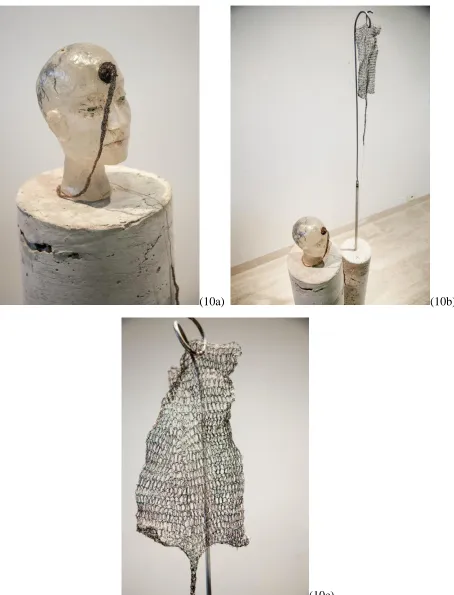
Figure 10
Life Infusion, (details)
(10a) (10b)
28
Figure 11
29
Figure 12
Mirroring, (details)
(12a) (12b)
30
Figure 13
31
Figure 14
By a Thread, (details)
(14a) (14b)
32
Figure 15
33
Figure 16
Telepathy, (details)
(16a) (16b)
34
Figure 17
35
Figure 18
Weighing on my Mind, (details)
(18a) (18b)
36
Figure 19
37
Figure 20
38
Figure 21
39
Figure 22
Spine Study #3 (detail)
40
Figure 23