This is a repository copy of Cause and effect relationship between post-merger operating performance changes and workforce adjustments.
White Rose Research Online URL for this paper: http://eprints.whiterose.ac.uk/11239/
Monograph:
Kuvandikov, A. (2010) Cause and effect relationship between post-merger operating performance changes and workforce adjustments. Working Paper. Department of Management Studies, University of York
[email protected] https://eprints.whiterose.ac.uk/
Reuse
Items deposited in White Rose Research Online are protected by copyright, with all rights reserved unless indicated otherwise. They may be downloaded and/or printed for private study, or other acts as permitted by national copyright laws. The publisher or other rights holders may allow further reproduction and re-use of the full text version. This is indicated by the licence information on the White Rose Research Online record for the item.
Takedown
If you consider content in White Rose Research Online to be in breach of UK law, please notify us by
promoting access to White Rose research papers
White Rose Research Online [email protected]
Universities of Leeds, Sheffield and York
http://eprints.whiterose.ac.uk/
White Rose Research Online URL for this paper: http://eprints.whiterose.ac.uk/ 11239
Working Paper
Kuvandikov, A (2010) Cause and effect relationship between post-merger operating performance changes and workforce adjustments
University of York
The York Management School
Working Paper No. 57/Part II
ISSN Number: 1743-4041
August 2010
Cause and effect relationship between
post-merger operating performance changes
and workforce adjustments
Azimjon Kuvandikov
University of York
Cause and effect relationship between post-merger operating
performance changes and workforce adjustments
1.1
Introduction
1.1.1 Research motivation
Prior empirical research provides substantial evidence showing that mergers and acquisitions lead
to operating performance decline (Ghosh, 2001). At the same time such transactions involve
workforce reductions, as reported in the public media. However, systematic empirical evidence
on the association between operating performance and workforce adjustments is inconclusive. On
the one hand workforce reductions may be undertaken to improve efficiency and firm
profitability (Cascio et al., 1997) or to arrest further performance deterioration. On the other,
post-takeover layoffs may be undertaken to create shareholder value and to regain premiums paid
to targets. Consequently, it is suggested that such layoffs destroy the human capital of acquired
firms and thereby negatively affect firm performance post-merger (Krishnan et al., 2007). Thus,
the answers to (1) whether post-takeover performance decline leads to workforce reductions and
(2) whether such layoffs positively or negatively affect firm performance are unknown. This
chapter aims to provide new empirical evidence on these two questions. Empirical evidence on
these questions would clarify whether post-merger labour management decisions are made to
further enhance efficiency and firm profitability.
Although there is well established research of the antecedents and consequences of workforce
downsizing, it is still unclear whether prior poor performance determines subsequent downsizing
decisions and whether such workforce reductions lead to performance improvement (Datta et al.,
explaining workforce reductions (Coucke et al., 2007; Hillier et al., 2007). At the same time,
there is also some evidence showing no link between prior performance and downsizing (Perry
and Shivdasani, 2005). Similarly, empirical evidence on the consequences of workforce
adjustments for firm performance is inconclusive. A general conclusion of this research is that
employee layoffs positively affect performance only when there is a slack to cut (Cappelli, 2000;
Love and Nohria, 2005).
Although empirical research that investigates the factors leading to post-merger workforce
reductions is well established (O'Shaughnessy and Flanagan, 1998; Conyon et al., 2001, 2002;
Gugler and Yurtoglu, 2004), empirical research investigating the consequences of post-merger
workforce adjustments is still in its infancy. There are very few studies on this issue: Krishnan
and Park (2002) and Krishnan et al. (2007) show that in related acquisitions excessive layoffs,
which are made to cover large premiums, lead to organisational performance deterioration.
The situation is complicated by the requirement that the association between operating
performance and workforce reductions should be analysed within the broader context of
takeovers‟ effects on firm performance. Although research on the effect of takeovers on firm
performance is well established, evidence on this issue is mixed as well: some studies report
modest operating performance improvement after takeovers, other studies report performance
decline over a two-to-five year period following acquisitions, yet other studies report
indistinguishable operating performance improvement in comparison to a sample of non-merging
benchmark firms (Martynova et al., 2007). Taking into consideration post-takeover operating
performance change is important, as failure of business integration and post-takeover
This chapter investigates the role of post-takeover operating performance decline as a factor
leading to workforce reductions. Then it investigates the consequences of such workforce
reductions for firm performance. The empirical work of this chapter links three strands of
literature: (1) research on antecedents and consequences of workforce downsizing, (2) research
on performance consequences of employee layoffs following mergers and (3) research on
performance consequences of takeovers. Using research methods from these strands of literature,
we measure performance change and workforce change following mergers and investigate the
association between these two variables. In addition to the full sample analysis, we compare the
performance of the WFG and WFR sub-samples1. In the multiple regression context, first we
examine the association between post-takeover operating performance changes and post-takeover
workforce changes in order to understand whether performance decline leads to workforce
reductions. To examine whether workforce adjustments negatively or positively affect
performance, we then regress workforce changes one year after mergers (from t-1 to t+1) on
operating performance change over three years.
1.1.2 Brief results and contributions
Using the full sample, the univariate analysis reveals that performance does not improve after
takeovers, but, on the contrary, declines, which is consistent with most of the research in this
area. When the sample is split, the results show that the performance decline is steeper in the
1
WFR sub-sample during the first two post-takeover years, while the performance decline is
steeper in the WFG sub-sample during the third post-takeover year.
The regressions show a strong positive association between operating performance change and
workforce change following mergers, which means that performance deterioration is an
important factor in explaining employee layoffs post-merger. In terms of operating performance
consequences, the results show that workforce changes are inversely related to operating
performance change. Therefore it can be concluded that post-merger workforce reductions
positively contribute to operating performance change.
The results of this chapter contribute to the literature on the antecedents and consequences of
merger-related employee layoffs by providing new evidence on the positive role of corporate
downsizing in the mergers and acquisitions context. The results suggest that post-takeover
performance decline could be one of the reasons for workforce adjustments. The conclusion that
post-merger workforce reductions positively contribute to operating performance change implies
that labour management decisions are made in order to improve efficiency and to maintain the
viability of the firms.
1.2
Theoretical background and hypothesis development
One factor that may lead to post-takeover workforce reductions is firm performance decline after
such transactions. Mergers may negatively affect firm performance for several reasons, such as
unsuccessful business integration, inadequate strategic fit or cultural differences between merging
Although accounting studies do not investigate the issues of why firm performance may
deteriorate post-merger, these studies thoroughly measure performance change post-merger.
However, the extant evidence on the operating performance consequences of takeovers is mixed:
some empirical research shows that takeovers cause only modest improvement (Healy et al.,
1992; Powell and Stark, 2005) or no improvement (Ghosh, 2001), while other studies report
significant decline in firm performance (Martynova et al., 2007). Reviewing the literature in this
area, Martynova et al. (2007) find that 14 out of 25 studies report significant decline in
post-takeover operating performance, 6 studies report insignificant change, while 5 studies report
significant improvement in operating performance after takeovers. For example, Meeks (1977)
and Ravenscraft and Scherer (1987) report that profitability of merging firms declines
significantly. Thus, most evidence indicates that acquirers‟ performance deteriorates.
The conventional view is that firm performance is an important factor in downsizing decisions.
Prior research concludes that performance decline often leads to employee layoffs (Iverson and
Pullman, 2000; Chen et al., 2001). For example, Hillier et al. (2007) find that layoffs follow a
period of poor operating and stock price performance. Coucke et al. (2007) report that firms make
redundancies after a decline in return on equity. Therefore it is reasonable to expect workforce
performance decline may necessitate workforce reductions. On the basis of this discussion, the
following hypothesis will be tested2:
Q2-H1: Post-takeover decline in operating performance leads to workforce reductions.
Although corporate downsizing is usually undertaken to cut costs and to further enhance
efficiency, it may negatively affect firm performance, especially when it follows mergers. Recent
evidence presented by Krishnan et al. (2007) shows that excessive employee layoffs after related
acquisitions, undertaken to cover high premiums, lead to significant performance deterioration.
There are several reasons for this adverse effect of labour cost cuts within the mergers and
acquisitions context.
The success of an acquisition depends on the ability of firms to effectively integrate acquired
intangible capital in the form of human resources, which embody valuable tacit knowledge (Seth
et al., 2002). First, managers may not be able to correctly estimate the required level of employee
layoffs to achieve the optimal employment level. Second, in this process some senior key staff of
acquired firms may voluntarily leave due to disagreement with the new management (Walsh,
1988). In support of this, Martin and McConnell (1991) and Franks and Mayer (1996) show that
2
Post-takeover firm performance decline could be another reason for post-merger employee
layoffs, as acquirers undertake labour cost cuts to stop further performance deterioration. This
management turnover is significantly higher after acquisitions than in normal periods. Third, in
the case of workforce reductions it may be difficult to determine whom to layoff, especially when
most managers and „white collar‟ workers of an acquired company leave the combined business.
Finally, the post-layoff morale of surviving staff may be low due to uncertainties about their own
future. Cascio (1993) argues that downsizing may lead to poor morale in the surviving
employees, creating „survivors‟ syndrome‟ and decreasing labour productivity.
Furthermore, the resource-based view of the firm can be used to explain the negative effect of
downsizing in the mergers and acquisitions context. According to this theory the departure of key
staff destroys acquired firms‟ strategic capabilities and this leads to poor performance. According
to this theory human capital is one of the three main resources that enable firms to implement
value-creation strategies, along with physical capital resources and organisational capital
resources (Barney, 1991). Among other things, human capital includes training, experience,
relationships and insights of individual managers and workers. If, in the integration process, this
resource is destroyed, then the strategic competitiveness of the firm is no longer sustainable.
Moreover, as the resource-based view considers a firm as a bundle of the above resources,
routines and capabilities, the role of mergers and acquisitions is to facilitate the exchange of these
firm-specific resources and capabilities that are otherwise costly to imitate and are not tradable
(James, 2002).
In sum, mergers and acquisitions may negatively affect human capital, destroying one of the most
important strategic capabilities of the firm that is difficult to imitate. Therefore employees view
such transactions as destructive events, because they increase job uncertainty, risk and stress,
environment may also change employees‟ work attitude, which in its turn negatively affects
employee performance and subsequently firm performance.
In contrast, it has been shown that post-merger workforce reductions lead to rationalisations in
the use of labour and increased efficiency (Conyon et al., 2002) and improve employee
profitability (Conyon et al., 2004). Thus, post-merger downsizing should lead to improvement in
firm performance.
Post-merger employee layoffs are a part of wider corporate downsizing activity. Although the
effect of corporate downsizing on firm performance has been researched extensively, the extant
evidence is inconclusive. Palmon et al. (1997) show that downsizing inversely affects firm
performance, while Elayan et al.(1998), Espahbodi et al. (2000), and Chen et al. (2001) report
significant firm performance improvement and an increase in labour efficiency after downsizing.
However, Cascio et al.(1997), Denis and Kruse (2000) and Love and Nohria (2005) report that
downsizing does not alter firm performance in general. Cascio et al. (1997) conclude that only
those firms that combine downsizing with asset sales improve profitability. Cappelli (2000)
argues that downsizing makes sense only when establishments experience excess operating
capacity. Otherwise, downsizing may hurt firm performance, as trying to cut slack when there is
no slack to cut may negatively affect organisational capabilities. The Love and Nohria (2005)
results show that downsizing only improves performance when there is a good deal of
organisational slack and when downsizing is a part of broad corporate restructuring and is done
Even though employee layoffs positively affect performance, their full effect might only be felt
after some time – 2 to 3 years after downsizing (Palmon et al., 1997; Espahbodi et al., 2000;
Perry and Shivdasani, 2005). Meanwhile the downsizers‟ performance level may still be low in
comparison to that of non-downsizers, even though there is positive performance change during
early periods after layoffs. Hillier et al. (2007) show that layoff-making firms continue to
under-perform their industry benchmark three years after the event. In other words, the extent of
performance change in layoff-making acquirers may be different from that of acquirers that do
not make layoffs, due to the positive effect of labour rationalisations. Therefore we investigate
the association between post-merger employee layoffs and performance change:
Q2-H2: Post-takeover workforce changes are inversely associated with operating performance
changes.
1.3
Data and methodology
1.3.1 Econometric model specification
To test the hypothesis Q2-H1 the following model will be estimated:
Et3 1 ROAApost 2H 3R 4Prem 5Size 5Lev 7Board (2)
where Et3 is the change in the number employees from t-1 to t+3,
p ost A ROA
is the first
post-takeover two years‟ (t+1 and t+2) average change in operating performance of acquiring firms; H
is a hostility dummy, which takes 1 if the initial offer was rejected and 0 otherwise; R is a
relatedness dummy, which takes 1 if both target and acquiring firms are in the same industry and
0 otherwise; Prem is the premium, measured as the excess amount of bid price over share price
one month prior to takeover announcement; Size is the ratio of acquiring firm size to the
completion year; Board is the ratio of non-executive directors to the total number of directors,
and indicates the error term. In extended models we also include the interactions of the R and
H dummies with the performance change variable (ROAAp ost).
To test the hypothesis Q2-H1 the following model will be estimated:
ROAta3 1 Et1 2Prem 3 ROAc 4Size 5Lev 6Board 7H 8R 3
where ROAAp ost is the performance change during three post-takeover years (from t-1 to t+ 3);
1
Et is the change in the number employees from t-1 to t+ 1,
c ROA
is the change in matched
firm performance during the corresponding period, and other variables are as explained above.
In these models we control for relative size, leverage and board structure on the basis of prior
research. First, the integration of larger firms may create a greater challenge as well as more
synergy than the integration of smaller firms. In this relation, McGuckin and Nguyen (2001) and
Conyon et al. (2002, 2004) find that the impact of acquisitions depends on the size of acquisition.
Therefore we control for the relative size measured as the ratio of acquired firm size (transaction
value) relative to acquirers‟ market value at the end of t-1. Ofek (1993) that argues that higher
leverage following poor performance increases the probability of corporate restructuring,
including employee layoffs. Therefore in the takeover context higher leverage may also force
acquirers to cut costs by reducing the workforce. We measure leverage as the ratio of debt to total
assets at the beginning of the relevant year. Finally, a greater number of non-executives on the
Board of Directors may force managers to undertake restructuring activities that maximise
more effective the Board (Cosh et al., 2006). Therefore we control for the Board structure of the
acquiring firms, measured as the ratio of outside directors to inside directors.
1.3.2 Data and measuring post-takeover workforce adjustments
This chapter uses the same sample and data as described in the previous chapter. Post-merger
workforce change is measured using the same technique as in the previous chapter.
1.3.3 Measuring post-takeover operating performance change
The operating performance measure (ROA, measured as earnings before interest, taxes,
depreciation and amortization divided by total assets), has been adjusted using two benchmarks:
industry-median firm and industry-, size- and performance-matched firm benchmarks, selected
on the basis of methodology recommended by Barber and Lyon (1996). Industry-adjusted
performance is obtained by deducting industry-median firm performance from the sample firm
performance3.
3
We also scaled EBITDA by Total Market Value (TMV), which is defined as the market value
of outstanding shares plus preferred stock and book value of total liabilities at the beginning of
each year. In addition to this we use Operating Cash Flow (OCF) defined as operating income
plus depreciation, depletion and amortisation expense, scaled by TMV and TA. Barber and Lyon
The industry-, size- and performance-matched firm benchmark is one of the most frequently used
performance benchmarks in contemporary accounting and finance research (Espahbodi et al.,
2000). This benchmark performs better than the industry-median firm benchmark, especially
when sample firms have performed either unusually well or unusually poorly (Barber and Lyon,
1996). As firms may undertake acquisitions during better-performing years, matching on
pre-takeover performance controls for the potential bias arising due to mean reversion in earnings.
Following the methodology proposed by Barber and Lyon (1996) and Loughran and Ritter
(1997), for each sample firm we select a matching firm at the end of year t-1 on the basis of the
following criteria: first, we filter all firms in the same industry with the sample firm; second, we
select all firms within the 25% to 200% size interval of the sample firm‟s size, size being
measured by total assets; third, we select the non-acquiring firm with the closest performance
measure to the matching firm. In order to capture the full differences in the performance of
acquiring and non-acquiring firms, the matched firms should not have undertaken any significant
acquisition around the sample takeover event which is being investigated. Therefore, as matched
firms we select only those firms which have made significant acquisitions during the two years
the basis of other performance measures. Therefore we only report the results on the basis of
before takeovers and three years after takeovers. Matched-firm-adjusted performance is obtained
by deducting the matched firm‟s performance from the sample firm performance.
Following Ghosh (2001) we use „the change method‟ to measure the operating performance
effect of takeovers. Ghosh (2001) argues that this method is superior to the regression method
suggested by Healy et al. (1992), which identifies the performance change as the intercept of the
regression of post-takeover performance on pre-takeover performance. As firms undertake
acquisitions after superior performance, acquirers outperform industry medians during
pre-takeover years. Ghosh (2001) points out that this non-random measurement error will result in a
biased intercept in the regression, showing the positive effect of acquisitions. If, on average,
merging firms do not outperform industry-median firms, then the regression method and the
change method should provide identical unbiased estimates. Following other studies (Healy et al.,
1992), the pre-takeover pro-forma combined performance measure is constructed by summing
the target and acquirer performance measures at the end of year t-1. This pro-forma performance
is subtracted from the post-takeover performance to identify the change in the industry (or
industry, size and pre-takeover performance) adjusted performance.
1.4
Results
1.4.1 Univariate analysis of post-takeover performance change
Table 4 reports performance change during post-takeover years relative to the pre-takeover level
for the whole sample as well as for the WFR and WFG sub-samples. As reported in Panel A, the
full sample, acquirers‟ unadjusted firm performance declines significantly during the post-merger
years relative to the pre-merger level. This is consistent with the Powell and Stark (2005) and
industry-median firms during the first two post-takeover years and outperform their matched
firms during the first post-takeover year. However, acquirers‟ industry-adjusted performance
declines significantly relative to the pre-merger level during all three years: the three-year median
industry-adjusted performance is 1.1% lower than the pre-merger level. Similarly,
matched-firm-adjusted performance shows that performance declines during the third post-takeover year.
The above results suggest that takeovers at best do not improve operating performance, which is
consistent with most of the prior research (Martynova et al., 2007). This performance decline
could be due to the fact that firms undertake acquisitions during or immediately after
better-performing periods.
Year around merger Unadjusted performance z-stat Industry median firm adjusted performance z-stat Matched firm adjusted performance z-stat
Panel A: Full sample
t-1 0.2139 0.0255 4.99 0.0080 2.76
t+1 0.1700 0.0127 2.98 0.0145 1.95
t+2 0.1511 0.0113 1.71 0.0144 1.31
t+3 0.1429 0.0102 1.16 -0.0052 -0.34
Median for t+1, t+2 and t+3 0.1528 0.0115 2.55 0.0048 0.99
t+1 less t-1 -0.0388 -6.56 -0.0043 -1.73 -0.0070 0.24
t+2 less t-1 -0.0688 -8.37 -0.0209 -3.22 0.0013 -0.53
t+3 less t-1 -0.0801 -8.89 -0.0174 -3.23 -0.0056 -2.07
Post median less t-1 -0.0532 -7.73 -0.0111 -2.53 -0.0089 -1.12
Panel B: The WFG sub-sample
t-1 0.2296 0.0527 4.58 0.0195 2.97
t+1 0.1980 0.0340 4.57 0.0197 2.11
t+2 0.1755 0.0331 3.84 0.0268 2.24
t+3 0.1515 0.0243 2.21 -0.0005 -0.11
Median for t+1, t+2 and t+3 0.1680 0.0302 4.43 0.0184 1.70
t+1 less t-1 -0.0277 -2.89 0.0019 -0.25 -0.0011 0.12
t+2 less t-1 -0.0399 -3.25 -0.0010 -0.48 0.0098 0.47
t+3 less t-1 -0.0661 -4.96 -0.0200 -1.98 -0.0101 -1.91
Post median less t-1 -0.0399 -3.93 -0.0062 -0.92 0.0002 -0.45
Panel C: The WFR sub-sample
t-1 0.1980 0.0171 0.11 0.0021 0.60
t+1 0.1531 0.0012 -0.27 -0.0007 1.02
t+2 0.1398 0.0014 -1.49 -0.0080 0.14
t+3 0.1312 0.0004 -0.64 -0.0086 -0.39
Median for t+1, t+2 and t+3 0.1425 0.0007 -0.71 -0.0067 0.29
t+1 less t-1 -0.0505 -6.21 -0.0071 -1.91 -0.0088 0.79
t+2 less t-1 -0.0933 -6.84 -0.0319 -3.17 -0.0058 -0.75
t+3 less t-1 -0.1031 -5.53 -0.0142 -1.54 -0.0035 -0.73
Post median less t-1 -0.0644 -6.57 -0.0137 -2.03 -0.0143 -0.46
Panel D: Difference between the WFG and WFR sub-samples
t-1 0.0317 2.02 0.0356 -1.1 0.0175 1.46
t+1 0.0449 3.24 0.0329 0.65 0.0203 2.44
t+2 0.0357 3.71 0.0317 -0.42 0.0348 1.93
t+3 0.0203 1.40 0.0239 -0.88 0.0081 2.18
Median for t+1, t+2 and t+3 0.0255 3.24 0.0295 -0.42 0.0251 2.66
t+1 less t-1 0.0228 2.21 0.0090 1.14 0.0077 -0.37
t+2 less t-1 0.0535 2.40 0.0309 1.73 0.0156 0.96
t+3 less t-1 0.0370 -0.39 -0.0058 -0.42 -0.0066 1.08
Post median less t-1 0.0246 1.70 0.0075 0.67 0.0145 -0.09 Not
As Panel B shows, the WFG sub-sample acquirers outperform their industry-median firms during
three post-takeover years and outperform their matched firms during two post-takeover years.
Both benchmarks show that the WFG sub-sample acquirers‟ performance does not differ from the
pre-takeover level during the first two post-takeover years. However, both benchmarks show that
this sub-sample acquirers‟ performance declines relative to the pre-takeover level during the third
post-takeover year. The third year industry-adjusted (matched-firm-adjusted) ROA is 2% (1%)
lower than the pre-takeover level.
In contrast, Panel C shows that the WFR sub-sample acquirers‟ performance does not differ from
their industry-median performance and matched firm performance during all three years. The
WFR sub-sample acquirers‟ industry-adjusted performance declines during the first two years,
but the third year performance does not significantly differ from the pre-takeover level. This
sub-sample acquirers‟ matched-firm-adjusted measure shows no significant change during the
post-takeover years relative to the pre-post-takeover level.
Finally, Panel D reports that the WFG sub-sample acquirers outperform the WFR sub-sample
acquirers by the unadjusted firm performance measure and matched-firm-adjusted performance
measures. One explanation for the continuous under-performance of the WFR sub-sample firms
may be the fact that the full effect of labour rationalisation might only be felt after some time.
Therefore the WFR sub-sample performance may still be lower than the WFG sub-sample
performance during the early post-takeover years. However, the WFR sub-sample‟s operating
performance change from the pre-takeover level to the post-takeover level could be significantly
different from the corresponding change in the WFG sub-sample operating performance due to
Consistent with this view, the above results imply that the WFR acquirers‟ performance further
deteriorates during the first two post-merger years, necessitating the need for efficiency
improvements and cost savings through labour cost cuts. Therefore although their performance is
significantly low during the first two post-takeover years relative to the pre-takeover level, in the
third year there is no difference between pre- and post-takeover performances. In contrast to this,
in the WFG sub-sample both industry-adjusted and matched-firm-adjusted performance shows
significant performance deterioration in the third year. Thus, these univariate results suggest that
post-merger employee layoffs are undertaken in under-performing firms4.
4 We also experiment with the above univariate analysis, splitting the full sample into “layoff”
and “non-layoff” sub-samples, using merger-related layoff information. This analysis leads to
similar conclusions. One explanation for less performance deterioration in the “layoff” sub
-sample could be the fact that layoffs arrest further performance deterioration. Both benchmarks
show that “layoff” combinations performance does not change significantly during the post
-takeover years. In contrast to this, the performance of the “non-layoff” sub-group firms
significantly declines during post-takeover years. “Non-layoff” acquirers‟ industry-adjusted
performance is significantly lower relative to the pre-takeover level during two post-takeover
years, while matched-firm-adjusted performance is lower in year t+3. These results indicate that
Overall, all three performance measures show that firm performance deteriorates post-merger. In
this case the related question is whether this performance deterioration explains workforce
reductions post-merger. The next section analyses this question using the regression technique.
1.4.2 Post-takeover performance decline as a factor leading to workforce reductions
To investigate the role of post-takeover performance decline in explaining employee layoffs, we
regress post-takeover workforce adjustments on performance change. As the dependent variable,
we use workforce adjustments during three post-takeover years and as the main independent
variable we use the two-year average industry-adjusted operating performance change (for t+2
and t+3)5.
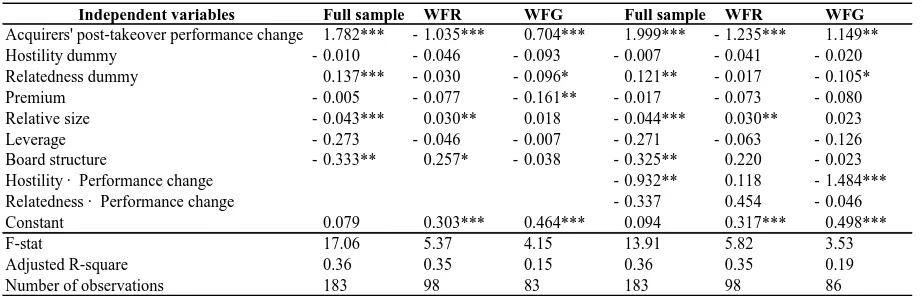
As reported in Table 5, the regression results show that there is significant positive association
between workforce adjustments and operating performance change. In the full sample, a 1%
higher ROA during the first two post-takeover years leads to 1.78% greater workforce growth.
This suggests that in the WFR sub-sample the association should be inverse, meaning that the
lower the ROA, the higher the workforce reduction. In contrast, in the WFG sub-sample the
association between these two variables should be positive: the better the performance, the higher
the workforce growth. The WFR and WFG sub-sample regressions confirm these associations. In
5
The results are the same when we use the change after one year and the change after two years
the WFR sub-sample, operating performance is negatively associated with workforce reduction: a
1% lower ROA leads to 1.04% greater workforce reduction. In the WFG sub-sample the
workforce growth variable is positively associated with the operating performance: a 1% higher
operating performance leads to 0.7% greater workforce growth6.
These regressions show insignificant difference between the impact of post-merger workforce
change following hostile takeovers and that following friendly takeovers. However, related
acquisitions cause significantly higher workforce adjustments than unrelated acquisitions do, as
shown by the full sample results. Consistent with the Krishnan et al. (2007) results, a high
premium negatively affects workforce growth, although it is only significant in the WFG
sub-sample. In this sub-sample a 1% higher premium leads to 0.16% lower workforce growth. The
negative coefficient of the relative organisational size indicates that the larger the acquired
company, the lower the post-takeover workforce adjustment. This is consistent with the view that
when a larger company is acquired there will be more duplicative activities to integrate this
company into the existing business, thus providing greater scope for workforce reductions.
Although signs of the leverage variable are negative in all regression models, the coefficients are
6
These results do not change if we control for the matched firm performance. As expected,
industry-adjusted matched firm performance is strongly positively associated with merging firm
not significant. Finally, consistent with the prior research, the signs of the Board structure
variable indicate that outside directors play an important governance role in layoff
decision-making (Yawson, 2006). The full sample regressions indicate that the lower the proportion of
outside directors, the higher the workforce growth and, in contrast, the higher the proportion of
outside directors, the greater the workforce reductions. The WFR sub-sample regressions confirm
this association: the positive association of the Board structure variable means that when boards
include a higher proportion of outside directors, they become more effective in taking layoff
decisions. Thus, board composition is one of the important factors in developing more successful
corporate governance practices7.
When the models include interactions of the dummy regressors with the performance change
variable, the results show that the difference between the slopes of hostile versus friendly
acquisitions‟ operating performance effect is not significant. The full sample results indicate that
in friendly acquisitions a 1% greater performance change is associated with a 2% higher
workforce adjustment, while in hostile takeovers a 1% higher ROA is associated with a 1%
[=1.999 – 0.932] greater workforce adjustment. Furthermore, in the WFG sub-sample the
7
Leverage becomes significant when we use the performance change variable after one year and
the performance change after two years individually. But it becomes insignificant when we use a
interaction term implies that in hostile acquisitions a 1% higher ROA would cause 0.36% [=1.149
– 1.484] lower workforce growth. So, the effect of operating performance on employment growth
is smaller after hostile takeovers thanafter friendly mergers. However, the results show no
difference between the slopes of related versus unrelated acquisitions‟ operating performance
[image:24.612.70.531.224.372.2]effect on workforce growth.
Table 2 Regression results explaining post-takeover operating performance.
Independent variables Full sample WFR WFG Full sample WFR WFG
Acquirers' post-takeover performance change 1.782*** - 1.035*** 0.704*** 1.999*** - 1.235*** 1.149** Hostility dummy - 0.010 - 0.046 - 0.093 - 0.007 - 0.041 - 0.020 Relatedness dummy 0.137*** - 0.030 - 0.096* 0.121** - 0.017 - 0.105* Premium - 0.005 - 0.077 - 0.161** - 0.017 - 0.073 - 0.080 Relative size - 0.043*** 0.030** 0.018 - 0.044*** 0.030** 0.023 Leverage - 0.273 - 0.046 - 0.007 - 0.271 - 0.063 - 0.126 Board structure - 0.333** 0.257* - 0.038 - 0.325** 0.220 - 0.023 Hostility · Performance change - 0.932** 0.118 - 1.484*** Relatedness · Performance change - 0.337 0.454 - 0.046 Constant 0.079 0.303*** 0.464*** 0.094 0.317*** 0.498***
F-stat 17.06 5.37 4.15 13.91 5.82 3.53
Adjusted R-square 0.36 0.35 0.15 0.36 0.35 0.19 Number of observations 183 98 83 183 98 86
Notes: The dependent variable is workforce change three years after takeovers (from t-1 to t+ 3). Acquirers‟ post-takeover performance change is the average of the change after one year and the change after two years.. The estimation method is OLS, using heteroscedasticity-robust standard errors (White, 1980). Significance levels: *p<0.1, **p<0.05; ***p<0.01. Appendix 9.2 provides the definitions of the variables.
In sum, the results show that one of the factors that may lead to post-takeover workforce
adjustments could be the performance decline following takeovers. The regression analysis
shows significant positive association between post-takeover performance change and workforce
change.
1.4.3 Consequences of post-merger workforce adjustments for operating performance
To investigate the effect of workforce change on operating performance, we use operating
performance change instead of operating performance levels, as the dependent variable in the
regression analysis. In order to control for reverse causality between dependent and independent
main independent variable and operating performance change three years after the takeover
completion year as the dependent variable.
The results of these regressions are given in Table 6. The full sample regressions indicate that the
workforce change variable is inversely related to operating performance change: 1% employment
growth leads to a 0.07% smaller change in ROA. This means that greater workforce reductions
are associated with more positive operating performance change, while higher workforce growth
is associated with more negative performance change. The WFR regressions show that a 1%
workforce reduction during the first post-takeover year leads to a 0.15% greater change in ROA
after two years. The WFG regressions imply that the higher the workforce growth, the more
negative the operating performance change: 1% workforce growth leads to a 0.09% smaller
change in ROA. One interpretation of these results is that post-merger workforce reductions at
least arrest further performance deterioration, whereas accelerated employment growth may
negatively affect performance. Thus, these results support the hypothesis that workforce
[image:25.612.74.532.501.692.2]reductions positively contribute to operating performance change.
Table 3 Regressions explaining post-takeover performance change
Independent variables Full sample WFR WFG Full sample WFR WFG
Workforce change from t-1 to t+1 - 0.068*** - 0.086***
Workforce reduction from t-1 to t+1 0.060 0.146**
Workfroce growth from t-1 to t+1 - 0.090** 0.025
Premium 0.048** 0.049 0.028 0.042* 0.079** - 0.001
Control firm performance 0.320*** 0.374*** 0.220*** 0.316*** 0.358*** 0.340***
Relative size - 0.003 0.004 - 0.014** - 0.004 0.006 - 0.016**
Board composition 0.112** - 0.095 - 0.046 - 0.092** - 0.120* - 0.019
Leverage - 0.037 - 0.119* 0.045 - 0.012 - 0.126* 0.071
Hostility dummy 0.020 0.016 0.021 0.034* 0.022 - 0.010
Relatedness dummy 0.032** 0.041* 0.034 0.036** 0.091** 0.096***
Hostility dummy · Workforce change 0.061 - 0.026 0.017
Relatedness dummy · Workforce change 0.001 0.193** - 0.291**
Constant - 0.001 0.044 - 0.070 - 0.027 0.024 - 0.112**
F-stat 6.72 3.14 3.97 5.35 3.33 3.11
Adjusted R-square 0.19 0.14 0.15 0.15 0.19 0.27
Number of observations 181 104 79 186 103 79 Not
heteroscedasticity-robust standard errors (White, 1980). Significance levels: *p<0.1, **p<0.05; ***p<0.01. Appendix 9.2 provides the definitions of the variables.
Regarding the control variables, the full sample results show that the premium is positively
associated with the change in operating performance: in acquisitions for which high premiums
are paid operating performance decline is smaller. This is consistent with the view that acquirers
pay high premiums for better-performing firms. However, further analysis shows that the
premium may affect operating performance differently for different groups. In the WFR
sub-sample, the premium positively affects the change in operating performance, which is consistent
with the full sample results. In contrast, in the WFG sub-sample, the premium is negatively
associated with operating performance change, indicating that in this sub-sample paying a higher
premium for the target firms leads to lower operating performance.
As expected, control firm performance change is positively associated with acquiring firm
performance change in all models. The results show that high leverage leads to more negative
performance change. Relative size is also inversely related to operating performance change in
the WFG regressions: acquiring large firms affect performance change more negatively. The
board composition variable is negatively associated with operating performance change.
The models that include dummy regressors and their interactions with the workforce change
variable confirm the positive effect of workforce reductions on operating performance change.
For example, in the WFR sub-sample a 1% workforce reduction leads to a 0.15% greater change
in ROA. The interaction term coefficients indicate that the effect of workforce adjustments on
operating performance is significantly different in related and unrelated acquisitions, while it is
higher workforce reduction in unrelated acquisitions causes a 0.15% greater operating
performance change, while in the related acquisitions this effect is 0.34% [= 0.146 + 0.193]. In
the WFG sub-sample, 1% higher workforce growth causes a 0.27% [= 0.025 – 0.291] smaller
operating performance change. Thus, in related acquisitions, workforce reductions lead to
materialisation of post-merger synergy and positively contribute to operating performance
change, while excessive workforce growth negatively affects performance change.
In sum, these results imply that post-merger workforce reductions positively affect firm
performance. This conclusion contradicts the Krishnan and Park (2002) and Krishnan et al.
(2007) results, which show that in related acquisitions excessive employee layoffs negatively
affect operating performance.
1.5
Discussion
Does post-takeover performance deterioration lead to workforce adjustments? We fail to reject
the hypothesis that post-takeover performance deterioration leads to workforce reductions, as
there is significant positive association between the two variables, shown by both full sample and
sub-sample regressions (Q2-H1). This evidence implies that acquirers take into consideration
post-takeover performance change in downsizing decisions and confirms the view that such
layoffs are undertaken for efficiency improvement purposes, as suggested by Conyon et al.
(2002).
What are the consequences of post-takeover workforce adjustments for operating performance?
Firstly, in the univariate analysis, both benchmarks show that the WFG sub-group acquirers‟
acquirers‟ performance does not differ significantly from the pre-takeover level. These results
indicate that workforce reductions may halt further performance deterioration.
The full effect of employee layoffs might only be felt 2 to 3 years after downsizing (Palmon et
al., 1997; Espahbodi et al., 2000; Perry and Shivdasani, 2005). Therefore we use performance
change as a dependent variable and our results reveal an inverse relationship between workforce
change and operating performance change (Q2-H2). This suggests that employee layoffs at least
arrest further operating performance deterioration during post-takeover years: workforce
reductions are associated with more positive operating performance changes, while higher
workforce growth is associated with more negative operating performance change. The results
indicate that the extent of post-merger workforce adjustments is greater in related acquisitions
than in unrelated acquisitions. The interaction of the relatedness dummy with the workforce
adjustment variable is significant in both the WFR and WFG models. For example, in the WFR
sub-sample, a 1% employment reduction in related acquisitions leads to significantly better
performance than a 1% employment reduction in unrelated acquisitions. Similarly, in the WFG
sub-sample, accelerated employment growth hurts more acquirers who acquire firms in the same
industry. This is consistent with the view that related acquisitions provide more synergy,
facilitating a large reduction in labour demand in comparison to unrelated acquisitions.
In other words, using the operating performance change variable, we are not able to further
support the hypothesis that excessive employee layoffs lead to operating performance
deterioration, as suggested by Krishnan et al. (2007). Instead, the results indicate that workforce
reductions contribute to positive operating performance change, while accelerated workforce
1.6
Conclusions
This chapter investigates the role of post-merger performance deterioration in explaining
workforce reductions. It also investigates whether post-merger employee layoffs arrest a
declining in performance or whether they cause further performance deterioration. The results
support the view that post-takeover workforce reductions are made in under-performing firms.
The results also reveal that operating performance decline is smaller in the WFR sub-sample than
in the WFG sub-sample. Both full sample and sub-sample regressions indicate that post-merger
decline in operating performance may also contribute to the workforce reductions.
Using a US sample, Krishnan and Park (2002) and Krishnan et al. (2007) show that managers
undertake excessive post-merger employee layoffs to cover high premiums paid to target
shareholders, which may lead to subsequent firm performance deterioration. However, a
counter-argument exists: a primary reason for downsizing is to improve operating performance. Therefore
workforce change could be expected to positively affect operating performance. The objective of
downsizing is to stop further performance deterioration and it may take some time to materialise
the effect of downsizing. Therefore we hypothesise that there is an inverse relationship between
workforce change and operating performance change, which implies that workforce reductions
halt further performance deterioration, given the fact that takeovers in general lead to a decline in
operating performance. In this regard, we have hypothesised that workforce reductions are
associated with more positive operating performance change, while high workforce growth is
associated with more negative operating performance change.
However, we could not generalise the Krishnan and Park (2002) and Krishnan et al. (2007)
negatively affect operating performance. The results show that the need for performance
improvement necessitates workforce reductions. So, it can be concluded that managers do not put
shareholders‟ interests above the labour force‟s‟ interest. Managers can be seen as active
participants in governance and make decisions to improve firm performance.
The results of the regression analysis show that there is an inverse relationship between
workforce change and operating performance change: accelerated workforce growth leads to
greater operating performance decline. Thus, this paper concludes that workforce reductions are
associated with greater operating performance change. In brief, the results imply that post-merger
employee layoffs contribute to materialising post-merger synergy and, thereby, positively affect
References
Barber, B. and Lyon, J. (1996) Detecting abnormal operating performance: The empirical power and specification of test statistics. Journal of Financial Economics, 41, 359-399.
Cappelli, P. (2000) Examining the incidence of downsizing and its effect on establishment performance. In Neumark, D. (Ed.) On the job: Is long-term employment a thing of the past. New York, Russell Sage Foundation, 463–516.
Cascio, W. E. (1993) What do we know, what have we learned? Academy of Management Executive, 7, 95-104.
Cascio, W. F., Young, C. E. and Morris, J. R. (1997) Financial Consequences of Employment-Change Decisions in Major US Corporations. Academy of Management Journal, 40, 1175-1189.
Chen, P., Mehrotra, V., Sivakumar, R. and Yu, W. W. (2001) Layoffs, shareholders' wealth, and corporate performance. Journal of Empirical Finance, 8, 171-199.
Conyon, M. J., Girma, S., Thompson, S. and Wright, P. W. (2001) Do hostile mergers destroy jobs? Journal of Economic Behavior and Organization, 45, 427-440.
Conyon, M. J., Girma, S., Thompson, S. and Wright, P. W. (2002) The impact of mergers and acquisitions on company employment in the United Kingdom. European Economic Review, 46, 31-49.
Conyon, M. J., Girma, S., Thompson, S. and Wright, P. W. (2004) Do Wages Rise or Fall Following Merger? Oxford Bulletin of Economics and Statistics, 66, 847-862.
Cosh, A., Guest, P. M. and Hughes, A. (2006) Board Share-Ownership and Takeover Performance. Journal of Business Finance and Accounting, 33, 459-510.
Coucke, K., Pennings, E. and Sleuwaegen, L. (2007) Employee layoff under different modes of restructuring: exit, downsizing or relocation. Industrial and Corporate Change, 16, 161-182.
Datta, D. K., Guthrie, J. P., Basuil, D. and Pandey, A. (2010) Causes and Effects of Employee Downsizing: A Review and Synthesis. Journal of Management, 36, 281-348.
Denis, D. J. and Kruse, T. A. (2000) Managerial discipline and corporate restructuring following performance declines. Journal of Financial Economics, 55, 391-424.
Elayan, F. A., Swales, G. S., Maris, B. A. and Scott, J. R. (1998) Market Reactions, Characteristics, and the Effectiveness of Corporate Layoffs. Journal of Business Finance & Accounting, 25, 329-351.
Espahbodi, R., John, T. A. and Vasudevan, G. (2000) The Effects of Downsizing on Operating Performance. Review of Quantitative Finance and Accounting, 15, 107-126.
Ghosh, A. (2001) Does operating performance really improve following corporate acquisitions? Journal of Corporate Finance, 7, 151-178.
Gugler, K. and Yurtoglu, B. B. (2004) The effects of mergers on company employment in the USA and Europe. International Journal of Industrial Organization, 22, 481-502.
Healy, P., Palepu, K. and Ruback, R. (1992) Does Corporate Performance Improve after Takeovers? Journal of Financial Economics, 31, 135-175.
Hillier, D., Marshall, A., McColgan, P. and Werema, S. (2007) Employee Layoffs, Shareholder Wealth and Firm Performance: Evidence from the UK. Journal of Business Finance and Accounting, 34, 467-494.
Iverson, R. D. and Pullman, J. A. (2000) Determinants of voluntary turnover and layoffs in an environment of repeated downsizing following a merger: an event history analysis. Journal of Management, 26, 977.
Krishnan, H. A., Hitt, M. A. and Park, D. (2007) Acquisition Premiums, Subsequent Workforce Reductions and Post-Acquisition Performance. Journal of Management Studies, 44, 709-732.
Krishnan, H. A. and Park, D. (2002) The impact of work force reduction on subsequent performance in major mergers and acquisitions: an exploratory study. Journal of Business Research, 55, 285-292.
Loughran, T. and Ritter, J. R. (1997) The operating performance of firms conducting seasoned equity offerings. The Journal of Finance, 52, 1823-1850.
Love, G. E. and Nohria, N. (2005) Reducing slack: the performance consequences of downsizing by large industrial firms, 1977-93. Strategic Management Journal, 26, 1087-1108.
Martin, K. J. and McConnell, J. J. (1991) Corporate performance, corporate takeovers, and management turnover. Journal of Finance, 46, 671-687.
Martynova, M., Oosting, S. and Renneboog, L. (2007) The long-term operating performance of European Acquisitions, International Mergers and Acquisitions Activity since 1990: Quantitative Analysis and Recent Research. In Gregoriou, G. and Renneboog, L. (Eds.). Massachusetts Elsevier, 1-40.
McGuckin, R. H. and Nguyen, S. V. (2001) The impact of ownership changes: a view from labor markets. International Journal of Industrial Organization, 19, 739-762.
Meeks, G. (1977) Disappointing Marriage: A Study of the Gains from Merger, Cambridge, Cambridge University Press
O'Shaughnessy, K. C. and Flanagan, D. J. (1998) Determinants of Layoff announcements following M & As: An empirical investigation. Strategic Management Journal, 19, 989-999.
Palmon, O., Sun, H. L. and Tang, A. P. (1997) Layoff announcements: Stock market impact and financial performance. Financial Management, 26, 54-68.
Perry, T. and Shivdasani, A. (2005) Do Boards Affect Performance? Evidence from Corporate Restructuring*. The Journal of Business, 78.
Powell, R. G. and Stark, A. W. (2005) Does operating performance increase post-takeover for UK takeovers? A comparison of performance measures and benchmarks. Journal of Corporate Finance, 11, 293-317.
Ravenscraft, D. J. and Scherer, F. M. (1987) Mergers, Sell-Offs, and Economic Efficiency, Washington, DC, Brookings Institution Press.
Seth, A., Song, K. P. and Pettit, R. R. (2002) Value creation and destruction in cross-border acquisitions: An empirical analysis of foreign acquisitions of US firms. Strategic Management Journal, 921-940.
Walsh, J. P. (1988) Top management turnover following mergers and acquisitions. Strategic Management Journal, 9, 173-183.
White, H. (1980) A heteroskedasticity-consistent covariance matrix estimator and a direct test for heteroskedasticity. Econometrica: Journal of the Econometric Society, 48, 817-838.