Embedding Semantic Relations into Word Representations
Danushka Bollegala Takanori Maehara Ken-ichi Kawarabayashi
University of Liverpool Shizuoka University National Institute of Informatics
JST, ERATO, Kawarabayashi Large Graph Project.
Abstract
Learning representations for semantic relations is important for various tasks such as analogy de-tection, relational search, and relation classifica-tion. Although there have been several proposals for learning representations for individual words, learning word representations that explicitly cap-ture the semantic relations between words re-mains under developed. We propose an unsuper-vised method for learning vector representations for words such that the learnt representations are sensitive to the semantic relations that exist be-tween two words. First, we extract lexical patterns from the co-occurrence contexts of two words in a corpus to represent the semantic relations that ex-ist between those two words. Second, we represent a lexical pattern as the weighted sum of the rep-resentations of the words that co-occur with that lexical pattern. Third, we train a binary classifier to detect relationally similar vs. non-similar lexi-cal pattern pairs. The proposed method is unsuper-vised in the sense that the lexical pattern pairs we use as train data are automatically sampled from a corpus, without requiring any manual intervention. Our proposed method statistically significantly out-performs the current state-of-the-art word repre-sentations on three benchmark datasets for propor-tional analogy detection, demonstrating its ability to accurately capture the semantic relations among words.
1
Introduction
Representing the semantics of words and relations are funda-mental tasks in Knowledge Representation (KR). Numerous methods for learning distributed word representations have been proposed in the NLP community [Turianet al., 2010; Collobert et al., 2011; Mikolovet al., 2013b; 2013a; Pen-ningtonet al., 2014]. Distributed word representations have shown to improve performance in a wide-range of tasks such as, machine translation [Choet al., 2014], semantic similar-ity measurement [Mikolov et al., 2013d; Pennington et al., 2014], and word sense disambiguation [Huanget al., 2012].
Despite the impressive performance of representation learning methods for individual words, existing methods use only co-occurrences between words, ignoring the rich se-mantic relational structure. The context in which two words co-occur provides useful insights into the semantic relations that exist between those two words. For example, the sen-tence ostrich is a large bird not only provides the infor-mation thatostrich and bird are co-occurring, but also de-scribes how they are related via the lexical pattern Xis a large Y, where slot variables X and Y correspond to the two words between which the relation holds. If we can somehow embed the information about the semantic rela-tions R that are associated with a particular word w into the representation ofw, then we can construct richer seman-tic representation than the pure co-occurrence-based word representations. Although the word representations learnt by co-occurrence prediction methods [Mikolov et al., 2013d; Pennington et al., 2014] have implicitly captured a certain degree of relational structure, it remains unknown how to ex-plicitly embed the information about semantic relations into word representations.
We propose a method for learning word representations that explicitly encode the information about the semantic re-lations that exist between words. Given a large corpus, we extract lexical patterns that correspond to numerous seman-tic relations that exist between word-pairs(xi, xj). Next, we
represent each wordxiin the vocabulary by ad-dimensional
vector xi ∈ Rd. Word representations can be initialized
ei-ther randomly or by using pre-trained word representations. Next, we represent a pattern p by the weighted average of the vector differences (xi −xj) corresponding to
word-pairs (xi, xj) that co-occur with pin the corpus. This
en-ables us to represent a pattern pby a d-dimensional vector
p ∈ Rd in the same embedding space as the words. Using
vector difference between word representations to represent semantic relations is motivated by the observations in prior work on word representation learning [Mikolovet al., 2013d; Penningtonet al., 2014] where, for example, the difference of vectors representingkingandqueenhas shown to be similar to the difference of vectors representingmanandwoman.
pro-posed method is unsupervised in the sense that both positive and negative training instances that we use for training are automatically selected from a corpus, without requiring any manual intervention. Specifically, pairs of lexical patterns that co-occur with the same set of word-pairs are selected as pos-itive training instances, whereas negative training instances are randomly sampled from pairs of patterns with low rela-tional similarities. Our proposed method alternates between two steps (Algorithm 1). In the first step, we construct pat-tern representations from current word representations. In the second step, we predict whether a given pair of patterns is re-lationally similar using the computed representations of pat-terns in the previous step. We update the word representations such that the prediction loss is minimized.
Direct evaluation of word representations is difficult be-cause there is no agreed gold standard for semantic represen-tation of words. Following prior work on represenrepresen-tation learn-ing, we evaluate the proposed method using the learnt word representations in an analogy detection task. For example, de-noting the word representation for a word w by v(w), the vectorv(king)−v(man) +v(woman)is required to be sim-ilar tov(queen), than all the other words in the vocabulary. Similarity between two vectors is computed by the cosine of the angle between the corresponding vectors. The accuracy obtained in the analogy detection task with a particular word representation method is considered as a measure of its ac-curacy. In our evaluations, we use three previously proposed benchmark datasets for word analogy detection: SAT anal-ogy dataset [Turney, 2005], Google analanal-ogy dataset [Mikolov et al., 2013c], and SemEval analogy dataset [Jurgens et al., 2012]. The word representations produced by our proposed method statistically significantly outperform the current state-of-the-art word representation learning methods on all three benchmark datasets in an analogy detection task, demonstrat-ing the accuracy of the proposed method for embedddemonstrat-ing se-mantic relations in word representations.
2
Related Work
Representing words using vectors (or tensors in general) is an essential task in text processing. For example, in distri-butional semantics [Baroni and Lenci, 2010], a word x is represented by a vector that contains other words that co-occur withxin a corpus. Numerous methods for selecting co-occurrence contexts (e.g. proximity-based windows, depen-dency relations), and word association measures (e.g. point-wise mutual information (PMI), log-likelihood ratio (LLR), local mutual information (LLR)) have been proposed [Tur-ney and Pantel, 2010]. Despite the successful applications of co-occurrence counting-based distributional word representa-tions, their high dimensionality and sparsity is often problem-atic when applied in NLP tasks. Consequently, further post-processing such as dimensionality reduction, and feature se-lection is often required when using distributional word rep-resentations.
On the other hand, distributed word representation learn-ing methods model words asd-dimensional real vectors and learn those vector representations by applying them to solve an auxiliary task such as language modeling. The
dimen-sionalitydis fixed for all the words in the vocabulary and, unlike distributional word representations, is much smaller (e.g.d ∈[10,1000]in practice) compared to the vocabulary size. A pioneering work on word representation learning is the neural network language model (NNLMs) [Bengioet al., 2003], where word representations are learnt such that we can accurately predict the next word in a sentence using the word representations for the previous words. Using backpropaga-tion, word vectors are updated such that the prediction error is minimized.
Although NNLMs learn word representations as a by-product, the main focus on language modeling is to predict the next word in a sentence given the previous words, and not on learning word representations that capture word se-mantics. Moreover, training multi-layer neural networks with large text corpora is often time consuming. To overcome those limitations, methods that specifically focus on learn-ing word representations that capture word semantics us-ing large text corpora have been proposed. Instead of usus-ing only the previous words in a sentence as in language mod-eling, these methods useallthe words in a contextual win-dow for the prediction task [Collobert et al., 2011]. Meth-ods that use one or no hidden layers are proposed to im-prove the scalability of the learning algorithms. For exam-ple, the skip-gram model [Mikolov et al., 2013c] predicts the words c that appear in the local context of a word x, whereas the continuous bag-of-words model (CBOW) pre-dicts a wordxconditioned on all the wordscthat appear in x’s local context [Mikolov et al., 2013a]. However, meth-ods that use global co-occurrences in the entire corpus to learn word representations have shown to outperform meth-ods that use only local co-occurrences [Huanget al., 2012; Pennington et al., 2014]. Word representations learnt us-ing above-mentioned representation learnus-ing methods have shown superior performance over word representations con-structed using the traditional counting-based methods [Baroni et al., 2014].
Word representations can be further classified depending on whether they are task-specific or task-independent. For ex-ample, methods for learning word representations for specific tasks such as sentiment classification [Socheret al., 2011], and semantic composition [Hashimotoet al., 2014] have been proposed. These methods use label data for the target task to train supervised models, and learn word representations that optimize the performance on this target task. Whether the meaning of a word is task-specific or task-independent re-mains an interesting open question. Our proposal can be seen as a third alternative in the sense that we use task-independent pre-trained word representations as the input, and embed the knowledge related to the semantic relations into the word rep-resentations. However, unlike the existing task-specific word representation learning methods, we do not require manually labeled data for the target task (i.e. analogy detection).
3
Learning Word Representations
Os-trich is a large birdthat primarily lives in Africa, we can infer that the semantic relationIS-A-LARGEexists between ostrichandbird. Prior work on relational similarity measure-ment have successfully used such lexical patterns as features to represent the semantic relations that exist between two words [Ducet al., 2010; 2011]. According to therelational duality hypothesis[Bollegalaet al., 2010], a semantic rela-tion R can be expressed eitherextensionally by enumerat-ing word-pairs for whichRholds, orintensionallyby stating lexico-syntactic patterns that define the properties ofR.
Following these prior work, we extract lexical patterns from the co-occurring contexts of two words to represent the semantic relations between those two words. Specifically, we extract unigrams and bigrams of tokens as patterns from the midfix (i.e. the sequence of tokens that appear in between the given two words in a context) [Bollegalaet al., 2007b; 2007a]. Although we use lexical patterns as features for repre-senting semantic relations in this work, our proposed method is not limited to lexical patterns, and can be used in prin-ciple with any type of features that represent relations. The strength of association between a word pair(u, v)and a pat-ternpis measured using the positive pointwise mutual infor-mation (PPMI),f(p, u, v), which is defined as follows,
f(p, u, v) = max(0,log
g(p, u, v)g(∗,∗,∗)
g(p,∗,∗)g(∗, u, v)
). (1)
Here, g(p, u, v) denotes the number of co-occurrences be-tweenpand(u, v), and∗denotes the summation taken over all words (or patterns) corresponding to the slot variable. We represent a patternpby the setR(p)of word-pairs(u, v)for whichf(p, u, v)>0. Formally, we defineR(p)and its norm |R(p)|as follows,
R(p) ={(u, v)|f(p, u, v)>0} (2)
|R(p)|= X (u,v)∈R(p)
f(p, u, v) (3)
We represent a wordxusing a vectorx ∈ Rd. The
dimen-sionality of the representation,d, is a hyperparameter of the proposed method. Prior work on word representation learn-ing have observed that the difference between the vectors that represent two words closely approximates the semantic re-lations that exist between those two words. For example, the vectorv(king)−v(queen)has shown to be similar to the vec-torv(man)−v(woman). We use this property to represent a pattern pby a vectorp ∈ Rd as the weighted sum of
dif-ferences between the two words in all word-pairs(u, v)that co-occur withpas follows,
p= 1
|R(p)|
X
(u,v)∈R(p)
f(p, u, v)(u−v). (4)
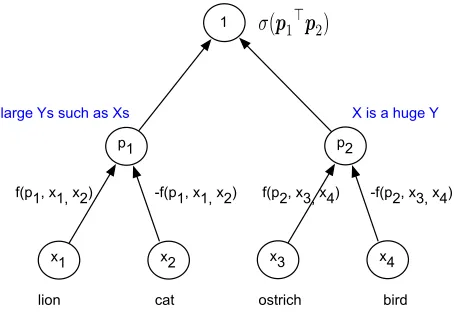
For example, consider Fig. 1, where the two word-pairs (lion, cat), and (ostrich, bird) co-occur respectively with the two lexical patterns, p1 = largeYs such asXs, and p2 = Xis a hugeY. Assuming that there are no other co-occurrences between word-pairs and patterns in the corpus, the representations of the patternsp1andp2are given respec-tively byp1=x1−x2, andp2=x3−x4. We measure the
x1 x2
p1
1
x3 x4
p2
lion cat ostrich bird
large Ys such as Xs X is a huge Y
f(p1, x1, x2)
(
p
1>p
2)
[image:3.612.323.550.54.210.2]-f(p1, x1, x2) f(p2, x3, x4) -f(p2, x3, x4)
Figure 1: Computing the similarity between two patterns.
relational similarity between(x1, x2)and(x3, x4)using the inner-productp1>p2.
We model the problem of learning word representations as a binary classification task, where we learn representations for words such that they can be used to accurately predict whether a given pair of patterns are relationally similar. In our previous example, we would learn representations for the four wordslion,cat,ostrich, andbirdsuch that the similarity between the two patternslargeYs such asXs, andXis a huge
Yis maximized. Later in Section 3.1, we propose an unsuper-vised method for selecting relationally similar (positive) and dissimilar (negative) pairs of patterns as training instances to train a binary classifier.
Let us denote the target label for two patterns p1,p2 by t(p1, p2) ∈ {1,0}, where the value 1 indicates thatp1 and p2are relationally similar, and0otherwise. We compute the prediction loss for a pair of patterns(p1, p2)as the squared loss between the target and the predicted labels as follows,
L(t(p1, p2), p1, p2) = 1
2(t(p1, p2)−σ(p1
>p
2)) 2
. (5)
Different non-linear functions can be used as the prediction function σ(·) such as the logistic-sigmoid, hyperbolic tan-gent, or rectified linear units. In our preliminary experiments we found hyperbolic tangent,tanh, given by
σ(θ) = tanh(θ) =exp(θ)−exp(−θ)
exp(θ) + exp(−θ) (6) to work particularly well among those different non-linearities.
To derive the update rule for word representations, let us consider the derivative of the loss w.r.t. the word representa-tionxof a wordx,
∂L ∂x =
∂L ∂p1
∂p1
∂x +
∂L ∂p2
∂p2
∂x, (7)
where the partial derivative of the loss w.r.t. pattern represen-tations are given by,
∂L ∂p1 =σ
0
(p1>p2)(σ(p1>p2)−t(p1, p2))p2, (8)
∂L ∂p2
=σ0(p1
>
p2)(σ(p1
>
Algorithm 1Learning word representations.
Input: Training pattern-pairs {(p(1i), p (i) 2 , t(p
(i) 1 , p
(i) 2 )}Ni=1, dimensionality d of the word representations, and the maximum number of iterationsT.
Output: Representation xj ∈ Rd, of a word xj for j =
1, . . . , M, whereM is the vocabulary size.
1: Initialize word vectors{xj}Mj=1.
2: for t= 1toT do
3: fork= 1toKdo
4: pk =|R(1pk)|
P
(u,v)∈R(pk)f(pk, u, v)(u−v)
5: end for
6: fori= 1toN do
7: forj= 1toM do
8: xj =xj−α
(t)
j ∂L ∂xj
9: end for
10: end for
11: end for
12: return {xj}Mj=1.
Here,σ0 denotes the first derivative oftanh, which is given
by1−σ(θ)2. To simplify the notation we drop the arguments of the loss function.
From Eq. 4 we get,
∂p1
∂x =
1 |R(p1)|
(h(p1, u=x, v)−h(p1, u, v=x)), (10)
∂p2
∂x =
1 |R(p2)|
(h(p2, u=x, v)−h(p2, u, v=x)), (11)
where,
h(p, u=x, v) = X
(x,v)∈{(u,v)|(u,v)∈R(p),u=x}
f(p, x, v),
and
h(p, u, v=x) = X
(u,x)∈{(u,v)|(u,v)∈R(p),v=x}
f(p, u, x).
Substituting the partial derivatives given by Eqs. 8-11 in Eq. 7 we get,
∂L
∂x =λ(p1, p2)[H(p1, x) X
(u,v)∈R(p2)
f(p2, u, v)(u−v)
+H(p2, x) X (u,v)∈R(p1)
f(p1, u, v)(u−v)], (12)
whereλ(p1, p2)is defined as
λ(p1, p2) =
σ0(p1>p2)(t(p1, p2)−σ(p1
>
p2)) |R(p1)||R(p2)|
, (13)
andH(p, x)is defined as
H(p, x) =h(p, u=x, v)−h(p, u, v=x). (14) We use stochastic gradient decent (SGD) with learning rate adapted by AdaGrad [Duchiet al., 2011] to update the word representations. The pseudo code for the proposed method is shown in Algorithm 1. Given a set ofN relationally similar
and dissimilar pattern-pairs,{(p(1i), p(2i), t(p(1i), p(2i))}N i=1, Al-gorithm 1 initializes each wordxj in the vocabulary with a
vectorxj ∈ Rd. The initialization can be conducted either
using randomly sampled vectors from a zero mean and unit variance Gaussian distribution, or by pre-trained word rep-resentations. In our preliminary experiments, we found that the word vectors learnt by GloVe [Pennington et al., 2014] to perform consistently well over random vectors when used as the initial word representations in the proposed method. Because word vectors trained using existing word representa-tions already demonstrate a certain degree of relational struc-ture with respect to proportional analogies, we believe that initializing using pre-trained word vectors assists the subse-quent optimization process.
During each iteration, Algorithm 1 alternates between two steps. First, in Lines 3-5, it computes pattern representations using Eq. 4 from the current word representations for all the patterns (Kin total) in the training dataset. Second, in Lines 6-10, for each train pattern-pair we compute the derivative of the loss according to Eq. 12, and update the word represen-tations. These two steps are repeated for T iterations, after which the final set of word representations are returned.
The computational complexity of Algorithm 1 is O(T Kd + T N M d), where d is the dimensionality of the word representations. Naively iterating over N training instances andMwords in the vocabulary can be prohibitively expensive for large training datasets and vocabularies. How-ever, in practice we can efficiently compute the updates using two tricks: delayed updates and indexing. Once we have computed the pattern representations for allKpatterns in the first iteration, we can postpone the update of a representation for a pattern until that pattern next appears in a training instance. This reduces the number of patterns that are updated in each iteration to a maximum of2instead ofK for the iterationst > 1. Because of the sparseness in co-occurrences, only a handful (ca.100) of patterns co-occur with any given word-pair. Therefore, by pre-compiling an index from a pattern to the words with which that pattern co-occurs, we can limit the update of word representations in Line 8 to a much smaller number thanM. Moreover, the vector subtraction can be parallized across the dimensions. Although the loss function defined by Eq. 5 is non-convex w.r.t. to word representations, in practice, Algorithm 1 converges after a few (less than 5) iterations. In practice, it requires less than an hour to train from a 2 billion word corpus where we haveN = 100,000,T = 10,K = 10,000 andM = 210,914.
3.1
Selecting Similar/Dissimilar Pattern-Pairs
We use the ukWaC corpus1 to extract relationally similar (positive) and dissimilar (negative) pairs of patterns(pi, pj)
to train the proposed method. The ukWaC is a 2 billion word corpus constructed from the Web limiting the crawl to the.uk domain. We select word-pairs that co-occur at least in50 sen-tences within a co-occurrence window of5tokens. Moreover, using a stop word list, we ignore word-pairs that purely con-sists of stop words. We obtain210,914word-pairs from this step. Next, we extract lexical patterns for those word-pairs by replacing the first and second word in a word-pair respec-tively by slot variablesXandYin a co-occurrence window of length5tokens to extract numerous lexical patterns. We select the top occurring10,000lexical patterns (i.e.K = 10,000) for further processing.
We represent a pattern pby a vector where the elements correspond to the PPMI valuesf(p, u, v)betweenpand all the word-pairs (u, v)that co-occur with p. Next, we com-pute the cosine similarity between all pairwise combinations of the10,000patterns, and rank the pattern pairs in the de-scending order of their cosine similarities. We select the top ranked50,000pattern-pairs as positive training instances. We select50,000pattern-pairs from the bottom of the list which have non-zero similarity scores as negative training instances. The reason for not selecting pattern-pairs with zero similar-ity scores is that such patterns do not share any word-pairs in common, and are not informative as training data for updat-ing word representations. Thus, the total number of trainupdat-ing instances we select isN = 50,000 + 50,000 = 100,000.
4
Evaluating Word Representations using
Proportional Analogies
To evaluate the ability of the proposed method to learn word representations that embed information related to semantic relations, we apply it to detect proportional analogies. For example, consider the proportional analogy, man:woman :: king:queen. Given, the first three words, a word represen-tation learning method is required to find the fourth word from the vocabulary that maximizes the relational similar-ity between the two word-pairs in the analogy. Three bench-mark datasets have been popularly used in prior work for evaluating analogies:Googledataset [Mikolovet al., 2013c] (10,675 syntactic analogies and 8869 semantic analogies), SemEval dataset [Jurgens et al., 2012] (79questions), and SATdataset [Turney, 2006] (374questions). For the Google dataset, the set of candidates for the fourth word consists of all the words in the vocabulary. For the SemEval and SAT datasets, each question word-pair is assigned with a limited number of candidate word-pairs out of which only one is cor-rect. The accuracy of a word representation is evaluated by the percentage of the correctly answered analogy questions out of all the questions in a dataset. We do not skip any ques-tions in our evaluaques-tions.
Given a proportional analogya : b :: c : d, we use the following measures proposed in prior work for measuring the relational similarity between(a, b)and(c, d).
1
[image:5.612.314.562.68.240.2]http://wacky.sslmit.unibo.it
Table 1: Word analogy results on benchmark datasets. Method sem. synt. total SAT SemEval ivLBL CosAdd 63.60 61.80 62.60 20.85 34.63 ivLBL CosMult 65.20 63.00 64.00 19.78 33.42 ivLBL PairDiff 52.60 48.50 50.30 22.45 36.94 skip-gram CosAdd 31.89 67.67 51.43 29.67 40.89 skip-gram CosMult 33.98 69.62 53.45 28.87 38.54 skip-gram PairDiff 7.20 19.73 14.05 35.29 43.99 CBOW CosAdd 39.75 70.11 56.33 29.41 40.31 CBOW CosMult 38.97 70.39 56.13 28.34 38.19 CBOW PairDiff 5.76 13.43 9.95 33.16 42.89 GloVe CosAdd 86.67 82.81 84.56 27.00 40.11 GloVe CosMult 86.84 84.80 85.72 25.66 37.56 GloVe PairDiff 45.93 41.23 43.36 44.65 44.67 Prop CosAdd 86.70 85.35 85.97 29.41 41.86 Prop CosMult 86.91 87.04 86.98 28.87 39.67 Prop PairDiff 41.85 42.86 42.40 45.99 44.88
CosAdd proposed by Mikolov et al. [2013d] ranks candi-datescaccording to the formula
CosAdd(a:b, c:d) = cos(b−a+c,d), (15) and selects the top-ranked candidate as the correct an-swer.
CosMult: CosAdd measure can be decomposed into the summation of three cosine similarities, where in practice one of the three terms often dominates the sum. To over-come this bias in CosAdd, Levy and Goldberg [2014] proposed theCosMultmeasure given by,
CosMult(a:b, c:d) =cos(b,d) cos(c,d)
cos(a,d) + . (16)
We convert all cosine valuesx∈[−1,1]to positive val-ues using the transformation(x+1)/2. Here,is a small constant value to prevent denominator becoming zero, and is set to10−5in the experiments.
PairDiff measures the cosine similarity between the two vectors that correspond to the difference of the word representations of the two words in each word-pair. It follows from our hypothesis that the semantic relation between two words can be represented by the vector dif-ference of their word representations. PairDiff has been used by Mikolov et al. [2013d] for detecting semantic analogies and is given by,
PairDiff(a:b, c:d) = cos(b−a,d−c). (17)
5
Experiments and Results
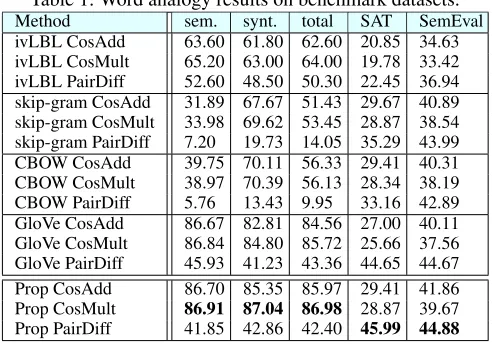
In Table 1, we compare the proposed method against pre-viously proposed word representation learning methods: ivLBL[Mnih and Kavukcuoglu, 2013],skip-gram[Mikolov et al., 2013c], CBOW [Mikolov et al., 2013a], and GloVe[Pennington et al., 2014]. All methods compared in Table 1 are trained on the same ukWaC corpus of 2B tokens to produce300dimensional word vectors. We use the pub-licly available implementations2,3by the original authors for
2https://code.google.com/p/word2vec/ 3
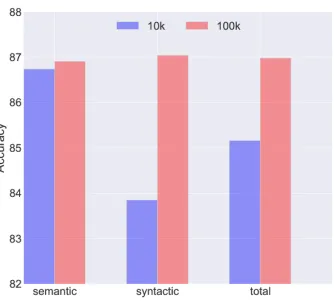
Figure 2: Accuracy on Google dataset when the proposed method is trained using 10k and 100k instances.
training the word representations using the recommended pa-rameter values. Therefore, any differences in performances reported in Table 1 can be directly attributable to the differ-ences in the respective word representation learning methods. In all of our experiments, the proposed method converged with less than5iterations.
From Table 1 we see that the proposed method (denoted by Prop) achieves the best results for the semantic (sem), syn-tactic (synt) and their union (total) analogy questions in the Google dataset using CosMult measure. For analogy ques-tions in SAT and SemEval datasets the best performance is reported by the proposed method using the PairDiff measure. The PairDiff measure computes the cosine similarity between the two difference vectors b−a and d−c, ignoring the spatial distances between the individual words as opposed to CosAdd or CosMult. Recall that in the Google dataset we are required to find analogies from a large open vocabulary whereas in SAT and SemEval datasets the set of candidates is limited to a closed pre-defined set. Relying on direction alone, while ignoring spatial distance is problematic when considering the entire vocabulary as candidates because, we are likely to find candidates d that have the same relation toc as reflected bya−b. For example, given the analogy man:woman::king:?, we are likely to recover feminine en-tities, but not necessarily royal ones using PairDiff. On the other hand, in both SemEval and SAT datasets, the set of can-didate answers already contains the related cancan-didates, leav-ing mainly the direction to be decided. For the remainder of the experiments described in the paper, we use CosMult for evaluations on the Google dataset, whereas PairDiff is used for the SAT and SemEval datasets. Results reported in Table 1 reveal that according to the binomial exact test with95% con-fidence the proposed method statistically significantly outper-forms GloVe, the current state-of-the-art word representation learning method, on all three benchmark datasets.
To study the effect of the train dataset size on the perfor-mance of the proposed method, following the procedure de-scribed in Section 3.1, we sample two balanced datasets
con-Figure 3: Accuracy of the proposed method on benchmark datasets for dimensionalities of the word representations.
taining respectively10,000and100,000instances. Figure 2 shows the performance reported by the proposed method on the Google dataset. We see that the overall performance in-creases with the dataset size, and the gain is more for syntac-tic analogies. This result can be explained considering that se-mantic relations are more rare compared to syntactic relations in the ukWaC corpus, a generic web crawl, used in our exper-iments. However, the proposed train data selection method provides us with a potentially unlimited source of positive and negative training instances which we can use to further improve the performance.
To study the effect of the dimensionalitydof the represen-tation on the performance of the proposed method, we hold the train data size fixed and produce word representations for different dimensionalities. As shown in Figure 3, the perfor-mance increases until around600dimensions on the Google, and the SAT datasets after which it stabilizes. The perfor-mance on the SemEval dataset remains relatively unaffected by the dimensionality of the representation.
6
Conclusions
We proposed a method to learn word representations that embeds information related to semantic relations between words. A two step algorithm that alternates between pat-tern and word representations was proposed. The proposed method significantly outperforms the current state-of-the-art word representation learning methods on three datasets con-taining proportional analogies.
Semantic relations that can be encoded as attributes in words are only a fraction of all types of semantic relations. Whether we can accurately embed semantic relations that in-volve multiple entities, or semantic relations that are only ex-trinsically and implicitly represented remains unknown. We plan to explore these possibilities in our future work.
References
[image:6.612.331.562.65.208.2]for corpus-based semantics. Computational Linguistics, 36(4):673 – 721, 2010.
[Baroniet al., 2014] Marco Baroni, Georgiana Dinu, and Germ´an Kruszewski. Don’t count, predict! a systematic comparison of context-counting vs. context-predicting se-mantic vectors. InACL’14, pages 238–247, 2014. [Bengioet al., 2003] Yoshua Bengio, R´ejean Ducharme,
Pascal Vincent, and Christian Jauvin. A neural proba-bilistic language model.Journal of Machine Learning Re-search, 3:1137 – 1155, 2003.
[Bollegalaet al., 2007a] D. Bollegala, Y. Matsuo, and M. Ishizuka. An integrated approach to measuring semantic similarity between words using information available on the web. In Proceedings of NAACL HLT, pages 340–347, 2007.
[Bollegalaet al., 2007b] Danushka Bollegala, Yutaka Mat-suo, and Mitsuru Ishizuka. Websim: A web-based seman-tic similarity measure. InProc. of 21st Annual Conference of the Japanese Society of Artitificial Intelligence, pages 757 – 766, 2007.
[Bollegalaet al., 2010] Danushka Bollegala, Yutaka Matsuo, and Mitsuru Ishizuka. Relational duality: Unsupervised extraction of semantic relations between entities on the web. InWWW 2010, pages 151 – 160, 2010.
[Choet al., 2014] Kyunghyun Cho, Bart van Merrienboer, Caglar Gulcehre, Dzmitry Bahdanau, Fethi Bougares, Hol-ger Schwenk, and Yoshua Bengio. Learning phrase rep-resentations using rnn encoder–decoder for statistical ma-chine translation. InEMNP’14, pages 1724–1734, 2014. [Collobertet al., 2011] Ronan Collobert, Jason Weston,
Leon Bottou, Michael Karlen, Koray Kavukcuoglu, and Pavel Kuska. Natural language processing (almost) from scratch. Journal of Machine Learning Research, 12:2493 – 2537, 2011.
[Ducet al., 2010] Nguyen Tuan Duc, Danushka Bollegala, and Mitsuru Ishizuka. Using relational similarity between word pairs for latent relational search on the web. In IEEE/WIC/ACM International Conference on Web Intelli-gence and Intelligent Agent Technology, pages 196 – 199, 2010.
[Ducet al., 2011] Nguyen Tuan Duc, Danushka Bollegala, and Mitsuru Ishizuka. Cross-language latent relational search: Mapping knowledge across languages. In Proc. of the Twenty-Fifth AAAI Conference on Artificial Intelli-gence, pages 1237 – 1242, 2011.
[Duchiet al., 2011] John Duchi, Elad Hazan, and Yoram Singer. Adaptive subgradient methods for online learning and stochastic optimization.Journal of Machine Learning Research, 12:2121 – 2159, July 2011.
[Hashimotoet al., 2014] Kazuma Hashimoto, Pontus Stene-torp, Makoto Miwa, and Yoshimasa Tsuruoka. Jointly learning word representations and composition functions using predicate-argument structures. InEMNLP’14, pages 1544–1555, 2014.
[Huanget al., 2012] Eric H. Huang, Richard Socher, Christopher D. Manning, and Andrew Y. Ng. Improving word representations via global context and multiple word prototypes. InACL’12, pages 873 – 882, 2012.
[Jurgenset al., 2012] David A. Jurgens, Saif Mohammad, Peter D. Turney, and Keith J. Holyoak. Measuring degrees of relational similarity. InSemEval’12, 2012.
[Levy and Goldberg, 2014] Omer Levy and Yoav Goldberg. Linguistic regularities in sparse and explicit word repre-sentations. InCoNLL, 2014.
[Mikolovet al., 2013a] Tomas Mikolov, Kai Chen, and Jef-frey Dean. Efficient estimation of word representation in vector space.CoRR, 2013.
[Mikolovet al., 2013b] Tomas Mikolov, Quoc V. Le, and Ilya Sutskever. Exploiting similarities among languages for machine translation. arXiv, 2013.
[Mikolovet al., 2013c] Tomas Mikolov, Ilya Sutskever, Kai Chen, Gregory S. Corrado, and Jeffrey Dean. Distributed representations of words and phrases and their composi-tionality. InNIPS, pages 3111 – 3119, 2013.
[Mikolovet al., 2013d] Tomas Mikolov, Wen tau Yih, and Geoffrey Zweig. Linguistic regularities in continous space word representations. In NAACL’13, pages 746 – 751, 2013.
[Mnih and Kavukcuoglu, 2013] Andriy Mnih and Koray Kavukcuoglu. Learning word embeddings efficiently with noise-contrastive estimation. InNIPS, 2013.
[Penningtonet al., 2014] Jeffery Pennington, Richard Socher, and Christopher D. Manning. Glove: global vectors for word representation. InEMNLP, 2014. [Socheret al., 2011] Richard Socher, Jeffrey Pennington,
Eric H. Huang, Andrew Y. Ng, and Christopher D. Man-ning. Semi-supervised recursive autoencoders for predict-ing sentiment distributions. In EMNLP’11, pages 151– 161, 2011.
[Turianet al., 2010] Joseph Turian, Lev Ratinov, and Yoshua Bengio. Word representations: A simple and general method for semi-supervised learning. InACL, pages 384 – 394, 2010.
[Turney and Pantel, 2010] Peter D. Turney and Patrick Pan-tel. From frequency to meaning: Vector space models of semantics. Journal of Aritificial Intelligence Research, 37:141 – 188, 2010.
[Turney, 2005] P.D. Turney. Measuring semantic similarity by latent relational analysis. InProc. of IJCAI’05, pages 1136–1141, 2005.