The pattern of memory and
perceptual dysfunctions in
recreational ecstasy users
John Anthony Brown
A thesis submitted for the degree of
Doctor of Philosophy
of The Australian National University
Declaration
I declare that this thesis reports my original work, that no part has
been previously accepted and presented for the award of any
degree or diploma from any university, and that, to the best of my
knowledge, no material previously published or written by any other
person is included, except where due acknowledgement is given.
“If MDMA neurotoxicity in humans is a myth, then it is a myth with a very heavy serotonergic component.”
Acknowledgements
I wish to sincerely thank my supervisors, Dr Jeff Ward, Dr Elinor McKone, and Dr Mark Edwards, for their guidance during the design, implementation and interpretation of my empirical studies, as well as for their critiques and proof reading of this thesis. In particular, I thank Jeff for his expertise in drug research, and for his guidance in the overall planning of my research. I thank Elinor for her expertise in cognition, and her assistance in all aspects of the memory studies. I also thank Elinor for her astute critique of earlier drafts of this entire thesis - as well as her comprehensive proof reading - all of which greatly clarified my thinking and considerably improved my expression. I thank Mark for his expertise in perception, and for patiently helping me to develop the understanding and skills I needed to design, implement, and interpret the perception study.
I also wish to sincerely thank other staff in the School of Psychology who have assisted me in a variety of ways, including:
- Dr Cobie Brinkman, who was an advisor on my supervisory panel, for helping me to understand the many aspects of neuroanatomy, neurochemistry, and neuroimaging with which I was unfamiliar, as well as for valuable feedback on earlier documents which helped to form the basis of this thesis.
- Dr Mike Smithson, for assistance with some of the more complex aspects of statistical analysis.
- Shane Pozzi, Petrina Daniel and other technical support staff for the provision of the computer equipment and facilities necessary to conduct this research.
Words seem inadequate to express my deepest thanks to my wife, Sue, for journeying with me through nearly 9 years of university study, after having already been through so many life changes together. It was your world of research, universities, and new
discoveries that led me to contemplate tertiary study in the first place, and your loving support, practical assistance, and patience that enabled me to succeed. For everything you have given me, and everything you have given up for my studies, I give my most heart-felt thanks.
Abstract
There is a growing body of evidence that the main psychoactive ingredient of the recreational drug “ecstasy” (methylendioxymethamphetamine; MDMA) causes lasting changes to the serotonin system in both animals and humans, including the
hippocampus (involved in memory) and the occipital lobe (involved in visual perception). Previous studies have often found memory deficits in ecstasy users.
However, the results have been far from consistent across studies. None of the methods used to date have adequately isolated the hippocampal component of memory from the contribution of other brain regions. Three memory studies were conducted in this thesis to clarify which components and processes of memory are in deficit in ecstasy users. In the first memory study, ecstasy users (n=32) did not differ from non-drug using controls (n=29) on implicit memory (automatic non-conscious retrieval, as revealed by a stem-completion task), or explicit memory (conscious recollection, as revealed by stem-cued recall). In the second memory study, no significant differences were found between ecstasy users (n=30) and non-drug using controls (n=34) on tests designed to clarify the findings on explicit memory, or on two standard neuropsychological tests of long-term memory (prose recall and Auditory Verbal Learning Test) that allowed greater use of elaborative processing at study. In the third memory study, a number of tests were applied that differed in their elaborative processing demands, including the California Verbal Learning Test, Visual Paired Associates, and Verbal Paired
Associates. Ecstasy users (n=32) had poorer recall, and made less strategic use of elaborative processing compared to both cannabis-using controls (n=33) and non-drug using controls (n=33). Also, on a novel test of elaborative processing (“Verbal Triplet Associates”), both cannabis users and ecstasy users had memory deficits on the first trial, but only ecstasy users had a significant learning deficit over successive trials. On the basis of the localisation of the components and processes of memory in literature, it was concluded that long-term memory deficits in ecstasy users may reflect changes in elaborative processes localised in the frontal lobes, or global deficits, rather than just changes to the memory functions of the hippocampus.
non-drug using controls (n=34). Unexpectedly, this result was only obtained for a subset of 12 ecstasy users (out of n=30) who had not used amphetamines in the recent past. It was concluded that the results for ecstasy users who had not recently used
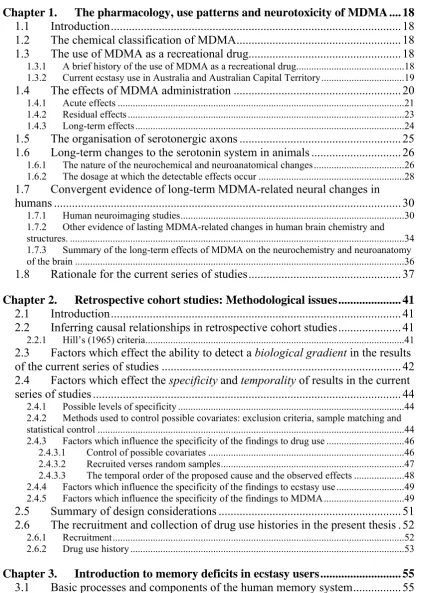
Table of contents
Acknowledgements... 5
Abstract ... 6
Table of contents... 8
[image:8.595.66.489.158.752.2]Table of figures ... 13
Table of tables... 15
Chapter 1. The pharmacology, use patterns and neurotoxicity of MDMA .... 18
1.1 Introduction... 18
1.2 The chemical classification of MDMA... 18
1.3 The use of MDMA as a recreational drug... 18
1.3.1 A brief history of the use of MDMA as a recreational drug...18
1.3.2 Current ecstasy use in Australia and Australian Capital Territory...19
1.4 The effects of MDMA administration ... 20
1.4.1 Acute effects ...21
1.4.2 Residual effects ...23
1.4.3 Long-term effects...24
1.5 The organisation of serotonergic axons ... 25
1.6 Long-term changes to the serotonin system in animals ... 26
1.6.1 The nature of the neurochemical and neuroanatomical changes...26
1.6.2 The dosage at which the detectable effects occur ...28
1.7 Convergent evidence of long-term MDMA-related neural changes in humans ... 30
1.7.1 Human neuroimaging studies...30
1.7.2 Other evidence of lasting MDMA-related changes in human brain chemistry and structures. ...34
1.7.3 Summary of the long-term effects of MDMA on the neurochemistry and neuroanatomy of the brain ...36
1.8 Rationale for the current series of studies... 37
Chapter 2. Retrospective cohort studies: Methodological issues... 41
2.1 Introduction... 41
2.2 Inferring causal relationships in retrospective cohort studies... 41
2.2.1 Hill’s (1965) criteria...41
2.3 Factors which effect the ability to detect a biological gradient in the results of the current series of studies ... 42
2.4 Factors which effect the specificity and temporality of results in the current series of studies ... 44
2.4.1 Possible levels of specificity ...44
2.4.2 Methods used to control possible covariates: exclusion criteria, sample matching and statistical control ...44
2.4.3 Factors which influence the specificity of the findings to drug use ...46
2.4.3.1 Control of possible covariates ...46
2.4.3.2 Recruited verses random samples...47
2.4.3.3 The temporal order of the proposed cause and the observed effects ...48
2.4.4 Factors which influence the specificity of the findings to ecstasy use ...49
2.4.5 Factors which influence the specificity of the findings to MDMA...49
2.5 Summary of design considerations ... 51
2.6 The recruitment and collection of drug use histories in the present thesis . 52 2.6.1 Recruitment...52
2.6.2 Drug use history ...53
Chapter 3. Introduction to memory deficits in ecstasy users... 55
3.1 Basic processes and components of the human memory system... 55
3.1.2 The use of elaborative and associative processing to aid the encoding of material in
long-term memory ... 57
3.1.3 Explicit memory and implicit memory... 59
3.1.4 The localisation of long-term memory components in the brain ... 60
3.2 Why study memory deficits in ecstasy users? ...62
3.2.1 Brief overview of research to date... 62
3.2.2 Memory studies in the current thesis ... 64
Chapter 4. The consequence of ecstasy use on implicit and explicit memory for lists of unrelated words... 65
4.1 Introduction to the present study...65
4.1.1 Overview ... 65
4.1.2 Evidence from tryptophan depletion studies of serotonergic involvement in implicit and explicit memory ... 66
4.1.2.1 The tryptophan depletion technique... 66
4.1.2.2 Review of tryptophan depletion studies: Serotonergic involvement in long-term implicit memory... 67
4.1.2.3 Review of tryptophan depletion studies: Serotonergic involvement in long-term explicit memory ... 67
4.1.2.4 Summary of the evidence from tryptophan depletion studies regarding implicit and explicit memory... 69
4.1.3 A review of evidence regarding on memory for lists of unrelated words (explicit memory) in ecstasy users ... 70
4.1.3.1 Evidence from standard neuropsychological tests of delayed memory retrieval . 70 4.1.3.2 Evidence for an association between long-term memory deficits and changes in neural functioning in ecstasy users... 74
4.1.3.3 Summary of and interpretation of evidence regarding the performance of ecstasy users on explicit memory ... 75
4.1.4 The possibility of implicit memory deficits in ecstasy users ... 76
4.1.5 The present study... 77
4.2 Method ...79
4.2.1 Participants ... 79
4.2.2 Structure of participant contact and test session ... 82
4.2.3 Experimental design ... 82
4.2.4 Experimental stimuli... 84
4.2.5 Experimental procedure... 85
4.2.5.1 Study phase ... 85
4.2.5.2 Distractor phase... 85
4.2.5.3 Test Phase ... 86
4.2.6 Statistical analysis of cohort effects and covariates: General approach... 87
4.3 Results...88
4.3.1 Study phase: Performance on the word-learning and digit-monitoring tasks ... 88
4.3.2 Test phase: Baseline response rates... 88
4.3.3 Test phase: Replication of standard test-type by attention interaction... 88
4.3.4 Test phase: Cohort effects: Was ecstasy use associated with implicit and/or explicit memory deficits?... 90
4.3.5 Subsidiary results: An ecstasy advantage in dual task performance? ... 92
4.4 Discussion ...94
4.4.1 Summary of findings in the present study ... 95
4.4.2 The consistency of the results compared to previous literature, and the interpretation of findings in the present study ... 96
4.4.2.1 Implicit memory... 96
5.1.1 Aim: To evaluate the effect of the number of learning trials on the explicit memory
performance of ecstasy users compared to controls ...100
5.1.2 Aim: To evaluate the effect of the level of cueing on the explicit memory performance of ecstasy users compared to controls ...102
5.1.3 Aim: To evaluate the effect of elaborative and associative processing on long-term memory test performance, as revealed by standard neuropsychological tests...103
5.1.3.1 The Auditory Verbal List Learning task (AVLT)...103
5.1.3.2 Prose recall ...105
5.1.4 Aim: To increase the power of the study to detect an ecstasy-related deficit ...106
5.2 Method ... 108
5.2.1 Participants...108
5.2.2 Experimental design...109
5.2.3 Experimental procedure and stimuli ...110
5.2.3.1 Follow-up tests: Study phase...110
5.2.3.2 Follow-up tests: Distractor phase ...111
5.2.3.3 Follow-up tests: Test Phase ...112
5.2.3.4 Prose recall and Auditory Verbal List Learning (AVLT) tests...112
5.3 Results... 113
5.3.1 Follow-up stem-cued recall tests...113
5.3.2 Standard clinical neuropsychological tests of long-term memory ...114
5.3.2.1 Prose recall ...114
5.3.2.2 Word list learning (AVLT)...115
5.4 Discussion ... 117
5.4.1 Summary of findings in the present study...117
5.4.2 Interpretation of the combined findings from the present and previous memory studies in the current thesis...118
Chapter 6. Ecstasy-related effects on associative processing in list learning memory tests using multi-component items ... 121
6.1 Introduction to the present study... 121
6.1.1 The California Verbal Learning Test ...121
6.1.2 The Verbal Paired Associates test...123
6.1.3 The Visual Paired Associates test ...126
6.1.4 The Verbal Triplet Associates tests...127
6.1.5 The present study ...128
6.2 Method ... 129
6.2.1 Participants...129
6.2.1.1 Demographic, personality, and mental health characteristics...130
6.2.1.2 Drug use ...131
6.2.1.3 Summary of group characteristics ...133
6.2.2 Experimental design...133
6.2.3 Experimental stimuli ...133
6.2.4 Experimental procedure ...134
6.2.5 Statistical Analysis...135
6.3 Results... 137
6.3.1 Immediate recall...137
6.3.1.1 California Verbal Learning Test (CVLT)...137
6.3.1.2 Verbal Paired Associates ...139
6.3.1.3 Visual Paired Associates ...143
6.3.1.4 Verbal Triplet Associates ...145
6.3.2 Delayed recall ...149
6.3.2.1 Verbal and Visual Paired Associates...149
6.3.2.2 CVLT...150
6.3.3 Use of semantic strategies in the CVLT...154
6.3.3.1 Immediate recall ...154
6.3.3.2 Delayed recall...156
6.3.4 Recency of drug use: Correlations between memory performance and the last use of ecstasy, alcohol, cannabis and amphetamines ...158
6.3.6 The validity of comparing results across the second and third memory studies: Are the
results due to sample or test characteristics?... 161
6.4 Discussion ...165
6.4.1 Summary of findings in the present study ... 165
6.4.2 The consistency of the results compared to previous literature ... 166
6.4.3 Interpretation of findings ... 168
6.4.3.1 The CVLT semantic clustering index ... 168
6.4.3.2 Learning in ecstasy users compared to cannabis-controls... 169
6.4.3.3 The validity of interpreting the pattern of results across memory studies in the current thesis ... 170
6.4.3.4 The localisation of long-term memory deficits in the brain: The implications of the pattern of results across the memory studies in this thesis ... 172
6.4.4 Evidence regarding slower processing speed in ecstasy users in previous literature... 172
6.4.5 Summary of discussion... 174
Chapter 7. The consequences of ecstasy use on the behavioural functioning of the occipital lobe... 176
7.1 Introduction to the present study...176
7.1.1 Overview ... 176
7.1.2 Evidence consistent with ecstasy having a long-term effect on the neural functioning of the occipital lobe... 177
7.1.2.1 Subjective report ... 177
7.1.2.2 Electroencephalography (EEG)... 178
7.1.2.3 Functional Magnetic Resonance Imaging (fMRI)... 179
7.1.2.4 Summary of published research to date regarding the effect of ecstasy on the operation of the occipital lobe... 180
7.1.3 The functions of the occipital lobe which can be observed experimentally ... 181
7.1.4 How orientation is encoded in the occipital lobe... 181
7.1.5 The tilt aftereffect and the neural mechanisms thought to underlie it... 184
7.1.6 Evidence in literature for an association between serotonin and the magnitude of the tilt aftereffect... 185
7.1.7 Does ecstasy use influence the tilt aftereffect? ... 186
7.1.8 Summary and the present study... 188
7.2 Method ...191
7.2.1 Participants and testing schedule ... 191
7.2.2 Design... 192
7.3 Stimuli and equipment ...193
7.4 Procedure ...193
7.5 Results...195
7.5.1 Cohort effects on the magnitude of the tilt aftereffect ... 195
7.5.2 Cohort effects on the slopes of the psychometric curves at the PSE ... 199
7.5.3 Dose dependence and recency effects for ecstasy, amphetamines, and cannabis: Correlations between the magnitude of the tilt aftereffect and measures of drug use... 201
7.6 Discussion ...202
7.6.1 Summary of ecstasy-related findings... 202
7.6.2 The consistency of the results compared to previous literature ... 202
7.6.3 Interpretation of findings ... 203
7.6.3.1 The tilt aftereffect in amphetamine-abstinent ecstasy users... 203
7.6.3.2 The effect of the recent use of amphetamines... 204
7.6.4 Summary of discussion... 204
8.1.2.4 Ecstasy: The absence of dose dependent effects...209
8.1.3 The specificity of the results to MDMA ...211
8.1.4 Summary of the specificity of findings to drug use, ecstasy and MDMA...212
8.2 From the current thesis to future research: Issues regarding the testing of cognitive and perceptual deficits in ecstasy users... 212
8.2.1 Refining the approach to ecstasy research regarding cognitive/perceptual deficits ...212
8.2.2 New findings...213
8.2.3 Future research...213
8.2.4 Final summary...215
Appendix A: Additional sample characteristics ... 216
Appendix B: Participant information sheet and consent forms... 219
Table of figures
Figure 1.1 Serotonergic pathways in the human brain (Heimer, 1994 with "Occipital lobe" label added)...26 Figure 4.1 Memory scores (target word completions of studied stems – baseline) on
stem completion (implicit) and stem-cued recall (explicit) memory tasks as a function of level of attention (full, divided) and cohort (controls, ecstasy users). Error bars = standard errors ...90 Figure 4.2 Mean memory scores (target word completions of studied stems – baseline)
as a function of type of memory task and cohort (control, ecstasy users). Error bars = standard errors...91 Figure 4.3 Mean reaction time and accuracy performance on the digit-monitoring task
as a function of task (the first and second set of practise trials under both single- and dual-task conditions, as well as the divided attention at study conditions of the stem completion and stem-cued tasks) and cohort (ecstasy users, controls). Error bars = standard errors...93 Figure 5.1 Explicit memory performance on the three follow-up memory tasks: a)
stem-cued following one learning trial; b) stem-stem-cued recall following two learning trials; and c) free recall (following one learning trial) as a function of cohort (ecstasy users, non-drug using controls). Error bars = standard errors...114 Figure 5.2 Prose recall as a function of test (Story A, the first repetition of Story B
(“Story B1”), the second repetition of Story B (“Story B2”) ) and cohort (ecstasy users, controls) . Error bars = standard errors ...115 Figure 5.3 Mean words recalled in the AVLT as a function of trial number (1st...5th) and
cohort (ecstasy users, controls) . Error bars = standard errors...116 Figure 6.1 Stimuli for the Verbal Triplet Associates test...134 Figure 6.2 Mean number of words recalled in the California Verbal Learning Test
(CVLT) as a function of trial (1...5) and cohort (ecstasy users, cannabis-controls, non-drug using controls). Error bars = standard errors...138 Figure 6.3 Mean recall on the Verbal Paired Associates test as a function of trial (1..4)
and cohort (ecstasy users, cannabis-controls, non-drug controls) ...140 Figure 6.4 Mean number of correct colour associations in the Visual Paired Associates
as determined at the width of the curve at half the height of the curve (from
Sekuler & Blake, 2002)... 182 Figure 7.2 Illustration of the pattern of activation of a population of neurons to a vertical
stimulus. The neuron with a preferred orientation of vertical has the maximum level of activation. Neurons with nearby preferred orientations have progressively lower levels of activation in proportion to the difference between their preferred orientation and the orientation of the stimulus. (Extract from Figure 7.3; adapted from Sekuler & Blake, 2002)... 183 Figure 7.3 Illustration of the (i) actual stimulus orientation, (ii) pattern of activation of
affected neurons, and (iii) perceived orientation of the stimulus at three stages of the tilt aftereffect, specifically, (a) when tested on a vertical stimulus during the pre-adaptation test, (b) at the end of the adaptation phase, and (c) when tested on a vertical stimulus in the post-adaptation test phase (adapted from Sekuler & Blake, 2002) ... 185 Figure 7.4 Illustration of the potential for relatively large increase in the magnitude of
the tilt aftereffect to be obtained at larger adaptation angles ... 187 Figure 7.5 Illustration of the possible effect of ecstasy on the tuning bandwidth of a V1
orientation selective neuron. The double-ended arrows show the comparative difference in activation for stimuli at 15o and 40o from the preferred orientation that an ecstasy-related change in tuning bandwidth may cause... 188 Figure 7.6 Example psychometric curve showing the Point of Subjective Equality (PSE)
corresponding to the point on the fitted curve when the proportion of stimuli perceived as being as orientated to the right or to the left is 0.5 (i.e. the test angle that the participant perceives to be vertical). Example pre- and post-adaptation psychometric curves for a participant in the present study are shown in Figure 7.8 (p.197)... 190 Figure 7.7 Example Gabor stimuli at various orientations ... 194 Figure 7.8 Example pre-adaptation and post-adaptation psychometric curves for a single participant in the 15o adaptation condition ... 196 Figure 7.9 The magnitude of the tilt aftereffect at 40o for cohorts of: non-drug using
controls; ecstasy users who had recently used amphetamines (within the 61 days prior to testing); and ecstasy users who were abstinent from amphetamines (for 115 days or more prior to testing). Error bars = standard errors... 198 Figure 7.10 The magnitude of the tilt aftereffect at 15o for non-drug using controls,
Table of tables
Table 4-1 Memory for lists of single unrelated words for studies with relatively strong control over the influence of drugs apart from ecstasy...71 Table 4-2 Memory for lists of single unrelated (unless specified) words for studies with
that exercised less control than the studies in Table 4-1 over the influence of drugs and other possible covariates. ...72 Table 4-3 Selected characteristics of ecstasy users and controls in the first memory
study ...80 Table 4-4 The sequence of events that took place with each participant...83 Table 4-5 Performance on the word-learning task (words correctly read aloud) and
digit-monitoring task (accuracy of odd-even decisions) as a function of level of attention (full, divided) and cohort (controls, ecstasy users) ...88 Table 4-6. The mean and (standard deviation) of baseline response rates (completions of
unstudied stems with target words) as a function of memory task (implicit,
explicit), level of attention (full, divided) and cohort (controls, ecstasy users)...89 Table 5-1 Prose recall test results in literature for studies with relatively strong control
over the influence of drugs apart from ecstasy. ...106 Table 5-2 Prose recall test results in literature for studies with relatively weak control
over the influence of drugs apart from ecstasy (c.f. Table 5-1) ...107 Table 5-3 Selected characteristics of ecstasy users and controls in the second
(follow-up) memory study ...109 Table 5-4 The sequence of events that took place with each participant...111 Table 5-5 Covariates of the total AVLT score, p<.10 ...117 Table 6-1 Summary of ecstasy literature regarding memory for lists of word-pairs using
either Verbal Paired Associates (VPA, Wechsler, 1997a) , LGT3(Bäumler, 1974), or a similar variant of these tests...125 Table 6-2 Selected characteristics of ecstasy users and controls in the third memory
study ...131 Table 6-3 Selected drug use measures by non-drug using controls, cannabis-controls,
Table 6-7 Summary of the simple effects analysis for each trial of Visual Paired
Associates controlling for sex, lifetime dose of alcohol and maximum ever dose of alcohol (standard drinks) as a function of cohort (ecstasy users, cannabis-controls, and non-drug using controls) ... 144 Table 6-8 Bivariate correlations between total Verbal Triplet Associates recall, p≤.10
... 146 Table 6-9 Summary of simple effects analysis for each trial of the Verbal Triplet
Associates test, including the backward elimination of estimated IQ, the lifetime dose of alcohol, and the maximum every monthly dose of alcohol... 148 Table 6-10 Mean number of words recalled in the California Verbal Learning Test
(CVLT) as a function of test type (free recall, category-cued recall, correct recognition), duration of delay (short, long) and cohort (ecstasy users, cannabis-controls, non-drug using controls). ... 150 Table 6-11 Covariates of short and long delay, free recall and category-cued recall,
p<.10 ... 151 Table 6-12 Bivariate correlations of CVLT long-delayed correct recognition, p<.01 . 154 Table 6-13 Mean List-Based Semantic Clustering Index (Standard Error of the Mean
shown in brackets) for tests of free recall in the California Verbal Learning Test, as a function of test (immediate, short delay, long delay) and cohort (non-drug using controls, cannabis-controls, and ecstasy users)... 155 Table 6-14 Bivariate correlations of the CVLT List-Base semantic Clustering Index
(LBSCI) as a function of the delay (immediate, short-delay and long-delay) on the free recall tests, p<.01 ... 156 Table 6-15 Bivariate correlations between the principal memory measures in the present
study and the number of days since the last use of alcohol (for all participants), as well as the number of days since the last use of cannabis (for cannabis-controls and ecstasy users only) ... 158 Table 6-16 Bivariate correlations between the principal memory measures in the present
study and the number of days since the last use of amphetamines, as well as the number of days since the last use of ecstasy, in the ecstasy users group... 159 Table 6-17 Dose dependence of ecstasy: Bivariate correlations between the principal
memory measures in the present study and lifetime dose of ecstasy, maximum monthly dose of ecstasy, and the maximum ever dose of ecstasy in a single session, within the ecstasy users group only ... 160 Table 6-18 Dose dependence of amphetamines: Bivariate correlations between the main
memory measure in the present study and lifetime dose of amphetamines, maximum monthly dose of amphetamines, and the maximum ever dose of amphetamines in a single session, for all amphetamine users in the
Table 6-19 Comparison of ecstasy users who participated in both the second and third memory studies (Study 2 & 3), with ecstasy users who only participated in the second study (Study 2 only)...162 Table 6-20 Comparison of ecstasy users who participated in both the second and third
memory studies (Study 2 & 3, ‘Old’), with ecstasy users who only participated in the third study (Study 3 only, ‘New’) and non-drug using controls in the third memory study (‘C’)...164 Table 7-1 Selected characteristics of ecstasy users and controls in the visual perception
study ...192 Table 7-2 The Mean (Standard Error of the Mean) of the magnitude of the
tilt-aftereffect as a function of cohort (controls, ecstasy users)...195 Table 7-3 The Mean (Standard Error of the Mean) of the slope of the psychometric
curves at the PSE for the pre-adaptation and post-adaptation tests, as a function of adaptation angle (15o and 40o) and cohort (controls, ecstasy users). ...200 Table 7-4 Dose dependence and recency of ecstasy and amphetamines: Bivariate
correlations between the magnitude of the tilt aftereffect as a function of adaptation angle (15o, 40o) and drug use (number of days since the last, lifetime dose,
maximum monthly dose, and the maximum ever dose of ecstasy in a single session) of ecstasy, amphetamines, and cannabis within the ecstasy users group. ...201 Table A-1 Additional characteristics of ecstasy users and non-drug using controls in the
first memory study (Chapter 4). SEM = Standard Error of the Mean. (.ns indicates p>.05). Additional characteristics are shown in Table 4-3 (p.80)...216 Table A-2 Additional characteristics of ecstasy users and non-drug using controls in the
second memory study (Chapter 5) and the low-level visual perception study (Chapter 7). SEM = Standard Error of the Mean. (.ns indicates p>.05). Additional characteristics are shown in Table 5-3 (p.109) and repeated in Table 7-1 (p.193). ...217 Table A-3 Additional characteristics of ecstasy users (n=32), cannabis-controls (n=32)