arXiv:1507.07406v2 [hep-ph] 30 Nov 2015
LTH–1052 MAN/HEP/2015/13
Extra
Z
′s and
W
′s in
Heterotic–String Derived Models
Alon E. Faraggi†1 and Marco Guzzi‡2
†Department of Mathematical Sciences
University of Liverpool, Liverpool, L69 7ZL, United Kingdom
‡Consortium for Fundamental Physics,
School of Physics & Astronomy
University of Manchester, Manchester, M13 9PL, United Kingdom
Abstract
The ATLAS and CMS collaborations recently recorded possible excess in the di–boson production at the di–boson invariant mass at around 2 TeV. Such an excess may be produced if there exist additionalZ′ and/orW′ at that scale.
We survey the extra Z′s and W′s that may arise from semi–realistic heterotic
string vacua in the free fermionic formulation in seven distinct cases including:
U(1)Z′ ∈ SO(10); family universal U(1)Z′ ∈/ SO(10); non–universal U(1)Z′;
hidden sector U(1) symmetries and kinetic mixing; left–right symmetric mod-els; Pati–Salam modmod-els; leptophobic and custodial symmetries. Each case has a distinct signature associated with the extra symmetry breaking scale. In one of the cases we explore the discovery potential at the LHC using resonant leptoproduction. Existence of extra vector boson with the reported properties will significantly constrain the space of allowed string vacua.
1
E-mail address: [email protected]
2
1
Introduction
The Standard Model multiplet structure strongly favours its embedding in chiral 16 representations ofSO(10). This can be most emphatically demonstrated by remem-bering that the Standard Model gauge charges are experimental observables. The Standard Model, including right–handed neutrinos, has three group factors, three generations, and six multiplets per family, and therefore heuristically the number of parameters required in the Standard Model is fifty–four. Embedding the Standard Model states inSO(10) representations reduces this number to one, which is the num-ber of 16 spinorial SO(10) representations required to accommodate the Standard Model states.
Gravitational interactions are not accounted for in the Standard Model. A con-temporary self–consistent framework that facilitates the exploration of the synthesis of the gravitational and gauge interactions is provided by string theories, which are conjectured to be effective limits of a more fundamental theory. Hetertic–string the-ory is the perturbative limit that allows for the embedding of the Standard Model states in chiralSO(10) representations as it gives rise the spinorial 16 representations in its perturbative spectrum. Three generation models with viable gauge group and Higgs states have been constructed using a variety of methods. Among those the free fermionic formulation [1] of the heterotic string [2] provided a particularly fertile ground. In these three generation models the SO(10) symmetry is broken at the string level to one of its maximal subgroups.
Recently, the ATLAS and CMS collaborations [3–5] reported an excess in fat jet production which is kinematically compatible with the decay of a heavy resonance into two vector bosons, generating a wide range of interest [6]. A possible interpretation of the observed excess is as an extra Z′ or W′ with a mass of the order of few TeV’s [3, 4, 6]. The existence of an extra Z′ inspired from heterotic string theory attracted considerable interest in the particle physics literature [7]. However, constructing string models that allow an Z′ to remain unbroken down to low scales has proven to be very challenging. The reason being that the extra U(1) symmetries that are studied in the literature are either anomalous or have to be broken at the high scale to generate qualitatively realistic fermion mass spectrum. Furthermore, Flavour Changing Neutral Current (FCNC) Constraints, indicate that the extra Z′ below the DecaTeV scale, has to be family universal, and imposes an additional strong constraint on the viable string vacuum. Extra vector bosons in the TeV region will exclude the majority of heterotic–string models constructed to date. Recently, a semi–realistic string derived model that allow for a light Z′ model was constructed in ref. [8].
the models pertaining to the gauge group structure are relevant to other constructions [9]. The various Z′ that arise in the models may be classified into several broad categories:
• Family universal U(1)s that admit theSO(10) and E6 embedding of the
Stan-dard Model charges.
• ExtraW′ & Z′ arising in left–right symmetric heterotic–string models.
• Family non–universal U(1)s.
• Hidden sector U(1) symmetries and kinetic mixing.
• Extra vector bosons from extensions of the colour group.
• Leptophobic and custodialSU(2) symmetries.
We will comment on these possibilities and their viability below the 10 TeV scale. We show that extra hidden sector U(1)s is not a viable possibility in these models. Fur-thermore, each of the remaining cases carries a unique signature associated with extra gauge symmetry breaking scale. For example, U(1)Z′ ∈ SO(10) only requires
addi-tional right–handed neutrinos for anomaly cancellation, whereas U(1)Z′ ∈/ SO(10)
mandates the existence of additional matter. Family non–universal U(1)s are con-strained to be above the DecaTeV scale, whereas non–Abelian extensions of the Standard Model gauge symmetries, as in the left–right symmetric models, give rise to additional vector bosons. Discovery of one or more additional vector bosons at the LHC will therefore pave the way to discriminate between the different possibilities and will strengthen the case for a multi–TeV lepton collider and a 100 TeV hadron collider. In section 4 we explore the discovery potential at the LHC using resonant leptoproduction.
2
Additional
U
(1)
s in heterotic–string models
In this section we elaborate on the type of extra gauge bosons that may arise from heterotic–string vacua. Our discussion is in the framework of the free fermionic formulation. Details of the construction and the models that we discuss are given in the the references provided, and will not be repeated here. In this paper we only mention the features that are relevant for the discussion of the light extra W′s and Z′s, which are obtained from the untwisted Neveu–Schwarz sector. The last category that we consider includes vector bosons from additional sectors.
fermions propagating on the string world–sheet. In the light–cone gauge in four di-mensions 20 right–moving and 44 left–moving world–sheet real fermions are required. These are typically denoted as
{ψ1,2, χ1,···,6, y1,···,6, ω1,···,6 | y¯1,···,6,ω¯1,···,6,ψ¯1,···,5,η¯1,2,3,φ¯1,···,8}
where in the right–moving bosonic sector the {y¯1,···6,ω¯1,···6} are real and {ψ¯1,···,5,η¯1,2,3,φ¯1,···,8} are complex. A complex world–sheet fermion produces a U(1)
current in the Cartan subalgebra of the string models. The 16 complex right–moving world sheet fermions therefore generate a rank 16 gauge group. Additional Cartan generators in the four dimensional gauge group may be obtained by complexifying ad-ditional world–sheet fermions from the set {y¯1,···6,ω¯1,···6}. The five world–sheet
com-plex fermions ¯ψ1,···,5 are the Cartan generators of the SO(10) gauge symmetry and
¯
η1,2,3 generate three U(1) symmetries in the observable sector, denoted by U(1) 1,2,3.
The three generation free fermionic models typically contain up to three additional U(1) symmetries from the set of real fermions {y¯1,···6,ω¯1,···6}, denoted by U(1)
4,5,6.
The symmetries discussed up to know are all in the observable sector, whereas the eight complex world–sheet fermions ¯φ1,···,8 correspond to the Cartan generators of the
hidden sector gauge group. The distinction between hidden and observable entails that the states that are identified as the Standard Model states may carry charges under the observable gauge symmetries but may not carry hidden charges.
Under parallel transport around the noncontractible loops of the world–sheet torus of the vacuum to vacuum amplitude, the world–sheet fermions pick up a phase. The allowed phase assignments are constrained by the requirement that the vacuum to vacuum amplitude is invariant under modular transformations. Models in the free fermionic formulation are obtained by specifying a set of boundary basis vectors and the associated one–loop GGSO phases [1], which both must satisfy a set of constraints derived by the requirement that the vacuum to vacuum amplitude is invariant under modular transformations. In this paper we will focus on the so– called NAHE–based models [11], which are typically produced by a set of eight (or nine) boundary condition basis vectors denoted by {1, S, b1, b2, b3, α, β, γ}, where the
set {1, S, b1, b2, b3} is the so–called NAHE–set [11]. The basis vectors of the NAHE–
set preserve the SO(10) symmetry. Basis vectors that extend the NAHE–set may preserve the SO(10) symmetry in which case they are denoted asb4,5,···, or they may
break the SO(10) symmetry, in which case they are denoted as {α, β, γ,· · · }. At least one basis vector beyond the NAHE–set must break the SO(10) symmetry.
sub-groups, or from extra NS U(1) symmetries. They arise in the case of custodial symmetries [12]. The projection of the spacetime vector bosons arising from the untwisted NS sector depend only on the boundary condition basis vectors, and do not depend on the GGSO phases [1]. The type of enhancement from the additional sectors does depend on the GGSO phases, but it will not play a role in our discussion here. The boundary condition basis vectors, and the GGSO phases, leading to the models that we discuss are given in the references.
The three sectors b1,2,3 correspond to the three twisted sectors of the Z2 ×Z2
orbifold. The basis vector S is the spacetime supersymmetry generator, and insures the projection of the untwisted NS tachyon. At the level of the NAHE–set each of the twisted sectors produces sixteen multiplets in the 16 spinorial representation of SO(10). The additional basis vectors beyond the NAHE–set reduce the number of generations to three generations and at the same time break the SO(10) symmetry to one of its maximal subgroups. Semi–realistic models were obtained with:
• SU(5)×U(1) (FSU5) [13];
• SU(3)×SU(2)×U(1)2 (SLM) [14, 15];
• SO(6)×SO(4) (PS) [16]
• SU(3)×U(1)×SU(2)2 (LRS) [17],
whereas the SU(4)×SU(2)×U(1) (SU421) class of models has been shown not to produce phenomenologically realistic examples [18].
All of the three generation free fermionic models share a common structure due to the underlying SO(10) symmetry and the spectrum available to break the U(1) symmetry which is embedded in SO(10) and is orthogonal to the weak hypercharge. In all these models this extra U(1) symmetry is necessarily broken by a Higgs field with charges identical to those of the right–handed neutrino,i.e. the Standard Model singlet that resides in the 16 spinorial representation of SO(10). The reason is the absence of the adjoint and higher level representations in the massless spectrum of these string models. All the semi–realistic models contain three chiral 16 representa-tions of SO(10) decomposed under the finalSO(10) subgroup and electroweak Higgs doublet representations that arise from the vectorial 10 representation of SO(10).
One distinction between the models is the scale at which the SO(10) extra U(1) has to be broken. For instance in the case of the FSU5 models it must be broken at the MSSM GUT scale, to generate masses for theSU(5)×U(1) vector bosons which mediate proton decay via dimension six operators. In the three other cases it could in principle remain unbroken below that scale, because these models do not contain vector bosons that may mediate proton decay via dimension six operators.
PS models, the U(1)1,2,3 symmetries, as well as their linear combination,
U(1)ζ =U(1)1+U(1)2+U(1)3 (2.1)
are anomalous, whereas in the LRS and SU421 models they are anomaly free. In the models in which this U(1) symmetry is anomalous it is broken by the Dine– Seiberg–Witten anomaly cancellation mechanism [20], whereas in models in which it is anomaly free it could in principle remain unbroken down to low scales. The basic characteristic of the FSU5, SLM and PS cases in this regard is that they emanate from the symmetry breaking pattern E6 →SO(10)×U(1)ζ, induced by the GGSO
projections. In this caseU(1)ζ becomes anomalous because the 10 + 1 components in
the 27 representation ofE6 are projected out, resulting inU(1)ζ becoming anomalous.
The LRS [17] and SU421 models [18] circumvent theE6 →SO(10)×U(1)ζ symmetry
breaking pattern with the price that the U(1)ζ charges of the Standard Model states
do not satisfy the E6 embedding. It turns out that the E6 embedding is necessary
for unified gauge couplings to agree with the low energy values of sin2θ
W(MZ) and
αs(MZ) [21]. Construction of string models that admit theE6charges of the Standard
Model states, while maintaining U(1)ζ as an anomaly free symmetry was discussed
in ref. [22]. The basic element of the proposed construction is to keep the massless chiral states in complete 27 representations of E6, while the E6 symmetry is broken
at the string level and is not manifest in the string vacuum. In ref. [8] a PS heterotic– string derived model with anomaly freeU(1)ζwas obtained by using the classification
methodology developed in ref. [23], and exploiting the spinor–vector duality that was discovered in ref. [24]. The key ingredient is that the model of ref. [8] is self–dual under the exchange of the total number of spinorial 16⊕16 and vectorial 10 representations ofSO(10). This is the same condition that one has if theSO(10)×U(1)ζ symmetry is
enhanced to E6. However, in the model of ref. [8] this is not the case,i.e the SO(10)
symmetry is not enhanced to E6. This is possible in the free fermionic model if the
different 16 and 10+1 states, that would make a complete 27 of E6, are obtained
from different fixed points of the underlying Z2×Z2 orbifold [8].
In the free fermionic SLM, PS and LRS models the weak hypercharge is given by3
U(1)Y =
1
2U(1)B−L+U(1)T3
R , (2.2)
where B −L is Baryon minus Lepton number and T3R is the diagonal generator of
SU(2)R. The SO(10) orthogonal combination is given by
U(1)Z′ =
1
2U(1)B−L− 2 3U(1)T3
R ∈ SO(10). (2.3)
The VEV of the Higgs field with the quantum charges of the right–handed neutrino
3
U(1)C = 3/2U(1)B−L andU(1)L = 2U(1)T3R are used in free fermionic models and will also
leaves unbroken the U(1)Z′ combination,
U(1)Z′ =
3
10U(1)B−L− 2 5U(1)T3
R −
1
5U(1)ζ ∈/ SO(10), (2.4)
that may remain unbroken down to low scales only if U(1)ζ is anomaly free.
2.1
Observable non–universal
U
(1)
s
In addition to the family universalU(1) symmetries in the observableE8 gauge group,
the string models contain two additional U(1) symmetries that are combinations of U(1)1,2,3 and are orthogonal to U(1)ζ. These are family non–universal and therefore
must be heavier than roughly 30 TeV due to Flavour Changing Neutral Current (FCNC) constraints [25]. Additional observable U(1)4,5,6 symmetries may arise from
complexification of real fermions as discussed above. One combination of those may be family universal while the other two are not. In ref. [26] it was proposed that the family universal anomaly free combination of U(1)1,2,3,4,5,6 in the model of ref. [15]
plays a role in adequately suppressing proton decay mediating operators, as well as allowing for suppression of left–handed neutrino masses via the seesaw mechanism. However, it was shown in ref. [27] that theU(1) discussed in ref. [26] must in fact be broken near the string scale. This is expected as thisU(1) symmetry is a combination of U(1)ζ, which is anomalous, with the family universal combination of U(1)4,5,6. In
ref. [28] it was shown that two of the anomaly free non–universal combinations may similarly, adequately suppress proton decay and generate small neutrinos via a seesaw mechanism. As discussed above they must be broken above the DecaTev scale. The additional combinations of U(1)1,2,3,4,5,6, aside from U(1)ζ, will not be considered
further here.
2.2
Hidden sector
U
(1)
s
In addition to the U(1) symmetries that arise in the observable sector, the string models may contain U(1)h symmetries that arise from the hidden E8 gauge group.
Such U(1)h symmetries may mix with the weak hypercharge via kinetic mixing [29]
provided that there exist light states in the spectrum that are charged under both U(1)Y and under the hidden sector U(1)h factor. Depending on the details of the
spectrum kinetic mixing may then arise from one–loop radiative corrections [29] and is proportional to TrQYQh.
The existence of hidden U(1)h symmetries in semi–realistic heterotic–string
The FSU5 models utilise rational boundary conditions, which breakSO(2n) sym-metries into SU(n)×U(1). Provided that the hidden sector gauge symmetry is not enhanced, the hidden sector may contain unbroken U(1) factors. In the FSU5 model of ref. [13] the hidden sector gauge group is enhanced and this model does not have any hidden sector U(1) factors. In the FSU5 models that were classified in ref. [30] all the hidden sector gauge group enhancements are projected out and therefore these FSU5 models do contain two hidden U(1) symmetries.
The SLM [14, 15, 31, 32] and LRS [17] models utilise two basis vectors that break the SO(10) symmetry. These models generically contain several hidden sector U(1) factors, irrespective of whether the hidden sector symmetry is enhanced or not.
We now turn to discuss the matter states appearing in the models and the feasi-bility of kinetic mixing. Before getting into specific SO(10) subgroups several broad observations can be made. All the models that we discuss have N = 1 space–time supersymmetry, but the general properties that we extract are also applicable in tachyon free non–supersymmetric vacua [33]. The first division of the matter sectors is into those that preserve N = 4, and those that preserve N = 2, spacetime super-symmetry. In the discussion of kinetic mixing it is sufficient to focus on the N = 2 sectors. These sectors are obtained from combinations of the basis vectors b1,2,3 with
the other basis vectors. The basis vectors b1,2,3 in the NAHE–based models produce
spinorial SO(10) representations that are neutral under the hidden sector. The sec-tors bi + 2γ produce states that transform as vector representations of the hidden
sector gauge group, and are singlets of the SO(10) subgroup. States that transform in the 10 vector representation of SO(10) are neutral under the hidden sector gauge group. All the sectors discussed thus far therefore cannot give rise to kinetic mixing with the weak hypercharge because they are not charged with respect to bothU(1)Y
and U(1)h.
States that can induce kinetic mixing in free fermionic models can therefore only arise from sectors that break the SO(10) symmetry. These sectors arise in combina-tions of the basis vectors b1,2,3 with the SO(10) basis vectors α, β, γ. Here we can
further divide into sectors that break the SO(10) symmetry to the PS or FSU5 sub-groups. We will focus here on the examples of the FSU5 and SLM models. In the case of the FSU5 models all SO(10) breaking sectors contain states that carry fractional electric charge. The states may transform as singlets or fiveplets of SU(5) and both type of states will carry fractional electric charge. These states must therefore be decoupled from the massless spectrum [34], or confined [13, 30], at a high scale and cannot generate sizable kinetic mixing.
The SLM models contain a richer variety of SO(10) breaking sectors, that can be divided according to the survivingSO(10) subgroup, which can be SU(5)×U(1), SO(6)×SO(4) or SU(3)×SU(2)×U(1)2 [34]. The first two cases produce states
type of states in these sectors are neutral under the weak hypercharge and therefore cannot generate kinetic mixing. The other type of states arising in these sectors are states that transform as 3, ¯3 and 2, ¯2 of the observable SU(3) and SU(2) groups, respectively, and carry the standard Standard Model charge under U(1)Y. These
states interact via the strong and electroweak interactions, and therefore cannot re-main light to the required scale to produce sizable mixing [29]. We conclude that kinetic mixing of a hidden sector U(1)h with U(1)Y is not viable in free fermionic
models.
For concreteness we can elaborate on this structure in some of the specific heterotic–string standard–like models in the literature. For instance the model of ref. [31], which is given by the NAHE–set of basis vectors plus the basis vectors
{b4, β, γ} in eq. (3.2) of [31]. In this model the observable and hidden sector gauge
symmetries are given by
Observable : SU(3)×SU(2)×U(1)C ×U(1)L×U(1)1,2,3,4,5,6 (2.5)
Hidden : SU(6)2×U(1)7 ×U(1)8 (2.6)
The entire spectrum of the model is given in ref. [31]. The sectorsbi, bi+ 2γ,b4+ 2γ,
1+b1 +b2 +b3 +b4 + 2γ and the NS sector, where i = 1,2,3, produce states that
are charged with respect to either U(1)Y orU(1)h but not with respect to both. The
states in the sectors 1+bj +bk + 2γ, j 6= k = 1,2,3, are neutral with respect to
bothU(1)Y and U(1)h. The sectors 1+b4+β+ 2γ, 1+b4+β,1+b1+b2+b4±γ,
1+b1+b2+b3+β+ 2γ,±γ,b1+b3±γ,1+b4+±γ,b3+b4±γ and b1+b2+b3+b4±γ
produce vector–like states that carry fractional±1/2 charge and must be decoupled or confined at a high scale [34]. The sectors1+b3+b4+β+±γ and1+b2+b4+β+2γ
produce exotic states that are neutral underU(1)Y and charged underU(1)h. Similar
structure of the spectrum with respect to states that can potentially mix between U(1)Y and U(1)h arises in the models of refs. [14, 15, 32]. We conclude that kinetic
mixing of U(1)Y and U(1)h in these free fermionic models is not viable.
3
Light
U
(1)
s
In this section we consider the possibility that an extra U(1) symmetry is left– unbroken in the heterotic–string vacuum; the phenomenological constraints; and the distinctions between the different models. The four cases that we discuss are: (i) the U(1)Z′ in eq. (2.3); (ii) the U(1)Z′ in eq. (2.3); (iii) the non–Abelian left–right
symmetric extension SU(2)R ×U(1)C; (iv) the PS models. For completeness we
also mention two additional cases: (v) the SU(4)×SU(2)×U(1)C models; (vi) the
leptophobicZ′ and custodial SU(2) models.
stability favours baryon number conservation, suppression of neutrino masses de-mands that lepton number is violated. In the free fermionic models baryon minus lepton number is gauged and therefore breaking lepton number implies that baryon number is broken as well, giving rise to dimension four proton decay mediating op-erators from non renormalisable opop-erators [35],
QLDNφn uddNφn (3.1)
whereφn is a string of states that get a vacuum expectation value of the order of the
string scale, whereas N and ¯N are the components of the heavy Higgs fields that break U(1)Z′. The operators in eq. (3.1) arise from the 164 operator of SO(10) and
therefore arise in any of the string models discussed above. It is noted from (3.1) that the magnitude of the proton decay mediating operators is proportional to the scale ofU(1)Z′ breaking. This is a general feature of the SO(10) based free fermionic
models.
On the other hand the structure of the neutrino mass matrix is also quite generic in these models. In term of component fields, the terms in the superpotential that generate the neutrino mass matrix are (see e.g. [36]),
LiNj¯h , NiN¯φj , φiφjφk , (3.2)
where Li, Ni and φi, with i, j, k = 1,2,3 are the lepton doublets; the right–handed
neutrinos; and three SO(10) singlet fields, respectively; ¯h is the electroweak Higgs doublet and ¯N is the component of the heavy Higgs field that breaks U(1)Z′. All
these states exist in the spectra of the string models, possibly as components of larger representation in,e.g., the FSU5 models. The neutrino seesaw mass matrix takes the generic form
νi, Ni, φi
0 (MD)ij 0
(MD)ij 0 hN i¯ ij
0 hN i¯ ij hφiij
νj
Nj
φj
, (3.3)
where MD is the Dirac mass matrix arising from the first term in eq. (3.2). Due
to the underlying SO(10) symmetry the Dirac mass matrix is proportional to the up–quark matrix [36]. At the cubic level of the superpotential the symmetry dictates the equality of the top quark and tau neutrino Yukawa couplings. Hence, for the tau neutrino we have that MD = kMtop, where k is a renormalisation factor due to
RGE evolution. Taking the mass matrices to be diagonal the mass eigenstates are primarily νi, Ni and φi with negligible mixing and with the eigenvalues
mνj ∼
kMj u
hN i¯
2
hφi , mNj, mφ∼ hN i¯ . (3.4)
structure is generic in this class of models and the question is what is required in order to accommodate the left–handed neutrino masses in the different scenarios. Detailed studies of the neutrino masses in free fermionic models were performed in [37]. Here we are only interested in the qualitative features. We can then consider several cases.
3.1
Case i: low
B
−
L
breaking scale
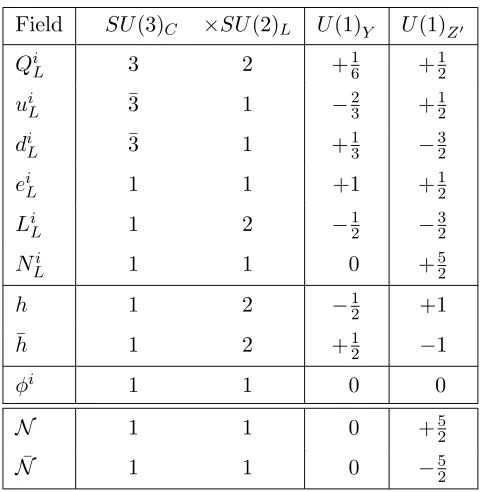
In this case the spectrum contains the MSSM states plus the right–handed neutrinos; a pair of Higgs doublets that break the electroweak symmetry and a pair of Higgs singlets that break theU(1)Z′ symmetry [38]. The full spectrum is displayed in table
1.
Field SU(3)C ×SU(2)L U(1)Y U(1)Z′
Qi
L 3 2 +16 +12
ui
L ¯3 1 −23 +12
di
L ¯3 1 +13 −32
ei
L 1 1 +1 +12
Li
L 1 2 −12 −32
Ni
L 1 1 0 +52
h 1 2 −1
2 +1
¯
h 1 2 +12 −1
φi 1 1 0 0
N 1 1 0 +52
¯
N 1 1 0 −5
[image:11.612.179.421.321.567.2]2
Table 1: Spectrum andSU(3)C×SU(2)L×U(1)Y×U(1)Z′ quantum numbers, withi=
1,2,3 for the three light generations. The charges are displayed in the normalisation used in free fermionic heterotic–string models.
Taking mt ∼ 173GeV; k ∼ 1/3; hN i ∼¯ 3 TeV we note that to accommodate a
3.2
Case ii: high
B
−
L
breaking scale
In this case we assume that the VEV ofN is high, or intermediate. Furthermore, we may assume that hφi ∼ 100GeV, i.e. that this VEV is associated with electroweak symmetry breaking. Then taking hN i ∼¯ 1017GeV gives m
ντ ∼10
−20GeV. Breaking
U(1)Z′ at the high scale therefore naturally produces light neutrino masses, with the
scale of hφi being associated with the electroweak breaking scale. In this case the combination U(1)Z′ in eq. (2.4) remains unbroken. This is possible if and only if
U(1)ζ is anomaly free. As discussed above this necessitates that the chiral states
form complete 27 representations of E6. However, the normalisation of U(1)Z′ may
differ from the standard E6 normalisation, similar to the discussion in relation to
the normalisation of the weak hypercharge [39]. The spectrum of the string inspired model that may keep U(1)Z′ unbroken down to the TeV scale is shown in table 2.
The effective dimension four operators induced from eq. (3.1) are not invariant un-der U(1)Z′. Hence, the dimension four proton decay operators are suppressed as in
the case with a low U(1)Z′ of section 3.1. The caveat is that the spectrum contains
leptoquark representations that arise from the SO(10) vectorial 10 representation, and may mediate rapid proton decay [35]. Additional discrete symmetries are re-quired to guarantee adequate suppression of the dangerous operators. This issue arises generically in string inspired Z′ models with an underlying E
6 symmetry [7],
i.e. in all models in which U(1)ζ forms part of the low scale Z′. We note that this
is not a problem in the model of section 3.1 because there U(1)ζ does not enter into
the combination of the low scale Z′. We note again that the root of the problem is the conflict between adequately suppressing proton decay mediating operators, which favours a low scale U(1)Z′ and the constraint of left–handed neutrino masses, which
works more naturally with U(1)Z′ being broken at a high scale.
3.3
Case iii: Low scale left–right symmetric models
In the LRS models with a low U(1)Z′ breaking the Standard model states are
organ-ised in representations of the low scale gauge symmetry,
SU(3)C ×U(1)C×SU(2)L×SU(2)R (3.5)
In this case theU(1)Z′ combination is identical to the combination given in eq. (2.3).
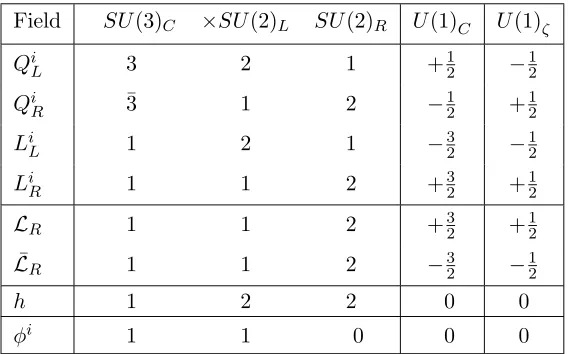
However, in this case additional W′ vector bosons arise. The spectrum of the model is shown in table 3. The dimension four proton decay mediating operators arise from the terms
QLLLQRLRφn and QRQRQRLRφn (3.6)
We note that as U(1)Z′ is broken at a high scale in this scenario both terms can
be generated without the adequate suppression discussed in refs. [27, 40]. However, as in section 3.1 they are adequately suppressed due to the fact thatU(1)Z′ is broken
Field SU(3)C ×SU(2)L U(1)Y U(1)Z′
QiL 3 2 +16 −23
ui
L ¯3 1 −23 − 2 3
diL ¯3 1 +13 −4
3
eiL 1 1 +1 −23
Li
L 1 2 −12 −
4 3
Ni
L 1 1 0 0
Di 3 1 −1
3 +43
¯
Di ¯3 1 +1
3 2
Hi 1 2 −1
2 2
¯
Hi 1 2 +1
2 +43
Si 1 1 0 −10
3
h 1 2 −12 −43
¯
h 1 2 +12 +43
[image:13.612.171.429.137.441.2]φi 1 1 0 0
Table 2: Spectrum andSU(3)C×SU(2)L×U(1)Y×U(1)Z′ quantum numbers, withi=
1,2,3 for the three light generations. The charges are displayed in the normalisation used in free fermionic heterotic–string models.
models only require the existence of the right–handed neutrinos in the spectrum, but not the states from the vectorial 10 representation ofSO(10). However, similar to the case in section 3.1, a Yukawa coupling of the Dirac mass term for the tau neutrino is of the order of the top quark mass and we have to assume the existence of a scale of the order of 1KeV as in section 3.1. This is the case in the LRS string derived model of ref. [17]. An alternative possibility that may be contemplated is that only the mass term of the top quark is generated at cubic order of the superpotential, whereas the coupling of the tau neutrino to the same Higgs bi–doublet is obtained from higher order nonrenormalisable terms. In this case the relation between the top quark and tau neutrino Dirac mass term can be avoided. The tau neutrino Yukawa coupling is equal to that of the tau lepton, where the two relevant mass terms are λtQtLQtRh
and λτLtLLtRh. Therefore up to running effects the tau neutrino Dirac mass term
will be of the order of the tau lepton mass. Taking mτ ∼1.776GeV and assuming a
Field SU(3)C ×SU(2)L SU(2)R U(1)C U(1)ζ
Qi
L 3 2 1 +12 −12
Qi
R ¯3 1 2 −12 +12
Li
L 1 2 1 −32 −12
Li
R 1 1 2 +32 +12
LR 1 1 2 +32 +12
¯
LR 1 1 2 −32 −12
h 1 2 2 0 0
[image:14.612.158.442.139.316.2]φi 1 1 0 0 0
Table 3: Spectrum andSU(3)C×U(1)C×SU(2)L×SU(2)R×U(1)ζ quantum numbers,
with i = 1,2,3 for the three light generations. The charges are displayed in the normalisation used in free fermionic heterotic–string models.
nonrenormalisable terms
LLLLLRLR, (3.7)
due to theU(1)ζ charges in these models, as displayed in table 3. Assuming that the
electrically neutral scalar component ofLR gets a VEV of the order of 3 TeV, we get
a Majorana mass term for the left–handed neutrino of order hN˜i2/M
S, where MS is
a scale of the order of the string scale, MS ∼5×10¹⁷GeV. The effective Majorana
mass for the left–handed neutrinos is then of order 10−1eV. This possibility enables
the breaking of SU(2)R without the additional Higgs fields LR and ¯LR, which is
advantageous for gauge coupling unification [41].
3.4
Case iv: Low scale Pati–Salam models
In the PS models the low energy effective gauge symmetry below the string scale is the SO(10) subgroup SO(6)×SO(4). The possibility of the Pati–Salam symmetry [42] at the TeV scale was discussed in ref. [42, 43]. Similarly to the case of U(1)Z′ and
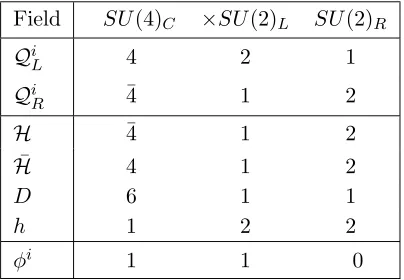
the left–right symmetry models anomaly cancellation only requires the addition of three right–handed neutrinos to the Standard Model states. The vector bosons in this model do not generate Proton decay via dimension six operators. A low scale breaking of the PS symmetry can therefore be considered. The spectrum of the model is shown in table 4.
Field SU(4)C ×SU(2)L SU(2)R
Qi
L 4 2 1
Qi
R ¯4 1 2
H ¯4 1 2
¯
H 4 1 2
D 6 1 1
h 1 2 2
[image:15.612.199.401.140.280.2]φi 1 1 0
Table 4: Spectrum and SU(4)C×SU(2)L×SU(2)Rquantum numbers, with i= 1,2,3
for the three light generations. The charges are displayed in the normalisation used in free fermionic heterotic–string models.
to break the symmetry along supersymmetric flat directions. The dimension four operators are induced from the quartic order terms QLQLQRQR and QRQRQRQR.
With a low breaking of SU(2)R these operators are sufficiently suppressed. The PS
model with a high scale breaking include the (6,1,1) representation to generate mass to the coloured states of the heavy Higgs states, via the couplings ¯HH¯D+HHD. With a low scale breaking these states are not required because an additional pair of heavy Higgs states is not required as the breaking can be implemented along a non flat direction. In this model suppression of left–handed neutrino masses may be obtained by the generations of VEVs of the order of 1keV, similar to the discussion in section 3.1, or may be generated from the quartic order coupling QRQRQRQR as
in section 3.3. We note that the mass structure of the extra vector states in this PS scenario requires elaborate analysis, with the possibility that the charged W′s are relatively light, whereas the neutral U(1)Z′ is comparatively heavy, as is the case in
the Standard Model. These considerations raise the prospect that there will be a need to probe the DecaTev scale and above.
3.5
Case v: Low scale
SU
(4)
×
SU
(2)
×
U
(1)
Lmodels
For completeness we comment on the case withSO(10) broken to theSU(4)×SU(2)×
U(1)Lmodel4. This model was considered in ref. [44] as a field theory extension of the
Standard Model. The field theory model considered in ref. [44] utilise Higgs field in the (15,2,1) representation ofSU(4)×SU(2)×U(1)L, to avoid the relation between
the Dirac mass terms of the top quark and the tau neutrino. The string models do not contain such representations and therefore the only available route to satisfy the neutrino mass constraints is to assumehφi ∼1keV. TheSU(4)×SU(2)×U(1) choice
4
for the SO(10) subgroup of the string model is attractive because it admits both the doublet–triplet splitting mechanism [45] as well as the doublet–doublet splitting mechanism [18]. However, as discussed above, while a field theory model consistent with the phenomenological constraints can be constructed [18], it was shown in ref. [18] that such string models are not viable because it is not possible to form complete families. This demonstrates that the string constructions are more restrictive than the field theory constructions. This is anticipated as the string framework consistently incorporates gravity into the construction. An alternative method to produceSU(4)× SU(2)×U(1) three generation vacua is by enhancement of the NS–gauge group from additional sectors [12, 46].
3.6
Case vi: Leptophobic
Z
′and custodial
SU
(2)
s
Finally, we comment briefly on the possibility of generating leptophobic Z′ [46] and custodial SU(2) symmetries [12] in the free fermionic heterotic–string models. As mentioned in section 3.5 the gauge group arising from the NS–sector may be enhanced by space–time vector bosons that are obtained from additional sectors in the additive group. Examples of such three generation string models were presented in refs. [12, 17, 46]. In these models the three generations still arise from the sectors b1,2,3 and
hence descend from the spinorial 16 representations of SO(10), but they transform in representations of the enhanced gauge symmetry. LeptophobicU(1)s are obtained when U(1)B−L combines with the a universal combination of the horizontal flavour
symmetries to cancel out the lepton number and produce a gauged U(1)B [46]. We
note that in the custodial SU(2) model only the lepton transforms as doublets of SU(2)C [12]. Hence, the model will have distinct signature compared to the LRS
models of section 3.3. Namely, the additional W′ vector bosons couple to leptons but not to the hadrons, whereas a leptophobic Z′ [46] couples to hadrons but not to leptons.
4
Prospects at the LHC
In this section we illustrate LHC prospects for a hypothetical phenomenological sce-nario of a low scale heterotic-string derived Z′, based on the high B-L breaking scale model of section 3.2. In particular, we show the LHC 8 TeV Drell-Yan (DY) invariant mass distribution at the next-to-next-to leading order (NNLO) in the QCD strong coupling constant (O(α2
s)) [47], for the production of aZ′ with mass MZ′ = 3 TeV.
and no significant deviations from the SM prediction have been observed in the mass range explored. However, data at large invariant mass are still affected by large uncertainties due to systematical, statistical and luminosity errors.
The uncertainty associated to scale variation of the NNLO QCD theory prediction amounts to a few percent, while that associated to the parton distribution functions (PDFs) luminosity is larger than 15%, especially in the large invariant mass region. In this kinematic region PDFs are probed at large x, where they are in general not well constrained. This has a significant impact on the parton luminosity uncertainties as they are the major source of uncertainty and represent a limiting factor to obtain precise predictions for the production of high-mass dilepton resonances.
LHC run-II will allow us to measure this and other differential observables with higher precision in the high-mass region, and thus will confirm or rule out the exis-tence of extra Z′s in the mass range of a few TeV’s.
4.1
Details of the calculation
In this section we briefly describe the details of the calculation and the choice of the parameter space. Electroweak corrections [50–55] are not included here, a more thorough analysis exploiting other differential observables [56, 57] is left for future studies.
The theory is calculated by using an amended version of CandiaDY [58, 59], a
program that calculates the DY invariant mass distribution up to NNLO in QCD for a large variety of Z′ string derived models. The full spin correlations as well as the γ∗/Z/Z′ interference effects are included in this calculation. The charge assignment is that of the high B−L breaking scale model described in Sec. 3.2 and is given in table 2. Furthermore, we have chosen tanβ = 10, the Z′ coupling constant g
z equal
to the hypercharge gY, andMZ′ = 3 TeV.
The colour-averaged inclusive differential cross section is given by
dσ
dM2 =τ σV(M 2, M2
V)WV(τ, M2) τ =
M2
S , (4.1)
where (V =Z, Z′), and all the hadronic initial state information is contained in the hadronic structure function which is defined as
WV(τ, M2) = X
i,j Z 1
0
dx1
Z 1
0
dx2
Z 1
0
dxδ(τ −xx1x2)LVi,j(x1, x2, µ
2
F)∆i,j(x, M2, µ2F).
(4.2)
The contribution WV takes into account all the initial state emissions of real gluons
and all the virtual corrections, while σV is the point-like cross section. The parton
the initial state, while the hard scattering contributions, denoted by ∆i,j(x, M2, µ2F),
can be perturbatively expanded in terms of the strong coupling constant αs(µ2R)
∆i,j(x, M2, µ2F) =
∞
X n=0
αns(µ2R)∆
(n)
i,j(x, M2, µF, µ2R). (4.3)
µF and µR are the factorization and renormalization scales respectively, while the
invariant mass of the dilepton pair is denoted by M.
We strictly follow the notation introduced in Ref. [58] and here we briefly recall the main definitions. The fermion-fermion-Z′ interaction is given by
X
f
zfgzf γ¯ µf Zµ′, (4.4)
where f = ejR, ljL, uRj, djR, qLj and qjL = (ujL, djL) , ljL = (νLj, ejL). The coefficients zu, zd
are the charges of the right-handed up and down quarks, respectively, while the zq
coefficients are the charges of the left-handed quarks.
The masses of the neutral gauge bosons are parametrized in terms of the charges and vev’s of the higgs sector as
ε= δM
2
ZZ′
M2
Z′ −MZ2
MZ2 = g
2
4 cos2θ
W
(vH21 +v
2
H2)
1 +O(ε2)
MZ2′ =
g2
z
4(z
2
H1v
2
H1 +z
2
H2v
2
H2 +z
2
φvφ2)
1 +O(ε2)
δMZZ2 ′ =−
ggz
4 cosθW
(zH21v
2
H1 +z
2
H2v
2
H2), (4.5)
where ε is defined as a perturbative parameter, and where g = e/sinθW gY =
e/cosθW. The interaction Lagrangian for the quarks and the leptons is written
as
Lint = ¯QjLNLZγ µ
QjLZµ+ ¯QjLNZ
′
L γ µ
QjLZµ′ + ¯u j RN
Z u,Rγ
µ
ujRZµ
+ ¯djRNZ d,Rγ
µdj
RZµ+ ¯ujRN Z′
u,Rγ µuj
RZ
′
µ+ ¯d j RN
Z′
d,Rγ µdj
RZ
′
µ
+ ¯QjLNLγγµQj
LAµ+ ¯ujRN γ u,Rγ
µuj
RAµ+ ¯djRN γ d,Rγ
µdj RAµ
+¯lLjNLγγµlj
LAµ+ ¯e j RN
γ e,Rγ
µej RAµ
+¯lLjN Z L,lepγ
µ
ljLZµ+ ¯ljLN Z′
L,lepγ µ
lLjZ
′
µ
+¯ejRNZ e,Rγµe
j
RZµ+ ¯ejRN Z′
e,Rγµe j RZ
′
10-10 10-9 10-8 10-7 10-6
2200 2400 2600 2800 3000 3200 3400
d
σ
/dM [pb/GeV]
M [GeV] LHC 8 TeV, MZ' = 3 TeV
SM Heterotic-string 0.8 0.85 0.9 0.95 1 1.05 1.1 1.15 1.2
1000 1200 1400 1600 1800 2000
Normalized to SM
M [GeV] LHC 8 TeV, MZ' = 3 TeV
[image:19.612.95.488.132.274.2](Heterotic-string)/SM SM
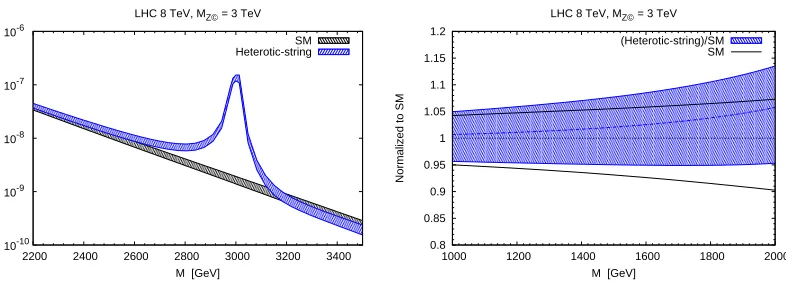
Figure 1: Left: LHC 8 TeV DY invariant mass distribution at NNLO for a case ii) high B−L breaking scale Z′. M
Z′ = 3 TeV, tanβ = 10, and Z′ coupling gz =gY.
Hatched bands represent PDFs + scale uncertainties added in quadrature. Right: same as in Left, but normalized to the SM.
where left-handed (L) and right-handed (R) couplings for the quarks are
NLZ,j =−i gcosθWT3L−gY sinθW
ˆ YL
2 +gzε ˆ zL
2
!
NLZ′,j =−i −gcosθWT3Lε+gY sinθW
ˆ YL
2 ε+gz ˆ zL
2
!
NZ
u,R =−i −gY sinθW
ˆ Yu,R
2 +gzε ˆ zu,R
2
!
NZ
d,R =−i −gY sinθW
ˆ Yd,R
2 +gzε ˆ zd,R
2
!
. (4.7)
Similar expressions can be written for the leptons.
The main phenomenological results for the high B−L breaking scale model are illustrated in Fig. 1. The left figure shows the Z′ invariant mass distribution (blue) compared to the SM (black) while, in the right figure, the same prediction is normal-ized to that of the SM in the 1 to 2 TeV mass range. Bands with different hatch-ing represent the sum in quadrature of the uncertainty relative to the CT14NNLO PDFs [60] rescaled to the 68% C.L., plus the uncertainty associated to independent variations of the µF and µR scales. Different choices for the PDFs, obtained from
the two uncertainty bands. The decay width of the Z′ predicted by this model is ΓZ′ = 8.76 GeV that is more than three times larger than that of the SM Z0.
5
Conclusions
In this paper we surveyed the possibility of low scale Z′s andW′s in three generation heterotic–string vacua. The semi–realistic free fermionic models produce the Stan-dard Model spectrum and the necessary Higgs states for viable symmetry breaking and fermion mass generation. The models possess theSO(10) embedding of the Stan-dard Model state and the SO(10) normalisation of the weak–hypercharge. Hence, they can reproduce viable values of sin2θW(MZ) andαs(MZ). These are the first
or-der criteria that a viable string vacuum should possess. The next major constraints on the string models are proton stability and suppression of left–handed neutrino masses. These two constraints are in tension because on the one hand proton stabil-ity prefers a low scaleU(1)Z′ breaking, whereas suppression of neutrino masses works
more naturally with a high scale U(1)Z′ breaking. As we discussed in section 3.1 low
scale U(1)Z′ breaking requires the introduction of the ad hoc VEV hφi ∼1keV. The
alternativeZ′ discussed in section 3.2 uses a high scaleU(1)
Z′ breaking but anomaly
cancellation necessitates the augmentation of the spectrum into complete 27 multi-plets, potentially generating new proton decay operators. We further remark that while field theory models allow much more model building freedom, the straitjacket imposed by synthesising the Standard Model with gravity in the framework of string theory is by far more restrictive.
Each of the cases discussed in section 3 has a distinct signature. Case I in section 3.1 has an additional Z′ but no additional states charged under the Standard Model, with the only additional particles being the three right–handed neutrinos. Case II of section 3.2 requires the existence of additional colour triplets and electroweak doublets in the vicinity of the Z′ breaking scale. Case III of the left–right symmetric models of section 3.3 contains W′s in addition to Z′. Similarly, case IV of section 3.4 gives rise to additional vector bosons from theSU(4), andSU(2)Rgroup factors.
Case V in section 3.5 produces theSU(4) vector bosons but not theSU(2)R. Finally,
in the models of case IV with a leptophobic Z′ or custodial SU(2) the additional vector bosons couple to either the quarks or the leptons but not to both.
For case II of section 3.2 we studied the NNLO Drell-Yan invariant mass distri-bution at the LHC 8 TeV for aZ′ with mass M
Z′ = 3 TeV, and estimated the main
sources of uncertainty in the QCD theory prediction. The uncertainty associated to the partonic content of the proton is the dominant one and is a limiting factor for precision at the present time.
bosons at the LHC will restrict the exploration of string vacua, and will elevate the utility of high-energy dilepton pair production at hadron colliders.
Acknowledgments
AEF thanks theoretical physics groups at CERN and Oxford University for hospi-tality. This work was supported in part by the STFC (ST/L000431/1) and by the Lancaster-Manchester-Sheffield Consortium for Fundamental Physics under STFC grant ST/L000520/1.
References
[1] H. Kawai, D.C. Lewellen, and S.H.-H. Tye, Nucl. Phys.B288 (1987) 1; I. Antoniadis, C. Bachas, and C. Kounnas, Nucl. Phys.B289 (1987) 87; I. Antoniadis and C. Bachas, Nucl. Phys. B298(1987) 586.
[2] D.J. Gross, J.A. Harvey, E.J. Martinec and R. Rohm, Nucl. Phys. B267(1986) 75.
[3] G. Aadet al. [ATLAS Collaboration], arXiv:1506.00962.
[4] V. Khachatryan et al. [CMS Collaboration], JHEP 1408, (2014) 173, arXiv:1405.1994.
[5] V. Khachatryan et al. [CMS Collaboration], JHEP 1408, (2014) 174, arXiv:1405.3447.
[6] B.A. Dobrescu and Z . Liu, arXiv:1506:06736; arXiv:1507:01923
K. Cheung, W.Y. Keung, P.Y. Tseng and T.C. Yuan, arXiv:1506:06064; J.A. Aguilar–Saavedra, arXiv:1506.06739;
A. Thamm, R. Torre and A. Wulzer, arXiv:1506:08688;
J. Brehmer, J. Hewett, J. Kopp, T. Rizzo and J. Tattersall, arXiv:1507.00013; G. Cacciapaglia and M.T. Frandsen, arXiv:1507.00900;
Q.H. Cao, B. Yan and D.M. Zhang, arXiv:1507.00268;
T. Abe, R. Nagai, S. Okawa and M. Tanabashi, arXiv:1507.01185; B.C. Allanach, B. Gripaios and D. Sutherland, arXiv:1507.01638; A. Carmona, A. Delgado, M. Quiros and J. Santiago, arXiv:1507.01914; T. Abe, T. Kitahara and M. M. Nojiri, arXiv:1507.01681;
G. Cacciapaglia, A. Deandrea and M. Hashimoto, arXiv:1507.03098; V. Sanz, arXiv:1507.03553;
C.H. Chen and T. Nomura, arXiv:1507.04431; W. Chao, arXiv:1507.05310;
L. Bian, D. Liu and J. Shu, arXiv:1507.06018; J. Hisano, N. Nagata, Y. Omura, arXiv:1506.03931; Y. Omura, K. Tobe, K. Tsumura, arXiv:1507.05028;
Y. Gao, T. Ghosh, K. Sinha and J. H. Yu, arXiv:1506.07511; A. Alves, A. Berlin, S. Profumo, arXiv:1506.06767;
S. Patra, F.S. Queiroz, W. Rodejohann, arXiv:1506.03456;
H.S. Fukano, M. Kurachi, S. Matsuzaki, K. Terashi, K. Yamawaki, arXiv:1506.03751;
H.S. Fukano, S. Matsuzaki, K. Yamawaki, arXiv:1507.03428;
C.W. Chiang, H. Fukuda, K. Harigaya, M. Ibe, T.T. Yanagida, arXiv:1507.02483.
[7] G. Costa, J.R. Ellis, G.L. Fogli, D.V. Nanopoulos and F. Zwirner, Nucl. Phys.
B297(1988) 244;
F. Zwirner, Int. J. Mod. Phys. A3 (1988) 49;
J.L. Hewett, T.G. Rizzo, Phys. Rep.183 (1989) 193;
Y. Y. Komachenko and M. Y. Khlopov,Sov. J. Nucl. Phys. 51(1990) 692; Yad. Fiz. 51 (1990) 1081;
G. Cleaver, M. Cvetic, J.R. Espinosa, L.L. Everett and P. Langacker, Phys. Rev.
D57 (1998) 2701;
A. Leike, Phys. Rep.317 (1999) 143;
S.F. King, S. Moretti, R. Nevzorov, Phys. Rev.D73(2006) 035009; P. Langacker, Rev. Mod. Phys. 81 (2009) 1199;
P. Athron, S.F. King, D.J. Miller, S. Moretti and R. Nevzorov, Phys. Rev. D80 (2009) 035009;
M. Ambroso and B.A. Ovrut,Int. J. Mod. Phys. A26 (2011) 1569; A. Belyaev, S.F. King and P. Svantesson, arXiv:1303.0770 [hep-ph].
[8] A.E. Faraggi and J. Rizos,Nucl. Phys. B895(2015) 233.
[9] L.E. Ibanez, J.E. Kim, H.P. Nilles and F. Quevedo, Phys. Lett. B191 (1987) 282;
D. Bailin, A. Love and S. Thomas, Phys. Lett. B194 (1987) 385; T. Kobayashi, S. Raby and R. J. Zhang,Nucl. Phys. B704(2005) 3; O. Lebedev et al, Phys. Lett. B645 (2007) 88;
M. Blaszczyk et al, Phys. Lett. B683 (2010) 340.
[10] A.E. Faraggi,Phys. Lett. B326(1994) 62; Phys. Lett. B544 (2002) 207; E. Kiritsis and C. Kounnas, Nucl. Phys.B503 (1997) 117;
A.E. Faraggi, S. Forste and C. Timirgaziu, JHEP 0608, (2006) 057.
[11] A.E. Faraggi and D.V. Nanopoulos, Phys. Rev. D48(1993) 3288.
[13] I. Antoniadis, J. Ellis, J. Hagelin and D.V. NanopoulosPhys. Lett.B231(1989) 65.
[14] A.E. Faraggi, D.V. Nanopoulos and K. Yuan,Nucl. Phys. B335(1990) 347; G.B. Cleaver, A.E. Faraggi and D.V. Nanopoulos,Phys. Lett.B455(1999) 135.
[15] A.E. Faraggi,Phys. Lett. B278(1992) 131; Nucl. Phys.B387 (1992) 239.
[16] I. Antoniadis, G.K. Leontaris and J. Rizos, Phys. Lett. B245(1990) 161; G.K. Leontaris and J. Rizos, Nucl. Phys.B554 (1999) 3;
K. Christodoulides, A.E. Faraggi and J. Rizos, Phys. Lett. B702 (2011) 81.
[17] G.B. Cleaver, A.E. Faraggi and C. Savage, Phys. Rev.D63 (2001) 066001; G.B. Cleaver, D.J. Clements and A.E. Faraggi Phys. Rev.D65 (2002) 106003.
[18] G.B. Cleaver, A.E. Faraggi and S.E.M. Nooij, Nucl. Phys.B672 (2003) 64; A.E. Faraggi and H. Sonmez, Phys. Rev.D91 (2015) 066006;
H. Sonmez, arXiv:1503.01193.
[19] G.B. Cleaver and A.E. Faraggi,Int. J. Mod. Phys. A14 (1999) 2335.
[20] M. Dine, N. Seiberg and E. Witten, Nucl. Phys.B289 (1987) 589; J.J. Atick, L.J. Dixon and A. Sen, Phys. Rev.D292 (1987) 109.
[21] A.E. Faraggi and V.M. Mehta, Phys. Rev.D84(2011) 086006;Phys. Rev.D88 (2013) 025006.
[22] P. Athanasopoulos, A.E. Faraggi and V. Mehta, Phys. Rev.D89(2014) 105023.
[23] A.E. Faraggi, C. Kounnas, S.E.M. Nooij and J. Rizos,Nucl. Phys. B695(2004) 41;
A.E. Faraggi, C. Kounnas and J. Rizos, Phys. Lett. B648 (2007) 84; B. Assel et al, Phys. Lett. B683 (2010) 306;Nucl. Phys. B844(2011) 365.
[24] A.E. Faraggi, C. Kounnas and J. Rizos, Nucl. Phys.B774 (2007) 208; C. Angelantonj, A.E. Faraggi and M. Tsulaia, JHEP 1007, (2010) 004;
A.E. Faraggi, I. Florakis, T. Mohaupt and M. Tsulaia,Nucl. Phys.B848(2011) 332.
[25] G.B. Cleaver, A.E. Faraggi, D.V. Nanopoulos and T. ter Veldhuis, Mod. Phys. Lett. A16 (2001) 3565.
[26] J. Pati,Phys. Lett. B388(1996) 532.
[27] A.E. Faraggi,Phys. Lett. B499(2001) 147.
[29] B. Holdom, Phys. Lett. B166 (1986) 196;
K.R. Dienes, C.F. Kolda and J. March–Russell, Nucl. Phys. B492(1997) 104; S.A. Abel, M.D. Goodsell, J. Jaeckel, V.V. Khoze and A. Ringwald, JHEP0807, (2008) 124;
M. Goodsell, S. Ramos–Sanchez and A. Ringwald, JHEP 1201, (2012) 021.
[30] A.E. Faraggi, J. Rizos and H. Sonmez, Nucl. Phys.B886(2014) 202.
[31] A.E. Faraggi, E. Manno and C. Timirgaziu, Eur. Phys. Jour. C50 (2007) 701.
[32] G.B. Cleaver, A.E. Faraggi, E. Manno and C. Timirgaziu,Phys. Rev.D78(2008) 046009.
[33] M. Blaszczyk, S. Groot Nibbelink, O. Loukas and S. Ramos-Sanchez, JHEP 1410, (2014) 119;
J.M Ashfaque, P. Athanasopoulos, A.E. Faraggi and H. Sonmez, arXiv:1506.03114;
M. Blaszczyk, S. G. Nibbelink, O. Loukas and F. Ruehle, arXiv:1507.06147.
[34] A.E. Faraggi,Phys. Rev. D46(1992) 3204;
C. Coriano, S. Chang and A.E. Faraggi, Nucl. Phys. B477(1996) 65.
[35] A.E. Faraggi,Nucl. Phys. B403(1993) 101; Nucl. Phys.B428 (1994) 111.
[36] A.E. Faraggi,Phys. Lett. B245(1990) 435.
[37] A.E. Faraggi and E. Halyo, Phys. Lett. B307(1993) 311; C. Coriano and A.E. Faraggi,Phys. Lett. B581 (2004) 99.
[38] A.E. Faraggi and D.V. Nanopoulos, Mod. Phys. Lett. A6 (1991) 61.
[39] L. Ibanez, Phys. Lett. B318(1993) 73;
K.R. Dienes, A.E. Faraggi and J. March-Russell, Nucl. Phys. B267(1996) 44.
[40] C. Coriano, A.E. Faraggi and M. Guzzi, Eur. Phys. Jour. C53(2008) 421.
[41] A.E. Faraggi,Phys. Lett. B302(1993) 202;
K.R. Dienes and A.E. Faraggi, Nucl. Phys. B457(1995) 409.
[42] J. Pati and A. Salam, Phys. Rev. D10(1974) 275.
[43] A. Kuznetsov and M. Mikheev, Phys. Lett. B329(1994) 295; G. Valencia and S. Willenbrock, Phys. Rev. D50(1994) 6843; R.R. Volkas, Phys. Rev.D53 (1996) 2681;
R. Foot,Phys. Lett. B420(1998) 333.
[45] A.E. Faraggi,Phys. Lett. B520(2001) 337.
[46] A.E. Faraggi and M. Masip, Phys. Lett. B388(1996) 524; A.E. Faraggi and V. Mehta, Phys. Lett. B703 (2011) 025006.
[47] R. Hamberg, W.L. Van Neerven, T. Matsuura, Nucl. Phys. B359(1991) 343
[48] The ATLAS Collaboration, Phys. Lett. B725 (2013) 223, arXiv:1305.4192
[49] The CMS Collaboration, Eur. Phys. Jour. C75 (2015) 147, arXiv:1412.1115
[50] G. Balossini, C.M. Carloni Calame, G. Montagna, M. Moretti, O. Nicrosini, F. Piccinini, M. Treccani, and A. Vicini Proceedings, Workshop on Monte Carlo’s, Physics and Simulations at the LHC. Part II 2006, 78
[51] G. Balossini, G. Montagna, C.M. Carloni Calame, M. Moretti, M. Trec-cani, O. Nicrosini, F. Piccinini, A. Vicini, Acta Phys. Polon. B39 2008, arXiv:0805.1129
[52] U. Baur, O. Brein, W. Hollik, C. Schappacher, and D. Wackeroth, Phys. Rev.
D65 (2002) 033007, hep-ph/0108274
[53] V.A. Zykunov, Phys. Rev.D75 (2007) 073019, hep-ph/0509315
[54] C.M. Carloni Calame, G. Montagna, O. Nicrosini, A. Vicini, JHEP 10, (2007) 109, arXiv:0710.1722
[55] A. Arbuzov, D. Bardin, S. Bondarenko, P. Christova, L. Kalinovskaya, G. Nanava, R. Sadykov, Eur. Phys. Jour.C54 (2008) 451
[56] R. Gavin, Y. Li, F. Petriello, S. Quackenbush, Comput.Phys.Commun. 184 (2013) 208, arXiv:1201.5896
[57] Y. Li, F. Petriello, Phys. Rev.D86(2012) 094034, arXiv:1208.5967
[58] C. Corian`o, A.E. Faraggi and M. Guzzi, Phys. Rev.D78 (2008) 015012
[59] A. Cafarella, C. Corian`o, M. Guzzi JHEP 08, (2007) 030, hep-ph/0702244
[60] S. Dulat, Sayipjamal,T.-J. Hou, J. Gao, M. Guzzi, J. Huston,P. Nadol-sky,J. Pumplin, C. Schmidt, D. Stump, C.-P. Yuan, arXiv:1506.07443
[61] The NNPDF Collaboration JHEP 1504, (2015) 040 arXiv:1410.8849
[62] L.A. Harland-Lang, A.D. Martin, P. Motylinski, R.S. Thorne, Eur. Phys. Jour.
C75 (2015) 204, arXiv:1412.3989