DEVELOPMENT AND VALIDATION OF NEW RP-HPLC
METHOD FOR THE ASSAY OF NEVIRAPINE AND ITS
RELATED SUBSTANCES IN TABLET DOSAGE FORM
Dissertation submitted to
THE TAMILNADU Dr. M. G. R. MEDICAL UNIVERSITY,
CHENNAI
in partial fulfillment for the award of the degree of
MASTER OF PHARMACY
IN
PHARMACEUTICAL ANALYSIS
DEPARTMENT OF PHARMACEUTICAL ANALYSIS
K. M. COLLEGE OF PHARMACY
UTHANGUDI, MADURAI – 625107
APRIL - 2012
CERTIFICATE
This is to certify that the dissertation entitled “DEVELOPMENT AND
VALIDATION OF NEW RP-HPLC METHOD FOR THE ASSAY OF NEVIRAPINE AND ITS RELATED SUBSTANCES IN TABLET DOSAGE
FORM” submitted by Mr. SOMAVEL. G (Reg. No: 26101728) in partial
fulfillment of the degree of Master of Pharmacy in Pharmaceutical Analysis,
K. M. COLLEGE OF PHARMACY, Madurai – 625107 under THE TAMILNADU DR. M. G. R. MEDICAL UNIVERSITY, Chennai, carried
out in EDICT PHARMACEUTICALS,Chennai.
It is a bonafide work carried out by him under my guidance and
supervision during the academic year 2011 – 2012. This dissertation partially or
fully has not been submitted for any other degree or diploma of this University or any
other Universities.
GUIDE & HOD
Dr. S. MEENA,M. Pharm., Ph. D.,
Professor and Head,
Dept. of Pharmaceutical Analysis, K. M. College of Pharmacy, Uthangudi, Madurai - 625107.
PRINCIPAL
Dr. S. JAYAPRAKASH, M. Pharm., Ph.D.,
Professor and Head, Dept. of Pharmaceutics, K. M. College of Pharmacy, Uthangudi, Madurai - 625107.
ACKNOWLEDGEMENT
“The expressivity of words loses significance when we search for an
appealing sentence of gratitude and obligation, since acknowledgement is
the only part of Dissertation which lacks guidance”
I take this privilege and pleasure to acknowledge the contributions of
many individuals who have been inspirational and supportive throughout my
work undertaken and endowed me with the most precious knowledge to see
success in my endeavour. My work bears the imprint of all those people, we are
grateful to.
I express my wholehearted gratitude to my esteemed teacher and guide,
Dr. S. Meena, M.Pharm., Ph.D., HOD, Dept. of Pharmaceutical Analysis, K. M.
College Of Pharmacy,
for her zealous guidance, indefatigable support and
constant encouragement for the entire period of my thesis work.
At the outset, I express my deep heartfelt and sincere thanks to
Mr. A.
Dinesh, AR&D Head, Edict Pharmaceuticals, Chennai,
for allowing me to
accomplish the project work. He was there always his enthusiastic suggestion,
despite of his extremely busy schedule. His work always inspired me to think beyond
what I could and encourage me to depute maximum efforts into my work.
College of Pharmacy, Madurai for his invaluable advice, suggestion and
encouragement extended throughout the work.
I owe my great debt of gratitude and heartful thanks to Prof. M.
Nagarajan, M.Pharm., M.B.A, DMS (IM), DMS (BM) Correspondent, K. M.
College of Pharmacy, Madurai for providing me with all the facilities and
encouragement for the successful completion of my thesis work.
I express my deep sincere thanks to Dr. S. Jayaprakash,
M.Pharm.,
Ph.D., Principal and H.O.D, Dept. of Pharmaceutics, for his timely
instigation and immeasurable esteemed help to complete this thesis.
I would like to extend my appreciation to
Dr. A. J. M Christina,
M.Pharm., Ph.D.,
Ex-Principal, K.M. College of Pharmacy, for her suggestion and
inspiration during the study.
My sincere thanks goes to Dr. M. Sundarapandian, M.Pharm., Ph.D.,
Assistant Prof. Dept. of Pharmaceutical Analysis and Mr. M. Boopathi,
M.Pharm., Ph.D., Lecturer, Dept. of Pharmaceutical Analysis, K. M. College
of Pharmacy, Madurai, for their valuable help and support for my work.
It would be my pleasure to put on record my sincere and heartful thanks to
Prof. K. V. Ramaseshu, M.Sc., Biochemistry, HOD, Dept. of Bio-Chemistry, K. M.
College of Pharmacy for allowing me to pursue my project as well as for
encouragement during the course of this study.
I also wish to express my gratitude to
Mrs. M. Shanthi, B. A , M. Li.Sc,
M.Phil, Librarian,
Mrs. Angelo Marina and Mr. Karthikeyan, B.C.A Computer
Department, K.M. College of Pharmacy, for their kind co-operation in my
dissertation work.
I cannot forget to express my gratitude to all my lovable hearts
Kinnera, Jothibasu, Princy prasanna, Rajaram, Kirankumar, Sravani,
Ravikishore, mallikarjuna, jegadeshwaran who helped me directly for the
successful completion of my project work.
Words are inadequate to express my deep sense of gratitude to my friends
Sakthivel
,Natraj, Jeeva, Kumaran, Loganathan, Selvaganesh and all my
colleagues
for their kind cooperation in my dissertation work.
Last but not least,
I thank the GOD and My Beloved Family for
showering their blessings for the completion of my thesis work.
My parents deserve special mention for their inseparable support and
prayers. I am greatly indebted to them for their love, encouragement and
inspirations which have been inexhaustible source of support and strength.
Somavel.
G
CONTENTS
CHAPTER NO. NAME OF THE CHAPTER PAGE NO.
1.
Introduction
1
2.
Drug
Profile
15
3.
Literature Review
18
4.
Aim and Plan of Work
34
5. Instruments
and
Materials
35
6.
Method
Development
for
- Assay
36
-
Related
Substances
40
7.
Method
Validation
for
Assay
46
8.
Method
Validation
for
Related
Substances
67
9.
Results
and
Discussion
82
10.
Summary
and
Conclusion
86
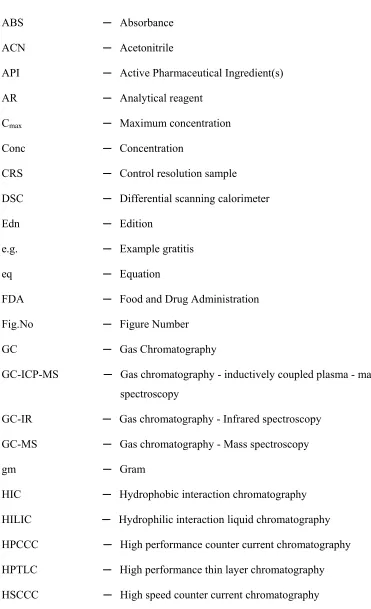
ABBREVIATIONS
ABS ─ Absorbance
ACN ─ Acetonitrile
API ─ Active Pharmaceutical Ingredient(s)
AR ─ Analytical reagent
Cmax ─ Maximum concentration
Conc ─ Concentration
CRS ─ Control resolution sample
DSC ─ Differential scanning calorimeter
Edn ─ Edition
e.g. ─ Example gratitis
eq ─ Equation
[image:8.612.126.497.110.719.2]FDA ─ Food and Drug Administration
Fig.No ─ Figure Number
GC ─ Gas Chromatography
GC-ICP-MS ─ Gas chromatography - inductively coupled plasma - mass spectroscopy
GC-IR ─ Gas chromatography - Infrared spectroscopy
GC-MS ─ Gas chromatography - Mass spectroscopy
gm ─ Gram
HIC ─ Hydrophobic interaction chromatography
HILIC ─ Hydrophilic interaction liquid chromatography
HPCCC ─ High performance counter current chromatography
HPTLC ─ High performance thin layer chromatography
ICH ─ International Conference on Harmonization
ICP-MS ─ Inductively coupled plasma-Mass spectroscopy
Imp ─ Impurity
Inj ─ Injection
IS ─ Internal standard
ISBN ─ International standard book number
LC-MS ─ Liquid chromatography - Mass spectroscopy
LC-NMR ─ Liquid chromatography - Nuclear mass resonance
spectroscopy
LOD ─ Limit of Detection
LOQ ─ Limit of Quantitation
M ─ Molar
Max ─ Maximum
mg ─ Milligram
min ─ Minute
mL ─ Millilitre
mM ─ Millimolar
NA ─ Not Applicable
nm ─ Nanometer
NMT ─ Not More Than
NPC ─ Normal phase chromatography
NVP ─ Nevirapine
ODS ─ Octa decyl silane
PDA ─ Photodiode array
PI ─ Protease inhibitors
RP-HPLC ─ Reverse phase high performance liquid chromatography
RS ─ Reference standard
RSD ─ Relative standard deviation
Rt ─ Retention time
S.No ─ Serial number
SD ─ Standard deviation
SFC ─ Supercritical fluid chromatography
STD ─ Standard
TGA ─ Thermo gravimetric analysis
TLC ─ Thin layer chromatography
UPLC ─ Ultra performance liquid chromatography
UV ─ Ultraviolet
tmax ─ Maximum time
οC ─ Degree centigrade
% ─ Percentage
µ ─ Micron
µg ─ Microgram
µm ─ Micrometer
θp ─ Purity angle
θth ─ Purity threshold
1. INTRODUCTION
Pharmaceutical analytical chemistry is concerned with the identification of a substance, the elucidation of its structure and quantitative analysis of its composition. It is an interdisciplinary branch of science which deals with various disciplines of chemistry such as inorganic, organic, physical, industrial and biochemistry. It also finds extensive application in environmental science, agricultural science and clinical chemistry, solid state research and electronics, oceanography, forensic science and space research. The scope of analytical chemistry is very broad and embraces a wide range of manual, chemical and instrumental techniques. [1]
Pharmaceutical analyst in research and development (R&D) of pharma industry plays a very comprehensive role in new drug development and follow up activities to ensure that, a new drug product meets the established standards, its stability and continued to meet quality throughout its shelf life.
The different activity of R&D includes drug development, (synthesis and manufacture), formulation, clinical trials, evaluation and finally launching i.e., finished products. Closely associated with these processes are regulatory and quality assurance functions.
1.1 CLASSIFICATION OF ANALYTICAL TECHNIQUES
The discipline involves qualitative analysis and quantitative analysis
¾ Qualitative Analysis: deals with identification of the substance [2]
¾ Quantitative analysis: deals with determination of amount of constituent
present.
The applied science of analytical chemistry is instrumental analysis, which involves the study of theoretical principle of various instrumental methods.
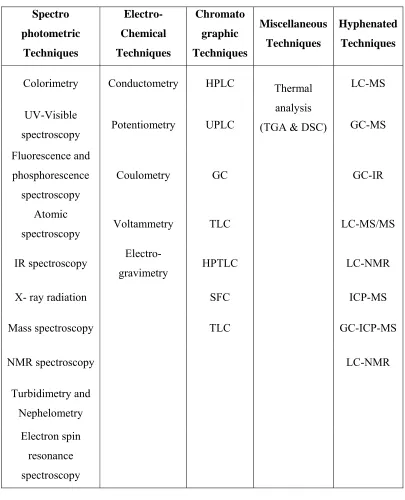
The instrumental methods can be categorized into five techniques are tabulated in table no. 1 as follows [3]
Table No: 1 Classification of instrumental analytical methods Spectro
photometric Techniques
Electro- Chemical Techniques
Chromato graphic Techniques
Miscellaneous Techniques
Hyphenated Techniques
Colorimetry Conductometry HPLC Thermal analysis (TGA & DSC)
LC-MS
UV-Visible
spectroscopy Potentiometry UPLC GC-MS
Fluorescence and phosphorescence
spectroscopy
Coulometry GC GC-IR
Atomic
spectroscopy Voltammetry TLC LC-MS/MS
IR spectroscopy
Electro-gravimetry HPTLC LC-NMR
X- ray radiation SFC ICP-MS
Mass spectroscopy TLC GC-ICP-MS
NMR spectroscopy LC-NMR
Turbidimetry and Nephelometry
1.2 CHROMATOGRAPHY
Chromatography is a technique in which solutes are resolved by differential rates of elution as they pass through a chromatographic column. Chromatography is essentially a group of techniques for the separation of the compounds of mixtures by their continuous distribution between two phases, one of which moves relative to the other. [4]
History:
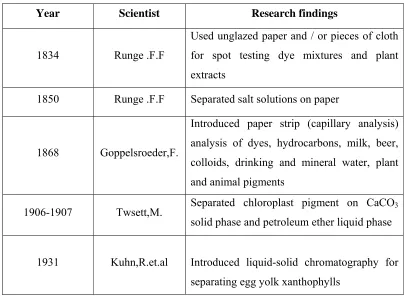
[image:13.612.120.527.376.672.2]Many publications have discussed or detailed the history and development of chromatography. Table No.2 lists the chronological order of the events that are the most notable in the development of the present state of the field. Since the various types of chromatography (liquid, gas, paper, thin-layer, ion exchange, supercritical fluid, and electrophoresis) have many features in common, they must all be considered in development of the field. [5]
Table No: 2 Development of the chromatography
Year Scientist Research findings
1834 Runge .F.F
Used unglazed paper and / or pieces of cloth for spot testing dye mixtures and plant extracts
1850 Runge .F.F Separated salt solutions on paper
1868 Goppelsroeder,F.
Introduced paper strip (capillary analysis) analysis of dyes, hydrocarbons, milk, beer, colloids, drinking and mineral water, plant and animal pigments
1906-1907 Twsett,M. Separated chloroplast pigment on CaCO3
solid phase and petroleum ether liquid phase
1931 Kuhn,R.et.al Introduced liquid-solid chromatography for
1940 Wilson,J.N
Wrote first theoretical paper on chromatography: assumed complete equilibration and linear sorption isotherms, qualitatively defined diffusion, rate of adsorption, and isotherm non linearity
1941 Tiselius,A.
Developed liquid chromatography and pointed out frontal analysis, elution analysis, and displacement development
1944
Consden, R.,Gordon,A.H.,
& Martin, A.J.P
Developed paper chromatography
1946 Claesson,S.
Developed liquid-solid chromatography with frontal and displacement development analysis
1951 Cremer,E. Introduced gas-solid chromatography
1952 James,A.T.,and
Martin,A.J.P. Introduced gas-liquid chromatography
1957 Golay,M Reported the development of open tubular
columns
High Performance Liquid Chromatography
High performance liquid chromatography is the fastest growing analytical technique for the analysis of the drugs. Its simplicity, high specificity and wide range of sensitivity make it ideal for an analysis of many drugs in both dosage forms and biological fluids. HPLC was developed in the late 1960s and 1970s. Today it is widely accepted separation technique for both sample analysis and purification in variety of areas. The successful use of liquid chromatography requires the right combination of a variety of operating conditions such as the type of,
• Column packing.
• Mobile phase and its flow rate.
• Column length and diameter.
• Column temperature and sample size.
1. Separation of wide variety of compounds, organic, inorganic and biological compounds, polymers, chiral compounds, thermally liable compounds and small ions to macro molecules.
2. Analysis of impurities.
3. Analysis of both volatile and nonvolatile compounds. 4. Determination of neutral ionic or zwitter ionic molecules. 5. Isolation and purification of compounds.
6. Ultra trace to preparative and process scale separations. 7. Qualitative and quantitative method.[6]
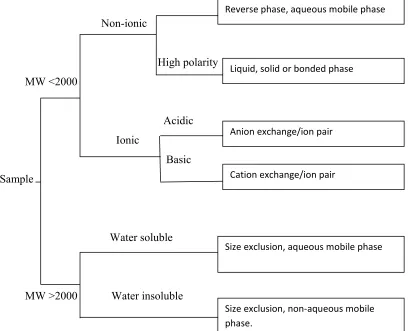
Guide to Liquid Chromatography Mode Selection
Selection of chromatography mode is based upon the analyte polarity, solubility and ionic nature. [7] A guide to liquid chromatography mode selection is represented in fig no: 1
Low polarity
Non-ionic
High polarity MW <2000
Acidic
Ionic Basic
Sample
Water soluble
[image:15.612.128.536.337.668.2]MW >2000 Water insoluble
Fig. No: 1 Guide to Liquid Chromatography Mode Selection Reverse Phase HPLC
Reverse phase, aqueous mobile phase
Liquid, solid or bonded phase
Anion exchange/ion pair
Cation exchange/ion pair
Size exclusion, aqueous mobile phase
Size exclusion, non‐aqueous mobile
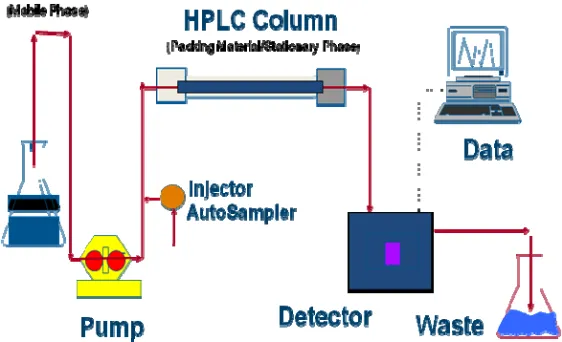
Reverse phase chromatography refers to the use of a polar mobile phase with the non-polar stationary phase in contrast to normal phase chromatography where a polar stationary phase is employed with a non-polar mobile phase. [8] The figure No. 2 and 3 shows the HPLC system and its various components.
Fig.No: 2 High Performance Liquid Chromatography
Fig.No: 3 Block diagram showing the components of an HPLC instrument
[image:16.612.183.464.461.632.2]The liquid-liquid partition chromatography uses a stationary phase consisting of liquid layer adsorbed to a surface of silica or alumina. In case of bonded phase or reverse phase HPLC uses a stationary phase consisting of an organic moiety chemically bonded to the surface of silica through the surface silanol groups. Since the organic moieties are generally long-chain hydrocarbons, the mobile phases are generally polar. In this mode, the more polar solutes are eluted first while the non-polar compounds are eluted later. The silanol group can react with a chlorosilane group to form the popular (ODS & C18) octadecylsilane packing.
E.g. Octadecylsilane (ODS or C18).
CH3 CH3
Si OH + Cl – Si – (CH2)17 – CH3 Si – O – Si – (CH2)17 – CH3 +HCl
CH3 CH3
For silica based bonded materials, the suitable working pH range is 2 - 8. At pH values of less than 2, the Si-C bond is attached, and at the higher pH values, hydrolysis of the siloxane takes place which leads to degradation or destruction of the packing. In most of the applications of RP-HPLC, elution is carried out with highly polar solvents such as methanol, acetonitrile or tetrahydrofuran in various concentrations. [9a]
Reverse phase mobile phase
The primary constituent of RP-HPLC mobile phase is water. Water miscible solvents such as methanol, ethanol, acetonitrile, dioxane, tetrahydrofuran and dimethyl formamide are added to adjust the polarity of the mobile phase. Additionally acids, bases, buffers and/or ionic surfactants are added. The water should be of high quality, either distilled or demineralised water.
acetonitrile. Reverse phase mobile phases are generally non-flammable due to high water content. Degassing is quite important with reverse phase mobile phases. [9b]
Detectors in HPLC
Characteristics of ideal detectors
1. Adequate sensitivity.
2. Good stability and reproducibility. 3. A linear response to analyte.
4. A short response time that is independent of flow rate.
5. High reliability.
6. Minimal internal volume in order to zone broadening. [9c]
Liquid chromatographic detectors are of two basic types, 1. Differential or bulk property detector 2. Selective or solute property detector
Differential or bulk property detector
Differential or bulk property detector provides a differential measurement of a bulk property that is possessed by both the analyte and the mobile phase.
e.g., Refractive index, dielectric constant.
Selective or solute property detector
Measure the property of an analyte which is not possessed by the mobile phase.
e.g., UV absorbance, fluorescence.
1.3 RELATED SUBSTANCES AND IMPURITIES
Preface
The pharmaceutical industry is required by the Food, Drug and Cosmetic Act to establish the identity and purity of all marketed drug products. The United States Food and Drug Administration (FDA) and other regulatory bodies around the world insist on the requirement of impurities in drug substance and drug product when present at threshold level recommended by the International Conference on Harmonisation (ICH) should be isolated and characterized. [10]
The identification of process related impurities and degradation products can provide an understanding on production of impurities and define degradation mechanism.
Definitions
Impurity: “any entity of the drug substances (bulk material) or drug (final
container product) that is not the chemical entity defined as the drug substance, an
excipient, or other additives to the drug product”.
Degradation product: The compound produced as a result of decomposition of
the material of interest or Active Pharmaceutical Ingredient are often called degradation products (degradants). Degradation could occur as a result of changes during processing or storage (e.g., oxidation, aggregation and proteolysis).
In the pharmaceutical world, an impurity is generally considered as any other organic material besides the drug substance or Active Pharmaceutical Ingredient, that arises out of synthesis. Most of the time, the inorganic contaminants are not given adequate consideration as impurities unless they are toxic, such as heavy metals or arsenic.
Interaction products are produced during formulation processes and degradation products.
Therefore, for all intents and purposes, various contaminants mentioned here can be called impurities and should be labelled as such because they decrease the purity of API.
Isolation and characterization of impurities
Impurities are generally assumed to be inferior to API because they might not have the same level of pharmacological activity. However, they are not necessarily always inferior. From the standpoint of its usage, the drug substance is not compromised in terms of purity even if it contains another material with superior pharmacological or toxicological properties. Therefore, any extraneous material present in the drug substances or active ingredients must be considered as an impurity even if it is totally inert or has superior pharmacologic properties so that an appropriate evaluation of its content in the drug product can be made.
In many final pharmaceutical products, test for related substances is performed as a part of the chemical quality control. This test is intended to check that the content of impurities structurally related to the active pharmaceutical ingredients (related substances), are at a very low level. This is important, as related substances can affect the efficacy of the final pharmaceutical product especially, degradation products from the API.
Identification and determination
The first step of impurity profiling is the detection of the impurities. High resolution NMR and mass spectrometry can play an important role in getting a finger print on the purity of the sample.
Impurity profiling in synthetic drug research
During the course of drug development, the qualititative impurity profile may change as a result of, for example, changes in synthetic route, drug product formulation, storage conditions and container / closure system. These changes result in increased levels of previously observed impurities above the identification and/or qualification threshold limits or new impurities not previously identified or qualified. When these impurities are above the threshold limits, consideration for identification and qualification of the level of the impurity is indicated and one of the decision trees for safety studies should be consulted. Safety studies should compare the new drug substance containing new a representative level of the impurity with previously qualified materials. Although studies using the isolated impurity are also acceptable, validated method for the separation and quantification of different impurities are preferred.
Various terms of impurities
By product
Degradation product
Interaction product
Intermediate
Related product
Transformation product
Toxic impurities
Organic volatile impurities
Foreign substances
Enantiomeric impurities
ICH Terminology
According to ICH guidelines, impurities are classified into the following three categories for the drug substance produced by chemical synthesis.
1. Organic impurities (starting materials, process related products, intermediates and degradation products).
3. Residual solvents (organic and inorganic liquids used during production and/or recrystallization).
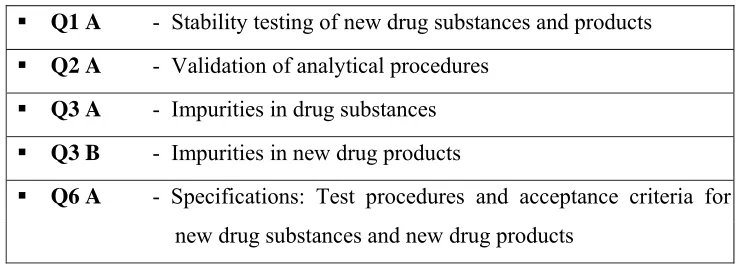
Table No: 3 ICH Quality Guidelines
Q1 A - Stability testing of new drug substances and products
Q2 A - Validation of analytical procedures
Q3 A - Impurities in drug substances
Q3 B - Impurities in new drug products
Q6 A - Specifications: Test procedures and acceptance criteria for
new drug substances and new drug products
Any impurity that may be present in the starting material has the potential to be carried into the active ingredient of interest.
The most obvious source of impurities is the synthesis, where intermediates and by-products may be carried into the API as impurities or an intermediate and become a source of other impurities resulting from them.
1.4 VALIDATION
The word “Validation” means “Assessment” of validity or “action of proving effectiveness”. [11]
System Suitability
System suitability testing is an integral part of many analytical procedures. The tests are based on the concept that the equipment, electronics, analytical operations and samples to be analyzed constitute an integral system that can be evaluated as such.
The system suitability testing parameters established for the liquid chromatographic procedure are:
¾ Retention time
¾ Symmetry factor or tailing factor
¾ Theoretical plates
¾ Resolution
General considerations
Retention Time (t)
This is the time of emergence of the peak maximum of a component after injection.
Symmetry factor (or) Tailing factor (T) T = W / 2f
The assessment of peak shape is in terms of symmetry factor. W - Width of peak at 5 % height
Number of theoretical plates (N)
N = 5.54 T / W
The assessment of performance of efficiency of a column is in terms of the number of theoretical plates.
W - Width of peak at half height
Resolution (R)
R = 2 (t2 – t1) / W2 + W1
This gives the resolution between the measured peaks on the chromatogram Where,
t2 and t1 - Retention times of the two components.
W2 and W1 - Widths of the components at the bases of the peaks obtained by
extrapolating the relatively straight sides of the peaks to the baseline.[12]
2. DRUG PROFILE
Name
Nevirapine
IUPAC Name
11-Cyclopropy1-5, 11-dihydro-4-methy1-6H-dipyrido [3, 2-b : 20, 30-e] [1, 4] diazepin-6-one. [13]
Structure of Nevirapine
N N
CH3 N H
N O
Molecular Formula : C15H14N4O
Molecular Weight : 266.30 CAS Number : 129618-40-2
Category : Non-nucleoside reverse transcriptase inhibitor
(NNRTI), class of anti-retroviral.
Description : White or almost white, odorless to nearly odorless,
crystalline powder.
Solubility : Practically insoluble in water, slightly soluble in
alcohol and in methanol.
Storage : Store at 25 °C (77 °F), excursions permitted to
15 °C-30 °C (59 °F-86 °F).
Nevirapine was discovered by Hargrave et al. at Boehringer Ingelheim Pharmaceuticals, Inc., one of the Boehringer Ingelheim group of companies. It is covered by U.S. Patent 5,366,972 and corresponding foreign patents. Nevirapine was the first NNRTI approved by the U.S. Food and Drug Administration (FDA). It was approved June 21, 1996 for adults and september 11, 1998 for children. [14] At present
nevirapine is an official drug in Indian Pharmacopoeia [15], British
Pharmacopoeia [16] and United States Pharmacopoeia.[17]
Impurities : Specified impurities A, B and C. [16]
N N
CH3 N H
N O
R
Related Substance A. R = C2H5 : 11-ethyl-4-methyl-5, 11-dihydro-6H-dipyrido
[3, 2-b: 2’,3’-e] [1,4] diazepin-6-one.
Related Substance B. R = H : 4-methyl-5, 11-dihydro-6H-dipyrido
[3, 2- b: 2’,3’-e] [1, 4] diazepin-6-one.
Impurity C. R = CH2-CH2-CH3 : 4-methyl-11-propyl-5, 11-dihydro-6H-dipyrido
[3, 2-b : 2’, 3’-e] [1,4] diazepin-6-one.
Dosage and administration: 200 mg tablets - Oral route of administration
Half life : 25 - 30 hours
Brand Names : Nevimune 200 mg, Nevivir 200 mg
Nevirapine diffuses into the cell and binds to reverse transcriptase adjacent to the catalytic site. This induces conformational changes that inactivate the enzyme. Resistance develops rapidly in cells exposed to nevirapine. High-level resistance is associated with mutations at reverse transcriptase codons 101, 103, 106, 108, 135, 181, 188 and 190.
Pharmacokinetics: Absorption
Nevirapine is well absorbed orally. It is readily crosses the placenta and has been found in breast milk, a feature that has encouraged use of nevirapine for pprevention of mother-to-child transmission of HIV. 90 % (Absolute bioavailability 93 ± 9 %), CSF to plasma level is 45 %. [18]
Distribution
Nevirapine is highly lipophilic and is essentially non-ionized at
physiological pH.
Metabolism
Oxidative metabolism of nevirapine in the liver by cytochrome P450 isoforms
CYP3A4 and CYP2B6 produces several metabolites including 2 -, 3 -, 8 - and 12 - hydroxynevirapine.
Elimination
Cytochrome P450 metabolism, glucuronide conjugation and urinary excretion
of glucuronidated metabolites represent the primary route of nevirapine biotransformation and elimination.
Drug Interactions:
Rifamibicin and ketoconazole are contraindicated in patients receiving nevirapine. Plasma ethinyl estradiol level decreases significantly with nevirapine coadministration. Although it can lower plasma concentrations of protease inhibitors. [19]
3. LITERATURE REVIEW
1. Anand Babu K, et al., (2011) [20] have developed and validated method for
the simultaneous estimation of zidovudine, lamivudine and nevirapine tablets by RP-HPLC.
Column : Hypersil BDS C18 column
Mobile Phase : Ammonium acetate buffer : acetonitrile [75 : 25] Flow Rate : 1 mL/min
Detector : UV detector set at 270 nm
2. D'Avolio A, et al., (2011) [21] have validated a sensitive and accurate high
performance liquid chromatography-mass spectrometric (HPLC-MS) method for the intracellular determination of 14 anti-retroviral drugs in peripheral blood mononuclear cells (PBMCs) for HIV patients.
Column : Atlantis T3 column
Mobile Phase : Gradient elution water (0.05% formic acid) and ACN Flow Rate : 1 mL/min
Detector : UV detection at 284 nm
3. Rohini, et al., (2011) [22] have estimated a reverse phase high performance
liquid chromatography method for nevirapine in tablets.
Column : Symmetry C18 column
Mobile Phase : Acetonitrile : phosphate buffer [65 : 35] Flow Rate : 0.8 mL/min
Detector : UV detection at 283 nm
4. Shewiyo D H, et al., ( 2011) [23] have developed and validated an improved
method for the simultaneous analysis of lamivudine, stavudine and nevirapine using high performance thin layer chromatography (HPTLC).
Column : C18 Column
Mobile Phase : Ethyl acetate : methanol : toluene : ammonia
[38.7 : 19.4 : 38.7 : 3.2]
5. D'Avolio A, et al., (2010) [24] have developed a bioanalytical method for the
determination of most commonly prescribed protease inhibitors (saquinavir, atazanavir, amprenavir, darunavir, lopinavir and ritonavir) and non-nucleoside reverse transcriptase inhibitors (etravirine, efavirenz and nevirapine). C18
column was used to analyse the samples.
6. Else L, et al., (2010) [25] described a simple, fast and sensitive HPLC-MS/MS
method for determination of the commonly used protease inhibitors (PI) amprenavir, atazanavir, darunavir, lopinavir, ritonavir, saquinavir and the non-nucleoside reverse transcriptase inhibitor (NNRTI) nevirapine.
Column : C18 column
Mobile Phase : Gradient acetonitrile and 0.05% formic acid Detector : UV detection at 280 nm
7. Hemanth Kumar A K, et al., (2010) [26] have described a relatively simple
and accurate method to estimate anti-retroviral drugs in pharmaceutical preparation is by spectrophotometric method.
Column : C18 column
Detector : UV detection at 300, 285 and 270 nm
8. Kaale E, et al., (2010) [27] have developed an inter-laboratory investigation on
the use of high performance thin layer chromatography to perform assays of lamivudine, zidovudine, metronidazole, nevirapine, and quinine composite samples.
9. Li Z, et al., (2010) [28] have developed a new high throughput LC-MS/MS
method for the simultaneous determination of lamivudine, stavudine and nevirapine in human plasma with zidovudine as an internal standard. Shiseido C8 column was used.
10.Ren C, et al., (2010) [29] have developed a highly sensitive and specific
11.Vogel M, et al., (2010) [30] have described a simple, stable and specific gas
chromatography-mass spectrometry method for the determination of nevirapine in plasma.
12.Elens L, et al., (2009) [31] have reported an ultra performance liquid
chromatography (UPLC) diode array detection method for the simultaneous quantification of the HIV protease inhibitors amprenavir, atazanavir, indinavir, lopinavir, nelfinavir, ritonavir, saquinavir, tipranavir and the non-nucleoside reverse transcriptase inhibitors efavirenz and nevirapine. C8 column was used
to analyse the sample.
13.Malm M, et al., (2009) [32] have developed and validated a bioanalytical
method for the determination of lamivudine, zidovudine and nevirapine in 100 µL capillary blood applied onto sampling paper.
Column : Zorbax SB C8 column
Mobile Phase : 2 step gradient: methanol : sodium acetate buffer
[pH 3.95, 15 : 85] and [pH 3.95, 50 : 50]
Flow Rate : 1.0 mL/min
Detector : UV detection at 265 nm
.
14.Martin J, et al., (2009) [33] have described a liquid chromatography-tandem
mass spectrometry assay for simultaneous determination of the plasma concentration of 11 anti-retroviral agents (nevirapine, indinavir, atazanavir, amprenavir, saquinavir, ritonavir, lopinavir, efavirenz, tipranavir, darunavir and maraviroc).
15.Mandloi D K, et al., (2009) [34] have developed a simple, highly sensitive,
isocratic reverse phase high performance liquid chromatography method for the determination of nevirapine in the bulk drug and tablet dosage forms.
Column : Luna 5 μ, C18 column
Mobile Phase : Methanol and water [89 : 11] Flow Rate : 1 mL/min
16.Nageswara Rao R, et al., (2009) [35] have developed and reported a simple,
rapid, reliable and highly sensitive online two-dimensional reverse phase liquid chromatography-tandem mass spectrometric method to determine anti-retroviral drugs viz., abacavir, nevirapine and indinavir in rat serum and urine.
Column : C18 column
Detector : ESI-MS/MS detection
17.Prasada Rao C H, et al., (2009) [36] have developed a reverse phase high
performance liquid chromatography method for the estimation of nevirapine in bulk drug and pharmaceutical dosage forms.
Column : Octa decyl silane column
Mobile Phase : Methanol and acetate buffer [60 : 40] Flow Rate : 1.0 mL/min
Detector : UV detection at 280 nm
18.Purnima D. Hamrapurkar, et al., (2009) [37] have reported a validated
method for the estimation of nevirapine from bulk drug and tablet formulations using appropriate solvent system on TLC plates.
HPTLC plates : Precoated silica gel, GF254, 10 cm x 20 cm Solvent : Ethyl acetate : glacial acetic acid (10 : 0.1) Detection : Densitometrically scanned at 283 nm
19.Stieger N, et al., (2009) [38] have developed UV spectrophotometric method
for the quantitative determination of nevirapine in water, methanol and 0.1 N HCl.
20.D'Avolio A, et al., (2008) [39] have developed and validated a new method
using high-performance liquid chromatography coupled with PDA detector for the quantification of plasma concentrations of 11 anti-retroviral agents including nevirapine and its metabolites.
21.Heine R, et al., (2008) [40] have developed a bioanalytical method for the
darunavir, lopinavir and ritonavir) and non-nucleoside reverse transcriptase inhibitors (efavirenz and nevirapine).
Column : C18 column (150 mm x 2.0 mm)
Mobile Phase : Acetonitrile, methanol and ZnSO4 in water [1 : 1 : 2]
22.Notari S, et al., (2008) [41] have quantified abacavir, amprenavir, didanosine,
efavirenz, nevirapine and stavudine in the plasma of HIV infected patients, by standard addition analysis.
23.Palaniappan Mohanraj, et al., (2008) [42] have described the method for
determination of nevirapine in tablet dosage forms by simple and rapid RP-HPLC method.
Column : ODS column
Mobile Phase : Methanol and water [89 : 11] Flow Rate : 1 mL/min
Detector : UV detection at 284 nm
24.Gehrig A K, et al., (2007) [43] have developed a bioanalytical method for
determination of some of the anti-HIV drugs including nevirapine.
Column : Nucleosil C18 column
Mobile Phase : Gradient 20 mM ammonium acetate including 0.1 %
aqueous acetic acid and acetonitrile
Detector : Electrospray ionisation / tandem mass spectrometry
25.Herve Rebiere, et al., (2007) [44] have developed and validated two methods
by reverse phase liquid chromatography for the analysis of 19 anti-retroviral molecules.
Method I: (NRTI)
Column : YMC pack ODS
Mobile Phase : Gradient ammonium acetate buffer pH 4.0 : methanol Flow Rate : 1 mL/min
Detector : UV detection at 270 nm Method II: (NNRTI & PI)
Column : Symmetry C18
Flow Rate : 1.5 mL/min
Detector : UV detection at 260 nm
26.Liu Z, et al., (2007) [45] have reported a rapid highly sensitive and specific
electrospray ionization liquid chromatography/tandem mass spectrometry
method for quantification of nevirapine and its two metabolites,
2-hydroxynevirapine and nevirapine 4-carboxylic acid.
27.Mistri H N, et al., (2007) [46] have developed and validated a selective and
high throughput liquid chromatography-tandem mass spectrometry method to detect and simultaneously quantify lamivudine, stavudine and nevirapine in human plasma using metaxalone as internal standard.
Column : Symmetry C18
Mobile Phase : Water : acetonitrile [20 : 80]
28.Rowland L S, et al., (2007) [47] have developed and validated a multiple
reaction monitoring LC/MS/MS method for the analysis of nevirapine oxidative metabolites, 2-hydroxynevirapine, 2-hydroxynevirapine, 3-hydroxy nevirapine, 8-hydroxynevirapine, 12-hydroxynevirapine and 4-carboxy nevirapine in human plasma.
29.Weller D R, et al., (2007) [48] have described an efficient, isocratic high
performance liquid chromatography method for determining human immunodeficiency virus non-nucleoside reverse transcriptase inhibitors and protease inhibitors in plasma is advantageous for laboratories participating in clinical trials and therapeutic drug monitoring programs, or conducting small animal research.
Column : S3 column
Detector : Detection at 212 nm
30.Geetha Ramachandran, et al., (2006) [49] have described a reverse phase high
performance liquid chromatographic method for simultaneous determination of plasma zidovudine and nevirapine.
Mobile Phase : Potassium dihydrogen phosphate pH 7.5 : acetonitrile
[75 : 25]
Flow Rate : 1.5 mL/min
Detector : UV detection at 260 nm
31.Notari S, et al., (2006) [50] have developed a HPLC-UV method to quantify
simultaneously some HIV protease inhibitors, reverse transcriptase inhibitors and non-nucleoside reverse transcriptase inhibitors including nevirapine in human plasma.
Column : C18 Symmetry
Mobile Phase : Linear gradient 0.01 M potassium dihydrogen
phosphate and acetonitrile
Flow Rate : 1.0 mL/min
Detector : UV detection at 240 and 260 nm
32.Namita Kapoor, et al., (2006) [51] have developed a method for the
simultaneous determination of lamivudine, stavudine and nevirapine in anti-retroviral fixed dose combinations by high performance liquid chromatography.
Column : Symmetry C18 column
Mobile Phase : Gradient elution
Sol. A: Acetate buffer pH 3.5: methanol [80 : 20] Sol. B: Acetonitrile : isopropyl alcohol [50 : 50]
Flow Rate : 0.6 mL/min
Detector : UV detection at 270 nm
33.Ramachandran G, et al., (2006) [52] have described a simple, fast, isocratic,
reverse phase high performance liquid chromatographic method for simultaneous determination of plasma zidovudine and nevirapine.
Column : C18 column
Mobile Phase : Potassium dihydrogen phosphate pH 7.5 and
acetonitrile [72 : 28].
34.Rezk N L, et al., (2006) [53] have reported full validation of an analytical
method that combines atazanavir with HIV protease inhibitors and
non-nucleoside reverse transcriptase inhibitors including nevirapine.
Column : Zorbax C18
Detector : Detection at 210 nm
35.Sarkar M, et al., (2006) [54] have developed and validated HPLC and an UV
spectrophotometric method for the quantitative determination of three antiretroviral drugs viz., lamivudine, stavudine and nevirapine that constitute one of the first line regimens in antiretroviral therapy.
Column : C18 symmetry
Detector : UV detection at 270, 265 and 313 nm
36.Silverthorn C F, et al., (2006) [55] have validated clinically relevant assay for
the assessment of nevirapine concentrations in neonate plasma samples.
Column : C8 column
Detector : UV detection at 280 nm
37.Anbazhagan S, et al., (2005) [56] have described the simultaneous
quantification of stavudine, lamivudine and nevirapine in tablets by UV spectroscopy, reverse phase HPLC and HPTLC methods.
Column : C18 ODS-Hypersil column
Mobile Phase : Sodium phosphate buffer : acetonitrile [4 : 1] Detector : UV detection at 266, 271 and 315 nm
38.Colombo S, et al., (2005) [57] have described a sensitive and accurate liquid
chromatography-tandem mass spectrometric method for the intracellular determination of nine antiretroviral drugs in human peripheral blood mononuclear cells (PBMCs). PBMCs are isolated by density gradient centrifugation using vacutainer CPT tubes and cell count is performed with a coulter instrument.
Column : RP C18 symmetry shield
39.Koal T, et al., (2005) [58] were quantified for the anti-retroviral drugs, i.e., PI
and NNRTI in dried blood spots from HIV/AIDS patient whole blood samples as the basis for therapeutic drug monitoring by a robust simultaneous liquid chromatography/tandem mass spectrometry method. This study includes PI and NNRTI using phenomenex synergy max column.
40.Lemmer P, et al., (2005) [59] have developed an accurate, selective, and
sensitive method for the determination of the non-nucleoside reverse transcriptase inhibitors nevirapine and efavirenz in human plasma using gas chromatography-mass spectroscopy.
41.Schuman M, et al., (2005) [60] have developed and validated a RP-HPLC
method using photo diode array detection for the simultaneous quantification
of lamivudine, stavudine, nevirapine, zidovudine, methylparaben and
propylparaben in solid and liquid drug formulations.
Column : Symmetry C8 column
Mobile Phase : Gradient 50 mM NaH2PO4 pH 3.8 and ACN
Flow Rate : Gradient (0.5 to 1.0 mL/min) Detector : UV detection
42.Tribut O, et al., (2005) [61] have reported simultaneous quantification of
anti-retroviral drugs and it metabolites in human plasma.
Column : X-TERRA column
Mobile Phase : Gradient water (3 mM pyrrolidine) and acetonitrile Detector : UV detection
43.Dailly E, et al., (2004) [62] have proposed a global method for therapeutic drug
except lopinavir. The absorbance is measured at 259 nm except for lopinavir (205 nm) and nevirapine (320 nm).
44.Dubuisson J G, et al., (2004) [63] described a fast, inexpensive thin-layer
chromatography method to detect the presence of NVP in human plasma. Clinical samples with nevirapine concentrations predetermined by high performance liquid chromatography were used to validate the TLC method.
45.Egge Jacobsen W, et al., (2004) [64] have reported an analytical assay based
on automated sample preparation and liquid chromatography coupled with electrospray mass spectrometry for the quantification of some of the anti-viral drugs.
46.Kaul N, et al., (2004) [65] have developed and validated sensitive, selective,
precise and stability indicating HPTLC method of analysis of nevirapine both as a bulk drug and in formulations.
Mobile Phase : Toluene : carbon tetrachloride: methanol: acetone :
ammonia [3.5 : 3.5 : 2.0 : 1.0 : 0.05]
Detection : Densitometric analysis, absorbance mode at 289 nm
47.Rezk N L, et al., (2004) [66] have described an accurate, sensitive, and specific
reverse phase high performance liquid chromatography assay for the simultaneous quantitative determination of HIV protease inhibitors and non-nucleoside reverse transcriptase inhibitors in human blood plasma.
Mobile Phase : Linear gradient phosphate buffer (pH 4.5), acetonitrile,
methanol and TFA.
Flow Rate : Gradient mobile phase flow rate (0.9 - 1.1 mL) Detector : UV detection
48.Bregt S Kappelhoff, et al., (2003) [67] have developed method for the
simultaneous determination of the NNRTI efavirenz and nevirapine in human plasma using liquid chromatography.
Column : Zorbax C18 column
Detector : UV detection at 275 nm
49.Chi J, et al., (2003) [68] have developed a sensitive and rapid liquid
chromatography tandem mass spectrometry method to measure the levels of the HIV-1 non-nucleoside reverse transcriptase inhibitor nevirapine in human plasma. LC-MS-MS in positive mode used pairs of ions at m/z of 267/226 for nevirapine and 628/421 for the IS respectively.
50.Droste J A, et al., (2003) [69] have described a reversed phase high
performance liquid chromatography method for the simultaneous quantitative determination of the HIV protease inhibitors and the non-nucleoside reverse transcriptase inhibitor nevirapine in human plasma.
Column : OmniSpher C18 column
Detector : UV detection at 215 nm and 280 nm
51.Jingduan Chi, et al., (2003) [70] have developed a sensitive method to measure
the levels of the NNRTI nevirapine in human plasma by liquid chromatography tandem mass spectrometry.
Column : Zorbax XDB C8 reverse phase column
Mobile Phase : Buffer pH 4.1 and acetonitrile [gradient flow] Flow Rate : 400 µL/min
Mass analyser : Triple quadrupole mass spectrometer
52.Kappelhoff B S, et al., (2003) [71] have described a simple and rapid high
performance liquid chromatographic method for the simultaneous quantification of efavirenz and nevirapine in human plasma suitable for therapeutic drug monitoring. The drugs were separated from endogenous compounds by isocratic reverse phase high performance liquid chromatography with ultraviolet detection at 275 nm.
53.Rezk N L, et al., (2003) [72] have reported an accurate, sensitive and specific
blood plasma. The new polarity dC C18 silica column used in this method
provides better resolution and peak shape and detected using four different ultraviolet wavelengths for accurate and specific quantitation of the analytes.
54.Rentsch K M, (2003) [73] has developed a sensitive and rapid liquid
chromatography tandem mass spectrometry method to measure the levels of the HIV-1 non-nucleoside reverse transcriptase inhibitor nevirapine in human plasma. LC-MS-MS in positive mode used pairs of ions at m/z of 267/226 for NVP and 628/421 for the IS, respectively.
55.A. Volosov, et al., (2002) [74] have developed simple rapid method for
quantification of antiretrovirals by liquid chromatography tandem mass spectrometry.
Column : Supelco LC18 DB chromatographic column
Mobile Phase : Ammonium acetate : methanol Flow Rate : 1 mL/min
Detector : UV detection at 260 nm
56.Fan B, et al., (2002) [75] have developed a new high-performance liquid
chromatography assay for the simultaneous determination of zidovudine/lamivudine/nevirapine in human plasma.
Column : Octylsilane column
Mobile Phase : Sodium phosphate buffer : acetonitrile [86:14] Detector : UV detection at 265 nm
57.Laurito T L, et al., (2002) [76] have developed and validated a rapid, sensitive
and specific method to quantify nevirapine in human plasma using
dibenzepine as the internal standard. C18 analytical column was used with UV
detection of 268 nm. This method was employed in a bioequivalence study of two nevirapine tablet formulations.
58.Langmann P, et al., (2002) [77] have developed a sensitive and rapid gas
capillary column with a nitrogen phosphorous detector, Helium 5.0 was used as carrier gas.
59.Marchei E, et al., (2002) [78] have developed a simple method for the
simultaneous determination of zidovudine and nevirapine in human plasma by reverse phase liquid chromatography.
Column : Zorbax SB C18 column
Mobile Phase : Potassium dihydrogen phosphate pH 6.5 : acetonitrile
[83 : 17]
Detector : UV detection at 265 nm
60.Marzolini C, et al., (2002) [79] have adapted the HPLC method previously
described for the simultaneous assay of amprenavir, ritonavir, indinavir, saquinavir, nelfinavir and efavirenz after solid-phase extraction is proposed
here for the separate analysis of the newer PI lopinavir and the
NNRTI nevirapine.
Column : Nucleosil C18 AB
Mobile Phase : Gradient elution acetonitrile: phosphate buffer pH 5.07 Detector : UV detection at 201 and 282 nm
61.Naser L Rezk, et al., (2002) [80] have described a reverse phase high
performance liquid chromatography assay for the simultaneous quantitative determination of three HIV NNRTI nevirapine, delavirdine, and efavirenz in human blood plasma.
Column : Eclipse XDB C8 column
Mobile Phase : Sodium phosphate buffer (pH 4.8) and
acetonitrile [Gradient flow]
Flow Rate : 1.5 mL/min
Detector : UV detection at 224 nm
62.Poirier J M, et al., (2002) [81] have developed a sensitive and selective liquid
elution. Double ultraviolet detection at 265 nm (amprenavir) and at 210 nm (for all other assayed drugs and internal standard) was used.
63.Rezk N L, et al., (2002) [82] have described a simple reverse phase high
performance liquid chromatography assay for the simultaneous quantitative determination of three HIV non-nucleoside reverse transcriptase inhibitors (nevirapine, delavirdine and efavirenz) in human blood plasma. Symmetry C18
column has been used with UV detection at 270 nm
64.Titier K, et al., (2002) [83] have developed a selective and sensitive high
performance liquid chromatographic method for the determination of the human immunodeficiency virus protease inhibitors and the non-nucleoside reverse transcriptase inhibitors (nevirapine and efavirenz).
Column : Stability RP C18 column
Mobile Phase : Gradient of acetonitrile and phosphate buffer pH 5.65 Detector : UV detection at 240 nm
65.Tribut O, et al., (2002) [84] have described a rapid (less than 30 min),
sensitive, and specific liquid chromatography method for simultaneous assay of nine anti-retroviral drugs in human plasma. This technique allowed therapeutic drug monitoring of six approved protease inhibitors (amprenavir, indinavir, lopinavir, nelfinavir, ritonavir, and saquinavir) and two approved non-nucleoside reverse transcriptase inhibitors (efavirenz and nevirapine).
Column : X-TERRA column Mobile Phase : Water and acetonitrile
Detector : Detection with a diode array detector
66.Dailly E, et al., (2001) [85] have reported a single HPLC assay for therapeutic
drug monitoring of 5 HIV protease inhibitors (indinavir, amprenavir, saquinavir, ritonavir and nelfinavir) and a non-nucleoside reverse transcriptase inhibitor (nevirapine) in human plasma.
Mobile Phase : Gradient elution of solvent A acetonitrile and 0.025 M
tetramethyl ammonium perchlorate [55:45] and solvent B methanol
Detector : UV detection at 320 nm, 259 nm, 254 nm and 239 nm
67.Lopez R M, et al., (2001) [86] have described a fast, simple isocratic reverse
phase high performance liquid chromatography method with a 30 mm long column for assaying nevirapine in human serum.
Column : C18 column
Mobile Phase : Phosphate buffer (pH 5) : acetonitrile [82:18] Flow Rate : 1.0 mL/min.
Detector : UV detection was performed at 240 nm
68.Villani P, et al., (2001) [87] have developed an analytical technique using
liquid chromatography (LC) coupled with electrospray mass spectrometry for the simultaneous determination of five protease inhibitors : saquinavir, indinavir, ritonavir, nelfinavir and amprenavir; and three non-nucleoside reverse transcriptase inhibitors : nevirapine, delavirdine and efavirenz, in human plasma.
Column : C18 reverse phase
Mobile Phase : Linear gradient with water and acetonitrile Detector : Mass spectrometry detection
69.Aymard G, et al., (2000) [88] have described a new high performance liquid
chromatography with UV detection assay for the simultaneous determination of protease inhibitors, nucleoside and non-nucleoside reverse transcriptase inhibitors using a plasma samples.
Column : C18 symmetry column
Mobile Phase : Sodium phosphate buffer : acetonitrile [50:50] Detector : UV detection at 241, 254 and 261 nm
70.Hollanders R M, et al., (2000) [89] have reported a sensitive and rapid high
Column : Hypersil ODS column
Mobile Phase : Acetonitrile and phosphate buffer pH 4.5 [30 : 70] Flow Rate : 1.0 mL/min
Detector : UV detection at 280 nm
71.Pav J W, et al., (1999) [90] have optimized and validated a reverse phase
HPLC method for the determination of nevirapine in human plasma, serum, milk and cerebrospinal fluid.
Column : Supelco LC8 analytical column
Mobile Phase : Phosphate buffer pH 6.0 : methanol : acetonitrile
[63 : 21.5 : 15.5]
Flow Rate : 1.0 mL/min
Detector : UV detection at 280 nm
72.Van Heeswijk R P, et al., (1998) [91] have described a simple and rapid high
performance liquid chromatographic method for the quantification of nevirapine in human plasma. The analyte was separated from endogenous compounds by isocratic reverse phase, ion pair and high performance liquid chromatography with ultraviolet detection at 282 nm.
4. AIM AND PLAN OF WORK
DEVELOPMENT AND VALIDATION OF NEW RP-HPLC METHOD FOR THE ASSAY OF NEVIRAPINE AND ITS RELATED SUBSTANCES IN TABLET DOSAGE FORM
From the literature survey, it was found that there are some analytical methods reported for nevirapine assay and fewer methods for the determination of impurities by RP-HPLC in pharmaceutical dosage forms. Nevirapine is increasingly finding use in treatment of anti-HIV as well as in combination therapy. So there is not only need to develop a newer analytical method for the estimation of nevirapine, but also to identify and quantify its process related impurities and its degradants.
The present work is aimed at
¾ Method development (By reverse phase HPLC).
¾ Validation of the developed method (By using following parameters).
a. Accuracy
b. Precision
c. Linearity and Range d. Limit of detection e. Limit of quantification f. Specificity
g. Robustness
h. Ruggedness
i. System suitability studies j. Solution stability and filter study
5. INSTRUMENTS AND MATERIALS
The following instruments and materials required for analytical method development and validation process of assay and related substances of nevirapine in tablet dosage form.
Instrument used:
• Waters separation module No. 2695, with PDA detector 2998
• EMPOWER ver.02 software
Reagents used:
1. Monobasic ammonium phosphate : Merck - AR grade
2. Acetonitrile : Merck - HPLC grade
3. Water : Millipore - Milli-Q grade
4. Sodium hydroxide : Merck - AR grade
5. Ethanol : Fischer scientific - AR grade
[image:45.612.163.486.427.697.2]Standards and samples
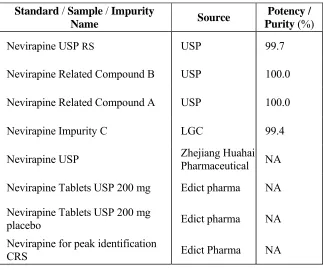
Table No: 4 List of standards and sample Standard / Sample / Impurity
Name Source
Potency / Purity (%)
Nevirapine USP RS USP 99.7
Nevirapine Related Compound B USP 100.0
Nevirapine Related Compound A USP 100.0
Nevirapine Impurity C LGC 99.4
Nevirapine USP Zhejiang HuahaiPharmaceutical NA
Nevirapine Tablets USP 200 mg Edict pharma NA
Nevirapine Tablets USP 200 mg
placebo Edict pharma NA
Nevirapine for peak identification
CRS Edict Pharma NA
SUMMARY AND CONCLUSION
Nevirapine is an anti-HIV of the non-nucleoside reverse transcriptase inhibitor (NNRTI). It is more potent than zidovudine on HIV-1, but do not inhibit HIV-2. Viral resistance to these drugs develops by point mutation and cross resistance is common.
Literature reports some UV-visible spectrophotometric, RP-HPLC methods for the quantification of the nevirapine in bulk drugs and formulations. But only few methods are available for determination of related substances and degradants. The chromatographic conditions were optimised for assay as well as related substances and the parameters are,
Mobile phase : Monobasic ammonium phosphate
buffer pH 5.0: ACN [80 : 20]
Column : Discovery Amide C16, 150 × 4.6, 5 µm
Flow rate : 1 mL/ min
Column temperature : 35 ºC
Sample temperature : 25 ºC
Injection volume : 25 µL
Run time : 25 mins
Retention time : 7.0 mins
Wavelength : 220 nm
The linear response was obtained with acceptable correlation co-efficient. No significant interference seen in specificity study. The method was fully validated for both assay of nevirapine and related substances with the precision, specificity/forced degradation study, accuracy, linearity, ruggedness, robustness, solution stability and filter study.