EFFECT OF VISUAL FEEDBACK ASSISTED ARM CYCLING
TRAINING IN IMPROVING THE UPPER EXTREMITY
FUNCTION AMONG THE INDIVIDUALS WITH ACUTE
STROKE.
AN EXPERIMENTAL STUDY
Dissertation submitted to the TamilnaduDr. M.G.R. Medical University towards
partial fulfilment of the requirements of
MASTER OF PHYSIOTHERAPY
(Advanced PT in Neurology)
Degree Programme.
KMCH COLLEGE OF PHYSIOTHERAPY
(A unit of Kovai Medical Centre Research and Educational Trust)
Post Box No. 3209, Avanashi Road,
Coimbatore – 641 014.
CERTIFICATE
This is to certify that the research work entitled “EFFECT OF VISUAL FEEDBACK ASSISTED ARM CYCLING TRAINING IN IMPROVING THE UPPER
EXTREMITY FUNCTION AMONG THE INDIVIDUALS WITH ACUTE STROKE –
An Experimental Study” was carried out by the candidate bearing the Register No: 27101609, KMCH College of Physiotherapy, towards partial fulfilment of the requirements
of the Master of Physiotherapy (Advanced PT in Neurology) of the Tamil Nadu Dr. M. G.
R. Medical University, Chennai - 32.
PROJECT GUIDE
PRINCIPAL
Mr. K. SENTHIL KUMAR, M.P.T(Neuro) Dr. EDMUND M.D’COUTO
Professor, MBBS., Dip. Phy.Med.&Rehab., KMCH College of Physiotherapy, KMCH College of Physiotherapy, Coimbatore - 641014. Coimbatore - 641014.
INTERNAL EXAMINER EXTERNAL EXAMINER
Acknowledgement
THIS PROJECT WORK IS DEDICATED
TO MY BELOVED PARENTS AND
FAMILY MEMBERS
In this juncture, I express my heartfelt gratitude to all those who made this possible. I am very happy to express my sincere and heart full thanks to ‘GOD ALMIGHTY’ who
showed his blessing on me to complete this project work in an efficient manner.
My deepest gratitude goes to My Beloved Brother Mr. C.Thangadurai MPT, for
his love, affection, encouragement and support without which I would not have accomplished anything.
I owne an immense depth of gratitude to our Chairman, Dr.Nalla G. Palaniswami,
Kovai Medical Centre and Hospital, for his guidance and allowing me to use the facilities of the department for this study.
I thank our Trustee Dr.Thavamani D. Palaniswamy, for her valuable guidance and
in fulfilment of task.
My heartfelt thanks to Dr. Edmund Mark D’Couto, MBBS.,D.Phys. Med.,
Principal, KMCH College of Physiotherapy for his advice, interest and guidance imparted to me for the proper completion of this study.
I forward my heartfelt gratitude towards Mrs. A. P. Kalpana M.P.T., Vice Principal,
KMCH college of Physiotherapy for her support throughout this study.
I am sincerely thanks to my project guide Mr. K. Senthil Kumar, M.P.T., Professor
for hisvaluable suggestion, outstanding commitment, patience and concern at every part of this study.
I express my deep sense of gratitude and heartfelt thanks to my Class in-charge
Mrs. A. Brammatha M.P.T., for her whole hearted assistance and support all round the
project.
It’s my privilege to give my deep sense of thanks to Mr.T.R. Kabilan, M.P.T., for
his valuable suggestion, constant encouragement and support.
I would like to thank to the faculty members Mr. K. VenuGopal, Professor in Research &
I wish to record my gratitude to Mr. S. Sivakumar M.P.T.,Mr. K. ShyamSundar M.P.T., Mr. U. Nambirajan M.P.T., Mrs. R. Uthra Devi M.P.T., for their support
.
I wish to express my sincere thanks to Mr. S. Damodaran and his Library Team,
for their co-operation and patience in providing reference material which helped immensely. I express my hearty thanks to all my subjects for their active participation and co-operation.
My special thanks to my friends Mr.JoeVithayathil MSC (PT) UK., and Mr. Joel Varghese Simon MS (PT) Aus., who helped me to collect the articles related to
my study.
I would like to thank my friend Mr. U. Anandkumarfor his technical support to
complete this study.
I convey my special and valuable thanks to all my Classmates and Friends, who
helped me to get through every stage of this work.
Contents
CONTENTS
S.NO TITLE
PAGE.NO.
ABSTRACT
1 INTRODUCTION
1.1. NEED FOR THE STUDY
1 – 3 4 – 5
2
REVIEW OF LITERATURE
2.1. INCIDENCE OF STROKE 2.2. STROKE AND ARTERY
2.3. MIDDLE CEREBRAL ARTERY STROKE 2.4. ARM RECOVERY AFTER STROKE 2.5. BILATERAL ARM TRAINING 2.6. ARM CYCLING
2.7. VISUAL FEEDBACK ON STROKE 2.8. CONVENTIONAL PHYSIOTHERAPY 2.9. OUTCOME MEASURES
6 – 14 6 6 6 7 9 10 – 11
12 12
3 AIMS
AND
OBJECTIVES
154 METHODOLOGY
4.1. STUDY DESIGN
4.2.SAMPLING TECHNIQUE 4.3. SAMPLE SIZE
4.4. STUDY SETTING
4.5. CRITERIA FOR SELECTION 4.5.1. INCLUSION CRITERIA 4.5.2. EXCLUSION CRITERIA 4.6. HYPOTHESIS
4.6.1. NULL HYPOTHESIS
4.6.2. ALTERNATE HYPOTHESIS 4.7. STUDY METHOD
4.7.1. TREATMENT PROCEDURE
4.7.2. TREATMENT DURATION
4.7.3. CONVENTIONAL PHYSIOTHERAPY 4.7.4. ARM CYCLING TRAINING
4.8. OUTCOME MEASURES 4.9. STATISTICAL ANALYSIS
19 21 24 24
5
5. DATA PRESENTATION
5.1. TABULAR PRESENTATION 5.2. GRAPHICAL PRESENTATION
25 – 32 25 – 28 29 – 32
6
DATA ANALYSIS AND RESULTS
33 – 357 DISCUSSION
36 – 388
SUMMARY AND CONCLUSION
399 SUGGESTION
AND
LIMITATION
4010 REFERENCES
11 APPENDIX
1. BRUNNSTROM VOLUNTARY MOTOR GRADING 2. FUGL – MEYER SCALE – UPPER LIMB COMPONENT 3. STREAM SCALE – UPPER LIMB COMPONENT
4. ASSESSMENT FORM
Abstract
ABSTRACT
OBJECTIVE: Impaired upper limb function is the most common consequences of middle
cerebral artery stroke, which limits the performance of activities of daily living. The motor recovery of the upper limb in hemiplegic stroke patients can be improved significantly by repetitive arm training at the initial phase of rehabilitation. The aim of this study is to determine the effect of visual feedback assisted arm cycling training in improving upper limb function among the individuals with acute stroke. STUDY DESIGN: Two groups Pre test – Post test experimental study design. PARTICIPANTS: Twenty middle cerebral artery acute stroke patients of both sexes between 40-65 years who meet the inclusion criteria were selected and randomly assigned into two groups, conventional physiotherapy group and arm cycling group. Each group contained 10 subjects. INTERVENTION: Both the groups were treated with conventional physiotherapy training for an 45 to 60 minutes a day, with arm cycling group received additional 30 minutes of arm cycling training. OUTCOMEMEASURES:
Upper limb function was assessed by Fugl-Meyer scale – upper limb component and Stream scale – upper limb component before the commencement and 3weeks after the training. RESULTS: At baseline subjects in both groups were closely similar. After the intervention both groups showed statistically significant differences on Fugl-Meyer and Stream scale. By comparing the mean value of improvement in both groups, arm cycling group showed more significant improvement than the conventional group in both outcome measurements. CONCLUSION: This study revealedthat there is significant improvement of arm cycling training in improving the upper limb function among the individuals with acute stroke.
Introduction
1. INTRODUCTION
Human brain is the most complex and unique part of the human body that depends upon the continuous supply of oxygen and other nutrients from the blood. When blood supply is disturbed even for few minutes, areas of brain may be damaged and a person may suddenly lose some of the functions controlled by that region of brain. This sudden loss of functions is referred to as stroke.1
Stroke etiology is divided into ischemic (90%) and haemorrhagic (10%). Of ischemic stroke, the thrombotic type is the most common, followed by embolic and lacunar types, respectively.Stroke is defined as “rapidly developing clinical signs of focal (or global) disturbance of cerebral function, with symptoms lasting 24 hours or longer or leading to death, with no apparent cause other than of vascular origin” – WHO.
A study by the World Health Organization (WHO), which released in 2009 June, says that the incidence of stroke in India is around 130 per 100,000 people every year. Stroke is the most common cause of disability with more than 70 % of stroke survivors remaining vocationally impaired and more than 30 % requiring assistance with activity of daily living.66
The middle cerebral artery is the artery most often occluded in stroke.58The features of middle cerebral artery stroke are contralateral hemiparesis (worse in the arm and face than in the leg), dysarthria, hemianesthesia, contralateral homonymous hemianopia, aphasia or apraxia and sensory neglect depends upon the involvement of dominant hemisphere.39
Hemiparesis is the most common consequences after stroke, affecting greater than 80% of the subjects acutely and 20% chronically.42 The paretic upper limb is a common undesirable consequences of which limits performance in daily activities and consequently increases the activity limitation.11,15 A leading cause of disability after stroke is hemiparesis, with poor control of arm, hand and finger movements.17Upper limb impairments following
Jill Whitall et al., reported that upper extremity hemiparesis impairs performance of many daily activities such as eating, dressing, bathing, self-care, and writing, thus reducing functional independence of the individual, only 5% of adults regain full arm function after stroke, and 20% regain no functional use.28
A lack of recovery reflected by performance on measures of activity limitation may cause therapists and patients to switch too quickly to the teaching of compensatory techniques using the unaffected upper limb and not working on improving the motor function in the affected upper limb. This, in turn, may lead to “learned non-use,” in which failed attempts to use the affected arm can lead to negative reinforcement in the use of that arm. Poor outcomes in the rehabilitation of the upper limb have been noted to be due to the missense of independence gained by the use of compensatory techniques.59
Stroke induces not only a region of cell death and scar formation, but regions of neural repair and reorganisation.60Cortical reorganization of involved hemisphere plays a major role of motor recovery of stroke.13,40 Functional imaging in humans suggest that recovery of functions is associated with extensive reorganization of the cortical motor system, presumably to maximize control of remaining motor output.64,65 Reorganization takes place in unaffected hemisphere through interhemispheric connections of premotor areas in the brain, so that premotor areas in undamaged hemisphere play a role in the recovery of functions after stroke.10,30
The rate of recovery in an arm paralysed after an acute stroke is usually greatest in the initialweeks, with little change occurring after one year. Good recovery is not expected if no movement is seen by one month.3Commonly available treatment for upper limb rehabilitation are Repetitive task training,Neuro developmental training, Sensory motor training, Mental practice, Hand splinting, Robotic devices for movement therapy, Virtual reality
technology, Constraint induced movement thereapy.
Bilateral arm training like arm cycling, a rehabilitation therapy based on the concept that bilateral movement permits interhemispheric facilitation of the limbs.Bilateral repetitive upper extremity rehabilitation therapy appears to induce reorganization in bilateral, but mainly in contralesional hemisphere networks and in cerebellum.2
K. Diserensad et al., have done study with arm cycling in chronic stroke patients and he stated that repetitive arm cycling training leads to significant improvement in motor function among chronic stroke patients and cycling on an arm cycling is a useful tool for rehabilitation.38 MH Rabadi et al., have done a pilot study of activity-based therapy in the arm motor recovery post acute stroke, he proved that arm cycling is a better therapy in decreasing impairment and improving disability in the paretic arm of severely affected stroke patients in the subacute phase.43
In this study we are using Reckmotomed arm cycling device to improve upper limb function, this device which offers the visual feedback to the patient about their symmetry of limb usage, and it also have motorised cycle that enables users with very limited muscle strength to cycle actively (with the support of the motor). So Patients can start early in the rehabilitation process to apply and strengthen even the weakest muscle, This cycling is also offer active training which it is carried out with own muscle strength, against resistance. The resistance level can be adjusted in finely graduated gears. The display gives feedback about the active performance.
Need
for
the
Study
1.1 NEED FOR THE STUDY
Upper limb functional recovery following middle cerebral artery stroke is not having satisfactory result as lower limb functional recovery, following studies are supporting this concept.
Nakayama H et al., proposed thatarm weakness occurs in 70–80% of post stroke patients, and it is persistent in 40% of patients. Nakayama and associates looked at the recovery of upper limb function from the first week of poststroke to until patients were discharged from acute care or died. They found that only 18% of the patients with severe upper limb paresis achieved full upper limb function.45
Approximately two thirds of stroke survivors have residual neurological deficits that persistently impair their function. Specifically, dysfunction from upper extremity hemiparesis impairs performance of many daily activities such as eating, dressing, bathing, self-care, and writing, thus reducing functional independence. In fact, only 5% of adults regain full arm function after stroke, and 20% regain no functional use.28 Buchkremer-Ratzmann et al., suggested from their studies that in stroke recovery period, the critical period was defined as the early hyper excitability that occurs in tissues ipsilateral and contrlateral to the ischemic infarct, which subsequently dissipates over several weeks.7Schallert et al., pointed out that this increased excitability coincides with the period during which commencement of early rehabilitation produces greatest recovery.33
Bilateral arm training like arm cycling, a rehabilitation therapy based on the concept that bilateral movement permits interhemispheric facilitation of the limbs. Specific bilateral repetitive upper extremity rehabilitation therapy appears to induce reorganization in bilateral, but mainly in contralesional hemisphere networks and in cerebellum, and may operate by recruiting these brain areas to provide functional benefits.2,48
Rhythmic training, like arm cycling induces phasic flexor and extensor movements involving rhythmic muscle and tendon stretching, gamma activation, and sensory input on the spinal level. The repetitive character could entrain supraspinal spasticity control through long-term potentiation.24
K. Diserensad et al., have done study with arm cycling in chronic stroke patients and he stated that Repetitive arm cycling training leads to significant improvement in motor function among chronic stroke patients and arm cycling is a useful tool for rehabilitation. Repetitive movements seem to be particularly effective in rehabilitation and motor learning; the major mechanisms are attributed to synaptic plasticity and synaptic efficacy in existing neural circuits.38
MH Rabadi et al., have done a pilot study of activity-based therapy in the arm motor recovery post acute stroke, he proved that arm cycling is a better therapy in decreasing impairment and improving disability in the paretic arm of severely affected stroke patients in the subacute phase. And he stated that arm cycling training helps decrease intracortical inhibition and helps to increase bilateral recruitment of corticospinal, reticulospinal and rubrospinal pathways in each supplementary motor area.43
E. Paul Zehr et al., stated that the modulation of cutaneous reflexes during rhythmic arm movement arises from the activity of a human locomotor central pattern generator and this could explain phase- and task-dependency of reflexes via pre-motoneuronal gating of afferent feedback and rhythmic arm movements are regulated by Central Pattern Generators just as posited for the leg.19Higgins et al: have done research in acute stroke(with in 5 weeks
of post stroke) and he suggest that the improvement occurring during the first 5 weeks post stroke in the affected arm is clinically meaningful and may actually translate into greater use of the affected limb in “realworld situations.”25
Biernaskie, Garry Chernenko also pointed out that initiating rehabilitative therapy as early after the stroke provided significant functional gains and enhanced structural plasticity relative to the same treatment delayed by one month.4
Review
of
Literature
2. REVIEW OF LITERATURE
2.1. INCIDENCE OF STROKE
Stroke incidence rises rapidly between the age group of 45 – 65 years with similar gender variability and increases rapidly after 65 years with increasing variability found in males than female with ratio of 3:1.51
2.2. STROKE AND ARTERY
On the basis of pathology it can be classified as
Thrombotic
Embolic
Haemorrhagic
Approximately 83% of strokes are due to ischaemic cerebral infarction and 17% due to brain haemorrhage.16
In majority of stroke patients the upper limb is more severely involved than the lower limb, as most infarction occurs in the territory of the middle cerebral artery.29
2.3. MIDDLE CEREBRAL ARTERY STROKE
The middle cerebral artery is the largest branch of the internal carotid. The artery supplies a portion of the frontal lobe and the lateral surface of the temporal and parietal lobes, including the primary motor and sensory areas of the face, throat, hand and arm and in the dominant hemisphere, the areas for speech. The middle cerebral artery is the artery most often occluded in stroke.58
The features of middle cerebral artery stroke are contralateral hemiparesis (worse in the arm and face than in the leg), dysarthria, hemianesthesia, contralateral homonymous hemianopia, aphasia (if the dominant hemisphere is affected) or apraxia and sensory neglect (if the nondominant hemisphere is affected)39
Tom Skyhoj Olsen have done study and he stated that following middle cerebral
Justin A et al.,suggested that 80% of patients experiencing acute paresis of the upper
extremity after stroke, only approximately 1/3 achieve full functional recovery, Predicting functional recovery for these patients is highly important in order to provide focused, cost effective rehabilitation.36
Longitudinal studies of recovery after stroke suggest that only 50% of patients with significant arm paresis recover useful function.63
2.4. ARM RECOVERY AFTER STROKE
Klein et al., concluded that in early phase following stroke, there is prompt initial
improvement in function as pathologic process associated with penumbra – ischaemic metabolic injury, edema, haemorrhage and blood pressure resolve. The later ongoing improvement involved is termed as reorganization that represent neuroplasticity. It is recognized that repeated participation by patients in active physical therapeutic programs probably provides direct influence on the process of functional reorganization in the brain and enhances the neurological recovery.
Shelton et al., suggested that neuronal dysfunction due to ischemic
penumbrasurrounding an area of infarction magnifies the apparent clinical severity of the stroke. Neuronal recovery in ischemic penumbra explains the rapid improvement of neurological impairment over the first several days of post stroke.21
Peurunnen et al.,suggested that early after stroke, the homeostatic environment
around an area of infarction is enriched in growth factors, altered transmitter receptors and other trophic process. This could support the formation of synapses or enhancement of dendritic arborisation and it is possible that these processes occurring early may play a disproportionate role in recovery.50
Susan B. O’Sullivan stated that following middle cerebral artery stroke upper
extremity is more affected than lower extremity, about 20% individuals with middle cerebral artery strokes fail to regain any functional use of the affected upper extremity.54
Harris et al.,suggested that upper limb impairments following stroke can include
Nancy et al., done a study with the purpose to describe the disabilities experienced by
person with stroke during first year and explore the evaluation of impairment, disability, handicap, and health related quality of life. They suggest that much of improvement in impairment and disability occurs during the first month and then reaches a plateau. Handicap and quality of life continue to be issue later.
Johanne Higgins et al., suggested that significant improvement in upper limb
function occurs in the first 5 weeks poststroke and the extent of upper limb deficits assessed in the first week following a stroke with the use of a measure of activity limitation is a good prognostic indicator of upper limb function at 5 weeks poststroke and should be used for the planning of treatment strategies.31
Broeks JG, et al., done study to investigate the recovery of arm function after stroke
over a period of 4 years and he stated that it is encouraging to note that even after 16 weeks improvement still occurred in some patients. However, considerable long-term loss of arm function, associated disability and perceived problems were found. There is an obvious need to develop effective treatment methods for hemiplegic arm function.6
Jill whitall et al., suggested that approximately two thirds of stroke survivors have
residual neurological deficits that persistently impair function. Specifically, dysfunction from upper extremity hemiparesis impairs performance of many daily activities such as dressing, bathing, self-care, and writing, thus reducing functional independence. In fact, only 5% of adults regain full arm function after stroke, and 20% regain no functional use.28
Bard and Hirschberg., suggested that any patient without observable movement or
recordable finger grip by 28 days is unlikely to recover any useful function and this information might be used to make a relatively early decision with regard to further therapy, either towards more intensive treatment or towards acceptance of the lack of function, with adaptive training to using the unaffected arm.3
Hilde M. Feys suggested that muscle weakness rather than spasticity plays a
addition, it might be crucial to apply this type of intervention as soon as possible to prevent learned nonuse of the hemiplegic arm.26
2.5. BILATERAL ARM TRAINING
Julie Duque et al., have done research in trancallosal inhibition in chronic stroke
patients and he suggested that deeper premovementinterhemispheric inhibition with paretic than non-paretic hand movements of patients with chronic stroke is a possible mechanism for underlying deficits in motor control.34
Parlow SE et al., suggested that Bilateral arm training a rehabilitation therapy based
on the concept that bilateral movement permits interhemispheric facilitation of the limbs.48
Andreas R et al., suggested that In patients with chronic motor impairment after
stroke, specific bilateral repetitive upper extremity rehabilitation therapy appears to induce reorganization in bilateral, but mainly in contralesional, hemisphere networks and in cerebellum, and may operate by recruiting these brain areas to provide functional benefits. This association supports the hypothesis that bilateral arm training improves arm function by inducing reorganization of contralesional motor cortex networks.2
Jill Whitall,et al., suggested that the bilateral arm training regimen based on motor
learning principles leads to significant and potentially durable functional gains in the paretic upper extremity of chronic hemiparetic patients.28
Goldberg G. Stated that bilateral arm training helps decrease intracortical inhibition
and helps to increase bilateral recruitment of corticospinal, reticulospinal and rubrospinal pathways in each supplementary motor area.
S. Hesse et al., have done the study on 4 to 8 weeks after stroke and he suggested that
2.6. ARM CYCLING
E. Paul Zehr et al., stated that the modulation of cutaneous reflexes during rhythmic
arm movement has been suggested to arise due to activity of a human locomotor Central Pattern Generator and this could explain phase- and task-dependency of reflexes via pre motoneuronal gating of afferent feedback and rhythmic arm movements are to some extent regulated by Central Pattern Generators just as posited for the leg.19
KDiserensad et al., suggested that Repetitive arm cycling training leads to
significant improvement in motor function among chronic stroke patients and cycling on an arm ergometer is a useful tool for rehabilitation.38
E. Paul Zehret al., from his study on neural control of rhythmic human arm
The inhibition of H-reflex amplitude during bilateral and ipsilateral arm cycling compared with static contraction suggests that feedback from the moving arms and central mechanisms (possibly originating from a central pattern generator resident in the cervical spinal cord) both interact to modify peripheral feedback during arm movements.19
MH Rabadi et al., have done a pilot study of activity-based therapy in the arm motor
recovery post acute stroke, he compared arm cycling training with occupational therapy programme and robotic training programme and he has proved that arm cycling training have the same effect as Ocupational therapy and robotic training group therapy in decreasing impairment and improving disability in the paretic arm of severely affected stroke patients in the subacute phase.43
K. Diserensad et al., have done study on the effect of repetitive arm cycling on post
stroke spasticity and motor control, in this study he used 30 minutes of arm cycling training consist of 15 minutes forward pedalling followed by 5 minutes rest period than again 15 minutes of backward pedalling and he stated that it is a effective protocol to provide improvement.38
E. Paul Zehr et al., have done study on possible contributions of central pattern
generator activity to the control of rhythmic human arm movement and he suggested that central pattern generator activity contributes to the neural control of rhythmic arm movement.19
Christensen lod, johannsen et al., have proposed position emission tomography
study during cyclic movement showed that active cycling significantly activated areas bilaterally in the primary sensory cortex, primary motor cortex and supplementary motor cortex and also in the anterior part of cerebellum.9
Braun &kautz et al., have told that person with hemiplegia increase force output by
2.7. VISUAL FEEDBACK ON STROKE
Magill RA et al., Feedback along with practice is considered to be a potent variable
affecting motor skill learning. When one performs a task, there are 2 general types of performance-related information or feedback available. One type of feedback is called inherent feedback, which is the sensory perceptual information that is a natural part of performing a skill. For example, a person sees that he has missed picking up a cup with his hands. The second type of feedback is called “augmented” feedback. Although various terms have been used to identify this type of feedback (information, extrinsic or artificial feedback) Augmented refers to adding to or enhancing task-intrinsic feedback with an external source, the external source may be a therapist or a device such as a biofeedback system or a timer.41
Sandeep K. Subramanian et al., had done review on extrinsic feedback result in
improved motor learning in the upper limb poststroke and he stated that that people with stroke may be capable of using extrinsic feedback for implicit motor learning and improving upper limb motor recovery.52
M. C. Cirstea, suggest that there is a considerable potential for enhancing the
effectiveness and efficiency of upper limb motor rehabilitation by providing feedback at the motor impairment level.44
2.8. CONVENTIONAL PHYSIOTHERAPY
Joel stein, defined conventional therapy as a standard approach which essentially
involves providing physical assistance and encouragement for stroke patients during functional or prefunctional tasks and then gradually withdrawing this support as the individuals ability to perform desired activity improves. The therapeutic program typically incorporates instruction in compensatory technique to improve functional abilities.29
Chae et al., suggested that surface neuromuscular stimulation enhances the upper
extremity motor recovery of acute stroke survivors and the effect is maintained for up to three months after completion of treatment.8
Gereon et al.,concluded that passive movements in hemiplegic patients produce
by functional imaging suggested that these may play an important role in the reorganization of sensory and motor system for preceding restoration of neurological function.22
Peter et al., suggested that repetitive active or passive practice of movements may
enhance motor learning and recovery in stroke patients.49
Susan Ryerson suggested that hemiplegic side, sustained stretching or elongation
through weight bearing in conjunction with the retraining of motor control is more effective in preventing future loss of joint range.57
Schmitz suggested that the more the patient can be made to use the affected side, the
greater the chance of increased sensory awareness and function. Treatment should therefore involve the patient using hemiplegic side in volitional motor task. The presentation of repeated sensory stimuli will maximize the use of residual functions and central nervous system reorganization.54
2.9. OUTCOME MEASURES
Julie Sanford et al., have assessed the reliability of fugl - meyer scale with three
experienced physical therapist on 12 patients in a rehabilitation population and he stated that It is a relatively simple assessment to administer and requires minimal training. The overall reliability for this instrument was high (ICC = .96).35
David J et al., suggested that The Fugl - Meyer scale is a much-needed instrument for
monitoring the course of recovery from hemiplegic stroke. Its design, content, and measurement properties strongly favour the use of the 100-point motor domain to evaluate changes in motor impairment following stroke. Excellent intrarater and interrater reliability have been demonstrated for the entire scale and each of its subsections.14
Thomas Platz et al., have done the study to assess the Reliability and validity of arm
function assessment with standardized guidelines for the FugI-Meyer Test, Action Research Arm Test and Box and Block Test and he stated that fugl - meyer is the valid measure to assess the upperlimb function of post stroke patients.61
Gladstone DJ, have done the review on the fugl-meyer assessment of motor recovery
John W. Krakauer,reported from his review on arm function after stroke: from
physiologyto recovery that The difference between impairment and disability highlights the critical distinction between true recovery or restoration of function, as opposed to compensation a patient with right arm paresis who learns to perform activities of daily living with her left arm has compensated but has not recovered. Measurements of impairment are more likely than measurements of activities of daily living or handicap to distinguish true recovery from compensation. Second, the Fugl - Meyer score at 5 days was a better predictor of recovery.32
Kathy Daley et al., have done the study on Reliability of Scores on the Stroke
Rehabilitation Assessment of Movement Measure and he stated that The reliability of scores obtained with the Stream measure as determined under the conditions of this study is excellent, both within and between raters and The internal consistency of the Stream scores is also excellent, with Cronbach alphas of greater than .98 on the subscales.37
Chun-Hou Wang et al., have done the study on inter-rater reliability and validity of
the stroke Rehabilitation assessment of movement (stream) instrument and he stated that Theintraclass correlation coefficient for the total score was 0.96 indicating very high inter-rater reliability and The total Stream score was moderately to highly associated with the score of the Barthel Index and Fugl-Meyer motor assessment scale, rho = 0.67, and 0.95.12
Sara Ahmed et al., have done the study onStroke Rehabilitation Assessmentof
Movement. A Comparison With other Measures used to evaluate effects of stroke and rehabilitation and he suggested that Stream showed a moderate to high correlation with the other measures used in this study.53
I-Ping Hsueh et al., have done the study on Psychometric Comparisons of 2 Versions
of the Fugl-Meyer Motor Scale and 2 Versions of the Stroke Rehabilitation Assessment of Movement and he stated that the motor scales showed acceptable levels of reliability, validity, and responsiveness in stroke patients. The Stream is recommended because it is short, responsive to change, and able to discriminate patients with severe or mild stroke.27
Nancy mayo stated that this Stream sub score of a, b, c is not used for statistical
Aim
&
Objectives
3. AIM AND OBJECTIVES
3.1. AIM
To find The Effect Of Visual Feedback Assisted Arm cycling Training In Improving The Upper Extremity Function Among The Individuals With Acute Stroke.
3.2. OBJECTIVES
To initiate arm motor recovery earlier in acute stroke patients to maximize their functional ability.
To evaluate the effect of visual feedback assisted arm cycling in improving the upper extremity Function among the individuals with acute stroke.
To determine the effect of conventional physiotherapy training in improving the upper extremity Function among the individuals with acute stroke.
Materials
&
Methodology
4. MATERIALS AND METHODOLOGY
4.1. STUDY DESIGN
Pre test-Post test experimental study design
4.2. SAMPLING TECHNIQUE
Simple random sampling.4.3. SAMPLE SIZE
20 subjects, satisfying the inclusion criteria with 10 subjects in each group. Group A – 10 subjects
Group B – 10 subjects
4.4. STUDY SETTING
Department of physiotherapy,
Kovai Medical Centre and Hospital, Coimbatore.
4.5. CRITERIA FOR SELECTION
4.5.1. INCLUSION CRITERIA
≤1 weeks of dominant hemisphere middle cerebral artery stroke with hemiparesis.
Age between 40 to 65 years.
Able to sit in chair with back support.
First time stroke.
Both thrombotic and haemorrhagic stroke with haemodynamically stable patient.
Patients with stable vital signs as confirmed by neurologist.
Both genders
Able to initiate shoulder flexion, extension and abduction, elbow flexion and extension movement. ( Brunnstromvoluntary motor grade2)
Fuglmeyer upper extremity motor score between 15 to 20
Both Inpatient and outpatient rehabilitation care.
4.5.2. EXCLUSION CRITERIA
Sensory impairment
Inferior subluxation or impingement syndrome of the affected side shoulder.
Shoulder pain during active and passive 60 degree of forward flexion.
Significant oedema in forearm and hand.
Massive haemorrhagic stroke.
Recurrent stroke.
Non – dominant hemisphere stroke.
Presence of biceps bursitis or tendinitis.
Recent cardiac events.
Recent unstable angina and cardiac dysrhythmia.
Patients with associated or with a history of any other neurological disorder.
Pre existing musculoskeletal deformities and contractures of wrist and hand.
Posterior cerebral artery & Anterior cerebral artery stroke
Perceptual & Cognitive disorder
4.6. HYPOTHESIS
4.6.1. NULL HYPOTHESIS
H 01 - There is no significant effect of visual feedback assisted arm cycling training in
H 02 - There is no significant effect of conventional physiotherapy training in improving the
upper extremity function among the individuals with acute stroke.
H 02 - There is no significant difference between the visual feedback assisted arm cycling
training and conventional physiotherapy training with conventional physiotherapy training in improving the upper extremity function among the individuals with acute stroke.
4.6.2. ALTERNATE HYPOTHESIS
H A1 - There is significant effect of visual feedback assisted arm cycling training in
improving the upper extremity function among the individuals with acute stroke.
H A2 - There is significant effect of conventional physiotherapy training in improving the
upper extremity function among the individuals with acute stroke.
H A2 - There is significant difference between the visual feedback assisted arm cycling
training and conventional physiotherapy training with conventional physiotherapy training in improving the upper extremity function among the individuals with acute stroke.
4.7. STUDY METHOD
4.7.1. TREATMENT PROCEDURE
Totally 20 patients who come under inclusion criteria were selected, out of these 20 patients 10 patients were allocated as arm cycling group and other 10 patients as conventional physiotherapy group by simple randomisation technique.
4.7.2. TREATMENT DURATION
5 sessions a week for 3 weeks. Group A receives 45 to 60 minutes a day of conventional physiotherapy training alone with adequate rest periods when patient needs.
Group B receives 45 to 60 minutes a day of conventional physiotherapy training with adequate rest periods followed by 30 minutes of arm cycling training consist of 15minutes forward and 15minutes backward pedalling.
4.7.3. CONVENTIONAL PHYSIOTHERAPY
Deep Diaphragmatic breathing exercise
Repetition – 10 times
Electrical stimulation
Electrical stimulation was given to wrist, finger extensor, quadriceps and dorsi flexor muscle groups.
Type of current - Faradic current
Waveform - symmetrical biphasic
Pulse duration - 1ms
Pulse frequency - 50HZ
Pulse amplitude - Sufficient enough to achieve desire strength of Contraction.
Number of contraction based on the response of the muscle in order to avoid fatigue.
Passive ROM exercise
Self assisted ROM exercise
Self assisted range of motion exercises to shoulder, elbow, wrist and finger flexion & extension and lower extremity movements were given.
Repetition – 10 times
Active assisted ROM exercise
Active assisted range of motion exercises to shoulder, elbow, wrist and finger flexion & Extension and lower extremity movements were given.
Repetition – 10 times
Active ROM Exercise
Active range of motion exercises of the upper extremity was given.
Sitting and arm raising movement in three planes.
Pronation - supination exercise in elbow at 90 of flexion.
Forward reaching
Hands to lumbar spine in sitting
Wrist circling
Flexion-extension of wrist
Flexion-extension of the elbow in all forearm positions (pronation, mid position, supination)
Elevation-depression of shoulder girdle
Shoulder flexion-extension (up to 90°)
Shoulder abduction-adduction with elbow flexed (up to 90°)
Lateral-Medial rotation of shoulder with elbow flexed end forearm resting on table
Pour sand from hand onto table
Manipulating a doorknob
Facilitatory Techniques
Quick stretching to muscles in the upper extremity and lower extremity.
Cryotherapy( fast icing with ice cubs for 10 to 15 minutes) to wrist and finger muscle groups.
Local facilitation techniques like muscle tapping over the muscle belly in the upper extremity muscles.
Weight bearing activities to upper extremity like long sitting, quadruped, prone on hand and prone on elbow with block transferring by unaffected hand.
Facilitate associate reactions ( grasp reactions) along with Tapping over belly of the flexor digitorumprofundus and superficialis tendon – for 5 mins continuously 5 repitions.
Contractual hand – orientating response training.
Grasp and release training with peg-board.
For group-A
Conventional physiotherapy training alone will be given 45 to 60minutes a daywith adequate rest periods when ever patient needs
For group B
Conventional physiotherapy training with adequate rest periods when ever patient needsfollowed by 30 minutes of arm cycling trainingwill be given.
4.7.4. ARM CYCLING TRAINING
The paretic arm will be supported by a wrist strap, and then placed on the arm cycle pedal to prevent wrist injury during exercise and wrist status was assessed before and after each treatment session to prevent injury.
Arm cycling training consist of 2sets of exercising in each session, the duration of each set is 15minutes with intermittent rest periods of 5minutes in each set.
Set 1: forward pedalling alone with 0 resistance and gradual increase in resistance based on patients ability.
Set 2: Backward pedalling alone with 0 resistance and gradual increase in resistance based on patients ability.
Each session consist of 30 minutes, totally 15 sessions will be given.
VISUAL FEEDBACK
4.8. OU
T st T in4.9. STA
T test and i INDEPE Where, PAIRED Where, S =d respectivUTCOME
The upper extroke. The upper nstrument (S
ATISTICA
The changes independent ENDENT `t’D `t’ TEST (w
t =
, S =
=combined difference be vely. & =num
MEASUR
xtremity secextremity s STREAM).
AL ANAL
within the e‘t’ test. TEST (betw
within group
standard dev etween initia
mber of patien =Mean of
RES
ction of thesection Stro
LYSIS
experimental ween groups) ps) viation al & final rents in group f group A &
Fugl-Meyer
oke Rehabi
l and control
)
adings in gro
A & group B group B resp
r assessment
ilitation As
l group were
oup A &grou
B respective pectively
t of motor r
sessment o
e analysed u
Data Presentation
5. DATA PRESENTATION
5.1. TABULAR PRESENTATION
PAIRED ‘T’ TEST:
FUGL-MEYER SCALE – UPPER LIMB COMPONENT
GROUP I – CONVENTIONAL PHYSIOTHERAPY GROUP
MEAN
‘t’ VALUE
LEVEL OF
SIGNIFICANCE CALCULATED
‘t’
VALUE
TABLE
‘t’
VALUE
PRE-TEST 16.2
14.95 2.262 At 5% Significant POST-TEST 24.6
GROUP II – ARM CYCLING GROUP
MEAN
‘t’ VALUE
LEVEL OF
SIGNIFICANCE CALCULATED
‘t’
VALUE
TABLE
‘t’
VALUE
PRE-TEST 16.3
[image:42.612.91.526.474.715.2]STREAM SCALE – UPPER LIMB COMPONENT
GROUP I – CONVENTIONAL PHYSIOTHERAPY GROUP
MEAN
‘t’ VALUE
LEVEL OF
SIGNIFICANCE CALCULATED
‘t’
VALUE
TABLE
‘t’
VALUE
PRE-TEST 6.0
14.33 2.262 At 5% Significant POST-TEST 10.30
GROUP II – ARM CYCLING GROUP
MEAN
‘t’ VALUE
LEVEL OF
SIGNIFICANCE CALCULATED
‘t’
VALUE
TABLE
‘t’
VALUE
PRE-TEST 6.0
INDEPENDENT ‘T’ TEST
PRE TEST:
FUGL-MEYER SCALE – UPPER LIMB COMPONENT
GROUP MEAN VALUE
‘t’ VALUE LEVEL OF SIGNIFICANCE CALCULATED ‘t’ VALUE TABLE ‘t’ VALUE CONVENTIONAL GROUP 16.20
0.1802 2.101 At 5%
Not significant ARM
CYCLING GROUP
16.30
STREAM SCALE – UPPER LIMB COMPONENT
GROUP MEAN VALUE
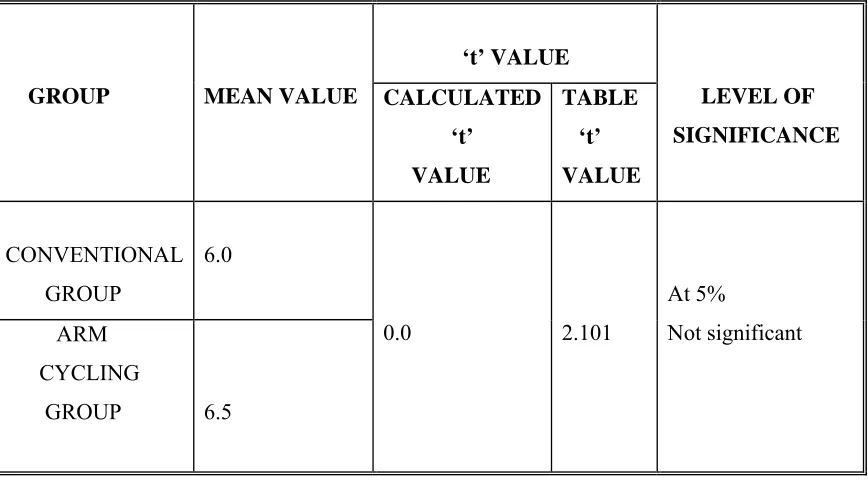
‘t’ VALUE LEVEL OF SIGNIFICANCE CALCULATED ‘t’ VALUE TABLE ‘t’ VALUE CONVENTIONAL GROUP 6.0
0.0 2.101
At 5%
Not significant ARM
CYCLING
GROUP 6.5
[image:44.612.88.526.163.407.2] [image:44.612.91.525.465.705.2]FUGL-MEYER SCALE – UPPER LIMB COMPONENT
GROUP MEAN VALUE
[image:45.612.87.526.98.345.2]‘t’ VALUE LEVEL OF SIGNIFICANCE CALCULATED ‘t’ VALUE TABLE ‘t’ VALUE CONVENTIONAL GROUP 24.6
11.21 2.101
At 5% Significant ARM CYCLING GROUP 34.4
STREAM SCALE – UPPER LIMB COMPONENT
GROUP MEAN VALUE
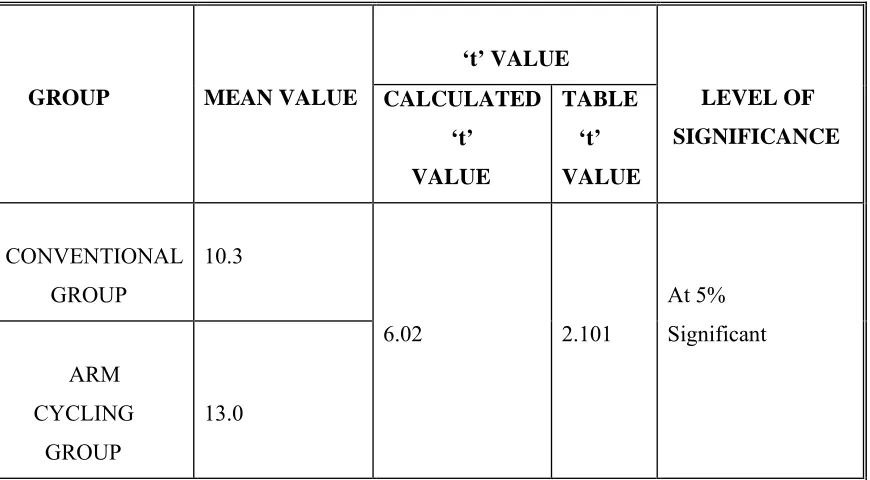
[image:45.612.91.526.406.646.2]‘t’ VALUE LEVEL OF SIGNIFICANCE CALCULATED ‘t’ VALUE TABLE ‘t’ VALUE CONVENTIONAL GROUP 10.3
6.02 2.101
5.2. GRAPHICAL PRESENTATION
FUGL – MEYER SCALE VALUES
GROUP I – CONVENTIONAL PHYSIOTHERAPY GROUP
PAIRED 't' TEST
PRE FUG L
PO ST F
UG L
0 20 40 60
GROUP II – ARM CYCLING GROUP
PAIRED 't' TEST
PRE FU
GL
PO ST FU
GL
STREAM SCALE VALUES
GROUP I – CONVENTIONAL PHYSIOTHERAPY GROUP
PAIRED 't' TEST
PRE S
TRE
AM
POST ST
RE
AM
0 5 10 15 20
GROUP II – ARM CYCLING GROUP
PAIRED 't' TEST
PRE STRE
AM
PO
ST S
TRE
AM
INDEPENDENT‘t’ TEST
PRE TEST VALUES
FUGL – MEYER SCALE VALUES
INDEPENDENT't' TEST
CON VE
NT ION
AL
AR
M CYCL
ING
0 20 40 60
STREAM SCALE VALUES
INDEPENDENT't' TEST
CONV
EN TIO
NAL
AR
M CY
CL ING
POST TEST VALUES
FUGL – MEYER SCALE VALUES
INDEPENDENT't' TEST
CONV EN
TIONAL
ARM
CY CL
ING
0 20 40 60
STREAM SCALE VALUES
INDEPENDENT't' TEST
CO NV
ENT
IONA
L
ARM
CY CL
ING
0 5 10 15 20
Data Analysis
&
Results
6. DATA ANALYSIS AND RESULTS
PAIRED ‘t’ TEST
GROUP I – CONVENTIONAL PHYSIOTHERAPY GROUP
FUGL – MEYER SCALE – UPPER LIMB COMPONENT
The pre test and post test values of Fugl – Meyer scale – upper limb component was analysed using paired ‘t’ test. For 9 degrees of freedom and at 5% level of significance, the table ‘t’ value is 2.262 and the calculated ‘t’ value was 14.95. As the calculated ‘t’ value was greater than the table ‘t’ value, null hypothesis was rejected . Hence there was significant effect of conventional physiotherapy in improving upper limb function of acute stroke patients.
STREAM SCALE – UPPER LIMB COMPONENT
The pre test and post test values of Stream scale – upper limb component was analysed using paired ‘t’ test. For 9 degrees of freedom and at 5% level of significance, the table ‘t’ value is 2.262 and the calculated ‘t’ value was14.33 . As the calculated ‘t’ value was greater than the table ‘t’ value, null hypothesis was rejected . Hence there was significant effect of conventional physiotherapy in improving upper limb function of acute stroke patients.
GROUP II – ARM CYCLING GROUP
FUGL – MEYER SCALE – UPPER LIMB COMPONENT
STREAM SCALE – UPPER LIMB COMPONENT
The pre test and post test values of Stream scale – upper limb component was analysed using paired ‘t’ test. For 9 degrees of freedom and at 5% level of significance, the table ‘t’ value is 2.262 and the calculated ‘t’ value was27.11 . As the calculated ‘t’ value was greater than the table ‘t’ value, null hypothesis was rejected . Hence there was significant effect of conventional physiotherapy in improving upper limb function of acute stroke patients.
INDEPENDENT ‘t’ TEST
PRE TEST VALUES
FUGL – MEYER SCALE – UPPER LIMB COMPONENT
The pre test values of both the groups were analysedusing independent‘t’ test. For 18 degrees of freedom and 5% level of significance, the table‘t’ value 2.101 and the calculated ‘t’ value is 0.1802. As the calculated ‘t’ value was lesser than the table ‘t’ value, there was no significant difference between the pre test values of both groups. Hence there was homogeneity between both the groups before the experiment.
STREAM SCALE – UPPER LIMB COMPONENT
POST TEST VALUES
FUGL – MEYER SCALE – UPPER LIMB COMPONENT
The post test values of both the groups were analysed using independent ‘t’ test. For 18 degrees of freedom and 5% level of significance, the table ‘t’ value 2.101 and the calculated ‘t’ value is 11.21. As the calculated ‘t’ value was greater than the table ‘t’ value, null hypothesis rejected. Hence there was significant difference between the effectiveness of arm cycling and conventional physiotherapy when compared with conventional physiotherapy in improving upper limb function of acute stroke patients.
STREAM SCALE – UPPER LIMB COMPONENT
Discussion
7. DISCUSSION
Stroke leaves many of its survivors with mental and physical disabilities. Impaired upper limb function is one of the primary reason of admission for inpatient rehabilitation after stroke. Aim of stroke rehabilitation is to reduce the disabilities and enable the patient to return to community and make the person functionally independent as much as possible. So there is a need of properly designed rehabilitation programme to achieve the efficient recovery.
Repetitive arm training is required for accurate motor recovery and for effective motor learning. In patients with middle cerebral artery stroke, muscle weakness rather than spasticity plays a dominant role in impairment of active voluntary movements. Efficacy of the therapy could be attributed mainly to the repetitive stimulation of muscle activity in the arm. Active repetitive motor training of hand and fingers has proven to be directed at recruitment of muscle activity. The important therapeutic implication is that interventions should be directed at recruitment of muscle activity will produce early recovery.26The purpose of this study was to identify the effect of visual feedback assisted arm cycling training in improving the upper extremity Function among the individuals with acute stroke.
This study was conducted on twenty acute middle cerebral artery stroke patients in which 10 patients were administered with 45 to 60minutes per day of conventional physiotherapy training only and another 10 patients were given 45 to 60minutes per day of conventional physiotherapy training followed by 30 minutes of arm cycling training for every day for 3 weeks. The upper limb functions were assessed by Fugl-Meyer scale – upper limb component, Stream scale- upper limb component before and after the treatment schedule. The data analysis was carried out with ‘t’ test.
The conventional physiotherapy includes a gold standard approach which essentially involves providing physical assistance and encouragement for stroke patients during functional or prefunctional tasks and then gradually withdrawing this support as the individuals ability to perform desired activity improves. Hence these techniques are effective in showing improvement.29
The reason with arm cycling training could be thatarm cycling induces phasic flexor and extensor movements involving rhythmic muscle and tendon stretching, gamma activation, and sensory input on the spinal level. These repetitive character could entrain supraspinal spasticity control through long-term potentiation.24 This was supported by K. Diserensad et al., he suggested that arm cycling training leads to significant improvement in motor function among stroke patients and it is an effective therapy in rehabilitation and motor learning, the major mechanisms are attributed to synaptic plasticity and synaptic efficacy in existing neural circuits.38
Another study by MH Rabadi et al., arm cycling training helps decrease intracorticalinhibition and helps to increase bilateral recruitment of corticospinal, reticulospinal and rubrospinal pathways in each supplementary motor area.43Johansen- Berg
H et al., suggested that Reorganization takes place in unaffected hemisphere through interhemispheric connections of premotor areas in the brain, so that premotor areas in undamaged hemisphere play a role in the recovery of functions after stroke.30
The findings from this study shows that proximal segment of the upper limb showed good recovery followed arm cycling training but distal segment like hand and fingers didn’t show same recovery as like the proximal segments, because arm cycling training includes more range of repetitive movements in the proximal segments like shoulder and elbow. But it produces less repetitive range of movements to the hand and fingers, this could be the reason why proximal segments showed good improvement than distal segments.
Hence the results of the present study indicate that upper limb functional recovery in acute stroke patients can be improved significantly by additional Arm cycling training.
Summary
&
Conclusion
8. SUMMARY AND CONCLUSION
Limitations
&
Suggestions
9. LIMITATIONS AND SUGGESTIONS
9.1. LIMITATIONS
Optimal sample size was not identified.
Experiment was done during the spontaneous recovery period that might have influenced the results.
Follow up assessment was not done.
Activities of daily living were not analysed.
There was no control group with no treatment
9.2. SUGGESTIONS
Optimal sample size has to be identified.
Control group should be added in further studies.
The follow up has to be done to identify the effect of therapy on long term.
Further studies should consider about the Activities of daily living also.
Motor threshold using mapping studies should be performed to determine the response of arm cycling training.
References
REFERENCES
1. Aho k, Hamerson P, Hatanos; Cerebro vascular disease in the community; results of WHO collaborative study. 1980; vol.58; pg.113-130.
2. Andreas R Luft, MD etal., Arm Training And Motor Cortex Activation In Chronic Stroke. JAMA, October 20, 2004—Vol 292, No. 15.
3. Bard G, Hirschberg GG. Recovery of motion in upper extremity following hemiplegia. Arch Phys Med Rehabil 1965; 46:567-72.
4. Biernaskie J, Chernenko G, Corbett D; Efficacy of rehabilitative experience declines with time after focal ischemic brain injury. J Neurosci. 2004; 24(5):1245-54.
5. Braun &kautz et al., increased workload enhances force output during pedalling exercise in person with poststroke hemiplegia, stroke 1998; 29; 598-606.
6. Broeks JG, et al., The long-term outcome of arm function after stroke: results of a follow-up study. DisabilRehabil. 1999 Aug;21(8):357-64.
7. Buchkremer-Ratzmann I, August M, Hagemann G, Witte OW. Electrophysiological transcorticaldiaschisis after cortical photothrombosis in rat brain. Stroke
1996;27:1105-1109.
8. Chae J, Francois Bethoux, Theresa Bohine, LoreenDobos, Tina Davis, Amy Friedl; Neuro muscular stimulation for upper extremity motor and functional recovery in acute hemiplegia; Stroke 1998; Vol.29; Pg.957-979.
10.Chouinard PA, Leonard G, Paus T; Role of the primary motor and dorsal premotor cortices in the anticipation of forces during object lifting. J Neurosci. 2005; 25: 2277-84.
11.Carey M et al., Motor impairments and recovery in the upper limb after stroke. Stroke 2005. Vol:36. Pg.625.
12.Chun-Hou Wang et al., Inter – Rater reliability and validity of the stroke rehabilitation assessment of movement instrument. J Rehabil Med 2002; 34: 20–24
13.Cramer, S. C. & Bastings, E. P. (2000) Mapping clinically relevant plasticity after stroke. Neuropharmacology., 39, 842-51.
14.David J. Gladstone TheFugl-Meyer Assessment of Motor Recovery after Stroke: A Critical Review of Its Measurement Properties. Neurorehabil Neural Repair 2002 16: 232.
15.David off G.N et al., Acute stroke patients; Long term effects of rehabilitation and maintenance of gains. Arch. Phy. Med. Rehabil July 1991; Vol 72: Pg. 809-873.
16.Delisa A. Joel, Gans M. Bruce. Rehabilitation medicine; principles and practice; third edition; chapter: stroke rehabilitation. Pg 1165 – 1184.
17.DonmezBirgul et al., The impressive factor on functional recovery of the upper extremity in hemiplegic patients. Journal of Neuro science 2007. Vol.24, no:12, Pg.226-233.
18.E. Paul Zehr et al., Neural control of rhythmic, cyclical human arm movement: task dependency, nerve specificity and phase modulation of cutaneous reflexes. Journal of Physiology (2001), 537.3.
20.E. Paul Zehr et al., The pattern of cutaneous reflex modulation during backward arm cycling was equivalent to that seen during forward cycling. J Neurophysiol93: 633– 640, 2005.
21.Fatima de N A P, Shelton and Michael J, Riding. Effect of lesion location on upper limb motor recovery after stroke. Stroke 2001; Vol.32; Pg.107.
22.GereonNelles, GregorSpikermann, MarkeesJuepther. Reorganization of sensory and motor systems in hemiplegic stroke patients; A position emission tomography study. Stroke 1999; Vol.30; Pg.1510-1516.
23.Harris E et al., Paretic upper limb strength best explains arm activity in people with stroke. August 2006.
24.Hesse S, Werner C. Poststroke motor dysfunction and spasticity: novel
pharmacological and physical treatment strategies. CNS Drugs. 2003;17:1093-1107.
25.Higgins et al., Upper-limb function after strokeJRRD, Volume 42, Number 1, 2005
26.Hilde M. Feys et al., Effect of a Therapeutic Intervention for the HemiplegicUpper Limb in the Acute Phase After Stroke. A Single-Blind, Randomized, Controlled Multicenter Trial Stroke 1998, 29:785-792.
27.I-Ping Hsueh et al., Psychometric Comparisons of 2 Versions of the Fugl-Meyer Motor Scale and 2 Versions of the Stroke Rehabilitation Assessment of Movement. Neurorehabil Neural Repair 2008 22: 737
28.Jill whitall, phd et al., Repetitive bilateral arm training with rhythmic auditory Cueing improves motor function in Chronic hemiparetic stroke. Stroke 2000;31;2390-2395.
30.Johansen- Berg H, Rusworth MF, Bogdanovic MD, Kischka U, Wimalarathan S, Matthews PM; The role of ipsilateral premotor cortex in hand movements after stroke. ProcNatlAcadSci USA. 2002; 99; 14518-14523.
31.Johanne Higgins et al., Upper-limb function and recovery in the acute phase poststroke. JRRD, Volume 42, Number 1, 2005.
32.John W. Krakauer. Arm Function after Stroke: From Physiology to Recovery. Seminars in neurology/volume 25, no:4. 2005.
33.Jones TA, Schallert T; Use-Dependent growth of pyramidal neurons after neocortical damage. J Neurosci. 1994;14:2140-2152.
34.Julie Duque et al., Transcallosal inhibition in chronic subcortical stroke
NeuroImage.Volume 28, Issue 4, December 2005, Pages 940-946 Special Section: Social Cognitive Neuroscience.
35.Julie Sanford et al.,Reliability of the Fugl-Meyer Assessment for Testing Motor Performance in Patients Following Stroke. Physical Therapy July 1993 vol. 73 no. 7
447-454
36.Justin A et al., Active Range of Motion predicts Upper Extremity Function Three months post-stroke Stroke. 2009 May; 40(5):
37.Kathy Daley et al.,Reliability of Scores on the Stroke Rehabilitation Assessment of Movement (STREAM) Measure. Physical Therapy. Volume 79. Number 1. January 1999.
38.K. Diserensad et al., The effect of repetitive arm cycling on post stroke spasticity and motor control: Repetitive arm cycling and spasticity, J Neurol Sci. 2007 Feb 15;253.
40.Luis Hernandez, Yifen Yen, Eric P. Bastings, Greg Hammon, David C.Good; Functional recovery of Motor Cortex after stroke; functional MRI and Transcranial Magnetic Stimulation; 1998.
41.Magill RA. Motor learning: concepts and applications. 6th edn. New York, NY: McGraw-Hill; 2001.
42.Mehadi M et al., Time course of changes in arm impairment after stroke variables predicting motor recovery over 12 months. Arch. Phys. Med. Rehabil. Aug 2008. Vol;89, Pg.1507-1513.
43.MH Rabadi et al., A pilot study of activity-based therapy in the arm motor recovery post stroke. ClinRehabil2008 22: 1071.
44.M. C. Cirstea,Improvement of Arm Movement Patterns and Endpoint Control Depends on Type of Feedback During Practice in Stroke Survivors. Neurorehabil Neural Repair. 2007;21:398-411.
45.Nakayama H, Horgensen HS, Faaschou HO, Olsen TS. Recovery of upper extremity function in stroke patients: the Copenhagen stroke study. Arch Phys Med Rehabil. 1994;75:394–98.
46.Nick S Ward, Leonardo G Cohen. Mechanism underlying recovery of motor function after stroke. Arch.Phys.Med.Rehabil, Vol.61; Dec 2004; pg. 1844 – 1848.
47.Pamla L Duncar et al., Measurement of motor recovery after stroke outcome assessment and sample size requirements. Stroke 1992, Vol.23, Pg.1084-1089.
48.Parlow SE, Dewey D. The temporal locus of transfer of training between hands: an interference study. Behav Brain Res. 1991;46:1-8.
50.Peurunnen K et al., Studies on the influence of enriched – environment housing combined with systemic administration of an alpha adrenergic antagonist on spatial learning and hyperactivity after global ischaemia in rats. Stroke: 1997; Vol.28; Pg.623-631.
51.Rankin J: CVA in patients over the age of 60; prognosis. Scot Med Journal. Vol 2; pg 200 – 215.
52.Sandeep K. Subramanian et al., Does Provision of Extrinsic Feedback Result in Improved Motor Learning in the Upper Limb Poststroke? A Systematic Review of the Evidence. Neurorehabil Neural RepairFebruary 2010 vol. 24 no. 2 113-124.
53.Sara Ahmed et al., The Stroke Rehabilitation Assessment of Movement (STREAM): A Comparison With Other Measures Used to Evaluate Effects of Stroke and Rehabilitation. Physical Therapy. Volume 83. Number 7. July 2003
54.Schmitz T J. Stroke. O Sullivan SB. Physical rehabilitation: Assessment and trearment, 4th edition Philadelphia: FA Davis Company, 2001:411-443.
55.Schmidt RA, Lee TD. Motor control and learning: a behavioural emphasis. 3rd edn. Champaign, IL: Human Kinetics; 1999.
56.S. Hesse et al., Computerized Arm Training Improves the Motor Control of the Severely Affected Arm After Stroke. Stroke 2005;36;1960-1966.
57.Susan Ryerson: Chapter 22; Hemiplegia resulting from vascular insult or disease. In Darcy Ann Umphred: Neurological rehabilitation, 2nd edition. Pg.632-645.
58.The internet stroke center, September 2010.
60.Thomas Carmicheal S, MD,Phd; Cellular and molecular mechanisms of neural repair after stroke: making waves; April 2006 Volume 59, Issue 5,p 735-742.
61.Thomas Platz et al., Reliability and validity of arm function assessment with standardized guidelines for the Fugl-Meyer Test, Action Research Arm Test and Box and Block Test: a multicentre study. ClinRehabilApril 2005 vol. 19 no. 4 404- 411
62.Tom Skyh0j Olsen. Arm and leg paresis as outcome predictors in stroke rehabilitation. Stroke1990;21;247-251.
63.Wade DT et al., The hemiplegic arm after stroke: measurement and recovery. J NeurolNeurosurg Psychiatry 1983;46:521– 524.
64.Ward NS, Broun MM, Thompson AJ, Frackowiak RSJ; Neural correlates of motor recovery after stroke; a longitudinal fMRI study. Brain 2003a; 126: 2476-2496.
65.Ward NS, Broun MM, Thompson AJ, Frackowiak RSJ; The influence of time after stroke on brain activations during a motor task. Ann Neurol. 2004; 55(6): 829-834.
APPENDIX - I
BRUNNSTROM VOLUNTARY MOTOR GRADING FOR ARM
RECOVERY STAGE 1
No voluntary movement of the affected limb can be initiated. In this stage the limbs feel heavy when moved passively, and little or no muscular resistance to movement can be detected.
RECOVERY STAGE 2
The basic limb synergies or some of their component now make their appearance either as weak associated reaction or minimal voluntary movement responses may be present. The extend of movement does not necessarily result in joint movement, spasticity is
developing but may not be very marked.
RECOVERY STAGE 3
The basic limb synergies or some of their components are performed voluntarily and are sufficiently developed to show definite joint movements. Spasticity has increased, and during this stage it may become marked.
RECOVERY STAGE 4
Spasticity begins to decrease, and some movement combinations that deviate from basic limb synergies become available.
RECOVERY STAGE 5
A relative independence of the basic limb synergies characterizes this stage, and
spasticity waning. More difficult movement combinations can be performed and certain individual joint movements may succeed. Easier movement combinations are performed in a more effortless manner.
RECOVERY STAGE 6
APPENDIX - II
FUGL – MEYER SCALE – UPPER LIMB COMPONENT
Area Test Scoring Criteria Maximum
Possible Score Attained Sco