JOURNAL OFVIROLOGY, Aug.1994, p. 5045-5055 Vol.68,No. 8 0022-538X/94/$04.00+0
Copyright © 1994, AmericanSociety forMicrobiology
Kinetic
and Structural
Analyses of
Hepatitis
C
Virus
Polyprotein
Processing
RALFBARTENSCHLAGER,* LUDWINAAHLBORN-LAAKE, JANMOUS,ANDHELMUT JACOBSEN
PharmaceuticalResearch-New Technologies, F.
Hoffmann-La
RocheLtd., 4002Basel, SwitzerlandReceived 9February1994/Accepted 22April 1994
Recombinantvaccinia viruseswereused to study theprocessingof hepatitis C virus (HCV) nonstructural polyprotein precursor. HCV-specific proteins and cleavage productswereidentified by size andby immuno-precipitation with region-specific antisera. A polyprotein beginning with 20 amino acids derived from the carboxy terminus of NS2andending withtheNSSBstopcodon(amino acids 1007to3011)wascleaved at the NS3/4A,NS4A/4B, NS4B/5A,andNS5A/5B sites, whereasapolyproteininwhichtheputative active site serine residuewas replacedby an alanineremained unprocessed, demonstrating thatthe NS3-encoded
serine-type
proteinase is essential forcleavage at these sites. Processing ofthe NS3'-5B polyproteinwas complex and occurred rapidly. Discrete polypeptide species corresponding to various processing intermediates were detected. With the exception of NS4AB-5A/NS5A, no clear precursor-product relationships were detected. Using double infection ofcellswith vaccinia virus recombinants expressing eithera proteolyticallyinactive NS3'-5B
polyprotein
or an active NS3 proteinase, we found that cleavage at the NS4A/4B, NS4B/5A, andNS5A/5Bsitescould bemediatedin trans. Absence of trans cleavage at theNS3/4A junction togetherwiththe findingthatprocessingatthissitewasinsensitivetodilutionoftheenzymesuggestedthatcleavageatthissite is anintramolecular reaction.Thetrans-cleavage assay was also used to showthat (i) thefirst211amino acids of NS3weresufficientforprocessingatalltranssitesand(ii)smalldeletions from the amino terminusofNS3 selectively affected cleavage attheNS4B/5Asite, whereas moreextensive deletions also decreasedprocessing efficienciesattheother sites.Usingaseries of
amino-terminally
truncatedsubstratepolyproteinsin the trans-cleavageassay, wefound thatNS4A is essential for cleavageattheNS4B/5A site andthatprocessingatthis sitecould berestoredby NS4A providedin cis (i.e., togetherwiththesubstrate) orin trans(i.e., together with the proteinase). These results suggest that in addition to the NS3 proteinase, NS4A sequences play an importantrole inHCV polyprotein processing.Infection with hepatitis C virus (HCV) is considered tobe the majorcause ofposttransfusion and sporadic, community-acquired non-A, non-B hepatitis (for a recent review, see reference 23). It can lead to various clinical manifestations,
including acute hepatitis, chronic hepatitis, liver cirrhosis, or an asymptomatic carrier state (22). In addition, the high
prevalence of anti-HCV antibodies in chronically infected
anti-hepatitis Bantigen-negative patients with hepatocellular
carcinoma indicates astrongassociation between HCV
infec-tion andtumordevelopment(9, 12, 15, 29,35).
Sincetheinitialcloning(10),anumber ofnewHCVisolates have been characterized(forasummary, seereferences4and
31).Asdeducedfrominfectivitystudies withchimpanzeesand from comparativesequenceanalyses, HCV has been classified as a separate genus in the family
Flaviviridae
together withpestiviruses andflaviviruses (7, 11, 27).Theseviruses have in commonavirion withalipidenvelope,asingle-strandedRNA genome ofpositive polarity encoding one longopen reading frame of ca. 3,000 to 4,000 codons, and a similar genomic
organization. The structural proteins (in the case of HCV, core-envelope 1 [E1]-E2) are located in the amino-terminal
region and are followed by the nonstructural (NS) proteins (NS2, NS3, NS4A/B, andNS5A/BforHCV).
Production ofmatureproteinsfrom thepolyprotein precur-sorisaccomplishedbyaseries ofproteolyticcleavages.Recent studies have shown that HCV structuralproteinsaregenerated
*Corresponding author. Present address: Institute for Virology,
Johannes-Gutenberg University of Mainz, Hochhaus am Augustus-platz, 55101 Mainz,Germany. Phone: 173134. Fax:
49-6131-172359.
from the polyprotein by host cell signalases (18, 19, 24, 26, 32), whereasprocessingof the NS polyprotein requiresatleasttwo virus-encodedenzymes:theNS2-3proteinase(16, 20) cleaving between NS2 and NS3 and the NS3 proteinase cleavingatall the sites further downstream (2, 13, 17, 20,36). Biochemical andmutationalanalysessuggestthat the NS2-3proteinaseisa
zinc-dependentmetalloproteinase(20),whichis,to our
knowl-edge,withoutprecedentamongflavivirusesandpestiviruses.In contrast, NS3 appears to be a serine-type proteinase as are
flavivirus NS3 and pestivirusp80 proteinases (5, 6, 8, 14, 28, 37).
In this report, recombinant vaccinia viruses were used to further characterize HCVpolyprotein processingandtodefine theactivityof the NS3proteinase moreprecisely. Our results
stronglysuggestthatthecarboxyterminus of NS3 isgenerated by an intramolecular reaction, whereas cleavage at all sites furtherdownstream can be mediated intransby aproteinase
containing the amino-terminal 211 amino acids of NS3.
Fur-thermore,wehave found thatsequencesfromthe NS4region playanimportantrole inpolyprotein processing, especiallyfor
cleavageat theNS4B/5Asite.
MATERIALSANDMETHODS
Construction of plasmids for homologous recombination. The basicplasmids pATA 1007-2234, pATA 1007-1830, and pBSK 1007-1912containingHCVsequencesinserted into the modified vaccinia virus recombinationvectorpATA-18orinto the T7transcriptionplasmid pBSK
(Stratagene,
Zurich,
Swit-zerland) have been described before
(2) (numbers
refertothe first and the last amino acids of the expressedHCVpolypro-5045
on November 9, 2019 by guest
http://jvi.asm.org/
5046 BARTENSCHLAGER ET AL.
tein fragment). To obtain plasmid pATA 1007-3011 bearing either a wild-type or mutated NS3 proteinase, pATA 1007-2234/wild type (wt) and pATA 1007-2234/S--A (in which the putative active site serine residue was replaced by an alanine residue [2]) were restricted with SpeI at the multiple cloning site (MCS) and HpaI at HCV nucleotide position 5969 (ac-cording to the nomenclature ofKato et al. [25]) and combined with HpaI-Bsu36I (5969 to 8134) and Bsu36I-SpeI (8134 to MCS) HCV fragments. These fragments were isolated from plasmids in which HCV sequences cloned from the serum ofa chronically HCV-infected patient had been inserted (2). Plas-mids containing HCV sequences from NS4A to NS5B (amino acids 1658 to 3011 of the polyprotein), NS4B toNS5B (1712to 3011), or NS5A to NS5B (1973 to 3011) were constructed by PCR with upstream primers containing at their 5' ends an EcoRI restriction site and an ATG codon. After 10 cycles, DNAfragments were purified by preparative gel
electrophore-sis,restricted withEcoRI (HCV nucleotide position 6687), and inserted into the EcoRI-digested plasmid pATA 1007-3011. Plasmid pATA 1007-1647 was obtained by insertion of an
EcoRI (stickyend)-NsiI (blunt ended after treatment with the Klenowenzyme) HCV fragment into pATA-18 cut with EcoRI
(sticky end) and BamHI (blunt ended). To construct plasmid pATA 1007-1564 an EcoRI (MCS)-StuI (nucleotide position 5020) fragment isolated from pBSK 1007-1912 was inserted in pATA-18 restricted with EcoRI and SpeI. Plasmid pATA 1007-1355 was obtained by insertion of an EcoRI (MCS)-BstEII (nucleotide position 4391) fragment into the EcoRI-SmaI-restricted pATA-18. To obtain plasmid pATA 1007-1395, an EcoRI-XbaI fragment (MCS to 4513) was isolated from plasmid pBSK A4513-5050 (2) and inserted into pATA-18 restricted with EcoRI and SpeI. Plasmids pATA 1007-1269 and pATA 1007-1238 were constructed in the same way with pBSK A4133-4783 and pBSK A4040-4713 (2) to isolate the HCV DNA fragments. Construction of the basic plasmids carrying various 5'-deleted NS3 fragments has been described recently (2).
Expression ofHCV-specific proteins inEscherichia coli and generation of antisera.Expression of NS3-, NS3/4-, and
NS5A-specific polyprotein fragments has been described previously (2) (see Fig. 2A). To express the NS5B-specific protein, a DNA fragment from nucleotide positions 7587 to 8207 (amino acids 2419 to 2625 of the polyprotein) was amplified by PCR with
oligonucleotides carrying BamHI restriction sites at their 5' ends and was inserted into the BamHI-restrictedvector pDS
561/RBSII 6xHis (33). After induction, the protein was puri-fiedby metal chelateaffinity chromatography under denaturing conditions(33). Furtherpurification of the protein and gener-ation of antiseraweredone exactly as described previously(2). The antibody titer as determined by enzyme-linked immu-nosorbent assay was 1:512,000.
Generation of recombinant vaccinia viruses. Human tk-143cells were infected with the temperature-sensitive vaccinia virus vts-7 (kindly provided by Hans-Jurgen Schlicht,
Univer-sityofUlm, Ulm, Germany) at a multiplicity of infection of 1 for 1 h atroom temperature in Dulbecco's modified minimal essential medium (DMEM). After removal of the inoculum, cellswere incubated in medium supplemented with 10% fetal calfserum (FCS) for2 hat33°C. Medium was removed, cells were washed several times with phosphate-buffered saline
(PBS), and the calcium phosphate precipitate, prepared as describedpreviously (3) with 1 ,ugofvaccinia virus wild-type DNA and0.5 to 2 ,ug of plasmid DNA in a total volume of 250
RI,
was added dropwise. After 1 h at room temperature, DMEMwithout FCS was added, cells were incubated for 2 h at40°C and washed four times with PBS, and FCS-containingA
5'- structural |
1026 82 809
nonstructural
1657 1711 1972 2419
3 4A. 4B 5A 5B
3011 B
1007
*1830
1007 1647
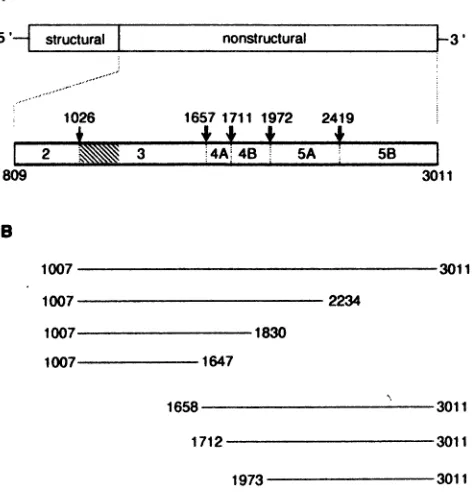
FIG. 1. HCV genome structure and expression constructs. (A) Diagram of theHCV genomeencoding the structuralproteins inthe 5'-terminalquarterfollowed bythe NSproteins2 to5B. The 5' and 3' nontranslatedregionsareindicatedasthinlines.Adetailedviewofthe NS protein region (amino acids 809 to 3011 ofthe polyprotein) is drawnbelow.Cleavage sitesof theNS2-3proteinase(,) (16,20)and the NS3proteinase(XU)(2, 13, 17, 20,36)aregiven.Numbers above the arrows refer to the aminoacidsattheP1 positionsof thescissile bonds.(B)HCVpolyprotein expressionconstructsusedinthisstudy. Linesdepict regions of theHCV genomeexpressedwithrecombinant vacciniaviruses and aredrawntoscale andorientedwith respect tothe diagraminpanelA.Numbers refertothefirstandlast aminoacidsof the HCVpolyprotein expressed with the recombinant vaccinia viruses.
mediumwasadded. Cellswere lysed after 48 hat40°C in 10 mMN-2-hydroxyethylpiperazine-N'-2-ethanesulfonic acid, and thelysatewasusedfor infection of human tk- 143 cells for 1 h at roomtemperature as described above. Finally, complete medium containing 100 ,ug of 5-bromo-2'-deoxyuridine (Sig-ma,Deisenhofen, Germany) per mlwasadded,and cells were incubated for48hat37°C.Large-scalepreparationsof recom-binant vaccinia virusesweregrownon HeLacells, and titers of infectious progenyweredetermined byplaqueassayonhuman tk- 143 cells.
Metaboliclabellingof infected cells andcharacterization of HCV-specific proteins.HeLacellswereinfectedat a multiplic-ityof infection of 5to10asdescribed above and16hlaterwere incubated in methionine- andFCS-free medium for 1 h. After addition of the samemedium supplemented with 100
pRCi
of[35S]methionine
(AmershamLifeScience, Braunschweig,Ger-many) and incubation for various times, cells were lysed in TNE(10 mM Tris-HCI [pH 8.0], 100mMNaCl, 1 mM EDTA) with 1% Triton X-100. The lysate was clarified by a 15-min centrifugation at 15,000 x g at 4°C, and proteins in the supernatant were precipitated by the addition of 2% sodium dodecyl sulfate(SDS) and5% trichloroacetic acid. After 10 to 30minat0°C, precipitated proteinswerecollectedbya5-min centrifugation at 6,000 x g and resolved in protein sample buffer(200mMTris-HCl[pH8.8],5 mMEDTA,2% SDS,1% J. VIROL.
on November 9, 2019 by guest
http://jvi.asm.org/
[image:2.612.329.565.80.326.2]HCV POLYPROTEIN PROCESSING 5047 A
1i 1kA.I
W- S3 -- -NS
antiserurm NS3 iNS3/4 *NS5A NS5B
P70 Pp8*P27t p58_.
P68__
vv1007-301 lIwt
3 3S4 A
.
II
I .. -Rvv1007-3011/S--A
II 3/4 iA
I + I +
I
.-.~.i.
_.
-220
--1eD1
A,Iz
1.
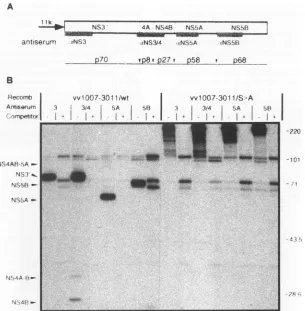
Ij..FIG. 2. Proteolytic processing ofanNS3'-5B polyprotein expressed with recombinant vaccinia viruses. (A) Schematic representation of the
HCVgenomesegmentexpressed undercontrol of the vaccinia virus 11-kDa latepromoter.Fragmentsof thepolyprotein usedtogenerateantisera
areindicated asdotted bars.Theapparentmolecularmasses(in kilodaltons) ofindividualprocessing productsaregivenbelow.(B)Analysisof HCV-specific proteins isolatedfromHeLacells infected with recombinantsexpressinganunalteredNS3'-5B polyprotein (w1007-3011/wt) oran
NS3'-5B withanenzymatically inactive NS3 proteinase (w1007-3011/S->A). Cellswere labelled for1hwith[35S]methionine,andproteinswere
isolated fromthe lysate byimmunoprecipitation. To demonstrate the specificities of the detected proteins, immunoprecipitationswereperformed
in theabsence(-)orpresence(+) ofahomologous competitor.Numberstotherightrefertothesizes of markerproteins (in kilodaltons).
2-mercaptoethanol, 10% sucrose, and 0.1% bromophenol blue). After 5 minofboiling, sampleswere diluted to RIPA bufferby adding20volumesof RIPA buffer withoutSDS(PBS, 1% Triton X-100, 0.5% sodium deoxycholate) containing 1 mM phenylmethylsulfonyl fluoride (Sigma). Finally, 15 ,ul of packed protein A-Sepharose containing preadsorbed immuno-globulin (corresponding to3to 6,ulofantiserum)wasadded and thesamples were incubated overnight at 4°Cwith agita-tion. After three washes of theimmunocomplexeswith RIPA buffer, protein sample buffer containing 3.3% SDS and 2% 2-mercaptoethanolwasadded,sampleswereboiled for5min,
and halfof the materialwasanalyzed bySDS-polyacrylamide
gelelectrophoresisandfluorography. Competitionsweredone
by adding 10 ,ug of purified homologous antigen to the immunoprecipitation.
In vitrotranscription andtranslation. Adetailed descrip-tion of these methods is given in reference 2. In brief, the
linearized plasmid pBSK 1007-1912 was used for in vitro
transcription, and afterphenol extraction and ethanol precip-itation,RNAwasquantified by comparisonofaserialdilution of the RNAwithaconcentration standard after
electrophore-sis through an agarose gel. RNA was used for in vitro
translations in a rabbit reticulocyte lysate according to the instructions of the manufacturer (Promega, Heidelberg, Ger-many).
RESULTS
Processing activity of an HCV NS3'-5B polyprotein. The goal ofourstudieswas an examination of HCV polyprotein processing mediated by the NS3 serine-type proteinase by using an NS3'-5B polyprotein expressed with recombinant vaccinia viruses (Fig. 1) (a prime indicates an HCV protein withanonauthentic aminoorcarboxy terminus).This polypro-tein was selected because it was expressed to much higher levels than the full-length polyprotein (la) and because it is predicted to properly reflect all the cleavagereactions medi-ated by the NS3 proteinase for two reasons: (i) we (2) and others (13, 17, 20, 36) have shown that sequences amino terminal to NS3 are dispensable for all NS3-mediated
cleav-ages,and(ii)mutational ablationof theNS2-3proteinasedoes not affect processing at any of the NS3-dependent cleavage sites (16, 20).TheNS3'-5Bpolyproteinincludesthecomplete NS3-4AB-5ABopenreadingframeandinitiates with 20 amino acids derived from the carboxy terminus of NS2 (Fig. 2, wlOO7-3011/wt). To correlate the generation of individual processing products with NS3-encoded activity, a further
re-combinant expressing an NS3'-5B polyprotein in which the putative activesite serine residuewas replacedby an alanine residue (vv1OO7-3011/S->A)wasmade (Fig. 2).
B
Recomb Anftlswum
o*vm("ttor
N.A
fi-VOL. 68,1994
LSB
+
**m
on November 9, 2019 by guest
http://jvi.asm.org/
[image:3.612.151.456.72.383.2]5048 BARTENSCHLAGER ET AL.
Infection of HeLa cells with recombinant virus expressing the activeproteinase generated proteins with apparent molec-ular masses of about 70, 27, 58, and 68 kDa corresponding to NS3', NS4B, NS5A, and NS5B, respectively, thus demonstrat-ing specific cleavage at the NS3/4A, NS4A/4B, NS4B/5A, and NS5A/5B sites (Fig. 2). Two additional double bands in the molecular mass range of about 67 and 95 kDa were consis-tently observed in all immunoprecipitations. They corre-sponded to vaccinia virus proteins binding nonspecifically to protein A-Sepharose since their amounts could not be reduced in immunoprecipitations using homologous competitors (Fig. 2,+lanes). We did not detect NS4A, a protein of about 8 kDa, possibly because of low reactivity with our antiserum and low labelling efficiency (the predicted NS4A of our isolate would contain only one methionine). However, the appearance of
A
NS3and NS4B canbe taken asevidence of cleavage between NS3 andNS4A aswellasbetween NS4A and NS4B.
In addition, various amounts of processing intermediates were detected and identified by their apparent molecular weights and their reactivities with the individual antisera as NS4ABand, much morevisible in the experiments described below(e.g.,seeFig. 3A), NS4AB-5A andNS4B-5A. Noneof these cleavage productswas obtained with the polyprotein in which the activesiteserineresidue was replaced by an alanine residue. Instead, the unprocessedpolyproteinwithan apparent molecular mass of about 220 kDa was detected, illustrating that theNS3-encodedproteinase is essential for cleavageatall sites downstream of its owncarboxyterminus.
Kinetics of NS3'-5B polyprotein processing. To identify possible precursors, pulse-labelling experiments were carried
min
B
uNS314
n.. I.1. I-U1 nI
.5B_
Aww.
...
1 11 130160
110012401
.I ::..E: ..:t...,I...: "..:: I
-3-5A--4A5Am
48 5A--03'
5A
4 A-,
ItzNS58 |
I5
lo | 1S lvs 160 |...
:} tisy, pesS: _ _
.: gxe_. _
..,.'...
.. :'.:.. ...:. _.:. ..:... .__
...'.'"
.::.::
-220
-101
-71
435
-286
aNS58
0OI 130j60 11001240
-soI§?i,= _" .. ..- .:. .1
=_... _ _~~~~10
SR_7
.i--435
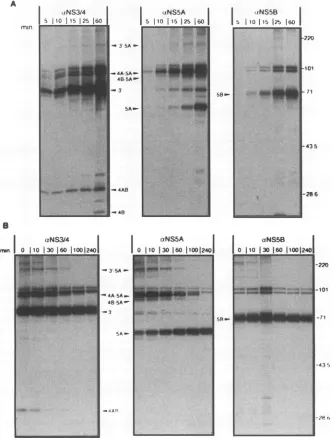
FIG. 3. Kinetic analyses of NS3'-5B polyprotein processing by continuous and pulse-chase labelling. (A) Cells were infected with the
recombinantexpressing NS3'-5B and16h later radiolabelledwith[35S]methioninefor the indicated times. (B) Infected cellswerelabelled for 20
min and,afterbeing washed, incubated in nonradioactivemedium for various times. HCV-specific proteinswereisolated from the celllysateby immunoprecipitation with the indicated antisera.
nn
0W.
..
..
I
0
J. VIROL.
tR
on November 9, 2019 by guest
http://jvi.asm.org/
[image:4.612.143.476.242.682.2]HCV POLYPROTEIN PROCESSING 5049 A
NS3 4A NS4B_NS5A NS5B 1007-3011 270 ,v p27i
258
' P681007-2234 P70
vp8,P27*
p28 Brecornb 1007-30l1 1S>A j
JP 3 13141|5A151B 3
5B-
4A-SAm-48-5AG
3-
58-
5Am-
4AB-
409-1 2 3 4
1007-3011wt
I
007-2234/S>3 131415A15B1 3 131J415A
...r.4
-3'-SAa-_
.w~
A .'
5 6 7 8 9 10 11
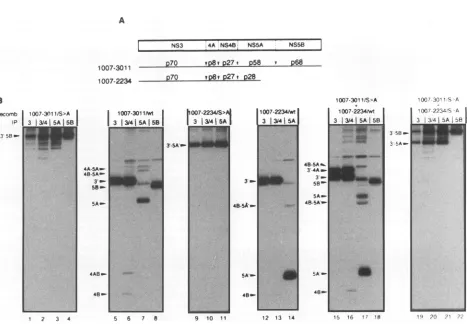
FIG. 4. Cleavage ofanNS3'-5B polyprotein intrans.(A) Schematic representation of the HCV NS3'-SB andNS3'-5A' polyproteins and the
apparentmolecularweights of processing products. (B) Cellswereinfected with eitherone ortworecombinants(recomb.) expressing unaltered HCVpolyproteins (wt)orpolyproteins withaninactiveNS3 proteinase (S-*A). Sixteen hours after infection, cellswereradiolabelled for 1 h and
then underwent celllysis and immunoprecipitation (IP).
outwith HeLa cells infected with vaccinia virusrecombinants expressing theenzymaticallyactive NS3'-SB polyprotein. The processedNS3'wasalready visible after 5min of labelling (Fig.
3A,left panel); labelling timesasshortas 2 minstillallowed
clear detection of thisprotein (datanotshown), suggestingthat cleavage at the NS3/4A site is a rapid event. NS4B was
detected after 60 min of continuous labelling (25 min with prolonged exposures), indicating delayed cleavage between NS4AandNS4B.Incontrast,the NS4AB processing interme-diatewasgeneratedveryrapidly, beingdetectableafter 5 min oflabelling (Fig. 3A, left panel). NS5A and NS5B could be detected after 15 and 10 min of labelling, respectively. In addition to the mature processing products, several higher-molecular-mass proteins of about 85, 95, and 170 kDawere
visible. Antiserum to NS3/4 and NSSA reacted with the 170 and95 kDaproteins, whereas the 85kDaproteinwas
precip-itated only by the NS5A-specific antiserum. None of these proteins reactedwith the antiserumtoNS5B. On the basis of these reactivities anddeduced molecularmasses, the170-kDa proteincanbedesignated NS3'-5A,the 95-kDaproteincanbe designated NS4AB-5A, and the 85-kDa proteincan be
desig-nated NS4B-5A. No NS5B-specific processing intermediates
were detected.
To analyze the stabilities of these proteins and to identify possible precursor-product relationships, pulse-chase experi-mentswereperformed (Fig. 3B).Results from
immunoprecipi-tations with the NS3/4-specific antiserum revealedthat NS3' forms a stable peptide with a half-life of about 4 h. In
con-trast, the NS3'-5A and NS4AB intermediates were unstable
and disappeared with half-lives of about 45 and 15 min, respectively. The only proteinwith aclear precursor-product
relationshipwas NS5A, whoselevel increased overtime
con-comitantlywithadecrease ofNS4AB-5A and NS4B-5A inter-mediates. Using longer pulse intervals, we could also detect
NS4B butfound ittobeveryunstable,withahalf-life ofonly
about 15min (datanotshown).Theonly proteindetected with the NS5B-specific antiserum was NS5B (Fig. 3B), a stable
protein decayingwithahalf-life of about6 h.
ProcessingofanNS3'-5Bpolyproteinintrans.So farwehad
used a polyprotein in which the proteinase was part of the polyproteinand thereforedirectlylinked with its substrate. To differentiatewhetherprocessingatthevarious siteswasstrictly an intramolecular reaction or could also occur
intermolecu-larly, transcomplementation experimentswereperformed (Fig.
4). Cells were infected with a recombinant vaccinia virus expressing the proteolytically inactive NS3'-5B polyprotein along with a recombinant directing the expression of an
NS3'-5A' protein with an enzymatically active proteinase domain (Fig. 4A). As shown inFig. 4B (lanes 15to 18), this doubleinfectionyielded proteins correspondingtoNS5A(lane 17) andNS5B (lane 18),both of whichwere notdetected in cells expressing either inactive NS3'-5A' or NS3'-5B protein
(lanes9 to 11 and 1 to4, respectively) norincellsexpressing
both defectivepolyproteins together (lanes 19to22).Anovel processing productof 78 kDawhichwasnotproduced bythe activeNS3'-5B polyprotein (Fig. 4B,lanes5to8)wasobserved
3
58-3
5A.-I
*40sA
-1007-2234Mt
3 131415A
3_NL
12 13 14
1007-301 IrS>A
1007-223wt
3 31415A SB
..
<.
_Ma "WS
1, 16 17 18
48-5A . 3-4Am
3-.
58- 5Am-4B-5Am_
5A-48A
I 7-30'1c A
¶00.r 2234S A
3 i34 5A 58
IQ ?(' .)
SA'- 48m-VOL.68, 1994
on November 9, 2019 by guest
http://jvi.asm.org/
[image:5.612.74.541.60.384.2]5050 BARTENSCHLAGER ET AL. A
101
-71
-43.5
-B
120
100
80
| 20|10
1s.0l
J1.0
0510.1
I
OMwo
mo_o .-~
- 3-4AB'
0.1 1.0 10 100
pig/ml
FIG. 5. CleavageattheNS3/4Asite isinsensitivetodilution. (A) VariousamountsofanHCV RNAencodinganNS3'-4B' polyprotein
(aminoacids 1007to1912)wereused for in vitrotranslation with the
rabbitreticulocyte lysate. After 60min at30°C,proteinswereanalyzed
byelectrophoresisinan11%polyacrylamide gel and by fluorography.
Numbersabove each lane refertotheamountof RNA(inmicrograms
per milliliter) used for each translation. The positions of marker proteins (in kilodaltons) are indicatedonthe left.(B) Radioactivities
containedin the NS3'-4B' and NS3' proteinswerequantitated witha
phosphoimager.Theprecursorproduct ratio obtained with 20 p.g/ml wassetas100.
reactingwith the NS3/4-specific antiserum (compare lanes 6
and 16). The size and immunoreactivity of this protein,
to-gether withthe fact thatnoNS4AB-5Awasobserved withthis
infectionbut onlyanNS4B-5A intermediate (Fig. 4B;compare
lanes7and 17),suggested that thispolypeptidecorresponded toanunprocessedNS3'-4Afusionprotein. Itshould benoted thatthe labelling procedure requiredtomonitor efficienttrans
cleavageand the kinetics of processing intrans(see below) did
not allow clear detection of the unstable NS4B (half-life of about 15 min). However, the appearance of NS3'-4A and NS5A is takenasevidence of processingat the NS4A/4B and NS4B/5Ajunctions. Taken together, we found that cleavage
between NS4A and NS4B, NS4B and NS5A, and NS5A and NS5B could be mediated in trans, whereas processing at the
NS3/4Asiteappearedtooccuressentially in cis,i.e.,
intramo-lecularly.
If cleavage between NS3 and NS4A is an intramolecular
reaction, it should follow first-order reaction kinetics and be
concentration independent. Therefore, weexamined the
pro-tein productsobtainedbyin vitrotranslation ofanNS3'-4AB'
RNA using differentamountsof RNAtoeffectivelychange the
concentrationof theproteinase. As shown in Fig. 5A,
transla-tion of this RNA yielded unmistakable amounts of
unpro-cessedprecursorandthe NS3' cleavage product, whileNS4AB'
couldnotbedetectedunder theseconditions(2).Quantitation
of the radioactivities contained in these bands revealed no
significant difference in the precursor-to-product ratio,
irre-spectiveof theRNA concentration (Fig. SB).Thesameresult
wasfound withshorterand longertranslation times (datanot
shown).These results together with the finding thatcleavage
between NS3 and NS4A appeared to occur in cis strongly suggested that processing at this site was an intramolecular reaction.
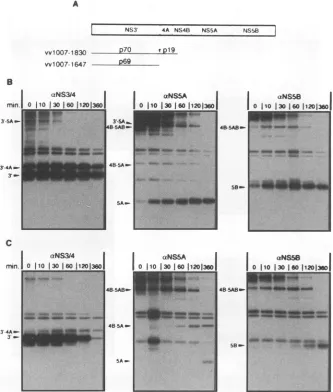
To analyze the kinetics of polyprotein processing in trans, pulse-chase experiments were performed with the proteolyti-cally inactive
NS3'-5B
polyprotein as a substrate and with an NS3'-4B' proteinase (Fig. 6A). Cleavage was slower than processing of the enzymatically activeNS3'-5B
(Fig. 3) because obvious amounts of unprocessed substrate were detected even after a 2-h chase (Fig. 6B). Amounts ofNS5B
and NS5Aincreased with time, reaching maximum levels after about 1 and 2
h,
respectively. Surprisingly, processing between NS4A and NS4B occurred with the fastest kinetics as shown by the rapid production ofNS3'-4A
and NS4B-5AB. This is in contrast to the results obtained with the enzymatically activeNS3'-5B,
when cleavage at this site was delayed (Fig. 3). Itshould be noted that essentially the same kinetics were found with the NS3'-5A' proteinase described above (data not shown), showing that sequences downstream of NS4B are dispensable for full proteolytic activity.
Much slower kinetics of trans cleavage and a slightly differ-ent pattern of processing products and processing intermedi-ates were observed with an NS3 proteinase lacking NS4 sequences and 10 amino acids from the carboxy terminus of NS3
(w1007-1647)
(Fig. 6C). Compared with the results obtained with theNS3'-4B'
proteinase, processing at the NS4A/4B site occurred with similar kinetics as shown by the rapid appearance ofNS3'-4A
and the NS4B-5AB inter-mediate. However, cleavage between NS5A andNS5B
and, most notably, between NS4B andNS5Awas much slower, and chase periods of 6 and 1 h were required to detect obvious amounts of NS5A andNS5B,
respectively. Furthermore, an unmistakable accumulation of theNS4B-5A
processing inter-mediate during the 6-h chase was observed. Since essentially the same results were found with anNS3
proteinase with the authentic carboxy terminus (amino acid 1657 of the polypro-tein) (data not shown), sequences of theNS4
region coex-pressed with the proteinase enhance processing efficiencies at all trans-cleavage sites, particularly between NS4B and NS5A(see below).
Mapping of the minimal NS3 domain required for proteo-lytic activity. Sequence comparisons between
NS3
of HCV and other viral and nonviral proteinases suggest that the proteolytic activity is located in the amino-terminal domain of the mole-cule. Hence, to map the minimalNS3
domain required for polyprotein processing, a series of recombinant vaccinia vi-ruses was generated, directing the expression of variousNS3
proteins beginning at amino acid 1007 of the polyprotein and ending at different positions in the
NS3
region. Thesebinants were used for double infections along with the recom-binant expressing the inactive
NS3'-5B
substrate polyprotein. Because of the slow reaction kinetics observed with protein-ases lacking NS4 sequences, in this and all subsequent exper-iments, cells were radiolabelled for 1 h and then chased for 6 h. To exclude possiblecleavage
products generated by cellular-or vaccinia virus-encoded enzymes, infections with wild-type vaccinia virus were included. As shown by the production ofNS3'-4A,
NS5A, and NS5B (Fig. 7A, B, and C, respectively), all variant NS3 proteinases could process the substrate at all trans-cleavage sites. In independent experiments, no significant differences with respect to processing efficiencies and kinetics were found between these NS3 truncations and the full-length NS3 proteinase (data not shown). Variations in the amounts of processing products were due to variations in the expression levels of the NS3 proteins and to their different stabilities. Most of them had half-lives much shorter than those observed J. VIROL.on November 9, 2019 by guest
http://jvi.asm.org/
[image:6.612.110.255.76.299.2]HCV POLYPROTEIN PROCESSING 5051 A
VvlOO07-1830
NS3 4A NS4B NS5A tS5
D70 IDlg
vvl007-1647 p69
B
3--5A
3-4Am-T
-C
aNS3J4 | aNSSA
rnn. 0 11103016011201360 jo io 130 eo I
.8-5AB-.,;
"u__m,t._-L4B
S-3L-4A
3_-3-_
_~~~~~~~~~~~~~~~~~~~~~~~~~~~~~~~~~~~~~~~~~~
i...,
...M
LB_SAB1
aNS5B
0 110 1301 °11201360 &~~~~~~ I
4mm
_U
I
[image:7.612.142.475.79.471.2]5B- I
FIG. 6. Pulse-chaseanalysisofNS3'-5B polyprotein processing intransby the NS3 proteinase in thepresenceandabsence of NS4sequences.
(A)Schematicrepresentationof theenzymatically inactive NS3'-5B polyprotein substrate andtwovariantproteinases. (B) Cellswereinfected with acombination of therecombinantexpressing the inactive polyprotein andarecombinant expressinganenzymatically activeNS3'-4B' proteinase
(amino acids 1007 to 1830 of the polyprotein). Sixteen hours after infection, proteinswere radiolabelledmetabolically for 20 min and then
incubated in nonradioactive medium forthe indicated times. (C) Results fromananalogous experiment with thesameNS3'-5B substrate andan
almostcompleteNS3 proteinase lacking NS4sequences(amino acids 1007to 1647of the polyprotein).
forfull-lengthandnearly full-length NS3 moleculesandcould be detected only in cell lysates prepared directly after the pulse-labelling (Fig. 7D). In summary, these results demon-strate that the first 211 amino acids ofNS3 (expressed from recombinant w1007-1238) are sufficient for processing at all trans-cleavage sites.
To determine the borders of the minimal NS3 proteinase domain more precisely, the smallest protein was used to introduce a series of amino-terminal deletions which were
tested in the sameway.Removal ofonly7 amino acids from the amino terminus of theNS3 proteinabolished cleavage at
the NS4B/5A site (w1034-1238) (Fig. 8B) without affecting processingatthe othersites (Fig. 8A and C).Asimilarpattern
wasfoundwhen 23 amino-terminal aminoacidsweredeleted
(w1050-1238). Deletion ofan additional16amino acids from the NS3 amino terminus also abolished cleavage at the NS5A/5B site, whereasprocessing between NS4A and NS4B stilloccurred, albeit with lowerefficiency (w1066-1238).None
of the cleavage productswas obtained with an inactive NS3 proteinase (vO50-1238/S-- A), excludingthe possibility that vaccinia virusorcellularenzymescouldsubstitute foranactive
NS3proteinase. These results show that deletions in the NS3 domain have differential effects on processing atthe various cleavagesites and thatcleavageattheNS4B/5Asite is themost sensitive to amino-terminal deletions in the proteinase do-main,whereastranscleavagebetweenNS4A and NS4Bcanbe
mediatedbyaproteinaseasshortas172amino acids from the
amino-terminalregion ofNS3.
Further attempts to narrow down the minimal proteinase
domain were complicated by the fact that these proteins probablydid not react or reacted very poorlywith our
NS3-specific antiserum; therefore,theexpression of theseproteins could notbe determined.
NS4 sequences are essential for cleavage at the NS4B/5A site. In all thetrans-cleavage assays describedsofar,we used the NS3'-5B polyprotein as a substrate. To analyze whether
I czNSS j
0 110 1 j o60112013640
__~~~~~~~~
..-.
_ _ A_AO
.t da It-N..
4B-
SAm-55m.So_o_r~"o
I
I
VOL.68, 1994
I
on November 9, 2019 by guest
http://jvi.asm.org/
5052 BARTENSCHLAGER ET AL.
A S11 .,; tf J, L
,- I- A
I<
10ol
1ool>
(XNS3
C
(ANS5B
FIG. 7. Mapping of the minimal NS3 domain required forfull proteolytic activity. Cellswere infected either singly with one of the NS3 recombinantsorwithvacciniawild-typevirus(w-wt) (D)orincombinationwiththerecombinantexpressing the inactiveNS3'-5B substrate(Ato
C).Sixteen hourslater,cellswerelabelled for 1 h andlysed directly (D)oraftera6-hchase (AtoC).HCV-specificproteinswereanalyzedby immunoprecipitationwithantiseraspecificfor NS3(AandD), NS5A(B),orNS5B(C).Asacontrol, the resultsobtained with cells expressing anunaltered(wt)ormutated(S-*A)NS3'-5Bpolyproteinareshowninthetwolanesonthe far left.Descriptionsoftheindividual lanes in panels Aand Balso refertothelanesdirectly belowinpanels C and D,respectively.
sequencesofthesubstrate haveaninfluenceoncleavageatthe varioussites, recombinant vaccinia viruses expressing NS4A-5B, NS4B-NS4A-5B, andNS5A-5Bpolyproteinsweremade,andwe
determined their processing patterns as generated by an
NS3'-4B' proteinase (Fig. 9, w1007-1830, II) or the NS3'
proteinase lackingNS4sequencesand 10 amino acids fromthe NS3 carboxy terminus (Fig. 9,w1007-1647, I).
transcleavage ofthe NS4A-5B substratewith either of the proteinasesgaverisetomatureNS5A andNS5B, demonstrat-ing cleavage at the NS4B/5A and NS5A/5B sites (Fig. 9A). Furthermore,smallamounts of NS4B indicative ofprocessing between NS4A and NS4B were detected (data not shown). Cleavage ofthe NS5A-5B polyprotein substrate by either of the proteinases occurred with similar efficiency (Fig. 9C). However, complete processing oftheNS4B-5B substratewas
observed only with the NS3'-4B' proteinase (II) (Fig. 9B), whereas in the case of the pure NS3 proteinase, cleavage
occurred only at the NS5A/5B junction and no processing
betweenNS4Band NS5Awasdetected(I) (Fig. 9B).Thesame
resultwasfound when we increased theamount oftheNS3'
proteinaseby raisingthemultiplicityof infectionofthe vv007-1647 recombinant. These results strongly suggest that NS4, particularly NS4A, is essential for processing between NS4B andNS5A and that NS4Aprovided byeither the substrate(i.e., incis)orthe proteinase (i.e.,intrans)can restorecleavageat thissite.
DISCUSSION
The present study examined processing of the HCV NS proteinswith thehelpofrecombinant vaccinia viruses
express-ingan NS3'-5Bpolyprotein. Thisproteinwaschosen because it contains all the sequences required for NS3-mediated polyprotein processingand hasconsiderablyhigherexpression levels than thecompletepolyprotein (la).
Resultsfrom kinetic studiesrevealed a complexpattern of
NSpolyprotein processing.The kineticsofprocessingbetween NS3 andNS4Awerecompatiblewith the view thatcleavageat thissiteoccursfirst.However, inaddition,smallamountsofan
NS3'-5A intermediateweredetected,suggesting that
alterna-B v t. i- 4
ff' w. .s, '^
'S
w _ _ __ _
t t t | ri ]>i J r« I r 4 _
48-5AB
-4B-5A --3-4A
5Am-ImX4.
fl o..N .: g ,~-w
D
_.~
OS -| -S-4B-5AB
-05B
uNS5A
lNS3
.1
OWAMO
1.1.
2.:
.INIMW WM
J.VIROL.
on November 9, 2019 by guest
http://jvi.asm.org/
[image:8.612.147.467.78.448.2]HCV POLYPROTEIN PROCESSING 5053
n 0 of
48
5AR-
48-5A-~3-4A
5A-A
1658 3011
I
It
11 prot5At5IB P
- 3 -50
-_
SC D
-4B-5AB
INS5B stiNS3
FIG. 8. Fine mapping oftheminimalNS3proteinase domain. Cells were doubly infected with the recombinant expressing the inactive NS3'-5B polyprotein substrate and one of several recombinants ex-pressing variousNS3truncations. Following radiolabelling for1h,cells werelysedeitherdirectly(D)oraftera6-hincubation in nonradioac-tive medium(AtoC). HCV-specific proteinswereisolatedby immu-noprecipitation with the given antisera. Resultsobtained with cells expressinganunaltered(wt)ormutated(S--A)NS3'-5Bpolyprotein are shown in the two lanes on the far left. (D) To determine the expression of various NS3 truncations, cells wereinfected with the corresponding recombinants, labelled for1h, andanalyzed by immu-noprecipitation with the NS3-specific antiserum. Descriptions of the individual lanes inpanelsAandBalsorefertothe lanesdirectly below inpanels C and D,respectively.
tive cleavages such as initial processing at the NS5AI5B site exist. Cleavage between NS4A and NS4B appeared to be
delayedasshownbythe presenceoftheNS4A/B intermediate
and the slow production of NS4B, whichwas detected only
after 60 minoflabelling comparedwith 2 min incaseof NS3. At least two cleavage pathways seem to operate at the
NS4B/5A
site: (i)rapidcleavageasindicatedbyrapidproduc-tion of the NS4AB intermediate and
(ii)
slowcleavage
as indicated by the presence of the relatively stable NS4AB-5Aintermediate(half-lifeofca. 1h),for whichaclear
precursor-product relationship was found. In contrast, processing be-tweenNS5A andNS5Bappears tobe ratherefficientbecause noprecursorofNS5B could bedetected.Thus,NS5Bseems to be generated either cotranslationally from an unprocessed
polyprotein byanintramolecular reactionorfromanunstable
processingintermediate which iscleaved veryrapidly
intermo-lecularly.
Differentkineticswere observed in thetrans-cleavage reac-tion.ProcessingattheNS3/4Asite couldnotbedetected,and
cleavagewasfastest atthe NS4A/4Bsite.Apossible
explana-tion for this apparent difference is that in the case of the
enzymatically
activeNS3'-5Bpolyprotein,
atransient intramo-lecularcomplexbetween the NS3proteinasedomain and NS4B
I3/41 -^ 1 5&3 1 7
I3/415A 15B1 3141
712-3011
I
I
Itsub.
11 prot.
C
SA }5E] 3}4 tSAg 5B | 3/4 5A | 58 | IP
434 -4|
i'' ..I
::._
_. _" :._
_.
w\'.. '. _
. I
l
4 ,te
|-3
_._
.4^_
_-5B
_s
.
tt__
w _mA_ ....
FIG. 9. Processingof NS4A-5B(A),NS4B-5B (B),andNS5A-5B (C) polyproteins (aminoacids 1658 to3011, 1712to3011, and 1973
to3011of the HCVpolyprotein, respectively)intranswith
recombi-nantvaccinia viruses expressingan almostcompleteNS3 proteinase (wlOO7-1647) (I)or anNS3'-4B' proteinase (vv007-1830) (II).For details,seethelegendtoFig.7.
sequences,particularly NS4A, forms,whichbringsthecleavage site in closeproximitytothe active siteoftheenzymetoensure
rapid processingbetween NS3 and NS4A. Consistentwith this idea, we obtained strong evidence that cleavage at this site
occurs in cis. However, in the case of the inactive NS3'-5B polyprotein, theproteinasedomain would remainstably
asso-ciated with NS4, making the cleavage site inaccessible to proteinase molecules provided in trans. Hence, one might
expectprocessing atthis sitetooccurintranswitha
polypro-tein lacking the NS3 proteinase domain. We are currently
testingthis hypothesis.
X,xcc
Cn tiit
(-NS3/4 VOL. 68, 1994
I
I
1973-3011 sub.I 'ff Prot
1--
--I
-.-Ion November 9, 2019 by guest
http://jvi.asm.org/
[image:9.612.61.298.74.349.2]5054 BARTENSCHLAGER ET AL.
Usingagenetic approach,wefound that sequences fromthe NS4 region, particularly NS4A, are important for efficient polyproteinprocessing, especiallyat the NS4B/5Asite. Cleav-age at this sitewas accomplished whenNS4Awas present in the substrate (in cis) and even more efficiently when it was coexpressed with theproteinase (in trans).The mechanismby
which NS4A promotescleavage iscurrentlynotknown.Several possibilitiescanbeenvisaged. (i)NS4Amightbeimportantfor properfolding of the substrate. Thispossibilityseemsunlikely
because NS4 canbeprovided intrans to restore cleavage and the NS5 substrate lacking NS4 sequences is processed prop-erly.(ii)NS4A mayformacomplexwith NS3 that isimportant
for NS3 function and analogous to the NS2B/3 heterodimer described for flaviviruses (1). However, in contrast to those viruses, in the case of HCV, formation of such a complex
would not be a prerequisite for proteinase activity per se because anNS3 proteinase lacking NS4 sequences still could cleave at the
NS5A/5B
junction. (iii) NS4A may serve as a membrane anchor attaching the more hydrophilic NS3 pro-teinasetothemembrane surfaceof theendoplasmic reticulum,wheremostof the HCVproteinsappeartobelocated(21,30).
In this model, NS4A wouldbring the NS3 proteinase inclose
proximityto its substrate, allowing efficient processing,
partic-ularly at the NS4B/5A junction. Sequence analysis of NS4A reveals that the first half of the molecule is very
hydrophobic
and has the potential to spanthe lipid bilayeronce, whereas the other half of the molecule is very hydrophilic (5 of 10
carboxy-terminal amino acids are acidic)andmay extend into the cytoplasm to interact with the more hydrophilic NS3. In agreement with this idea, Hijikata and coworkers
(21)
have recently shown that membrane association ofNS3 translated in vitro in the presence of microsomal membranes requires the presence of NS4A. It should be noted that this kind of interaction may contribute not only to efficientpolyprotein
processing but also tothe formation ofaputative membrane-associatedreplicationcomplex (postulated by analogyto flavi-viruses [7]) involving the nucleoside triphosphatase and heli-case activitiesresiding in the carboxy-terminaldomainofNS3
(34).
In an attempt to narrow down the minimal NS3 domain required for fullproteolytic activity,wefound that the first 211 amino acids of NS3 suffice for cleavage at all trans sites. Further amino-terminal deletions selectively abolished pro-cessing between NS4B and NS5A while cleavage atthe other transsiteswas notaffected.
Interestingly,
thesamephenotype,
the lossofcleavageabilityatthe
NS4B/5A site,
wascausedby
the lack of NS4A protein. On the basis of these results, one might postulate specific interactions between the NS3 amino terminus and the NS4A protein. However, the existence and nature of suchinteractions remain to be determined.
Formanyviruses,proteolytic processing mediated
by
virus-encodedproteinasesplays animportant role for virus replica-tion. Recently, it was shown that mutational ablation of the NS3-encodedproteinase ofyellowfever virusseverelyreduced virus replication (8). Thus, it seems likelythat the analogousproteinaseofHCVplaysanequallyimportantrole for theviral life cycle. Although we are still far away from a complete
understanding of the pathways governing HCV polyprotein
processing,ourresultsare afirst stepinthis direction and may
provideabasis forthe rationaldesign ofanantiviral drug. ACKNOWLEDGMENTS
Wethank K.Yasargilfor excellenttechnicalassistance,H. Jacotand W. Suppiger for immunization and care of rabbits, A. Wyss for synthesisofoligonucleotides, M.Hanggiand R.Wittek for thegiftof
vaccinia viruswild-type DNA,and D.Stuber for thegiftof the pDS
vector.
REFERENCES
1. Arias, C.F.,F.Preugschat,andJ.Strauss. 1993.Denguevirus 2 NS2B and NS3 form astablecomplexthatcancleave NS3 within the helicase domain.Virology193:888-899.
la.Bartenschlager,R. Unpublisheddata.
2. Bartenschlager, R.,L.Ahlborn-Laake,J.Mous,and H.Jacobsen. 1993. Nonstructural protein 3 of thehepatitis C virusencodes a
serine-type proteinase required for cleavage at the NS3/4 and NS4/5junctions.J.Virol. 67:3835-3844.
3. Bartenschlager,R.,C.Kuhn,and H.Schaller. 1992.Expressionof the P-protein of the human hepatitis Bvirus in avaccinia virus
system anddetectionof thenucleocapsid-associatedP-protein by
radiolabellingatnewlyintroduced phosphorylationsites. Nucleic Acids Res. 2:195-202.
4. Bukh, J., R. H. Purcell, and R. H. Miller. 1993. At least 12 genotypes ofhepatitis Cviruspredicted bysequence analysis of the putative Elgene of isolatescollected worldwide. Proc.Natl. Acad. Sci.USA90:8234-8238.
5. Cahour, A., B. Falgout, and C.-J. Lai. 1992. Cleavage of the dengue viruspolyprotein at the NS3/NS4Aand NS4B/NS5
junc-tions is mediated by viral protease NS2B-NS3, whereas NS4A/ NS4Bmaybeprocessed bya cellularprotease.J. Virol. 66:1535-1542.
6. Chambers,T.J.,A.Grakoui,andC.M.Rice.1991.Processingof the yellow fever virus nonstructural polyprotein: a
catalytically
active NS3 proteinasedomain and NS2B arerequired for cleav-agesatdibasic sites. J. Virol. 65:6042-6050.
7. Chambers, T. J., C. Hahn, R. Galler, and C. M. Rice. 1990. Flavivirus genome organization, expression, and
replication.
Annu. Rev. Microbiol. 44:649-688.
8. Chambers,T.J.,R.C.Weir,A.Grakoui,D.McCourt,J.F.Bazan, R. J. Fletterick, and C. M. Rice. 1990. Evidence that the N-terminal domain ofnonstructuralproteinNS3 fromyellowfever virus isaserine protease responsibleforsite-specific cleavagesin the viralpolyprotein.Proc. Natl. Acad.Sci. USA87:8898-8902. 9. Chien, D.,Q. Choo,A.Tabrizi,C.Kuo,J.McFarland,K.Berger,
C.Lee,J.Shuster,T. Nguyen,D.Moyer,M.Tong, S.Furuta,M.
Omata,G.Tegtmeier,H.Alter,E.
Schiff,
L.Jeffers,M.Houghton, andG. Kuo.1992.DiagnosisofhepatitisC virus(HCV)infection usinganimmunodominant chimericpolyproteintocapture circu-latingantibodies: reevaluation of the role of HCV in liver disease. Proc. Natl.Acad. Sci. USA 89:10011-10015.10. Choo, Q.-L.,G.Kuo,A.J.Weiner,L. R.Overby,D. W.Bradly,and M. Houghton. 1989. Isolation of acDNAclone derived from a
blood-borne non-A, non-B hepatitis genome. Science 244:359-362.
11. Collett, M. 1992. Molecular geneticsofpestiviruses. Comp. Im-munol.Microbiol.Infect. Dis. 15:145-154.
12. Colombo, M., G. Kuo, Q.-L. Choo,M. F. Donato, E. D. Ninno,
M. A.Tommasini,N.Dioguardi,and M.Houghton.1989. Preva-lence of antibodies to hepatitis C virus in Italian patientswith hepatocellularcarcinoma. Lancet ii:1006-1008.
13. Eckart, M. R., M. Selby, F. Masiarz, C. Lee, K. Berger, K.
Crawford,C.Kuo,G.Kuo,M.Houghton,andQ.-L.Choo. 1993. The hepatitis C virus encodes a serine proteinase involved in processing of the putative nonstructural proteins from the viral
polyprotein precursor. Biochem. Biophys. Res. Commun. 192: 399-406.
14. Falgout, B., M. Pethel, Y.-M. Zhang,and C.-J. Lai. 1991. Both nonstructural proteins NS2B andNS3 are required for the
pro-teolytic processingofdenguevirusnonstructuralproteins.J.Virol. 65:2467-2475.
15. Gerber,M. A.1993.Relation ofhepatitisCvirustohepatocellular
carcinoma. J.Hepatol. 17(Suppl. 3):108-111.
16. Grakoui, A., D. McCourt, C. Wychowski, S. M. Feinstone, and C. M. Rice.1993.AsecondhepatitisCvirus-encodedproteinase.
Proc.Natl. Acad. Sci. USA 90:10583-10587.
17. Grakoui, A.,D. W.McCourt,C.Wychowski,S.M.Feinstone,and C. M. Rice. 1993. Characterization of the hepatitis C virus-encoded serine proteinase: determination of
proteinase-depen-J. VIROL.
on November 9, 2019 by guest
http://jvi.asm.org/
HCV POLYPROTEIN PROCESSING 5055 dentpolyproteincleavagesites.J.Virol.67:2832-2843.
18. Harada, S., Y. Watanabe, K. Takeuchi, T. Suzuki, T. Katayama, Y. Takebe,I.Saito, and T. Miyamura.1991. Expressionof processed core protein of hepatitis C virus in mammalian cells. J. Virol. 65:3015-3021.
19. HUikata, M., N. Kato, Y. Ootsuyama, and M. Nakagawa. 1991. Genemapping of the putative structural region of the hepatitis C virusgenomeby in vitro processing analysis. Proc. Natl. Acad. Sci. USA 88:5547-5551.
20. HUikata, M., H. Mizushima, T. Akagi, S.Mori, N. Kakiuchi, N. Kato, T. Tanaka, K. Kimura, and K. Shimotohno. 1993. Two distinct proteinase activities required for the processing of a putative nonstructural precursor protein ofhepatitis C virus. J. Virol.67:4665-4675.
21. Hiikata, M., H. Mizushima, Y. Tanji, Y. Komoda, Y. Hirowatari, T. Akagi, N. Kato, K. Kimuran, and K. Shimotohno. 1993. Proteolytic processing and membrane association of putative nonstructuralproteinsof hepatitis Cvirus.Proc.Natl. Acad. Sci. USA 90:10773-10777.
22. Hollinger, F. B. 1990. Non-A, non-B hepatitis viruses, p. 2239-2273.In B. N.Fields (ed.), Virology. Raven Press, New York. 23. Houghton, M., A. Weiner, J. Han, G. Kuo, and Q.-L. Choo. 1991.
Molecular biology of the hepatitis C viruses: implications for diagnosis, development andcontrol of viral disease.Hepatology 14:381-388.
24. Hsu, H. H., M. Donets, H. Greenberg, and S. M. Feinstone. 1993. Characterization of hepatitis Cvirus structural proteins with a recombinant baculovirus expression system. Hepatology 17:763-771.
25. Kato, N., M.HiJikata,Y.Ootsuyama, M. Nakagawa, S. Ohkoshi, T.Sugimura, and K. Shimotohno. 1990. Molecularcloning of the human hepatitis C virus genome from Japanese patients with non-A,non-Bhepatitis.Proc.Natl.Acad. Sci.USA87:9524-9528. 26. Matsuura, Y., S. Harada, R Suzuki, Y. Watanabe, Y. Inoue,I. Saito,and T.Miyamura.1992. Expression of processed envelope protein of hepatitisCvirusinmammalian and insectcells. J.Virol. 66:1425-1431.
27. Miller, R. H., and R H. Purcell. 1990. Hepatitis C virus shares amino acidsequencesimilarity with pestivirusesandflavivirusesas
well asmembers oftwoplant virus subgroups. Proc.Natl. Acad. Sci.USA 87:2057-2061.
28. Preugschat, F., C.-W. Yao, and J. H. Strauss. 1990. In vitro processing of dengue virus type 2nonstructural proteins NS2A,
NS2B, and NS3. J.Virol. 64:4364-4374.
29. Saito, I., T. Miyamura, A. Ohbayashi, H. Harada, T. Katayama, S. Kikuchi, Y. Watanabe, S.Koi, M. Onji, Y. Ohta, Q.-L. Choo, M. Houghton, and G. Kuo. 1990. Hepatitis C virus infection is associated with the development of hepatocellular carcinoma. Proc.Natl. Acad.Sci. USA 87:6547-6549.
30. Selby, M. J., Q.-L. Choo, K.Berger, G. Kuo, E. Glazer, M. Eckart, C. Lee, D.Chien, C. Kuo, andM. Houghton. 1993. Expression, identification and subcellularlocalizationof theproteinsencoded by the hepatitis Cviralgenome.J. Gen. Virol. 74:1103-1113. 31. Simmonds, P., E. C. Holmes, T.-A.Cha, S.-W. Chan, F. McOmish,
B. Irvine, E. Beall, P. L.Yap, J. Kolberg, and M. S. Ureda. 1993. Classification of hepatitisC virus into six majorgenotypes anda
seriesofsubtypesbyphylogenetic analysisof the NS-5 region.J. Gen.Virol. 74:2391-2399.
32. Spaete, R. R., D. Alexander, M. Rugroden, Q.-L. Choo, K. Berger, K. Crawford, C. Kuo, S.Leng,C. Lee, R. Ralston, K. Thudium, J. W. Tung, G. Kuo, and M. Houghton.1992. Characterization of thehepatitis C virus E2/NS1geneproduct expressedin mamma-lian cells.Virology 188:819-830.
33. Stueber, D., H. Matile, and G. Garotta. 1990.System for high-level production in Escherichiacoli and rapid purificationof recombi-nant proteins: application to epitope mapping, preparation of antibodies, and structure-function analysis, p. 121-152. In I. Lefkovits and B. Pemis(ed.), Immunological methods, vol. IV. AcademicPress, NewYork.
34. Suzich, J. A., J. K. Tamura, F. Palmer-Hill, P. Warrener, A. Grakoui, C. M. Rice, S. M.Feinstone,and M. S. Collett. 1993. HepatitisC virusNS3protein polynucleotide-stimulated nucleo-sidetriphosphataseandcomparisonwith the relatedpestivirusand flavivirusenzymes. J.Virol. 67:6152-6158.
35. Tanaka, K., T. Hirohata, S. Koga, K. Sugimachi, T. Kanematsu, F. Ohryohji, H. Nawata, H. Ishibashi, Y. Maede, H. Kiyokawa, K. Tokunaga, Y. Irita, S.Takeshita,Y.Arase,and N. Nishino. 1991. Hepatitis C and hepatitis B in the etiology of hepatocellular carcinomaintheJapanesepopulation.Cancer Res. 51:2842-2847. 36. Tomei, L., C. Failla, E. Santolini, R. deFrancesco, and N. La Monica.1993.NS3isaserineproteaserequiredforprocessingof hepatitisCviruspolyprotein.J.Virol. 67:4017-4026.
37. Wiskerchen, M., and M. S. Collett. 1991.Pestivirusgene expres-sion: protein p80 of bovine viral diarrhea virus isa proteinase involvedinpolyproteinprocessing. Virology184:341-350. VOL.68, 1994