0022-538X/94/$04.00+0
Copyright
© 1994, AmericanSociety
for MicrobiologyThe Herpes Simplex Virus Regulatory Protein ICP27
Contributes
to
the Decrease in
Cellular
mRNA
Levels
during Infection
MARYANNHARDWICKEtANDROZANNE M. SANDRI-GOLDIN*
Departmentof Microbiology and Molecular Genetics, College of Medicine, University of California, Irvine,
Irvine,
Califomia
92717-4025Received 10September 1993/Accepted 6 May1994
We have previously shown that the herpes simplex virus immediate-early regulatory protein ICP27 acts posttranscriptionally to affect mRNA processing (R. M. Sandri-Goldin and G. E. Mendoza, Genes Dev. 6:848-863, 1992). Specifically, in the presence of ICP27, spliced target mRNAs were decreased 5- to 10-fold in transfections with target genes containing a 5' or 3' intron. Here, we have investigated the effect of ICP27 during herpes simplex virus type 1(HSV-1) infection onaccumulation of spliced cellularmRNAs.ICP27 viral mutants have been shown to be defective in host shutoff (W. R Sacks, C. C. Greene, D. P. Aschman, and P. A. Schaffer, J. Virol. 55:796-805, 1985). Therefore, we examined whether ICP27 could contributetothis complex process by decreasing cellular mRNA levels through its effects on host cell splicing. It was found that in infections with viral mutants defective inICP27, the accumulated levels of three spliced host mRNAs were higher than those seen with wild-type HSV-1. The differences occurred posttranscriptionally as shown by nuclear runofftranscription assays. The stabilities of the spliced products during infection with wild-type or ICP27mutant viruses were similar, and unspliced precursormRNA for a viral spliced gene was detected in infections with wild-type HSV-1 but not ininfections in whichICP27 was not expressed. These results suggest thatthe reductionincellular mRNA levels and the accumulation of pre-mRNA are related and may be caused byanimpairmentin hostcellsplicing. These data further showthat ICP27 is required for these effectstooccur.
Lytic infection with herpes simplex virus results in the repression of most host cell protein synthesis (7, 8, 10, 18, 22, 23, 32-34, 37, 48, 55, 57,58) and the sequential expression of atleast four classes ofcoordinately regulated viral genes (43). Theinhibition of host protein synthesis is a multiphase process. Theshutoffis initially caused by a structural component of the infecting virion which causes disaggregation of cellular polyri-bosomes(57,58)anddegradation of host mRNAs(37, 48, 55). Isolation of mutants defective in this virion host shutoff (vhs) activity has enabled this functiontobemappedtocoordinates 0.604 to 0.606 on the viral genome (23). The open reading frame in thisregion, designatedUL41,encodes a protein with an apparent molecular mass of 55 kDa (9, 23, 28). The vhs protein actsbyfacilitating thenonspecific degradation of host mRNAs and also viral mRNAs (21, 34, 37). A delayed or secondary stage of host shutoff reduces theremaininglevels of
hostprotein synthesisandrequiresprior viral geneexpression
(11, 22, 33, 37, 55). Theprotein(s) responsible for the second-aryshutoff has not been identified.
It has previously been reported that temperature-sensitive (ts) and deletion mutants with mutations in the
immediate-early regulatory protein ICP27 (IE63 andUL54)were
defec-tive in theirabilitytoshut off hostprotein synthesis(44).Viral mutants defective in ICP27 display a variety of phenotypes,
includinganoverexpression ofsomeimmediate-earlyandearly
*Correspondingauthor. Mailingaddress:Department of
Microbi-ology and Molecular Genetics, University of California, Irvine, CA 92717-4025. Phone: (714) 856-7570. Fax: (714) 856-8598. Electronic mail address: [email protected].
tPresent address: Dana Farber Cancer Institute, Boston, MA 02115.
geneproducts, adecrease in DNAsynthesis, an
underexpres-sion of late geneproducts, andanimpairment inhostshutoff
(27,40, 41, 44,52).Wehave beenstudying the mode of action of ICP27. Transfection experiments have demonstrated that ICP27 can activate or repress expression, depending on the target gene(1, 17,30, 39,42, 50,56). However, theregulatory
activityof ICP27 is independent of the target gene promoter
sequences; instead, it depends on the presence of different mRNAprocessing signals (5,29,47). Particularly strikingwas theobservation thatsplicedtargetmRNAs weredecreased 5-to 10-fold in transfections with target genescontaininga5'or 3' intron(47). This result suggests that ICP27 may affect host
cellsplicing.Because themajorityofherpessimplex virus type
1(HSV-1)transcriptsare notspliced (60),whereas the
major-ity of cellulartranscripts arespliced, we have considered the
possibility that ICP27 may contribute to the shutoff of host
protein synthesis by interferingwith efficient splicing of host
cell mRNAs, which would result in a decrease of spliced
products presentedto the translationmachinery.
Wehavebegunto testthishypothesis by analyzingthelevels
ofspliced cellularmRNAsduringHSV-1 infection. Here,we
show that in infections with viral mutantsdefective in ICP27,
the accumulated levels ofat least three spliced host mRNAs were higher than those seen with wild-type infected cells.
Furthermore, the differences seen between infections with
HSV-1wild-type and ICP27mutantviruses occurred
posttran-scriptionallyand did notresultfrom altered stabilities of the
spliced products. ICP27 appeared to be the only viral gene product required to cause this decrease in the amounts of spliced mRNAs. Finally, unspliced precursor mRNA was found in HSV-1 KOS1.1 infections, further
suggesting
that host cellsplicingmay beimpairedwhen ICP27 is functional. 4797on November 9, 2019 by guest
http://jvi.asm.org/
MATERIALS AND METHODS
Cells and viruses. African green monkey kidney cells,
HeLa R19 cells, and rabbit skin fibroblast cells were grown
as described previously (50, 53). The cell line 2-2, which contains the wild-type ICP27 gene; Stu15, which contains the
ICP27mutant SiB (17); and Sst26, which contains theICP27 mutant S23 (17), have been described previously (52, 54). HSV-1 KOS 1.1, the ICP27ts mutanttsLG4 (44, 46), and the mutant27-LacZ, which hasaninsertion of the lacZgeneinthe
ICP27 locus (52),werepropagatedasdescribedpreviously (46,
52). Virus 27R wasisolated bymarker rescue of the chimeric
ICP27-lacZ gene in the mutant 27-LacZ by cotransfection of 27-LacZ DNA with EcoRI fragment EK isolated from pSG28 (14),whichcontainsthewild-typeICP27gene.Progeny
virus which hadawhiteplaque phenotype aftertreatmentwith X-Gal (5-bromo-4-chloro-3-indolyl-13-D-galactopyranoside),
failedtohybridize withaprobe specific for the lacZgene,and
were able to grow on Vero cells were further analyzed by
Southernblothybridization analysistoconfirm thepresenceof
thewild-type ICP27 gene. One such isolate was termed 27R
and used in this study. For UV inactivation of KOS 1.1 and 27-LacZ (see Fig. 5 and 6), virus stocks were suspended in
phosphate-buffered saline (PBS)ataconcentration of 2x 10⁷ PFU/ml. A 5-ml amountof the virussuspension in a
100-mm-diameter culture dish was irradiated with a germicidal lamp
(wavelength, 254 nm) for 10 min with constantagitation. The incident radiation at the surface of the suspension was 15
ergs/s/mm2. Virus titers were reduced greater than 5 logs by thistreatment.
Transfections. Rabbit skin fibroblast cells were grown as
described previously (50). Transfections were performed in
100-mm-diameter dishes as described previously (50). RNA wasisolated 36 h aftertransfection.Inthe experimentshown in Fig. 9, actinomycin Dwas added to some of the transfected
culturesasindicatedataconcentration of 10,ug/ml36 hafter
transfection.RNAwasisolated6h later. PlasmidspSG28K/B,
which encodes ICP4;pRS-1,whichencodes ICPO;pSG130B/S, whichencodesICP27; and pB7, whichcontainsanICP27gene
withan insertioninthe repressor regionhavebeen described
previously (17, 50). Plasmids pSV2-CAT (16) and pTK-CAT-5'S-SVLPA (47) were added to transfections as target plas-mids as described previously (47). Plasmids pCMV-27 and
pCMV-B7, which contain the promoter and enhancer of an
immediate-early gene of human cytomegalovirus (2), were
constructed by inserting a PstI-SstI fragment from plasmid
pCMV,B (Clonetech) into aHinfl site 55 bp upstream of the translational start ofICP27 after removal of the ICP27
pro-moter sequences and appropriate modification of the ends.
The plasmid pCMV-,-Gal was derived from pCMV3 by
deletionofanXhoI-NotI fragmenttoremovethe simian virus
40(SV40) splicing signals. The plasmid pUL41 wassubcloned
into pUC18 as a 3.8-kb HindIII-SalI fragment from pSG124
(14) asdescribedby Read et al. (38).
Northern (RNA) hybridizations. Total RNAwasextracted
atthe times indicated for each experiment by the guanidium thiocyanate method (4). Cytoplasmic RNA was isolated as
described previously (47). RNA was quantified by optical densityreadings. Equivalentamounts ofRNA(usually20,ug)
weredenatured in glyoxal (59)and fractionatedon1%agarose
gels. To confirm that equivalent amounts of RNA were
analyzed, portions of eachsample loadedonglyoxalgelswere
fractionated in agaroseand stained with ethidium bromide to
visualize the 28S and 18S rRNAs. Gels were photographed
withpositive/negative film, and the negativeswerescanned by
laser densitometry. Photographs of the negatives are shown
below (see Fig. 5 and 7A). As an alternative means to ensure evenloading of RNA samples, Northern blots were hybridized with a probe specific for 28S rRNA after hybridization with probes specific for cellular or viral mRNAs. Hybridization with 28S rRNA is shown below (see Fig. 8). Transfer of RNA to GeneScreen (DuPont, NEN Research Products) and hybrid-ization conditions were as described previously (45). Theprobe used to detect 1-tubulin RNA was derived from a plasmid containing a 250-bp BamHI-EcoRI fragment from the 3' untranslated region of a human ,-tubulin cDNA clone (24) and wasobtained from the American Type Culture Collection. This fragment was cloned into the in vitro transcription vector pGEM-1 (Promega). The 3-tubulin probe hybridized with two
3-tubulin mRNA species of 1.8 and 2.6 kb which result from
alternative polyadenylation sites (24). The probe used to detect 3-actin mRNA consisted of a 250-bp portion of a cDNA clone of mouse 3-actin which was inserted behind a T7 promoter in an invitro transcription vector (Ambion). The probe used to detectglyceraldehyde-3-phosphate dehydrogenase (GAPDH) was a 1.3-kb cDNA fragment derived from the plasmid pGAPDH and was obtained from Eric Stanbridge (University ofCalifornia, Irvine). The 28S rRNA probe was subclonedinto pGEM-2 (Promega) as a 1,437-bp BamHI fragment from plasmid pHrA (15) and was transcribed with T7 polymerase. Probes used in Northern hybridization analysis of viral mRNA specific for ICP4, ICP27, thymidine kinase (TK), and glyco-protein C (gC) were as described previously (54). The probe specific for the US11 gene, which also hybridizes with the ICP47 gene, was as described by Johnson and Everett (19).
32P-labeled DNA probes were prepared by random priming
(Pharmacia). 32P-labeled RNA probes were prepared by in vitro transcription with T7 RNA polymerase.
Nuclear runoff assays. Vero cells wereeither mock infected orinfected with KOS 1.1 or tsLG4 at a multiplicity of infection of 10 at 39.5°C. At 5 or 7 h after infection as indicated (see Table 1), nuclei were isolated from 2.5 x 10⁷ cells for each sample as described by Konieczny and Emerson (20). Nuclear transcription reactions were carried out as described by Wein-heimer and McKnight (61) with the conditions described previously (52). The plasmid p,-tub containing the 250-bp ,B-tubulin DNA
fragment
inpGEM-1
was used in in vitro transcription reactions to generate the complementary (anti-sense) and noncomplementary (sense) strands of RNA by transcribing with T7 and SP6 polymerases. The plasmid con-taining the 250-bp ,-actin probe was similarly used to generatef-actin-specific
RNA. Purified transcribed RNA, either com-plementary or noncomplementary, was denatured in glyoxal andapplied to Gene-Screen filters in 0.1- and 1.0-,ug amounts with aslot blot apparatus (Bethesda Research Laboratories). Filters were baked at 80°C under vacuum for 2 h and then were prehybridized as described previously (52). RNA samples from the nuclear runoff reactions were heated at 95°C for 5min and then added to the prehybridization solution. Hybridizations were carried out as described previously (52) at 45°C for 18 h. Filters were washed and treated with RNase A as described previously (52). Filters were exposed to X-ray film and then quantified by liquid scintillation counting of the slots. Back-ground values obtained with the noncomplementary strand were similar to those found with filters to which RNA from vectorsequences alone was bound. The values for each probe weresubtracted before relative transcription rates were calcu-lated.RNaseprotection analysis. Total RNA samples, purified as describedpreviously (4), were treated with RNase-free DNase I (Promega) in the presence of RNasin for 60 minat37°C to ensure that any residual viral DNA had beenremoved from the
on November 9, 2019 by guest
http://jvi.asm.org/
samples
before the RNaseprotection
assayswereperformed.
To generate an ICPOintron-exon-spanning
antisense RNAprobe,
aT7 expressionplasmid
in whicha320-bp
BamHI-AvaIfragment
wasinserted intopGEM-2afterappropriate modifi-cation of the endswascloned. Theplasmidwaslinearized withEarl before
transcription
with T7 polymerase. This allowedtranscription
of a 375-nucleotide antisense RNA includingabout 50 nucleotides ofvectorsequencesothat the
undigested
probe
could bedistinguishedfromfully protectedpre-mRNA. A second ICP0probe,
which consisted of a 435-bpBamHI-XhoI
fragment
from the ICPO gene inserted into pGEM-2(Promega),
was also used. This allowed transcription of a 476-nucleotideRNAprobe.
Thefully protected
ICPOproduct(precursor mRNA)
was expected tobe 435 nucleotides, from the BamHI site in intron 1 to theXhoI site in exon 2(35).
Inclusion of41 nucleotides ofadditional transcribed sequence from the
transcription
vectorenabled the distinction betweenundigested probe (476 nucleotides)
andfully
protected prod-uct(435 nucleotides)
tobe made. Thechloramphenicol
acetyl-transferase CATRNase
protection probe
has been describedpreviously (47).
Aprobe
antisense to a portion of the ICP27 gene was obtainedby
cloning
a SalII-BamHIfragment
intopGEM-2.
Theplasmid
was linearized with NcoI, and T7transcription
wasperformed
to generate a 217-nucleotide antisense RNAprobe.
TheICP4probeused in theprotectionassays was cloned as a
1,690-bp
BamHI-SalI fragment inpGEM-1.
Theplasmid
waslinearized with Stul and transcribed with T7, which resulted in a 349-nucleotide antisense RNAprobe
specific
for ICP4 mRNA. Equal amounts of RNAsamples
(usually
50,ug)
were mixed with 5 x 10⁵ cpm of antisense RNA which had been gel purified. Hybridizationsand RNase
protections
wereperformed
as describedby
Zinn et al.(63),
except that thehybridization
temperature was raisedto58°C
forhybridization
with HSV-1 RNAbecause of thehigh
GCcontent. Protected fragments werefractionatedon5%
denaturing polyacrylamide-urea gels.
Immunofluorescent staining. Vero cells or 2-2 cells were infected withKOS1.1, 27-LacZ,orUV-inactivated KOS1.1 as indicated in the
legend
toFig.
6. Five hours after infection,cellswere fixed in 3.7%
formaldehyde.
Cellswerepermeabi-lized in PBS
containing
0.5% Nonidet P-40 for 5 min. Cells were rinsed three times in PBScontaining
1% newborn calfserum. In
general, coverslips
were rinsed three times in PBScontaining
1%newborn calfserumbefore the addition of eachantibody
orreagent.Cellsweretreated witha1:100dilution ofdonkey
serum for 30 min to blocknonspecific
interactions. Cellswere then reacted withtheprimary antibody
for 30 min. Monoclonal antibodies 1112 toICPO,
1113 to ICP27, 1114 toICP4,
and 1115 to ICP8 were obtained from the Goodwin Institute for Cancer Research. These antibodieswereusedat dilutions of 1:500.Biotinylated
goatanti-mouseantibody
(Am-ersham)
at a 1:100 dilution was added to cells for 30 min.Following rinsing,
a 1:100 dilution ofstreptavidin-conjugated
fluorescein
(Amersham)
wasadded to cells for 30 min. Cellswererinsed three times in PBS
containing
newborn calfserum and then three times inPBS without serum.Coverslips
were mounted in PBS. Cellswere examined with a Nikon UFX-IIepifluorescence microscope
witha10OX,
1.25-numerical-aper-ture
objective
lens.RESULTS
Levels of three cellular mRNAs are reduced in infections withHSV-1 KOS1.1comparedwith those ofICP27ts mutant-infected cells. Studies
by
Sacks et al.(44)
showed that cellsinfectedwith fourdifferentICP27ts mutantsexhibited
greatly
5h 7h 9h 13h K L M'K L M K L M K L M
1-TUBULIN ** *
ACTIN _4y
GADPH v
FIG. 1. Northern blot hybridization analysis of cellular mRNAs afterinfectionwith HSV-1 KOS 1.1 or tsLG4. HeLa cells were mock infected(lanes M)orinfected with HSV-1 KOS 1.1(lanes K)ortsLG4 (lanes L)at amultiplicityof infection of 10 at39.5°C.Total RNA was isolatedat5, 7, 9, and 13 hafter infection.Equal amounts of RNA for eachsample(20 ,ug)werefractionated in agaroseand transferredto GeneScreenfilters. Theblotswerehybridized with32P-labeledDNA probes, generated by randompriming, whichwerespecificfor 3-tubu-lin, ,-actin,orGAPDH(see MaterialsandMethods).
impaired shutoff of host protein synthesis. To investigate the
basis for this effect, we began by measuring the steady-state levels of three cellular mRNAs inwild-type and ICP27 mutant infections. Specifically, theamountsof ,B-tubulin, 1-actin,and GAPDHmRNAs were determined by Northernblot hybrid-ization of totalRNAisolated at various times from HeLa cells which were either mock infected or infected with HSV-1.
Experimentswere performedat 39.5°C with HSV-1 wild-type
strain KOS1.1 and theICP27ts mutanttsLG4(44, 46).Twenty micrograms of total RNAfrom each samplewasanalyzed.As discussed in Materials and Methods, the ,B-tubulin probe
hybridized with two mRNA species of 1.8 and 2.6 kb which
result from utilization of alternativepolyadenylation sites(24). The results demonstrate that as the infection progressed, the level of each mRNA in KOS 1.1-infected cells decreased
significantly compared with the level in tsLG4-infected cells
(Fig. 1).Theamountof each cellular mRNA in tsLG4-infected
cells also was reduced compared with that ofmock-infected
controls, and this decreasewaslikelyduetothe action of the
vhs product. However, accumulation of all three mature
mRNAs, 3-tubulin, 3-actin, and GAPDH, was reduced to a greater extent in KOS 1.1-infected cells when ICP27 was functional.
The activity of the input vhs function in wild-type- and
ICP27 mutant-infected cells is equivalent. One possibility which could explain the differences in cellular mRNA levels between KOS 1.1-infected cells and tsLG4-infected cells would be differencesintheactivityof thevirion factor vhs(UL41).To determine ifthe vhs functions in KOS 1.1 and tsLG4virions
were equivalent,HeLacellsweretreated with actinomycinD
to inhibit transcription and then infected with KOS 1.1 or tsLG4 inthe presence of the inhibitor. Under theseconditions,
transcriptionof the viral genomeis blocked andonly proteins
presentin the virioncanfunctionininfected cells.Total RNA wasisolated 5hafter infection andanalyzed byNorthern blot
hybridization. As can be seen in Fig. 2, the amounts of
on November 9, 2019 by guest
http://jvi.asm.org/
[image:3.612.343.508.72.250.2]+ACT
K
L
MB.TUBULIN _Wo
ACTIN
UJ-FIG. 2. Effect of the vhs function on accumulation of cellular
mRNAs in KOS 1.1- andtsLG4-infected cells. The inhibitor
actino-mycin D(10p,g/ml) (+ ACT)wasaddedtoHeLacellswhichwere
then mock infected (lane M) orinfected with KOS 1.1 (lane K) or
tsLG4 (lane L) at a multiplicityof infection of10. Five hours after
infection, total RNA was isolated and analyzed by Northern blot
hybridizationwith 32P-labeled DNAprobes specificfor 3-tubulin and
,-actinmRNA.
1-tubulin
and ,B-actin mRNAs found in KOS 1.1- and tsLG4-infected cells were the same and were significantly reducedfrom that seen in uninfected controls. In both KOS 1.1- and
tsLG4-infectedcells,smalleramountsof,B-tubulinand 3-actin mRNAswere seen thanwere found at the 5-h time point in Fig.1. The lower levels of cellularmRNAs inFig.2than inFig. 1 are dueto the blocking oftranscription by actinomycin D, which was added before infection. Data shown in Fig. 2 indicate that the vhs products in KOS 1.1 and tsLG4 virions function equivalently during infection and, further, that
an-other viralproductnotexpressedinthepresenceof actinomy-cinDwasresponsiblefor the differences inthe accumulation of host mRNAsinKOS 1.1-infected cells (Fig. 1).
Transcription of
13-actin
and0-tubulin
in KOS 1.1- and tsLG4-infectedcells is similar. In addition to degradinghost cell mRNAs through the action of the vhs protein, HSV-1 infection has been shownto inhibitthe transcriptionofsomecellular genes (51). To determine whether the differencesin
accumulation of 3-actin and ,B-tubulin mRNAs could be the result of ICP27 affecting transcription of these genes, we
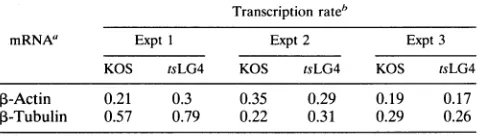
performed nuclear runofftranscription assays (Table 1). Re-sults from three separate experiments showed that while infection with KOS 1.1 did in fact inhibit transcription of ,B-actinthree-tofivefold andof 3-tubulintwo-tofivefold,the reductionsin transcriptioninitiation in tsLG4-infectedcells in which ICP27 is defective were the same. Therefore, the
differences in accumulation levels of host mRNA between wild-type-infected cells and ICP27mutant-infectedcellswere
not due to transcription effects of ICP27. Instead, these differences occurredposttranscriptionally.
ICP27 does not appear to alter the stability of
P-actin
mRNA. Another possibility that accounts for the reduced accumulation of cellular mRNAs in KOS 1.1-infected cells could be alterations in thestability of cellularRNAscaused by ICP27. Mosca et al. (31) reported that an HSV-1 productincreased thestabilityofotherwiseunstable interferonmRNA. Ourfindingswould requireICP27,or someproduct regulated
byICP27,todestabilizecellularmRNAs.Totestthis possibil-ity, we measured the turnover of ,-actin mRNA in cells infected either withKOS 1.1orwith theICP27mutantviruses
TABLE
1. Transcription of cellular genes as measured by nuclear runoff assayswith KOS 1.1-infected cells and tsLG4-infected cellsTranscriptionrate'
mRNA" Expt I Expt 2 Expt 3 KOS tsLG4 KOS tsLG4 KOS tsLG4
,B-Actin 0.21 0.3 0.35 0.29 0.19 0.17
,B-Tubulin 0.57 0.79 0.22 0.31 0.29 0.26
a RNAprobes were prepared and bound to GeneScreen filters as described in Materials and Methods.
bNuclei were isolated from Vero cells which were mock infected or infected
with HSV-1 KOS 1.1 (KOS) or tsLG4 at 5 h (experiments 1 and 2) or 7h (experiment 3) after infection. Transcription from preinitiated transcription
complexes was continued for 30min at 27'C in the presence of [32P]CTP.
Hybridized filterswerecountedbyliquidscintillation counting after autoradiog-raphy of the slot blots. Values are presented as relativetranscription rates, in which the value for mock-infected cells ineach experiment was set equal to 1.0 and values for KOS- andtsLG4-infectedcells were calculated relative to this value.
tsLG4 and 27-LacZ, in which the ICP27 gene has been inactivated by the insertion of lacZ (52). Infected cellswere incubated for 4 h to allow expression of ICP27, and then actinomycinD wasaddedtoinhibit furthertranscription. Total cellular RNA was isolated at the time of actinomycin D addition and 2 and 4 h later. The amount of I-actin mRNA detectedinKOS 1.1-infectedcells atthe time ofactinomycin D additionwassignificantly less than those detectedin 27-LacZ-ortsLG4-infectedcells, again demonstrating the difference in accumulation of host mRNAwhen ICP27 is functional (Fig. 3A). The fractions of mRNA remaining 2 and 4 h after actinomycin D addition were not substantially greater for samples from27-LacZ-ortsLG4-infected cells than theywere forsamples from KOS 1.1-infected cells; however, 1.7 times more ,B-actin mRNA was seen at 2 h after actinomycin D addition in the 27-LacZsample. This could reflectadifference in thestability ofr-actinmRNAin KOS 1.1-infectedcells,or it could reflect differences in the processing of 3-actin pre-mRNA. To determine if the stabilities of spliced ,3-actin
mRNA in wild-type KOS 1.1-infected cells and in 27-LacZ-infected cells were equivalent, a second approach in which cytoplasmic rather than total RNAwas isolated at 4 h after infection was used. Again, actinomycin D was added at this time and cytoplasmic RNA was isolated 2, 4, and 6 h after addition of the inhibitor. As can be seen in Fig. 3B, the decay of1-actin mRNAin the cytoplasm of KOS 1.1-infected cells was similar to that of 27-LacZ-infected cells. Densitometer scanning of the autoradiographs showed that about 35% of
f-actinmRNAremained 2h after addition ofactinomycinD
tothesample from KOS 1.1-infected cells, whereas about 33%
of ,B-actin mRNA remained in the sample from
27-LacZ-infected cells.Thesedataindicatethat the cytoplasmic stability
of,B-actinmRNAappearstobeunaffectedbytheexpressionof
ICP27, although accumulation of the spliced product in KOS 1.1-infected cells is decreased. These data suggest that conver-sion of pre-mRNA to spliced product and/or the nuclear stability of pre-mRNA may be affected by ICP27.
Functional ICP27 is required for the decrease in spliced mRNA accumulation. We next sought to determine whether decreased accumulation ofcellular mRNAs was due to the activity of the ICP27 protein directly or indirectly through the action of some viral product which requires ICP27 for its
expression. Thisquestionwasresolvedby twoapproaches.To
address whether ICP27 alone would be sufficient to cause decreased accumulation of spliced mRNAs, a transfection
on November 9, 2019 by guest
http://jvi.asm.org/
[image:4.612.322.562.93.161.2]FRACTION OF mRNAREMAINING
UN KOS 27-LacZ tsLG4
100 100 100 100 35 60
16 23
33 27
pSV2-CAT
N
z
LI _ I 1
m
IActin _
2 4
UN
B
0 0 2 4
L
KOS
02 4 0 2 4
27-LacZ LG4
KOS 27-LaCZ
cC0° etCO0 I I I I I I I I
Actin- *
i:
FIG. 3. Decay of ,B-actin mRNA. (A) Vero cellswere left unin-fected(UN)or wereinfected withKOS 1.1(KOS), 27-LacZ,ortsLG4
atamultiplicity of infectionof 10at39.5°C. Four hours after infection,
RNA was isolated from one set of cultures (zero time) for each infection, and actinomycin D (10 ,ug/ml) (Act D)wasadded to the remainingcultures. RNAwasisolated 2 and 4 h after the addition of
Act D. Equal amounts of total RNA (20 p.g) were fractionated in agarose for each sample. Northern hybridization analysis was
per-formed as described in Materials and Methods with a 32P-labeled
13-actin antisense RNA probe. Several exposures of each Northern hybridization were made, and different exposureswere scanned for
eachconditionbyalaser densitometertoquantify the levels of RNA
and toensure thatthe readingswere inlinear rangefor eachsetof samples. The fraction ofmRNAremainingwascalculatedonthe basis
of theamountof,B-actinmRNAseenforeachsampleatthe time of additionof Act D(zero time).(B) Vero cellswereinfectedwith KOS or27-LacZata multiplicityofinfection of10 for 4 h. At thistime, cytoplasmic RNAwasisolated fromonesetofcultureswhile ActD
wasaddedtotheremaining cultures. Cytoplasmic RNAwasisolated 2,
4,and 6 hafter additionofAct D.EquivalentamountsofRNA(10 ,ug)
werefractionated inagarose,andNorthern blotswerehybridized with an RNA probe specific for 1-actin RNA. The autoradiograph was
scanned withalaserdensitometertoquantify the results.
experimentwas performed.We hadpreviously shown that in the presence of ICP27, spliced target mRNA levels were
decreased 5- to 10-fold in transfections with target genes
containing a 5' or 3' intron (47). In those experiments, plasmids expressingtheHSV-1 transactivators ICP4 and ICPO
were alsopresent. To avoid includinganyHSV-1 gene
prod-uctsother thanICP27, transfectionswereperformed withthe target plasmid pSV2-CAT, which contains the strong SV40 earlypromoterand enhancer andisabundantly expressed. In addition, this plasmid contains the small t antigen intron derivedfromSV40 (16). Wild-type ICP27wasexpressed from aplasmidtermedpCMV-27,inwhich theICP27geneisplaced
underthe controlof thestrongimmediate-earlypromoterand enhancer from human cytomegalovirus (2). The mutant B7, which contains an insertion intherepressor region of ICP27 (17), was also cloned under the cytomegalovirus
immediate-early promoter. As a control for transfection efficiencies, a
plasmidwhichencodes the lacZgeneencoding 1-galactosidase
probe-CAT-*
12 3
B-GAL-
ft
ICP27-
Actin-1 2
3
FIG. 4. ICP27,inthe absenceofother viralproducts,candecrease
mRNAaccumulation fromatargetgenecontaininganintron.
Trans-fections were performed with the target plasmid pSV2-CAT (16),
whichcontains theSV40 smalltantigen intron 3' tothe CAT coding
sequences.Cellswereeithertransfected withpSV2-CATalone(lanes 1)or werecotransfected withaplasmid containing the wild-type ICP27
gene(pSG130B/S) (lanes 2)orwithaplasmid containing the ICP27
insertion mutant B7 (lanes 3). Aplasmid containing thelacZgene
under thecontrol of thecytomegaloviruspromoterwasincluded in the transfectionsas a control for transfection efficiency.Total RNAwas
isolated 36 h after transfection, and RNase protection assays were
performed. A CAT-specific antisense RNAprobe which spans 250 nucleotides at the 5' end of CAT mRNA (47) was used in the protectionsshown intheuppermostpanel.A 1-galactosidase-specific (13-GAL) RNA probewhichspans 250nucleotides at the 5' end of 1-GALRNAwasused in theprotectionsshown in thepanelbeneath
the uppermostpanel.An ICP27-specificRNAprobewasused in the
middle panel. To determine if equivalent amounts of RNA were
recoveredandanalyzed,afractionof eachsamplerepresenting 1/10 of
theamountofRNAused in theupperpanelswashybridized witha
,B-actinRNAprobe.The actinprotectionassayis shown in the bottom
panel.
was also included. The lacZ genewas alsoplaced under the
control of the cytomegalovirus promoter. RNase protection experimentswereperformedwith total RNAsamplesisolated fromtransfections withpSV2-CATalone(Fig. 4,lane1)orin
thepresenceofwild-type ICP27(lane 2)ormutantB7(lane 3). Protections with a probe antisense to the 5' region of CAT mRNA showed that about six times more CAT RNA was
present in cells transfected with pSV2-CAT alone than was
foundin thepresenceofICP27(Fig. 4). This result indicates thatICP27 alone is sufficienttodecreaseaccumulation of CAT RNA. About four times more CAT RNAwas found in the transfection with B7 than in the transfection with wild-type
A
Hoursafter Act Daddition0
2 4
82 65
on November 9, 2019 by guest
http://jvi.asm.org/
[image:5.612.380.487.72.386.2] [image:5.612.58.303.73.316.2]ICP27, which correlates with previous results showing that the repressor region ofICP27 must remain intact for its effect on spliced RNAs to be observed (47). The levels of the ,-galac-tosidase-protected product in transfections with wild-type ICP27 and the mutant B7 were equivalent, indicating that transfectionefficiencies were the same. It can also be seen in Fig. 4 that equivalent amounts of RNA were recovered and analyzed from each transfection, since equivalent amounts of
1-actin
RNA were seen whenportions
of the RNAsamples
hybridized with a probe antisense to 1-actinRNA. This result is different from thedecreased levels of1-actin RNA observed in infected cells because in thetransfection experiment, only a small percentage of the cells (less than 10%) were successfully transfected with the ICP27 plasmid compared with nearly 100% of the cells which became infected. Therefore, the effects of ICP27on1-actinmRNAlevelsintransfection assays would be masked by the overwhelming number of cells which were nottransfected. Thus, the amount of 3-actinRNAanalyzed is anaccurate measureof the amount of total RNA analyzed.
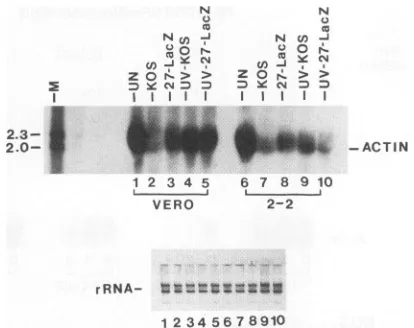
Inthe secondapproach, we analyzed the effect of ICP27 on cellularmRNAlevelsduringinfection. This experiment made use of the ICP27-complementing cell line 2-2 (52). In this experiment, Vero cells or 2-2 cells were infected either with KOS 1.1 or 27-LacZ or with UV-inactivated KOS 1.1 or 27-LacZ.The rationale for thisapproachwasasfollows.Inthe infection of Vero cells, ICP27 would not be expressed by 27-LacZinfections, and in theUV-inactivated virus infections, no viral synthesis would occur, with only those products present inthe virion functioning. ICP27 is not present in the virion (62). Inthe case of 2-2 cells, the resident ICP27 gene under its own promoter is not expressed during the normal growth of cells, but upon infection with HSV-1, VP16 in the virion induces expression of the cellular ICP27 (3, 25). There-fore, infection with 27-LacZ would yield a wild-type infection, whereasinfectionwithUV-inactivated virus would result in the expression of ICP27asthe only viral product except for virion proteins. As seen in Fig. 5,
P-actin
mRNA levels in KOS 1.1-infected Vero cells were reduced aboutfivefold compared with those in Vero cells infected with 27-LacZ or UV-inacti-vatedvirus. Levels in these three infections, although higher than inKOS 1.1-infected Vero cells,were still about twofold lower than in theuninfected control. This is due to the action of the vhs product. In contrast, ,B-actin mRNA levels were reducedtothesameextentin 2-2cells infected with 27-LacZ or UV-inactivated virus as they were when 2-2 cells were infected withKOS 1.1. Toensurethat equivalent amounts of total RNA were analyzed, a portion of each sample was fractionated in agarose and stained with ethidium bromide to visualize the 28S and 18SrRNAs. Anegativeof the stained gel, shownatthe bottomofFig. 5,wasscanned by laser densitom-etry. The maximum difference in the amounts of RNAana-lyzedby Northernhybridization wasabout 1.3-fold as seen in
Fig. 5,lanes 9and10.Therefore, equivalent amounts ofRNA wereanalyzed for each sample, and the differences cannot be attributedtosample loading variations.
The results presented above suggest that expression of ICP27in the 2-2 cell line wasresponsible for the decreased accumulation of
1-actin
mRNA which was seen. This is because the only HSV-1 product expected to beexpressed, in addition to the virion proteins, in 2-2 cells infected with UV-inactivated virus was ICP27. To confirm that this was the case, immunofluorescent staining was performed on cells infectedwith KOS 1.1 or UV-inactivated KOS 1.1. Monoclonal antibodiestoICP4, ICPO,ICP27, and ICP8 were used. Infec-tion of2-2cells with KOS 1.1resulted in characteristic nuclearstainingofICPO(Fig. 6E),ICP4(panel G),and ICP8(panelI).
N
0
(joN
ccn
U)
leC'
N)
Z OII >
D YII DI
N C.)
C) ~~~~~co NX
0
ZON > >
I I
-ACTIN
IL-i
I
VER
22
45 6291
rRNA- £X E U
12 34 5678910
FIG. 5. Analysis of ,-actin mRNA levels in the presence and absence of ICP27expression. Vero cells and the cell line 2-2, which contains the wild-type ICP27 gene (52), were uninfected (UN) or infected either with KOS 1.1 (KOS) or 27-LacZ or with KOS and 27-LacZ virus which had been UV irradiated (see Materials and Methods). Infections were performed at a multiplicity of infection of 10. Forvirus stocks which were UVirradiated, this multiplicity was calculated on the basis of the virustiter before treatment with UV light. The actual titers of the UV-inactivated KOS and 27-LacZ samples were reduced to <100 PFU/ml after irradiation. RNA was isolated 5 h after infection. The RNA blot was hybridized with a
32P-labeled,B-actin antisense RNA probe. To ensure that equivalent
amounts of RNA were analyzed, portions of each sample were fractionated in agarose and stained with ethidium bromide to visualize the 28S and 18S rRNAs. Thegel was photographed with positive/ negative film. The negative, shown in the bottom panel, was scanned by laser densitometry to quantify the amounts of rRNA. Lane M, the positions of2.3- and2.0-kb HindIII fragmentsfromAbacteriophage DNAwhich were32plabeled and fractionated with the RNAsamples toserveassize markers.
Similarly, defined nuclear staining of ICP27 was seen with Vero cells infected with KOS 1.1 (Fig. 6A) and 2-2 cells infected with 27-LacZ (panel C). In contrast, infection of 2-2 cellswith UV-inactivated KOS 1.1 showed no staining above background level forICPO(Fig. 6F), ICP4 (panel H), and ICP8 (panel J). Infection of Vero cells with UV-inactivated KOS 1.1 showednostaining with antibody to ICP27 (Fig. 6B). However, 2-2 cells infected with UV-inactivated KOS 1.1 did show nuclearstaining of ICP27 (Fig.6D).These results confirm that ICP27 wasexpressed in 2-2 cells infected withUV-inactivated virus. Further, they show that ICP27 was the only de novo viral gene product expressed, because expression of ICP4, ICPO,
and ICP8 was not detected. Because ICP4 is required for HSV-1 early and late gene expression, it is unlikely that other early gene products not monitored in this study were ex-pressed. These results show that since the virion proteins alone were not sufficient to cause the additional effect on
3-actin
mRNAlevels seenin Vero cell infections with UV-inactivated virus, ICP27 expression appears to be sufficient for decreased accumulation.Therepressor region ofICP27 must be intact for the effects oncellular mRNAlevels. We previously showed that theregion definedasthe activator region of ICP27 (17) was not required for the down regulation of spliced products in transfection assays,whereas the repressor region was required to be intact for this effect (17, 47). The mutation in tsLG4 was shown to map inthe repressor region of ICP27 (54), and as shown here, this viral mutantwas not able to reduce the accumulation of
on November 9, 2019 by guest
http://jvi.asm.org/
-
-FIG. 6. Immunofluorescentstainingof cells infected with UV-inactivated virus. Vero cells(AandB)and 2-2 cells(C throughJ)wereinfected with KOS 1.1(A,E, G, andI),27-LacZ(C),orUV-inactivatedKOS1.1(B,D, F, H,andJ).Five hours afterinfection,cellswerefixed and stained with monoclonal antibodiestoICP27(A, B, C,andD), ICPO(EandF),ICP4(GandH),orICP8(IandJ).
cellularmRNA. Todeterminewhateffect otheractivatorand repressor mutants would have on cellular mRNAs, we ana-lyzed the effects of mutant S23, an ICP27 activator mutant which hasaninsertion of2amino acidsatresidue 383(17, 54),
andmutant
SiB,
which hasa4-aminoacidinsertionatresidue 406(17,54).Thismutation,
previously
definedas anactivatormutation, maps near the border of what we defined as the
repressorregion (17). Inpreviousstudies with these mutants,
on November 9, 2019 by guest
http://jvi.asm.org/
A]
N N NUUX
Xi
C) OZ C)
:E Z
O~
z o O z ZO.-m l l le l le l
I^
IU
I
IIX
2.3-
2.0-..
or- * i:
*
-~ ~ ~ ~~~~~I,*
-gC
gCRSF Stu15 Sst 26
rRNA-
!1RI!5l1
RS F Stul5Sst26
B)
VERO22 S15 S26
r-NN N N
00 0 0 mm (Um
0nIj _j -J
ZO r..ZR ZP.Z
D YeC CNDO1DscmN I I I III I I
ICP4- 1M, w
C)
I.
env
g
ICP47-VERO 22 S15S26
FIG. 7. Analysis of 13-actin mRNA levels in cell lines expressing ICP27mutants.(A)Rabbitskinfibroblastcellsandthe celllinesStulS,
whichcontainsthe ICP27mutantS1B,andSst26,whichcontainsthe ICP27mutantS23 (54),wereuninfected (UN)orinfected withKOS
1.1 (KOS) or 27-LacZ. RNA was isolated 5 h after infection, and
samples (20 ,ug) were fractionated in agarose and transferred to GeneScreen.To ensure equal loadingof RNAsamples, portions of
each samplewere fractionated inagarose andstainedwithethidium
bromide. Thestained gelwasphotographed,and thenegative, shown
at the bottom, was scanned by laser densitometr to quantify the
amountsofRNA.The blotwashybridizedwitha34P-labeled ,-actin antisense RNA probe. Following autoradiography, the hybridized probewasstrippedfromtheblot,whichwasthenrehybridized withan
antisense RNAprobespecificforICP27 (middle panel). The
hybrid-ized probe was again stripped from the blot, and the RNA was
rehybridized with an antisense RNA probe specific for gC mRNA
(lower panel).Sizemarkersareshown intheupperpanel (lane M)and
areasdescribed inthelegendtoFig.5.(B) Vero, 2-2, StulS, and Sst26
cellseitherwereleftuninfectedor wereinfected withKOSor27-LacZ.
Total RNA was isolated at 5 h after infection in the Northern
we showed that S23 and S1B expressed proteins which were trans dominant to wild-type ICP27 and interfered with virus replication, most notably at lowmultiplicities of infection(54).
Consequently, we have been unable to introduce these muta-tions into the viral genomeby recombination. Instead,wehave analyzed the mutant phenotypes by using cell lines stably
transformed with the mutant genes. These cell lines,
desig-nated Sst26, which contains mutant S23, and StulS, which contains mutant SiB, were isolated and characterized previ-ously (54). Infection of these cells with 27-LacZ results in induction of the resident mutant ICP27 as the only source of ICP27 in the infected cell. This approach is similar to that of Gao and Knipe (13), who studied the effects of a trans dominant ICP8 protein during viral infection by using a cell line which expressed the trans dominant mutant. In the follow-ing experiments, infection of each mutant cell line with KOS 1.1was performed at high multiplicity (multiplicity of infection of 10), at which the trans dominant effect is not seen (54), to directly compare the effects of the wild-type protein and the mutant.Infection of the Sst26 cell line with 27-LacZ resulted in greatly reduced levels of 1-actin mRNA detected relative to those of uninfected control cells, and the level was similar to the level seen with KOS 1.1 infection (Fig. 7A). This is consistent with our previous observation that activator mutants decreased expression from target genes containing introns as efficiently as the wild type (17, 47). By contrast, the level of
1-actin
mRNA in 27-LacZ-infected StulS cells was substan-tially higher than in KOS 1.1-infected StulS cells (Fig. 7A). This result indicates that the mutation inStulS inactivates the effect which ICP27 has in decreasing accumulation ofcellular mRNAs. In this respect, the StulS mutant behaved like the previously defined repressor mutants, which decreased mRNA levels from spliced target genes.To further characterize the phenotypes of these mutants with respect to viral gene expression during infection, accumu-lation of several viral gene products was also analyzed. Some viral ICP27 mutants have been found to overexpress some immediate-early and early gene products and to underexpress late gene products (27, 40, 44). The blot in Fig. 7A was stripped of the 1-actin hybridization probe and was rehybridized first with a probe specific forICP27 RNA to confirm expression in StulS and Sst26 cells and, after subsequent stripping, with a probe specific for the late gene product gC. As expected of an activator mutant, gC mRNA levels were about 30-fold lower during infection of the Sst26 cell line with 27-LacZ than with KOS 1.1. In addition, gC mRNA was not detectable inStulS cells infected with 27-LacZ. In a second experiment, immedi-ate-early, early, and late gene expression was monitored in
StulS and Sst26 cells compared with those of wild-type KOS
1.1 infection and 27-LacZ infection in Vero and 2-2 cells (Fig. 7B). Theimmediate-early gene product ICP4 did not appear to be overexpressed in eitherStulS or Sst26 cells compared with 2-2 cells infected with 27-LacZ or Vero cells infected with 27-LacZ or KOS 1.1 (Fig. 7B). However, TK mRNA levels weresomewhat more abundant in Sst26 than inStuJ5cells. In the bottom panel of Fig. 7C, a probe which overlaps the coterminal mRNAs for the immediate-early gene ICP47 and the true late geneUS11 was used. In the 27-LacZ infection of Vero and StulS cells, only the immediate-early product was
hybridization shown in panel B and 9 h after infection in the hybridizations shown in panel C.32P-labeledDNA probesspecificfor ICP4 and TK and a probe which hybridizes to bothUS11 andICP47 wereused to detect viral mRNAs.
on November 9, 2019 by guest
http://jvi.asm.org/
[image:8.612.66.293.70.542.2]found.Ininfectionsof2-2andSst26cells,comparableamounts
of ICP47 and US11 mRNAwere seen. Itwas surprising that
moreUS11 expression than gCexpressionwasdetected in the Sst26 cell line. This result suggests that this mutation may render the ICP27 protein partially functional in its ability to induce late gene expression during infection. On the other hand, the mutation in Stul5 resultsnot onlyin theinability of the mutantprotein to decrease cellularmRNAlevelsas seenin Fig. 7A but also in the inability to induce viral late gene expression.
Precursor RNA can be detected in cells infected with
wild-type HSV-1. While we have shown that ICP27 causes
decreased accumulation ofsome cellular mRNAswhich was not the result of a depression of transcription or reduced stability of the mature mRNAs, these findingsdonot directly
demonstrate that splicing is affected. In a related study,
Schroder et al. (49) analyzed the processing of ,B-tubulin
heterogeneous nuclear RNA in HSV-1-infected cells and found that processing of ,3-tubulin heterogeneous nuclear RNAwas reduced by 2 h after infection and inhibited almost completely by 5 h. This resulted in accumulationofunspliced
,-tubulin pre-mRNA. We have been unableto detect
precur-sor RNAfor the cellulartranscriptswe haveanalyzed. This is probably because unspliced RNA is rapidly degraded in the nucleus, the cellular mRNAs we analyzed are nottranscribed to high levelsnormally, and their transcriptionrate is further reduced by HSV-1 infection (Table 1), making it even more difficult to detect precursors. Inaddition, the probesweused werederivedfromcDNAs,notgenomicclones.Therefore,we chose to focus on aviral product which is spliced and abun-dantly transcribed early during infection, namely ICPO. The
ICPOgeneis3,587 bplong andcomposedof threeexons(35).
Experiments were performed with an RNA probe which
spanned an intron-exon junction so that both precursor and
spliced product would be detected (see Materials and Meth-ods). In the first experiment, total RNA was isolated from Vero and 2-2 cells infected with KOS 1.1 or 27-LacZ. In addition, infectionswere performedwith avirus termed27R,
which was constructed by marker rescue of the chimeric
ICP27-lacZ gene inthe 27-LacZ virus with a DNA fragment
spanningthewild-typeICP27 gene. Infectionswereperformed
with the rescued virus 27RtofurtherconfirmthatICP27 was
responsiblefor theeffects observedonsplicedmRNAs.
Equiv-alent amountsof totalRNAfrom each samplewere analyzed
by Northern blothybridization. Thatthiswasthecase canbe
seen in the lowest
panel
of Fig. 8, where the blot washybridizedwithaprobespecificfor 28S rRNA. The uppermost
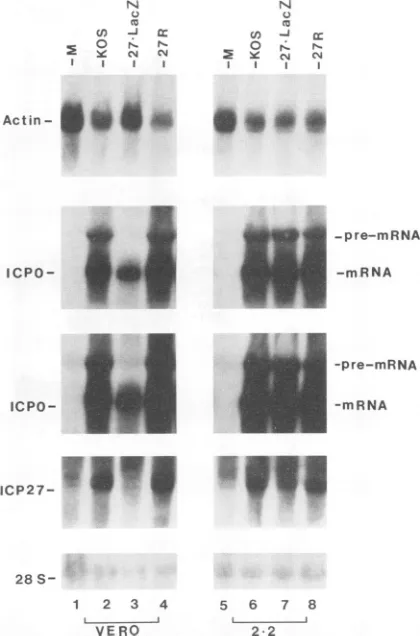
panel of Fig. 8 shows that levels of ,B-actin mRNA were reduced during infectionofVero and 2-2 cells with KOS 1.1 and the rescued virus 27R. As was seen previously,
3-actin
mRNAlevelswerehigherin Verocellsinfected with 27-LacZ
(Fig.8, toppanel),in whichICP27wasnotexpressed,butwere
equivalenttothose of KOS1.1and 27Rinfections in 2-2cells,
in whichICP27wasexpressed bythe cell line. The blot in the uppermostpanelwasthenstripped of the
hybridization
probe
and was rehybridized with an ICPO antisense RNA
probe
which spans thejunctionof intron 1andexon2
(see
MaterialsandMethods).Inthis case,ICPOprecursormRNAwasclearly
detectable in KOS 1.1and27Rinfections ofVerocells and in all of the infections of 2-2 cells. In fact, the
product-to-precursor ratio was around 6:1. Smaller amounts of ICPO
mRNA were seenin the 27-LacZinfection ofVerocells than in KOS 1.1 or 27R infections; however, even upon longer
exposure of the autoradiogram, as seeninthe
panel
immedi-ately below the onementioned above, ICPO pre-mRNAwas
notdetected in the RNAsamplefrom27-LacZ-infectedVero
N
C.)
U, -J cc 0 N -N
c e Cq N
l
IcPo-
lcpo-N
U, -j
I
cr
N
CN
-pre-mRNA
-mRNA
-pre-mRRNA
-mRNA
ICP27- flu
28
S-1 2 3 4 5 6 7 8
VERO 2 2
FIG. 8. DetectionofICPO pre-mRNAduringinfection. Vero and 2-2 cells were mock infected (lanes M) or infected with KOS 1.1 (KOS), 27-LacZ, or the rescued virus 27R, in which the wild-type
ICP27 gene was restored in 27-LacZ virus by markerrescue. Total RNAwas isolated5 h after infection.Twenty-microgram samplesof RNAwereloaded ontotheglyoxal gels.Thatequivalentamounts of total RNA were loaded can be seen in the hybridization of the Northern blot with a28S rRNAprobe asshown atthe bottom. The RNAblotwasfirsthybridizedwithanRNAprobespecificfor1-actin mRNA(uppermost panel). The hybridizedprobewasthen stripped, and the blot was rehybridizedwith an antisense RNA probe which hybridizesto aportionof intron1andexon2 inICPORNA. Adarker exposure of each autoradiogram is also shown immediately below. AfterhybridizationtoICPOmRNA,theprobewasagainstrippedand
the RNA blotwashybridized to anRNA probespecific for ICP27
RNA.Finally,the blotwasstrippedof the ICP27hybridization probe andwasrehybridizedwithaprobespecificfor 28S rRNA.
cells.In contrast,itwasdetected in
equivalent
amountsin 2-2 cells infected with27-LacZ,
KOS1.1,
and 27R. This indicatesthatICP27is
required
notonly
for reduction inspliced
mRNAlevels but also for accumulation ofprecursormRNA.
Accumulation ofICPOprecursormRNAinthepresenceof
ICP27 but not in its absence suggests that ICP27 exerts its influence on mRNA at the level of
splicing.
Toexplore
thispossibility
furtherandtoclearly
distinguish
theeffectofICP27onmRNAlevels
compared
with thatof the UL41 vhsproduct,
we
performed
atransfectionexperiment
withplasmids
express-ing
ICP27 or UL41. We measured the amounts of RNArecovered from two
spliced
RNAspecies
and twounspliced
RNA
species by
RNaseprotection
assay. A targetplasmid
termed
pTK-CAT-5'S-SVLPA
(47),
which is under the control of the HSV-1TKpromoter and contains alternativesplice
sitesActin
is
Is
Aais
40
0
#
on November 9, 2019 by guest
http://jvi.asm.org/
[image:9.612.333.543.79.397.2]act D
20
f-o .+ ++ +
't o ooo
.++ +4+
l l
404-ICPO
309-242
238-
217-
201-
190-
180-act0
v-It
_r D_
,e+ It
+ ++ +
qw tle t le er I I I i
C4+
00
4t+
I
-probe -pre-mRNA
1320nt
0-mRNA 1203nt
6 7
9 @94
rSt ,M3 rC ,7
ICP4 v. ,
Actin
1 2 3 4 5 6 7 actD
T-o
++ +,e+ IC ,+11
ICP27
actD
FIG. 9. Detection of ICPO pre-mRNAintransfection experimentsin thepresence and absence of ICP27. Rabbit skin fibroblastcellswere
cotransfected with the plasmid pTK-CAT-5'S-SVLPA and with plasmids pSG28K/B, which encodes ICP4,and pRS-1, which encodes ICPO. PlasmidpSG130B/S, encodingICP27, andplasmidpB7,whichencodesanICP27insertionmutant,were addedtosomeof the transfectionsas
indicated. Aplasmid termed pUL41, whichencodesthe HSV-1 UL41gene, wasincludedinsomeof the transfectionsasindicated. RNAwas
isolatedat36hafter transfection(lanes1 through 5). Lanes 6and7, actinomycinD(actD) (10 ,ug/ml)wasaddedtothetransfectedcellsat36
h and RNAwasharvested 6 h later. An antisense RNAprobewhichencompassespartof intron 1 and part ofexon2of ICP0wasusedtodetect ICPOpre-mRNAandmRNA. Anantisenseprobewhichencompasses250nucleotides (nt)in the CATcodingsequenceand the5' intronwhich
contains alternativespliceacceptorsites(47)wasusedtodetectalternatively splicedCAT mRNAs.Antisense RNAprobeswerealso usedtodetect
ICP4 andICP27 mRNAasdescribed inMaterialsandMethods.Aportion ofeachsample representing 1/20 of theamountof RNAanalyzedin the otherprotectionexperimentswashybridizedwithaprobe specificfor,-actinmRNAtoensurethatequivalentamountsof RNAwererecovered
andanalyzed from eachtransfection. Lane marker, 32P-labeledHinfl-digested pBR322 DNA.
5' totheCATgene,wascotransfected withplasmids
express-ing ICP4 and ICPO. These transactivators were added to induce expressionof the TKpromoter and to induce
expres-sion of theplasmidencodingULA1,whichwasaddedtosome
ofthetransfections. Ascanbeseenintheupperright panelof
Fig. 9,theamountsofthe310-nucleotidesplicedCAT mRNA product and the alternatively spliced 375-nucleotide CAT mRNAproductwere reduced morethanfivefold in transfec-tions which includedICP27. The UL41productdidnotappear
to affect accumulation of the spliced CAT mRNA in the sampleisolated 36 h aftertransfection. It ispossiblethat UL41 levelswerenothigh enoughtoseethedestabilizing effect while
transcriptionwasoccurring. The UL41 product wasfound at
much lowerlevels thanICP4 and ICP27 inthe RNase
protec-tion assay(data notshown). However,in aparallel sample in
whichactinomycinDwasaddedtothetransfectedcellsat36 h andRNAwasisolated6hlater, therewasaboutaneightfold
decrease in theamountof CAT mRNA found in thepresence
of ULA1. Because CAT mRNAwas barely detectable in the presenceofICP27, itwasnotpossibletodeterminetheeffects
onthestabilityof thespliced productwhenactinomycinDwas
similarlyaddedto atransfection which includedICP27. ICPO
waspresentinallof thetransfections, andtherefore, the level of product to precursor was determined with the antisense
RNAprobeused in theNorthernhybridizationshown inFig. 8. Thefull-length probe,which encompassespart of intron 1 andexon 2, is375nucleotides, including about50nucleotides
of transcription vector sequences. The fully protected
pre-mRNAproduct was expected to be around 320 nucleotides, andthe fully spliced mRNA productwas 203 nucleotides. In
addition, a band of around 220 nucleotides was seen. This
represents a product which likely resulted from incomplete
digestionwith RNase.Incubationat45°C duringRNase diges-tion eliminated this product (data not shown); thus, it may
result fromtheformation ofsecondarystructures.In calculat-ingamounts ofRNA,thisproductwasincluded withthefully
processed mRNA. In the transfection in which ICP27 was
present, there was about 2.5 to 7 times less ICPO mRNA detected(Fig. 9,upperleftpanel,lane2)than intransfections inwhichICP27wasnotpresent(lanes1 and4)orinwhichthe repressormutantB7wasused(lane3). However,ahigher ratio
ofprecursor to product was seen in the presence of ICP27. There was about 1/4 as much pre-mRNA as mRNA in the presenceofwild-type ICP27, whereas the ratiowas1/10to1/20
-probe
-375nt CAT
-3 10nt
on November 9, 2019 by guest
http://jvi.asm.org/
[image:10.612.140.480.75.385.2]asmuch in the absence ofICP27 or with the mutant B7. This result indicates that ICP27 causes an accumulation of pre-mRNA which results in a concomitant decrease in spliced product. In contrast, UL41 has its effect on the level of the spliced product, as has been shown previously (37, 48, 55). Thus, the levels of ICP4 mRNA and ICP27 mRNA, two species which are not spliced, in transfections with ICP27 before the addition of actinomycin D and 6 h after addition were similar, again illustrating that ICP27 does not affect the stability of mRNAs (Fig. 9, middle and bottom panels on the right). The level of ICP4 was reduced after incubation with actinomycin D when UL41 was present, as was the level of CAT mRNA.
TomonitoraccumulationofICPO precursor mRNA during viral infection in wild-type- and ICP27 mutant-infected cells, RNaseprotection assays were performed on total RNA sam-ples isolated4 h after infection. TheRNAprobe used in the
experiment was larger than the probe used earlier, and it
included additional intron and exon sequences. The pre-mRNA was expected to be 435 nucleotides, and the fully spliced product was 253 nucleotides. The precursor product wasdetected in KOS 1.1-infectedVeroand 2-2cells butnotin 27-LacZ-infected Vero cells (Fig. 10A). The darker exposure in the far right panel of Fig. 10A shows that precursor ICPO RNAcanbe detected in 27-LacZ-infected 2-2 cells, in which ICP27 isexpressed, butnotin Vero cells even with overexpo-sure of the autoradiograph. This result is consistent with the resultspresented in Fig. 8, and it indicates that ICP27 expres-sion is required for accumulation of ICPO pre-mRNA. ICPO pre-mRNA wasalsodetected by Northern blot analysis in KOS 1.1-infected Vero cells(Fig. 10C), in which both the precursor
(3.8 kb) and spliced product(2.8 kb) wereseen. Again, ICPO
pre-mRNA was notfoundin27-LacZ-infected Vero cells (Fig. 10C).
Next,weanalyzedICPOexpression in the presence of ICP27 activator and repressor mutants to determine if detection of
ICPO pre-mRNA correlated with the effects seen with these mutants onaccumulation of spliced cellular mRNAs. Infection of the activatormutant-containingcell line Sst26 with 27-LacZ resulted in ICPOpre-mRNA amountssimilartothoseseen in KOS 1.1-infected cells(Fig. 10B). However, therewas
signifi-cantly less ICPO pre-mRNA detected in tsLG4-infected cells than in KOS 1.1-infected cells (Fig. 10B), in accord with this mutant'sinabilitytoreduce levels ofspliced cellularmRNAs. These results suggest thatreduction in cellular mRNA levels and accumulation of ICPO pre-mRNA are related and are caused by an impairment in host cell splicing. These data further suggest that the repressor region of ICP27 must be intact for this effecton splicingtooccur.
DISCUSSION
Inhibition of hostproteinsynthesisby HSV-1 isamultistep process,with theprimary phaseinvolvingmRNAdegradation
mediatedby the vhs(ULAl)componentof the virion(7,8, 10, 18, 22,
34,
37, 48, 55, 57, 58). A secondary stage of shutoffwhich appears to require de novo viral proteinsynthesis has alsobeendescribed before(33).However, itis unclearatwhat level this secondary phase of shutoff occurs and what viral
proteinis involved.StudiesonICP27ts mutantsby Sacksetal.
(44) showed that the shutoff of host protein synthesis was
greatly reduced when ICP27 was defective. Furthermore,
studies in ourlaboratory showed that spliced RNA products
from target genes containing introns were found in smaller amountsinthepresence of ICP27(47).Fromthesestudies,we
postulatedthatICP27 could affect host cellsplicing.If thatwas
A) N N
n0 UxXJ vz
I i
622- U 527-405- 4F
-probe 14801
-435nt
310- 0
242_4p i -253nt
217- W 1
VERO 2-2
N N
I I
A -435 nt
-253 nt VERO 2- 2
B) m
B) zc'4
ft -253nt i -253 nt VERO
*
~
~~~~~~
11
[image:11.612.317.560.73.329.2]Sst 26 VERO
FIG. 10. Detection ofICPOpre-mRNAduringinfection with wild-type HSV-1 and ICP27mutants byRNaseprotectionanalysis.Vero and 2-2 cellswereinfected with KOS 1.1(KOS)or27-LacZ,and RNA
wasisolated4hafterinfection(A).RNaseprotectionsshown inpanel Awereperformedwithanantisenseprobewhichspannedaportionof intron 1 andexon2 oftheICPOgene (seeMaterials and Methods). TheICPOprobeis shownalongwith sizemarkers(laneM)whichwere
obtainedbyendlabelingHinfI-digestedpBR322DNA. Atthe farright isamuchlongerexposureof theautoradiographshownimmediatelyto
theleft. AccumulationofICPO pre-mRNAin the presenceofanICP27 activator mutant (S23) and repressor mutant (tsLG4) was also
ana-lyzed(B).The cell lineSst26,whichcontainsS23,and Verocellswere
infectedwithKOS, 27-LacZ,ortsLG4asindicated. RNaseprotections
wereperformedonRNAisolated4h afterinfection.Thepre-mRNA protected productis 435 nucleotides(nt)while the spliced protected productis 253nt.ICPOpre-mRNAwasalso detectedby Northernblot hybridization(C).RNAsamplesfrompanelAwerefractionatedand transferred to afilterwhichwas hybridizedwith the ICPO antisense RNAprobe usedin theprotection experiments.A4.3-kb X DNAsize markercan also be seen (lane M).The X DNA size markers were
obtainedbyendlabelingHindIlI-digested XDNA.
the case,ICP27 could contributetothe shutoff of host
protein
synthesis
byreducing
the level ofspliced transcripts
available for translation. In this work, we measured accumulation of three cellular mRNAs during infection and found that the levels of thesemRNAs weresignificantly
reduced whenICP27 wasfunctional.These data do not
directly
demonstrate animpairment
of hostsplicing.
However,weanalyzed
othercontrol stepswhichcould account for the differences seen and found that these stepsare notlikelytobe involved.First, the reduced accumu-lation of
1-tubulin
and ,-actin which occurred when ICP27 wasfunctional was not the result of differences between theactivityof the vhsproteinpresentinICP27mutantvirions and
that of the wild type. This was demonstrated for tsLG4
by
preventing
viraltranscription
withactinomycin D,
asshown inFig. 2, and for 27-LacZ
by
the UV inactivationexperiment
shown in Fig. 5. Inboth
instances,
levels of cellularmRNAs,
while lower than thosefoundin uninfected
cells,
wereequiv-stc) N
a-,~ ~ ~ ,i.0
-435nt to -435 nt
3.., p
4.3- 4,g * e-R
*_
*-wmRNA
on November 9, 2019 by guest
http://jvi.asm.org/
alent for KOS 1.1 and ICP27 mutant infections. These data also showed that a further reduction in ,-tubulin or ,-actin mRNAoccurred when viral geneswere expressed and
specif-ically, asshown in
Fig.
5, when ICP27 was expressed. Second,thetranscriptionof 3-tubulinand,-actin,while inhibited
two-tofivefoldfollowingHSV-1infection,wascomparably reduced in KOS 1.1- and tsLG4-infected cells, indicating that differ-ences in mRNAaccumulation occurredposttranscriptionally.
Third, the stability of ,B-actin mRNA was not substantially
different in KOS 1.1-infected cells from that in cells infected with tsLG4 and27-LacZ,indicating that ICP27 is unlikely to be
acting by destabilizing RNA (Fig. 3).Thiswasalso shown in
thetransfection experiment depictedinFig. 9,inwhich ICP27 did not decrease the stability of its own mRNA or of ICP4 mRNA. Fourth, ICPO pre-mRNAwas detected in infections with KOS 1.1 but not with 27-LacZ (Fig. 8 and 10), and in transfection withwild-type ICP27,ICP0 pre-mRNAwasfound to accumulate (Fig. 9). Thisfindingsuggests that impairment
of splicing
efficiency
may occur when ICP27 is functionalbecauseunsplicedprecursorRNAisgenerallynotfound. The detectionof ICP0 pre-mRNA in KOS 1.1-infected cells could indicate that splicinghas beenaffected.
Other investigators have also suggested that HSV-1 infec-tion interferes withhost cellsplicing.Schroderetal.(49)found that the processing efficiencyof 1-tubulin heterogeneous nu-clear RNA was decreased by 2 h after HSV-1 infection and almost completely inhibited by 5 h after infection as deter-minedbyaccumulation of,-tubulinpre-mRNA. We havenot detected ,B-tubulinor
1-actin
precursor RNAin the Northernblot hybridization experimentsshown here. However, the use
ofmoresensitive RNaseprotectionassaysalongwithaprobe
which spansanintron-exonjunction,instead ofacDNAprobe,
enabledus todetect ICP0pre-mRNA.Infact,wefoundICPO
pre-mRNAbyNorthern hybridizationwith thisprobe.Witha
completely different approach, Martin et al.
(26)
also foundevidence for effects on host cell
splicing following
HSV-1 infection. Theseinvestigators analyzedthedistribution of host cell small nuclear ribonucleoprotein(snRNP)
antigens after infectionwithHSV-1. Redistribution from thenormallyspeck-led appearance of thesnRNPs was seen.Namely,formation of condensed snRNP clusters was seen to occur, with these clusters moving to the periphery of the nucleus as infection
proceeded. As a result of these
findings,
Martin et al. (26)speculated thatsplicingmaybe impaired by HSV-1 infection
because these changes could adversely affect spliceosome
assembly. However,nocorrelationwasfound between
expres-sion ofaparticularviralproteinandreassortmentof snRNPs. Wealso found redistribution of snRNPs and the non-snRNP
splicing
factor SC35(12) following
infection with HSV-1 KOS1.1. Importantly, this relocalization did not occur in 27-LacZ
infections,
indicating
that ICP27 is required for this effect(45a). In asimilarstudy, Phelanet al.
(36)
found that ICP27alone could alter the distribution of snRNPs when
ICP27-expressing plasmidswere transfected into cells. These data all
pointto the possibility that HSV-1 infection inhibits splicing
andthat ICP27 may facilitate inhibition.We have testedthat
hypothesis directly by performing in vitro splicing reactions
with HeLa cell nuclear extracts. Extracts were made from uninfected HeLa cells or cells infected with KOS 1.1 or 27-LacZ. The efficiencyofsplicing a
3-globin
substrateRNA was reduced 5- to 10-fold in extracts from KOS 1.1-infected cells compared with those from uninfected or 27-LacZ-in-fected cells, providing direct evidence that HSV-1 infectionimpairs splicingandthat ICP27 isrequired for this effect (17a).
In previous studies, we defined activator and repressor
regions
of ICP27 and showed that theseregions
correlatedwith different activities carried out by ICP27 (17). The activa-torregion was required for ICP27 to increase polyadenylation at specific poly(A) sites (29, 47). The repressor region was required for the 5- to 10-fold decrease seen in the level of spliced transcripts in transfections with intron-containing tar-get genes (47). Here, we have also attempted to correlate decreased accumulation of cellular mRNAs and the presence ofICPO pre-mRNA with specific regions in the ICP27 protein by using defined mutants of ICP27. Theactivator mutant S23, expressed in the cell line Sst26 (54), had a phenotype similar to wild-type ICP27 in that 3-actin mRNA levels were reduced and ICPO pre-mRNA was detected (Fig. 6 and 7). This was consistent with previous studies of this activator mutant which showed that CAT expression from target genes with introns was downregulatedintransfections with S23(17) or infections of Sst26 cells (54). In contrast, the lesion in tsLG4 maps to the repressorregion of ICP27(54). Inaccord withthe phenotype ofmutantswithin thisregion, cellularmRNAlevelswere not reduced in tsLG4 infections and ICPO pre-mRNA was detected in much lower abundance than in a KOS 1.1 infection(Fig. 1, 4, and 7). Interestingly, when a plasmid subclone containing the ICP27 gene from tsLG4 was used in transfection assays, a repression of CAT expression nearly equivalent to that of wild-type ICP27 wasseen atboth 34 and 39°C(17). This could be the result of the very large number of copies of the tsLG4 gene which enter the transfected cell compared with the infected cell(6). The resultant high level of expression of the partially functional ts protein thus could produce responses which are different from thoseseenduring viralinfection. This may also be thesituationseenwith the Stul5 cell line, which harbors the SiB mutant. The SiB mutation mapsat residue 406, which isattheboundaryof theactivatorregion,with the repressorregiondefinedasextending from residues 434to508 (17). However, McMahan and Schaffer (30) described a
sec-ond, weaker repressor region which extended to amino acid 407.Intransfection experiments, SIB causedadownregulation inCATactivity,asis thecasewith otheractivator mutants, but here cellular mRNAlevels were not reduced in theStulS cell line. Again, the differences between transfection experiments andinfection ofastably transformed cell linearelikely related totheunnaturallyhigh levels of expression of the SiBmutant during transfection compared with the level expressed during infection of cell line Stul5. The results with tsLG4 and the StulS cell line indicate that the C-terminal region of the
proteinmustremain intact for theeffects observedoncellular
mRNAs to occur. Further, the previously defined repressor region of the proteinlikely extends at least through amino acid 406. Our studies will now be focused on determining how ICP27causesthe effectswehaveseen on RNAprocessing and
alsoondeterminingwhat otherregionsofthe proteinbesides
the repressor region are functionally important in causing
thesechanges.
ACKNOWLEDGMENTS
We thank ReefHardyforcloningthe ICPO plasmids used in the RNaseprotection experiments.
This workwas supported by Public Health Service grantA121515 from the National Institute of Allergy and Infectious Diseases to
R.M.S.-G., whowasalsothe recipient of Public Health Service Career DevelopmentAwardA10078.M.A.H.wastherecipientofaNational Institutesof HealthCarcinogenesisTraining Grant.
REFERENCES
1. Block, T., and R.Jordan. 1988. Herpessimplexvirus type1alpha genecontaining plasmidscaninhibitexpressionregulated froman