A strain of RSV with precise deletions of both dr1 elements express src and are transformed by this mutant virus but production of virus particles is very low and virus spread throughout the culture requires several weeks. We show that the replication defect is due to complex effects on viral RNA transport, viral RNA half-life, and virus particle assembly. The dr1 elements may contain binding sites for a permissive cell-specific factor(s) that facilitates efficient nuclear-cytoplasmic transport, RNA stability, and cytoplasmic utilization of unspliced viral RNA. The implications of these results for understanding the defects of nonpermissive virus infections in mammalian cells are discussed.
The genome of the Prague A strain of Rous sarcoma virus (RSV) contains two;135-nucleotide (nt) imperfect direct re-peat (DR) elements that flank the src gene (see Fig. 1). These repeats, which are approximately 80% homologous and pre-dicted to form stem-loop structures, are composed of two smaller repeats, dr1 (;100 nt) and dr2 (;36 nt) (5). One of the repeats (upstream DR) is immediately downstream from the env gene, and the other (downstream DR) is downstream of the src gene in the 39 untranslated region. In the case of the downstream DR, dr1 and dr2 are separated by an additional 52-nt element referred to as the E element. DR elements have been postulated to contain RNA packaging signals which are required in addition to the packaging signal in the 59 leader sequence (24). More recently, fragments of the Prague C RSV genome containing the dr1 elements were shown to substitute for human immunodeficiency virus type 1 (HIV-1) Rev and the Rev-responsive element (RRE) in several HIV-1 expression constructs and facilitate cytoplasmic accumulation and expres-sion of unspliced RNA in chicken embryo fibroblasts (CEF) (18). Several other simple primate retroviral genomes contain posttranscriptional regulatory elements in their 39untranslated regions which, when placed within the HIV-1 genome, com-plement the loss of either the RRE or the trans-acting HIV-encoded factor Rev and, when present, allow Rev-independent HIV replication (4, 33). Since Rev contains a nuclear export signal and facilitates transport of unspliced RRE-containing RNA from the nucleus to the cytoplasm (7–10, 14, 15, 33), these elements in the simple retroviruses which lack posttran-scriptional regulatory proteins analogous to Rev have been termed constitutive transport elements (CTEs).
Consistent with a crucial role for the DR elements in virus replication, RSV mutants lacking dr1 elements have been shown not to replicate in avian cells (18, 24). These mutants were constructed by removal of large regions of the RSV
genome which include the src gene and the region of the src 39
splice site, as well as the dr1 sequences. To probe the function of the DR elements in the context of the intact RSV genome, we have analyzed an RSV mutant in which the two dr1 ele-ments were precisely deleted. This virus mutant undergoes infections in permissive avian cells in which src is expressed but in which virus particle production is very low. Surprisingly, in addition to effects on the ratio of nuclear to cytoplasmic RNA, we found that the viral polyprotein Pr76gagsynthesized in these infected cells was not efficiently processed and mature viral proteins were not detected in extracellular virions.
MATERIALS AND METHODS
Plasmids.pJD100 is an infectious nonpermuted clone of a Prague A strain of RSV. pJTM14 was created by cloning the entire provirus derived from pJD100 into a pUC18-based vector containing the cat gene and the simian virus 40 early poly(A) signal (16). Nucleotide numbers are from the Prague C RSV sequence (22). Plasmid pSBS48 was constructed by annealing of the oligonucleotides 59-CAGTTATAATAATCCTGCGAATCGGGCTGTAACGGGGC-39 and 59 - TCGAGCCCCGTTACAGCCCGATTCGCAGGATTATTATAACTGAGCT-39, followed by ligation to pJTM14, which was cleaved with SacI and XhoI. This created a deletion between nt 6907 and nt 6983. pSBS48 was then cleaved with
SacI and the SacI/SacI fragment (nt 255 to nt 6865) from pJD100 was ligated to
the cleaved plasmid to create pSBS50. PlasmidDUDR was then made by iso-lating the KpnI/MluI fragment (nt 4995 to nt 7901) from pSBS50 and inserting it into pJD100, which was cleaved with KpnI and MluI. Plasmid pSBS76 was created by a three-fragment ligation in which two PCR products were cloned between the BglII site at nt 7736 and the HindIII site at nt 9393. This created a deletion between nt 8796 and nt 8881. pSBS76 was then cleaved with MluI and
HindIII, and the MluI/HindIII fragment (nt 7901 to the HindIII site in pBR322,
which flanks the 39 long terminal repeat) was ligated with the HindIII/ClaI fragment from pBR322 and the ClaI/MluI fragment from pJD100 to create DDDR. PlasmidDBDR was created by ligating the ClaI/MluI fragment contain-ing the UDR deletion fromDUDR with the MluI/ClaI fragment containing the DDR deletion fromDDDR. Plasmids used to make templates for analysis of RSV and lacZ RNA have also been previously described (2, 13).
Cell culture and DNA transfections.Secondary CEF were cultured in SGM (Medium 199 [Bethesda Research Laboratories, Inc., Gaithersburg, Md.] sup-plemented with 10% [vol/vol] tryptose phosphate broth and 5% [vol/vol] calf serum). Secondary turkey embryo fibroblasts (TEF) were cultured in SGM supplemented with 1% (vol/vol) heat-inactivated chicken serum. CEF and TEF were transfected either by the DEAE-dextran procedure as previously described (16) or by the calcium phosphate coprecipitation procedure essentially as previ-ously described (31).
* Corresponding author. Fax: (319) 335-9006. E-mail: marty-stoltz [email protected].
† Present address: Department of Laboratory Medicine, University of California, San Francisco, CA 94143.
9150
on November 9, 2019 by guest
RNA isolation and analysis.Total cellular RNA was harvested by the guani-dine hydrochloride technique essentially as described by Strohman et al. (27). Cytoplasmic and nuclear RNAs were isolated as previously described (23). This preparation was followed by phase-contrast microscopic observation, and the purified nuclei appeared to be free of cytoplasmic tags. RNase protection anal-yses using [a-32P]UTP-labeled riboprobes indicated that the nuclear but not the cytoplasmic RNA fraction contained unspliced c-src RNA precursors. RNase protection assays were carried out essentially as described previously (2).
Protein analysis.Cells were labeled with [35S]methionine after starving in methionine-free medium (50mCi/ml in Fig. 7 and 125mCi/ml in Fig. 8). For the data shown in Fig. 7, cell monolayers were lysed as described previously, except that after disruption in radioimmunoprecipitation assay buffer, the lysates were centrifuged at full speed in a tabletop microcentrifuge for 10 min rather than in an ultracentrifuge (26). For the data shown in Fig. 7, the cell monolayers were lysed and immunoprecipitations were carried out as described previously (29).
RESULTS
Prague RSV dr1 deletion mutants transform avian cells but demonstrate delayed-replication phenotypes and a decrease in
particle production.The effects of precisely deleting both dr1
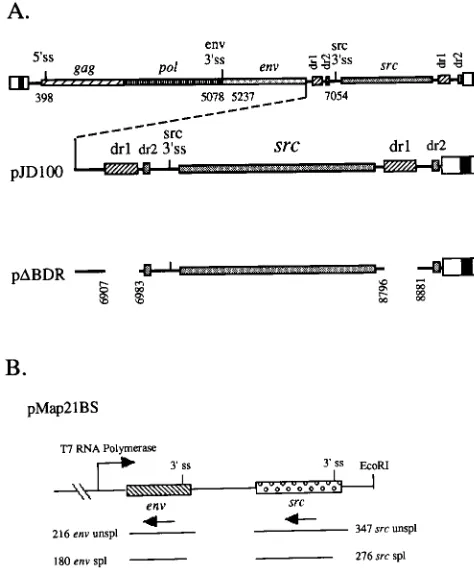
elements in the context of the Prague A RSV genome (Fig. 1A) were tested by transfection of a mutant proviral DNA construct (DBDR) into either permissive CEF or TEF. Both cell types yielded similar results in the experiments described below. Under these conditions, the replication-competent phe-notype can be determined by the ability of infectious virus to spread from the originally transfected cells, which represent
only 5 to 10% of the cells, to the remainder of the nontrans-fected cells in the culture. To assay for the production of virus particles, reverse transcriptase (RTase) activity in the culture medium was measured at intervals after transfection (Fig. 2). RTase was detected in the wild type at 5 days after transfec-tion, and its level was increased at 7 days. In contrast, RTase activity was not detected in the medium ofDBDR-transfected cells, even at 28 days posttransfection. Despite the low levels of RTase, the majority of cells were morphologically transformed and expressed src, as shown by an immunofluorescence assay for the src protein pp60v-src(Fig. 3). Low levels of infectious
virus could be detected by focus assays of the culture medium (;102focus-forming units/ml at 28 days compared to a
wild-type level of;106focus-forming units/ml at 7 days), indicating
virus spread.
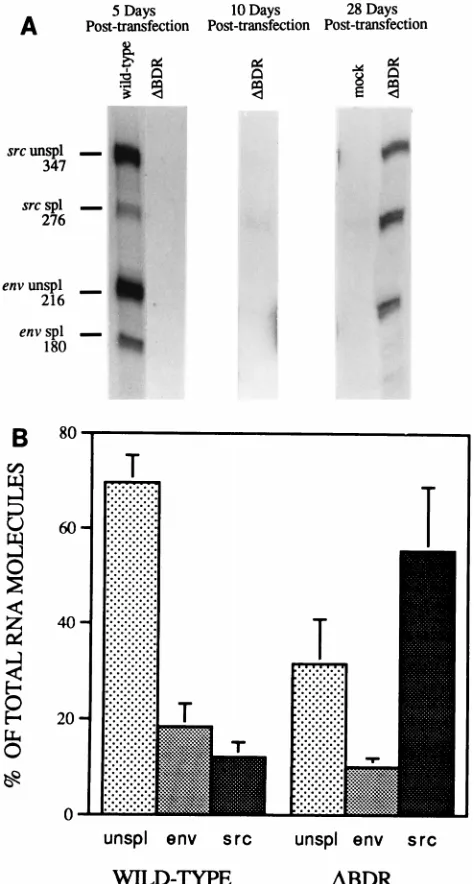
[image:2.612.50.287.71.355.2]Cells infected with the dr1 deletion mutant express viral RNA. Since previous studies have indicated that RSV con-structs lacking dr1 elements fail to replicate (18, 24) but our data showed low levels of virus infection, we carried out addi-tional experiments to characterize this process. Total RNA was isolated from infected cells at various times after transfection, and the probe derived from pMap21BS shown in Fig. 1B was used to detect unspliced gag-pol, env, and src mRNAs by RNase protection assays (Fig. 4A). Viral RNA in theD BDR-infected cells was barely detectable at 10 days, but at 28 days, these cells contained significant levels of RNA corresponding to the three species of viral RNA. The RNA data, together with the src immunofluorescence and RTase assays, indicated that virus in which both dr1 elements were deleted was pro-duced in very low amounts but after several weeks was able to spread throughout the cell culture. Examination of the viral RNA in DBDR-infected cells by reverse transcription-PCR indicated that the deletions of the dr1 elements were main-tained after 28 days. Likewise, Northern blots indicated that there were no deletions in the unspliced, env, and src mRNA species compared to wild-type RNA, other than the expected minor changes in mobility arising from the dr1 deletions (data FIG. 1. Schematic representations of the Prague A RSV-proviral constructs
and the riboprobe templates. (A) Diagrams of the wild-type RSV proviral DNA (pJD100) and mutant construct. Deletions are indicated by gaps in the con-structs, with start and end points and other sites of interest marked by nucleotide number according to the Prague C RSV sequence (22). Abbreviations: 59ss, 59 splice donor; env 39ss, env 39splice acceptor; src 39ss, src 39splice acceptor; dr, direct repeat. (B) Riboprobe template used to analyze the RSV proviral RNA by RNase protection assays. Plasmid pMap21BS spans the env 39splice site (nt 5042 to 5258) and the src 39splice site (nt 6983 to 7330) with a heterologous sequence as a spacer. The plasmid was linearized with EcoRI, and antisense RNA was transcribed by using T7 RNA polymerase. The sizes of the fragments protected by each RNA species are indicated below the riboprobe maps.
FIG. 2. Comparison of virus particle production by cells infected with wild-type RSV (É) or a dr1 deletion mutant (E). After transfection of CEF with proviral DNA or control DNA (mock transfection [h]), culture medium was analyzed for RTase activity at the various posttransfection times indicated by using previously described techniques (32). The amount of [a-32P]TTP-labeled product, which is proportional to the number of virions released from CEF over the time course of infection, is plotted. Cells were passaged as they became confluent, and the medium was changed 24 h prior to harvesting of the medium for analysis. Constructs are described in Fig. 1. Data shown is representative of several independent transfections in both CEF and TEF.
on November 9, 2019 by guest
http://jvi.asm.org/
not shown). Virus from the medium of the mutant-infected cells was used to infect new CEF. These infected cells exhibited the same delay in transformation and absence of detectable RTase activity. These results suggested that the virus which spread in theDBDR-transfected cells was not revertant.
We also determined the relative amounts of different viral RNA species in cells infected with the mutant viruses. The data in Fig. 4B, based on multiple RNase protection experiments, indicated that the levels of both unspliced gag-pol mRNA and env mRNA were reduced in DBDR-infected cells relative to those in wild-type-infected cells. Concomitant with the de-creases in env and unspliced gag-pol mRNAs, there was a corresponding increase in the level of src mRNA.
Unspliced gag-pol and env mRNAs are unstable in cells
infected by mutants lacking dr1 elements. To determine
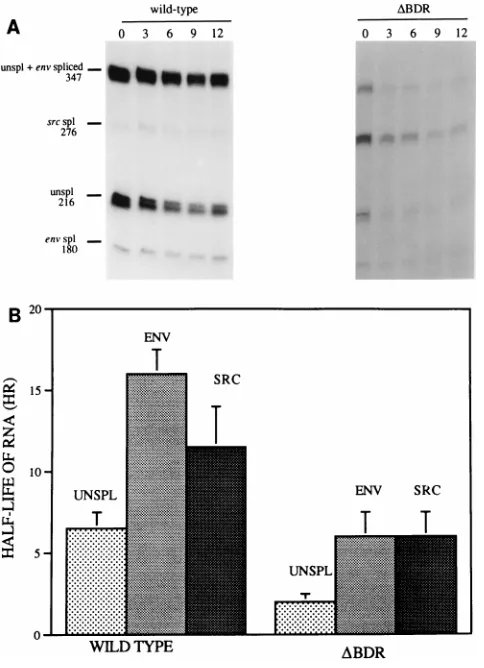
whether the absence of the dr1 elements affected RNA stabil-ities and to what extent this correlated with the differences between the mutant and wild type in steady-state RNA levels, we performed analyses in which transcription was blocked at zero time with dactinomycin and infected cell cultures were harvested at 3-h intervals after treatment with the drug (Fig. 5A). Viral RNA was analyzed at each time point by RNase protection assays. The fraction of the RNA species remaining at each time point was measured by beta scanning, and the half-lives of all of the species were determined from the slopes of semilogarithmic plots of the data. The wild-type unspliced, env, and src mRNAs decayed with half-lives of 6, 16, and 11 h, respectively (Fig. 5B). This is in good agreement with our previously reported data on the stabilities of another RSV strain, B77 avian sarcoma virus (25). The results shown in Fig. 5B indicated that the decay of unspliced RNAs in D BDR-infected cells occurred significantly faster than that of un-spliced RNA in wild-type-infected cells. The env mRNA also decayed more rapidly in DBDR-infected cells than in wild-type-infected cells. The decay rate of src mRNA was also increased by the dr1 deletions but to a lesser extent than that of the unspliced RNA and env mRNA. These results indicate that the reduction in the percentages of unspliced RNA and
env mRNA inDBDR-infected cells (Fig. 4B) is correlated with a decrease in the half-life of these RNA species. There is a concomitant increase in the percentage of src mRNA, whose half-life is affected to a lesser extent.
[image:3.612.310.547.69.511.2]and analyzed by immunofluorescence assay every 3 days posttransfection by using mouse v-src monoclonal antibody EC10 (19) as the primary antibody and a goat anti-mouse antibody conjugated with fluorescein isothiocyanate as the secondary antibody. EC10 reacts strongly with v-src and cross-reacts weakly with c-src. Photographs were taken with the 403objective of a fluorescence micro-scope. (A) TEF infected with the wild type at 6 days posttransfection. (B) TEF infected with the dr1 deletion (DBDR) mutant at 9 days posttransfection. (C) TEF infected with theDBDR mutant at 24 days posttransfection. (D) TEF transfected with no DNA at 24 days posttransfection.
FIG. 4. Altered steady-state ratios of viral RNA species in CEF infected with dr1 deletion mutants. (A) RNase protection assays of total cell RNA isolated 5 days (5mg), 10 days (5mg), and 28 days (10mg) posttransfection by using the pMap21BS riboprobe labeled with [32P]UTP carried out as described in Mate-rials and Methods. Wild-type and mutant constructs are described in Fig. 1. The sizes in nucleotides and locations of the protected bands are indicated. (B) Percentages of viral RNA molecules calculated from the amounts of radioactivity in the protected bands, as determined by direct counting of the gels with an AMBIS beta scanner. The amounts of radioactivity were then corrected for the number of uridine residues in the protected bands. The 276-nt spliced (spl) src band was used for total src mRNA, the 180-nt spliced env band was used for total
env mRNA, and the 216-nt unspliced (unspl) env band was used for total
un-spliced mRNA. The value determined for each of these bands was divided by the sum total of the three bands and multiplied by 100 to give the percentage of RNA molecules. The 347-nt unspliced src band arises from protection by both un-spliced and env mRNAs and was not used in these calculations. Similar results were obtained with TEF.
on November 9, 2019 by guest
[image:3.612.54.287.70.228.2]Mutant lacking dr1 elements demonstrates an elevated
ra-tio of nuclear to cytoplasmic RNA. It has previously been
shown that cells transfected with a Prague C RSV construct lacking dr1 sequences have a reduced level of unspliced viral RNA in the cytoplasm (18). To confirm this effect of the dr1 deletions on nuclear and cytoplasmic RNA levels for the Pra-gue A DBDR mutant, cells were transiently transfected for 48 h with mutant and wild-type proviral DNA constructs. Pre-liminary studies indicated that spread of wild-type virus from the initially transfected cells occurred within this time period. Thus, to confine virus expression only to the initially trans-fected cells and to avoid this complication, we used constructs which contained several point mutations within the viral inte-grase gene. These mutations do not cause any changes in the stability or splicing ratios of RSV RNA but severely inhibit the ability of the virus to replicate (3, 11). Use of these nonrepli-cating virus constructs allowed valid comparisons of RNA lev-els in different transfections by including an internal control plasmid. As an internal control for these studies, we cotrans-fected plasmid pGAGLAC532BS, an RSV plasmid with an intact downstream DR sequence and the b-galactosidase re-porter gene fused in frame with the gag gene (13). The nuclear
[image:4.612.51.293.69.403.2]and cytoplasmic fractions were prepared as described in Ma-terials and Methods, and the levels of the various viral RNA species were quantitated by RNase protection assays. The re-sults of a representative assay are shown in Fig. 6A. In this experiment, the transfection efficiency of theDBDR mutant was lower than that of the wild type, as indicated by the dif-ference in the signal of the 827-nt lacZ protected fragment. As shown in Fig. 6B, the nuclear levels of unspliced RNA were similar in cells transfected with either the dr1 mutant or the wild-type genome RNA when normalized to the lacZ RNA signals. In contrast, the level of mutant cytoplasmic RNA was reduced. These results are in agreement with those of Ogert et FIG. 5. Comparison of stabilities of viral mRNA species in cells infected with
[image:4.612.319.536.70.486.2]wild-type RSV and dr1 deletion mutant RSV constructs. (A) Infected-cell RNA harvested at various time points (indicated in hours) after the addition of dacti-nomycin (1 mg/ml). This concentration is sufficient to inhibit bulk cellular poly(A)1RNA by more than 95%. RNase protection assays using a pMap21BS riboprobe were performed, and the amounts of each RNA species were deter-mined by direct counting of the gels on an AMBIS beta scanner as described in the legend to Fig. 4. unspl, unspliced. (B) Log of the fraction of RNA remaining for each species plotted versus time after dactinomycin addition. The half-lives were determined from the slope of the line, and these values are shown.
FIG. 6. Comparison of nuclear and cytoplasmic viral RNA levels in wild-type RSV and in the dr1 deletion mutant. (A) RNase protection assays of nuclear and cytoplasmic CEF RNAs (6 and 15mg, respectively) harvested at 48 h after transfection of the wild type and the dr1 deletion mutant carried out with pMap21BS and pMapLacZ riboprobes. Plasmid pGAGLAC532BS, which pro-duces an RSV gag-lacZ fusion mRNA, was used as a cotransfection control. spl, spliced; unspl, unspliced. (B) Amounts of unspliced src and LacZ RNA were determined by directly counting the gel on an AMBIS beta scanner, and RNA levels, determined as described in the legend to Fig. 4, were then normalized to the amount of lacZ RNA to determine the relative levels of nuclear (N) and cytoplasmic (C) unspliced RNAs and src mRNA. WT, wild type.
on November 9, 2019 by guest
http://jvi.asm.org/
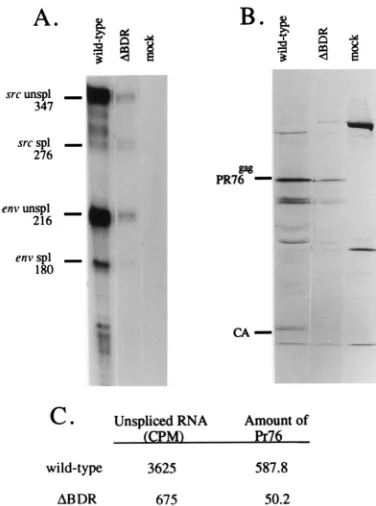
ences in the levels of translation products of the unspliced gag-pol mRNA when the RNAs lacked dr1 elements, we de-termined the relative amounts of gag polyprotein precursor synthesized in infected cells. TEF infected with wild-type RSV and DBDR mutant RSV were pulse-labeled with [35
S]methi-onine for 30 min. Because the kinetics of virus spread differed between the mutant and the wild type, we used cells at 5 days posttransfection for the wild-type virus and at 21 days post-transfection for theDBDR virus. Cells were lysed and immu-noprecipitated with antiserum to capsid (CA) protein. Immu-noprecipitates were subjected to sodium dodecyl sulfate (SDS)-polyacrylamide gel electrophoresis (PAGE), and the results are shown in Fig. 7B. A major labeled band correspond-ing to the Gag precursor was present in each case. The amounts of Pr76gagsynthesized, as determined by densitomet-ric analysis of the protein gel, were compared to the relative amounts of unspliced RNA isolated from parallel cell cultures determined by RNase protection analysis (Fig. 7A). These results (Fig. 7C) indicated that in this experiment there was an approximately 11-fold reduction in the amount of Pr76gag syn-thesized in the cultures infected with theDBDR mutant, and this was concomitant with an approximately 5-fold decrease in the level of total unspliced RNA. The greater effect on the translation of unspliced RNA compared to the amount of total viral RNA almost certainly is a consequence of the reduced proportion of the unspliced mutant RNA which is present in the cytoplasm and available for translation (Fig. 6B).
The Gag protein of theDBDR mutant does not assemble or
process.The effects of the dr1 deletions on cytoplasmic RNA
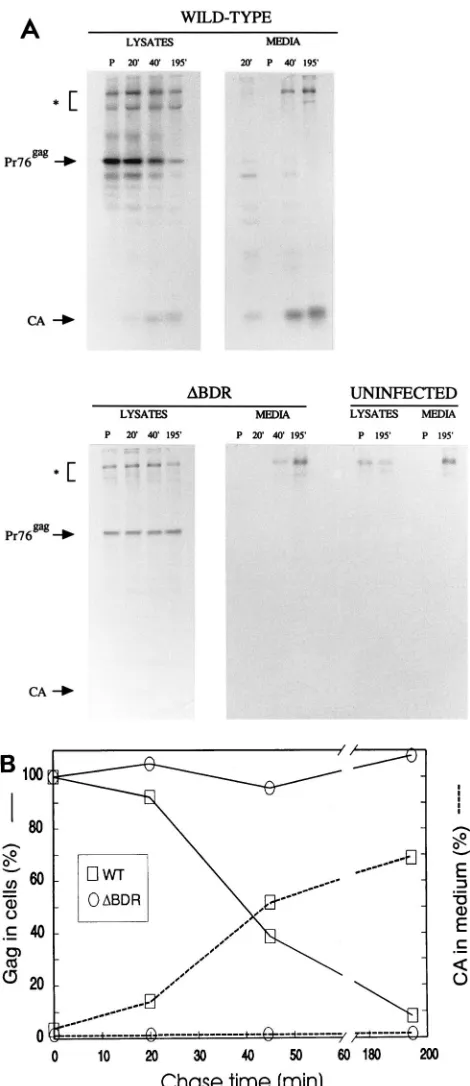
accumulation and translation of Pr76gag were too small to explain the greater than 99% reduction in particle production by the RTase activity in Fig. 2. Therefore, to test whether assembly and processing of Pr76gagwere affected by deletion of dr1 elements, we carried out a 20-min [35S]methionine pulse,
followed by 20-, 45-, and 195-min chase periods to determine the fate of the Gag precursor protein in the wild-type- and mutant-infected TEF. The appearance of labeled mature Gag protein in virus particles was also monitored. The results of the SDS-PAGE analysis are shown in Fig. 8A. The disappearance of the Pr76gag precursor and the appearance of mature CA protein in the medium are plotted in Fig. 8B. After the pulse, most of the radioactive label appeared in the Pr76gagband in both wild-type- and mutant-infected cells. During the chase in wild-type-infected cells, the Pr76gag band decreased and in-creasing amounts of label appeared as processed CA protein in the infected-cell lysates. In the medium, the radioactive label appeared as CA in released virus and this increased with the chase time. In contrast, in the DBDR-infected cells, Pr76gag
was stable and remained almost entirely in the precursor form throughout the chase. Furthermore, little or no processed CA was detected in the DBDR-infected lysates or medium even when the autoradiogram shown in Fig. 8 was exposed for longer times. In addition to the virus-specific bands, several high-molecular-weight bands of host cell origin were present (marked with an asterisk in Fig. 8A) in all of the lysate and medium samples, including those from uninfected cells.
The results of Fig. 8 indicated that the presence of dr1 elements in unspliced gag-pol mRNA is necessary for the Gag precursor to undergo efficient assembly and processing to ma-ture protein products. The lack of Gag precursor processing in the mutant-infected cells is most likely a secondary result of the failure to assemble, since RSV gag mutants that fail to assemble also fail to process (30).
DISCUSSION
[image:5.612.334.522.69.322.2]In this study, we have shown that an RSV mutant with precise deletions of both dr1 elements infects permissive avian fibroblasts but is severely impaired in the ability to replicate. This replication defect arises from activities of the dr1 ele-ments that act at several points in the virus replication cycle. Our results are in agreement with previous studies showing that replication of RSV dr1 mutants is undetectable by release of RTase. However, in these earlier studies, the RSV genome FIG. 7. Comparison of unspliced RNA and synthesis of Pr76gag in TEF
infected with the wild type and the dr1 deletion mutant. (A) RNase protection assay of total cellular RNA infected with wild-type (5 days posttransfection) and theDBDR mutant (21 days posttransfection) with a pMap21BS riboprobe were carried as described in Materials and Methods. spl, spliced; unspl, unspliced. (B) Immunoprecipitation of Pr76gagwith an antibody specific for the RSV CA
pro-tein. Infected cells were labeled for 30 min with [35S]methionine, the cells were harvested, and immunoprecipitation of the cell lysates was carried out as de-scribed in Materials and Methods. Proteins were subjected to SDS–10% PAGE. (C) The amount of unspliced RNA was determined by directly counting the gel shown in panel A on an AMBIS beta scanner. The amount of Pr76gagprotein was
determined by scanning densitometry of the gel in panel B. Prior to harvesting of the cells for RNA and labeling of the cells with [35S]methionine, a single culture for each infection was split into two parallel 100-mm-diameter plates, which were used for the two assays.
on November 9, 2019 by guest
lacked the region of the genome containing the src gene and analysis of virus-infected cells was terminated at 10 days (18) and 7 days (24) postinfection. In our study, analysis of src expression by transformation and immunofluorescence and as-says for the three different RSV RNA species were used to detect the low-level replication phenotype of the virus mutant. First, in cells infected with the dr1 deletion mutant, the relative amount of viral RNA represented by spliced src mRNA is significantly elevated relative to those of unspliced gag-pol and env mRNAs. At least part of this difference from the wild-type pattern is due to the instability of both the un-spliced and env mRNAs relative to the src mRNA. It is also possible that increased splicing at the src 39splice site contrib-utes to the imbalance. Second, the ratio of cytoplasmic to nuclear unspliced viral RNA is lower in cells transfected with the mutant than in those infected with the wild type, suggesting that the dr1 element is able to facilitate the transport and/or the cytoplasmic stability of unspliced viral RNA. This is con-sistent with previous data showing that the dr1 sequence facil-itates Rev-independent expression of unspliced RNA in avian cells when substituted in HIV constructs for the RRE se-quence; i.e., dr1 contains sequences with the property of a CTE (18, 23a). Our results shown above clearly indicate, however, that the dr1 elements are not absolutely required for the trans-port and translation of unspliced RSV gag-pol mRNA.
Third, we found that in mutant-infected cells the gag pre-cursor Pr76gag is synthesized at levels consistent with the amount of unspliced viral RNA in the cytoplasm. Unexpect-edly, however, the protein is not assembled into particles or processed into mature Gag proteins. These results differ from those of Ogert et al., who did not detect significant levels of intracellular Gag proteins in cells transiently transfected with a Prague C RSV mutant with the src gene and dr1 elements deleted (18). Whether this is due to differences in the viral strain or in the methods of detection (e.g., transfection versus infection) is not clear.
A previous study on Schmidt-Ruppin RSV concluded that the DR elements contain essential cis-acting RNA packaging signals in addition to the majorCpackaging signal in the 59
untranslated region (24). We have compared the effects ofC
mutations and a dr1 deletion mutant on packaging by exploit-ing a previously described assay (13). These results indicated that whereas theCmutations reduced specific RNA packaging 25-fold, the dr1 deletion reduced packaging less than 2-fold (32a). Thus, our data and that of others indicate that the effects of the dr1 on RNA transport, RNA stability, and particle assembly are more significant than the effect on packaging, at least in the context of the Prague RSV.
The effect of the dr1 deletions on virus particle assembly is most surprising since evidence to date has indicated that the assembly and release of retrovirus-like particles is a function of the Gag protein and that no other viral proteins are required (for a review, see reference 6). The gag sequences remain wild type in the mutant, and yet particle release is nearly abolished. We suggest two possible hypotheses. First, there may be a threshold level of Pr76gagprecursors necessary in the cell for efficient virus assembly to occur. The reduced level of un-FIG. 8. Pulse-chase analysis of viral proteins in dr1 deletion mutant- and
wild-type-infected cells. (A) TEF cell cultures infected with the wild-type or mutant virus labeled with [35S]methionine in methionine-free medium for 20 min. After this time, the media and lysates were prepared from one set of 60-mm-diameter plates. The labeling medium was removed from duplicate sets of plates and replaced with medium containing normal amounts of methionine. The incubation was continued for 20-, 45-, and 195-min labeling periods, and the media and lysates were prepared from these cells. Gag proteins were immuno-precipitated with anti-RSV serum from both the media and lysates, and the immunoprecipitates were subjected to SDS–12% PAGE, followed by fluorogra-phy to detect the protein bands. The positions of Pr76gagand CA are marked.
The asterisk indicates the position of the high-molecular-weight host cell pro-teins present in the immunoprecipitates. We believe that bands may represent
fibronectin protein which is secreted by the cells and is known to bind to the
Staphylococcus aureus cells used in the immunoprecipitation procedure (21). P,
pulse. (B) Amounts of Pr76gagin the lysates (relative to the amount after the
pulse) determined by PhosphorImager analysis of the gel and plotted versus chase time. The amounts of CA appearing in the medium relative to the amount of label in the pulse were determined by PhosphorImager analysis, and these values are plotted versus chase time. WT, wild type.
on November 9, 2019 by guest
http://jvi.asm.org/
[image:6.612.52.287.67.610.2]mammalian cells may lack the factor(s) that interacts with the dr1 sequences. Consistent with this hypothesis, we have shown that, in the context of the HIV reporter constructs, dr1 substi-tutes for HIV Rev and the HIV RRE to facilitate expression of unspliced RNA in permissive avian cells but fails to substitute for HIV Rev and the HIV RRE in HeLa cells and human foreskin fibroblasts, suggesting a host cell dependence for the CTE activity of the element (23a).
ACKNOWLEDGMENTS
This research was supported by Public Health Service grants CA28051 to C.M.S. and CA 47482 to John Wills, in whose laboratory a portion of this work was performed.
We thank Stanley Perlman and Mark Stinski for critical reviews of the manuscript.
REFERENCES
1. Berberich, S. L., M. Macias, L. Zhang, L. P. Turek, and C. M. Stoltzfus. 1990. Comparison of Rous sarcoma virus RNA processing in chicken and mouse fibroblasts: evidence for double-spliced RNA in nonpermissive mouse cells. J. Virol. 64:4313–4320.
2. Berberich, S. L., and C. M. Stoltzfus. 1991. Analysis of spliced and unspliced Rous sarcoma virus RNAs early and late after infection of chicken embryo fibroblasts: effect of cell culture conditions. Virology 182:135–144. 3. Berberich, S. L., and C. M. Stoltzfus. 1991. Mutations in the regions of the
Rous sarcoma virus 39splice sites: implications for regulation of alternative splicing. J. Virol. 65:2640–2646.
4. Bray, M., S. Prasad, J. W. Dubay, E. Hunter, K.-T. Jeang, D. Rekosh, and M.-L. Hammarskjold.1994. A small element from Mason-Pfizer monkey virus genome makes human immunodeficiency virus type 1 expression and replication Rev-independent. Proc. Natl. Acad. Sci. USA 91:1256–1260. 5. Coffin, J. M. 1984. Structure of the retroviral genome, p. 261–368. In R.
Weiss, N. Teich, H. Varmus, and J. Coffin (ed.), RNA tumor viruses, vol. 1. Cold Spring Harbor Laboratory, Cold Spring Harbor, N.Y.
6. Craven, R. C., and L. J. Parent. 1996. Dynamic interactions of the Gag polyprotein. Curr. Top. Microbiol. Immunol. 214:65–94.
7. Emerman, M., R. Vazeus, and K. Peden. 1989. The rev gene product of the human immunodeficiency virus affects envelope-specific RNA localization. Cell 57:1155–1165.
8. Felber, B. K., M. Hadzopoulou-Cladaras, C. Cladaras, T. Copeland, and G. N. Pavlakis.1989. Rev protein of human immunodeficiency virus type 1 affects the stability and transport of the viral mRNA. Proc. Natl. Acad. Sci. USA 86:1495–1499.
9. Fischer, U., J. Huber, W. C. Boelens, I. W. Mattaj, and R. Luhrmann. 1995. The HIV-1 Rev activation domain is a nuclear export signal that accesses an export pathway used by specific cellular RNAs. Cell 82:475–483. 10. Fischer, U., S. Meyer, M. Teufel, C. Heckel, R. Luhrmann, and G.
Raut-mann.1994. Evidence that HIV-1 Rev directly promotes the nuclear export
18. Ogert, R. A., L. H. Lee, and K. L. Beemon. 1996. Avian retroviral RNA element promotes unspliced RNA accumulation in the cytoplasm. J. Virol. 70:3834–3843.
19. Parsons, S. J., D. J. McCarley, C. M. Ely, D. C. Benjamin, and J. T. Parsons. 1984. Monoclonal antibodies to Rous sarcoma virus pp60srcreact with
en-zymatically active cellular pp60srcof avian and mammalian origin. J. Virol.
51:272–282.
20. Quintrell, N., S. H. Hughes, H. E. Varmus, and J. M. Bishop. 1980. The structure of viral RNAs in mammalian cells infected with avian sarcoma virus. J. Mol. Biol. 143:363–393.
21. Ryden, C., K. Rubin, P. Speziale, M. Hook, M. Lindberg, and T. Wadstrom. 1982. Fibronectin receptors from Staphylococcus aureus. J. Biol. Chem. 258: 3396–3401.
22. Schwartz, D. E., R. Tizard, and W. Gilbert. 1983. Nucleotide sequence of Rous sarcoma virus. Cell 32:853–869.
23. Simpson, S., and C. M. Stoltzfus. 1994. Frameshift mutations in the v-src gene of avian sarcoma virus act in cis to specifically reduce v-src mRNA levels. Mol. Cell. Biol. 14:1835–1844.
23a.Simpson, S., and C. M. Stoltzfus. Unpublished data.
24. Sorge, J., W. Ricci, and S. H. Hughes. 1983. cis-acting RNA packaging locus in the 115-nucleotide direct repeat of Rous sarcoma virus. J. Virol. 48:667– 675.
25. Stoltzfus, C. M., K. Dimock, S. Horikami, and T. A. Ficht. 1983. Stabilities of avian sarcoma virus RNAs; comparison of subgenomic and genomic species with cellular mRNAs. J. Gen. Virol. 64:2191–2202.
26. Stoltzfus, C. M., S. K. Lorenzen, and S. L. Berberich. 1987. Noncoding region between the env and src genes of Rous sarcoma virus influences splicing efficiency at the src gene 39splice site. J. Virol. 61:177–184. 27. Strohman, R., P. Moss, J. Micou-Eastwood, D. Spector, A. Przybyla, and B.
Peterson.1977. Messenger RNA for myosin polypeptides: isolation from single myogenic cell cultures. Cell 10:265–273.
28. Vogt, V. M., D. A. Bruckenstein, and A. P. Bell. 1982. Avian sarcoma virus
gag precursor polypeptide is not processed in mammalian cells. J. Virol.
44:725–730.
29. Wills, J. W., R. C. Craven, and J. A. Achacoso. 1989. Creation and expression of myristylated forms of Rous sarcoma virus gag protein in mammalian cells. J. Virol. 63:4331–4343.
30. Wills, J. W., R. C. Craven, R. A. Weldon, T. D. Nelle, and C. R. Erdie. 1991. Suppression of retroviral MA deletions by the amino-terminal membrane-binding domain of p60src. J. Virol. 65:3804–3812.
31. Zhang, L., S. B. Simpson, and C. M. Stoltzfus. 1996. Selection and charac-terization of replication-competent revertants of a Rous sarcoma virus src gene oversplicing mutant. J. Virol. 70:3636–3644.
32. Zhang, L., and C. M. Stoltzfus. 1995. A suboptimal src 39splice site is necessary for efficient replication of Rous sarcoma virus. Virology 206:1099– 1107.
32a.Zhang, L., and C. M. Stoltzfus. Unpublished data.
33. Zolotukhin, A. S., A. Valentin, G. N. Pavlakis, and B. K. Felber. 1994. Continuous propagation of RRE(2) and Rev(2)RRE(2) human immuno-deficiency virus type 1 molecular clones containing a cis-acting element of simian retrovirus type 1 in human peripheral blood lymphocytes. J. Virol. 68:7944–7952.