White Rose Research Online URL for this paper: http://eprints.whiterose.ac.uk/141984/
Version: Accepted Version
Article:
Gustavson, D.E., Lurquin, J.H., Michaelson, L.E. et al. (4 more authors) (2019) Lower general executive function is primarily associated with trait worry: A latent variable analysis of negative thought/affect measures. Emotion. ISSN 1528-3542
https://doi.org/10.1037/emo0000584
©American Psychological Association, 2019. This paper is not the copy of record and may not exactly replicate the authoritative document published in the APA journal. Please do not copy or cite without author's permission. The final article is available, upon publication, at: https://doi.org/10.1037/emo0000584
[email protected] https://eprints.whiterose.ac.uk/
Reuse
Items deposited in White Rose Research Online are protected by copyright, with all rights reserved unless indicated otherwise. They may be downloaded and/or printed for private study, or other acts as permitted by national copyright laws. The publisher or other rights holders may allow further reproduction and re-use of the full text version. This is indicated by the licence information on the White Rose Research Online record for the item.
Takedown
If you consider content in White Rose Research Online to be in breach of UK law, please notify us by
Lower General Executive Function is Primarily Associated with Trait Worry:
A Latent Variable Analysis of Negative Thought/Affect Measures
Daniel E. Gustavson1, John H. Lurquin2, Laura E. Michaelson2, Jane E. Barker2, Nicholas P. Carruth2, von Bastian, C. C.,2,3 and Akira Miyake2
1 University of California, San Diego 2 University of Colorado Boulder 3 University of Sheffield
©American Psychological Association, 2019. This paper is not the copy of record and may not exactly replicate the authoritative document published in the APA journal. Please do not copy or cite without author's permission. The final article is available, upon
publication, at http://dx.doi.org/10.1037/emo0000584
Author Notes
Daniel E. Gustavson, Department of Psychiatry and Center for Behavior Genetics of Aging, University of California, San Diego; John H. Lurquin, Department of Psychology and Neuroscience, University of Colorado Boulder; Laura E. Michaelson, Department of Psychology and Neuroscience, University of Colorado Boulder; Jane E. Barker, Department of Psychology and Neuroscience, University of Colorado Boulder; Nicholas P. Carruth, Department of
Psychology and Neuroscience, University of Colorado Boulder; Claudia C. von Bastian, Department of Psychology, University of Sheffield; Akira Miyake, Department of Psychology and Neuroscience, University of Colorado Boulder. This work was, in part, completed while Daniel Gustavson was at the University of Colorado Boulder.
This research was conducted while Daniel Gustavson was at the Department of Psychology and Neuroscience, University of Colorado Boulder.
The writing of this article was supported by Grants MH016880 and AG050595 from the National Institutes of Health.
The dataset and analysis scripts are available at the following link: https://osf.io/cs8k3/ We thank Naomi P. Friedman for her assistance with the data analysis and interpretation of results. We also thank Donald Bell-Souder, Danielle Goodmann, Lucas Hampton, Chris Farmelo, Gabrielle Junor, Adam Winter, Anil Arora, Breann Donnelly, Lauren Hellmuth, Katie Lamb, Arien Looney, Shannon Martin, Greta Osgood, Jen Scheideler, Laura Tran, Donna Ty, and Allison Van Crey for their assistance with data collection.
Abstract
This exploratory latent-variable study sought to identify common sources of variance between two multi-faceted important sets of constructs: executive functions (EFs) and negative
thoughts/affect. One-hundred ninety-two college students completed nine tasks representing three types of EFs (inhibition, updating, and shifting) and a set of questionnaires assessing four facets of negative thought/affect (anxiety symptoms, depression symptoms, worry, and
rumination). Results indicated that, although the four negative thought/affect constructs were substantially correlated with one another, trait worry was the construct uniquely associated with EFs. Specifically, worry was associated with general EF abilities underlying all three subtypes of EFs (common EF), but was not associated with specific EF abilities (i.e., shifting-specific and updating-specific). These findings highlight the importance of partitioning common and specific variances in both EFs and negative thought/affect when examining the associations between these two research domains.
Lower General Executive Function Is Associated Primarily with Trait Worry:
A Latent Variable Analysis of Negative Thought/Affect Measures
A recent surge of interest in executive functions (EFs), defined here as a set of
domain-general control processes that regulate one’s thought and behavior (Miyake & Friedman, 2012;
Miyake et al., 2000), has led to a widespread research endeavor to specify the nature of the
relationships between EFs and several clinically important constructs, such as anxiety,
depression, and their respective thought-related subcomponents, worry and rumination. Recent
reviews (including meta-analyses) suggest that, not only among clinical samples but also among
nonclinical samples, weaker EFs are generally associated with higher levels of anxiety symptoms
(e.g., Eysenck, Derakshan, Santos, & Calvo, 2007), depression symptoms (e.g., Snyder, 2013),
worry (e.g., Moran, 2016), and rumination (e.g., Whitmer & Gotlib, 2013; Yang, Cao, Shields,
Teng, & Liu, 2017). Moreover, such associations do not appear to be restricted to any specific
type(s) of EFs, such as the inhibition of prepotent responses (inhibition), the flexible switching of task sets (shifting), and the monitoring and addition/deletion of working memory representations (updating). Rather, such associations have been observed for all of these widely studied EFs, suggesting that the relationship between EFs and these negative thought/affect constructs1 might be a general one (for a recent review, see Snyder, Miyake, & Hankin, 2015).
Despite such advances in our general understanding of the relationship between EFs and negative thought/affect constructs, it has been difficult to precisely specify the nature of this relationship primarily due to one methodological limitation present in most previous studies on this topic. Specifically, these studies focus on just one type of EF (e.g., updating) and one
1 For simplicity, we will hereafter use the term negative thought/affect to collectively refer to the four
negative thought/affect construct (e.g., anxiety symptoms), often relying on a single EF task (e.g., N-back) and a single questionnaire (e.g., Beck Anxiety Inventory). There are two major problems with this approach. First, because no single EF or negative thought/affect measure is process-pure, an observed association may not generalize to other tasks/measures. Second, different facets of both EFs and negative thought/affect constructs, though separable, are also known to be substantially related to each other. Thus, even if one finds that higher levels of anxiety symptoms are associated with worse updating performance, this association may not necessarily reflect a “true” relationship between anxiety symptoms and updating performance; rather, it may instead reflect comorbidity among related constructs.
To start addressing these methodological and interpretational problems, we conducted a latent-variable study in which we assessed, within a single study, multiple EFs (inhibition, updating, and shifting) and four negative thought/affect constructs (i.e., anxiety symptoms, depression symptoms, worry, and rumination) that are most often examined in existing research. After separately validating latent-factor (confirmatory factor analysis or CFA) models of EFs and of the negative thought/affect variables, we examined which specific aspect(s) of EFs would be uniquely associated with which specific aspect(s) of the negative thought/affect variables, using structural equation modeling (SEM). On the basis of our previous work (e.g., Friedman & Miyake, 2017; Miyake & Friedman, 2012), the primary hypothesis of this study was that
common EF ⎯ a general EF ability hypothesized to underlie different types of EFs ⎯ but not
symptoms, worry, and rumination) would be most strongly associated with common EF. The Unity/Diversity Framework of Executive Function
The theoretical model of EFs we used in this study was the unity/diversity framework (Friedman & Miyake, 2017; Miyake & Friedman, 2012). As briefly mentioned above, existing research on EFs and negative thought/affect constructs has capitalized on the separability of different EF subcomponents, such as inhibition, shifting, and updating. For example, on the basis of their reviews of the anxiety literature, Eysenck et al. (2007) proposed that subclinical levels of anxiety are more strongly associated with inhibition and shifting abilities than with updating ability. Although this approach emphasizing the separability of EFs has been prevalent, it neglects an important observation that those different facets of EFs also show some underlying commonality, a pattern often referred to as the unity and diversity of EFs (Miyake et al., 2000). In other words, these three EF abilities are separable (diversity), but are also moderately
correlated with one another and thus share considerable common variance (unity). The unity/diversity framework is a reconceptualization of the relationships among inhibition, shifting, and updating that more directly represents this notion of the unity and
diversity of EFs. According to this framework (Friedman & Miyake, 2017; Miyake & Friedman, 2012), individual differences in these EFs can be understood in terms of three different EF components: common EF, shifting-specific, and updating-specific. This unity/diversity pattern has been demonstrated in several latent-variable studies spanning late childhood (Engelhardt, Briley, Mann, Harden, & Tucker-Drob, 2015), adolescence (Friedman et al., 2008), early
adulthood (Friedman et al., 2016; Ito et al., 2015), and middle age (Gustavson, Panizzon, Elman, et al., 2018; Gustavson, Panizzon, Franz, et al., 2018).
represent general goal-management abilities that underlie successful performance across all types of EFs across multiple situations, including the ability to activate, maintain, and remove task goals (see Friedman & Miyake, 2017, for a more detailed discussion). The updating-specific and shifting-specific components capture variance in those tasks beyond what is explained by the common factor, thus representing the “diversity” of EFs. The updating-specific component is hypothesized to underlie the gating of information in working memory (e.g., Frank, Loughry, & O'Reilly, 2001), whereas the shifting-specific component is hypothesized to reflect the ability to flexibly replace goals that are no longer necessary (Friedman & Miyake, 2017; Miyake & Friedman, 2012). As yet, at least in our own research, there is no evidence for an inhibition-specific component, suggesting that inhibition ability (inhibition-specifically, prepotent response inhibition) may be completely encapsulated by the common EF component (Friedman et al., 2008).
Important to note, in the context of the unity/diversity framework, common EF has been the most relevant EF component in predicting various socially and clinically important outcome variables. For example, in a sample of community-dwelling adolescent twins, common EF was associated with behavioral disinhibition (a general vulnerability factor for externalizing
behaviors), the number of substances ever tried, and the frequency of substance use (Gustavson, Stallings, et al., 2017; Herd et al., 2014; Young et al., 2009). Other applications of the
unity/diversity framework suggest that in young adults, common EF also accounts for the association between EFs and self-regulatory behaviors, such as the control over implicit racial biases (Ito et al., 2015) and procrastinating on everyday tasks (Gustavson, Miyake, Hewitt, & Friedman, 2015). In contrast, there was limited evidence that the shifting- or updating-specific components were associated with such socially- and clinically-relevant constructs.
the primarily associated to clinically relevant outcomes. In fact, a recent longitudinal study (Friedman, du Pont, Corley, & Hewitt, 2018), also based on the same twin sample, has shown that this conclusion may be applicable to negative thought/affect constructs, demonstrating a measure of depression symptoms (CES-D) was uniquely related to common EF. Moreover, in a separate sample of late middle-aged adult twins (mean age 62), common EF was associated with both trait anxiety and depression symptoms (Gustavson, Franz, et al., 2018). Thus, we
hypothesized that common EF, not shifting-specific or updating-specific, is uniquely associated with (one or more of) the negative thought/affect variables examined in the current study.
Linking the Unity/Diversity Framework to Negative Thought/Affect Constructs
Although we had a strong a priori hypothesis regarding the role of common EF, we had no specific hypothesis as to how it might be related to the four negative thought/affect constructs examined in the current study. This is primarily because, to the best of our knowledge, no prior work has examined multiple types of EFs and all these negative thought/affect constructs within a single study. Given that prior research tended to focus on one or two specific negative
thought/affect constructs at a time, it is difficult to see a clear discernible pattern of results that point to one specific a priori hypothesis regarding the nature of the association between common EF and the negative thought/affect constructs. This is not particularly surprising given that all four constructs are substantially correlated with one another, suggesting a high degree of
comorbidity even within unselected samples of college students (Gustavson, du Pont, Whisman, & Miyake, 2018). For these reasons, instead of evaluating a single a priori hypothesis, we explored multiple possibilities that could be justified on the basis of the existing literature.
for each of these overlapping constructs. For example, a large body of research has examined the associations between EFs and subclinical levels of anxiety symptoms. Attentional Control Theory (Berggren & Derakshan, 2013; Eysenck & Derakshan, 2011; Eysenck et al., 2007), developed on the basis of such prior evidence, proposes that inhibition and shifting are impaired in anxiety even in emotionally neutral situations (i.e., trait anxiety), but that updating may not be associated with EF unless situations involve threatening stimuli or manipulation of state anxiety. A recent meta-analysis (Moran, 2016), however, revealed that working memory updating may also be systematically associated with trait anxiety (g = –.29, k = 26, N = 10,967), thus raising the possibility of a broad-scope impact of anxiety on general EF, rather than specific EFs. In light of these findings, one could argue that anxiety symptoms may be the negative
thought/affect construct uniquely associated with common EF.
A similar argument can be made for the unique role of depression symptoms, even
though the existing evidence is somewhat weaker. There is considerable evidence that depression may be associated with performance on different types of EFs (for reviews, see Gotlib &
Joormann, 2010; Snyder, 2013), although most such research has focused on clinical samples of individuals diagnosed with major depression. Moreover, as mentioned earlier, in the only studies thus far that examined associations using the unity/diversity framework (Friedman et al., 2018; Gustavson, Franz, et al., 2018), the common EF factor was significantly associated with self-reported depression symptoms in adolescents (r = –.30), young adults (r = –.13), and
middle-aged adults (r = –.32). These results, however, are ambiguous in that common EF was not associated with another outcome measure, concurrent major depressive disorder symptoms, in the sample of adolescents and young adults. Moreover, neither study reported analyses
One could also make a case for the unique role of worry or of rumination. For example, according to Eysenck et al.’s (2007) Attentional Control Theory, the thought-related component
of anxiety, worry, plays a major role in one’s performance on EF tasks. Consistent with this claim, some studies have demonstrated a negative association between trait worry and EF performance (Gustavson & Miyake, 2016; Hayes, Hirsch, & Mathews, 2008; Moran, 2016). Similarly, in an attentional scope model of rumination, Whitmer and Gotlib (2013) provided a systematic theoretical account of how rumination (both trait and state levels of rumination) may have a negative impact on one’s EF performance, and this link is supported by some empirical evidence (Altamirano, Miyake, & Whitmer, 2010; Whitmer & Banich, 2007; Yang et al., 2017).
In our reading of the existing literature, the cases for the two anxiety-related constructs (worry and anxiety symptoms) seem stronger than those for the two depression-related constructs (rumination and depression symptoms). This is because several studies that tested nonclinical young-adult samples and assessed more than one negative thought/affect constructs have consistently demonstrated a still significant relationship between trait anxiety or worry and performance on an EF task even after controlling for the levels of depressive symptoms or trait rumination. In contrast, the relationship between depressive symptoms or trait rumination and the performance on the same EF task often becomes nonsignificant after controlling for the levels of anxiety symptoms or trait worry (Edwards, Edwards, & Lyvers, 2015; Goodwin & Sher, 1992; Gustavson, Altamirano, Johnson, Whisman, & Miyake, 2017; Gustavson & Miyake, 2016). Thus, even though the number of such studies is limited, the association with common EF
appears to be greater for the anxiety-related constructs (worry and/or anxiety symptoms) than for the depression-related constructs (rumination and/or depression symptoms).
multiple negative thought/affect constructs as the primary source of their relationships to common EF. The first such possibility concerns the concept of repetitive negative thinking, which refers to individuals’ tendencies to frequently experience uncontrollable thoughts about
some negative topics (Ehring & Watkins, 2008; Gustavson, du Pont, et al., 2018; Watkins, 2008). In the current study, worry and rumination jointly represent this concept. Researchers have proposed that tendencies for repetitive negative thinking may underlie the associations between anxiety and depression symptoms and, in turn, their associations with cognition (Ehring
& Watkins, 2008; Watkins, 2008). Thus, both worry and rumination ⎯ more specifically, the
overlap between these two constructs ⎯ may be uniquely associated with common EF.
A final possibility that we entertained was that the common variance shared across all four constructs examined in the study ⎯ a general negative thought/affect factor analogous to
the common EF factor ⎯ may be uniquely and most strongly associated with common EF.
Given that the four negative thought/affect constructs are substantially correlated with one another (e.g., Gustavson, du Pont, et al., 2018), this outcome also seemed plausible.
As reviewed here, prior research points to these different possibilities regarding the hypothesized association between EF and the negative thought/affect constructs. To the best of our knowledge, however, no prior research has assessed all four negative thought/affect
constructs within a single study and examined their potential associations with different EF components. To fill this void in the literature, we conducted a latent-variable study in which we assessed multiple types of EFs (inhibition, shifting, and updating) and all four negative
thought/affect constructs (anxiety symptoms, depression symptoms, worry, and rumination) among a sample of college students, each construct represented by multiple tasks and
challenges associated with most prior studies and thereby to more rigorously examine which aspect(s) of EF is associated with which aspect(s) of the negative thought/affect constructs.
Method
Subjects
One hundred ninety-two undergraduate students (125 women and 67 men) completed this study for partial course credit. Most subjects identified as white non-Hispanic (75.0%), with others identifying as white Hispanic (3.1%), African American (1.6%), Asian (4.7%), other (6.8%), mixed-race (5.2%), or did not respond (3.6%). All other demographic information collected is reported in Table 1. All subjects completed informed consent, and all procedures were approved by the Institutional Review Board of the University of Colorado Boulder.
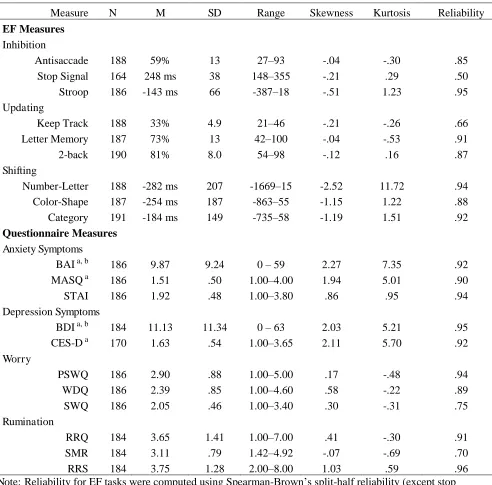
All subjects were included in analyses as long as they were fluent English speakers and finished all aspects of the study. In some cases, individual observations for some of the EF tasks were missing due to computer error, experimenter error, color blindness (Stroop and color-shape tasks only), or significantly below-chance performance on tasks based on binomial probability (e.g., performance significantly lower than 50% in the shifting tasks). See Table 2 for the sample size of each task. Exclusions resulted in only 0–5 missing cases per EF task, except for the stop
signal task, for which 27 cases were lost due to a procedural error resulting in data files that could not be matched with subject number.
Design and Procedure
Subjects completed nine computerized EF tasks, followed by the questionnaires assessing negative thought/affect constructs. We administered EF tasks before the questionnaires to
completed the questionnaires, using a Qualtrics internet survey. The EF battery took about 90– 120 min to complete, and the questionnaires took about 30 min to complete.2
EF tasks. All nine EF tasks were adapted from those used in previous work by our group
(Friedman et al., 2008; Ito et al., 2015). The tasks were nearly identical to those presented in our recent work, with some reduction in the number of trials due to time constraints. Because these tasks are described in detail in these earlier publications, we provide only a brief description of each task here.3 For data analyses, some dependent measures (e.g., shifting tasks) were reverse scored so that higher numbers always indicated better performance.
Inhibition. Inhibition was measured with the stop signal (Logan, 1994), the Stroop
(Stroop, 1935), and the antisaccade tasks (Roberts, Hager, & Heron, 1994). In all tasks, subjects were required to override dominant yet inappropriate responses to avoid making errors.
In the stop signal task, participants saw a green arrow and were instructed to quickly indicate its direction (using the left or right keys), but withhold their response on the 25% of trials where the color of the arrow changed to red. The dependent measure was the stop signal response time (RT), an estimate of the subjects’ stopping process based on how the program adapted to their responses over the course of 3 blocks of 80 trials each. In the Stroop task, participants named the color of either (a) neutral strings of asterisks, (b) words printed in the matching color, or (c) words printed in an incongruent color (RED displayed in blue). Their vocal RTs were measured with a voice key. The dependent measure was the RT interference,
2 This study was part of a larger two-session study investigating individual differences in EF, but only
tasks and questionnaires from the first session are in the analyses reported in the study. In this first session, four other questionnaires primarily assessing individual differences in personality variables (the Big Five Inventory, Right Wing Authoritarianism, Tolerance for Ambiguity, and a questionnaire about media use) were intermixed with the negative thought/affect questionnaires used in this study.
3 The EF tasks were administered in the same order for all subjects (stop signal, category switching,
based on the subtraction of RT for naming colors of incongruent words (2 blocks of 44 trials each) minus RT for naming colors of strings of asterisks (1 block of 44 trials). In the antisaccade task, participants saw cues (black squares) quickly flash on the left or right of the screen. They had to avoid the reflexive tendency to saccade toward these cues; instead, they immediately had to look to the opposite side of the screen to identify a digit that appeared briefly before being masked. The dependent measure was the total accuracy (across 3 blocks of 36 trials).
Shifting. Shifting was measured with the category-switch (Mayr & Kliegl, 2000), the
color–shape (Miyake, Emerson, Padilla, & Ahn, 2004), and the number–letter switching tasks (Rogers & Monsell, 1995). In these tasks, stimuli could be categorized based on two dimensions (e.g., based on the color or the shape of the object in the color-shape tasks) according to a cue.
In the category-switch task, subjects judged whether words described something living or non-living or something bigger or smaller than a soccer ball, based on a cue that appeared 350 ms before the word appeared (a heart or a cross) and remained on screen until the response. In the color-shape task, subjects judged whether colored shapes were either green or red or were a circle or triangle, based on a similar cue (a C or an S). In the number-letter task, subjects judged whether number-letter pairs contained a vowel or consonant or contained an odd or even number, based on where the stimulus appeared in a quadrant of a square on the screen (top or bottom). The dependent measures for all shifting tasks were the RT switch costs: the difference in average response time for switch trials (e.g., switching between color judgments and shape judgments for the color-shape task) and repeat trials in the mixed block (2 blocks of 68 trials each).
Updating. Working memory updating was measured with the spatial 2-back (Friedman et
memory, and removed no-longer-relevant items from working memory before a response. In the spatial 2-back task, participants saw an array of 10 boxes scattered across the screen light up one at a time and pressed a button if the current box was the same as the one lit two trials before. The dependent measure was the total accuracy across 6 blocks of 24 trials. In the keep-track task, participants saw a list of 15-25 words drawn from multiple categories (e.g., animals, metals) presented one at a time on the screen. They were instructed to remember only the most recent word presented from each of two to five specified categories (displayed on the bottom of the screen). The dependent measure was the proportion of total words recalled across all 12 trials (three trials each of 2, 3, 4, and 5 categories). In the letter memory task, participants saw a list of letters presented one at a time. After each letter, participants said aloud the 4 most recent letters that appeared (a rehearsal score). The dependent measure was the proportion of sets correctly rehearsed across all 12 trials (four trials each of length 9, 11, and 13 letters). Points were given for rehearsing only the correct letters in the correct serial order.
Questionnaires. Individual differences in anxiety symptoms, depression symptoms,
worry, and rumination were assessed using multiple questionnaires for each construct.4 Those questionnaires are summarized in Table 3, which also displays some example items from each questionnaire. To differentiate these constructs as much as possible, a given questionnaire was
used to assess only one construct. However, two frequently-used questionnaires ⎯ the State
Trait Anxiety Inventory and the Ruminative Responses Scale ⎯ contributed items to multiple
constructs (described below). All questionnaires measured trait levels of each construct, or how much each item was representative of an individual either in general or in the past few weeks.
4 The questionnaires were administered in the same order for all subjects: Beck Anxiety Inventory, Mood
and Anxiety Symptoms Questionnaire, Scott-McIntosh Rumination Scale, State Trait Anxiety Inventory, Penn State Worry Questionnaire, Worry Domains Questionnaire, Student Worry Questionnaire,
Anxiety symptoms. The tendency to experience physiological or somatic anxiety was
measured with the Beck Anxiety Inventory (BAI; Beck, Epstein, Brown, & Steer, 1988), the arousal subscale of the Mood and Anxiety Symptoms Questionnaire (MASQ; Keogh & Reidy, 2000), and 10 of the 20 items from the State Trait Anxiety Inventory5 (STAI; Spielberger, 1983).
Depression symptoms. The tendency to experience depression symptoms or depressed
mood was measured with the Beck Depression Inventory-Second Edition (BDI; Beck, Steer, & Brown, 1996), and the Center for Epidemiologic Studies–Depression (CES-D; Radloff, 1977).
We also allowed the Ruminative Responses Scale (RRS) to be an indicator of depression symptoms (see below).
Worry. Levels of trait worry ⎯ the tendency to experience repetitive negative thoughts
about future events ⎯ were measured with the Penn State Worry Questionnaire (PSWQ; Meyer, Miller, Metzger, & Borkovec, 1990), the Student Worry Questionnaire (SWQ; Davey, Hampton, Farrell, & Davidson, 1992), and the Worry Domains Questionnaire (WDQ; Stober & Joormann, 2001). Additionally, because the State Trait Anxiety Inventory (described below) also had some items related to trait worry (e.g., I worry over possible misfortunes), this scale was used as an indicator of both worry and anxiety symptoms.
Rumination. Levels of trait rumination ⎯ the tendency for past-oriented perseverative thinking on the causes and consequences of one’s emotional state ⎯ were measured with the
Ruminative Responses Scale (RRS; Nolen-Hoeksema & Morrow, 1991), the rumination subscale of the Rumination-Reflection Questionnaire (RRQ; Trapnell & Campbell, 1999), and three items
5 Only the ten nonreverse-scored items of the STAI were used in this study. Previous research has
from the emotionality subscale of the Scott-McIntosh Rumination Scale6 (SMR; Scott &
McIntosh, 1999). Because, akin to the STAI, many of the RRS items overlapped with depression inventories (Treynor, Gonzalez, & Nolen-Hoeksema, 2003), this scale was used as an indicator of both rumination and depression symptoms.
Although our intention was to primarily assess depressive rumination (i.e., the tendency for perseverative negative thinking when one is in a depressed or negative mood), the SMR scale included two items about anger and intellectual rumination. Exploratory analyses revealed nearly identical results, however, when the analysis was conducted with the single SMR item directly assessing depressive rumination (supplement Figure S1, top panel) or when the SMR scale was excluded entirely (Figure S1, bottom panel).
Data Analysis
All analyses were performed with Mplus software (Version 7.2; Muthén & Muthén, 2010), which adjusts for missing observations using a full-information maximum likelihood approach. Overall model fit was evaluated with chi-square tests ( 2), the root-mean-square error
of approximation (RMSEA), the Akaike information criterion (AIC), and the Comparative Fit Index (CFI). We considered 2 values less than two times the degree of freedom, RMSEA values
< .08, and CFI values > .95 as indicators of good model fit (Hu & Bentler, 1998). Within each model, parameters (i.e., factor loadings, correlations) were determined significant with chi-squared difference tests ( 2diff). Nested models with lower AIC values had better fit. Standard
error-based 95% confidence intervals (95% CIs) are reported for key associations reported in the
6 These three items were from the emotionality subscale of the SMR that most directly measure
results, including correlations among all latent variables.
Sample size considerations and power. Because no prior studies had systematically
examined the associations between common EF and the negative thought/affect constructs at the level of latent variables, we were not able to base our sample size or power based on prior work. Furthermore, there are no well-established methods for determining power in SEM, because power depends on the number of measures, latent variables, and the strength of the factor loadings. For these reasons, we simply tried to collect as much data as possible with the resources available to us across two semesters.
After the data collection for the current study was completed, however, we discovered a resource for power analysis (Soper, 2018) and computed our post-hoc power. With 20 measured variables and 7 or 8 latent variables (depending on the analysis), we had >80% power to detect moderate correlations of r = .29 between latent factors.
Results
Descriptive statistics for all EF tasks and negative thought/affect measures are presented in Table 2. The full correlation matrix between all the measures is presented in the Appendix. As expected for a college-student sample not specifically screened for clinical levels of anxiety and depression, levels of anxiety and depression symptoms were generally low. However, 31
individuals reached the threshold for moderate anxiety on the BAI (score > 15), 11 of whom could be classified as experiencing severe anxiety (score > 25). Similarly, 31 individuals reached the threshold for moderate depression on the BDI (score > 19), and 14 of them could be
classified as experiencing severe depression (score > 28). Thus, there was a substantial amount of variability among our subjects in their levels of anxiety and depression symptoms.
https://osf.io/cs8k3/). Although we used Mplus for data analyses, we also provide versions of the data and script files that can be read by other applications and programs.
CFA Models for EF and Negative Thought/Affect Measures
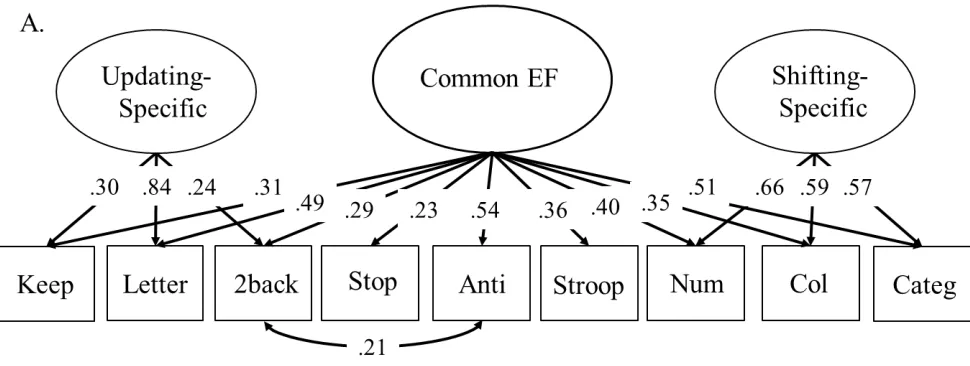
EF model. The unity/diversity model of EF, displayed in Figure 1, fit the data well,
2(20) = 21.39, p = .375, RMSEA = .019, AIC = 4554, CFI = .995. All EF tasks loaded
significantly on both the Common EF factor as well as the respective Updating-Specific and Shifting-Specific factors, all 2diff(1) > 3.86, p < .050, and these loadings were similar to those reported in our previous work (Friedman et al., 2016; Ito et al., 2015). Also as depicted in Figure 1, we included a residual correlation between the antisaccade task and the spatial 2-back task, which was expected on the basis of two previous independent studies using the same battery of EF tasks (Friedman et al., 2016; Ito et al., 2015). This correlation was marginally significant in the EF-only model (Figure 1), r = .21, 2diff(1) = 3.28, p = .070, but it reached statistical
significance in subsequent models with negative thought/affect constructs.7
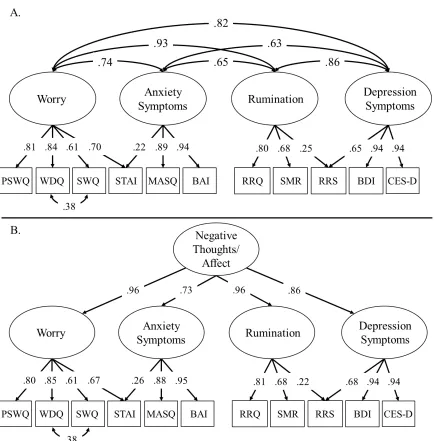
Models for negative thought/affect measures. Figure 2 displays the latent-factor
models of the negative thought/affect variables used in the study. In the correlated-factor model (Figure 2a), all four latent constructs were strongly positively correlated with one another (rs = .63–.93). In this model, we identified a residual correlation between the SWQ and WDQ, r = .38,
2diff(1) = 20.48, p < .001, that was included in all subsequent models. Although not predicted a
priori, this residual correlation was justified because the items for these two worry scales had a more similar structure (i.e., the items were lists of possible worries such as I am unattractive or financial concerns) than did the PSWQ and STAI scales. This model fit the data well, 2(35) =
7 Although not depicted in Figure 1 and not predicted a priori, it was also necessary to constrain the
62.22, p = .001, RMSEA = .064, AIC = 2773, CFI = .984.
The higher-order model of the negative thought/affect constructs is displayed in Figure 2b. In this model, a single second-order latent factor (called Negative Thought/Affect) was created to account for the correlations between the latent variables for anxiety symptoms, depression symptoms, worry, and rumination. This model had acceptable fit, 2(37) = 67.54, p = .002, RMSEA = .066, AIC = 2774, CFI = .981, and did not fit significantly worse than the full correlational model from Figure 2a, 2diff(2) = 5.32, p = .070, although it had a slightly worse RMSEA, AIC, and CFI values.
In addition to these two models shown in Figure 2, we also explored other models of the relationships among these four constructs based on other prominent theorized frameworks in the literature. For example, in one model, we extracted a higher-order Depression factor with
rumination and depression symptoms. In another, we extracted a higher-order Anxiety factor with worry and anxiety symptoms. In a third, we extracted a higher-order Repetitive Negative Thinking factor with worry and rumination (in each of these models, higher-order factors were allowed to correlate with the other negative thought/affect measures, and factor loadings on higher-order factors were equated to identify the model). Although some of these alternative models also had acceptable fit, the two models shown in Figure 2 (2a and 2b) were the most parsimonious and provided the best fit (e.g., based on RMSEA, AIC, and CFI values). Thus, we focused our subsequent analyses on the models in Figure 2.
Relating EF to Negative Thought/Affect Measures
thought/affect constructs. For this purpose, we estimated these associations using multiple regression procedures (i.e., negative/thought affect-related constructs being predicted by direct paths from EF variables). These directional paths, however, were not meant to imply causation.
First, we combined the correlated-factors model of anxiety symptoms, depression symptoms, worry, and rumination (from Figure 2a) with the EF model (from Figure 1). This model, shown in Figure 3a, fit the data well, 2(143) = 184.11, p = .011, RMSEA = .039, AIC = 7169, CFI = .979. The 95% CIs for associations between latent variables in this model are presented in Table 4. In this model, levels of worry were significantly associated with the Common EF factor, = –.43, 2diff(1) = 9.93, p = .002, but were not associated with the
Updating-Specific factor, = .19, 2diff(1) = 3.27 p = .071, or Shifting-Specific factor, = .16, 2diff(1) = 1.32, p = .251. In contrast, levels of anxiety symptoms, depression symptoms, or
rumination were not associated with the Common EF factor, all 2diff(1) < 1.14, p > .259, nor were they associated with the specific EF factors, all 2diff(1) < 1.71, p > .191. Furthermore, the association between worry and common EF was significantly larger than those between
Common EF and anxiety symptoms, depression symptoms, or rumination, all 2diff(1) > 13.04, p < .001. These results suggest that, when examined separately, worry is the construct most strongly related to Common EF.
Second, we combined the higher-order model of the negative thought/affect constructs (Figure 2b) with the EF model (Figure 1). In this model, displayed in Figure 3b, we estimated the direct paths from each of the three EF factors to the general Negative Thought/Affect factor, such that the associations between EF and the individual negative thought/affect constructs act through the Negative Thought/Affect latent factor. This model also fit the data reasonably well,
association between Common EF and the Negative Thought/Affect factor in this model, = – .29, 95% CI [–.55, –.03], 2diff(1) = 4.44, p = .035, but there were no associations between the
Shifting-Specific or Updating-Specific factors and the general Negative Thought/Affect factor, 2diff(1) < 1.62, p > .203.
These results for the model in Figure 3b suggest that EF may be associated with the negative thought/affect constructs through common variance in both sets of constructs (i.e., Common EF and Negative Thought/Affect). Important to note, however, this model fit the data substantially worse than did the corresponding correlated-factors model from Figure 3a, 2diff(11) = 33.97, p < .001. This poorer fit of the model from Figure 3b was due in part to the fact that there was evidence for an additional association between Common EF and worry that was not represented in the model.
As shown in Figure 3c, when a direct path between Common EF and worry was added to the model, this path was significant, = –.18, 95% CI [–.31, –.06], 2diff(1) = 7.76, p = .005. In this constrained model, however, the previously significant association between the Common EF and Negative Thought/Affect factors (from Figure 3b) became nonsignificant, even though the directionality remained the same, = –.16, 95% CI [–.43, .09], 2diff(1) = 1.55, p = .213.
Moreover, this model in Figure 3c, while fitting the data reasonably well overall, 2(153) = 210.32, p = .002, RMSEA = .044, AIC = 7570, CFI = .971, still had a worse fit than the
Discussion
The primary goal of this study was to examine, in a sample of young adults unselected for clinical anxiety or depression, the associations between EFs and four commonly cooccurring negative thought/affect constructs. We tested the a priori hypothesis that EFs are primarily associated with these constructs through Common EF variance, as opposed to variance specific to shifting or updating. In addition, we explored multiple possibilities regarding which aspects of the negative thought/affect constructs were most related to EFs.
In the main SEM model (Figure 3a), Common EF was associated with trait worry ( = – .43), and there were no associations between the Updating-Specific or Shifting-Specific factors and any of the four negative thought/affect constructs. There was limited evidence (Figure 3b) that the Common EF factor was associated ( = –.29) with a general Negative Thought/Affect
factor (i.e., the variance shared among anxiety symptoms, depression symptoms, worry, and rumination). However, this model fit worse than did the correlated-factors model (Figure 3a), even when a direct path was included between Common EF and trait worry ( = –.18; Figure 3c).
Thus, our primary conclusion is that the often hypothesized or observed relationships between EFs and various negative thought/affect constructs may be due to a more specific association between common EF and worry, rather than a broader-scope association between common EF and a general negative thought/affect factor.
these results are consistent with a body of work suggesting that depression is not always strongly correlated with EFs, especially after controlling for levels of anxiety (Edwards et al., 2015; Gustavson, Altamirano, et al., 2017; Wagner, Alloy, & Abramson, 2015). Moreover, the results are also consistent with work showing that associations between rumination and shifting or updating abilities are weak or nonexistent, especially when depression is absent (Yang et al., 2017). However, the association between Common EF and depression may be more substantial in adolescence or middle age (Friedman et al., 2018; Gustavson, Franz, et al., 2018). Finally, the current results are consistent with the observation noted in the introduction that the relationship with EFs appears to be stronger for anxiety-related constructs, although this relationship may be driven primarily by worry (not by anxiety symptoms per se).
Theoretical Implications of the Study
Although the current results must be replicated, the association between common EF and worry observed in this study suggests a need for reexamining or even reconceptualizing many of the previously reported associations between EF and negative thought/affect constructs. As reviewed in the introduction and as pointed out by Snyder et al. (2015), a substantial proportion of the previous research on this topic focused on an association between one specific aspect of EF (e.g., inhibition) and one specific aspect of negative thought/affect constructs (e.g.,
depression symptoms), often leading researchers to suggest that there is a “true” or direct relationship between these two constructs. The current results suggest an alternative possibility: Such previously reported associations may instead reflect general EF ability (common EF), the substantial comorbidity with worry, or both. If true, this alternative possibility could
For example, the weak association between depression symptoms and common EF reported in a young adult twin sample (r = –.13; Friedman et al., 2018), may be in part due to the
fact that trait worry overlaps substantially with depression symptoms (in fact, the CES–D, which was used in that study, was correlated with the worry questionnaires at r = .45 to .67 in the current study). Moreover, some existing theoretical (mechanistic or process-oriented) models (e.g., Whitmer & Gotlib, 2013) tend to focus on a particular negative thought/affect construct of interest (e.g., rumination) as the direct underlying mechanism for one’s EF performance
decrement (e.g., via a change in attentional scope), but the current results raise the possibility that a known correlate of rumination, worry, might instead be more directly relevant.
The current results also provide some important implications for a leading theory on the relationship between EFs and subclinical levels of anxiety, Attentional Control Theory (Eysenck et al., 2007). According to this theory, levels of anxiety are associated with inhibition and shifting abilities, but not with updating abilities (see also Berggren & Derakshan, 2013; Eysenck & Derakshan, 2011). Although Attentional Control Theory has so far focused on the diversity of EFs, the current results suggest that it may be more parsimonious to view these associations as reflecting a single association with common EF that encompasses all three EFs, rather than to conceptualize them as reflecting separate associations with each EF. In fact, given that the three EFs are also substantially correlated with each other (i.e., the unity of EFs), it is reasonable to think that, if inhibition and shifting abilities are negatively affected in anxiety, then updating ability is also likely to be affected. Together with some recent meta-analytic results suggesting reliable associations between anxiety and updating abilities (Moran, 2016), the current results suggest a need for a possible revision in the central claim of Attentional Control Theory.
Attentional Control Theory that worry is primarily responsible for the association between state anxiety and processing efficiency (Eysenck et al., 2007). Specifically, consistent with this claim, we found that worry was more strongly associated with common EF than physiological anxiety symptoms. However, considering that our results are based on trait worry, the association between worry and EFs may not exclusively reflect attentional resources being compromised by concurrent worrisome thoughts (i.e., state worry) per se, as currently postulated in Attentional Control Theory (Eysenck et al., 2007). Rather (or additionally), these findings suggest that individuals who regularly experience worry may inherently differ in the way they engage in cognitive processing (Gustavson & Miyake, 2016).
It will be important for future studies to include measures of both trait and state worry to understand its relations with EFs so that the extent to which state worry underlies the relationship between trait worry and common EF observed in the current study can be more precisely
specified. In particular, one possible reason for the association between common EF and trait worry observed in the current study is that the perception that one did not perform well on the long EF task battery might have increased the level of state worry, especially among those individuals with high trait-worry levels. Because we administered the EF tasks before the questionnaires (primarily to prevent negative thoughts/affects induced by responding to the questionnaires from negatively affecting EF performance) and we did not include a measure of state worry, we cannot rule out this possibility. Assessing both state and trait worry in a future study would be highly informative in this regard.
outcomes such as EF (Ehring & Watkins, 2008; Watkins, 2008). This argument is appealing because, intuitively, cognitive aspects of anxiety and depression symptoms (e.g., repetitive worrisome thoughts) should be most strongly associated with cognitive measures of EF. Indeed, the general Negative Thoughts/Affect factor examined here (Figures 3b and 3c) likely reflected tendencies for general repetitive negative thinking, especially considering that it accounted for nearly all the variance in worry and rumination (factor loadings > .94 in Figure 3c).
Important to note, however, the current study challenges this view by demonstrating that the worry-specific aspect of repetitive negative thinking, rather than general repetitive negative thinking that overlaps with rumination, is most strongly associated with EFs. Future work is necessary to elucidate why worry-specific, instead of general, repetitive negative thinking is uniquely associated with common EF. Nevertheless, these findings highlight the usefulness of componential approaches like the one used in the current study that systematically decompose worry-specific, rumination-specific, and common aspects of repetitive negative thinking (Gustavson, du Pont, et al., 2018; Topper, Molenaar, Emmelkamp, & Ehring, 2014). Methodological Implications of the Study
The current results also provide important methodological implications for future research attempts to specify the nature of the associations between EFs and negative
different types of EFs (common EF) or variance unique to a specific type of EF (shifting-specific). Similarly, on the negative thought/affect side, the association could reflect either variance unique to that particular construct or variance attributable to its comorbidity with other constructs. Future research needs to assess both multiple EFs and multiple aspects of negative thoughts/affect because this is the only way to tease apart these distinct sources of variance.
If possible, these associations should be examined at the level of latent variables, especially when it comes to the assessment of EFs (see Snyder et al., 2015 for similar
methodological suggestions). Latent variables reduce the impact of task-specific influences and better capture the common and specific sets of variance in EFs. Given that no measure can purely capture its underlying constructs (known as the task impurity problem; Miyake et al., 2000), combining multiple EF tasks and negative thought/affect constructs into larger study designs will be central to our understanding and further theoretical development of the associations between EFs and the negative thought/affect constructs.
Limitations
First, this study focused only on levels of anxiety and depression symptoms in the general population. The relationships observed here may be different if examined in a clinical sample, in which EF impairments are more substantial (Snyder et al., 2015). Importantly, however, our post-hoc analyses that excluded individuals (n = 20) with high anxiety and/or depression scores (BAI > 25 and BDI > 28) revealed nearly identical patterns of results, especially in terms of the relationship between common EF and the negative thought/affect constructs (see Figure S2 in the supplement).8 These findings suggest that the relationships observed in this study were not
driven primarily by a relatively small number of individuals exhibiting clinical levels of severe anxiety and/or depression symptoms.9
Second, although we had almost 200 subjects (N = 192), which is larger than most studies on EFs and anxiety or depression, the study’s power was still limited. Specifically, the study had
power to reliably detect only moderate correlations between latent factors (greater than ~.29). Thus, it will be important to replicate and further examine the current results in a larger sample. In particular, a larger sample would allow for a stronger test of whether the association between the Common EF and the Negative Thoughts/Affect factors in Figure 3c is statistically significant even with the direct association with variance unique to worry included in the model.
Third, the models we tested in the study are correlational in nature and thus cannot speak to the directionality of these effects. It is possible, for example, that (a) worse EFs predispose individuals to experience more worry or that (b) constantly experiencing worry impairs EFs. Even both could be true if they have reciprocal influences. In fact, consistent with this
possibility, there is some evidence for bidirectionality in the associations between anxiety and cognition across the lifespan (Petkus, Reynolds, Wetherell, Kremen, & Gatz, 2017). Thus, even though the SEM models depicted in Figure 3 includes directional paths, these results do not imply that EFs causally affect the negative thought/affect constructs. Longitudinal extensions of this work will be necessary to better elucidate the temporal dynamics and the causal
directionality of these associations.
Fourth, it will be helpful to expand our scope to other related negative thought/affect constructs. In this study, we focused on anxiety symptoms, depression symptoms, worry, and
9 We also conducted additional post-hoc analyses excluding individuals who were currently taking
rumination primarily because they are most frequently studied in relation to EFs, but there are other negative thought/affect constructs that may also be associated with poor EFs, such as anger, frustration, neuroticism, and stress (Sorg & Whitney, 1992; Sprague, Verona, Kalkhoff, & Kilmer, 2011). It may be important to examine these constructs in greater detail in future
research. For example, anger, intellectual, and depressive rumination may be differentially associated with EFs (Whitmer & Banich, 2007), although, as noted earlier, there was no evidence that removing the anger/intellectual rumination items had any impact on our results (see Figure S1 in the supplement).
Finally, the correlations between the EF and negative thought/affect measures are low, especially at the level of individual tasks and measures. This problem is not specific to the measures examined in this study, however. Indeed, it is well established that correlations between behavioral cognitive tasks (performance measures) and questionnaire measures (self-report measures) are low (Duckworth & Kern, 2011; Gustavson et al., 2015; Saunders,
Milyavskaya, Etz, Randles, & Inzlicht, 2018; Toplak, West, & Stanovich, 2013). Thus, it may be helpful to use not only more objective measures to assess physiological anxiety and other
constructs examined here but also larger samples as well as methods that can account for biases introduced using self-reported measures to examine these associations with greater precision. Concluding Remarks
References
Altamirano, L. J., Miyake, A., & Whitmer, A. J. (2010). When mental inflexibility facilitates executive control: Beneficial side effects of ruminative tendencies on goal maintenance. Psychological Science, 21, 1377-1382. doi:10.1177/0956797610381505
Beck, A. T., Epstein, N., Brown, G., & Steer, R. A. (1988). An inventory for measuring clinical anxiety: Psychometric properties. Journal of Consulting and Clinical Psychology, 56, 893-897. doi:10.1037/0022-006X.56.6.893
Beck, A. T., Steer, R. A., & Brown, G. K. (1996). Beck Depression Inventory-II manual (BDI-II). San Antonio, TX: Psychological Corporation.
Berggren, N., & Derakshan, N. (2013). Attentional control deficits in trait anxiety: Why you see them and why you don't. Biological Psychology, 92, 440-446.
doi:10.1016/j.biopsycho.2012.03.007
Davey, G. C. L., Hampton, J., Farrell, J., & Davidson, S. (1992). Some characteristics of worrying: Evidence for worrying and anxiety as separate constructs. Personality and Individual Differences, 13, 133-147. doi:10.1016/0191-8869(92)90036-O
Duckworth, A. L., & Kern, M. L. (2011). A meta-analysis of the convergent validity of self-control measures. Journal of Research in Personality, 45, 259-268.
doi:10.1016/j.jrp.2011.02.004
Edwards, E. J., Edwards, M. S., & Lyvers, M. (2015). Cognitive trait anxiety, situational stress, and mental effort predict shifting efficiency: Implications for attentional control theory. Emotion, 15, 350-359. doi:10.1037/emo0000051
Engelhardt, L. E., Briley, D. A., Mann, F. D., Harden, K. P., & Tucker-Drob, E. M. (2015). Genes unite executive functions in childhood. Psychological Science, 26, 1151-1163. doi:10.1177/0956797615577209
Eysenck, M. W., & Derakshan, N. (2011). New perspectives in attentional control theory. Personality and Individual Differences, 50, 955-960. doi:10.1016/j.paid.2010.08.019 Eysenck, M. W., Derakshan, N., Santos, R., & Calvo, M. G. (2007). Anxiety and cognitive
performance: Attentional control theory. Emotion, 7, 336-353. doi:10.1037/1528-3542.7.2.336
Frank, M. J., Loughry, B., & O'Reilly, R. C. (2001). Interactions between frontal cortex and basal ganglia in working memory: A computational model. Cognitive Affective & Behavioral Neuroscience, 1, 137-160. doi:10.3758/Cabn.1.2.137
Friedman, N. P., du Pont, A., Corley, R. P., & Hewitt, J. K. (2018). Longitudinal relations between depressive symptoms and executive functions from adolescence to early adulthood: A twin study. Clinical Psychological Science, 6, 543-560.
doi:10.1177/2167702618766360
Friedman, N. P., & Miyake, A. (2017). Unity and diversity of executive functions: Individual differences as a window on cognitive structure. Cortex, 86, 186-204.
doi:10.1016/j.cortex.2016.04.023
Friedman, N. P., Miyake, A., Young, S. E., Defries, J. C., Corley, R. P., & Hewitt, J. K. (2008). Individual differences in executive functions are almost entirely genetic in origin. Journal of Experimental Psychology: General, 137, 201-225. doi:10.1037/0096-3445.137.2.201 Goodwin, A. H., & Sher, K. J. (1992). Deficits in set-shifting ability in nonclinical compulsive
checkers. Journal of Psychopathology and Behavioral Assessment, 14, 81-92. doi:10.1007/Bf00960093
Gotlib, I. H., & Joormann, J. (2010). Cognition and depression: Current status and future directions. Annual Review of Clinical Psychology, 6, 285-312.
doi:10.1146/annurev.clinpsy.121208.131305
Gustavson, D. E., Altamirano, L. J., Johnson, D. P., Whisman, M. A., & Miyake, A. (2017). Is set shifting really impaired in trait anxiety? Only when switching away from an
effortfully established task set. Emotion, 17, 88-101. doi:10.1037/emo0000212 Gustavson, D. E., du Pont, A., Whisman, M. A., & Miyake, A. (2018). Evidence for
transdiagnostic repetitive negative thinking and its association with rumination, worry, and depression and anxiety symptoms: A commonality analysis. Collabra: Psychology, 4, 13. doi:10.1525/collabra.128
Gustavson, D. E., Franz, C. E., Panizzon, M. S., Reynolds, C. A., Xian, H., Toomey, R., . . . Kremen, W. S. (2018). Genetic and environmental associations among executive
functions, trait anxiety, and depression symptoms in middle age. Clinical Psychological Science, advance online publication. doi:10.1177/2167702618805075
Gustavson, D. E., & Miyake, A. (2016). Trait worry is associated with difficulties in working memory updating. Cognition and Emotion, 30, 1289-1303.
Gustavson, D. E., Miyake, A., Hewitt, J. K., & Friedman, N. P. (2015). Understanding the cognitive and genetic underpinnings of procrastination: Evidence for shared genetic influences with goal management and executive function abilities. Journal of Experimental Psychology: General, 144, 1063-1079. doi:10.1037/xge0000110
Gustavson, D. E., Panizzon, M. S., Elman, J. A., Franz, C. E., Reynolds, C. A., Jacobson, K. C., . . . Kremen, W. S. (2018). Stability of genetic and environmental influences on executive functions in midlife. Psychology and Aging, 33, 219-231. doi:10.1037/pag0000230 Gustavson, D. E., Panizzon, M. S., Franz, C. E., Friedman, N. P., Reynolds, C. A., Jacobson, K.
C., . . . Kremen, W. S. (2018). Genetic and environmental architecture of executive functions in midlife. Neuropsychology, 32, 18-30. doi:10.1037/neu0000389
Gustavson, D. E., Stallings, M. C., Corley, R. P., Miyake, A., Hewitt, J. K., & Friedman, N. P. (2017). Executive functions and substance use: Relations in late adolescence and early adulthood. Journal of Abnormal Psychology, 126, 257-270. doi:10.1037/abn0000250 Hayes, S., Hirsch, C., & Mathews, A. (2008). Restriction of working memory capacity during
worry. Journal of Abnormal Psychology, 117, 712-717. doi:10.1037/a0012908 Herd, S. A., O'Reilly, R. C., Hazy, T. E., Chatham, C. H., Brant, A. M., & Friedman, N. P.
(2014). A neural network model of individual differences in task switching abilities. Neuropsychologia, 62, 375-389. doi:10.1016/j.neuropsychologia.2014.04.014
Hu, L. T., & Bentler, P. M. (1998). Fit indices in covariance structure modeling: Sensitivity to underparameterized model misspecification. Psychological Methods, 3, 424-453. doi:10.1037//1082-989x.3.4.424
function in implicit racial bias. Journal of Personality and Social Psychology, 108, 187-218. doi:10.1037/a0038557
Keogh, E., & Reidy, J. (2000). Exploring the factor structure of the Mood and Anxiety Symptom Questionnaire (MASQ). Journal of Personality Assessment, 74, 106-125.
doi:10.1207/S15327752JPA740108
Logan, G. D. (1994). On the ability to inhibit thought and action: A users' guide to the stop signal paradigm. In D. D. & T. H. Carr (Eds.), Inhibitory processes in attention, memory, and language (pp. 189-239). San Diego, CA: Academic Press.
Mayr, U., & Kliegl, R. (2000). Task-set switching and long-term memory retrieval. Journal of Experimental Psychology: Learning, Memory, and Cognition, 26, 1124-1140.
Meyer, T. J., Miller, M. L., Metzger, R. L., & Borkovec, T. D. (1990). Development and validation of the Penn State Worry Questionnaire. Behavior Research and Therapy, 28, 487-495. doi:10.1016/0005-7967(90)90135-6
Miyake, A., Emerson, M. J., Padilla, F., & Ahn, J. C. (2004). Inner speech as a retrieval aid for task goals: The effects of cue type and articulatory suppression in the random task cuing paradigm. Acta Psychologica, 115, 123-142. doi:10.1016/j.actpsy.2003.12.004
Miyake, A., & Friedman, N. P. (2012). The nature and organization of individual differences in executive functions: Four general conclusions. Current Directions in Psychological Science, 21, 8-14. doi:10.1177/0963721411429458
Miyake, A., Friedman, N. P., Emerson, M. J., Witzki, A. H., Howerter, A., & Wager, T. D. (2000). The unity and diversity of executive functions and their contributions to complex "frontal lobe" tasks: A latent variable analysis. Cognitive Psychology, 41, 49-100.
Moran, T. P. (2016). Anxiety and working memory capacity: A meta-analysis and narrative review. Psychol Bull, 142, 831-864. doi:10.1037/bul0000051
Morris, N., & Jones, D. M. (1990). Memory updating in working memory: The role of the central executive. British Journal of Psychology, 81, 111-121. doi:10.1111/j.2044-8295.1990.tb02349.x
Muthén, L. K., & Muthén, B. O. (2010). Mplus User's Guide: Statistical Analysis with Latent Variables: User's Guide: Muthén & Muthén.
Nolen-Hoeksema, S., & Morrow, J. (1991). A prospective study of depression and posttraumatic stress symptoms after a natural disaster: The 1989 Loma Prieta Earthquake. Journal of Personality and Social Psychology, 61, 115-121. doi:10.1037/0022-3514.61.1.115 Petkus, A. J., Reynolds, C. A., Wetherell, J. L., Kremen, W. S., & Gatz, M. (2017). Temporal
dynamics of cognitive performance and anxiety across older adulthood. Psychology and Aging. doi:10.1037/pag0000164
Radloff, L. S. (1977). The CES-D scale: A self-report depression scale for research in the general population. Applied psychological measurement, 1, 385-401.
Roberts, R. J., Hager, L. D., & Heron, C. (1994). Prefrontal cognitive processes: Working-wemory and inhibition in the antisaccade task. Journal of Experimental Psychology: General, 123, 374-393. doi:Doi 10.1037//0096-3445.123.4.374
Saunders, B., Milyavskaya, M., Etz, A., Randles, D., & Inzlicht, M. (2018). Reported self-control is not meaningfully associated with inhibition-related executive function: A bayesian analysis. Collabra: Psychology, 4, 39. doi:10.1525/collabra.134
Scott, V. B., & McIntosh, W. D. (1999). The development of a trait measure of ruminative thought. Personality and Individual Differences, 26, 1045-1056. doi:10.1016/S0191-8869(98)00208-6
Snyder, H. R. (2013). Major depressive disorder is associated with broad impairments on neuropsychological measures of executive function: A meta-analysis and review. Psychological Bulletin, 139, 81-132. doi:10.1037/a0028727
Snyder, H. R., Miyake, A., & Hankin, B. L. (2015). Advancing understanding of executive function impairments and psychopathology: Bridging the gap between clinical and cognitive approaches. Frontiers in Psychology, 6, 328. doi:10.3389/fpsyg.2015.00328 Soper, D. S. (2018). A-priori sample size calculator for structural equation models [Software].
Available from http://www.danielsoper.com/statcalc.
Sorg, B. A., & Whitney, P. (1992). The effect of trait anxiety and situational stress on working memory capacity. Journal of Research in Personality, 26, 235-241. doi:Doi
10.1016/0092-6566(92)90041-2
Spielberger, C. D. (1983). Manual for the State-Trait Anxiety Inventory STAI (form Y)(" self-evaluation questionnaire").
Stober, J., & Joormann, J. (2001). A short form of the Worry Domains Questionnaire: construction and factorial validation. Personality and Individual Differences, 31, 591-598. doi:10.1016/S0191-8869(00)00163-X
Stroop, J. R. (1935). Studies of interference in serial verbal reactions. Journal of Experimental Psychology, 18, 643-662. doi:10.1037/0096-3445.121.1.15
Toplak, M. E., West, R. F., & Stanovich, K. E. (2013). Practitioner review: Do performance-based measures and ratings of executive function assess the same construct? Journal of Child Psychology and Psychiatry, 54, 131-143. doi:10.1111/jcpp.12001
Topper, M., Molenaar, D., Emmelkamp, P., & Ehring, T. (2014). Are rumination and worry two sides of the same coin? A structural equation modelling approach. Journal of
Experimental Psychopathology, 5, 363-381. doi:10.5127/jep.038813
Trapnell, P. D., & Campbell, J. D. (1999). Private self-consciousness and the five-factor model of personality: distinguishing rumination from reflection. Journal of Personality and Social Psychology, 76, 284-304.
Treynor, W., Gonzalez, R., & Nolen-Hoeksema, S. (2003). Rumination reconsidered: A psychometric analysis. Cognitive Therapy and Research, 27, 247-259.
doi:10.1023/A:1023910315561
Wagner, C. A., Alloy, L. B., & Abramson, L. Y. (2015). Trait rumination, depression, and executive functions in early adolescence. Journal of Youth and Adolescence, 44, 18-36. doi:10.1007/s10964-014-0133-8
Whitmer, A. J., & Banich, M. T. (2007). Inhibition versus switching deficits in different forms of rumination. Psychological Science, 18, 546-553. doi:10.1111/j.1467-9280.2007.01936.x Whitmer, A. J., & Gotlib, I. H. (2013). An attentional scope model of rumination. Psychological
Bulletin, 139, 1036-1061. doi:10.1037/a0030923
Yang, Y., Cao, S., Shields, G. S., Teng, Z., & Liu, Y. (2017). The relationships between rumination and core executive functions: A meta analysis. Depression and Anxiety, 34, 37-50. doi:doi.org/10.1002/da.22539
Yntema, D. B. (1963). Keeping track of several things at once. Human Factors, 5, 7-17. doi:10.1177/001872086300500102
Table 1
Demographic Characteristics of the Sample
Demographic Variable M SD Range
Gender (% Female) 65.1 - -
Race (% White) 78.1 - -
Ethnicity (% non-Hispanic) 86.5 - -
Age 19.63 2.69 18, 38
Sleep last night (hours) 7.15 1.46 3, 11
Medication (% yes) 15.6 - -
Loss of consciousness (% yes) 25.5 - -
Note: “Medication” was a yes/no response to the question Are you currently taking any
Table 2
Descriptive Statistics for all EF Tasks and Negative Thought/Affect Questionnaires
Measure N M SD Range Skewness Kurtosis Reliability
EF Measures
Inhibition
Antisaccade 188 59% 13 27–93 -.04 -.30 .85
Stop Signal 164 248 ms 38 148–355 -.21 .29 .50
Stroop 186 -143 ms 66 -387–18 -.51 1.23 .95
Updating
Keep Track 188 33% 4.9 21–46 -.21 -.26 .66
Letter Memory 187 73% 13 42–100 -.04 -.53 .91
2-back 190 81% 8.0 54–98 -.12 .16 .87
Shifting
Number-Letter 188 -282 ms 207 -1669–15 -2.52 11.72 .94 Color-Shape 187 -254 ms 187 -863–55 -1.15 1.22 .88 Category 191 -184 ms 149 -735–58 -1.19 1.51 .92
Questionnaire Measures
Anxiety Symptoms
BAI a, b 186 9.87 9.24 0 – 59 2.27 7.35 .92
MASQ a 186 1.51 .50 1.00–4.00 1.94 5.01 .90
STAI 186 1.92 .48 1.00–3.80 .86 .95 .94
Depression Symptoms
BDI a, b 184 11.13 11.34 0 – 63 2.03 5.21 .95
CES-D a 170 1.63 .54 1.00–3.65 2.11 5.70 .92
Worry
PSWQ 186 2.90 .88 1.00–5.00 .17 -.48 .94
WDQ 186 2.39 .85 1.00–4.60 .58 -.22 .89
SWQ 186 2.05 .46 1.00–3.40 .30 -.31 .75
Rumination
RRQ 184 3.65 1.41 1.00–7.00 .41 -.30 .91
SMR 184 3.11 .79 1.42–4.92 -.07 -.69 .70
RRS 184 3.75 1.28 2.00–8.00 1.03 .59 .96
Note: Reliability for EF tasks were computed using Spearman-Brown’s split-half reliability (except stop signal, which was computed using Cronbach’s alpha) and reliability for questionnaires was computed
using Cronbach’s Alpha. BAI = Beck Anxiety Inventory, MASQ = Mood and Anxiety Symptoms
Questionnaire, STAI = State Trait Anxiety Inventory, BDI = Beck Depression Inventory, CES-D = Center for Epidemiologic Studies – Depression, PSWQ = Penn State Worry Questionnaire, WDQ = Worry Domains Questionnaire, SWQ = Student Worry Questionnaire, RRQ = Rumination Responses
Questionnaire, SMR = Scott-McIntosh Rumination, RRS = Ruminative Responses Scale. a = Scale was
log-transformed for all analyses. Skewness (range .80 to 1.15) and kurtosis (range .10 to 1.82) values were acceptable after this transformation. b = For all questionnaires, we display the mean response option