This is a repository copy of Eliciting preferences in dentistry with multiattribute stated
preference methods: A systematic review.
White Rose Research Online URL for this paper:
http://eprints.whiterose.ac.uk/131724/
Version: Accepted Version
Article:
Barber, S, Pavitt, S, Khambay, B et al. (2 more authors) (2018) Eliciting preferences in
dentistry with multiattribute stated preference methods: A systematic review. JDR Clinical
and Translational Research, 3 (4). pp. 326-335. ISSN 2380-0844
https://doi.org/10.1177/2380084418780324
(c) International & American Associations for Dental Research 2018. This is an author
produced version of a paper published in JDR Clinical & Translational Research. Reprinted
by permission of SAGE Publications.
[email protected] https://eprints.whiterose.ac.uk/ Reuse
Items deposited in White Rose Research Online are protected by copyright, with all rights reserved unless indicated otherwise. They may be downloaded and/or printed for private study, or other acts as permitted by national copyright laws. The publisher or other rights holders may allow further reproduction and re-use of the full text version. This is indicated by the licence information on the White Rose Research Online record for the item.
Takedown
If you consider content in White Rose Research Online to be in breach of UK law, please notify us by
Eliciting Preferences in Dentistry using Multi-Attribute Stated Preference Methods: A Systematic Review
Authors
1. Sophy Barber
Post-CCST Registrar in Orthodontics & NIHR Doctoral Research Fellow
Orthodontic Department, Leeds Dental Institute, Clarendon Way, Leeds, LS2 9LU 07793003050
2. Sue Pavitt
Professor in Translational and Applied Health Research
Professorial Suite, Level 6 Worsley Building, Clarendon Way, Leeds LS2 9LU 0113 343 6985
3. Balvinder Khambay Professor in Orthodontics
School of Dentistry, University of Birmingham, 5 Mill Pool Way, Birmingham, B5 7EG
0121 466 5470
4. Hilary Bekker
Professor in Medical Decision Making
Leeds Institute of Health Sciences, Level 10, Worsley Building, Clarendon Way, Leeds, LS2 9TJ
0113 343 2726
5. David Meads
Associate Professor in Health Economics
Leeds Institute of Health Sciences, Level 11, Worsley Building, Clarendon Way, Leeds, LS2 9TJ
0113 343 0860
Corresponding author:
Sophy Barber
Orthodontic Department Leeds Dental Institute Clarendon Way Leeds
LS2 9LU 07793003050
Keywords
Discrete Choice Experiment
Conjoint analysis
Attribute
Willingness-to-pay
Decision-making
KNOWLEDGE TRANSFER STATEMENT
Understanding patient, professional and public preferences is fundamental for
evidence-based decision-making and treatment delivery. Preference elicitation
methods can be used to estimate the value given to health states, service delivery,
individual treatments and health outcomes. By describing and appraising the
methodology and application of multi-attribute stated preference experiments in
dentistry, this review provides an essential first step to wider use of well-designed,
ABSTRACT
Background: Preference experiments are used to understand how patients and
stakeholders value aspects of healthcare. These methods are gaining popularity in
dentistry but quality and breadth of use has not been evaluated.
Objectives: To describe multi-attribute stated preference experiment use in dentistry
through illustration and critique of existing studies.
Data sources: Systematic literature search of PubMed, Econlit and Ovid for Medline,
Embase, PsychINFO, PsychARTICLES and All EBM Reviews, and grey literature.
Study eligibility: Multi-attribute stated preference experiments eliciting preferences
for dental service delivery, treatments and oral health states from patients, public and
dental professional perspective. Outcomes of interest were preference weights and
marginal rates of substitution. Study selection was performed by two reviewers
independently.
Appraisal: 10-point checklist published by International Society of
Pharmacoeconomics and Outcomes Research (2011) was used for quality
assessment.
Synthesis: Descriptive analysis.
Results: Searches identified 12 records published between 1999-2015, mostly in
non-dental academic journals. Studies were undertaken in high-income countries in
Europe and the USA. The studies aimed to elicit preference for service delivery,
treatment or oral health states from the perspective of the patients, dentists or the
public using Discrete Choice Experiment (DCE) methods. The quality scores for the
studies ranged from 53-100%.
Limitations: A detailed description and critique of stated preference methods are
provided but it was not possible to provide synthesised preference data.
Conclusions: Multi-attribute stated preference experiments are increasingly popular
but understanding the methods and outputs is essential for designing and
interpreting preference studies to improve patient care. Patient preferences highlight
important considerations for decision-making during treatment planning. Valuation of
health states and estimation of willingness-to-pay is important for resource planning
and allocation and economic evaluation. Preference estimates and relative value of
attributes for interventions and service delivery inform development and selection of
treatments and services.
INTRODUCTION
Preference is described as an individual’s liking for one alternative over another and
it depends on values built through knowledge, experience and reflection. Patient
preferences are a fundamental component of evidence-based healthcare and there
is evidence that involving patients in care decisions and delivery results in better
choices and more effective, personalised care (Mulley et al. 2012). Preference
elicitation methods aim to provide important evidence for decisions about treatment
selection and delivery, and service provision, including allocation of resources,
clinical and policy decision-making, prediction of demand and planning services and
economic evaluations (Centre for Devices and Radiological Health 2016).
Two broad categories of preference elicitation methods exist. Revealed preference
methods estimate preferences using data arising from observation of behaviour
around actual choices. Stated preference experiments obtain preferences using
hypothetical scenarios, enabling existing choice situations to be tested under
controlled conditions or exploration of non-existent choices. Multi-attribute stated
preference experiments are a subset of stated preference experiments and are
based on Lancaster’s theory of value (Lancaster 1966). This states that utility (value)
is derived from the underlying characteristics (attributes) of a good or service and
consumer choice is a result of consideration of more than one attribute. It is
assumed that people are rational utility maximisers, which means that when making
choices between alternatives, the positive and negative attributes of a good or
service are weighed up and traded-off to give a choice that is expected to yield the
greatest utility.
Multi-attribute stated preference experiments require characterisation of the
intervention, service or health state and identification of the underlying attributes.
The most relevant attributes are selected and the dimensions of the attribute
(attribute levels) are defined as numerical or categorical variables (Figure 1).
Attribute levels are presented in different combinations as hypothetical scenarios.
Respondents are asked to choose which scenario they prefer, forcing trading off
between attributes. Attribute values are estimated based on analysis of the
trade-offs that respondents are willing to make, assuming that less valued attributes are
sacrificed for those perceived to have more utility. The requirement for respondents
methodological approaches from simple rating scales where choices are expressed
independently without discrimination, and from less complex single-attribute ranking
methods. Multi-attribute stated preference experiments provide an estimated value
for the utility of the attributes and levels (attribute coefficients) and from this it is
possible to calculate part-worth utilities (the additional utility gained from attribute
relative to attribute base level) and marginal rates of substitution (attribute values
relative to each other) such as money equivalence (willingness to pay), time
equivalence (willingness to wait) and risk equivalence (maximum acceptable risk).
Multi-attribute stated preference experiments can be divided into two groups; those
quantifying the value of attributes to explore trade-offs in multi-attribute goods or
service and those eliciting direct monetary values for an intervention to estimate
demand for a single product (Bridges et al. 2011). This review focuses only on the
former, also known as conjoint analysis. Multi-attribute stated preference
experiments are designed in discrete, sequential stages (Figure 2) These are
described in detail in best practice guidance published by the International Society of
Pharmacoeconomics and Outcomes Research (ISPOR) (Bridges et al. 2011;
Johnson et al. 2013; Hauber et al. 2016) and in methodology papers published by
experts in the field (Ryan and Gerrard 2003; Lancsar and Louviere 2008; Vinney et
al. 2002; Mangham et al. 2009).
In healthcare multi-attribute stated preference experiments have been used with
three key groups of stakeholders 1) Patients - for valuing experience, health
outcomes, and tradeoffs between experience and outcome 2) Health professionals
-preferences for treatment and screening 3) Public - -preferences to inform priority
setting and development of policy (Clark et al. 2014). With the growing awareness of
the potential for preference elicitation methods in dentistry, a review of the quality
and breadth of use in this area is timely and pertinent to guide good practice from the
outset. This study aims to describe and evaluate how multi-attribute stated
preference experiments have been used in dentistry to elicit preferences for dental
procedures, treatment outcomes, oral health states and service delivery from a
MATERIALS AND METHODS
A scoping review confirmed no reviews were planned or published on this topic. The
protocol was published on PROSPERO in March 2017 (CRD42017059859).
Eight electronic databases were searched (Ovid: Medline, Embase, PsychINFO,
PsychARTICLES, All EBM Reviews; Pubmed; Econlit). A grey literature search
involved hand searching reference lists of relevant publications and reviews and
targeted searching of online resources: NICE and SIGN; www.clinicaltrials.gov;
Google Scholar; Conference abstracts. Search terms were constructed around two
search concepts, stated preference experiments and dentistry (Appendix Table 1)
based on a previous review (Clark et al. 2014). No language or date restrictions
were applied.
Study eligibility criteria was applied:
Population: any person participating in a multi-attribute stated preference
experiment related to dentistry - people receiving dental treatment (patients), public,
dental professionals and other key stakeholders e.g. health service providers, service
managers. No restrictions for age, sex, ethnicity or country of origin or setting.
Intervention: Studies eliciting preferences for dental service delivery, treatment(s)
for dental/oral conditions involving dental professionals and oral health states.
Exclusion: Studies eliciting preferences for multiple healthcare services with dentistry
as only one subgroup.
Outcomes: Preference weights for services, interventions or oral health states;
Marginal rates of substitution. Exclusion: Ranking or rating; Economic outcomes e.g.
contingent values, willingness to pay (WTP) were excluded.
Study design: Multi-attributed stated choice experiments with service/interventions
described in more than one dimension and preferences elicited between multiple
options. Exclusion: Choice experiments that do not provide a relative value;
Revealed preference experiments; Protocol papers; Abstracts where full text
unavailable.
Language: Full text available in English or translation of report into English.
Titles were collected and imported into EndNoteTM X4 (2010). Study selection and
data extraction were performed by title, abstract and full text by two reviewers
independently and in duplicate. Records were only excluded by title and abstract if
were resolved through discussion and the level of agreement rate was calculated.
Studies excluded after full text review were indexed in Microsoft Excel v14.7.4 with
reason for exclusion. A standardised data extraction form was used to extract the key
information from each study. The following data items were extracted: author, date,
country, topic, aim, design, participants, attributes, experimental design, and
outcomes. The 10-point checklist published by ISPOR (Bridges et al. 2011) for
Conjoint Analysis was used to assess specific quality markers of experimental
design. Each of the 10 criteria in the checklist is composed of three questions, which
were scored 0=incomplete and 1=complete, resulting in a maximum score of 30.
Data extraction and quality assessment were performed by one reviewer (SB) then
discussed and revised with co-authors until agreement was reached. Heterogeneity
between studies precluded statistical synthesis of preference values and instead a
descriptive analysis was undertaken.
Results
Electronic searches were completed on 22nd March 2017 (Figure 3). The database
searches identified 773 records, from which eight met the inclusion criteria (Bech et
al. 2011; Cunningham et al. 1999; Espelid et al. 2006; Gaeth et al. 1999; Kiiskinen et
al. 2010; Krucien et al. 2015; Krucien et al. 2013; Ryan and Farrar 2000). A further
four records were included from the grey literature search (Arora 2006; Douglas
2001; Lord et al. 2015; Zhang 2013) resulting in a total of 12 records for synthesis
(Figure 2). A high number of records were case reports, laboratory studies and
non-dental resulting in a high proportion of exclusions by title and abstract. The number
of irrelevant records is likely to reflect the search terms used and the decision not to
use filters in the search strategy. The agreement rate between reviewers at each
stage was good.
The key data from studies included in the review is given in Appendix Table 2.
Studies were published between 1999 and 2015 with the majority published in
non-dental academic journals. Two were published by Universities as postgraduate
theses (Douglas 2001; Zhang 2013) and one study formed part of a report
undertaken by a University and Health Partner Consortium on behalf of NICE (Lord
et al. 2015). The studies were all undertaken in high-income countries in Europe and
the USA.
The studies aimed to elicit preferences for dental service delivery, treatment or oral
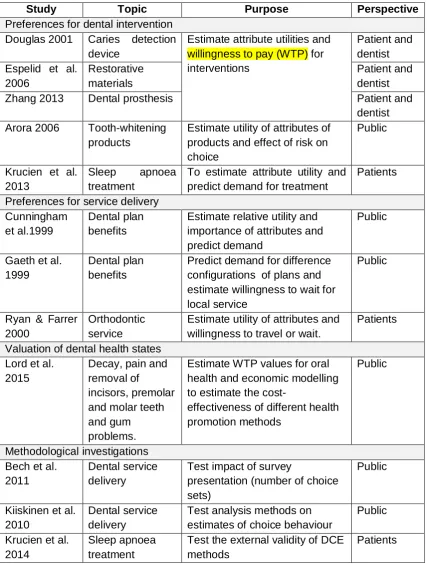
health states from the perspective of the patients, dentists or the public (Table 1).
Three studies were methodological investigations using dental service delivery as a
model (Bech et al. 2011, Kiiskinen et al. 2010, Krucien et al. 2014). All studies used
a common stated preference method, Discrete Choice Experiment (DCE), citing a
desire to establish the relative importance of multiple attributes and to reflect real-life
decision-making by requiring respondents to choose by making trade-offs.
Synthesis and critique of methods
Attributes varied from two to seven with little justification for the number selected.
The attributes were most commonly related to cost (92%), time domains such as
waiting time or time for treatment effect (66%), and different measures of
effectiveness (50%). Effectiveness attributes included accuracy of diagnostic test,
longevity of restoration, effectiveness of treatment, appearance and function.
Participants from the target population were directly involved in identification of
attributes in three studies (Douglas 2001; Espelid et al. 2006; Zhang 2013), two of
which showed evidence of patient-centred attribute identification through interviews
(Douglas 2001; Zhang 2013). The third identified attributes from a large general
population survey and a dentist survey and verified the selection of attributes using a
pilot study, however, no details of the exact methods were given. The remaining
studies relied on existing literature and policies without use of patient or public
involvement. The methods used to assign attribute-levels were reported in less
detail.
There was little uniformity in experimental design, construction of tasks and survey
design across the studies. The methods used for construction of tasks were most
comprehensively reported. Full profiles were used in all studies, that is, each profile
contained all attributes at varying levels. The number of profiles presented in each
task varied from two to four alternatives and an opt-out or the option to retain the
status quo was given in all but three studies. Generic labelling was used in all studies
except one (Kiiskinen et al. 2010), which provided an explicit justification for use of
labelling. In contrast the reporting of experimental design was less comprehensive.
All studies used a fractional factorial design and three studies reported use of design
Reporting of design properties was highly variable and only two studies provided a
statistical evaluation of the design (Lord et al. 2015; Ryan and Farrar 2000).
The total number of tasks ranged from twelve to 32, but in those with more choice
tasks blocking was used to limit the number of tasks required of an individual
respondent to a maximum of eight. One methodological study (Bech et al. 2011)
focussed primarily on whether the number of tasks affected results by varying the
number of tasks from 4 to 8 to 16. Elicitation of preference confidence (Bech et al.
2011) and strength of preference (Arora 2006; Ryan and Farrar 2000) were
undertaken using rating scales, or by requesting respondents chose their most and
least preferred option from a choice of three with an indication of how difficult the
response was (Zhang 2013).
Generally, information regarding the sample, setting and recruitment process was
inadequate; few studies reported an inclusion and exclusion criteria for participants
and five studies provided no information about the recruitment process. Justification
for sample size was provided in four studies (Douglas 2001, Krucien et al. 2013,
Krucien et al. 2014, Zhang 2013) (Table 2). Douglas (2001) based sample size on
minimum sample size requirements for regression analysis combined with ‘rule of
thumb’ for conjoint analysis. The other three studies followed the parametric
approach suggested by Louviere et al. (2000), which provides a minimum sample
size for measuring choice probability with some degree of accuracy. These do not
correspond to current proposed methods for sample size calculation (De
Bekker-Grob et al. 2015). Varying methods of survey administration were used including
postal (Douglas 2001; Zhang 2013), internet (Bech et al. 2011; Lord et al. 2015) and
face-to-face (Espelid et al. 2006; Krucien et al. 2013; Krucien et al. 2015; Lord et al.
2015; Ryan and Farrar 2000). For the remaining studies the administration method
was unclear. An explanation for tasks was reported in seven of the twelve studies
(58%). Half the studies reported a piloting stage to assess aspects of experimental
and survey design, including ‘think aloud’ cognitive interviews (Lord et al. 2015) and
an extensive piloting using a small-scale version of the full survey (Douglas 2001;
Zhang 2013).
All studies used advanced modelling methods for data analysis to produce estimates
of attribute coefficients and from this relative importance of attributes, part-worth
1999; Gaeth et al. 1999; Krucien et al. 2013) and one study used the values to
predict actual choice (Krucien et al. 2015). Subgroup analysis was reported in terms
of participant demographics (Arora 2006; Espelid et al. 2006; Lord et al. 2015; Zhang
2013), participant behaviour (Kiiskinen et al. 2010) or participant groups based on
experimental design (Bech et al. 2011). The internal validity of responses was tested
by using a repeat question or including a task with one obviously superior (dominant)
profile. The results of this were variably managed; one study performed a sensitivity
analysis to determine the effect of inconsistent responders (Zhang 2013), one study
reported the percentage of inconsistent responders but did not clarify how this was
managed (Douglas 2001) and three studies excluded inconsistent responders
(Cunningham et al. 1999; Krucien et al. 2015; Ryan and Farrar 2000).
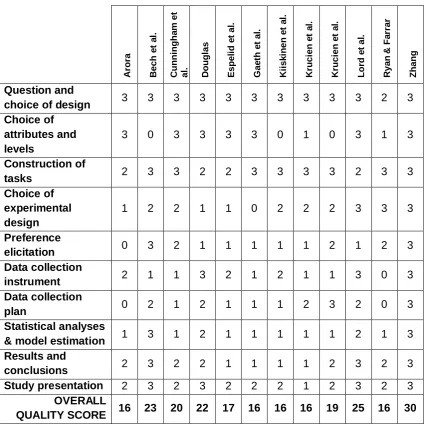
The quality scores of the studies varied from 16/30 to 30/30 (Table 2). The highest
scores were awarded to the University theses (Douglas 2001; Zhang 2013) and the
Consortium report (Lord et al. 2015); two of these studies were recent and for all
three, word count was not restricted as it is in an academic journal. Two further
studies that scored well were those testing aspects of conjoint analysis methodology,
published in Health Economics (Bech et al. 2011; Krucien et al. 2014), possibly
because the purpose of the studies and the audience of these journals require a
more comprehensive description of the methods, although generally papers
focussing on methodological testing did not describe attribute selection in detail.
Only one study published after the ISPOR guidelines in 2011 had notable absences
in the quality assessment; this was published as a letter and although a
supplemental file was available with additional information, there were limitations in
the description of the survey instrument, data collection and analyses (Krucien et al.
2013).
Clinical implications of findings
The heterogeneity between studies prevented statistical synthesis, however,
clinically relevant key findings are summarised in Table 3. This demonstrates the
clinical application of preference data and allows some comparison of results across
DISCUSSION
Preference elicitation methods provide an opportunity to understand patient and
stakeholder preferences for the structures, processes and outcomes associated with
dental care. This evidence can guide improvements to care at an individual and
population level. Multi-attribute stated preference experiments have shown
increasing popularity in health care, yet the number of studies identified for this
review indicates the uptake is considerably slower in dentistry. There are several
contributing factors likely driving this slow adoption: a lack of awareness of
preference elicitation techniques secondary to their scarcity in dental journals,
barriers to funding and publishing methods beyond testing treatment efficacy, the
collaboration required to succeed with the complex experimental design and
statistical analysis and, most importantly, the need for a paradigm shift towards a
patient-centred approach to research and shared decision-making in dental care.
Proposals for upcoming studies incorporating DCE methods suggest this is an
emerging field with growing interest (de Silva-Sanigorski et al. 2011; Ke et al. 2013;
Clarkson et al. 2013; Fleming 2016) and the increasing emphasis on incorporating
values and preferences into healthcare decisions is likely to generate more
opportunities for use of these methods in the future.
Multi-attribute stated preference methods ask respondents to consider multiple
competing attributes simultaneously, which presents a decision-making process that
is much more reflective of real-life choices than simple ranking or rating methods.
This does, however, add a complexity to experimental design and analysis
processes that may weaken studies if expert knowledge is not sought. The design of
a valid and relevant preference experiment is dependent on identification and
selection of attributes that are most relevant to the study perspective and most useful
for informing translation into practice. The studies in this review largely
under-reported how attributes and levels were identified and selected. Research bodies
advocate the inclusion of patient and public representatives during the design and
conduct of healthcare research and this, combined with rigorous qualitative methods
involving the participants from the target population, ensures attributes are not limited
to the researcher perspective.
Reporting of design features was variable across studies and even in cases where
task construction and survey presentation were described, the rationale underpinning
and advancement in methodology, it would be advantageous for reasons for design
choices to be explained. For example, elicitation of responder certainty is one aspect
of task construction that may have important implications of this for interpreting
preference data (Lundhede et al. 2009; Regier et a. 2014), yet no studies explicitly
stated why a measure of certainty was used or not. A further area of notable
under-reporting was around the selection and recruitment of the sample. As with other
research designs, it is expected that a clear inclusion and exclusion criteria are
provided, there is transparency in recruitment and comparison is made between the
study and target population. Preferences are influenced by values, experiences and
environment, so it is critical that the sample population is fully described to enable
interpretation of the results.
Piloting is a discrete stage in multi-attribute stated preference experiment
development and due to the complexity of the preference elicitation, careful
pre-testing is recommended. This allows the validity of attributes to be tested, ensures
task construction and complexity is appropriate and provides data to inform the
experimental design. Methods for assessing reliability and validity are ideally
incorporated within the design (Janssen et al. 2017) and may also benefit from
pre-testing. The ISPOR guidelines provide a comprehensive guide to all aspects of
design and conduct and interested readers are referred to these reports (Bridges et
al. 2011; Johnson et al. 2013; Hauber et al. 2016).
Cost attributes can be problematic in healthcare systems where treatment is free at
the point of delivery, as respondents are not used to placing a monetary value on
treatment. The widespread use of co-payment models for dental care in the UK and
worldwide makes dentistry an attractive model for testing methodological issues
related to willingness to pay (WTP). However, difficulties in anchoring cost attributes
when respondents have existing price knowledge may present a different challenge
for accurately estimating WTP and this needs to be tested further.
Multi-attribute stated preference experiments are likely to have an important role in
the future for economic evaluation in dentistry. Lord et al. (2015) is the first study to
use public preferences to value health states. Further work is required to determine
a benchmark for valuing dental health for cost-effectiveness evaluation and
REFERENCES
Arora R. 2006. Product positioning based on search, experience and credence attributes using conjoint analysis. J Product Brand Management. 15(5): 285-292
Bech M, Kjaer T, Lauridsen J. 2011. Does the number of choice sets matter? Results from a web survey applying a discrete choice experiment. Health Econ. 20(3): 273-86
de Bekker-Grob EW, Ryan M, Gerard K. 2012. Discrete choice experiments in health economics: a review of the literature. Health Econ. 21(2): 145-72.
Bridges JFP, Hauber AB, Marshall D, Lloyd A, Prosser LA, Reiger DA, Johnson FR, Mauskopf J. 2011. Conjoint Analysis Applications in Health—a Checklist: A Report of the ISPOR Good Research Practices for Conjoint Analysis Task Force. Value Health. 14(4): 403-413.
Centre for Devices and Radiological Health. 2016. Patient Preference Information – Voluntary Submission, Review in Premarket Approval Applications, Humanitarian Device Exemption Applications, and De Novo Requests, and Inclusion in Decision Summaries and Device Labeling. Guidance for Industry, Food and Drug
Administration Staff, and Other Stakeholders. US Department of Health and Human Services Food and Drug Administration.
https://www.fda.gov/downloads/medicaldevices/deviceregulationandguidance/guidan cedocuments/ucm446680.pdf
Clark MD, Determann D, Petrou S, Moro D, de Bekker-Grob EW. 2014. Discrete choice experiments in health economics: a review of the literature.
Pharmacoeconomics. 32(9):883-902.
Clarkson JE, Ramsay CR, Averley P, Bonetti D, Boyers D, Campbell L, Chadwisk GR, Duncan A, Elders A, Gouick J et al. 2013. IQuaD dental trial; improving the quality of dentistry: a multicentre randomised controlled trial comparing oral hygiene advice and periodontal instrumentation for the prevention and
management of periodontal disease in dentate adults attending dental primary care. BMC Oral Health. 13: 58.
Cunningham MA, Gaeth GJ, Juang C, Chakraborty G. 1999. Using choice-based conjoint to determine the relative importance of dental benefit plan attributes. J Dent Educ. 63(5): 391-9.
De Bekker-Grob EW, Donkers B, Jonker MF, Stolk EA. 2015. Sample Size
Requirements for Discrete-Choice Experiments in Healthcare: a Practical Guide. The Patient, 8(5), 373–384.
Douglas G. 2001. Preferences for a new caries detection device [dissertation] [Aberdeen (UK)]: University of Aberdeen.
EndNoteTM X4 (2010). Clarivate Analytics, Philadelpia, USA.
Fleming P. 2016. A pilot study to investigate the value of orthodontic treatment within society. British Orthodontic Society Foundation Grant (UK).
https://www.bos.org.uk/Professionals-Members/British-Orthodontic-Society- Foundation-BOSF/BOSF-Grants-and-Awards/Grant-Recipients/Dr-Padhraig-Fleming-BOSF-2016
Gaeth GJ, Cunningham MA, Chakraborty G, Juang C. 1999. Designing managed care dental plan benefits. Marketing Health Services. Winter 1999/Spring 2000: 39-44
Hauber AB, Gonzalez JM, Groothuis-Oudshoorn CG, Prior T, Marshall DA, Cunningham C, IJzerman MJ, Bridges JF. 2016. Statistical Methods for the Analysis of Discrete Choice Experiments: A Report of the ISPOR Conjoint Analysis Good Research Practices Task Force. Value Health. 19(4): 300-315
Hendry GJ, Turner DE, Gardner-Medwin J, Lorgelly PK, Woodburn J. 2014. An exploration of parents’ preferences for foot care in juvenile idiopathic arthritis: a possible role for the discrete choice experiment. J Foot Ankle Res 7:10.
http://www.jfootankleres.com/content/7/1/10
Janssen EM, Marshall DA, Heuber AB, Bridges JFP. 2017. Improving the quality of discrete choice experiments in health: how can we assess validity and reliability? Expert Review Pharmoec Outcomes Res.
https://doi.org/10.1080/14737167.2017.1389648
Johnson FR, Lancsar E, Marshall D, Kilambi V, Muhlbacher A, Reiger DA, Bresnahan BW, Kanninen, Bridges JFP. 2013. Constructing Experimental
Designs for Discrete-Choice Experiments: Report of the ISPOR Conjoint Analysis Experimental Design Good Research Practices Task Force. Value Health. 16(1): 3-13.
Ke KM, Mackichan F, Sandy JR, Ness AR, Hollingworth W. 2013. Parents'
perspectives on centralized cleft services for children: the development of a DCE questionnaire. Oral Dis. 19(2): 185-92.
Kiiskinen U, Suominen-Taipale AL, Cairns J. 2010. Think twice before you book? Modelling the choice of public vs private dentist in a choice experiment. Health Econ. 19(6): 670-82.
Krucien N, Gafni A, Pelletier-Fleury N. 2015. Empirical Testing of the External Validity of a Discrete Choice Experiment to Determine Preferred Treatment Option: The Case of Sleep Apnea. Health Econ. 24(8): 951-65.
Krucien N, Gafni A, Fleury B, Pelletier-Fleury N. 2013. Patients' with obstructive sleep apnoea syndrome (OSAS) preferences and demand for treatment: a discrete choice experiment. Thorax. 68(5): 487-8.
Lancaster KJ. 1996. A New Approach to Consumer Theory. J Polit Econ. 74(2): 132-157
Lancsar E, Louviere J. 2008. Conducting discrete choice experiments to inform healthcare decision making: a user's guide. Pharmacoeconomics. 26(8): 661-77.
(UK). https://www.nice.org.uk/guidance/ng30/documents/oral-health-promotion-approaches-for-dental-teams-health-economic-analysis2
Louviere J, Hensher DA, Swait JD. 2000. Stated choice methods: analysis and application. Cambridge: Cambridge University Press.
Lundhede TH, Olsen SB, Jacobsen JB, Thorsen BJ. 2009. Handling respondent uncertainty in choice experiments: Evaluating recoding approaches against explicit modelling of uncertainty. J Choice Modelling. 2(2); 118-147
Mangham LJ, Hanson K, McPake B. 2009. How to do (or not to do).. Designing a discrete choice experiment for application in a low-income country. Health and Policy Planning. 24(2): 151-158.
Mulley A, Trimble C, Elwyn. 2012. Patient’s preferences matter. Stop the silent misdiagnosis. The King’s Fund (England).
Nafees B, Setyawan J, Lloyd A, Ali S, Hearn S, Sesane R, Sonuga-Barke E,
Hodgkins P. 2014. Parent preferences regarding stimulant therapies for ADHD: a comparison across six European countries. Eur Child Adolesc Psychiatry. 23(12): 1189-1200
Regier DA, Watson V, Burnett, Ungar WJ. 2014. Task complexity and response certainty in discrete cohice experientms: an application to drugs treatments for juvenile idiopathic arthirtis. J Behav Exp Economics. 50: 40-49.
Ryan M, Farrar S. 2000 Using conjoint analysis to elicit preferences for health care. BMJ. 320:1530-3.
Ryan M, Gerard K. 2003. Using discrete choice experiments to value health care programmes: current practice and future research reflections. Appl Health Econ Health Policy. 2(1): 55-64.
de Silva-Sanigorski AM, Waters E, Calache H, Smith M, GOld L, Gussy, Scott A, Lacy K, Virgo-Milton M. 2011. Splash!: a prospective birth cohort study of the impact of environmental, social and family-level influences on child oral health and obesity related risk factors and outcomes. BMC Public Health. 11: 505.
Viney R, Lancsar E, Louviere J. 2002. Discrete Choice Experiments to measure consumer preferences for health and healthcare. Expert Rev.
Pharmacoeconomics Outcomes Res. 2(4); 89-96
Whitty JA, Stewart S, Carrington MJ, Calderone A, Marwick T, Horowitz JD, Krum H, Davidson PM, Macdonald PS, Reid C, Scuffham PA. 2013. Patient Preferences and Willingness-To-Pay for a Home or Clinic Based Program of Chronic Heart Failure management: Findings from the Which? Trial. PLOS One. 8(3): e58347
ACKNOWLEDGEMENTS
The work was supported by Dental Translational and Clinical Research Unit (DenTCRU), part of Leeds NIHR Clinical Research Facility. We wish to thank the reviewers for their comments, which were used to improve the manuscript.
CONFLICT OF INTEREST
The authors report no commercial, proprietary, or financial interest in the products or companies described in this article. Sophy Barber is funded through an NIHR Doctoral Research Fellowship (DRF-2015-08-052). NIHR had no involvement in the study or preparation of the manuscript.
DATA
Full data set (all data extracted from the included studies) is available from the corresponding author by request.
FIGURE & TABLES LEGENDS
Figure 1: An example of five attributes with two or three attribute-levels for a
hypothetical orthodontic assessment
Figure 2: Stages in designing a multi-attribute Stated Preference Experiment
Figure 3: Study selection process
Table 1: Use of multi-attribute stated preference methods in dentistry
Table 2: Quality assessment scores
Table 3: Clinically relevant findings from multi-attribute stated preference studies in
TABLES
Table 1: Use of multi-attribute stated preference methods in dentistry
Study Topic Purpose Perspective
Preferences for dental intervention
Douglas 2001 Caries detection
device
Estimate attribute utilities and willingness to pay (WTP) for interventions
Patient and dentist Espelid et al.
2006
Restorative materials
Patient and dentist
Zhang 2013 Dental prosthesis Patient and
dentist
Arora 2006 Tooth-whitening
products
Estimate utility of attributes of products and effect of risk on choice
Public
Krucien et al. 2013
Sleep apnoea treatment
To estimate attribute utility and predict demand for treatment
Patients
Preferences for service delivery Cunningham
et al.1999
Dental plan benefits
Estimate relative utility and importance of attributes and predict demand
Public
Gaeth et al. 1999
Dental plan benefits
Predict demand for difference configurations of plans and estimate willingness to wait for local service
Public
Ryan & Farrer 2000
Orthodontic service
Estimate utility of attributes and willingness to travel or wait.
Patients
Valuation of dental health states Lord et al.
2015
Decay, pain and removal of
incisors, premolar and molar teeth and gum
problems.
Estimate WTP values for oral health and economic modelling to estimate the
cost-effectiveness of different health promotion methods
Public
Methodological investigations Bech et al.
2011
Dental service delivery
Test impact of survey
presentation (number of choice sets)
Public
Kiiskinen et al. 2010
Dental service delivery
Test analysis methods on estimates of choice behaviour
Public
Krucien et al. 2014
Sleep apnoea treatment
Test the external validity of DCE methods
[image:19.595.85.513.133.698.2]Table 2: Quality assessment scores A ro ra B e c h e t a l. C u n n in g h a m e t a l. D o u g la s E s p e li d e t a l. G a e th e t a l. K ii s k in e n e t a l. K ru c ie n e t a l. K ru c ie n e t a l. L o rd e t a l. R y a n & F a rr a r Z h a n g Question and
choice of design 3 3 3 3 3 3 3 3 3 3 2 3
Choice of attributes and levels
3 0 3 3 3 3 0 1 0 3 1 3
Construction of
tasks 2 3 3 2 2 3 3 3 3 2 3 3
Choice of experimental design
1 2 2 1 1 0 2 2 2 3 3 3
Preference
elicitation 0 3 2 1 1 1 1 1 2 1 2 3
Data collection
instrument 2 1 1 3 2 1 2 1 1 3 0 3
Data collection
plan 0 2 1 2 1 1 1 2 3 2 0 3
Statistical analyses
& model estimation 1 3 1 2 1 1 1 1 1 2 1 3
Results and
conclusions 2 3 2 2 1 1 1 1 2 3 2 3
Study presentation 2 3 2 3 2 2 2 1 2 3 2 3
OVERALL
Table 3: Clinically relevant findings from multi-attribute stated preference studies in dentistry
Attribute importance Caries detection device
Patients: discomfort > cost > accuracy > time (Douglas 2001)
Restorative material
Patients: appearance > longevity
Dentists: longevity > appearance (Espelid et al. 2006)
Dental prosthesis Patients: Longevity > appearance > function (Zhang 2013)
Sleep apnoea treatment
‘Negative impact on daily life’ > effectiveness > severity of side effects (Krucien et al. 2013)
Tooth whitening products
Duration of results > time taken to see effect > reporting of side effects > pricing (Arora 2006)
Dental plan benefits
Maximum annual benefit > coverage of orthodontic & restorative treatment > service delivery > premium (Cunningham et al. 1999; Gaeth et al. 1999)
Marginal rates of substitution Willingness to Pay
(WTP)
Patients are willing to pay:
£6.59 extra per check up to avoid discomfort
£0.73 extra per check up for 1% increased accuracy
£0.45 extra per check up for every one minute in the dental chair avoided (Douglas 2001)
Patients are willing to pay:
£3357 to change from artificial to natural looking appearance £2657 to change from compromised to good chewing function £31.37 for 1% improvement in treatment 5-year success rate (Zhang 2013)
Respondents were willing to pay £333 to avoid removal of an anterior tooth
Respondents were willing to pay £37 to avoid removal of a posterior tooth (Lord et al. 2015)
Willingness to Wait (WTW)
Patients are willing to give:
14.9 minutes extra in the dental chair to avoid discomfort 1.7 minutes extra for 1% increase in accuracy (Douglas 2001) 1 month increase in waiting time reduces benefit score by 0.59 (Ryan and Farrer 2000)
Willingness to Travel (WTT)
Patients were willing to wait an extra 1.3 and 1.5 months for a local clinic for their first and second appointments (Ryan and Farrer 2000)
Risk equivalence Patients require 16.2-17 years additional longevity from
restoration to accept small risk of adverse reaction