This is a repository copy of Accounting for Changing Temperature Patterns Increases
Historical Estimates of Climate Sensitivity.
White Rose Research Online URL for this paper:
http://eprints.whiterose.ac.uk/137122/
Version: Accepted Version
Article:
Andrews, T, Gregory, JM, Paynter, D et al. (7 more authors) (2018) Accounting for
Changing Temperature Patterns Increases Historical Estimates of Climate Sensitivity.
Geophysical Research Letters, 45 (16). pp. 8490-8499. ISSN 0094-8276
https://doi.org/10.1029/2018GL078887
© 2018 Crown copyright. This article is published with the permission of the Controller of
HMSO and the Queen's Printer for Scotland. This is the peer reviewed version of the
following article: Andrews, T, Gregory, JM, Paynter, D et al. (7 more authors) (2018)
Accounting for Changing Temperature Patterns Increases Historical Estimates of Climate
Sensitivity. Geophysical Research Letters, 45 (16). pp. 8490-8499, which has been
published in final form at https://doi.org/10.1029/2018GL078887. This article may be used
for non-commercial purposes in accordance with Wiley Terms and Conditions for Use of
Self-Archived Versions.
[email protected] https://eprints.whiterose.ac.uk/
Reuse
Items deposited in White Rose Research Online are protected by copyright, with all rights reserved unless indicated otherwise. They may be downloaded and/or printed for private study, or other acts as permitted by national copyright laws. The publisher or other rights holders may allow further reproduction and re-use of the full text version. This is indicated by the licence information on the White Rose Research Online record for the item.
Takedown
If you consider content in White Rose Research Online to be in breach of UK law, please notify us by
Confidential manuscript submitted to Geophysical Research Letters
Accounting for changing temperature patterns
1
increases historical estimates of climate sensitivity
2
3
Timothy Andrews1#, Jonathan M. Gregory1,2, David Paynter3, Levi G. Silvers4, Chen Zhou5, 4
Thorsten Mauritsen6, Mark J. Webb1, Kyle C. Armour7, Piers M. Forster8 and Holly Titchner1. 5
6
1Met Office Hadley Centre, Exeter, UK. 7
2NCAS-Climate, University of Reading, Reading, UK. 8
3GFDL-NOAA, Princeton, USA. 9
4Princeton University / GFDL, Princeton, USA. 10
5Nanjing University, China. 11
6Max Planck Institute for Meteorology, Hamburg, Germany. 12
7University of Washington, Seattle, USA. 13
8School of Earth and Environment, University of Leeds, Leeds, UK. 14
15
Submitted: 23rd May 2018 16
Revised: 10th July 2018 17
Key points
18
Climate sensitivity simulated for observed surface temperature change is smaller 19
than for long-term carbon dioxide increases. 20
Observed historical energy budget constraints give climate sensitivity values that are 21
too low and overly constrained, particularly at the upper end. 22
Historical energy budget changes only weakly constrain climate sensitivity. 23
24
_________________________________ 25
#Corresponding Author: 26
Timothy Andrews 27
Met Office Hadley Centre 28
FitzRoy Road 29
Exeter, EX1 3PB. 30
Confidential manuscript submitted to Geophysical Research Letters
Abstract
32
Eight Atmospheric General Circulation Models (AGCMs) are forced with observed historical 33
(1871-2010) monthly sea-surface-temperature (SST) and sea-ice variations using the AMIP 34
II dataset. The AGCMs therefore have a similar temperature pattern and trend to that of 35
observed historical climate change. The AGCMs simulate a spread in climate feedback 36
similar to that seen in coupled simulations of the response to CO2 quadrupling. However the 37
feedbacks are robustly more stabilizing and the effective climate sensitivity (EffCS) smaller. 38
This is due to a ‘pattern effect’ whereby the pattern of observed historical SST change gives 39
rise to more negative cloud and LW clear-sky feedbacks. Assuming the patterns of long-40
term temperature change simulated by models, and the radiative response to them, are 41
credible, this implies that existing constraints on EffCS from historical energy budget 42
variations give values that are too low and overly constrained, particularly at the upper end. 43
For example, the pattern effect increases the long-term Otto et al. (2013) EffCS median and 44
5-95% confidence interval from 1.9K (0.9-5.0K) to 3.2K (1.5-8.1K). 45
Plain text summary
46
Recent decades have seen cooling over the eastern tropical Pacific and Southern Ocean 47
while temperatures rise globally. Climate models indicate that these regional features, and 48
others, are not expected to continue into the future under sustained forcing from atmospheric 49
carbon dioxide increases. This matters, because climate sensitivity depends on the pattern 50
of warming, so if the past has warmed differently from what we expect in the future then 51
climate sensitivity estimated from the historical record may not apply to the future. We 52
investigate this with a suite of climate models and show that climate sensitivity simulated for 53
observed historical climate change is smaller than for long-term carbon dioxide increases. 54
The results imply that historical energy budget changes only weakly constrain climate 55
Confidential manuscript submitted to Geophysical Research Letters
1. Introduction
57
The relationship between global surface temperature change and the Earth’s radiative 58
response - a measure of the radiative feedbacks in the system and a key determinant of the 59
Earth’s climate sensitivity - can vary on timescales of decades to millennia. Thus feedbacks 60
governing warming over the observed historical record may be different from those acting on 61
the Earth’s long-term climate sensitivity to rising greenhouse gas concentrations (e.g. 62
Gregory and Andrews 2016; Zhou et al., 2016; Armour 2017; Proistosescu and Huybers 63
2017; Silvers et al., 2018; Marvel et al., 2018). This is in contrast to decades of studies that 64
explicitly or implicitly assume that the relationship between historical temperature change 65
and energy budget variations provides a direct constraint on long-term climate sensitivity 66
(e.g. Gregory et al., 2002; Otto et al., 2013). 67
68
The primary reason why radiative feedback and sensitivity is not constant is because climate 69
feedback depends on the spatial structure of surface temperature change (Armour et al. 70
2013; Rose et al., 2014; Andrews et al., 2015; Zhou et al. 2016; 2017; Haugstad et al., 2017; 71
Ceppi and Gregory, 2017; Andrews and Webb, 2018; Silvers et al., 2018). This evolves on 72
annual to decadal timescales with modes of unforced coupled atmosphere-ocean variability 73
(e.g. Xie et al., 2016) and spatiotemporal variations in anthropogenic or natural forcings (e.g. 74
Takahashi and Watanabe, 2016; Smith et al., 2016). It also evolves on decadal to 75
centennial timescales in response to sustained anthropogenic forcing due to the intrinsic 76
timescales of the climate response (such as delayed warming in the eastern tropical Pacific 77
and Southern Ocean) (e.g. Senior and Mitchell, 2000; Andrews et al., 2015; Armour et al., 78
2016). Thus the pattern of historical temperature change, and thus radiative feedback, is 79
expected to be different from that in response to long-term CO2 increases (see Discussion). 80
We refer to the dependency of radiative feedbacks on the evolving pattern of surface 81
temperature change as a ‘pattern effect’ (Stevens et al., 2016). 82
83
Most previous estimates of climate sensitivity based upon historical observations of Earth’s 84
energy budget have not allowed for a pattern effect between historical climate change and 85
the long-term response to CO2 (e.g. Otto et al., 2013). Armour (2017) found that the 86
equilibrium climate sensitivity (ECS) (the equilibrium near surface-air-temperature change in 87
response to a CO2 doubling) of Atmosphere-Ocean General Circulation Models (AOGCMs) 88
(estimated from simulations of abrupt CO2 quadrupling (abrupt-4xCO2)) was about 26% 89
larger than climate sensitivity inferred from transient warming (1%CO2 simulations, taken to 90
Confidential manuscript submitted to Geophysical Research Letters
therefore concluded that energy budget estimates of Earth’s ECS from the historical record 92
should be increased by this amount. Lewis and Curry (2018) argue for a smaller pattern 93
effect, highlighting ambiguities in the methodology when using idealised CO2 experiments as 94
an analogue for historical climate change. However, as noted in Armour (2017), the use of 95
1%CO2 simulations as an analogue for historical climate change has important limitations in 96
that it neglects the impact from non-CO2 forcings and unforced climate variability that could 97
have had a significant impact on the pattern of historical temperature change. In particular, 98
under 1%CO2, AOGCMs do not show cooling of the tropical eastern Pacific Ocean and 99
Southern Ocean – features that have been observed over recent decades but are not 100
expected in the long-term response to increased CO2 (Zhou et al., 2016). These are regions 101
where atmospheric feedbacks (in particular clouds) are sensitive to the patterns of surface 102
temperature change due to their impact on local and remote atmospheric stability (e.g. Zhou 103
et al., 2017; Andrews and Webb, 2018). This suggests that the magnitude of the pattern 104
effect reported in Armour (2017) may be too low relative to historical climate change. This is 105
an outstanding issue that we aim to address and quantify here. 106
107
Here we will show that a suite of Atmospheric General Circulation Models (AGCMs) forced 108
with historical (post 1870) sea-surface-temperatures (SSTs) and sea-ice changes are ideal 109
simulations for quantifying the relationship between historical climate sensitivity and 110
idealised long-term model derived ECS. They allow us, for the first time, to quantify the 111
pattern effect associated with observed temperature patterns, and so provide improved 112
updates to estimates of climate sensitivity derived from historical energy budget constraints. 113
The work builds upon individual studies (Andrews, 2014; Gregory and Andrews 2016; Zhou 114
et al., 2016; Silvers et al., 2018). Our aim is to: (i) bring together these individual model 115
results for an intercomparison of AGCMs forced with historical SST and sea-ice variations; 116
(ii) explore the dependence of the experimental design to the underlying SST and sea-ice 117
dataset; (iii) explore how historical feedbacks in the AGCMs relate to feedbacks diagnosed 118
from their parent AOGCM forced by abrupt-4xCO2; (iv) quantify the pattern effect causing 119
the difference between climate sensitivity under historical climate change and long-term CO2 120
changes; (v) use this pattern effect to update observed energy budget constraints on Earth’s 121
climate sensitivity. 122
2. Simulations, Models and Data
123
Eight AGCMs (Table 1) are forced with monthly time-varying observationally derived fields of 124
Confidential manuscript submitted to Geophysical Research Letters
(AMIP) II boundary condition data set (Gates et al., 1999; Taylor et al., 2000; Hurrell et al., 126
2008). All simulations have natural and anthropogenic forcings (e.g. greenhouse gases, 127
aerosols, solar radiation etc.) held constant at assumed pre-industrial conditions (except 128
CAM4 which used assumed constant present-day conditions; we assume the level of 129
background forcing has no impact on the diagnosed feedback of the model). With constant 130
forcings the variation in radiative fluxes comes about solely from the changing SST and sea-131
ice boundary conditions, allowing radiative feedbacks to be accurately diagnosed directly 132
from top-of-atmosphere (TOA) radiation fields (e.g. Haugstad et al., 2017). For details of 133
individual simulations see Gregory and Andrews (2016) for HadGEM2 and HadAM3, Silvers 134
et al. (2017) for GFDL-AM2.1, GFDL-AM3 and GFDL-AM4.0, Zhou et al. (2016) for CAM4 135
and CAM5.3, and Mauritsen et al. (2018) for ECHAM6.3. This experiment, referred to here 136
as amip-piForcing (Gregory and Andrews, 2016), is included in the Cloud Feedback Model 137
Intercomparison Project (CFMIP) contribution to CMIP6 (Webb et al. 2017). The sensitivity 138
of the results to the AMIP II boundary condition dataset is explored with analogous 139
experiments using the HadISST2.1 SST and sea-ice dataset (Titchner and Rayner, 2014) 140
(Supporting Information). 141
142
All simulations ran for 140yrs from Jan 1871 through to Dec 2010, except for GFDL-AM2.1 143
and GFDL-AM3 which finished in Dec 2004. All data is global-annual-mean and anomalies 144
are presented relative to an 1871-1900 baseline. CAM4 and CAM5.3 results are single 145
realisations, HadGEM2 and HadAM3 simulations are ensembles of 4 realisations each, 146
ECHAM6.3, GFDL-AM2.1 and GFDL-AM4.0 have 5 realisations each, while GFDL-AM3 has 147
6 realisations. The HadGEM2 results are not identical to those presented in Gregory and 148
Andrews (2016) because it has been discovered that land-cover change was included in 149
their HadGEM2 simulations. We have confirmed that the updated simulations used here, 150
which have constant land-cover, do not affect the main conclusions of Gregory and Andrews 151
(2016). In fact the multi-decadal variability in feedback in HadGEM2 is now found to be more 152
consistent with their HadAM3 results (Section 3). 153
154
For comparison to long-term climate sensitivity and feedback parameters we make use of an 155
abrupt-4xCO2 simulation of each AGCM’s parent AOGCM. For CAM4, GFDL-AM2.1, 156
GFDL-AM3 and HadGEM2 we use the CCSM4, GFDL-ESM2M, GFDL-CM3 and HadGEM2-157
ES CMIP5 abrupt-4xCO2 simulations respectively (Taylor et al., 2012). Feedbacks and 158
associated effective climate sensitivity (EffCS) (the equilibrium near surface-air-temperature 159
change in response to a CO2 doubling assuming constant feedback strength) are derived 160
from the regression of global-annual-mean change in radiative flux dN against surface-air-161
Confidential manuscript submitted to Geophysical Research Letters
F2x, the forcing from a doubling of CO2, is equal to the dN-axis intercept divided by two (to 163
convert 4xCO2 to 2xCO2) and , the feedback parameter, is equal to the slope of the 164
regression line (Andrews et al., 2012). We have similar simulations for ECHAM6.3 and 165
HadAM3 using the MPI-ESM1.1 and HadCM3 models respectively, though these are not in 166
the CMIP5 archive. The HadCM3 simulation is only 100yrs long but is a mean of 7 167
realisations. CAM5.3 and GFDL-AM4.0 do not yet have equivalent coupled 4xCO2 168
simulations. We choose to use EffCS rather than the ‘true’ equilibrium climate sensitivity 169
(ECS) since few AOGCMs are run to equilibrium and thus the true ECS is not generally 170
known. Paynter et al. (2018) showed that the actual ECS from multimillennial GFDL-171
ESM2M and GFDL-CM3 simulations was nearly 1K higher than the EffCS we use here from 172
abrupt-4xCO2. Hence the values we report for EffCS might be viewed as a lower bound on 173
ECS if other models behave in a similar way. 174
3. Radiative feedbacks and sensitivities
175
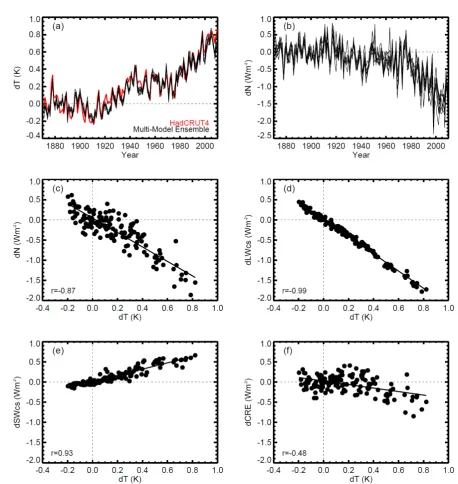
Figure 1a shows the global-annual-mean near-surface-air-temperature change (dT) of the 176
eight individual AGCM amip-piForcing simulations in comparison to HadCRUT4 (Morice et 177
al., 2012). As expected the models capture the observed variability and trends in dT well (the 178
correlation coefficient, r, between observed and simulated dT is >0.95 for every model). 179
However the AGCMs omit the small part of the recent warming trend over land that arises as 180
a direct adjustment to changes in CO2 and other forcing agents (dT in HadCRUT4 averaged 181
over 2000-2010 is 0.79K, whereas it ranges from 0.66-0.76K in the AGCMs) (see also, 182
Andrews, 2014; Gregory and Andrews, 2016). Figure 1b shows the net TOA radiative flux 183
change, dN. It is generally negative because as dT increases positively the planet loses heat 184
to space. This relationship is shown in Figure 1c for the multi-model ensemble-mean. The 185
slope of the regression line (ordinary least-squares, over the annual-mean 1871-2010 186
timeseries data) measures the feedback parameter amip (in Wm-2 K-1), where subscript 187
‘amip’ is used to indicate that the feedback parameter was derived from the amip-piForcing 188
experiment. Individual model results are given in Table 1. 189
190
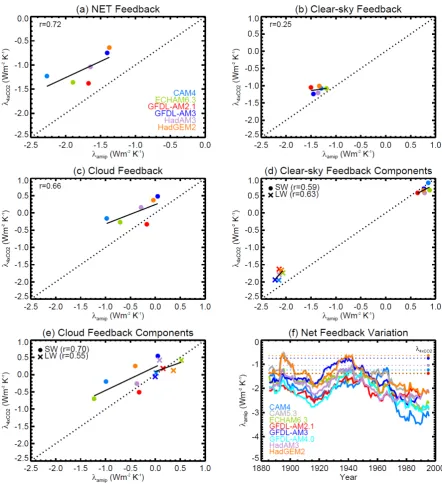
The equivalent feedback parameters derived from six available parent AOGCM abrupt-191
4xCO2 simulations ( 4xCO2) are compared to amip in Figure 2 and Table 1. We find that amip 192
is more negative than 4xCO2 in all models. In other words, AGCMs forced with historical SST 193
and sea-ice changes robustly simulate more stabilizing feedbacks (lower EffCS) than their 194
Confidential manuscript submitted to Geophysical Research Letters
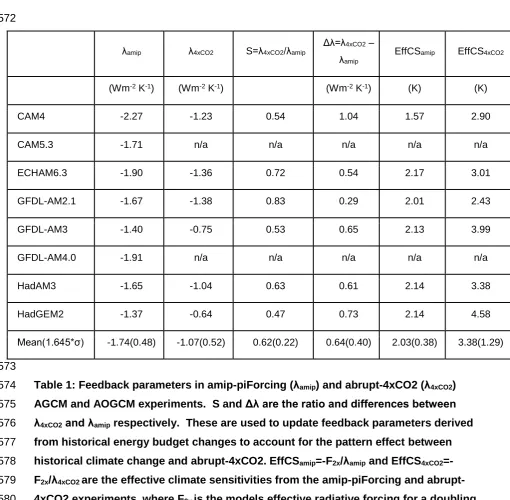
amip-piForcing and abrupt-4xCO2 is = 4xCO2- amip=0.64 Wm-2 K-1, ranging from 0.29 to 196
1.04 Wm-2 K-1 across the AGCMs (Table 1). 197
198
The source of is shown in Figure 2. The clear-sky feedback (Figure 1d,e) is slightly (but 199
robustly) more negative in amip-piForcing compared to abrupt-4xCO2 (Figure 2b) due to 200
differences in LW clear-sky feedback processes that are partly offset by SW clear-sky 201
feedback differences (Figure 2d). This difference in clear-sky alone explains the relatively 202
small change in net sensitivity for the GFDL-AM2.1 model. For the other models, differences 203
in cloud feedback (Figure 1f) are a larger source of the reduced sensitivity in amip-piForcing 204
(Figure 2c). This mostly comes from SW cloud feedback processes, with historical LW cloud 205
feedback processes generally being representative of that seen in abrupt-4xCO2 (Figure 206
2e). These findings are consistent with process orientated studies that suggest lapse-rate 207
(which affects LW clear-sky) and low-cloud (which affect SW and NET CRE) feedbacks vary 208
the most with SST patterns, especially in the Pacific (see below and: Rose et al., 2014; 209
Andrews et al., 2015; Zhou et al., 2016; 2017; Silvers et al., 2017; Ceppi and Gregory, 2017; 210
Andrews and Webb, 2018). 211
212
In amip-piForcing the model-mean EffCSamip=-F2x/ amip is ~2K, ranging from 1.6 to 2.2K 213
across the AGCMs (Table 1). The narrowness of this EffCSamip range does not arise due to 214
reduced uncertainty in amip relative to 4xCO2. On the contrary, the spread (measured by 215
1.645* ) in amip is almost the same size as the spread in 4xCO2 (Table 1). The spread in 216
EffCSamip is narrower primarily because amip is on average more negative than 4xCO2. Since 217
EffCS depends on the reciprocal of , the same spread in , shifted to more negative 218
numbers, will give rise to a narrower spread in EffCS (e.g., Roe, 2009). A similar spread in 219
in amip and 4xCO2 suggests that different patterns of SST change across AOGCMs do not 220
contribute significantly to the spread in atmospheric feedbacks in abrupt-4xCO2 experiments 221
(see also Ringer et al., 2014; Andrews and Webb, 2018), which must therefore come about 222
due to differences in atmospheric physics and parameterisations. 223
224
EffCS4xCO2 (of the parent AOGCM) is in all cases larger than EffCSamip, ranging from 2.4 to 225
4.6K (Table 1). In the multi-model-mean, EffCS4xCO2 is ~67% larger than that implied from 226
EffCSamip. This model-mean historical pattern effect is substantially larger than the 26% 227
found by Armour (2017), supporting the hypothesis that the pattern effect is larger in the 228
historical record than simulated in transient 1%CO2 AOGCM simulations because the later 229
miss key features of the observed warming pattern. This result is even more striking given 230
that Armour (2017) used an EffCS definition from abrupt-4xCO2 that gives larger values than 231
Confidential manuscript submitted to Geophysical Research Letters
233
It is also useful to study shorter time periods to help inform our understanding of the 234
relationship between shorter term variations in temperature and radiative fluxes, as have 235
been used by many studies to estimate EffCS particularly since the satellite era (e.g. Forster, 236
2017). Figure 2f shows the feedback parameter for 30yr moving windows over the historical 237
period in the AGCM simulations (calculated as per Gregory and Andrews, 2016), in 238
comparison to 4xCO2 (horizontal lines). There is substantial multi-decadal variability in the 239
feedback parameter that is common to all models, with a peak in feedback parameter 240
(higher EffCS) around the 1940s and a minimum (lower EffCS) in the most recent decades 241
(post ~1980). Generally amip is always more negative than 4xCO2. There are only a few 242
instances where the amip is similar to 4xCO2, for example ~1940 for HadGEM2 and GFDL-243
AM2.1, but no instances where amip is substantially less negative than 4xCO2. The difference 244
is greatest in the most recent decades, suggesting that energy budget constraints on ECS 245
based on recent decades of satellite data will be most strongly biased low. This is consistent 246
with process understanding of the pattern effect, since recent decades have shown 247
substantial cooling in the eastern Pacific and Southern Ocean while warming in the west 248
Pacific warm pool (e.g. Zhou et al., 2016). The cooling in the descent region of the tropical 249
Pacific will favour increased cloudiness (a negative feedback), while warming in the west 250
Pacific ascent region efficiently warms free tropospheric air (increasing the negative lapse-251
rate feedback widely across the tropics and mid-latitudes) as well as further increasing the 252
lower tropospheric stability and cloudiness in the marine low-cloud descent regions (Zhou et 253
al., 2016; Ceppi and Gregory, 2017; Andrews and Webb, 2018). 254
255
Most of the multi-decadal variation in feedback strength comes from changes in the strength 256
of cloud feedback (the correlation between the Net and CRE feedback timeseries, calculated 257
in a similar way, is >0.94 in each AGCM) while the clear-sky feedbacks show less variation 258
(not shown). This, as well as atmospheric variability, helps explain why cloud feedback is not 259
as linearly correlated to dT variations over the full historical period compared to clear-sky 260
feedbacks (r=0.48 for CRE compared to 0.99 and 0.93 for the clear-sky fluxes, Figures 261
1d,e,f). 262
4. Constraints on observed estimates of climate
263
sensitivity
264
Confidential manuscript submitted to Geophysical Research Letters
EffCS do not directly apply to long-term ECS. To account for this, we use the difference in 267
between amip-piForcing and abrupt-4xCO2 as a measure of the pattern effect to update 268
historical energy budget estimates of and EffCS. This is in contrast to Armour (2017) who 269
had to use 1%CO2 simulations as a surrogate for historical climate change. Here we are 270
quantifying the pattern effect associated with patterns of temperature change that actually 271
occurred in the real world, relative to those simulated by AOGCMs to long-term CO2 272
increases. The pattern effect therefore assumes that long-term warming patterns in 273
AOGCMs not yet seen in the historical record, and the radiative response to them, are 274
credible (see Discussion). 275
276
To illustrate the impact of the pattern effect we use the Otto et al. (2013) historical energy 277
budget constraints as our starting point, though other datasets exist (see Forster, 2017) and 278
clearly the EffCS estimates presented below will depend on this. First, we reproduce the 279
historical EffCS estimates reported in Otto et al. (2013) using their best estimate and 5-95% 280
confidence intervals for the historical (denoted by subscript ‘hist’) change in temperature 281
(dThist=0.48±0.2 K), heat uptake (dNhist=0.35±0.13 Wm-2) and radiative forcing 282
(dFhist=1.21±0.52 Wm-2) for the 40 yr period 1970-2009 relative to pre-industrial (which they 283
define as 1860-1879) (their Table S1, row 5). To be consistent with Otto et al. (2013) we also 284
use their forcing and its uncertainty for a doubling of CO2 (F2x=3.44 (±10%) Wm-2). We 285
randomly sample (with replacement) 10 million times from the gaussian distributions of dThist, 286
dNhist, dFhist and F2x to calculate hist= (dNhist-dFhist)/dThist and EffCShist=-F2x/ hist. We assume 287
the uncertainty in F2x and the greenhouse gas component of dFhist are correlated as in Otto et 288
al. (2013). The resulting EffCS values are binned into intervals of 0.02 and normalised to 289
produce a probability density function (PDF), excluding values less than zero and greater 290
than twenty. The resulting PDF and percentiles (Figure 3, black lines) recovers the Otto et al. 291
(2013) EffCShist median (1.9K) and 5-95% confidence interval (0.9-5.0K) to within 0.1K. 292
293
Following Armour (2017), we update the Otto et al. (2013) EffCS estimate for the pattern 294
effect between historical climate change and abrupt-4xCO2 using two methods. We first 295
scale the historical feedback parameter hist by the ratio of the feedbacks found in the amip-296
piForcing and abrupt-4xCO2 simulations, so = hist*S where S= 4xCO2/ amip (Table 1). EffCS is 297
then given by EffCS=-F2x/ =-F2x/( hist*S) (equivalent to Equation 4 in Armour 2017). 298
Alternatively, we update hist by the difference in feedbacks, according to = hist+ , where 299
= 4xCO2- amip. EffCS is then given by EffCS=-F2x/ =-F2x/( hist+ ) (equivalent to Equation 5 300
in Armour 2017). We then calculate the EffCS PDF as above by randomly sampling from 301
the F2x and hist distributions, along with S and chosen randomly with equal likelihood from 302
Confidential manuscript submitted to Geophysical Research Letters
increases the likelihood of returning very large (or even negative) EffCS values, since 304
= hist+ can result in values close to zero or even with a changed sign when sampling 305
hist values that are small. Hence the results of this method are potentially sensitive to the 306
assumption of excluding negative EffCS values or those greater than 20K. 307
308
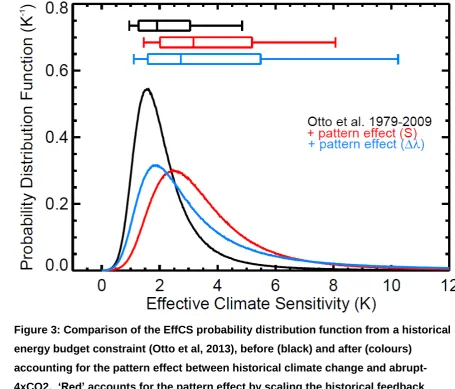
We compare the PDF of EffCShist (which is an approximation of Otto et al. (2013)) against its 309
updated versions that accounts of the pattern effect in Figure 3. The Otto et al. (2013) 310
median and 5-95% confidence interval increases from 1.9K (0.9-5.0K) to 3.2K (1.5-8.1K) 311
using the ratio (S) approach (Figure 3, red lines), or 2.7K (1.1-10.2K) if we use the difference 312
( ) approach (Figure 3, blue lines). Alternatively, if we take the Otto et al. (2013) data 313
relating to their most recent decade (2000-2009) (their Table S1 row 4) then the Otto et al. 314
(2013) estimate and 5-95% confidence interval increases from 2.0K (1.2-3.9K) to 3.3K (1.8-315
6.8K) using the ratio approach or 3.0K (1.5-9.7K) using the difference approach. Thus, 316
eitherway and for different time periods, the pattern effect from amip-piForcing to abrupt-317
4xCO2 results in a substantial median ECS increase, while the lowest values of ECS 318
become less likely, and higher ECS values become much harder to rule out. 319
320
Another way of estimating the pattern effect is by comparing feedbacks in AOGCM historical 321
simulations to abrupt-4xCO2 (e.g. Paynter and Frolicher, 2015; Marvel et al., 2018). 322
However we believe amip-piForcing is superior, because (i) the diagnosed pattern effect in 323
an AOGCM historical simulation will depend on its ability to correctly simulate the patterns of 324
historical climate change, including the magnitude and timing of unforced variability, which 325
they are not expected to simulate correctly (e.g. Zhou et al., 2016; Mauritsen, 2016) and (ii) 326
determining feedbacks in AOGCM historical simulations requires knowledge of the time-327
varying effective radiative forcing of the model, something which is not routinely diagnosed 328
and is difficult to assume because of model diversity in forcing, particularly from aerosols 329
(Forster, 2017). The amip-piForcing approach alleviates both of the above issues. 330
331
Note that for simplicity in the above calculations we have assumed that amip (calculated via 332
linear regression over the amip-piForcing simulations, Section 3) is appropriate to the time 333
periods and methodology of Otto et al. (2013) (who use finite differences, rather than linear 334
regression, between decades to calculate changes). To check this we recompute amip and 335
the corresponding S and values using the same method and time-periods as Otto et al., 336
i.e. amip=dN/dT, where dN and dT are averaged over the relevant decades (though for 2000-337
2009 we use the 1995-2004 decade, since the GFDL runs finished in 2004). We cannot use 338
Confidential manuscript submitted to Geophysical Research Letters
EffCS PDF has a median and 5-95% confidence interval to within ±15% of the regression 341
methods used above. Hence in practice our conclusions are not sensitive on this 342
assumption. 343
5. Summary and discussion
344
An intercomparison of AGCMs forced with historical (post 1870) sea-surface-temperatures 345
and sea-ice from the AMIP II boundary condition dataset reveal some common results: 346
347
1. When AGCMs are forced with historical SST and sea-ice changes the models agree 348
on an effective climate sensitivity (EffCS) of ~2K, in line with best estimates from 349
historical energy budget variations (e.g. Otto et al., 2013) but significantly lower than 350
the EffCS of the corresponding parent AOGCMs when forced with abrupt-4xCO2 351
(~2.4 - 4.6K for the corresponding set of models). 352
353
2. The lower historical EffCS relative to abrupt-4xCO2 is predominantly because LW 354
clear-sky and cloud radiative feedbacks are less positive in response to historical 355
SST and sea-ice variations than in long-term climate sensitivity simulations. This is 356
an example of what is called a ‘pattern effect’ (Stevens et al., 2016), and is consistent 357
with process understanding that suggests lapse-rate and low-cloud feedbacks vary 358
most with SST patterns, especially those in the tropical Pacific ascent/descent 359
regions which have large impacts on atmospheric stability (Zhou et al., 2016; Ceppi 360
and Gregory, 2017, Andrews and Webb, 2018). 361
362
3. The models agree that the most recent decades (e.g. 1980-2010) generally give rise 363
to the most negative feedbacks (lowest EffCS). Hence the pattern effect will be 364
largest for estimates of feedbacks and EffCS based on the satellite era. This is a 365
period when the eastern tropical Pacific and Southern Ocean, regions important for 366
the pattern effect, have been cooling, but are not expected to continue to do so in the 367
long-term response to increased CO2 (e.g. Zhou et al., 2016). 368
369
The pattern effect causing the difference between EffCS under historical climate change and 370
long-term CO2 changes implies that current constraints on climate sensitivity that do not 371
consider this give values that are too low and are overly constrained, particularly at the 372
upper bound. We present an approach to adjust historical energy budget derived EffCS 373
Confidential manuscript submitted to Geophysical Research Letters
observational EffCS estimate (median) and 5-95% confidence interval of Otto et al. (2013) 375
increases from 1.9K (0.9-5.0K) to 3.2K (1.5-8.1K) using an approach that scales the 376
historical feedback parameter by the ratio of the feedbacks found in amip-piForcing and 377
abrupt-4xCO2. Thus the pattern effect increases historical EffCS median values, reduces 378
the likelihood of the lowest EffCS values, and makes higher values significantly harder to 379
rule out. Determining whether values towards the extremes of these bounds are plausible 380
would require further understanding of the pattern effect or assessing and combining other 381
lines of evidence, such as from process understanding (see Stevens et al., 2016). This is 382
important because a higher EffCS increases the risk of state-dependent feedbacks and large 383
warmings (Bloch-Johnson et al., 2015). 384
385
The pattern effect between historical climate change and long-term CO2 increase assumes 386
that key aspects of long-term warming patterns simulated by AOGCMs not yet seen in the 387
observational record, such as substantial warming of the Southern Ocean and eastern 388
tropical Pacific, and the radiative response to them, are credible. Such patterns are 389
consistent with paleo records (e.g. Masson-Delmotte et al. 2013; Fedorov et al., 2015) and 390
basic physical understanding of the behaviour and timescale of oceanic upwelling (e.g. 391
Clement et al. 1996, Held et al., 2010; Armour et al., 2016), though they are difficult to 392
observationally constrain (Mauritsen, 2016). To argue for a negligible pattern effect (e.g. 393
Lewis and Curry, 2018) would require that atmospheric feedbacks are insensitive to patterns 394
of temperature change, or that the pattern of observed historical temperature change 395
represents the equilibrated pattern response to increased CO2. This is at odds with basic 396
physical understanding and bodies of work on the role for unforced variability, transient 397
effects and non-CO2 forcings such as aerosols on the pattern of historical climate change 398
(e.g. Held et al., 2010; Jones et al., 2013; Xie et al., 2016; Takahasi and Watanabe, 2016; 399
Armour et al., 2016). Further progress in constraining the pattern effect and EffCS will come 400
from improved understanding of the causes and processes of surface temperature change 401
patterns in observations and AOGCM projections, as well as the radiative response to them. 402
Acknowledgments and data
403
Global-annual timeseries data of temperature and radiative flux change in the amip-404
piForcing simulations, as well as the abrupt-4xCO2 simulations not in the CMIP5 archive, 405
are provided in the Supporting Datasets. We thank Michael Winton, Tom Knutson, Mark 406
Confidential manuscript submitted to Geophysical Research Letters
and MJW were supported by the Met Office Hadley Centre Climate Programme funded by 408
BEIS and Defra.. PMF was supported by grant NE/N006038/1. 409
References
410
Andrews, T., and M.J. Webb, 2018: The dependence of global cloud and lapse rate 411
feedbacks on the spatial structure of tropical pacific warming. J. Climate, 31, 641–654, 412
doi:10.1175/JCLI-D-17-0087. 413
414
Andrews, T., J.M. Gregory, and M.J. Webb, 2015: The dependence of radiative forcing and 415
feedback on evolving patterns of surface temperature change in climate models, J. Clim., 28, 416
1630–1648, doi:10.1175/jcli-d-14-00545.1. 417
418
Andrews, T., 2014: Using an AGCM to diagnose historical effective radiative forcing and 419
mechanisms of recent decadal climate change, J. Clim., 27, 1193–1209, doi:10.1175/jcli-d-420
13-00336.1. 421
422
Andrews, T., J.M. Gregory, M.J. Webb, and K.E. Taylor, 2012: Forcing, feedbacks and 423
climate sensitivity in CMIP5 coupled atmosphere–ocean climate models, Geophys. Res. 424
Lett., 39, L09712. 425
426
Armour, K.C., 2017: Energy budget constraints on climate sensitivity in light of inconstant 427
climate feedbacks, Nature Climate Change, 7, 331–335, doi:10.1038/nclimate3278. 428
429
Armour, K.C., J. Marshall, J.R. Scott, A. Donohoe and E.R. Newsom, 2016: Southern 430
Ocean warming delayed by circumpolar upwelling and equatorward transport. Nature 431
Geoscience, 9, 549–554, doi:10.1038/ngeo2731. 432
433
Armour, K.C., C.M. Bitz and G.H. Roe, 2013: Time-varying climate sensitivity from regional 434
feedbacks. J. Climate, 26, 4518-4534, doi: 10.1175/JCLI-D-12-00544.1. 435
436
Bloch Johnson, J., R.T. Pierrehumbert, and D S. Abbot, 2015: Feedback temperature 437
dependence determines the risk of high warming. Geophys. Res. Lett., 42, 4973–4980. doi: 438
10.1002/2015GL064240. 439
Confidential manuscript submitted to Geophysical Research Letters
Ceppi, P., and J.M. Gregory, 2017: Relationship of tropospheric stability to climate sensitivity 441
and Earth’s observed radiation budget. PNAS, 114(50), doi:10.1073/pnas.1714308114. 442
443
Clement, A.C., R. Seager, M.A. Cane and S.E. Zebiak (1996), An ocean dynamical 444
thermostat. J. Climate, 9, 2190–2196. 445
446
Collins, M., et al. (2013), Long-term climate change: Projections, commitments and 447
irreversibility, in Climate Change 2013: The Physical Science Basis. Contribution of Working 448
Group I to the Fifth Assessment Report of the Intergovernmental Panel on Climate Change, 449
edited by M. Collins et al., pp. 1029–1136, Cambridge Univ. Press. 450
451
Fedorov, A.V., N.J. Burls, K.T. Lawrence and L.C. Peterson, 2015: Tightly linked zonal and 452
meridional sea surface temperature gradients over the past five million years. Nature 453
Geoscience, 8, 975-980, doi:10.1038/ngeo2755. 454
455
Forster, P.M., 2017: Inference of Climate Sensitivity from Analysis of Earth's Energy Budget, 456
Annu. Rev. Earth Planet. Sci., 44, 85-106. doi: 10.1146/annurev-earth-060614-105156. 457
458
Gates, W.L., et al., 1999: An Overview of the Results of the Atmospheric Model 459
Intercomparison Project (AMIP I). Bull. Amer. Meteor. Soc., 80, 29–56. 460
461
Gregory, J.M., and T. Andrews, 2016: Variation in climate sensitivity and feedback 462
parameters during the historical period. Geophys. Res. Lett., 43, 3911–3920, 463
doi:10.1002/2016GL068406. 464
465
Gregory, J.M., R.J. Stouffer, S.C. Raper, P.A. Stott, and N.A. Rayner, 2002: An 466
Observationally Based Estimate of the Climate Sensitivity. J. Climate, 15, 3117–3121. 467
468
Haugstad, A. D., K. C. Armour, D. S. Battisti, and B. E. J. Rose (2017), Relative roles of 469
surface temperature and climate forcing patterns in the inconstancy of radiative feedbacks, 470
Geophys. Res. Lett., 44, 7455–7463, doi:10.1002/2017GL074372. 471
472
Held, I.M., et al. (2010), Probing the fast and slow components of global warming by returning 473
abruptly to preindustrial forcing. J. Climate, 23, 2418-2427. 474
Confidential manuscript submitted to Geophysical Research Letters
Hurrell, J., J. Hack, D. Shea, J. Caron, and J. Rosinski, 2008: A New Sea Surface 476
Temperature and Sea Ice Boundary Dataset for the Community Atmosphere Model. J. 477
Climate, 21, 5145–5153, doi: 10.1175/2008JCLI2292.1. 478
479
Jones, G. S., P. A. Stott, and N. Christidis (2013), Attribution of observed historical near 480
surface temperature variations to anthropogenic and natural causes using CMIP5 481
simulations, J. Geophys. Res. Atmos., 118, 4001–4024, doi: 10.1002/jgrd.50239. 482
483
Lewis, N. and J. Curry, 2018: The Impact of Recent Forcing and Ocean Heat Uptake Data 484
on Estimates of Climate Sensitivity. J. Climate, 31, 6051–6071, doi:10.1175/JCLI-D-17-485
0667.1. 486
487
Marvel, K., Pincus, R., Schmidt, G. A., & Miller, R. L. (2018). Internal variability and 488
disequilibrium confound estimates of climate sensitivity from observations. Geophysical 489
Research Letters, 45, 1595–1601. https://doi.org/10.1002/2017GL076468. 490
491
Masson-Delmotte, V., et al. (2013), Information from paleoclimate archives, in Climate 492
Change 2013: The Physical Science Basis. Contribution of Working Group I to the Fifth 493
Assessment Report of the Intergovernmental Panel on Climate Change, edited by M. Collins 494
et al., pp. 383–464, Cambridge Univ. Press. 495
496
Mauritsen, T., et al., 2018: Developments in the MPI-M Earth System Model version 1.2 497
(MPI-ESM1.2) and its response to increase CO2. Submitted to JAMES. 498
499
Mauritsen, T., 2016: Global warming: Clouds cooled the Earth. Nat. Geosci., 9, 865-867, 500
doi:10.1038/ngeo2838. 501
502
Otto., A., et al., 2013: Energy budget constraints on climate response. Nature Geoscience. 503
6, 415-416, doi:10.1038/ngeo1836. 504
505
Paynter, D., Frölicher, T. L., Horowitz, L. W., & Silvers, L. G. (2018). Equilibrium climate 506
sensitivity obtained from multimillennial runs of two GFDL climate models. Journal of 507
Geophysical Research: Atmospheres, 123, 1921–1941. doi:10.1002/2017JD027885. 508
509
Paynter, D., and T. L. Frölicher (2015), Sensitivity of radiative forcing, ocean heat uptake, 510
and climate feedback to changes in anthropogenic greenhouse gases and aerosols, J. 511
Confidential manuscript submitted to Geophysical Research Letters
513
Proistosescu, C., and P.J. Huybers, 2017: Slow climate mode reconciles historical and 514
model-based estimates of climate sensitivity. Sci. Adv., 3, 7, doi:10.1126/sciadv.1602821. 515
516
Roe, G., 2009: Feedbacks, timescales, and seeing red. Annu. Rev. Earth Planet. Sci., 37:93-517
115: doi: 10.1146/annurev.earth.061008.134734. 518
519
Rose, B.E.J., K.C. Armour, D.S. Battisti, N. Feldl, and D.D.B. Koll, 2014: The dependence of 520
transient climate sensitivity and radiative feedbacks on the spatial pattern of ocean heat 521
uptake, Geophys. Res. Lett., 41, 1071–1078, doi:10.1002/2013GL058955. 522
523
Ringer, M.A., T. Andrews and M.J. Webb, 2014: Global-mean radiative feedbacks and 524
forcing in atmosphere-only and fully-coupled climate change experiments. Geophys. Res. 525
Lett., 41, 4035-4042, doi:10.1002/2014GL060347. 526
527
Senior, C.A., and J.F.B Mitchell, 2000: The time-dependence of climate sensitivity. 528
Geophys. Res. Lett., 21(17), 2685-2688, doi:10.1029/2000GL011373. 529
530
Silvers, L.G., D. Paynter and M. Zhao, 2018: The diversity of cloud responses to twentieth 531
century sea surface temperatures. Geophysical Research Letters, 45, 391–400. 532
https://doi.org/10.1002/2017GL075583. 533
534
Smith, D.M., B.B.B. Booth, N.J. Dunstone, R. Eade, L. Hermanson, G.S. Jones, A.A Scaife, 535
K.L. Sheen and V. Thompson, 2016: Role of volcanic and anthropogenic aerosols in the 536
recent global surface warming slowdown. Nature Climate Change. 6, 936-940, 537
doi:10.1038/nclimate3058. 538
539
Stevens, B., S.C. Sherwood, S. Bony, S. and M.J. Webb, 2016: Prospects for narrowing 540
bounds on Earth's equilibrium climate sensitivity. Earth's Future, 4: 512-522. 541
doi:10.1002/2016EF000376. 542
543
Takahashi, C., and M. Watanabe, 2016: Pacific trade winds accelerated by aerosol forcing 544
over the past two decades. Nature Climate Change, 6, 768-772, doi:10.1038/nclimate2996. 545
546
Taylor, K. E., R. J. Stouffer, and G. A. Meehl, 2012: An overview of CMIP5 and the 547
Confidential manuscript submitted to Geophysical Research Letters
Taylor, K.E., D. Williamson, and F. Zwiers, 2000: The sea surface temperature and sea-ice 550
concentration boundary conditions for AMIP II simulations, PCMDI Report No. 60, Program 551
for Climate Model Diagnosis and Intercomparison, Lawrence Livermore National Laboratory. 552
553
Titchner, H. A., and N. A. Rayner (2014), The Met Office Hadley Centre sea ice and sea 554
surface temperature data set, version 2: 1. Sea ice concentrations, J. Geophys. Res. 555
Atmos., 119, 2864–2889, doi:10.1002/2013JD020316. 556
557
Webb, M.J., et al., 2017: The Cloud Feedback Model Intercomparison Project (CFMIP) 558
contribution to CMIP6. Geosci. Model Dev., 10, 359-384, doi:10.5194/gmd-10-359-2017. 559
560
Xie., S-P., Y. Kosaka, and Y.M. Okumura, 2016: Distinct energy budgets for anthropogenic 561
and natural changes during global warming hiatus. Nature Geoscience. 9, 29-33, 562
doi:10.1038/ngeo2581. 563
564
Zhou, C., M. D. Zelinka, and S. A. Klein, 2017: Analyzing the dependence of global cloud 565
feedback on the spatial pattern of sea surface temperature change with a Green's function 566
approach. J. Adv. Model. Earth Syst., 9, doi:10.1002/2017MS001096. 567
568
Zhou., C., M.D. Zelinka and S.A. Klein, 2016: Impact of decadal cloud variations on the 569
Confidential manuscript submitted to Geophysical Research Letters
Tables
571
572
amip 4xCO2 S= 4xCO2/ amip
= 4xCO2–
amip
EffCSamip EffCS4xCO2
(Wm-2 K-1) (Wm-2 K-1) (Wm-2 K-1) (K) (K)
CAM4 -2.27 -1.23 0.54 1.04 1.57 2.90
CAM5.3 -1.71 n/a n/a n/a n/a n/a
ECHAM6.3 -1.90 -1.36 0.72 0.54 2.17 3.01
GFDL-AM2.1 -1.67 -1.38 0.83 0.29 2.01 2.43
GFDL-AM3 -1.40 -0.75 0.53 0.65 2.13 3.99
GFDL-AM4.0 -1.91 n/a n/a n/a n/a n/a
HadAM3 -1.65 -1.04 0.63 0.61 2.14 3.38
HadGEM2 -1.37 -0.64 0.47 0.73 2.14 4.58
Mean(1.645* ) -1.74(0.48) -1.07(0.52) 0.62(0.22) 0.64(0.40) 2.03(0.38) 3.38(1.29)
[image:19.595.38.549.101.601.2]573
Table 1: Feedback parameters in amip-piForcing ( amip) and abrupt-4xCO2 ( 4xCO2)
574
AGCM and AOGCM experiments. S and are the ratio and differences between
575
4xCO2and amip respectively. These are used to update feedback parameters derived
576
from historical energy budget changes to account for the pattern effect between
577
historical climate change and abrupt-4xCO2. EffCSamip=-F2x/ amip and EffCS4xCO2
=-578
F2x/ 4xCO2 are the effective climate sensitivities from the amip-piForcing and
abrupt-579
4xCO2 experiments, where F2x is the models effective radiative forcing for a doubling
580
of CO2 (calculated from the abrupt-4xCO2 experiments using a linear regression
581
technique as per Andrews et al., 2012).
Confidential manuscript submitted to Geophysical Research Letters
Figures
583
584
Figure 1: (a) Comparison of historical near-surface-air-temperature change (dT)
585
simulated by the AGCMs in amip-piForcing (individual black lines) against observed
586
(HadCRUT4) variations (red). (b) Timeseries of the change in net TOA radiative flux
587
(dN) in the individual AGCM experiments. (c - f) The relationship and correlation
588
coefficent (r) between the multi-model ensemble-mean (c) dN, (d) LW clear-sky
589
radiative flux change, dLWcs, (e) SW clear-sky radiative flux change, dSWcs, and (f)
590
cloud radiative effect change, dCRE, against dT. All points are global-annual-means
591
covering the historical period (1871-2010) and fluxes are positive downwards.
592
Changes are relative to an 1871-1900 baseline.
Confidential manuscript submitted to Geophysical Research Letters
[image:21.595.76.519.71.561.2]594
Figure 2: Relationship between the feedback parameter evaluated by regression of dN
595
against dT over the historical period (1871-2010) in amip-piForcing ( amip) and 150yrs
596
of abrupt-4xCO2 ( 4xCO2) for (a) NET radiative feedback, (b) Clear-sky component, (c)
597
CRE component, (d) LW and SW clear-sky components, (e) LW and SW CRE
598
components. (f) Timeseries of amip for individual AGCMs evaluated by linear
599
regression of dN against dT in a sliding 30 year window in the amip-piForcing
600
experiments, the year represents the centre of the window. Coloured circles in (f) with
601
horizontal lines show the feedback parameter values from abrupt-4xCO2.
Confidential manuscript submitted to Geophysical Research Letters
[image:22.595.58.514.81.470.2]603
Figure 3: Comparison of the EffCS probability distribution function from a historical
604
energy budget constraint (Otto et al, 2013), before (black) and after (colours)
605
accounting for the pattern effect between historical climate change and
abrupt-606
4xCO2. ‘Red’ accounts for the pattern effect by scaling the historical feedback
607
parameter hist by the ratio (S= 4xCO2/ amip) of the feedbacks found in the
amip-608
piForcing and abrupt-4xCO2simulations. ‘Blue’ accounts for the pattern effect by
609
adding the difference in feedbacks ( = 4xCO2- amip)to hist (see Section 4 and Table 1).
610
Box plots show the 5-95% confidence interval (end bars), the 17-83% confidence
611
interval (box ends) and the median (line in box).