Int. J. Electrochem. Sci., 7 (2012) 8627 - 8636
International Journal of
ELECTROCHEMICAL
SCIENCE
www.electrochemsci.org
Effect of Carbon Content on the Physical Properties of Carbon
Composite Gas Diffusion Layer in PEMFCs
Choonsoo Han1,, In-Tae Kim2, Ho-Jung Sun3, Gyungse Park4, Ji-Jung Lee5, Hong-Ki Lee5, Joongpyo Shim1,*
1
Department of Nano & Chemical Engineering, Kunsan National University, Jeonbuk, 573-701, KOREA
2
Fuel cell Nanomaterials Center, University of Yamanashi, Yamanashi, 400-8510, JAPAN
3
Department of Material Science & Engineering, Kunsan National University, Jeonbuk, 573-701, KOREA
4
Department of Chemistry, Kunsan National University, Jeonbuk, 573-701, KOREA
5
Fuel Cell Regional Innovation Center, Woosuk University, Jeonbuk, 565-701, KOREA *E-mail: [email protected]
Received: 21 July 2012 / Accepted: 6 August 2012 / Published: 1 September 2012
Carbon composite gas diffusion layers (GDLs) containing carbon black and graphite for use in polymer electrolyte membrane fuel cells were prepared by a simple method. The physical properties of the carbon composite GDLs, such as air flux through a plane, porosity, pore diameter, pore area, and through-plane resistance, were investigated. Electrochemical measurements were carried out using a membrane electrolyte assembly prepared by hot-pressing a Nafion membrane and catalyst-coated GDLs. Graphite content was seen to have an effect on the physical properties of the carbon composite GDLs, and in turn, fuel cell performances. The effect of the variation in the physical properties of the carbon composite GDLs on fuel cell performance was investigated as a function of current density.
Keywords: polymer electrolyte membrane fuel cell, gas diffusion layer, carbon composite, porosity, air permeability
1. INTRODUCTION
of PEMFCs, consists of a catalyst, polymer electrolyte membrane (PEM), and gas diffusion layer (GDL). The GDL has the role of diffusing reactant gases, providing mechanical support, providing an electric pathway, and channelling product water away from the electrodes. The physical properties required of the GDL are high electrical conductivity [2], appropriate hydrophobicity as a water repellent sheet [3,4], high gas permeability [5], and sufficient strength [6,7].
The GDL is typically a carbon-based material, and usually produced in cloth or paper form using a carbonization or fabric process. Only a few studies on the preparation of GDLs without carbon paper or carbon cloth have been published [8,9]. We have previously reported a new and simple manufacturing process for synthesizing a porous carbon composite GDL for PEMFCs [10]. We compared the performance of fuel cells containing these carbon composite GDLs, which prepared using carbon black with polytetrafluoroethylene (PTFE) as the binder, in comparison with commercial GDLs. In this work, we investigate the preparation of composite GDLs with carbon black and graphite, and assess the relationship between their physical properties and cell performance.
2. EXPERIMENTAL
To prepare the carbon composite GDL, carbon black (Vulcan XC-72, Cabot), graphite (synthetic, ~20μm, Aldrich) and a PTFE suspension (60% solid, DuPont) were mixed in a water/isopropyl alcohol (IPA, Aldrich) solvent. The solution was agitated to make a paste-like gum, and then rolled on a glass plate until a thin sheet was formed. The carbon composite GDL sheet was dried at 80oC for 6 h and then heat-treated at 340oC for 1 h to remove the surfactant contained within the PTFE suspension. The GDL thickness ranged from 150 to 200 μm and its PTFE content was 40% with respect to carbon black and 10% with respect to graphite.
The porosity and pore size distribution were measured using mercury porosimeter (AutoPore 9500, Micromeritics, KBSI Jeonju Center), and the surface morphology of the GDLs was observed using scanning electron microscopy (SEM; S-4800, Hitachi).
Air permeability through a plane (along the z direction) of the GDLs was measured with a laboratory made instrument using the Gurley method (ASTM D737). The through-plane resistance was measured using a DC power supply (Jhp-1500A, Jin Heung Scientific Co) with a current-voltage multimeter (34401A, Agilent) using Au-coated Cu plates. The resistance, ρ (Ωcm), was calculated using the equation proposed by the New Energy and Industrial Technology Development Organization (NEDO), Mitsubishi Electric and elsewhere [11-14].
excess, respectively. The fuel cell performance was measured in constant current mode from open circuit voltage (OCV) to 0.3 V.
3. RESULTS AND DISCUSSION
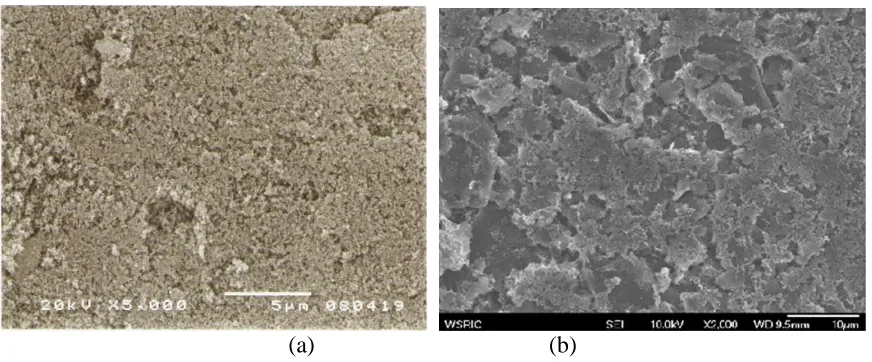
The primary particle size of carbon black was approximately 0.02 μm; however, it is normally agglomerated to form bigger particles. The particle size of the graphite was around 20 μm which was significantly larger than that of carbon black. If the carbon black was well dispersed during mixing, it could cover the surface of the graphite particles. Fig. 1 shows the surface of the carbon composite GDLs prepared from the mixture of carbon black and graphite compared to that prepared from carbon black only.
[image:3.596.82.518.301.482.2]
(a) (b)
Figure 1. SEM images of carbon composite GDL. (a) CB 100% (G 0%), (b) CB 30% + G 70%.
resistivity between sheets, which is affected by surface roughness and difficult to eliminate from the original conductivity [18,19].
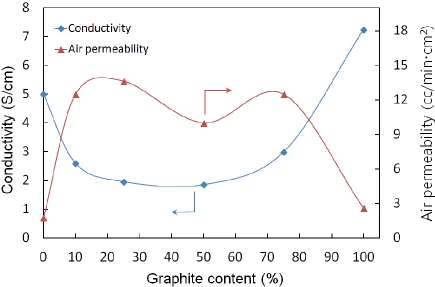
Figure 2. Conductivity and air permeability of carbon composite GDLs as a function of graphite content.
The air permeabilities of carbon composite GDLs are also shown in Fig. 2. The air permeability of these composite GDLs, apart from G 0 % and G 100 %, was approximately half that of other commercial GDLs made with a microporous layer (MPL) [10,20]. The lower air permeability of composite GDLs prepared using only carbon black or graphite is assumed to be due to the narrow pore channels formed by the small particles of carbon black, or the low number of large pore channels formed by the large graphite particles. Thus, the spaces or pores available for gas diffusion through composite GDLs consisting of solely carbon black or graphite might be insufficient in comparison to those formed from a mixture of the two materials.
[image:4.596.82.517.134.421.2][image:5.596.125.453.136.359.2]
and convection [23]. We assume that the gas diffusion through our composite GDL would occur via the Knudsen diffusion and the Bulk diffusion combined.
Figure 3. Pore size distributions of carbon composite GDLs.
Figure 4. Porosity, pore area and pore diameter of carbon composite GDLs.
[image:5.596.137.463.434.611.2][image:6.596.22.577.176.273.2]
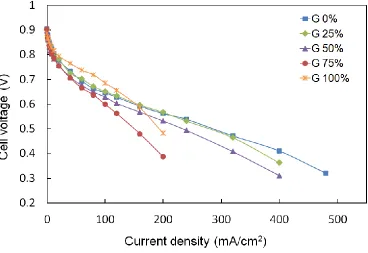
Electrochemical measurements were carried out for fuel cells containing MEAs with the composite GDLs. In the I-V polarization curves shown in Fig. 5, the composite GDL with high content of carbon black showed fairly good performance.
Table 1. Physical properties of carbon composite GDLs
Porosity
(%)
Pore size (μm)
Pore area (m2/g)
Conductivity (S/cm)
Permeability coefficient (cc/cm2min)
Currenta (mA/cm2)
Tafel slopeb (mV/dec)
CB100G0 64.44 0.12 61.31 5.00 1.76 151.1 77.5
CB75G25 66.21 0.17 58.30 1.96 13.6 156.8 71.6
CB50G50 69.98 0.29 45.45 1.85 10.0 123.4 81.8
CB25G75 57.05 0.24 26.25 2.98 12.5 99.5 84.8
CB0G100 58.45 0.72 5.55 7.24 2.63 152.0 58.0
a: at 0.6V. b: until 0.8V
[image:6.596.111.479.404.657.2]It is generally considered that the electric conductivity of carbon composite GDLs influences this. Nevertheless, the composite GDL with 100% graphite, which had high conductivity, showed poor performance. It is hypothesized that for the composite GDL containing solely graphite, other factors affected the cell performance.
Figure 5. Fuel cell performances of MEAs with carbon composite GDL.
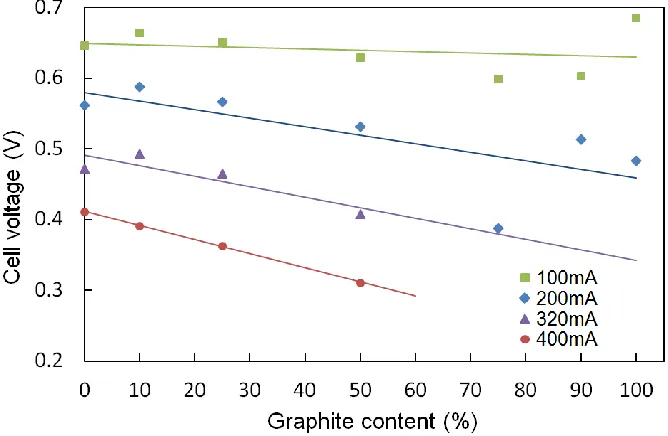
Figure 6. Cell voltage variation of MEAs with carbon composite GDL as a function of current.
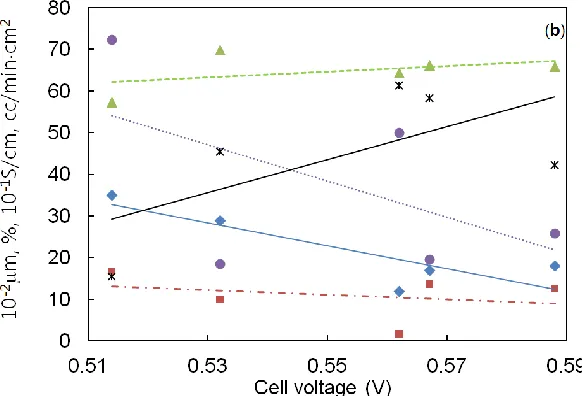
Figure 7. Physical properties of composite GDLs as a function of cell voltage at (a) 20 mA/cm2 and (b) 200 mA/cm2. (◆, ―――) Pore diameter, (▲, - - - -) porosity, (,―――) pore area, (, ) conductivity, (,― ―) air permeability.
Cell performance is known to be especially influenced by the mass transfer of the reactant gas and is directly related to gas concentration, which depends on pore area, air permeability. The ion conductivity of the electrolyte membrane is another contributing factor; however, in this work, the ion conductivity did not have any influence. Fig. 7 shows the relationship between fuel cell performance and the physical properties of the composite GDLs on the cell voltage at two constant current densities, one for an activation polarization region (below 50 mA/cm2) and another for an ohmic polarization region (over 100 mA/cm2). The changes in the Tafel slopes in the activation polarization region (listed in table 1) were small, being within about 10 mV, except for the GDL consisting of 100% graphite. This was because the same catalyst was used for all the composite GDLs and this affects the activation energy. In Fig. 7, both graphs show similar behavior as a function of the physical properties of the composite GDLs. The cell performance increased with increasing porosity and pore area, but pore diameter, conductivity and air permeability showed the opposite trend. Kannan and Munukutla reported that an increase in the pore diameter of a MPL on the GDL led to enhanced cell performance at higher current density without flooding [24]. The results of Kitahara et al. demonstrated a maximum cell performance at a pore diameter of 3 μm of the MPL on the GDL at the cathode side [25]. They assumed when the pore diameter was higher or lower than 3 μm, the performance tended to decrease by flooding or mass transport limitations. Usually, the introduction of a MPL on carbon paper or carbon cloth in GDLs improves gas transport and water management capabilities, and reduces ohmic resistance [26,27]. Chen et al. reported that the MPL on carbon paper increased the volume of micro-pores and meso-micro-pores, but slightly decreased that of macro-micro-pores [28].
mass transport in our GDLs might be controlled by Knudsen diffusion dominantly because of the low mean pore diameter. Therefore, the cell performance could be improved by the increase in gas diffusion (rather than Bulk diffusion) gained through the enlargement of pore volume, as shown in Fig. 7.
4. CONCLUSIONS
Carbon composite GDLs were prepared from carbon black and graphite using a simple method. Their physical properties and the fuel cell performances containing them were subsequently investigated. Graphite content was found to influence the physical properties (e.g. electric conductivity and air permeability) of the carbon composite GDLs. The pore size and conductivity of the composite GDLs increased with increasing graphite content but their porosity, pore area, and air permeability showed the reverse trend. The composite GDLs with high carbon black content showed better fuel cell performances than the others. Comparing the cell performances with the physical properties, it was observed that the cell performance increased with increasing porosity and pore area; but pore diameter, conductivity, and air permeability showed the reverse trend. It may be assumed that the mass transport in our GDLs might be controlled by Knudsen diffusion dominantly because of low mean pore diameter. Therefore, the cell performance could be improved by an increase in gas diffusion through an enlargement of pore volume.
ACKNOWLEDGEMENT
This work was financially supported by the Program of Regional Innovation Center at Woosuk University which was conducted by the Ministry of Knowledge Economy of the Korean Government.
References
1. EG&G Technical Services, Inc., “Fuel Cell Hand-book”, U.S. Department of Energy, West Virginia, p1-12 (2004).
2. S. Park, J.-W. Lee, B. N. Popov, J. Power Sources, 163 (2006) 357.
3. G.-G. Park, Y.-J. Sohn, T.-H. Yang, Y.-G. Yoon, W.-Y. Lee, C.-S. Kim, J. Power Sources, 131 (2004) 182.
4. J. Lobato, P. Canizares, M. A. Rodrigo, C. Ruiz-López, J. J. Linares, J. Appl. Electrochem., 38 (2008) 793.
5. J. P. Feser, A. K. Prasad, S. G. Advani, J. Power Sources, 162 (2006) 1226. 6. J. Ge, A. Higier, H. Liu, J. Power Sources, 159 (2006) 922.
7. S. Escribano, J.-F. Blachot, J. Ethève, A. Morin, R. Mosdale, J. Power Sources, 156 (2006) 8. 8. M. Hayashi, T. Sugitani, Y. Asano, US Patent 2005/0173244 A1, 2005, 13.
9. Y. W. Chen-Yang, T. F. Hung, J. Huang, F. L. Yang, J. Power Sources, 173 (2007) 183. 10. J. Shim, C. Han, H. Sun, G. Park, J. Lee, H. Lee, Trans. Kor. Hydrogen New Energy Soc., 23
(2012) 34.
11. L. Du, S. C. Jana, J. Power Sources, 172 (2007) 734.
13. N. Cunningham, M. Lefèvre, G. Lebrun, J.-P. Dodelet, J. Power Sources, 143 (2005) 93 14. Y. R. J. Thomas, M. M. Bruno, H. R. Corti, Micropor. Mesopor. Mater., 155 (2012) 47. 15. K. Ahn, C. Yang, S. Lee, Trans. Kor. Hydrogen New Energy Soc., 21 (2010) 540.
16. K. Kinoshita, "Carbon: Electrochemical and physicochemical properties", John Wiley & Sons, p70 (1988).
17. D. Pantea, H. Darmstadt, S. Kaliaguine, L. Summchen, C. Roy, Carbon, 39 (2001) 1147. 18. B. Avasarala, P. Haldar, J. Power Sources, 188 (2009) 225.
19. T.-M. Wen, K.-H. Hou, C.-Y. Bai, M.-D. Ger, P.-H. Chien, S.-J. Lee, Corr. Sci., 52 (2010) 3599. 20. J.-J. Lee, I.-T. Kim, Y. Zhang, H.-K. Lee, J. Shim, J. Kor. Electrochem. Soc., 10 (2007) 270. 21. M. Watanabe, M. Tomikawa, S. Motoo, J. Electroanal. Chem., 195 (1985) 81.
22. M. Uchida, Y. Aoyama, N. Eda, A. Ohta, J. Electrochem. Soc., 142 (1995) 4143.
23. X. Wang, H. Zhang, J. Zhang, H. Xu, X. Zhu, J. Chen, B. Yi, J. Power Sources, 162 (2006) 474. 24. A. M. Kannan, L. Munukutla, J. Power Sources, 167 (2007) 330.
25. T. Kitahara, T. Konomi, H. Nakajima, J. Power Sources, 195 (2010) 2202.
26. L. R. Jordan, A. K. Shukla, T. Behrsing, N. R. Avery, B. C. Muddle, M. Forsyth, J. Power Sources, 86 (2000) 250.
27. W.-M. Yan, C.-Y. Hsueh, C.-Y. Soong, F. Chen, C.-H. Cheng, S.-C. Mei, Int. J. Hydro. Energy, 32 (2007) 4452.
28. J. Chen, H. Xu, H. Zhang, B. Yi, J. Power Sources, 182 (2008) 531.
29. X. L. Wang, H. M. Zhang, J. L. Zhang, H. F. Xu, Z. Q. Tian, J. Chen, H. X. Zhong, Y. M. Liang, B. L. Yi, Electrochim. Acta, 51 (2006) 4909.
30. C. K. Park, I. S. Jo, B. S. Oh, Trans. Kor. Hydrogen New Energy Soc., 18 (2007) 422.