Int. J. Electrochem. Sci., 11 (2016) 9067 – 9073, doi: 10.20964/2016.11.65
International Journal of
ELECTROCHEMICAL
SCIENCE
www.electrochemsci.orgShort Communication
Effect of Antisite Defects on Li Ion Diffusion in LiNiPO
4: a First
Principles Study
Jianjian Shi
Center for Public Security Information and Equipment Integration Technology, School of Physical Electronics, University of Electronic Science and Technology of China, Chengdu, 610054, P.R. China E-mail: [email protected]
Received: 25 August 2016 / Accepted: 17 September 2016 / Published: 10 October 2016
Lithium diffusion properties in crystalline LiNiPO4 were studied using density functional theory.
Formation and clustering energies of Li-Ni antisite defects are calculated, results showed the antisite defects are energetically favorable in the LiNiPO4 and they not tend to bind together. The energy
barrier of Li is 0.28 eV in the pristine LiNiPO4. The energy barriers of Li diffusion along the [010]
direction in the LiNiPO4 were not affected so much compared with that in the pristine system,
however, the diffusion energy barrier of Ni diffusion was much larger than that of Li. This indicates that the existence of antisite defect will severely impede Li diffusion along the [010] direction and thus explains the poor cycling performance of LiNiPO4 cathode materials for LIBs.
Keywords: Li ion batteries, DFT, antisite defects, cathode, LiNiPO4
1. INTRODUCTION
The lithium ion batteries (LIBs) are considered as cheap energy storage devices, which exhibit promising applications in hybrid electric vehicles and all-electric vehicles [1, 2]. Developing of new cathode materials is very important for improving the charge capacity. Olivine-family lithium metal phosphate (LiMPO4, M=Fe, Mn, Ni, Co) cathode materials are the most promising ones due to their
safety, environmental friendliness, low cost and high capacity [3-12]. Among the olive-type families, LiNiPO4 is attracted more attention for its the highest voltage (about 5.1 V vs. Li/Li+). However, the
obstacle for commercial application of LiNiPO4 is its poor cycling performances, which are caused by
its low intrinsic electronic and ionic conductivity. Several strategies have been used to improve the electrochemical performance of LiNiPO4, such as synthesizing LiNiPO4/C, graphitic carbon
LiNiPO4 were improved via above methods, however the degradation mechanism of the pristine
LiNiPO4 are not well understood. The electrochemical properties show great dependence on the
structure stability of LiNiPO4, therefore, it is essential to investigate the structure property and
understand their chemistry to further enhance the cycling property of high voltage LiNiPO4 electrode
materials for LIBs.
Olivine-type LiNiPO4 structure with space group of pnma, in which Li atoms occupy linear
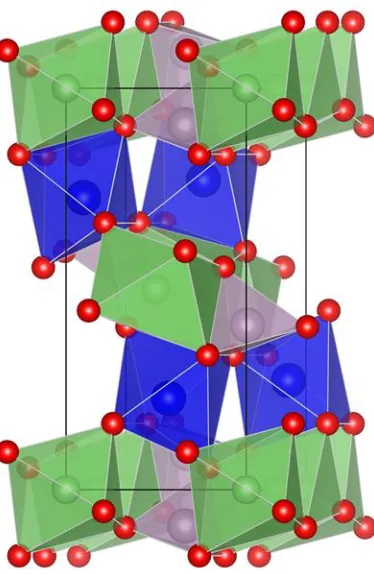
chains of edge-sharing octahedral along the [010] direction, whereas Ni atoms occupy zigzag chains of corner-sharing octahedral in the (011) plane. These chains are bridged by edge and corner shared phosphate tetrahedral, which create a rigid three-dimensional structure as shown in Fig. 1. The blue, green, red and grey balls represent the Ni, Li, O and P atoms, respectively. The LiNiPO4 has
one-dimensional Li channels along the [010] direction. According to Devaraju et.al [12] observation using HAADF/ABF-STEM analysis show that antisite defects exists in LiNiPO4, antisite defects means that
[image:2.596.205.392.325.612.2]Ni atoms occupy Li sites and Li occupy the Ni sites. The atomic scale investigations on the Li kinetic properties of LiNiPO4 with antisite defects are not understood.
Figure 1. The crystallographic structure of LiNiPO4. The blue, green, red and grey balls represent the
Ni, Li, O and P atoms, respectively.
In this work, the formation and clustering energies of Li-Ni antisite defects, diffusion energy barriers for Li and Ni in the olivine-type LiNiPO4 system were studied using density functional theory
(DFT). It is found that Li diffusion along the [010] direction is severely hindered by the antisite defect in LiNiPO4 and thus provides an insightful comprehension of the poor cycling performance of
2. SIMULATION DETAILS
Li-Ni antisite defect formation energies, Li and Ni diffusion energy barriers were calculated using the SIESTA (Spanish Initiative for Electronic Simulations with Thousands of Atoms) code [17] based on DFT [18, 19]. The exchange-correlation energies were described using local density approximation (LDA) with the Ceperley-Alder (CA) functional [20, 21]. Numerical atomic orbits were described by using double zeta basis set plus polarization. A cutoff of 150 Ry was used for the Fourier expansion of the density. The unit cell of LiNiPO4 was composed of 4Li, 4Ni, 4P and 16O atoms. A
3×7×7 k-point grid was used to optimize the atomic configuration by relaxing the atomic positions and cell parameters. Geometric optimization was done by conjugate gradients (CG) method until the force on every atom is smaller than 0.04 eV/Å. The calculated lattice constants for LiNiPO4 are a=10.00 Å,
b=5.75 Å, c=4.65 Å, which are great consistent with results of other groups [11, 12, 14, 15, 22, 23]. 1a×2b×3c LiNiPO4 supercell was used to study the Li-Ni antisite defects.
The formation energies of Li-Ni antisite defects Ef(LiNi) are calculated using the following equation [24, 25].
) perfect ( ) Ni Li ( Ni)
(Li E E
Ef tot (1)
where Etot(LiNi) is the total energy of the LiNiPO4 with Li-Ni antisite defects. E(perfect)is total energy of the pristine bulk LiNiPO4.
The clustering energies Eclustering are calculated using the equation (2) [26]. Ni)
(Li Ni)
(Li
f singlef
clustering E nE
E (2)
Here, Esinglef(LiNi)is the formation energy of a single Ni defect, n is the number of Li-Ni defects. A positive value of Eclustering indicates that Li-Ni antisite defects tend to separate each
other when they are present in the samples.
3. RESULTS AND DISCUSSION
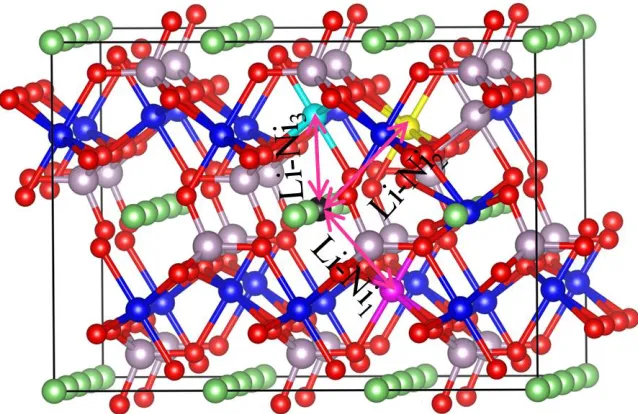
According to the symmetry of LiNiPO4, each Li atom has six neighboring Ni atoms with Li-Ni
distance of 3.52, 3.60, and 3.08 Å, respectively. So Li-Ni1, Li-Ni2 and Li-Ni3 antisite defects may be
formed, as shown in Fig. 2. The calculated formation energies of Li-Ni1, Li-Ni2 and Li-Ni3 antisite
defects are 0.59, 0.54 and 0.57 eV, respectively. Low formation energies of defects generally mean that these defects form easily. The result indicates that these three kinds of Li-Ni antisite defects are energetically favorable in the LiNiPO4, which is consistent with the experimental observations [12].
This offers the theoretical evidence that the existence of Ni in Li positions and Li in Ni positions as antisite defects in the LiNiPO4.
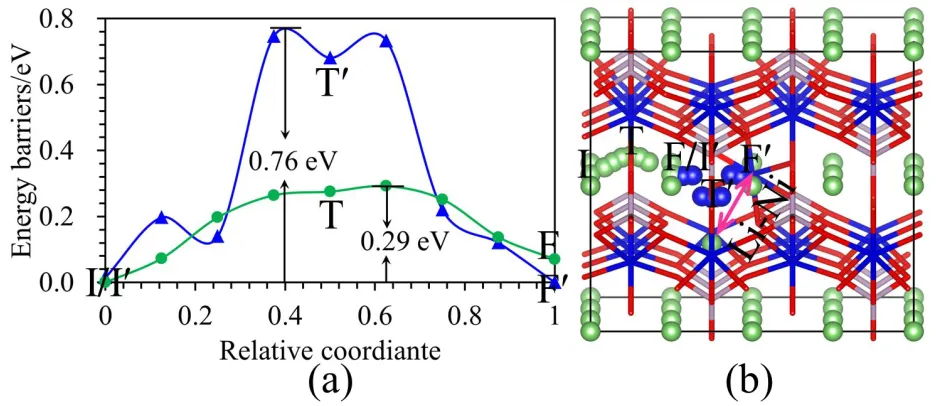
In order to investigate how the antisite defect affects Li diffusion kinetics, the energy barriers of Li and Ni atoms diffusing from one octahedral to another octahedral site along the [010] diffusion channels were calculated. The calculated diffusion barrier of Li along the diffusion path in Fig. 3(b) in the pristine LiNiPO4 is 0.28 eV, as shown in Fig.3 (a), which is in the range of reported values of
of Li-Ni antisite defect are 0.29 and 0.76 eV, respectively, as shown the green and blue curves in Fig. 4 (a). I-T-F and I′-T′-F′ paths in Fig.4 (b) refer to Li and Ni diffusion pathways, respectively. Although the energy barrier value of Li in LiNiPO4 with one Li-Ni is close to that of Li in the pristine LiNiPO4,
[image:4.596.139.458.193.400.2]however the value of diffusion barrier for Ni in Li sites along the [010] Li diffusion channels is 0.47 eV larger than that of Li. This suggests that Ni in Li sites will seriously hinder the diffusion of Li in the [010] Li diffusion channels.
Figure 2. The crystallographic structure of the supercell LiNiPO4. The black ball represents one of Li
atoms, it with the rosy (Ni1), yellow (Ni2) and sapphire (Ni3) balls consists of Li-Ni1, Li-Ni2
and Li-Ni3 three kinds of Li-Ni antisite defects, respectively.
Figure 3. (a) The diffusion energy barrier curve for Li in the pure LiNiPO4 supercell. (b) The diffusion
[image:4.596.78.519.476.668.2]
Devaraju et al. reported that antisite defects are homogeneously distributed in LiNiPO4 [12].
Therefore, the clustering energy were calculated when more than one Li-Niantisite defects exist. The calculated clustering energies are 0.11 and 0.12 eV for LiNiPO4 with two and three Li-Ni antisite
defects, which demonstrate that the Li-Ni antisite defects do not tend to cluster. This is an agreement with the experiment observation that the antisite distributions are homogeneous [12]. Defects critically affect the properties of materials, thus, the defect concentration often plays a pivotal role in performance. Yildirim et al. [29] reported that the defect concentrations have an influence on the diffusion processes.
Figure 4. (a) The diffusion energy barrier curves for Li and Ni in the LiNiPO4 with one Li-Ni antisite
defect. The green and blue curves correspond to Li and Ni energy barriers, respectively. (b) The diffusion pathways of Li and Ni in the LiNiPO4 with one antisite defect. I-T-F and I′-T′-F′
paths correspond to Li and Ni, respectively.
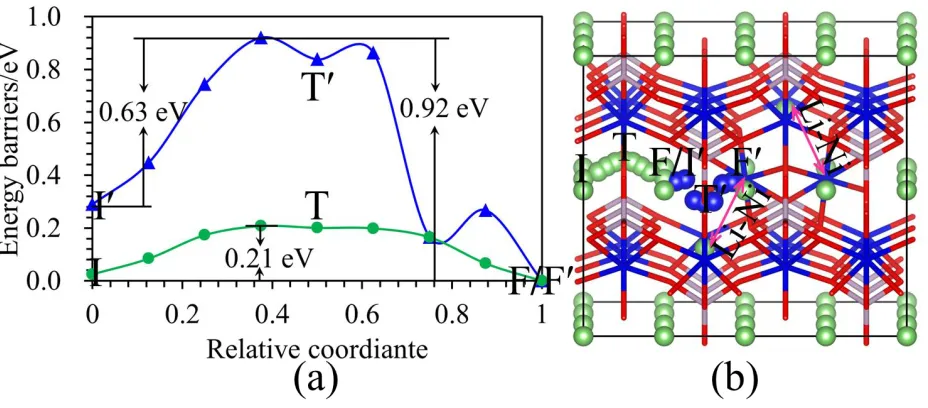
Hence, it is necessary to further study the effect of the Li-Ni defects pairs on Li ion diffusion, the diffusion energy barriers of Li and Ni in the LiNiPO4 with two Li-Ni antisite defects were also
calculated. The diffusion energy barrier is 0.21 eV for Li. However, the energy barrier for Ni along the I′-T′-F′ path is 0.63 eV, along the F′-T′-I′ path is 0.92 eV. The values of Ni in the LiNiPO4 with two
pairs of antisite defects are less than 0.13 eV and more than 0.16 eV that that of Ni in the LiNiPO4 with
one pair of defects along the I′-T′-F′ and F′-T′-I′ paths, respectively. The value of Li in the LiNiPO4
with two pairs of Li-Ni antisite defects is 0.07 smaller than in the pristine system. This suggests that the antisite defect concentrations have an influence on the Li and Ni diffusion. Although the diffusion barrier of Ni along the I′-T′-F′ in two pairs of defects is smaller than in one pair, the values of Ni are still much larger than that of Li in the pure system. This resembles the results of the LiNiPO4 with one
[image:5.596.66.534.224.427.2]
J.J. Shi Figure 5
Figure 5. (a) The diffusion energy barrier curves for Li and Ni in the LiNiPO4 with two Li-Ni antisite
defects. The green and blue curves correspond to Li and Ni energy barriers, respectively. (b) The diffusion pathways of Li and Ni in the LiNiPO4 with two antisite defects. I-T-F and I′-T′-F′
paths correspond to Li and Ni, respectively.
On the basis of above discussions, Li-Ni antisite defects are energetically favorable in LiNiPO4
and not tend to cluster, which is consistent with the experimental results [12]. Moreover, antisite defects seriously hinder Li moving along the [010] direction in LiNiPO4.
4. CONCLUSIONS
Lithium ion diffusion in crystalline LiNiPO4 was studied using density functional theory.
Formation and clustering energies show that Li-Ni antisite defects are energetically favorable in the LiNiPO4 and not tend to cluster. The result is great consistent with the experiment observation. The
energy barriers of Ni in Li sites in the LiNiPO4 are great larger than those of Li in the LiNiPO4 system.
This suggests that Ni in Li sites in LiNiPO4 system seriously hinder Li moving along the [010]
diffusion channels and thus provides an insightful understanding of the poor cycling performance in LiNiPO4 system.
ACKNOWLEDGEMENT
This work was financially supported by the National Natural Science Foundation of China (11474047). This work was carried out at National Supercomputer Center in Tianjin, and the calculations were performed on TianHe-1(A).
References
[image:6.596.71.535.72.276.2]
2. Y. Lin, Y. Yang, R. Yu, H. Lai and Z. Huang, Journal of Power Sources 259 (2014) 188. 3. Y. Zhang, H.J. Zhang, Y.Y. Feng, L. Fang and Y. Wang, Small 12 (2016) 516.
4. T.-F. Yi, Z.-K. Fang, Y. Xie, Y.-R. Zhu and C. Dai, Journal of Alloys and Compounds 617 (2014) 716.
5. R. Trócoli, S. Franger, M. Cruz, J. Morales and J. Santos-Peña, Electrochimica Acta 135 (2014) 558.
6. L.F.J. Piper, N.F. Quackenbush, S. Sallis, D.O. Scanlon, G.W. Watson, K.W. Nam, X.Q. Yang, K.E. Smith, F. Omenya, N.A. Chernova and M.S. Whittingham, The Journal of Physical Chemistry C 117 (2013) 10383.
7. J. Yang and J.S. Tse, J Phys Chem A 115 (2011) 13045.
8. F.C. Strobridge, D.S. Middlemiss, A.J. Pell, M. Leskes, R.J. Clément, F. Pourpoint, Z. Lu, J.V. Hanna, G. Pintacuda, L. Emsley, A. Samoson and C.P. Grey, J Mater Chem A 2 (2014) 11948. 9. M.K. Devaraju, Q.D. Truong, T. Tomai, H. Hyodo, Y. Sasaki and I. Honma, RSC Adv. 4 (2014)
52410.
10.J.L. Allen, T. Thompson, J. Sakamoto, C.R. Becker, T.R. Jow and J. Wolfenstine, Journal of Power Sources 254 (2014) 204.
11.Y. Zhang, Y. Pan, J. Liu, G. Wang and D. Cao, Chem Res Chinese U 31 (2015) 117.
12.M.K. Devaraju, Q.D. Truong, H. Hyodo, Y. Sasaki and I. Honma, Sci Rep 5 (2015) 11041.
13.M. Prabu, S. Selvasekarapandian, A.R. Kulkarni, S. Karthikeyan and C. Sanjeeviraja, Transactions of Nonferrous Metals Society of China 22 (2012) 342.
14.M. Mumtaz, N.K. Janjua, A. Yaqub and S. Sabahat, Journal of Sol-Gel Science and Technology 72 (2014) 56.
15.R. Qing, M.-C. Yang, Y.S. Meng and W. Sigmund, Electrochimica Acta 108 (2013) 827. 16.L. Dimesso, C. Spanheimer and W. Jaegermann, Mater Res Bull 48 (2013) 559.
17.J.M. Soler, E. Artacho, J.D. Gale, A. Garcia, J. Junquera, P. Ordejon and D. Sanchez-Portal, J Phys-Condens Mat 14 (2002) 2745.
18.F. Legrain, O. Malyi and S. Manzhos, Journal of Power Sources 278 (2015) 197. 19.F. Legrain, O.I. Malyi and S. Manzhos, Comp Mater Sci 94 (2014) 214.
20.L.J. Sham, Philos T Roy Soc A 334 (1991) 481.
21.D.M. Ceperley and B.J. Alder, Phys Rev Lett 45 (1980) 566.
22.R. Cheruku, G. Kruthika, G. Govindaraj and L. Vijayan, J Phys Chem Solids 86 (2015) 27. 23.S. Karthickprabhu, G. Hirankumar, A. Maheswaran, R.S. Daries Bella and C. Sanjeeviraja, Ionics
21 (2014) 345.
24.H. Duan, J. Li, H. Du, S.W. Chiang, C. Xu, W. Duan and F. Kang, The Journal of Physical Chemistry C 119 (2015) 5238.
25.K. Hoang and M. Johannes, Chemistry of Materials 23 (2011) 3003.
26.H. Guo, X. Song, Z. Zhuo, J. Hu, T. Liu, Y. Duan, J. Zheng, Z. Chen, W. Yang, K. Amine and F. Pan, Nano letters DOI 10.1021/acs.nanolett.5b04302(2015).
27.D. Morgan, A. Van der Ven and G. Ceder, Electrochemical and Solid-State Letters 7 (2004) A30. 28.C.A.J. Fisher, V.M.H. Prieto and M.S. Islam, Chemistry of Materials 20 (2008) 5907.
29.H. Yildirim, A. Kinaci, M.K.Y. Chan and J.P. Greeley, ACS applied materials & interfaces 7 (2015) 18985.