N A T I O N A L B A N K O F B E L G I U M
WORKING PAPERS - RESEARCH SERIES
MODEL-BASED INFLATION FORECASTS AND
MONETARY POLICY RULES
_______________________________
Raf Wouters(*) Michel Dombrecht(*)
The views expressed in this paper are those of the authors and do not necessarily reflect the views of the National Bank of Belgium.
The authors would like to thank Philippe Moës for his helpful comments. The paper was presented at the colloquium on "Optimal Monetary Policy Rules and Accountability" University of Antwerp (UFSIA) on May 10th, 1999.
(*)
Editorial Director
Jan Smets, Member of the Board of Directors of the National Bank of Belgium
Statement of purpose:
The purpose of these working papers is to promote the circulation of research results (Research Series) and analytical studies (Documents Series) made within the National Bank of Belgium or presented by outside economists in seminars, conferences and colloquia organised by the Bank. The aim is thereby to provide a platform for discussion. The opinions are strictly those of the authors and do not necessarily reflect the views of the National Bank of Belgium.
The Working Papers are available on the website of the Bank:
http://www.nbb.be
Individual copies are also available on request to:
NATIONAL BANK OF BELGIUM
Documentation Service boulevard de Berlaimont 14 B - 1000 Brussels
Imprint: Responsibility according to the Belgian law: Jean Hilgers, Member of the Board of Directors, National Bank of Belgium. Copyright © National Bank of Belgium
Reproduction for educational and non-commercial purposes is permitted provided that the source is acknowledged.
Abstract
In this paper, the interaction between inflation and monetary policy rules is
analysed within the framework of a dynamic general equilibrium model derived from
optimising behaviour and rational expectations. Using model simulations, it is illustrated
that the control of monetary policy over the inflation process is strongly dependent on the
role of forward looking expectations in the price and wage setting process and on the
credibility of monetary policy in the expectation formation process of the private sector.
Furthermore, the central bank should take into account a wide variety of indicators in
making monetary policy decisions in order to approach the optimal monetary policy rule as
TABLE OF CONTENTS:
1. INTRODUCTION ...1
2. A DYNAMIC GENERAL EQUILIBRIUM MODEL FOR AN OPEN ECONOMY...4
2.1. Technologies and firms...5
2.1.1. Final-good sector...5
2.1.2. Intermediate goods producers...6
2.1.3. Capital rental firms ...9
2.2. The household sector ...10
2.3. The government sector ...13
2.4. The balance of payments and foreign demand ...13
2.5. Market equilibrium...14
2.6. The parameterisation of the model ...15
3. SIMULATION RESULTS ...18
3.1. Illustration of the impact of the monetary policy rule on the inflation forecast ...19
3.2. Difference between accommodating and non-accommodating monetary policies ...20
3.3. Illustration of the importance of rigidity in the inflation process ...21
3.4. Illustration of the credibility issue for monetary policy...22
3.5. Illustration of the importance of the information that is included in the monetary policy reaction function ...23
4. CONCLUSION ...26
1. INTRODUCTION
Inflation forecasts depend on the expected monetary policy behaviour, at least if
central bank actions have some effect on inflation over the forecast horizon. Model-based
inflation forecasts will therefore depend on the maintained hypothesis about future
monetary actions in the simulation exercise. Empirical studies have illustrated that this
central bank behaviour can be approximated by relatively simple monetary policy rules that
describe systematic relations between the monetary policy instrument, in practice the
short-term interest rate, and some measure of inflation and/or output developments in the
economy1.
If the central bank inflation objective is perfectly credible, the forecast of inflation
over the horizon over which the central bank has control will equal the central bank's
inflation target that is present in the monetary policy rule. But this control is not perfect, for
various reasons. For instance, the cost of bringing down inflation quickly can be too high,
given that the central bank also cares about the real economy. Furthermore, monetary
policy objectives are not always considered as perfectly credible by the public. Such
arguments explain why inflation can deviate from the objective even over a relatively
longer time horizon.
In this paper a small structural model is proposed which is able to explain the
inflation process and its major interactions with other macro-economic aggregates and
which makes it possible to illustrate the role of monetary policy rules in making inflation
forecasts. A model needs to fulfil certain conditions in order to be able to discuss and
compare different monetary policy rules. Ireland (1997) and Rotemberg and Woodford
(1998) argue that structural models derived from optimising behaviour based on rational
(or model-consistent) expectations are robust to the Lucas critique and therefore make it
possible to compare and evaluate alternative monetary policy rules.
The model, calibrated for the euro area, enables us to discuss the impact of
monetary policy rules on inflation forecasts. The importance of monetary policy rules for
model-based forecasts is illustrated by comparing the outcome of a demand shock on
inflation and broader macro-economic aggregates under different monetary policy
reactions.
But the model also enables us to discuss other issues related to the interaction
between the inflation process and monetary policy behaviour in the context of model
simulations. A first topic is the relative importance of lagged inflation versus forward
looking inflation expectations in the price and wage dynamics. Optimising models derived
from the Calvo model or from quadratic adjustment costs2 result in inflation equations that
are purely forward looking. The traditional Taylor nominal-contract model also results in a
purely forward looking inflation equation. This specification has important implications for
monetary policy: it makes disinflation costless if the announced inflation targets are
regarded as credible by the public. This result conflicts with empirical evidence on the cost
of disinflation3. This type of inflation equation is also criticised for not explaining observed
persistence in inflation4. However, the relative importance of lagged versus forward
looking terms in the inflation equations remains an empirical debate. Gali and Gertler
(1998), for instance, found a dominant weight for the forward looking term using the
marginal cost, instead of the traditional output gap, as an explanatory variable in the
inflation equation. In the calibration of our model, a general dynamic specification for both
price and wage inflation is specified and the implications for model simulations and the
sacrifice ratio, in particular, are presented.
A crucial hypothesis in simulations with model-consistent expectations is the
credibility of monetary policy rules and inflation targets in the perception of the private
sector5. This assumption strongly supports the power of monetary policy over inflation
expectations and indirectly over actual price and wage setting. The impact of the perfect
credibility hypothesis is pointed out by comparing the simulation results of a demand shock
under perfect credibility of the monetary policy reaction and inflation target with an
alternative scenario in which the public perceives an incorrect inflation target and only
gradually learns the actual inflation target of monetary policy. The experiment with our
model confirms that the credibility assumption has important effects on the inflation
outcome and that credibility is particularly valuable for central banks as it greatly reduces
the sacrifice ratio of combating inflationary tendencies.
2
See Rotemberg (1996), Hairault and Portier (1993).
3 See Ball (1993) for a discussion of the costs of disinflation policies.
4 See Fuhrer and Moore (1995) for evidence on inflation persistence within the framework of contracting models. 5
A third issue in the relation between monetary policy rules and the inflation
process is the question of whether monetary policy should react to inflation or whether
monetary policy should also consider other macro-economic indicators in making policy
decisions. Svensson's (1998) argument for "inflation forecast" targeting implies that the
central bank should use all relevant information in evaluating and deciding on policy
actions. In the literature, this issue of "optimal monetary rules" is often discussed using a
loss function containing the variance of inflation and output6. Such exercises, based on
stochastic simulations, seek to arrive at a complete model estimate and identification of the
major shocks that drive the economy. In this paper, the topic of "optimal" or
"information-efficient" rules is simply illustrated by pointing to the consequences of different instrument
rules for the sacrifice ratio.
6
2. A DYNAMIC GENERAL EQUILIBRIUM MODEL FOR AN OPEN ECONOMY
The model is an application of the real business cycle methodology for an open
economy with sticky prices and wages7. Households maximise a utility function over a
finite life horizon with the following arguments: consumption of domestic and foreign
goods, money and leisure. Consumption appears in the utility function relative to the
time-varying external habit variable8. Labour is differentiated over households, so that
there is some monopoly power over wages which results in an explicit wage equation and
allows for the introduction of sticky nominal wages à la Calvo. Households allocate wealth
among money, equity, domestic and foreign assets, which are considered as perfect
substitutes, so that UIRP applies in the linear approximation. Firms produce differentiated
goods and decide on labour, capital (with capital adjustment costs), capacity utilisation9
and prices, again according to the Calvo model. Prices are therefore set in function of
current and expected marginal costs. These marginal costs depend on the marginal unit
labour cost (average over the economy) and on the price of imported intermediate inputs,
described further in the text as energy inputs, which are used in fixed proportions in the
production process. The composite domestic good is an imperfect substitute for the
foreign good, so that the real exchange rate is not constant over time.
The model is calibrated on the euro area economy as far as the economic
structure is concerned, while other behavioural parameters are set at realistic values found
elsewhere in the literature. The linear approximation is solved using the forward simulator
available in the Troll software.
Models that are based on dynamic micro-economic foundations for
macro-economic relations are now becoming the standard tool for analysing monetary
policy questions10. The specific model specification, presented in this paper, makes it
possible to discuss various topics: the open economy problem (total versus domestic
inflation), energy or broader commodity price shocks (either as intermediate input in the
production process or as final demand component in consumption), and wage versus price
stickiness (against the one-price models, which do not explicitly incorporate the wage
7
This model is a version of the model considered in Kollman (1997,1998) and features monopolistic competition in both the goods and labour markets.
8 Habit depends on lagged aggregate consumption which is unaffected by any one agent's decisions. Abel calls this the "catching up with the Joneses" effect. See Abel (1990,1996) and Campbell (1998).
9
Following the approach of King and Rebelo (1998). 10
formation process in the labour market)11. In this paper the interaction between inflation
and output behaviour under different monetary policy rules is discussed. On the following
pages we present a brief description of the main building blocks of the model.
2.1. Technologies and firms
The country produces a single final good and a continuum of intermediate goods
indexed by j where j is distributed over the unit interval (j∈
[ ]
0,1). The final-good sector isperfectly competitive and uses as inputs domestic and imported intermediate goods. The
final good is used for consumption by the representative household and the government
and for investment by the firms that rent out capital. There is monopolistic competition in
the markets for intermediate goods: each intermediate good is produced by a single firm.
2.1.1. Final-good sector
The final good is produced using domestic and imported intermediate goods in
the following CES technology:
(1)
( )
( )
) 1 ( ) 1 /( 1 F t ) 1 /( 1 H t
t y y
Y
γ + γ + γ
+
+
=
where γ is a parameter and yHt and yFt are indices of domestic and imported intermediate
goods. yHt can be written as:
(2)
( )
υ + υ +
=
∫
1 1
0
) 1 /( 1 H
j , t H
t y dj
y
where υ is a parameter, and yHt,j denotes the quantity of domestic intermediate good of
type j that is used in final goods production, at date t.
The cost minimisation conditions in the final goods sector can be written as:
(3) Ht 1 H t H t , j H t , j y p p y υ υ + −
= and
(4) t 1 t H t H t Y P p y γ γ + − =
where pHj,t is the price of the home intermediate good j , pHt is the price of the domestically
produced composite intermediate good and Pt is the price of the final good. Perfect
competition in the final goods market implies that the latter two can be written as:
(5)
( )
υ − υ − =
∫
1 0 / 1 H j , t Ht p dj
p
(6)
( )
( )
γ − γ − γ − +
= F 1/
t t / 1 H t
t p sp
P
where stis the nominal exchange rate and pFt is the foreign-currency price of the
composite imported good.
2.1.2. Intermediate goods producers
Each intermediate good
j
is produced by a firmj
using the followingtechnology:
(7) yj,t ≤(1+ie)AKαj,tH1j,−tα,
where yj,t (1+ie) is the firm’s value added, A is a productivity parameter, Kj,t is the
effective utilisation of the capital stock (the distinction between the utilisation rate and the
physical capital stock is discussed in connection with capital rental firms) and Hj,t is an
index of different types of labour used by the firm. This index is given by:
(8) φ + φ + τ τ =
∫
1 1 0 1 1 t , , j t,j h d
where φ is a parameter and hj,τ,t is the quantity of type τ labour used by firm j at time t. Energy is used in a fixed proportion, ie, of value added.
Cost minimisation implies:
(9) j,t
/ ) 1 ( t t , t , , j H W w h φ φ + − τ
τ = and
(10) α α − =1 K R H W t , j t t , j t
where Rt is the rental rate of capital, wτ,t is the wage rate for type τ labour and Wt is an aggregate wage index, given by:
(11)
( )
φ − φ − τ τ =
∫
1 0 / 1 t ,t w d
W .
Equation (10) implies that the capital-labour ratio will be identical across intermediate
goods producers and equal to the aggregate capital-labour ratio.
As the production function exhibits constant returns to scale, the firm’s average
and marginal cost are equal and given by:
(12) e e e t t ) 1 ( t 1 t e e e t t H t e t e e e t t K t e t t t i 1 i p s ) ) 1 ( ( R W A 1 i 1 i p s F ) i 1 ( W i 1 i p s F ) i 1 ( R AC MC + + α − α = + + + = + + + = = α − − α − α α −
where FtK and FtH are respectively the marginal value added of capital and labour and pet
is the foreign-currency price of energy. This implies that the marginal cost, too, is
independent of the intermediate good produced.
Total demand for firm j ’s good equals the sum of domestic and foreign demand:
(13) y,jt = yHj,t +xHj,t,
(14) Ht 1 H t H t , j H t , j x p p x υ υ + − = ,
and xHt is aggregate world demand for the country’s exports.
Using equations (3), (13) and (14), nominal profits of firm
j
are then given by:(15)
(
Ht Ht)
1 H t H t ,j t H t ,j t
,j y x
p p ) MC p ( + − = π υ υ + −
Each firm j has market power in the market for its own good and maximises
expected profits using a discount rate (βρt) which is consistent with the pricing kernel for
nominal returns used by the country’s shareholders-households:
k t C t C k t k t P 1 V V + + + =
ρ , where
C t
V is the marginal utility of consumption at time t (see section 2.2).
The model of price determination, inspired by Calvo (1983), assumes that firms
are not allowed to change their prices unless they receive a random “price-change signal”.
The probability that a given price can be changed in any particular period is constant
(1−ς ) and determines the fraction of all prices that are changed in each period. A producer who is “allowed” to set a new price at time t will maximise the following
intertemporal profit function:
(16) t k t k
0 k
t k k
E + +
∞ = π ρ β ς
∑
Profit maximisation implies the following mark-up equation:
(17)
( )
( )
t i 1 0 i H i t i t t i i i t i t 1 0 i H i t i t t i i H t ,j y p E MC y p E ) 1 ( p + υ υ + ∞ = + + + + υ υ + ∞ = + +∑
∑
ρ ς β ρ ς β υ + =Equation (17) shows that the price set by firm
j
, at time t, is a function of expected futureare perfectly flexible (ς =0), the mark-up will be constant and equal to 1+υ. With sticky
prices the mark-up becomes variable over time when the economy is hit by exogenous
shocks. A positive demand shock lowers the mark-up and stimulates employment,
investment and real output. Through this last channel the model acquires a Keynesian
character.
The definition of the price index in equation (5) implies that its law of motion is
given by:
(18)
( )
pHt −1/υ =ς( )
pHt−1−1/υ +(1−ς)( )
pHj,t −1/υ.Finally, using equations (3), (7), (10), (13) and (14) the aggregate demand for
capital is given by:
(19) υ υ + − α − α − α + = =
∫
1 H t H t 1 t t e t 1 0 t , j t p p R ) 1 ( W A ) i 1 ( y dj KK ,
where ptH is determined by the following law of motion:
(18')
( )
( )
( )
υυ + − υ υ + − − υ υ + − ς − + ς
= H 1
t , j 1 H 1 t 1 H
t p (1 )p
p
2.1.3. Capital rental firms
Capital is a homogenous factor of production that is owned by firms that rent
capital to producers of intermediate goods. These firms can choose between physical
capital accumulation (Kp) or a higher utilisation rate (z) with K=zKp. Capital accumulation is
given by:
(20)
(
)
pt[
( )
t]
t,p t 2 p t p 1 t p 1
t K 1 z I
K K K 2
K + +ψ + − = −τ + ,
where ψ is an adjustment-cost parameter, It is gross investment and τ
( )
zt is thedepreciation rate, which is an increasing function of the utilisation rate.
(21)
∑
∞ = + + + + + + − ρ β 0 k k t k t p k t K t k t k t t k ) I P K z R ( E ,giving rise to the following first-order condition for capital:
(22) + τ − βρ = + + + + + + + 1 t 1 t 1 t 1 t 1 t 1 t 1 t t t p R z ) z ( Q p E Q ,
where Tobin’s Q is given by:
(23) p t p t p 1 t t K K K 1
Q = +ψ + −
The first order condition for the utilisation rate equates the cost of higher utilisation in terms
of faster replacement investments with the rental price of capital services.
(24) Rt =ptτz
( )
zt2.2. The household sector
There is a continuum of households indicated by index
τ
. Households differ in that they supply a differentiated type of labour. So each household has a monopoly powerover the supply of its labour. Each household
τ
maximises a utility function that is separable in its inputs:(25)
= τ τ τ
τ t , t t t t t , P M , CH C V V l
Utility depends on consumption of goods, Cτt, relative to the external habit variable, CHt , real cash balances, Mtτ/Pt and labour supply lτ,t. Households act as price-setters in the labour market.
Household τ’s intertemporal utility function is given by:
(26)
∑
∞ = τ + β 0 j j t j jt pr V
E ,
Households hold money balances Mt, domestic government bonds Bt, foreign
interest-bearing bonds Ft and domestic equity Ut. Bonds are one-period bonds with price
t
b for domestic bonds and ft for foreign bonds. A perfect insurance market inherits
consumers' wealth contingent on their death and redistributes wealth in the form of an
annuity payment in proportion to household wealth. The budget constraint faced by the
household is then given by:
(27) − − + + + + = + + + τ τ τ τ τ − τ − τ − τ − τ τ τ τ t t t , t t , t 1 t t t 1 t t t 1 t t 1 t t t t t t t t t t t t t T C P w P U d P F s P B P M * ) pr 1 ( P U d P F f s P B b P M l
where dt represents the capital income return and Tt lump-sum taxes.
Households maximise the objective function (26) subject to the intertemporal
budget constraint (27) and the demand for their labour given in equation (9). As in the
goods market, we assume that wages can only be changed after some random
“wage-change signal” is received. The probability that a particular household can “wage-change its
nominal wage in period t is constant and equal to 1−ξ. A household τ which receives
such a signal in period t, will thus set a new nominal wage wτ taking into account the probability that it remains unchanged in the future.
This maximisation yields the following first-order conditions for consumption,
wealth allocation and wage-setting, where λt is the Lagrange multiplier, it is the nominal
rate of return on domestic bonds (1+it =1bt ) and iFt is the foreign-currency rate of return
on foreign bonds (1+iFt =1ft):
(28) Vtc =λt/pr
(29) t t t P / M t 1 t 1 t t P P V P
E + = λ
(30) t t t 1 t 1 t t p ) i 1 ( p
E = λ
+ λ β + + (31) t t F t t 1 t 1 t 1 t t p ) i 1 ( s s p
E = λ
+ λ β + + + (32) t t t 1 t 1 t 1 t t P d d P
E = λ
λ β + + + (33) i t C i t 0 i i t 1 i t i i t 0 i i t i t 1 i t i i t t , P V H W E ) V ( H W E ) 1 ( w + + ∞ = + φ φ + + ∞ = + + φ φ + + τ
∑
∑
ξ β − ξ β φ + = lCombining equations (28) and (30) gives the usual first-order condition for
consumption growth. Equations (28), (29) and (30) together result in a money demand
equation. Real money holdings depend on consumption, with an elasticity that is possibly
smaller than one, and the velocity of money depends positively on the interest rate.
Equations (30) and (31) give the uncovered interest rate parity condition for nominal
exchange rate determination. Equation (32) shows that the expected holding return on
equity equals the expected one-period interest rate under certainty equivalence.
Finally, equation (33) shows that the nominal wage at time t of a household
τ
that is allowed to change its wage is set so that the present value of the marginal return toworking is a mark-up over the present value of marginal cost (the subjective cost of
working)12. When wages are perfectly flexible (ξ=0), the real wage will be constant
mark-up over the ratio of the marginal disutility of labour and the marginal utility of an additional
unit of consumption.
12
Given equation (11), the law of motion of the aggregate wage index is given by:
(34)
( )
Wt −1/φ =ξ(
Wt−1)
−1/φ +(1−ξ)( )
wτ,t −1/φ2.3. The government sector
For the sake of completeness and in order to arrive at a realistic representation of
the final demand components, we also introduce a government sector. The government
has to satisfy the following budget restriction:
(35) t t
t 1 t
t t
t G T
P B P B b − + = − ,
which states that the primary deficit, G−T, and the debt service has to be financed by the
issuing of new public debt Bt at the current price bt. To rule out explosive debt dynamics,
the following endogenous tax behaviour is assumed:
(36)
− = ° P B P B g T t t t ,
where the reaction coefficient g is greater than the real interest rate (g>i−π). This
ensures a stable public debt at the long-term objective Bo.
2.4. The balance of payments and foreign demand
The accumulation of foreign assets Ft is determined by the current account
relation: (37) t t e t t F t t F t t H t t H t t 1 t t t t t t IE P p s y P p s x P p P F s P F f s − − + = −
The net foreign asset position depends on the interest payments on existing net foreign
exports, XHt , and the real value of imports of final goods, YtF, and energy inputs,IEt.
Energy acts only as an input in the production process:
(38) t
e e
t y
i 1
i IE
+ =
The demand for exports is a function of the terms of trade (stpFt /pHt ) and demand
in the rest of the world (ROWt):
(39) t
F t t
H t H
t ROW
p s
p x
ϑ −
=
2.5. Market equilibrium
The final goods market is in equilibrium if production equals demand by
consumers, the government and the capital accumulation firms:
(40) Yt =Ct +Gt +It
The capital rental market is in equilibrium when the demand for capital by the
intermediate goods producers equals the supply by the capital rental firms. The labour
market is in equilibrium if firms’ demand for labour equals labour supply at the wage level
set by households. Aggregate consumption behaviour deviates from the first-order
condition describing optimal decisions at household level by the additional wealth effect
resulting from the finite horizon assumption. The external habit variableCHt is a simple
function of the lagged aggregate consumption level:
(41) CHt =Cht−1
The interest rate is determined by a reaction function that describes monetary policy
decisions. This rule will be discussed in the following sections of the paper. In order to
maintain money market equilibrium, the money supply adjusts endogenously to meet the
In the capital market, equilibrium means that the government debt is held by
domestic investors at the market interest rate it (assuming that the country is in a net
foreign asset position), and that the net foreign assets are held by investors at the going
interest and exchange rates.
2.6. The parameterisation of the model
In the standard simulation of the theoretical model the following values for the
coefficients are assumed. The share of capital is set at 0.35 and the parameter for the
cost of capital adjustment is 10. The parameter determining the marginal cost of higher
capacity utilisation (King and Rebelo (1998)) is set at 0.1. In the utility function, we set the
coefficient of relative risk aversion at 1. The habit variable moves with consumption
lagged one period with a coefficient equal to 0.8. The macro-economic labour supply
elasticity with respect to real wages is 0.5.
The structure of final demand is given by the following steady-state assumptions:
final import/gdp = 0.06, energy import/gdp = 0.04, export/gdp = 0.10, consumption/gdp =
0.58, investment/gdp = 0.22, government expenditures/gdp = 0.20, public debt/gdp = 2.4
(60% on annual basis) and net foreign assets/gdp = 0.4 (10% on annual basis). The
discount factor β is set at 0.99, the rate of depreciation is 0.02 and capital/gdp ratio is 11.0.
The import and export price elasticity is set at 0.75. These parameters reflect the
economic structure of a large open economy such as the euro area.
The parameters of the price and wage adjustment equation require further
attention. In the theoretical model we assumed a forward looking inflation specification for
the whole economy. In the simulation of the model we use a generalisation in which the
inflation process is influenced by both forward looking expectations and lagged adjustment
effects13. Following the approach of Tinsley (1993), we assume some general dynamic
13
adjustment cost mechanism in estimating the price and wage dynamics. Price and wage
setters are assumed to minimise the following cost of adjustment expression:
(42)
(
)
(
)
(
)
∆ + − + − β + = − + + + + ∞ =
∑
∑
2 1 t k K 2 k k 2 1 i t i t 1 2 * i t i t 0 0 ii b p p b p p b p
where p* represents the equilibrium price level. This problem results in a general dynamic
expression for inflation:
(43)
( )
(
)
( )
(
)
*t i0 i i j t k 1 j j * 1 t 1
t p b p ,b,k p
p 1 A p + ∞ = − = −
− − + γ ∆ + ϕ β ∆
− =
∆
∑
∑
where A(L)=1+a1
( )
b L+a2( )
b L2 +...+ak+1( )
b Lk+1. The estimation results using euro-area data for GDP deflator and wages indicate that for inflation the sum of the coefficients forthe lagged variables assumes a value of 0.7, while for the wage dynamics the lagged
variables have a coefficient equalling 0.5514. The impact of the forward looking
expectations is therefore greatly reduced compared to the pure Calvo-price mechanism.
The model specification implies that a monetary shock has persistent effects on
output and inflation. These results contrast with the results of other sticky-price general
equilibrium models15. The difference is explained by some typical characteristics of our
model:
- the introduction of both sticky prices and sticky wages slows down the adjustment
speed of the price system16. Furthermore, the introduction of lagged inflation
terms resulting from the assumed adjustment lags in both price and wage
relations prevents the domestic inflation process from following the typical jump
profile of models with only forward looking expectations17. In our specification the
inflation process will show a gradual and "hump-shaped" response to nominal and
real shocks;
14
The sum of lagged and lead terms is restricted to one in the estimate. 15 See Andersen (1998) and Jeanne (1998) for a discussion of this problem. 16 See Erceg (1997).
17
- a second reason for the persistence of the effects results from the assumption
underlying aggregate demand behaviour. The introduction of habit formation in
the consumption process implies that aggregate demand reacts more smoothly to
shocks18. A slower reaction of output also moderates the reaction of marginal
costs and therefore of prices;
- the introduction of a variable capacity utilisation reduces the short-run impact of
output fluctuations on marginal costs. Higher output in the short run is produced
with a more intensive use of production capacity, so that marginal productivity of
labour declines less strongly and employment moves only slightly more than
proportionally to production. The fact that marginal costs behave in a less volatile
manner also implies that the effect on domestic inflation is somewhat smoothed
over time.
18
3. SIMULATION RESULTS
The role of monetary policy rules in the prediction of inflation based on structural
model simulation is illustrated by analysing the consequences of an exogenous demand
shock on economic activity and the inflation process. Aggregate demand increases
following a shock in government expenditures of one per cent of GDP. The impact of the
shock will depend on the reaction function or the monetary policy rule that describes the
interest rate decisions of the central bank. After an illustration of the impact of the
monetary policy rule on the model simulation outcomes, other aspects of the relationship
between the inflation process and the monetary policy rules are discussed. In the first
place, it is shown that the control exerted by the monetary policy over the inflation rate will
depend on the dynamic properties of the inflation process, the credibility of the monetary
policy and the form of the instrument rule of the central bank. To illustrate the role of these
arguments in the interaction between monetary policy and inflation, the sacrifice ratio, the
output-cost of monetary policy actions necessary to bring inflation down by one per cent, is
used to summarise the outcomes19. This output cost is essentially a short-term cost
related to the gradual adjustment of the inflation expectations following a positive demand
shock. The stabilisation of inflation at a low level will increase long term economic welfare
through different channels20: the reduction in the economy-wide mark-up which will bring
the economy closer to a competitive economy, the reduction in the relative price dispersion
between individual producers reduces welfare costs from misallocation in aggregate
demand, the reduction of the inflation tax on money balances. Inflation may have more
negative effects through mechanisms that fall outside the scope of this paper: the
interaction with a legal and contractual framework that is not adapted to coping with
inflation, uncertainty and volatility of the inflation process disturbing intertemporal and
static allocation problems. In both scenarios economic activity will return towards its
long-term equilibrium growth path. According to the vertical long-long-term Phillips-curve theory, this
level will be independent of the temporal deviation between actual and steady state output.
But the latter may increase if the long-term growth path depends negatively on the average
rate of inflation (the positive Phillips-curve relation between inflation and unemployment).
19
In the literature different monetary policy rules are often compared using the outcome of the loss function, a combination of inflation and output variability, in stochastic simulations. See for instance Haldane and Batini (1998), Svensson (1998), Rotemberg and Woodford (1997).
20
3.1. Illustration of the impact of the monetary policy rule on the inflation forecast
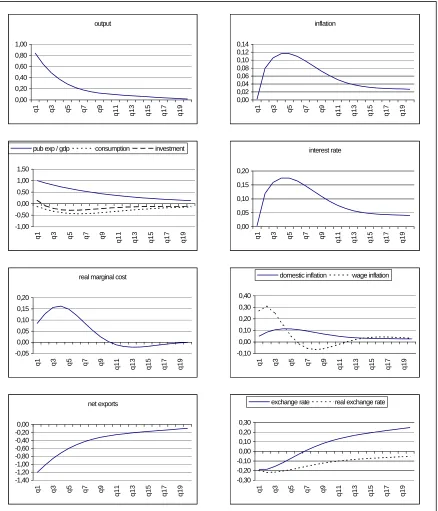
Figure 1 summarises the impact of the exogenous demand shock on inflation and
economic activity as it is simulated with the model. In this scenario, the central bank is
assumed to follow a very simple instrument rule: the interest rate is increased (decreased)
every time that inflation increases (decreases) above its target rate:
(44) rt =rr° +∆pa +a
(
∆pt −∆pa)
where rr° represents the equilibrium real interest rate and ∆pa the inflation objective of the
central bank. This instrument rule and the inflation objective are announced and are
considered by the market participants as a perfectly credible policy, so that the interest
rate equation becomes part of the model structure and is used as such by the public when
forming model-consistent expectations. In the simulation described in Figure 1, the
coefficient "a" is set at 1.5: the real interest rate increases by 50 basis points if inflation
increases by 1%.
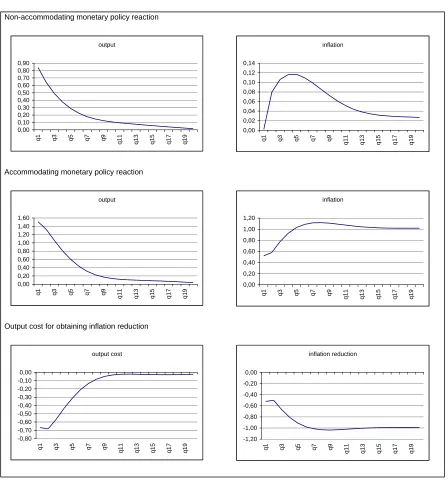
The outcome in Figure 1 shows that the inflation rate will temporally increase
above the target level of the monetary authorities, but the reaction of the central bank will
force inflation back to its target level after some time. As economic activity increases, the
marginal cost of production will increase through different mechanisms: marginal
productivity tends to decrease as the output gap narrows and capacity utilisation
increases, whereas wages will come under upward pressure as unemployment decreases
and expected inflation rises. Higher production costs and the willingness of firms to
restore the mark-up will tend to increase the inflationary pressure in the economy.
Inflation does increase smoothly over time, as the dynamics of price and wage
inflation are influenced by both a backward and a forward looking component. The
backward looking terms in the inflation equations prevent inflation from jumping
immediately to a higher level, thereafter possibly returning gradually to the target rate.
This behaviour results from the existence of contracts and other rigidities in the price and
wage setting that limit the flexibility of the inflation dynamics. The lead terms in the
inflation equations result from the forward looking behaviour: price and wage setters who
can change their price at a certain moment will take into account the expected cost
increases in the future when deciding on the new price level, as its price is likely to remain
will be influenced by the monetary policy rule and the inflation target. The monetary policy
actions provide the nominal anchor on which market participants can base their
expectations. Depending on the monetary policy rule, expectations regarding future
inflation developments will differ and the outcome of the actual price and wage decisions
will also differ. If the central bank reacts strongly to inflation movements and keeps clearly
to the previously announced inflation target, market expectations regarding future inflation
will be very moderate, so that the inflation process does not gain momentum. Firms will be
motivated to restrict cost increases and will therefore be reluctant to increase supply or
output levels. Higher real interest rates and real appreciation of the exchange rate
decrease aggregate demand. Inflation and output will return relatively quickly to the
equilibrium growth path.
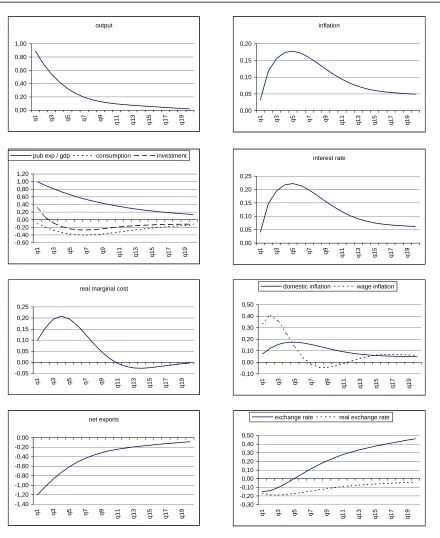
Figure 2 shows that for a less strong reaction of the central bank to the demand
shock (for example when, in the reaction function, the coefficient for inflation "a" is reduced
from 1.5 to 1.25), inflation will increase more strongly and more persistently. In this
scenario the expansion of output will also be greater. Both inflation and output-gap
variance increase in this scenario. In a more extreme case, where the coefficient for
inflation is smaller than 1, this means that the real interest rate will decrease following the
increase in inflation, the model will not produce a unique solution, and any inflation path
becomes possible21. The central bank fails to provide a nominal anchor under such a
monetary policy rule22. Prediction of the future inflation path becomes impossible as any
outcome can result from self-fulfilling expectations.
3.2. Difference between accommodating and non-accommodating monetary policies
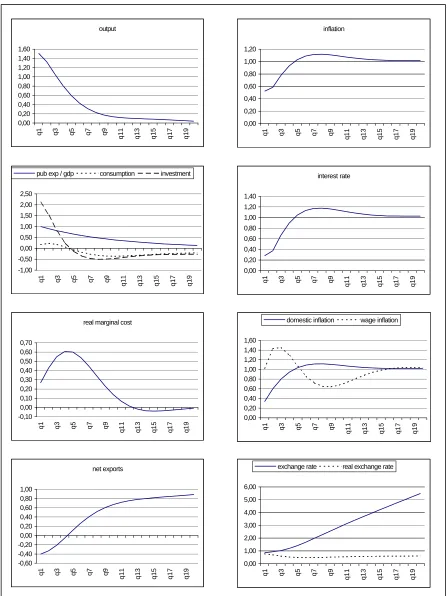
Figure 3 summarises the results of a simulation in which the central bank reacts
accommodatingly to the inflationary pressure resulting from the increase in economic
activity. In this scenario the central bank adjusts the inflation objective upwards in order to
support economic activity following an expansion in demand. For instance, let us assume
that the central bank increases the inflation objective by one per cent following an increase
in demand emanating from public expenditures. Here it is assumed that the higher
inflation objective is announced and taken into account by market participants when doing
their planning and especially when setting their prices and wages.
21 See Bernanke and Woodford (1997) and Clarida, Gali and Gertler (1998).
These results should be compared to the results in Figure 1 describing the
non-accommodating monetary policy reaction following the demand shock. It is clear that the
total area below the output curve is larger under the accommodating monetary policy. This
means that the non-accommodating monetary policy has a clear temporal cost in terms of
output. This cost is called the sacrifice ratio in the economic literature23. The sacrifice
ratio is here defined as the cumulative output cost of bringing down inflation by one
percentage point in the non-accommodating scenario compared to the accommodating
scenario (see Table 1 and Figure 3b).
3.3. Illustration of the importance of rigidity in the inflation process
The long-term price-wage behaviour is determined by fundamental economic
determinants (productivity, inflation objective, goods and labour market characteristics,
etc.). But the dynamic behaviour is strongly dependent on adjustment lags and
expectations about the future. Adjustment lags are largely explained by the existence of
contracts and other market rigidities due to market regulation, monopoly situations, or just
behaviour by simple rules of thumb.
The relative weight of forward versus backward looking elements in the dynamic
price and wage behaviour are crucial for the speed and the cost at which the central bank
can influence the inflation process. In the baseline model the dynamic processes for
prices and wages were based on estimation results from a general dynamic
cost-of-adjustment model for the euro area. In these estimation results the relative weight of
forward expectations in the price-setting process was relatively limited (30%) versus (70%)
for the lagged price dynamics. For the nominal wage equations the relative importance
was estimated at (45%) forward versus (55%) backward.
It is clear that with a 100% forward looking model, monetary policy would have an
immediate and costless control over the inflation process if the central bank were fully
credible. In such a situation it would be sufficient to announce a lower inflation target to
have an immediate impact on the actual inflation rate. If, however, there are adjustment
lags or backward looking effects in the inflation process, the adjustment will take more time
and it will cause a short-term cost. To illustrate the importance of these relative weights
23
we simulate an alternative model in which the relative weight of the forward looking
expectations has been increased by 10% for both prices (40%) and wages (55%).
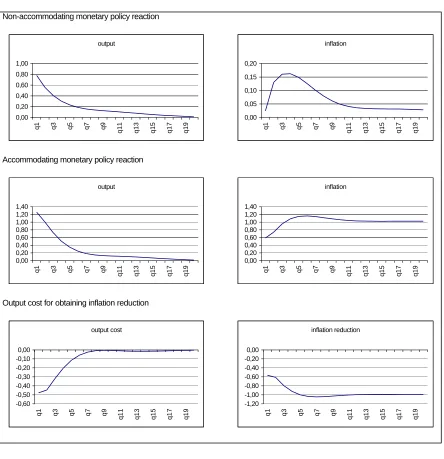
Repeating the exercise of a demand shock with an accommodating and a
non-accommodating monetary policy allows us to calculate again the sacrifice ratio, or in other
words the total output costs incurred to obtain a reduction in the inflation rate of 1%. With
fewer market rigidities, contracts or other mechanisms causing backward looking elements
in the price - wage process, the cost of reducing inflation is substantially lower (see Table
1 and Figure 4). Market expectations have a stronger impact on the actual price and wage
setting, so that, under the perfect credibility assumption, the impact of monetary policy
announcements will have a stronger impact on actual price movements. This reduces the
need for real interest rate increases and the corresponding output effects in the inflation
reduction process.
3.4. Illustration of the credibility issue for monetary policy
The price and wage dynamics not only depend on the importance of market
rigidities but also on the credibility of monetary policy in the perception of the market
participants. In the previous examples, monetary policy was very powerful in influencing
the expectations of market participants because of the assumption of perfect credibility.
To illustrate the role of the credibility issue, we make an alternative simulation in which the
central bank announcement only gradually (over time) affects the expectations of market
participants regarding future price and wage developments. The rate at which the market
adapts its expectations towards the newly announced target is fixed deterministically at 5%
per quarter. Thus the inflation target perceived by the public ∆ppt gradually moves
towards the correct inflation target that determines monetary policy actions ∆pa:
(45) ∆ppt =0.95∆ppt−1+0.05∆pa
In the previous simulations, full credibility was assumed through the model
consistent expectations formation process. As the central bank's monetary policy rule was
part of the model structure, the market participants used the announced monetary rule and
inflation objective in making their predictions about future variables relevant for actual
However, market participants may not believe that the central bank will adhere to
its monetary policy rule or to the announced inflation objective. To illustrate this problem,
we assume that market participants believe that the central bank will react
accommodatingly to a demand shock, so that output and inflation can increase strongly.
The central bank will actually adhere to the constant inflation target and increase the
interest rate according to the previously announced rule and objective. Market participants
observe "unexpected" interest rate shocks, and will “learn” only gradually over time that the
central bank has kept its original inflation target. In the example we assume a speed of 5%
per quarter. In the meantime the central bank has however shocked the economy, by a
series of unexpected interest rate increases, so that the output effects will be smaller than
in the accommodating case. The output cost of reducing inflation to the original inflation
level will in this case be considerably higher than with the perfect credible
non-accommodating policy.
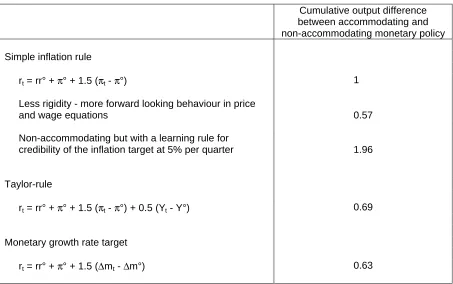
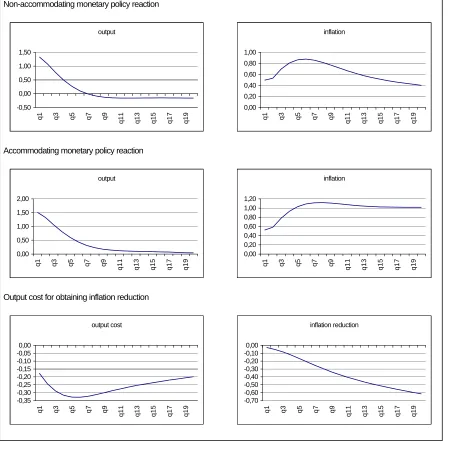
Table 1 and figure 5 show that the sacrifice ratio is considerably higher under the
"learning" assumption. The cost of reducing inflation by one per cent, calculated as the
difference in cumulative output difference under the accommodating and the
non-accommodating policy is much higher than in the perfect credibility simulation results. The
role of expectations in the disinflation process is limited in this scenario, so that the central
bank has to make more use of its interest rate (and exchange rate) instruments to fight the
inflation process.
3.5. Illustration of the importance of the information that is included in the monetary policy reaction function
In the previous simulations it was assumed that the central bank used a very
simple instrument rule to determine its policy actions. The central bank increases the
interest rate each time inflation surpasses the target inflation rate. Such a simple
instrument rule will in general not be optimal for the central bank. Even if the objective
function of the central bank includes inflation variability as its only objective, the optimal
behaviour of the central bank will be more complex than just a simple relation between the
interest-rate instrument and the inflation-target variables.
An alternative instrument rule is for instance the Taylor rule, that is considered in
empirical research as a good approximation to the actual monetary policy behaviour both
of the Federal Reserve in the US (Taylor (1993)) and for European countries, such as the
strategy the central bank will increase its interest rate if inflation increases above the
inflation target (the real interest rate will rise by 0.5 points for a 1% increase in inflation) but
also if the output level increases above its equilibrium or potential output level (the real
interest rate will rise by 0.5 points for a 1% reduction in the output gap).
(46) rt =rr° +∆pa +a
(
∆pt −∆pa) (
+b Yt −Yt0)
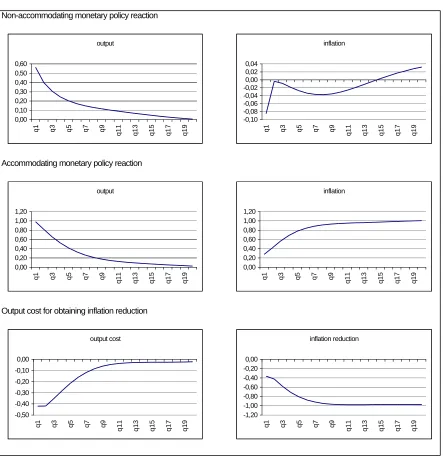
Using the Taylor-reaction function instead of the simple inflation-reaction rule, we
can repeat the simulation experiment with an accommodating and a non-accommodating
reaction to a demand shock and recalculate the sacrifice ratio. The sacrifice ratio under
the more general Taylor rule turns out to be smaller compared to the simpler reaction
function (see Table 1 and Figure 6) .
The interpretation of this result is that the central bank uses more information to
decide on its monetary policy actions under the Taylor rule. By incorporating information
on the stance of the output gap in its decisions, the central bank not only looks at the
actual inflation figures, but also at future inflation pressure that is present in the observed
output-gap value. The result is that the central bank will react more strongly immediately
following the appearance of the demand shock, but that it will reverse its policy more
quickly once the output effects of the shock disappear. Using this rule means that
monetary policy results in a soft-landing scenario following an expansive demand shock,
preventing excessively strong fluctuations in output and inflation.
This result also indicates that there is an important difference between the
ultimate objective of monetary policy on the one hand and the reaction function or
instrument rule on the other hand. Although the objective can be defined narrowly in terms
of inflation targeting, the central bank should take a larger set of economic variables into
account in reaching its monetary policy decisions.
This example can be considerd as an illustration of the more general principle that
the central bank should use a broad area of indicators for deciding on its monetary policy
actions. In these circumstances monetary policy can approach the optimal monetary
policy which allows the ultimate target to be approximated at minimum cost. One has
therefore to determine the optimal weights in the reaction function with respect to the
different indicators. Under such an optimal rule, the impacts of monetary actions are
model this problem is complicated, as the monetary policy has a direct inflation effect via
the exchange rate channel and a slower, longer-term effect via the interest rate channel.
This profile does not necessarily correspond to the inflationary impact of a demand shock.
Thus the central bank has to use all available information for predicting the future course of
inflation and the impact of its policy actions before deciding on the optimal policy reaction.
The policy should however remain clear and understandable to the public.
Without fulfilment of this condition, a large part of the monetary policy effect, through its
impact on market expectations, will be lost. This balancing of arguments summarises the
difficult problems facing central banks in their decisions on monetary policy and in
communicating the policy to the public. The money aggregate can play a role in this
process, as it incorporates information on both the inflation gap (deviation of actual versus
optimal target inflation), the output gap and the velocity gap (excess liquidity in the
system)24. Using a monetary growth rate targeting rule25, the same simulation experiment
shows that the sacrifice ratio can be further decreased, compared to the simple inflation
rule or Taylor rule for monetary policy (see Table 1)26. Of course such a result disregards
the possible problems caused by velocity instability.
24 See Coenen (1998) on the comparison of inflation and monetary targeting in a P-star model.
25 Consumption was replaced by total output, with unit elasticity, in the money-demand equation for this exercise. 26
4. CONCLUSION
In this paper, the interaction between inflation and monetary policy rules is
analysed within the framework of a structural model derived from optimising behaviour and
rational expectations. Using model simulations, it is shown that the control exercised by
monetary policy over the inflation process is strongly dependent on the role of forward
looking expectations in the price and wage setting process and on the credibility of
monetary policy in the expectation formation process of the private sector. Furthermore,
the central bank should take into account a wide variety of indicators in making monetary
policy decisions, in order to approach the optimal monetary policy rule as closely as
possible. However such complications should not conflict with the public's understanding
of the monetary policy behaviour. Therefore, clear communication of the monetary
strategy and presentation of the arguments supporting it are crucial conditions for efficient
central bank behaviour.
The understanding of the transmission mechanism and the price and wage
inflation process are important ingredients in the monetary decision process. Further
elaboration of dynamic general equilibrium models can help in analysing these
mechanisms and show their dependency on the monetary policy behaviour. Especially the
theoretical derivation of dynamic price-wage inflation equations and the empirical
estimation of these models are necessary steps in this process. The resulting
identification of the stochastic shocks makes it possible to carry out stochastic simulation
exercises. The optimal monetary policy can then be derived explicitly by using an
objective function for central bank behaviour. Such exercises should include the
Table 1 - Indices of sacrifice ratios under different monetary policy and model assumptions (Annual basis, sacrifice ratio of first reported result is set equal to 1)
Cumulative output difference between accommodating and non-accommodating monetary policy
Simple inflation rule
rt = rr° + π° + 1.5 (πt - π°) 1
Less rigidity - more forward looking behaviour in price
and wage equations 0.57
Non-accommodating but with a learning rule for
credibility of the inflation target at 5% per quarter 1.96
Taylor-rule
rt = rr° + π° + 1.5 (πt - π°) + 0.5 (Yt - Y°) 0.69
Monetary growth rate target
Figure 1 - Impulse-response of a demand shock (public expenditures)
under a non-accommodating monetary policy following a simple inflation instrument rule rt = rr° + π° + 1.5 (πt - π°)
output
0,00 0,20 0,40 0,60 0,80 1,00
q1 q3 q5 q7 q9 q11 q13 q15 q17 q19
inflation
0,00 0,02 0,04 0,06 0,08 0,10 0,12 0,14
q1 q3 q5 q7 q9 q11 q13 q15 q17 q19
-1,00 -0,50 0,00 0,50 1,00 1,50
q1 q3 q5 q7 q9 q11 q13 q15 q17 q19
pub exp / gdp consumption investment interest rate
0,00 0,05 0,10 0,15 0,20
q1 q3 q5 q7 q9 q11 q13 q15 q17 q19
net exports
-1,40 -1,20 -1,00 -0,80 -0,60 -0,40 -0,20 0,00
q1 q3 q5 q7 q9
q11 q13 q15 q17 q19
-0,30 -0,20 -0,10 0,00 0,10 0,20 0,30
q1 q3 q5 q7 q9
q11 q13 q15 q17 q19
exchange rate real exchange rate real marginal cost
-0,05 0,00 0,05 0,10 0,15 0,20
q1 q3 q5 q7 q9
q11 q13 q15 q17 q19
-0,10 0,00 0,10 0,20 0,30 0,40
q1 q3 q5 q7 q9
q11 q13 q15 q17 q19
Figure 2 - Impulse-response function of a demand shock (public expenditures) under a non-accommodating monetary policy following a simple inflation instrument rule
rt = rr° + π° + 1.25 (πt - π°)
output
0,00 0,20 0,40 0,60 0,80 1,00
q1 q3 q5 q7 q9
q11 q13 q15 q17 q19
inflation
0,00 0,05 0,10 0,15 0,20
q1 q3 q5 q7 q9
q11 q13 q15 q17 q19
-0,60 -0,40 -0,20 0,00 0,20 0,40 0,60 0,80 1,00 1,20
q1 q3 q5 q7 q9
q11 q13 q15 q17 q19
pub exp / gdp consumption investment interest rate
0,00 0,05 0,10 0,15 0,20 0,25
q1 q3 q5 q7 q9
q11 q13 q15 q17 q19
net exports
-1,40 -1,20 -1,00 -0,80 -0,60 -0,40 -0,20 0,00
q1 q3 q5 q7 q9
q11 q13 q15 q17 q19
-0,30 -0,20 -0,10 0,00 0,10 0,20 0,30 0,40 0,50
q1 q3 q5 q7 q9
q11 q13 q15 q17 q19
exchange rate real exchange rate real marginal cost
-0,05 0,00 0,05 0,10 0,15 0,20 0,25
q1 q3 q5 q7 q9
q11 q13 q15 q17 q19
-0,10 0,00 0,10 0,20 0,30 0,40 0,50
q1 q3 q5 q7 q9
q11 q13 q15 q17 q19
Figure 3 - Impulse-response function of a demand shock (public expenditures) under an accommodating monetary policy following a simple inflation instrument rule
rt = rr° + π° + 1.5 (πt - π°) and π° increases by 1%
output 0,00 0,20 0,40 0,60 0,80 1,00 1,20 1,40 1,60
q1 q3 q5 q7 q9 q11 q13 q15 q17 q19
inflation 0,00 0,20 0,40 0,60 0,80 1,00 1,20
q1 q3 q5 q7 q9
q11 q13 q15 q17 q19
-1,00 -0,50 0,00 0,50 1,00 1,50 2,00 2,50
q1 q3 q5 q7 q9
q11 q13 q15 q17 q19
pub exp / gdp consumption investment interest rate
0,00 0,20 0,40 0,60 0,80 1,00 1,20 1,40
q1 q3 q5 q7 q9
q11 q13 q15 q17 q19
net exports -0,60 -0,40 -0,20 0,00 0,20 0,40 0,60 0,80 1,00
q1 q3 q5 q7 q9 q11 q13 q15 q17 q19
0,00 1,00 2,00 3,00 4,00 5,00 6,00
q1 q3 q5 q7 q9 q11 q13 q15 q17 q19
exchange rate real exchange rate real marginal cost
-0,10 0,00 0,10 0,20 0,30 0,40 0,50 0,60 0,70
q1 q3 q5 q7 q9
q11 q13 q15 q17 q19
0,00 0,20 0,40 0,60 0,80 1,00 1,20 1,40 1,60
q1 q3 q5 q7 q9 q11 q13 q15 q17 q19
Figure 3b - Impulse-response function of a demand shock (public expenditures) under an accommodating monetary policy following a simple inflation instrument rule
rt = rr° + π° + 1.5 (πt - π°) and π° increases by 1%
Non-accommodating monetary policy reaction
Accommodating monetary policy reaction
Output cost for obtaining inflation reduction output
0,00 0,20 0,40 0,60 0,80 1,00 1,20 1,40 1,60
q1 q3 q5 q7 q9 q11 q13 q15 q17 q19
inflation
0,00 0,20 0,40 0,60 0,80 1,00 1,20
q1 q3 q5 q7 q9 q11 q13 q15 q17 q19
output
0,00 0,10 0,20 0,30 0,40 0,50 0,60 0,70 0,80 0,90
q1 q3 q5 q7 q9 q11 q13 q15 q17 q19
inflation
0,00 0,02 0,04 0,06 0,08 0,10 0,12 0,14
q1 q3 q5 q7 q9 q11 q13 q15 q17 q19
output cost
-0,80 -0,70 -0,60 -0,50 -0,40 -0,30 -0,20 -0,10 0,00
q1 q3 q5 q7 q9 q11 q13 q15 q17 q19
inflation reduction
-1,20 -1,00 -0,80 -0,60 -0,40 -0,20 0,00
Figure 4 - Impulse-response function of a demand shock (public expenditures) under a simple inflation instrument rule in a model with less rigidity
in the price and wage equation
Non-accommodating monetary policy reaction
Accommodating monetary policy reaction
Output cost for obtaining inflation reduction
output
0,00 0,20 0,40 0,60 0,80 1,00
q1 q3 q5 q7 q9
q11 q13 q15 q17 q19
inflation
0,00 0,05 0,10 0,15 0,20
q1 q3 q5 q7 q9
q11 q13 q15 q17 q19
output
0,00 0,20 0,40 0,60 0,80 1,00 1,20 1,40
q1 q3 q5 q7 q9
q11 q13 q15 q17 q19
inflation
0,00 0,20 0,40 0,60 0,80 1,00 1,20 1,40
q1 q3 q5 q7 q9
q11 q13 q15 q17 q19
output cost
-0,60 -0,50 -0,40 -0,30 -0,20 -0,10 0,00
q1 q3 q5 q7 q9
q11 q13 q15 q17 q19
inflation reduction
-1,20 -1,00 -0,80 -0,60 -0,40 -0,20 0,00
q1 q3 q5 q7 q9
Figure 5 - Impulse-response function of a demand shock (public expenditures) under a non accommodating monetary policy following a simple inflation instrument rule
where the announced objectives is only gradually perceived as credible by the public (5% learning rule)
Non-accommodating monetary policy reaction
Accommodating monetary policy reaction
Output cost for obtaining inflation reduction
output
-0,50 0,00 0,50 1,00 1,50
q1 q3 q5 q7 q9 q11 q13 q15 q17 q19
inflation
0,00 0,20 0,40 0,60 0,80 1,00
q1 q3 q5 q7 q9 q11 q13 q15 q17 q19
output
0,00 0,50 1,00 1,50 2,00
q1 q3 q5 q7 q9 q11 q13 q15 q17 q19
inflation
0,00 0,20 0,40 0,60 0,80 1,00 1,20
q1 q3 q5 q7 q9 q11 q13 q15 q17 q19
output cost
-0,35 -0,30 -0,25 -0,20 -0,15 -0,10 -0,05 0,00
q1 q3 q5 q7 q9
q11 q13 q15 q17 q19
inflation reduction
-0,70 -0,60 -0,50 -0,40 -0,30 -0,20 -0,10 0,00
q1 q3 q5 q7 q9
Figure 6 - Impulse-response function of a demand shock (public expenditures) under Taylor-rule for monetary policy
rt = rr° + π° + 1.5 (πt - π°) + 0.5 (Yt - Y°)
Non-accommodating monetary policy reaction
Accommodating monetary policy reaction
Output cost for obtaining inflation reduction
output
0,00 0,10 0,20 0,30 0,40 0,50 0,60
q1 q3 q5 q7 q9
q11 q13 q15 q17 q19
inflation
-0,10 -0,08 -0,06 -0,04 -0,02 0,00 0,02 0,04
q1 q3 q5 q7 q9
q11 q13 q15 q17 q19
output
0,00 0,20 0,40 0,60 0,80 1,00 1,20
q1 q3 q5 q7 q9 q11 q13 q15 q17 q19
inflation
0,00 0,20 0,40 0,60 0,80 1,00 1,20
q1 q3 q5 q7 q9 q11 q13 q15 q17 q19
output cost
-0,50 -0,40 -0,30 -0,20 -0,10 0,00
q1 q3 q5 q7 q9
q11 q13 q15 q17 q19
inflation reduction
-1,20 -1,00 -0,80 -0,60 -0,40 -0,20 0,00
q1 q3 q5 q7 q9
References
Andersen, T.M. (1998), "Persistency in sticky price models", European Economic Review , No. 3-5 (May), pp. 593-603.
Aucremanne, L. and Wouters, R. (1999), "A structural VAR approach to core inflation and its relevance for monetary policy", in BIS (ed.), Measures of underlying inflation and their role in the conduct of monetary policy - proceedings of the workshop of central bank model builders held at the BIS on 18-19 February 1999, Bank of International Settlements, Basel, Switzerland.
Ball, L. (1993), “What determines the sacrifice ratio?”, NBER Working Papers, No. 4306.
Bernanke, B. and Woodford, M. (1997), “Inflation forecasts and monetary policy”, NBER Working Papers, No. 6157.
Blake, A.P. and Westaway, P.F. (1996), “Credibility and the effectiveness of inflation targeting regimes", The Manchester School Supplement, pp. 28-50..
Blanchard, O. (1985), “Debt, deficits, and finite horizons”, Journal of Political Economy, 93(2), pp. 223-247.
Bomfin, A., Tetlow, R., von zur Muehlen, P. and Williams, J. (1997), “Expectations, learning and the costs of disinflation: experiments using the FRB/US Model", BIS Conference Papers, 1997.
Campbell, J. (1998), "Asset prices, consumption, and the business cycle", NBER Working Papers, No. 6485.
Calvo, G. (1983), “Staggered prices in a utility maximising framework”, Journal of Monetary Economics, 12, pp. 383-398.
Chari, V.V., P.J. Kehoe, and E.R. McGratten (1996), “Monetary shocks and real exchange rates in sticky price models of international business cycles”, NBER Working Paper, No. 5876.
Christiano, L.J., Eichenbaum M. and Evans C.L. (1997), "Sticky prices and limited participation models of money: a comparison", European Economic Review, No. 6 (June), pp.1201-1249.
Clarida, R., Gali, J. and Gertler, M. (1997), "Monetary policy rules in practice: some international evidence", NBER Working Paper, No. 6254.
Clarida, R., Gali, J. and Gertler, M. (1998), "Monetary policy rules and macroeconomic stability: evidence and some theory", CEPR Discussion Paper, No. 1908.