Astronomy
&
Astrophysics
https://doi.org/10.1051/0004-6361/201732548© ESO 2018
Core fragmentation and Toomre stability analysis of W3(H
2
O)
A case study of the IRAM NOEMA large program CORE
?
,??
A. Ahmadi
1,2, H. Beuther
1, J. C. Mottram
1, F. Bosco
1,2, H. Linz
1, Th. Henning
1, J. M. Winters
3, R. Kuiper
4,
R. Pudritz
5, Á. Sánchez-Monge
6, E. Keto
7, M. Beltran
8, S. Bontemps
9, R. Cesaroni
8, T. Csengeri
10, S. Feng
11,
R. Galvan-Madrid
12, K. G. Johnston
13, P. Klaassen
14, S. Leurini
15, S. N. Longmore
16, S. Lumsden
13, L. T. Maud
17,
K. M. Menten
10, L. Moscadelli
8, F. Motte
18, A. Palau
12, T. Peters
19, S. E. Ragan
20, P. Schilke
6, J. S. Urquhart
21,
F. Wyrowski
10, and H. Zinnecker
22,23(Affiliations can be found after the references)
Received 24 December 2017 / Accepted 21 July 2018
ABSTRACT
Context. The fragmentation mode of high-mass molecular clumps and the properties of the central rotating structures surrounding the most luminous objects have yet to be comprehensively characterised.
Aims. We study the fragmentation and kinematics of the high-mass star-forming region W3(H2O), as part of the IRAM NOrthern Extended Millimeter Array (NOEMA) large programme CORE.
Methods. Using the IRAM NOEMA and the IRAM 30 m telescope, the CORE survey has obtained high-resolution observations of 20 well-known highly luminous star-forming regions in the 1.37 mm wavelength regime in both line and dust continuum emission. Results. We present the spectral line setup of the CORE survey and a case study for W3(H2O). At∼000.35 (700 AU at 2.0 kpc) res-olution, the W3(H2O) clump fragments into two cores (west and east), separated by∼2300 AU. Velocity shifts of a few km s−1are observed in the dense-gas tracer, CH3CN, across both cores, consistent with rotation and perpendicular to the directions of two bipolar outflows, one emanating from each core. The kinematics of the rotating structure about W3(H2O) W shows signs of differential rotation of material, possibly in a disk-like object. The observed rotational signature around W3(H2O) E may be due to a disk-like object, an unresolved binary (or multiple) system, or a combination of both. We fit the emission of CH3CN (12K−11K),K=4−6 and derive a
gas temperature map with a median temperature of∼165 K across W3(H2O). We create a ToomreQmap to study the stability of the rotating structures against gravitational instability. The rotating structures appear to be Toomre unstable close to their outer bound-aries, with a possibility of further fragmentation in the differentially rotating core, W3(H2O) W. Rapid cooling in the Toomre unstable regions supports the fragmentation scenario.
Conclusions. Combining millimetre dust continuum and spectral line data toward the famous high-mass star-forming region W3(H2O), we identify core fragmentation on large scales, and indications for possible disk fragmentation on smaller spatial scales.
Key words. stars: formation – stars: massive – stars: early-type – stars: kinematics and dynamics – stars: individual: W3(H2O)/(OH) – techniques: interferometric
1. Introduction
Fundamental questions pertaining to the fragmentation of high-mass clumps and the accretion processes that result in the birth of the most massive stars (M & 8 M) still remain
unanswered. This is in part due to the clustered nature of star formation and the typically large distances involved. For a long time the existence of high-mass stars had been puzzling as it was thought that the expected intense radiation pressure would prevent the accretion of enough material onto the protostar (e.g.
Kahn 1974; Wolfire & Cassinelli 1987). More recently, two-and three-dimensional (magneto)hydrodynamical simulations of collapsing cores have validated the need for accretion disks in the formation of very massive stars, analogous to low-mass star
?Based on observations from an IRAM large program. IRAM is
sup-ported by INSU/CNRS (France), MPG (Germany), and IGN (Spain). ??Observational data are only available at the CDS via
anony-mous ftp to cdsarc.u-strasbg.fr (130.79.128.5) or via http://cdsarc.u-strasbg.fr/viz-bin/qcat?J/A+A/618/A46, or alternatively athttp://www.mpia.de/core.
formation (e.g.Yorke & Sonnhalter 2002;Krumholz et al. 2009;
Kuiper et al. 2010, 2011; Peters et al. 2010; Kuiper & Yorke 2013; Klassen et al. 2016). Furthermore, different fragmenta-tion processes can contribute to the final stellar mass distribufragmenta-tion within a single region, including fragmentation from clouds down to core scales (e.g.Bontemps et al. 2010;Palau et al. 2013,
2015;Beuther et al. 2018; see review byMotte et al. 2018) and disk fragmentation at smaller spatial scales (e.g.Matsumoto & Hanawa 2003; see review byKratter & Lodato 2016).
been found in recent years (e.g.Carrasco-González et al. 2012;
Sánchez-Monge et al. 2013;Beltrán et al. 2014; see reviews by
Cesaroni et al. 2007andBeltrán & de Wit 2016), the existence of such rotating structures around the most massive, O-type proto-stars is still elusive; only a few cases have been reported to date (Johnston et al. 2015;Ilee et al. 2016;Cesaroni et al. 2017).
As higher resolution observations are becoming more accessible, thus allowing structures to be resolved on scales
<1000 AU, it is important to determine whether disks around intermediate to high-mass stars (OB-type) are ubiquitous, and if so, to characterise their properties. What is the typical extent of these disks? Are they in differential rotation about a centrally dominating protostar, similar to their low-mass counterparts, and if so, over what range of radii? Is there any scale where a core stops fragmenting1? At what scales do we see the fragmentation of disks? Are close binary/multiple systems an outcome of disk fragmentation (as suggested by e.g.Meyer et al. 2018)? If so, stability analyses of these high-mass rotating cores and disks are needed to shed light on fragmentation at disk scales. These ques-tions can only be answered with a statistical approach for a large sample of high-mass star-forming regions.
We have undertaken a large programme at IRAM, called CORE (Beuther et al. 2018), making use of the IRAM NOrthern Extended Millimeter Array (NOEMA, formerly Plateau de Bure Interferometer) at 1.37 mm in both line and continuum emis-sion to study the early phases of star formation for a sample of 20 highly luminous (L > 104 L) star-forming regions at
high angular resolution (∼0.400) to analyse their fragmentation
and characterise the properties of possible rotating structures. Additionally, observations with the IRAM 30 m telescope are included to complement the interferometric data, allowing us to understand the role of the environment by studying high-mass star formation at scales larger than those covered by the inter-ferometer. Observations in the 1.3 mm wavelength regime of the CORE project began in June 2014 and finished in January 2017, consisting of a total of more than 400 h of observations with NOEMA. The sample selection criteria and initial results from the observed level of fragmentation in the full sample are presented inBeuther et al.(2018), and details of the 30 m observations and the merging of single-dish observations with interferometric observations can be found in Mottram et al.
(2018). In this work, we describe our spectral setup and present a case study of one of the most promising star-forming clouds in our sample, W3(H2O).
W3(H2O), also known as the Turner–Welch object, resides in the W3 high-mass star-forming region and was initially iden-tified through observations of the dense-gas tracer HCN at 88.6 GHz (Turner & Welch 1984). It is located∼0.05 pc (500) east of the well-known ultra compact HIIregion (UCHII) W3(OH). The name W3(H2O) stems from the existence of water masers in the vicinity of the source (Dreher & Welch 1981), allow-ing for an accurate distance measurement of 2.0 kpc for this region (Hachisuka et al. 2006; cf. Xu et al. 2006). The relative proper motions of these masers are further explained by an out-flow model oriented in the east–west direction (Hachisuka et al. 2006). A continuum source elongated in the east–west direc-tion and spanning the same extent as the water maser outflow has been observed in subarcsecond VLA observations in the radio regime with a spectral index of –0.6, providing evidence for synchrotron emission (Reid et al. 1995;Wilner et al. 1999). This source of synchrotron emission has been characterised by
1 Here a core is defined as a gravitationally bound region that forms
single or multiple stars, followingWilliams et al.(2000).
a jet-like model due to its morphology, and the point symmetry of its wiggly bent structure about the centre hints at the possi-bility of jet precession. Moreover,Shchekinov & Sobolev(2004) attribute this radio emission to a circumstellar jet or wind ionised by the embedded (proto)star at this position. Additional radio continuum sources have been detected in the vicinity of the syn-chrotron jet, the closest of which is to the west of the elongated structure and has a spectral index of 0.9 (Wilner et al. 1999;Chen et al. 2006), consistent with a circumstellar wind being ionised by another embedded protostellar source. In fact, the high angu-lar resolution (∼000.7) observations ofWyrowski et al.(1999) in the 1.36 mm band allowed for the detection of three contin-uum peaks in thermal dust emission, one of which peaks on the position of the water maser outflow and synchrotron jet, and another on the position of the radio continuum source with pos-itive spectral index, confirming the existence of a second source at this position. The detection of two bipolar molecular (CO) outflows further supports the protobinary scenario, suggesting that W3(H2O) may be harbouring at least two rotating structures (Zapata et al. 2011). The two cores within W3(H2O) have indi-vidual luminosities on the order of 2×10⁴ L
, suggesting two
15Mstars of spectral type B0 (see Sect.4.3).
In this paper, we study the fragmentation properties of W3(H2O) and the kinematics of the rotating structures within it. We use this source as a test-bed for an expanded study in a forthcoming paper which will focus on the kinematic proper-ties of a larger sample within our survey. The structure of the paper is as follows. Section 2 presents our spectral line setup within the CORE survey with the details of our observations and data reduction for W3(H2O). The observational results are described in Sect.3. The kinematics, temperature, and stability analysis of W3(H2O) is presented in Sect.4. The main findings are summarised in Sect.5.
2. Observations and data reduction
2.1. NOEMA observations
Observations of W3(H2O) at 1.37 mm were made between October 2014 and March 2016 in the A-, B-, and D-array con-figurations of NOEMA in track-sharing mode with W3 IRS4. The compact D-array observations were made with six anten-nas, while seven antennas were used for the more extended A-and B-array observations. Baselines in the range of 19−760 m were covered, therefore, the NOEMA observations are not sensi-tive to structures larger than 1200(0.1 pc) at 220 GHz. On-source
observations were taken in roughly 20 min increments dis-tributed over an observing run and interleaved with observations of various calibration sources. The phase centre for the obser-vations of W3(H2O) is α(J2000) = 02h27m03s.87, δ(J2000) = 61◦5202400.5. A summary of the observations can be found in
Table1.
Fig. 1.Full WideX spectrum of W3(H2O) averaged over a 400×400region encompassing two cores, W3(H2O) E and W3(H2O) W, showing the chemical richness of the source. The coverage of the narrow-band correlator units are shown as horizontal green lines and labelled accordingly. The units of the spectrum have been converted from Jy beam−1to K by multiplying the flux by 188 K Jy−1under the Rayleigh–Jeans approximation.
Table 1.Observations of W3(H2O) and W3(OH).
Observation date Array Time on-source Bandpass
(h) calibrator
2014-October-31 D 3.9 3C454.3
2015-March-18 A 2.6 3C84
2015-April-3 B 0.9 3C84
2015-April-6 B 1.3 3C84
2016-March-11 A 2.2 3C84
Notes.The phase and flux calibrators were 0059+581 and MWC349,
respectively, for all observations.
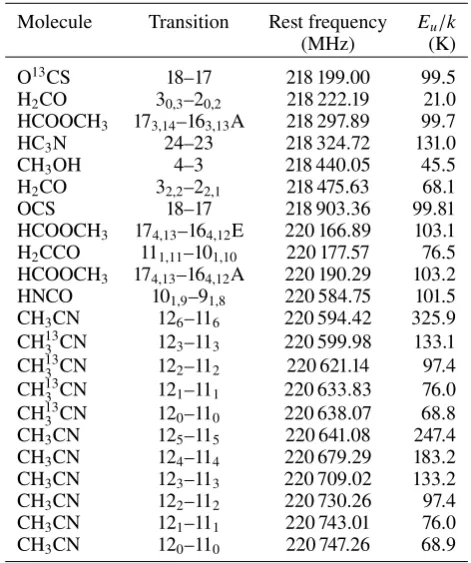
antennas; therefore, in cases where the sources were observed with more than six antennas, the correlator automatically accepts the signal from the antennas that yield the best uv-coverage. Important lines covered by the narrow-band receiver are listed in Table3and presented in Fig.2for the pixel at the phase centre toward W3(H2O).
Data reduction and imaging were performed with theCLIC and MAPPING program of the GILDAS2 software package developed by the IRAM and Observatoire de Grenoble. The
[image:3.595.45.285.519.608.2]2 http://www.iram.fr/IRAMFR/GILDAS
Table 2.Correlator units and frequency ranges observed with NOEMA.
Correlator Spectral unit Pol. Frequency range
(MHz)
Narrow-band L01 H 220 690.6–220 769.7
L02 H 220 630.6–220 709.7
L03 H 220 570.6–220 649.7
L04 H 220 130.6–220 209.7
L05 H 218 860.6–218 939.7
L06 H 218 415.6–218 494.7
L07 H 218 280.6–218 359.7
L08 H 218 180.6–218 259.7
WideX L09 H
218 878.6–220 859.5
L10 V
L11 H
217 078.6–219 059.4
L12 V
Notes.H and V correspond to horizontal and vertical polarisations.
Fig. 2.Spectra of the frequency range covered by the narrow-band cor-relator for the pixel at the phase centre toward W3(H2O). The name of the correlator unit is listed in the bottom left corner of each panel; some of the detected lines are marked.
the cubes using the CLARK algorithm (Clark 1980) with a uniform weighting (robust parameter of 0.1)3yielding a synthe-sised beam size of 000.43×000.32, PA = 86◦, and an rms noise of 3.2 mJy beam−1for the continuum emission using the combined set of observations in the A-, B-, and D-array configurations (hereafter ABD). We also imaged the data from just the A- and B-array configurations (hereafter AB), as well as the A-array only, for which the synthesised beam sizes and rms noise values are summarised in Table4.
Continuum subtraction for the lines was performed in the uv-plane by subtracting the emission in the line-free channels in the spectral unit in which the line was observed. Due to line contamination in spectral unit L03, we used the continuum from spectral unit L02 to remove the continuum from spectral unit L03, under the assumption that there is no significant spectral slope between the two adjacent spectral windows. For the WideX continuum subtraction, we subtracted the continuum obtained from line-free channels in all four spectral units. All narrow-band spectra were resampled to a spectral resolution of 0.5 km s−1and when imaged with the CLARK algorithm and uniform weighting
3 This corresponds to the CASA robust weighting with a robustness
parameter of –2.
Table 3.Bright lines covered in the narrow-band correlator setup.
Molecule Transition Rest frequency Eu/k
(MHz) (K)
O13CS 18–17 218 199.00 99.5
H2CO 30,3–20,2 218 222.19 21.0
HCOOCH3 173,14–163,13A 218 297.89 99.7
HC3N 24–23 218 324.72 131.0
CH3OH 4–3 218 440.05 45.5
H2CO 32,2–22,1 218 475.63 68.1
OCS 18–17 218 903.36 99.81
HCOOCH3 174,13–164,12E 220 166.89 103.1
H2CCO 111,11–101,10 220 177.57 76.5
HCOOCH3 174,13–164,12A 220 190.29 103.2
HNCO 101,9–91,8 220 584.75 101.5
CH3CN 126–116 220 594.42 325.9
CH133 CN 123–113 220 599.98 133.1
CH133 CN 122–112 220 621.14 97.4
CH133 CN 121–111 220 633.83 76.0
CH133 CN 120–110 220 638.07 68.8
CH3CN 125–115 220 641.08 247.4
CH3CN 124–114 220 679.29 183.2
CH3CN 123–113 220 709.02 133.2
CH3CN 122–112 220 730.26 97.4
CH3CN 121–111 220 743.01 76.0
CH3CN 120–110 220 747.26 68.9
Notes. Rest frequencies and upper energy levels have been obtained
from the Cologne Database for Molecular Spectroscopy (CDMS;
Müller et al. 2001,2005) with the exception of those for HCOOCH3 transitions, which were acquired from the Jet Propulsion Laboratory (Pickett et al. 1998).
have a negligibly smaller synthesised beam than the continuum images. The average rms noise of the line images in the ABD configuration is 11.2 mJy beam−1km s−1. The synthesised beam size and the average rms noise of the line data for all imaged combinations of array configurations are listed in Table4.
2.2. IRAM 30 m observations
Observations of W3(H2O) with the 30 m telescope were obtained on March 13, 2015, centred on the same position as the phase centre of the interferometric observations. We used the Eight MIxer Receiver (EMIR) covering the range 213−236 GHz, reaching a spectral resolution of 0.3 km s−1. In this work, we have merged the NOEMA observations of13CO with the single-dish observations using the MAPPING software and CLEANed the merged cube with the Steer-Dewdney-Ito (SDI) method (Steer et al. 1984) in order to recover more of the extended features to study molecular outflows. Further details of the 30 m obser-vations and data reduction, as well as the merging process, can be found inMottram et al.(2018). The resulting merged image has an angular resolution of 100.14 × 000.92, PA = 49◦, and an rms noise of 8.4 mJy beam−1km s−1. We also make use of our single-dish13CO data which have been reduced and converted to bright-ness temperatures for a detailed outflow analysis (see Sect.3.3).
3. Observational results
[image:4.595.313.549.102.384.2]Table 4.Details of CLEANed images.
Continuum Line (Narrow-band)
Synthesised rms noise Synthesised Average rms noise
Configuration beam (mJy beam−1) beam (mJy beam−1km s−1)
ABD 000.43×000.32, PA = 86◦ 3.2 000.42×000.31, PA = 87◦ 11.2
AB 000.41×000.30, PA = 86◦ 2.6 000.38×000.28, PA = 87◦ 8.6
A 000.39×000.28, PA = 88◦ 2.5 000.36×000.26, PA = 88◦ 8.0
Fig. 3.NOEMA 1.37 mm (219 GHz) continuum image toward W3(H2O) and W3(OH) in the ABD configuration. The solid contours start at 6σ and increase in steps of 6σ(1σ= 3.2 mJy beam−1). The dotted contours show the same negative levels. A scale bar and the synthesised beam (000.
43×000.
32, PA = 86◦
) are shown at the bottom.
CH3CN spectral line emission. Maps of the other lines are shown in AppendixA.
3.1. Continuum emission
Figure 3 shows the 1.37 mm (219 GHz) continuum emission map of W3(H2O) and W3(OH) in the ABD configuration. At this wavelength, the continuum emission in our field of view is dominated in W3(OH) by free–free emission, while the emis-sion in W3(H2O) is due to dust (Wyrowski et al. 1999). In the following, we focus on the fragmentation and kinematics of the younger region, W3(H2O).
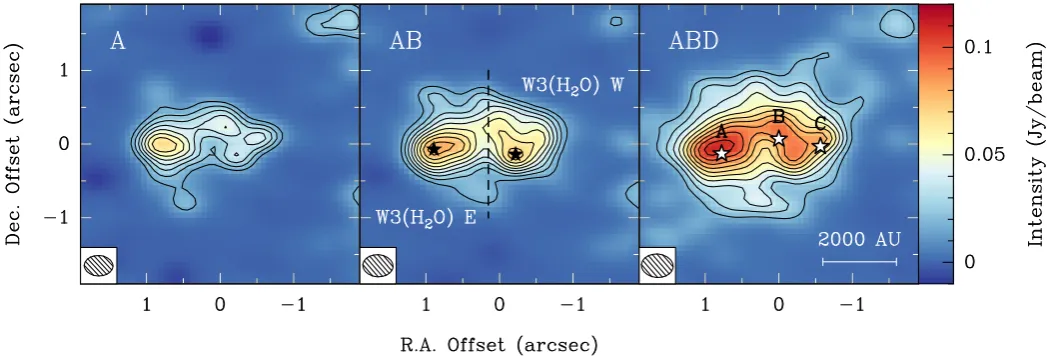
Figure 4 shows a comparison of the continuum emission maps of W3(H2O) obtained by imaging the ABD, AB, and A-array only observations. The integrated flux within the 6σ contours is 1220, 656, and 364 mJy for the ABD, AB, and A-array images, respectively. The fragmentation of W3(H2O) into two cores, separated by∼2300 AU, is best seen in the AB image at 700 AU scales. The two cores are labelled W3(H2O) E and W3(H2O) W, and their peak continuum positions are depicted by stars in Fig.4, marking the positions of embedded (proto)stars. The peak position of W3(H2O) E is α(J2000) = 02h27m04s.73,δ(J2000) = 61◦5202400.66, and that of W3(H2O) W is α(J2000) = 02h27m04s.57, δ(J2000) = 61◦5202400.59. The
approximate separation boundary between W3(H2O) E and W is marked with a vertical dashed line. The integrated flux within 6σ contours and the separation boundary are 377 and 279 mJy for W3(H2O) E and W3(H2O) W, respectively. Furthermore, there is an additional emission peak to the
northwest of W3(H2O) at an offset of−100.6, 100.6 (α(J2000) = 02h27m04s.37, δ(J2000) = 61◦5202600.35), which is best seen in the ABD image as it has the best sensitivity. This is most likely a site for the formation of lower mass stars.
Radiative transfer models byChen et al.(2006) for W3(H2O) in the 1.4 mm wavelength regime show that the averaged dust optical depth is less than 0.09; therefore, we assume the ther-mal dust emission to be optically thin in our observations. The positions of continuum peaks A and C from Wyrowski et al.
(1999) coincide well with the continuum peaks W3(H2O) E and W3(H2O) W in our observations to within a synthesised beam (see Fig.4).Wyrowski et al.(1999) had attributed the third peak in their observations between the other two cores to an inter-play of high column density and low temperatures in the central region, and concluded that W3(H2O) is harbouring two cores at the positions of continuum peaks A and C. Our double-peaked continuum image in AB, with a better spatial resolution than that ofWyrowski et al.(1999) by a factor of 3.3, supports this inter-pretation. Furthermore, peak B coincides well with the northeast extension of W3(H2O) W in our observations, best seen in the middle panel of Fig.4.
3.2. Line emission
W3(H2O) is one of the most chemically rich sources in our sample (see Fig.1) with detections of sulphur-bearing species such as33SO and34SO
Fig. 4.1.37 mm continuum image toward W3(H2O) observed with the A (left panel), AB (middle panel), and ABD (right panel) configurations of NOEMA. The solid contours start at 6σand increase in steps of 3σ(see Table4). Synthesised beams are shown in the bottom left corners of each panel, along with a scale bar in the bottom right of theright-hand panel. The black stars in themiddle panelcorrespond to the positions of the continuum peaks, marking the locations of the two individual cores, W3(H2O) W and W3(H2O) E, with the dashed line as the approximate separation boundary. The white stars in theright panelcorrespond to the positions of the continuum peaks A, B, and C fromWyrowski et al.
(1999). The offset zero position is the phase centre of the observations:α(J2000) = 02h27m03s.87,δ(J2000) = 61◦
520
2400.
5.
and intensity-weighted peak velocity (first moment) maps of CH3CN (123−113) for W3(H2O) and W3(OH). The zeroth moment map confirms the fragmentation of W3(H2O) into two cores. The moment maps of most lines covered by the narrow-band receiver (see Table 3 and Fig. 2) are presented in Appendix A. All moment maps have been created inside regions where the signal-to-noise ratio (S/N) is greater than 5σ. The integrated intensity maps of most tracers for W3(H2O) also show two peaks coincident with the locations of W3(H2O) E and W3(H2O) W. While the continuum emission is stronger for W3(H2O) E, some dense gas tracers (e.g. CH3CN, HC3N) show stronger line emission towards W3(H2O) W.
The bottom panels in Fig.5show the intensity-weighted peak velocity (first moment) map of the region in CH3CN (123−113). We chose to do our kinematic analyses on this transition as it is the strongest unblended line in the methyl cyanide (CH3CN) K-ladder. There is a clear velocity gradient in the east–west direction across W3(H2O), and in the NW–SE direction across W3(OH). The systemic velocities of both clumps are deter-mined by averaging the spectra of CH3CN (123−113) over a 400×400area centred on each source and fitting a Gaussian line to the resulting averaged spectrum. In this way, W3(H2O) and W3(OH) have average velocities of –49.1 and –45.0 km s−1, respectively.
The velocity gradient across W3(H2O) is detected in most of the high spectral resolution lines in our survey (see Fig.A.2) and spans∼6000 AU in size, corresponding to an amplitude of 170 km s−1pc−1. The velocity gradient resolved in W3(OH) has an amplitude of∼100 km s−1 pc−1 and is roughly perpendicu-lar to the motion of the ionised gas in the east–west direction as traced by the H92α line in observations ofKeto et al. (1995), and is perpendicular to the direction of the “champagne flow” observed to the northeast at radio frequencies (Keto et al. 1995;
Wilner et al. 1999). Thus, in W3(OH) we seem to be witness-ing the large-scale motion of the remnant molecular gas. The interpretation of line emission for W3(OH) is complex because most of the continuum emission at 1.37 mm is due to free–free emission which affects the appearance of molecular lines. In practice, free–free emission at 1.3 mm reduces the molecular line
emission which is reflected by the reduced integrated line emis-sion towards the peaks of W3(OH). As this is beyond the scope of this paper, we refrain from further analysis of W3(OH).
3.3. Outflow structure
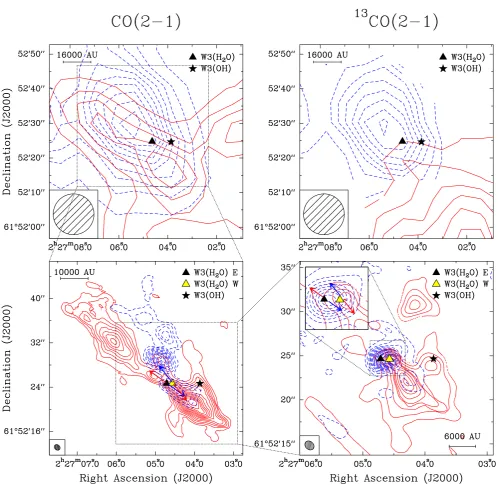
In Fig. 6, we show integrated intensity (zeroth moment) maps of outflow-tracing molecules (12CO and13CO) for the redshifted and blueshifted gas. The minimum intensity below which a pixel is not considered in the creation of the moment maps is based on 5σrms noise level in emission-free channels. The single-dish CO (2–1) map (see top left panel of Fig.6) shows the existence of a bipolar outflow in the overall vicinity of W3(H2O) but also encompassing W3(OH) in an approximately NE–SW direction. The13CO (2–1) single-dish map (see top right panel of Fig.6) shows less extended emission than the12CO as the13C isotopo-logue is a factor of∼76 less abundant (Henkel et al. 1982), and the map highlights the general NE–SW direction of the outflow even better.
The integrated intensity map of12CO from SMA interfero-metric data of Zapata et al. (2011) allows for the detection of two bipolar outflows (see bottom left panel of Fig.6). The out-flow emanating from W3(H2O) E has its blueshifted side to the southwest and its redshifted lobe to the northeast, while the sec-ond outflow emanating from W3(H2O) W has its blueshifted side extending to the northeast with its redshifted side to the south-west (Zapata et al. 2011). The difference between the position angles of the two outflows (in the plane of the sky) is 25◦.
Fig. 5.Top row: integrated intensity (zeroth moment) map of CH3CN (123−113) for W3(H2O) (left panel) and W3(OH) (right panel) in the ABD configuration.Bottom row: intensity-weighted peak velocity (first moment) map of CH3CN (123−113) for W3(H2O) (left panel) and W3(OH) (right
panel) in the ABD configuration. The dashed line corresponds to the cut made for the PV plot of W3(H2O) presented in Fig.8. The solid contours correspond to the 1.37 mm continuum, starting at 6σand increasing in steps of 6σ(1σ= 3.2 mJy beam−1). The dotted contours correspond to the same negative levels. A scale bar and the synthesised beam (000.
43×000.
32, PA = 86◦
) are shown in thetop right panel.
the bottom right panel of this figure, highlighting that the two outflows are in fact emanating from different positions.
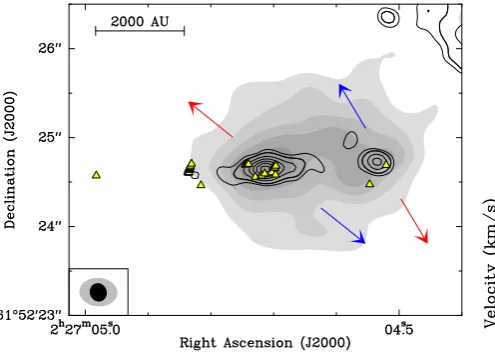
In Fig.7, we show how the centimetre emission aligns with the millimetre continuum emission. The directions of bipolar molecular outflows emanating from the cores are shown by red and blue arrows, and the positions of water masers shown by yellow triangles. The elongated radio source centred on
Fig. 6.Top left panel: intensity map of CO (2–1) emission from IRAM 30 m integrated over the velocity range from−40 to−20 km s−1 for the redshifted and from−80 to−55 km s−1 for the blueshifted gas. Contours start at 5σand increase in steps of 5σ(1σ= 1.9 K km s−1).Top right
panel: intensity map of13CO (2–1) emission from IRAM 30 m integrated over the velocity range from−40 to−20 km s−1for the redshifted and from−80 to−55 km s−1for the blueshifted gas. Contours start at 3σand increase in steps of 2σ(1σ= 0.42 K km s−1).Bottom left panel: intensity map of CO (2–1) emission obtained byZapata et al.(2011) with the SMA integrated over the velocity range from−45 to−25 for the redshifted and from−75 to−55 for the blueshifted gas. Contours start at 5σand increase in steps of 5σ(1σ= 1.1 mJy beam−1 km s−1). The blue and red arrows highlight the positions and directions of the CO outflows emanating from each source.Bottom right panel: intensity map of13CO (2–1) emission from IRAM 30 m merged with NOEMA observations integrated over the velocity range from−41 to−30 for the redshifted and from−70 to−53 for the blueshifted gas. Contours start at 3σand increase in steps of 3σ(1σ= 0.03 mJy beam−1km s−1for redshifted and 0.17 mJy beam−1 km s−1for blueshifted sides). The zoom panel in the top left corner highlights the launching positions of each outflow, with the red and blue arrows showing the directions of the two bipolar outflows fromZapata et al.(2011). The rms noise used in drawing the contours of the integrated intensity maps have been determined by first creating the maps without any constraints on the minimum emission level (threshold of 0) and calculating the noise in an emission-free part of the resulting map.
object and the molecular outflow could be due to the existence of multiple objects in this core, unresolved by our observations. Interestingly, it has been shown that synchrotron radiation can be produced not only via jets, but also through the accelera-tion of relativistic electrons in the interacaccelera-tion of disk material with a stellar wind (Shchekinov & Sobolev 2004), providing an alternative explanation for the maser and cm emission.
4. Analysis and discussion
4.1. Dense gas kinematics
Fig. 7.NOEMA 1.37 mm (219 GHz) continuum image toward W3(H2O) in grey with levels starting at 6σand increasing in steps of 6σ. The black contours correspond to the cm emission fromWilner et al.(1999). The positions of H2O masers obtained fromHachisuka et al.(2006) are plotted as yellow triangles. The blue and red arrows show the directions of bipolar molecular outflows fromZapata et al.(2011; see Fig.6). The synthesised beam size of the cm emission (000.
21×000.
19, PA = 68◦
) is shown in black in the bottom left corner. The synthesised beam size of our mm continuum image is shown in grey in the bottom left corner.
CH3CN and HCOOCH3 (e.g. Beuther et al. 2005). In the following, we divide our focus between the large-scale kine-matics of the entire W3(H2O) region, where we put forward arguments for the observed velocity gradients in CH3CN and HCOOCH3 being due to rotation instead of infall (Sect.4.1.1), and the small-scale kinematics of the two separate cores within W3(H2O) (Sect. 4.1.2). Although the alignment of the elon-gated radio emission with the water masers can be described by an outflow model oriented in the east–west direction, the detection of two molecular outflows emanating from the posi-tions of the two continuum peaks, roughly perpendicular to the observed velocity gradient in CH3CN at large scale and per-pendicular to the observed velocity gradients on smaller scales (see Sect. 4.1.2), make it unlikely that the motions in CH3CN would be due to expansion or outflow. Furthermore, CH3CN and HCOOCH3line profiles do not show the broad components typ-ically seen in emission from expanding gas, and these species are nevertheless too complex to exist in an ionised jet. We, there-fore, conclude that the observed velocity gradient is most likely due to rotation, which we will assume for the remainder of this paper.
4.1.1. Large-scale kinematics
The PV plots of CH3CN and HCOOCH3 for W3(H2O) are shown in Fig.8for a cut in the direction of the velocity gradient going through the continuum peaks (dashed line in bottom left panel of Fig.5) obtained from the NOEMA observations. The white curves in the top left panel correspond to gas in Keplerian rotation with Vrot ∝R−1/2 about a 10, 25, and 50 M central
object. These white curves are not fits to the PV diagram, but are merely drawn to guide the eye. It is clear that the gas is not in Keplerian rotation; however, higher velocity gas is observed closer to the centre of W3(H2O) which can be a signpost for differential rotation.
[image:9.595.38.286.81.257.2]Ohashi et al.(1997) created models for comparison to their interferometric data of the low-mass protostar L1527, using a
Fig. 8.Position–velocity plots of W3(H2O) for a cut in the direction of rotation as depicted by a dashed line in the bottom left panel of Fig.5
for various species and transitions in the ABD configuration. The verti-cal dashed lines correspond to the centre of the cut. The vertiverti-cal dotted lines correspond to the positions of continuum peaks corresponding to W3(H2O) E and W3(H2O) W. The horizontal dashed lines correspond to the LSR velocity of W3(H2O). The black contours start at 4σand increase in steps of 6σ. The white solid, dashed, and dotted lines in thetop left panelcorrespond to the region within which emission is expected if the gas is in a disk in Keplerian rotation about a 10, 25, 50 Mstar, respectively. The white curves are not fits to the rotation
curve, but are drawn to guide the eye. A scale bar and a cross that cor-responds to the spatial and spectral resolutions are shown in thebottom right panel.
Chen et al.(2006) generated a binary model with radiative transfer post-processing of methyl cyanide for each source within W3(H2O), showing that the high-velocity deviations from solid body rotation in their PV plots could be a result of two spa-tially unresolved cores (on similar scales to our observations) with a small radial velocity difference. The detection of a smooth velocity gradient in all tracers across W3(H2O) E and W sug-gests that the observed angular velocity difference cannot be solely due to binary motion of the cores, but that there is also a large-scale toroidal structure encompassing and rotating about the two resolved cores. Such circumbinary toroidal structures have indeed been observed previously at lower angular resolu-tions in other sources (e.g. Beltrán et al. 2005; Beuther et al. 2007).
4.1.2. Small-scale kinematics
Although we see a smooth velocity gradient in CH3CN across the entire W3(H2O) structure, the existence of at least two cores within it as presented by our continuum results, and two col-limated outflows requires further analysis. Imaging the data in the most extended configuration and therefore reaching our highest resolution, we can filter out the large-scale envelope to analyse the kinematics of gas around each of the cores. Figure9shows the first moment map of CH3CN (123−113) for the cores to the east and west using the A-array observations exclusively. The maps have been scaled and masked to high-light the velocity structure of each core. The mean line-of-sight velocity difference between the two main cores, W3(H2O) W and E, is a few km s−1. Velocity differences of a few km s−1 are observed across each core, approximately perpendicular to the directions of the bipolar molecular outflows emanat-ing from each core (Zapata et al. 2011). This indicates that the small-scale gradients across each individual core are most likely due to rotation. The two line-of-sight velocity gradients are on the order of ∼1000 km s−1 pc−1, depending on the choice for the extent of the gradient, much faster than the rota-tional motion of 170 km s−1 pc−1 for the whole of W3(H2O) from the ABD data. Furthermore, the directions of the veloc-ity gradients observed for each core are slightly inclined with respect to the overall east–west motion of the gas on larger scales (Fig.5), suggesting that the general rotation seen around the two cores may be inherited from the large-scale rotation. Meanwhile, the direction of the blueshifted (redshifted) out-flow emanating from W3(H2O) W is almost in the opposite direction of the blueshifted (redshifted) outflow ejected from W3(H2O) E. This implies that the inclination angles of the two rotating structures with respect to the plane of the sky are likely different.
Figure 10 shows PV diagrams for W3(H2O) E (left) and W3(H2O) W (right) corresponding to cuts in the directions of rotation as depicted by dashed lines in Fig.9. Based on the PV plots, the LSR velocities of W3(H2O) E and W3(H2O) W are estimated to be−51 and−47 km s−1, respectively. White curves correspond to gas in Keplerian rotation about a 5, 10, and 15M
centrally dominated object. As on larger scales, these PV dia-grams do not show the symmetric four-quadrant shape expected if the velocity gradients were due to infall.
The PV plot for W3(H2O) W contains contributions from W3(H2O) E due to the angle and extent of the cut, hence there is added emission in quadrants toward positive offset, making it difficult to infer rotational signatures pertaining to the blueshifted emission of W3(H2O) W. The redshifted rota-tional signatures seen in the quadrants toward negative offsets,
Fig. 9. Intensity-weighted peak velocity (first moment) map of CH3CN (123−113) using only the A-array observations and masked out to show contributions from W3(H2O) W (top panel) and W3(H2O) E (bottom panel). The solid contours correspond to the 1.37 mm contin-uum in the A-array only observations and start at 6σand increase in steps of 3σ(1σ= 2.5 mJy beam−1). The dashed lines correspond to the cuts made for the PV plots (Fig.10). The blue and red arrows show the directions of bipolar molecular outflows (Fig.6). A scale bar and the synthesised beam (000.
39×000.
28, PA = 88◦
) are shown in the bottom. The velocity ranges are different for the two cores.
however, show signatures of increased gas velocities closer to the centre of the core. Such a trend in the PV plot implies differential rotation of material, possibly within a disk-like object.
[image:10.595.321.541.80.410.2]Fig. 10.Position–velocity plots along a cut in the direction of rotation as depicted by dashed lines in Fig.9for a fragment to the east (left panel) and to the west (right panel). The black contours start at 4σand increase in steps of 6σ. The white solid, dashed, and dotted lines correspond to the region within which emission is expected if the gas is in a disk in Keplerian rotation about a 5, 10, and 15Mstar, respectively. The crosses in
the bottom right corners correspond to the spatial and spectral resolutions. Regions to the left of the dotted vertical line in the right figure contain contributions from W3(H2O) E.
4.2. Temperature distribution
As a symmetric top molecule, CH3CN is an excellent thermome-ter of hot molecular gas (e.g. Loren & Mundy 1984; Zhang et al. 1998) since its relative populations in different K-levels are dominated by collisions. Our high spectral resolution obser-vations of CH3CN covers its J =12−11, K =0−6 transitions and some of their isotopologues which have upper energy levels in the range 70–325 K with 0.5 km s−1spectral resolution (see Table3).
We made use of the eXtended CASA Line Analysis Soft-ware Suite (XCLASS4;Möller et al. 2017) to model the observed spectra under the assumption of Local Thermodynamical Equi-librium (LTE), which is typically valid for CH3CN in such high-density environments (see Sect.4.3). In summary,XCLASS solves the radiative transfer equation in one dimension for a set of initial conditions (source size, column density, temperature, linewidth, and peak velocity) provided by the user, and through aχ2 minimisation routine changes the initial conditions within ranges that have been provided by the user to obtain the best fit to the observed spectra. The details of our XCLASSmodelling are summarised in AppendixB.
In Fig. 11, we present our results of pixel-by-pixel XCLASSmodelling of CH3CN (12K−11K),K =4−6, including
4 https://xclass.astro.uni-koeln.de
Fig. 11.Column density (top left panel), velocity offset (top middle panel), full width at half maximum linewidth (top right panel), and rotational temperature (bottom left panel) maps obtained by fitting CH3CN (12K−11K), K=4−6 and CH313CN (12K−11K),K=0−3 lines simultaneously
withXCLASS. The black contours correspond to the continuum image in the AB configuration, start at 6σand increase in steps of 3σ(see Table4).
Bottom right panel: observed spectrum of a given pixel drawn in black and overlaid with the resulting fit for CH3CN (12K−11K),K=4−6 in red
and the marginally detected CH313CN (12K−11K),K =0−3 in blue. The dashed red line corresponds to the predicted fit for the CH3CN lines that were not used in the fitting process (see explanation in AppendixB). The bright line detected betweenK=4 and 5 components is identified as C2H5CN. The corresponding fit parameters are provided in the panel. Regions outside of the most extended combination of 6σcontours of integrated intensity of CH3CN lines are masked out.
4.3. Mass estimates
The combined bolometric luminosity of W3(H2O) and W3(OH), determined from fitting the SED from the near-IR to sub-mm, is 8.3×10⁴L
(Mottram et al. 2011). The contribution from
OH can be estimated by first calculating the corresponding flux of ionising photons (see e.g. Appendix B.2 ofSánchez-Monge 2011, for more details) using
Q0 photons s−1
!
=8.852×1040 Fν Jy
!
ν GHz
0.1Te
K 0.35 d
pc !2
,
(1)
where Fν is the flux density of the free–free radio continuum
emission at frequencyν,Teis the electron temperature, and d is the distance. The observed integrated radio flux at 15 GHz for W3(OH) is 2.53 Jy (Kurtz et al. 1994), and assuming a typical electron temperature of 104K, this results in a value of Q0 = 1.2 ×1048photons s−1. Interpolating from Table 1 of Davies et al.(2011) and the relationships between spectral type and photospheric temperature from Martins et al. (2005) and
Boehm-Vitense(1981) for O and B stars, respectively, this ion-ising photon flux approximately corresponds to an O8.5 main sequence star, withM≈20MandL≈4.4×10⁴L. This leaves
a total bolometric luminosity of 3.9×10⁴L
, which we assume
to be evenly distributed between the two cores within W3(H2O), 1.95×10⁴Leach; using the same tables this would correspond
to two 15Mstars of spectral type B0.
The above estimates are based onDavies et al. (2011) for zero age main sequence (ZAMS) stars. High-mass protostars
growing by accretion resemble ZAMS stars in terms of their luminosities and temperatures when core nuclear burning domi-nates other sources of luminosity such as accretion and envelope burning. When this occurs depends primarily on when the pro-tostar gains sufficient mass, but also on the accretion rate. Stellar structure calculations suggest that this occurs at 5–10 M for
accretion rates of 10−5–10−4 M
yr−1, respectively (Norberg &
Maeder 2000;Behrend & Maeder 2001; Keto & Wood 2006). The mass estimates further assume that all the emitted energy has been produced within the (proto)stars, ignoring contributions from episodic accretion to the luminosity. Therefore, the 15M
estimates can be taken as upper limits, in agreement with calcu-lations ofChen et al.(2006) who find a minimum binary mass of 22Mfor the protostars within W3(H2O). Furthermore, assum-ing the gas to be in gravito-centrifugal rotation around the two individual cores, our PV plots (see Fig.10) suggest that the range of 5−15Mis a reasonable estimate for the protostellar masses.
As dust is typically optically thin in the 1.3 mm wavelength regime and proven to be for this region in particular (Chen et al. 2006), we use the prescription byHildebrand(1983) to convert the flux density,Fν, of the continuum observations to a mass. In
the form presented bySchuller et al.(2009),
M= d
2F
νR
Bν(TD)κν
, (2)
whereRis the gas-to-dust mass ratio,Bν(TD) is the Planck func-tion at a dust temperature ofTD, andκνis the dust absorption
coefficient from Ossenkopf & Henning (1994), corresponding to thin ice mantles after 105 yr of coagulation at a density of 106cm−3.
High-mass cores, such as the ones we are studying, typ-ically have densities high enough to thermalise the methyl cyanide lines. To check this, using the spontaneous decay rate of CH3CN (124−114) obtained from the LAMDA database5, 7.65×10⁻⁴s−1, and the collision rate of 2.05×10⁻¹⁰cm3s−1 with H2 at 140 K (Green 1986), we calculate the simplified two-level critical density of this line to bencrit≈3.7×106cm−3. The effective density, once the radiation field is taken into account, is typically an order of magnitude lower (Evans 1999;
Shirley 2015). FollowingSchuller et al.(2009), the H2 column density is calculated via
NH2=
SνR
Bν(TD)θBκνµmH
, (3)
whereSνis the peak intensity,θBis the beam solid angle,µis the mean molecular weight assumed to be equal to 2.8, andmH is the mass of the hydrogen atom. At a temperature of 140 K and using our continuum intensity of a given position near the cen-tre, we can estimate the H2column density to be 4.5×1024cm−2. This can be converted to a volume density ofnH2>7×10
7cm−3, assuming the maximum extent of the third dimension to be the plane-of-sky size of the clump (∼4000 AU). Therefore, since the density of molecular hydrogen is much higher than the critical density of the lines, the LTE assumption is valid and the rota-tional temperature map of CH3CN obtained from our modelling can be assumed to be tracing the gas kinetic temperature.
Using Eq. (2), our continuum map with its unit converted to Jy pixel−1 and the temperature map obtained from XCLASS, assuming dust and gas temperatures are coupled, we obtain a pixel-by-pixel mass density map (see Fig.C.1). Summing over the pixels in our mass density map in the ABD observations, the total mass for W3(H2O) is calculated to be∼26.8M, with
15.4Mcontributed from the core to the east, and 11.4Mfrom
the core to the west. Similarly, using the AB observations, we obtain a total mass of∼11.4Mfor W3(H2O), with a core mass of 6.7 and 4.7 M from the cores to the east and west,
respec-tively. The effect of spatial filtering of the interferometer is clear in these mass estimates as the exclusion of the D-array data removes more than half of the mass.
Comparing our NOEMA observations to SCUBA-2 850µm single-dish observations, about 25% of the flux is filtered out by the interferometer in our ABD observations (assuming a ν−3.5frequency-relation;Beuther et al. 2018), implying that our core mass estimates of 15.4 and 11.4 M are lower limits, but
nevertheless reasonable. Masses estimated in this manner have contributions from the cores and the disk-like structures and not from any embedded (proto)stars.
4.4. Toomre stability
For a differentially rotating disk, the shear force and gas pressure can provide added stability against gravitational collapse. This idea was originally introduced by Safronov(1960) and further quantified by Toomre(1964) for a disk of stars, and has since been used in various applications ranging from planet formation to galaxy dynamics. We investigate the stability of the rotating structures in W3(H2O), assuming that they are disks in gravito-centrifugal equilibrium, against axisymmetric instabilities using
5 http://home.strw.leidenuniv.nl/~moldata/
the ToomreQparameter,
Q= csΩ
πGΣ, (4)
wherecsis the sound speed, andΩis the epicyclic frequency of the disk which is equivalent to its angular velocity. The surface density of the disk,Σ, is calculated by multiplying the column density (Eq. (3)) by the mean molecular weight and mass of the hydrogen atom (µmH) to convert the number column density to a mass surface density. A thin disk becomes unstable against axisymmetric gravitational instabilities ifQ<1.
Having obtained a temperature map representative of the kinetic temperature, we are able to calculate the Toomre Q parameter pixel by pixel. In particular, the temperature is used in the calculation ofBν(TD) and the sound speed,
cs=
s
γkBT
µmH
, (5)
whereγis the adiabatic index with a value of 5/3.
We assume two 10 M (proto)stellar objects to be present,
one at the position of each of the two continuum peaks (see AB image in Fig.4). The angular velocity maps are created by adding up mass within concentric circles starting at the position of each core and going outwards. In this way, we incorporate the mass of the rotating structures, calculated via Eq. (2), and the mass of the central objects. The angular velocity of a disk in gravito-centrifugal equilibrium at a radiusris
Ω(r)= r
G(M∗+Mdisk(r))
r3 , (6)
where the mass of the central object,M∗, is 10MandMdisk(r) is the gas mass enclosed withinr. Given the radii involved, this means that in practice, most parts of the maps are dominated by Mdiskrather thanM∗.
In Fig.12, we present our ToomreQmap of W3(H2O), which is created by stitching together the ToomreQmaps of the two individual cores. The stitching boundary is shown by a solid vertical line and the positions of the two central objects corre-sponding to our continuum peaks in the AB image (see Fig.4) are indicated by stars. While the Toomre Q calculations were performed on the AB-array data, we have drawn the contin-uum contours from the A-array only observations. The boundary whereQ=1 is shown by a dashed line.
The most significant factor stabilising the disk against Toomre instability is the high gas temperatures and the fast dif-ferential rotation of material closest to the (proto)star; therefore, we find the highest Toomre Qvalues closest to the presumed locations of the (proto)stars depicted by stars in Fig. 12 as expected. We find low Toomre Q values at the periphery of W3(H2O) E and W, suggesting that both rotating structures are only marginally stable against axisymmetric instabilities. More-over, W3(H2O) W shows low ToomreQvalues at the positions of additional continuum peaks in the highest resolution A-array data (solid contours in Fig. 12), suggesting further fragmenta-tion at these posifragmenta-tions may be possible. As the dimensions of the observed continuum peaks are smaller than the size of our synthesised beam, the validity of this hypothesis needs to be confirmed with higher resolution observations (at 345 GHz) to be taken with NOEMA.
Fig. 12.ToomreQmap obtained by assuming two disk-like structures in gravito-centrifugal rotation about the positions of peak continuum emission as depicted by the two stars, each with a mass of 10M. The
Toomre Qcalculations and the positions of (proto)stars are based on the AB-array data (see Fig.4) with regions outside the 6σmm contin-uum emission masked out. Solid contours correspond to our contincontin-uum data in the most extended configuration (A-array), starting at 6σand increasing in steps of 3σ(1σ= 2.5 mJy beam−1). The solid vertical line corresponds to the stitching boundary. The dashed lines correspond to
Q=1.
massive disk around that protostar is hot and stable to frag-mentation, with Toomre Q > 2.8 at all radii. Hydrodynamic simulations of collapsing protostellar cores by Klassen et al.
(2016) find massive accretion disks which evolve to become asymmetrically Toomre-unstable, creating large spiral arms with an increased rate of accretion of material onto the central object. They find that the self-gravity of these spiral arm segments is lower than the tidal forces from the star, causing the spiral arms in their simulations to remain stable against collapse. However, they find that the Toomre conditions combined with the cooling of the disk (Gammie 2001) would potentially yield the formation of a binary companion. Similarly, simulations by Kuiper et al.
(2011) see such spiral arms in a massive disk, and simulations byKrumholz et al.(2009) and more recentlyMeyer et al.(2017,
2018) see disk fragmentation on even smaller spatial scales, on the order of hundreds of AU. Therefore, disk fragmentation sce-narios in the high-mass regime are valid from a theoretical stand point.
Among the assumptions that go into this Toomre analysis is the thin-disk approximation. According to Gammie (2001), the critical value of Q for an isothermal disk of finite thick-ness should be 0.676 (as derived fromGoldreich & Lynden-Bell 1965). Even with such a low critical value, the rotating structures around each core would still show signs of instability in their outskirts. To get an estimate on the importance of disk thick-ness, following Gammie (2001), the instability condition for a disk with scale height,H'cs/Ω, can be written as
Mdisk & H
r M∗. (7)
Using our temperature and angular velocity maps, we create a map of the H/r ratio. In this way, we calculate an average value of H/r ≈0.3. Assuming the mass of each (proto)star is roughly 10 M, we calculate that for the candidate disks to be
unstable against gravitational collapse, the mass of the candi-date disk must be Mdisk &3 M. Since the mass estimates for
the cores obtained from the continuum maps using Eq. (2) are 15 and 11M, the masses are large enough to result in the
rotat-ing structures berotat-ing Toomre-unstable. Therefore, the thickness of the candidate disks does not affect the general interpretation of our results.
The angular velocity maps used in the calculation of the Toomre Qmap have been created assuming a face-on geome-try for the candidate disks. If the objects are inclined, we would be overestimating the surface density of the candidate disks and the line-of-sight angular velocities. Since these two parameters have the opposite effect on the ToomreQvalue (see Eq. (4)), our results are still reasonable. Furthermore, W3(H2O) E may har-bour multiple (proto)stars within it (see Sect.4.1) such that the possibility of rotational contributions from multi-body rotation would require a different prescription for the epicyclic frequency than what we have assumed.
The estimation of 10 M for the central (proto)stars have
been deduced from our own and previous mass estimations (see Sect.4.3), and by examining the emission in the PV plots with Keplerian curves that are just “grazing” the emission. The latter method has the caveat that the observed PV plot is the result of the convolution with the instrumental beam and the line width. Therefore, the real emission is less extended in space and veloc-ity than we observe, and as a result we may be overestimating the mass of the (proto)stars. Performing our Toomre calcula-tions, but with the assumption of 5 M (proto)stars, we obtain
median ToomreQvalues of 1.3 compared to a value of 1.7 in the 10Mcalculations. Therefore, lower protostellar masses would
lead to the decrease in the ToomreQvalue, and thus larger unsta-ble regions, making the disk fragmentation scenario even more plausible. On the other hand, as the mass estimates using the bolometric luminosities suggest the central (proto)stellar masses to be in the 15Mregime, the median ToomreQvalue would
be 2.0, with unstable regions still present in the outskirts. The Toomre Q maps created assuming two 5 and 15 M (proto)
stars at the position of the continuum peaks can be found in AppendixD. The change of±5 Mdoes not strongly affect the
ToomreQmaps because we add the mass of the candidate disks, estimated from the continuum emission to be 15 and 11M, in
rings (see Eq. (6)) and they dominate over an addition or subtrac-tion of 5M, especially in the outermost regions. This, together
with the root dependence on mass lead to uncertainties inM∗to
only have a small effect on the ToomreQresults.
We are currently conducting simulated observations from 3D hydrodynamic simulations to investigate the reliability of our methods in even more depth (Ahmadi et al. in prep.). Our prelim-inary results on the effect of inclination and (proto)stellar mass on the calculation of ToomreQmaps using hydrodynamic simu-lations suggest that the ToomreQvalue is not strongly dependent on these parameters. A forthcoming paper is dedicated to this topic.
4.5. Cooling
cooling for marginally stable thin disks in gravito-centrifugal equilibrium. In their prescription
β= Ωtcooling, (8)
where the cooling time,tcooling, is assumed to be constant and a function of the surface density and internal energy of the disk. If the local collapse needs more than a few orbits, due to a long cooling timescale, a locally collapsing region within the disk can be ripped apart by shear. Therefore, there is a critical βvalue below which a locally collapsing region would be rapidly cool-ing, and if it is sufficiently self-gravitatcool-ing, it would be prone to fragmentation. Conversely, values above this criticalβvalue would put a marginally stable disk into a self-regulating sce-nario such that heating acts as a stabilising force and directly counteracts the cooling rate.
The Gammie cooling criterion is relevant only if the disk is marginally stable, with regions that are locally unstable against axisymmetric gravitational instabilities. A Toomre-stable disk will not fragment regardless of how quickly it may be cooling.
This critical value is determined through numerical simula-tions and varies depending on the heating and cooling recipes and convergence issues. For an overview of these issues, see
Kratter & Lodato(2016) andBaehr et al. (2017). Regardless of the specific numerical simulation issues, it is generally assumed that the criticalβvalue ranges between 1 and 5.
Following the prescription ofKlassen et al.(2016),
tcooling = Ez Fgrey
, (9)
where Ez is the column internal energy integrated in the z-direction (along the axis of rotation) andFgrey is the radiative flux away from the disk adopting a grey-body approximation. The internal energy of an ideal gas is calculated via
Eint=cvρT, (10)
whereρis the volume density andcvis the specific heat capacity defined as
cv= NAkB Mu(γ−1)
, (11)
with NA as Avogadro’s number and Mu the molar mass. By replacing the volume density with the surface density, the col-umn internal energy is then
Ez=
NAkBΣT 3Mu(γ−1)
. (12)
Knowing the cooling time, which is of the order of months, and the rotation rate at each pixel, we construct a localβmap. Figure13shows theβmap for the two disks presumed in gravito-centrifugal equilibrium about the positions of peak continuum emission as depicted by stars. The medianβvalue is 1.8×10⁻⁴, and the maximum value found in the outskirts is on the order of 10−2, which is much lower than the critical value of 1–5. This finding is consistent with that ofKlassen et al.(2016) andMeyer et al. (2018) who also find β 1 in their simulation of col-lapsing protostellar cores with a mass of 100Mat later times.
[image:15.595.304.558.80.270.2]The rotating bodies within W3(H2O) are therefore able to cool rapidly and any local collapse induced by the gravitational insta-bilities in the disks will lead to fragmentation. Rapid cooling in this context means that the cooling timescale is comparable to the local dynamical timescale.
Fig. 13.Map ofβcooling parameter obtained by assuming two disk-like structures in gravito-centrifugal rotation about the positions of peak continuum emission as depicted by stars. The solid contours correspond to our continuum data in the most extended configuration, starting at 6σ and increasing in steps of 3σ(1σ= 2.5 mJy beam−1). The solid vertical line corresponds to the stitching boundary. The dashed line corresponds to ToomreQ=1. Regions outside of the 6σmm continuum emission contour in the AB configuration are masked out.
5. Conclusions and summary
Our IRAM large programme, CORE, aims to study frag-mentation and the kinematics of a sample of 20 high-mass star-forming regions. We have performed a case-study for one of the sources in our sample, the prototypical hot core W3(H2O). In this paper we present details of the spectral line setup for our NOEMA observations in the 1.37 mm band which covers transitions of important tracers of dense gas and disks (e.g. CH3CN, HCOOCH3, CH3OH), inner envelopes (e.g. H2CO), and outflows (e.g. 13CO, SO). We cover the range of 217 078.6−220 859.5 MHz with a spectral resolu-tion of 2.7 km s−1, and eight narrower bands centred on specific transitions to provide higher spectral resolution of 0.5 km s−1.
With the aim of studying the fragmentation and kinematic properties of W3(H2O), the following is a summary of our findings:
– At an angular resolution of ∼000.35 (∼700 AU at 2 kpc),
W3(H2O) fragments into two cores, which we refer to as W3(H2O) E and W3(H2O) W, separated by∼2300 AU, as seen in both line and thermal dust continuum emission. – Based on the integrated dust continuum emission, W3(H2O)
has a total mass of∼26.8M, with 15.4Mcontributed from
W3(H2O) E, and 11.4Mfrom W3(H2O) W.
– The kinematics of the rotating structure about W3(H2O) W shows differential rotation of material about a (proto)star as deduced from the redshifted part of its PV plot, sug-gesting that the rotating structure may be a disk-like object. The radio source with a rising spectrum at this position can be attributed to a circumstellar jet or wind ionised by the embedded (proto)star at this position.
– The PV plots of the rotating structure about W3(H2O) E is inconclusive on whether the observed rotation is due to a disk-like rotating object, an unresolved binary (or multiple) system, or a combination of the two.
– We fit the emission of CH3CN (12K−11K),K =4−6 and CH313CN (12K−11K),K =0−3 with XCLASSand produce temperature, column density, peak velocity, and velocity dispersion maps. On average, the entire structure is hot (∼165 K) with no particular temperature structure. The col-umn density map of CH3CN is double peaked, similar to the continuum and line emission maps, with a median column density of∼1.4×1015cm−2. Close to the centre of the cores the H2column density is estimated to be∼5×1024cm−2. – We investigate the axisymmetric stability of the two
rotat-ing structures usrotat-ing the Toomre criterion. Our Toomre Q map shows low values in the outskirts of both rotating struc-tures, suggesting that they are unstable to fragmentation. Some regions with low ToomreQvalues in the vicinity of W3(H2O) W coincide with unresolved thermal dust contin-uum peaks (in our highest resolution observations), hinting at the possibility of further fragmentation in this core. – The Toomre-unstable regions within W3(H2O) E and
W3(H2O) W are able to cool rapidly, and any local collapse induced by the gravitational instabilities will lead to further fragmentation.
In this work, we showcase our in-depth analysis for the kine-matics and stability of the rotating structures within W3(H2O). We showed that high-mass cores can be prone to fragmenta-tion induced by disk instabilities at∼1000 AU scales, and core fragmentation at larger scales. Therefore, different modes of fragmentation contribute to the final stellar mass distribution of a given region. One question still remains: How universal are these findings? To this end, we aim to benchmark our methods using hydrodynamic simulations and extend our analysis to the full CORE sample in future papers.
Acknowledgements. The authors would like to thank the anonymous referee whose comments helped the clarity of this paper. We also thank Thomas Möller for his technical support with theXCLASSanalysis, and Kaitlin Kratter for fruit-ful discussions regarding the ToomreQstability analysis. A.A., H.B., J.C.M., and F.B. acknowledge support from the European Research Council under the European Community’s Horizon 2020 framework programme (2014–2020) via the ERC Consolidator Grant “From Cloud to Star Formation (CSF)” (project number 648505). R.K. acknowledges financial support via the Emmy Noether Research Group on Accretion Flows and Feedback in Realistic Models of Mas-sive Star Formation funded by the German Research Foundation (DFG) under grant no. KU 2849/3-1. T.Cs. acknowledges support from theDeutsche For-schungsgemeinschaft, DFGvia the SPP (priority programme) 1573 “Physics of the ISM”. A.P. acknowledges financial support from UNAM and CONACyT, México.
References
Baehr, H., Klahr, H., & Kratter, K. M. 2017,ApJ, 848, 40 Behrend, R., & Maeder, A. 2001,A&A, 373, 190 Beltrán, M. T., & de Wit W. J. 2016,A&ARv, 24, 6
Beltrán, M. T., Cesaroni, R., Neri, R., et al. 2005,A&A, 435, 901
Beltrán, M. T., Sánchez-Monge, Á., Cesaroni, R., et al. 2014,A&A, 571, A52 Beuther, H., Schilke, P., Gueth, F., et al. 2002,A&A, 387, 931
Beuther, H., Zhang, Q., Sridharan, T. K., & Chen, Y. 2005,ApJ, 628, 800
Beuther, H., Zhang, Q., Hunter, T. R., Sridharan, T. K., & Bergin, E. A. 2007, A&A, 473, 493
Beuther, H., Mottram, J. C., Ahmadi, A., et al. 2018,A&A, 617, A100 Boehm-Vitense, E. 1981,ARA&A, 19, 295
Bontemps, S., Motte, F., Csengeri, T., & Schneider, N. 2010, A&A, 524, A18
Carrasco-González, C., Galván-Madrid, R., Anglada, G., et al. 2012,ApJ, 752, L29
Cesaroni, R., Galli, D., Lodato, G., Walmsley, C. M., & Zhang, Q. 2007, in Protostars and Planets V, eds. B. Reipurth, D. Jewitt, & K. Keil (Tucson, AZ: Arizona University Press),197
Cesaroni, R., Sánchez-Monge, Á., Beltrán, M. T., et al. 2017,A&A, 602, A59 Chen, H.-R., Welch, W. J., Wilner, D. J., & Sutton, E. C. 2006,ApJ, 639, 975 Chen, H.-R. V., Keto, E., Zhang, Q., et al. 2016,ApJ, 823, 125
Clark, B. G. 1980,A&A, 89, 377
Davies, B., Hoare, M. G., Lumsden, S. L., et al. 2011,MNRAS, 416, 972 Draine, B. T. 2011,Physics of the Interstellar and Intergalactic Medium
(Prince-ton: Princeton University Press)
Dreher, J. W., & Welch, W. J. 1981,ApJ, 245, 857 Evans, II, N. J. 1999,ARA&A, 37, 311
Fallscheer, C., Beuther, H., Zhang, Q., Keto, E., & Sridharan, T. K. 2009,A&A, 504, 127
Feng, S., Beuther, H., Henning, T., et al. 2015,A&A, 581, A71
Frank, A., Ray, T. P., Cabrit, S., et al. 2014, inProtostars and Planets VI, eds. H. Beuther, R. Klessen, C. Dullemond, & T. Henning (Tucson, AZ: University of Arizona Press),451
Gammie, C. F. 2001,ApJ, 553, 174
Goldreich, P., & Lynden-Bell, D. 1965,MNRAS, 130, 125 Green, S. 1986,ApJ, 309, 331
Hachisuka, K., Brunthaler, A., Menten, K. M., et al. 2006, ApJ, 645, 337
Henkel, C., Wilson, T. L., & Bieging, J. 1982,A&A, 109, 344 Hildebrand, R. H. 1983,QJRAS, 24, 267
Ilee, J. D., Cyganowski, C. J., Nazari, P., et al. 2016,MNRAS, 462, 4386 Johnson, B. M., & Gammie, C. F. 2003,ApJ, 597, 131
Johnston, K. G., Robitaille, T. P., Beuther, H., et al. 2015,ApJ, 813, L19 Kahn, F. D. 1974,A&A, 37, 149
Keto, E., & Wood, K. 2006,ApJ, 637, 850
Keto, E. R., Welch, W. J., Reid, M. J., & Ho, P. T. P. 1995,ApJ, 444, 765 Klassen, M., Pudritz, R. E., Kuiper, R., Peters, T., & Banerjee, R. 2016,ApJ, 823,
28
Kratter, K., & Lodato, G. 2016,ARA&A, 54, 271
Krumholz, M. R., Klein, R. I., McKee, C. F., Offner, S. S. R., & Cunningham, A. J. 2009,Science, 323, 754
Kuiper, R., & Yorke, H. W. 2013,ApJ, 772, 61
Kuiper, R., Klahr, H., Beuther, H., & Henning, T. 2010,ApJ, 722, 1556 Kuiper, R., Klahr, H., Beuther, H., & Henning, T. 2011,ApJ, 732, 20 Kurtz, S., Churchwell, E., & Wood, D. O. S. 1994,ApJS, 91, 659 Leurini, S., Codella, C., Zapata, L., et al. 2011,A&A, 530, A12 Loren, R. B., & Mundy, L. G. 1984,ApJ, 286, 232
Martins, F., Schaerer, D., & Hillier, D. J. 2005,A&A, 436, 1049 Matsumoto, T., & Hanawa, T. 2003,ApJ, 595, 913
Maud, L. T., Moore, T. J. T., Lumsden, S. L., et al. 2015,MNRAS, 453, 645 Meyer, D. M.-A., Vorobyov, E. I., Kuiper, R., & Kley, W. 2017,MNRAS, 464,
L90
Meyer, D. M.-A., Kuiper, R., Kley, W., Johnston, K. G., & Vorobyov, E. 2018, MNRAS, 473, 3615
Möller, T., Endres, C., & Schilke, P. 2017,A&A, 598, A7 Motte, F., Bontemps, S., & Louvet, F. 2018,ARA&A, 56, 41
Mottram, J. C., Hoare, M. G., Urquhart, J. S., et al. 2011,A&A, 525, A149 Mottram, J. C., et al. 2018,A&A, submitted
Müller, H. S. P., Thorwirth, S., Roth, D. A., & Winnewisser, G. 2001,A&A, 370, L49
Müller, H. S. P., Schlöder, F., Stutzki, J., & Winnewisser, G. 2005,J. Mol. Struct., 742, 215
Norberg, P., & Maeder, A. 2000,A&A, 359, 1025
Ohashi, N., Hayashi, M., Ho, P. T. P., & Momose, M. 1997,ApJ, 475, 211 Ossenkopf, V., & Henning, T. 1994,A&A, 291, 943
Palau, A., Fuente, A., Girart, J. M., et al. 2013,ApJ, 762, 120
Palau, A., Ballesteros-Paredes, J., Vázquez-Semadeni, E., et al. 2015,MNRAS, 453, 3785
Peters, T., Banerjee, R., Klessen, R. S., et al. 2010,ApJ, 711, 1017
Pickett, H. M., Poynter, R. L., Cohen, E. A., et al. 1998,J. Quant. Spectr. Rad. Transf., 60, 883
Pudritz, R. E., Ouyed, R., Fendt, C., & Brandenburg, A. 2007, inProtostars and Planets V, eds. B. Reipurth, D. Jewitt, & K. Keil (Tucson, AZ: University of Arizona Press),277
Reid, M. J., Argon, A. L., Masson, C. R., Menten, K. M., & Moran, J. M. 1995, ApJ, 443, 238
Safronov, V. S. 1960,Ann. Astrophys., 23, 979
Sánchez-Monge, Á. 2011, PhD Thesis, Universitat de Barcelona, Spain Sánchez-Monge, Á., Cesaroni, R., Beltrán, M. T., et al. 2013, A&A, 552,
L10
Schuller, F., Menten, K. M., Contreras, Y., et al. 2009,A&A, 504, 415 Shchekinov, Y. A., & Sobolev, A. M. 2004,A&A, 418, 1045 Shirley, Y. L. 2015,PASP, 127, 299
Steer, D. G., Dewdney, P. E., & Ito, M. R. 1984,A&A, 137, 159 Tobin, J. J., Hartmann, L., Bergin, E., et al. 2012,ApJ, 748, 16 Toomre, A. 1964,ApJ, 139, 1217
Turner, J. L., & Welch, W. J. 1984,ApJ, 287, L81
Williams, J. P., Blitz, L., & McKee, C. F. 2000, inProtostars and Planets IV, eds. V. Mannings, A. Boss, & S. Russell (Tucson, AZ: Arizona University Press), 97
Wilner, D. J., Reid, M. J., & Menten, K. M. 1999,ApJ, 513, 775 Wolfire, M. G., & Cassinelli, J. P. 1987,ApJ, 319, 850
Wyrowski, F., Schilke, P., Walmsley, C. M., & Menten, K. M. 1999,ApJ, 514, L43
Xu, Y., Reid, M. J., Zheng, X. W., & Menten, K. M. 2006,Science, 311, 54 Yorke, H. W., & Sonnhalter, C. 2002,ApJ, 569, 846
Zapata, L. A., Rodríguez-Garza, C., Rodríguez, L. F., Girart, J. M., & Chen, H.-R. 2011,ApJ, 740, L19
Zhang, Q., Ho, P. T. P., & Ohashi, N. 1998,ApJ, 494, 636
1 Max Planck Institute for Astronomy, Königstuhl 17, 69117
Heidelberg, Germany e-mail:[email protected]
2 International Max Planck Research School for Astronomy and
Cosmic Physics at the University of Heidelberg (IMPRS-HD) 3 IRAM, 300 Rue de la Piscine, Domaine Universitaire de Grenoble,
38406 St.-Martin-d’Hères, France
4 Institute of Astronomy and Astrophysics, University of Tübingen,
Auf der Morgenstelle 10, 72076 Tübingen, Germany
5 Department of Physics and Astronomy, McMaster University, 1280
Main St. W, Hamilton, ON L8S 4M1, Canada
6 I. Physikalisches Institut, Universität zu Köln, Zülpicher Str. 77,
50937 Köln, Germany
7 Harvard-Smithsonian Center for Astrophysics, 160 Garden St,
Cam-bridge, MA 02420, USA
8 INAF, Osservatorio Astrofisico di Arcetri, Largo E. Fermi 5, 50125
Firenze, Italy
9 Laboratoire d’Astrophysique de Bordeaux – UMR 5804, CNRS –
Université Bordeaux 1, BP 89, 33270 Floirac, France
10 Max-Planck-Institut für Radioastronomie, Auf dem Hügel 69, 53121
Bonn, Germany
11 Max-Planck-Institut für Extraterrestrische Physik, Gissenbachstrasse
1, 85748 Garching, Germany
12 Instituto de Radioastronomía y Astrofísica, Universidad Nacional
Autonóma de México, PO Box 3-72, 58090 Morelia, Michoacan, Mexico
13 School of Physics & Astronomy, E.C. Stoner Building, The
Univer-sity of Leeds, Leeds LS2 9JT, UK
14 UK Astronomy Technology Centre, Royal Observatory Edinburgh,
Blackford Hill, Edinburgh EH9 3HJ, UK
15 INAF – Osservatorio Astronomico di Cagliari, Via della Scienza 5,
Selargius CA 09047, Italy
16 Astrophysics Research Institute, Liverpool John Moores University,
146 Brownlow Hill, Liverpool L3 5RF, UK
17 Leiden Observatory, Leiden University, PO Box 9513, 2300 RA
Leiden, The Netherlands
18 CNRS, Institut de Planétologie et d’Astrophysique de Grenoble,
Université Grenoble Alpes, 38000 Grenoble, France
19 Max-Planck-Institut für Astrophysik, Karl-Schwarzschild-Str. 1,
85748 Garching, Germany
20 School of Physics and Astronomy, Cardiff University, Cardiff CF24
3AA, UK
21 Centre for Astrophysics and Planetary Science, University of Kent,
Canterbury CT2 7NH, UK
22 SOFIA Science Center, Deutsches SOFIA Institut, NASA Ames
Research Center, Moffett Field, CA 94035, USA
23 Universidad Autónoma de Chile, Av. Pedro de Valdivia 425,