Int. J. Electrochem. Sci., 8 (2013) 6393 - 6398
International Journal of
ELECTROCHEMICAL
SCIENCE
www.electrochemsci.org
Short Communication
Synthesis and Characterization of Novel Cathode Material
Li
5FeO
4for Li-ion Batteries
Lei Liang1,4, Jing Luo2,4, Min Chen2, Li Wang2,4, Jianjun Li2,4, Xiangming He2,3,4,*
1
Environment College, Liaoning University, Shenyang 110036,PR China
2
Institute of Nuclear and New Energy Technology, Beijing Key Lab of Fine Ceramics, Tsinghua University, Beijing 100084, PR China
3
State Key Laboratory of Automotive Safety and Energy, Tsinghua University, Beijing 100084, PR China
4
Huadong Institute of Lithium Ion Battery, Zhangjiagang, Jiangsu 215600,PR China
*
E-mail: [email protected]
Received: 1 March 2013 / Accepted: 22 March 2013 / Published: 1 May 2013
Antifluorite-type material Li5FeO4 was synthesized and characterized as novel cathode materials for
using in a lithium secondary battery. It was prepared by high-temperature solid-state method, LiOH and Fe2O3 as raw materials. The obtained samples were featured by using TG/DTA, XRD, and its
specific capacity and cycle property were also measured by LAND cell test system. The results showed that materials obtained by high-temperature solid-state method , that temperatures were 450C for 10h, then 850C for 20h and the mole ratios of Li to Fe is 6/1 exhibited single-phase and high capacity. Its first charge capacity and recharge capacity reaches 584.5 and 210.8 mAh/g respectively.
Keywords: lithium iron oxides; novel cathode materials; Li5FeO4; Li-ion battery; cobalt free.
1. INTRODUCTION
Owing to lithium iron oxides are always considered to have low cost and non-toxicity, they are paid more attention as a cathode of lithium secondary battery. LiFeO2[1,2,3]have been made great
progress on its preparation, structure and modification due to extensive use of new preparation methods such as hydrothermal, low-temperature solid state reaction etc., and new analysis instruments such as MÖssbauer spectra, HRTEM etc.. But the research work of Li5FeO4[4,5,6] are very limited,
anode materials, Li5FeO4 can be applied in the lithium battery in the near future due to its low cost and
its amity to environment.
Reported about Li5FeO4 was first seen in 1971, Demois-son and his colleagues[7] found new
lithium iron oxides, high temperature and low temperature forms of Li5FeO4 in the system of Li2O and
Fe2O3. Its crystalline structure belongs to the anti-fluorite type structure where three equivalent lithium
vacancies (Li5V2FeO4) are ordered among isolated FeO4 tetrahedron. In 2010, Johnson[8] reported
their researched works about Li2O removal from Li5FeO4, they think when Li2O removed from
Li5FeO4, the material become a cathode precursor for lithium-ion batteries.
Although there are also some papers concerning Li5FeO4[9], the properties of Li5FeO4 have
been improved remarkably recently. However, there are many exact mechanisms we still don't know, need us to solve.
In this work, Li5FeO4 was prepared by high-temperature solid-state method, and the obtained
samples were research deeply.
2. EXPERIMENTAL
2.1 Synthesis of Materials
The cathode material Li5FeO4 was synthesized by high-temperature solid-state method. The
pink-colored samples was prepared by intimately mixing stoichiometric amounts of nanosized Fe2O3
with LiOH·H2O and sintering the mixture under flowing nitrogen at 850C for 20 h. Because Li5FeO4
has very high lithium content, it slowly decomposes in air, reacting with ambient moisture and CO2.
Therefore we must avoid the samples contact with air in the series of operating process.
2.2 Characterization of the materials` structure and morphology
Netzsch sta 409 pc thermal analyzer was used for precursor from room temperature to 900C at a heating rate of 10C /min in argon atmospheres. X-ray diffraction (XRD) analysis of the sample is carried out on a Bruker D8ADVANCE X-ray diffractometer equipped with a Cu-Kα source (λ =0.154 nm) at 40kV and 30mA. The 2θ angular region between 10° and 90° is recorded at a scan rate of 8°/step. X-ray Diffractometer was used to characterize the structure of Li5FeO4 powders.
2.3 Test of electrochemical performance
The electrochemical characterization was performed using CR2032 coin cells. The cell consisted of a cathode with the composition of 80wt% Li5FeO4, 10wt% Super P carbon black, and 10wt% poly(vinylidenefluoride), and a lithium metal anode separated by a Celguard 2400 microporous film. The electrolyte was 1 mol/L LiPF6 /EC+DEC+DMC(1:1:1 by volume). The cells were assembled
3. RESULTS AND DISCUSSION
[image:3.596.164.428.282.455.2]In order to know about what was happened in the process of the sintering, thermo gravimetric (TG) and differential scanning calorimetry (DSC) analysis was carried out on Netzsch sta-409 pc. Fig.1 presents the TG-DSC curves of the samples which are respectively LiOH•H2O and the mixture
of LiOH•H2O and Fe2O3 in argon atmospheres. The weight loss and weak endothermic peak in the
range of 80~140C are due to the removal of residual water molecules in the powder, and the weight loss is about 40% and 18% respectively. liquated and reacted with Fe2O3 at 420C, and decompounded
at 470C. There is a small endothermic peak at 820C, at which the reaction was happened between Li2O and Fe2O3. Therefore, we can initially conclude that if we want to obtain the single phase
samples, we need sinter the samples at higher temperature to 820C.
Figure 1. TG-DSC curves of the samples which are respectively LiOH•H2O and the mixture of
LiOH•H2O and Fe2O3
20 30 40 50 60 70 80 90
2θ( °)
Intensity(a.u.)
[image:3.596.189.396.527.695.2]
Antifluorite-type materials, Li5FeO4 has the very high lithium’s content, it easily reacted with
ambient moisture and CO2. For this reason, care will be taken to store and handle the Li5FeO4 samples
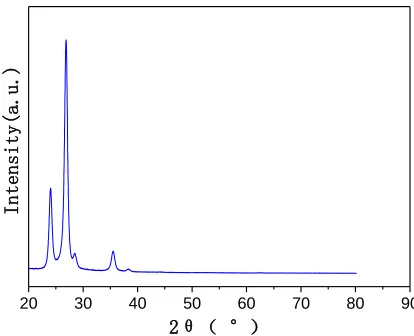
in an inert atmosphere. Therefore, before testing XRD the powders were pressed into sample holder plates and covered by adhesive tape in the glove box. So the XRD pattern of adhesive tape is Fig.2. The XRD patterns of the samples Li5FeO4 synthesized by high-temperature solid-state method at
850C for 20 h under flowing nitrogen are shown in Fig.3
20 30 40 50 60 70 80
2θ( °)
Intensity(a.u.)
Figure 3. XRD pattern for the samples prepared from LiOH·H2O and Fe2O3. The molar ratio of Li and
Fe is 6/1, the sintering temperature and time were 450C for 10h and then 850C for 20h.
After comparing them we can see the peaks between 22° and 30° are considered to be attributed to the adhesive tape, and all the other diffraction peaks can be indexed based on the anti-fluorite type structure. The single phase was obtained at the starting composition of around 6:1 (Li/Fe) ratio. The actual composition of Li/Fe ratio of the sample was confirmed to be 5:1 by the XRD patterns. The evaporation of some amount of Li occurred during heating at high temperature.
10 20 30 40 50 60 70 80
2θ( °)
Intensity(a.u.)
7/1
6/1
PDF#24-0623
[image:4.596.192.397.196.362.2]5.025/1
[image:4.596.185.401.544.713.2]
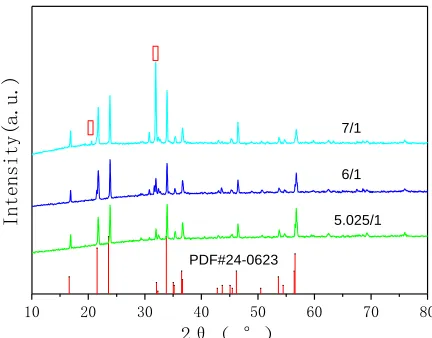
According to the original work we chose 5.025/1, 6/1 and 7/1 as the mole ratios of Li to Fe, The Fig.4 are the XRD pattern of the samples we obtained in the characterizing work. As we can see in the pattern, when the mole ratios of Li to Fe is 6/1 the material was sintered at 850C has a nearly perfect crystal structure and without impurity, but when the mole ratio is increasing, Characteristic peaks of Li2CO3 appeared in the spectrum.
The first charge-discharge curves of the Li5FeO4 synthesized by high-temperature solid-state
method at 850C for 20h are shown in Fig.4. For the charge curves, we can see when we Charging our Li/ Li5FeO4 cells to 4.55V, the voltage suddenly fell down to about 4.3V, then the voltage grow up
slowly. At the same time the structure undergoes a phase change as the removal of lithium progresses. Corresponding to the charge curves that lithium removal takes place in two steps. The first between∼3.0 and 4.5 V and the second on a voltage plateau at about 4.7V, each step corresponding to the removal of one Li2O per Li5FeO4 formula unit. For the discharge curves, no plateau is observed
due to the irreversible reaction of Li2O extraction from Li5FeO4 component, which causes large
irreversible capacity loss, and about 60% capacity loss is observed at the first discharge.
Figure 5. First charge-discharge curves of Li5FeO4 synthesized at 800C
4. CONCLUSION
Pure phase uniform Li5FeO4 powder can be successfully prepared by high-temperature
solid-state method and temperatures were 450C for 10h and then 850C for 20h. The samples sintered at optimized the mole ratios of Li to Fe is 6/1 shows uniform fine well-crystallized particles and high capacity. Its first charge capacity and recharge capacity reaches 584.5 and 210.8mAh/g respectively.
ACKNOWLEDGEMENT
[image:5.596.181.406.329.505.2]
2012THZ08129), State Key Laboratory of Automotive Safety and Energy (grand No. ZZ2012-011), he Shenyang City Science and technology plan projects in 2012 (121807:F12-178-9-00), the Natural Science Founds of the Liao Ning Province (201104526) and Foundation of President of the Liao Ning University 211.
References
1. T. Shirane, R. Kanno, Y. Kawamoto, Y. Takeda, M. Takano, T. Kamiyama, F. Izumi , Solid State Ionics. 79(1995):227-233.
2. Y.S. Lee, S. Sato, Y.K. Sun, K. Kobayakawa, Y. Sato, Journal of Power Sources. 119–121(2003): 285–289.
3. Y.S. Lee, S. Sato, M. Tabuchi, C.S. Yoon, Y.K. Sun, K. Kobayakawa, Y. Sato, Electrochemistry Communications. 5(2003):549–554.
4. S. Narukawa, Y. Takeda, M. Nishijima, N. Imanishi, O. Yamamoto, M. Tabuchi, Solid State Ionics. 122 (1999) 59.
5. E. Burzo, in: P.J. Wijin(Ed.), Landolt-Bornstein, New Series, vol.III/27f1a, Springer, Berlin– Heidelberg –New York, 1996H.
6. T. Matsumura, R. Kanno, Y. Inaba, Y. Kawamoto, M. Takano, J. Electrochem. Soc. 149 (2002): A1509.
7. G. Demoisson, F. Jeannot, C. Gleizer, J. Aubry, C. R. Acad. Sci. Paris 272(1971):458
8. C. S. Johnson, S. H. Kang, J. T. Vaughey, S. V. Pol, M. Balasubramanian, M. M. Thackeray. Chem. Mater. 22(2010):1263–1270
9. M. Tabuchi, A. Nakashima, H. Shigemura, K. Ado, H. Kobayashi,H. Sakaebe, K. Tatsumi, H. Kageyama, T. Nakamura, R. Kanno, J. Mater. Chem. 13 (2003):1747.