doi: 10.3389/feart.2019.00219
Edited by: James D. L. White, University of Otago, New Zealand
Reviewed by: Shigekazu Kusumoto, University of Toyama, Japan Oleg E. Melnik, Lomonosov Moscow State University, Russia Larry Garver Mastin, United States Geological Survey, United States
*Correspondence: Luke H. Marsden [email protected]
Specialty section: This article was submitted to Volcanology, a section of the journal Frontiers in Earth Science
Received:01 May 2019 Accepted:09 August 2019 Published:30 August 2019
Citation: Marsden LH, Neuberg JW, Thomas ME, Mothes PA and Ruiz MC (2019) Combining Magma Flow and Deformation Modeling to Explain Observed Changes in Tilt. Front. Earth Sci. 7:219. doi: 10.3389/feart.2019.00219
Combining Magma Flow and
Deformation Modeling to Explain
Observed Changes in Tilt
Luke H. Marsden1*, Jürgen W. Neuberg1, Mark E. Thomas1, Patricia A. Mothes2and
Mario C. Ruiz2
1School of Earth & Environment, The University of Leeds, Leeds, United Kingdom,2Instituto Geofisico, Escuela Politécnica Nacional, Quito, Ecuador
The understanding of magma ascent dynamics is essential in forecasting the scale, style and timing of volcanic eruptions. The monitoring of near-field deformation is widely used to gain insight into these dynamics, and has been linked to stress changes in the upper conduit. The ascent of magma through the conduit exerts shear stress on the conduit wall, pulling up the surrounding edifice, whilst overpressure in the upper conduit pushes the surrounding edifice outwards. How much shear stress and pressure is produced during magma ascent, and the relative contribution of each to the deformation, has until now only been explored conceptually. By combining flow and deformation modeling using COMSOL Multiphysics, we for the first time present a quantitative model that links magma ascent to deformation. We quantify how both shear stress and pressure vary spatially within a cylindrical conduit, and show that shear stress generally dominates observed changes in tilt close to the conduit. However, the relative contribution of pressure is not insignificant, and both pressure and shear stress must be considered when interpreting deformation data. We demonstrate that significant changes in tilt can be driven by changes in the driving pressure gradient or volatile content of the magma. The relative contribution of shear stress and pressure to the tilt varies considerably depending on these parameters. Our work provides insight into the range of elastic moduli that should be considered when modeling edifice-scale rock masses, and we show that even where the edifice is modeled as weak, shear stress generally dominates the near field deformation over pressurization of the conduit. While our model addresses cyclic tilt changes observed during activity at Tungurahua volcano, Ecuador, between 2013 and 2014, it is also applicable to silicic volcanoes in general.
Keywords: shear stress, tilt, pressure, numerical modeling, magma ascent, Tungurahua
1. INTRODUCTION
realistic pressure variations often requires the source radius to far exceed that of the assumed conduit (e.g.,Voight et al., 1999). Therefore, shear stress has been suggested in several studies as an alternative source of deformation (Beauducel et al., 2000; Green et al., 2006; Neuberg et al., 2018).
The ascent of highly viscous magma generates sustained shear traction at the conduit walls, which pulls up the surrounding edifice and causes deformation at the surface. It thereby provides an important link between ascent dynamics and deformation (Figure 1). Shear stressσsis a function of the ascent velocityv
and viscosityηof the magma, such that
σs= ˙εη= ∂v
∂rη (1)
where ε˙ is strain rate, which can be written as ∂v/∂r, the lateral gradient of the magma ascent velocity across the conduit (Neuberg et al., 2006). r is the horizontal distance from the center of the conduit. Therefore, if deformation is driven predominantly by a shear stress source, and the viscosity of the magma and the mechanical properties of the edifice are known, the amount of deformation can be used to estimate the ascent velocity of the magma, a vital parameter in forecasting eruption style.
Where shear stress reaches a critical value, brittle failure of the melt occurs, triggering low frequency seismicity (Neuberg et al., 2006). Brittle failure occurs where the shear stressσs is greater
than the shear strength of the magma, τm. Shear stress in the
conduit cannot exceed the value at which magma fractures, hence the shear stress is limited by the shear strength at the depth that low frequency seismicity is observed.
There have been several attempts to conceptually link the shear stress or pressure necessary to achieve observed deformation as magma ascends.Green et al. (2006)showed that shear stress of 0.5 MPa in the upper 1 km of the conduit can explain tilt of 20µrad at the tiltmeter at Chances Peak, Soufriére Hills volcano, whereas a pressure in excess of 40 MPa is required to model the same tilt using a realistic conduit radius. More recently,Neuberg et al. (2018)showed that shear stress of 20 MPa along a 4.5 km conduit can explain 480µrad of tilt at the RETU tiltmeter at Tungurahua, whereas an overpressure of several hundreds of MPa would be required. However, the key question remains whether such stress levels are achieved and sustained in a volcanic conduit during ascent of magma, or how shear stress and pressure vary both spatially and temporally within a conduit as a result of various volcanic phenomena.
Through flow modeling, it is possible to simulate realistic magma ascent, where the governing parameters are based on results of several disciplines within volcanology. This allows us to quantify how both pressure and shear stress vary within a volcanic conduit. Thomas and Neuberg (2012) showed that variations in conduit geometry can significantly increase the shear stress locally to potentially induce seismicity through brittle failure of magma, and in further work (Thomas and Neuberg, 2014) identified volatile content and the driving pressure gradient as key parameters in modulating the ascent dynamics and therefore shear stress and pressure.Okumura and Kozono (2017)
demonstrated that the transition from viscous flow to friction-controlled slip occurs at a greater depth if the crystal content is higher, as strain localizes in the melt phase where crystals are assumed rigid. However, there is a significant mismatch between the shear stress and pressure values obtained in these studies and the values required in modeling to explain the observed deformation. Shear stress on the order of MPa is only modeled in the uppermost section of the conduit if at all. This poses the question; can shear stress sufficient to explain observed deformation realistically be achieved during magma ascent?
Despite advances in both flow and deformation modeling, few studies have attempted to couple the two. One exception by Albino et al. (2011)demonstrated that the formation of a viscous plug can lead to a localized increase in shear stress in the upper part of the conduit, and induce near-field deformation. By using a simple step function to define the viscosity as a function of depth, due to the plug and underlying magma, they also obtained a step function for shear stress as a function of depth. In reality, the melt viscosity increases gradually as magma ascends and volatiles exsolve.
Moving on from these studies, we investigate whether observed deformation can be explained using realistic depth-dependent pressure and shear stress profiles, obtained through flow modeling. Here, we build upon the 3 phase, 2D axisymmetric flow models of Collier and Neuberg (2006) and Thomas and Neuberg (2014) to simulate more realistic conditions during ascent of magma through a cylindrical conduit. From this, we obtain depth-dependent pressure and shear stress profiles at the conduit-edifice boundary, which we use to drive our deformation modeling. In doing so, we for the first time provide a quantitative model that links magma ascent to observed deformation.
FIGURE 1 |Schematic diagram illustrating how as magma ascends, shear stress is exerted on the conduit walls, inducing deformation. Shear fractures form where the shear stress reaches a critical threshold, triggering low frequency seismicity. Once formed, these fractures move up with the ascending magma, allowing friction controlled slip along them. The shear stress cannot exceed this critical threshold at which brittle failure is induced. The total shear stress is partitioned between low frequency seismicity and the deformation.
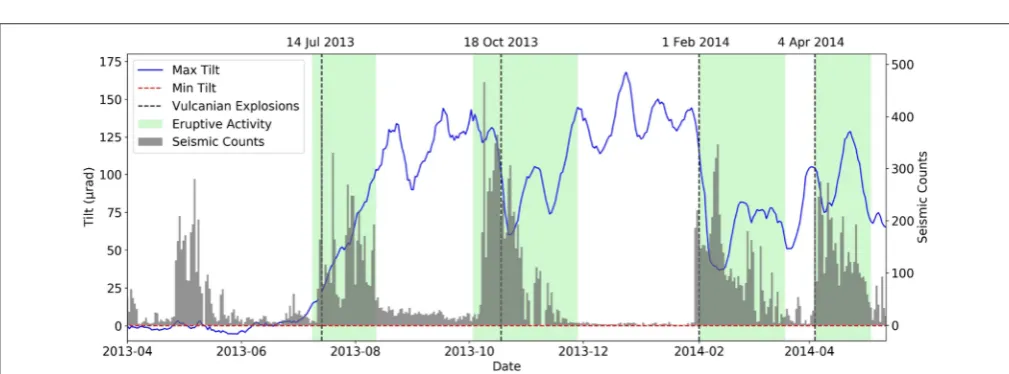
FIGURE 2 |Daily averaged tilt (µrad) and long-period seismic event count recorded at RETU. Each marked period of eruptive activity includes a single Vulcanian
explosion.
We demonstrate how independently inferred processes, such as the gradual solidification of a viscous plug (Hall et al., 2015) or the injection of a volatile rich batch of magma at depth (Samaniego et al., 2011; Andújar et al., 2017), can explain both the amplitude
FIGURE 3 |Elevation map showing the location of tiltmeters deployed at Tungurahua volcano (blue dots). Note that due to its proximity to the conduit, only RETU is sensitive to changes in stress in the conduit (Neuberg et al., 2018).
2. FLOW MODEL SET-UP
The 2D axisymmetric flow modeling in this project builds upon the work of Collier and Neuberg (2006) and Thomas and Neuberg (2014), and is performed using the Laminar Flow Module in the finite element software COMSOL Multiphysics 5.3. 1D models have been used successfully to discern volcanic phenomena, such as lava dome extrusion (Melnik and Sparks, 1999) and plug formation (Diller et al., 2006). However, other authors have highlighted the importance of radial changes within conduit flow models (Llewellin and Manga, 2005; Collier and Neuberg, 2006), and quasi 2D models ofTsvetkova and Melnik (2018)have recently showed that the dependence of shear rate on viscosity and therefore ascent dynamics can be significant. The magma is considered a three-phase fluid comprising gas, crystals and melt. While the melt is treated as a Newtonian fluid, the magma viscosity is modulated by the gas and crystal content and strain rate. A cylindrical conduit is represented in 2D axial symmetric domain space as a rectangle, through which isothermal magma ascent is governed by the compressible form of the Navier-Stokes equation
ρ∂v
∂t+ρv· ∇v= −∇P+ ∇ ·(η
h
∇v+(∇v)T
i −2
3η[∇ ·v]I)+F
(2)
and the continuity equation
∂ρ
∂t + ∇ ·(ρv)=0 (3) whereρis density,vis the velocity vector,Pis pressure,ηis the viscosity,Fis a volume force vector, in this case gravity, andI is the identity tensor (Faber, 1995). We solve for an equilibrium
solution, and time dependent termsρ∂v ∂t and
∂ρ
∂t are discarded.
Typically, finite element models use an unstructured mesh (for example a triangular mesh). However, as a simple cylindrical geometry is used for the conduit, a rectangular “mapped” mesh is employed in this case, providing improved stability to the model solver. This allows larger spatial variations in parameters to be modeled, which would face convergence issues when using a unstructured mesh. A mesh refinement study was performed to determine the mesh resolution close to the conduit wall required to model a solution for the shear stress at the conduit wall that is independent of the mesh size. An minimum element size as small as 2 cm at the conduit wall was applied in some tests, increasing toward the conduit center.
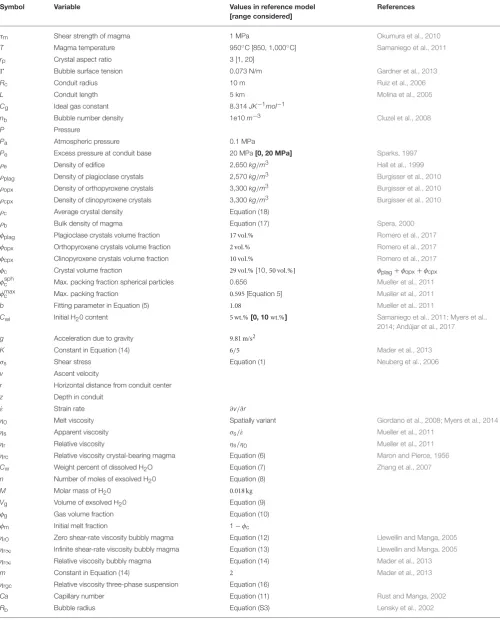
A summary of the parameters used in the flow model is presented inTable 2. A no-slip boundary condition is applied at the conduit wall. Pressure boundary conditions are set at the top and base of the conduit as atmospheric and magmastatic plus overpressure, respectively. ρe is the density of the edifice
surrounding the conduit,gis acceleration due to gravity,zis the depth in the conduit,Pais atmospheric pressure, andPeis excess
pressure at the base of the conduit, which is varied between tests (section 4) to account for overpressure in the system.
P=Pa+ρegz+Pe (4)
2.1. Magma Rheology
Magma is typically a multiphase suspension consisting of silicate melt, crystals and bubbles. The relative proportion of these three phases significantly influences the magma rheology, and therefore the eruption dynamics (Dingwell, 1996). At low gas and crystal volume fractions, magma can be considered to behave as a Newtonian fluid, where the viscosityη0 is constant. However,
at moderate crystal and gas fractions, the apparent viscosity of the suspensionηsis a function of the shear stressσsand strain
rateε˙, such thatηs = σs/ε˙(Mueller et al., 2011). This is often
normalized by the viscosity of the suspending meltη0, to give the
relative viscosity asηr=ηs/η0.
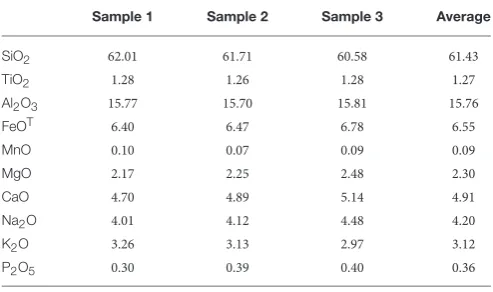
The viscosity of the melt phase has been determined as a function of melt composition and temperature, using the model byGiordano et al. (2008). The melt composition we use has been obtained byMyers et al. (2014)from averaging the composition of matrix glass from scoria bombs of the 2010 eruption of Tungurahua (Table 1).
2.1.1. Crystal Bearing Magma
Crystals increase the viscosity of magma due to energy being dissipated through fluid-particle and particle-particle interactions. The relative viscosity increases exponentially as the crystal content increases, approaching the maximum packing fraction, at which point the suspension becomes jammed (Mueller et al., 2011). More elongate crystals with a higher aspect ratio encompass a larger area during rotation, hence, enhance the particle-particle interactions. From experiments on suspensions of particles over a range of aspect ratios, Mueller et al. (2011)derived the following empirical relationship between the maximum packing fraction φmax
c and the particle
TABLE 1 |Composition of melt phase, from matrix glass of scoria clasts from the 2010 eruption at Tungurahua volcano (Myers et al., 2014).
Sample 1 Sample 2 Sample 3 Average
SiO2 62.01 61.71 60.58 61.43
TiO2 1.28 1.26 1.28 1.27
Al2O3 15.77 15.70 15.81 15.76
FeOT 6.40 6.47 6.78 6.55
MnO 0.10 0.07 0.09 0.09
MgO 2.17 2.25 2.48 2.30
CaO 4.70 4.89 5.14 4.91
Na2O 4.01 4.12 4.48 4.20
K2O 3.26 3.13 2.97 3.12
P2O5 0.30 0.39 0.40 0.36
φmax
c =φ
sph c exp
"
−(log10rp)
2
2b2 #
(5)
where the maximum packing fraction for spherical particles
φcsph =0.656, and a fitting parameterb=1.08, have each been
experimentally derived byMueller et al. (2011). Here, where we assume an aspect ratio of 3 for a predominantly plagioclase and pyroxene crystal phase,φmax
c =0.595.Mueller et al. (2011)found
empirically that for diverse crystal suspensions over a range of values forrp,ηrand the crystal volume fraction of the suspension φc, that the theoretical model ofMaron and Pierce (1956)is able
to accurately describe the relative viscosity, hence the rheology.
ηrc =ηr
1− φc
φmax
c
−2
(6)
Romero et al. (2017)assessed thin sections of pyroclastic density current blocks from the February 2014 eruption on Tungurahua, and estimated the crystal volume fraction as φc = 0.29. For
simplicity, we proceed with the constant value ofφc=0.29 in all
our models, making the assumption that the ascent time is short relative to the time period of crystallization. Using this value, the relative viscosity of the crystal-bearing suspensionηrcis a factor
of 4 greater than the relative viscosity of the melt phaseηr.
2.1.2. Bubbly Magma
The gas volume fraction at any point in the conduit is a function of the solubility of volatiles in the melt, the initial content dissolved in the melt at depth, and the amount of gas that has been able to escape from the system. In our models, we consider only H2O as the most volumetrically significant volatile phase
that exsolves from the melt, and use the law fromZhang et al. (2007)to determine the weight percent of H2O,Cw, dissolved in
the melt phase:
Cw=
−0.231+651.1
T
√
P+
0.03424−32.57
T +0.02447AI
P
(7) whereTis temperature in degrees Kelvin,Pis pressure in MPa, andAIis the sum of the mole fractions of Na, K and Al.
An upper limit is placed upon Cw from estimates of the
initial concentration of water dissolved in the melt. Myers et al. (2014)found that melt inclusions from eruptions in 2006 and 2010 contained as much as 4 wt.% H2O.Samaniego et al.
(2011)performed a petrological analysis of juvenile blocks and bombs from pyroclastic flow deposits of the 2006 paroxysmal eruptions at Tungurahua. They stated that the observed absence of amphibole suggests that the magmas evolved at a H2O content <4 wt.%, and temperatures higher than 950–1,000◦. Andújar et al. (2017)propose that prior to the July 2006 eruption magma was stored at 400 MPa, at 1.000◦C, with an H2O content of 6 wt.%, before ascending to a second storage reservoir at 200 MPa. For our reference model, we use an initial H2O content of 5 wt.%,
and assess how varying this value by ±5 wt.% influences the ascent dynamics and associated deformation in section 4.
Equation (7) is valid where the water content dissolved in the melt is in equilibrium with the exsolved water, and assumes instantaneous and homogeneous nucleation and exsolution. This yields a sharp variation inCw at the nucleation depth. A more
gradual onset of exsolution is probably more realistic, and has been implemented by applying a taper function as shown in the Supplementary Section S3(Equation S6).
Equation (7) provides the mass fraction of H2O that has been
exsolved. However, the gas volume fractionφgdepends on the gas
density, which is also pressure and therefore depth dependent. To quantify howφgvaries with depth, first the number of moles of
exsolved H2O per cubic meter,n, must be calculated using the
melt densityρmand the molar mass of H2O,M=0.018 kg
n= Cwρm
M (8)
The volume of exsolved H2O,Vg, can then be calculated using
the ideal gas equation:
Vg=
nCgT
P (9)
whereTis temperature in degrees Kelvin,Pis pressure in MPa andCgis the ideal gas constant. The volume of melt from which
gas exsolves is reduced by the fraction of crystals within the magma, therefore,Vg is weighted by the initial melt fraction, φm=1−φc. The gas volume fraction,φg, is calculated by
φg=
Vgφm
Vgφm+φm+φc. (10)
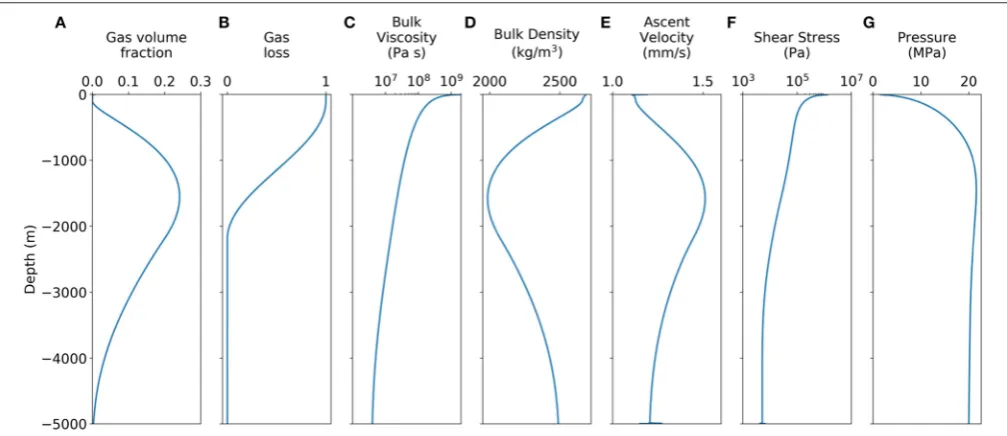
FIGURE 4 |Depth profiles of key variables obtained from the reference flow model.(A–E)Have been extracted from the center of the conduit,(F,G)have been extracted from the conduit wall. Note that the shear stress profile has been clipped at 1 MPa to accommodate low frequency seismicity.
and Neuberg, 2014). Therefore, it is important to be able to quantify how much gas is lost from the system.
Independent ascent of bubbles through magma is not considered in this highly viscous system, and therefore gas is assumed to be lost only through permeable flow. Permeable gas flow occurs where the porosity is sufficient for bubbles to be interconnected (Klug and Cashman, 1996). Additionally, gas loss may be facilitated by fractures in the magma (Gaunt et al., 2014). The minimum porosity required for degassing is unclear and varies with crystal volume fraction and strain rate (Laumonier et al., 2011). Also, it is unclear how magma permeability and degassing vary with depth. Therefore, in this study, a simplified forced degassing approach is adopted, where an empirical permeability depth profile is provided. We assume that no permeable degassing pathways exist whereφg < 0.2, a reasonable compromise based on results of several studies (see theSupplementary Section S4). This corresponds to a depth of 1.600 m in the reference model. This depth is then set as the maximum depth of degassing in all future models. This was derived by iteratively adjusting the maximum gas loss depth and assessing theφgdepth profile. We assume that all the gas is lost at the surface, to simulate in our flow model the presence of an impermeable plug in the upper conduit (Hall et al., 2015). This is supported by observations of negligible outgassing during periods of quiescence at the Tungurahua (Hidalgo et al., 2015). A cosine taper is used for the gas loss profile to achieve a smooth variation with depth. Our resultant profile for the gas volume fraction is in line with the numerical modeling of Diller et al. (2006), who showed that if the magma and surrounding edifice are permeable, a low vesicularity, dense region forms in the upper conduit.
Bubbles can either increase or decrease the relative viscosity of the bubble suspensionηrgdepending on the capillary number
Ca, a ratio of the viscous stresses deforming the bubble to the interfacial stresses restoring it (Rust and Manga, 2002).
Ca= η0Rbε˙
Ŵ (11)
where Ŵ is the bubble surface tension and Rb is the bubble
radius, where the computation of Rb is documented in
the Supplementary Section S1. Bubbles increase the relative viscosityηrgby distorting the flow paths of the melt, and decrease ηrgby providing free-slip surfaces for flow. The zero shear-rate
viscosityηr0 and infinite shear rate viscosityηr∞ describe the limits of the influence of bubbles on the viscosity, where the bubbles are considered spherical or at the limit of elongation, respectively, and are functions of the gas volume fractionφg, as
determined byLlewellin and Manga (2005)whereφgis<0.5.
ηr0=(1−φg)−1 (12)
ηr∞=(1−φg)5/3 (13)
The relative viscosity betweenηr0andηr∞can be defined using
ηrg=ηr∞+
ηr0−ηr∞
1+KCam, (14)
where K = 6/5 and m = 2 (Mader et al., 2013). ηrg
tends asymptotically toward ηr0 at low strain rate, where the
2.1.3. Three-Phase Magma
Three-phase suspension experiments from Truby et al. (2015) presented a model for the relative viscosity of three-phase magma. In this model, the bubble-bearing suspension is treated as the “effective medium” in which crystals are suspended, and hence Equations (12) and (6) have been combined to provide the bulk viscosity.
ηrgc=(1−φg)−1
1− φc
φmax
c
−2
(15)
This equation has been tested only for steady flow in the low capillarity regime (spherical bubbles), for 0≤ φg ≤0.3 and 0
≤ φc ≤0.85, howeverTruby et al. (2015)state that the model’s
applicability is potentially much broader, although subject to experimental validation. To our knowledge, this has not yet been done, nor has an alternative model been suggested for higher capillary numbers. By combining Equations (6) and (14), we extrapolate the trend so it is usable for higher capillary numbers.
ηrgc=
ηr∞+
ηr0−ηr∞ 1+KCam 1−
φc φmax
c
−2
(16)
Equation (16) is used within our flow models to provide a spatially variant viscosity that accounts for melt, crystals and bubbles.
2.1.4. Why the Bulk Viscosity Needs to Be Scaled Up
Equation (16) provides us with a good representation of how the bulk magma viscosity varies spatially within the conduit. However, this describes the classical flow dynamics within a clean pipe. In reality, a volcanic conduit is filled with rubble from previous eruptions that ascending magma must percolate through and incorporate. For this reason, a Bingham rheology is often used (e.g., Blake, 1990), where a yield strength must be overcome for magma to ascend. Furthermore, based on the available data for Tungurahua, we must consider in our models a range of values for magma temperature, composition, crystal content and aspect ratio, resulting in significant uncertainties in the bulk viscosity. We adopt the concept of a Bingham rheology by scaling up the bulk viscosity derived in Equation (16) by a factor of 10.000, in order to yield suitable values for the ascent velocity (millimeters per second) that are low enough for magma to ascend from chamber depth (7.5–9.5 km, Samaniego et al., 2011) to the surface without fragmentation over the 3 months between each Vulcanian explosion. Due to the large uncertainties in the bulk viscosity, we neglect a further fine-tuning that takes crystallization during magma ascent into account (Melnik and Sparks, 2005).
2.2. Magma Density
The density of the melt phaseρmhas been calculated as a function
of the composition (Table 1), pressure and temperature, as in Spera (2000), such that the melt density varies spatially within the conduit. The bulk densityρbis a function of the gas volume
fractionφgand densityρg, and crystal volume fractionφcand
densityρc.
ρb=ρmφm(1−φg)+ρgφg+φcρc(1−φg) (17)
As H2O is exsolved from the melt as it ascends, the melt density ρmincreases, whilst the bulk magma densityρbdecreases due to
the increased gas volume fractionφg. The crystal volume fraction φchas been taken from estimates ofRomero et al. (2017), who
assessed thin sections from pyroclastic density current blocks from the February 2014 eruption on Tungurahua. The crystal assemblage was estimated to consist mainly of 17 % plagioclase (φplag), 10 % clinopyroxene (φcpx), and 2 % orthopyroxene (φopx).
Approximations of the density of each crystal phase (ρplag,ρcpx,
and ρopx) have been taken fromEngineering Toolbox (2009).
Given that the density varies quite considerably within the pyroxene group, an average density of 3334 kg/m3 is used for both ρcpx and ρopx. Using this information, we calculate the
average crystal densityρcusing.
ρc=ρplag φplag
φc + ρcpx
φcpx φc +
ρopx φopx
φc
. (18)
2.3. Accounting for Seismicity
Brittle failure of the magma occurs where the shear stress exceeds the shear strength of the magma, triggering low frequency seismicity (Neuberg et al., 2006). The occurrence of this seismicity marks the critical depth where a crucial change in the flow regime exists, from viscous flow below this level to friction controlled slip above it along existing fractures. The shear stress in the conduit cannot exceed the shear strength of the magma, here assumed to be constant at 1 MPa for simplicity, based on experiments on vesicular magma at low confining pressures (Okumura et al., 2010). To accommodate this, the shear stress profile obtained from our flow model is clipped at 1 MPa, which is reached only in the uppermost section of the conduit in all of our models. As low frequency seismicity is only observed at RETU, located at high elevation, this critical source depth is poorly constrained, but probably in the upper section of the conduit (Bell et al., 2018). A full investigation would also take the depth-dependence of the shear strength of the magma into account.
2.4. Resulting Reference Flow Model
Figure 4 shows how various parameters taken at the conduit center (a–e) and wall (f,g) vary with depth in the solution of the resulting reference flow model, parameterized as inTable 2. The gas volume fraction increases as magma ascends, as volatiles exsolve from the melt. Closer to the surface where gas loss is significant, the gas volume fraction decreases toward zero. The melt and therefore bulk viscosity increase by several orders of magnitude as magma ascends and volatiles exsolve. The bulk density is inversely proportional to the gas volume fraction.
2.5. Thermal Boundary Layer
TABLE 2 |Parameters and variables used in the flow model, based on Tungurahua volcano, Ecuador.
Symbol Variable Values in reference model
[range considered]
References
τm Shear strength of magma 1 MPa Okumura et al., 2010
T Magma temperature 950◦C [850, 1,000◦C] Samaniego et al., 2011 rp Crystal aspect ratio 3 [1, 20]
Ŵ Bubble surface tension 0.073 N/m Gardner et al., 2013
Rc Conduit radius 10 m Ruiz et al., 2006
L Conduit length 5 km Molina et al., 2005
Cg Ideal gas constant 8.314JK−1mol−1
nb Bubble number density 1e10m−3 Cluzel et al., 2008
P Pressure
Pa Atmospheric pressure 0.1 MPa
Pe Excess pressure at conduit base 20 MPa[0, 20 MPa] Sparks, 1997
ρe Density of edifice 2,650kg/m3 Hall et al., 1999
ρplag Density of plagioclase crystals 2,570kg/m3 Burgisser et al., 2010
ρopx Density of orthopyroxene crystals 3,300kg/m3 Burgisser et al., 2010
ρcpx Density of clinopyroxene crystals 3,300kg/m3 Burgisser et al., 2010
ρc Average crystal density Equation (18)
ρb Bulk density of magma Equation (17) Spera, 2000
φplag Plagioclase crystals volume fraction 17vol.% Romero et al., 2017
φopx Orthopyroxene crystals volume fraction 2vol.% Romero et al., 2017
φcpx Clinopyroxene crystals volume fraction 10vol.% Romero et al., 2017
φc Crystal volume fraction 29vol.%[10,50vol.%] φplag+φopx+φcpx
φcsph Max. packing fraction spherical particles 0.656 Mueller et al., 2011
φcmax Max. packing fraction 0.595[Equation 5] Mueller et al., 2011 b Fitting parameter in Equation (5) 1.08 Mueller et al., 2011
Cwi Initial H20 content 5wt.%[0, 10wt.%] Samaniego et al., 2011; Myers et al., 2014; Andújar et al., 2017
g Acceleration due to gravity 9.81m/s2
K Constant in Equation (14) 6/5 Mader et al., 2013
σs Shear stress Equation (1) Neuberg et al., 2006
v Ascent velocity
r Horizontal distance from conduit center
z Depth in conduit
˙
ε Strain rate ∂v/∂r
η0 Melt viscosity Spatially variant Giordano et al., 2008; Myers et al., 2014
ηs Apparent viscosity σs/ε˙ Mueller et al., 2011
ηr Relative viscosity ηs/η0 Mueller et al., 2011
ηrc Relative viscosity crystal-bearing magma Equation (6) Maron and Pierce, 1956 Cw Weight percent of dissolved H2O Equation (7) Zhang et al., 2007
n Number of moles of exsolved H20 Equation (8)
M Molar mass of H20 0.018kg
Vg Volume of exsolved H20 Equation (9)
φg Gas volume fraction Equation (10)
φm Initial melt fraction 1−φc
ηr0 Zero shear-rate viscosity bubbly magma Equation (12) Llewellin and Manga, 2005
ηr∞ Infinite shear-rate viscosity bubbly magma Equation (13) Llewellin and Manga, 2005
ηr∞ Relative viscosity bubbly magma Equation (14) Mader et al., 2013 m Constant in Equation (14) 2 Mader et al., 2013
ηrgc Relative viscosity three-phase suspension Equation (16)
Ca Capillary number Equation (11) Rust and Manga, 2002 Rb Bubble radius Equation (S3) Lensky et al., 2002
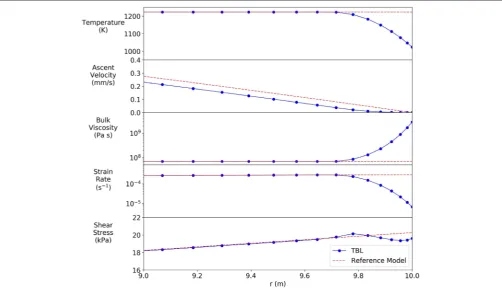
surrounding edifice.Collier and Neuberg (2006) estimated the temperature difference across a 0.3 m thick thermal boundary layer (TBL) at the conduit wall to be 50–200 K (depending on the thermal conductivity of the magma, seeTable 2) calculated by running a time-dependent model of constant fluid flow including heat loss. Where a TBL with a temperature difference of 200 K is included in our model, we observe that the velocity and therefore strain rate decreases within the TBL. However, this is counteracted by an increase in viscosity to yield a similar shear stress with or without the TBL (Figure 5). Therefore, a TBL has been excluded from future model runs. We also discard a vertical temperature gradient in the upper conduit in our model, assuming this, similarly, does not extend far into the conduit and, therefore, does not affect the ascent dynamics.
3. DEFORMATION MODEL
To investigate the deformation field at Tungurahua, we build upon the 2D axisymmetric modeling of Neuberg et al. (2018) using the Solid Mechanics Module in COMSOL Multiphysics 5.4. The edifice is represented by a homogeneous cone, with the slope angle set to a constant of 26.6◦ to fix the location of RETU to 1 km vertically and 2 km laterally away from the summit. The base of the slope is 3 km below the summit. Beyond this, the model is extended with a flat surface to a horizontal distance of 100 km from the conduit, and a depth of 100 km from the summit, to avoid numerical boundary effects. A six node triangular mesh is used with an element size of around 50 m across the edifice, extending with distance from the conduit beyond the base of the slope. Roller boundary conditions are applied to exterior lateral model boundaries, such that horizontal displacement is constrained, allowing vertical displacement only. The base of the model is fully constrained in all directions. No constraints are applied to on the upper surface of the model. The depth-dependent shear stress and pressure profiles at the conduit wall, obtained from the flow modeling, are employed along the conduit-edifice boundary to drive the deformation model.
To accurately model the amplitude of the deformation it is imperative to assign realistic values for the mechanical properties (most importantly the elastic modulus) of the volcanic edifice. Volcanic edifices are formed from the deposits of numerous eruptions, effusive and explosive, including lava flows, ignimbrites and ash fall deposits. They are therefore heterogeneous structures, assembled over geologically short time scales of several thousands of years, which makes them inherently unstable (McGuire, 1996). It is therefore very difficult to assign a single overall value for the elastic modulus of a volcanic edifice.
The Young’s modulus of intact rock samples of lava flows is often quoted to be on the order of tens of GPa (e.g., Heap et al., 2010). However, volcanic edifices are exposed to successive fracturing due to stress perturbations, and are therefore intersected by faults and fractures (Thomas et al., 2004), which can drastically reduce the strength of the entire rock mass (e.g., Heap et al., 2014). Cyclic stressing experiments by Heap et al. (2010)on intact rock samples of both intrusive and extrusive basalts showed that successive fracturing can reduce the Young’s
modulus by up to 32 %. Additionally, after deposition, rocks are subject to chemical alteration due to hydrothermal activity and weathering, leading to the formation of primarily clay minerals which are weak in strength (Pola et al., 2014).Heap et al. (2014) sampled andesites from Colima volcano, Mexico, and found the Young’s modulus to be as low as 6.38 GPa. The Young’s modulus is also known to be lower where the rock porosity is higher (Heap et al., 2014).
Unlike intact rock samples, rock masses do not always behave elastically, but deform and fail along fracture surfaces. Instead of the Young’s modulus, we use the deformation modulusEm to
quantify how an entire rock mass deforms, similarly defined as the ratio of applied stress to strain exerted, but accounting for elastic and inelastic behavior (Hoek and Diederichs, 2006). The deformation modulus of a volcanic edifice is poorly constrained, in part due to the difficulty in determiningEmin the laboratory,
as one needs to test a rock mass volume sufficiently large to be a good representation of the heterogeneity in reality. For this reason, the deformation modulus is generally smaller when a larger sample size is used (Pinto de Cunha and Muralha, 1990), andEmcan be orders of magnitude lower than
the Young’s modulus (e.g., Hoek and Diederichs, 2006). Isik et al. (2008) attempted to quantify the deformation modulus of heavily jointed and highly weathered andesites underlying northern Ankara, Turkey, and measured a mean value of Em=34.8 MPa, with a standard deviation of 25.8 MPa, obtained
from pressuremeter tests. Alternatively, Em can be estimated
empirically based on other properties of the rock (e.g.,Hoek and Diederichs, 2006). However, estimates ofEm obtained through
any of the discussed methods are only representative of the area around the test or sample site, whilst deeper in the edifice the weakening effects of temperature and degree of alteration may be considerably higher.
To address this uncertainty, the tilt induced by either shear stress, pressure, or both, has been modeled using a suite of different deformation moduli (Figure 6). A Poisson’s ratio of 0.25 and edifice density of 2.650 kg/m3 (Hall et al., 1999) are used in each test. Where the deformation modulusEm is 10 MPa, a
tilt at RETU of 67µrad is modeled using shear stress alone, 24 µrad through pressure alone, and 91µrad where both sources contribute. Where the deformation modulus is a factor of 10 larger, the tilt modeled is a factor of 10 smaller, as stated by Hooke’s law. It has been suggested that conduit pressure is able to explain observed changes in tilt if the conduit is surrounded by a weak zone (Voight et al., 2006); however here we show that regardless of the strength of the edifice, shear stress dominates the tilt at Tungurahua. This is despite the shear stress obtained from flow modeling being several orders of magnitude smaller than the pressure at most depths.
4. CHANGES IN TILT THROUGH TIME
FIGURE 5 |Horizontal profiles of (from top to bottom) temperature, ascent velocity, bulk viscosity, strain rate and shear stress at 2,000 m in the reference flow model. Zoomed to within 1 m of the conduit wall (9≤r≤10). We compare flow models run with (solid) and without (dashed) a TBL of 0.3 m thickness, with a temperature difference of 200 K. Dots show the location of mesh node points. Note that the shear stress at the conduit wall is similar in either case. Instabilities in the strain rate modeled toward the conduit wall arise from the difficulty in modeling such steep changes in melt viscosity with a sufficiently fine mesh size in a FEM.
FIGURE 6 |(Left) Shear stress (blue dashed) and pressure (red solid) profiles obtained from the reference flow model. Note the difference in amplitude between the shear and pressure stresses. (Right) Modeled tilt at RETU induced by shear stress (+), pressure (x), or both (star) for a suite of edifice deformation moduli. The tilt modeled due to shear stress is a factor of 2.8 higher than due to pressure, regardless of the deformation modulus used. A deformation modulus of around 10 MPa is required to model 170µrad of tilt at RETU as observed (black dotted line) (Figure 2).
observed following the first major explosion in the period of interest on July 14th 2013, before decreasing significantly in the days leading up to the three proceeding major explosions (Figure 2). We use a constant deformation modulus Em of
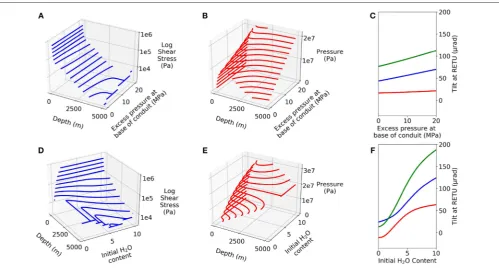
FIGURE 7 |Modeled variations in shear stress(A,D)and pressure(B,E)with depth from flow modeling, and modeled tilt at RETU(C,F), each as a function of the excess pressure at the base of the conduit(A–C)and the initial H2O content(D–F).
Firstly, we consider the July 14th 2013 explosion to be the first event in a sequence. Hall et al. (2015) suggested that the cyclic Vulcanian explosions observed between 2013 and 2014 at Tungurahua were the result of pressurization below tightly sealed viscous plugs. If friction at the conduit wall where this plug has formed is sufficient to impede ascent of magma, the magma ascent velocity and therefore shear stress at the wall would be zero (Equation 1), assuming the magma is behaving as a fluid. Shear stress would still be exerted only in the uppermost section of the conduit where magma completely solidifies. In a transitional regime, a viscoelastic treatment would be appropriate. As pressure increases below the plug, tilt would increase, but as the contribution of pressure to the tilt is small, this change in tilt would be small, as observed prior to the explosion on July 14th 2013 (Figure 2).
Consider that the conduit was vacated following the first eruption, magma would again begin to ascend and fill up the conduit due to the reduction in confining pressure. Pressure and shear stress would be progressively exerted on a greater proportion of the conduit walls, causing tilt to increase through time. This could explain why tilt increases over the weeks following each Vulcanian explosion. Tilt then decreases for several days leading up to the next Vulcanian explosion. Hall et al. (2015) suggested that each eruption is preceded by the formation of a viscous plug in the upper conduit. Should this occur, the ascending magma would decelerate, thus causing shear stress to decrease. As shear stress tends to dominate
over pressure (Figure 7), this may explain why tilt decreases prior to the three latter Vulcanian explosions, despite the pressurization of the system. As viscosity continues to increase, the magma goes through the ductile-brittle transition zone and fails in a brittle manner, triggering seismicity and causing shear stress to drop further (Neuberg et al., 2018). However, to appropriately model these transient processes, and quantify the resultant changes in tilt, time dependent models that account for disequilibrium in the system must be developed in future work.
Alternative explanations for what has previously triggered major explosions at Tungurahua include the injection of a fresh batch of mafic magma into the magma chamber prior to the paroxysmal events in July and August 2006 (Samaniego et al., 2011), which is potentially volatile rich (Myers et al., 2014; Andújar et al., 2017). This could induce changes in the volatile content of the magma and the pressure at the base of the conduit, whichThomas and Neuberg (2014)previously demonstrated can significantly influence ascent dynamics and therefore pressure and shear stress. Here we attempt to quantify how realistic variations in these parameters will influence the tilt.
An increase in the initial H2O content will result in a higher
gas volume fraction and a decrease in the bulk magma density. This will facilitate magma ascent through increased buoyancy. Our results suggest that shear stress is higher, despite the melt viscosity being lower where the H2O content is greater. Again,
this points to the dominance of ascent rate over viscosity in the trade-off between the two key parameters. Additionally, this leads to an increase in the exsolved volatile content, hence to a higher pressure in the conduit. Figures 7D–F shows that changing the initial H2O content can significantly influence
the shear stress, pressure and resulting tilt, with a maximum combined tilt of 188 µrad for the maximum H2O content of
10 wt.%. Where the H2O content is below 1.5 wt.%, a negative
radial tilt induced by pressure reduces the combined tilt to only 13µrad.
We have shown that observed changes in tilt at RETU, in excess of 100 µrad, can be explained by moderate changes in the volatile content or the increase of excess pressure in the conduit. Interestingly, the relative contribution of shear stress and pressure to the combined modeled tilt varies considerably depending on the volatile content. However, the contribution of shear stress to the combined tilt is always greater or equal to the contribution of pressure in all of our models. In some cases, the shear stress and pressure induce opposing and almost counterbalancing tilts. In other cases, the combined tilt is made up almost entirely of the contribution of shear stress. Obviously there is a trade-off between the change in stress required and the deformation modulus of the edifice, to explain observed tilt variations. It is therefore challenging to estimate how much the volatile content or excess pressure did vary through time from the observed tilt variations alone. However, we suggest that with additional information, such as changes in gas flux or the broader deformation pattern, tilt observations can be used to assess how these parameters are varying through time.
5. CONCLUSIONS
• By quantitatively linking magma ascent to deformation for the first time, we confirm that shear stress exerted on the conduit walls generally dominates over pressurization as a deformation source of tilt observed close to the conduit. Whilst our model is tuned to Tungurahua volcano, the contribution of both shear stress and pressure should be considered at all silicic volcanoes.
• Previous attempts to link near-field changes in tilt to overpressure or shear stress have used large values for the applied stress. Here, we have used flow modeling to constrain these values. Our results suggest that for tilt variations at RETU to be the result of changes in either shear stress or overpressure in the conduit, the deformation modulus of Tungurahua’s edifice must be lower than previously assumed, perhaps on the order of tens of MPa. This suggests that the edifice is either heavily fractured, highly altered, or highly porous, and most likely a combination of the three.
• Realistic variations in the driving pressure gradient and the volatile content are key parameters in driving changes in
shear stress, pressure and therefore tilt through time. These variations could be more pronounced due to the non-linear relationships that exist between discharge rate and both crystallization and gas loss (Melnik and Sparks, 1999). Given the large uncertainties in parameters, such as crystal content and permeability, we neglect crystallization during magma ascent and keep the gas loss profile constant. The relative contributions of shear stress and pressure to the tilt vary considerably as a function of the volatile content.
• As magma refills the conduit following a major eruption, shear stress and pressure are progressively exerted on a greater proportion of the conduit wall. Therefore one may expect tilt to increase as this occurs, as observed following Vulcanian explosions at Tungurahua. However, to properly simulate this, or other transient volcanic processes, fully time dependent flow models must be developed, that are able to keep track of changes in the ascent dynamics.
• A decrease in tilt prior to a major explosion can be explained by a decrease in shear stress as ascending magma grinds to a halt below a fixed plug and a pressurization in the upper conduit. Alternatively, this decrease in tilt could be explained by the onset of seismicity which leads to frictional heating and a subsequent decrease in the magma viscosity. This allows the magma column to accelerate to critical ascent rates without transferring shear stress across the conduit wall. This explanation would require further investigations into the rheology of magma, including frictional heating, and strength recovery of magma. Additionally it is important to quantify how much shear stress reduction is achieved by a seismic swarm and define the seismicity and tilt rates that point to critical magma ascent.
DATA AVAILABILITY
All datasets generated for this study are included in the manuscript and/or theSupplementary Files.
AUTHOR CONTRIBUTIONS
LM developed the models. JN and MT provided expertize on the governing processes. PM and MR advised on technical aspects of the project.
FUNDING
LM was funded by a studentship from the NERC-SPHERES Doctoral Training Partnership (NE/L002574/1). JN was partially funded by the Centre for the Observation and Modelling of Earthquakes, Volcanoes and Tectonics (COMET NE/J01978X/1).
ACKNOWLEDGMENTS
functioning, andvigíaswho provide observations during periods of activity. We acknowledge Amy Collinson for her useful contributions to discussions and for providing help with the modeling. We would like to thank Shigekazu Kusumoto, Oleg Melnik, and Larry Mastin for their constructive reviews.
SUPPLEMENTARY MATERIAL
The Supplementary Material for this article can be found online at: https://www.frontiersin.org/articles/10.3389/feart. 2019.00219/full#supplementary-material
REFERENCES
Albino, F., Pinel, V., Massol, H., and Collombet, M. (2011). Conditions for
detection of ground deformation induced by conduit flow and evolution.J.
Geophys. Res. Solid Earth116:B06201. doi: 10.1029/2010JB007871
Andújar, J., Martel, C., Pichavant, M., Samaniego, P., Scaillet, B., and Molina, I. (2017). Structure of the plumbing system at Tungurahua Volcano, Ecuador: insights from phase equilibrium experiments on July–August
2006 eruption products. J. Petrol. 58, 1249–1278. doi: 10.1093/petrology/
egx054
Beauducel, F., Cornet, F.-H., Suhanto, E., Duquesnoy, T., and Kasser, M. (2000). Constraints on magma flux from displacements data at Merapi
volcano, Java, Indonesia. J. Geophys. Res. Solid Earth 105, 8193–8203.
doi: 10.1029/1999JB900368
Bell, A. F., Naylor, M., Hernandez, S., Main, I. G., Elizabeth Gaunt, H., Mothes, P., et al. (2018). Volcanic eruption forecasts from accelerating rates
of drumbeat long-period earthquakes. Geophys. Res. Lett. 45, 1339–1348.
doi: 10.1002/2017GL076429
Blake, S. (1990). “Viscoplastic models of lava domes,” inLava Flows and Domes, ed J. H. Fink (Berlin; Heidelberg: Springer), 88–126.
Burgisser, A., Poussineau, S., Arbaret, L., Druitt, T. H., Giachetti, T., and Bourdier, J.-L. (2010). Pre-explosive conduit conditions of the 1997 Vulcanian explosions at Soufrière Hills Volcano, Montserrat: I. Pressure
and vesicularity distributions. J. Volcanol. Geotherm. Res. 194, 27–41.
doi: 10.1016/j.jvolgeores.2010.04.008
Cluzel, N., Laporte, D., Provost, A., and Kannewischer, I. (2008). Kinetics of heterogeneous bubble nucleation in rhyolitic melts: implications for the number density of bubbles in volcanic conduits and for pumice textures.
Contrib. Mineral. Petrol.156, 745–763. doi: 10.1007/s00410-008-0313-1 Collier, L., and Neuberg, J. (2006). Incorporating seismic observations into
2D conduit flow modeling. J. Volcanol. Geotherm. Res. 152, 331–346.
doi: 10.1016/j.jvolgeores.2005.11.009
Diller, K., Clarke, A., Voight, B., and Neri, A. (2006). Mechanisms of conduit plug formation: implications for vulcanian explosions.Geophys. Res. Lett.33:L20302. doi: 10.1029/2006GL027391
Dingwell, D. B. (1996). Volcanic dilemma: flow or blow? Science273:1054.
doi: 10.1126/science.273.5278.1054
Engineering ToolBox (2009).Mineral Densities. Available online at: https://www. engineeringtoolbox.com/mineral-density-d_1555.html
Faber, T. E. (1995). Fluid Dynamics for Physicists. Cambridge: Cambridge
University Press.
Gardner, J. E., Ketcham, R. A., and Moore, G. (2013). Surface tension of hydrous
silicate melts: constraints on the impact of melt composition. J. Volcanol.
Geotherm. Res.267, 68–74. doi: 10.1016/j.jvolgeores.2013.09.007
Gaunt, H. E., Sammonds, P. R., Meredith, P. G., Smith, R., and Pallister, J. S. (2014). Pathways for degassing during the lava dome eruption of Mount St. Helens
2004–2008.Geology42, 947–950. doi: 10.1130/G35940.1
Giordano, D., Russell, J. K., and Dingwell, D. B. (2008). Viscosity of
magmatic liquids: a model. Earth Planet. Sci. Lett. 271, 123–134.
doi: 10.1016/j.epsl.2008.03.038
Green, D., Neuberg, J., and Cayol, V. (2006). Shear stress along the conduit wall as a plausible source of tilt at Soufrière Hills volcano, Montserrat.Geophys. Res. Lett.33:L10306. doi: 10.1029/2006GL025890
Hall, M. L., Robin, C., Beate, B., Mothes, P., and Monzier, M. (1999). Tungurahua
volcano, Ecuador: structure, eruptive history and hazards. J. Volcanol.
Geotherm. Res.91, 1–21. doi: 10.1016/S0377-0273(99)00047-5
Hall, M. L., Steele, A. L., Bernard, B., Mothes, P. A., Vallejo, S. X., Douillet, G. A., et al. (2015). Sequential plug formation, disintegration by vulcanian explosions, and the generation of granular pyroclastic density currents at
Tungurahua volcano (2013–2014), Ecuador.J. Volcanol. Geotherm. Res.306,
90–103. doi: 10.1016/j.jvolgeores.2015.09.009
Heap, M., Faulkner, D., Meredith, P., and Vinciguerra, S. (2010). Elastic moduli evolution and accompanying stress changes with increasing crack damage: implications for stress changes around fault zones
and volcanoes during deformation. Geophys. J. Int. 183, 225–236.
doi: 10.1111/j.1365-246X.2010.04726.x
Heap, M., Lavallée, Y., Petrakova, L., Baud, P., Reuschle, T., Varley, N., et al. (2014). Microstructural controls on the physical and mechanical properties of
edifice-forming andesites at Volcán de Colima, Mexico.J. Geophys. Res. Solid Earth
119, 2925–2963. doi: 10.1002/2013JB010521
Hidalgo, S., Battaglia, J., Arellano, S., Steele, A., Bernard, B., Bourquin, J., et al. (2015). SO 2 degassing at Tungurahua volcano (Ecuador) between 2007 and 2013: transition from continuous to episodic activity.J. Volcanol. Geotherm. Res.298, 1–14. doi: 10.1016/j.jvolgeores.2015.03.022
Hoek, E., and Diederichs, M. S. (2006). Empirical estimation of rock mass modulus.
Int. J. Rock Mech. Mining Sci.43, 203–215. doi: 10.1016/j.ijrmms.2005.06.005 Hreinsdóttir, S., Sigmundsson, F., Roberts, M. J., Björnsson, H., Grapenthin,
R., Arason, P., et al. (2014). Volcanic plume height correlated with
magma-pressure change at Grímsvötn volcano, Iceland.Nat. Geosci.7:214.
doi: 10.1038/ngeo2044
Isik, N. S., Doyuran, V., and Ulusay, R. (2008). Assessment of deformation modulus of weak rock masses from pressuremeter tests and seismic surveys.
Bull. Eng. Geol. Environ.67, 293–304. doi: 10.1007/s10064-008-0163-0 Klug, C., and Cashman, K. V. (1996). Permeability development in vesiculating
magmas: implications for fragmentation. Bull. Volcanol. 58, 87–100.
doi: 10.1007/s004450050128
Laumonier, M., Arbaret, L., Burgisser, A., and Champallier, R. (2011). Porosity redistribution enhanced by strain localization in crystal-rich magmas.Geology
39, 715–718. doi: 10.1130/G31803.1
Lensky, N., Lyakhovsky, V., and Navon, O. (2002). Expansion dynamics of volatile-supersaturated liquids and bulk viscosity of bubbly magmas.J. Fluid Mech.460, 39–56. doi: 10.1017/S0022112002008194
Llewellin, E., and Manga, M. (2005). Bubble suspension rheology and
implications for conduit flow. J. Volcanol. Geotherm. Res. 143, 205–217.
doi: 10.1016/j.jvolgeores.2004.09.018
Mader, H., Llewellin, E., and Mueller, S. (2013). The rheology of two-phase
magmas: a review and analysis.J. Volcanol. Geotherm. Res.257, 135–158.
doi: 10.1016/j.jvolgeores.2013.02.014
Maron, S. H., and Pierce, P. E. (1956). Application of Ree-Eyring generalized flow theory to suspensions of spherical particles.J. Colloid Sci.11, 80–95. doi: 10.1016/0021-9797(56)90012-1
McGuire, W. (1996). Volcano instability: a review of contemporary themes.Geol.
Soc.110, 1–23. doi: 10.1144/GSL.SP.1996.110.01.01
Melnik, O., and Sparks, R. (1999). Nonlinear dynamics of lava dome extrusion.
Nature402:37. doi: 10.1038/46950
Melnik, O., and Sparks, R. (2005). Controls on conduit magma flow dynamics during lava dome building eruptions.J. Geophys. Res. Solid Earth110:B02209. doi: 10.1029/2004JB003183
Molina, I., Kumagai, H., Le Pennec, J.-L., and Hall, M. (2005). Three-dimensional
P-wave velocity structure of Tungurahua volcano, Ecuador. J. Volcanol.
Geotherm. Res.147, 144–156. doi: 10.1016/j.jvolgeores.2005.03.011
Mothes, P. A., Yepes, H. A., Hall, M. L., Ramón, P. A., Steele, A. L., and Ruiz, M. C. (2015). The scientific–community interface over the fifteen-year
eruptive episode of Tungurahua volcano, Ecuador.J. Appl. Volcanol. 4:9.
doi: 10.1186/s13617-015-0025-y
Mueller, S., Llewellin, E., and Mader, H. (2011). The effect of particle shape on suspension viscosity and implications for magmatic flows.Geophys. Res. Lett.
Myers, M. L., Geist, D. J., Rowe, M. C., Harpp, K. S., Wallace, P. J., and Dufek, J. (2014). Replenishment of volatile-rich mafic magma into a degassed chamber
drives mixing and eruption of Tungurahua volcano.Bull. Volcanol.76:872.
doi: 10.1007/s00445-014-0872-0
Neuberg, J., Tuffen, H., Collier, L., Green, D., Powell, T., and Dingwell, D. (2006). The trigger mechanism of low-frequency earthquakes on Montserrat.
J. Volcanol. Geotherm. Res. 153, 37–50. doi: 10.1016/j.jvolgeores.2005. 08.008
Neuberg, J. W., Collinson, A. S., Mothes, P. A., Ruiz, M. C., and Aguaiza, S. (2018). Understanding cyclic seismicity and ground deformation patterns at volcanoes: intriguing lessons from Tungurahua volcano, Ecuador.Earth Planet. Sci. Lett.
482, 193–200. doi: 10.1016/j.epsl.2017.10.050
Okumura, S., and Kozono, T. (2017). Silicic lava effusion controlled by the transition from viscous magma flow to friction controlled flow.Geophys. Res. Lett.44, 3608–3614. doi: 10.1002/2017GL072875
Okumura, S., Nakamura, M., Nakano, T., Uesugi, K., and Tsuchiyama, A. (2010). Shear deformation experiments on vesicular rhyolite: implications for brittle fracturing, degassing, and compaction of magmas in volcanic conduits.
J. Geophys. Res. Solid Earth115:B06201. doi: 10.1029/2009JB006904 Pinto de Cunha, A., and Muralha, J. (1990). “About LNEC experience on scale
effects in the deformability of rock masses,” inInternational Workshop on Scale Effects in Rock Masses(Loen).
Pola, A., Crosta, G. B., Fusi, N., and Castellanza, R. (2014). General characterization of the mechanical behaviour of different volcanic rocks with respect to alteration.Eng. Geol.169, 1–13. doi: 10.1016/j.enggeo.2013. 11.011
Romero, J. E., Douillet, G. A., Vargas, S. V., Bustillos, J., Troncoso, L., Alvarado, J. D., et al. (2017). Dynamics and style transition of a moderate, vulcanian-driven eruption at Tungurahua (Ecuador) in February
2014: pyroclastic deposits and hazard considerations. Solid Earth 8:697.
doi: 10.5194/se-8-697-2017
Ruiz, M. C., Lees, J. M., and Johnson, J. B. (2006). Source constraints
of Tungurahua volcano explosion events. Bull. Volcanol. 68, 480–490.
doi: 10.1007/s00445-005-0023-8
Rust, A., and Manga, M. (2002). Effects of bubble deformation on the
viscosity of dilute suspensions. J. Non-Newton. Fluid Mech. 104, 53–63.
doi: 10.1016/S0377-0257(02)00013-7
Samaniego, P., Le Pennec, J.-L., Robin, C., and Hidalgo, S. (2011). Petrological analysis of the pre-eruptive magmatic process prior to the 2006 explosive
eruptions at Tungurahua volcano (Ecuador).J. Volcanol. Geotherm. Res.199,
69–84. doi: 10.1016/j.jvolgeores.2010.10.010
Sparks, R. S. J. (1997). Causes and consequences of pressurisation
in lava dome eruptions. Earth Planet. Sci. Lett. 150, 177–189.
doi: 10.1016/S0012-821X(97)00109-X
Spera, F. J. (2000). “Physical properties of magma,” inEncyclopedia of Volcanoes, ed H. Sigurdsson (San Diego, CA: Academic Press), 171–190.
Thomas, M. E., and Neuberg, J. (2012). What makes a volcano tick–a first
explanation of deep multiple seismic sources in ascending magma.Geology40,
351–354. doi: 10.1130/G32868.1
Thomas, M. E., and Neuberg, J. W. (2014). Understanding which parameters
control shallow ascent of silicic effusive magma.Geochem. Geophys. Geosyst.
15, 4481–4506. doi: 10.1002/2014GC005529
Thomas, M. E., Petford, N., and Bromhead, E. N. (2004). Volcanic rock-mass properties from Snowdonia and Tenerife: implications for volcano edifice strength.J. Geol. Soc.161, 939–946. doi: 10.1144/0016-764903-166
Truby, J. M., Mueller, S. P., Llewellin, E. W., and Mader, H. M. (2015). The rheology
of three-phase suspensions at low bubble capillary number.Proc. R. Soc. A
471:20140557. doi: 10.1098/rspa.2014.0557
Tsvetkova, Y. D., and Melnik, O. (2018). The influence of non-Newtonian properties of magma on flow in a volcanic conduit.Doklady Phys.63, 485–488. doi: 10.1134/S1028335818110071
Voight, B., Linde, A., Sacks, I., Mattioli, G., Sparks, R., Elsworth, D., et al. (2006). Unprecedented pressure increase in deep magma reservoir triggered by
lava-dome collapse.Geophys. Res. Lett.33:L03312. doi: 10.1029/2005GL024870
Voight, B., Sparks, R., Miller, A., Stewart, R. S., Hoblitt, R., Clarke, A., et al. (1999). Magma flow instability and cyclic activity at Soufrière
Hills volcano, Montserrat, British West Indies. Science 283, 1138–1142.
doi: 10.1126/science.283.5405.1138
Zhang, Y., Xu, Z., Zhu, M., and Wang, H. (2007). Silicate melt properties and
volcanic eruptions.Rev. Geophys.45:RG4004. doi: 10.1029/2006RG000216
Conflict of Interest Statement: The authors declare that the research was conducted in the absence of any commercial or financial relationships that could be construed as a potential conflict of interest.