Int. J. Electrochem. Sci., 8 (2013) 12519 - 12530
International Journal of
ELECTROCHEMICAL
SCIENCE
www.electrochemsci.org
Electrochemical Oxidation of Ascorbic Acid Using MgB
2-MWCNT Modified Glassy Carbon Electrode
D. Banan1, W.T. Tan1, Y. Sulaiman1, M. F. Yusri1, M.Zidan1,2, S. Ab Ghani3
1
Department of Chemistry, Universiti Putra Malaysia, 43400 UPM, Serdang, Selangor, Malaysia.
2
Department of Chemistry, Faculty of Science, University of Sebha, Libya.
3
Pusat Pengajian Sains Kimia, Universiti Sains Malaysia, 11800 USM, Pulau Pinang, Malaysia.
*
E-mail: [email protected]
Received: 2 January 2013 / Accepted: 19 March 2013 / Published: 20 October 2013
The electrochemical properties of ascorbic acid (AA) have been studied using cyclic voltammetry technique at the surface of MgB2-MWCNT mixture modified glassy carbon electrode (MgB2
-MWCNT/GCE) via mechanical attachment method. An enhancement factor of the ascorbic acid oxidation current by about 2 fold compared to the bare electrode was observed. The current was due to diffusion-adsorption process with diffusion activation energy of 2.7kJmol-1. The MgB2-MWCNT/GCE
has a limit of detection of 1.3µM AA with a sensitivity of 76.6 mA M-1AA. Good reproducibility and recovery rate was obtained when determining the presence of AA in real life samples.
Keywords: Ascorbic Acid; Cyclic Voltammetry; Glassy carbon electrode; Magnesium boride; Multiwalled carbon nanotube
1. INTRODUCTION
Application of carbon nanotubes (CNT) in electrochemistry was first reported by Britto et.al [3] and since then, there have been a significant number of studies carried out on the usage of CNT for electrodes modification. Discussions on the role of CNT as electrochemical sensors have been reviewed and covered extensively [4-7]. It was revealed that CNT is able to promote electron transfer reaction as well as minimize surface fouling on electrochemical devices [7,8]. The electrocatalytic ability of CNT is suggested to be influenced by its dimensions, structures, presence of reactive groups and defects on its surface [4,6,7], as well as the presence of metallic impurities within CNT itself [9]. Its stability in both aqueous and non-aqueous solutions also makes it suitable for modification of various electrodes [10]. Studies conducted on the multiwalled CNT (MWCNT) modified GCE show that it is capable of mediating redox reaction of metals [11], organic compounds [12-14], drugs [15,16] and neurotransmitters [1,17]. Modification of GCE with hybrid combination of MWCNT and other particles such as metals [18,19], metal oxides [20,21], alloys [22,23], polymers [24,25], semiconductors [26,27] and superconductors [28] show great improvement in sensitivity and overvoltage minimization.
MgB2 is one of the superconductors which has been the subject of great attention since its
superconducting ability was made known by Akimitsu et. al in 2001 [29]. In the same year more than 260 studies have appeared with an average of 1.3papers/day [30]. With a critical temperature of 37K, it is believed that the superconductivity of MgB2 is very much attributed by the metallic boron layers in
its structure [31]. Although numerous publications had been reported on its superconducting properties and behavior [32-39], there are only minimum reports available on the electrochemical characterization as well as mediation ability of MgB2 as an electrode modifier [40,41]. No reports,
however, are available for the studies of MgB2 hybrid modified electrode.
This work therefore reports on the study of the electrochemical properties of MgB2-MWCNT
modified GC electrode on the oxidation behavior of AA.
2. EXPERIMENTAL
2.1 Instrumentation and electroanalytical methods
Cyclic voltammetry analyses were carried out on electrochemical workstations of Bioanalytical System Inc. USA: Model BAS 50W with potentiostat driven by electroanalytical measuring software connected to external computer. A three electrodes system was employed consisting of Ag/AgCl (3M NaCl) electrode as the reference electrode (RE), a platinum wire as the counter electrode and a GCE ( = 3mm) as the working electrode. Unless otherwise stated, the voltammetric experiments were carried out at 25 ± 2°C using 0.1M KNO3 as supporting electrolyte. Solutions were degassed with nitrogen for
ten minutes prior to recording the voltammograms.
2.2 Chemicals and Reagents
analytical reagent grade purity and were used without further purification. Vitamin C tablet brand named Chewies and Marigold Peel Fresh Orange Juice were purchased from a local pharmacy and used in real samples determination. Preparations of solutions were carried out using distilled water.
2.3 Preparation of MgB2-MWCNT/GCE
Prior to modification, the surface of the GCE to be used was first polished using 0.05µm alumina slurry, followed by ultrasonic cleaning for about 1-2 minutes before being dried with lint-free tissue paper. MgB2 powder and MWCNT powder were mixed physically according to a weight ratio of
1:1 and a sample amount of 1-3mg of the mixture was then placed on a coarse grade filter paper. The GCE was then pressed and rubbed onto the mixture to get the mixture adhered to the electrode surface.
3. RESULTS AND DISCUSSION
3.1 Preliminary Study
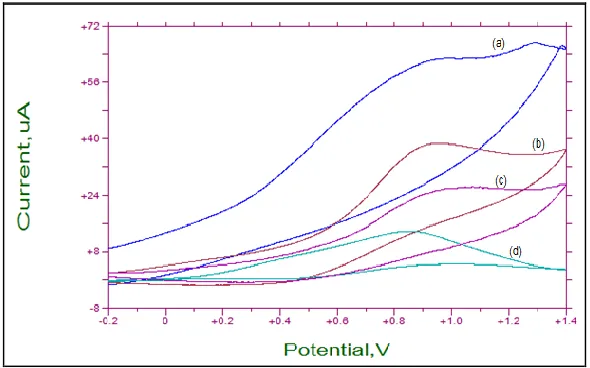
The cyclic voltammograms (CV) of 0.5mM AA in 0.1M KNO3 aqueous electrolyte solution
[image:3.596.151.446.446.630.2]were obtained with a potential scanning at a positive direction over the potential range of -200mV to +1400mV at a scan rate of 100mVs-1 for modified and bare GCE versus Ag/AgCl (Fig, 1). CV recorded for all the electrodes appear to be irreversible.
Figure 1. CV of 0.5mM AA in 0.1M KNO3 at the (a) MgB2-MWCNT/GCE, (b) MWCNT/GCE, (c)
MgB2/GCE and (d) bare GCE (against RE; scan rate 100mVs-1)
AA oxidation current enhancement was detected when using MWCNT/GCE and MgB2
-MWCNT/GCE with enhancement factor of 1.5 and 1.7, respectively. However, it was noted that the peak potential shifted negatively towards the origin by about 86mV when using the MgB2
shift observed in the overpotential and the enhancement of the oxidation current signifies that the MgB2-MWCNT/GCE possess a good electrocatalytic activity towards the AA oxidation.
The oxidation of AA has been widely agreed to follow the EC mechanism and the reaction pathway is shown below (Equations 1and 2). The process involves the loss of two electrons and the final species is electro inactive, which explains the absence of peak at the reverse scan [42].
(Equation 1)
(Equation 2) 3.2 Effect of pH
The optimum pH for AA oxidation at the MgB2-MWCNT/GC electrode was determined by
conducting pH studies on the supporting electrolyte solution (the unadjusted pH of KNO3 solution is
6.5 ± 0.2). A series of 0.1M KNO3 in the pH range of 3 to 8 ± 0.4 was prepared in order to investigate
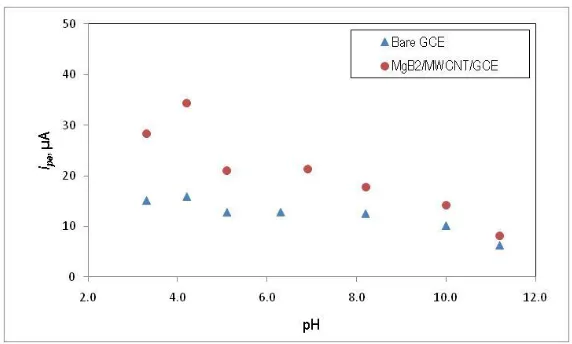
[image:4.596.155.441.509.681.2]the pH effect on the oxidation peak of AA. The pH was adjusted by drop wise addition of 0.1M HCl and 0.1M KOH solutions. At both bare and modified electrode, it was observed that the oxidation current was high in the acidic condition up to pH 4 ± 0.4, indicating the involvement of a proton transfer in the electrode process [43]. The details of AA oxidation in acidic medium which follows the EC mechanism as well as the pathways for the kinetic reaction had been reported by Ruiz et. al [44].
Figure 2. Qxidation current of 0.1mM AA in 0.1M KNO3 at bare and MgB2/MWCNT/GC electrode at
At weakly acidic environment (pH 5 ± 0.4), the current begins to decrease before leveling off as it approaches the neutral point. As the pH continues to increase, a decreasing trend of the peak current starts to be seen for both bare and modified electrode (Figure 2).
This may be contributed by the fact that AA is unstable in basic solution [45] and thus exists in anionic form [46]. There is a possibility that due to the shortage of proton, difficulty of electrochemical reaction arises [47,48] and a repulsive electrostatic interaction occurs between the anions and the modified electrode surface [46]. Since the maximum value of both oxidation current and enhancement factor (Figure 3) for the modified electrode was achieved at pH 4 ± 0.4, therefore, the condition of supporting electrolyte at pH 4 ± 0.4 was used for the following studies.
0.0 0.5 1.0 1.5 2.0 2.5 3.0
2.0 4.0 6.0 8.0 10.0 12.0
E
nha
nc
em
ent
Fa
ct
or
pH
Figure 3. Plot of oxidation current enhancement factor of MgB2-MWCNT/GC electrode over bare
electrode at different pH
3.3 Calibration graph
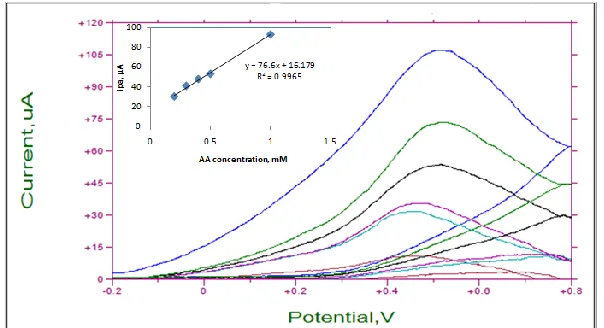
Figure 4. CV of different AA concentration in 0.1M KNO3, pH 4 ± 0.4 at MgB2-MWCNT/GCE
[Inset: Plot of oxidation current versus AA concentration in 0.1M KNO3, pH 4 ± 0.4 at MgB2
[image:5.596.159.438.250.421.2] [image:5.596.148.450.537.701.2]
In order to obtain the detection limit and sensitivity of the MgB2-MWCNT/GC electrode, the
calibration graph of AA was determined (Fig. 4).
A linear response with correlation value of 0.997 which obeys the Randles-Sevcik (Equation 3);
(Equation 3)
Where ip, peak current; n, electron stoichiometry; A, electrode area; D, diffusion coefficient;
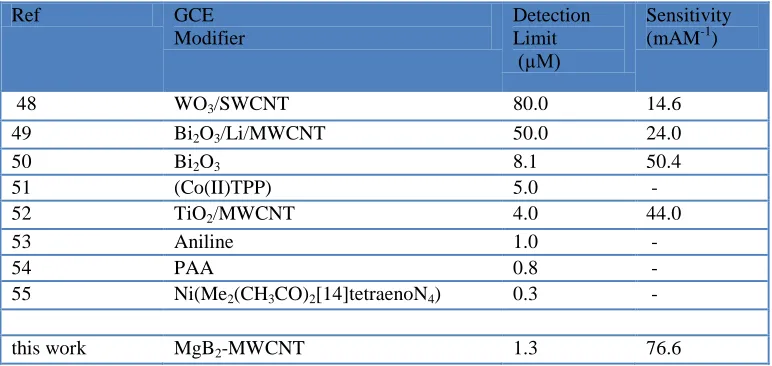
[image:6.596.106.492.326.509.2]C, concentrationand v, scan rate are obtained over a concentration range of 0.2 to 1mM AA. Based on the linear equation slope, a sensitivity response of 76.6mA/M and detection limit of 1.3µM was acquired. This value is comparable to the results reported in literature, where the detection limit ranges from 0.3 to 80µM as tabulated in Table 1.
Table 1. Comparison of the analytical parameters of AA determination at various modified GCE via CV.
Ref GCE
Modifier
Detection Limit (µM)
Sensitivity (mAM-1)
48 WO3/SWCNT 80.0 14.6
49 Bi2O3/Li/MWCNT 50.0 24.0
50 Bi2O3 8.1 50.4
51 (Co(II)TPP) 5.0 -
52 TiO2/MWCNT 4.0 44.0
53 Aniline 1.0 -
54 PAA 0.8 -
55 Ni(Me2(CH3CO)2[14]tetraenoN4) 0.3 -
this work MgB2-MWCNT 1.3 76.6
3.4 Effect of scan rate
Kinetics of the AA oxidation at the electrode surface was examined by conducting a scan rate study. The effect of scan rate on the CV of 0.1mM AA at the MgB2-MWCNT/GCE in 0.1M KNO3 at
pH 4 ± 0.4 was studied. Results show that both the oxidation current and oxidation peak were influenced by the scan rate. The oxidation current increased with scan rate due to heterogeneous kinetics, where as the oxidation peak shifted towards a more positive potential indicating the existence of kinetic limitation in the reaction between the redox sites of MgB2-MWCNT film and AA
Figure 5. CV of AA in 0.1M KNO3, pH 4 ± 0.4 at MgB2-MWCNT/GCE with different scan rate
[Inset: Plot of oxidation current versus the square root of scan rate for 0.1mM AA in 0.1M KNO3, pH 4 ± 0.4 at MgB2-MWCNT/GCE]
A straight line is obtained from the plot of log oxidation current versus log scan rate yielding an equation of y = 0.572x + 0.236 with an R2 = 0.994 (Fig. 6). A slightly higher slope value than the theoretical value of 0.53 is due to pure diffusion control process [58]. This suggests the presence of weak AA adsorption occurring simultaneously along with AA diffusion in controlling the anodic process [59].
y = 0.5722x + 0.2364 R² = 0.9942
0.00 0.50 1.00 1.50 2.00
0.00 0.50 1.00 1.50 2.00 2.50 3.00
Log
ipa
[image:7.596.148.453.70.239.2]Log ѵ
Figure 6. Plot of log oxidation current versus log of scan rate for 0.1mM AA in 0.1M KNO3, pH 4 ±
0.4 at MgB2-MWCNT/GCE
3.5 Effect of temperature
The effect of temperature on the conductivity of both bare and MgB2-MWCNT/GCE was
[image:7.596.148.449.422.597.2]
This is due to the elevation of diffusion rate at higher temperature level which caused current increment.
The relationship between the diffusion coefficient and temperature is indicated by the Arrhenius equation (Equation 4).
(Equation 4)
where D is diffusion, D0 is initial diffusibility, Ea is the activation energy, R is the specific gas constant at 8.314 J K-1mol-1 and T is temperature in degrees Kelvin. The activation energy for the diffusion of AA can further be determined by taking the logarithm of Equation 4 and, hence, Equation 5;
(Equation 5)
A linear relationship of plot log oxidation current of AA versus the reciprocal of temperature for both bare and modified electrode was obtained (Fig. 7). From the slope the activation energy for the diffusion of AA on the modified electrode was found to be 2.7kJmol-1 which is about 60% of the activation energy (4.2kJmol-1) required for diffusion of AA on the bare electrode. This further strengthens the evidence of electrocatalytic ability of the MgB2-MWCNT/GCE. However, this value
is quite low compared to the other modified GCE [50,52]. Presumably, this is due to nature of the materials used to modify the GCE and also the different matrix in the cell itself.
[image:8.596.113.485.475.697.2]
3.6 Reproducibility
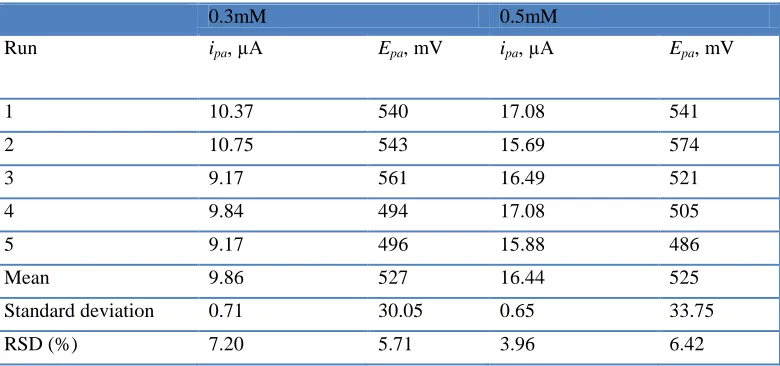
For this study, measurements were made at fresh surface of modified electrode. The process was repeated five times, where the electrolyte solution was unchanged and its condition was kept constant. The study was also carried out on real life sample using expired Vitamin C tablet obtained from a local clinic, originally containing 500mg of AA. The tablet was dissolved and later diluted to 0.3mM and 0.5mM. Table 2 and Table 3 show that a mean enhancement factor of 1.93 was obtained with a %RSD of 4.16%. Reproducibility was also good for both oxidation current and oxidation peak, where the %RSD obtained from all three data sets are in the range of 4–7% and 2–6% respectively. These results further confirm the 2 fold enhancement factor of the MgB2-MWCNT/GCE over the bare
electrode.
Table 2. Reproducibility data of 0.1mM AA determined using MgB2-MWCNT/GC electrode under
optimized conditions in 0.1M KNO3 at pH 4 ± 0.4 (Bare electrode ipa = 6.3µA)
Run ipa, µA Epa, mV Enhancement
Factor
1 12.90 468 2.0
2 11.60 487 1.8
3 11.80 482 1.9
4 12.30 496 2.0
5 12.30 475 2.0
Mean 12.18 482 1.93
Standard deviation 0.51 10.78 0.08
RSD (%) 4.16 2.24 4.16
Table 3. Detection of AA in expired Vitamin C tablets (originally containing 500mg AA) using MgB2/MWCNT/GC electrode in 0.1M KNO3 at pH 4±0.4
0.3mM 0.5mM
Run ipa, µA Epa, mV ipa, µA Epa, mV
1 10.37 540 17.08 541
2 10.75 543 15.69 574
3 9.17 561 16.49 521
4 9.84 494 17.08 505
5 9.17 496 15.88 486
Mean 9.86 527 16.44 525
Standard deviation 0.71 30.05 0.65 33.75
[image:9.596.115.483.320.488.2] [image:9.596.105.495.554.737.2]
3.7 Recovery Study of AA in Vitamin C Tablet and Fruit Juice
The detection ability of the MgB2-MWCNT/GCE on AA was validated using real life samples
of both known and unknown concentration. For the sample with known concentration, Chewies Vitamin C tablet containing 100mg of AA was dissolved in 100mL of DI water and mixed with a ratio of 1:9 to the supporting electrolyte solution; whereas for the sample with unknown concentration, Marigold Peel Fresh Orange Juice was mixed with a ratio of 1:1 to the supporting electrolyte solution. The standard addition method was applied using a stock solution of 0.1M AA. Five replicate were carried out for each sample and the results are shown in Table 4 and Table 5. A good recovery rate of 100.7 ± 4.01% (for 0.57mM AA) and mean concentration of 3.8mM ± 4.35% was obtained (for concentration of AA in orange juice) indicating a high reliability of the modified electrode detection ability.
Table 4. Recovery rate of AA in 0.57mM Chewies Vitamin C Tablet, determined using MgB2
-MWCNT/GCE in 0.1M KNO3 at pH 4 ± 0.4 Real life sample Recovered concentration (mM) Recovery rate (%) Mean recovery (%) Standard Deviation RSD (%)
1 0.60 105.3 100.7 4.0 4.01
2 0.54 94.7
3 0.59 103.5
4 0.57 100.0
5 0.57 100.0
Table 5. Recovery of AA in Marigold Peel Fresh Orange Juice, determined using MgB2
-MWCNT/GCE in 0.1M KNO3 at pH 4 ± 0.4 Real life sample Concentration (mM) Mean concentration (mM) Standard Deviation RSD (%)
1 3.9 3.8 0.164 4.35
2 3.9
3 3.8
4 3.5
5 3.8
4. CONCLUSIONS
The fabrication of MgB2-MWCNT/GCE was successfully done via mechanical attachment
[image:10.596.104.493.324.464.2] [image:10.596.104.489.536.633.2]
MWCNT/GCE to other analytes proves to be promising and can be further explored. This is the subject of the next report.
ACKNOWLEDGEMENT
The authors wish to thank Universiti Putra Malaysia for providing research facility and financial support for the accomplishment of this work.
References
1. H.R.Zare and N.Nasirizadeh, J. Iran. Chem. Soc., 8 (2011) S55 2. S.M.Macha and A.Fitch, Mikrochimica Acta,128 (1998) 1
3. P.J.Britto, K.S.V.Santhanam and P.M.Ajayan, Bioelectrochemistry and Bioenergetics, 41(1) (1996) 121
4. C.Hu and S.Hu, Journal of Sensors, 2009 (2009)
5. L.Agüí, P.Yá˜nez-Sede˜no and J.M.Pingarrón, Anal. Chim. Acta, 622 (2008) 11
6. G.A.Rivas, M.D.Rubianes, M.C.Rodr´ıguez, N.F.Ferreyra, G.L.Luque , M.L.Pedano, S.A.Miscoria and C.Parrado, Talanta 74 (2007) 291
7. A.J.S.Ahammad, J.J.Lee and M.A.Rahman, Sensors, 9 (2009) 2289 8. S.Lu, Microchemical Journal, 77(1) (2004) 37
9. C.L.Scott and M.Pumera, Electrochemistry Communications, 13 (2011) 426
10.P.Santhosh, K.M.Manesh, A.Gopalan and K.P.Lee, Sens. Actuat. B-Chem., 125 (2007) 92 11.M.M.Radhi, W.T.Tan, M.Z.A.Rahman and A.B.Kassim, Oriental Journal of Chemistry, 26(3)
(2010)805
12.M.Musameh, J.Wang, A.Merkoci and Y.Lin, Electrochemistry Communications 4 (2002) 743 13.D.Yang, L.Zhu and X.Jiang, Journal of Electroanalytical Chemistry 640 (2010) 17
14.S.Sajjadi, H.Ghourchian and P.Rahimi, Electrochimica Acta, 56(26) (2011) 9542
15.Y.H.Zhu, Z.L.Zhang and D.W.Pang, Journal of Electroanalytical Chemistry 581 (2005) 303 16.Y.H.Zhu, Z.L.Zhang, W.Zhao and D.W.Pang, Sensors and Actuators B 119 (2006) 308
17.Z.A.Alothman, N.Bukhari, S.M.Wabaidura and S.Haiderb, Sensors and Actuators B 146 (2010) 314
18.H.F.Cui, J.S.Ye, W.D.Zhang, J.Wang and F.S.Sheu, Journal of Electroanalytical Chemistry, 577(2) (2005) 295
19.X.Kang, Z.Mai, X.Zou, P.Cai and J.Mo, Analytical Biochemistry, 363 (2007) 143 20.S.Buratti, B.Brunetti and S.Mannino, Talanta, 76(2) (2008) 454
21.M.Asgari, M.G.Maragheh, R.Davarkhah and E.Lohrasbi, J. Electrochem. Soc., 158(12) (2011) K225
22.H.F.Cui, J.S.Ye, X.Liu, W.D.Zhang and F.S.Sheu, Nanotechnology, 17 (2006) 2334
23.Y.Zhao, Y.Yifeng, L.Z.Fan, Y.F.Qiu and S.H.Yang, Electrochimica Acta, 52(19) (2007) 5873 24.A.Liu, T.Watanabe, I.Honma, J.Wang and H.Zhou, Biosensors and Bioelectronics 22 (2006) 694 25.J.Zeng, X.Gao, W.Wei, X.Zhai, J.Yin, L.Wu, X.Liu, K.Liu and S.Gong, Sensors and Actuators B,
120 (2007) 595
26.C.Zhang, G.Wang, M.Liu, Y.Feng, Z.Zhang and B.Fang, Electrochimica Acta, 55 (2010) 2835 27.S.Palanisamy, S.Cheemalapati and S.M.Chen, Analytical Biochemistry, 429(2) (2012) 108 28.Y.Q.Tian, N.B.Li and H.Q.Luo, Electroanalysis, 21(23) (2009) 2584
29.J.Nagamatsu, N.Norimasa, T.Muranaka, Y.Zenitani and J.Akimitsu Nature, 410 (2001) 63 30.C.Buzea and T.Yamashita, Supercond. Sci. Technol., 14 (2001) R115
33.R.B.King, Polyhedron, 21(23) (2002) 2347
34.Z.Ivanov, A.Malisa, L.G.Johansson and P.V.Komissinski, Physica C: Superconductivity, 372– 376(2002) 1274
35.S.L.Bud’ko, P.C.Canfield and V.G.Kogan, Physica C: Superconductivity, 382(1) (2002) 85 36.C.Portesi, S.Borini, G.B.Picotto and E.Monticone, Surface Science, 601(1) (2007) 58
37.C.E.J.Dancer, P.Mikheenko, A.Bevan, J.S.Abell, R.I.Todd and C.R.M.Grovenor, Journal of the European Ceramic Society, 29(9) (2009) 1817
38.Q.M.Nie, J.P.Lv and Q.H.Chen, Physics Letters A, 374(4) (2010) 655 39.G.Ravikumar and J.V.Yakhmi, Functional Materials (2012) 261
40.W.T.Tan, F.Yusri and Z.Zainal, Sensors & Transducers Journal, 104(5) (2009) 119
41.M.Zidan, W.T. Tan, A.H.Abdullah, Z.Zainal and G.J.Kheng, E-Journal of Chemistry 8(2) (2011) 553
42.W.Qi, A.Geiger, R.Frias and T.D.Golden, Chem. Educator, 5 (2000) 58
43.S.Yilmaz, M.Sadikoglu, G.Saglikoglu, S.Yagmur and G.Askin, Int. J. Electrochem. Sci., 3 (2008) 1534
44.J.J. Ruiz, A.Aldaz and M.Dominguez, Can. J. Chem., 55 (1977) 2799 45.L.Zhang and J.Lian, Journal of Electroanalytical Chemistry, 611 (2007) 51 46.B.Habibi and M.H.Pournaghi-Azar, Electrochimica Acta, 55 (2010) 5492 47.B.Zeng, S.Wei, F.Xiao and F.Zhao, Sens. Actuators B, 115 (2006) 240
48.K.S.Ngai, W.T.Tan, Z.Zainal, R.M.Zawawi and M.Zidan, Int. J. Electrochem. Sci., 7 (2012) 4210 49.M.Zidan, W.T.Tan, Z.Zainal, A.H.Abdullah and J.K.Goh, Int. J. Electrochem. Sci., 5 (2010) 501 50.M.Zidan, W.T.Tan, A.H.Abdullah, Z.Zainal and J.K.Goh, Int. J. Electrochem. Sci., 6 (2011)289 51.C.X.Li, Y.L.Zeng, Y.J.Liu and C.R.Tang, Anal Sci., 22(3) (2006) 393
52.P.Ganchimeg, W.T.Tan, N.A.Yusof and J.K.Goh, Journal of Applied Sciences, 11(5) (2011) 848 53.I.G.Casella and M.R.Guascito, Electroanalysis, 9(18) (1997) 1381
54.Y.Zhang, S.Su, Y.Pan, L.Zhang and Y.Cai, Ann Chim., 97(8) (2007) 665 55.M.Khorasani-Motlagh and M.Noroozifar, Anal Sci., 19(12) (2003) 1671
56.Y.H.Zhao, C.M.Zhang, T.Liu, Q.Q.Du, J.Zhang, S.Liang and X.J.Wang, Int. J. Electrochem. Sci., 7 (2012) 6417
57.J. B.Raoof, R.Ojani and H.Beitollahi, Int. J. Electrochem. Sci., 2 (2007) 534
58.O.Gilbert, B.E.Kumara Swamy, U.Chandra and B.S.Sherigara, Int. J. Electrochem. Sci., 4 (2009) 582
59.P.M.Ndangili, A.N.Jijana, R.A.Olowu, S.N.Mailu, F.R.Ngece, A.Williams, T.T.Waryo, P.G.L. Baker and E.I.Iwuoha, Int. J. Electrochem. Sci., 6 (2011) 1438
![Figure 5. CV of AA in 0.1M KNO3, pH 4 ± 0.4 at MgB2-MWCNT/GCE with different scan rate [Inset: Plot of oxidation current versus the square root of scan rate for 0.1mM AA in 0.1M KNO3, pH 4 ± 0.4 at MgB2-MWCNT/GCE]](https://thumb-us.123doks.com/thumbv2/123dok_us/1917455.150649/7.596.148.449.422.597/figure-mwcnt-different-oxidation-current-versus-square-mwcnt.webp)