This is a repository copy of Translanguaging space and creative activity : theorising collaborative arts-based learning.
White Rose Research Online URL for this paper: http://eprints.whiterose.ac.uk/147929/
Version: Accepted Version
Article:
Bradley, J. orcid.org/0000-0002-4232-1983, Moore, E., Simpson, J. et al. (1 more author) (2018) Translanguaging space and creative activity : theorising collaborative arts-based learning. Language and Intercultural Communication, 18 (1). pp. 54-73. ISSN 1470-8477 https://doi.org/10.1080/14708477.2017.1401120
This is an Accepted Manuscript of an article published by Taylor & Francis in Language and Intercultural Communication on 20 November 2017, available online:
http://www.tandfonline.com/10.1080/14708477.2017.1401120.
[email protected] https://eprints.whiterose.ac.uk/ Reuse
Items deposited in White Rose Research Online are protected by copyright, with all rights reserved unless indicated otherwise. They may be downloaded and/or printed for private study, or other acts as permitted by national copyright laws. The publisher or other rights holders may allow further reproduction and re-use of the full text version. This is indicated by the licence information on the White Rose Research Online record for the item.
Takedown
If you consider content in White Rose Research Online to be in breach of UK law, please notify us by
This is a repository copy of Translanguaging space and creative activity: theorising collaborative arts-based learning.
White Rose Research Online URL for this paper: http://eprints.whiterose.ac.uk/147929/
Version: Accepted Version
Article:
Bradley, J orcid.org/0000-0002-4232-1983, Moore, E, Simpson, J et al. (1 more author) (2018) Translanguaging space and creative activity: theorising collaborative arts-based learning. LANGUAGE AND INTERCULTURAL COMMUNICATION, 18 (1). pp. 54-73. ISSN 1470-8477
https://doi.org/10.1080/14708477.2017.1401120
[email protected] https://eprints.whiterose.ac.uk/
Reuse
Items deposited in White Rose Research Online are protected by copyright, with all rights reserved unless indicated otherwise. They may be downloaded and/or printed for private study, or other acts as permitted by national copyright laws. The publisher or other rights holders may allow further reproduction and re-use of the full text version. This is indicated by the licence information on the White Rose Research Online record for the item.
Takedown
If you consider content in White Rose Research Online to be in breach of UK law, please notify us by
Translanguaging space and creative activity: Theorising collaborative arts-based
learning
Jessica Bradley
University of Leeds
School of Education
Leeds
LS2 9JT
United Kingdom
Email address: [email protected]
Tel number: +44 (0)113 343 4545
Emilee Moore
University of Leeds
School of Education
Leeds
LS2 9JT
United Kingdom
Email address: [email protected]
Tel number: +44 (0)113 343 4545
and
Universitat Autònoma de Barcelona
Faculty of Education
Bellaterra
08193
Spain
Email address: [email protected]
Tel number: +34 93 581 2637
University of Leeds
School of Education
Leeds
LS2 9JT
United Kingdom
Email address: [email protected]
Tel number: +44 (0)113 3434687
Louise Atkinson
University of Leeds
School of Fine Art, History of Art and Cultural Studies
Leeds
LS2 9JT
United Kingdom
Email address: [email protected]
Corresponding author
Jessica Bradley
Funding
The project was possible thanks to funding from the Educational Engagement Social
Sciences Cluster at the University of Leeds as part of the institution’s engagement
with children and young people. It led from research undertaken by the UK Arts and
Humanities Research Council “Translation and Translanguaging: Investigating Linguistic and Cultural Transformations in Superdiverse Wards in Four UK Cities”
(TLANG) project.
Disclosure statement
The authors hereby declare that they have no conflicts of interest in relation to the
submitted manuscript.
Biographical notes
Jessica Bradley is doctoral researcher for the TLANG project in the School of
Education and visiting researcher in the School of Fine Art, History of Art and
Cultural Studies at the University of Leeds. Her research focuses on multilingual and
multimodal practices in community arts and her doctoral research traces the trajectory
of a text as it is developed into a street arts production. She has interests in
co-production and collaboration with artists and creative practitioners in the field of
language and communication research. She has project managed and researched
multiple arts-based co-produced projects including with refugees in West Yorkshire.
Emilee Moore is Serra Húnter Fellow at the Universitat Autònoma de Barcelona and
a postdoctoral researcher in the Beatriu de Pinós program (Generalitat de Catalunya),
affiliated with the TLANG project at the University of Leeds. She studies
interactional practices in multilingual and multicultural contexts from a perspective
integrating linguistic ethnography, interactional sociolinguistics, ethnomethodology
and sociocultural theories.
James Simpson is a Senior Lecturer in Language Education at the University of
Leeds, and is a co-investigator on the TLANG project. As well as his work on
TLANG his research interests are the teaching and learning of English for
technology in the developing world. He is developing research interests in
participatory arts and language learning.
Louise Atkinson is a visual artist, curator, and researcher who completed a
practice-based PhD in the School of Fine Art, History of Art and Cultural Studies at the University of Leeds in 2016. Her work is based on ideas of appropriation as interpretation and how these relate to collecting in museum and art practice. She is also interested in exploring co-production and cross-cultural understanding in and through material culture.
Translanguaging space and creative activity: theorising collaborative arts-based
learning
Abstract
This paper focuses on an innovative transdisciplinary educational arts-based learning project, LangScape Curators (LS-C), which links to and leads from research conducted for the AHRC-funded ‘Translation and Translanguaging’ (TLANG) project. Here we describe how we work collaboratively with creative practitioners to use a variety of creative arts methods with young people to explore the linguistic landscapes of Leeds. We propose a theoretical framework for collaborative research activity of this nature, and we use one of the creative arts activities – collage – to exemplify visual
understandings of how communicative repertoires and linguistic landscapes are explored through co-produced pedagogical workshops. The programme and its associated research make an original contribution to linguistic landscape-based collaborative ethnography. We conclude by setting out directions for the future of these activities and their application in applied linguistics research and practice.
Key words: linguistic landscape, collaborative ethnography, arts based methods,
translanguaging, superdiversity
1. Introduction
In this paper we focus on a transdisciplinary educational arts project linked to and
leading from the AHRC-funded project, Translation and Translanguaging:
Investigating Linguistic and Cultural Transformations in Superdiverse Wards in Four
UK Cities (TLANG)i, a large-scale multi-site linguistic ethnographic study of urban
multilingualism. LangScape Curators (LS-C) is a programme aimed at young people
which uses creative practice and arts based methods to develop critical thinking and
analytical skills across a range of core curriculum areas (Literacy, Geography,
Modern Languages, History, Art and Design) through encouraging young people to
become ethnographic researchers in the streets of their communities. It builds on and
develops linguistic ethnographic research methodologies (Copland & Creese, 2015;
Blackledge & Creese et al., 2017) used within the TLANG project (for example,
observation, interviews, photography, linguistic landscape-based research). Taking
research into the multilingual linguistic landscape (for example, Blommaert, 2013) as
its starting point, the LS-C programme invites young people to explore and analyse
their own spaces and places in non-formal workshop settings. Here we propose and
research activity, focusing on one of the creative arts workshop activities – collage –
to highlight the role of the creative arts in building spaces for dynamic communicative
practices.
Our description of the creative arts collage activity enables us to explain how the
concept of translanguaging space (Li Wei, 2011), in combination with collaging
practices that we draw upon in the workshops, converge and inform our work.
Towards the end of the paper we provide a pathway for developing the project further,
suggesting that LS-C enables new innovative ways to consider the affordances of
arts-based methods and practice in language pedagogy and in collaborative research
practice with young people (Hackett, Pahl & Pool, 2017).
2. Background: LangScape Curators
LS-C is an ongoing, transdisciplinary, collaborative engagement project using
arts-based methods to engage young people in thinking about research and in becoming
ethnographic researchers (Atkinson & Bradley, 2017; Simpson & Bradley, 2017;
Bradley, Moore & Atkinson, 2016; Bradley, Moore & Simpson, 2016; Bradley, 2016;
Bradley, 2017). The activities are carried out in two neighbourhoods in one of the
UK’s largest cities, Leeds, working with a third sector organisation, IntoUniversityii, and through the educational engagement team for social sciences at the University of
Leeds. IntoUniversity provides learning centres for children and young people of
primary age (7-11 years old) and secondary school age (11-18 years old) in areas of
lower progression to university, aiming to raise educational achievement and
aspirations towards higher education through working in partnership with Russell
Group universitiesiii. The two Leeds-based centres, in the neighbourhoods of Harehills
(Leeds-East) and Beeston (Leeds-South), work with the University of Leeds to
develop and run multidisciplinary programmes of activities in addition to providing
homework support. The LS-C project stems from TLANG, a large-scale multi-site
linguistic ethnographic study of urban multilingualism. Within the Leeds-based team
there was strong interest in exploring ways of engaging young people through
educational workshops, leading on from the emergent research findings of TLANG
2015) that the larger project followed. We developed LS-C in dialogue with the centre
managers and the educational engagement clusters for arts and social sciences at the
University of Leeds as a way to extend the TLANG research and work with people
across the city. It is designed to bring together different practitioners and researchers
into a community of experts, following the structure of the TLANG project itself
(Blackledge & Creese et al., 2017).
One research area of focus for TLANG is the study of the linguistic landscape of the
four cities which are the case study sites (Birmingham, Cardiff, Leeds and London)
(Callaghan, 2015, 2016). For LS-C we worked in collaboration with artist-researchers
to develop a programme of arts-based activities which enabled young people to
explore their local communities in the same ways that ethnographic linguistic
landscape researchers might, but extending that approach by using creative inquiry to
synthesise, analyse, and create artefacts which were then used to present their
findings.
The three central TLANG project research themes were woven into LS-C as
epistemological touchstones. Our notion of translation considers the translating of
research for young people and its retranslation back into research. Translanguaging is
a socilinguistic concept referring to the dynamic multilingualism characteristic of
contemporary life in linguistically and culturally diverse environments. It was
included because it sheds light on how the project values and promotes the young
people’s deployment of the full range of their linguistic and communicative
repertoires and those encountered in the immediate surroundings of the IntoUniversity
centres. It also takes a multimodal approach to translanguaging (Kusters et al., 2017;
Blackledge & Creese, 2017; Bradley & Moore, 2018), extending beyond ‘language’
towards the multimodal (Pennycook, 2017). LS-C engages with the notion of
trans-space (García & Li Wei, 2014) through the design of a programme of workshops
which move between and beyond bounded structures, disciplines and practices.
Finally, superdiversity, following Steven Vertovec (2007), was introduced to draw the
focus of the project and young people’s attention to the increasing diversity of
societies brought about by demographic and technological changes. Participants were
encouraged to analyse the changing semiotic environments and consider the reasons
3. Theoretical Framework and Methodological Approaches
Here we set out the broad theoretical framework and methodological approaches
underpinning the rationale and methodology for LS-C: linguistic landscapes,
ethnographic approaches to the linguistic landscape, translanguaging space, collage,
collaborative ethnography and co-production and interdisciplinarity.
3.1. Linguistic landscape
Our starting point for LS-C is the linguistic, or, following Adam Jaworski and Crispin
Thurlow (2010, p. 1), semiotic landscape as a site for the “interplay between
language, visual discourse, and the spatial practices and dimensions of culture”. Building on the idea that ‘landscape’ is a “way of seeing the external world” (Berger, 1972 in Jaworksi & Thurlow, 2010, p. 3), the LS-C project has, as with the research
area in general, the broad aim of developing deeper understanding of “how we view
and interpret space in ways that are contingent on geographical, social, economic,
legal, cultural and emotional circumstances” (ibid). Alastair Pennycook suggests that current translanguaging approaches to the linguistic landscape (e.g. Gorter & Cenoz,
2015) have mainly sought to consider linguistic landscapes through a translanguaging
lens, in contrast to drawing complex semiotic landscapes into translanguaging (2017,
p.270). The choice of activities within the LS-C programme (see section four) seek to
consider communicative repertoires (Rymes, 2014) as internal and external, therefore
bridging the border between the individual idiolect and the ‘multilingual and
multimodal repertoire’ of the linguistic landscape itself (Gorter & Cenoz, 2015, p.71, in Pennycook, 2017, p.270).
Working with young people in the neighbourhoods in which they live, which are also
the neighbourhoods in which we carry out our research or ones with similar
characteristics, we focused on the idea of ‘home’. Home is, as Jaworski and Thurlow
explain, drawing from Entrikin (1991) and Johnstone (2004), ‘inevitably bound up
with specific geographical locations which we come to know and experience both
sensually and intellectually’ (2010, p.7). The programme responds to researcher
interests in exploring ways of engaging young people through educational workshops,
ethnographic methodologies (Copland & Creese, 2015; Rampton, Maybin & Roberts,
2015) that the larger project followed.
3.2. Ethnographic approaches to linguistic landscape
Jan Blommaert maintains that an ethnographic approach to the linguistic landscape
entails observing ‘signs as traces of multimodal communicative practices within a socio-politically structured field which is historically configured’ (2016, para. 4).
Further to Blommaert’s critiques of certain areas of linguistic landscape research, and
as explained by Callaghan (2016), researching the visual can risk a slip into
superificiality. However, when combined with ethnographic enquiry, significant
social trends may be illuminated. Ethnographic approaches to linguistic landscaping,
we argue, allow for hidden and perhaps stigmatised communicative repertoires, often
those of linguistic minority groups, to be foregrounded. They allow everyday semiotic
practices of diverse individuals to become “‘real’, more credible, more viable as
objects of policy and activism, more present as everyday realities that touch our lives
and dynamically shape our futures” (Gibson-Graham, 2008, p.9). We see
ethnographic linguistic landscaping work as potentially being strongly connected to
what feminist economic geographers Katherine Gibson and Julie Graham (2008) refer
to as a performative ontological project (Moore, Bradley & Simpson, 2018
forthcoming). This means seeing knowledge as always in a process of being and
becoming, and of considering scholars as privileged actors in this process of
(re)inscribing meanings onto the world (Gibson-Graham, 2008, p.25). Such
re-inscription is what we believe creative practices, such as collage, have enabled in the
LS-C workshops.
3.3. Translanguaging space
In planning the workshops and considering the communicative repertoires students
encounter within and beyond educational spaces, the notion of translanguaging space
(Li Wei, 2011; García & Li Wei, 2014; Zhu Hua, Li Wei & Lyons, 2017) offers a
conceptual lens. Li Wei (2011, p. 1223) describes translanguaging spaces as spaces
Through engaging with different artistic practices and through this paper, we explore
mechanisms for the creation of these spaces.
Using the concept of translanguaging space, we demonstrate how collage works as a
creative activity to create and build a fluid multilingual space, as a methodological
tool for synthesis of research findings, as a lens for visualising creativity and
criticality (Li Wei, 2011, p.1222), and as a potential shared means of communication.
Through analysis of the collaging process and resultant collage products, we focus
firstly on the methods and processes involved, and secondly on the creation and
building of a creative positive translanguaging space (Bradley & Simpson, 2018). We
consider this work in terms of a dialogic process (Bakhtin, 1981) of engagement with
and through transdisciplinary research. This dialogic process takes place both between
the multidisciplinary research team and the project participants themselves, and
between the artistic practice and ethnography, which are brought into contact.
Translanguaging space is a useful starting point for interdisciplinary investigations
around communicative repertoire in creative arts settings. If translanguaging space
allows for criticality and creativity by using linguistic difference as a resource, our
focus here is also on the development of a ‘shared language’ (see for example,
Sandrine Eschanauer and Joelle Aden’s research into translanguaging and theatre, e.g.
Eschanauer, 2014; Aden, 2014). This moves the focus away from the individual
idiolect (Otheguy, García & Reid, 2015) and towards the development of a shared
3.4. Collage
Collage, from the French ‘coller’ (to stick), has been considered ‘art’ since the early
20th century (Butler-Kisber, 2010, p.102) and was embedded into the programme
design as a method of inquiry (Yuen, 2016) which enabled ‘simultaneous analysis, synthesis and representation’ (p.338). In recent years, as Lynn Butler-Kisber explains, collage has been developed in qualitative research as an experimental way to integrate
visual approaches (2010, p.102). In Felice Yuen’s participatory action research
project with aboriginal women in Canada, collage was demonstrated to have ‘the
potential to communicate a poignant and evocative message, thereby contributing to
creating a strong platform for social justice’ (2016, p.338). In Yuen’s findings from
creating collage in health research, the collage process and the resultant artefacts
elicited a ‘sensory response’ for those creating the works and for the viewers of the collages. Kate Pahl describes collage in her research in literacies with communities as
working to ‘build up a picture that was alive with experiences’ (2014, p.59). Collage
as method enables participants to draw together whatever is to hand, creating visual
‘texts’. The process itself, as a ‘process of engagement’ is as Pahl describes, ‘a gathering together of modes in an ensemble of meaning making’ (p.59). This complements Butler-Kisber’s understandings of collage in qualitative inquiry:
collage clusters can help to conceptualize dimensions of understanding that
were previously unconscious, and how collage creation can be a way of
making thoughts concrete, facilitating the thinking, writing and talking about
the inquiry.
(2010, p.102)
Collage was developed within the programme design to draw from artistic practice, to
develop a process of engagement with the linguistic landscape and to facilitate the
process of making thoughts and ideas concrete. The collaging process involves the
young people using whichever resources they have to hand to synthesise, analyse and
present their research findings, in this way connecting with the concept of a
translanguaging space in which people can draw from their full communicative
3.5. Collaborative ethnography and co-production
The methodology for LS-C is developed from Luke Eric Lassiter’s (2005) scholarship
in ‘collaborative ethnography’. In our work on the TLANG project, we seek to conduct ethnographic research that, as Lassiter (2005, p. 3) states, involves
“collaborative reading and interpretation, between the ethnographer and his or her
interlocutors, of the very ethnographic text itself”. In becoming ethnographers, the
young people are developing research skills across the programme which enables
them to develop their critical reading and analysis of the communities in which they
live and study. Likewise, as workshop facilitators and researchers we are also ‘co
-learners’ (García & Li Wei, 2014, p. 112), and as such we make deliberate steps to disrupt and challenge the hierarchies of research and of the workshop space – for
example, through developing creative activities which are led by the young people
and through the design of the fieldwork which aims to draw out the participants’ own
observations rather than a prescribed set of features. Collage here works as a
collaborative process of engagement with the linguistic landscapes of the surrounding
area, enabling a space to develop an artefact together, sharing responses.
Positioning this work as a performative ontological project means that we consider
the processes of ‘knowledging’ and focus on these as theoretically grounded and also
as inductive. The kinds of research epistemologies embedded throughout LS-C are
developed through co-production (Facer & Enright, 2016; Graham 2016; McKay &
Bradley, 2016) and collaborative, cross-sector work within the broad paradigm of
action research (Facer & Pahl, 2017). In the context of museum studies, Helen
Graham (2016) fuses together two ‘genealogies’ of the concept of co-production to
develop a concept that encompasses ‘community participation’ and ‘more
-than-human participation’. Here we consider this ‘hybrid’ definition as one that enables us to develop understandings of the collaging process and translanguaging spaces within
the project space.
3.6. Interdisciplinarity
Our collage data, in terms of process and the artefacts produced, explores and
co-production and working across disciplines can foster these multilingual spaces of
criticality and creativity. In an edited volume entitled, The Anxiety of
interdisciplinarity (1998), art historian Hal Foster describes the danger of not being
rooted or grounded within one (or two) disciplines: there is the risk of being without a
discipline. Gayatri Spivak also refers to this interdisciplinary anxiety: “the anxiety of
so-called interdisciplinary work is that one computes with the methodological training
of one discipline, however transformed” (1999, p. 213). In working together, and in
recognising and starting from our own varied disciplinary backgrounds, both
academic and practitioner, we aimed to develop a project in which we could all
continue to draw from each other’s experiences and methodological training. In doing
so, we would work across and beyond our disciplines, and in this sense create and
foster a transdisciplinary approach.
4. Workshop Structure
This section sets out the methodology for LS-C. The LS-C workshop programme
from which this paper draws took place at the two IntoUniversity sites over three days
as part of the centre’s ‘Holiday Focus’ activities during the school half-term holidays
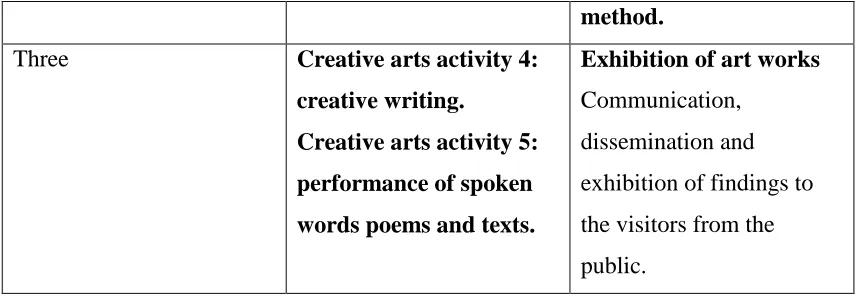
in October 2016 and February 2017. The workshop structure is described below, with
each day starting at 10.30am and finishing at 3pm:
Day AM PM
One Introductions, warm up
activities;
Creative arts activity 1: Group ‘language
portraits’ (following Busch, 2016)
Linguistic landscapes:
street and community
ethnographic research,
interviews in groups.
Two Synthesis, analysis and
communication of
findings.
Creative arts activity 2:
collage as method.
Continuation of synthesis,
analysis and
communication of findings
method.
Three Creative arts activity 4:
creative writing.
Creative arts activity 5:
performance of spoken
words poems and texts.
Exhibition of art works
Communication,
dissemination and
exhibition of findings to
the visitors from the
[image:16.595.84.513.72.220.2]public.
Figure 1: workshop structure
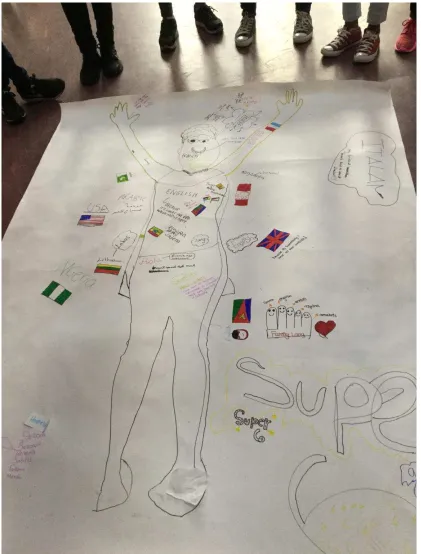
We start the workshops with an introduction to the concept of repertoire, using a
creative method drawing from Brigitta Busch’s (2016) biographical approaches to the
linguistic repertoire. The young people work collaboratively to create life-sized
portraits which represent their shared communicative repertoires. This enables use to
consider multimodality, communication across different media and points of
Figure two: group language portraits
We then conduct ethnographic explorations of the street and surrounding area in small
groups using photography, video and interviewing of community members (e.g.
shopkeepers), to develop understandings of the local semiotic landscapes and the
methodologies and the research conducted by project researchers (e.g. Callaghan,
2015). During the second and third days we work with creative practitioners to
synthesise, analyse and communicate the research findings using visual methods
including collage, zineing, creative writing and performance. At the end of the
three-day workshop, the participants exhibit and talk about their work at a celebration and
sharing event to which parents/carers, other community members and university
teachers and researchers are invited. This is followed by a short presentation session
in which certificates and ‘LangScape Curators’ medals are distributed.
Broadly, the creative arts activities aim to create a space for participants to continue to
investigate and explore their research findings from their own neighbourhoods. The
collage activity is one of five arts-based activities which, in the example given in this
paper, took place during the second day of the three-day workshops, after the young
people had explored the semiotic landscape of the streets in the surrounding area to
the centre (and in which many of the young people live). This data collection activity
involved photography, film and interviews with community members about the
neighbourhood and about their languages. Conducting the ethnographic research
developed the participants’ understanding of and familiarity with their
neighbourhoods. However, the research skills that were being taught and tested out
across this process enabled them to consider how they might make the ‘familiar
strange’ and the ‘strange familiar’ (Rampton, Maybin & Roberts, 2015, following Todorov 1988) as novice ethnographers. In this sense, they became ethnographers
themselves, taking on the role of researchers and developing their critical analytical
skills (for a similar collaborative linguistic landscaping project, see Unamuno &
Patiño, 2017). The exercises that we undertook over the three days were also intended
to open up the participants to new ways of seeing and thinking about these areas.
Therefore, we chose creative methods that would disrupt the ways in which they
would usually inhabit the spaces around them. We encouraged them to see things
differently through using space differently. Considering this through the lens of
translanguaging space allowed us to develop understandings of how the arts methods
would build and enable positive translanguaging spaces of criticality and creativity.
In this section we describe and analyse the collaging process and the artistic products
created through this activity, using a case study from one of the workshops.
In exploring the results of the collage activity in this workshop, we ask:
How we can consider our perspectives of ‘home’ through using collage as
mode, as medium, and linguistic/semiotic landscapes as a prism?
How does this creative practice facilitate activation of and reflexion on
individual and shared communicative repertoires?
How can we develop deeper and richer understandings of the spaces in which we research through engaged practices such as collage, around our research
themes of translation, translanguaging and superdiversity?
And do activities such as collage enable the voices of young people within and
around our research, in terms of extending and developing our ethnographic
methods collaboratively?
These questions inform and frame our work.
4.2. Practice-led research
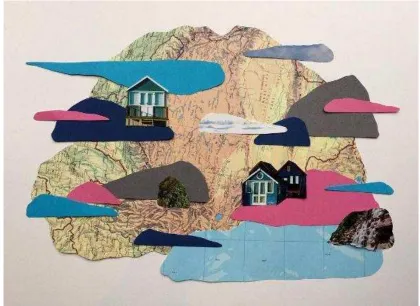
The collage workshop was devised and led by artist-researcher Louise Atkinson and
came from her own creative practice, in which she uses collage to create images
which are reminiscent of a place.
Figure 3: an example of Louise’s collages
In this way the creation of imagery of ‘place’ aligns with Jaworski and Thurlow’s (2010, p. 9) description of place as collective memory:
Imagery of place is, of course, an important resource for diasporic communities
in maintaining their sense of national or ethnic identity and through which to
express their longing and nostalgia for the ‘lost’ homeland.
Louise’s own collage works are created using shapes cut from coloured pieces of paper, interspersed with pictures from travel brochures, to produce images that were
reminiscent of a place. Due to the lack of landmarks or distinguishing features within
the collage pieces, the images cannot (and are not intended to) be identifiable as a
specific location, in this sense producing a ‘web of connections instead of linear ones’
(Butler-Kisber, 2010:105). However, through questioning the young people as to the
nature of the images, they identify a particular type of place, such as countryside,
desert, mountain, etc. This creates a nearness – and a distance – simultaneously.
Through ongoing discussion around Louise’s collages, the young people also
temperatures, suggested by the particular colour palette shown in the image. This
allowed them to consider how they might use different colours in their own collages.
Although the examples shown did not include any text, we encouraged the young
people to think about how they might incorporate texts and photographs, including
those from the linguistic landscaping of the community that they had engaged in, into
their own work.
4.3. Process and products
The students worked in three larger groups for the workshops, which were split into
smaller groups of two or three for the collage activity. The groups were single sex, but
not by project design. On the first day we had put them into mixed groups, but the
centre coordinator had allowed them to change into their chosen groups due to the
workshops taking place as a holiday activity, outside formal school. The participants
split themselves into groups of their own volition, with one group of boys and two
groups of girls.
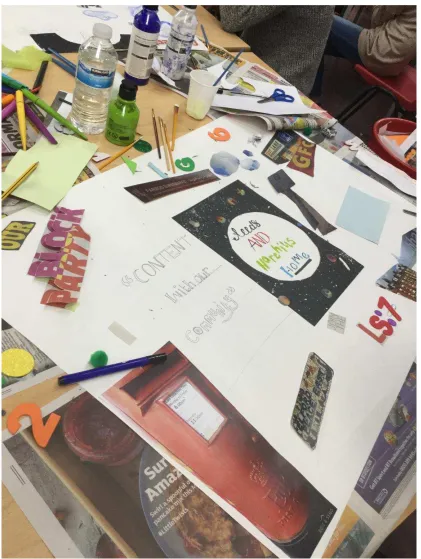
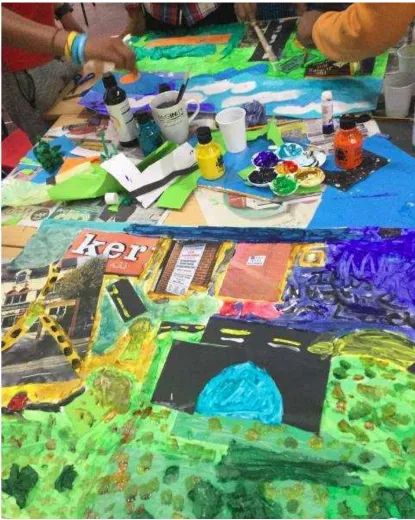
Each group was given a sheet of A1 cartridge paper and a number of photographic
prints of images and text taken from their earlier investigations around their
neighbourhood. They were then encouraged to cut out and collage these images to
create an alternative ‘landscape’, to represent aspects of their neighbourhood, considering the idea of the ‘imagined community’ (Anderson, 1983). Each group
responded differently, some focusing on building up blocks of photographic imagery,
while others created textures with the photographs by tearing the edges and
overlaying different images on top of each other. The transmodality enabled a space
in which new ways of thinking about ‘place’ could be developed, through a process of
engagement with a new method and collaborative collaging. It also enabled a space in
which the broader semiotic landscape could be unpacked and reassembled.
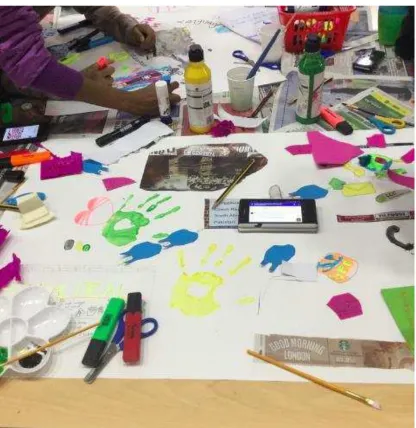
In addition to this, some participants chose to use the photographs as reference
material, meticulously drawing out signs for fast food onto their pages. They also
used their phones as a way of gathering more images related to their interests in the
topic, as sources of additional data, demonstrating the digital literacy practices within
Figure 4: collage in progress
As a way of introducing colour to their work, participants applied cut out shapes from
coloured paper and tissue paper which they also screwed up and glued to the surface
to recreate the greenery of the park which they had seen and worked in earlier in the
another layer of colour into their work. As well as a practical measure, this also
allowed them to develop themes from the text and imagery before deciding how the
[image:23.595.90.505.153.673.2]colour might affect their collages.
Figure 5: collage in progress
The boys’ groups tended towards covering their sheets with colour, creating a rich
imagery of the park and houses surrounded by shops and signs. These works also
Conversely, the girls’ works appeared more analytical, incorporating more
handwritten text and quotes that they had heard and produced throughout the
ethnographic linguistic landscape research period. These works also contained
elements of the multilingualism within the neighbourhood as well as references to
[image:24.595.91.507.191.619.2]their personal interests, such as fashion.
Figure 6: collage in progress
Although this section focuses specifically on the collage element of the workshops,
the previous exercises throughout the programme were clearly evident within the
visual art produced by the participants. This process was facilitated to some extent by
the materials provided, such as the printouts of photographs to be used for collaging.
interviews they had undertaken and images from the language portrait activity that
they had produced on the previous day, without prompting. The process of collaging
therefore enabled participants to synthesise their previous experiences into single
images, allowing them to see the relationship between these elements more easily.
The collage products, once completed, then provided a visual space for
communicating the participants’ findings to a wider audience. The visitors to the celebration and exhibition which concluded the programme were invited to explore
the findings with the young people and to develop their own understandings of the
semiotic landscapes of the neighbourhoods in which we are working.
5. Discussion: Creative Translanguaging Space
So far in this paper we have considered LS-C, an engagement project grounded in
linguistic landscape research and linked to the TLANG research project. We have also
explored ways in which this work connects elements of creative arts practice to the
broad research themes of translanguaging in superdiverse contexts. Our focus here
has been on collage, one of five creative arts workshops within the LS-C programme.
The collage workshops, as we have described above, serves to synthesise the young
people’s own emergent research findings during the process of learning how to be researchers. The collage activity opened up a creative space within which they could
generate ideas and thoughts around their experiences with their semiotic
surroundings, through the collaborative construction of the pieces. It also served to
provide a space of analysis, opening up opportunities for critical engagement with the
semiotic landscapes of the surrounding area.
By working with young people to explore and respond to the linguistic landscape,
developing their ideas through creative arts, this work contributes to:
linguistic landscape research, which should, “bring something unique and
valuable [e.g. young people’s voices and visions] to higher levels of
generalization about societies, their histories, dynamics and structures”
the performative ontological project (Gibson-Graham, 2008) of bringing
everyday communicative repertoires in superdiversity, in particular those
emerging in and from the semiotic landscape, to the forefront of theory
(Blackledge & Creese et al., 2017);
a developing understanding of translanguaging research as an epistemological
project (Moore, Bradley & Simpson, 2018, forthcoming), strongly committed
to new forms of knowledge production and to the transformation of
subjectivities, requiring novel processes, such as transdisciplinary work and
creative co-production with young people;
ethical, methodological practices allowing collaborative spaces for re-imagining and re-constructing the semiotic landscapes inhabited by young
people.
Multimodal translanguaging (Lee, 2015; Kusters et al., 2017) is observed visually
within the collages. We can observe how the different words, different languages and
different visuals combine to construct and produce the pieces, which can be
considered as ‘multimodal artefacts, which carry traces of their making within them’
(Pahl, 2007, p.87). The collage itself, and the act of collaging, enables creative and
critical spaces for mobilising repertoires around the activities, as the participants
developed their ethnographic research into creative arts pieces. Following Tong King
Lee (2015, p. 463), these spaces “constitute a ‘third narrative’ whose existence as a
pristine site of in-betweenness signals the presence of other relatively well-formed
spaces”. The collaging process therefore acts as an example of a site of
in-betweenness, opening up translanguaging spaces through the collaborative creation of
pieces of creative work.
The collages also acted as media to develop a shared ‘language’ within each group as
the participants worked collaboratively on their pieces of work. We see the collages
themselves as spaces which represent fluid multimodality and are iconic of fluid
multilingualism. The collages are spaces which open up for the exploration of
language and of the semiotic landscape. They are vehicles of metacommentary but
they also become objects of metacommentary (Rymes, 2014; Creese, Kaur Takhi &
We now return to the concept of translanguaging spaces and how they can open up,
and be enabled. One of the participants had asked, earlier in the project, whether it
was ok to use her home language, Tigrinya, in the workshop during the periods of
discussion and exploration of individual and shared linguistic repertoires. For us, as
researchers of multilingualism, this question was an important one, as well as a
surprising one, raising further questions about what is perceived and expected in
terms of educational spaces and spaces of multilingualism. Our data, in terms of the
collages represented and discussed in this article, demonstrate the development and
emergence of space during creative workshops – space in which the young people
could consider their languaging practices within the context of their research into the
[image:27.595.90.508.319.605.2]broader superdiverse communities in which they live and attend school.
Figure 7: M’s collage
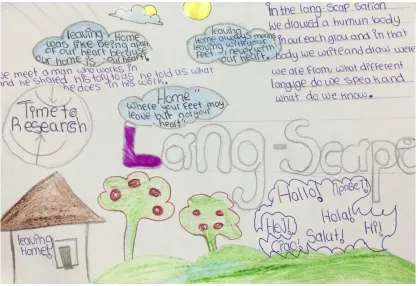
The final image shows a piece of work created by one of the participants during the
evening after the second workshops and brought to the final session. As a multimodal
artefact (Pahl, 2014:59), it demonstrates her learning, her synthesis of her learning
and her analysis of the project themes and processes. It demonstrates what was taken
from the programme by one of the young people, and the generative processes of the
conventional than those previously created within the workshops, showing a more
schooled literacy practice. In a small way it is a multilingual piece, recognising and
exemplifying the process as building positive translanguaging spaces (Bradley &
Simpson, 2018) for creativity and criticality. Here we return to the questions which
underpin this work and consider this in terms of voice, and how voice can be enabled
through developing spaces for criticality and creativity. Collage here, and the
synthesis of the workshops became a stimulus for the participant, and a mode through
which she could express her own voice, making it both audible and visible.
6. Conclusion
This paper described the LS-C research-based arts-based learning programme through
which young people become ethnographic researchers of areas of multilingual
inner-city Leeds. The programme takes the linguistic landscape as its starting point to
develop collaborative ways of conducting research into multilingualism in the street.
We focused on one of the arts-based activities, collage, and considered the concept of
translanguaging space through analysis of the collage process and the resultant
artefacts. In doing so we developed the case for methodologies of this kind as
extending the scope of research into urban multilingualism. Yuen suggests that in
using arts-based methods such as collage in research, in this case collaborative
research with young people, enables us to ‘move beyond the margins’ (2016, p.344). In the case of LS-C, we move beyond the margins in developing ways of working
which enable voices to be made audible and visible, and sketch out the possibilities
for collaborative arts-based research into language and communication which extends
beyond bounded languages and modalities. The collage process and the collages
themselves demonstrate the new meanings and understandings (Norris, 2008, in
Butler-Kisber, 2004, p.104) that develop through collaborative research with young
people in which ‘the research becomes a co-creator and sharer of stories, provocations
and ideas, a facilitator and collaborator’ (Parry, 2015, p.96). This has significant theoretical, epistemological and methodological implications for research of this kind.
Αδεν, ϑ. (2014, Οχτοβερ). Τηεατρε εδυχατιον φορ αν εmπατηιχ σοχιετψ. Παπερ πρεσεντεδ
ατ Ιντερνατιοναλ Χονφερενχε ον Περφορmινγ Αρτσ ιν Λανγυαγε Λεαρνινγ,Ροmε.
Ρετριεϖεδ φροm
ηττπσ://ωωω.αχαδεmια.εδυ/8990132/Τηεατρε_Εδυχατιον_φορ_αν_Εmπατηιχ_Σοχι
ετψ.
Ανδερσον, Β. (1983). Ιmαγινεδ χοmmυνιτιεσ: Ρεφλεχτιονσ ον τηε οριγιν ανδ σπρεαδ οφ
νατιοναλισm. Λονδον & Νεω Ψορκ: ςερσο.
Ατκινσον, Λ. & Βραδλεψ, ϑ. (2017). WΠ23 Μεανινγ mακινγ ανδ χολλαβορατιϖε
ετηνογραπηψ ιν τρανσδισχιπλιναρψ αρτσ. [Ονλινε]. Wορκινγ Παπερσ ιν
Τρανσλανγυαγινγ ανδ Τρανσλατιον. Αϖαιλαβλε ατ:
ηττπ://ωωω.βιρmινγηαm.αχ.υκ/γενεριχ/τλανγ/πυβλιχατιονσ/ινδεξ.ασπξ. [Αχχεσσεδ
5/8/17].
Βακητιν, Μ. (1981). Τηε διαλογιχ ιmαγινατιον: Φουρ εσσαψσ. Εδιτεδ βψ Μ. Ηολθυιστ,
τρανσλατεδ βψ Χ. Εmερσον ανδ Μ. Ηολθυιστ. Αυστιν: Υνιϖερσιτψ οφ Τεξασ Πρεσσ.
Βεργερ, ϑ. (1972). Wαψσ οφ Σεεινγ. Λονδον: ΒΒΧ ανδ Πενγυιν.
Βλαχκλεδγε, Α. & Χρεεσε, Α. (2017). Τρανσλανγυαγινγ ανδ τηε βοδψ. Ιντερνατιοναλ
ϑουρναλ οφ Μυλτιλινγυαλισm, 14(3), ππ.250−268.
Βλαχκλεδγε, Α. & Χρεεσε, Α., ωιτη Βαψνηαm, Μ., Χοοκε, Μ., Γοοδσον, Λ., Λι Wει,
Μαλκανι, Β., Πηιλλιmορε, ϑ., Ροβινσον, Μ., Ροχκ, Φ., Σιmπσον, ϑ., Ταγγ, Χ.,
Τηοmπσον, ϑ., Τρεηαν, Κ., ανδ Ζηυ Ηυα. (2017). WΠ26 Λανγυαγε ανδ
Συπερδιϖερσιτψ: Αν Ιντερδισχιπλιναρψ Περπσεχτιϖε. Ρετριεϖεδ φροm
ηττπ://ωωω.βιρmινγηαm.αχ.υκ/γενεριχ/τλανγ/ινδεξ.ασπξ .
Βλοmmαερτ, ϑ. (2013). Ετηνογραπηψ, Συπερδιϖερσιτψ ανδ Λινγυιστιχ Λανδσχαπεσ:
Χηρονιχλεσ οφ Χοmπλεξιτψ. Βριστολ: Μυλτιλινγυαλ Ματτερσ.
Βλοmmαερτ, ϑ. (2016). Τηε χονσερϖατιϖε τυρν ιν Λινγυιστιχ Λανδσχαπε Στυδιεσ.
Ρετριεϖεδ φροm ηττπ://αλτερνατιϖε−δεmοχραχψ−ρεσεαρχη.οργ/2016/01/05τηε−
χονσερϖατιϖε−τυρν−ιν− λινγυιστιχ−λανδσχαπε−στυδιεσ
Βραδλεψ, ϑ. (2016). Βεψονδ λανγυαγε: Χο−προδυχτιον ανδ χολλαβορατιον ιν λανγυαγε
ρεσεαρχη. Παπερ πρεσεντεδ ατ ΡΕΧΛΑΣ, Υνιϖερσιτψ οφ ϑψϖσκψλ, Φινλανδ,
Dεχεmβερ 2016.
Βραδλεψ, ϑ. & Μοορε, Ε. (2018, φορτηχοmινγ). Ρεσεmιοτισατιον ανδ χρεατιϖε
(εδσ). Μακινγ σιγνσ, τρανσλανγυαγινγ ετηνογραπηιεσ: Εξπλορινγ υρβαν, ρυραλ,
ανδ εδυχατιοναλ σπαχεσ. Βριστολ: Μυλτιλινγυαλ Ματτερσ.
Βραδλεψ, ϑ., Μοορε, Ε. & Σιmπσον, ϑ. (2016). ΛανγΣχαπε Ινϖεστιγατορσ: Βρινγινγ τηε
ουτσιδε ιν. Παπερ πρεσεντεδ ατ Μιγρατιον ανδ Εδυχατιον: Λανγυαγε
Φορεγρουνδεδ χονφερενχε, Υνιϖερσιτψ οφ Dυρηαm, 21−23 Οχτοβερ
Βραδλεψ, ϑ., Μοορε, Ε., & Ατκινσον, Λ. (2016). Τρανσλανγυαγινγ χρεατιϖιτψ: χρεατινγ
σπαχεσ φορ τηε ϖισυαλ ανδ τηε αυδιβλε. Παπερ πρεσεντεδ ατ Ιντερνατιοναλ
Ασσοχιατιον οφ Λανγυαγε ανδ Ιντερχυλτυραλ Χοmmυνιχατιον, Υνιϖερσιτατ
Αυτονοmα δε Βαρχελονα, 25−27 Νοϖεmβερ.
Βραδλεψ, ϑ. & Σιmπσον, ϑ. (2018, φορτηχοmινγ). Νεγατιϖε τρανσλανγυαγινγ σπαχε:
Μοβιλιτψ ανδ ιmmοβιλιτψ ιν ιννερ−χιτψ Λεεδσ. Ιν Κ. Ηορνερ & ϑ. Dαιλεψ−O’Cain,
Μυλτιλινγυαλισm ανδ (Ιm)mοβιλιτιεσ: Λανγυαγε, Ποωερ, Αγενχψ. Βριστολ:
Μυλτιλινγυαλ Ματτερσ.
Βυσχη, Β. (2016). Μετηοδολογψ ιν βιογραπηιχαλ αππροαχηεσ ιν αππλιεδ λινγυιστιχσ.
Wορκινγ Παπερσ ιν Υρβαν Λανγυαγε ανδ Λιτεραχιεσ, 187. Ρετριεϖεδ φροm
ηττπσ://ωωω.αχαδεmια.εδυ/20211841/WΠ187_Βυσχη_2016._Μετηοδολογψ_ιν_β
ιογραπηιχαλ_αππροαχηεσ_ιν_αππλιεδ_λινγυιστιχσ.
Βυτλερ−Κισβερ, Λ. (2010). Θυαλιτατιϖε Ινθυιρψ: Τηεmατιχ, Ναρρατιϖε ανδ Αρτσ−Ινφορmεδ
Περσπεχτιϖεσ. Τηουσανδ Οακσ: ΣΑΓΕ.
Χαλλαγηαν, ϑ. (2015). Χηανγινγ λανδσχαπεσ: Γιπτον & Ηαρεηιλλσ—α συπερδιϖερσε ιννερ
χιτψ ωαρδ. Wορκινγ Παπερσ ιν Τρανσλανγυαγινγ ανδ Τρανσλατιον, 7. Ρετριεϖεδ
φροm ηττπ://ωωω.βιρmινγηαm.αχ.υκ/γενεριχ/τλανγ/δοχυmεντσ/χηανγινγ−
λανδσχαπεσ.πδφ .
Χαλλαγηαν, ϑ. (2016, Απριλ). Φιτ φορ πυρποσε: ορ, πλαψινγ φαστ ανδ λοοσε ωιτη ΛΛΣ.
Παπερ πρεσεντεδ ατ Λινγυιστιχ Λανδσχαπε 8 Χονφερενχε, Υνιϖερσιτψ οφ Λιϖερποολ,
Λιϖερποολ.
Χοπλανδ, Φ. & Χρεεσε, Α. (2015). Λινγυιστιχ ετηνογραπηψ: Χολλεχτινγ, αναλψσινγ ανδ
πρεσεντινγ δατα. Λοσ Ανγελεσ: ΣΑΓΕ.
Χρεεσε, Α., Τακηι, ϑ.Κ., & Βλαχκλεδγε, Α. (2015). Μεταχοmmενταρψ ιν Λινγυιστιχ
Ετηνογραπηψ. Ιν ϑ. Σνελλ, Σ. Σηαω, & Φ. Χοπλανδ (Εδσ.), Λινγυιστιχ
Ετηνογραπηψ: Ιντερδισχιπλιναρψ Εξπλορατιονσ (ππ. 266−284). Λονδον: Παλγραϖε
ΜαχΜιλλαν.
Εντρεκιν, (1991). Τηε βετωεεννεσσ οφ πλαχε: Τοωαρδσ α γεογραπηψ οφ mοδερνιτψ.
Εσχηεναυερ, Σ. (2014). Φαιρε χορπσ αϖεχ χεσ λανγυεσ. Τητρε ετ διδαχτιθυε: ϖερσ υνε
δφινιτιον_δε_λα_τρανσλανγαγεανχε. Ιν ϑ. Αδεν & Α. Αρλεο (Εδσ.), Αχτεσ δε
Χολλοθυε : Λανγυεσ εν mουϖεmεντ : διδαχτιθυε δεσ λανγυεσ ετ πρατιθυεσ
αρτιστιθυεσ. Ρετριεϖεδ φροm ηττπ://ωωω.χρινι.υνιϖ−
ναντεσ.φρ/1403000125802/0/φιχηε___παγελιβρε/&ΡΗ=1402999468883
Φαχερ, Κ. & Ενριγητ, Β. (2016). Χρεατινγ λιϖινγ κνοωλεδγε: Χοννεχτεδ χοmmυνιτιεσ
ανδ τηε παρτιχιπατορψ τυρν ιν τηε προδυχτιον οφ κνοωλεδγε. Βριστολ: ΑΗΡΧ/ΥοΒ.
Ρετριεϖεδ φροm ηττπ://ωωω.χοννεχτεδ−χοmmυνιτιεσ.οργ.υκ
Φαχερ, Κ. & Παηλ, Κ. (Εδσ). (2017). ςαλυινγ ιντερδισχιπλιναρψ χολλαβορατιϖε ρεσεαρχη:
Βεψονδ ιmπαχτ. Βριστολ: Πολιχψ Πρεσσ.
Φοστερ, Η. (1998). Dε−, δισ−, εξ−, ςολ. 2: Τηε ανξιετψ οφ ιντερδισχιπλιναριτψ. Λονδον:
Βλαχκ Dογ Πυβλισηινγ.
Γαρχα, Ο. (2016, Μαρχη 2). Wηατ ισ τρανσλανγυαγινγ? Αν ιντερϖιεω ωιτη Οφελια
Γαρχα. (Ιντερϖιεω χονδυχτεδ βψ Φρανχοισ Γροσϕεαν). Πσψχηολογψ Τοδαψ (βλογ).
Ρετριεϖεδ φροm ηττπσ://ωωω.πσψχηολογψτοδαψ.χοm/βλογ/λιφε−
βιλινγυαλ/201603/ωηατ−ισ−τρανσλανγυαγινγ
Γαρχα, Ο. & Λι Wει. (2014). Τρανσλανγυαγινγ: Λανγυαγε, βιλινγυαλισm ανδ
εδυχατιον. Βασινγστοκε: Παλγραϖε Μαχmιλλαν.
Γιβσον−Γραηαm, ϑ.Κ. (2008). Dιϖερσε εχονοmιεσ: Περφορmατιϖε πραχτιχεσ φορ οτηερ
ωορλδσ. Προγρεσσ ιν Ηυmαν Γεογραπηψ, 32(5), 613−632.
Γορτερ, D. & Χενοζ, ϑ. (2015). Τρανσλανγυαγινγ ανδ λινγυιστιχ λανδσχαπεσ. Λινγυιστιχ
Λανδσχαπε, 1(1−2), ππ. 54−74.
Γραηαm, Η. (2016). The ‘co’ in co−προδυχτιον: Μυσευmσ, χοmmυνιτψ παρτιχιπατιον
ανδ Σχιενχε ανδ Τεχηνολογψ Στυδιεσ. Σχιενχε Μυσευmσ ανδ Ρεσεαρχη, 5.
Ρετριεϖεδ φροm ηττπ://ϕουρναλ.σχιενχεmυσευm.αχ.υκ/βροωσε/ισσυε−05/τηε−χο−ιν−
χο−προδυχτιον/
Ηαχκεττ, Α., Παηλ, Κ. & Ποολ, Σ. Ιν αmονγστ τηε γλιττερ ανδ τηε σθυασηεδ βλυεβερριεσ:
crafting a collaborative lens for children’s literacy pedagogy in a community
σεττινγ. Πεδαγογιεσ: Αν Ιντερνατιοναλ ϑουρναλ, 12(1), ππ.58−73.
ϑαωορσκι, Α. & Τηυρλοω, Χ. (2010). Ιντροδυχινγ σεmιοτιχ λανδσχαπεσ. Ιν Α. ϑαωορσκι
& Χ. Τηυρλοω (Εδσ.), Σεmιοτιχ λανδσχαπεσ: Λανγυαγε, ιmαγε, σπαχε (ππ. 1−40).
ϑοηνστονε, Β. (2004). Πλαχε, γλοβαλιζατιον ανδ λινγυιστιχ ϖαριατιον. Ιν Χ. Φουγητ (Εδ.),
Σοχιολινγυιστιχ ϖαριατιον: Χριτιχαλ ρεφλεχτιονσ (ππ. 65−83). Νεω Ψορκ: Οξφορδ
Υνιϖερσιτψ Πρεσσ.
Κυστερσ, Α., Σποττι, Μ., Σωανωιχκ, Ρ. & Ταπιο, Ε. (2017). Βεψονδ λανγυαγεσ, βεψονδ
mοδαλιτιεσ: τρανσφορmινγ τηε στυδψ οφ σεmιοτιχ ρεπερτοιρεσ. Ιντερνατιοναλ ϑουρναλ
οφ Μυλτιλινγυαλισm, 3, ππ.219−232.
Λασσιτερ, Λ. Ε. (2005). Τηε Χηιχαγο γυιδε το χολλαβορατιϖε ετηνογραπηψ. Χηιχαγο:
Υνιϖερσιτψ οφ Χηιχαγο Πρεσσ.
Λεε, Τ−Κ. (2015). Τρανσλανγυαγινγ ανδ ϖισυαλιτψ: Τρανσλινγυαλ πραχτιχεσ ιν λιτεραρψ αρτ.
Αππλιεδ Λινγυιστιχσ Ρεϖιεω, 6 (4), 441−465.
Λι Wει. (2011). Μοmεντ Αναλψσισ ανδ τρανσλανγυαγινγ σπαχε: Dισχυρσιϖε χονστρυχτιον
οφ ιδεντιτιεσ βψ mυλτιλινγυαλ Χηινεσε ψουτη ιν Βριταιν. ϑουρναλ οφ Πραγmατιχσ. 43
(5), 1222−1235.
ΜχΚαψ, Σ. & Βραδλεψ, ϑ. (2016). Ηοω δοεσ αρτσ πραχτιχε ενγαγε ωιτη ναρρατιϖεσ οφ
migration from refugees? Lessons from ‘utopia’. ϑουρναλ οφ Αρτσ & Χοmmυνιτιεσ, 8(1−2), ππ.31−46.
Μοορε, Ε., Βραδλεψ, ϑ. & Σιmπσον, ϑ. (Εδσ) (φορτηχοmινγ]). Τρανσλανγυαγινγ ασ
τρανσφορmατιον: Τηε χολλαβορατιϖε χονστρυχτιον οφ νεω λινγυιστιχ ρεαλιτιεσ.
Βριστολ: Μυλτιλινγυαλ Ματτερσ.
Οτηεγυψ, Ρ., Γαρχα, Ο. & Ρειδ, W. (2015). Χλαριφψινγ τρανσλανγυαγινγ ανδ
δεχονστρυχτινγ ναmεδ λανγυαγεσ: Α περσπεχτιϖε φροm λινγυιστιχσ. Αππλιεδ
Λινγυιστιχσ Ρεϖιεω, 6 (3), 281−307.
Pahl, K. (2007). Creativity in events and practices: a lens for understanding children’s
mυλτιmοδαλ τεξτσ. Λιτεραχψ, 41(2), ππ.86−92.
Παηλ, Κ. (2014). Ματεριαλιζινγ Λιτεραχιεσ ιν Χοmmυνιτιεσ: Τηε Υσεσ οφ Λιτεραχψ
Ρεϖισιτεδ. Λονδον: Βλοοmσβυρψ.
Παρρψ, Β. (2015). Αρτσ−Βασεδ Αππροαχηεσ το Ρεσεαρχη ωιτη Χηιλδρεν: Λιϖινγ ωιτη
Μεσσ. Ιν Ψαmαδα−Ριχε, D. & Στιρλινγ, Ε. (εδσ). ςισυαλ Μετηοδσ ωιτη Χηιλδρεν
ανδ Ψουνγ Πεοπλε, Λονδον: Παλγραϖε ΜαχΜιλλαν,ππ.89−98.
Πεννψχοοκ, Α. (2017). Τρανσλανγυαγινγ ανδ σεmιοτιχ ασσεmβλαγεσ. Ιντερνατιοναλ
ϑουρναλ οφ Μυλτιλινγυαλισm, 14(3), ππ.269−282.
Ραmπτον, Β., Μαψβιν, ϑ., & Ροβερτσ, Χ. (2015). Τηεορψ ανδ Μετηοδ ιν Λινγυιστιχ
Ετηνογραπηψ. Ιν Σνελλ, ϑ., Σηαω, Σ. & Χοπλανδ, Φ. (εδσ), Λινγυιστιχ
Ρψmεσ, Β. (2014). Χοmmυνιχατινγ βεψονδ λανγυαγε. Νεω Ψορκ: Ρουτλεδγε.
Σιmπσον, ϑ. & Βραδλεψ, ϑ. (2017). Χοmmυνιχατιον ιν τηε χονταχτ ζονε: Τηε ΤΛΑΝΓ
προϕεχτ ανδ ΕΣΟΛ. Λανγυαγε Ισσυεσ, 27−2, ππ.4−18.
Σπιϖακ, Γ. (1999). Α χριτιθυε οφ ποστχολονιαλ ρεασον. Χαmβριδγε, Μασσαχηυσεττσ/
Λονδον, ΥΚ: Ηαρϖαρδ Υνιϖερσιτψ Πρεσσ.
Τοδοροϖ, Τ. (1988). Κνοωλεδγε ιν σοχιαλ αντηροπολογψ. Αντηροπολογψ Τοδαψ 4 (2), 2−
5.
Υναmυνο, ς. & Πατι〉ο, Α. (2017). Προδυχινγ κνοωλεδγε αβουτ πλυριλινγυαλισm ωιτη
ψουνγ στυδεντσ: α χηαλλενγε φορ χολλαβορατιϖε ετηνογραπηψ. Ιν Ε. Μοορε & Μ.
Dοολψ (Εδσ.), Θυαλιτατιϖε αππροαχηεσ το ρεσεαρχη ον πλυριλινγυαλ εδυχατιον /
Ενφοχαmεντσ θυαλιτατιυσ περ α λα ρεχερχα εν εδυχαχι⌠ πλυριλινγε / Ενφοθυεσ
χυαλιτατιϖοσ παρα λα ινϖεστιγαχι⌠ν εν εδυχαχι⌠ν πλυριλινγε (ππ. 129−149).
Dυβλιν, Ιρελανδ/ςοιλλανσ, Φρανχε: Ρεσεαρχη−πυβλισηινγ.νετ. DΟΙ:
ηττπσ://δοι.οργ/10.14705/ρπνετ.2017.εmmδ2016.625
Ψυεν. Φ. (2016). Χολλαγε: Αν Αρτσ−Βασεδ Μετηοδ φορ Αναλψσισ, Ρεπρεσεντατιον ανδ
Σοχιαλ ϑυστιχε. ϑουρναλ οφ Λεισυρε Ρεσεαρχη, 48(4), ππ.338−446.
ςερτοϖεχ, Σ. (2007). Συπερ−διϖερσιτψ ανδ ιτσ ιmπλιχατιονσ. Ετηνιχ ανδ Ραχιαλ Στυδιεσ.
30(6), ππ.1024−1054.
Acknowledgements
The project was possible due to funding from the Educational Engagement Social
Sciences Cluster and the authors thank Steven Gleadall for his ongoing support and
his enthusiasm for the project. We would also like to thank the young people and
centre staff at IntoUniversity Leeds-East and Leeds-South, the Leeds-based TLANG
team which included Mike Baynham, Jolana Hanusova and Massimilliano Sassi, and
in particular John Callaghan on whose linguistic landscape research practice this
project is based. The creative writing activities were devised and led by Sarah
Bradley-Adam and the performances by Helen Clarke. The work develops from the
Arts and Humanities research project (1/4/2014–31/3/2018) ‘Translation and
Τρανσλανγυαγινγ. Ινϖεστιγατινγ Λινγυιστιχ ανδ Χυλτυραλ Τρανσφορmατιονσ ιν
Superdiverse Wards in Four UK Cities’ ((AH/L007096/1), £1,973,527), Principal
Βραδλεψ, ϑοην Χαλλαγηαν, Λισα Γοοδσον, Ιαν Γροσϖενορ, Αmαλ Ηαλλακ, ϑολανα
Ηανυσοϖα, Ραχηελ Ηυ, Dαρια ϑανκοωιχζ−Πψτελ, Αγνιεσζκα Λψονσ , Βηαρατ Μαλκανι,
Σαραη Μαρτιν, Εmιλεε Μοορε, Λι Wει, ϑεννψ Πηιλλιmορε, Μικε Ροβινσον, Φρανχεσ
Ροχκ, ϑαmεσ Σιmπσον, ϑασπρεετ Καυρ Τακηι, Χαρολινε Ταγγ, ϑανιχε Τηοmπσον, Κιραν
Τρεηαν, Πιοτρ Wεγοροωσκι, ανδ Ζηυ Ηυα.
i For more information, please refer to: www.birmingham.ac.uk/tlang
ii For more information, please refer to: http://intouniversity.org. We have permission from the
organisation to use their name, although all pupils’ names have been altered to protect their identity.
iii A group of twenty-four research-intensive universities in the UK. See: