This is a repository copy of
A composite Bayesian hierarchical model of compositional
data with zeros
.
White Rose Research Online URL for this paper:
http://eprints.whiterose.ac.uk/100013/
Version: Accepted Version
Article:
Napier, Gary, Neocleous, Tereza and Nobile, Agostino orcid.org/0000-0002-5344-8525
(2015) A composite Bayesian hierarchical model of compositional data with zeros. Journal
of Chemometrics. 96 - 108. ISSN 1099-128X
https://doi.org/10.1002/cem.2681
Reuse
Items deposited in White Rose Research Online are protected by copyright, with all rights reserved unless indicated otherwise. They may be downloaded and/or printed for private study, or other acts as permitted by national copyright laws. The publisher or other rights holders may allow further reproduction and re-use of the full text version. This is indicated by the licence information on the White Rose Research Online record for the item.
Takedown
If you consider content in White Rose Research Online to be in breach of UK law, please notify us by
A composite Bayesian hierarchical model of
compositional data with zeros
Gary Napier∗ Tereza Neocleous∗ Agostino Nobile††
September 26, 2014
Abstract
We present an effective approach for modelling compositional data
with large concentrations of zeros and several levels of variation,
ap-plied to a database of elemental compositions of forensic glass of
vari-ous use types. The procedure consists of: (i) partitioning the data set
in subsets characterised by the same pattern of presence/absence of
chemical elements and (ii) fitting a Bayesian hierarchical model to the
transformed compositions in each data subset. We derive expressions
for the posterior predictive probability that newly observed fragments
of glass are of a certain use type and for computing the evidential value
of glass fragments relating to two competing propositions about their
source. The model is assessed using cross-validation, and it performs
well in both the classification and evidence evaluation tasks.
Keywords: Bayes factor; classification; evidence evaluation;
foren-sic glass; Markov chain Monte Carlo
1
Introduction
Chemical compositions often contain large concentrations of zeros, which
require special consideration during the statistical modelling process. We
focus on the elemental composition of glass and construct a model that deals
with this data complexity in a practical way. The elemental composition
data, described in detail in Section 2, consist of the percentage weights
(wt%) of each chemical element comprising a glass fragment. They contain
many zeros indicating that an element is either below limits of detection
or absent from the composition of a fragment. Our model accounts for the
presence (above limits of detection) or absence (below limits of detection)
of particular elements, and seems to improve performance in tasks related
to the statistical analysis of glass fragments in a forensic context.
Analysis of glass fragments for forensic purposes usually focuses on evidence
evaluation, which relates to the comparison of two sets of fragments under
competing propositions, or, at the investigation stage, on the classification
of a fragment into a use-type category (type of glass object from which the
fragments could have originated). Most glass fragments analysed by forensic
experts are too small for their use type to be determined by their thickness
or colour [1], so measurements of physico-chemical features of the fragments,
such as the refractive index or elemental composition, are obtained. Such
measurements are also used for computing a numerical measure of the
evi-dential value of glass fragments transferred to or from a crime scene.
In this paper we present a model that allows us to address both evidence
evaluation and classification of glass fragments, while dealing with the issue
combines models on lower-dimensional subsets of the data, which are
de-termined by presence/absence patterns of the elements iron and potassium,
and performs well in simulation studies to assess classification and evidence
evaluation performance.
The paper is organised as follows: the glass data set and data
transforma-tions applied to it are described in Section2. Section3presents the approach
to handling compositional zeros and Section4 describes the Bayesian
hier-archical model for the forensic glass data. Section 5 gives details of how
the composite model is put together and describes how the model is used to
classify glass items into use-type categories. Section6discusses the evidence
evaluation procedure. Concluding remarks are provided in Section 7.
2
Glass data
The data were provided by the Institute of Forensic Research, Krakow, and
were collected in an experimental setting. Glass fragments from 320 glass
objects of five use types (26 bulbs, 94 car windows, 16 headlamps, 79
contain-ers and 105 building windows) were analysed. Their elemental content was
measured using a scanning electron microscope with an energy-dispersive
X-ray (SEM-EDX) spectrometer [1]. SEM-EDX produces measurements on
the percentage weight (wt%) of the main elements making up the
compo-sition of the glass items. These are oxygen (O), sodium (Na), magnesium
(Mg), aluminium (Al), silicon (Si), potassium (K), calcium (Ca) and iron
(Fe). Three replicate measurements were taken on four glass fragments from
The data are compositional: the percentage weights of each fragment are
non-negative and sum to 100%. Some of the percentage weights are zero;
the frequency of zeros for each element is shown in Table1.
Table1about here.
Denoting the number of elements in the composition byD, the percentage
weights w = (w1, . . . , wD) satisfy PDd=1wd = 100 and wd ≥ 0 and can be
transformed by taking the ratio ofD−1 elements to the remaining one. This
removes the issue of the constrained sample space and reduces the dimension
of the data vector toD−1. The transformed vector is
w∗ =
w1
wD
, . . . ,wD−1 wD
, (1)
where oxygen (O) was chosen as the common divisor, wD, because it is
always present in glass and has the highest weight percentage.
While the Dirichlet distribution would seem a natural fit to modelling
com-positional data, it is restrictive in a way that prevents it from detecting
correlation between subcompositions from the same full composition; this
is referred to as complete subcompositional independence [2, Chapter 10].
Instead, a data transformation is typically applied to (1) to achieve
vari-ance stability and normality. The most common choice of transformation
for compositional data is the additive log-ratio (ALR) of Aitchison [2] which
takes the logarithm of (1). Other transformations that have been applied
to compositional data include the Box-Cox [3], isometric log-ratio [4],
hy-perspherical [5, 6, 7], centred log-ratio [8], multiplicative log-ratio [9] and
Some members of the Box-Cox family of transformations were examined,
with improvements in variance stability and normality of the data obtained
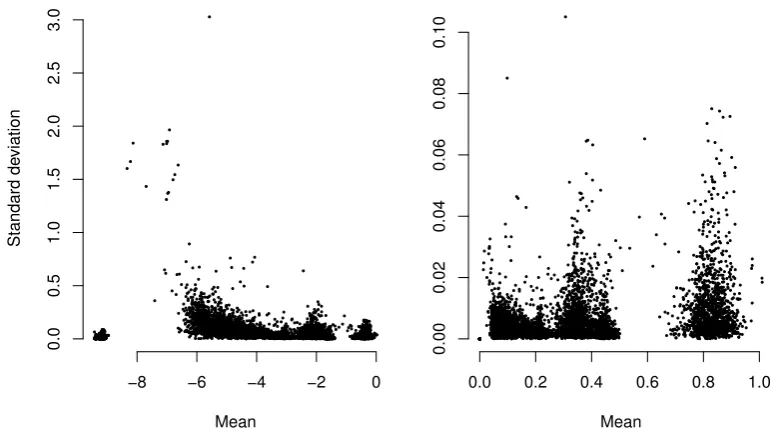
by applying the square root transformation to (1). A comparison of the ALR
and square root transformations can be seen in Figure1and shows that the
square root transformation is more effective at stabilising the variability
in the data. Furthermore, the square root transformation can be applied
directly to compositional zeros, while logarithmic transformations require
replacing them by a small constant (see Section 3). For these reasons, the
square root transformation was considered the appropriate choice for the
analysis of these data.
Figure1 about here.
3
Compositional zeros
There are two types of compositional zeros: rounded zeros, indicating that if
present a component is below some detection limit, and essential zeros,
de-noting the absolute absence of a component from an observation [12].
Com-positional zeros in glass are most often treated as rounded zeros under the
assumption that traces of certain elements are present but below detection.
The simplest strategy then is to replace rounded zeros by some small
con-stant equal to or below the detection limit. Techniques for doing this include
the additive replacement strategy of Aitchison [2] and the multiplicative
re-placement strategy of Mart´ın-Fern´andez et al. [13]. Palarea-Albaladejo et
al. [14] introduced a parametric approach that reduces artificial correlation
induced by such strategies. For the case of essential zeros Butler and
mass at zero; see also [16].
Here, we partition the glass data depending on whether the elements iron
and potassium are present (above the detection limit) or absent (below the
detection limit) from each composition. Any (D−1) dimensional
compo-sition (1) with Z zero elements is reduced to a (D−Z −1) dimensional
subcomposition, by simply removing the zeros. A separate model is then
estimated for each resulting subset of the data. In fact, Stewart and Field
[9] handled zeros in a similar way by proposing a mixture model that splits
the data according to the presence or absence of components.
Observing the presence or absence of an element from the composition of
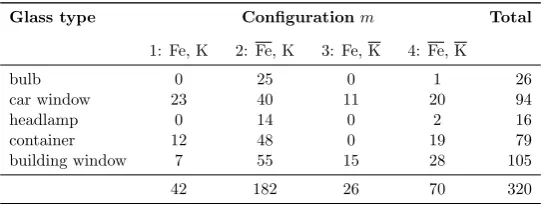
a glass item can help determine its use type. For example, none of the
bulbs and headlamps in our database contain iron; therefore, a composition
containing iron is thought as being unlikely to be of either of these types.
Other techniques of obtaining the elemental composition of glass fragments,
such as laser ablation inductively coupled plasma mass spectrometry, may
detect traces of such elements in these glass types [17]. Oxygen, silicon
and sodium are always present in glass. The remaining five elements could
be present or absent, giving 32 possible presence/absence configurations.
Only 10 of these configurations were found in the glass database, with most
accounting for very few items. In fact, as can be seen in Table 1, iron
and potassium are responsible for 87.9% of zero measurements, thus only
focusing on the presence or absence of those two elements allows for the
majority of zeros to be removed from the data. We therefore consider only
four configurations as shown in Table2.
Typically, the presence or absence of an element in a glass item is
unam-biguous: out of 320 items, only eight have a chemical element with its 12
measurements not all positive or all zero. In general, we assumed that an
element is present in an item if at least one of its 12 measurements is positive.
Modelling of nonzero subcompositions reduces the biasing influence of zeros
on the distribution of the data. This is shown in Figures2and3, containing
plots of the item means for the whole data set, and for the subset having
configuration 2 (Fe, K) from Table2. In Figure 3, an improvement can be
seen in the symmetry and concentration of points once the large mass at
zero for iron is removed.
The next section discusses a Bayesian hierarchical model for the glass data.
A separate model is estimated for each subset of the data with a given
pattern of presence/absence of chemical elements, which we call elemental
configuration. We consider four models, one for each configuration m =
1, . . . , M = 4 reported in Table2.
Figure2 about here.
Figure3 about here.
4
Bayesian hierarchical model
Aitken and Lucy [18] and Neocleous et al. [10] used frequentist approaches
to modelling the elemental composition of glass fragments using random
effects models with two levels of variation: between-item and within-item.
the data using a mixed effects model. The model contains a fixed effect for
the mean by glass type, and three random effects: at item level, at fragment
level and at measurement level.
For each data set with a given elemental configuration m (often not
ex-plicitly indicated), we denote by ztijk the p-vector of square roots of the
compositional ratios from thek-th measurement on the j-th fragment from
thei-th item of use typet, and assume that
ztijk =θt+bti+ctij+ǫtijk,
btiiid∼Np(0,Ωt−1), ctij iid∼Np(0,Ψ−1), ǫtijk iid∼Np(0,Λ−1).
(2)
The parameter θt is the mean vector for use type t; bti is the item-level
random effect; ctij is the fragment within item random effect; and ǫtijk
denotes the measurement error. Multivariate normal distributions are
as-sumed for all random effects, with unknown precision matrices, Ωt, Ψ and
Λ. The dimensionpmay differ across elemental configurations. The
param-eters in the model are collectively designated as ξm = {θ,Ω,Ψ,Λ}, where
θ={θt}Tt=1 and Ω ={Ωt}Tt=1; for the random effects we use the shorthands
b={bti}Ii=1t Tt=1 and c ={ctij}Jj=1 Ii=1t Tt=1. The symbol T = 5 denotes the
number of use types;Itis the number of glass items of use type t(I1= 26,
I2 = 94,I3 = 16,I4 = 79,I5 = 105);J = 4 is the number of fragments from
each item; andK= 3 is the number of repeated measurements on each
frag-ment. If we denote byztheJKmeasurements on an item of use typeTz=t,
then model (2) implies that the distribution of z, without conditioning on
the random effects, is
where the covariance matrix Σt is given by
Σt= (1J K1′J K)⊗Ω−t1+
IJ ⊗(1K1′K)
⊗Ψ−1+IJ K⊗Λ−1, (4)
1d denotes a column vector of d1’s, andId is thed×didentity matrix.
The prior distributions on the fixed effectsθt are independent multivariate
normals truncated to the positive orthant, to ensure that the means for the
square-root-transformed data are non-negative:
θt iid
∼Np(0,Φ−1), θt>0, t= 1, . . . , T.
The covariance matrix Φ−1 is fixed and equal to s·Ip, with s a relatively
large constant, we used s= 1000. Conjugate Wishart priors are placed on
the precision matrices of the random effects:
Ωt∼Wp(d1t, At), Ψ∼Wp(d2, B), Λ∼Wp(d3, C),
where the degrees of freedom d1t, d2 and d3 are all set equal to p, and the
precision matrices At, B and C are set to (1/1000)·Ip. It was necessary
to introduce separate precision matrices, Ωt, for each glass type, due to the
random variation between items having different properties across use types,
as can be seen from the results in Section4.2.
4.1 MCMC implementation
Markov chain Monte Carlo (MCMC) methods are used to sample from the
joint posterior distribution of the parameters in the model,ξm ={θ,Ω,Ψ,Λ}
quantities are standard distributions and are reported in Appendix A.1.
These are used to update b, c, Ω, Ψ and Λ, using Gibbs sampling moves;
see [19] for an introduction to Gibbs sampling. The update ofθtis performed
by means of a Metropolis-Hastings (M-H) move, with proposal distribution
equal to the multivariate normal in the full conditional distribution of θt,
disregarding the restriction to the positive orthant. The acceptance
prob-ability is either 1 or 0, depending on whether the candidate vector falls in
the positive orthant or not.
We also use two additional M-H moves to update the θt’s. The first one is
performed on θ1 only, as the samples for this vector displayed appreciable
positive autocorrelation. It is a random walk M-H move, performed on each
element ofθ1 separately, with uniform proposal over an interval centred at
the current value, and with interval widths determined from a preliminary
run.
The second move changes at onceθ and b, with the candidate state chosen
in a way that leaves the likelihood unchanged. This move is a special case of
the M-H algorithm as described in [20]. It is discussed in detail in appendix
A.2and, in our experiments, it substantially reduced autocorrelation of the
samples.
4.2 Posterior samples for configuration m= 2 (Fe, K)
The results shown are those for items with configurationm= 2 (Fe, K) from
Table2. Similar results for the three other configurations are not reported
here. All of the analysis was carried out using the statistical programming
approximately 10 hours, which included a burn-in period of 10,000, and also
thinning of the Markov chain, where every 200th draw was stored and the
rest discarded. The acceptance rate for the M-H move performed onθ1only
was 31%, and the rate for the joint move onθ and bwas 54%. Time series
plots of the sampled fixed effect θt are shown in Figure 4. Scatterplots of
the draws of θt are displayed in Figure 5 and show clear separation in the
means between the five use-type categories.
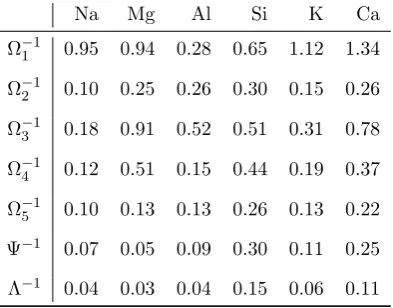
As can be seen in Table3, the variability at item level is shown to be rather
different between use types, which is why the model accommodates for these
differences by allowing the covariance matrix at item level, Ω−t1, to change by use type. When we compare the variability at fragment level, Ψ−1, with
that for the measurement error, Λ−1, there is little difference observed, with the variability at fragment level being slightly greater, as would be expected.
As expected the variability between glass items is much greater than that
found within items.
Table3about here.
Figure4 about here.
Figure5 about here.
5
Composite model
In the previous section we specified multivariate mixed effects models for the
square-root-transformed compositions z, one model for each configuration
we show how these configuration-specific models can be pulled together in a
single model. The model is then used in section5.1to compute the use-type
probabilities for a newly observed item y of unknown use type. We begin
with some definitions.
Let D = {zti, i = 1, . . . , It, t = 1, . . . , T} be the reference data, where the
numbersItof items of use typetare under control of the experimenter. Also
letDm ={z∈D:Cz=m}be the subset ofDwith elemental configuration
m. For any given z ∈ D, the hierarchical model (2) for configuration m
supplies the distribution
p(z|Tz=t,Cz=m, ξ) =p(z|Tz=t,Cz=m, ξm)
whereξ ={ξm}Mm=1 denotes the collection of parameters across all
configu-rations. More specifically, p(z|Tz =t,Cz=m, ξm) is given by formulae (3)
and (4).
Letϕt= (ϕt1, . . . , ϕtM) be an unknown vector of configuration probabilities
for an itemz of use typet:
ϕtm = p(Cz=m|Tz=t, ϕ, ξ) = p(Cz=m|Tz=t, ϕt). (5)
We assume that a priori the configuration probabilities ϕ = {ϕt}Tt=1 are
independent ofξ and have independent Dirichlet prior distributions:
ϕt|ξ ∼ Dir(αt1, . . . , αtM), t= 1, . . . , T, (6)
where theαtm’s are suitable constants reflecting any prior information about
details on the choice of theα’s.
Next we derive the likelihood function L(ξ, ϕ). The distribution of a single
itemz∈D, given its type Tzand the parameters ξ and ϕ, is
p(z|Tz=t, ξ, ϕ) = M
X
r=1
p(Cz=r|Tz=t, ξ, ϕ)p(z|Tz=t,Cz=r, ξ, ϕ)
=
M
X
r=1
ϕtrp(z|Tz=t,Cz=r, ξr). (7)
Therefore, the distribution of the reference dataD, givenξ and ϕ(and the
items use types, fixed by design), is
p(D|ξ, ϕ) =
T Y t=1 It Y i=1 (M X r=1
ϕtrp(zti|Tzti =t,Czti =r, ξr) )
(8)
The likelihoodL(ξ, ϕ) is given by (8), regarded as a function ofξandϕ, with
D fixed at the observed data. This means that the configurations Czti are
all known, which implies that theP
r contains only one term corresponding
to the observed configuration ofzti. Thus the likelihood can be written as
L(ξ, ϕ) =
T Y t=1 It Y i=1
ϕtmp(zti|Tzti =t,Czti =m, ξm)
= ( T Y t=1 M Y m=1
ϕNtm tm ) · ( M Y m=1 T Y t=1 Y
i∈Etm
p(zti|Tzti =t,Czti =m, ξm) )
,
(9)
whereEtm={i:Tzti =t,Czti =m}and Ntm= #Etm. In words, theNtm’s
are the counts in Table2: the number of items inD that are of use type t
and configuration m.
factori-sation of the likelihood implies that they are also a posteriori independent.
Moreover, combining the first term on the right-hand side of (9) with the
prior distribution ofϕ in (6), yields independent Dirichlet posterior
distri-butions for theϕt’s:
ϕt|ξ, D∼Dir(αt1+Nt1, . . . , αtM+NtM), t= 1, . . . , T. (10)
Posterior independence of ϕ and ξ implies that a sample from their joint
posterior distribution can be obtained in two stages: (i) sample ϕ from
the independent posterior distributions in (10) and (ii) sampleξm, for each
configurationm, using the MCMC procedure described in Section 4.1.
We conclude this section by remarking that formula (7) provides a mixture
representation for the density of z. This has been already recognised by
Stewart and Field [9], see their formula (3.1). Because the mixture
compo-nent that has generatedzis immediately known on inspection of the item’s
measurements, we prefer the use of the term “composite”, rather than
“mix-ture”, model.
5.1 Glass classification
The object of interest isp(Ty|y, D), that is, the posterior distribution of the
use type Ty of a newly observed glass itemy, conditional on the reference
dataDand the new itemy. Let the elemental configuration ofybeCy =m,
which is known ifyis conditioned upon. Then, using Bayes theorem,
p(Ty=t|y, D) = p(Ty=t|y,Cy=m, D)
Next, we derive expressions for the two terms in the right-hand side of (11).
Beginning with the first quantity and using again Bayes theorem, one has
p(Ty=t|Cy=m, D) ∝ p(Ty=t|D)p(Cy=m|Ty=t, D). (12)
On its own, the reference data set D is not informative about Ty, as the
use types of the items in D were under the control of the experimenter.
Therefore,p(Ty=t|D) =p(Ty=t) and (12) becomes
p(Ty =t|Cy=m, D) ∝ p(Ty=t)p(Cy=m|Ty=t, D). (13)
The prior distribution p(Ty = t) should be chosen to reflect any available
information about the prevalence of use types as forensic samples; if no
such information is available, it may be set equal to a discrete uniform
distribution. The second term in the right-hand side of (13) can be computed
as follows:
p(Cy =m|Ty=t, D) =
Z
p(Cy=m|Ty=t, ϕt, D)p(ϕt|Ty=t, D) dϕt
= Z
ϕtmp(ϕt|D) dϕt
= PMαtm+Ntm
r=1(αtr+Ntr)
, (14)
where we used the definition of theϕ’s in (5) and the posterior distribution
of ϕt in (10). Substituting in (13) yields the posterior distribution of the
use type Ty conditional only on D and the configuration Cy, but without
conditioning on the actual new itemy:
p(Ty=t|Cy=m, D) ∝ p(Ty=t)
αtm+Ntm
PM
r=1(αtr+Ntr)
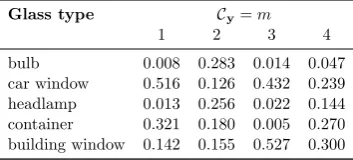
Table4 reports the values of p(Ty =t|Cy =m, D) computed usingp(Ty =
t) = 1/T and the hyperparameters αtm= 0.1 for all tand m.
Table4about here.
Incidentally, we remark that the choice of 0.1 as the value for the α’s did
not seem to matter much: we repeated five times the classification exercise
reported in Section5.2, setting theα’s to 0, 0.2, 0.3, 0.4 and 0.5, and in all
cases, the classifications given in Table 5 remained unchanged. Similarly,
the evidence evaluation error rates reported in Section6.1 were unaffected
by changing theα’s from 0.1 to 0.5.
As for the second term in (11), the posterior predictive distribution of y
conditional on its use type, configuration and the reference data, one has
p(y|Ty=t,Cy=m, D) =
= Z
p(y|Ty=t,Cy =m, ξm, D)p(ξm|Ty =t,Cy=m, D) dξm
= Z
p(y|Ty=t,Cy =m, ξm)p(ξm|Dm) dξm
= Eξm|Dm[p(y|Ty=t,Cy =m, ξm)], (16)
whereEξm|Dm denotes expectation with respect to the posterior distribution
of ξm. The density p(y|Ty = t,Cy = m, ξm) is provided by the Bayesian
hierarchical model (2) for elemental configuration m. To be more specific,
assuming that y is a vector consisting of ˜K measurements on each of ˜J
fragments from the same item of use typet and configuration m, then the
distribution ofy|Ty=t, ξm is given by formulae (3) and (4), after replacing
J with ˜J and K with ˜K:
Σt= (1J˜K˜1′J˜K˜)⊗Ω −1 t +
IJ˜⊗(1K˜1′K˜)
⊗Ψ−1+IJ˜K˜ ⊗Λ−1. (17)
Plugging (15) and (16) into (11) gives the expression for the use-type
prob-ability of a future itemy:
p(Ty=t|y, D) ∝ p(Ty=t)
αtm+Ntm
PM
r=1(αtr+Ntr)
Eξm|Dm[p(y|Ty =t,Cy=m, ξm)],
(18)
where the expectation on the right-hand side can be estimated by averaging
the densities p(y|Ty = t,Cy = m, ξm) over an MCMC sample from the
posterior ofξm, obtained as detailed in Section 4.1.
5.2 Classification results
A simulation study was conducted in order to assess the performance of the
composite model in classifying glass fragments into one of the five use types
(bulb, headlamp, container, car window or building window). Probabilities
that each set of fragments was from an item of a certain use type were
estimated using expression (18) with p(Ty = t) = 1/T and αtm = 0.1 for
all t and m. Fragments were classified into the use-type category with the
highest probability.
The simulation study used five-fold cross-validation with the reference data
D randomly divided into five parts, each consisting of 64 items. One part
was kept as test data consisting of unobserved glass itemsy. The remaining
four parts were considered as training data containing reference glass items
z, from which model parameters were estimated. This was repeated five
The classification results are shown in Table5, with Figure6giving an
indi-cation of the uncertainty about the classifiindi-cation of each item. The overall
misclassification rate was 20.6%, reflecting good classification performance
for bulbs, containers and headlamps, and poorer performance for car and
building windows. From Table 5, it is clear that misclassification of a
win-dow type is most often to the other winwin-dow type. This is because car and
building windows have a very similar elemental composition, thus making it
difficult to correctly distinguish between them based on this alone. Zadora
[1] reports improved classification rates for car and building windows when,
in addition to the elemental composition, the refractive index before and
after annealing is used.
Table5about here.
Comparing our classification results with those obtained using a
hierarchi-cal model that does not take into account the configurations, shows that
the composite model leads to a reduction in the number of items
misclas-sified (misclassification rates of 20.6% for the composite model compared
with 22.8% for the model without configurations). In addition, the
com-posite model achieves a lower misclassification rate (20.6%) than support
vector machines (SVM) [22] (22.8%). The composite model also
outper-forms SVM across two other classification performance measures: Cohen’s
kappa (κ = 0.721 for the composite model compared with 0.688 for SVM)
and Brier score (BS = 0.319 for the composite model, 0.447 for SVM).
Cohen’s kappa [23] is a measure of agreement ranging from 0 to 1 with
κ = 1 indicating perfect agreement. The Brier score [24] is a measure of
prediction strength with BS = 0 implying perfect predictions. For
without considering configurations areκ= 0.693 andBS = 0.338. In both
comparisons, the benefit of modelling the configurations is clear.
Figure6 about here.
6
Evidence evaluation
Glass fragments obtained from a suspect can be used as evidence in
sup-port of (or against) the proposition that the suspect was at the scene of the
crime. The statistical approach to evaluating the strength or value V of
such evidence stems from [25]; a recent overview is provided by [26, Chapter
10], whose terminology we adopt. Let E be the evidence, Hp the
prosecu-tion proposiprosecu-tion, Hd the defence proposition and I additional background
information related to the case. The value of the evidence for Hp, also
known in the forensic literature as thelikelihood ratio, is defined as the
fac-tor by which to multiply the prior odds on Hp, as a result of observing E:
V = Pr(E|Hp, I)/Pr(E|Hd, I). Typically, the probability statements in V
are obtained by integrating over the posterior distributions of unknown
pa-rameters, then the appropriate term isBayes factor [27] for Hp and against
Hd, on evidenceE.
More specifically, denote by x the measurements collected from a sample
of glass fragments found at the crime scene (source evidence) and by y
the measurements obtained from fragments found on the suspect (receptor
object), under the assumption that all fragments in y are from the same
item. The glass evidence comprises both control and recovered samples:
item as x, that is, the fragments found on the suspect originated from the
broken item found at the crime scene. The defence proposition,Hd, is that
yis not from the same item asx, that is, the fragments found on the suspect
originated from some source outwith the crime scene. The value of the glass
evidence is then
V = p(x,y|Hp, I) p(x,y|Hd, I)
. (19)
Here, we assume that two sets of fragmentsx and y do not come from the
same item if their elemental configurations do not match; that is, Cx6=Cy,
yielding V = 0. This assumption may not always hold in practice as it is
possible for two sets of fragments from the same item to have non-matching
configurations, although for the glass data, this occurs very rarely (less than
1% of the time). In the following, we assume that Cx =Cy =C =m. Let
Tx = t be the known use type of the glass recovered at the crime scene.
Under Hp, one has that Ty = Tx, while under Hd, the use type of y is
uncertain. Dropping in (19) the explicit conditioning on I, save for the
reference data setD used to assess the competing propositions, the known
elemental configurationC, and the known use type Tx of x, one has:
V = p(x,y|Tx=t,C=m, D, Hp)
p(x,y|Tx=t,C=m, D, Hd)
. (20)
We show in Appendix A.3thatV can be rewritten as
V = Eξm|Dm
p(x,y|T(x,y)=t,C=m, ξm)
T
X
s=1
p(Ty =s|C=m, D)Eξm|Dm[p(x|Tx=t,C=m, ξm)p(y|Ty=s,C=m, ξm)]
,
(21)
wherep(Ty=s|C =m, D) is given in (15). The densityp(x,y|T(x,y)=t,C=
˜
J = ˜Jx+ ˜Jy is the total number of fragments obtained, ˜K is the number
of measurements taken on each fragment, and the covariance matrix Σthas
the expression given in (17). The densities p(x|Tx = t,C = m, ξm) and
p(y|Ty = s,C = m, ξm) in the denominator are of NJ˜
xKp˜ (1J˜xK˜ ⊗θt,Σtx)
and NJ˜yKp˜ (1J˜yK˜
⊗θt,Σty) respectively, where Σtx and Σty are given by
formula (17), with ˜J replaced by ˜Jx and ˜Jy.
6.1 Evidence evaluation results
The performance of the composite model in the evidence evaluation task was
assessed in terms of the percentage of false negative (FN) and false positive
(FP) answers produced in a simulation study. An FN occurs when glass
fragments from the same item are evaluated as originating from different
items, a decision that is made whenever V ≤ v, for some threshold value
v. An FP happens when glass fragments are from different items, but V >
v so that they are evaluated as coming from the same item. Here, V is
obtained using (21), with parameter values and resulting p(Ty = s|C =
m, D) estimates as in Table4.
Five-fold cross-validation was used in the simulation study to estimate the
percentages of FN and FP answers. Each test set consisted of 64 items with
the percentage of FN answers obtained by randomly choosing two fragments
from each item as the source evidence, x, and comparing them with the
remaining two fragments from the same item as the receptor sample,y. This
was repeated for each of the five test sets yielding a total of 320 same-source
comparisons. The percentage of FP answers was obtained by taking all 12
measurements from an item asxand all 12 measurements from another item
was repeated for each of the five test sets giving a total of 5× 642
= 10,080
comparisons. Note that because many more comparisons were made for
different-source pairs than for same-source pairs, estimates of FN rates are
more uncertain than those of FP rates.
Using as threshold v = 1, the rates of FNs and FPs produced by
cross-validation were 4.4% and 1.4%, respectively, which are improvements on
previous publications with similar glass databases; see [10]. However, the
two types of error are of different seriousness: because incorrectly evaluating
two sets of fragments as originating from the same item may contribute to
the conviction of an innocent person, emphasis should be placed on avoiding
false positives. This is readily achieved by varying the thresholdv. To each
value ofv there corresponds a pair of error rates and these are represented
in the receiver operating characteristic (ROC) curve displayed in Figure 7,
where as usual the true positive (TP) rate (TP rate = 1−FN rate) is plotted
against the FP rate. The ROC curve is very steep in the region of FP rates
close to 0: small reductions in the FP rate, say below 1%, can be achieved
only at the cost of noticeably increasing the FN rate to about 10% or more.
The value of the area under the curve is 0.99, a value of 1 is achieved by an
“ideal” procedure with zero FP rate and unit TP rate.
Figure7 about here.
7
Conclusion
We have presented a composite model to deal with a large point mass at
set was partitioned according to the presence or absence of the elements iron
and potassium, and a Bayesian hierarchical model was fit to each resulting
subset of the data. While this approach allows for the majority of
composi-tional zeros to be accounted for, a small proportion of zeros persists, as seen
from Figure3, mainly occurring when the element magnesium is absent from
a composition. To check whether accounting for these additional zeros would
improve results, we split configuration 2 in Table 2, (Fe,K), into two
con-figurations based on the presence or absence of magnesium, (Fe,K,Mg) and
(Fe,K,Mg). Repeating the analysis with the resulting five configurations
did not change or improve upon the classification and evidence evaluation
results obtained using the original four configurations.
Before proceeding with the analysis, we have applied a square root
transfor-mation to the ratios of chemical elements’ contents to that of oxygen. This
is a departure from the more commonly used ALR transformation. We have
found that, in addition to being more effective at stabilising the variability
in these data, use of the square root also meant that any remaining zeros in
the data did not require further special treatment such as replacement by a
small amount.
Our hierarchical model is more general than previous random effects models
for similar data [10,18] as it contains a fixed effect for use type of glass and
three levels of variability (item, fragment and measurement) and allows for
different variances for each use type of glass. A normality assumption was
made for the distribution of all random effects, which may not be ideal for
the between-item distribution in particular. An alternative would be to use
mixture models – this is an area of future work. However, the simplicity of a
satisfactory results, as is the case here in both classification and evidence
evaluation tasks.
The composite model outperforms SVM as well as a hierarchical model
with-out configurations in the classification task, with very good results obtained
for the classification of glass items of use types bulb, headlamp and
con-tainer. The relatively high overall misclassification rate of 20.6% is due to
the difficulty in distinguishing between car and building windows, which
are manufactured in a similar way and have similar elemental compositions.
However, whenever a window is misclassified, it is most often misclassified
as the other window type. Perhaps different glass measurements such as
the refractive index would be more useful in distinguishing between window
types.
The performance of the composite model in the evidence evaluation task is
also good. The FP and FN rates, obtained using cross-validation and giving
equal importance to the two types of error, were 1.4% and 4.4%, respectively.
More generally, the ROC curve (area under the curve = 0.99) shows that
very low FP rates can be achieved, if one is willing to accept moderate FN
rates.
Acknowledgements
The authors would like to thank Prof. Grzegorz Zadora for providing us with
access to the glass database used in the analysis. Gary Napier acknowledges
financial support under a doctoral training grant from the U.K. Engineering
A
Appendix
A.1 Full conditional distributions
The full conditional distribution of all the unknown quantities in the model
are reported below. We use “| · · ·” to mean “conditionally on all the other
variables”.
• θt| · · · ∼Np( ˜φt,Φ˜−t1), θt>0,
where ˜φt= ˜Φ−t1hJKIt(¯zt···−¯bt·−¯ct··)
i
, and ˜Φt=JKItΛ + Φ.
• bti| · · · ∼Np( ˜ωti,Ω˜−t1),
where ˜ωti = ˜Ω−t1
h
JKΛ(¯zti··−θt−¯cti·)
i
, and ˜Ωt=JKΛ + Ωt.
• ctij | · · · ∼Np( ˜ψtij,Ψ˜−1),
where ˜ψtij = ˜Ψ−1hKΛ ¯ztij·−θt−bti
i
, and ˜Ψ =KΛ + Ψ.
• Ωt| · · · ∼Wp( ˜d1t,A˜t),
where ˜d1t=d1t+It, and ˜At=At+PIi=1t btib′ti.
• Ψ| · · · ∼Wp( ˜d2,B˜),
where ˜d2 =d2+JPTt=1It, and ˜B =B+PTt=1 PIt
i=1 PJ
j=1ctijc′tij. • Λ| · · · ∼Wp( ˜d3,C˜),
where ˜d3=d3+JKPTt=1It, and ˜C=C+PTt=1 PIt
i=1 PJ
j=1 PK
k=1(ztijk−
A.2 MH move on θ and b jointly
This move updates simultaneously the fixed effectθtand the random effects
at item levelbti, separately for each use typet. The candidate state is chosen
to leaveθt+btiunchanged, so that it shares with the current state the same
value of the likelihood. The candidate for the fixed effect is obtained as
˜
θt=θt+v,
where v = (v1, . . . , vp)′, with components vl ∼ U nif(−δtl, δtl)
indepen-dently, with interval widths determined from a preliminary run. The
candi-dates for the random effects are then set to
˜
bti =bti−v, i= 1, . . . , It.
Since the likelihood is left unchanged, the ratio of target densities reduces
to the ratio of prior densities evaluated at the candidate and current state.
Then, following the approach in§2.2 of [20], the acceptance probability can
be computed as
α= min
1,p(˜θt)p(˜bt|Ωt) p(θt)p(bt|Ωt)
˜ f(˜v) f(v)
∂(˜θt,b˜t,˜v)
∂(θt,bt,v)
wheref is the density, uniform on a p-hyperrectangle, of the random
reverse move. The absolute value of the determinant of Jacobian matrix is
∂(˜θt,˜bt,v)˜
∂(θt,bt,v)
=
Ip 0p,pIt Ip
0pIt,p IpIt −1It ⊗Ip
0p,p 0p,pIt −Ip
= 1.
Therefore the acceptance probability only involves the prior density at the
current and candidate values:
α= min
1,p(˜θt)p(˜bt|Ωt) p(θt)p(bt|Ωt)
.
A.3 Computing the evidence value V
Here we show how to derive the expression (21) for V. Starting with (20),
V = p(x,y|Tx=t,C=m, D, Hp)
p(x,y|Tx=t,C=m, D, Hd)
= R
p(x,y|Tx=t,C=m, ξm, D, Hp)p(ξm|Tx=t,C=m, D, Hp) dξm
R
p(x,y|Tx=t,C=m, ξm, D, Hd)p(ξm|Tx=t,C=m, D, Hd) dξm
.
(22)
For the first term of the integrand in the numerator one has
p(x,y|Tx=t,C=m, ξm, D, Hp) = T
X
s=1
p(x,y|Tx=t,Ty =s,C=m, ξm, D, Hp)
·p(Ty=s|Tx=t,C=m, ξm, D, Hp)
= p(x,y|Tx=t,Ty=t,C=m, ξm, D)
since Hp implies that Ty = Tx = t, the known use type of x, and we use
the notationT(x,y) to emphasize that, underHp,xandyare measurements
from the same glass item. Then the numerator of (22) can be written as
Z
p(x,y|T(x,y)=t,C =m, ξm)p(ξm|Dm) dξm=
Eξm|Dm
p(x,y|T(x,y)=t,C=m, ξm)
. (23)
Consider next the denominator of (22). Under Hd and conditional on the
parametersξm,xis independent of yso that
p(x,y|Tx=t,C=m, ξm, D, Hd) =
= p(x|Tx=t,C =m, ξm, D, Hd)p(y|Tx=t,C=m, ξm, D, Hd)
= p(x|Tx=t,C =m, ξm)p(y|C=m, ξm, D). (24)
The second term on the right hand side of (24) can be written as
p(y|C=m, ξm, D) = T
X
s=1
p(y|Ty=s,C=m, ξm, D)p(Ty=s|C=m, ξm, D)
=
T
X
s=1
p(y|Ty=s,C=m, ξm)p(Ty =s|C =m, D),
wherep(Ty=s|C =m, D) is given in (15). It then follows that the
denom-inator of (22) is
Z
p(x|Tx=t,C=m, ξm)
" T X
s=1
p(y|Ty =s,C=m, ξm)p(Ty=s|C=m, D)
#
p(ξm|Dm) dξm=
=
T
X
s=1
p(Ty=s|C =m, D)
References
1. Zadora G. Classification of glass fragments based on elemental
compo-sition and refractive index. J. Forensic Sci.2009; 54(1):49–59.
2. Aitchison J. The statistical analysis of compositional data. Chapman &
Hall, 1986.
3. Rayens WS, Srinivasan C. Box-Cox transformations in the analysis of
compositional data. J. Chemometr.1991; 5(3):227–239.
4. Egozcue JJ, Pawlowsky-Glahn V, Mateu-Figueras G, Barcel´o-Vidal C.
Isometric logratio transformations for compositional data analysis.
Math. Geol.2003; 35(3):279–300.
5. Scealy JL, Welsh AH. Regression for compositional data by using
dis-tributions defined on the hypersphere. J. R. Stat. Soc. B 2011; 73(3):
351–375.
6. Scealy JL, Welsh AH. Fitting Kent models to compositional data with
small concentration. Stat. Comput. 2014; 24(2): 165–179.
7. Wang H, Liu Q, Mok HMK, Fu L, Tse WM. A hyperspherical
trans-formation forecasting model for compositional data. Eur. J. Oper. Res.
2007; 179(2):459–468.
8. Campbell GP, Curran JM, Miskelly GM, Coulson S, Yaxley GM,
Grun-sky EC, Cox SC. Compositional data analysis for elemental data in
forensic science. Forensic Sci. Int. 2009; 188(1–3):81–90.
9. Stewart C, Field C. Managing the essential zeros in quantitative fatty
10. Neocleous T, Aitken CGG, Zadora G. Transformations for
composi-tional data with zeros with an application to forensic evidence
evalua-tion. Chemometr. Intell. Lab. 2011; 109(1):77–85.
11. Box GEP, Cox DR. An analysis of transformations. J. R. Stat. Soc. B
1964; 26(2):211–252.
12. Mart´ın-Fern´andez JA, Barcel´o-Vidal C, Pawlowsky-Glahn V. Dealing
with zeros and missing values in compositional data sets using
nonpara-metric imputation. Math. Geol.2003; 35(3):253–277.
13. Mart´ın-Fern´andez JA, Barcel´o-Vidal C, Pawlowsky-Glahn V. Zero
re-placement in compositional data sets. In Kiers H, Rasson J, Groenen P,
Shader M, editors,Proceedings of the 7th Conference of the International
Federation of Classification Societies, (University of Namur (Belgium)),
pages 155–160. Springer-Verlag, Berlin, 2000.
14. Palarea-Albaladejo J, Mart´ın-Fern´andez JA, G´omez-Garc´ıa JG. A
para-metric approach for dealing with compositional rounded zeros. Math.
Geol.2007; 39(7):625–645.
15. Butler A, Glasbey C. A latent Gaussian model for compositional data
with zeros. J. R. Stat. Soc. C 2008; 57(5):505–520.
16. Leininger TL, Gelfand AE, Allen JM, Silander Jr JA. Spatial regression
modeling for compositional data with many zeros. J. Agr. Bio. Envir.
St.2013; 18(3):314–334.
17. Trejos T, Almirall JR. Sampling strategies for the analysis of glass
fragments by LA-ICP-MS Part 1: micro-homogeneity study of glass
18. Aitken CGG, Lucy D. Evaluation of trace evidence in the form of
mul-tivariate data. J. R. Stat. Soc. C 2004; 53(1):109–122.
19. Casella G, George EI. Explaining the Gibbs Sampler. Am. Stat.1992;
46(3):167–174.
20. Green PJ. Trans-dimensional Markov chain Monte Carlo. In Green PJ,
Hjort NL, Richardson S, editors, Highly structured stochastic systems,
pages 179–196. Oxford: Oxford University Press, 2003.
21. R Development Core Team. R: A language and environment for
sta-tistical computing. R Foundation for Stasta-tistical Computing, Vienna,
Austria, 2011. URL http://www.R-project.org.
22. Cortes C, Vapnik VN. Support-vector networks. Mach. Learn.1995; 20
(3):273–297.
23. Cohen J. A coefficient of agreement for nominal scales. Educ. Psychol.
Meas. 1960; 20(1):37–46.
24. Brier GW. Verification of forecasts expressed in terms of probability.
Mon. Weather Rev.1950; 78(1):1–3.
25. Lindley DV. A problem in forensic science. Biometrika 1977; 64(2):
207–213.
26. Aitken CGG, Taroni F. Statistics and the evaluation of evidence for
forensic scientists. John Wiley and Sons, 2004.
27. Kass RE, Raftery AE. Bayes factors.J. Am. Statist. Ass.1995; 90(430):
Table 1: Frequency of zero measurements by chemical element.
Element O Si Na Ca Al Mg K Fe
Frequency 0 0 0 108 205 265 1168 3036
Table 2: Presence (Fe, K) and absence (Fe,K) at item level by use type.
Glass type Configurationm Total
1: Fe, K 2: Fe, K 3: Fe, K 4: Fe, K
bulb 0 25 0 1 26
car window 23 40 11 20 94
headlamp 0 14 0 2 16
container 12 48 0 19 79
building window 7 55 15 28 105
Table 3: Standard deviations (multiplied by 10) from covariance matrices Ω−1
t ,
Ψ−1 and Λ−1. For Ω−1
t , t= 1, . . . ,5 correspond to use types: bulb, car
window, headlamp, container and building window.
Na Mg Al Si K Ca
Ω−11 0.95 0.94 0.28 0.65 1.12 1.34
Ω−21 0.10 0.25 0.26 0.30 0.15 0.26
Ω−31 0.18 0.91 0.52 0.51 0.31 0.78
Ω−41 0.12 0.51 0.15 0.44 0.19 0.37
Ω−51 0.10 0.13 0.13 0.26 0.13 0.22
Ψ−1 0.07 0.05 0.09 0.30 0.11 0.25
Table 4: Use type probabilities p(Ty =t|Cy =m, D), with αtm = 0.1 for all t
andmandp(Ty=t) = 1/T.
Glass type Cy=m
1 2 3 4
bulb 0.008 0.283 0.014 0.047
car window 0.516 0.126 0.432 0.239
headlamp 0.013 0.256 0.022 0.144
container 0.321 0.180 0.005 0.270
Table 5: Classification of each glass item into one of five use type categories.
Classification Glass type
bulb car window headlamp container building window Total
bulb 25 0 1 0 1 27
car window 1 74 0 4 29 108
headlamp 0 1 15 1 1 18
container 0 2 0 72 6 80
building window 0 17 0 2 68 87
Total 26 94 16 79 105 320
Mean
Standard de
viation
−8 −6 −4 −2 0
0.0
0.5
1.0
1.5
2.0
2.5
3.0
Mean
0.0 0.2 0.4 0.6 0.8 1.0
0.00
0.02
0.04
0.06
0.08
[image:39.595.114.504.125.342.2]0.10
Figure 1: Plots of fragments’ standard deviations against corresponding means,
using the ALR (left panel) and the square root (right panel) transforma-tions. For the ALR, 0.005 was added to all compositional zeros. Seven pairs (mean, sd) are plotted for each fragment, one for each element of
0.30
0.40
0.50
Na
0.00
0.10
0.20
Mg
0.00
0.10
0.20
Al
0.65
0.80
Si
0.00
0.15
0.30
K
0.0 0.2 0.4
0.00
0.06
0.12
Ca
F
e
0.30 0.40 0.50
Na
0.00 0.10 0.20
Mg
Bulb Car window Headlamp Container Building window
0.00 0.10 0.20
Al
0.65 0.75 0.85
Si
0.00 0.15 0.30
[image:40.595.116.548.173.621.2]K
Figure 2: Scatterplots of all item means from the database. The mean of each
0.30
0.40
0.50
Na
0.00
0.10
0.20
Mg
0.00
0.10
0.20
Al
0.65
0.75
0.85
Si
0.0 0.1 0.2 0.3 0.4
0.00
0.10
0.20
0.30
Ca
K
0.30 0.40 0.50
Na
0.00 0.10 0.20
Mg
Bulb Car window Headlamp Container Building window
0.00 0.10 0.20
Al
0.65 0.75 0.85
[image:41.595.114.549.174.613.2]Si
Figure 3: Scatterplots of the item means for items with configuration 2 from Table
0.32 0.38 0.44 θ1 0.442 0.448 θ2 0.425 0.445 θ3 0.430 0.438 θ4 θ5 Na 0.432 0.438
0.04 0.10 0.16 0.200 0.215
0.00 0.10 0.10 0.12 0.14
Mg 0.208 0.214 0.130 0.150 0.085 0.100 0.08 0.14 0.120 0.130 Al 0.080 0.088
0.74 0.78 0.82 0.83 0.85
0.80 0.86 0.79 0.81 0.83
Si
0.805 0.825
0.15 0.25 0.060 0.070
0.14 0.17 0.20 0.075 0.090
K
0.050 0.056
0.05 0.15 0.340 0.355
[image:42.595.281.559.114.487.2]0.32
0.36
0.40
0.44
Na
0.00
0.10
0.20
Mg
0.08
0.12
0.16
Al
0.75
0.80
0.85
Si
0.05 0.15 0.25 0.35
0.05
0.15
0.25
Ca
K
0.32 0.36 0.40 0.44
Na
0.00 0.10 0.20
Mg
Bulb Car window Headlamp Container Building window
0.08 0.12 0.16
Al
0.75 0.80 0.85
[image:43.595.115.549.184.621.2]Si
Figure 5: Scatterplots of the draws from the posterior distribution of θt in the
Bulb (1) 1 2 3 4 5
Car window (2)
1 2 3 4 5 Headlamp (3) 1 2 3 4 5 Container (4) 1 2 3 4 5
Building window (5)
[image:44.595.114.527.187.498.2]1 2 3 4 5 Bulb (1) Car window (2) Headlamp (3) Container (4) Building window (5)
Figure 6: Plot of the classification probabilities in five-fold cross validation. Each
0.0 0.2 0.4 0.6 0.8 1.0
0.0
0.2
0.4
0.6
0.8
1.0
False positive rate
T
rue positiv
e r
ate
[image:45.595.159.425.294.551.2]AUC = 0.99