6
1. ITALY
1.1. INTRODUCTION
This report presents the existing work/life balance (WLB) policies and practices in the Italian universities and focuses in particular on the implemented policies and future actions of the University of Trento. The interventions considered are addressed to the different components of the university community: students, administrative staff, academic staff with permanent contracts, and academic staff at early career stages with temporary contracts (PhD candidates, postdoctoral researchers and fixed-term assistant professor). In the last part of the report the analysis focuses on the interviews conducted with researchers without a tenure track position in order to show their work conditions, WLB, and the needs.
Before describing the desk-analysis on the WLB policies ongoing in Italian universities, it is important to underline the main differences, in terms of work organisation, among the university community’s components.
The administrative staff is characterized by a stable presence in the workplace and by a regularly scheduled administrative workweek controlled by a time registration system (clocking in and out). Therefore, in terms of WLB, the principal flexibility policies regard the possibility to access teleworking.
Members of the academic staff, with both permanent and temporary contracts, do not have a regular scheduled workday; they only have to guarantee their presence at the University for institutional meetings and teaching activities. However, in regard to postdoc fellows, it should be highlighted that they are hired on specific projects; and their substitution is not foreseen should they need to take leave for sickness, maternity or other personal/family reasons.
The above-mentioned features of the university community’s components highlight the different needs that the university management should take into account in order to plan WLB policies.
A desk analysis of work/life balance policies and practices within Italian
universities
The desk analysis of WLB policies in Italian universities was developed in two stages:
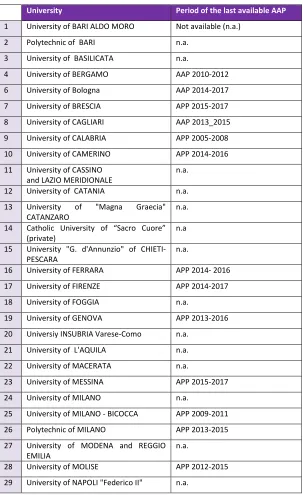
1. collection and analysis of the work/life balance actions described in the Affirmative Action Plans (AAPs). Among the 66 public Italian universities, 31 have approved and uploaded the AAP on their websites; 35 universities do not have an AAP approved or available on their websites. Some universities do not have an AAP, but they adopt various WLB policies.1
2. identification of the more common practices and the most innovative actions.
1
7
The Affirmative Action Plan is a mandatory document for public institutions. It was introduced by art. 6 of Legislative Decree n. 198/2006 (Equal Opportunity Code), and by art. 48 of the Parliamentary Decree n. 246/2005.
At universities, the Supervisory Committee (former Equal Opportunities Committee) usually draws up the document in collaboration with the Rector’s Delegate for Equal Opportunities and, if present, the university’s research centres on gender issues. The Board of Directors approves and issues the AAP. The Supervisory Committee was introduced by art. 21 of Law 183/2010. This body replaced two different committees in their duties and functions: the Equal Opportunities Committee and the Anti-Harassment Committee. This change occurred at the same time as the Gelmini Reform; for this reason, the election of this new body was delayed. Several universities have nominated the Committee members in the past year and have not yet approved the AAP.
Examination of the AAPs of Italian universities revealed different strategies to promote equal opportunities. The main and the most widespread were: i) awareness-raising and educational initiatives to promote the culture of equal opportunities between men and women addressed to the academic community and local stakeholders; ii) data collection and promotion of organisational well-being; iii) work/life balance policies; iv) overcoming gender asymmetries in career and study paths, and in representation on governing bodies.
The following description of the common and innovative policies on WLB does not include those of the University of Trento (UNITN) because they will be described in detail in the next section.
Common policies
Among the WLB policies, it is possible to identify the three most common areas of intervention and actions developed at the Italian universities. They are:
1. Childcare services
• University nursery.
• Home-based/babysitting, baby parking and toy-library. • Summer camp.
These services are mainly addressed to administrative and academic staff with permanent contracts, but more and more universities are extending them to students, PhD candidates and postdoctoral researchers (e.g. University of Rome Tre; University of Pisa; University of Padua and Polytechnic of Milan).
Moreover, there are some experimental projects of day nurseries and home-based babysitting involving students on education degree courses as babysitters and nursery staff through internships and scholarships (University of Rome Tre and University of Padua).
2. Economic support and subsidies
• Maternity/ paternity and parental leave.
• Nursery voucher scheme (agreements with public or private institutions and organisations).
8
Parental, maternity and paternity leave is regulated by national laws, according to the type of work contract: dependent (permanent or temporary), autonomous or freelance. As said in the Garcia working paper n. 1 (Bozzon et al., 2015, pp. 17-18), “in terms of maternity leave entitlements, the Italian system is well designed for dependent employment: the leave duration is neither too short, neither too long and it is also relatively generous: 100% in the public sector and 80% in the private sector for five months. Much less generous benefits are foreseen for parental leaves (Murgia and Poggio 2009, 2013), which are paid at 30% of the parent’s salary and unpaid if the child is aged 3-8 years old. Parents may be absent from work, even simultaneously, for a period of six months each (continuously or piecemeal) up to a maximum of ten months. But if the father takes leave of absence for a continuous period amounting to more than 3 months, the 6-month limit is extended to 7, and the total amount of leave entitlement for the two parents becomes 11 months. The administrative data (INPS) show that on average 88% of the time of parental leaves is taken up by women, and that each mother takes up 18 weeks of parental leave in the first three years of the child (Mundo 2012, in EP 2014: 27). In order to (symbolically) increase the involvement of fathers, the Fornero Reform (L. 92/2012) introduced a pilot compulsory paternity leave of one day at full salary, plus two optional extra days subtracted from the mother’s mandatory leave”.
The administrative and academic staff members with permanent (and consequently dependent) contracts benefit from this regulation; instead, so-called ‘atypical’ staff members such as postdoctoral researchers have very little protection. They have access to the compulsory maternity leave of 5 months paid at 80% by the National Social Insurance Agency (INPS). During this time, the work contract is suspended and the researcher can resume it after the maternity leave. Moreover, they have access to the parental leave of 3 months (which must be used within the child’s first year of age). However, it should stressed that for PhD candidates and postdocs employed with external funds coming from projects or private companies – that is to say, in most cases – the costs are allocated, in large part, to the project’s funds, and their replacement during the period of absence is not possible. This can have a significant effect on hiring practices, especially for women, and it can become pressure not to request maternity or parental leave. To limit these risks, some universities (e.g. University of Pisa, University of Turin, University of Parma and Polytechnic of Milan) have introduced special benefits for maternity leave. Furthermore, some universities (e.g. University of Bologna) supplement the payment of 80% of the 5-month compulsory maternity leave for postdoctoral researchers, but in the most cases this information is not reported in the AAP. Moreover, some other universities – for instance, the University of Trieste – focus on the possible discriminations that may affect the employee after the sick, parental, maternity and paternity leave, and they propose that these periods should be considered in internal evaluations of productivity performance.
3. Flexible working hours and distance work
• Part-time. • Telework.
9
kinds of flexible working hours arrangements: split shifts, one hour of flexibility at the beginning and end of the work day, and flexible lunch breaks, from a minimum of half an hour to a maximum of two hours. The University of Milano-Bicocca explicitly specifies these policies in its AAP. However, it should be stressed that several studies (e.g. Poggio, Murgia, De Bon, 2010) show that part-time and telework have a negative impact in the Italian context on the promotion/career opportunities of university employees (as mentioned, they are usually women).
As the list of common policies showed, at Italian universities, WLB policies are mainly translated into work/family policies. The focus is principally on the care responsibilities of women and men as parents; and, in general, free time, training and learning, leisure and personal or familial health conditions are not taken into account as WLB issues.
Innovative policies
The most innovative policies developed by the Italian universities concern mental health issues, childcare supplies and equipment.
The mental health services include:
1. Counselling services
Some universities have introduced counselling services in order to help employees with personal problems (e.g. affective, relational and behavioural); those who return to work after a long period of absence (parental, paternity, maternity, sick leave); those experiencing particular and temporary crises and hardships in the workplace. Experts deliver the counselling services in order to help the employees find the proper strategy to overcome their problems (e g. individual psychological sessions – face-to-face or by email and phone – accompaniment programmes). These services also include counselling sessions before the maternity and paternity choice. Services of this kind have been included in the AAPs of the University of the Marche, the University of Turin and the Polytechnic of Milan.
2. Well-being
In its most recent AAP (2014-2016), the University of Trieste has included as a WLB policy lessons and courses addressed to all the university community (administrative and academic staff with permanent or temporary contracts and students) on good posture in order to prevent health problems, and yoga. The action has not yet been implemented: only the study of logistical and economic aspects has been planned.
Several interesting policies have been introduced by some universities. They are:
3. Creation of diaper-changing areas and breastfeeding areas (Polytechnic of Milan and University of Molise).
4. “Welcome kids into the workplace” or “Kids in the office with mum and dad”: during a workday, children visit the workplaces of their parents (University of Ferrara, University of Trieste and University of Udine).
10
6. Information and awareness campaign addressed to father-employees about the sharing of childcare responsibilities and the right to parental and paternity leave (University of Brescia).
7. Economic contribution to enable non-EU PhD students to return home during the third or fourth year of the course: the Doctorate School provides a refund of up to € 500 (International School for Advanced Studies of Trieste).
8. Carpooling: this is a method of transport based on the sharing of private cars by groups of people in order to reduce transport costs and pollution emissions (University of Urbino).
1.2. THE WORK/LIFE BALANCE POLICIES AND PRACTICES AT THE UNIVERSITY
OF TRENTO (UNITN)
The Board of Directors of the University of Trento approved the Affirmative Action Plan on February 2014. As mentioned in a Garcia working paper on gender biases in management methods and decision-making (Rapetti et al., forthcoming 2015) the AAP includes 6 general goals, 4 axes of the intervention and 12 crosswise actions to promote equal opportunities, structural change, organisational well-being, and dialogue with the local community.
The 6 general goals are:
1. Promoting equal opportunities in terms of access and career advancement of all university employees, without distinctions on the basis of gender, religion and personal belief, race and ethnicity, disability, age or sexual orientation.
2. Overcoming asymmetries between women and men in terms of representation and responsibilities in governance bodies and decision-making processes.
3. Promoting a work/life balance policy addressed to the entire academic community (students, administrative staff and academic staff – with permanent and temporary contracts).
4. Promoting organisational well-being and combating discrimination, bullying and harassment.
5. Promoting the consideration of gender dimension in assessment of excellence, in both research and teaching.
6. Making the University of Trento a standard setter on equal opportunities, substantive equity and integration of the gender perspective into teaching and research at local, national and international level.
The 4 axes of intervention are:
1. Data monitoring.
2. Removing asymmetries (introduction of equal opportunities and gender policies in human resources management and academic careers).
3. Training and awareness-raising actions
11
Work/life balance policy in the AAP of the University of Trento
Two specific actions of the AAP are relevant to WLB policies.
1. Positive parenting policy.
This policy comprises several actions that will be implemented during the triennium (2014-2016) of the AAP’s application.
The day nursery, opened in 2006, is a service for all the employees of the University. Postdoctoral fellows and PhD candidates are covered by the service; but academic and administrative employees, i.e. staff with dependent contracts, have priority on the waiting list. Initially, the nursery had places for 20 children; now it can take 30. The parents can choose a full-time service (8.00 a.m. – 5.30 p.m.) or a part-time one (8.00 a.m. – 2.00 p.m.); moreover, they can ask for an extension until 7.00 p.m.
The description of the activity stresses the innovativeness of the pedagogical model and stresses the importance of constructing good relations among the nursery staff, the children, and the parents. The purpose of the project is to use and enhance the university’s internal resources. The cost of the service is calculated on the basis of the family’s economic circumstances: the maximum monthly fee is fixed at 380,00 euros for a full-time service and 266,00 euros for a part-time one. Each academic year, employees access the service through a ranking list drawn up according to the state of health (disabled children or parents obtain higher scores), family composition (one-parent family or presence of brothers and sisters have higher scores); working time of parents (full-time workers have higher scores) and economic situation (lower-income families have higher scores).
The score associated with the working time of parents differs according to the work contract of each parent. The score for employees (administrative and academic staff) with permanent contracts working full-time is 5 points. The score for administrative staff working part-time from 19 to 24 hours per week, of postdoctoral researchers and PhD candidates, is 3 points. The score for administrative staff with part-time schedules of 18 hours per week, and of part-time academic staff, is 2 points. This method of classifying work contracts has negative consequences on access to the service by researchers in the early stages of their careers – postdocs and PhDs – who are considered to be part-time workers.
The “Spazio genitori-bimbi (Parents-children area)” is a service for all the University’s employees (not admitted to the day nursery) that gives parents the opportunity to spend some hours with their children (once or twice a week) and improve the parent/child relationshipin a proper location with qualified staff. The service is available from 3 to 6 p.m. and costs 10 euros per session.
12
institutes). The fee is set from 85 € to 150 € per week (the amount depends on the kind of service, not on the user’s characteristics).
As described in the previous section, maternity, paternity and parental leaves are regulated by national laws according to the type of contract. The UNITN supplements to 100% the payment of 80% of the 5-month compulsory maternity leave for postdoctoral researchers. This economic integration is paid directly by the University if the fellowship is funded by internal funds, and by funding of the project on which the postdoctoral fellow is hired if s/he is paid – as in the vast majority of cases – with resources external to the University.
Besides the above services the AAP foresees the introduction of other initiatives in order to improve the WLB of parents.
• Introduction of a specific service addressed to students with children of pre-school age.
• The introduction of specific solutions for employees that work in university buildings distant from the day nursery.
• Identification of services and economic support and subsidies, such as for example, the opportunity for students to pay their university fees in instalments, and the creation of breastfeeding areas.
• Integration of the existing childcare services, such as ‘emergency’babysitting and the toy-library, in order to facilitate the participation of parents in occasional events (conferences, teaching activities, or overtime).
• Integration of the existing summer camp through the establishment of external organisation in order to extend the service offer.
Finally to be mentioned is another new policy, even if it is not part of the AAP. Starting from 2015, the UNITN has a carpooling service, an experimental collaboration with Inno.vìe. This is a company, based in Rovereto (a town near Trento), which deals with innovative mobility solutions regarding people transport. The aim of the project is to support the use of this innovative mobility system so that users can respect the environment (reduction of traffic due to commuting, decongestion of the parking lots around the University, Co2 emission reduction, lower number of vehicles, etc.) and save money, increasing the sense of belonging to the University.
2. Family Audit Certification
13
services, family district, new technologies. An external evaluator monitors its implementation.2
The University of Trento is the first and only Italian university to have started the process to obtain the FAC. The analysis phase was completed in January 2015, and the three-year action plan has been developed.3
When the organisation starts the FAC process, it obtains the “base certificate”; and after three years, if the defined plan of actions has been implemented, it obtains the “final certificate”. This latter lasts three years; after that period, a new FAC certification process begins.
The work/life balance plan of UNITN is arranged under six headings divided into 11 topics:
A. Work organisation: 6 actions
1. Elaboration of the Guidelines on working hours scheduling.
Elaboration of a document in order to share the good WLB practices ongoing in the different units of the University. This has a twofold objective: to guarantee the operation of services, and to meet the personal needs of employees. The time scheduling flexibility is mainly addressed to administrative staff. The principal existing policies for them at UNITN are teleworking4 and part time5. The 2014-2016 Performance Plan also includes teleworking among strategies for work flexibility (e.g. shift work, customized schedules, improvement of teamwork, on-call service).
2. Flexibility of working hours scheduling.
a. The action addressed to the administrative staff includes the introduction of an “hours bank” that employees can use to leave the workplace in the case of emergencies or specific needs. The working hours spent out of the office are gradually recouped.
b. The academic staff does not have fixed working hours; but the action targeted on employees with permanent contracts promotes consideration of the family and personal needs in the organisation of lessons and the scheduling of departmental activities.6 Moreover, this action includes identification of gender asymmetries in terms of teaching, research and organizational workloads and, if they exist, seeks solutions to improve the situation. Postdoctoral researchers (and researchers on temporary contracts) are not included in actions of this kind.
3. Creation of a toolkit (tool box) for university managers in order to promote: a tutorship programme between “senior and junior” members of the administrative
2
http://www.trentino.familyaudit.org/?q=system/files/IT_Family%20Audit_final_EIGE.pdf
3
The GARCIA team collaborated with the FAC team in the analysis phase and had the opportunity to point out the specific needs of researchers with temporary posts.
4
Teleworking is a method of organising and performing work using information technology which enables employees to carry out their duties outside the regular workplace.
5
The full-time schedule consists of 36 work hours a week (5 days), and the part-time schedule varies among 30, 24, 18 and 12 hours a week.
6
14
staff (better workload distribution and effective substitution); welcome programme for visiting professors, postdoctoral researchers and new employees; dissemination of an information brochure on the regulation and rights of employees.
4. The “Welcome back” programme developed by the Equal Opportunities Committee plans a counselling service to ensure the good integration of employees returning to work after a long period of absence (e.g. parental, maternity, paternity, sick leave).
5. Evaluation and Careers. The action promotes consideration in evaluation and recruitment processes of gender and WLB issues in terms of: gender balance and role composition of evaluation/recruitment committees; definition of curriculum vitae standard/excellence; career advancement taking account of long periods of absence from the workplace; re-evaluation and enhancement of the activities carried out by academic staff and their skills and expertise. These aspects must also be taken into account in regard to research staff on temporary contracts.
6. Support the development and improvement of teleworking.
B. Work/family balance culture: 6 actions to be implemented in the next three years:
7. Training programmes and awareness-raising campaigns on WLB issues addressed to managers working in the Human Resources Area.
8. Organisation of a meeting with the Board of the Directors of Departments in order to explain the Family Audit plan and to identify the possible actions to develop in each department.
9. Training programmes and awareness-raising campaigns addressed to administrative staff for the promotion of a shared and more widespread WLB culture. Specifically, these programmes focus on WLB policies and actions, on the consequences of these policies (e.g. the effect of part time on retirement conditions), and on negotiation among colleagues to access WLB instruments considering individual and team (office) needs.
10. Monitoring the impact of the WLB policies introduced by the Family Audit. The action includes the administration of a questionnaire (every three years) to all university employees (with permanent and non-permanent contracts).
11. Conduct of a study on the organisational well-being of the academic staff, including researchers with non-permanent posts.
12. Definition of the duties and functions of the Supervisory Committee relating to the WLB policies and the Family Audit Plan (e.g. monitoring, dissemination and promotion).
C. Communication: 2 actions
15
14. Organisation of a biennial event, called “Families Day”7, in order to promote the participation of employees and their families in an occasion of community sharing.
D. Fringe benefits and services: 5 actions
15. Promotion of ‘organizational citizenship’: conduct of a feasibility study to evaluate whether WLB policies should be extended to research staff with non-permanent contracts.
16. Conduct of a study in order to evaluate the feasibility of introducing everyday life services. The analysis should include: estate agents (for visiting professors, foreign and postdoctoral researchers); a list of baby sitters and child minders, etc.
17. Conduct of a study in order to evaluate the feasibility of activating summer camps and training activities (foreign languages and workshops) for employees’ children from pre-school to high-school age.
18. Conduct of a study in order to evaluate the feasibility of establishing or expanding the special agreements with private and public organisations for the supply goods and services for the administrative and academic staff, with both permanent and non-permanent contracts (in Trento and Rovereto).
19. Counselling service for parents with children of pre-school age.
Family district: 3 actions
20. Evaluation of whether to adhere to the Family District of the City of Trento.
21. Corporate social responsibility. Integration of the Family Audit goals into the Performance Plan.
22. Elaboration of a yearly monitoring report on the actions implemented and their results and impacts.
New technologies: 2 actions
23. Development of a “Work/life balance App” with two objectives: to test the knowledge of managers about WLB issues and policies, and to inform administrative and academic staff about the WLB instruments and services.
24. Promotion of the exchange of experiences and information among local stakeholders (organisations and institutions) in order to encourage the development of specific technologies to facilitate the WLB (e.g. cloud services, online badge, webcam of the canteen, etc.)
1.3. EXPERIENCES AND NEEDS OF TEMPORARY RESEARCHERS
Introduction
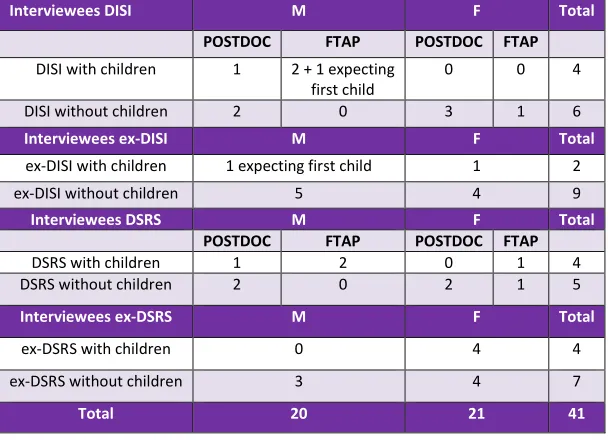
The analysis is based on 41 interviews with temporary researchers: 8 with fixed-term assistant professors, and 33 with postdoc fellows currently working, or who had worked in the past (from 01.01.2010 to 01.01.2014), at the Department of Information Engineering
7
16
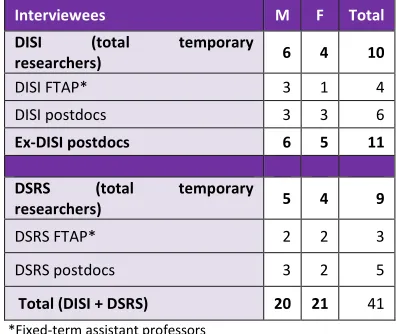
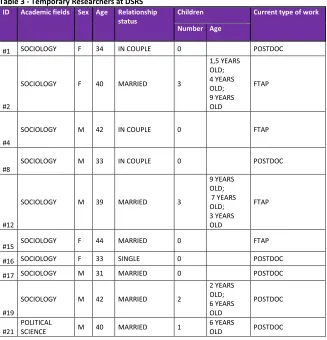
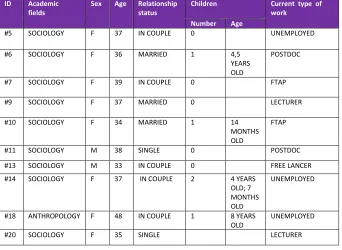
[image:11.499.123.321.199.366.2]and Computer Science (DISI –STEM) and at the Department of Sociology and Social Research (DSRS - SSH). Tables 1.1 and 1.2 set out the main characteristics of the interviewees included in the analysis.
Table 1.1shows in detail theposition of theinterviewees who were working at the DISI and DSRS departments at the time of the interviews (September 2014-March 2015) and of the interviewees who worked there as postdocs from January 2010 to January 2014 (indicated here as ex-DISI and ex-DSRS). This information is relevant to the analysis presented because is strictly connected to the perception of the instability/stability of the job and the level reached in the academic career.
Table 1.1 Interviewees by relationship with institution, gender, and department
Interviewees M F Total
DISI (total temporary
researchers) 6 4 10
DISI FTAP* 3 1 4
DISI postdocs 3 3 6
Ex-DISI postdocs 6 5 11
DSRS (total temporary
researchers) 5 4 9
DSRS FTAP* 2 2 3
DSRS postdocs 3 2 5
Total (DISI + DSRS) 20 21 41
*Fixed-term assistant professors
17
Table 1.2 Interviewees by parenthood, gender, and department
Interviewees DISI M F Total
POSTDOC FTAP POSTDOC FTAP
DISI with children 1 2 + 1 expecting first child
0 0 4
DISI without children 2 0 3 1 6
Interviewees ex-DISI M F Total
ex-DISI with children 1 expecting first child 1 2
ex-DISI without children 5 4 9
Interviewees DSRS M F Total
POSTDOC FTAP POSTDOC FTAP
DSRS with children 1 2 0 1 4
DSRS without children 2 0 2 1 5
Interviewees ex-DSRS M F Total
ex-DSRS with children 0 4 4
ex-DSRS without children 3 4 7
Total 20 21 41
Temporary researchers at DISI
Working hours and workplace: autonomy, flexibility and self-obligation
The DISI researchers said that the typical work day was eight hours long (from 9 a.m. to 6 a.m.) and, often, when necessary they worked during the evenings and/or at weekends. These extra hours of work were usually dedicated to meeting deadlines and to writing papers or project proposals.
The majority of the interviewees stated that they could manage their workday as they preferred. They emphasised their autonomy in deciding the time and place of work – “it’s up to you” – and this had positive and negative aspects in terms of WLB. On the one hand, the researchers were able to plan their work by themselves and manage work and personal tasks freely. On the other hand, not having fixed working hours meant never stopping work and being available around the clock. For example, they checked their emails during evenings, weekends and holidays.
“The downside of working at university is that there are no fixed working hours. This makes people feel forced to work around the clock, without ever disconnecting” [ex-DISI, woman, 35 years old].
Some interviewees, in particular the fixed-term assistant professors who were also fathers, stressed that they worked at the department in the morning and then went home in the afternoon. They did not perceive the DISI as a stressful environment: they had some activities with their research group, like meetings or teaching activities, but no other constraints. The most important thing was respecting deadlines.
18
“there are often impromptu meetings” and because it was important that colleagues knew that they were working, even though the contract does not stipulate working at the university.
Also evident in the answers of female researchers was the difficulty of separating the work sphere from the personal one; in fact, they highlighted the need to be passionate about their jobs and devoted to them.
The majority of the interviewees, both men and women, described the PhD period as the most stressful and gruelling. After that period, they stated, the research work alternated between very intensive work periods and more relaxed ones.
Work/Life Balance: relationships and parental status
The WLB issue emerged in different ways between women and men on the basis of their position in the academic career structure (postdocs, fixed-term assistant professors), their relationship (if they were single or in a couple), and parental status (whether or not they had children).
It is interesting to note the differences in the relationship status between the women and men researchers interviewed; in fact, 5 women out 9 were single, but only 2 men out 12 were so.8 The only woman interviewee who was also a mother was currently working as a researcher in a foreign country. The male interviewees who had children were two fixed-term assistant professors and one postdoc. Moreover, one fixed-fixed-term assistant professor working at the DISI, and one ex-DISI currently a lecturer at another university, were expecting their first child at the time of the interview.
According to the majority of the interviewees’ stories collected, WLB was not a significant issue in terms of everyday life organisation; the interviewees did not express particular complaints. The single men interviewed said they had good social lives and engaged in leisure activities, such as sport or going out with friends. The single female interviewees did not complain about their WLB, even if most of them said that they did not have extra-work engagements such as sport, political, cultural or leisure activities. It seems that they accepted not having free time during the week and considered it sufficient to have the weekend off. They were aware that matters would be different with children because their needs in everyday organisation would change:
“Now I’m fully devoted to research, but when the time comes, we’ll see…” [DISI, woman, 31 years old].
The influence of work on private life emerged from the answers of the women interviewees when they talked about their relationships with partners or friends. The long working hours and the pressure of the work did not allow them to spend their free time like people with different jobs could. Some interviewees said that they had few friends, or that they did not spent a lot of time with their friends because of the workload. In some cases, they also had problems with their partners because of the working time, mobility periods (working abroad and participation in conferences), and geographical instability (frequent changes of workplace in different cities or countries).
8
19
Among male interviewees, only those in distance relationships said that it was not so easy to balance the work and the personal spheres, but they were looking for a solution with their partner and trying to get a job in the same city.
The woman researcher with a child stressed the change in her way of work after her child’s birth in terms of working hours – e.g. she was too tired to work during the evenings – and her concentration.
"I don't feel really good, I don't feel I work enough, and anyway I work in a different way from how I worked before. And I'm sure this won’t be the same anymore". [ex-DISI, woman, 29 years old]
The interviewees who were fathers stated that they managed their work and family duties thanks to better organisation and changes in their work time: for example, working less during the weekends.
“My son is turning four years old, so what happens is that I take him to the kindergarten in the morning and I come here. Then after lunch I can normally stay even until 15.00. I pick him up from school at 16.30 and then I go home with him for the rest of the afternoon. This is how I take care of both the children and the work, at home; this is what they call – in America – the supermom or superdad. My wife works but she has this time off work. I do think I have a good balance, because my family doesn’t complain much that I’m not there for them or whatever. I try to play, I try to read, I try to do activities with my son and with my family in general. So yes, up to now – at least – I don’t have any complaints”. [DISI, man, 36 years old].
Mobility: international experiences, conferences and visiting periods
The interviewees considered participation in conferences and project meetings as part of their jobs, and as important opportunities for career construction. The research group or the department covered the travel expenses for conference participation. The postdoctoral researchers said that, in the majority of cases, they could participate in conferences if they presented a paper whose topic was connected to the project on which they were working. The fixed-term assistant professors had personal funds and could freely decide to attend conferences.
One interviewee said that postdocs, due to their professional degree, should have more autonomy and have their own travel funds – e.g. 1,000 euros a year – as at others European universities. At the moment, in fact, they did not have mobility funds that they could use for conferences.
In regard to international mobility, the women and men interviewed had different experiences, opinions and feelings.
Among the male researchers, all the interviewees except one participated in several conferences per year, and some of them (two people) also had visiting periods. Geographical instability did not emerge as a significant issue. The father-researchers continued to travel also after the births of their children:
“for the moment it has never happened that I’ve had to stay less only because I have a family. It has never affected me” [DISI, man, 36 years old].
20
Instead, for the majority of the women researchers the frequent changes of workplaces and countries emerged as problems in their answers: work experience abroad was an important element in the past, and/or of the present and/or of the future of the interviewees' career paths. They explained that geographical instability was a motivating and stimulating aspect of their jobs; but after many experiences they would prefer to find somewhere to settle down and no longer be a stranger.
“Now I have to face a new change in my life and I am forced to leave my country and start all over again: new job, new friends, new everything. At 36 years old maybe I would prefer not to do so, if I had the chance I would be very happy to live here in Trento, but since there has not been this chance ... we’ll leave and go to England” [DISI, woman, 36 years old].
Future: work, personal and family sphere
Planning the future was the most difficult aspect that emerged from the stories of the interviewees, above all for the postdoctoral researchers. In fact, the main concerns regarded academic posts (postdocs and fixed-term assistant professor) and the relationship status. Personal and family choices for postdocs, both men and women, depended on the chances of finding a more stable job, obtaining the National Scientific Qualification (necessary to obtain a position as associate professor) and identifying a city where to construct their futures. These interviewees seem to be trapped in the present and could not think about the future because of work instability:
“I’ve stopped thinking about the future, it’s better to focus on the present” [DISI, woman, 37 years old].
The majority of the single interviewees said that they could not clearly imagine their future family life.
The interviewees in stable relationships said that the decisions to buy a house and have children had been postponed because of the uncertainty of work. Those who had distance relationships were more worried about the possibility of starting to live together without both partners renouncing their careers and realisation.
The female researchers stated that their main worries concerned the future of the professional sphere, with particular regard to the ability to maintain the present workload, to deal with the high level of competitiveness, and to acquire more autonomy.
The interviewees who expressed the desire to become mothers (one postdoc, one fixed-term assistant professor, and one “ex-DISI”) were well aware of the difficulties of achieving a work-life balance; they knew that it would be a challenge, but they did not want to renounce having a family. They thought it would be necessary to organise everyday life better and redefine their priorities. They did not have clear ideas about the work/life balance requirements; they generally referred to childcare services, such as nurseries and financial support.
21
The male interviewees with children, or expecting their first child, focused on achieving a permanent contract or a career promotion. They did not appear to be stressed by this situation and were confident about career advancement. In regard to personal and family life, they planned to remain in Trento in the short and medium period, while transfer to a foreign country was a remote possibility.
“My partner is pregnant, so I don’t think I’ll move to a foreign country in the near future. I don’t necessarily expect to live all my life in Trento – my partner and me, we are both at university, so finding a job in another country is not difficult – but in the short or medium term I think we will stay here” [DISI, man, 39 years old].
Policies and services
The women interviewed underlined their stress and anxiety due to the workload, uncertainty about the future, and the difficulty of achieving a work/life balance.
“I take everything seriously so I’m easily stressed. So it’s not easy to have a balance between work life and social life, even without a baby, even now. It’s not easy. So my boyfriend is always complaining; he’s trying to get used to it, but he’s really had a problem accepting this” [DISI, woman, FTAP, 31 years old].
The men interviewees also suffered from these conditions but they did not focus particular attention on the situation.
This seems to emerge from a different perception of the characteristics of the DISI environment. As said above, more women researchers underlined the high level of competition and pressure in order to advance in the career.
Moreover, two “ex-DISI” women complained about the ambiguity of the work contract of postdoctoral fellows – “you don’t have duties and rights” – they stated – since “a postdoc does not have rights to sickness leave and holidays, and the possibility to stay at home is like a favour granted by your supervisor”.
The interviewees pointed out that certain services were necessary to improve the lives of temporary researchers. They suggested introducing social insurance for researchers with temporary contracts, and PhD candidates, and improving the pension provision of postdoctoral fellows. They thought it important to recognize that postdocs have jobs instead of scholarships. Some others thought that the Province of Trento should introduce specific benefits for researchers because they contribute to the well-being and progress of the province;
“[…] maybe special things targeted on researchers or on people that are already working and let’s say providing some sort of growth to the region. The people that are working and producing things, and maybe you want to keep them…” [DISI, man, 36 years old].
In regard to parenthood, on comparing DISI with the new workplace (a university in a foreign country), a male researcher proposed a counselling service – It would be useful to have somebody in place to meet regularly just to find out how people are doing and if there’s anything they could benefit from[ex-DISI, man, 40 years old] – and asked for paternity leave for postdocs as well.
22
them benefited from economic contributions to apartment rents during their PhD degree courses9 and health insurance.
Researchers from a foreign country suggest creating an information point or brochures about the obligations and rights (laws) of the work contract, taxes, and pension provision. Furthermore, one of the male postdocs stressed the importance of more support to their families in terms of social integration – specifically advice on the local labour market.
Finally, in regard to parenthood, none of the male interviewees with children had used the university nursery service, either because they had not been admitted to the service or because other solutions were preferred – e.g. a nursery closer to home.
Gender issues
Two “ex-DISI” female interviewees, both still in academic careers, and two male fixed-term assistant professors, expressed opinions on being a woman in a male career and discipline. One of them explicitly referred to the existence of discrimination against women:
"Generally speaking, I think that a woman has more difficulties in this research sector. With or without children, women have more difficulties. Maybe also because in our field.. there are prejudices...I don’t know, and there are no specific policies...For example, it could be useful to set a gender quota: in a department you must have women, you have to ensure a certain number or a percentage of women – I don’t know what I would do – it is not possible that there are only men. And I think something would change... "[ex-DISI, man, 36 years old].
Concerning the relationship status, several women complained about the difficulty of constructing a symmetrical relation with a man:
“I’ve noticed that women who are autonomous and are following their path alone, without help, have more difficulties [...] a woman who works in a technical field... well, maybe men are afraid of an independent woman - I don’t know how to put it – maybe she adopts male forms of behaviour because she's always in that environment” [ex-DISI, woman, 36 years old].
Two male interviewees (one with children and one expecting his first child) pointed out the different consideration of paternity and maternity in the workplace and family life.
“[...] Maternity is unfortunately seen as an obstacle in some way, [...]. there’s a lack of ad hoc help to ensure that a person can somehow maintain a certain track while having a family life, especially for women; for men this problem is limited to handling a few family responsibilities, but not going forward in terms of the main commitment” [DISI, man, 39 years old].
Another one stated:
“If I were a woman I would answer that there are obstacles on the career ladder when you have children. Being male I would say no. Yes, clearly the family affects the work organisation, in particular with regard to the extra time that typically one that who works in university dedicated to research... if you want to do excellent research, theoretically you should almost never stop thinking about it. If I were a woman with two children I would say definitely yes, this is inevitable. It is inevitable: it is neither
9
23
correct nor fair, but unfortunately it's something that happens” [DISI, FTAP, 37 years old].
Finally to be highlighted is that some female interviewees explicitly mentioned the fact that maternity was not part of their future plans
“[...] other people’s children are nice, but I think maternity is really not in my nature, and I’m also an engineer... it’s intrinsic. I don’t have this predisposition, really [ex-DISI, woman, 36 years old].
Temporary researchers at the DSRS
Working hours and the workplace: autonomy and self-obligation
All the interviewees except one stated that they had complete autonomy in terms of working hours and workplace. The researchers worked at home or went to the office according to the activities planned and their personal preferences and needs: in the case of meetings and data collection they spent the day at DSRS; if not they could stay at home. The fixed-term assistant professors also had teaching duties and attended institutional meetings (Board of Department). They worked at the department more than the postdoctoral researchers.
The only person, a postdoctoral researcher, who had limits on this flexibility had to go to DSRS at least three days a week; but she did not consider it a problem in her everyday life.
Some postdoctoral researchers said that they preferred to work at home because they did not have a proper office at the department – they had a desk in an open space. Others lived in a city distant from the workplace and had decided to reduce commuting and go to the office only when necessary.
Likewise, the interviewees decided their working hours: at least 8 hours, but usually more. If necessary, all of them worked in the evenings and during the weekends and/or holidays. Most of them did not complain about this, and explained that there was an alternation between more intensive work periods and less intensive ones. The self-definition of working hours had positive and negative aspects connected to the instability of the work contract. Both women and men explained that during the PhD contracts (and for the assistant professors also the postdocs), the deadlines and pressure of evaluation were more intense.
Work-Life Balance: relationships and parental status
24
The most interesting topic that emerged from the question on the work/life balance regarded the impossibility of managing work and family tasks in terms of energy and attention. The women interviewees described research work as a vocation and an all-absorbing job. In fact, dedicating most of one’s time to research became a forma mentis and a modus vivendi.
The temporary researchers who were also mothers (1 DSRS and 3 ex-DSRS) explained that free time did not exist beyond the time dedicated to their families. They said that it was very difficult to maintain a good work/life balance, and after the child’s birth they had not been able to work as before. The grandparents, the babysitter, and the nursery enabled them to continue working and not ‘exit’ from the academic context. For these interviewees maternity was consequently an obstacle to the academic career:
“I calculated to become pregnant at the end of a contract, so as not to bother anyone. If I had decided to become a mother before, when I was on a one-year contract as a postdoc, I would have probably compromised my position at the university” [ex-DSRS, woman, 36 years old].
“Being a woman with a child is disabling. You can’t think of studying and working like before: so it would take some form of support for women and some kind of greater recognition” [DSRS, woman, 34 year old].
This issue did not emerge from the answers of male temporary researchers who were also fathers.
For those who did not have children the academic career was an obstacle to the maternity/paternity choice:
“it depends on your priorities, but if you want children, you don’t choose to became a researcher […] If I’d wanted a family, I would have continued working as a secretary, and I wouldn’t have chosen to do research”[ex-DSRS, woman, 37 years old]; “you have no protection and you must have a total vocation. The instability of the work contract influences the decision to have children […] and the work stress level is very high and you wouldn’t want to add other sources of stress, so you decide to postpone the paternity choice” [DSRS, man, 31 years old].
These examples illustrate the main interactions between work and family life in both directions, and they highlight the ambiguity of research work, the commitment that the interviewees said that they wanted to dedicate to their jobs but, at the same time, also the need to find a balance with private life.
Finally, the interviewees that had visiting periods in other European countries pointed out the differences from the Italian context in terms of working time organisation and maternity leave. In fact, the majority of academic contexts outside Italy seem to be more WLB–friendly, and also researchers in fixed-term posts (postdoctoral researchers and PhD candidates) more easily decide to have children.
Stress, guilt and inadequacy
25
that impacted negatively on psychophysical well-being (e.g. tiredness). One female interviewee who had decided to leave academic work explained that research was not compatible with her psychophysical well-being, and that was the reason for her decision.
Moreover, some women postdoctoral fellows stated that the deadlines, the workload, and the impossibility of dedicating all one’s energy to work, created feelings of guilt and inadequacy. Above all the temporary researchers who were mothers explained that they were unable to concentrate fully on their work or their children. They stated that there was always a tension between work that one likes and love for one’s family. Among the 20 temporary researchers interviewed (DSRS and ex-DSRS), 8 of them have children (5 women and 3 men): only two of them, both men, were postdocs at the DSRS at the moment of the interview; one woman and one man are currently fixed term assistant professors at the DSRS; and the remaining 4 women are not working anymore at the DSRS.
Finally, it should be highlighted that the postdoctoral researchers were more stressed by the instability of their jobs than the fixed term assistant professors. Indeed, the latter described the need to rethink everyday life organisation, but they did not seem particularly worried about the possibility of pursuing their careers. Moreover, the postdoctoral researchers did not have access to any services and economic subsidies; the economic aspect relating to the WLB was more important in their answers compared with those of the FTAPs (e.g. payments for private nurseries or child minders)-
Policies and services
Three of the interviewees with children (two mothers and one father) accessed the University’s nursery; four (two mothers and two fathers) did not use the service because they had chosen other solutions (e.g. a private/public nursery closer to home) or because they had obtained a low score on the ranking list. In fact, as already mentioned, the University nursery gives priority to permanent administrative and academic staff. The women researchers who had become mothers while working in DSRS (one as PhD candidate and 1 as postdoc) received 5 months of maternity leave, but did not obtain other benefits. Of the three male researchers with children, one accessed 6 months of unpaid paternity leave during his PhD course, and the other two (1 postdoc and 1 fixed term assistant professor) received grants to cover nursery costs.
Some interviewees with temporary posts did not know exactly if they were entitled to maternity, paternity and parental leave and “if” and “how” they could apply for it. They said that it would be useful to have a vademecum or an information brochure about the conditions of access to the different kinds of leave, contributions, and services for academic staff, with both temporary and permanent contracts.
26
conditions until the age of 45 – “it’s unfair to be considered eternal interns”[DSRS, woman, 37 years old].
And that it would also be necessary to recognise the value of the PhD degree outside the academic work sector. Focusing specifically on work/life balance services, the female interviewees stressed the need for babysitting and emergency babysitter services, and a breastfeeding area.
Mobility: commuting and conference participation
At the DSRS the mobility issue emerged in relation to two topics. First, the interviewees said that they participated in several conferences during the year. The fixed-term assistant professors had a personal fund from the department and could use it as they preferred to travel to conferences, seminars and workshops. The postdoctoral fellows working in the frame of a national or internal project usually had access to funds to attend conferences. If they did not have this kind of funding, they had no access to funds, and they often had to pay for conference participation by themselves. Moreover, two postdocs stated that during the contract at DSRS they travelled to different parts of Italy or the region in order to collect data. They paid for these journeys by themselves and did not receive any reimbursements.
The second issue that emerged from the interviews concerned commuting. In fact, some interviewees lived far from Trento, the city in which they worked, and they did not receive any support or reimbursement for travel expenses. This affected the quality of life in terms of personal/family life and/or work life. They had not moved to the city where they worked for various reasons: the brief duration of the contract – usually one year – or because the partner could not change his/her job and move to another city – e.g. a female fixed-term assistant professor with a child travelled 400 km each week. These researchers usually stayed in the workplace city three days a week, and then returned to the city of “personal life” and worked from home. They complained about this because when they were in the city where they worked, time was short and they tried to do as much work as possible, but they could not avoid also working at home. Finally, some interviewees said that, because they worked far from the research group, they sometimes suffered from being and working alone.
International mobility did not emerge as a significant issue from the interviews: only one woman researcher (a fixed term assistant professor) who was also a mother had reduced conference attendance since the birth of her last child.
Some interviewees had some visiting periods abroad, but mostly during the PhD course. During the PhD course, in fact, an economic contribution is foreseen by the University (the income is increased by 50% during the visiting term?) while during a postdoc contract there is no contribution for mobility, for either conferences or visiting terms.
Finally, the possibility of continuing the academic career in a foreign country was mentioned; but did not have the same importance as for the DISI researchers in terms of possible opportunities.
Future: work, personal and family sphere
27
The majority of the interviewees were willing to pursue their academic careers in the next few years and obtain a more stable job. They were well aware of the difficulties that they would encounter and expressed ambiguous statements about the opportunity to decide about their personal and family lives beyond the work career. On the one hand, they knew that they could not wait for greater stability before deciding, for example, to have children or buy a house. On the other hand, they underlined the risks of making these decisions without considering the work sphere. The two spheres are bound up with and influence each other.
In regard to work, the majority of the interviewees stressed the need to maintain or build a strong curriculum vitae in order to be competitive in the academic context – in Italy and Trento specifically, but also in other countries if necessary.
Two interviewees, one woman and one man, stated that they would leave the academic career if they could not achieve a good work/life balance.
To conclude, at the DSRS it seems that there were no significant differences between women and men in their approach to, or perspectives on, the future: uncertainty and precarious conditions were the main concerns of all the interviewees. The fixed-term assistant professors were less worried about the possibility of pursuing an academic career, even if they knew that they had to guarantee a hard engagement in the work sphere and maintain a high competitive profile, also because their posts were not tenured, but temporary ones, without any commitment to them by the University upon conclusion of the contract.
1.4. CONCLUSIONS
The most common WLB policies and services in the Italian universities are addressed to administrative staff with permanent contracts. Actions are developed for employees with regular work schedules who must guarantee their presence in the workplace. Part-time, flexible working hours and teleworking are examples of these actions. The Italian universities also offer services such as nursery and babysitting in order to promote the balance between family and work for parents, but mainly for employees with permanent jobs. In recent years, they have also introduced facilities for employees who have to care for elderly and disabled relatives. This is an important issue in Italy, where the welfare state – Mediterranean model – is based on the family, especially women, as care providers.
The innovative aspects of WLB policies regard:
• The introduction of more flexible facilities in terms of times and places of the childcare service (such as baby parking, emergency babysitting, toy library, etc.).
• The extension of some policies to administrative and academic staff on temporary contracts.
• The inclusion of wellbeing and health issues as WLB policies (counselling services, good health related lessons).
28
in regard to the academic staff with permanent contracts, and in some cases also those with temporary ones.
The initiatives that take account of the reciprocal influence between the work and personal/family spheres in career construction and personal/family planning are particularly interesting for the target group of the GARCIA project: for example, considering the long period of absence from the workplace in definition of the recruitment and career advancement process.
The work organisation of the academic staff in terms of time, space and workload has specific characteristics that require specific interventions. In fact, the interviews evidenced the opposite aspects, positive and negative, of the high level of flexibility and autonomy in work organisation, particularly for researchers at the early stages of their careers. The WLB needs emerged in regard not only to everyday life organisation – and work-family duties reconciliation – but also to planning the future personal, family, and career path.
Autonomy was an ambiguous element of work organisation: in fact, on the one hand, the researchers stated that they were free to decide how to spend their time; on the other, they had to work harder and harder in order to meet deadlines and construct their competitive curriculum vitae (Bellé et al. 2015). The connection of a competition environment and the more demanding pace of work with precariousness generated stress and anxiety. These conditions increased work/family conflict and provoked feelings of inadequacy and guilt because of the impossibility of dedicating sufficient energy and concentration to their work and to their families. This was especially the case of female researchers with temporary contracts who had children. At the same time, female interviewees, both with or without children, stressed their determination to pursue an academic career, and their devotion to, and vocation for, academic work. This latter element was not present in the interviews with their male colleagues. According to Brevis (2000) and Nikunen (2012), this may be interpreted as an introjection of the organisation’s requirement of a masculine work identity in order to assure permanence in the system. “Masculinity is often connected to devotion to work seemingly without other responsibilities” (Nikunen in Ahola and Hoffman, 2012, p. 277).
Precariousness, related to professional careers but more in general to biographies (Armano, Murgia, 2015), emerged from the interviews as the most problematic element, and it was strictly connected to the family/private sphere. The difficulties of planning the work career, in fact, influenced the private sphere; the interviewees explained that they had postponed the decision to have children or to buy a house because of the instability of their jobs and economic discontinuity. On the one hand, the academic career emerged as an obstacle to the choice of parenthood; on the other, maternity was considered an obstacle to the academic career, for both men and women interviewees. In fact, the main and most frequent requests made by the interviewees concerned access to social security for temporary researchers (above all postdocs) and a more transparent academic system, with fairer and more certain rules for career advancement.
29
BIBLIOGRAPHY
Armano, E., Murgia, A. (2015), “The precariousnesses of young knowledge workers. A subjectoriented approach”, in J. Matthew (ed.) Precariat: Labour, Work and Politics, New York: Routledge, pp. 102-117.
Bellé, E., Bozzon, R., Murgia, A., Peroni, C., Rapetti, E., (2015), “Fare ricerca in e su l’Accademia. Vecchie questioni metodologiche e nuove pratiche di osservazione riflessiva, Sociologia Italiana AIS Journal of Sociology, 5: 143-154.
Bozzon R., Donà A., Villa P., Murgia M., Poggio B. (2015), Italy, in Le Feuvre, Nicky (ed.) Contextualizing women’s academic careers: Comparative perspectives on gender, care and employment regimes in seven European countries, GARCIA working papers, n. 1, University of Trento. http://goo.gl/zYBgULBrevis, J., (2000),
Crompton, R., and Lyonette, C., (2006). “Work-Life ‘Balance’in Europe.” Acta Sociologica 49(4): 379–93. http://asj.sagepub.com/content/49/4/379.short.
Damaske, S., Ecklund, E. H., Lincoln, E., White, V. J., (2014), “Male Scientists’ Competing Devotions to Work and Family: Changing Norms in a Male-Dominated Profession.” Work and Occupations.
Kinman, G., Jones F., (2008). “A Life Beyond Work? Job Demands, Work-Life Balance, and Wellbeing in UK Academics”, Journal of Human Behavior in the Social Environment 17(1-2): 41–60.
Mundo, A. (2012), “Analisi dei dati sull’utilizzo del congedo parentale: focus sulla situazione del Paese”, presentation at the conference ‘Maternità, paternità & lavoro: istruzioni per l’uso’.
Murgia, A., Poggio, B. (2013), “Fathers' Stories of Resistance and Hegemony in Organizational Cultures”, Gender, Work and Organization, 20(4) 413-424.
Murgia, A., Poggio, B. (2009) “Challenging Hegemonic Masculinities. Men’s Stories on Gender Culture in Organizations”, Organization, 16(3): 407-423.
Nikunen, M. (2012) " Precarious work at the ‘entrepreneurial’ university: Adaptation versus
‘abandon ship’. Individualization and identity work: Coping with the ‘entrepreneurial’
university", in Ahola, S., Hoffman, D., M., (2012). Higher education research in Finland:
Emerging structures and contemporary issues Internationalized Campuses Just Don’t Happen: Intercultural Learning Requires Facilitation and Instutional Support.
Poggio, B., Murgia, A., De Bon M., (2010), Interventi organizzativi e politiche di genere, Roma: Carocci.
Rees, T. L., (2001), “Mainstreaming Gender Equality in Science in the European Union: The ETAN Report’.” http://orca.cf.ac.uk/3048/
.
30
Appendix 1
Table 1 - Affirmative Action Plan (AAP) in Italian Universities
University Period of the last available AAP
1 University of BARI ALDO MORO Not available (n.a.)
2 Polytechnic of BARI n.a.
3 University of BASILICATA n.a.
4 University of BERGAMO AAP 2010-2012
6 University of Bologna AAP 2014-2017
7 University of BRESCIA APP 2015-2017
8 University of CAGLIARI AAP 2013_2015
9 University of CALABRIA APP 2005-2008
10 University of CAMERINO APP 2014-2016 11 University of CASSINO
and LAZIO MERIDIONALE
n.a.
12 University of CATANIA n.a.
13 University of "Magna Graecia" CATANZARO
n.a. 14 Catholic University of “Sacro Cuore”
(private)
n.a 15 University "G. d'Annunzio" of
CHIETI-PESCARA
n.a.
16 University of FERRARA APP 2014- 2016
17 University of FIRENZE APP 2014-2017
18 University of FOGGIA n.a.
19 University of GENOVA APP 2013-2016
20 Universiy INSUBRIA Varese-Como n.a.
21 University of L'AQUILA n.a.
22 University of MACERATA n.a.
23 University of MESSINA APP 2015-2017
24 University of MILANO n.a.
25 University of MILANO - BICOCCA APP 2009-2011
26 Polytechnic of MILANO APP 2013-2015
27 University of MODENA and REGGIO EMILIA
n.a.
28 University of MOLISE APP 2012-2015
31
University Period of the last available AAP
30 University of NAPOLI n.a.
31 University of NAPOLI "Parthenope" n.a. 32 University of NAPOLI "L'Orientale" n.a.
33 University of PADOVA APP. 2009-2011
34 University of PALERMO n.a.
35 University of PARMA AAP 2013-2015
36 University of PAVIA AAP 2014-2016
37 University of PERUGIA AAP 2015-2017
38 University for Foreigners of PERUGIA AAP 2015-2017 39 University of PIEMONTE ORIENTALE AAP 2013-2015
40 University of PISA AAP 2014-2016
41 University of Sant’Anna, PISA n.a.
42 Scuola Normale Superiore of PISA AAP 2012-2013 43 Politechnic of MARCHE AAP 2013-2015 44 University "Mediterranea" of REGGIO
CALABRIA
n.a.
45 University of ROMA "Foro Italico" n.a. 46 University of ROMA "La Sapienza" n.a. 47 University of ROMA "Tor Vergata" n.a.
48 University of ROMA TRE AAP 2004-2007
49 University of SALENTO n.a.
50 University of SALERNO n.a.
51 University of SANNIO of BENEVENTO AAP 2010-2011
52 University of SASSARI AAP 2013-2016
53 University of SIENA n.a.
54 University for Foreigners of Siena n.a.
55 University of TERAMO n.a.
56 University of TORINO AAP 2013-2015
57 University of TRENTO AAP 2014-2016
58 Polytechnic of TORINO AAP 2007-2010
59 University of TRIESTE AAP 2014-2016