21
STCENTURY MAKERS AND MATERIALITIES
21
STCENTURY MAKERS AND MATERIALITIES
Proceedings of the 2nd Biennial
Research Through Design Conference
|
RTD 2015
2
Re-knitting: exploring openness
through design
Amy Twigger Holroyd
School of Design,
University of Leeds, UK
[email protected]
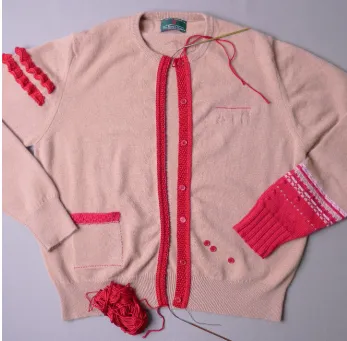
amateur making. At the conference I will show a sample garment featuring five different re-knitting ‘treatments’, which I produced while working with the research participants.
The research produced an extensive re-knitting resource, and a nuanced understanding of the lived experience of wearing homemade clothes in contemporary British culture. Furthermore, the study generated transferable knowledge relating to the reworking of existing items and ways in which this can be supported; the abilities of amateurs to design for themselves and the conditions which encourage this activity; and the changes in practice and identity which take place as we shift between the roles of designer-maker and meta-designer-maker.
Keywords: Open; Knitting; Fashion; Metadesign; Amateur.
Abstract: This paper profiles a doctoral research project that investigated the idea of openness within fashion in order to understand the relationships between amateur fashion making, well-being and sustainability. The
research was conducted through my practice as a designer-maker of knitwear.
4
Introduction
This paper accompanies a reworked jumper, which I produced as part of my doctoral research project. The research investigated the idea of openness within fashion in order to understand and explore the relationships between amateur fashion making, well-being and sustainability.
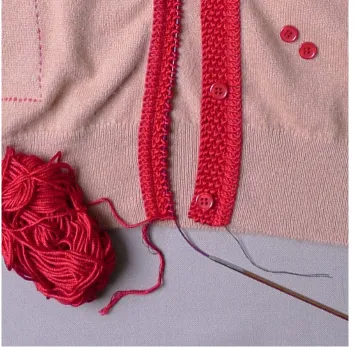
The garment was used as a sampler to try out five re-knitting alterations, or ‘treatments’: replace edge section; integral embellish; stitch-hack;
afterthought pocket; and cut open and trim. Images of these five treatments in progress will guide us through the paper. I will be demonstrating the techniques on another sampler throughout the conference.
Background
This research considers amateur fashion making – which I describe as ‘folk fashion’ – as a strategy for sustainability. It is linked to my practice as a designer-maker of knitwear, with the topic emerging from the explorations of design and sustainability which I have undertaken in the past decade.
[image:4.842.459.806.114.455.2]I launched my experimental knitwear label, Keep & Share, in 2004 in order to investigate the design for sustainability principle of sufficiency, and associated strategies of longevity and versatility. Craft is integral to the philosophy of my label, because a knowledge of the making process can
5
Twig
ger H
olr
oyd
run, I have met many people who make their own clothes and find this to be an empowering, positive experience. However, other conversations have shown me that amateur fashion making is riddled with ambivalences, which affect the way that knitters feel about their homemade items. Thus, I identified a need to investigate makers’ experiences of wearing homemade clothes in a culture dominated by mass-produced garments, in order to build a deeper understanding of the relationship between folk fashion, well-being and sustainability.
Another issue affecting this relationship is the strong emphasis within amateur knitting culture of solely making new items. Although the reworking of existing items would have been an integral element of knitting activity in the past, such practices have fallen out of favour in recent decades. While there are many contemporary examples of wearers repairing and reworking garments using dressmaking techniques, examples using knitting are limited. This arguably restricts the advantages of knitting in terms of sustainability, as it mirrors – rather than challenges – the linear production-consumption model of the mainstream fashion industry.
Gill and Lopes (2011: 312) argue that too many sustainable design initiatives involve the production of new things; they suggest that ‘the challenge for the material practices of design might be recast in terms of a negotiation with those things already in existence’. Excited by this idea, engender emotional connections which contribute to longevity. The logical
extension of this philosophy is to encourage wearers to become makers themselves, and between 2008 and 2013 I facilitated other people’s making, running hand and machine knitting workshops and projects in a range of contexts. These experiences sparked my interest in the relationship between folk fashion and sustainability.
My working understanding of sustainability is rather broader than the most frequently cited definition, which involves three interconnected elements: environment, society and economy (United Nations 2005). This conception has been criticised for its dependence on conventional economic thinking, which arguably created many of the environmental problems that we face (Jackson 2009). As an alternative, Ehrenfeld (2008: 49) offers a positive, aspirational definition of sustainability, which I favour: ‘the possibility that humans and other life will flourish on the Earth forever’. A focus on flourishing encourages us to understand human well-being as an integral element of sustainability.
6
7
Twig
ger H
olr
oyd
of appearing through dress, throughout history. Fashion depends on this broad, varied, vibrant resource: new fashions involve existing styles revisited, recombined or recontextualised. I believe it is important for our well-being – and therefore sustainability – to have an open fashion commons, offering diverse options with which we can construct our identities. Some researchers argue that fashion is already an open
commons, because it has minimal legal protections for its creative design (Cox and Jenkins 2005). While I acknowledge that intellectual property law affects the openness of the commons, I feel that other factors are restricting access to, or enclosing, this resource.
As a maker, I am particularly interested in the role of manufacture as a mechanism of enclosure. Clothing production has become increasingly industrialised and professionalised in recent decades, and concentrated in the hands of a small number of powerful companies. Consequently, wearers have become geographically and psychologically alienated from the making of their clothes. The businesses which produce the garments that we wear restrict our use of the fashion commons because they make many choices about what is available and, as dependent wearers without an independent means of production, we can only choose from the options provided. This enclosure can be challenged, of course; opening up the fashion commons would involve gaining access to a greater diversity of styles, and making or adapting our own clothes is a particularly accessible strategy for doing so.
I became interested in developing methods of reworking contemporary knitted garments using knit-based techniques, skills and knowledge.
As we will see, I used a design research methodology to investigate these two central ideas – understanding the experience of wearing homemade clothes, and revitalising the practice of re-knitting – via a central theme of openness.
About openness
Openness draws together amateur activity and sustainability, and thus provided a useful concept to guide my research. The trend of openness has reached many fields of life, creating movements such as open source software, open manufacturing and open gaming (van Abel et al. 2011). In each area, if we compare the conventional culture with its open equivalent, we see the breaking down of hierarchical relationships and divisions
between professional experts and amateur users. In many cases, the role of the user is fundamentally altered from passive observer to active contributor (Gauntlett 2011).
8
[image:8.842.461.806.113.451.2]9
Twig
ger H
olr
oyd
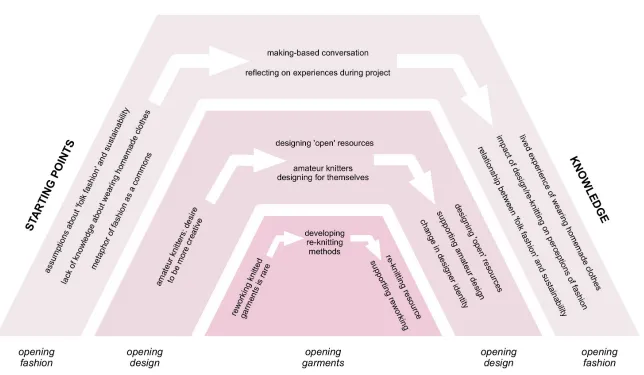
practical platform through which I was able to explore the possibilities of openness at two, increasingly abstract, levels: first, opening up my design practice to share design skills with amateur knitters; and second, opening up the fashion commons through folk fashion. These levels are represented in figure 8.
The links between these activities were fortuitous: because existing garments are endlessly variable, re-knitting offered an excellent opportunity to explore the creation of ‘open’ resources (rather than fixed patterns) and to investigate the abilities of amateurs to design for themselves. Furthermore, by working closely with a group of knitters to develop and test the re-knitting techniques, I was able to gain a deep insight into their experiences of making and wearing homemade clothes.
During the first phase of activity I worked independently: developing the re-knitting methods through iterative cycles of planning, sampling and reflection. I gradually worked through my initial ideas about re-knitting, researched methods from the past and built a spectrum of techniques that could be used to alter and rework any knitted garment – whether hand-knitted or mass-produced (figure 9).
There is a clear link between making and openness. Openness, after all, relates to a ‘making and doing’ culture, and an atmosphere of sharing and collaboration. The cultures and communities of amateur craft have offered an opportunity for people to actively create for centuries. The culture of craft is based on sharing, with activities such as knitting, quilting and embroidery drawing on a rich resource of traditional designs and an ethos of communal evolution (Freeman 1987; Robertson 2010). Open culture is vibrant in the world of contemporary knitting; knitters have embraced the potential of the internet for connecting and sharing their knowledge. However, knitting is not as open as it may first appear: many knitters who I encountered in my practice and research expressed frustration at their own dependence on patterns. In my experience many amateurs have a desire to be ‘more creative’, but lack the confidence to work without a pattern – both in terms of technical planning and making aesthetic design decisions. If we combine these issues with the concerns people have about wearing their homemade items, mentioned in the previous section, we can see that amateur making does not automatically lead to an open fashion commons or a satisfying, fulfilling experience of fashion.
The process
10
11
Twig
ger H
olr
[image:11.842.51.695.100.475.2]oyd
12
13
Twig
ger H
olr
oyd
garment-based interviews in advance of the group activities and carried out three evening ‘knitting circle’ sessions, which provided opportunities for structured discussion and reflection. When the scheduled sessions drew to a close, the participants expressed a desire to continue meeting, and thus I was able to document several additional evening sessions. All of these activities were audio and video recorded; I transcribed every session and used thematic coding and a constant comparative method (Robson 2011) in order to analyse the data.
The success of this methodology hinged on the gathering of data during the creative activity. Rather than talking to makers about their practice retrospectively, as would be the case in an interview-based strategy, I was able to hear the participants’ feelings first-hand as they tried out the re-knitting techniques. By capturing the participants’ thoughts before, during and after the workshops, I was able to examine the changes that occurred in their attitudes as the project progressed.
Outcomes
The project produced various outcomes relating to re-knitting, which I gathered together as an online re-knitting resource. The core of the resource is the re-knitting ‘spectrum’ that visualises a range of treatments that could be used to alter an existing item of knitwear, and identifies the steps involved in each treatment (figure 9). This spectrum Because I intended that these techniques would be used by amateur
makers, it was crucial that I had input from such people during the development process. I recruited six female amateur knitters, aged
between 43 and 66, especially for the project. The majority had previously attended one of my skills-based knitting workshops, and all were motivated to take part by the opportunity to explore design and creativity.
The workshops I had carried out within my practice formed the starting point for this research; I had found this environment to be conducive to open conversation and collaborative work. I built my methodology around four day-long workshops spanning a period of four months. At the early workshops I tested my re-knitting techniques, design activities and instructional materials with the group. The sessions gradually shifted from these short structured activities to a more fluid studio environment, as the knitters developed ideas for their individual projects: designing and executing an alteration to a knitted item from their own wardrobe.
14
is comprehensive; from a technical perspective, it includes every possible knit-based alteration. However, each treatment has countless variations, depending on the characteristics of the original garment and the design of the alteration.
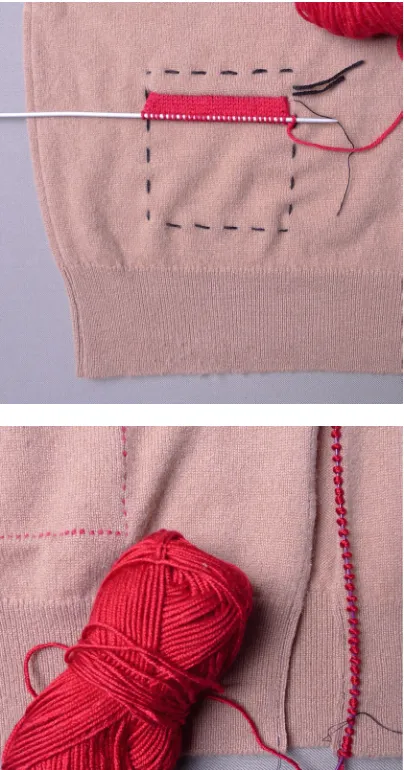
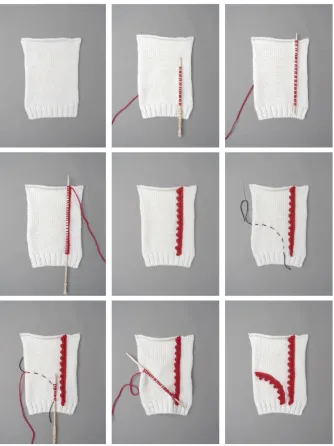
There is a section for each re-knitting treatment within the resource, including step-by-step instructions for carrying out the treatment (for example figures 12 and 13). Further pages offer instructions for each
individual step. In developing these instructional materials and producing the associated samples, I was highly conscious that the choices I made would affect the way the techniques were perceived by others. These choices fell into two groups: technical and aesthetic. When I needed to narrow down a wide array of technical options and select those to sample, I was guided by my tacit knowledge of knitters’ preferences and the research participants’ initial responses. In aesthetic terms, because I was aiming to create resources that could be readily adapted by others, I made my samples as generic as possible. I employed a consistent and basic style, using red woollen yarn to alter cream woollen panels. I used the same approach for the sample garment that is featured in this paper. I feel that this strategy was successful; the knitters were able to see the potential of the treatments and imagine how they could be adapted for their own garments. The six completed participant projects (figure 14) demonstrate that the participants understood, and exploited, the versatility of the techniques.
[image:14.842.605.807.142.527.2]15
Twig
ger H
olr
[image:15.842.395.729.33.479.2]oyd
Figure 12. Replace edge section step-by-step instructions. Credit: Amy Twigger Holroyd.
[image:15.842.39.372.34.484.2]16
17
Twig
ger H
olr
[image:17.842.406.761.37.384.2]oyd
Figure 15. Cut open and trim treatment. Credit: Amy Twigger Holroyd.
The study generated knowledge regarding the second level of openness – opening up my design practice to share design skills with amateur knitters. This research shows that amateur knitters are able to design for themselves, and draw on their tacit knowledge, gained from years The resource has received a positive response from the knitting
community, with particular interest in materials which support the process of changing gauge, a technical challenge which does not seem to have been previously addressed. At present the resource remains in prototype form, with further work necessary to make the materials more user-friendly.
Critical reflections
The research generated knowledge relating to each of the three levels of openness that I had identified: opening garments, opening design, and opening fashion. In many cases, these insights can be applied beyond the immediate context of knitting and fashion. A summary of this knowledge is included in figure 8.
18
able to accomplish this task. It is important to note that this activity was different from that of the industrial designer designing garments for mass production. The participants were designing for themselves, and therefore were ideally placed to consider their own individual – and sometimes idiosyncratic – preferences as knitters and as wearers. Although the participants had the ability to design for themselves, they needed support to do so. The key element in building the participants’ abilities as designers was not to show them the ‘right’ way to design, but to create the space for them to experiment and make creative decisions. I found that integrating peer support into this permissive space was key to its success; by trying out their ideas in front of their peers within the group, the knitters gained confidence in their decisions.
[image:18.842.87.435.38.382.2]During this process of opening up my design practice, my role and identity changed: I shifted from designer-maker to meta-designer-maker. While my previous practice involved designing and making garments to sell as finished items, during this project I was designing fragments of knit processes, developing instructions and advice, and creating a structure within which to present these resources. Furthermore, I was attempting to facilitate the creativity of others. This blend of activities corresponds with the ‘hacktivist’ designer role described by von Busch (2009: 63), which involves ‘designing material artefacts as well as social protocols’. I found this role to be highly rewarding, enabling me to explore design and making at different scales, from individual stitches to complex systems.
Figure 16. All five treatments completed. Credit: Amy Twigger Holroyd
19
Twig
ger H
olr
oyd
before. Hence, I found that re-knitting can be seen as an effective strategy for sustainability. It not only provides a means of extending product life, but more holistically offers an alternative means of participating in fashion, and a way of addressing the relationship between fashion and consumption.
References
Allwood, J.M., Laursen, S.E., Malvido de Rodriguez, C. & Bocken, N.M.P. 2006. Well dressed? The present and future sustainability of clothing and textiles in the United Kingdom. Cambridge: University of Cambridge. Available from: <http://www.ifm.eng.cam.ac.uk/resources/sustainability/ well-dressed/> [Accessed 11 August 2013].
Cox, C. & Jenkins, J. 2005. ‘Between the seams, a fertile commons: an overview of the relationship between fashion and intellectual
property. Ready to share: fashion and the ownership of creativity’. USC Annenberg, 29 January. Available from: <http://www.learcenter.org/pdf/ RTSJenkinsCox.pdf> [Accessed 11 August 2013].
[image:19.842.37.384.37.382.2]Ehrenfeld, J. 2008. Sustainability by design: a subversive strategy for transforming our consumer culture. New Haven: Yale University Press. Freeman, J. 1987. ‘Sewing as a woman’s art’. In: G. Elinor, S. Richardson, S. Scott, A. Thomas, & K. Walker eds. Women and Craft. London: Virago, pp.55–63.
Figure 17. Re-knitting tools. Credit: Amy Twigger Holroyd.
20
Forum for the Future 2007. Fashioning sustainability: a review of the sustainability impacts of the clothing industry. Available from: <http:// www.forumforthefuture.org/sites/default/files/project/downloads/ fashionsustain.pdf> [Accessed 11 August 2013].
Gauntlett, D. 2011. Making is connecting. Cambridge: Polity.
Gill, A. & Lopes, A.M. 2011. ‘On wearing: a critical framework for valuing design’s already made’. Design and Culture, 3 (3), pp.307–328.
Jackson, T. 2009. Prosperity without growth: economics for a finite planet. London: Earthscan.
Petre, M., Sharp, H. & Johnson, J. 2006. ‘Complexity the
rough combination: an account of knitwear design’. Design Studies, 27 (2), pp.183–222.
Robertson, K. 2010. ‘Embroidery pirates and fashion victims: textiles, craft and copyright’. Textile, 8 (1), pp.86–111.
Robson, C. 2011. Real world research: a resource for users of social research methods in applied settings. 3rd ed. Chichester: Wiley.
United Nations 2005. 2005 World Summit outcome. Available from: <http://daccess-dds- ny.un.org/doc/UNDOC/GEN/N05/487/60/PDF/ N0548760.pdf> [Accessed 11 August 2013].
van Abel, B., Evers, L., Klaassen, R. & Troxler, P. eds. 2011. Open design now. Amsterdam: BIS Publishers.