This is a repository copy of
Fermions on adS
.
White Rose Research Online URL for this paper:
http://eprints.whiterose.ac.uk/98092/
Version: Accepted Version
Proceedings Paper:
Ambruş, V.E. and Winstanley, E. orcid.org/0000-0001-8964-8142 (2015) Fermions on adS.
In: 1st Karl Schwarzschild Meeting on Gravitational Physics. 1st Karl Schwarzschild
Meeting on Gravitational Physics, 22-26 July 2013, Frankfurt. Springer Proceedings in
Physics . Springer International Publishing , pp. 331-336.
https://doi.org/10.1007/978-3-319-20046-0_39
[email protected] https://eprints.whiterose.ac.uk/
Reuse
Unless indicated otherwise, fulltext items are protected by copyright with all rights reserved. The copyright exception in section 29 of the Copyright, Designs and Patents Act 1988 allows the making of a single copy solely for the purpose of non-commercial research or private study within the limits of fair dealing. The publisher or other rights-holder may allow further reproduction and re-use of this version - refer to the White Rose Research Online record for this item. Where records identify the publisher as the copyright holder, users can verify any specific terms of use on the publisher’s website.
Takedown
If you consider content in White Rose Research Online to be in breach of UK law, please notify us by
arXiv:1310.7429v1 [gr-qc] 28 Oct 2013
Fermions on adS
Victor E. Ambrus,and Elizabeth Winstanley
Abstract We construct the Feynman propagator for Dirac fermions on anti-de Sitter space-time and present an analytic expression for the bi-spinor of parallel transport. We then renormalise the vacuum expectation value of the stress-energy tensor and end by analysing its renormalised expectation value at finite temperatures.
1 Introduction
Quantum field theory (QFT) on curved spaces (CS) is a semi-classical theory for the investigation of quantum effects in gravity. Due to its simplicity, the scalar field has been the main focus of QFT on CS. However, due to the fundamental differ-ence between the quantum behaviour of fermions and bosons, it is important to also study fermionic fields. In this paper, we consider the propagation of Dirac fermions on the anti de Sitter space-time (adS) background space-time, where the maximal symmetry can be used to obtain analytic results.
We start this paper by presenting in Sec. 2 an expression for the spinor parallel propagator [7]. Using results from geodesic theory [1, 7], an exact expression for the Feynman propagator is obtained in Sec. 3. Section 4 is devoted to Hadamard’s regularisation method [8], while, in Sec. 5, the result for the renormalised vacuum expectation value (v.e.v.) of the stress-energy tensor (SET) is presented using two methods: the Schwinger-de Witt method [4] and the Hadamard method [6]. The
Victor E. Ambrus¸
Consortium for Fundamental Physics, School of Mathematics and Statistics, University of Sheffield, Hicks Building, Hounsfield Road, Sheffield, S3 7RH, United Kingdom
e-mail:[email protected]
Elizabeth Winstanley
Consortium for Fundamental Physics, School of Mathematics and Statistics, University of Sheffield, Hicks Building, Hounsfield Road, Sheffield, S3 7RH, United Kingdom
e-mail:[email protected]
2 Victor E. Ambrus,and Elizabeth Winstanley
exact form of the bi-spinor of parallel transport is then used in Sec. 6 to calculate the thermal expectation value (t.e.v.) of the SET for massless spinors. More details on the current work, as well as an extension to massive spinors, can be found in [2].
2 Geometric structure of adS
Anti-de Sitter space-time (adS) is a vacuum solution of the Einstein equation with a negative cosmological constant, having the following line element:
ds2= 1 cos2ωr
−dt2+dr2+sin
2ωr ω2 dθ
2+sin2θdϕ2
. (1)
The time coordinate t runs from−∞to∞, thereby giving the covering space of adS. The radial coordinate r runs from 0 to the space-like boundary atπ/2ω, whileθ andϕ are the usual elevation and azimuthal angular coordinates. In the Cartesian gauge, the line element (1) admits the following natural frame [5]:
ωˆt= dt
cosωr, ω
ˆi= dxj
cosωr
sinωr ωr
δi j−
xixj r2
+x
ixj
r2
, (2)
such thatηαˆβˆωµαˆω ˆ
β
ν =gµν, whereηαˆβˆ=diag(−1,1,1,1)is the Minkowski metric.
A key role in the construction of the propagator of the Dirac field is played by the bi-spinor of parallel transportΛ(x,x′), which satisfies the parallel transport equation nµDµΛ(x,x′) =0 [7]. On adS, the explicit form ofΛ(x,x′)is [2]:
Λ(x,x′) = cos(ω∆t/2) cos(ωs/2)√cosωr cosωr′
n
cosωr 2 cos
ωr′ 2 +
x·γˆ r
x′·γˆ r′ sin
ωr 2 sin
ωr′ 2
−γˆttanω∆t
2
x·γˆ r sin
ωr 2 cos
ωr′ 2 −
x′·γˆ r′ cos
ωr 2 sin
ωr′ 2
o
, (3)
whereγαˆ = (γˆt,γˆ)are the gamma matrices in the Dirac representation and s is the
geodesic distance between x and x′.
3 Feynman propagator on adS
The Feynman propagator SF(x,x′)for a Dirac field of mass m can be defined as the
solution of the inhomogeneous Dirac equation, with appropriate boundary condi-tions:
where Dµ denotes the spinor covariant derivative and g is the determinant of the background space-time metric. Due to the maximal symmetry of adS, the Feynman propagator can be written in the following form [7]:
SF(x,x′) = [αF(s) +n/βF(s)]Λ(x,x′). (5)
The functionsαFandβFcan be determined using (4):
αF= ω
3k
16π2cos ωs
2
(
− 1
sin2ω2s +2(k
2−1)ln sin
ωs 2
2F1
2+k,2−k; 2; sin2ωs 2
+(k2−1) ∞
∑
n=0
(2+k)n(2−k)n
(2)nn!
sin2ωs 2
n Ψn
)
, (6)
βF=
iω3 16π2sin
ωs 2
(
1+k2sin2(ωs/2) [sin(ωs/2)]4 −k
2(k2
−1)ln
sin ωs 2 2F1
2+k,2−k; 3; sin2ωs 2
−k
2(k2−1)
2 ∞
∑
n=0
(2+k)n(2−k)n
(3)nn!
sin2ωs 2
n
Ψn−
1 2+n
)
, (7)
where an=Γ(a+n)/Γ(a)is the Pochhammer symbol,Γ(z) =
R∞
0 xz−1e−xdx is the
gamma function, k=m/ω,
Ψn=ψ(k+n+2) +ψ(k−n−1)−ψ(n+2)−ψ(n+1) (8)
andψ(z) =d lnΓ(z)/dz is the digamma function.
4 Hadamard renormalisation
To regularise SF, it is convenient to use the auxilliary propagatorGF, defined by
analogy to flat space-time [8]:
SF(x,x′) = (iD/+m)GF. (9)
On adS,GFcan be written using the bi-spinor of parallel transport:
GF(x,x′) =αF
mΛ(x,x
′), (10)
whereαFis given in (6).
4 Victor E. Ambrus,and Elizabeth Winstanley
GH(x,x′) = 1
8π2
u(x,x′)
σ +v(x,x′)lnµ2σ
, (11)
where u(x,x′)and v(x,x′)are finite when x′ approaches x,σ =−s2/2 is Synge’s world function andµis an arbitrary mass scale. The functions u and v can be found by solving the inhomogeneous Dirac equation (4), requiring that the regularised auxilliary propagatorGreg
F ≡GF−GHis finite in the coincidence limit:
u(x,x′) =p∆(x,x′)Λ(x,x′), (12)
v(x,x′) = ω
2
2 (k
2
−1)cosωs 2 2F1
2−k,2+k; 2; sin2ωs 2
Λ(x,x′), (13)
where the Van Vleck-Morette determinant∆(x,x′) = (ωs/sinωs)3on adS.
5 Renormalised vacuum stress-energy tensor
To remove the traditional divergences of quantum field theory, we employ two reg-ularisation methods: the Schwinger–de Witt method in Sec. 5.1 and the Hadamard method in Sec. 5.2. Due to the symmetries of adS, the regularised v.e.v. of the SET takes the formhTµνiregvac=1
4Tgµν, whereT=T
µ
µ is its trace. The renormalisa-tion process has the profound consequence of shiftingTfor the massless (hence, conformal) Dirac field to a finite value, referred to as the conformal anomaly.
5.1 Schwinger–de Witt regularisation
By using the Schwinger–de Witt approach to investigate the singularity structure of the propagator of the Dirac field in the coincidence limit, Christensen [4] calculates a set of subtraction terms which only depend on the geometry of the background space-time, using the following formula:
hTµνi=lim
x′→x
tr
i
2
γ
(µDν)−γ(µ′Dν′)SF(x,x′)
. (14)
After subtracting Christensen’s terms, we exactly recover the result obtained by Camporesi and Higuchi [3] using the Pauli-Villars regularisation method:
hTiSdWvac =−
ω4
4π2
11 60+k−
k2 6 −k
3+2k2(k2
−1)hlnµ
ω −ψ(k)
i
, (15)
5.2 Hadamard regularisation
The Hadamard theorem presented in Sec. 4 allows the renormalisation to be per-formed at the level of the propagator. To preserve the conservation of the SET, the following definition for the SET must be used [6]:
hTµνi=lim
x′→xtr
i
2
γ(µDν)−γ(µ′Dν′)+
1 6gµν
i
2(D/−D/
′)−mSreg
F (x,x′),
(16) where SregF (x,x′) = (iD/+m)(GF−GH)is the regularised propagator. The coefficient of gµν is proportional to the Lagrangian of the Dirac field and evaluates to zero when applied to a solution of (4). However, SregF (x,x′)is not a solution of (4). The v.e.v. obtained from (16) matches perfectly the result obtained by Camporesi and Higuchi [3] using the zeta-function regularisation method (γis Euler’s constant):
hTiHadvac =−
ω4
4π2 (
11 60+k−
7k2 6 −k
3+3k4
2 +2k
2(k2−1) "
lnµe
−γ√2
ω −ψ(k) #)
.
(17) Even though the results (15) and (17) are different for general values of the mass parameter k, they yield the same conformal anomaly. We would like to stress that the omission of the term proportional to gµνin (16) would increase the value of the conformal anomaly by a factor of 3.
6 Thermal stress-energy tensor
The renormalised thermal expectation value (t.e.v.) of the SET can be written as:
hTµνiregβ =h:Tµν:iβ+hTµνirenvac, (18)
whereβ=T−1is the inverse temperature and the colons :: indicate that the operator enclosed is in normal order, i.e. with its v.e.v. subtracted. The bi-spinor of parallel transport can be used to show that
h:Tµν:iβ =diag(−ρ,p,p,p), (19)
whereρis the energy density and p is the pressure. If m=0, we have p=ρ/3 and:
ρ⌋m=0=−
3ω4
4π2(cosωr) 4
∑
∞j=1
(−1)j cosh(jωβ/2)
[sinh(jωβ/2)]4, (20)
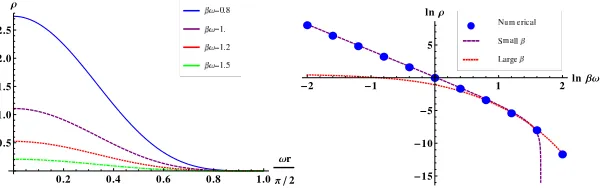
with the coordinate dependence fully contained in the(cosωr)4prefactor. The first
6 Victor E. Ambrus,and Elizabeth Winstanley
extracted:
ρ⌋m=0= (cosωr)4 7π2
60β4− ω2
24β2+O(ω 4)
, (21)
ρ⌋m=0=
6ω4 π2
(cosωr)4
1+e3β ω/2 "
1+5e−ωβ1+e−
3ωβ/2
1+e−5ωβ/2+O(e
−2ωβ) #
[image:7.612.169.466.115.176.2]. (22)
Figure 1 shows a graphical representation of the above results.
Fig. 1 aρbetween the origin (r=0) and the boundary (rω=π/2) forβω=0.8,1.0,1.2 and 1.4;
b Log-log plot ofρin terms ofβω; comparison with the asymptotic results in (21) and (22)
Acknowledgements This work is supported by the Lancaster-Manchester-Sheffield Consortium
for Fundamental Physics under STFC grant ST/J000418/1, the School of Mathematics and Statis-tics at the University of Sheffield and European Cooperation in Science and Technology (COST) action MP0905 “Black Holes in a Violent Universe”.
References
1. Allen, B. and Jacobson, T.: Vector two-point functions in maximally symmetric spaces. Com-mun. Math. Phys. 103, 669–692 (1986)
2. Ambrus,, V. E. and Winstanley, E.: Fermions on adS. Paper in preparation.
3. Camporesi, R. and Higuchi, A.: Stress-energy tensors in anti-de Sitter spacetime. Phys. Rev. D 45, 3591–3603 (1992)
4. Christensen, S. M.: Regularization, renormalization, and covariant geodesic point separation. Phys. Rev. D 17, 946–963 (1978)
5. Cot˘aescu, I.: Dirac fermions in de Sitter and anti-de Sitter backgrounds. Rom. J. Phys. 52, 895–940 (2007)
6. Dappiaggi, C.; Hack, T.-P. and Pinamonti, N.: The extended algebra of observables for Dirac fields and the trace anomaly of their stress-energy tensor. Rev. Math. Phys 21, 1241–1312 (2009)
7. M¨uck, W.: Spinor parallel propagator and Green’s function in maximally symmetric spaces. J. Phys. A 33, 3021–3026 (2000)
[image:7.612.138.443.215.311.2]