The impact of Amazonian deforestation
on Amazon basin rainfall
D. V. Spracklen1and L. Garcia-Carreras1,2
1
School of Earth and Environment, University of Leeds, Leeds, UK,2Department of Meteorology and Bert Bolin Centre for Climate Research, Stockholm University, Stockholm, Sweden
Abstract
We completed a meta-analysis of regional and global climate model simulations (n= 96) of the impact of Amazonian deforestation on Amazon basin rainfall. Across all simulations, mean (±1σ) change in annual mean Amazon basin rainfall was 12 ± 11%. Variability in simulated rainfall was not explained by differences in model resolution or surface parameters. Across all simulations wefind a negative linear relationship between rainfall and deforestation extent, although individual studies often simulate a nonlinear response. Using the linear relationship, we estimate that deforestation in 2010 has reduced annual mean rainfall across the Amazon basin by 1.8 ± 0.3%, less than the interannual variability in observed rainfall. This may explain why a reduction in Amazon rainfall has not consistently been observed. We estimate that business-as-usual deforestation (based on deforestation rates prior to 2004) would lead to an 8.1 ± 1.4% reduction in annual mean Amazon basin rainfall by 2050, greater than natural variability.1. Introduction
Vegetation alters moisture, energy, and trace gasfluxes between the surface and the atmosphere [Bonan, 2008]. Rapid deforestation in the tropics has occurred over the past few decades [Hansen et al., 2013] with implications for regional climate [Mahmood et al., 2014]. Deforestation can change rainfall with important impacts on agriculture [Oliveira et al., 2013;Bagley et al., 2012], hydropower [Stickler et al., 2013], and river navigation [Lima et al., 2014]. Here we report a meta-analysis of climate model studies that have simulated the impact of Amazonian deforestation on Amazon basin rainfall.
The Amazon rainforest covers an area of ~5.3 million km2, accounting for 40% of global tropical forest area [Aragão et al., 2014]. Over the last few decades the Amazon has experienced rapid land use change, with 15% of original forest area deforested by the year 2003 [Soares et al., 2006]. Under a business-as-usual scenario, based on deforestation rates prior to 2004, it is estimated that 47% of the Brazilian Amazon would be deforested by 2050 [Soares et al., 2006]. Since these projections, Brazil has substantially reduced defores-tation rates [Hansen et al., 2013;Aragão et al., 2014]. However, large reductions in Amazon basin forest cover may still occur in the future. Deforestation rates within other Amazon countries are increasing [Hansen et al., 2013], and changes to Brazil’s forest policy may cause increases in Brazilian deforestation rates [Soares et al., 2014]. Indeed, deforestation rates in the Brazilian Amazon were higher in 2013 and 2014 compared to 2012 [Instituto Nacional de Pesquisas Espaciais, 2015]. A better understanding of how future land use changes in the Amazon will alter regional climate is therefore required.
Amazon forests are an important component of the climate system, affecting the global carbon cycle as well as regional and global climate and weather [Davidson et al., 2012]. Deforestation results in important changes in energy and water balance through increased surface albedo, reduced surface roughness and tur-bulent transport, reduced water transpiration to the atmosphere, increased sensible heatfluxes and reduced latent heatfluxes, and altered emissions of CO2, trace gases, and aerosols [Bonan, 2008]. Through these
changes deforestation can result in regional changes to temperature and rainfall [Mahmood et al., 2014]. Climate models have been used to simulate the impact of deforestation on regional rainfall. The majority of studies explored scenarios of large-scale deforestation and predicted reduced regional rainfall but with substantial diversity in model predictions [Lejeune et al., 2014; D’Almeida et al., 2007; Lawrence and Vandecar, 2015]. Model studies are typically limited by coarse spatial resolution, unrealistic representation of spatial and temporal deforestation patterns, and uncertainties in the representation of tropical convec-tion and rainfall.
Geophysical Research Letters
RESEARCH LETTER
10.1002/2015GL066063
Key Points:
•Deforestation of the Amazon likely to lead to reductions in regional rainfall •Current deforestation extent estimated
to reduce annual rainfall across Amazon basin by 1.8%
•By 2050, deforestation estimated to reduce annual rainfall by 8.1%, greater than natural variability
Supporting Information: •Table S1
Correspondence to: D. V. Spracklen, [email protected]
Citation:
Spracklen, D. V., and L. Garcia-Carreras (2015), The impact of Amazonian deforestation on Amazon basin rainfall,
Geophys. Res. Lett.,42, doi:10.1002/
2015GL066063.
Received 7 SEP 2015 Accepted 12 OCT 2015
©2015. The Authors.
Here we complete a meta-analysis of climate model simulations of the impact of Amazonian deforestation on Amazon basin rainfall. Our objectives were to quantify the impact of Amazon deforestation on rainfall across the Amazon basin, document the diversity in simulated projections, and explore potential reasons for this simulated diversity. Overall, our aim is to improve our understanding of the impacts of land use change on rainfall across the Amazon basin.
2. Methods
We synthesized results from regional climate model (RCM) and global general circulation model (GCM) studies of the impacts of large-scale Amazon deforestation on rainfall across the Amazon basin. Using ISI Web of Science, we searched for all relevant peer-reviewed articles published between 1975 and March 2015. We searched using the keywords“deforest*,” “Amazon*”and“precipitation”or“deforest*,” “Amazon*,” and“rainfall”. We collected information on the deforestation scenario (fraction of Amazon deforested), the model setup (RCM or GCM, model resolution (H), whether the model was atmosphere-only or coupled ocean-atmosphere configuration), and model inputs including assumed surface properties of the forest and deforested surface (albedo (A), leaf area index (LAI), and surface roughness (L)). We restricted the analysis to published studies that report, or allowed us to calculate, simulated change in Amazon basin rainfall due to a specific deforestation scenario.
We identified 44 studies that reported simulated impacts of Amazon deforestation on rainfall. In total these studies reported 96 different simulations. These studies assumed different Amazon deforestation scenarios— the fraction of the Amazon that was assumed to be deforested (ΔD) varied from 10% to 100%. The average deforestation across all simulations was 69%; 46% (n= 44) of simulations were for complete Amazon defor-estation (ΔD= 100%). The studies assume that deforestation of the Amazon results in closed canopy forest being replaced by pasture or grassland (n= 89) or soybean agriculture (n= 7). Three different models contrib-uted the largest number of simulations: NCAR CCM (n= 36), CPTEC-INPE (n= 17), and NASA GISS (n= 8). Studies have different simulation lengths (typically 1 to 50 years). We weight all simulations equally regard-less of simulation length. Data from these studies is reported in supporting information Table S1.
We report changes in annual mean rainfall over the Amazon basin (ΔR), which is the most commonly reported value across the synthesized studies. Larger changes in rainfall may occur directly over regions of land use change and around the periphery of the Amazon basin. The mean change in rainfall does not describe potential redistribution of rainfall across the basin which may be important [Lejeune et al., 2014]. We note that model experiments were not standardized, meaning that definitions of Amazon basin may differ slightly between stu-dies, both in terms of deforestation extent and the area over which changes in rainfall are calculated.
We analyzed the mean and diversity across the synthesized simulations. Analysis of normal quantile-quantile plots suggested that simulated change in precipitation was approximately Gaussian distributed, although a Shapiro-WilkWtest showed nonnormality (W= 0.942,P= 0.00035) and a Bartlett’s test demonstrated the data was not homoscedastic (P<0.01). A range of methods are available to test the robustness of the multimodel mean and its magnitude relative to natural variability [Tebaldi et al., 2011;Power et al., 2011]. We followed a simi-lar method to the Intergovernmental Panel on Climate Change Fifth Assessment Report and defined a large change in precipitation with high model agreement when the multimodel mean change exceeds internal varia-bility and at least 90% of models agree on the sign of change. Internal variavaria-bility is defined as the standard devia-tion of Amazon basin annual mean rainfall multiplied by the square root of 2. Our results will be dependent on the spatial scale over which significance is calculated; we used Amazon basin mean values as these are regularly reported. Average changes in rainfall across the Amazon basin will miss important variability in rainfall.
We calculated internal variability using rainfall retrieved by the Tropical Rainfall Measuring Mission (TRMM). We use the 3 h 0.25° × 0.25° TRMM3B42 data and calculate annual mean rainfall over the Amazon basin over a 10 year period from 2001 to 2010.
3. Results and Discussion
+15% to 57%. Despite this large range, 92% of simulations (n= 88) agree on the sign of change and predict that defores-tation will cause a reduction in rainfall. The “central” subset of simulations, defined here as the central two thirds of simulations, has a substantially narrower range ( 2.5% to 21.2%) and consis-tently predict that deforestation will result in reduced annual mean rainfall. Across this central subset of simulations mean ΔRis 11.2%. Simulated change in rainfall is model dependent, with the INPE model simulating slightly greater sensitivity of rainfall to deforestation (NCAR CCM ΔR= 12.3 ± 7.5%; CPTEC-INPEΔR= 15.1 ± 11.4%).
Figure 1 also shows the sensitivity of simulated rainfall to deforestation extent. Individual studies that explored more than one deforestation scenario often exhibit nonlinear responses of rainfall to deforestation extent [Da Silva et al., 2008; Nobre et al., 2009; Lejeune et al., 2014;Lima et al., 2014], as has been high-lighted previously [Lejeune et al., 2014; Lawrence and Vandecar, 2015]. For smaller deforestation extent (D<40%), some simulations (n= 4) suggest increased rainfall although the majority (n= 17, 78%) simulate reduced rainfall.
Across all studies, greater reductions in rainfall are simulated for scenarios of greater deforestation. For simulations of complete Amazonian deforestation (D= 100%,n= 44) the mean (±standard deviation) ΔRwas 16.5 ± 13%, signifi -cantly greater than simulations where deforestation is less than 100% (Wilcoxon-Mann-Whitney,P<0.01). We explored the relationship between deforestation extent (D) and percentage change in rainfall (ΔR). An ordinary least squares model (ΔR= ( 0.16 ± 0.03)D (1.12 ± 2.3),r= 0.47,P<0.01, Akaike Information Criterion (AIC) = 710.8) was slightly superior to a quadraticfit (ΔR= 0.23D+ 0.00057D2+ 0.49, AIC = 712.7). Due to heteroscedasticity of the data, we also used a weighted least squares regression, with weights inversely proportional to the variance. This resulted in a similar relationship (ΔR= ( 0.16 ± 0.03)D (1.08 ± 1.7), AIC = 684.5,r= 0.52). A local poly-nomialfit (loess) using a span of 1 also resulted in a qualitatively similar relationship (see Figure 1), suggesting that a linearfit is appropriate. All relationships (linear, quadratic, and local polynomial) all resulted in similar sensitivity ofΔRtoD(see Figure 1). The weighted least squares model suggests that Amazon basin rainfall declines by approximately 1.6% for a 10% reduction in Amazon forest cover. We also analyzed the relation-ship between deforestation and rainfall separately for the two models with the most simulations. Both indi-vidual models also show reductions in rainfall with increasing deforestation: CCM (ΔR= 0.16D 2.44, r= 0.70,P<0.01) and CPTEC-INPE (ΔR= 0.34D+ 7.2,r= 0.85,P<0.01). We note that individual studies exhibit both higher and lower sensitivities of simulated rainfall to deforestation extent. Future work needs to better characterize this sensitivity, particularly for relatively small deforestation extents (D<40%). Figure 1.Simulated change in annual mean Amazon basin rainfall as a
function of percentage of Amazon basin deforested (D). Results from indi-vidual simulations (n= 96) shown by square symbols (solid: GCMs; open: RCMs). We identify models simulations as NCAR CCM (red), CPTEC-INPE (blue), and other (black). Data are also binned according toD(D<20%, 20%≤D<40%, 40%≤D<60%, 60%≤D<80%, 80%≤D) with numbers at top of panel showing number of simulations in each bin. Box and whisker plots show variability across simulations (mean: star, median: line, box: 25th and 75th percentiles, and whiskers: 5th and 95th percentiles); box and whisker to the right of panel shows all studies. Weighted least squares linearfit (orange line, equation at bottom of panel), weighted quadratic
To assess the robustness of the multimodel mean we compared the simulated rainfall against the natural variability in rainfall (see methods). Using the TRMM3B42 data set we calculated the 2001–2010 standard deviation in annual mean Amazon basin rainfall to be 5.1%. Such large variability is typical for precipitation and can mask signals driven by anthropogenic forcing [Tebaldi et al., 2011]. SimulatedΔRis greater than 1 standard deviation in observed rainfall for simulations when more than 32% of the basin has been defor-ested. We defined a large change in precipitation with high model agreement when the multimodel mean change exceeds internal variability and at least 90% of models agree on the sign of change (see section 2). These criteria are met when more than 41% of the basin has been deforested.
Our synthesis confirms a large diversity in simulated impacts of deforestation on rainfall. Previous studies have attributed this diversity to differences in model resolution [Da Silva et al., 2008; D’Almeida et al., 2007], simulation length, and the presence of boundary conditions within RCMs [Medvigy et al., 2011]. The studies synthesized here used different model structures, different horizontal resolution (20 km to 1000 km) with either an atmosphere-only model or a coupled ocean-atmosphere configuration (supporting information Table S1). We explored the relationship ofΔRwith model horizontal resolution (H) and the differ-ence in assumed surface properties between the forested and deforested surface: albedo (ΔA), leaf area index (ΔLAI), and surface roughness length (ΔL). We also studied a categorical variable (S) forfixed (0) or coupled ocean-atmosphere (1) models. To test for nonindependence, we tested for covariance between the different variables. Lack of model documentation meant that surface properties were not available from all the studies we synthesized. The limited number of studies (n= 25) that reported all these variables is a limitation to this ana-lysis. There were significant correlations betweenDandH(r= 0.58) andDandΔL(r= 0.43). That is, studies with coarse model resolution tend to be combined with scenarios of greater deforestation extent and have largerΔL. There was also a significant correlation betweenΔLandΔA(r= 0.45). Nonindependence means individual relationships have to be treated with caution.
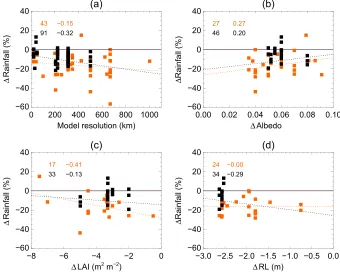
[image:4.612.202.542.92.364.2]Simulated change in rainfall (ΔR) was correlated with model resolution (Figure 2a; Pearson’s r= 0.32, P<0.01), with coarser resolution models simulating larger reductions in rainfall. However, this relationship is complicated by the fact that models with coarser resolution generally simulate scenarios with greater deforestation. A comparison of regional (RCM) and global (GCM) models confirms that RCMs have been used to simulate scenarios with less deforestation (meanD= 51%,n= 14) compared to GCMs (mean D= 74%, n= 77). When we restrict the analysis to simulations of 100% deforestation, the relationship betweenΔR and model resolution (H) is not significant (n= 43, Pearson’s r= 0.15, P= 0.34). This suggests that the covariability ofDandHcomplicates the analysis across all simulations. We also compared atmosphere-only models to coupled ocean-atmosphere models. Coupled ocean-atmosphere models (n= 12) have also generally been used with scenarios of greater deforestation (D= 92%) compared to atmosphere-only models (D= 67%). Coupled models simulate greater reduction in rainfall (ΔR= 22.6%) compared to models with atmosphere-only models (ΔR= 10.2%). There are insufficient studies to compare only those simulations of 100% deforestation. Across the studies reporting surface parameters, deforestation results in increased surface albedo (meanΔA= +0.057, n= 46), reduced leaf area index (mean ΔLAI = 3.56 m2m 2,n= 33), and reduced roughness length (meanΔL, 2.17 m,n= 34). Simulated change in rainfall had insignificant rela-tionships withΔA(r= 0.2,P>0.1,n= 46),ΔLAI (r= 0.13,P>0.1,n= 33), andΔL (r= 0.29,P>0.05,n= 34). The relationship between surface parameters and simulated rainfall change is also insignificant (P>0.1) when we restrict the analysis to simulations of 100% deforestation. These results suggest that the choice of surface parameters is not a major source of uncertainty causing the spread between models but rather how the different model structures respond to the changes in surface properties.
To complement this bivariate analysis, a general linear model wasfitted to all simulations with complete information onΔR,D, H, ΔA,ΔLAI, ΔL, and S (n= 25). We found a significant negative relationship for deforestation extent (D) (t= 6.94;P<0.001) andS(t= 3.48,P<0.01) and insignificant relationships for other variables (P>0.05). In the general linear model,ΔRchanged by 3.2% for each 10% of the basin that is deforested—approximately double the sensitivity calculated in the bivariate analysis across all simulations. Our analysis confirms that coupled ocean-atmosphere models typically predict greater reductions in rainfall compared to atmosphere-only models (difference inΔRof 19.0%) matching previous studies [Nobre et al., 2009;Lejeune et al., 2014]. Wefind an insignificant relationship between model resolution (H) andΔR, as found previously [Lejeune et al., 2014].
We used the relationships between deforestation extent (D) and simulated rainfall (ΔR) to estimate the impact of current deforestation on Amazon basin rainfall. We used the (lower) sensitivity from our bivariate analysis as a conservative estimate of the impacts of deforestation on rainfall. In 2010, about 11.4% of original forested area in the Amazon basin had been converted to pasture and agriculture (gross deforestation was about 15% of the original forest, with 25% of this area subsequently regenerating into secondary forests) [Aragão et al., 2014]. WithD= 11.4%, we estimate a 1.8 ± 0.3% reduction in Amazon basin rainfall. This pro-jected change in annual mean rainfall is less than the observed natural variability in rainfall (standard devia-tion in annual mean Amazon basin rainfall is 5.1%). This may explain why analyses of Amazon basin rainfall do notfind systematic long-term reductions in annual mean rainfall over the past few decades [Marengo, 2009; Gloor et al., 2013]. A business-as-usual deforestation scenario (based on deforestation rates prior to 2004) pro-jects that 47% of original forest area would be deforested by 2050. Our analysis suggests this deforestation extent would result in an 8.1 ± 1.4% reduction in Amazon basin rainfall, a value which exceeds changes due to natural climatic variability. This estimate is smaller than that estimated by a recent study combining satellite retrievals of vegetation and rainfall together with a Langangian model to predict 12% and 21% reductions in wet-season and dry-season rainfall, respectively, in 2050 [Spracklen et al., 2012].
calculation of convection; higher-resolution studies with explicit convection are needed. Most studies are limited to the biophysical impacts of deforestation, but carbon-climate feedbacks [Castillo and Gurney, 2013] and changes in atmospheric aerosol [Poschl et al., 2010] may also impact rainfall. Smoke fromfires that are used to clear vegetation and prepare land for agriculture may cause additional changes to rainfall [Tosca et al., 2013]. Studies that consistently account for all these different interactions are needed.
Our analysis further demonstrates the crucial role played by the Amazon forest in the maintenance of regional rainfall patterns. In addition to regional impacts, Amazon deforestation may also alter extratropical rainfall [Werth and Avissar, 2002;Gedney and Valdes, 2000;Medvigy et al., 2013]. Deforestation can also have substantial impacts on rainfall in Africa [Werth and Avissar, 2005a;Akkermans et al., 2014] and Asia [Werth and Avissar, 2005b;Schneck and Mosbrugger, 2011]. The impact of rapid ongoing deforestation in parts of Asia [Margono et al., 2014] and West Africa as well as projected future declines in forest cover in the Congo [Galford et al., 2015] requires further attention.
References
Akkermans, T., W. Thiery, and N. P. M. Van Lipzig (2014), The regional climate impact of a realistic future deforestation scenario in the Congo Basin,J. Clim.,27, 2714–2734.
Aragão, L. E. O. C., B. Poulter, J. B. Barlow, L. O. Anderson, Y. Malhi, S. Saatchi, O. L. Phillips, and E. Gloor (2014), Environmental change and the carbon balance of Amazonian forests,Biol. Rev.,89, 913–931.
Bagley, J. E., A. R. Desai, P. A. Dirmeyer, and J. A. Foley (2012), Effects of land cover change on moisture availability and potential crop yield in the world’s breadbaskets,Environ. Res. Lett.,7.
Bagley, J. E., A. R. Desai, K. J. Harding, P. K. Snyder, and J. A. Foley (2014), Drought and deforestation: Has land cover change influenced recent precipitation extremes in the Amazon?,J. Clim.,27, 345–361.
Bonan, G. B. (2008), Forests and climate change: Forcings, feedbacks, and the climate benefits of forests,Science,320, 1444–1449. Castillo, C. K. G., and K. R. Gurney (2013), A sensitivity analysis of surface biophysical, carbon, and climate impacts of tropical deforestation
rates in CCSM4-CNDV,J. Clim.,26, 805–821.
Da Silva, R. R., D. Werth, and R. Avissar (2008), Regional impacts of future land-cover changes on the amazon basin wet-season climate,
J. Clim.,21, 1153–1170.
D’almeida, C., C. J. Vörösmarty, G. C. Hurtt, J. A. Marengo, S. L. Dingman, and B. D. Keim (2007), The effects of deforestation on the hydro-logical cycle in Amazonia: A review on scale and resolution,Int. J. Climatol.,27, 633–647.
Davidson, E. A., et al. (2012), The Amazon basin in transition,Nature,481, 321–328.
Galford, G. L., B. S. Soares-Filho, L. J. Sonter, and N. Laporte (2015), Will passive protection save Congo forests?,Plos One,10, doi:10.1371/ journal.pone.0128473.
Garcia-Carreras, L., and D. J. Parker (2011), How does local tropical deforestation affect rainfall?,Geophys. Res. Lett.,38, L19802, doi:10.1029/ 2011GL049099.
Gedney, N., and P. J. Valdes (2000), The effect of Amazonian deforestation on the northern hemisphere circulation and climate,Geophys. Res.
Lett.,27, 3053–3056, doi:10.1029/2000GL011794.
Gloor, M., R. J. W. Brienen, D. Galbraith, T. R. Feldpausch, J. Schongart, J. L. Guyot, J. C. Espinoza, J. Lloyd, and O. L. Phillips (2013), Intensification of the Amazon hydrological cycle over the last two decades,Geophys. Res. Lett.,40, 1729–1733, doi:10.1002/grl.50377. Hansen, M. C., et al. (2013), High-resolution global maps of 21st-century forest cover change,Science,342, 850–853.
INPE (2015), INPE (Instituto Nacional de Pesquisas Espaciais)Program for the Estimation of Amazon Deforestation(Projeto PRODES Digital) [Online]. [Available at http://www.obt.inpe.br/prodes/prodes_1988_2014.htm, Accessed 31 August 2015.]
Knox, R., G. Bisht, J. F. Wang, and R. Bras (2011), Precipitation variability over the forest-to-nonforest transition in southwestern Amazonia,
J. Clim.,24, 2368–2377.
Lawrence, D., and K. Vandecar (2015), Effects of tropical deforestation on climate and agriculture,Nat. Clim. Change,5, 27–36.
Lejeune, Q., E. Davin, B. Guillod, and S. Seneviratne (2014), Influence of Amazonian deforestation on the future evolution of regional surface fluxes, circulation, surface temperature and precipitation,Clim. Dyn., 1–18.
Lima, L. S., M. T. Coe, B. S. Soares, S. V. Cuadra, L. C. P. Dias, M. H. Costa, and H. O. Rodrigues (2014), Feedbacks between deforestation, climate, and hydrology in the Southwestern Amazon: Implications for the provision of ecosystem services,Landscape Ecol.,29, 261–274. Mahmood, R., et al. (2014), Land cover changes and their biogeophysical effects on climate,Int. J. Climatol.,34, 929–953.
Marengo, J. A. (2009), Long-term trends and cycles in the hydrometeorology of the Amazon basin since the late 1920s,Hydrol. Processes,23, 3236–3244.
Margono, B. A., P. V. Potapov, S. Turubanova, F. Stolle, and M. C. Hansen (2014), Primary forest cover loss in Indonesia over 2000–2012,Nature
Clim. Change,4, 730–735.
Medvigy, D., R. L. Walko, and R. Avissar (2011), Effects of deforestation on spatiotemporal distributions of precipitation in South America,
J. Clim.,24, 2147–2163.
Medvigy, D., R. L. Walko, M. J. Otte, and R. Avissar (2013), Simulated changes in northwest U.S. climate in response to Amazon deforestation,
J. Clim.,26, 9115–9136.
Nobre, P., M. Malagutti, D. F. Urbano, R. A. F. De Almeida, and E. Giarolla (2009), Amazon deforestation and climate change in a coupled model simulation,J. Clim.,22, 5686–5697.
Oliveira, L. J. C., M. H. Costa, B. S. Soares, and M. T. Coe (2013), Large-scale expansion of agriculture in Amazonia may be a no-win scenario,
Environ. Res. Lett.,8.
Poschl, U., et al. (2010), Rainforest aerosols as biogenic nuclei of clouds and precipitation in the Amazon,Science,329, 1513–1516. Power, S. B., F. Delage, R. Colman, and A. Moise (2011), Consensus on twenty-first-century rainfall projections in climate models more
widespread than previously thought,J. Clim.,25, 3792–3809.
Schneck, R., and V. Mosbrugger (2011), Simulated climate effects of Southeast Asian deforestation: Regional processes and teleconnection mechanisms,J. Geophys. Res.,116, D11116, doi:10.1029/2010JD015450.
Soares, B. S., D. C. Nepstad, L. M. Curran, G. C. Cerqueira, R. A. Garcia, C. A. Ramos, E. Voll, A. Mcdonald, P. Lefebvre, and P. Schlesinger (2006), Modelling conservation in the Amazon basin,Nature,440, 520–523.
Soares, B., R. Rajao, M. Macedo, A. Carneiro, W. Costa, M. Coe, H. Rodrigues, and A. Alencar (2014), LAND USE cracking Brazil’s forest code,
Science,344, 363–364.
Spracklen, D. V., S. R. Arnold, and C. M. Taylor (2012), Observations of increased tropical rainfall preceded by air passage over forests,Nature,
489, 282–U127.
Stickler, C. M., M. T. Coe, M. H. Costa, D. C. Nepstad, D. G. Mcgrath, L. C. P. Dias, H. O. Rodrigues, and B. S. Soares (2013), Dependence of hydropower energy generation on forests in the Amazon Basin at local and regional scales,Proc. Natl. Acad. Sci. U.S.A.,110, 9601–9606. Tebaldi, C., J. M. Arblaster, and R. Knutti (2011), Mapping model agreement on future climate projections,Geophys. Res. Lett.,38, L23701,
doi:10.1029/2011GL049863.
Tosca, M. G., J. T. Randerson, and C. S. Zender (2013), Global impact of smoke aerosols from landscapefires on climate and the Hadley circulation,Atmos. Chem. Phys.,13, 5227–5241.
Werth, D., and R. Avissar (2002), The local and global effects of Amazon deforestation,J. Geophys. Res.,107, 8087, doi:10.1029/2001JD000717. Werth, D., and R. Avissar (2005a), The local and global effects of African deforestation,Geophys. Res. Lett.,32, L12704, doi:10.1029/
2005GL022969.
![Figure 1 also shows the sensitivity of �simulated rainfall to deforestation extent.Individual studies that explored morethan one deforestation scenario oftenexhibit nonlinear responses of rainfall todeforestation extent [Da Silva et al.,2008; Nobre et al., 2009; Lejeune et al.,2014; Lima et al., 2014], as has been high-lighted previously [Lejeune et al., 2014;LawrenceandVandecar,2015].Forsmaller deforestation extent (D < 40%),some simulations (n=4) suggest increasedrainfall although the majority (n= 17, 78%)simulate reduced rainfall.](https://thumb-us.123doks.com/thumbv2/123dok_us/7914888.190637/3.612.194.391.90.381/sensitivity-deforestation-deforestation-oftenexhibit-todeforestation-lawrenceandvandecar-deforestation-increasedrainfall.webp)