This is a repository copy of
Verifying Linearizability on TSO Architectures
.
White Rose Research Online URL for this paper:
http://eprints.whiterose.ac.uk/113095/
Version: Accepted Version
Proceedings Paper:
Derrick, J., Smith, G. and Dongol, B. (2014) Verifying Linearizability on TSO Architectures.
In: Integrated Formal Methods. IFM: International Conference on Integrated Formal
Methods. iFM 2014: The 11th International Conference on Integrated Formal Methods,
09/09/2014-11/09/2014, Bertinoro, Italy. Lecture Notes in Computer Science , 8739 .
Springer Verlag , pp. 341-356. ISBN 978-3-319-10180-4
https://doi.org/10.1007/978-3-319-10181-1_21
The final publication is available at Springer via
http://dx.doi.org/10.1007/978-3-319-10181-1_21.
[email protected] https://eprints.whiterose.ac.uk/ Reuse
Unless indicated otherwise, fulltext items are protected by copyright with all rights reserved. The copyright exception in section 29 of the Copyright, Designs and Patents Act 1988 allows the making of a single copy solely for the purpose of non-commercial research or private study within the limits of fair dealing. The publisher or other rights-holder may allow further reproduction and re-use of this version - refer to the White Rose Research Online record for this item. Where records identify the publisher as the copyright holder, users can verify any specific terms of use on the publisher’s website.
Takedown
If you consider content in White Rose Research Online to be in breach of UK law, please notify us by
Verifying linearizability on TSO architectures
John Derrick1, Graeme Smith2, and Brijesh Dongol1
1Department of Computing, University of Sheffield, Sheffield, UK 2School of Information Technology and Electrical Engineering,
The University of Queensland, Australia
Abstract. Linearizability is the standard correctness criterion for fine-grained, non-atomic concurrent algorithms, and a variety of methods for verifying lin-earizability have been developed. However, most approaches assume a sequen-tially consistent memory model, which is not always realised in practice. In this paper we define linearizability on aweakmemory model: the TSO (Total Store Order) memory model, which is implemented in the x86 multicore architecture. We also show how a simulation-based proof method can be adapted to verify linearizability for algorithms running on TSO architectures. We demonstrate our approach on a typical concurrent algorithm, spinlock, and prove it linearizable us-ing our simulation-based approach. Previous approaches to provus-ing linearizabilty on TSO architectures have required a modification to the algorithm’s natural ab-stract specification. Our proof method is the first, to our knowledge, for proving correctness without the need for such modification.
1
Introduction
The correctness of concurrent algorithms has received considerable attention over the last few years. For algorithms that have fine-grained concurrent implementations cor-rectness has focussed on a condition calledlinearizability[12]. This requires that the fine-grained operations (e.g., insertion or removal of an element of a data structure) appear as though they take effect “instantaneously at some point in time within their intervals of execution” [12], thereby achieving the same effect as an atomic operation.
Such fine-grained implementations are becoming increasingly commonplace, and are now standard in libraries such asjava.util.concurrent. To increase effi-ciency, these algorithms dispense with locking, or only lock small parts of a shared data structure. Therefore the shared data structure might be concurrently accessed by differ-ent processors executing differdiffer-ent operations. This complexity makes the correctness of such algorithms, i.e., their proofs of linearizability, a key issue.
Because linearizability is such an important condition, there has been a large amount of interest in proof methods for verifying whether an algorithm is linearizable. How-ever, the vast majority of this work has assumed a particular memory model; in partic-ular asequentially consistent(SC) memory model, whereby program instructions are executed by the hardware in the order specified by the program. This is in contrast to multiprocessor architectures such as x86 [15], Power [1] or ARM [1] that only provide weaker guarantees in order to allow efficient executions.
. . . .
Write buffer
read
flush write
read
Write buffer
read
flush write
read
Core 1 Core n
[image:3.612.164.451.117.197.2]Shared memory
Fig. 1.The TSO architecture
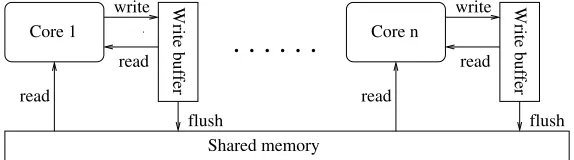
greater scope for optimisation, the order in which instructions are executed by the hard-ware is no longer the same as that specified by the program. In this paper we focus on one such memory model, the TSO (Total Store Order) model which is implemented in the x86 multicore processor architecture. Rather surprisingly given Intel’s and AMD’s use of x86, and in contrast to the many different approaches and techniques for lineariz-ability on sequentially consistent architectures, there have only been three approaches to the question of linearizability on a TSO model: [4], [11] and [17].
The proof approaches in both [4] and [11], however, require the natural abstract specification of a concurrent implementation to be modified. Burckhardt et al. [4] de-fine so-called TSO-to-TSO linearizability, which as the name implies compares a con-current implementation with an abstract specification that executes in TSO memory. Their definition of linearizability thus compares two specifications with local buffers. In our approach, we aim to compare the execution of an implementation in TSO against its natural SC abstraction. In [11] Gotsman et al. define a more sophisticated mapping between the TSO model and a sequentially consistent one (this is called TSO-to-SC lin-earizability), but to verify the linearizability of an example like spinlock (our running example) they weaken the abstract specification to allow non-deterministic behaviour when one would not naturally expect it. The approach closest to ours is [17] which uses the same principles that we discuss, but does not provide a proof method (rather they use SPIN to model check particular runs of the algorithm, much like testing).
The purpose of this paper is to make two contributions: define linearizability of concurrent algorithms on a TSO memory model which avoids the compromises of [4, 11], and define a proof method for verifying it. We begin in Section 2 by introducing the TSO model as well as our running example, the spinlock algorithm. In Section 3 we introduce linearizability and discuss how we adapt the definition to the TSO model. In Section 4 we explain an existing simulation-based method for verifying linearizability and show how we can adapt this to the TSO model. This method is then applied to the spinlock example in Section 5 before we conclude in Section 6.
2
The TSO memory model
word x=1;
void acquire() {
1 while(1) {
2 lock;
3 if (x==1) {
4 x=0;
5 unlock;
6 return;
}
7 unlock;
8 while(x==0){};
} }
void release() {
1 x=1;
}
int tryacquire() {
1 lock;
2 if (x==1) {
3 x=0;
4 unlock;
5 return 1;
}
6 unlock;
7 return 0;
[image:4.612.135.471.115.282.2]}
Fig. 2.Spinlock implementation
computation without waiting for the write to be committed to memory. Pending writes do not become visible to other processes until the buffer is flushed, which commits (some or all) pending writes to memory.
The value of a memory locationreadby a process is the most recent in the proces-sor’s local buffer. If there is no such value (e.g., initially or when all writes correspond-ing to the location have been flushed), the value of the location is fetched from memory. The use of local buffers allows a read by one process, occurring after a write by another, to return an older value as if it occurred before the write.
In general, flushes are controlled by the CPU. However, a programmer may ex-plicitly include afence, ormemory barrier, instruction in a program’s code to force a flush to occur. Therefore, although TSO allows non-sequentially consistent executions, it is used in many modern architectures on the basis that these can be prevented, where necessary, by programmers using fence instructions.
A pair oflockandunlockcommands in TSO allows a process to acquire sole access to the memory. Both commands include a memory barrier which forces the store buffer of that process to be flushed completely (via a sequence of atomic flushes).
2.1 Example - spinlock
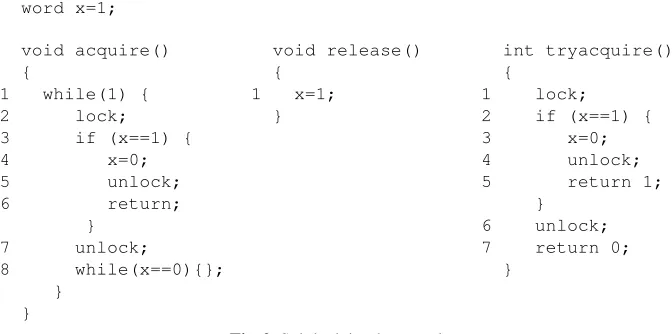
Spinlock [3] is a locking mechanism designed to avoid operating system overhead as-sociated with process scheduling and context switching. A typical implementation of spinlock is shown in Fig. 2, where a global variablexrepresents the lock and is set to 0 when the lock is held by a process, and 1 otherwise. A process trying to acquire the lockxspins, i.e., waits in a loop and repeatedly checks the lock for availability. It is particularly efficient when processes only spin for short periods of time and is often used in operating system kernels.
Theacquireoperation only terminates if it successfully acquires the lock. It will lock the global memory1so that no other process can write tox. If, however, another
1
process has already acquired the lock (i.e.,x==1) then it will unlock the global mem-ory and spin, i.e., loop in the while-loop until it becomes free, before starting over. Otherwise, it acquires the lock by settingxto 0.
The operationreleasereleases the lock by settingxto 1. We assume that only a process that has acquired the lock will call this operation. The operationtryacquire differs fromacquirein that it only makes one attempt to acquire the lock. If this is successful it returns 1, otherwise it returns 0.
Thelockandunlockcommands act as memory barriers. Hence, writes toxby theacquireandtryacquireoperations are not delayed. For efficiency, however, releasedoes not have a memory barrier and so its write toxcan be delayed until a flush occurs. This leads to the possibility of atryacquireoperation of a process
qreturning 0 after the lock has been released by another processp. For example, the following concrete execution is possible, where we write(q,tryacquire(0))to de-note processqperforming atryacquireoperation and returning 0, andflush(p) to denote the CPU flushing a value from processp’s buffer:
h(p,acquire),(p,release),(q,tryacquire(0)),flush(p)i (1) Thuspperforms anacquire, then areleaseand thenqperforms atryacquire that returns 0 even though it occurs immediately after therelease. This is because theflush(p), which sets the value ofxin memory to0has not yet occurred.
At an abstract level, the operations are captured by the following Z specification, which has parameterised operationsAcquirep,ReleasepandTryAcquirep, the parameter
pdenoting the identifier of the process performing the operation.
AS x:{0,1}
Init AS x= 1
Acquirep ∆AS x= 1 x0
= 0
Releasep ∆AS x= 0 x0
= 1
TryAcquirep ∆AS out! :{0,1}
ifx= 1
thenx0= 0^out! = 1
elsex0=x^out! = 0
The question is now: “Is the behaviour of spinlock under TSO comparable to this ab-stract specification?”. We answer this question in the subsequent sections by proving that spinlock under TSO is actually linearizable with respect to the specification.
3
Linearizability on TSO
The comparison is made at the level of invocations and returns of operations as the fine-grained nature of some operations means that an operation’s steps might be in-terleaved with steps of another operation executed by another process. For example, processpmight start arelease, but then processqinvokes itstryacquirebefore
p’sreleasehas returned. The key idea of linearizability is as follows.
Linearizability provides the illusion that each operation applied by concurrent processes takes effect instantaneously at some point between its invocation and its return. This point is known as thelinearization point.
In other words, if two operations overlap, then they may take effect in any order from an abstract perspective, but otherwise they must take effect in program order.
The original definition in [12] (for a formalisation, see [7]) is based on the concept ofpossibilities, however there are now a number of different proof strategies which have been applied to a number of algorithms. These range from using shape analysis [2, 5] and separation logic [5] to rely-guarantee reasoning [18] and refinement-based simula-tion methods [10, 14, 7]. The simulasimula-tion-based methods, which we will adapt for use in this paper, show that an abstraction (or simulation or refinement) relation exists between the abstract specification of the data structure and its concurrent implementation.
We will return to the proof method in Section 4. In this section we address the ques-tion: Isspinlocklinearizable on TSO? The definition of linearizability is architecture-neutral, so we should be able to answer the question on a TSO memory model. However, the presence of local buffers, and operations under control of the CPU (i.e., the flushes) complicate the answer.
Consider the execution of spinlock in (1). Obviously, such an execution has no cor-responding behaviour at the abstract level, since looking at the Z specification, the value ofxafterReleaseis 1, thusTryAcquirereturns 1. Hence standard approaches to proving linearizability will fail. There are three alternative approaches to tackling the issue of linearizability on TSO: [4], [11] and [17]. Of these, both [4] and[11] involve changes to the natural abstract specification. For example, in [4] the abstract specification is de-scribed with local buffers and flushes. Linearizability, as they define it, (which they call TSO-to-TSO linearizability) then compares two specifications both with local buffers, but this seems to miss the essential nature of the abstract to concrete transformation. On the other hand in [11], Gotsman et al. weaken the abstract specification to allow tryacquireto nondeterministically either fail or succeed whenxis 1, i.e.,
TryAcquire2p ∆AS
out! :{0,1}
ifx= 1
then(x0= 0^out! = 1)_(x0 =x^out! = 0)
elsex0=x^out! = 0
abstract specification seems to weaken what one has achieved with the proof. The ap-proach closest to ours is [17] which uses the same principles that we use here, but uses model checking to test linearizability. Our aim is to formalise this intuition and provide a refinement-based proof method for it.
Although at first sight it would seem that linearizability simply fails without chang-ing the abstract specification, one needs to take into account the role of the local buffers. Since the flush of a process’s buffer is sometimes the point that the effect of an oper-ation’s changes to memory become globally visible, the flush can be viewed as being the final part of the operation. For example, the flush of a variable, such asx, after an operation, such asrelease, can be taken as the return of that operation. Under this interpretation, thereleaseoperation extends from its invocation to the flush which writes its change toxto the global memory. The key point is the following principle:
The return point of an operation on a TSO architecture is not necessarily the point where the operation ceases execution, but can be any point up to the last flush of the variables written by that operation.
Formalisation:We now formalise this intuition. In the standard definition of lin-earizability,histories are sequences ofevents which can be invocations or returns of operations from a setIand performed by a particular process from a setP. Invocations have an associated input from domainIn, and returns an output from domainOut(we assume both domains contain an element?denoting no input or output, respectively). On TSO, we generalise events so that they can also be flushes which are performed by the CPU and operate on a particular process’s buffer:
Event::=invhhP⇥I⇥Inii |rethhP⇥I⇥Outii |flushhhPii
History==seqEvent
The TSO history corresponding to the execution (1) is2:
hinv(p,acquire,),ret(p,acquire,),inv(p,release,),ret(p,release,) inv(q,tryaquire,),ret(q,tryacquire,0),flush(p)i (2)
To prove linearizability on a TSO architecture we transform this history to one where the flush on pis the return of the release, since in TSO it is the flush that makes the effect visible. The original return of the releasein the history above is removed. That is, the above history is transformed to:
hinv(p,acquire,),ret(p,acquire,),inv(p,release,),
inv(q,tryaquire,),ret(q,tryacquire,0),ret(p,release),)i (3)
In general, we need to transform a historyhconsisting of invocations, returns and flushes to a historyTrans(h)which replaces flushes by the appropriate returns whilst removing all other flushes and returns that are no longer required. The transformation
Trans(h)is formalised below. This new history consists just of invocations and returns, the latter indicating when the effect of an operation is made visible globally.
2
We omit⊥in the events of this and subsequent histories in this section, e.g.,inv(p,acquire,)
3.1 Defining the transformation
We first present a number of preliminary definitions that enable the transformation to be carried out deterministically. Letmp(p,m,n,h)denote matching pairs of invocations and returns by processpin historyhas in [7]. Its definition requires thath(m)andh(n) are executed by the same processpand are an invocation and return event, respectively, of the same operation. Additionally, it requires that for allkbetweenmandn,h(k)is not an invocation or return event ofp. That is, giveninv?(e)andret?(e)denote that the eventeis an invocation and return event, respectively,e.πdenotes the process executing
e, ande.ithe operation being executed,mp(p,m,n,h)holds iff
0<m<n#h^
inv?(h(m))^ret?(h(n))^h(m).π=h(n).π=p^h(m).i=h(n).i^ 8k•m<k<n)h(k).π6=p
Letbs(p,m,h)denote the size of processp’s buffer at pointmin the historyh, and
nf(p,m,n,h)denote the number of flushes of processp’s buffer between pointsmand
ninh. The number of new items in processp’s buffer between two pointsmandnin a historyhis given by
bi(p,m,n,h)=b bs(p,n,h) +nf(p,m,n,h)−bs(p,m,h)
We use the functionmpf below to find indicesm,nandlinhsuch that(m,n)is a matching pair andlcorresponds to the point to which the return of the matching pair must be moved.
mpf(p,m,n,l,h)=b mp(p,m,n,h)^nl^
ifbi(p,m,n,h) = 0thenl=n
elseh(l) =flush(p)^
nf(p,m,l,h) =bs(p,m,h) +bi(p,n,m,h)
The first part of theif states that l = nif no items are put on the buffer by the operation invoked at point m. The second states thatl corresponds to a flush ofp’s buffer and the number of flushes betweenmandlis precisely the number required to flush the contents of the buffer atmand any items added to the buffer betweenmandn.
To transform a historyh, we do the following two steps.
Step 1.Givenmpf(p,m,n,l,h)holds for somep: ifn6=l
then h(l)becomesh(n)andh(n)becomes a dummy eventδ elsewe do nothing because the return should not be moved.
This results in a historyh0
2seq(Event[ {δ}), where all returns have been moved to the return positions of their corresponding flushes.
Step 2.The second step is straightforward: allδand flushes are removed.
hinv(p,acquire,),ret(p,acquire,),inv(p,release,), δ,
inv(q,tryaquire,),ret(q,tryacquire,0),ret(p,release,)i
which in turn is transformed to history (3) by Step 2.
3.2 TSO linearizability
A formal definition of linearizability is given in [7]. We adapt this definition as follows. An incomplete history h is extended with a sequence h0 of return and flush events, then matched to a sequential historyhsby removing the remaining pending invocations using a functioncomplete, i.e.,complete(h)is a subhistory ofhformed by removing all pending invocations fromh. We say a historyhislegaliff for eachn : 1..#hsuch thatret?(h(n)), there exists an earlierm: 1..n−1such thatmp(p,m,n,h), and for each
n: 1..#hsuch thath(n) =flush(p),bs(p,n,h)>0.
A key part of adapting the standard definition to TSO is what we mean by a match-ing pair of invocations and returns. The formal definition of the function mp in [7] (defined above) requires that for allkbetweenmandn,h(k)is not an invocation or return event ofp. This is not true for our transformed histories on TSO since operations by the same process may overlap. Therefore, we will use a new version of matching pairsmpTSOdefined as follows.
mpTSO(p,m,n,h) iff mpf(p,x,z,y,h) where m=x−P
p:P
nf(p,1,x,h) and n=y−P
p:P
nf(p,1,y,h) and x<zy
Given RF is the set of all return and flush events, we define TSO linearizability as follows.
Definition 1 (TSO linearizability). A history h : History isTSO linearizable with respect to some sequential history hs iff lin(h,hs)holds, where
lin(h,hs)=b 9h0:seq RF•legal(hah0)^linrel(Trans(complete(hah0)),hs)
where
linrel(h,hs)=b 9f : 1..#h⇢!1..#hs•(8n: 1..#h•h(n) =hs(f(n)))^
(8p:P; m,n: 1..#h•m<n^mpTSO(p,m,n,h))f(n) =f(m) + 1)^
(8p,q:P; m,n,m0,n0 : 1..#h•
n<m0^mp
TSO(p,m,n,h)^mpTSO(q,m0,n0,h))f(n)<f(m0)) 2 That is, operations inhsdo not overlap (each invocation is followed immediately by its matching return) and the order of non-overlapping operations inhis preserved inhs.
Note that history (2) is a complete legal history, and thatTransapplied to this his-tory gives us hishis-tory (3). Sincereleaseandtryacquirenow overlap in the trans-formed history (3), a potential linearization in terms of the abstract specification is
hinv(p,Acquire,),ret(p,Acquire,),inv(q,TryAcquire,),ret(q,TryAcquire,0), inv(p,Release,),ret(p,Release,)i
4
A proof method for linearizability on TSO
We do not work directly with this definition of linearizability, but rather use a refinement-based proof method for verifying linearizability as defined in [6–8, 14]. This approach defines simulation rules that form a sound (and complete) proof method for verify-ing linearizability. Different classes of algorithm use slightly different rules, where the difference depends on how easy it is to identify the linearization points — in some algo-rithms these can’t be identified directly, and depend on the behaviour of other processes [8]. However, for the example in this paper we can use the simplest set of rules found in [7] and described below.
General approach. The approach is based on proving a concrete specification that has one operation for each line of code is anon-atomic refinement[9] of the abstract specification capturing the code’s intent. Each allowable sequence of concrete steps must simulate a sequence of abstract operations despite the interleaving of concrete steps performed by different processes3.
LetPbe the set of processes. Let our abstract and concrete specifications be given asA= (AState,AInit,(AOPp,i)p2P,i2I)andC= (CState,CInit,(COPp,j)p2P,j2J)where
the setsIandJare used to index the abstract operations and concrete steps, respectively. The functionabs:J!Imaps each concrete step to the abstract operation it (together with other steps) implements. We assume the concrete state spaceCStateis composed of a global stateGS(the shared memory) and the local stateLSof one process (the program counter, local variables and, on TSO, the local buffer). Following [7], linearizability is then shown by:
1. Defining astatusfunction that identifies the linearization points of operations.
LetSTATUS::=IDLE|INhhInii |OUThhOutiiwhereInandOutare the domains of inputs and outputs, respectively, as defined in Section 3. We define a function
status:GS⇥LS!STATUSsuch that the following hold.
If a process has no pending operation then the status of the process isIDLE. If it is executing an operation and has not passed the linearization point, then the status of the process isIN(in)whereinis the input of the operation, if any, and?otherwise. If it is executing an operation and has passed the linearization point, the status is
OUT(out)whereoutis the output of the operation if any, and?otherwise. 2. Showing individual concrete runs of a process correctly implement the abstract
operations using non-atomic refinement.
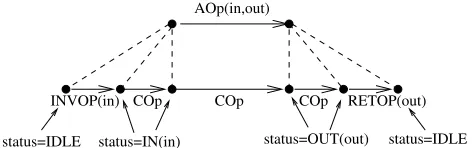
We find a forward simulationR relating the global state and the local state of a process to the abstract state, i.e.,R✓AState⇥(GS⇥LS), and a set of simulation rules which additionally update the status function appropriately as shown in the example in Fig. 3. In this example, the inputinof an invocation stepINVOP(in) is used to establish a status ofIN(in). After the invocation an internal operation implementsskipand leave the status unchanged. Then the linearization point that implementsAOp(in,out)is passed and the status changes toOUT(out). Finally the status is used to compute the output of a return stepRETOP(out)and the status returns toIDLE.
3
status=IDLE status=IN(in)
COp COp RETOP(out)
status=OUT(out) COp
INVOP(in)
[image:11.612.190.428.116.190.2]status=IDLE AOp(in,out)
Fig. 3.The status information for non-atomic refinement
There are 5 different simulation rules depending on whether the particular concrete step being considered is an invocation step, a return step, or an internal step before linearization, after linearization or at the linearization point. As an example, the simulation rule for a concrete invocation step is4:
8as:AState; gs,gs0 :GS; ls,ls0:LS; in:In•
R(as,gs,ls)^status(gs,ls) =IDLE^INVOPj(in,gs,ls,gs0,ls0)
)(status(gs0,ls0) =IN(in)^R(as,gs0,ls0))
_(9as0 :AState; out:Out•
AOPabs(j)(in,as,as0,out)^status(gs0,ls0) =OUT(out)^
R(as0
,gs0
,ls0
))
where the first and second disjuncts in the consequent capture invocations that do and do not correspond to a linearization, respectively.
3. Showinginterference freedom, i.e., that other processes running in parallel do not destroy this non-atomic refinement.
To ensure steps of other processes preserve the local simulation relationR, we de-fineR(as,gs,ls)=b ABS(as,gs)^INV(gs,ls)whereABS(as,gs)captures how the abstract state is represented by the global state, andINV(gs,ls) provides further constraints between the global and local variables.ABS(as,gs)is preserved by all steps ofallprocesses. Hence it is sufficient to prove thatINV(gs,ls)is preserved by other processes. Theinterference freedomcondition is:
8as:AState; gs,gs0 :GS; ls,ls0,lsq:LS•
ABS(as,gs)^INV(gs,ls)^INV(gs,lsq)^D(ls,lsq)^COPj(gs,ls,gs0,ls0)
)INV(gs0
,lsq)^D(ls0
,lsq)^status(gs0
,lsq) =status(gs,lsq)
where a symmetric predicateD ✓ LS⇥LS is used to constrain the relationship between the local states of any two processes. This predicate must also be preserved by the steps of all processes.
4. Showing the concrete initialisation satisfies the abstract initialisation.
8gs:GSInit• 9as:AInit•
ABS(as,gs)^(8ls:LSInit•INV(gs,ls))^(8ls,lsq:LSInit•D(ls,lsq)) 4
whereGSInitandLSInitare the initial states of the global and local state spaces,
respectively. 2
Thestatusfunction captures the status of a single pending operation. Under TSO, however, we may have several pending operations: that operation currently being exe-cuted by the process, if any, and those that have completed apart from the flushing of their writes to memory. In our extension to the above approach, we letstatuscapture the status of the operation which the process is currently executing. If there is no such process, the status isIDLE. All other pending operations, i.e., those completed apart from flushes, will necessarily be before their linearization points.
The other role of thestatusfunction is to carry the inputs of the operation until they are needed at the linearization point where they, along with the operation’s outputs, must match those of the associated abstract operation. To adapt the approach to TSO, we need to be able to keep track of the inputs of completed, but pending, operations. We also need to keep track of the abstract operation associated with each completed, but pending, operation and the completed operation’s outputs (since the operation has already completed, its outputs will have already occurred).
To do this we add four auxiliary variables to the local concrete state spaceLS. The first of these lin : seq((I [ {null})⇥In⇥Out) records, for each buffer entry, the abstract operation for which its flush is a linearization point (nullindicates its flush is not a linearization point), the abstract operation’s input, and the abstract operation’s output. When a flush occurs the values corresponding to the flushed entry are read into the other three auxiliary variablesop:I[ {null},in:Inandout:Out.
We also need to introduce two new simulation rules. The first corresponds to a process with statusIN returning toIDLEwithout linearizing. This would be the case where the operation is to be linearized by a flush which is yet to occur.
Return without Lin.
8as:AState; gs,gs0:GS; ls
,ls0 :LS; in:In•
R(as,gs,ls)^status(gs,ls) =IN(in)^RETOPj(gs,ls,gs0,ls0,out))
status(gs0
,ls0) =IDLE^R(as
,gs0
,ls0)
The second corresponds to the occurrence of a flush. A flush acts as either an internal step or a linearizing step as shown in cases (a) and (b) of Fig. 4, respectively. Case (a) can occur when the process has any status and its status is not changed. When the status isIN orOUT the internal step may be of the pending operations, and for any status it may be of an operation which has previously completed.
Case (b) also occurs from any status and when the status isIDLEorOUTit remains unchanged. Such a flush in these statuses corresponds to the linearization of an opera-tion which has already completed. When the status isINthe flush may also be lineariz-ing an operation which has already completed, in which case the status is unchanged, or it may be linearizing the pending operation, in which case the status becomesOUT.
The rule refers to the post-states of the auxiliary variablesop,inandoutvials0
.op,
ls0
.inandls0
(a)
Flush
StatusA StatusA
Flush
[image:13.612.150.464.435.492.2]StatusB StatusC AOp(in,out) (b)
Fig. 4.Simulation rules for flush Flush.
8as:AState; gs,gs0
:GS; ls,ls0
:LS; in:In•
R(as,gs,ls)^Flush(gs,ls,gs0
,ls0))
(ls0
.op=null)R(as,gs0
,ls0)^status(gs0
,ls0) =status(gs
,ls))^
(ls0
.op6=null)
(9as0:AState•AOP
ls0.op(ls 0
.in,as,as0
,ls0
.out)^R(as0
,gs0
,ls0))^
(status(gs0
,ls0) =status(gs
,ls)
_(status(gs,ls) =IN(ls0
.in)^status(gs0
,ls0) =OUT(ls0
.out)))
5
Spinlock is linearizable on TSO
To show that spinlock is linearizable using the approach described in Section 4, we produce a concrete specification of the algorithm. GivenPis the set of all process iden-tifiers, the global state of the concrete specification includes the value of the shared variablexwhich is initially 1, and a variablelockdenoting which process, if any, cur-rently has the global memory locked.
GS x:{0,1}
lock:PP
#lock1
GSInit GS x= 1 lock=∅
The local state of a given process is specified in terms of its process identifier from
P, a program counter indicating which operation (i.e., line of code) can next be per-formed, and the process’s buffer.
LetPC ::= 1
|
2|
a1|
. . .|
a8|
ta1|
. . .|
ta7|
r1where the value 1 denotes theprocess is idle when it has not acquired the spinlock, the value 2 denotes the process is idle when ithasacquired the spinlock, the valuesai, fori21. .8, denote the process is ready to perform theith line of code ofacquire, the valuestai, fori21. .7, denote the process is ready to perform theith line of code oftryacquire, and the valuer1 denotes the process is ready to perform the first line ofrelease.
LS0
id:P pc:PC
As detailed in Section 4, we add auxiliary variables to our local state to keep track of information required at linearization points corresponding to a flush. LetI=={1,2,3}
be the indices of the abstract operations such that 1 denotesAcquire, 2 denotesRelease
and 3 denotesTryAcquire. LetIn=={?}be the set of input values of operations, and
Out=={0,1,?}be the set of output values.
LS LS0
op:I[ {null}
in:In out:Out
lin:seq((I[ {null})⇥In⇥Out) #lin= #buffer
LSInit LS pc= 1 buffer=h i
Given this specification, the lines of code are formalised as Z operations5. For
ex-ample, for theacquireoperation we have an operationA0corresponding to the invo-cation of the operation, an operationA1corresponding to the line of codewhile(1), and an operationA2corresponding to the line of codelock.
A0 ΞGS ∆LS pc= 1 pc0 =a1
A1 ΞGS ∆LS pc=a1 pc0=a2
A2 ∆GS ∆LS
lock=∅^pc=a2
lock0={id} ^pc0 =a3
To model the fact thatA2 also results in all entries of the process’s buffer being flushed, the operationA3corresponding to the following line of code,x=1, is not en-abled unlessbuffer = h i. It will become enabled after the required number ofFlush
operations have occurred. These remove an entry from the buffer and update the aux-iliary variablesop,inandoutaccording to the information inlin. This information is added tolinwhen the buffer entries are added. For example, the operationA4, corre-sponding to the linex=0, updateslinto indicate that the flush of this value will not be a linearization point.
A3 ΞGS ∆LS buffer=h i
pc=a3
ifx= 1
thenpc0
=a4
elsepc0 =a7
Flush ∆GS ∆LS
lock=∅_lock={id}
buffer6=h i
x0
=head buffer buffer0
=tail buffer head lin= (op0
,in0
,out0) lin0 =tail lin
A4 ΞGS ∆LS pc=a4
buffer0 =bufferah0i pc0=a5
lin0=linah(null,?,?)i
5
The other concrete operations are modelled similarly. The operations corresponding to theunlockstatements are only enabled whenbuffer=h imodelling that the buffer must be completely flushed before the memory is unlocked.
Such a concrete specification is well-formed only if any sequence of operations corresponding to an abstract operation has exactly one linearization point. It is impor-tant, therefore, when modelling operations which changelin(i.e., those that write to the buffer) to ensure this. If a buffer entry is marked as a linearization point, the sequence of operations in which it occurs should not be linearized by a change in status fromIN
toOUT, nor by any other buffer entry.
Linearization can now be proved by defining the functionstatusso that the lineariza-tion points ofAcquireandTryAcquireare the operations which release the memory lock, and the linearization point ofReleaseis the flush that commits the associated value of 1 to the global variablex.
The required relationsABS,INVandDare as follows.
ABS:AS$GS
8as:AS; gs:GS|ABS(as,gs)•
(gs.lock=∅)gs.x=as.x)^(gs.lock6=∅^gs.x= 1)as.x= 1)
INV:GS$LS
8gs:GS; ls:LS|INV(gs,ls)•
(ls.pc={1,a1,a2,a3,ta1,ta2} ^ls.buffer6=h i )gs.x= 0)^
(ls.pc2 {a4,ta3} )gs.x= 1)^
(ls.pc2 {a5,ta4} ^ls.buffer=h i )gs.x= 0)^
(ls.pc2 {a5,ta4} ^ls.buffer6=h i )
gs.x= 1^ls.buffer=h0i ^(head ls.lin).1 =null)^
(ls.pc2 {2,a6,ta3,ta6,r1} )gs.x= 0)^
(ls.pc62 {a6,ta6} ^ls.buffer6=h i )
ls.buffer=h1i ^(head ls.lin).1 = 2)^
(ls.pc2 {2,a4,a6,a7,a8,ta3,ta5,ta6,ta7,r1} )ls.buffer=h i)^
(ls.pc2 {a3,a4,ta2,ta3} )gs.lock={ls.id})^
(gs.x= 1^ls.buffer6=h i )gs.lock={ls.id})
D:LS$LS
8ls,lsq:LS|D(ls,lsq)•
ls.buffer6=h i )lsq.buffer=h i ^
lsq.buffer6=h i )ls.buffer=h i ^
ls.pc2 {2,a4,a6,ta3,ta5,r1} )ls.buffer=lsq.buffer=h i ^
lsq.pc2 {2,a4,a6,ta3,ta5,r1} )ls.buffer=lsq.buffer=h i ^
ls.pc2 {a5,ta4} )lsq.buffer=h i ^
lsq.pc2 {a5,ta4} )ls.buffer=h i
Consider theFlushrule of Section 4. Since ls0
.op = (head ls.lin).1 = nulland
status(gs,ls) = IN(?), this will hold if bothABS(as,gs0)
andINV(gs0
,ls0)
hold and
status(gs0
,ls0) =IN(?)
. The latter follows since the operation does not changels.pc.
ABS(as,gs0)
also holds since the operation does not changegs.lock(i.e.,gs0
.lock6=∅)
and setsgs0
.x= 0.INV(gs0
,ls0)
holds since in addition to settinggs0
.x= 0theFlush
operation setsls0
.buffer=tail ls.buffer=h i.
We also need to prove non-interference for this operation. Letlsdenote the state of the process on whose buffer the flush is performed. Since ls.buffer 6= h i, when
D(ls,lsq)holds for alllsq 6= ls, all other process buffers are empty. Since the other process’s buffers are not changed by the operation, DS(ls0,lsq)
holds. Although the operation changes the value of the global variablegs.xto 0,INV(gs0,lsq)
will remain true since it can only be affected by this change whenlsq.pc2 {a4,ta3,a5,ta4}and in each of these casesls.bufferwould be equal toh ibyD(ls,lsq), i.e., theFlushoperation would not be enabled.
Since similar proofs can be carried out for each concrete operation, and the initial-isation condition holds (sinceas.x = gs.x = 1 implies ABS(as,gs),ls.pc = 1 and
ls.buffer =h iimpliesINV(gs,ls), andls.buffer=lsq.buffer =h iimpliesD(ls,lsq)), spinlock is linearizable on TSO.
6
Conclusions
This paper has presented a definition and simulation-based proof method for lineariz-ability on the TSO memory model. The key to our definition is the treatment of flushes of local buffer entries as part of the operation which made the entries. This enables a proof method which, unlike existing methods, can be used to show implementations of algorithms are linearizable with respect to their natural abstract specifications. This work has applied state-based methods to program verification, and is part of a larger ef-fort on the verification of linearizability on sequentially consistent architectures as well as weaker memory models. This larger effort mechanises the proofs of linearizability by integrating the state-based reasoning into the KIV theorem prover, see [6–8], and in [14] we prove (and mechanise the proof) that our approach is complete, in that all lin-earizable algorithms can be verified by such simulation-based methods. Given we are using the same simulation-based approach, mechanisation and integration into KIV of the theory in this paper will be relatively straightforward.
One interesting consequence of our approach is that operations on a single pro-cess may overlap and hence be reordered under linearizability. This is in contrast to earlier work on sequentially consistent architectures where linearizability implies the additional correctness criterion ofsequential consistency[13], i.e., that operations on a single process occur in the order that they are called. Sequential consistency will only hold on TSO when, in addition to linearizability, memory barriers are included in all operations which (a) do not write to memory, but (b) occur in a process with other operations which do write to memory. This can be checked by inspection of the code.
coarse-grained abstraction as an intermediate layer between the concrete and abstract specifi-cations, and a means to automatically generate the required invariants.
References
1. J. Alglave, A. Fox, S. Ishtiaq, M. O. Myreen, S. Sarkar, P. Sewell, and F.Z. Nardelli. The Semantics of Power and ARM Multiprocessor Machine Code. In L. Petersen and M.M.T. Chakravarty, editors,DAMP ’09, pages 13–24. ACM, 2008.
2. D. Amit, N. Rinetzky, T.W. Reps, M. Sagiv, and E. Yahav. Comparison under abstraction for verifying linearizability. In W. Damm and H. Hermanns, editors,CAV 2007, volume 4590 of
LNCS, pages 477–490. Springer, 2007.
3. D. Bovet and M. Cesati.Understanding the Linux Kernel. OReilly, 3rd edition, 2005. 4. S. Burckhardt, A. Gotsman, M. Musuvathi, and H. Yang. Concurrent library correctness
on the TSO memory model. In H. Seidl, editor,ESOP 2012, volume 7211 ofLNCS, pages 87–107. Springer, 2012.
5. C. Calcagno, M. Parkinson, and V. Vafeiadis. Modular safety checking for fine-grained concurrency. In H.R. Nielson and G. Fil´e, editors,SAS 2007, volume 4634 ofLNCS, pages 233–238. Springer, 2007.
6. J. Derrick, G. Schellhorn, and H. Wehrheim. Proving linearizability via non-atomic refine-ment. In J. Davies and J. Gibbons, editors,IFM 2007, volume 4591 ofLNCS, pages 195–214. Springer, 2007.
7. J. Derrick, G. Schellhorn, and H. Wehrheim. Mechanically verified proof obligations for linearizability.ACM Trans. Program. Lang. Syst., 33(1):4, 2011.
8. J. Derrick, G. Schellhorn, and H. Wehrheim. Verifying linearisabilty with potential lineari-sation points. In M. Butler and W. Schulte, editors,FM 2011, volume 6664 ofLNCS, pages 323–337. Springer, 2011.
9. J. Derrick and H. Wehrheim. Non-atomic refinement in Z and CSP. InZB2005, LNCS. Springer, 2005.
10. S. Doherty, L. Groves, V. Luchangco, and M. Moir. Formal verification of a practical lock-free queue algorithm. In D. de Frutos-Escrig and M. Nunez, editors,FORTE 2004, volume 3235 ofLNCS, pages 97–114. Springer, 2004.
11. A. Gotsman, M. Musuvathi, and H. Yang. Show no weakness: Sequentially consistent spec-ifications of TSO libraries. In M. Aguilera, editor,DISC 2012, volume 7611 ofLNCS, pages 31–45. Springer, 2012.
12. M. Herlihy and J. M. Wing. Linearizability: A correctness condition for concurrent objects.
ACM Trans. Program. Lang. Syst., 12(3):463–492, 1990.
13. L. Lamport. How to make a multiprocessor computer that correctly executes multiprocess programs.IEEE Trans. Computers, 28(9):690–691, 1979.
14. G. Schellhorn, H. Wehrheim, and J. Derrick. How to prove algorithms linearisable. In P. Madhusudan and S.A. Seshia, editors,CAV 2012, volume 7358 ofLNCS, pages 243–259. Springer, 2012.
15. P. Sewell, S. Sarkar, S. Owens, F.Z. Nardelli, and M.O. Myreen. x86-TSO: a rigorous and usable programmer’s model for x86 multiprocessors.Commun. ACM, 53(7):89–97, 2010. 16. D.J. Sorin, M.D. Hill, and D.A. Wood.A Primer on Memory Consistency and Cache
Coher-ence. Synthesis Lectures on Computer Architecture. Morgan & Claypool Publishers, 2011. 17. O. Travkin, A. M¨utze, and H. Wehrheim. SPIN as a linearizability checker under weak
memory models. In V. Bertacco and A. Legay, editors,HVC’13, volume 8244 ofLNCS, pages 311–326. Springer, 2013.