
6d Conformal matter
The Harvard community has made this
article openly available.
Please share
how
this access benefits you. Your story matters
Citation
Del Zotto, Michele, Jonathan J. Heckman, Alessandro Tomasiello,
and Cumrun Vafa. 2015. “6d Conformal Matter.” Journal of High
Energy Physics 2015 (2). https://doi.org/10.1007/jhep02(2015)054.
Citable link
http://nrs.harvard.edu/urn-3:HUL.InstRepos:41385032
Terms of Use
This article was downloaded from Harvard University’s DASH
repository, and is made available under the terms and conditions
applicable to Other Posted Material, as set forth at
http://
JHEP02(2015)054
Published for SISSA by Springer
Received: November 3, 2014
Revised: January 15, 2015
Accepted: January 15, 2015
Published: February 10, 2015
6d Conformal matter
Michele Del Zotto,a Jonathan J. Heckman,a,b Alessandro Tomasielloc and
Cumrun Vafaa
aJefferson Physical Laboratory, Harvard University,
Cambridge, MA 02138, U.S.A.
bDepartment of Physics, University of North Carolina,
Chapel Hill, NC 27599, U.S.A.
cDipartimento di Fisica, Universit`a di Milano Bicocca,
Milan, Italy
E-mail: [email protected],[email protected],
[email protected],[email protected]
Abstract:A single M5-brane probingG, an ADE-type singularity, leads to a system which
hasG×Gglobal symmetry and can be viewed as “bifundamental” (G, G) matter. For the
AN series, this leads to the usual notion of bifundamental matter. For the other cases it
cor-responds to a strongly interacting (1,0) superconformal system in six dimensions. Similarly,
an ADE singularity intersecting the Hoˇrava-Witten wall leads to a superconformal matter
system withE8×Gglobal symmetry. Using the F-theory realization of these theories, we
elucidate the Coulomb/tensor branch of (G, G0) conformal matter. This leads to the notion
of fractionalization of an M5-brane on an ADE singularity as well as fractionalization of the intersection point of the ADE singularity with the Hoˇrava-Witten wall. Partial Higgsing of these theories leads to new 6d SCFTs in the infrared, which we also characterize. This
generalizes the class of (1,0) theories which can be perturbatively realized by suspended
branes in IIA string theory. By reducing on a circle, we arrive at novel duals for 5d affine
quiver theories. Introducing many M5-branes leads to large N gravity duals.
Keywords: F-Theory, AdS-CFT Correspondence, Field Theories in Higher Dimensions
JHEP02(2015)054
Contents1 Introduction 2
2 Conformal matter 5
2.1 Higgsing and brane recombination 7
3 CFTs from domain walls 7
3.1 M5-brane probes of ADE singularities 8
3.2 M5-branes probing E-type singularity 10
3.2.1 Fractional M5-branes 10
3.3 IIA realization of T(SU(k), N) theories 12
3.3.1 IIB/F-theory description 13
3.4 IIA realization of T(SO(2p), N) theories 14
3.4.1 IIB/F-theory description 15
3.4.2 The special casep= 0 16
4 Novel 5d dualities 17
4.1 Hints of a 6d duality 19
5 Partial Higgs branches of the T(G, N) theories 19
5.1 IIA realizations 22
5.2 Alternative realizations for some SU(k) cases 24
6 SCFTs from the Hoˇrava-Witten wall 26
6.1 Orbifolds 26
6.1.1 Tensor branch 27
6.1.2 Partial Higgs branches 30
7 Holographic duals and scaling limits 31
7.1 The Zk case 33
7.2 Adding orientifolds 34
8 Conclusions 35
A Non-Higgsable clusters 36
B (GL, GR) conformal matter 37
B.1 E×E conformal matter 37
B.2 E×A conformal matter 38
B.3 E×D conformal matter 39
B.4 D×D conformal matter 40
JHEP02(2015)054
D 6d (1,0) minimal models of type αANβ 41
1 Introduction
One of the remarkable developments in string theory is the close interplay between the geometry of its extra dimensions, and the resulting low energy theories. In the case of geometries with singularities, such methods have led to a host of tools in the construction and study of conformal field theories in diverse dimensions. Of particular significance are conformal field theories in six dimensions, which resist a UV Lagrangian description. The key ingredients of these theories are tensionless strings coupled to dynamical tensor modes.
Notable examples of such theories include the ADE (2,0) theories [1]. For the A-type
series, this is realized by a coincident stack of M5-branes [2]. Alternatively, all of the ADE
theories can be realized by type IIB strings compactified on an ADE orbifold singularity [1].
Comparatively less is known about (1,0) theories; some examples were found in the past
in [3–11]. Recent work [12] gave a complete classification of (1,0) theories without a Higgs
branch. Those results also give a systematic starting point for pursuing a full classification of theories which have a Higgs branch.
The CFTs in the classification in [12] do not have a weakly coupled UV Lagrangian.
However, one can always go to the Coulomb/tensor branch of these theories, which corre-sponds to giving vevs to scalars in tensor multiplets. In such cases one can find an effective
Lagrangian description for (1,0) theories in terms of a weakly coupled quiver gauge theory,
where the scalar in the tensor multiplet controls the coupling constant of the correspond-ing gauge groups (i.e. the multiplet containcorrespond-ing the gauge couplcorrespond-ing) and is promoted to a dynamical collection of fields, ending up with a quiver-type theory. Moving to the origin
of the tensor branch typically leads to a 6d SCFT with (1,0) supersymmetry. Given the
ubiquity of quivers in string theory, it is perhaps not surprising that some of these theories
have a straightforward realization in string theory [8,11,13].
There are, however, some seemingly obvious quiver gauge theories which do not have a realization in perturbative string theory. For example, the structure of the orientifold
projection forbids a bifundamental between SO(2p) and SO(2k), but instead leads to
bi-fundamentals between SO(2p) and Sp(k). Perhaps even more conspicuous is the absence
of E-type gauge theories, let alone an understanding of what a bifundamental between two such nodes would mean.
In this paper we point out that such generalized quivers do exist in string theory, but their matter sector is itself a strongly coupled 6d SCFT. We focus on two primary examples. One of them involves the realization of such 6d SCFTs by treating M5-branes as domain walls in a higher dimensional theory. This case is realized by the theory of
M5-branes probing an ADE singularity C2/ΓADE in M-theory. The other type involves
intersecting an ADE singularity with a Hoˇrava-Witten wall [14,15].
JHEP02(2015)054
space in two, each such domain wall contributes additional light states to the low energy theory. Each subsequent parallel M5-brane introduces another domain wall, and for each finite segment between adjacent M5-branes we get a dynamical gauge symmetry whose in-verse squared coupling constant is proportional to the length of the segment. We thus end
up with a linear quiver consisting of gauge groups G, where the “bifundamental” between
each adjacent group is interpreted as the associated superconformal matter with G×G
symmetry. For N M5-branes, we therefore get theories T(G, N).
The question is thus reduced to understanding this matter sector, i.e. the theory living on such a domain wall. To determine this, we use a dual description of conformal matter in F-theory. We take F-theory on a non-compact elliptically fibered Calabi-Yau threefold. In F-theory, the conformal matter degrees of freedom on the domain wall are associated with
the collision of two seven-branes, each supporting a gauge group G and wrapping a
non-compact curve. Conformal matter is located at the intersection of two such curves, where the associated elliptic fibration can become more singular. In the case of a collision of two
A-type gauge groups, there is a single hypermultiplet in the bifundamental ofGL×GR. For
D- and E-type gauge groups, such a collision leads to a theory of tensionless strings which can be studied by introducing a minimal resolution in the base of the F-theory geometry. The existence of additional tensor multiplets suggests that the M5-brane fractionates on a singularity, leading to new gauge symmetries between the fractional M5-branes. We suggest an interpretation of fractional M5-branes as domain walls separating loci of M-theory
singularities with different fractional discrete three-form flux of the type proposed in [16].
For example, the strongly coupled conformal matter produced by the collision of two
so2p+8 factors has a non-trivial tensor branch, consisting of a single tensor multiplet, an
spp gauge theory, and a half hypermultiplet in the (2p+8,2p,1)⊕(1,2p,2p+8) of
so2p+8×spp×so2p+8. In this case, we can view the brane as fractionating to two 1/2
M5-branes between which the gauge symmetry has changed from thesotype to thesptype. As
another example, conformal matter betweene8ande8leads to a strongly coupled CFT with
an eleven-dimensional tensor branch and gauge algebra (sp1×g2)L×f4×(g2×sp1)Rwith
a half hypermultiplet in the (2,7+1) for the (sp1×g2)Lfactor, and a half hypermultiplet
in the (7+1,2) for the (g2×sp1)R factor. In this case the M5-brane fractionates to 12
fractional M5-branes, and the gauge groups arise from the finite intervals between the
fractional M5-branes.1 Such considerations show that even in the case of a single
M5-brane, the resulting probe theory of a D- or E-type singularity leads to a non-trivial fixed point which is the reflection of the existence of fractional M5-branes. This is in line with the expectation that additional degrees of freedom enter the low energy theory near the singular point of the moduli space. Upon compactification on a circle, these lead to novel duals of the well studied affine quiver gauge theories.
As the second main example, we consider the M-theory background R/Z2×C2/ΓADE,
i.e. ADE singularities intersecting the Hoˇrava-Witten wall. The Z2 fixed point gives an
E8 nine-brane which wrapsC2/ΓADE. This leads to a conformal system with E8×GADE
global symmetry. In this case we again find the phenomenon of fractionating, but now
JHEP02(2015)054
the intersection point of the ADE singularity and the wall fractionate. As before, we can also introduce M5-branes along the line of the ADE singularity. In heterotic terms, this is
the theory of small E8 instantons [3–5] probing an ADE singularity. Some aspects of this
system have been analyzed using F-theory in [17]. We findG-type gauge symmetries with
(G, G) conformal matter system for all of them, except the one adjacent to the wall, which
gauges theGsymmetry of the (E8, G) conformal matter system at the wall. We label these
theories asT(E8, G, N).
These theories also have partial Higgs branches where operators develop vevs which
break some of the flavor symmetry, leading tonew conformal fixed points. By studying the
vacua of the 7d SYM theory, or equivalently the vacua of the flavor seven-branes, we show
that partial Higgs branches of theT(G, N) theories are classified by the orbits of nilpotent
elements for the flavor symmetry factors. In F-theory, such configurations are examples of
T-brane configurations [18–22]. These are non-abelian configurations of intersecting
seven-branes which can remain hidden from the complex structure moduli of the Calabi-Yau
geometry. We label these theories asT(G, µL, µR, N), which consists ofN M5-branes, and
a flavor symmetryGL×GRwhich can be broken, as dictated by the orbits ingof nilpotent
elements µL∈gL and µR∈gR for the two Lie algebras.
There are also new conformal theories coming from the partial Higgsing of theories involving M5-brane probes of the ADE singularities intersecting the Hoˇrava-Witten wall.
These theories are classified as T(E8, GR, γL, µR, N): we have a theory ofN M5-branes,
and flavor symmetry E8 ×GR which can be broken, as dictated by a nilpotent element
µR ∈ g (and its associated orbit) for the right Lie algebra, as well as a homomorphism
γL: ΓG→E8 corresponding to the choice of a flat E8 connection on S3/ΓG.
Taking the limit of a large number of M5-branes also leads us to a collection of gravity duals in both M-theory and IIA string theory. An interesting feature of our analysis is that we can see how certain features of IIA duals with a Romans mass show up in our construction.
One can also study, from the perspective of F-theory, the more general case of colliding
GADE×G0ADE singularities and the associated conformal matter. For completeness, we
also include this analysis.
The rest of this paper is organized as follows. To set the stage, we first show in section2
how to understand conformal matter sectors in F-theory. We use this analysis in section3
to study M5-branes probing an ADE singularity. In section 4 we show how reduction
of these theories on a circle leads to novel 5d dualities. In section 5 we show how to
characterize the additional SCFTs generated by moving onto the partial Higgs branches of
such theories. Next, in section6we turn to the theory of heterotic small instantons probing
an ADE singularity, determining both the associated generalized quivers, and their partial
Higgs branches. In section 7 we turn to scaling limits of our solutions, and characterize
the corresponding holographic dual descriptions. We present our conclusions in section8.
JHEP02(2015)054
2 Conformal matterOne of the aims of our paper will be to show how conformal matter appears in various contexts. In this section we show how to derive properties of these theories via F-theory.
In F-theory, conformal matter arises from the collision of seven-branes where the local-ized matter is not a weakly coupled hypermultiplet. A convenient way to deduce properties of the matter sector is to formulate the collision of seven-branes in terms of the geometry of an elliptically fibered Calabi-Yau threefold. In minimal Weierstrass form, this is given by:
y2 =x3+f x+g, (2.1)
where f and g are sections of O(−4KB) and O(−6KB), with B the base of the elliptic
fibration. Seven-branes are associated with irreducible components of the discriminant
locus, i.e. the zero set of 4f3+ 27g2 = 0. The corresponding gauge symmetry on such a
seven-brane is dictated by the order of vanishing forf and g, which in turn determines the
Kodaira-Tate type of the singular fiber. This, in combination with additional geometric
data can be used to read off the gauge group on a seven-brane (see e.g. [23]).
Localized matter is associated with the collision of two such irreducible components of the discriminant locus. At these collisions, the Kodaira-Tate singularity type of the elliptic fiber can become more singular, thus leading to the phenomenon of trapped matter. In
fact, the fiber can sometimes become so singular that additional blowups in the base B
become necessary to understand the resulting matter content. When such blowups are introduced, there are additional exceptional curves in the base. Each such curve can be wrapped by a D3-brane, contributing a string in the six-dimensional effective theory. As these curves shrink to zero size, the tension of this string also tends to zero, yielding a six-dimensional SCFT. The total number of tensor multiplets for such a theory is simply the number of independent curves which simultaneously contract to zero size.
In this section, our primary interest is in the collision of two seven-branes which support the same ADE gauge group, and the corresponding conformal matter. The result of this
analysis has been performed in various places, for example in [6, 12, 24, 25]. Rather
than launch into a detailed discussion of the necessary blowup structure, we shall use
the algorithmic procedure developed and automated in [12], which involves stating some
minimal combinatorial data about intersections of curves in the base B.
Using this procedure, we can determine the corresponding degrees of freedom trapped
along each collision of singularities. For example, in F-theory, an A-typesukgauge
symme-try is realized by a Kodaira-Tate fiber of splitIktype.2 At the collision of two splitIkandIp
singularities, the singularity becomesIk+p, so we have a Higgsing ofsuk+pdown to the
prod-uctsuk×sup, with a corresponding hypermultiplet in the bifundamental (k,p) ofsuk×sup.
In the remaining cases we consider, the collision of two seven-branes will lead to a strongly coupled conformal sector. Consider next the collision of two D-type singularities.
In F-theory, a D-type so2p+8 gauge symmetry is realized by a Kodaira-Tate fiber of split
Ip∗ type. The non-split case would realize anso2p+7 gauge symmetry. At the intersection
JHEP02(2015)054
point, the collision of I∗
k and Ip∗ leads to an order of vanishing for f and g which does
not yield a standard Kodaira-Tate fiber. Thus, a blowup at this point is required. This
yields a−1 curve which itself supports a non-splitIk+p type fiber [17]. The resulting gauge
symmetry from such a non-split singularity issprwithr= [(k+p)/2]+, that is, the smallest
integer obtained from rounding up [6, 25, 26].3 In addition to this gauge symmetry, we
also have a half hypermultiplet in the bifundamental trapped at each collision of our spr
seven-brane with an so2k+8 and so2p+8 seven-brane. In the case where k+p is odd, we
also have an extra hypermultiplet in the 2rofspr. Now, the key point is that the “matter
sector” between our two sofactors is really a conformal field theory, since the −1 curve is
shrunk to zero size in our geometry. This is our first example of conformal matter. Consider next the collision of two E-type singularities. The Kodaira-Tate fiber for
E6, E7 and E8 is respectively a split IV∗ fiber, and a III∗ and II∗ fiber. The pairwise
collisions can be conveniently summarized by the minimal Weierstrass models:
(E6, E6) :y2 =x3+u4v4 (2.2)
(E7, E7) :y2 =x3+u3v3x (2.3)
(E8, E8) :y2 =x3+u5v5, (2.4)
with conformal matter located in the base at the pointu=v= 0. Performing the minimal
blowups necessary to get all fibers into Kodaira-Tate form yields an additional configuration of curves, which intersect pairwise at a single point. For details of this resolution algorithm,
see reference [12]. Letting a sequence of positive integers denote minus the self-intersection
number for these curves, we have the minimal resolutions:
(E6, E6) :
Gauge Symm: su3
Curve: 1 3 1 (2.5)
(E7, E7) :
Gauge Symm: su2 so7 su2
Curve: 1 2 3 2 1
Hyper: 1
2(2,8)
1 2(8,2)
(2.6)
(E8, E8) :
Gauge Symm: sp1 g2 f4 g2 sp1
Curve: 1 2 2 3 1 5 1 3 2 2 1
Hyper: 12(2,7+1) 12(7+1,2)
(2.7)
Here, the self-intersection of these curves also dictate the gauge symmetry and matter content for this theory on the resolved branch, as we have indicated. These repeating
patterns were noted as basic building blocks of F-theory compactifications in [27,28]. For
earlier work where these building blocks were also identified see [6].
3
In the case wherek+pis even, this can be understood by quotienting by the outer automorphism of suk+p, thus producing anspralgebra. In the case wherek+pis odd, the analysis of roots in the associated
resolution of the fiber is more subtle, and only anspr−1algebra can be identified geometrically [26]. However,
JHEP02(2015)054
Thus, what the F-theory realization gives us is a direct description of the tensor branch of the conformal matter sector. By following a similar procedure, other collisions with
different singularity types G×G0 lead to canonical notions of conformal matter. We give
a list of such conformal matter sectors in appendix B.
2.1 Higgsing and brane recombination
A hallmark of bifundamental matter is that activating a vev breaks some of the symmetries of the system. Even in our non-Lagrangian systems, this characterization still carries over.
As a warmup, consider again the collision of two Ak−1-type singularities, with a
bifun-damental hypermultiplet in the (k,k) of SU(k)L×SU(k)R. The corresponding geometric
singularity is locally given by:
y2 =x2+ukvk. (2.8)
Activating a bifundamental corresponds to a brane recombination operation. As explained
in [29], this can be viewed as the deformationuv7−→uv+a. So in other words, the flavor
symmetry is broken to an SU(k)diag stack supported at uv+a= 0:
y2 =x2+ (uv+a)k. (2.9)
Similar considerations hold for the strongly coupled conformal matter. For example, in the
collision of twoE8 singularities, we have the breaking pattern:
y2 =x3+u5v57−→x3+ (uv+a)5, (2.10)
that is, we break to the diagonal of E8×E8.
Following up on our discussion of collision of singularities given earlier, we can see that a similar characterization holds for all of the other collisions. In other words, if we
have flavor symmetry GLsupported onu= 0 and GRsupported onv = 0, then the brane
recombination uv7−→uv+abreaks this to the diagonal subgroup.4
3 CFTs from domain walls
In this section we introduce our first class of examples of 6d SCFTs with conformal matter. In M-theory, these will be realized by M5-branes probing an ADE singularity. In field
the-ory terms, we introduce a class of (1,0) superconformal field theories which are realized as
domain wall solutions in seven-dimensional gauge theory. This leads to theories where the
flavor symmetry of the CFT is a productGL×GRwithGL'GRan ADE group. The
prob-lem naturally reduces to the study of a single M5-brane probing the singularity, leading to
the conformal matter, from which one can deduce the quiver theory associated withN
par-allel M5-branes. We shall therefore label these theories asT(G, N), in the obvious notation.
This section is organized as follows. First, we begin with some general considerations in both M- and F-theory. Next, we consider in turn each type of orbifold singularity. In the case of the A- and D-series, we also provide realizations in IIA string theory.
JHEP02(2015)054
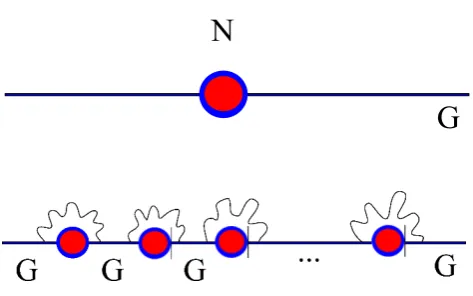
[image:10.595.180.417.82.230.2]Figure 1. up: N M5-branes at an orbifold singularity (SCFT point). down: the Coulomb/tensor
branch deformation where theNM5-branes are separated along the singularity locus and associated conformal matter which are symbolically represented by wavy lines between adjacent gauge factors.
3.1 M5-brane probes of ADE singularities
To begin, we recall that seven-dimensional super Yang-Mills theory with 16 supercharges is
realized by the M-theory backgroundR6,1×C2/ΓG, where ΓGis an ADE discrete subgroup
of SU(2). For additional properties of the group theory and associated geometry of these singularities, see appendix C. The bosonic field content of this theory consists of a seven-dimensional gauge field, and three real adjoint-valued scalars.
Domain wall solutions of the M-theory realization correspond to M5-brane probes which fill six spacetime dimensions and sit at the orbifold fixed point. In more detail, the
domain wall fillsR5,1 and sits at a point of the real line factor of R⊂R×C2/ΓG. We are
interested here precisely in the 6d theory living on the worldvolume of this domain wall;
see figure 1. Being half-BPS, this 6d system has (1,0) supersymmetry. Moreover, being
a domain wall for the 7d theory, the 7d gauge theory degrees of freedom serve as flavor
symmetry currents in the 6d system. Thus the system has a flavor groupGL×GR. The
7d gauge symmetry may be (partially) broken by suitable choices of boundary conditions
for the 7d fields at the domain wall [13,31].
By a similar token, we can introduce multiple domain walls and partition up the
real line factor in R×C2/ΓG into finite size segments such that the the leftmost and
rightmost segments are still non-compact. Each such segment on the real line specifies a
six-dimensional gauge theory with gauge group G. The value of the gauge coupling is in
turn specified by the length of the interval. As an interval segment becomes large, the corresponding gauge theory factor becomes weakly coupled. In particular, we see that the leftmost and rightmost intervals are non-compact and thus support flavor symmetries.
Summarizing then, we have arrived at a six-dimensional theory with (1,0)
supersymme-try, i.e. eight real supercharges. For each segment of the real line, we have a corresponding gauge group:
JHEP02(2015)054
where we have partitioned up the real line into N−1 finite segments, andGi 'Gfor all
i. The 6d gauge coupling of each segment is proportional to the length of the segment:
1
g2 i
∼Li, (3.2)
where Li is the length of the interval. Hence, the leftmost and rightmost segments define
flavor symmetries, while finite size intervals contribute dynamical degrees of freedom. An additional feature of this construction is that the length of each line segment is itself a dynamical mode, i.e. the scalar of a tensor multiplet.
We reach a conformal fixed point by shrinking the distance between the domain walls to zero size, that is, by passing to a strongly coupled fixed point of the gauge theory. In other words, our description in terms of domain walls partitioning up the real line characterizes the tensor branch of a six-dimensional theory.
Each domain wall contributes additional degrees of freedom trapped along its worldvol-ume. From this characterization, we see that we have a generalized notion of a quiver gauge theory: we have a set of gauge groups and matter sectors which act as links between them. Clearly then, it is important to know what are the additional degrees of freedom living on each domain wall, i.e., the conformal matter. The conformal matter sector corresponds to
the special case of N = 1 given by a single M5-brane which in F-theory corresponds to
the case of two non-compactG-type seven-branes intersecting at a single point. The more
general situation with N M5-branes, translates in F-theory to the case where the
seven-branes intersect at the ZN fixed point of the AN−1 singularity. The conformal matter will
automatically haveG×Gsymmetry as discussed before. In the F-theory setup this simply
comes from the fact that the non-compact seven-branes play the role of global symmetries. As for what this conformal matter is, we know the answer, as it follows directly from the
results reviewed in section2. To see this, observe that in M-theory, theAN−1 (2,0) theory
is realized by N coincident M5-branes, while in F-theory, it is realized by the geometry
C2/ZN×T2. In the resolution of the base, we haveN −1P1’s, each with self-intersection
−2, with neighboring intersections dictated by theAN−1 Dynkin diagram. Moreover, the
volumes of theP1’s control the relative positions of the M5-branes on the tensor branch. We
are interested in the case where there are some additional flavors, so we can also introduce
two stacks of non-compact seven-branes, with respective gauge groups GL and GR.5 In
the resolution of the C2/ZN singularity,GL intersects the leftmost P1 while GR intersects
the rightmost P1. Following the analysis of [12], we can see that the minimal singularity
type over each of the −2 curves enhances to an algebra g. So in other words, we have a
configuration of curves:
[GL]
g g . . . g g
2 2 . . . 2 2 [GR], (3.3)
that is, each −2 curve is wrapped by a seven-brane with gauge symmetry g. At each
intersection of a divisor in the base, we get a conformal matter sector. for which the G
-symmetries are gauged by the adjacent G on the −2 curve. In the following sections we
5In fact, sometimes such a flavor symmetry isrequired in order to satisfy the condition that an elliptic
JHEP02(2015)054
discuss theE case first, which has no type IIA realization, and then turn to theA and D
cases which do have IIA realizations.
3.2 M5-branes probing E-type singularity
As discussed above, the problem reduces to finding the conformal matter which arises when
two Ei singularities collide. This was already discussed in section 2. For example, in the
case G=E8, the relevant conformal matter is given by line (2.7); thus we end up with a
theory with gauge symmetries:
sp1×g2×f4×g2×sp1, (3.4)
with half hypermultiplets in the (2,7+1) of eachsp1×g2 factor (and in the (7+1,2) of
eachg2×sp1 factor), and with flavor groupE8×E8. More precisely we have a generalized
quiver theory of the form:
(3.5)
where the notation above denotes one tensor multiplet per each circle, the number below the circle denotes the (negative of) self intersection number of the corresponding cycle in the F-theory geometry. The two systems
(3.6)
denote, respectively, the theory of a single small E8 instanton which has a global E8
symmetry (consistent with the gauge and flavor symmetries attached to it as in line (3.5)),
and the (2,0) theory of 2 parallel M5-branes (i.e. theA1 (2,0) system). The configuration
of a −1 curve next to a−2 curve corresponds to the theory of two smallE8 instantons. In
the present case, the−2 curve touches a curve withsp1 gauge symmetry, which is obtained
by gauging a subalgebra of theso4 global symmetry.6
3.2.1 Fractional M5-branes
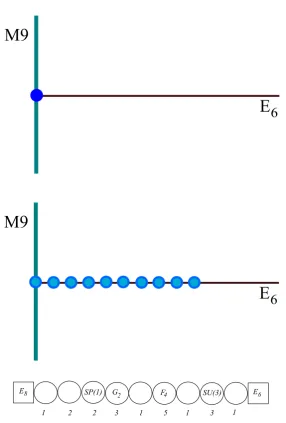
This picture suggests that the single M5-brane on the line ofE8 singularity has split to 12
points on it, leading to 11 finite segments whose lengths are controlled by the scalars of the
associated tensor multiplet (see figure 2). In other words, we have branes with fractional
6For further discussion of the anomaly polynomial for multiple small E
8 instantons, see [35]. The
JHEP02(2015)054
E
8
E
8
E
8
[image:13.595.93.519.81.462.2]
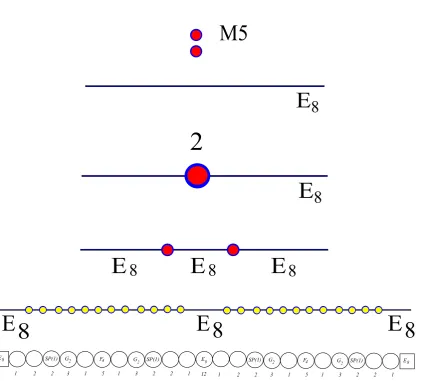
Figure 2. Example of two M5-branes probing anE8 singularity. Moving onto the tensor branch
gives rise to (E8, E8) conformal matter that are SCFTs themselves with their own tensor branches,
as described by the generalized quiver of line (3.5). This suggests that each M5-brane onE8 has
fractionated to 12 pieces.
M5 brane charge. Looking at the list of colliding E-singularities, we discover in this way that the fractionalization of M5-branes for the ADE series are given by
E8 E7 E6 Dp Ak
# of M5 Fractions 12 6 4 2 1 (3.7)
where as we will discuss in the context of D-type singularities, an M5-brane on it can frac-tionate to 2, while in the case of M5-branes on an A-type singularity no fractionation occurs.
This raises the question of why the gauge group factor on each interval is not the E8
gauge symmetry, but rather the list above. We propose an answer to this question:7 It
JHEP02(2015)054
has already been suggested that by choices of discrete three-form fluxes stuck at
seven-dimensional M-theory singularities, the type of the gauge symmetry can change [16]. We
thus propose that fractional M5-branes change the discrete flux from one value to the next, changing the gauge group in the process. Moreover we propose that each fractional M5-brane changes the three-form flux fraction by equal amounts. So for example in the
E8 case, each fractional M5-brane will change the fractional three-form flux by 1/12. Our
description of fractional M5-branes also matches to the list of groups (up to what we hope
is a typo for theE6 entry) listed in table 14 of reference [16].
In fact, the fraction of discrete flux matches where we find the corresponding group in
our repeated pattern of exceptional curves! For example, reading from left to right in the
configuration 1,2,2,3,1,5,1,3,2,2,1 for the conformal (E8, E8) matter, we find that there
is an sp1 gauge symmetry on the third curve, which would give 3/12 = 1/4, associated
with aZ4 flux. Further, on the fourth curve, we have 4/12 = 1/3 flux givingg2 (Z3 flux),
the sixth curve yields 6/12 = 1/2, giving f4 (Z2 flux). Similar considerations hold for E7
and E6 (and D type) conformal matter. One subtlety, however, is that the labels which
correspond to trivial gauge group are different from [16]. For example, forE8 there is no
Z5. But in addition there are all the other fractions of 1/12 which lead to no gauge factors.
3.3 IIA realization of T(SU(k), N) theories
Let us now consider more closely the theory of N M5-branes probing anAk−1-type
singu-larityC2/Zk. A convenient description of the domain wall discussed above is obtained via a
standard duality with Type IIA. TheAk−1-type singularity can be thought of as an infinite
radius limit of the chargekTaub-NUT space, orAk−1ALF space. More precisely, theT Nk
space has a canonical fibration as a circle of radius R, S1
R, over R3: in the limit R → ∞
one obtains the Ak−1 ALE space. M-theory on theT Nk geometry describes a system of
kKaluza-Klein monopoles that dualize to a system of k parallel infinite D6-branes on the
Type IIA side, once one identifies S1
R with the M-theory circle [32]. In the limit in which
the KK monopoles coincide, one obtains an enhanced SU(k) gauge symmetry; these are
the degrees of freedom of the 7d gauge theory we discussed above. Instead, in Type IIA the
D6-branes fill the X0, X1, . . . , X6 directions and the enhanced symmetry comes from the
gauge theory living on the worldvolume of the stack ofkcoincident D6-branes. Under such
a duality the N M5 probes turn into N NS5 probes of the stack of k D6-branes. On the
worldvolume of theN coincident NS5s lives a well-known but still quite mysterious 6d (1,0)
SCFT with tensionless strings [11]. Let us briefly discuss the field content of this theory.
Each NS5 contributes to the worldvolume a (2,0) tensor multiplet. As usual, the center of
mass degrees of freedom decouple and we are left with a system ofN−1 tensor multiplets
at the superconformal point. Each (2,0) multiplet decomposes into a (1,0) tensor plus two
(1,0) hypers. The scalars of the multiplets arise from quantizing the motion transverse to
the NS5s in the whole geometry, including the M-theory circle. In particular the vev of the scalars in the tensor multiplets parameterize the relative distance between the NS5s along
theX6 direction. Separating the NS5s we break superconformal invariance and move onto
JHEP02(2015)054
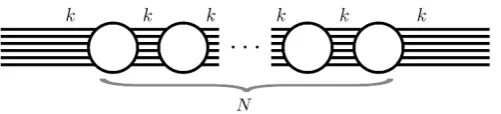
Figure 3. Type IIA description of the system ofNM5-branes probing theC2/Zk singularity: herewe are drawing schematically theX6 direction for the tensor branch. One obtainsN NS5-branes
sitting on top ofkinfinite D6 branes.
(3.8)
where edges stands for bifundamental hypers, the N −1 round nodes for gauge groups,
and the two square nodes for flavor groups as usual. Notice that naively the brane system
in figure 3 should correspond to a U(k) quiver gauge theory. In this context, however,
the U(1)’s are anomalous because of the nonzero term FU(1)∧Tr(F3
SU(k)) in the anomaly
polynomial. To cure this pathology, one couples the compact scalar corresponding to the
M-theory circle to the abelian gauge field, making it massive [11, 33]. This is the reason
why in 6d one obtains SU(k) gauge groups on the tensor branch.
3.3.1 IIB/F-theory description
TheT(SU(k), N) theories also have a straightforward realization in type IIB string theory.
To obtain it, we recall that if we T-dualize the S1 at the boundary of an ALE space, we
reach a collection of coincident NS5-branes. In such a configuration, we can next consider a stack of D7-branes which pass through the singular locus of this geometry. Upon
T-dualizing this circle, we see that a D7-brane wrapped over a collapsingP1 of the geometry
C2/ZN will become a D6-brane in the dual description. Putting these elements together,
we see that for each such P1, we get a stack of D6-branes suspended between NS5-branes.
In fact, we can also lift this IIB description back to F-theory. The tensor branch of
the 6d (1,0) theory engineered with F-theory is given by a local system of −2 curves in
the base of an elliptically fibered Calabi-Yau threefold. In the case of the system of N
M5-branes probing the C2/Zk singularity, each such curve supports a Kodaira type Ik
singular fiber, corresponding to enhanced gauge symmetry of type SU(k). Flavor groups in
the F-theory description correspond to non-compact divisors of the base of the elliptically
fibered Calabi-Yau threefold. Since we know that the system carries an SU(k)×SU(k)
flavor group, we need two non-compact divisors in the base. Moreover, the fact that the system we are engineering corresponds to the tensor branch of an SCFT translates to
the requirement that all compact −2 curves in the base can be shrunk simultaneously to
zero. Since bifundamental hypers are trapped at the intersections in between the various
JHEP02(2015)054
configuration of −2 curves for the F-theory description is:
. . .
Ik Ik
Ik
Ik
Ik
Ik Ik
(3.9)
the leftmost and rightmost−2 curves supportingIk type Kodaira fibers are non-compact.
Taking the conformal limit of such a system would correspond to shrinking the compact
−2 curves to zero size: at the SCFT point the two non-compact curves corresponding to
the flavor symmetries touch at anAN−1 singularity of the base:
Ik
A
Ik
N-1
(3.10)
This local configuration of curves corresponds to the SCFT describing the worldvolume of
N M5-branes probing an Ak−1 singularity in M-theory.
3.4 IIA Realization of T(SO(2p), N) theories
Let us now turn to the theory of N M5-branes probing a D-type singularity. First of all,
a Dp+4 singularity gives rise to 7d SYM theory with gauge group SO(2p+ 8) for p ≥ 0.
Following the same reasoning of the previous section, we seek a 6d (1,0) system with
SO(2p+ 8)×SO(2p+ 8) flavor group.
Following [32,34] we can obtain a Type IIA description of the system by replacing the
Dp+4 singularity with the correspondingDp+4 ALF space. Eventually, one obtains a stack
of p+ 4 parallel D6-branes on top of an O6− plane, together with p+ 4 mirror images of
the D6s below. The resulting 7d theory has SO(2p+ 8) gauge symmetry. Consider now
introducing domain walls. By construction, the theory living on the wall has SO(2p+
8)×SO(2p+ 8) flavor symmetry. However, when an O6± plane meets an NS5-brane, it
turns into an O6∓ plane, with a net shift of eight units of D6 charge. Now, a system of
p+ 4 D6-branes parallel to an O6+ plane gives rise to an spp gauge theory. Therefore, we
do not just get a set of N NS5-branes sitting on top of the p+ 4 D6s in the presence of
JHEP02(2015)054
i.e. SO(2p+ 8)×Sp(p), and this is impossible. The only way out from this paradox is to
conclude that there are 2N NS5-branes, and Sp factors in between our SO factors, for a
total of 2N−1 tensor multiplets.
We have just found that in contrast with M5-brane probes of A-type singularities, for D-type singularities we find fractional M5-branes. Since there are only two varieties of
these branes for the D-type singularity, we shall refer to them as 1/2-M5-branes.
This notion of fractionalization of M5-brane for the D-type singularity further supports the picture we proposed for fractionalization of M5-branes probing the E-type singularities.
Indeed, as noted in [37], the singularity with Z2 flux is a simple lift of a D6-O6 system of
Type IIA.
3.4.1 IIB/F-theory description
Let us now turn to the IIB / F-theory description of this system. As before, we can consider the effects of T-dualizing our suspended brane configuration to a related configuration of D7-branes and O7-planes in type IIB string theory. This leads us to a configuration of
seven-branes of SO type wrapping the −2 curves of an A-type singularity. This A-type
singularity is, in the IIB description, associated with the IIA NS5-branes used to partition up the interval in the first place.
Turning to the F-theory lift of this description, we need to consider −2 curves
inter-secting according to theAN−1Dynkin diagram. EachP1 supports a Kodaira-TateIp∗ fiber:
I
pI
p
A
N-1
*
*
(3.11)
As we already explained, the collision of two such fibers contains conformal matter, given
by anspp gauge theory (coupled to half hypers) wrapping a collapsing exceptional curve:
Ip∗ Ip∗
I∗
p Ip∗
−1
−n −m −(n+ 1) IQV −(m+ 1) 2p
JHEP02(2015)054
This type of blowup is the only one that occurs for the configuration of curves we are considering. Proceeding by successive blowups, eventually we obtain the configuration
...
I
I I
I
I I
I
p
2p p p
p
2p
2p
*
* *
*
ns
ns
ns
(3.13)
where each Ins
2p (resp. Ip∗) fiber is supported on a compact −1 (resp. −4) curve in the
base. Further, each Ins
2p is of non-split type, so the associated algebra is spp. For the
leftmost and rightmost non-compact curves curves we have an “external”I∗
p fiber, yielding
an SO(2p+ 8)×SO(2p+ 8) flavor symmetry. The tensor branch of this system can be
described by anSO / Spquiver theory: the alternatingspp and so2p+8 factors correspond
to the alternation of theIns
2p and the Ip∗ singular fibers along the chain of intersecting P1’s
of line (3.13). At the intersections of the −4 with the −1 curves we also find localized
matter modes in the form of bifundamental half hypers.
Let us stress here a crucial difference with respect to what we have found discussing
the M5 probes of an Ak−1 singularity. For the theory of N M5-branes probing an Ak−1
singularity, the corresponding F-theory realization involves dressing the−2 curves obtained
by resolving theAN−1 singularity byIkfibers, so we find precisely N−1 tensor multiplets
in the tensor/Coulomb branch of the system. If, instead, we consider the theory of N
M5-branes probing a Dp+4 singularity, we have seen that in the F-theory realization we
dress the −2 curves obtained by resolving the AN−1 singularity with Ip∗ fibers. However,
the full resolution does not lead toN−1 tensor multiplets, but to 2N−1. This fact again
suggests the existence of a fractional M5 charge: probing theDp+4 singularity we find that
a full M5-brane is a compound of two objects, and this explains why we find almost twice as many tensor multiplets in both the IIA and IIB descriptions of these 6d systems.
3.4.2 The special case p= 0
For generic values of p, we see the M5-branes probing the Dp+4 singularity lead, in the
resolved phase, to a configuration of −4 and −1 curves, where the−4 curves support SO
type gauge groups, while the −1 curves support Sp type gauge groups. When p = 0,
however, each−1 curve supports no gauge group, since Sp(0) is trivial.
This special case is also closely connected with the “rigid” theories encountered in [12].
Indeed, let us recall that the alternating pattern of compact curves:
4,1, . . . ,1,4 (3.14)
supports a collection of so8 gauge symmetries, each supported on a −4 curve. In the
notation of [12] (see also appendix D), this theory comes from the minimal resolution
JHEP02(2015)054
[image:19.595.87.511.85.205.2]
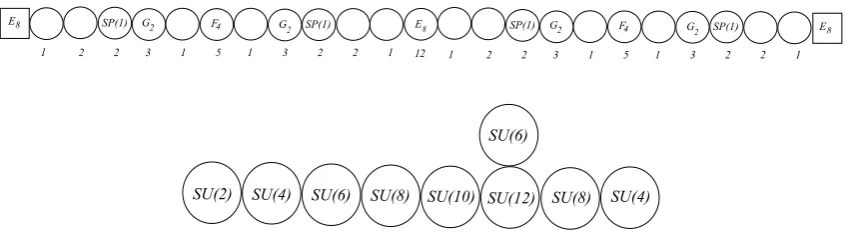
Figure 4. An instance of a novel 5d duality. The 6d theory of two M5-branes probing an E8
singularity (top) compactified onS1 is dual to the affineEb8(2) 5d quiver system (bottom).
we decompactify the leftmost and rightmost −4 curves, thus converting them to flavor
symmetries.
4 Novel 5d dualities
Though our main focus in this paper is the theory of conformal matter in six dimensions, it is natural to ask what becomes of this system upon further compactification. Here we
study the simplest possibility given by compactifying on an S1. We will argue that this
compactified theory is dual to a more conventional 5d quiver gauge theory, as obtained from D-brane probes of an ADE singularity.
To orient ourselves, let us consider the simplest example of this, namely N M5-branes
probing anAk singularity. As we already discussed, this is expected to give a linear quiver
gauge theory with SU(k+ 1)N−1 gauge symmetry, and bifundamental matter.
Compacti-fying on a circle will still give rise to the same quiver theory but now in five dimensions. On the other hand, using the relation between M-theory and type IIA, by viewing the
circle as the ‘11-th’ dimension, this is the same asN D4-branes probing theAksingularity.
Using the Douglas-Moore construction [33], we deduce that this should be given by the
quiver theory involving SU(N)k+1 arranged along a ring leading to a duality between two
different 5d quiver theories. In fact this duality was explained in [38–40] using the
hori-zontal/vertical exchange symmetry [41] of the toric realization of these theories, and used
to compute the partition function of the associated strings of the 6d (1,0) SCFT.
For the case of M5-branes probing D-singularities in the same way we get a duality
between the quiver chain SO×Sp×SO . . . . and the affine D-quiver arising from N
D4-branes probing D-singularities. These are already non-trivial dualities. For the E-series we get novel dualities which were not noted before. For example, in the case of 2 M5-branes
probing an E8 singularity the resulting duality is shown in figure4. Let us note here that
the E8 flavor symmetries are only realized in the strong coupling limit: indeed, the −1
curves at the very left and very right function as “unconventional matter” for the rest of the gauge theory system, which is massive on the tensor branch.
JHEP02(2015)054
obtained by dimensional reduction. We shall then verify that this matches the dimensional reduction of M5-branes, i.e. D4-branes probing our ADE singularity. This will provide a nice check on our proposal that we have correctly identified the degrees of freedom in the
6d theory.8
In the five-dimensional theory, we can get vector multiplets in one of two ways. First of all, starting on the tensor branch, we see that each tensor multiplet, upon dimensional reduction, gives a U(1) vector multiplet. Additionally, we see that for each 6d gauge group factor on the tensor branch, we get some additional vector multiplets in 5d. So, we predict
the number of vector multiplet to ber+nT whereris the total rank of the 6d gauge groups
and nT is the number of 6d tensor multiplets. Moreover, the tensor multiplets either arise
from the (N −1) “intervals” between the M5-branes and N times the number of tensors
for each conformal matter system. Similarly the total rank of the gauge group r arises
from two sources: (N−1)rG from the intervals between M5-branes whererGis the rank of
theGADE-type singularity, and N times the rank of the gauge group from each conformal
matter sector. In a system with N M5-branes, we have partitioned up our interval into
N −1 compact pieces, so the dimension of the Coulomb branch for the 5d theory is:
dim5dCoul(G, N) =ninterval+ncmatter, (4.1)
The contribution from the intervals is straightforward:
ninterval= (N−1)rG+ (N−1). (4.2)
The first summand comes from the 6d vector multiplets, and the additional summand
of (N −1) comes from the tensor multiplet of each interval. The contribution from the
conformal matter sector must be calculated on a case by case basis:
Ak :ncmatter= 0 (4.3)
Dp :ncmatter= (p−3)N (4.4)
E6 :ncmatter= (2 + 3)N (4.5)
E7 :ncmatter= (5 + 5)N (4.6)
E8 :ncmatter= (10 + 11)N (4.7)
in the E-type cases, we have split up the contribution in the parentheses: the first term is the rank of the gauge group for the conformal matter sector, and the second summand is the total number of tensors. Totalling this up, we get a prediction for the dimension of the Coulomb branch in the lower-dimensional theory:
dim5dCoul(Ak, N) = (k+ 1)N −(k+ 1) (4.8)
dim5dCoul(Dp, N) = (2p−2)N −(p+ 1) (4.9)
dim5dCoul(E6, N) = 12N −7 (4.10)
dim5dCoul(E7, N) = 18N −8 (4.11)
dim5dCoul(E8, N) = 30N −9. (4.12)
JHEP02(2015)054
A succinct formula for all of these cases is:
dim5dCoul(G) =
X
i
(N d(Gb)
i −1) =N hG−rGb, (4.13)
where the sum on iis over all the nodes of the affine Dynkin diagram, with hG the dual
Coxeter number for G, rGb the rank of the affine Gb Dynkin diagram, and d
(Gb)
i the affine
Dynkin numbers for each node.
On the other hand, we also know that in the IIA description of the D4-brane probe system, there is a quiver gauge theory with connectivity of an affine ADE Dynkin
dia-gram [33]. Each node of the affine Dynkin diagram quiver has gauge groupQ
iSU(N d (Gb) i ). Thus, the dimension of the Coulomb branch for the D4-brane probe theory is nothing
other than equation (4.13). This is a rather non-trivial check of the 5d duality and on our
proposal as a whole.
Finally, it would be interesting to see whether these dualities can also be extended
to the case of flavor symmetries G×G0, where G 6=G0. By a similar token, it would be
instructive to extend these considerations to lower-dimensional systems, perhaps along the
lines of references [34,43–45].
4.1 Hints of a 6d duality
The close match in five dimensions between D4-brane probes of ADE singularities, and our more “exotic” superconformal matter sectors naturally suggests a lift all the way back to
six dimensions.9 On the one hand, we have a rather conventional 6d quiver gauge theory, of
the type studied in [9]. On the other hand, we have a strongly interacting non-Lagrangian
conformal fixed point. Indeed, if we compare the superconformal indices onS5×S1for these
two theories, we are guaranteed to get the same answer. This is because the 5d theories
on S5 (after reduction on theS1) are already dual. While this does not constitute a proof
of a 6d duality, it is at least suggestive and would be interesting to understand better.
5 Partial Higgs branches of the T(G, N) theories
So far, our discussion has focussed on SCFTs which have a geometric avatar in both M-and F-theory. Starting from these “master theories” we can also move down to a number of lower theories by partial Higgsing, that is, by activating operator vevs in the 6d SCFT which break part of the flavor symmetry. Our plan in this section will be to characterize
how to pass from our (G, G) theories down to theories with a broken flavor symmetry.
Our interest in this section will be on partial Higgsing of the flavor symmetry. A full
Higgsing to the diagonal Gdiag ⊂GL×GR symmetry group would correspond to moving
9
JHEP02(2015)054
the M5-branes off the singularity. We are interested instead in keeping all the M5-branes on the singularity, so we exclude this possibility in what follows. This means in particular that the complex geometry of the F-theory compactification will stay put. The resulting
class of deformations in F-theory specify “T-brane data” (see e.g. [18,22]).
The main result from our analysis is that we can characterize the resulting SCFTs
as T(G, µL, µR, N), where N is the number of domain walls, andµL and µR specify two
independent nilpotent elementsµL∈gLandµR∈gR(and their orbits), yielding a breaking
pattern of the “ambient” flavor symmetry GL×GR. There are no anomaly cancellation
constraints since the choice of nilpotent element dictates a breaking pattern into the interior of the theory on the tensor branch.
To understand the possible ways to break the flavor symmetry, it is instructive to see the effects of these contributions on the worldvolume theory of the flavor branes. For
specificity, we work in terms of the F-theory picture with flavor symmetryG. We seek to
understand how background values for fields in the seven-brane show up in the 6d SCFT. What we will show is that these background values induce vevs for operators in the theory. Conversely, a choice of operator vev leads to a specific choice of boundary condition for the flavor branes.
Consider, therefore, the worldvolume theory for our leftmost flavor brane. This is a
seven-brane with gauge symmetry G wrapping the curve Σ 'C∗, that is, a cylinder. To
study possible boundary conditions for this system, it is convenient to view this curve as
a compact P1 with two marked points, which we label as p0 and p∞. The intersection of
the flavor brane with another seven-brane occurs at p0, while p∞ is far away from this
intersection point.
Allowing for singular behavior for our fields at the marked points, the BPS equations for the seven-brane are governed by the Hitchin system coupled to defects:
∂AΦ =
X
p
µ(p)
C δ(p), F+ [Φ,Φ
†] =X
p
µ(p)
R δ(p) (5.1)
for an adjoint-valued (1,0) form Φ and the worldvolume connection A, with F its
field-strength. Here, we allow for possibly singular behavior at a marked point p. For each
point p, µ(p)
C and µ (p)
R specify a triplet of moment maps. When matter is localized at an
intersection point, the associated sources can be interpreted as vevs for matter fields [22,29].
Letting z denote a local coordinate on Σ such that z = 0 is a marked point, the
local behavior of a solution to this system of equations can be determined by solving the holomorphic constraint (i.e. the F-term) modulo complexified gauge transformations. Doing so, we get:
Φ∼µCdz
z (5.2)
where we have presented the solution in a holomorphic gauge so that A(0,1) is trivial (see
e.g. [18,46]). To pass to a unitary gauge in which F- and D-terms modulo unitary gauge
transformations are satisfied, we need to conjugate by an appropriate position dependent
element h(z, z) of the complexified group, Φ → h−1·Φ·h and A
(0,1) → h−1·∂h. This
JHEP02(2015)054
is related to the fact that the flux profile of the seven-brane yields a funnel solution which
opens up near the point p∞. When we turn to the IIA realization of this system, we
will encounter this behavior again as an “ordering constraint” on the partitioning of
semi-infinite D6-branes (see also [47]). Solutions to Hitchin system with a simple pole were first
considered in [48]. For further discussion, we refer the interested reader to section 3.3 of
reference [46]. Higher order poles (i.e. irregular singularities) can also be studied in the
same fashion, and correspond to activating vevs for multiple operators [29].
To characterize these solutions more globally, it is convenient to introduce the com-plexified connection:
A=A+ Φ + Φ†. (5.3)
Solutions to Hitchin’s system are given by flat complexified connections [49]. In the case at
hand where Σ is a cylinder, we see that there is precisely one closed one-cycle to integrate around, so there is one holonomy we get to specify:
H=Pexp
−
I
A
, (5.4)
valued in GC. The conjugacy class for the holonomy CH in GC is gauge invariant data,
and fixes a choice of vacuum. Observe that encircling the point p∞ and specifying the
holonomy there amounts to also specifying the holonomy aroundp0 sinceH∞· H0 =id.
Now, in the 6d SCFT, the boundary data associated with µCand µRis interpreted as
giving vevs to operators of the theory. Said differently, we see that the background values of the flavor seven-branes generate a non-zero Higgsing in the resulting theory. Conversely, if we ask what the lift of operator vevs in the 6d SCFT translates to in the brane construction,
we need to alter the boundary conditions for the Hitchin system fields out atp∞. Finally, we
note that although this fixes the breaking pattern for the flavor symmetry, it is important
to note that in unitary gauge, the relative size of the Hitchin system fields at p∞ and p0
will in general be different, being controlled by the Hermitian pairing for the Higgs bundle. Thus, our characterization of vacua boils down to possible choices for boundary
con-ditions at the marked points, which are in turn controlled byµC and µR. Now, recall that
we are also restricting attention to deformations of the 6d SCFT which cannot be under-stood as unfolding the singularity associated with the seven-brane. In the decomposition of
µC=µs+µninto a semi-simple (i.e. in the Cartan) and nilpotent piece, it is well-known that
the semi-simple part shows up as just such an unfolding (see e.g. [29]). For our present
pur-poses, it is therefore enough to focus attention on the caseµs= 0, so that µCnilpotent. In
other words,µCacts as a raising operator, andµR∝[µC, µ†
C] acts as a Cartan generator for
ansu(2) subalgebra ofg, specifying a homomorphism (by abuse of notation) µ:su(2)→g.
Summarizing, the basic data associated with a partial Higgs branch of our 6d SCFT
is a choice of nilpotent elementµ, or even more precisely, its orbitOµ⊂gC. Conversely, if
we specify inGCa conjugacy classCH for the holonomy, then we have implicitly also fixed
a choice of Higgs branch.
Now, since we can independently choose the boundary data for our two flavor branes
GL andGR, we see that the Higgs branches of our theories are labeled by a pair of
JHEP02(2015)054
symmetry for T(G, µL, µR, N) is the commutant of the image µL(SU(2))×µR(SU(2)) ⊂
GL×GR.10
Our characterization of vacua by nilpotent elements of the complexified flavor sym-metry is basically a special case of the broader notion of “T-brane data” in an F-theory
compactification [18–22]. These are non-abelian intersecting brane configurations in which
the adjoint-valued Higgs field of the seven-brane is nilpotent (i.e. upper triangular for
sl(n,C)). As they are nilpotent, such vacua do not appear in holomorphic Casimir
invari-ants, and so are not visible in the complex geometry of the Calabi-Yau threefold. Rather,
they can be seen in the limiting behavior of its intermediate Jacobian [22]. What we have
just seen is that T-brane data leads to a rich class of 6d SCFTs.11
Having illustrated how boundary data of the Hitchin system realization in F-theory feeds into the 6d SCFT, let us now return to the M-theory realization in terms of 6d domain
walls in 7d super Yang-Mills theory with gauge group G. Here, our flavor symmetry is
supported on a pair of semi-infinite intervals, so it is convenient to label this coordinate as
x6. The two marked pointsp∞andp0 are now replaced by a choice of boundary conditions
for this 7d Yang-Mills sector: one which is far away from all of the compact intervals at
x6 =x6
∞, and one which touches the various compact intervals. In the worldvolume of the
7d theory, there is a pole for the Nahm equations:
∂AΦi =ijk[Φj,Φk], (5.5)
where now Φi fori=x, y, z are the triplet of real scalars in 7d SYM, and ∂
A= ∂x∂6 −A6
is the worldvolume covariant derivative in the directionx6 along the semi-infinite interval.
Near x6 =x6
∞, the fields have asymptotic behavior:
Φi∼ t
i
x6−x6
∞
, (5.6)
where the ti are Hermitian generators of an su(2) subalgebra of the gauge algebra g. Of
course, this is the same data we already encountered in the F-theory description. Further,
we see that the pole for the Higgs field in the Hitchin system out at p∞ is now reflected
in a pole for the Φi atx6 =x6
∞. With this boundary condition fixed, we also see that the
profile of the field configuration in 7d SYM will now interpolate from x6 =x6
∞ inwards to
the first M5-brane, inducing a vev for operators in the 6d SCFT.
5.1 IIA realizations
In the special case where we have a IIA realization, we can be even more explicit. For
specificity, we focus on the case G= SU(k) studied in [13]. In that context, the relevant
brane systems are the ones considered in [8, 11, 13]. The relevant brane configurations
10
This residual symmetry can be extracted from known results in the literature (see e.g. [50]), and was actually already considered in the physics literature in the related context of class S theories in four dimensions; see for example [51,52].
11Such T-brane configurations also provide a way to construct four-dimensional superconformal field
JHEP02(2015)054
Figure 5. A brane configuration similar to figure3, where now the D6s end on D8s in two differentways on the two sides, corresponding to two different Young diagrams. This configuration is T-dual to the one in figure6.
are similar to the ones of our “master theory”, except that now we take the D6 to end on
several D8s; let µa
L (µaR) be the number of D6s ending on the a-th D8 on the left (right).
When each D6 ends on a separate D8, so that all the µa
L,R = 1, the D8s impose Dirichlet
boundary conditions for the gauge field on the D6s, and Neumann for the scalars.
An example of a more general situation, with not all the µa
L,R = 1, is depicted for
example in figure5. Actually, however, such a picture is too naive: one now expects that
the D6s and the D8s fuse into a single D8/D6 bound state. This is described on the
worldvolume of the D6s by a pole for the Nahm equations, just as in equation (5.5).
The presence of the Nahm pole can be interpreted as the fact that the D6s open up into
the D8s. To see this, consider first for simplicity the “full” pole where all k D6s end on a
single D8, as on the left of figure5. Notice that forx6 →x6
∞we have ΦiΦi → (xk6(−kx−61)
∞)2id; a
slice at constantx6 is well approximated by a fuzzy sphere of radius∼ k
x6−x6
∞. In the more
general case where not all the D6s end on the same D8 (as on the right side of figure 5),
each D8 represents a Jordan block, whose size is the numberµiof D6s ending on it; we then
have several fuzzy spheres, of radii∼ µi
x6−x6
∞. An exception is the case of a Jordan block of
size 1, which is of course simply a zero; in that case, the fuzzy sphere actually has radius 0, and the D6 actually ends on a D8: the two do not fuse together. This block then behaves as in the case we mentioned at the beginning of this subsection: the D8s in this block impose Dirichlet boundary conditions for the gauge field on the D6s, and Neumann for the scalars. Thus in general we should imagine fuzzy funnels coming out of the NS5 system; for a
cartoon (in the case where the NS5s coincide) see figure 5 of reference [13]. Implicit in that
cartoon is also the fact that the D8s in pictures such as figure 5should be ordered so that
theµa
LandµaRshould decrease as one goes outside (this was found in [47] by comparing the
moduli spaces of solutions to Nahm equations to the moduli spaces of the corresponding field theories).
A second constraint is that there should be enough NS5s [13]: when one moves the
branes around to reach a quiver description, one should not remain with some extra de-coupled sectors. This reads
JHEP02(2015)054
where µ1
L and µ1R are the number of D6s ending on the two innermost D8s or, in other
words, the tallest columns of the two Young diagrams (this would amount toN ≥5+3 = 8
in the example of figure 5).
In order to see the connection of the IIA discussion in this subsection to the previous discussion in F-theory it is enough to T-dualize along a direction transverse to the D6s, say
x7, generalizing our discussion in section 3.3.1. The NS5s turn into geometry: each pair
of them give rise to a nontrivial two-cycle. The D6s suspended in between the NS5s now
become a D7 stack (or in other words D7s with nonabelian gauge group SU(k)) wrapping
the two-cycle. This is the tensor branch of the model; the SCFT point is reached by putting the NS5s on top of each other, and in the T-dual picture this amounts to collapsing the corresponding nontrivial two-cycles to zero size. At each of the ends of the diagram, however, things are a little different. Let us first look at the case where each of the D6s
ends on a separate D8. In this case, we get an SU(k) flavor symmetry, because no Nahm
pole is possible. Further, if we T-dualize, we get a single stack of D7-branes wrapping a non-compact two-cycle.
In more general cases, however, we have seen in IIA that the D6s and the D8s fuse together into a single object, as reflected in non-trivial Nahm pole data. We expect this to have its own counterpart on the IIB side. This can be described on the worldvolume of the
former D6 as follows: one of the transverse scalars (say Φ3) becomes in IIB a gauge field,
and we can complexify the two remaining scalars: Φ≡Φ1+iΦ2. The Nahm equations (5.5)
now turn into the (gauge fixed) Hitchin equations (5.1); the presence of a Nahm pole (5.6)
turns into the presence of a Hitchin pole. The D7 with a Hitchin pole can now be thought of as the fusion of a system of D7s. The structure of the D8/D6 system with a Nahm pole is therefore encoded in the structure of the block decomposition of the Hitchin field, that, in turn, encode the T-brane data on the F-theory side. The situation is now depicted
schematically in figure 6.
In IIA string theory, we can also realize theories with SO and Sp gauge symmetry.
Compared with the A-type case, the Type IIA description of the system is almost analogous,
the main difference being the presence of the O6−plane. Again introducing D8s on the left
and on the right of the NS5s that impose Dirichlet boundary conditions for the gauge field
on the D6s, and Neumann for the scalars we recover the system withSOL×SORflavor
sym-metry and the T-dual configuration ofIp∗ fibers we discussed in the previous section.
Con-sider now introducing Nahm poles for the D6/D8 systems on the left and on the right. These
are specified by a pair of homomorphisms µL and µR from su(2) to so2p+8. By T-duality
these very same homomorphisms characterize the T-brane data on the F-theory side.
5.2 Alternative realizations for some SU(k) cases
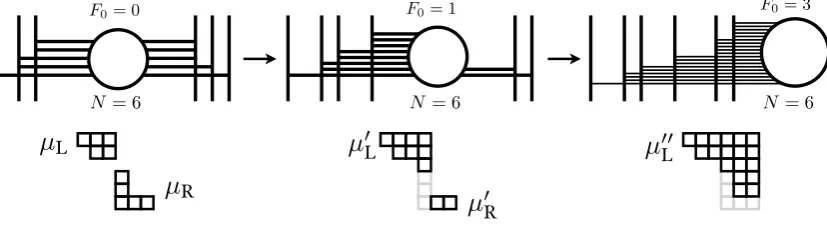
Notice that so far we have kept all the NS5s in the region whereF0 = 0. In figure 5: there
are no D6s ending on any NS5. In general, the net number of D6s ending on a NS5 equals
kD6,L−kD6,L=n0 = 2πF0 (which is an integer by flux quantization). This can be seen
ei-ther by anomaly cancellation in the 6d field theory, or by a Bianchi identity in the brane pic-ture. Because of this, given any valid D8-D6-NS5 configuration, we can decide to move all

![Figure 10. A cartoon of the internal space (topologically an S3) for one of the solutions in [13, 63];it represents the near-horizon geometry of the brane configuration in figure 5.](https://thumb-us.123doks.com/thumbv2/123dok_us/7904502.188658/36.595.232.364.94.202/figure-cartoon-internal-topologically-solutions-represents-geometry-conguration.webp)
