This is a repository copy of Differences in illness perceptions between patients with
non-epileptic seizures and functional limb weakness.
White Rose Research Online URL for this paper:
http://eprints.whiterose.ac.uk/96433/
Version: Accepted Version
Article:
Ludwig, L., Whitehead, K., Sharpe, M. et al. (2 more authors) (2015) Differences in illness
perceptions between patients with non-epileptic seizures and functional limb weakness.
Journal of Psychosomatic Research, 79 (3). pp. 246-249. ISSN 0022-3999
https://doi.org/10.1016/j.jpsychores.2015.05.010
[email protected] https://eprints.whiterose.ac.uk/
Reuse
Unless indicated otherwise, fulltext items are protected by copyright with all rights reserved. The copyright exception in section 29 of the Copyright, Designs and Patents Act 1988 allows the making of a single copy solely for the purpose of non-commercial research or private study within the limits of fair dealing. The publisher or other rights-holder may allow further reproduction and re-use of this version - refer to the White Rose Research Online record for this item. Where records identify the publisher as the copyright holder, users can verify any specific terms of use on the publisher’s website.
Takedown
If you consider content in White Rose Research Online to be in breach of UK law, please notify us by
SHORT REPORT for
Journal of Psychosomatic Research
Differences in illness perceptions between patients with non
-epileptic seizures and functional limb weakness.
Lea Ludwig MSc, Kimberley Whitehead BSc, Michael Sharpe MD, Markus Reuber PhD, Jon Stone PhD
Lea Ludwig, Dept Clinical Neurosciences, Western General Hospital, Edinburgh, EH4 2XU, UK
Kimberley Whitehead, Department of Clinical Neurophysiology, National Hospital for Neurology and
Neurosurgery, London, WC1N 3BG, UK. E: [email protected]
Professor Michael Sharpe, Department of Psychiatry, University of Oxford
Oxford, OX3 7JX, UK. E: [email protected]
Professor Markus Reuber, Academic Neurology Unit, University of Sheffield
Royal Hallamshire Hospital. Sheffield, S10 2JF, UK
Dr Jon Stone, Consultant Neurologist and Honorary Senior Lecturer. Dept Clinical Neurosciences
Western General Hospital, Edinburgh, EH4 2XU, UK
T: +44 (0)131 5371167
Corresponding author: Jon Stone
Keywords: Psychogenic non-epileptic seizures; Functional weakness; Conversion disorder; Epilepsy
Illness perception; Neurology
Abstract Objectives
Illness perceptions are considered to play an important role in the onset and maintenance of symptoms in Functional Neurological Symptom Disorder (Conversion Disorder). There has, however, been little work examining differences between subtypes of this disorder. We therefore aimed to compare illness perceptions of patients with non-epileptic seizures (NES) and those with functional weakness (FW)
with matching neurological disease controls to examine their specificity.
Methods
The Illness Perception Questionnaire Revised (IPQ-R) was completed by patients with functional
limb weakness, non-epileptic seizures and patients with neurological disease causing limb weakness
and epilepsy in two separate case control studies.
Results
Patients with FW (n=107), NES (=40), Epilepsy (n=34) and neurological disease causing limb weakness (NDLW) (n=46) were included in the analysis. Both FW and NES patients reported a low level of personal control, understanding of their symptoms and a tendency to reject a psychological causation of their symptoms. However NES patients rejected psychological causes less strongly than FW patients (p<0.01), including the single ‘stress’ item of the IPQ-R (p<0.01). Patients with NES
were also more likely to consider their treatment to be more effective (p<0.01). None of these differences appeared in a similar comparison between patients with epilepsy and patients with NDLW.
Conclusion
Introduction
Illness perceptions are considered to have an important impact on outcome in functional neurological symptom disorder (FNSD/Conversion Disorder) [1][2]. Compared to patients with similarly disabling
neurological diseases, such as multiple sclerosis or epilepsy, patients with functional limb weakness and non-epileptic seizures typically have quite similar illness perceptions regarding the impact of their
symptoms but are less likely to endorse psychological factors as causes [3][4][5].
Symptoms of seizures and weakness have always been grouped together within DSM Conversion Disorder because: 1) both present to neurological services, 2) they co-exist in the same patient much
more often than chance, 3) there are patients who have intermediate forms of the disorders (e.g. paroxysmal movement disorders that could also be considered 'seizures' or patients whose NES leave them with more persistent functional limb weakness), 4)
both presentations have traditionally
been conceptualized to share a similar etiological (psychogenic, conversion) explanation
. However, data comparing these two groups is scarce[6–9]
and no previous studies have focused on illness perceptions.We therefore aimed to compare the illness perceptions of two well-characterised cohorts of patients
with NES and FW. Additional disease controls with matching symptoms (patients with weakness caused by neurological disease or with epilepsy) allowed us to investigate whether any differences between groups related specifically to conversion disorder rather than more generally to the experience of having attacks or limb weakness. Data from these two cohorts have previously been analysed to explore differences between patients with functional and neurological limb weakness [4], patients with non-epileptic seizures and their doctors [5], and between relatives of patients with
functional symptoms or symptoms of neurological disease [10]. However, none of the previous studies have examined differences between the two different functional symptom groups and the specificity of these.
Methods
Recruitment
(EP) or non-epileptic seizures (NES) (diagnosed on the basis of video EEG recordings of typical
seizures conforming to a ‘documented’ level of diagnostic certainty, Department Clinical Neurology, Sheffield, 2009-11)[5]
[11]
. Inclusion criteria were: symptom onset within last two years (FW andNDLW only since the recruitment protocol for NES did not specify a duration); not “partly functional/partly organic diagnosis” / not mixed epileptic and non-epileptic seizures (ES and NES
only); age over 16, able to read English. Patients completed the Illness Perception Questionnaire
-Revised (IPQ-R)[12] and the Hospital and Anxiety Depression Scale (HADS) [13] after seeing a
consultant neurologist but prior to being seen by the research fellow for an assessment (FW and NDLW) or, in the case of Epilepsy and NES, before the outcome of the video-EEG recording had
been discussed with them.
Further details of recruitment and other clinical and self-report data can be found elsewhere [4] [5].
Ethical approval was provided by the Lothian Research Ethics committee (FW) and Sheffield
Research Ethics Committee (NES).
Measures and Analysis
The IPQ-R is a 38-item self-report questionnaire in order to assess patients’ illness perceptions [12].
Eight Subscales are rated on a five-point Likert scale ranging from strongly agree to strongly disagree
(for a detailed description please see below, Table 2). We excluded the Identity subscale, a list of
physical symptoms, as it was not collected in the seizure samples. Additionally, we grouped a list of
18 possible "causes" into psychological/emotional (items 1,9-12, and 17; “stress”, “my mental
attitude”, “family problems”, “overwork”, “my emotional state” and “my personality”) (Cronbach's = .864) and non-psychological (items 2-8, 13-16, and 18; e.g. “hereditary”, “germ or virus”, “poor
medical care in the past”, “accident or injury”).
The Hospital Anxiety and Depression Scale (HADS) [13] is a widely used and validated measure of
anxiety and depression in patients with physical symptoms.
We used SPSS Statistics 21 to compare the functional groups (NES vs FW) and the neurological
groups (EP vs NDLW) on age, gender, HADS score, and IPQ-R data. We used t-tests where data was
normally distributed (Kolmogorov Smirnov test) or non-parametric Mann-Whitney U tests where it
was not. Because of multiple testing, we conservatively interpreted two-sided p values of 0.01 as
Results
We recruited 107 patients with FW, 46 with NDLW (commonest diagnoses multiple sclerosis (n=27),
Guillain-Barré syndrome (n=4) and others[4]), 40 with NES and 34 with epilepsy. There were no age
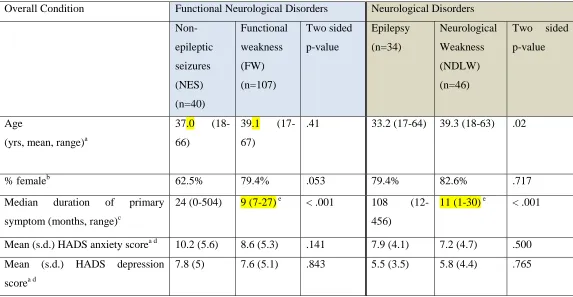
or gender differences between FW and NES groups (Table 1). Symptom duration in the NES and
Epilepsy groups was significantly longer compared to the FW and NDLW groups in keeping with
different recruitment protocols at the two sites. There were no significant differences in anxiety or
depression scores between patients with FW and NES or between NDLW and epilepsy.
The IPQ-R results for all four groups are shown in Table 2. Although both NES and FW groups
tended to reject psychological explanations, NES patients rejected them less strongly than FW
patients (p<.01, effect size d=0.49, medium effect). This was also true for the single item asking
whether 'stress' was a possible cause of their illness (p<.01, effect size d=0.56, medium effect). This
item, together with the other ‘psychological causation’ items are shown in Figure 1 for the FW and
NES cohorts.
Although both groups agreed that the conditions had major consequences on their lives, FW patients
reported a relatively lower effect of the condition on themselves and their families, compared to
patients with NES (p<.01, effect size d=0.44, small effect).
NES patients also considered the effectiveness of treatment to be higher than FW patients (p<.01,
d=0.52, medium effect).
There were no differences between patients with FW and NES in terms of their perception of the
cyclical nature or the long duration of their disorders (Timeline), personal control over their condition
(Personal control) understanding of their condition (Illness Coherence) or the perceived emotional
impact (Emotional representation).
Patients with Epilepsy estimated the degree of personal control as significantly lower than patients
with NDLW (p<.001, effect size d=0.84, large effect). No other differences were found between
Table 1. Demographic and HADS scores in all four groups.
Overall Condition Functional Neurological Disorders Neurological Disorders
Non-epileptic seizures (NES) (n=40) Functional weakness (FW) (n=107) Two sided p-value Epilepsy (n=34) Neurological Weakness (NDLW) (n=46)
Two sided
p-value
Age
(yrs, mean, range)a
37.0
(18-66)
39.1
(17-67)
.41 33.2 (17-64) 39.3 (18-63) .02
% femaleb 62.5% 79.4% .053 79.4% 82.6% .717
Median duration of primary
symptom (months, range)c
24 (0-504) 9 (7-27) e < .001 108
(12-456)
11 (1-30) e < .001
Mean (s.d.) HADS anxiety scorea d 10.2 (5.6) 8.6 (5.3) .141 7.9 (4.1) 7.2 (4.7) .500
Mean (s.d.) HADS depression
scorea d
7.8 (5) 7.6 (5.1) .843 5.5 (3.5) 5.8 (4.4) .765
a t-test
b Pearson’s c
hi-squared test
c
Mann-Whitney U test
d
e
[image:8.842.72.753.192.468.2]FW (n=2, 25+27 months) and NDLW (n=1, 30 months) had weakness duration over 24 months
Table 2. Comparison of adapted IPQ-R scores for all patients with Non-Epileptic Seizures (NES) compared with Functional Weakness (FW), and Epilepsy (EP) compared
with neurological disease causing limb weakness (NDLW). All scores are normalised to a 1-100 scale. t-test unless otherwise specified.
IPQ-R subscales Interpretation of higher score IPQ-R score, mean (s.d.) and statistical comparison between NES and FW
IPQ-R score, mean (s.d.) and statistical comparison between EP and NDLW Functional Neurological Disorders Neurological Disorders
NES (n=40) FW (n=102) Two sided p-value
EP (n=34) NDLW
(n=43)
Two sided p-value Psychological causal
attributions
Greater endorsement of six psychological causes
36 (24) 25 (21) .009 39 (19)b 35 (20) .403
Stress (single item) Agrees with stress as a cause of illness 54 (36) 34 (33) .004a 67 (30) 59 (29) .241a
Consequences Condition has great effect on patient and family
71 (19) 62 (21) .019a 68 (19) 68 (17) .947
Treatment control Treatment is effective for condition 61 (15)b 53 (15) .004a 54 (18) 53 (18) .819
Timeline (cyclical) Condition is cyclical 60 (20) 55 (25) .257 63 (17) 54 (22) .048
Timeline (acute/chronic)
Condition will have long duration 58 (16) 51 (21) .041a 63 (21) 69 (25) .250
Personal control Patient has high level of control over condition
42 (19) 46 (17) ,167 35 (19) 52 (20) .000
Illness Coherence Greater understanding of the condition 32 (26)b 24 (19) .160a 44 (25) 50 (24) .290
Emotional representations
Greater emotional impact on patient 62 (27)c 56 (22) .261 60 (24) 62 (19) .746
aMann-Whitney U test
bdata missing for n=1
Figure 1. Differences in illness perceptions about psychological causes among patients with
Functional Weakness (FW) and Non-Epileptic Seizures (NES)
FW n=102, NES n=40
NES FW
Stress
My mental attitude
Family problems
Overwork
My emotional state
My personality
Strongly Disagree Neither Agree Strongly Disagree Agree nor Agree
Discussion
Several previous studies have shown that patients with both NES [3][5] and FW [4] tend to reject
psychological factors as potentially causal factors [14][15]. Reasons for this may include the stigma of
associated psychological factors when there is no validating disease label and a possible tendency of
some patients to deny or not to be able to perceive psychological factors of potential relevance
[16,17]. However, the data here suggests that of these two patient groups, those with FW are even
more reluctant to endorse psychological factors than those with NES.
Previous studies comparing these two subgroups of patients have examined demographics, psychiatric
comorbidity, life events and a history of abuse but not illness perceptions [6–9]. Three studies have
shown that NES patients are on average younger at onset [6–8] and one highlighted a higher female
percentage in NES[8] (whereas we found no significant difference). Two found higher rates of
previous abuse and stressful life events in NES vs FW patients [6,7], but none have shown convincing
differences in the frequency of psychiatric comorbidity. We have not found prior studies comparing
illness perceptions of patients with a motor disorder such as stroke and epilepsy.
Possible explanations for the observed differences between NES and FW patients include: (1) the
experience of cognitive symptoms such as fear, derealisation or depersonalisation during NES [18,19]
or the experience of triggering which may be more likely to be recognised as ‘psychological’ (2) It is
also possible that NES is a problem in which psychological factors are especially relevant for
symptom triggering and maintenance as suggested by studies of prior life events and abuse [6,7] and
studies of threat perception[20]. (3) FW is continuous whereas NES is episodic, making psychological
factors more plausible (i.e. patients with FW may have weakness all the time but are unlikely to feel
stressed or upset all the time). (5) Differences may be due to a selection bias since patients were seen
in different locations and times and had different durations of symptoms, any or all of which may
have been the principal shaping factor in their perceptions (rather than the nature of their symptoms).
Somewhat against this is the lack of any similar differences in the disease control groups, which
shared these potential confounding issues.
The last explanation is also one of several limitations of this study. In addition, the NES patients
represent only the subgroup of NES patients who had typical seizures during a video-EEG recording.
A previous study has suggested that there may be systematic differences between those patients with
NES who experience a NES during such a brief video-EEG test and those who do not [21].
Differential severity of the symptoms could also confound differences in illness perceptions
irrespective of symptom type. We also note that the patients with seizures contributing to this study
Despite these limitations, the study offers for the first time a comparison of illness perceptions in
subgroups of patients with functional neurological symptoms with substantial sample sizes, with
additional disease controls to examine the specificity of the differences identified. In this study both
NES and FW groups tended to reject psychological factors as relevant to their symptoms, NES
patients did so less strongly than patients with FW. If this data does reflect a genuine difference
between groups it may map on to the common experience of clinicians treating these disorders, that it
appears easier (although not much easier) to introduce ideas regarding psychological factors and use
these in treatment in patients with NES compared to FW. Higher dropout rates in a trial of
psychotherapy for motor disorders [22] compared to a trial for NES [23] lend support to this
observation. The data also contribute to the debate regarding whether all functional neurological
symptom disorders should be lumped together or considered separately [24]. Future studies examining
a range of other potential predisposing, precipitating and perpetuating factors would help inform this
debate.
Acknowledgements
References
[1] Edwards MJ, Adams RA, Brown H, Pareés I, Friston KJ. A Bayesian account of “hysteria”. Brain 2012;135:3495–512.
[2] Sharpe M, Stone J, Hibberd C, Warlow C, Duncan R, Coleman R, et al. Neurology out-patients with symptoms unexplained by disease: illness beliefs and financial benefits predict 1-year outcome. PsycholMed 2009:1–10.
[3] Stone J, Binzer M, Sharpe M. Illness beliefs and locus of control: a comparison of patients with pseudoseizures and epilepsy. J Psychosom Res 2004;57:541–7.
[4] Stone J, Warlow C, Sharpe M. The symptom of functional weakness: a controlled study of 107 patients. Brain 2010;133:1537–51.
[5] Whitehead K, Kandler R, Reuber M. Patients’ and neurologists' perception of epilepsy and psychogenic nonepileptic seizures. Epilepsia 2013;54:708–17.
[6] Stone J, Sharpe M, Binzer M. Motor conversion symptoms and pseudoseizures: a comparison of clinical characteristics. Psychosomatics 2004;45:492–9.
[7] Driver-Dunckley E, Stonnington C. Comparison of psychogenic movement disorders and psychogenic nonepileptic seizures: is phenotype clinically important? Psychosomatics 2011;52:337–45.
[8] Hopp JL, Anderson KE, Krumholz a, Gruber-Baldini a L, Shulman LM. Psychogenic seizures and psychogenic movement disorders: are they the same patients? Epilepsy Behav
2012;25:666–9.
[9] Strutt A, Scott B, Ferrara J, York M, Jankovic J. Psychosocial profiles of psychogenic movement disorder patients with non-epileptic seizures and other abnormal motor manifestations. Neurology 2011;76(Supp 4):A591 (abstract only).
[10] Whitehead K, Stone J, Norman P, Sharpe M, Reuber M. Differences in relatives’ and patients' illness perceptions in functional neurological symptom disorders compared with neurological diseases. Epilepsy Behav 2015;42:159–64.
[11] Lafrance WC, Baker G a, Duncan R, Goldstein LH, Reuber M. Minimum requirements for the diagnosis of psychogenic nonepileptic seizures: A staged approach: A report from the
International League Against Epilepsy Nonepileptic Seizures Task Force. Epilepsia 2013:1– 14.
[12] Weinman J, Petrie KJ, Moss-Morris R, Horne R. The illness perception questionnaire: a new method for assessing the cognitive representations of illness. Psychol Heal 1996;11:431–45.
[14] Monzoni CM, Duncan R, Grünewald R, Reuber M. Are there interactional reasons why doctors may find it hard to tell patients that their physical symptoms may have emotional causes? A conversation analytic study in neurology outpatients. Patient Educ Couns 2011;85:e189–200.
[15] Monzoni CM, Duncan R, Grünewald R, Reuber M. How do neurologists discuss functional symptoms with their patients: a conversation analytic study. J Psychosom Res 2011;71:377– 83.
[16] Dimaro L V, Dawson DL, Roberts N a, Brown I, Moghaddam NG, Reuber M. Anxiety and avoidance in psychogenic nonepileptic seizures: The role of implicit and explicit anxiety. Epilepsy Behav 2014;33C:77–86.
[17] Goldstein LH, Mellers JDC. Ictal symptoms of anxiety, avoidance behaviour, and dissociation in patients with dissociative seizures. J Neurol Neurosurg Psychiatry 2006;77:616–21.
[18] Reuber M, Jamnadas-Khoda J, Broadhurst M, Grunewald R, Howell S, Koepp M, et al. Psychogenic nonepileptic seizure manifestations reported by patients and witnesses. Epilepsia 2011;52:2028–35.
[19] Hendrickson R, Popescu A, Dixit R, Ghearing G, Bagic A. Panic attack symptoms
differentiate patients with epilepsy from those with psychogenic nonepileptic spells (PNES). Epilepsy Behav 2014;37:210–4.
[20] Bakvis P, Roelofs K, Kuyk J, Edelbroek PM, Swinkels W a M, Spinhoven P. Trauma, stress, and preconscious threat processing in patients with psychogenic nonepileptic seizures. Epilepsia 2009;50:1001–11.
[21] McGonigal A, Oto M, Russell AJC, Greene J, Duncan R. Outpatient video EEG recording in the diagnosis of non-epileptic seizures: a randomised controlled trial of simple suggestion techniques. 2002.
[22] Kompoliti K, Wilson B, Stebbins G, Bernard B, Hinson V. Immediate vs. delayed treatment of psychogenic movement disorders with short term psychodynamic psychotherapy: Randomized clinical trial. Parkinsonism Relat Disord 2013:7–10.
[23] Goldstein LH, Chalder T, Chigwedere C, Khondoker MR, Moriarty J, Toone BK, et al. Cognitive-behavioral therapy for psychogenic nonepileptic seizures: A pilot RCT. Neurology 2010;74:1986–94.