COMC85) 497 final
Brussels,12 September 1985
REPORT ON COMMITTEES AND GROUPS OF EXPERTS
(Communication from the Commission to the European Parliament)
I
CONTENTS
Introduction
Results in budgetary terms
• General analysis
• Results for 1984
Results in terms of meetings and experts convened
Evaluation of the main administrative and budgetary
measures instituted by the Commission
3
4
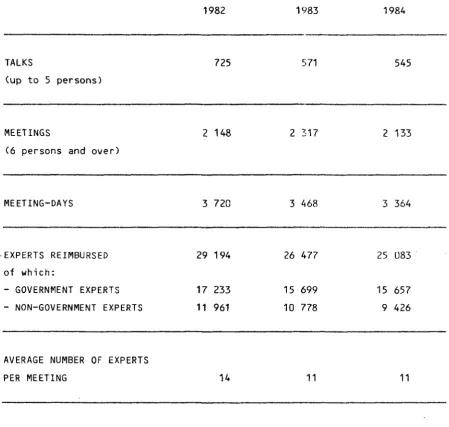
4
6
INTRODUCTION
1. A report CCOMC84)93 final) was addressed to Parliament in February 1984
reviewing measures adopted by the Commission on committees and groups of
experts and the management of appropriations during the period of 1983 when
funds were blocked.
2. On 10 April 1984, in its resolution "on the rationalization of the
operations of management and consultative committees, groups of experts and
similar bodies financed from the EC budget", Parliament approved the action
taken by the Commission in response to its wishes and invited it to "make a
further brief report on the overall situation in regard to these bodies" in
1985 C OJ C 127, 14.5. 1984).
3. This report was drawn up in response to this invitation. It reflects
RESULTS IN BUDGETARY TERMS
General analysis
BUDGET ART! CLE
250 Meetings in general
251 Committee meetings
2510 Compulsory
consultation
2511 Non-compulsory
consultation
*
EstimateEXPENDITURE ON MEETINGS
<million ECU)
APPROPRIATION
81 82 I 83 84
7 I 6. 5 6 6.3
4.2 5 I 4.8
11 • 2 l
'
' 11.5 ; 10.8 ;12.6
b
0
Breakdown approved by Parliament.
OUTTURN
81 ' 82 83 r 84
I
,
I
5 5.4 1 4.5*14.1I
(
I(
'I
4. 3 I 5. 4 ' 5*I
I
II
f
I
I
9.3 :10.8)9.5
I
\ I i 4. 5 l
I
I
:0.9
4. As far as Article 250 is concerned, _ initial appropriations for 1980 to
· 1984 were virtually the same and made no allowance for i:ncreases in transport
costs. This alone represents a significant cut in expenditure. The curve for
final appropriations {after·transfers and/or amending budgets during the year)
in the graph below· shows that the utilization rate in 1984 was almost 20%
&,5
6
5,5
4
5. Commitments entered into - the most significant element in an in-depth
study -have been declining since 1982, falling from 5.3 million ECU to
4.4 million ECU in 1983 and 4.1 million ECU in 1984 <see graph below).
--- ··· --1
I
--- i
...___ _
L
~RllCLE
250 (nill on ECU)~ -~--1 ·
--1
_ _..,e:_. ____ _
, -., ...
-- -- I
r---~""7"!:&...~~~~~~-...:....---::--_._,r--~'--"---:=----~-·---r-
-~~~; t_ia~L_aw~~-~~
imsI I ...._ - - . _ . . - - -·- : ' \ , I ~ '
-____ J__
... -.. : ..
~
,_
l
-
...into
. . .
I
.... ·•
I '• • • • • • I '
'" • • • • • I
·---...:':....•ca...!''-...' • __________ ....__ _____ -:.._~---~~-- ~-,- ..
' I
_ _ _ _ _ _ _ _ J _ _ _ ·.. I ' I
---+---~r;:::---· ····---·~..6.-·
I
·•·. .
. . . I
'Final ~ropriati s·.
'---·-·._r._l_· _
.. __
· _· ---·
---..r---1
~itrre1ts
enter1980 1981 1982 1983 1984
6. Although the rationalization and economy measures applied since the end of
1983 have undoubtedly contributed to this state of affairs, it should not be
forgotten that Parliament's action on the budget forced
departments -irrespective of any internal discipline- to spend Less in 1984
<entering of appropriations in Chapter 100, shortage of funds from the
7. As far as Article 251 is concerned, the curve for initial ·appropriations,
final appropriations and commitments entered into - as depicted in the graphs
and table on pages 4, 5 and 6 - show that the number of meetings of committees
of government and/or private experts (Article 251) now exceeds the number of
meetings in general (Article 250).
trends.
Results for 1984
This represents a reversal of previous
8. For Article 250 initial appropr-iations were slightly Lower than in 1983,
i.e. 6 470 000 ECU. Final appropriations were 4 333 000 ECU, i.e. 68.78% of
the initial appropriation.
9. Four transfers of appropriations were made from Article 250. Three were
within Chapter 25 and one,
Ethiopia.
10. The 15% reserve applied in 1984 to take account of budgetary constraints
imposed by the ceiling on own resources was 945 000 ECU. More than
2.2 million ECU, i.e. 35% of the initial appropriation, were saved in 1984.
If 15% is regarded as imposed from outside, the 20% must be attributed to
a
large extent to the rationalization measures <Limitation of the number of
participants reimbursed, elimination of non-essential meetings, etc.).
11. For Article 251 initial appropriations for 1984 were identical to those
for Article 250, representing an 18.8% increase on 1983.
12. The 15% reserve was used in its entirety for aid to Ethiopia at the end
of the year.
13. Measures to improve management of expenditure on committee meetings made
it possible - Leaving the 15% reserve aside - to keep spending in 1984 within
availabilities.
14. It should be pointed out that delays in convening committees as a result
of budgetary constraints cannot always be made good during the year because
technical faciLities (meeting rooms, interpretation, etc.) are saturated
RESULTS IN TERMS OF MEETINGS AND EXPERTS CONVENED
15. The table below demonstrates quite clearly that there has been a
significant fall-off in the number of meetings and experts convened since
1982. Although the figures are rough - pending the creation of a tai lormade
data base - they do make it possible to evaluate the results obtained.
TALKS
(up to 5 persons)
MEETINGS
(6 persons and over)
MEETING-DAYS
-EXPERTS REIMBURSED
of which:
- GOVERNMENT EXPERTS - NON-GOVERNMENT EXPERTS
AVERAGE NUMBER OF EXPERTS PER MEETING
1982
725
2 148
3 720
29 194
17 233
11 961
14
1983
571
2 317
3 468
26 477
15 699
10 778
11
1984
545
2 133
3 364
25 083 .
15 657
9 426
[image:8.546.45.494.201.628.2]EV~LUATION OF THE ~AIN ADMINISTRATIVE AND BUDGETARY ~EASURES INSTITUTED BY THE
CO .... ISSION
16. As Parliament was informed (see Report from the Commission to the
European Parliament on committees and groups of experts, COM(84)93 final,
21.2.1984, p. 4 et seq) the measures taken by the Commission to improve the
administrative and budgetary management of meetings relate to:
- annual approval of committees and gr-oups authorized to meet in the following
year;
- the number of experts who can be reimbursed and arrangements for
reimbursement;
- the organization of meetings;
- budget management.
17. On the whole, these measures have proved satisfactory and the Commission
has just conf·irmed them, subject to a number of technical improvements and
additions. ihe Commission would dra~1 Parliament's attention to the following
aspects of each of these measures.
18. Of the four measures instituted, the annual authorization procedure is
the most effective in terms of rationalization. So far the procedure has
been applied twice, in 1984 and in 1985. On the first occasion it was
confined to meetings charged to Articles 250 and 251 and 607 :::o1o1mittees and
groups of experts were authorized. On the second occasion the procedure was
extended- as planned- to all meetings; 673 committees and groups funded by
Articles 250 and 251, and 113 funded by other budget headings or the research
budget, were authorized. The increase in the number of committees and groups
funded by Articles 250 and 251 (66 more than in 1984) is Largely attributable
19. Limiting the number of government and non-government experts reimbursed per meeting has also proved to be an effective way of making savings. In the case of non-government experts, however, this measure has provoked much discussion, particularly among professional organizations.
20. To avoid a cutback of this order leading to inadequate representation of the interests of the various organizations concerned, the Commission has opted for a measure of flexibility. It has confirmed its decision to limit reimbursement of expenses to 20 non-government experts per meeting but it has agreed that an exception can be made in all cases where the constitution of the committee provides for a membership of more than 20, on the understanding that numbers would not be increased following enlargement.
21. As for the internal organization of meetings in general and Parliament's suggestion that the number of meetings held outside the provisional centres be reduced in particular, the Commission is pleased to say that meetings in 1984 were 13% down on 1983, as can be seen from the table below.
1983 1984 %
reduction Number of meetings held in
places other than the 239 208 13
provisional centres
Attendance by government 1 935 1 384 28
experts
Attendance by non-government 5 670 3 017 47 experts
Average number of experts 32 21 34
22. The budgetary management measures discussed in the Commission's 1984
report to Parliament (see Report from the Commission to the European
Parliament on committees and groups of experts, COM(84)93 final, 21.2.1984,
p. 10 et seq.) have been instituted and are operating satisfactorily. They
should be further improved by the imminent computerization of the arrangements