This is a repository copy of Continuous-flow reactors for the rapid evolution and validation
of kinetic motifs.
White Rose Research Online URL for this paper:
http://eprints.whiterose.ac.uk/94797/
Version: Accepted Version
Article:
Hone, CA, Bourne, RA and Muller, FL (2015) Continuous-flow reactors for the rapid
evolution and validation of kinetic motifs. Chimica Oggi - Chemistry Today, 33 (4). pp.
14-20. ISSN 0392-839X
Uploaded with permission from the publisher.
[email protected]
https://eprints.whiterose.ac.uk/
Reuse
Unless indicated otherwise, fulltext items are protected by copyright with all rights reserved. The copyright
exception in section 29 of the Copyright, Designs and Patents Act 1988 allows the making of a single copy
solely for the purpose of non-commercial research or private study within the limits of fair dealing. The
publisher or other rights-holder may allow further reproduction and re-use of this version - refer to the White
Rose Research Online record for this item. Where records identify the publisher as the copyright holder,
users can verify any specific terms of use on the publisher’s website.
Takedown
If you consider content in White Rose Research Online to be in breach of UK law, please notify us by
CHRISTOPHER A HONE, RICHARD A BOURNE AND FRANS L MULLER* *Corresponding author [email protected]
Institute of Process Research and Development, iPRD
Institute of Process Research and Development (iPRD), School of Chemistry and School of Chemical Engineering, University of Leeds, Leeds, LS2 9JT, UK.
Continuous-flow reactors for the rapid evolution and
validation of kinetic motifs
KEYWORDS: Continuous processing; flow chemistry; kinetic motif; scale-up; high value chemical manufacture; optimisation
ABSTACT: In this paper we apply the concept of a kinetic motif as a simple way to represent all the time-dependent behaviour in a single-step or multi-step reaction system. Small-scale continuous-flow reactors offer the potential to rapidly collect large amounts of data while accessing conventionally challenging experimental conditions. The scope of the approach is demonstrated on reaction case study examples.
Introduction
Continuous processing technology is transforming the way that fine chemicals are manufactured.1 Compared to
batch technology, continuous-flow reactors offer many advantages in terms of safety, control and quality for chemical manufacture. The advantages of flow chemistry for chemical discovery and manufacture have recently been reviewed.2,3 The recent uptake of continuous processing in the fine chemical industry needs to be supported
by strategies which minimise the risk associated with continuous-flow scale-up.4 The scale-up approach used by
the bulk and commodity chemical sectors is to obtain the process rates at the small-scale and then use this to support equipment and process design.5 This activity is seldom used by the high value chemical manufacturing
sector. The generation of a robust process model is in key accordance with Quality by Design (QbD) from the Food and Drug Administration (FDA).6 In particular, the development of a model which shows the effect of the input
parameters on process performance and output quality. Lonza has developed a toolbox strategy based on obtaining the reaction kinetics at the small-scale for the design of high value manufacturing processes.7 A recent
study by Lonza indicated that 50% of reactions carried out in batch would benefit from the transfer to continuous processing.8 In this article, we show how kinetic motifs, commonly used to represent biological systems, can be
applied in process development to obtain an understanding of rate processes that exist within a reaction system.9,10
Kinetic Motifs
In a kinetic mechanistic model the individual steps and reaction parameters, rate constants, equilibrium constants and activation energies, are developed to the highest level of detail based on all known data. Biological processes are inherently complex, with large numbers of equilibrium and rate constants needed to explain the processes taking place, making it difficult to arrive at a full kinetic model.9 Thus kinetic motifs are used to represent the
dynamics of biological systems in a simplified manner, in particular for describing enzyme binding interactions (Scheme 1, i).10 A kinetic motif is defined as “a kinetic sequence and associated constants, represented as a set
of balanced reactions and their parameters conserved over different molecules, reactions or combinations thereof”.11 With the often limited available data a motif which describes the rate processes can be evaluated against
We extend the well-established approach of fitting biological processes using kinetic motifs with flow chemistry for the process development of organic reactions. The transformations used by the fine chemical industry are complex with many competing pathways, including reactant and product decomposition and reactant pre-equilibrium, which can influence the product quality (Scheme 1, ii).12 In these instances the experimental data can be fitted to a kinetic
motif selected from a list of template motifs. As more experimental data becomes available, the motif evolves to accurately describe the complete dataset. This type of approach is particularly important when the constraints placed on development prevent derivation of a full kinetic model which represents the system from being obtained, but where the understanding obtained must be sufficient to design a process at a larger scale.
Scheme 1 (i) Substrate-binding to an enzyme10 and (ii) generic fine chemical example.12
The high attrition rate in pharmaceutical development places significant constraints on the development of fine chemicals including time, technology and material availability. Central to process development is the fast optimisation and scale-up of reactions. Continuous-flow reactors can facilitate this through the rapid collection of data through sequential experimentation with minimal material usage. The use small-scale flow devices for the study of reaction kinetics has been reported.13 The true reaction kinetics are scale and equipment independent so
can be collected at the small-scale in the absence of transport phenomena limitations.14 The small channel
dimensions give precise control of the reaction zone, and enhanced heat and mass transfer properties.
Process Development Optimisation
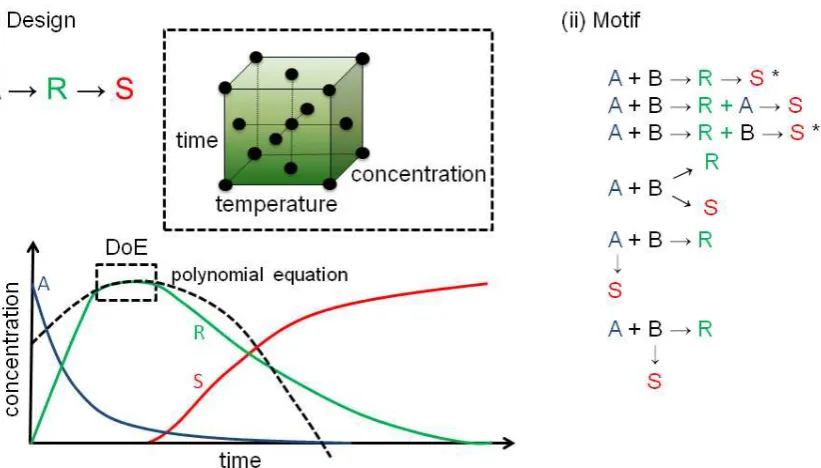
Figure 1. (i)Schematic reaction profile for a reaction in series; (ii) Different kinetic motifs for a multi-step reaction systemscenario, only 2 of these motifs can describe the profile sketched (starred*).
Design of experiments (DoE) is a popular optimisation approach within the fine chemical industries.15 DoE requires
little a priori knowledge of the reaction system. Statistical approaches are used to rapidly identify the key parameters and identify an optimal operating region that maximises yield or other reaction metric for the desired product R.11 These techniques perform well in the equipment used for the optimisation, but do not reveal an
explanation as to why a response is dependent on a particular input. DoE aims to identify the optimal operating conditions at the small-scale with the implicit assumption that if these conditions are recreated at a larger scale the same will happen.16 The input parameters are varied, often within a limited operating range, to explore the
sensitivity of the input conditions on a response. The range of conditions used in DoE studies is often close to a set of previously established conditions where a reasonable yield was found, so as to investigate the robustness of product R yield. A polynomial model is then developed based on the experimental observations rather than on physical relationships which exist within a system; this allows identification of important factors, and local optimisation, but as illustrated in Figure 1 this data fit should not be used to extrapolate outside the experimentally explored space. As these conditions are close to an optimum changes with respect to time tend to be small, and because of this are least likely to give mechanistic understanding. For instance if the optimisation objective is to maximise the formation of R, then the change in concentration over time for R is close to zero for and R is near its maximum value for many of the optimisation experiments.
A kinetic motif explains the overall rate behaviour of the complete system based on a number of simplified transformations with associated rate expressions. A kinetic motif is a description of a combination of transformations, each with its own rate expression, and each a simplified representation of a network of reactions and equilibria. The motif can be evaluated against the time-dependent behaviour of all the observed components present within a single or multi-step reaction. In contrast to DoE, motifs are underpinned by basic mechanistic principles, such as mass balances and reaction orders. Numerical simulation of kinetic motifs prevents the need to derive complex rate expressions for a reaction system as a whole which becomes increasingly complex and time-consuming as more intermediates become measurable. This is particularly useful in process development since often a reaction system is not fully understood.
a kinetic motif evolves, it becomes more akin to a full kinetic model, in which all important intermediates and all reactions are modelled as elementary reactions, with reaction parameters that are dependent on temperature only. Kinetic motifs can be combined with heat and mass transport processes to allow the evaluation of any scale-up scenario, including different reactor systems. This level of predictive capability is not possible using statistical models. Scale-up using kinetic motifs significantly reduces the risk compared to directly transferring laboratory conditions to the manufacturing scale. An optimum can be identified using statistical models and kinetic motif models, but extrapolation from a kinetic motif is more likely to be in-line with the developer’s expectations because underpinning it there is a physical rationale. Evidently, a kinetic motif cannot be used to anticipate previously unobserved behaviour. Overall the development of kinetic motifs supports the process developer to consider a variety of scale-up aspects12: -
the relative rates between competitive and parallel reactions to enable control over selectivity;
the influence of reactant concentrations on selectivity;
prediction of the impact of mixing and mass transfer effects on selectivity;
identification of possible safety issues present;
the reaction profile and estimation of reaction time.
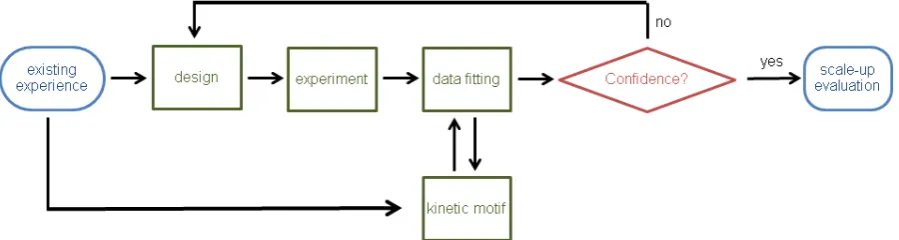
There are two components for the development of a kinetic motif: (1) the selection or design of appropriate kinetic motifs and (2) estimation of the reaction parameters (activation energies and rate constants). Stage 1 is the selection or design of an appropriate kinetic motif which describes the time-dependent behaviour of the collected experimental data. The goal of stage 2 is estimation of the reaction parameters and to minimise the confidence intervals for each parameter within the model. The parameter space can be explored quickly and comprehensively using continuous-flow reactors to generate the experimental data. A flow reactor platform can easily be coupled with an appropriate analysis technique for rapid data acquisition.17 Computational packages allow for joint
evaluation of all data for the prediction of all the kinetic parameters simultaneously. If the fit is not sufficient to give confidence in the kinetic motif and parameter estimates then further experimentation will be required.18
Discussion and Case Studies
Hessel introduced the concept of novel process windows for the implementation of unconventional operating conditions using continuous-flow reactors, such as the use of high temperatures, high concentrations and high pressures.19 To arrive at a kinetic motif which best encompasses the reaction system the largest process window
possible should be explored: conditions ranging from the mildest (e.g. dilute, low temperature) to the harshest which is feasible in the equipment (e.g. concentrated, high reagent to substrate ratios, high temperature). Such a wide window is difficult to access using conventional batch processing equipment. Harsher processing conditions increase the extent to which reactions progress, facilitating the determination of impurity formation rates and also expose new mechanisms to hitherto unseen compounds. Deviations of the predictions might be observed which would give an early warning of further reaction pathways and impurities. This type of approach can be applied to the reaction system reported by Reizman (Case Study 1),20 whereby harsher conditions gave higher quantities of
The kinetic motif evolves and is validated in a continuous cycle of learning and exploration (Figure 3). The confidence in the predictive capability grows over time. Once a kinetic motif is obtained it is used to explore other processing options, equipment configurations and operational scales. This can be illustrated with the Paal-Knorr pyrrole synthesis (Case Study 2). The reaction is known to be second order, providing a rationale for the initial motif and experimentation in which concentrations, ratios and temperature were changed to confirm this behaviour. Subsequently we considered the influence of water as an input parameter; the original motif did not predict the effect of water. The kinetic motif evolved from a second order motif to a motif which included the rate-dependency on the water concentration (Figure 4).
A key feature of a kinetic motif is that it does not have to stay true to the perceived reaction mechanism of the system. It is a simplified representation of the system which gives fit-for-purpose understanding in a development scenario. Roberge studied a Henry reaction of formaldehyde and nitromethane to give 2-nitroethanol (Case Study 3).23 The small-scale experimentation focused on determining which input parameters were crucial to process
performance so that impurity formation could be minimised. In this study they simplified the motif in order to predict the behaviour. The formation of the two overreaction products was adequately described by a single kinetic parameter rather than two, which was sufficient to successfully operate at a production scale.
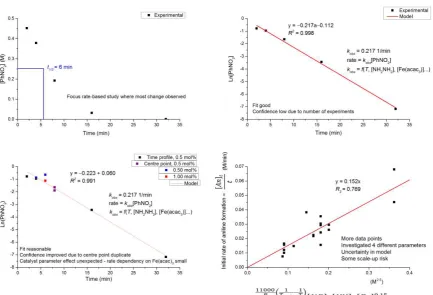
To efficiently evolve the kinetic motif, whilst not entailing excessive experimentation, we developed a simple rate-based DoE approach. Initially a time and temperature relationship of the reaction system is investigated. A profile is obtained by varying the volumetric flow rate at isothermal conditions. Subsequently the residence time at which 50% of the material is converted is used to complete a series of stepwise temperature experiments. This provides sufficient experimental data to fit an initial simple motif; typically a zero, first or second order. We recently applied this approach to an iron oxide nanoparticle catalysed reduction of nitrobenzene which was reported by Kappe (Case Study 4).24, 25 The exact nature of the active catalyst species is not fully understood. The initial application
Scheme 5. Exploration of parameter effects on the iron oxide nanoparticle catalysed reduction of nitrobenzene. Residence time based on volumetric flow rate and does not consider changes in fluid density.
The initial experimentation does not provide sufficient confidence in an applied motif across a wide design space; hence a second step is to explore the behaviour with respect to key input conditions. A rate-based DoE measures the response at a time where conversion is 50% or less. Such an experimental design matrix provides an efficient approach for studying how the input parameters affect the observed rate. The key factors in the rate- based DoE were nitrobenzene concentration, Fe loading and hydrazine to nitrobenzene ratios. The results of the DoE supported the evolution of the kinetic motif; the reaction appeared to be second order overall, first order with respect to nitrobenzene (NB) and Hydrazine (HY). The overall rate expression was given by:
Figure X.A Evolution of a kinetic motif
Conclusion
The use of kinetic motifs can accelerate the understanding of chemical reaction systems. In particular, small-scale continuous-flow reactors can be used to rapidly generate experimental data and access difficult operating conditions for rapid exploration of a wider design space than conventionally possible. Kinetic motifs evolve over time as more experimental data is collected, the process window studied is enlarged, and a larger number of factors have been studied. And, allowing time and resources, will eventually result in a kinetic mechanistic model. We present and demonstrate a rate-based experimental design in which every iteration of design space exploration increases the validity of the evolved motif. confidence in its ability to comprehensively describe all observations, and predict in silico the process outcomes for new conditions, equipment or processing scale.
Acknowledgements
The authors gratefully acknowledge the generous support by AstraZeneca, EPSRC DTG funding and the University of Leeds. CAH wishes to thank AstraZeneca for the award of a CASE studentship. Further acknowledgement goes to David Williamson for the experimental work on the nitrobenzene reductions.
References
1 S. Mascia, P. L. Heider, H. Zhang, R. Lakerveld, B. Benyahia, P. I. Barton, R. D. Braatz, C. L. Cooney, J. M. B. Evans, T. F. Jamison, K. F. Jensen, A. S. Myerson and B. L. Trout, Angew. Chem. Int. Ed., 2013, 52, 12359–12363.
2 K. S. Elvira, X. Casadevall i Solvas, R. C. R. Wootton and A. J. de Mello, Nat. Chem., 2013, 5, 905–15. 3 L. Malet-Sanz and F. Susanne, J. Med. Chem., 2012, 55, 4062–4098.
4 P. Poechlauer, J. Colberg, E. Fisher, M. Jansen, M. D. Johnson, S. G. Koenig, M. Lawler, T. Laporte, J.
5 E. H. Stitt, Chem. Eng. J., 2002, 90, 47–60.
6 A. R. Looker, M. P. Ryan, B. J. Neubert-Langille and R. Naji, Org. Process Res. Dev., 2010, 14, 1032– 1036.
7 P. Plou, A. Macchi and D. M. Roberge, Org. Process Res. Dev., 2014, 18, 1286–1294.
8 D. M. Roberge, L. Ducry, N. Bieler, P. Cretton and B. Zimmermann, Chem. Eng. Technol., 2005, 28, 318– 323.
9 S. Heissler, X. Liu, E. D. Korn and J. R. Seller, J. Bio. Chem., 2013, 288, 26709–27720. 10 G. A. Grant, Biochem., 2012, 51, 6961–6967.
11 Kinetic motifs, in Dictionary of Applied Mathematics and Engineers and Scientists, ed. by E. Previato, CRC Press, Boca Raton, 2002.
12 J. H. Atherton, in Pharmaceutical Process Development: Current Chemical and Engineering Challenges, ed. by A. J. Blacker and M. T. Williams, RSC, Cambridge, 2011, ch. 9, pp. 178–208
13 (a) J. P. McMullen and K. F. Jensen, Org. Process Res. Dev., 2011, 15, 398–407. (b) S. Mozharov, A. Nordon, D. Littlejohn, C. Wiles, P. Watts, P. Dallin and J. M. Girkin, J. Am. Chem. Soc., 2011, 133, 3601– 3608. (c) S. Schwolow, B. Heikenwälder, L. Abahmane, N. Kockmann and T Röder, Org. Process Res. Dev., 2014, 18, 1535–1544.
14 K. D. Nagy, B. Shen, T. F. Jamison and K. F. Jensen, Org. Process Res. Dev., 2012, 16, 976–981. 15 M. R. Owen, C. Luscombe, S. Godbert, D. L. Crookes and D. Emiabata-Smith, Org. Process Res. Dev.,
2001, 5, 308–323.
16 D. Lendrem, M. Owen and S. Godbert, Org. Process Res. Dev., 2001, 5, 324–327. 17 J. P. McMullen and K. F. Jensen, Annu. Rev. Anal. Chem., 2010, 3, 19–42.
18 J. P. Guzowski, E. J. Delaney, M. J. Humora, E. Irdam, W. F. Kiesman, A. Kwok and A. D. Moran, Org. Process Res. Dev., 2012, 16, 232–239.
19 V. Hessel, D. Kralisch, N. Kockmann, T. Noël and Q. Wang, ChemSusChem, 2013, 6, 746–789. 20 B. J. Reizman and K. F. Jensen, Org. Process Res. Dev., 2012, 16, 1770–1782.
21 V. Amarnath, D. C. Anthony, K. Amarnath, W. M. Valentine, L. A. Wetterau and D. G. Graham, J. Org. Chem., 1991, 56, 6924–6931.
22 J. S. Moore and K. F. Jensen, Angew. Chem. Int. Ed., 2014, 53, 470–473.
23 D. Roberge, C. Noti, E. Irle, M. Eyholzer, B. Rittiner, G. Penn, G. Sedelmeier and B. Schenkel, J. Flow Chem., 2013, 4, 1–9.